
On the Violence in the Middle East…

By Doug “Uncola” Lynn

Source: The Burning Platform

Like most of the world, I have been considering the Israel / Gaza slaughter with fascination and a sense of dread.   Did Israel allow the events of October 7, 2023 to happen? It appears so. Were the savage acts of Hamas sickening? It appears so. Have the ensuing actions of Israel in Gaza been devastating? Yes.

Have the reactions of the general public in nations around the world, and on the internet, become increasingly polarized? Definitely.

Geopolitical expert and former U.N. weapons inspector Scott Ritter has predicted Israel will lose this war, and deservedly so.

At the height of the hysteria during the build-up to Operation Desert Storm®, and in the jingoistic fever of the newly coined War on Terror®, Ritter claimed Saddam Hussein had zero Weapons of Mass Destruction®.  Ritter was right back then, so, now, I pay attention whenever he addresses global tensions.

However, there are many others, including especially some Christians, who believe Israel cannot lose; and, today, as of this writing, The Jerusalem Post has predicted a truce.

Who is right?

I recently viewed a video posted on the Lew Rockwell website entitled: “Bad Theology: Israel, the “Rapture,” and the End Times” and the Bible scholar in that interview claimed modern Israel is a secular nation having nothing to do with Biblical Eschatology.

Of course, other Christians disagree with that conclusion and believe the God of Abraham, Isaac, and Jacob is still dealing with the nations of the world through Israel – and just before the return of Christ.

Apocalyptical interpretations, and misinterpretations, regarding modern Israel are concerning because people act upon what they believe… one way, or another.  Hence the great divide today, as derived from historically ancient faiths; and why supporters of both Israel and Palestine/Gaza are protesting and rallying around the world.

In February 2019, I considered some of the potential interpretations of possible events in an article entitled “As the Games Begin…”:

Some… Christian Zionists believe the entire world would embrace the Psalm 83 war as the Book of Revelation’s “Armageddon” thus setting the stage for planet earth to accept a false messiah; like Islam’s Twelfth Imam, a Talmudic strongman, a fake return of Christ, or possibly even an outer-space alien (i.e. metaphysical demon / fallen angel) as all of the above – and delivering a false peace and prosperity thus fulfilling the “strong delusion” or “great deception” or “falling away” of the Bible’s 2nd Thessalonians, chapter 2, verses 3-12…

…Other Christians claim the Psalm 83 prophecy is credible because none of those nations are named in the Ezekiel 38 and 39 war when Russia, Iran, Turkey and other countries come against Israel or, even later, in the Sixth Trumpet War of Revelation 9 when the Kings of the East (China?) march up the Euphrates river to Israel in the battle just prior to Armageddon.

Crazy, no? Again, don’t kill the messenger. All of this is on the internet and, as some claim, in the Bible.

On the other side of the debate… many folks, including several bloggers and online commenters, believe modern Israel is the de facto “Synagogue of Satan” as referenced in the Bible’s Book of Revelation (Rev 2:9 and Rev 3:9). These verses refer to those “who say they are Jews but are not”.

Correspondingly, a video at StopWorldControl.com about modern Israel, its early formation and sinister benefactors, is quite compelling – just not to those who believe a Psalms 83 War (paired with other Biblical prophecies) will result in the complete destruction of the following nations:

– Gaza (Philistia)

– Egypt (Edom, Ishmaelites, Moab, Hagrites + Isaiah 19:1-25)

– Jordan (Ammon & Amalek + Ezekiel 25 & Jerimiah 49:1-2)

– Iraq (Ammon & Amalek + Babylon in Jeremiah 50 & 51)

– Syria (Assyria & Hagrites + Isaiah 17:1 & Jeremiah 49:23-27)

– And, as some claim:  “Gebal” and “Tyre” will be decimated prior to the conclusion of the Psalm 83 war – with these referring to modern Lebanon and southern Lebanon (Hezbollah), respectively, as well as Turkey.

But others argue Turkey (i.e. “Gomer”, “Meshek”, “Tubal”, & “Beth Togarmah”) won’t meet its fate until the later Ezekiel Chapters 38-39 War involving Russia (Rosh), Iran (Persia), Libya (Put),  Ethiopia (Cush), and the Central Asian nations (Magog) including…but perhaps not limited to… Kazakhstan, Kirghizia, Uzbekistan, Turkmenistan, and Tajikistan.   I say “not limited to” because some interpreters include Afghanistan in the latter group and I’ve also seen Ukraine, the Baltics, and Eastern Europe included under “Gomer” as well.

Anyway, here is the point: Many Bible “scholars” believe ancient scriptures have predicted that modern Israel would defeat wave after wave of military attacks by other countries. First, the surrounding Psalm 83 nations, then, later, the Ezekiel 38-39 war, until, finally, the Sixth Trumpet War of Revelation 9 when the Kings of the East (China?) march up the Euphrates river to Israel in the battle just prior to Armageddon.

All of this, in accordance with other prophecies in the Bible, such as…

… I will make Jerusalem a cup of trembling unto all the people round about, when they shall be in the siege both against Judah and against Jerusalem.

And in that day will I make Jerusalem a burdensome stone for all people: all that burden themselves with it shall be cut in pieces, though all the people of the earth be gathered together against it.

– Zechariah 12:2-3

And

And I will bring again the captivity of my people of Israel, and they shall build the waste cities, and inhabit them; and they shall plant vineyards, and drink the wine thereof; they shall also make gardens, and eat the fruit of them.

And I will plant them upon their land, and they shall no more be pulled up out of their land which I have given them, saith the Lord thy God.

– Amos 9:14-15

Around two weeks ago (as of this writing), Israel’s Prime Minister, Benjamin Netanyahu, referenced Hamas in relation to an ancient tribe of people called “Amalek” in scripture.  He said: “You must remember what Amalek has done to you, says our Holy Bible. And we do remember.

In the Bible’s book of 1st Samuel, in chapter 15, God  commanded (Israel’s) King Saul to “go and smite Amalek, and utterly destroy all that they have, and spare them not; but slay both man and woman, infant and suckling, ox and sheep, camel and ass 

But, not wanting to be overly cruel, King Saul disobeyed God’s command and Israel was eventually given cause to kill others who didn’t deserve to die.  This story, in fact, is said to have inspired the concept of “cruel to be kind”  – thereby instilling this maxim into Jewish culture:

To be lenient when you should be firm is to be cruel when you could be kind.

Or, in other words:  “He who is compassionate to the cruel will ultimately become cruel to the compassionate”.

Or, stated another way: “Destroying evil is perhaps the greatest act of kindness possible.”

Nonetheless, non-Zionist Christians (such as the Bible scholar in the above-embedded “Bad Theology” video/link), as well as pretty much all non-Christians, consider this type of Biblical parsing and cherry-picking of scripture to be completely ludicrous, if not insane; especially as the headlines rage:

Israeli Troops Fighting “In The Heart” Of Gaza City, Hamas Leader Surrounded In A Bunker

Turkey’s Erdogan: Whoever is on Israel’s side, we are against them

Iran Warns Of ‘Inevitable Expansion’ Of War After IDF Conducts Flag-Raising Ceremony In Gaza

US & Israel Poised to Open Lebanon Front:

Israel’s best chance of survival lies in expanding the scope of the war in Gaza into Lebanon — and possibly even into Syria — shoulder-to-shoulder with the Americans.

Will Israel defeat all challengers? Will Iran and the U.S. escalate the war in the Middle East?  Will the Psalm 83 nations of “Gebal”, “the inhabitants of Tyre”, the “Hagrites” (i.e. Lebanon, South Lebanon / Hezbollah, and Syria, respectively), and the nation of Turkey, join the war?

Turkey is a member of NATO. How would that work?

I don’t have the answers to these questions. Yet.  I am just a blogger sharing what I’ve read and viewed online.

But even if the Psalm 83 War came to pass in the days ahead, most of the world would surely call it a coincidence… or Armageddon… or claim it occurred as the result of a deceptive conspiracy using the Bible as a script.

Conversely, if peace suddenly broke out in the Middle East and World War III was narrowly averted, the prophecy experts will likely claim that Armageddon was delayed… but only for a while.

For how long?  I guess we’ll see.  Hence this time-stamped post.

Is There Life After Death?

By Edward Curtin

Source: Behind the Curtain

A review essay of James and Whitehead on Life after Death by David Ray Griffin

Life is entwined with death from the start, for death is the price we must pay for being born, even though we don’t choose it, which may be why some people who are very angry at the deal, decide to choose how and when they will die, as if they are getting revenge on someone who dealt them a rotten hand, even if they don’t believe in the someone.

The meaning of death, and whether humans do or do not survive it in some form, has always obsessed people, from the average person to the great artists and thinkers.  Death is the mother of philosophy and all the arts and sciences.  It is arguably also what motivates so much human behavior, from keeping busy to waging war to trying to hit a little white ball with a long stick down a lot of grass into a hole in the ground and doing it again and again.

Death is the mother of distractions.

It is also what we cannot ultimately control, although a lot of violent and crazy rich people try.  The thought of it drives many people mad.

No one is immune from wondering about it.  We are born dying, and from an early age we ask why.  Children often explicitly ask, but as they grow older the explicit usually retreats into implicity and avoidance because of adults’ need to deny death or their lack of answers about it that makes sense.

David Ray Griffin is not a child or an adult in denial.  He has spent his life in an intrepid search for truth in many realms – philosophy, theology, politics, etc.  He is an esteemed author of over forty books, an elderly man in his eighties who has spent his life writing about God, and also in the last twenty years a series of outstanding books on the attacks of September 11, 2001 and the demonic nature of U.S. history.  He fits T.S Eliot’s description in The Four Quartets:

Old men ought to be explorers
Here and there does not matter
We must be still and still moving
Into another intensity
For a further union, a deeper communion
Though the dark cold and the empty desolation,
The wave cry, the wind cry, the vast waters
Of the petrel and the porpoise. In my end is my beginning

In his latest book, which is another beginning, James and Whitehead on Life after Death, he explores the age-old question of whether there is life after death and concludes that there probably is.  It is a conclusion that is arguably shared in some way still by many people today but is clearly rejected by most intellectuals and highly schooled people, as Griffin writes:

The traditional basis for hope was belief in life after death. Modern culture, however, has so diminished this belief that today, in educated circles, it is largely assumed that life after death is an outmoded belief….The dominant view among science-based modern intellectuals is that the idea of life after death is not one to take seriously. That conclusion, however, is virtually implicit in the presuppositions of these intellectuals, such as Corliss Lamont. According to these modern intellectuals, there is no non-sensory perception; the world is basically mechanistic; and the world contains nothing but physical bodies and forces.

Griffin argues the opposite.  His book is devoted to refuting these presuppositions with the help of William James and Alfred North Whitehead.  It is not an easy read, and is not aimed at regular people who would find it rough going, except for the middle chapters on mediums, extrasensory perception, telepathy, apparitions, near-death out-of-body experiences, and reincarnation – the stuff of tabloid nonsense but which in Griffin’s scholarly hands is treated very intelligently. Moreover, these chapters are crucial to his overall argument.  However, the book will mainly appeal to the intellectuals whom Griffin wishes to convince of their errors, or to those who agree with him.  It is scholarly.

Without entering into all the nuances of his rather complicated thesis, I will try to summarize his key points.

Griffin is what is called a process theologian and his work of philosophical theology is intimately linked with scientific thinking and the idea of evolution, even as it rejects the modern mechanistic worldview for a “postmodern” cosmology based on recent science, in particular, the work of microbiology.  Although he is a Christian, the present book does not presuppose any Christian beliefs such as revelation, nor, for that matter, specific beliefs of any religion, although he does presuppose (and partially explains in chapter eleven) the existence of a “divine creator” or “divine reality” who is responsible for the evolutionary process that is the expression of a cosmic purpose with the “fine-tuning” of the universe.  This “Holy Reality” is important to his argument.

The thought of the philosopher Alfred North Whitehead underlies everything Griffin writes here.  Whitehead is known as the creator of process philosophy, which, to simplify, is the idea that all reality is not made up of things or bits of inert matter, no matter how small (e.g. atoms, brain molecules) or large (people or trees) interacting in some blind way with other bits of matter, but consists of conscious processes of ongoing experiences.  In other words, reality is constant change, flowing experiences with types of awareness and intention and the free creativity to change.  Humans are, therefore, ongoing experiments, not static entities.

Following Whitehead, Griffin has coined the term “panexperientialism,” meaning that all reality is comprised of experiences.  It is worth noting that the etymology of the words experience and experiment are the same – Latin, experiri, to try.  Life is therefore a trying.  As some might say, it is trying to be born and to know you will die.

Griffin begins by noting the importance of life after death and why many argue against it.  He states how he will avoid many of their objections and how he will show how the valid ones dissolve under his analysis.  He promptly writes that “Microbiology has dissolved the mind-body problem.” He bases this on the work of acclaimed evolutionary biologist Lynn Margulis,, among others, and her theory of symbiogenesis:

Her theory of symbiogenesis was based on the idea that all living organisms are sentient. Saying that her world view ‘recognizes the perceptive capacity of all live beings,’ she held that ‘consciousness is a property of all living cells,’ even the most elementary ones: ‘Bacteria are conscious. These bacterial beings have been around since the origin of life.’

Margulis’s point is consonant with Whitehead’s philosophy of organism, meaning that all physical reality possesses a degree of perceptive experience, although Griffin says “some of us may prefer to save the term ‘consciousness’ for higher types of experience.”  The fundamental point is that all of physical reality experiences, or, as he quotes William James, “is a piece of full experience.”  In layman’s language as applied to people, the mind and body are one.

Having laid down this scientific/philosophical foundation in the first four chapters (and in two more detailed appendices), Griffin turns to psychical research and how Whitehead and James believed in the need for such research and how James’s radical empiricism supported the reality of parapsychological events as did Whitehead, who accepted telepathy.  Griffin writes:

Like James, Whitehead affirmed the reality of non-sensory perception. Moreover, besides affirming its reality,Whitehead argued that non-sensory perception is fundamental, so that sensory perception is secondary. Far from being primary, sensory perception is derivative from non-sensory perception….Accordingly, there is nothing supernatural about telepathy; one becomes aware of the content of other minds through the same non-sensory mode of perception that tells us about causation, the real existence of physical objects, memory, and time.

(Let me interject the simple but important point that it follows that in order to have any perceptions one must exist in physical form.)

Turning to actual psychical research that was promoted by the establishment of The Society For Psychical Research (SPR) in London in 1882, Griffin, as previously mentioned, devotes four key chapters to mediums, telepathy, extrasensory perception, near-death out-of-body experiences, apparitions, and reincarnation. This research and its findings, while rejected by the modern scientific worldview, is widespread and quite believable, in various degrees.  Griffin shows why this is so.  The truth of such psychic experiences is hard to refute since there are so many examples, which Griffin gives.  He would agree with James who said:

The concrete evidence for most of the ‘psychic’ phenomenon under discussion is good enough to hang a man twenty times over.

And James, of course, the longtime professor at Harvard University, is revered as one of the United States’ most brilliant thinkers, not a fringe nut-case.  This is also true for many of the others Griffin calls on to show how solid is the evidence for much psychic phenomena.  Most readers will find these chapters very engaging and the most accessible.

Finally, Griffin explains why the idea of a fine-tuned universe makes the most sense and how it dovetails with the belief in God, even as it runs counter to the mechanistic, materialistic, and atheistic view of many intellectuals. He writes:

The new worldview advocated in this book requires a new understanding of the divine reality. Whitehead and [Charles] Hartshorne [an American process philosopher and theologian who developed Whitehead’s work] advocated a view of the universe known as ‘panentheism.’ The term means ‘all-in-God.’  Panentheism [the world is in God] is thus distinguished from pantheism, on the one hand, and traditional theism, on the other.

Based on these factors – microbiology, Whitehead and James’s philosophy, psychic research, etc. – Griffin concludes that there is ample evidence for life after death, not in the physical sense but in that of psyche or soul or spirit.  He says that he has “long believed in life after death,” but that in offering this book with his argument for life after death as our “only empirical ground for hope” since we all die, he does so reluctantly.  “I suggest this answer with fear and trembling, knowing that most of my friends and other people whose opinions I respect will hate this answer.”

That they would be surprised by his conclusion is a bit perplexing since he has long believed in life after death.  I surely do not hate his answer and believe that he has made a strong case for his long-held belief.  I share it, but differently.  And I think that many of his scientifically-oriented friends and others may indeed agree with him more than he thinks, for his argument is rooted, not just in philosophy and theology, but in science.  It is based on the idea of the non-duality between mind and matter, with the difference being that for him matter is conscious and for them it is not. They may come to accept the recent findings of microbiology and reject the “assumption of materialists and dualists alike” that “neurons are insentient.”  They may reject some of their own presuppositions.  For these debates take place at the highest level of abstraction where intellectuals dwell, and accepting one new scientific paradigm does not necessarily lead to belief in life after death.  Far from it.  That is when God enters the picture.

Griffin wisely uses hardcore commonsense beliefs to refute dualism and materialism.  But I propose that there is another hardcore, commonsense belief that he ignores: that people know and feel that they are flesh and bones.  Out of this feeling comes our conceptions about life, not the other way around.  The Spanish philosopher Miguel De Unamuno, in The Tragic Sense of Life,  put it this way:

Our philosophy – that is, our mode of understanding or not understanding the world and life – springs from our feeling toward life itself …. Man is said to be a reasoning animal.  I do not know why he has not been defined as an affective or feeling animal …. And thus, in a philosopher, what must needs most concern us is the man.

David Griffin, relying on John Cobb’s term, says the “resurrection of the soul” is a better term for life after death than the more traditional ones of “immortality of the soul” and the “resurrection of the body,” since it splits the difference, thereby taking a bit of truth from both terms.

But as I understand his argument in this book, he is doing what he cautions against via Whitehead: “… he [Whitehead] said that one must avoid ‘negations of what in practice is presupposed.’”  Griffin’s presupposition is that both dualism and materialism are both wrong and panexperientialism is correct.  He writes:

Panexperientialism is based upon the supposition that we can and should think about the units comprising the physical world by analogy with our own experience, which we know from within. The supposition, in other words, is that the apparent difference in kind between our experience, or our ‘mind,’ and the entities comprising our bodies is an illusion, resulting from the fact that we know them in two different ways. We know our minds from within, by identity and memory, whereas in sensory perception of our bodies, as in looking in a mirror, we know them from without. Once we realize this, there is no reason to assume them really to be different in kind. [my emphasis]

So if that is true, I ask this question: why, if body and soul/mind are inseparable and are what people are, why is it necessary to argue for their divorce in death?  If God created them as one at birth, could not God recreate them as one in death?  Why Griffin concludes that this is impossible or would require a miracle escapes me.  Maybe contemplating it is a bit too pedestrian and non-philosophical.

Despite my point above, James and Whitehead on Life after Death is another quintessentially brilliant volume from Griffin’s pen.  It forces you to think about difficult but essential matters.  It may not be easy reading, but it may force you to imaginatively ask yourself, what, if anything were possible and life continued after death, you would want such a life to be like.  Maybe the man David Ray Griffin wants it to be non-bodily.  Maybe many do and can’t imagine an alternative.  But I can, and I hope for bodily resurrection.  It’s just what I am.

Philosophy and theology can get very abstract and leave regular people in the dust.  Another poet comes to mind, a counterpoint to T.S. Eliot, William Butler Yates, who wrote in “An Acre of Green Grass”:

Grant me an old man’s frenzy,

Myself I must remake

Till I am Timon and Lear

Or that William Blake

Who beat upon the wall

Till Truth obeyed his call;


A mind Michael Angelo knew

That can pierce the clouds,

Or inspired by frenzy

Shake the dead in their shrouds;

Forgotten else by mankind,

An old man’s eagle mind.


I would love to read what a frenzied David Ray Griffin has to say, now that I have read his philosophical logic. I can’t help agreeing with Unamuno:

And thus, in a philosopher, what must needs most concern us is the man

The man of flesh, blood, and bones.

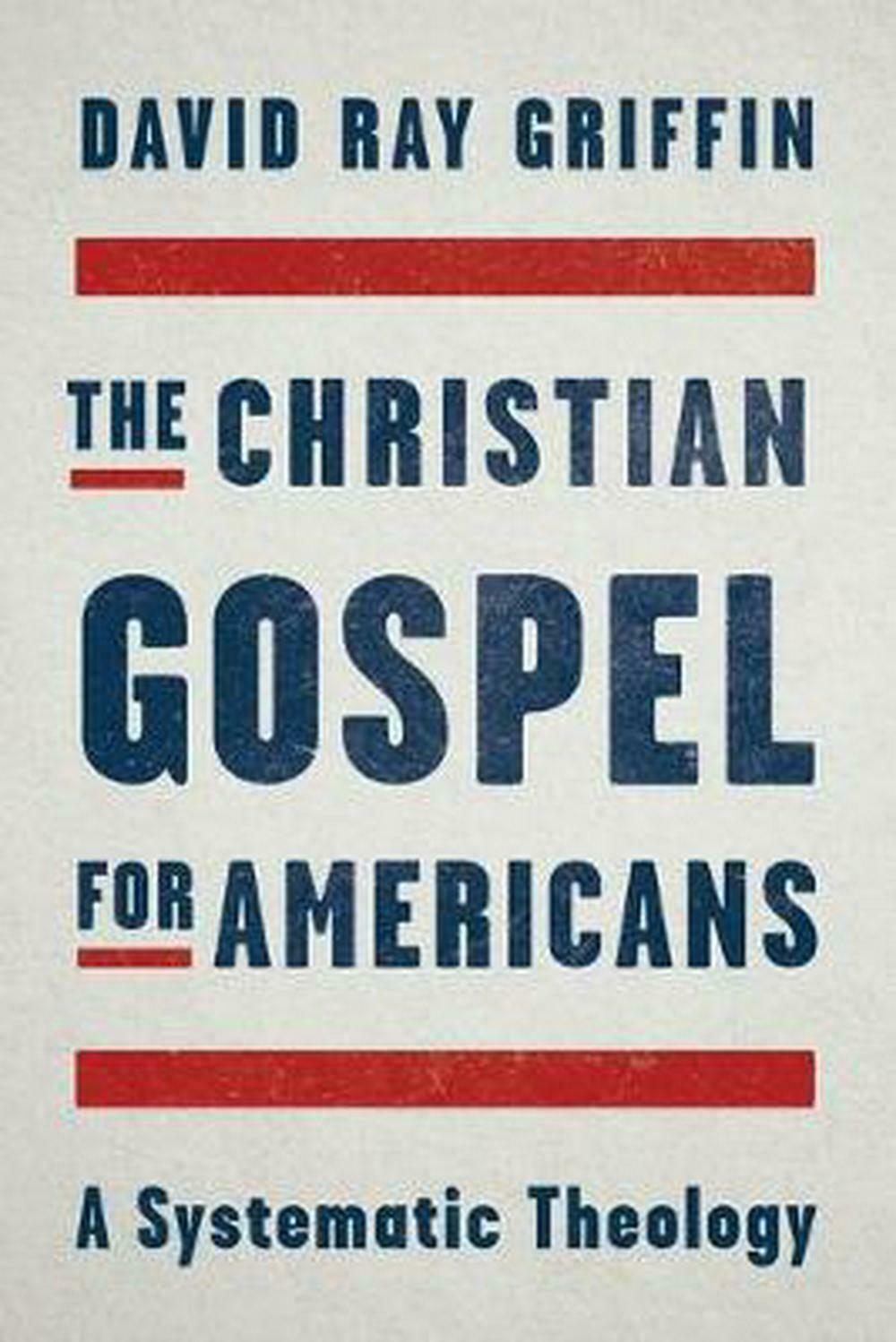
David Ray Griffin’s The Christian Gospel for Americans: A Systematic Theology

By Edward Curtin

Source: Behind the Curtain

A Review  

There are very few writers who have done more to try to open the public’s mind to the evil nature of the American empire than David Ray Griffin.  His series of books on the false flag attacks of September 11, 2001 will endure for a long time, and they will one day, when it is safe to do so, be recognized as seminal texts exposing the traitorous conspiracy of elements within the Unites States’ government to launch the endless so-called war on terror.  That many now know, and many more will, that those so-called “terrorist” attacks were carried out by terrorists in the highest reach of the U.S. government will be due to his extraordinary work.

What many do not know is that David Ray Griffin is a Christian theologian with impeccable credentials and a scholarly oeuvre of dozens of theological books. And that long before his conscience led him to devote himself to exposing the U.S. government’s lies about the September 11 attacks, he was committed to proclaiming the radical Christian gospel of a living Christ, who was executed by the Roman state for opposing its grotesque and violent empire.

The Christian Gospel for Americans is his crowning achievement, a rare marriage of spiritual contemplation and social analysis that brings to life Jesus and the Hebrew prophets for contemporary Americans.  It is an accessible systematic theology of freedom and creativity that will inspire hope in all caring souls to resist the demonic American Empire. It is an intellectual tour de force, a kaleidoscopic “constructive postmodern” example of process theology at its finest, drawing on the work of Alfred North Whitehead, John Cobb, and Henri Bergson, among others.  Rarely does such a book come along to roil the waters of religious and social complacency.

Times change.  Once in the United States of America, theologians were fêted as important social critics and considered worth heeding.  Two of the most famous in the mid-to-late twentieth century were Reinhold Niebuhr and Paul Tillich.  Both appeared on the cover of Henry Luce’s Time Magazine, and Barack Obama was later fond of referring to Niebuhr to justify his violent policies to extend the American empire.  Obama knew his audience, for Niebuhr was noted for a neo-orthodox theological perspective that encouraged “political realism,” popular among the elites who had created and extended the American empire.  He was a friend of the rich and famous ruling establishment.  His critiques of immoral government practices were always offered within the parameters of official acceptance, conservative and liberal.  He was the establishment’s theologian, lionized by the empire-touting Time magazine as the theologian who really understood politics and how God figured into the necessary realism of American foreign policy.

To his great credit, David Ray Griffin is a brave theologian who will never appear on the cover of Time magazine, for his message is more in keeping with the Biblical prophets who warned the people that their government’s behavior is an abomination in the eyes of God, and if they do not dissent and reject such policies, they will be rejecting the God they say they worship.  In true prophetic style, he connects the dots to say: look at what you are doing, slaughtering innocents everywhere as you worship your golden calf. When the Hebrew prophets “indict Israel or Judah,” he writes, “the indictments are not directed against the people in general, but against the elites who were responsible for creating and maintaining the structures of domination and exploitation.’”

The American elites surely do not wish to publicize a man who says such things; better to ignore him or have their mouthpieces call him a “conspiracy nut,” which of course they have.

Griffin’s book is rooted in the basic fact that “Christian theology is necessarily at once theological and political” since Jesus was a radical rebel leader who opposed the demonic power of the Roman Empire and was executed for that reason.  This is so fundamental, yet it has been papered over, especially since the age of Constantine in the fourth century.  Griffin says:

For one thing, the complete opposition of Jesus and his followers to the imperialism of their day has been largely hidden to readers of the gospels.  The main reason for this hiddenness is that the authors of the gospels, seeking to present the message of Jesus so as to serve the needs of the Christian movement 40 or more years after the death of Jesus, sought to make it appear that Jesus’ message was directed against, and evoked opposition from, ‘the Jews,’ rather than the Roman Empire and those who collaborated with it….This failure of later Christians to understand the beginnings of their religion has contributed to what is arguably the most fateful reversal in history: Christianity, in origin probably the most explicitly anti-imperial religious movement ever, has since the fourth century provided the religious foundation for the growth of empires even more extensive than Rome’s….He [Jesus] was crucified by the Roman Empire – not by ‘the Jews’ – because he was perceived as a threat by Roman authorities.  Given the nature of Jesus’ life and his death, American Christians today should be anti-imperialistic, rather than basking in the pleasures of Empire, as did the Roman populace two thousand years ago – ignoring the terror and poverty brought to other provinces by Roman rule.

This is the foundation upon which Griffin builds his gospel for Americans.

His theological method is liberal, while his content is conservative.  This means that to establish truth by appealing to authority is rejected as a method.  It is only evidence and reason that he relies on to establish the truth of various doctrines.  Therefore science and modern scholarship are important and must always be considered.  To claim something is true because of a deposit of divine revelation that you can read in the Bible is an old way of doing theology and Griffin rejects that method.  In fact, his understanding of revelation is an ongoing process, insight as part of the creative and spontaneous freedom of living in openness to God’s spirit.

His theology is conservative in content because it rests upon certain primary doctrines of the Christian gospel (good news) “such as God’s creation of the world, God as actively present in it, and divinely-given life after death.”

For those unfamiliar with modern theological thinking that is not bound by a particular church’s teachings and respects science, Griffin’s method might at first seem unusual.  As one trained in theology and philosophy, I can assure you it is not.  His process of reasoning accords with the best scholarship in those disciplines, but one has to take the time to enter into its postmodern worldview that positions many of the conundrums of traditional religious thinking within a new framework, one that Griffin calls postmodern naturalism where “divine influence must be understood as part of the normal cause-effect relations, not an exception to them.”

Griffin takes on many of the great issues that have perplexed inquiring minds: the problem of evil, creation, truth, human freedom, God’s so-called omnipotence, miracles, life after death, out-of-body experiences, etc. Whether you end up agreeing with all his reasoning or not, you will be challenged to assess your thinking.  I find his systematic theological analyses to be brilliant and always intriguing.

But the point of his systematic theology is to bring us to his analysis of the demonic nature of the American Empire and the need for Christians and people of all faiths to resist it.  In my opinion, his argument for the demonic as a real power in the world, and that the United States is in its grip, is true.  He says:

Can we look at the past century of our world without thinking that the human race must be under the influence of such a power?  The twentieth century was by far the bloodiest century in history, with unprecedented slaughter and genocide, and yet we have taken no steps to overcome the war-system of settling disputes.  Americans created nuclear weapons and then, when we learned how deadly they are, built thousands more, until we had the world wired to be destroyed many times over.  After we learned that a relatively modest exchange of nuclear weapons could initiate a “nuclear winter,” leading to the death of human civilization and other higher forms of life, we still did not abolish them.

He gives the historical background to the American belief in its divine mission, the idea of Manifest Destiny, and the city on the hill nonsense about America being God’s country whose mission was to spread democracy around the world.  He quotes George W. Bush saying, in his state-of-the-union address two months before laying waste to Iraq based on lies, “The liberty we prize is not America’s gift to the world; it is God’s gift to humanity.”

Melville couldn’t have said it better through the mouth of mad Ahab.  Mad Ahab, mad Bill Clinton, mad George, mad Lyndon Johnson, the list goes on and on.  Madmen all, God’s men in their minds, or perhaps just lying madmen playing with our minds, God be damned.

Griffin lays it all out – Iran 1953, Guatemala 1954, Vietnam 1954-73, Indonesia 1965, etc.  – all the blood, the massacres, the evil empire doing its nonstop handiwork across the world.

He does, however, omit a crucial element of the demonic at work here in the U.S., as if something is blocking him from recognizing it, some shadow blocking his sight.  It is a strange omission.  It is as if his vision is focused outward on all the evil the American government inflicts on the world, but here in his own house, he cannot see the demonic at work.

He nowhere mentions the American government’s assassinations of JFK, Malcolm X, MLK, and RFK, all martyrs to the unspeakable truth that this country is in the grip of evil killers who will stop at nothing to silence the voices of genuine peacemakers who have opposed the American Empire. Their deaths opened the door to hell on earth for millions of others around the world.

He correctly catalogues the long list of U. S. atrocities, false flag attacks, coup d’états, immoral and endless wars; gives dates; draws a damning picture of a country in the grip of demonic forces intent on savagely killing innocents wherever it can find them.  He shows conclusively that the United States is the Roman Empire updated and outfitted to kill millions with sophisticated weapons and to spread its imperialistic power with evil intent.

He makes an open and shut case that if one wishes to follow the Christian Gospel, one must act in opposition to this evil empire.  But he forgets that the crucifixion is also a domestic affair, and the homegrown rebels must be eliminated first.

Even the wisest of men, such as the David Ray Griffin, have their Achilles heels.

But despite that omission, or maybe because of it since it shows us how flawed we all areThe Christian Gospel for Americans is a brilliant clarion call to action.

Read it.  It will rock your world.  It is gospel.