The War Conspiracy – Oligarchical Collectivism

s_500_wakeup-world_com_0_The-Conspiracy-Of-War-Power-Profit-Propaganda-and-Imperialism

By Ethan Indigo Smith

Source: OpEdNews.com

“Since armies are legal, we feel that war is acceptable; in general, nobody feels that war is criminal or that accepting it is criminal attitude. In fact, we have been brainwashed. War and the large military establishments are the greatest sources of violence in the world. Whether their purpose is defensive or offensive, these vast powerful organizations exist solely to kill human beings. We should all be horrified, but we are too confused.” (source)

Power, Profit, Propaganda and Imperialism

With all the wisdom and knowledge we have access to, I simply cannot believe that the governments of the world are once again positioning our armed forces in a war stance. I cannot believe that individuals are allowing it, and even pushing for it, and volunteering to take part in its violent uselessness. It’s as if there has been a breakout of some terrible disease that wrings out moral essences, removes our impetus for self-preservation and instills a self-destructive hatred of one’s fellow man. There is no sound logic to war, unless there is something more we are not being told”

The fog of war makes obtaining the facts stupendously difficult. Although most prefer to believe government propaganda is a thing of the past, history shows us that it is an inherent part of any wartime society, obscuring facts and motivations in favor of those who initiate — and benefit from — war. Known euphemistically as ‘public relations’, it is the manufacturing of consent to suit a particular agenda, and along with its ‘proper’ use comes the ability to control the thinking of masses (both their focus and beliefs) and mold the collective mind.

However, the more we know about history and the causes and effects of wars in the past, the less we need to know about the wars of the present. Indeed the more we know of the nature of war, the more likely we are to reach accurate conclusions of our current situation, making contextual hypotheses based on what we do know, without having to filter through what we’re (nonsensically) being told.

“Now, according to U.S. foreign policy in Syria, we want to fight ISIS while also fighting Assad in Syria” even though ISIS is fighting against Assad in Syria, and the Russians are helping Syria fight ISIS” so we may have to fight Russia to stop them from fighting with Syria against ISIS. If that sounds insane to you, that’s because it is.” ~ Investigative Journalist Ben Swann

So what’s the rationale?

War is a Racket

US Marine Corps Major General, Smedley Butler, eventually concluded that “war is a racket” in which individuals are used like fodder for institutions. Dear Smedley died the most decorated US Marine in history, and one might merely read his concise 4-chapter book, “War Is A Racket”, to understand the reality of war: it’s an act of institutions against individuals.

“War is a racket. It always has been. It is possibly the oldest, easily the most profitable, surely the most vicious. It is the only one international in scope. It is the only one in which the profits are reckoned in dollars and the losses in lives” It is conducted for the benefit of the very few, at the expense of the very many. Out of war a few people make huge fortunes” In World War 1, a mere handful garnered the profits of the conflict” [and] at least 21,000 new millionaires and billionaires were made.” ~ Smedley D. Butler, War Is a Racket

Written from an insider perspective, it reads like it might have been written five years ago rather than fifty. We are living in a world today that is very much like the world of Smedley Butler, in that not much has changed, not much has been learned, and we’re still doing the same thing — and, inexplicably, expecting a different outcome.

War does not bring peace. As the saying goes, “Fighting for peace is like f**king for virginity. “ War never serves any individual or group, except a powerful elite few — the oligarchs who perpetuate and manipulate tribal, feudal, nationalistic and fascist war-mongering the world over, generating trillion dollar profits from death and destruction, while touting their own patriotism, and encouraging your support.

One of the best ways to gain and maintain power and support for war is to keep the people in constant fear — in fear of wars, of outsiders, and more recently, of “terrorism”. Maintaining a culture of war-minded fear keeps a society in a prolonged stress-response, the kind biologically linked to the threat of death in the wild, enabling those at the top of the oligarchical pile to easily direct the thinking of — and therefore to shape — the society they control. As a result, we consent to a bulk of our taxes being spent on funding the endless military-industrial-complex, instead of creating Nirvana for ourselves. Believing we are under constant threat of the unseen, we have become willing and dedicated contributors to the financial and political objectives of the monstrous war industry, marketed to us under the guise of our own security and protection.

This motive becomes clearer when we consider that the United States Of America is actually a foreign corporation operating out of Washington DC.

The facts are, the United States has been at war for 222 years out of the last 239 years. (That’s 93% of the time!) Since the Declaration of Independence was written in 1776, the U.S. has actually been at peace (albeit planning for further wars) for a total of only 21 years. Not one U.S. president actually qualifies as a solely peacetime president, and the only time the United States lasted five years without going to war was between 1935 and 1940, during the period of the Great Depression — from which economic recovery was led by the war-industry.

More recently, if we look objectively at the history of the Presidents of the United States since the end of the Second World War, we see that each administration — Truman, Kennedy, Eisenhower, Nixon, Reagan, Bush, Clinton, Dubya, and now Obama — created a presidential Doctrine directly pertaining to war, either directly inciting conflict or inviting US involvement in it. Since U.S. involvement in World War II began in 1940, most of the world’s military operations have been initiated by the U.S., and U.S. Military spending today exceeds the rest of the world’s military spending combined, making the US war machine the single most profitable industry in the world. For the period 2010-14, the United States was the world’s biggest exporter of major arms, accounting for 31 percent of global shares, delivering weapons to at least 94 different recipients — many we are told are “hostile to US interests.” [source] In the fiscal year 2015, US military spending is projected to account for 54 percent of all discretionary federal spending — over $598 billion — exceeding the combined budgets for science, environment, housing, health, veterans affairs, education and transportation. [source] The U.S. defense industry employs a staggering 3.5 million Americans — or 1 in every 45 people employed in American [source] — while the private companies supporting the military generate in excess of $300 billion in revenue per year.

The U.S. economy is now so dependent on war, there is no incentive for the U.S. Government to strive for peace — it just isn’t profitable.

s_500_wakeup-world_com_0_War-becomes-perpetual-when-it-is-used-as-a-rationale-for-peace-12

With the U.S. economy and military operations so intrinsically linked, the American people have over time come to accept its war culture as normal, believing the increasingly ludicrous propaganda that tells us the U.S. is subject to threats from far weaker military nations and is nobly “fighting for peace” — an oxymoron of the highest order. As a result, the U.S. government has never been compelled by its People to create peace. The very notion of peace — and I don’t mean winning wars, I mean real peace — is so foreign to the people of the United States because we, as a nation, have never really experienced peace, nor have our leaders (despite their rhetoric) ever envisioned peace, much less planned for it or made it the focus of Presidential Doctrine.

The culture of war we live in today is no accident but the result of implicit cultural design — the very definition of conspiracy.

Conspiracy (noun): a secret plan by a group to do something unlawful or harmful.

Patriotism or Imperialism?

War is built on a narrative of “us” versus “them”, creating the perception of threat and inhumanity in those we are told are our enemies. With governments, corporate military machines and media working together, achieving that perception in any population is the easy part — quelling those who are opposed to war is more difficult.

To achieve this, the very idea of patriotism has been confounded and confused with elitism, imperialism and oligarchical collectivism. By definition, true patriots question information to educate themselves and share it with others, in order that we might progress beyond the status quo. Patriots are forward thinking, they observe and question actuality, and prioritize what is right over personal concerns. They are able to embrace change, including ceasing participation, and are willing to implement beneficial change through their actions. But they do not drive change for its own sake, or their own selfish ends, only when change is necessary to make a right or cancel a wrong. In this way, thetrue patriot poses a distinct threat to the status quo. They do not fear repercussions of their speech; they are unafraid to speak the truth so that others may benefit.

So, within and without their own ranks, institutions seek to isolate and disempower true patriotism by distorting and confusing its meaning, and eliminating the notion altogether by instilling nationalistic ‘you’re either for us or against us’ thinking — which is simply elitism dressed up in patriots clothing. As a result, the true patriot is absent from our mainstream narrative. Government and media institutions have attempted to delete the notion of true patriots and transform our understanding of ‘patriotism’ into flag-waving idiocy, war-minded zealotry, and hyper-nationlistic elitist imperialism. And they have done this so completely, in fact, that people identify materialistic oligarchs like Donald Trump or Hillary Clinton as patriots. In actuality, most politicians around the world are oligarchical collectivists, steering their societies toward imperialist goals — such as war, environmental desecration for corporate benefit and diminished individual freedoms, benefitting only those at the top of the social pyramid, not the society on the whole.

So, before serving your country, first learn who your government is serving.

Oligarchical Collectivism

What is oligarchical collectivism? The term was coined by George Orwell in his seminal book 1984. More precisely, the term is from ‘the book within the book’, entitled “The Theory and Practice to Oligarchical Collectivism”, which is heavily referenced through the narrative of 1984. Some researchers have suggested the only reason Orwell wrote 1984 at all was to enable writing the book within the book.

In it, the fictional world of 1984 is described and it is very much like the actual world of today, where endless war is waged not as a matter of winning, but as a matter of maintaining a steady war economy — a war society through which profits are garnered from the institutions of war and controls over individuals justified. It depicts a world where the states are eternally shifting sides, and eternally at war, and where citizens are constantly under threat of terrorist attack, by nobody knows who, much like we have today with the War On “Terror” — an abstract emotional response against which war can never be won.

Beyond that aspect, the fictional society of 1984 is very much like the reality of today in that everyone is watched and monitored, and pertinent information is restricted, controlled and manipulated to prop up the system.

1984 provides a stark view of a burgeoning culture of totalitarianism that is as important as a work of fiction as it is as a reflection of modern fact. Each aspect of the Five Freedoms of The First Amendment were infringed and removed. Freedom of speech was so restricted that not only was there one source of news — operated by the official governing body — there was also a whole arm of government dedicated to slowly and steadily eliminating and altering language deemed detrimental to the state. Today sharing information on institutional activity that harms individuals is already punishable, whistleblowers are treated as treasonists not patriots, and the sharing of ideas that challenge the status quo is becoming more heavily censored. Japan’s censorship of globally critical information relating to Fukushima, the United States’ constant surveillance of its own people, and the UK’s attempt to prohibit ‘esoteric’ information are all prime examples.

The Conspiracy Of War

The inference of 1984, the underlying lesson in Butler’s War Is A Racket, and the lessons we can learn from reality (both today and in history) is that wars are a matter of instituting control. War is waged on “them” to control “us”. And it is enacted as an unwritten policy, shrouded in secrecy, where the methods and true motives of government are routinely concealed from the People.

“The conscious intelligent manipulation of the organized opinions and habits of the masses is an important element in a democratic society. Those who manipulate this unseen mechanism of society constitute an invisible government which is the true ruling power of our country. We are governed, our minds molded, our tastes formed, our ideas suggested largely by men we have never heard of. In almost every act of our lives, whether in the sphere of politics or business, in our social conduct or our ethical thinking, we are dominated by the relatively small number of persons who understand the mental processes and social patterns of the masses. It is they who pull the wires that control the public mind.” ~ Edward Bernays, considered “the Father of Propaganda”.

Several elements of the war-machine State work in unison. Government priorities change from regulating industry and protecting individuals, to regulating individuals and protecting industry. The release of technology to the public is limited. The society is set up (through economic and other mechanisms) to literally keep people busy securing resources rather than considering the system they are living in, and the impact of that system on the planet, ourselves and each other. The media works to instill and reinforce the ideals, beliefs and official narrative of government. The monetary system is privately owned. The education system prepares children to join the ranks of the working class. Other cultures and ways of thinking are demonized. And the passing on of ancient knowledge and wisdom, history and spirituality, is suppressed.

“One of the saddest lessons of history is this: If we’ve been bamboozled long enough, we tend to reject any evidence of the bamboozle. We’re no longer interested in finding out the truth. The bamboozle has captured us. It’s simply too painful to acknowledge, even to ourselves, that we’ve been taken.” ~ Carl Sagan

What 1984 Can Teach Us About 2015

In the fictional world of 1984, oligarchies war against each other as a matter of routine. It is a world of shifting sides, of terrorism enacted by shadowy entities and populations under mass restriction of information, freedom, movement, natural resources and, importantly, technology — technology that would remove the need to fight over resources. It all sounds very familiar.

Whenever there is a surge of change and awakening in a society, those who profit the most from the status quo institute war and the threat of war, as a tried and tested way to maintain control. And today, the endless (unwinnable) War On Terror and numerous false flag attacks have proven to be effective (albeit transparent) ways to drive both corporate profits and tighter legislative controls, literally taking control of the collective consciousness of humanity.

One of the main ways that those in power control the consciousness of the people, and absorb patriotic opposition to war into the background of public awareness, is to create thought systems that appropriate war. An example offered by George Orwell in 1984 was the use of ‘Big Brother’ by the controlling Inner Party, the human image of “news” presented to the masses via the widely viewed Telescreen. Big Brother does not reflect the patriotic spirit of brotherhood, nor the potential or even the reality of the world, rather it provides an ‘official’ narrative for the actions of the controlling Party which appropriates and misrepresents the concept of brotherhood into a ‘brand name’ of the Telescreen — a psychology of collectivism, not brotherhood, which is a big difference indeed. Today, via the wonder of Television, institutions transfer and confuse words and ideas in the same manner, deliberately confusing themselves, their policies and their products with patriotic ideas, words and ideals. The ‘Patriot Act’ is the perfect example of the modern era.

“If thought corrupts language, language can also corrupt thought.” ~ George Orwell

One of the biggest lessons of 1984, and part of every war that has been — and sometimes the main inducing factor — is the creation of a certain bond within the nation that enables the oligarchical collectivism to continue. The “us” and “them” atmosphere of war creates an nationalistic togetherness within the “us”, bonding a society to its controllers and their goals, and causing that society not only to accept a war as “necessary” but to accept a constant state of hindered development, where resources are diverted to war, and just keeping our nostrils above water takes up most of our energy, time and concentration.

But more than a warning, 1984 and ‘the book within the book’ are an instruction manual for individuals bonded by the oligarchy. It shows us in detail that war is a function of individuals versus institutions, and that no matter what the beginning philosophy — be it capitalism or communism, or most any other structure — war ultimately ends up leading to oligarchical collectivism. War is more than simply influencing political ideas and seeking nationalistic gains, or whatever the stated reason, it is designed to further the goals of elitists, entrenching the corporate-military-industrial complex at the top, where they are, harvesting profit and power off of the rest of us.

“We know that no one ever seizes power with the intention of relinquishing it. Power is not a means; it is an end. One does not establish a dictatorship in order to safeguard a revolution; one makes the revolution in order to establish the dictatorship. The object of persecution is persecution. The object of torture is torture. The object of power is power. Now you begin to understand me.” ~ George Orwell, 1984

Final Thoughts

The war world we are seeing today is the result of text book oligarchical collectivism; the same formulation of authority used by empires and emperors for millennia before us, playing out in a rapidly degrading economic, political and environmental setting. It bears little difference to those societies that have risen and duly fallen before us. The only difference now is that there are “new and improved” modes and destructive war, resources and media/propaganda technologies being used to enforce the rule of the oligarchy. There are new tools and new names, the ‘order’ is packaged in a new sleek design with new bells and whistles, but at its core, it is the same system that sacrifices the lives and livelihoods of individuals to benefit those the system is biased toward.

Those institutions at the top of the pyramid and the “authorities” behind them claim act for the betterment of mankind, and yet, they always seem to get the better of mankind. In a community that is led by the wealthy for the wealthy, this continuation of the status quo comes at the direct cost of individuals and their basic rights to freedom, peace, and unimpeded access to the planet’s natural resources — all of which are treated as commodities. We are led to believe our personal freedoms and livelihood depend on adhering to the status quo, without which the rights and richness of our natural world cannot be accessed. In truth, the opposite is true.

“All the others, even those who resembled ourselves, were cowards and hypocrites. The German Nazis and the Russian Communists came very close to us in their methods, but they never had the courage to recognize their own motives. They pretended, perhaps they even believed, that” just around the corner there lay a paradise where human beings would be free and equal. We are not like that. The Party seeks power entirely for its own sake. We are not interested in the good of others; we are interested solely in power, pure power. What pure power means you will understand presently. We are different from the oligarchies of the past in that we know what we are doing.” ~ 1984

It is true: the war-minded imperialists of today know what they are doing, and arguably do it more effectively than most other empires in history. But in working to break their instilled culture of perpetual war, our strength lies in the lessons of history. Exploitative institutional mechanics can be dismantled and bettered, and individuals can ascend institutional walls. Just as people are capable of creating institutions, people are capable of halting institutions as well. Institutions after all, no matter how powerful or exploitative, are only human structures — a social machinery that relies on our consent and agreement. And as history has proven, when controlling empires push a population too far, they will inevitably fall.

If we educate ourselves and others of the inner workings of our society and, as C.G. Jung put it, “make the darkness conscious”, we can rise above the restraints of misinformation and disinformation, lies, deceit, and propaganda that creates benefit for some, and create a world of mutually agreed peace, which values living breathing beings over life-less institutions. In a world where war is the design of powerful conspirators, peace is the coming revolution.


If Americans Truly Cared About Muslims, They Would Stop Killing Them by the Millions

index

By Glen Ford

Source: Black Agenda Report

In the most dramatic expression of insider opposition to a sitting administration’s policies in generations, over 1,000 U.S. State Department employees signed on to a memo protesting President Donald Trump’s temporary ban on people from seven predominantly Muslim countries setting foot on U.S. soil. Another recent high point in dissent among the State Department’s 18,000 worldwide employees occurred in June of last year, when 51 diplomats called for U.S. air strikes against the Syrian government of President Bashar al Assad.

Neither outburst of dissent was directed against the U.S. wars and economic sanctions that have killed and displaced millions of people in the affected countries: Iran, Iraq, Libya, Somalia, Sudan, Syria and Yemen. Rather, the diplomatic “rebellion” of last summer sought to pressure the Obama administration to join with Hillary Clinton and her “Big Tent” full of war hawks to confront Russia in the skies over Syria, while the memo currently making the rounds of State Department employees claims to uphold “core American and constitutional values,” preserve “good will towards Americans” and prevent “potential damage to the U.S. economy from the loss of revenue from foreign travelers and students.”

In neither memo is there a word of support for world peace, nor a hint of respect for the national sovereignty of other peoples — which is probably appropriate, since these are not, and never have been, “core American and constitutional values.”

Ironically, the State Department “dissent channel” was established during one of those rare moments in U.S. history when “peace” was popular: 1971, when a defeated U.S. war machine was very reluctantly winding down support for its puppet regime in South Vietnam. Back then, lots of Americans, including denizens of the U.S. government, wanted to take credit for the “peace” that was on the verge of being won by the Vietnamese, at a cost of at least four million Southeast Asian dead. But, those days are long gone. Since 2001, war has been normalized in the U.S. — especially war against Muslims, which now ranks at the top of actual “core American values.” Indeed, so much American hatred is directed at Muslims that Democrats and establishment Republicans must struggle to keep the Russians in the “hate zone” of the American popular psyche. The two premiere, officially-sanctioned hatreds are, of course, inter-related, particularly since the Kremlin stands in the way of a U.S. blitzkrieg in Syria, wrecking Washington’s decades-long strategy to deploy Islamic jihadists as foot soldiers of U.S. empire.

The United States has always been a project of empire-building. George Washington called it a “nascent empire,” Thomas Jefferson bought the Louisiana Territory from France in pursuit of an “extensive empire,” and the real Alexander Hamilton, contrary to the Broadway version, considered the U.S. to be the “most interesting empire in the world.” The colonial outpost of two million white settlers (and half a million African slaves) severed ties with Britain in order to forge its own, limitless dominion, to rival the other white European empires of the world. Today, the U.S. is the Mother of All (Neo)Colonialists, under whose armored skirts are gathered all the aged, shriveled, junior imperialists of the previous era.

In order to reconcile the massive contradiction between America’s predatory nature and its mythical self-image, however, the mega-hyper-empire must masquerade as its opposite: a benevolent, “exceptional” and “indispensible” bulwark against global barbarism. Barbarians must, therefore, be invented and nurtured, as did the U.S. and the Saudis in 1980s Afghanistan with their creation of the world’s first international jihadist network, for subsequent deployment against the secular “barbarian” states of Libya and Syria.

In modern American bureaucratese, worrisome barbarian states are referred to as “countries or areas of concern” — the language used to designate the seven nations targeted under the Terrorist Travel Prevention Act of 2015 signed by President Obama. President Donald Trump used the existing legislation as the basis for his executive order banning travelers from those states, while specifically naming only Syria. Thus, the current abomination is a perfect example of the continuity of U.S. imperial policy in the region, and emphatically not something new under the sun (a sun that, as with old Britannia, never sets on U.S. empire).

The empire preserves itself, and strives relentlessly to expand, through force of arms and coercive economic sanctions backed up by the threat of annihilation. It kills people by the millions, while allowing a tiny fraction of its victims to seek sanctuary within U.S. borders, based on their individual value to the empire.

Donald Trump’s racist executive order directly affects about 20,000 people, according to the United Nations High Commissioner on Refugees. President Obama killed an estimated 50,000 Libyans in 2011, although the U.S. officially does not admit it snuffed out the life of a single civilian. The First Black President is responsible for each of the half-million Syrians that have died since he launched his jihadist-based war against that country, the same year. Total casualties inflicted on the populations of the seven targeted nations since the U.S. backed Iraq in its 1980s war against Iran number at least four million — a bigger holocaust than the U.S. inflicted on Southeast Asia, two generations ago — when the U.S. State Department first established its “dissent channel.”

But, where is the peace movement? Instead of demanding a halt to the carnage that creates tidal waves of refugees, self-styled “progressives” join in the macabre ritual of demonizing the “countries of concern” that have been targeted for attack, a process that U.S. history has color-coded with racism and Islamophobia. These imperial citizens then congratulate themselves on being the world’s one and only “exceptional” people, because they deign to accept the presence of a tiny portion of the populations the U.S. has mauled.

The rest of humanity, however, sees the real face of America — and there will be a reckoning.


How War Propaganda Keeps on Killing

071216fake

By Robert Parry

Source: Consortium News

A key reason why American foreign debacles have been particularly destructive mostly to the countries attacked but also to the United States is that these interventions are always accompanied by major U.S. government investments in propaganda. So, even when officials recognize a misjudgment has been made, the propaganda machinery continues to grind on to prevent a timely reversal.

In effect, Official Washington gets trapped by its own propaganda, which restricts the government’s ability to change direction even when the need for a shift becomes obvious.

After all, once a foreign leader is demonized, it’s hard for a U.S. official to explain that the leader may not be all that bad or is at least better than the likely alternative. So, it’s not just that officials start believing their own propaganda, it’s that the propaganda takes on a life of its own and keeps the failed policy churning forward.

It’s a bit like the old story of the chicken that continues to run around with its head cut off. In the case of the U.S. government, the pro-war or pro-intervention “group think” continues to run amok even after wiser policymakers recognize the imperative to change course.

The reason for that dilemma is that so much money gets spread around to pay for the propaganda and so many careers are tethered to the storyline that it’s easier to let thousands of U.S. soldiers and foreign citizens die than to admit that the policy was built on distortions, propaganda and lies. That would be bad for one’s career.

And, because of the lag time required for contracts to be issued and the money to flow into the propaganda shops, the public case for the policy can outlive the belief that the policy makes sense.

Need for Skeptics

Ideally, in a healthy democracy, skeptics both within the government and in the news media would play a key role in pointing out the flaws and weaknesses in the rationale for a conflict and would be rewarded for helping the leaders veer away from disaster. However, in the current U.S. establishment, such self-corrections don’t occur.

A current example of this phenomenon is the promotion of the New Cold War with Russia with almost no thoughtful debate about the reasons for this growing hostility or its possible results, which include potential thermonuclear war that could end life on the planet.

Instead of engaging in a thorough discussion, the U.S. government and mainstream media have simply flooded the policymaking process with propaganda, some of it so crude that it would have embarrassed Joe McCarthy and the Old Cold Warriors.

Everything that Russia does is put in the most negative light with no space allowed for a rational examination of facts and motivations – except at a few independent-minded Internet sites.

Yet, as part of the effort to marginalize dissent about the New Cold War, the U.S. government, some of its related “non-governmental organizations,” mainstream media outlets, and large technology companies are now pushing a censorship project designed to silence the few Internet sites that have refused to march in lockstep.

I suppose that if one considers the trillions of dollars in tax dollars that the Military Industrial Complex stands to get from the New Cold War, the propaganda investment in shutting up a few critics is well worth it.

Today, this extraordinary censorship operation is being carried out under the banner of fighting “fake news.” But many of the targeted Web sites, including Consortiumnews.com, have represented some of the most responsible journalism on the Internet.

At Consortiumnews, our stories are consistently well-reported and well-documented, but we do show skepticism toward propaganda from the U.S. government or anywhere else.

For instance, Consortiumnews not only challenged President George W. Bush’s WMD claims regarding Iraq in 2002-2003 but we have reported on the dispute within the U.S. intelligence community about claims made by President Barack Obama and his senior aides regarding the 2013 sarin gas attack in Syria and the 2014 shoot-down of Malaysia Airlines Flight 17 over Ukraine.

In those two latter cases, Official Washington exploited the incidents as propaganda weapons to justify an escalation of tensions against the Syrian and Russian governments, much as the earlier Iraqi WMD claims were used to rally the American people to invade Iraq.

However, if you question the Official Story about who was responsible for the sarin gas attack outside Damascus on Aug. 21, 2013, after President Obama, Secretary of State John Kerry and the mainstream media pronounced the Syrian government guilty, you are guilty of “fake news.”

Facts Don’t Matter

It doesn’t seem to matter that it’s been confirmed in a mainstream report by The Atlantic that Director of National Intelligence James Clapper advised President Obama that there was no “slam-dunk” evidence proving that the Syrian government was responsible. Nor does it matter that legendary investigative journalist Seymour Hersh has reported that his intelligence sources say the more likely culprit was Al Qaeda’s Nusra Front with help from Turkish intelligence.

By straying from the mainstream “group think” that accuses Syrian President Bashar al-Assad of crossing Obama’s “red line” on chemical weapons, you are opening yourself to retaliation as a “fake news” site.

Similarly, if you point out that the MH-17 investigation was put under the control of Ukraine’s unsavory SBU intelligence service, which not only has been accused by United Nations investigators of concealing torture but also has a mandate to protect Ukrainian government secrets, you also stand accused of disseminating “fake news.”

Apparently one of the factors that got Consortiumnews included on a new “black list” of some 200 Web sites was that I skeptically analyzed a report by the Joint Investigation Team (JIT) that while supposedly “Dutch-led” was really run by the SBU. I also noted that the JIT’s conclusion blaming Russia was marred by a selective reading of the SBU-supplied evidence and by an illogical narrative. But the mainstream U.S. media uncritically hailed the JIT report, so to point out its glaring flaws made us guilty of committing “fake news” or disseminating “Russian propaganda.”

The Iraq-WMD Case

Presumably, if the hysteria about “fake news” had been raging in 2002-2003, then those of us who expressed skepticism about Iraq hiding WMD would have been forced to carry a special marking declaring us to be “Saddam apologists.”

Back then, everyone who was “important” in Washington had no doubt about Iraq’s WMD. Washington Post editorial page editor Fred Hiatt repeatedly stated the “fact” of Iraq’s hidden WMD as flat fact and mocked anyone who doubted the “group think.”

Yet, even after the U.S. government acknowledged that the WMD allegations were a myth – a classic and bloody case of “fake news” – almost no one who had pushed the fabrication was punished.

So, the “fake news” stigma didn’t apply to Hiatt and other mainstream journalists who actually did produce “fake news,” even though it led to the deaths of 4,500 U.S. soldiers and hundreds of thousands of Iraqis. To this day, Hiatt remains the Post’s editorial-page editor continuing to enforce “conventional wisdoms” and to disparage those who deviate.

Another painful example of letting propaganda – rather than facts and reason – guide U.S. foreign policy was the Vietnam War, which claimed the lives of some 58,000 U.S. soldiers and millions of Vietnamese.

The Vietnam War raged on for years after Defense Secretary Robert McNamara and even President Lyndon Johnson recognized the need to end it. Part of that was Richard Nixon’s treachery in going behind Johnson’s back to sabotage peace talks in 1968, but the smearing of anti-war dissidents as pro-communist traitors locked many officials into support for the war well after its futility became obvious. The propaganda developed its own momentum that resulted in many unnecessary deaths.

A Special Marking

In the Internet era, there will now be new-age forms of censorship. Your Web site will be excluded from major search engines or electronically stamped with a warning about your unreliability.

Your guilt will be judged by a panel of mainstream media outlets, including some partially funded by the U.S. government, or maybe by some anonymous group of alleged experts.

With the tens of millions of dollars now sloshing around Official Washington to pay for propaganda, lots of entrepreneurs will be lining up at the trough to do their part. Congress just approved another $160 million to combat “Russian propaganda,” which will apparently include U.S. news sites that question the case for the New Cold War.

Along with that money, the House voted 390-30 for the Intelligence Authorization Act with a Section 501 to create an Executive Branch “interagency committee to counter active measures by the Russian Federation to exert covert influence,” an invitation to expand the  McCarthyistic witch hunt already underway to intimidate independent Internet news sites and independent-minded Americans who question the latest round of U.S. government propaganda.

Even if a President Trump decides that these tensions with Russia are absurd and that the two countries can work together in the fight against terrorism and other international concerns, the financing of the New Cold War propaganda — and the pressure to conform to Official Washington’s  “group think” — will continue.

The well-funded drumbeat of anti-Russian propaganda will seek to limit Trump’s decision-making. After all, this New Cold War cash cow can be milked for years to come and nothing – not even the survival of the human species – is more important than that.


Investigative reporter Robert Parry broke many of the Iran-Contra stories for The Associated Press and Newsweek in the 1980s. You can buy his latest book, America’s Stolen Narrative,either in print here or as an e-book (from Amazon and barnesandnoble.com).


Deep State America Why U.S. Policies Serve No National Interests

deep_state_2_0

By Philip Giraldi

Source: Information Clearing House

On September 9th the Washington Post featured a front page article describing how the Defense Department had used warplanes to attack targets and kill suspected militants in six countries over the Labor Day weekend. The article was celebratory, citing Pentagon officials who boasted of the ability to engage “multiple targets” anywhere in the world in what has become a “permanent war.” The article did not mention that the United States is not currently at war with any of the six target countries and made no attempt to make a case that the men and women who were killed actually threatened the U.S. or American citizens.

Actual American interests in fighting a war without limits and without an end were not described. They never are. Indeed, in the U.S. and elsewhere many citizens often wonder how certain government policies like the Washington’s war on terror can persist in spite of widespread popular opposition or clear perceptions that they are either ineffective or even harmful. This persistence of policies regarding which there is no debate is sometimes attributed to a “deep sThe phrase “deep state” originated in and was often applied to Turkey, in Turkish “Derin Devlet,” where the nation’s security services and governing elite traditionally pursued the same chauvinistic and inward-looking agenda both domestically and in foreign affairs no matter who was prime minister.

In countries where a deep state dominates, real democracy and rule of law are inevitably the first victims. A deep state like Turkey’s is traditionally organized around a center of official and publicly accepted power, which means it often includes senior government officials, the police and intelligence services as well as the military. For the police and intelligence agencies the propensity to operate in secret is a sine qua non for the deep state as it provides cover for the maintenance of relationships that under other circumstances would be considered suspect or even illegal.

It has been claimed that deep state activities in Turkey are frequently conducted through connivance with politicians who are able to provide cover for the activity, with corporate interests and sometimes even with criminal groups, which can operate across borders and help in the mundane tasks of political corruption to include money laundering. This connection of political power with the ability to operate under the radar and generate considerable cash flows are characteristic of deep state.

As all governments for sometimes good reasons engage in concealment of their more questionable activities or even resort to out and out deception, one must ask how the deep state differs. While an elected government might sometimes engage in activity that is legally or morally questionable there are normally some checks and balances in place to limit resort to such activity as well as periodic elections to repudiate what is done. For players in the deep state, there are no accountability and no legal limits and everything is based on self-interest justified through assertion of patriotism and the national interest if they are ever challenged.

Every country has a deep state of some kind even if it goes by another name. “The Establishment” or “old boys’ network” was widely recognized in twentieth century Britain. “Establishment” has often also been used in the United States, describing a community of shared values and interests that has evolved post-Second World War from the Washington-New York axis of senior government officials and financial services executives. They together constitute a group that claims to know what is “best” for the country and act accordingly, no matter who sits in the White House. They generally operate in the shadows but occasionally surface and become public, as when 50 foreign so-called policy experts or former senior officials write letters staking out political positions, as has been occurring recently. The “experts” are currently weighing in to both support and fund the campaign of Hillary Clinton, who, they believe, shares their views and priorities.

The deep state principle should sound familiar to Americans who have been following political developments over the past twenty years. For the deep state to be effective it must be intimately associated with the development or pre-existence of a national security state. There must also be a perception that the nation is in peril, justifying extraordinary measures undertaken by self-described patriots to preserve life and property of the citizenry. Those measures are generically conservative in nature, intended to protect the status quo with the implication that change is dangerous.

Those requirements certainly prevail in post 9/11 America and also feed the other essential component of the deep state, that the control should work secretly or at least under the radar. Consider for a moment how Washington operates. There is gridlock in Congress and the legislature opposes nearly everything that the White House supports. Nevertheless, certain things happen seemingly without any discussion, including the bipartisan, unconstitutional and extremely dangerous assumption of increased executive authority by the White House.

As the Post article demonstrates, there is also widespread acceptance by our country’s elites of the fiction that America is threatened and that Washington has a right to intervene preemptively anywhere in the world at any time. Unpopular and unconstitutional wars continue in Afghanistan, Syria and Iraq while the American president routinely claims the meaningless title “leader of the free world” even as he threatens countries that do not adhere to norms dictated by Washington. In the case of Russia, some American leaders actually believe a potentially nuclear war can be won and should be considered while at least one general has taken steps to bring about such a conflict.

Meanwhile both targeted citizens and often innocent foreigners who fit profiles are assassinated by drones without any legal process or framework. Lying to start a war as well as the war crimes committed by U.S. troops and contractors on far flung battlefields including torture and rendition are rarely investigated and punishment of any kind is so rare as to be remarkable when it does occur.

Here at home banks are bailed out and corporate interests are protected by law. Huge multi-year defense contracts are approved for ships and planes that are both vulnerable and money pits. The public is routinely surveilled, citizens are imprisoned without being charged or are tried by military tribunals, the government increasingly cites state secrets privilege to conceal its actions and whistleblowers are punished with prison. America the warlike predatory capitalist operating with little interference or input from the citizenry might be considered a virtual definition of deep state.

Some observers believe that the deep state is driven by the “Washington Consensus,” a subset of the “American exceptionalism” meme. It is plausible to consider it a 1950s creation, the end product of the “military industrial complex” that Dwight Eisenhower warned about, but some believe its infrastructure was actually put in place through the passage of the Federal Reserve Act prior to the First World War. Several years after signing the bill, Woodrow Wilson reportedly lamented “We have come to be one of the worst ruled, one of the most completely controlled and dominated governments in the civilized world, no longer a government by conviction and the vote of the majority, but a government by the opinion and duress of a small group of dominant men.”

As I have noted, America’s deep state is something of a hybrid creature that operates along a New York to Washington axis. Where the Turks sometimes engage in unambiguous criminal activity like drug trafficking to fund themselves the Washington elite instead turns to the banksters, lobbyists and defense contractors, operating much more in the open and, ostensibly, legally. U.S. style deep state includes all the obvious parties, both public and private, who benefit from the status quo to include key players in the police and intelligence agencies, the military, the treasury and justice departments and in the judiciary. It is structured to materially reward those who play along with the charade and the glue to accomplish that comes ultimately from Wall Street. “Financial services” might well be considered the epicenter of the entire process. Even though government is needed to implement desired policies, the banksters comprise the truly essential element, capable of providing genuine rewards for compliance. As corporate interests increasingly own the media, little dissent comes from the Fourth Estate as the process plays out while many of the proliferating Washington think tanks that provide deep state “intellectual” credibility are similarly funded by defense contractors.

The cross fertilization that is essential to make the system work takes place through the famous revolving door whereby senior government officials enter the private sector at a high level. In some cases the door revolves a number of times, with officials leaving government before returning in an even more elevated position. This has been characteristic of the rise of the so-called neoconservatives. Along the way, those select individuals are protected, promoted and groomed for bigger things. The senior government officials, ex-generals, and high level intelligence operatives who participate find themselves with multi-million dollar homes for their retirement years, cushioned by a tidy pile of investments.

The deep state in American is completely corrupt because it exists to sell out the public interest and it includes both major political parties as well as government officials. Politicians like the Clintons who leave the White House “broke” and accumulate more than $100 million in a few years exemplify how it rewards its friends while a bloated Pentagon churns out hundreds of unneeded flag officers who receive munificent pensions and benefits for the rest of their lives. And no one is punished, ever. Disgraced former general and CIA Director David Petraeus is now a partner at the KKR private equity firm even though he knows nothing about financial services. More recently, former Acting CIA Director Michael Morell, who supports Hillary and is publicly advocating assassinating Russians and Iranians, has become a Senior Counselor at Clinton-linked Beacon Global Strategies. Both Petraeus and Morell are being rewarded for their loyalty to the system.

What makes the deep state so successful? It wins no matter who is in power by creating bipartisan supported money pits within the system. Unending wars and simmering though hard to define threats together invite more spending on national security and make for good business. Monetizing the completely unnecessary and hideously expensive global war on terror benefits the senior government officials, beltway industries and financial services that feed off it. Because it is essential to keep the money flowing, the deep state persists in promoting policies that otherwise make no sense, to include the unwinnable wars currently enjoying marquee status in Iraq/Syria and Afghanistan. The deep state knows that a fearmongered public will buy its product and does not even have to make much of an effort to sell it.

The United States of America is not exactly deep state Turkey but to be sure any democracy can be subverted by particular interests hiding behind the mask of patriotism buttressed by phony international threats. Ordinary Americans frequently ask why politicians and government officials appear to be so obtuse, rarely recognizing what is actually occurring in the country. That is partly due to the fact that the political class lives in a bubble of its own creation but it might also be because many of America’s leaders actually accept and benefit from the fact that there is an unelected, un-appointed and unaccountable presence within the system that actually manages what is taking place from behind the scenes. That would be the American deep state.

[This article is a lightly edited version of a paper presented at the Ron Paul Institute’s conference on peace and prosperity held on September 10, 2016 in Dulles, Virginia]

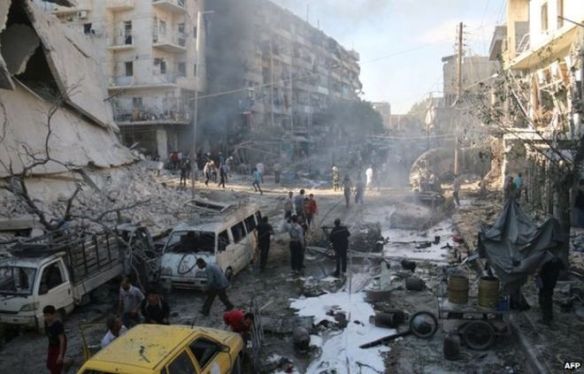
A Nonviolent Strategy to Liberate Syria

_74590478_00e0aa73-8303-4224-89de-0029b5e5eae1

Editor’s note: While we do not completely agree with the author’s analysis of factors leading to the strife in Syria, we share his desire for greater peace, freedom and stability in the region.

By Robert J. Burrowes

In early 2011, as the Arab Spring was moving across North Africa and the
Middle East, small groups of nonviolent activists in Syria, which has
been under martial law since 1963, started protesting against the brutal
dictatorship of Bashar al-Assad and demanding democratic reforms, the
release of political prisoners, an increase in freedoms, abolition of
the emergency law and an end to corruption.

By mid-March these protests, particularly in cities such as Damascus,
Aleppo and Daraa, had escalated and the ‘Day of Rage’ protest on 15
March 2011 is considered by many to mark the start of the nationwide
uprising against the Assad dictatorship. The dictatorship’s reaction to
the protests became violent on 16 March and on 18 March, after Friday
prayers, activists gathered at the al-Omari Mosque in Daraa were
attacked by security forces with water cannons and tear gas, followed by
live fire; four nonviolent activists were killed.

Within months, as the nonviolent protests expanded and spread, the
regime had killed hundreds of activists and arbitrarily arrested
thousands, subjecting many of them to brutal torture in detention. This
pattern has continued unchecked. For the earliest of a succession of
reports that document this regime violence against nonviolent activists,
see the Human Rights Watch report ‘”We’ve Never Seen Such Horror” Crimes
against Humanity by Syrian Security Forces‘.

For the most recent report, see the UN Human Rights Council report ‘Out
of Sight, Out of Mind: Deaths in Detention in the Syrian Arab Republic‘.

In recent commentaries on the war in Syria, both long-time solidarity
activist Terry Burke – see ‘U.S. Peace Activists Should Start Listening
to Progressive Syrian Voices
– and long-term Middle East scholar Professor Stephen Zunes have
encouraged the anti-war movement to listen to Syrian voices in framing
their response, particularly given the tendency within some sections of
it to support ‘the extraordinarily brutal Assad regime – a family
dictatorship rooted in the anti-leftist military wing of the Baath
Party’. See ‘Anti-war movement must listen to voices within Syria’s
civil war’.

One such Syrian voice is that of scholar and nonviolent activist
Professor Mohja Kahf. In her account of the Syrian uprising against the
Assad dictatorship – see ‘Then and Now: The Syrian Revolution to Date. A
young nonviolent resistance and the ensuing armed struggle
– Professor Kahf offers the following introductory paragraphs:

‘The Syrian uprising sprang from the country’s grassroots, especially
from youth in their teens, and adults in their twenties and thirties.
They, not seasoned oppositionists, began the uprising, and are its core
population. They share, rather than a particular ideology, a
generational experience of disenfranchisement and brutalization by a
corrupt, repressive, and massively armed ruling elite in Syria.

‘The uprising began nonviolently and the vast majority of its populace
maintained nonviolence as its path to pursue regime change and a
democratic Syria, until an armed flank emerged in August 2011.

‘The Syrian Revolution has morphed. From midsummer to autumn 2011, armed
resistance developed, political bodies formed to represent the
revolution outside Syria, and political Islamists of various sorts
entered the uprising scene. Since then, armed resistance has
overshadowed nonviolent resistance in Syria.

‘…political bodies and support groups for the revolution’s militarized
wing, have become venues for internal power struggles among opposition
factions and individuals, and entry-points for foreign powers attempting
to push their own agendas into a revolution sprung from Syrian
grievances, grown from the spilling of Syrian blood on Syrian soil.

‘Many in the global peace community can no longer discern the Syrian
uprising’s grassroots population through the smoke of armed conflict and
the troubling new actors on the scene. Further, some in the global left
or anti-imperialist camp understand the Syrian revolution only through
the endgame of geopolitics. In such a narrative, the uprising population
is nothing but the proxy of U.S. imperialism.

‘Such critics may acknowledge that the Assad regime is brutal, but
maintain from their armchairs that Syrians must bear this cost, because
this regime has its finger in the dike of U.S. imperialism, Zionism, and
Islamism. Or, perhaps they agree that a revolution against a brutal
dictator is not a bad idea, but wish for a nicer revolution, with better
players. Eyes riveted to their pencils and rulers and idées fixés, such
critics abandon a grassroots population of disenfranchised human beings
demanding basic human freedoms in Syria. This is a stunning and cruel
failure of vision.

‘The voices of the original grassroots revolution of Syria are
nonviolent, nonsectarian, noninterventionist, for the fall of the Assad
regime, and for the rise of a democratic, human rights upholding Syria
that is bound by the rule of law. They are still present in this
revolution. Who will hear them now, after so much dear blood has been
spilled, so much tender flesh crushed under blasted blocks of cement, so
much rightful anger unleashed?’

Other Syrian voices offer a similar account. See, for example, the
recent book by Robin Yassin-Kassab and Leila al-Shami titled ‘Burning
Country: Syrians in Revolution and War’
reviewed in ‘Book Review: Burning Country‘.

If Syrians and their solidarity allies are to develop and implement a
successful nonviolent grassroots strategy to end the war in/on Syria and
remove the Assad dictatorship, then we need a sound strategic framework
that guides the comprehensive planning of our strategy. Obviously, there
is no point designing a strategy that is incomplete or cannot be
successful.

A sound strategic framework simply enables us to think and plan
strategically so that once our strategy has been elaborated, it can be
widely shared and clearly understood by everyone involved. It also means
that nonviolent actions can then be implemented because they are known
to have strategic utility and that precise utility is understood in
advance. There is little point taking action at random, especially if
our opponent is powerful and committed (even if that ‘commitment’ is
insane, which is frequently the case).

There is a simple diagram presenting a 12-point strategic framework
illustrated here in the form of the ‘Nonviolent Strategy Wheel‘.

In order to think strategically about nonviolently resolving a violent
conflict, a clearly defined political purpose is needed; that is, a
simple summary statement of ‘what you want’. However, given the
complexity of the multifaceted conflict in the case of Syria, it is
strategically simpler to identify two political purposes. These might be
stated thus: 1. To end the war in/on Syria, and 2. To establish a
democratic form of government in Syria (which, obviously, requires
removal of the dictatorship).

Once the political purpose has been defined, the two strategic aims
(‘how you get what you want’) of the strategy acquire their meaning.
These two strategic aims (which are always the same whatever the
political purpose) are as follows: 1. To increase support for your
campaign by developing a network of groups who can assist you. 2. To
alter the will and undermine the power of those groups who support the
war/dictatorship.

While the two strategic aims are always the same, they are achieved via
a series of intermediate strategic goals which are always specific to
each struggle. To keep this article reasonably straightforward, I have
only identified a set of strategic goals that would be appropriate in
the context of ending the war in/on Syria below. For a basic set of
strategic goals appropriate for ending the dictatorship, see ‘Strategic
Aims‘.

Before listing the strategic goals for ending the war, I wish to
emphasize that I have only briefly discussed two aspects of a
comprehensive strategy to end the war in/on Syria: its political purpose
and its two strategic aims (with its many subsidiary strategic goals).
For the strategy to be effective, all twelve components of the strategic
framework should be planned (and then implemented). See Nonviolent
Defense/Liberation Strategy.
This will require, for example, that tactics that will achieve the
strategic goals must be carefully chosen and implemented bearing in mind
the vital distinction between the political objective and strategic goal
of any such tactic. See ‘The Political Objective and Strategic Goal of
Nonviolent Actions‘.

Strategic goals to end the war in/on Syria

I have outlined a basic list of strategic goals below although, it
should be noted, the list would be considerably longer as individual
organizations should be specified separately.

Many of these strategic goals would usually be tackled by action groups
working in solidarity with Syria campaigning within their own country.
Ideally they would be undertaken by activist groups with existing
expertise in the relevant area (for example, experience in campaigning
against a weapons corporation) but this is not essential.

Of course, individual activist groups would usually accept
responsibility for focusing their work on achieving just one or a few of
the strategic goals (which is why any single campaign within the overall
strategy is readily manageable).

It is the responsibility of the struggle’s strategic leadership to
ensure that each of the strategic goals, which should be identified and
prioritized according to their precise understanding of the
circumstances in Syria, (so, not necessarily precisely as identified
below) is being addressed (or to prioritize if resource limitations
require this).

So here is a set of strategic goals to end the war in/on Syria:

(1) To cause the women in [women’s organizations WO1, WO2, WO…] in Syria
to join the liberation strategy by participating in [your nominated
nonviolent action(s)/campaign(s) and/or constructive program
activities]. For example, simple nonviolent actions would be to wear a
national symbol (such as a badge of the Syrian revolutionary flag and/or
ribbons in the national colors) and/or to boycott all media outlets
supporting the war. For this item and many items hereafter, see the list
of possible actions that can be taken here: ‘198 Tactics of Nonviolent Action‘.

(2) To cause the workers in [trade unions T1, T2, T…] in Syria to join
the liberation strategy by participating in [your nominated nonviolent
action(s)/campaign(s) and/or constructive program activities]. For
example, this might include withdrawing their labor from occupations
that support the Syrian military forces.

(3) To cause young people in Syria to resist conscription into the
Syrian military forces.

(4) To cause young people in Syria to refuse recruitment into the Free
Syrian Army, al-Qaeda and its affiliates/allies, the Islamic State
(Daesh) and its allies.

(5) To cause the members of [religious denominations R1, R2, R…] in
Syria to join the liberation strategy by participating in [your
nominated nonviolent action(s)/campaign(s) and/or constructive program
activities].

(6) To cause the members of [ethnic communities EC1, EC2, EC…] in Syria
to join the liberation strategy by participating in [your nominated
nonviolent action(s)/campaign(s) and/or constructive program
activities].

(7) To cause the activists, artists, musicians, intellectuals and other
key social groups in [organizations O1, O2, O…] in Syria to join the
liberation strategy by participating in [your nominated nonviolent
action(s)/campaign(s) and/or constructive program activities].

(8) To cause the students in [student organizations S1, S2, S…] in Syria
to join the liberation strategy by participating in [your nominated
nonviolent action(s)/campaign(s) and/or constructive program
activities].

(9) To cause the soldiers in [military units M1, M2, M…] to refuse to
obey orders from the dictatorship to arrest, assault, torture and shoot
nonviolent activists and the other citizens of Syria.

(10) To cause the police in [police units P1, P2, P…] to refuse to obey
orders from the dictatorship to arrest, assault, torture and shoot
nonviolent activists and the other citizens of Syria.

(11) To cause young people in [the US, NATO countries, Russia and other
countries fighting in Syria] to refuse recruitment into their respective
military forces.

(12) To cause conscripts into the military forces of [NATO countries,
Russia and other countries fighting in Syria] that still use
conscription to conscientiously refuse to perform military duties.

(13) To cause military personnel in the military forces of [the US, NATO
countries, Russia and other countries fighting in Syria] to refuse
deployment to the war in/on Syria.

(14) To cause young people in [your country] to refuse recruitment into
the Free Syrian Army, al-Qaeda and its affiliates/allies, the Islamic
State (Daesh) and its allies.

(15) To cause former soldiers in [your country] to refuse recruitment as
mercenaries by corporations that supply ‘military contractors’ to fight
in Syria.

(16) To cause the activists in [peace groups P1, P2, P…] in [your
town/city/country] to resist the war on Syria by encouraging their
members to boycott [all/specified nonmilitary products] of [weapons
corporations W1, W2, W…]. For example, this might include boycotting all
commercial flights that use Boeing and Airbus passenger aircraft given
the heavy involvement of these corporations in the production of
military aircraft.

(17) To cause the activists in [environment groups E1, E2, E…] in [your
town/city/country] to resist the war on Syria by encouraging their
members to boycott [all/specified nonmilitary products] of [weapons
corporations W1, W2, W…]. For example, this might including boycotting
all commercial products of General Electric given the heavy involvement
of this corporation in the production of military engines, systems and
services.

(18) To cause the workers in [trade unions or labor organizations T1,
T2, T….] in [your town/city/country] to resist the war on Syria by
encouraging their members to boycott [all/specified nonmilitary
products] of [weapons corporations W1, W2, W…].

(19) To cause the women in [women’s organizations WO1, WO2, WO…] in
[your town/city/country] to resist the war on Syria by encouraging their
members to boycott [all/specified nonmilitary products] of [weapons
corporations W1, W2, W…].

(20) To cause the members of [religious denominations R1, R2, R…] in
[your town/city/country] to resist the war on Syria by encouraging their
members to boycott [all/specified nonmilitary products] of [weapons
corporations W1, W2, W…].

(21) To cause the members of [ethnic communities EC4, EC5, EC…] in [your
town/city/country] to resist the war on Syria by encouraging their
members to boycott [all/specified nonmilitary products] of [weapons
corporations W1, W2, W…].

(22) To cause the artists, musicians, intellectuals and other key social
groups in [organizations O4, O5, O…] in [your town/city/country] to
resist the war on Syria by encouraging their members to boycott
[all/specified nonmilitary products] of [weapons corporations W1, W2,
W…].

(23) To cause the students in [student organizations S1, S2, S…] in
[your town/city/country] to resist the war on Syria by encouraging their
members to boycott [all/specified nonmilitary products] of [weapons
corporations W1, W2, W…].

(24) To cause the consumers in [your town/city/country] to resist the
war on Syria by boycotting [all/specified nonmilitary products] of
[weapons corporations W1, W2, W…].

(25) To cause more individuals in [your town/city/country] to resist the
war on Syria by conscientiously resisting paying [part/all] of their
taxes for war.

(26) To cause more organizations in [your town/city/country] to resist
the war on Syria by conscientiously resisting paying [part/all] of their
taxes for war.

(27) To cause [weapons corporations W4, W5, W…] to convert from the
manufacture of military weapons to [the specified/negotiated
socially/environmentally beneficial products].

(28) To cause [banks B1, B2, B…] to cease financing the weapons
industry.

(29) To cause bank customers to shift their deposits to ethical banks
and credit unions that do not finance (or are otherwise involved in) the
weapons industry.

(30) To cause [religious organizations R4, R5, R…] to divest from the
weapons industry.

(31) To cause [superannuation funds S1, S2, S…] to divest from the
weapons industry.

(32) To cause superannuation fund customers to shift their money to
ethical funds that do not finance (or are otherwise involved in) the
weapons industry.

(33) To cause [insurance companies I1, I2, I…] to divest from the
weapons industry.

(34) To cause insurance customers to shift their policies to ethical
insurance companies that do not finance (or are otherwise involved in)
the weapons industry.

(35) To cause [corporations C1, C2, C…] that provide
[services/components] for [weapons corporations W1, W2, W…] to cease
doing so.

(36) To cause the workers in [trade unions or labor organizations T4,
T5, T…] to withdraw their labor from [weapons corporations W1, W2, W…]
[partially/wholly], [temporarily/permanently].

(37) To cause the workers in [trade unions or labor organizations T7,
T8, T…] to withdraw their labor from [corporations C1, C2, C…]
[partially/wholly], [temporarily/permanently].

(38) To cause [corporations C4, C5, C…] that provides
[services/supplies] to [military bases MB1, MB2, MB…] to cease doing so.

(39) To cause the workers in [trade unions or labor organizations T10,
T11, T…] who work in/supply [military bases MB1, MB2, MB…] to withdraw
their labor [partially/wholly], [temporarily/permanently].

(40) To cause the workers in [trade unions or labor organizations T13,
T14, T…] to withdraw their labor from [corporations C4, C5, C…]
[partially/wholly], [temporarily/permanently].

(41) To cause [corporations C7, C8, C…] that manufacture and supply spy
satellites for military purposes to cease doing so.

(42) To cause the workers in [trade unions or labor organizations T16,
T17, T…] to withdraw their labor from [corporations C7, C8, C…]
[partially/wholly], [temporarily/permanently].

(43) To cause [corporations C10, C11, C…] that provide
[services/components] for the militarization of space to cease doing so.

(44) To cause the workers in [trade unions or labor organizations T19,
T20, T…] to withdraw their labor from [corporations C10, C11, C…]
[partially/wholly], [temporarily/permanently].

(45) To cause [corporations C13, C14, C…] that provide private military
contractors (mercenaries) to fight in wars to cease doing so.

(46) To cause the private military contractors (mercenaries) who fight
in wars to withdraw their labor from [corporations C13, C14, C…].

(47) To cause the soldiers in [military units M1, M2, M…] in [your
town/city/country] to refuse to obey orders to [arrest, assault, torture
and shoot, depending on your local circumstances] nonviolent activists
campaigning against the war.

(48) To cause the police in [police units P1, P2, P…] in [your
town/city/country] to refuse to obey orders to [arrest, assault, torture
and shoot, depending on your local circumstances] nonviolent activists
campaigning against the war.

(49) To cause individual members of the military forces at [Military
Base MB1/Drone Base DB1/Navy Ship NS1/Air Force Base AFB1/Army unit
AU1/Marines unit MU1] in [your town/city/country] to resign.

(50) To cause individual members of those corporations that
employ/supply private military contractors (mercenaries) to resign.

As you can see, the two strategic aims are achieved via a series of
intermediate strategic goals.

Not all of the strategic goals will need to be achieved for the strategy
to be successful but each goal is focused in such a way that its
achievement functionally undermines the power of those conducting the
war.

The difference between success and failure in any struggle is the
soundness of the strategy.


Biodata: Robert J. Burrowes has a lifetime commitment to understanding and ending human violence. He has done extensive research since 1966 in an effort to understand why human beings are violent and has been a nonviolent activist since 1981. He is the author of ‘Why Violence?‘ His email address is flametree@riseup.netand his website is at http://robertjburrowes.wordpress.com

Robert J. Burrowes
P.O. Box 68
Daylesford
Victoria 3460
Australia
Email: flametree@riseup.net

Websites:
Nonviolence Charter
Flame Tree Project to Save Life on Earth
‘Why Violence?’
Nonviolent Campaign Strategy
Nonviolent Defense/Liberation Strategy
Anita: Songs of Nonviolence
Robert Burrowes
Global Nonviolence Network

How Does Corporate Media Manufacture False Narratives?

aa-corporate-media-very-good-poster

By Nauman Sadiq

Source: RINF

What bothers me is not that we are unable to find the solution to our problems, what bothers me more is the fact that neoliberals are so utterly unaware of the real structural issues that their attempts to sort out the tangential issues will further exacerbate the main issues. Religious extremism, militancy and terrorism are not the cause but the effect of poverty, backwardness and disenfranchisement.

Empirically speaking, if we take all the other aggravating factors out: like poverty, backwardness, illiteracy, social injustice, disenfranchisement, conflict, instability, deliberate training and arming of certain militant groups by the regional and global players, and more importantly grievances against the duplicitous Western foreign policy, I don’t think that Islamic State, al-Qaeda and the likes would get the abundant supply of foot soldiers that they are getting now in the troubled regions of Middle East, North Africa and South Asia.

Moreover, I do concede that the rallying cry of “Jihad in the way of God” might have been one reason for the abundant supply of foot soldiers to the jihadists’ cause, but on an emotional level it is the self-serving and hypocritical Western interventionist policy in the energy-rich Middle East that adds fuel to the fire. When Muslims all over the Islamic countries see that their brothers-in-faith are dying in Palestine, Syria, Iraq, Libya, Yemen and Afghanistan, on an emotional level they feel outraged and seek vengeance and justice.

This emotional outrage, in my opinion, is a far more potent factor than the sterile rational argument of God’s supposed command to fight holy wars against the infidels. If we take all the other contributing factors, that I have mentioned in the second paragraph out of the equation, I don’t think that Muslims are some “exceptional” variety of human beings who are hell-bent on killing the heretics all over the world.

Notwithstanding, it’s very easy to distinguish between the victims of structural injustices and the beneficiaries of the existing neocolonial economic order all over the world. But instead of using words that can be interpreted subjectively I’ll let the figures do the talking. Pakistan’s total GDP is only $270 billion and with a population of 200 million it amounts to a per capita income of only $1400. While the US’ GDP is $18 trillion and per capita income is in excess of $50,000. Similarly the per capita income of most countries in the Western Europe is also around $40,000. That’s a difference of 40 to 50 TIMES between the incomes of Third World countries and the beneficiaries of neocolonialism, i.e. the Western powers.

Only the defense budget of the Pentagon is $600 billion, which is three times the size of Pakistan’s total GDP. A single multi-national corporation based in the Wall Street and other financial districts of the Western world owns assets in excess of $200 billion which is more than the total GDP of many developing economies. Examples of such business conglomerates are: Investment banks – JP Morgan, Goldman Sachs, Barclays, HSBC, BNP Paribas; Oil majors – Exxon Mobil, Chevron, BP, RDS, Total, Vitol; Manufacturers – Apple, Microsoft and Google.

On top of that, semi-legit wealth from all over the world flows into the Western commercial and investment banks: last year there was a report that the Russian oligarchs have deposited $800 billion in the Western banks, while the Chinese entrepreneurs have deposited $1.5 trillion in the Western financial institutions.

Moreover, in April this year the Saudi finance minister threatened that the Saudi kingdom would sell up to $750 billion in Treasury securities and other assets if Congress passed a bill that would allow the Saudi government to be held responsible for any role in the September 11, 2001 terror attacks. And $750 billion is only the Saudi investment in the US, if we add up Saudi investment in Western Europe, and the investments of UAE, Kuwait and Qatar in the Western economies, the sum total would amount to trillions of dollars of Gulf’s investment in the US and Western Europe.

The first and foremost priority of the Western powers is to save their Corporate Empire, and especially their financial institutions, from collapsing; everything else like eliminating terrorism, promoting democracy and “responsibility to protect” are merely arranged side shows to justify their interventionist foreign policy, especially in the energy-rich Middle East.

Additionally, the irony is that the neoliberal dupes of the mainstream media justify and validate the unfair practices of the neocolonial powers and hold the victims of structural injustices responsible for their misfortunes. If a Third World’s laborer has been forced to live on less than $5 a day and a corporate executive sits in the Wall Street on top of $18 trillion business empire, neoliberals are okay with this travesty.

However, we need to understand that how does a neoliberal mindset is structured? As we know that mass education programs and mass media engender mass ideologies. We like to believe that we are free to think, but we aren’t. Our narratives aren’t really “our” narratives. These narratives of injustice and inequality have been constructed for the public consumption by the corporate media, which is nothing more than the mouthpiece of the Western political establishments and the business interests.

Media is our eyes and ears through which we get all the inputs and it is also our brain through which we interpret raw data. If media keeps mum over some vital structural injustices and blows out of proportion some isolated incidents of injustice and violence, we are likely to forget all about the former and focus all of our energies on the tangential issues which the media portrays as the “real” ones.

Monopoly capitalism and the global neocolonial economic order are the real issues while Islamic radicalism and terrorism are the secondary issues and itself an adverse reaction to the former. That’s how the mainstream media constructs artificial narratives and dupes its audience into believing the absurd: during the Cold War it created the “Red Scare” and told us that communism is an existential threat to the free world and the Western way of life. We bought this narrative.

Then the West and its Saudi and Pakistani collaborators financed, trained and armed the Afghan so-called “freedom fighters” and used them as their proxies against the Soviets. After the collapse of the Soviet Union they declared the former “freedom fighters” to be terrorists and another existential threat to the “free world” and the Western way of life. We again bought this narrative.

And finally, during the Libyan and Syrian proxy wars the former terrorists once again became freedom fighters – albeit in a more nuanced manner, this time around the corporate media sells them as “moderate rebels.” And the lobotomized neoliberal audience of the mainstream media is once again willing to buy this narrative, how ironic?


Nauman Sadiq is an Islamabad-based attorney, columnist and geopolitical analyst focused on the politics of Af-Pak and MENA regions, neocolonialism and Petroimperialism.

The Age of Disintegration

images

Neoliberalism, Interventionism, the Resource Curse, and a Fragmenting World

By Patrick Cockburn

Source: TomDispatch.com

We live in an age of disintegration. Nowhere is this more evident than in the Greater Middle East and Africa. Across the vast swath of territory between Pakistan and Nigeria, there are at least seven ongoing wars — in Afghanistan, Iraq, Syria, Yemen, Libya, Somalia, and South Sudan. These conflicts are extraordinarily destructive. They are tearing apart the countries in which they are taking place in ways that make it doubtful they will ever recover. Cities like Aleppo in Syria, Ramadi in Iraq, Taiz in Yemen, and Benghazi in Libya have been partly or entirely reduced to ruins. There are also at least three other serious insurgencies: in southeast Turkey, where Kurdish guerrillas are fighting the Turkish army, in Egypt’s Sinai Peninsula where a little-reported but ferocious guerrilla conflict is underway, and in northeast Nigeria and neighboring countries where Boko Haram continues to launch murderous attacks.

All of these have a number of things in common: they are endless and seem never to produce definitive winners or losers. (Afghanistan has effectively been at war since 1979, Somalia since 1991.) They involve the destruction or dismemberment of unified nations, their de facto partition amid mass population movements and upheavals — well publicized in the case of Syria and Iraq, less so in places like South Sudan where more than 2.4 million people have been displaced in recent years.

Add in one more similarity, no less crucial for being obvious: in most of these countries, where Islam is the dominant religion, extreme Salafi-Jihadi movements, including the Islamic State (IS), al-Qaeda, and the Taliban are essentially the only available vehicles for protest and rebellion. By now, they have completely replaced the socialist and nationalist movements that predominated in the twentieth century; these years have, that is, seen a remarkable reversion to religious, ethnic, and tribal identity, to movements that seek to establish their own exclusive territory by the persecution and expulsion of minorities.

In the process and under the pressure of outside military intervention, a vast region of the planet seems to be cracking open. Yet there is very little understanding of these processes in Washington. This was recently well illustrated by the protest of 51 State Department diplomats against President Obama’s Syrian policy and their suggestion that air strikes be launched targeting Syrian regime forces in the belief that President Bashar al-Assad would then abide by a ceasefire. The diplomats’ approach remains typically simpleminded in this most complex of conflicts, assuming as it does that the Syrian government’s barrel-bombing of civilians and other grim acts are the “root cause of the instability that continues to grip Syria and the broader region.”

It is as if the minds of these diplomats were still in the Cold War era, as if they were still fighting the Soviet Union and its allies. Against all the evidence of the last five years, there is an assumption that a barely extant moderate Syrian opposition would benefit from the fall of Assad, and a lack of understanding that the armed opposition in Syria is entirely dominated by the Islamic State and al-Qaeda clones.

Though the invasion of Iraq in 2003 is now widely admitted to have been a mistake (even by those who supported it at the time), no real lessons have been learned about why direct or indirect military interventions by the U.S. and its allies in the Middle East over the last quarter century have all only exacerbated violence and accelerated state failure.

A Mass Extinction of Independent States

The Islamic State, just celebrating its second anniversary, is the grotesque outcome of this era of chaos and conflict. That such a monstrous cult exists at all is a symptom of the deep dislocation societies throughout that region, ruled by corrupt and discredited elites, have suffered. Its rise — and that of various Taliban and al-Qaeda-style clones — is a measure of the weakness of its opponents.

The Iraqi army and security forces, for example, had 350,000 soldiers and 660,000 police on the books in June 2014 when a few thousand Islamic State fighters captured Mosul, the country’s second largest city, which they still hold. Today the Iraqi army, security services, and about 20,000 Shia paramilitaries backed by the massive firepower of the United States and allied air forces have fought their way into the city of Fallujah, 40 miles west of Baghdad, against the resistance of IS fighters who may have numbered as few as 900. In Afghanistan, the resurgence of the Taliban, supposedly decisively defeated in 2001, came about less because of the popularity of that movement than the contempt with which Afghans came to regard their corrupt government in Kabul.

Everywhere nation states are enfeebled or collapsing, as authoritarian leaders battle for survival in the face of mounting external and internal pressures. This is hardly the way the region was expected to develop. Countries that had escaped from colonial rule in the second half of the twentieth century were supposed to become more, not less, unified as time passed.

Between 1950 and 1975, nationalist leaders came to power in much of the previously colonized world. They promised to achieve national self-determination by creating powerful independent states through the concentration of whatever political, military, and economic resources were at hand. Instead, over the decades, many of these regimes transmuted into police states controlled by small numbers of staggeringly wealthy families and a coterie of businessmen dependent on their connections to such leaders as Hosni Mubarak in Egypt or Bashar al-Assad in Syria.

In recent years, such countries were also opened up to the economic whirlwind of neoliberalism, which destroyed any crude social contract that existed between rulers and ruled. Take Syria. There, rural towns and villages that had once supported the Baathist regime of the al-Assad family because it provided jobs and kept the prices of necessities low were, after 2000, abandoned to market forces skewed in favor of those in power. These places would become the backbone of the post-2011 uprising. At the same time, institutions like the Organization of Petroleum Exporting Countries (OPEC) that had done so much to enhance the wealth and power of regional oil producers in the 1970s have lost their capacity for united action.

The question for our moment: Why is a “mass extinction” of independent states taking place in the Middle East, North Africa, and beyond? Western politicians and media often refer to such countries as “failed states.” The implication embedded in that term is that the process is a self-destructive one. But several of the states now labeled “failed” like Libya only became so after Western-backed opposition movements seized power with the support and military intervention of Washington and NATO, and proved too weak to impose their own central governments and so a monopoly of violence within the national territory.

In many ways, this process began with the intervention of a U.S.-led coalition in Iraq in 2003 leading to the overthrow of Saddam Hussein, the shutting down of his Baathist Party, and the disbanding of his military. Whatever their faults, Saddam and Libya’s autocratic ruler Muammar Gaddafi were clearly demonized and blamed for all ethnic, sectarian, and regional differences in the countries they ruled, forces that were, in fact, set loose in grim ways upon their deaths.

A question remains, however: Why did the opposition to autocracy and to Western intervention take on an Islamic form and why were the Islamic movements that came to dominate the armed resistance in Iraq and Syria in particular so violent, regressive, and sectarian? Put another way, how could such groups find so many people willing to die for their causes, while their opponents found so few? When IS battle groups were sweeping through northern Iraq in the summer of 2014, soldiers who had thrown aside their uniforms and weapons and deserted that country’s northern cities would justify their flight by saying derisively: “Die for [then-Prime Minister Nouri] al-Maliki? Never!”

A common explanation for the rise of Islamic resistance movements is that the socialist, secularist, and nationalist opposition had been crushed by the old regimes’ security forces, while the Islamists were not. In countries like Libya and Syria, however, Islamists were savagely persecuted, too, and they still came to dominate the opposition. And yet, while these religious movements were strong enough to oppose governments, they generally have not proven strong enough to replace them.

Too Weak to Win, But Too Strong to Lose

Though there are clearly many reasons for the present disintegration of states and they differ somewhat from place to place, one thing is beyond question: the phenomenon itself is becoming the norm across vast reaches of the planet.

If you’re looking for the causes of state failure in our time, the place to start is undoubtedly with the end of the Cold War a quarter-century ago. Once it was over, neither the U.S. nor the new Russia that emerged from the Soviet Union’s implosion had a significant interest in continuing to prop up “failed states,” as each had for so long, fearing that the rival superpower and its local proxies would otherwise take over. Previously, national leaders in places like the Greater Middle East had been able to maintain a degree of independence for their countries by balancing between Moscow and Washington. With the break-up of the Soviet Union, this was no longer feasible.

In addition, the triumph of neoliberal free-market economics in the wake of the Soviet Union’s collapse added a critical element to the mix. It would prove far more destabilizing than it looked at the time.

Again, consider Syria. The expansion of the free market in a country where there was neither democratic accountability nor the rule of law meant one thing above all: plutocrats linked to the nation’s ruling family took anything that seemed potentially profitable. In the process, they grew staggeringly wealthy, while the denizens of Syria’s impoverished villages, country towns, and city slums, who had once looked to the state for jobs and cheap food, suffered. It should have surprised no one that those places became the strongholds of the Syrian uprising after 2011. In the capital, Damascus, as the reign of neoliberalism spread, even the lesser members of the mukhabarat, or secret police, found themselves living on only $200 to $300 a month, while the state became a machine for thievery.

This sort of thievery and the auctioning off of the nation’s patrimony spread across the region in these years. The new Egyptian ruler, General Abdel Fattah al-Sisi, merciless toward any sign of domestic dissent, was typical. In a country that once had been a standard bearer for nationalist regimes the world over, he didn’t hesitate this April to try to hand over two islands in the Red Sea to Saudi Arabia on whose funding and aid his regime is dependent. (To the surprise of everyone, an Egyptian court recently overruled Sisi’s decision.)

That gesture, deeply unpopular among increasingly impoverished Egyptians, was symbolic of a larger change in the balance of power in the Middle East: once the most powerful states in the region — Egypt, Syria, and Iraq — had been secular nationalists and a genuine counterbalance to Saudi Arabia and the Persian Gulf monarchies. As those secular autocracies weakened, however, the power and influence of the Sunni fundamentalist monarchies only increased. If 2011 saw rebellion and revolution spread across the Greater Middle East as the Arab Spring briefly blossomed, it also saw counterrevolution spread, funded by those oil-rich absolute Gulf monarchies, which were never going to tolerate democratic secular regime change in Syria or Libya.

Add in one more process at work making such states ever more fragile: the production and sale of natural resources — oil, gas, and minerals — and the kleptomania that goes with it. Such countries often suffer from what has become known as “the resources curse”: states increasingly dependent for revenues on the sale of their natural resources — enough to theoretically provide the whole population with a reasonably decent standard of living — turn instead into grotesquely corrupt dictatorships. In them, the yachts of local billionaires with crucial connections to the regime of the moment bob in harbors surrounded by slums running with raw sewage. In such nations, politics tends to focus on elites battling and maneuvering to steal state revenues and transfer them as rapidly as possible out of the country.

This has been the pattern of economic and political life in much of sub-Saharan Africa from Angola to Nigeria. In the Middle East and North Africa, however, a somewhat different system exists, one usually misunderstood by the outside world. There is similarly great inequality in Iraq or Saudi Arabia with similarly kleptocratic elites. They have, however, ruled over patronage states in which a significant part of the population is offered jobs in the public sector in return for political passivity or support for the kleptocrats.

In Iraq with a population of 33 million people, for instance, no less than seven million of them are on the government payroll, thanks to salaries or pensions that cost the government $4 billion a month. This crude way of distributing oil revenues to the people has often been denounced by Western commentators and economists as corruption. They, in turn, generally recommend cutting the number of these jobs, but this would mean that all, rather than just part, of the state’s resource revenues would be stolen by the elite. This, in fact, is increasingly the case in such lands as oil prices bottom out and even the Saudi royals begin to cut back on state support for the populace.

Neoliberalism was once believed to be the path to secular democracy and free-market economies. In practice, it has been anything but. Instead, in conjunction with the resource curse, as well as repeated military interventions by Washington and its allies, free-market economics has profoundly destabilized the Greater Middle East. Encouraged by Washington and Brussels, twenty-first-century neoliberalism has made unequal societies ever more unequal and helped transform already corrupt regimes into looting machines. This is also, of course, a formula for the success of the Islamic State or any other radical alternative to the status quo. Such movements are bound to find support in impoverished or neglected regions like eastern Syria or eastern Libya.

Note, however, that this process of destabilization is by no means confined to the Greater Middle East and North Africa. We are indeed in the age of destabilization, a phenomenon that is on the rise globally and at present spreading into the Balkans and Eastern Europe (with the European Union ever less able to influence events there). People no longer speak of European integration, but of how to prevent the complete break-up of the European Union in the wake of the British vote to leave.

The reasons why a narrow majority of Britons voted for Brexit have parallels with the Middle East: the free-market economic policies pursued by governments since Margaret Thatcher was prime minister have widened the gap between rich and poor and between wealthy cities and much of the rest of the country. Britain might be doing well, but millions of Britons did not share in the prosperity. The referendum about continued membership in the European Union, the option almost universally advocated by the British establishment, became the catalyst for protest against the status quo. The anger of the “Leave” voters has much in common with that of Donald Trump supporters in the United States.

The U.S. remains a superpower, but is no longer as powerful as it once was. It, too, is feeling the strains of this global moment, in which it and its local allies are powerful enough to imagine they can get rid of regimes they do not like, but either they do not quite succeed, as in Syria, or succeed but cannot replace what they have destroyed, as in Libya. An Iraqi politician once said that the problem in his country was that parties and movements were “too weak to win, but too strong to lose.” This is increasingly the pattern for the whole region and is spreading elsewhere. It carries with it the possibility of an endless cycle of indecisive wars and an era of instability that has already begun.


Patrick Cockburn is a Middle East correspondent for the Independent of London and the author of five books on the Middle East, the latest of which isChaos and Caliphate: Jihadis and the West in the Struggle for the Middle East(OR Books).

The Odor of Desperation

screen-shot-2016-10-18-at-8-59-54-pm

By James Howard Kunstler

Source: Kunstler.com

It must be obvious even to nine-year-old casual observers of the scene that the US national election is hacking itself. It doesn’t require hacking assistance from any other entity. The two major parties could not have found worse candidates for president, and the struggle between them has turned into the most sordid public spectacle in US electoral history.

Of course, the Russian hacking blame-game story emanates from the security apparatus controlled by a Democratic Party executive establishment desperate to preserve its perks and privileges . (I write as a still-registered-but-disaffected Democrat). The reams of released emails from Clinton campaign chairman John Podesta, and other figures in HRC’s employ, depict a record of tactical mendacity, a gleeful eagerness to lie to the public, and a disregard for the world’s opinion that are plenty bad enough on their own. And Trump’s own fantastic gift for blunder could hardly be improved on by a meddling foreign power. The US political system is blowing itself to pieces.

I say this with the understanding that political systems are emergent phenomena with the primary goal of maintaining their control on the agencies of power at all costs. That is, it’s natural for a polity to fight for its own survival. But the fact that the US polity now so desperately has to fight for survival shows how frail its legitimacy is. It wouldn’t take much to shove it off a precipice into a new kind of civil war much more confusing and irresolvable than the one we went through in the 1860s.

Events and circumstances are driving the US insane literally. We can’t construct a coherent consensus about what is happening to us and therefore we can’t form a set of coherent plans for doing anything about it. The main event is that our debt has far exceeded our ability to produce enough new wealth to service the debt, and our attempts to work around it with Federal Reserve accounting fraud only makes the problem worse day by day and hour by hour. All of it tends to undermine both national morale and living standards, while it shoves us into the crisis I call the long emergency.

It’s hard to see how Russia benefits from America becoming the Mad Bull of a floundering global economy. Rather, the Evil Russia meme seems a projection of our country’s own insecurities and contradictions. For instance, we seem to think that keeping Syria viciously destabilized is preferable to allowing its legitimate government to restore some kind of order there. Russia has been on the scene attempting to prop up the Assad government while we are on the scene there doing everything possible to keep a variety of contestants in a state of incessant war. US policy in Syria has been both incoherent and tragically damaging to the Syrians.

The Russians stood aside while the US smashed up Iraq, Afghanistan, and Libya. We demonstrated adequately that shoving sovereign nations into civic failure is not the best way to resolve geopolitical tensions. Why would it be such a bad thing for the US to stand aside in Syria and see if the Russians can rescue that country from failure? Because they might keep a naval base there on the Mediterranean? We have scores of military bases around the region.

It’s actually pretty easy to understand why the Russians might be paranoid about America’s intentions. We use NATO to run threatening military maneuvers near Russia’s borders. We provoked Ukraine — formerly a province of the Soviet state — to become a nearly failed state, and then we complained foolishly about the Russian annexation of Crimea — also a former territory of the Soviet state and of imperial Russia going back centuries. We slapped sanctions on Russia, making it difficult for them to participate in international banking and commerce.

What’s really comical is the idea that Russia is using the Internet to mess with our affairs — as if the USA has no cyber-warfare ambitions or ongoing operations against them (and others, such as hacking Angela Merkel’s personal phone). News flash: every country with access to the Internet is in full hacking mode around the clock against every other country so engaged. Everybody’s doing it. It is perhaps a projection of America’s ongoing rape hysteria that we think we’re special victims of this universal activity.


Related Article:

Update from Craig Murray: “I can tell you with 100% certainty that it is not any Russian state actor or proxy that gave the Democratic National Committee and Podesta material to WikiLeaks.”