U.S. Interventionism in Latin America is to Blame for Ecuadorian Civil War

Deteriorating social conditions, dollarization and lack of punishment for criminals have been key aspects of Ecuadorian politics since the U.S.-led regime change in the country.
By Lucas Leiroz

Source: Strategic Culture Foundation

In South America, a new scenario of hostilities is emerging. A civil war began in Ecuador, with the local government declaring martial law and a state of “internal armed conflict” in response to several terrorist attacks carried out by drug trafficking groups. At first, this seems like a simple domestic security issue, with no major geopolitical relevance. However, analyzing the case in depth, it is possible to see that the conflict situation is a direct result of U.S. interventionist actions in Latin America.

Ecuador has been going through an extremely turbulent political and economic period over the last seven years. In 2017, Lenin Moreno was elected president in the country as an ally of Rafael Correa. Combining elements of the socialist left with Catholic conservatism, Correa was the leader of the so-called “Citizen Revolution”, having promoted important social reforms over ten years, making the country one of the most prosperous and safe in South America.

Moreno was elected with the promise of continuing Correa’s legacy, having broad popular approval due to the endorsement given to him by his predecessor. However, once coming to power, Moreno undid the legacy of the Citizen Revolution, breaking with Correa and launching a radical neoliberal wave strongly supported by the U.S. Not only that, Moreno was also a key factor in consolidating a reactionary wave across South America, having even sent weapons and war equipment to Bolivia in 2019 in order to support Jeanine Añez’s coup d’état.

The neoliberal shock policy implemented by Moreno and his successor Guillermo Lasso had a brutal social impact in Ecuador. In addition to poverty, unemployment, inflation and other problems in the economic sphere, neoliberal measures also brought with them an exponential increase in crime. The country’s safety indexes quickly dropped. The number of homicides jumped from 970 in 2017 to 4800 in 2022. The country went from being the safest in South America to becoming the most dangerous one, consolidating a drastic social change with catastrophic impacts.

During his years in government, Rafael Correa had implemented both economic measures to reduce social inequalities and strong punitive actions against criminals, halting the growth of the organized crime in the country. He, however, failed to reverse Ecuador’s economic dollarization, which had been implemented before his rise to power. Correa had plans to change Ecuador’s monetary policy, but Moreno’s “soft coup d’état” prevented such a project from being advanced.

It is known that dollarized economies are preferred by drug trafficking cartels and criminal organizations since the absence of exchange mechanisms makes it easier for illegal money to circulate in society, mainly through money laundering schemes. In this sense, since dollarization in 2000, the Ecuadorian authorities have had many difficulties in controlling the illegal economic flow in the country, and this has only gotten worse as criminal networks have gained even more power in the country since Moreno’s neoliberal shock.

Regarding the criminal scenario, Ecuador is known for being a region disputed by Colombian and Mexican cartels. Several gangs operate in Ecuador as proxies for foreign cartels. The country’s location is strategic for the drug market in the southern direction of the continent, which is why Mexican and Colombian traffickers (who control the illegal Latin American market) compete for Ecuadorian territory and back local armed militias to achieve their objectives. In addition, Ecuador is located between Peru and Colombia, which are the two largest global producers of cocaine, further increasing the strategic interest of the Ecuadorian territory for drug trafficking.

Neoliberalism in Ecuador has made the state incapable of controlling the activities of foreign groups in the country, as well as preventing local citizens – increasingly poor and vulnerable – from being co-opted by illegal networks. The result was the emergence of a brutal conflict, with the authorities completely losing control of the situation.

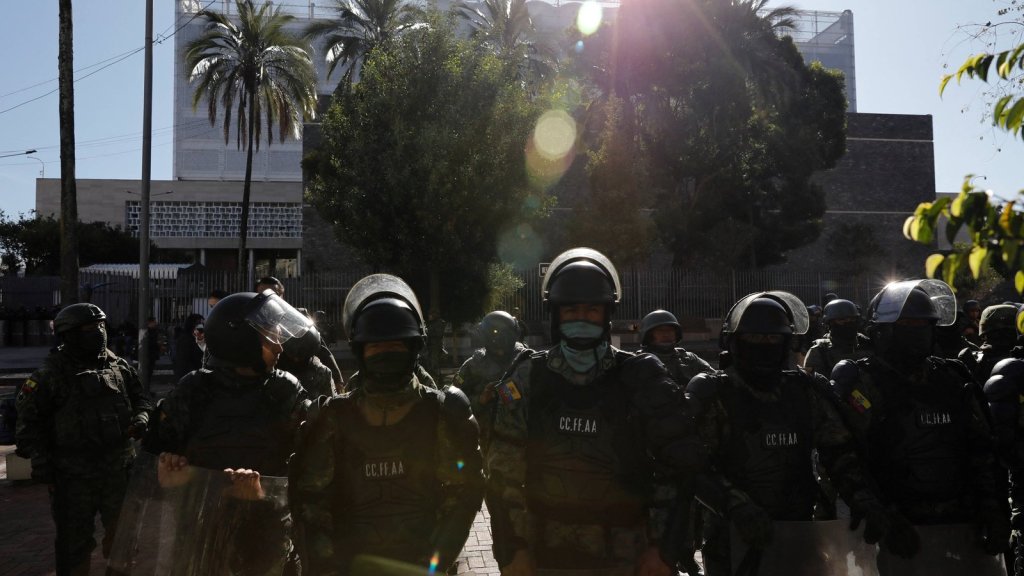
The current outbreak of violence began after the state reacted to the escape from prison of Adolfo Macías — known as “El Fito” — leader of the “Los Choneros” gang. The government declared a state of emergency and tried to impose a siege on the criminals, but suffered several brutal retaliations, with members of Fito’s gang capturing the University of Guayaquil, invading a live TV studio, and even bombing hospitals and public facilities. Furthermore, prisons were captured by criminals, with officers being held hostage, tortured and even hanged. The barbaric scenario led President Daniel Noboa to declare war on the “domestic enemy”, calling on the armed forces to act.

Currently, the streets of Ecuador are the scene of brutal urban warfare, with soldiers facing heavily armed narco-terrorists in intense attrition. The power acquired by criminal groups in the country is impressive, which shows how the impotence of a neoliberal state can have devastating consequences for national security.

It is important to emphasize that U.S.-born Daniel Noboa does not appear to be a skilled politician to reverse this situation completely. He came to power in a tense electoral scenario, in which gangs actively participated in political disputes, even being involved in the murder of a candidate. Noboa is a liberal politician who is extremely aligned with the U.S., and is not interested in resuming Correa’s policies, in addition to suffering a lot of pressure from criminal groups – which have a broad institutional infiltration.

However, it is desirable that at least the public situation in the country returns to normal in some way. The use of military force is the correct way to neutralize gang violence, but it is not the key to solving the drug trafficking problem. To truly undermine the power of criminal networks, it is necessary to implement illiberal policies that reduce poverty, removing ordinary citizens from the sphere of influence of drug trafficking in the country’s periphery. Furthermore, it is necessary to de-dollarize the economy and establish a sovereign currency and exchange rate policy, which make the work of drug trafficking more difficult through strict control of financial flows.

Noboa will certainly not be able to end the drug trafficking problem, as he is not willing to follow the illiberal path, but there is hope that, with the use of force, he will be able to return to normality at some point in the future. After suffering losses on the battlefield, gangs may agree to secretly negotiate a peace agreement with the government to end hostilities on both sides. This will have a positive aspect, as it will put an end to fighting, but it will also have a catastrophic characteristic, as it will definitely turn Ecuador into a Narco-State, where criminal gangs negotiate with the government and act in an institutional manner.

If the U.S. had not intervened in Correa’s Citizen Revolution, perhaps the situation in Ecuador would be different today. But, with neoliberalism and dollarization, the only possible result is a scenario like the current one.
US Backs Coup in Oil-Rich Venezuela, Right-Wing Opposition Plans Mass Privatization and Hyper-Capitalism

The US has effectively declared a coup in Venezuela. Trump recognized unelected right-wing opposition leader Juan Guaidó as new “president,” who plans mass privatization and neoliberal capitalist policies.

By Ben Norton

Source: GrayZone

The United States has effectively declared a political coup d’état in Venezuela, from abroad. Trump announced on January 23 that the US recognizes the unelected, illegitimate right-wing opposition leader Juan Guaidó as the supposed new “interim president” of Venezuela’s supposed new “government.”

Venezuela’s US-backed opposition has pledged to carry out a mass privatization of state assets and to implement harsh neoliberal capitalist policies. The opposition-controlled legislatures declared in its “transition” plans that the “centralized model of controls of the economy will be replaced by a model of freedom and market based on the right of each Venezuelan to work under the guarantees of property rights and freedom of enterprise.”

The US has also hinted at violence in Venezuela. During a background briefing after Trump’s declaration, journalist Dan Cohen heard a US official declare that if the government of actual President Nicolás Maduro responds with any violence, “They have no immediate future, they have no immediate livelihood. One way or another they have their days counted.”

Trump administration officials added, “When we say all options are on the table, all options are on the table… Let’s hope Maduro and his cronies see the magnitude of the message.”

Region’s Right-Wing Countries Join US in Recognizing Coup

Canada’s Liberal government, led by Prime Minister Justin Trudeau; Brazil’s new far-right leader Jair Bolsonaro; and the overtly pro-US Organization of American States (OAS) and its Secretary General Luis Almagro have joined Trump in endorsing this diplomatic coup in Venezuela.

Likewise, the right-wing, US-allied countries in Latin America, including Argentina, Chile, Colombia, Costa Rica, and Ecuador have joined Trump in anointing Guaidó as leader.

The region’s few remaining leftist governments, Bolivia, Cuba, and Nicaragua, have continued recognizing Venezuela’s legitimate government, as has Mexico’s newly elected left-wing President Andrés Manuel López Obrador.

Bolivian President Evo Morales warned that “the claws of imperialism again seek to fatally wound the democracy and self-determination of the peoples of South America,” adding, “No longer will we be the backyard of the US.”

The US government, its right-wing allies, and an obeisant corporate media have repeatedly referred to Venezuela’s actual president, Nicolás Maduro, as an “authoritarian dictator.” What they have failed to mention is that Venezuela still has regular elections, but the US-backed right-wing opposition, which is notoriously disunited and incompetent, has chosen to boycott these elections, preferring to call for foreign-backed military coups instead.

One of the only elected officials in the US who has spoken out against the coup is left-wing California Congressman Ro Khanna. Other progressive and anti-Trump US politicians, including self-declared “democratic socialists,” have remained silent on Trump’s effective declaration of a coup in Latin America.

Opposition Plans for Privatized ‘Free Market’ Economy

While supporters of regime change in Venezuela insist this blatantly undemocratic move is necessary to “defend democracy,” make no mistake, the upheaval is clearly not motivated by resistance to authoritarianism.

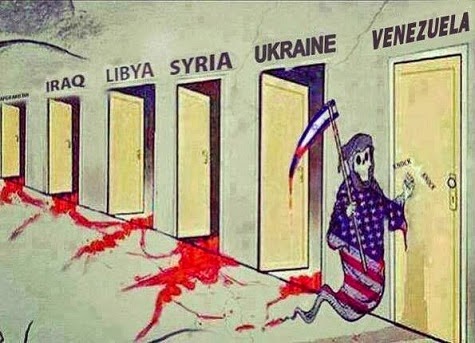
Venezuela, which has the world’s largest oil reserves and has challenged the hegemony of the US dollar, has long been a target of US aggression. In 2002, the United States supported a military coup that briefly ousted democratically elected President Hugo Chávez and replaced him with the right-wing oligarch Pedro Carmona. US intervention, including crippling economic sanctions, has only continued since then.

Elements of Venezeula’s opposition have portrayed themselves to credulous foreign observers as “social democratic,” but their real intentions are very clear: The opposition-controlled legislature has demanded mass privatization of state assets and a return to a capitalist oligarch-controlled economic system built on “property rights and freedom of enterprise.”

In 2017, the Venezuelan government declared the creation of the Constituent Assembly, to rewrite the constitution. Venezuela’s opposition refused to recognize this body and boycotted the elections. The opposition instead remained in control of the National Assembly and decided to run it as a separate parallel legislature.

The opposition-controlled National Assembly drafted a “transition” law that openly outlines what policies the opposition, led by Juan Guaidó, would pursue in its illegitimate, US-recognized “government” in Venezuela. Analyst Jorge Martín, explained what this means in an article published by VenezuelaAnalysis:

The “transition law” drafted by the Assembly National (in contempt) is explicit about the central objectives of the coup in the political and economic field:

“[C]entralized controls, arbitrary measures of expropriation and other similar measures will be abolished… For these purposes, the centralized model of controls of the economy will be replaced by a model of freedom and market based on the right of each Venezuelan to work under the guarantees of property rights and freedom of enterprise.”

In other words, the nationalised companies will be returned to their former private owners (including telecommunications, electrical, SIDOR, cement, etc), as will expropriated landed estates. It is noteworthy that there is a lot of talk of property and business rights, but no mention is made of workers’ rights, which would certainly be abolished. It continues:

“Public companies will be subject to a restructuring process that ensures their efficient and transparent management, including through public-private agreements.”

What this means, in plain language, is massive dismissal of workers from state companies and the entry of private capital into them: a policy of looting which has already proved to be a disaster in all countries where it has been applied.

The model of the opposition’s new coup regime in Venezuela — backed by the US, Canada, and Brazil — is the reimposition of neoliberal capitalism and the recolonization of Latin America. Any bluster about restoring democracy is a mere pretense at this point.

US plotting coups in Venezuela, Cuba and Nicaragua?

By Stephen Lendman

Source: Intrepid Report

The US wants all nations worldwide colonized, their resources looted, their people exploited as serfs, including ordinary Americans.

Sovereign independent governments everywhere are targeted for regime change—by coups d’état or wars.

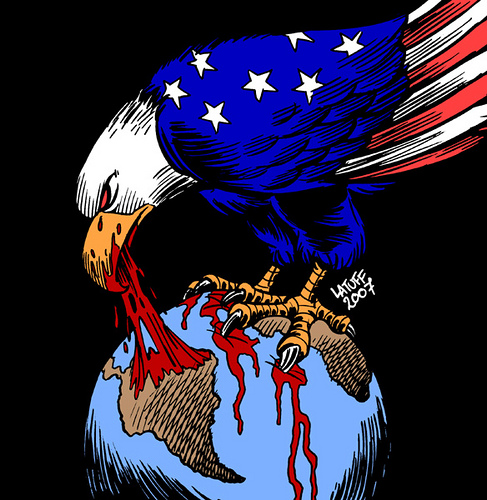
That’s what imperialism is all about, a diabolical plot for unchallenged global dominance by whatever it takes for the US to achieve its aims, Republicans and undemocratic Dems allied for the same geopolitical objectives.

Humanitarian intervention, responsibility to protect, and democracy building are code words by both right wings of America’s war party for wanting fascist tyranny replacing governance of, by, and for everyone equitably everywhere—legitimate governments replaced by US-controlled puppet ones.

Post-9/11 alone, the US orchestrated coups in Haiti, Honduras, Paraguay, Brazil, Ukraine, Egypt, and elsewhere in the Middle East.

The so-called Arab spring was made in the USA. Uprisings were orchestrated. Nothing was spontaneous. CIA dirty hands were involved in replacing unpopular regimes with despotic ones considered more reliable.

Spring never bloomed, just the illusion of change for the better. It was pure deception. Everything changed in targeted countries but stayed the same.

In Egypt, Yemen and elsewhere things worsened, notably in Occupied Palestine. No spring bloomed there or anywhere else in the Middle East.

Plan Colombia was and remains all about Washington’s aim to control Latin America, eliminating opposition to regimes it controls, plotting coups against ruling authorities unwilling to bend to its will, along with pursuing anti-Sino/Russian regional policies.

Since Soviet Russia’s dissolution, the US escalated wars on humanity, using NATO as a killing machine. Republicans and Dems colluded to thirdworldize America, banana republicanize it, wrecking the economy, handing its wealth to Wall Street, war-profiteers and other corporate predators.

Both right wings of duopoly governance mock democratic values and rule of law principles they abhor, governing under a police state apparatus, hardened over time, risking global war to achieve its aims.

Venezuela, Cuba, Nicaragua, and Bolivia are the remaining sovereign independent Latin and Central American nations.

Trump regime hardliners want fascist tyranny replacing their legitimate governments. In early January, State Department deputy spokesman Robert Palladino turned truth on its head, saying the US “support[s] the people of Venezuela, Cuba and Nicaragua in restoring democratic governance and their human rights”—notions Washington abhors.

Venezuelan Bolivarian social democracy is the Trump regime’s top Latin American target for regime change. Pompeo made US intentions clear.

He turned truth on its head, saying President Nicolas Maduro is “illegitimate and the United States will continue . . . to work diligently to restore a real democracy to that country,” adding, “We are very hopeful that we can be a force for good to allow the region to come together to deliver that.”

Fact: Last May, Maduro was overwhelmingly re-elected by a two-thirds majority.

Fact: Scores of international observers from 30 countries monitored the election, judging it open, free and fair.

Fact: Venezuela’s political process is the world’s best.

Fact: It’s polar opposite America’s money-controlled system, one-party rule with two right wings, ordinary people having no say over how they’re governed.

Fact: US democracy is pure fantasy. Venezuelans have the real thing, why Republicans and Dems want its government toppled, their eyes on the prize—the world’s largest oil reserves they want handed to Big Oil.

On January 10, Maduro was inaugurated for a second six-year term, saying he’s committed to continue “fight[ing] for social and economic prosperity and to build 21st century socialism”—despite relentless US political, economic, financial, and propaganda war against the country’s social democracy.

Despite the Trump regime’s all-out efforts to mobilize international opposition to his legitimate rule, delegations from over 90 countries attended the inaugural ceremonies—including from Russia, China, Cuba, Nicaragua, Bolivia, Mexico, El Salvador, Iran, Turkey, and Ireland’s Sinn Fein.

Representatives from US colonized EU nations were absent, a spokeswoman for foreign policy chief Federica Mogherini lied saying that “the presidential elections were not free nor fair”—a falsified statement, serving US imperial interests.

Representatives from the African Union, CARICOM, the Arab League, the ALBA Bolivarian Alliance for the Peoples of Our Americas, OPEC, and the UN also attended.

In his inaugural address, Maduro said, “I tell the people. This presidential sash is yours. This power is yours. It does not belong to the oligarchy or to imperialism. It belongs to the sovereign people of Venezuela.”

He denounced the diabolical aims of “the most powerful empire in history,” urging dialogue to serve Venezuelan interests, including UN support for “peace, mutual recognition, harmony, (and) coexistence of different political visions,” adding: “I would like to sit down with the opposition, stop the sterile, useless, unnecessary conflict, talk about economic issues; with the experience of the UN we can achieve it.”

Trump regime hardliners falsely call genuine democracies dictatorships, how neocon John Bolton reacted to Maduro’s inauguration, saying the US “will not recognize” his legitimacy to rule.

The US-controlled Organization of American States (OAS), headquartered in Washington, reacted the same way. Most of its member states support longstanding US plans for regime change.

The US-controlled 13-nation Lima Group issued a statement, refusing to recognize Maduro’s legitimacy.

Caracas slammed what it called a “humiliating subordination” to US imperial interests—applying to all nations allied with Washington against Venezuela’s social democracy and sovereign independence.

On January 12, State Department deputy spokesman Palladino openly called for regime change, saying, “It is time to begin the orderly transition to a new government.”

Previous US orchestrated coup attempts failed—against Hugo Chavez and Maduro. Will the Trump regime try again in the new year?

If unable to succeed by coup d’etat, will an attempt be made to assassinate Maduro? If economic, financial, political, and other tactics fail, will military intervention be the Trump regime’s fallback option?

Will Iran be targeted the same way in the new year? Imperialism isn’t pretty.

Endless US belligerence and state-sponsored terrorism is virtually certain ahead, the way hardliners in Washington always operate—hostile to peace, stability, equity and justice at home and abroad.

Oligarchs, Bankers, and Swindlers

us-imperialism-latin-america-racism12

Washington’s “New Managers” in Latin America

By James Petras

Source: Dissident Voice

Amid raging corruption, social pathologies and outright political thuggery, a new gang of vassal regimes has taken-over Latin America. The new rulers are strictly recruited as the protégé’s of US financial and banking institutions. Hence the financial press refers to them as the “new managers” – of Wall Street.

The US financial media has once again provided a political cover for the vilest crimes committed by the ‘new managers’ as they launch their offensive against labor and in favor of the foreign and domestic financiers.

To understand the dynamics of the empire’s new vassal managers we will proceed by identifying (1) the illicit power grab (2) the neo-liberal policies they have pursued (3) the impact of their program on the class structure (4) their economic performance and future socio-political perspectives.

Vassals as Managers of Empire

Latin America’s current vassalage elite is of longer and shorter duration.

The regimes of longer duration with a historical legacy of submission, corruption and criminality include Mexico and Colombia where oligarchs , government officials and death squads cohabitate in close association with the US military, business and banking elites.

Over the past decades 100,000 citizens were murdered in Mexico and over 4 million peasants were dispossessed in Colombia. In both regimes over ten million acres of farmland and mining terrain were transferred to US and EU multinationals.

Hundreds of billions of illicit narco earnings were laundered by the Colombian and Mexican oligarchy to their US accounts via private banks.

The current political managers, Peña in Mexico and Santos in Colombia are rapidly de-nationalizing strategic oil and energy sectors, while savaging dynamic social movements – hundreds of students and teachers in Mexico and thousands of peasants and human rights activists in Colombia have been murdered.

The new wave of imperial vassals has seized power throughout most of Latin America with the direct and indirect intervention of the US. In 2009, Honduras President Manuel Zelaya was ousted by a military coup backed by Secretary of State Hillary Clinton. Zelaya’s program of agrarian reform, regional integration (with Venezuela) and constitutional elections was abolished. Zelaya was replaced by a US vassal, Roberto Micheletti who proceeded to murder several hundred landless rural workers and indigenous activists.

Washington moved to organize a constitutional cover by promoting a highly malleable landowner, Porfirio Lobo Sosa to the presidency.

The State Department next ousted Paraguyan President Francisco Lugo who governed between 2008-2012. Lugo promoted a moderate agrarian reform and a centrist regional integration agenda.

With the backing of Secretary of State Clinton, the Paraguayan oligarchy in Congress seized power, fabricated an impeachment decree and ousted President Lugo. He was briefly replaced by Vice President Federico Franco (2012-2013).

In 2013, Washington backed the capital Asuncion’s, notorious crime boss for President, one Horacio Castes – convicted for currency fraud in 1989, drug running in 1990, and most recently (2010) money laundering.

The Honduras and Paraguayan coups established (in miniature) the precedent for a new wave of ‘big country’ political vassals. The State Department moved toward the acceleration of banking takeovers in Brazil, Argentina and Peru.

In rapid succession, between December 2015 and April 2016 vassal managers seized power in Argentina and Brazil. In Argentina millionaire Mauricio Macri ruled by decree, by-passing constitutional legality. Macri fired scores of thousands of public service workers, closed social agencies and appointed judges and prosecutors without Congressional vote. He arbitrarily arrested social movement leaders – violating democratic procedures.

Macri’s Economic and Finance Ministers gained millions of dollars by ‘buying into’ multinational oil companies just prior to handing over private options on public enterprises.

The all-encompassing swindles and fraud carried out by the ‘new managers’ were covered up by the US media,who praised Macri’s professional team.

Moreover, Macri’s economic performance was a disaster. Exorbitant user fees on utilities and transport for consumers and business enterprises, increased three to ten-fold, forcing bankruptcy rates to soar and households to suffer light and gas closures.

Wall Street vulture funds received seven billion dollar payment from Macri’s managers, for defaulted loans purchased for pennies over a dollar, twenty-fold greater then the original lenders.

Data based on standard economic indicators,highlights the worst economic performance in a decade and a half.

Price inflation exceeds 40%; public debt increased by twenty percent in six months. Living standards and employment sharply declined. Growth and investment data was negative. Mismanagement, official corruption, and arbitrary governance did not induce confidence among local small and medium size businesses.

The respectable media, led by the New York Times, the Financial Times, the Wall Street Journal, and the Washington Post falsified every aspect of Macri’s regime. Failed economic policies implemented by bankers turned cabinet ministers were dubbed long-term successes; crude ideologically driven policies promoting foreign investor profiteering were re-invented as business incentives.

Political thugs dismantled and replaced civil service agencies were labelled ‘a new management team’ by the vulgar propaganda scribes of the financial press.

In Brazil, a phony political power grab by Congressional opportunists ousted elected President Dilma Rousseff. She was replaced by a Washinton approved serial swindler and notorious bribe taker, Michel Temer.

The new economic managers were predictably controlled by Wall Street, World Bank and IMF bankers. They rushed measures to slash wages, pensions and other social expenditures, to lower business taxes and privatize the most lucrative public enterprises in transport, infrastructure, landholdings, oil and scores of other activities.

Even as the prostitute press lauded Brazil’s new managers’, prosecutors and judges arrested three newly appointed cabinet ministers for fraud and money laundering. ‘President’ Temer is next in line for prosecution for his role in the mega Petrobras oil contracts scandal for bribes and payola.

The economic agenda by the new managers are not designed to attract new productive investments. Most inflows are short-term speculative ventures. Markets, especially in commodities, show no upward growth, much to the chagrin of the free market technocrats. Industry and commerce are depressed as a result of the decline in consumer credit, employment, and public spending induced by ‘the managers’ austerity policies.

Even as the US and Europe embrace free market austerity, it evokes a continent wide revolt. Nevertheless, Latin America’s wave of vassal regimes remain deeply embedded in decimating the welfare state and pillaging public treasuries led by a narrow elite of bankers and serial swindlers.

Conclusion

As Washington and the prostitute press hail their ‘new managers’ in Latin America, the celebration is abruptly given way to mass rage over corruption and demands for a shift to the political left.

In Brazil, “President” Temer rushes to implement big business measures, as his time in office is limited to weeks not months. His time out of jail is nearing a deadline. His cabinet of ‘technocrats’ prepare their luggage to follow.

Maurico Macri may survive a wave of strikes and protests and finish the year in office. But the plunging economy and pillage of the treasury is leading business to bankruptcy, the middle class to empty bank accounts and the dispossessed to spontaneous mass upheavals.

Washington’s new managers in Latin America cannot cope with an unruly citizenry and a failing free market economy.

Coups have been tried and work for grabbing power but do not establish effective rulership. Political shift to the right are gyrating out of Washington’s orbit and find no new counter-balance in the break-up of the European Union.

Vassal capitalist takeovers in Latin America generated publicist anesthesia and Wall Street euphoria; only to be rudely shocked to reality by economic pathologies.

Washington and Wall Street and their Latin America managers sought a false reality of unrestrained profits and pillaged wealth. The reality principle now forces them to recognize that their failures are inducing rage today and uprisings tomorrow.


James Petras is author of The End of the Republic and the Delusion of Empire, Extractive Imperialism in the Americas: Capitalism’s New Frontier (with Henry Veltmeyer), and The Politics of Empire: The US, Israel and the Middle East. Read other articles by James, or visit James’s website.

Hillary Clinton Breaks the Irony Meter

By Kevin Carson

Source: Center for a Stateless Society

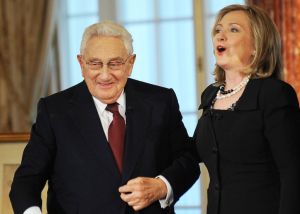
At the March 9 Democratic debate, Hillary Clinton had this to say about competitor Bernie Sanders’s favorable comments on Castro’s Cuba and the Sandinista regime in the ’80s:  “if the values are that you oppress people, you disappear people, imprison people or even kill people for expressing their opinions…, that is not the kind of revolution of values that I ever want to see anywhere.” This, coming from a former Secretary of State who backed a right-wing coup in Honduras and proudly name-drops Henry Kissinger — Henry Kissinger! — as a close friend and mentor, is the kind of thing the Onion can’t compete with.

If Kissinger was known for anything in his years as National Security Adviser and Secretary of State, it was installing dictators who oppressed, disappeared and imprisoned people. He oversaw a wave of coups that swept South America in the late ’60s and ’70s, installing right-wing military regimes that tortured, murdered or disappeared dissidents by the thousands, and where a common fate for labor and peasant activists was to be found in a ditch with their faces hacked off. Under Kissinger the U.S. actively supported Operation Condor — the program by which these South American dictators used torture and murder to suppress opposition — with military aid and technical assistance. He gave the green light to Indonesia’s genocidal invasion of East Timor.

Clinton has a long history of close personal friendship with this monster, and indeed touts herself as something of a protege. According to both Hillary and Bill, Kissinger praised her for running the State Department better than anybody in decades. And well might he praise her, because she’s followed in his footsteps in many ways. As Secretary of State, she oversaw the sale of millions of dollars worth of arms to despotic regimes that oppressed, disappeared and imprisoned people for expressing their opinions — many of which regimes were also large donors to the Clinton Foundation. And while we’re on the subject of people being murdered and disappeared, how about Berta Caceres — an activist murdered by the right-wing Honduran regime whose seizure of power Clinton backed in 2009?

As senator, Clinton voted to authorize George Bush’s criminal war of aggression on Iraq, which has resulted in hundreds of thousands of Iraqi deaths since 2003. She says now it was “a mistake.” It was a mistake all right. She mistakenly believed the vote would make her more viable as a future presidential candidate. She mistakenly predicted the way the political winds would be blowing when she decided to run for president.

And don’t forget Clinton’s support for the Obama administration’s indiscriminate use of drones for extrajudicial killing. Many of the victims were civilians, and hundreds of them were actually children.

If you add it all up, Hillary Clinton still isn’t quite the war criminal her old friend and mentor Henry Kissinger is. Those are some big, bloody shoes to fill. But if she’s elected she’ll grow into them.