Spolier Alert: if you want to watch an excellent 30-minute film without knowing what happens, scroll down and watch it before reading any of these words.
We’ve long known that U.S. mass-shooters are disproportionately trained in shooting by the U.S. military. I don’t know whether the same applies to those who kill in the U.S. with bombs. I wouldn’t be surprised if the connection were even greater.
The Oscar-nominated short film Stranger at the Gate tells the story of a man who went from a difficult childhood straight into the U.S. military at 18.
When learning to shoot at paper targets, he had concerns about killing actual people. He recounts being given the advice that if he could look at those he would kill as anything other than human he would have no problems. So, that, he says, is what he did.
But, of course, conditioning people to thoughtlessly kill doesn’t provide them with any way of being unconditioned again, of comfortably ceasing to be self-deceptive murderers.
This guy went off to U.S. wars where he killed people he thought of as Muslims. The characterization of the people killed as belonging to an evil religion, was largely a game of military propaganda. The actual motivations of those picking the wars tended to have more to do with power, global domination, profits, and politics. But bigotry has always been used to sucker the rank and file into doing what’s desired.
Well, this good soldier did his job and returned to the United States believing that he had done his job, and that that job had been to kill Muslims because of the evil of Muslims. There was no Off switch.
He was troubled. He was drunk. The lies didn’t rest easily. But the lies had a tighter grip than the truth. When he saw that there were Muslims in his hometown, he believed he needed to kill them. Yet he grasped that he would no longer be praised for it, that he would now be condemned for it. Even so, he still believed in the cause. He decided that he would go to the Islamic Center and find proof of the evil of the Muslims that he could show everyone, and then he would blow the place up. He hoped to kill at least 200 people (or non-people).
The men and women at the Islamic Center welcomed him and transformed him.
In the United States today one may want to rewrite this line:
“Do not neglect to show hospitality to strangers, for by so doing some people have entertained angels without knowing it.”
in this way:
“Do not neglect to show hospitality to strangers, for by so doing some people have entertained would-be mass-murderers without knowing it.”
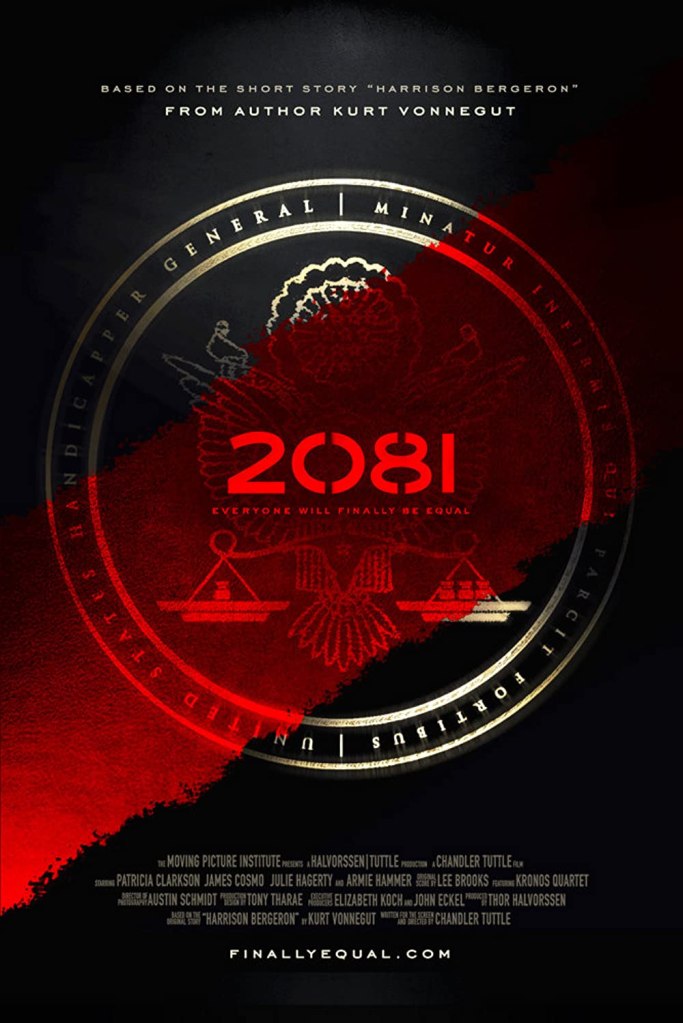
2081 is a 2009 science fiction featurette which premiered at the Seattle International Film Festival on May 29, 2009. It is directed and written by Chandler Tuttle, based on the 1961 short story “Harrison Bergeron” by author Kurt Vonnegut. The cast is led by James Cosmo, Julie Hagerty, Patricia Clarkson, and Armie Hammer. The story paints a picture through the use of hyperbole of a future in which a powerful, dictatorial government goes to extreme measures to ensure that absolute equality exists between all individuals.
“Shadow Puppets” (1994) is black and white animated dystopian short by Chuck Gamble and was featured at the Human Rights Watch Film Festival. The at times bleak and hopeful story depicts a button-pushing drone’s existence in a totalitarian world where his only escape is through making shadow puppets with his hands. When he tragically loses this ability he finds a way to persevere.
With films like Swipe, Shehr e Tabassum, Pakistan’s Puffball Studio depicts dystopias that feel all too real
An app that mirrors mob justice. A dystopia where smiling is the only expression allowed. Pakistan’s Puffball Studio and its founder Arafat Mazhar skewer the mechanisms of intolerance and hate through their films.
In the animated short film Shehr e Tabassum, the ‘Supreme Leader’ of a dystopian Pakistan in 2071 passes a law declaring all expressions other than smiling a crime. It’s the state’s way of manufacturing both consent and a flimsy yet persuasive image of a happy civilisation. People who refuse are deemed as traitors. The drugged, exclusionary vision of the future that the short film offers is eerily echoed by the present of many countries around the world.
Mimicking to an extent the consumerist hell of Blade Runner, Shehr e Tabassum released earlier this year on YouTube. Behind the film is Puffball Studio, a group of young creators from the country, led by Arafat Mazhar. In November, Puffball released its second film Swipe, a Black Mirror-ish reflection of the intolerance of today, through the lens of technology. In Swipe, an app basically mimics mob justice, by enabling users to have people executed via a simple swipe.
“My research has been centered around the way ideas like ghairat (honour), ishq (love) ghaddar (traitor) and tauheen (insult) have been distorted in the recent past and forcibly circumscribed to violence while at the same time, the definition for blasphemous or traitorous acts continue to broaden,” Mazhar says. Curiously, the protagonist of Swipe is a child. “I have seen so many videos of young people at rallies organised by religious activists and NGOs calling for violence against other groups, videos of children taking part in mob violence. I can’t help but think that we’re failing our children when we teach them manufactured meanings of honour and love that are devoid of any spirituality,” he adds.
Mazhar and his team created Swipe during the pandemic. The intersection of technology and culture is something the filmmaker has always been interested in. He also leads other initiatives like Engage Pakistan, a project that counters the country’s blasphemy laws with research and alternative histories. Procuring funding for all these projects can’t possibly be a cakewalk.
“Swipe and Shehr e Tabassum were both self-financed for the most part,” Mazhar explains. “What helps is that our team is very versatile: we have excellent traditional artists but also an excellent 3D and motion graphics team which means that we do premium service work for clients too. Aside from that, we also have an alternative critical histories channel called Hashiya, where we collaborate with local and international universities to create historical short films and explainers.”
Both Shehr e Tabasum and Swipe cross paths with technology, intolerance and the brutalising nature of consumerist economies. If empathy and humanism are shown the door, the natural course culture takes is the commodification of everything human — from faith to love. It’s a lesson the young protagonist of Swipe learns the hard way.
“We knew from the outset that both Shehr e Tabassum and Swipe would be unapologetically political films but I was just as set on making them a thrilling and evocative experience for viewers. So when we wanted to explore how different fundamental freedoms — to express, to protest etc. — are stifled in a hyper-surveillant and increasingly oppressive society, we used the allegory of a smile as the only expression allowed to citizens,” Mazhar says of his first film.
“Other times, the story writes itself: when we wanted to show a city hooked to an app (iFatwa) that generates allegations against citizens and gamifies extrajudicial violence, we would look to news stories around us to draw inspiration for the app cases,” he adds about Swipe. (The anecdotal stories that feature on iFatwa are reminiscent of outrage we witness every other day on this side of the border.)
Through both films, Mazhar channels a kind of activism that he promises the group will continue to work on. But with activism these days comes the risk of outing yourself to trolls and self-appointed moralists. It’s a price some have paid heavily for on both sides of the border, and perhaps around the world.
“I believe storytelling, fiction or otherwise, speaks to possibilities of greater awareness, understanding and connection between people and communities. I believe in creating art that speaks to our collective humanity, that forces us to think beyond our biases and our conditioned hate towards those who are different from us. With Swipe, there was no pretense about what we had set out to do: we aren’t claiming to change the fabric of our society or our thinking. Swipe is just a heartfelt plea to pause and reflect collectively,” Mazhar says.
Filmmaking is hard enough; such provocative, truthful and political filmmaking even more so. “For those who attack us online because they fear an agenda behind our films, I always try and respond to their anxieties which usually stem from perceived threats to tradition, religion, etc. Beyond that, there isn’t much that anyone can do. I think our viewers recognise and appreciate that though our films are uncomfortable to watch, they go beyond mere cynicism and derision,” Mazhar says, optimistic that his work will be afforded the tolerance his films paint the absence of.
After taking a walk through a remote Welsh valley, Peter committed himself to a life there, and disconnected from the outside world. In doing so, he found a solitary inner peace – a peace he maintained for nearly three decades, until, one day, he stumbled upon a lamb that had been left for dead. Finding kinship with the fellow ‘dropout’, Peter took the abandoned creature home and named him Ben. The short Peter and Ben (2007) by the UK filmmaker Pinny Grylls captures the duo’s relationship three years after their chance meeting, as Peter attempts to return Ben to the wild. With a melancholic piano score and sweeping views of the Welsh countryside, her touching film lends a lyrical beauty to this tale of unlikely connection and camaraderie between outsiders.
“Simply mind-blowing. A must see!” – Niels Matthijs, Screen Anarchy
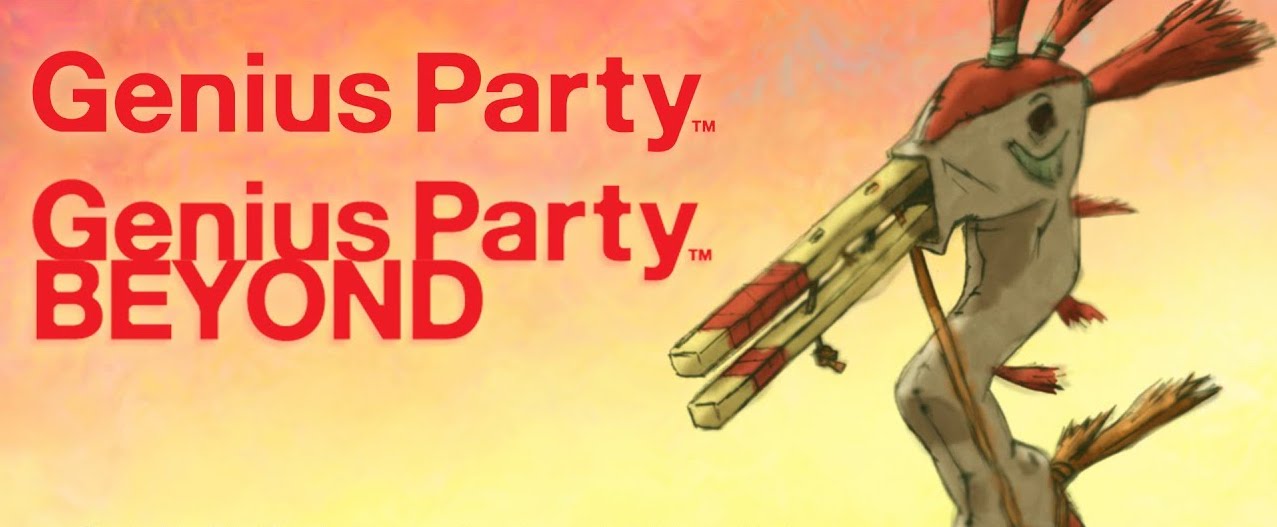
From groundbreaking animation outfit STUDIO 4°C (MFKZ, Mind Game) comes two extraordinary projects with a shared, simple vision: to take an all-star team of some of the best animators working in anime today, and give each free reign to tell a unique short story built around “the spirit of creativity.” The results are GENIUS PARTY and GENIUS PARTY BEYOND, two animated anthology films featuring contributions from directors Shoji Kawamori, Shinichiro Watanabe, Masaaki Yuasa, Mahiro Maeda, and many others. Full of boundless imagination, fantastic worlds, and unique visual styles, these two acclaimed films are now available for the first time in North America.
“Next Floor” (2008) is a Canadian short directed by Denis Villeneuve. The mostly wordless film depicts a decadent banquet attended by servers and valets, with eleven gluttonous guests endlessly engorging themselves until they reach a sudden limit to their apparent abundance.
Rakka is the story of broken humanity following the invasion of a technologically superior alien species. Bleak, harrowing and unrelenting, the humans we meet must find enough courage to go on fighting.
Directed by Neill Blomkamp and starring Sigourney Weaver.






 After the Crash