The Varieties of Psychonautic Experience: Erik Davis’s ‘High Weirdness’

Art by Arik Roper

By Michael Grasso

Source: We Are the Mutants

High Weirdness: Drugs, Esoterica, and Visionary Experience in the Seventies
By Erik Davis
Strange Attractor Press/MIT Press, 2019

Two months ago, I devoured Erik Davis’s magisterial 2019 book High Weirdness: Drugs, Esoterica, and Visionary Experience in the Seventies the same weekend I got it, despite its 400-plus pages of sometimes dense, specialist prose. And for the past two months I have tried, in fits and starts, to gather together my thoughts on it—failing every single time. Sometimes it’s been for having far too much to say about the astonishing level of detail and philosophical depth contained within. Sometimes it’s been because the book’s presentation of the visionary mysticism of three Americans in the 1970s—ethnobotanist and psychonaut Terence McKenna, parapolitical trickster Robert Anton Wilson, and paranoid storyteller-mystic Philip K. Dick—has hit far too close to home for me personally, living in the late 2010s in a similarly agitated political (and mystical) state. In short, High Weirdness has seemed to me, sitting on my bookshelf, desk, or in my backpack, like some cursed magical grimoire out of Weird fiction—a Necronomicon or The King in Yellow, perhaps—and I became obsessed with its spiraling exploration of the unfathomable universe above and the depthless soul below. It has proven itself incapable of summary in any linear, rationalist way.

So let’s dispense with rationalism for the time being. In the spirit of High Weirdness, this review will try to weave an impressionistic, magical spell exploring the commonalities Davis unveils between the respective life’s work and esoteric, drug-aided explorations of McKenna, Wilson, and Dick: explorations that were an attempt to construct meaning out of a world that to these three men, in the aftermath of the cultural revelations and revolutions of the 1960s that challenged the supposed wisdom and goodness of American hegemony, suddenly offered nothing but nihilism, paranoia, and despair. These three men were all, in their own unique ways, magicians, shamans, and spiritualists who used the tools at their disposal—esoteric traditions from both East and West; the common detritus of 20th century Weird pop culture; technocratic research into the human mind, body, and soul; and, of course, psychedelic drugs—to forge some kind of new and desperately-needed mystical tradition in the midst of the dark triumph of the Western world’s rationalism.

A longtime aficionado of Weird America, Davis writes in the introduction to High Weirdness about his own early encounters with Philip K. Dick’s science fiction, the Church of the SubGenius, and other underground strains of the American esoteric in the aftermath of the ’60s and ’70s. As someone who came late in life to a postgraduate degree program (High Weirdness was Davis’s doctoral dissertation for Rice University’s Religion program, as part of a curriculum focus on Gnosticism, Esotericism, and Mysticism), I find it incredibly easy to identify with Davis’s desire to tug at the edges of his longtime association with and love for the Weird in a scholarly context. This book’s scholarly origins do not make High Weirdness unapproachable to the layperson, however. While Davis does delve deeply into philosophical and spiritual theorists and the context of American mysticism throughout the book, he provides succinct and germane summaries of this long history, translating the work of thinkers as diverse as early 20th century psychologist and student of religious and mystical experience William James to contemporary theorists such as Peter Sloterdijk and Mark Fisher. Davis’s introduction draws forth in great detail the long tradition of admitting the ineffable, the scientifically-inexplicable, into the creation of subjective, individual mystical experiences.

Primary among Davis’s foundational investigations, binding together all three men profiled in the book, is a full and thorough accounting of the question, “Why did these myriad mystical experiences all occur in the first half of the 1970s?” It’s a fairly common historical interpretation to look at the Nixon years in America as a hangover from the cultural revolution of the late 1960s, a retrenchment of Nixon’s “silent majority” of middle- and working-class whites vs. the perceived chaos of a militant student movement and identity-based politics among racial and sexual minorities. Davis admits that the general mystical seeking that went on in the early ’70s is a reaction to this revanchism. And while he quotes Robert Anton Wilson’s seeming affirmation of this idea—“The early 70s were the days when the survivors of the Sixties went a bit nuts”—his interest in the three individuals at the center of his study allows him to delve deeper, offering a more profound explanation of the politics and metaphysics of the era. In the immediate aftermath of the assassinations, the political and social chaos, and the election of Nixon in 1968, there was an increased tendency among the younger generation to seek alternatives to mass consumption culture, to engage in what leftist philosopher Herbert Marcuse would term “the Great Refusal.” All three of the figures Davis focuses on in this book, at some level or another, decided to opt out of what their upbringings and conformist America had planned for them, to various levels of harm to their livelihoods and physical and mental health. This refusal was part of an awareness of what a suburban middle-class life had excised from human experience: a sense of meaning-making, of a more profound spirituality detached from the streams of traditional mainline American religious life.

To find something new, the three men at the center of High Weirdness were forced to become bricoleurs—cobbling together a “bootstrap witchery,” in Davis’s words—from real-world occult traditions (both Eastern and Western); from the world of Cold War technocratic experimentation with cybernetics, neuroscience, psychedelics, and out-and-out parapsychology; and from midcentury American pop culture, including science fiction, fantasy, comic books, and pulp fiction. Davis intriguingly cites Dick’s invention of the term “kipple” in his 1968 novel Do Androids Dream of Electric Sheep? as a key concept in understanding how this detritus can be patched together and brought new life. Given Dick’s overall prescience in predicting our 21st century world of social atomization and disrepair, this seems a conceptual echo worth internalizing a half-century later. If the late 1960s represented a mini-cataclysm that showed a glimpse of what a world without the “Black Iron Prison” might look like, those who graduated to the 1970s—the ones who “went a bit nuts”—needed to figure out how to survive by utilizing the bits and scraps left behind after the sweeping turbulence blew through. In many ways, McKenna, Wilson, and Dick are all post-apocalyptic scavengers.

All three men used drugs extensively, although not necessarily as anthropotechnics specifically designed to achieve enlightenment (Davis notes that Dick in particular had preexisting psychological conditions that, in conjunction with his prodigious use of amphetamines in the 1960s, were likely one explanation for his profound and sudden breaks with consensus reality in the ’70s). But we should also recognize (as Davis does) that McKenna, Wilson, and Dick were also, in many ways, enormously privileged. As well-educated scions of white America, born between the Great Depression and the immediate aftermath of World War II, they had the luxury to experiment with spirituality, psychedelic drugs, and technology to various degrees while holding themselves consciously separate from the mainstream institutions that would eventually co-opt and recuperate many of these strains of spirituality and individual seeking into the larger Spectacle. As Davis cannily notes, “Perhaps no one can let themselves unravel into temporary madness like straight white men.” But these origins also help explain the expressly technocratic bent of many of their hopes (McKenna) and fears (Wilson and Dick). Like their close confederate in Weirdness, Thomas Pynchon (who spent his early adulthood working for defense contractor Boeing, an experience which allowed him a keener avenue to his literary critiques of 20th century America), all three men were adjacent to larger power structures that alternately thrilled and repelled them, and which also helped form their specific esoteric worldviews.

It would be a fool’s errand to try to summarize the seven central chapters of the book, which present in great detail Terence (and brother Dennis) McKenna’s mushroom-fueled experiences contacting a higher intelligence in La Chorrera, Colombia in 1971, Robert Anton Wilson’s LSD-and-sex-magick-induced contact with aliens from the star Sirius in 1973 and ’74 as detailed in his 1977 book Cosmic Trigger: The Final Secret of the Illuminati, and Philip K. Dick’s famous series of mystical transmissions and revelations in February and March of 1974, which influenced not only his fiction output for the final eight years of his life but also his colossal “Exegesis,” which sought to interpret these mystical revelations in a Christian and Gnostic context. Davis’s book is out there and I can only encourage you to buy a copy, read these chapters, and revel in their thrilling detail, exhilarating madness, and occasional absurdity. Time and time again, Davis, like a great composer of music, returns to his greater themes: the environment that created these men gave them the tools and technics to blaze a new trail out of the psychological morass of Cold War American culture. At the very least, I can present some individual anecdotes from each of the three men’s mystical experiences, as described by Davis, that should throw some illumination on how they explored their own psyches and the universe using drugs, preexisting religious/esoteric ritual, and the pop cultural clutter that had helped shape them.

Davis presents a chapter focusing on each man’s life leading up to his respective spiritual experiences, followed by a chapter (in the case of Philip K. Dick, two) on his mystical experience and his reactions to it. For Terence McKenna and his brother Dennis, their research into organic psychedelics such as the DMT-containing yagé (first popularized in the West in the Cold War period by William S. Burroughs), alternately known as oo-koo-hé or ayahuasca, led them to South America to find the source of these natural, indigenous entheogens. But at La Chorrera in Colombia they instead met the plentiful and formidable fungus Psilocybe cubensis. In their experiments with the mushroom, Terence and Dennis tuned into perceived resonances with long-dormant synchronicities within their family histories, their childhood love of science fiction, and with the larger universe. Eventually, Dennis, on a more than week-long trip on both mushrooms and ayahuasca, needed to be evacuated from the jungle, but not before he had acted as a “receiver” for cryptic hyper-verbal transmissions, the hallucinogens inside him a “vegetable television” tuned into an unseen frequency—a profound shamanic state that Terence encouraged. The language of technology, of cybernetics, of science is never far from the McKenna brothers’ paradigm of spirituality; the two boys who had spent their childhoods reading publications like Analog and Fate, who had spent their young adulthoods studying botany and science while deep in the works of Marshall McLuhan (arguably a fellow psychedelic mystic who, like the McKennas and Wilson, was steeped in a Catholic cultural tradition), used the language they knew to explain their outré experiences.

Wilson spent his 20s as an editor for Playboy magazine’s letters page and had thus been exposed to the screaming gamut of American political paranoia (while contributing to it in his own inimitable prankster style). He had used this parapolitical wilderness of mirrors, along with his interest in philosophical and magickal orientations such as libertarianism, Discordianism, and Crowleyian Thelema as fuel for both the Illuminatus! trilogy of books written with Robert Shea (published in 1975), and his more than year-long psychedelic-mystical experience in 1973 and 1974, during which he claimed to act as a receiver on an “interstellar ESP channel,” obtaining transmissions from the star Sirius. His experiences as detailed in Cosmic Trigger involve remaining in a prolonged shamanic state (what Wilson called the “Chapel Perilous,” a term redolent with the same sort of medievalism as the McKenna brothers’ belief that they would manifest the Philosopher’s Stone at La Chorrera), providing Wilson with a constant understanding of the universe’s playfully unnerving tendency towards coincidence and synchronicity. Needless to say, the experiences of one Dr. John C. Lilly, who was also around this precise time tuned into ostensible gnostic communications from a spiritual supercomputer, mesh effortlessly with Wilson’s (and Dick’s) experiences thematically; Wilson even used audiotapes of Lilly’s lectures on cognitive meta-programming to kick off his mystical trances. Ironically, it was UFO researcher and keen observer of California’s 1970s paranormal scene Jacques Vallée who helped to extract Wilson out of the Chapel Perilous—by retriggering his more mundane political paranoia, saying that UFOs and other similar phenomena were instruments of global control. In Davis’s memorable words, “Wilson did not escape the Chapel through psychiatric disenchantment but through an even weirder possibility.”

Philip K. Dick, who was a famous science fiction author at the dawn of the ’70s, had already been through his own drug-induced paranoias, political scrapes, and active Christian mystical seeking. Unlike McKenna and Wilson, Dick was a Protestant who had stayed in close contact with his spiritual side throughout adulthood. In his interpretation of his mystical 2-3-74 experience, Dick uses the language and epistemology of Gnostic mystical traditions two millennia old. Davis also notes that Dick used the plots of his own most overtly political and spiritual ’60s output to help him understand and interpret his transcendent experiences. Before he ever heard voices or received flashes of information from a pink laser beam or envisioned flashes of the Roman Empire overlapping with 1970s Orange County California, Dick’s 1960s novels, specifically The Three Stigmata of Palmer Eldritch (1965) and Ubik (1969), had explored the very nature of reality and admitted the possibility of a Gnostic universe run by unknowable, cruel demiurges. Even in these hostile universes, however, there exists a messenger of hope and mercy who seeks to destroy the illusion of existence and bring relief. These existing pieces of cultural and religious “kipple,” along with the parasocial aspects of Christian belief that were abroad in California at the time, such as the Jesus People movement (the source of the Ichthys fish sign that triggered the 2-3-74 experience), gave Dick the equipment he needed to make sense of the communications he received and the consoling realization that he was not alone, that he was instead part of an underground spiritual movement that acted as a modern-day emanation of the early Christian church.

After learning about these three figures’ shockingly similar experiences with drug-induced contact with beyond, the inevitable question emerges: what were all these messages, these transmissions from beyond, trying to convey? One common aspect of all three experiences is how cryptic they are (and how difficult and time-consuming it was for each of these men to interpret just what the messages were saying). It’s also a little sobering to discover through Davis’s accounts how personal all three experiences were, whether it’s Terence and Dennis’s private fraternal language during the La Chorrera experiment, or mysterious phone calls placed back in time to their mother in childhood, or a lost silver key that Dennis was able to, stage-magician-like, conjure just as they were discussing it, or the message Philip K. Dick received to take his son Christopher to the doctor for an inguinal hernia that could have proven fatal. But alongside these personal epiphanies, there is also always an undeniable larger social and political context, especially as both Wilson and Dick saw their journeys in 1973 and 1974 as a way to confront and deal with the intense paranoia around Watergate and the fall of Richard Nixon (in his chapter setting the scene of the ’70s, Davis calls Watergate “a mytho-poetic perversion of governance”). In every case, the message from beyond requires interpretation, meaning-making, and, in Davis’s terminology, “constructivism.” The reams of words spoken and written by all three men analyzing their respective mystical experiences are an essential part of the experience. And these personal revelations all are attempts by the three men to make sense of the chaos of both their personal lives and their existence in an oppressive 20th century technocratic society: to inject some sense of mystery into daily existence, even if it took the quasi-familiar and, yes, somewhat comforting form of transmissions from a mushroom television network or interstellar artificial intelligence.

Over the past nine months I’ve spent much of my own life completing (and recovering from the process of completing) a Master’s degree. My own academic work, focusing on nostalgia’s uses in binding together individuals and communities with their museums, tapped into my earliest memories of museum visits in the late 1970s, when free education was seemingly everywhere (and actually free), when it was democratic and diverse, when it was an essential component of a rapidly-disappearing belief in social cohesion. In a lot of ways, my work at We Are the Mutants over the past three years is the incantation of a spell meant to conjure something new and hopeful from the “kipple” of a childhood suffused in disposable pop culture, the paranormal and “bootstrap witchery,” and science-as-progress propaganda. At the same time, over the past three years the world has been at the constant, media-enabled beck and call of a figure ten times more Weird and apocalyptic and socially malignant than any of Philip K. Dick’s various Gnostic emanations of Richard Nixon.

Philip K. Dick believed he was living through a recapitulation of the Roman Empire, that time was meaningless when viewed from the perspective of an omniscient entity like VALIS. In the correspondences and synchronicities I have witnessed over the past few months—in the collapse of political order and the revelation of profound, endemic corruption behind the scenes of the ruling class—this sense of recurring history has sent me down a similar set of ecstatic and paranoid corridors as McKenna, Wilson, and Dick. The effort to find meaning in a world that once held some inherent structure in childhood but has become, in adulthood, a hollow facade—a metaphysical Potemkin village—is profoundly unmooring. But meaning is there, even if we need technics such as psychedelic drugs, cybernetics (Davis’s final chapter summarizing how the three men’s mystical explorations fed into the internet as we know it today is absolutely fascinating), and parapolitical activity to interpret it. On this, the 50th anniversary of the summer of 1969, commonly accepted as the moment the Sixties ended, with echoes of moon landings and Manson killings reverberating throughout the cultural theater, is it any wonder that the appeal of broken psychonauts trying to pick up the pieces of a shattered world would appeal to lost souls in 2019? High Weirdness as a mystical tome remains physically and psychically close to me now, and probably will for the remainder of my life; and if the topics detailed in this review intrigue you the way they do me, it will remain close to you as well.

Saturday Matinee: Quest

By Jonathan Crow

Source: Open Culture

Saul Bass was one of the greatest graphic designers who ever lived. He created the logos for such ubiquitous organizations as AT&T, United Airlines and the Girl Scouts of America. He revolutionized the art of movie titles in such films as The Man with the Golden Arm, Vertigo and West Side Story. He may or may not have designed the famous shower sequence in Alfred Hitchcock’s Psycho. His design work was always marked by a clean, highly graphic style that you can pick out a mile away.

Yet when Bass got a chance to actually direct, he didn’t make slick movies with simple plots and great visuals, as you might expect. Instead, he made profoundly trippy movies with great visuals. His one and only feature film, Phase IV (1974), is a deeply weird movie about evolution. Think of it as a low-budget 2001: A Space Odyssey. With ants. The movie was butchered by scared distributors and consequently, it bombed at the box office.

Almost a decade later, Bass, along with his second wife Elaine, made a short film called Quest, based on Ray Bradbury’s story “Frost and Fire.” You can watch it above.

The film centers on a tribe of robe-sporting people who live for only a mere eight days. If you’re an infant on a Monday, you will be elderly by the time the next Monday rolls around. At the opening, a nameless child is born as his elders ask in hushed tones, “Is this the one?” Of course he is. The reason he and his tribe have a shorter shelf life than grocery store sushi has something to do with a gate that blocks life sustaining light. “Beyond the great gate,” intones one elder, “people live 20,000 days or more.” The problem is that gate is five or so days away by foot.

So after a very brief training montage, the youth sets off across strange and fanciful landscapes that recall Yes album covers. Along the way, he faces down a beast that looks like a bear crossed with a lamprey, plays a video game with a Yeti on top of a ziggurat, and stumbles across a wizened old man who only the previous week was the tribe’s golden boy.

The movie is incredibly, hilariously dated, so much so that it goes right past kitsch into something close to sublime. If you remember watching, and loving, The Dark Crystal, Beast Master, Krull and Tron in your youth, you must check this out.

Saturday Matinee: Southland Tales

In defence of Southland Tales – Richard Kelly’s futuristic folly

The director’s much-maligned second feature is a vigorous piece of pulp for the 21st century.

By Dominic Jaeckle

Source: Little White Lies

It’s November 2016, and Richard Kelly is sat in a Los Angeles restaurant dining with a newspaper journalist. They talk a little about the cult consensus surrounding the reissue of his 2001 debut, Donnie Darko, but the main topic on the table is Kelly’s reemergence following a long period of inactivity. Both writer and subject are eager to discuss the director’s ill-fated second feature, Southland Tales, which celebrates its tenth anniversary this year.

Endeavouring to reappraise the film, the journalist would later dub it “a pre-game show for the next decade of global misery” when he finally put pen to paper. Revisiting Southland Tales in 2017, however, it’s not only the speculative powers of the film that sing. What also resonates is the quiet conflict between commercial and contextual providence when we’re trying to read popular cinema, to hold it up against the world.

Kelly’s playbook, defined as it is by hypothetical disorder, frames an associative reservoir of contemporary symbolisms in which critics will swim. Searching for a sense of the inherent value of Southland Tales, some look for its hidden depths; others, the flat veneer of its surface. But the absence of consensus around the film feels entirely appropriate.

Taking the newsfeed as a stylistic turn, Southland Tales weaves together various subplots, dead-ends, and vignettes in the form of a rolling newscast. Set against the backdrop of nuclear war in America – the bomb having landed in Abilene, Texas – we find a country in meltdown. State borders are closed, and extensions of the Patriot Act have allowed intelligence services to function unmonitored. On the west coast, a neo-Marxist revolution is falling into chaotic failure around Venice Beach, and an actor named Boxer Santaros (Dwayne Johnson) – having married the debutante of some Republican house of cards – has lost his memory. Now hiding out in Los Angeles, he runs with Krysta Now (Sarah Michelle Gellar), an ambitious and entrepreneurial ex-porn star.

Together, Gellar and Johnson are penning a screenplay, a cop movie entitled ‘The Power’. But amid its attention to the trappings of genre, the script holds some answers to a spiritual foreboding prompted by an impending energy crisis stayed, only, by the numinous capabilities of a scientist (Wallace Shawn). A figure shrouded in a fog of incense, mystic vagaries and influence owing to the financial backing of a mysterious German multinational.

Seann William Scott stars as two police officers who are not allowed to meet, should they rupture a temporal continuum, and the film is ambiently scored by hotel lobby-era Moby. Justin Timberlake, playing a misanthropic Iraq War veteran, establishes the dynamics of the film’s dénouement. Rather than place or time, Timberlake instead reads us a bastardisation of the Book of Revelation fused, throughout, with misquotes from high-modernist poetry. Repeatedly, he tells us that “this is the way the world ends.”

Southland Tales is a time capsule flirting with end-of-history ideologues. It is a joke on the very idea of the running order of recent history. Self-identifying as a parable playing on a cultural implosion of operatic proportions, it runs as a look-book of early 21st century anxieties. It’s a speculative three-act riff on the catastrophic failings of the last 10 years, a fever dream in two hours and twenty-five minutes. Kelly’s film is a carrion call for a new culture of private consumption. Its characters can do little but watch one another, and the film milks its ignoble examination of mass consumerism through depiction of a dystopian reality defined by tragic inevitability and heavy self-consciousness. “I feel like sometimes things just need time to marinate,” Kelly has said; he always wanted us to read the film forwards.

This is a murky film, no question, but Kelly has suggested that key to understanding its meaning is the intellectual scope of its centrepiece scene: a three-minute dance routine. Around the halfway mark, a doped-out Timberlake slips into an opiate induced coma. In a fantasy sequence – blood down his shirt, Budweiser in hand – he dances through a thoroughly 20th century panorama, a pinball arcade, flanked by a chorus of dancers all legs and vinyl. He looks straight down the camera, lip-syncing his way through The Killer’s ‘All These Things That I’ve Done’, whose anthemic drive is matched only by the empty opacity of its lyrics. “All these things that I’ve done” – the song is about meaning read backwards, the ownership of experience, an inversion of the speculation showcased throughout Southland Tales. The engagement of its terms here feels like a play on use-value; it’s a psalm for our private habits as viewers.

If watching rather than knowing is our active-verb in Southland Tales, then the song proves vital. Meaningless in its aim for universalism, a pop song only resonates in the right room, when played in the right context, and recalling it – personalising its terms – becomes a statement of value. That’s a perfect picture of the vitality of Southland Tales – a vigorous piece of pulp for the 21st century, it courts that very idea. It wants to be used; the film wants to mount a consideration of the cumulative character of meaning, how popular cinema is always contingent on popular feeling.

At first, what we have seems like a mess of ideas. But give it time, let those ideas marinate, and we’re left with something more. Kelly’s joke, still intact 10 years later, is that there will always be a solitary ‘I’ as far as consumption is concerned. In 2007, Southland Tales was simply out of step, waiting for new platforms for personal entertainment, for the semiotic carry-on instigated by streaming cultures. It’s a film honed for the minute when cinema would feel more like a private habit than a public spectacle.


Watch the full film here.

Saturday Matinee: Endangered Species

A Strange Harvest: Alan Rudolph’s ‘Endangered Species’

By Michael Grasso, K.E. Roberts, Richard McKenna

Source: We Are the Mutants

GRASSO: When our esteemed editor-in-chief recommended we look this week at the little-heralded-nor-remembered Endangered Species from 1982, I was cautiously optimistic. A B-movie starring Robert Urich, JoBeth Williams, Paul Dooley, and Hoyt Axton about cattle mutilations, shot on location in Colorado and Wyoming? I consider myself well-versed in movies about UFOs from the late ’70s and early ’80s, and the fact I’d never heard of this one was a real shock. To my further shock, the film was amazing: fascinating as both a time capsule of the early Reagan years and as a piece of weird outsider art/conspiratorial agitprop. In fact, in Mutant Chat this week I called Endangered Species “the last great 1970s political conspiracy thriller”; with a few days to mull over this assessment, I stand by it even more assertively. Endangered Species seamlessly and expertly weaves together all the threads of cattle mutilation lore as they currently stood in 1982, all while engaging the kind of B-plots that are characteristic of similar movies from this time period: a shoehorned (and slightly icky) romance between the two leads, a plucky teenage character for the teens in the audience to identify with, and a good chunk of edgy blood and gore (not just from the aforementioned mutilated cattle).

So I just have to ask before getting into the details and why I loved this trashy piece of late-night ’80s cable fare—Kelly, how in the hell did you find out about this thing?

ROBERTS: I remember this flick from the video store, but I never watched it (not that I remember, anyway) until about a year ago. Conspiracy films became a genre unto themselves after Watergate, as did UFO films after 1977’s Close Encounters. Endangered Species merges both—one of the few examples of such before The X-Files (1980’s Hangar 18, produced by exploitation experts Sunn Classic Pictures, is another). The campy elements are there, for sure, but overall I agree with you, Mike: this is a very interesting portrait of ramped-up paranoia during the high Cold War period that hits a surprising number of now well-known genre staples: “silent” black helicopters, chemical and germ warfare, keeping up with the Russians, moving vans that disguise shadowy government conspirators, references to satanism. Although the script can’t quite live up to the premise, the opening sequence that moves from a herd of cows in rural Colorado to a herd of humans rushing through the streets of NYC makes the point perfectly clear: our government makes no distinction between cows and people; we are all dumb beasts whose purpose is to be sacrificed for the preservation of the bastards in power.

MCKENNA: Jesus but it’s been a while since I last saw a mainstream film that felt as out-of-control as Endangered Species. I had a vague recollection of watching it, but apparently it was one of those false memories engendered by spending too long staring at the VHS covers down the rental shop, hence it was totally new to me. It comes on like an aggressive cross between a self-aware B-movie and an oddball independent cinema artifact, so it’s no surprise that director Alan Rudolph was a protégé of Robert Altman. Prior to Endangered Species, Rudolph had made a string of low-budget, intelligent, critically acclaimed films in a variety of genres. And Endangered Species is fucking great, despite the many odd and sometimes unpleasant things about it, which include what can’t help feeling like a bit of a cavalier attitude to animal welfare and Robert Urich’s awful yet incongruously multifaceted “hero” Ruben Castle. Castle is one of the most irritating and borderline repellent protagonists I can remember seeing posited as a good guy and romantic lead, despite which he’s given to flashes of grace and insight. Given Rudolph’s smarts, it’s intriguing to wonder if the character wasn’t a deliberate piss-take of bullheaded thuggish machismo—in fact, it’s sometimes hard to tell whether Endangered Species is actually stupid or just playing at it.

You mention Close Encounters, Kelly, and in some ways the whole film almost feels like a compelling satire-mashup of Spielbergian motifs, from the casting right down to the Sugarland Express-like motorcade of cars that provides the film with one of its most memorable images, as well as the disguised trucks containing government technology, like the ones used to ferry Francois Truffaut’s benevolent scientific staff across the US, though here ferrying something much less benign.

Rudolph’s direction is lucid and kinetic, the editing surprising, the acting pretty great, and the script off the wall enough to have its moments, but what is perhaps most surprising about it— especially given how early on it’s made clear that the UFOs are a cover for military–industrial complex shenanigans—is that Endangered Species somehow manages to remain oddly frightening (thanks in part to a deeply unsettling score by Gary Wright) and convincingly transfers the eerie atmosphere initially engendered by the non-sequitur aerial shots of rampaging livestock and rumors of heifer-lasering ETs to government conspiracies equally inhuman and incomprehensible.

GRASSO: Kelly, you’re right: this really is a sui generis artifact of ufology at the outset of the ’80s, one that really bridges two distinct eras in the field. As the 1980s progressed, tales of close encounters were rapidly leaving behind encounters of J. Allen Hynek’s third kind (where entities can be sensed or glimpsed) and becoming more and more likely to be abductions where perceptions of the experiencer’s sense of reality were changed: i.e., encounters of Jacques Vallée’s fourth kind. The suspicion that the U.S. government might be in some ways covering up or working in cahoots with the UFOs also dates from the 1980s, as the Majestic-12 hoax documents began circulating a year or two after Endangered Species was released. (One of Majestic-12’s biggest proponents, investigative reporter Linda Moulton Howe, was also one of the earliest journalists to cover the cattle mutilation phenomenon.)

But ultimately I can’t think of another film from this period that is so decidedly Valléean in its almost fractal unfolding of putative UFO phenomena. In his 1979 Messengers of Deception, Vallée spends quite a bit of time looking at cattle mutilations in the American West. At the time, the classic mutilation event was over a decade old: the case of Snippy the Horse in 1967. Vallée examines how the costly mystery of the cattle mutilation phenomenon in the latter half of the ’70s gradually turned these ranchers from initially believing that UFOs were responsible to eventually believing some kind of government conspiracy were behind the mutilations. These streams of anti-government conspiratorial thought obviously flowed together with existing suspicion of government interference in ranching and land management in the West that would feed into the militia movements of the 1990s and beyond. (It’s interesting to note that JoBeth Williams’ Sheriff Harry character deputizes the entire town at the end of the film to confront the shadowy base on the edge of town; the idea of the posse comitatus was hugely inspirational to the anti-government militias forming in the West at this time.)

But let’s concede this much to the ranchers: their cattle were dying, and they had some reason to suspect government experiments. In Endangered Species, the paramilitary forces are abducting and experimenting on cattle to test biological weapons to be used against the Soviets. (This is probably the best place to note that both Peter Coyote’s and Dan Hedaya’s black ops operatives emit real sleazy menace in every scene they’re in; they don’t get much screen time, but for me they were by far the best part of the film.) These mysterious operatives are utterly dedicated to these experiments for “patriotic” reasons. In Coyote’s confrontation with Hoyt Axton’s big-time rancher, it’s obvious that Axton’s character’s patriotism was a big reason for his collaboration with the cattle mutilators (“I’m a patriot, Steele; I’d do anything for my country”), but after the murder of town newspaper editor Paul Dooley to keep the coverup intact, the black ops boys have gone too far for his tastes. “And you’re not in Guatemala takin’ pot-shots at barefoot natives,” Axton says to Coyote, putting the black ops conspirators firmly in the sphere of the CIA. It’s no surprise that Axton eventually dies a gruesome death; after a black-bag team taints his toothbrush with a mysterious agent, his guts literally fall out of him as an out-of-control hemorrhagic illness ravages his system. Obviously, we’re meant to be reminded of the kinds of domestic ops performed by CIA programs like MKUltra here, but it’s also interesting to see a bioweapon on screen in 1982 that is very similar to the Ebola virus (discovered by scientists in 1976). Government conspiracies involving Ebola/Marburg viruses were also au courant in the 1990s, as were beliefs that the U.S. government either had deliberately engineered or released the AIDS virus into the U.S. population at the end of the 1970s.

ROBERTS: I need to mention E.T.: the Extra-Terrestrial here. Released exactly two months before Endangered Species, Spielberg’s film also featured government agents (in this case, the FBI) spying on American citizens and actively seeking to keep the truth from them, prepared to use violence if necessary. Ultimately, the agents are portrayed as benevolent, even paternalistic, their boss (played by Peter Coyote!) revealed to be much like idealistic kid-hero Elliott—as well as a potential father figure to him. Endangered Species does not cop out in such a way (as Spielberg did in 2002 when digitally replacing the FBI’s guns in the chase scene with walkie-talkies, a tragic mistake he later rectified), and is much more disturbing because of it, as you guys mention. While a number of popular ’80s films take on the military-industrial complex and conspiracy, to some degree—The Manhattan Project (1986), The Philadelphia Experiment (1984), WarGames (1983), No Way Out (1987)—only John Carpenter’s They Live (1988) and Endangered Species offer an outright rejection of Reagan’s manipulative idealism.

The film missed an opportunity with JoBeth Willams (who had just starred in 1981’s Poltergeist), whose character we expect to be a man when she’s introduced as newly elected sheriff “Harry.” The camera follows her as she walks to the podium to get sworn in, her long hair tucked up under her hat. For a while, Harry gets to show off her investigatory chops, and even challenges Urich’s claim to hero status, until the predictable “Does she ever wear a dress?” comment gets trotted out, and she takes a backseat to a stock character (the burned-out, drunk NYC cop who’s dictating his first hard-boiled novel into a mini tape recorder).

MCKENNA: It’s true, the very talented JoBeth Willams isn’t used anywhere near as well as she could have been, and the situations the script puts her in range from patronizing to offensive, but despite that she still manages to give a performance that radiates humanity and realness. Playing Urich’s daughter, Marin Kanter (who also appeared in Ladies and Gentlemen, the Fabulous Stains the same year) is great too, as are all the various minor characters who evoke a convincing milieu of dickhead provincial bureaucracy.

In fact, Endangered Species is such a monster that even the poster’s a rocker, bringing together the lights in the sky from the alternate posters for E.T. with a light-grid (which appears in the film as part of the black ops tech used by the baddies) reminiscent of 1981’s Looker, giving it something of the feel of a summa of the zeitgeist. The whole thing quite clearly bears the greasy fingerprints of its executive producer, Zalman King. Better known for his screenplay for 1986 wank-fest 9½ Weeks and the erotic thrillers he subsequently directed, King had given a great performance four years previous to Endangered Species as the protagonist of Jeff Lieberman’s Blue Sunshine—another sort-of-countercultural horror-conspiracy movie—and was one of those people who seemed in some strange way to have the pulse of the unwholesome side of the popular culture, for better or worse. Endangered Species is yet more proof of that odd talent.

Another thing that struck me was the language used by the villains of the piece—a realistic-sounding form of the clinically euphemistic combat talk (which, like the conversations between scientists in 1980’s Altered States, makes you aware you are listening to professionals) that has now become commonplace but that feels surprisingly ahead-of-its-time in the context of the film. It not only gives Endangered Species a sheen of accuracy but also makes you wonder just how much this compellingly detached way of speaking about death and killing—because it is compelling, unfortunately—has contributed to normalizing, to whatever small extent, the kind of thinking that lies behind it.

GRASSO: As I said at the outset, Endangered Species feels a lot more like ’70s thrillers such as The Parallax View or Three Days of the Condor than your typical 1980s VHS fare. Even the ambiguous ending pretty much assures us that greater and more momentous injustices committed by U.S. government-aligned forces will likely continue, long after the credits roll. But it does diverge from those classic 1970s conspiracy thrillers in an important way: instead of the protagonists being crusading journalists (Paul Dooley’s newspaper editor dies about halfway through), the protagonists here are a pair of cops. JoBeth William’s Sheriff Harriet character, as mentioned before, is a woman who can get things done and has the nominal trust of her fellow Coloradans (even if there is the whiff of sexism around the way she is treated at a climactic town meeting). But Robert Urich’s vacationing New York City cop is straight out of street-level 1970s films. While he’s not the same kind of maverick hero as Al Pacino’s Serpico, he’s a salt-of-the-earth schlub, reminiscent of ’70s protagonists such as Walter Matthau in The Taking of Pelham One-Two-Three. But ultimately both protagonists are cops, and I think that’s worth noting as we move from the Nixonian Seventies to the Reaganite Eighties.

To echo what Richard said above, the film certainly is visually interesting for its budget and limitations. The high plains landscapes and slowly decaying small-town streets evoke the period exceptionally well, when America’s small towns were beginning to feel the hollowing out by global capital. The implicit confluence of shadowy government forces with local and international capitalists (in form of Axton’s rancher, the sinister big rigs, and the cattle mutilators’ headquarters, a U.S. missile silo eventually sold into private hands after the first round of U.S.-Soviet arms treaties in the late ’60s) is probably one of the most interesting sub rosa themes in the film. The film’s editing, especially around the repeated ubiquitous cattle abductions by helicopter, is solid as well. And the occasional use of computer graphics eschew the frequent cheesiness inherent in most ’80s films and give us a believable look at what the advanced surveillance and medical systems that the black ops personnel use might look like. Even Gary Wright’s offbeat synth score helps convey a feeling of technological alienation (although I chuckled at the inclusion of a character singing along to “Dream Weaver” on the radio). I maybe wouldn’t go so far to say that Endangered Species is a lost classic, but it’s a fascinating document that tells us more about the state of American conspiracy theorizing in the early 1980s than a lot of bigger, better-known films from the period.

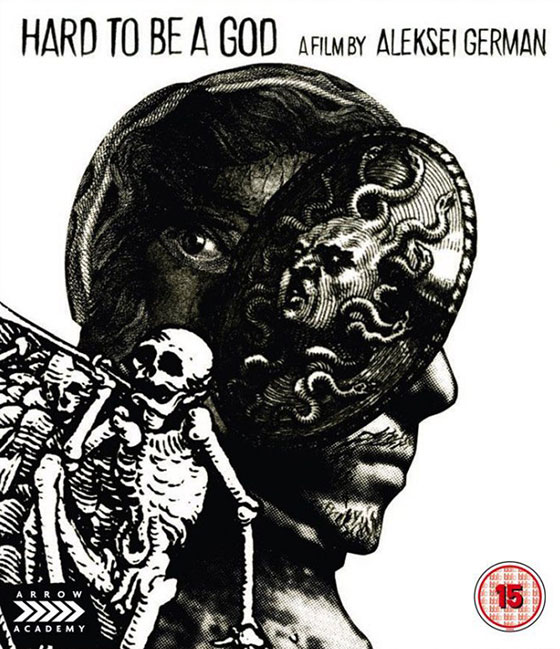
Saturday Matinee: Hard To Be A God

Source: Kanopy

When legendary Russian auteur Aleksei German died in 2013, he left behind this extraordinary final film, a phantasmagoric adaptation of the revered sci-fi novel by the Strugatsky brothers (authors of the source novel for Tarkovsky’s Stalker). Hard to be a God began percolating in German’s consciousness in the mid-1960s, and would actively consume him for the last 15 years of his life.

He brought the film close enough to completion for his wife and son to apply the finishing touches immediately after his passing. Taking place on the planet Arkanar, which is in the midst of its own Middle Ages, the film focuses on Don Rumata (Leonid Yarmolnik), one of a group of Earth scientists who have been sent to Arkanar with the proviso that they must not interfere in the planet’s political or historical development. Treated by the planet’s natives as a kind of divinity, Don Rumata is both godlike and impotent in the face of its chaos and brutality.

Running Time
179 mins
Year
2013
Kanopy ID
1173813
Filmmakers
Aleksei Yuryevich German
Features
Dmitriy Vladimirov, Laura Lauri, Leonid Yarmolnik
Languages
Russian

Watch the full film here.

Saturday Matinee: Hotel Artemis

As rioting rocks Los Angeles in the year 2028, disgruntled thieves make their way to Hotel Artemis — a 13-story, members-only hospital for criminals. It’s operated by the Nurse, a no-nonsense, high-tech healer who already has her hands full with a French assassin, an arms dealer and an injured cop. As the violence of the night continues, the Nurse must decide whether to break her own rules and confront what she’s worked so hard to avoid.

Directed by Drew Pearce and featuring Jodie Foster, Sterling K. Brown, Sofia Boutella, Jeff Goldblum, Charlie Day, Brian Tyree Henry, Jenny Slate, Dave Bautista, and Zachary Quinto.

Watch on Hoopla here: https://www.hoopladigital.com/title/12229224

Cyberpunk: The Human Condition amid High-tech Alienation and Urban Dystopia

By Raymond Lam

Source: BuddhistDoor.net

I love the seashore and the countryside, but I have spent most of my life in cities, with little to no time spent in the country. I grew up in Brisbane, Australia (which, despite its beauty and vibrant coffee culture, is hardly a skyscraper metropolis) and have spent a good deal of time in Hong Kong. Over the years I have visited Shanghai, Tokyo, and Seoul—cities that have long inspired novelists and artists in cyberpunk circles.

Cyberpunk features “technologized” cities with endless skyscrapers shimmering in an ocean of neon lights and elevated railways. These cityscapes are often bathed in darkness, shadow, and rain. More often than not, the protagonists of these stories are lone-wolf types, running through grungy alleys and estranged from wider society. As a genre of writing, film, and animation, the dystopian cyberpunk imagination has been immensely influential in both Asian and Western pop culture, exemplified by the Blade Runner movies, The Matrix franchise, and the Japanese anime Ghost in the Shell.

To many social commentators, cyberpunk carries eerie reminders of certain characteristics of urban living today—an endless feed of information, insecurity, and distractions through the Internet and social media, the press and media serving as distractions or brainwashing rather than useful information, and social alienation and unfulfilling work. In these activities is an almost gleeful dismissiveness of the need to reflect on human nature and what it means to be a human being: a key concern of religions and philosophical schools through the ages.

As Buddhistdoor Global columnist Paola Di Maio notes about our headlong trajectory into developing communication between human beings and AI: “Excited at the prospect of scientific advances, researchers seem to ignore that enhanced cognition comes with enhanced responsibility, maturity, and responsible decision-making abilities.” This is the key concern and, as it happens, the idea of human interface with computers or “mind technologies” is about as cyberpunk as it gets.

There are far more informed writers who have unpacked the themes of cyberpunk exhaustively, but I find this description particularly useful for grasping the general aesthetic and spirit. This is from an essay by Lawrence Person: “Classic cyberpunk characters were marginalized, alienated loners who lived on the edge of society in generally dystopic futures where daily life was impacted by rapid technological change, an ubiquitous datasphere of computerized information, and invasive modification of the human body.” (Slashdot.org) Surely many of these themes sound familiar?

The eminent science fiction writer J. G. Ballard (1930–2009) defied assumptions about traditional storytelling and sought to upend the archetypes that were assumed to be universal, saying that he wanted a storytelling style that possessed “more psycho-literary ideas, more meta-biological and meta-chemical concepts, private time systems, synthetic psychologies and space-times, more of the sombre half-worlds one glimpses in the paintings of schizophrenics.” (Ballard 2017, 103) Most interestingly, Ballard criticized the “external” emphasis of so much science fiction of his day (such as on space travel), declaring: “The biggest developments of the immediate future will take place, not on the Moon or Mars, but on Earth, and it is inner space, not outer, that needs to be explored. The only truly alien planet is Earth.” (Ballard 2017, 103)

My opinion is that good cyberpunk is itself a kind of literary expression of contemporary inner preoccupations and concerns. Take the notion of loneliness, for example. Some good research has been done about urban life and its correlation with loneliness, but the results are ambiguous. One study found that urban life is undoubtedly more stressful than rural life (and has been so since the Industrial Revolution), yet how lonely one feels is a very difficult thing to measure. If we are to take seriously Ballard’s notion that the best kind of science fiction is about inner space, then perhaps we have also been distracted by the neon cityscapes of gritty cyberpunk metropolises.

The interesting stuff is not happening in an action-packed helipad gunfight with a hypersonic jet on top of a tower owned by a futuristic robotics corporation. It is happening in the neurotic mind of one of that corporation’s low-level office workers, humiliated in public through a thoughtless social media post by her supervisor, who himself seeks distraction from his instantly replaceable managerial role by interfacing his brain with a computer’s pornographic VR program. It is not just about cybernetics and the development of androids, but how society changes as a result of them.

I like to think that, perhaps one day in the future, when meditation practice centers are hidden away in glass and metal skyscrapers—some of them already are in the worlds biggest cities—and temples of traditional Asian design are surrounded by looming corporate structures, these loci of spiritual meaning and truly human work will have helped to fortify the inner worlds of these cities’ denizens against the darker side of cyberpunk. Ballard was right. The true struggle for meaning and dignity is more often on the inside, even in a society dominated by neon, nightfall, and neuro-computers.

References

Ballard, J. G. 2017. “Which way to inner space?” In Science Fiction Criticism: An Anthology of Essential Writings. Edited by Rob Latham. London and New York: Bloomsbury.

Saturday Matinee: The Damned

“The Damned” (released as “These Are the Damned” in the USA) is a 1963 British science fiction film directed by blacklisted Hollywood expat Joseph Losey, produced by Hammer Film and starring Macdonald Carey, Shirley Anne Field, Viveca Lindfors and Oliver Reed. The screenplay by Ben Barzman and  Evan Jones (based on H.L. Lawrence’s novel “The Children of Light”) centers on an American tourist (Macdonald Carey), an Englishwoman (Shirley Anne Field) and her biker gang leader brother King (Oliver Reed) who stumble across genetically modified children able to survive a nuclear war.