Saturday Matinee: Seobok

REVIEW: ‘Seobok: Project Clone’ Is a Well-balanced Philosophical Sci-Fi Action Film

By Ricardo Gallegos

Source: But Why Tho?

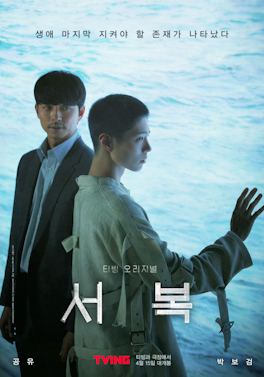
Lee-Yong Ju’s science fiction film Seobok: Project Clone delves into one of the genre’s most prominent philosophical concerns: the fate of men. And even though it tends to ponder on too many ideas, it manages to create food for thought while providing jaw-dropping setpieces.

Former intelligence agent Min Ki-hun (Gong Yoo) is struggling both physically and emotionally. The regret of his past is consuming him and a brain tumor has left him with little time to live. One day, he’s asked by former boss Ahn (Jo Woo-jin) to return to action in a secret mission involving the protection of project Seobok (Park Bo-gum), the first human clone who, besides possessing pressure bending powers, is immortal and therefore is the key to the research that could save Ki-hun’s life. However, what seems like a straightforward task soon puts Ki-hun in the middle of a war to possess (or kill) Seobok that involves American mercenaries, government officials, and the laboratory involved in the research. Still unsure on who to trust, Ki-hun sticks to protecting Seobok, and, together, they go on the run.

With a strong sci-fi core, Seobok: Project Clone tips its toes into the road movie genre in a second act full of ethical conundrums. From very different angles, Ki-hun and Seobok are forced to reflect on their mortality while driving through highways and cities. The former realizes that in order to be cured, Seobok has to be exploited, which is something other characters see as perfectly fine given that he’s, after all, some sort of sub-human experiment. Does Seobok have moral rights? What are their limits? If he was created for research only, shouldn’t his suffering and exploitation be unimportant? The movie asks these questions to both the audiences and Ki-hun, whose condition worsens as time goes by.

Meanwhile, Seobok learns about humanity with every interaction and blood-soaked encounter and eventually asks himself what the meaning of immortality is. Should he allow humans to stop death by researching him? As Seobok ponders on this question, the inhumanity around him grows, and soon, the true colors of our world make clear that, ultimately, only wealthy men would be able to get the ‘benefits’ from immortality.

Gong Yoo and Park Bo-gum’s beautifully nuanced performance gives power to these thoughts, but they can’t stop the whole road movie section from being bogged down by the high number of philosophical queries the film lays out, none of which are thoroughly explored. Because of this, you’ll find yourself losing interest in the motivation of the characters, even more, due to the dull pace of the editing.

Eventually, your patience and investment are rewarded when Lee-Yong Ju successfully transforms these philosophical conundrums into emotional fuel for a spectacular action-packed third act where everything comes full circle. Aided by top-notch VFX work and sound design, as well as an extraordinary score by Yeong-wook Jo, Seobok’s powers are used in a terrifying manner to lead the film toward an outstanding conclusion that provides audiovisual and narrative satisfaction; and thanks to the correct development of his character arc throughout the film, Seobok’s never reduced to a just a killing tool. His actions and realizations are consequences of his experiences outside the laboratory and his interactions with Ki-hun.

Seobok: Project Clone is a riveting balance of philosophy, sci-fi, and action with a hint of road movie goodness that never sacrifices its complex questions in lieu of cheap entertainment. The issues at hand are never forgotten even when the most visual effects-heavy scenes fill the screen, and that’s something not many films of this nature are able to do.

Watch Seobok on Hoopla here: https://www.hoopladigital.com/title/14858932

The Future Is Here: Dystopian Movies Fit for a Dystopian World

By John W. Whitehead

Source: The Rutherford Institute

“The Internet is watching us now. If they want to. They can see what sites you visit. In the future, television will be watching us, and customizing itself to what it knows about us. The thrilling thing is, that will make us feel we’re part of the medium. The scary thing is, we’ll lose our right to privacy. An ad will appear in the air around us, talking directly to us.”—Director Steven Spielberg, Minority Report

We have arrived, way ahead of schedule, into the dystopian future dreamed up by such science fiction writers as George Orwell, Aldous Huxley, Margaret Atwood and Philip K. Dick.

Much like Orwell’s Big Brother in 1984, the government and its corporate spies now watch our every move.

Much like Huxley’s A Brave New World, we are churning out a society of watchers who “have their liberties taken away from them, but … rather enjoy it, because they [are] distracted from any desire to rebel by propaganda or brainwashing.”

Much like Atwood’s The Handmaid’s Tale, the populace is now taught to “know their place and their duties, to understand that they have no real rights but will be protected up to a point if they conform, and to think so poorly of themselves that they will accept their assigned fate and not rebel or run away.”

And in keeping with Philip K. Dick’s darkly prophetic vision of a dystopian police state—which became the basis for Steven Spielberg’s futuristic thriller Minority Report which was released 20 years ago—we are now trapped into a world in which the government is all-seeing, all-knowing and all-powerful, and if you dare to step out of line, dark-clad police SWAT teams and pre-crime units will crack a few skulls to bring the populace under control.

Minority Report is set in the year 2054, but it could just as well have taken place in 2022.

Seemingly taking its cue from science fiction, technology has moved so fast in the short time since Minority Report premiered in 2002 that what once seemed futuristic no longer occupies the realm of science fiction.

Incredibly, as the various nascent technologies employed and shared by the government and corporations alike—facial recognition, iris scanners, massive databases, behavior prediction software, and so on—are incorporated into a complex, interwoven cyber network aimed at tracking our movements, predicting our thoughts and controlling our behavior, Spielberg’s unnerving vision of the future is fast becoming our reality.

Both worlds—our present-day reality and Spielberg’s celluloid vision of the future—are characterized by widespread surveillance, behavior prediction technologies, data mining, fusion centers, driverless cars, voice-controlled homes, facial recognition systems, cybugs and drones, and predictive policing (pre-crime) aimed at capturing would-be criminals before they can do any damage.

Surveillance cameras are everywhere. Government agents listen in on our telephone calls and read our emails. Political correctness—a philosophy that discourages diversity—has become a guiding principle of modern society.

The courts have shredded the Fourth Amendment’s protections against unreasonable searches and seizures. In fact, SWAT teams battering down doors without search warrants and FBI agents acting as a secret police that investigate dissenting citizens are common occurrences in contemporary America.

We are increasingly ruled by multi-corporations wedded to the police state. Much of the population is either hooked on illegal drugs or ones prescribed by doctors. And bodily privacy and integrity has been utterly eviscerated by a prevailing view that Americans have no rights over what happens to their bodies during an encounter with government officials, who are allowed to search, seize, strip, scan, spy on, probe, pat down, taser, and arrest any individual at any time and for the slightest provocation.

All of this has come about with little more than a whimper from an oblivious American populace largely comprised of nonreaders and television and internet zombies, but we have been warned about such an ominous future in novels and movies for years.

The following 15 films may be the best representation of what we now face as a society.

Fahrenheit 451 (1966). Adapted from Ray Bradbury’s novel and directed by Francois Truffaut, this film depicts a futuristic society in which books are banned, and firemen ironically are called on to burn contraband books—451 Fahrenheit being the temperature at which books burn. Montag is a fireman who develops a conscience and begins to question his book burning. This film is an adept metaphor for our obsessively politically correct society where virtually everyone now pre-censors speech. Here, a brainwashed people addicted to television and drugs do little to resist governmental oppressors.

2001: A Space Odyssey (1968). The plot of Stanley Kubrick’s masterpiece, as based on an Arthur C. Clarke short story, revolves around a space voyage to Jupiter. The astronauts soon learn, however, that the fully automated ship is orchestrated by a computer system—known as HAL 9000—which has become an autonomous thinking being that will even murder to retain control. The idea is that at some point in human evolution, technology in the form of artificial intelligence will become autonomous and human beings will become mere appendages of technology. In fact, at present, we are seeing this development with massive databases generated and controlled by the government that are administered by such secretive agencies as the National Security Agency and sweep all websites and other information devices collecting information on average citizens. We are being watched from cradle to grave.

Planet of the Apes (1968). Based on Pierre Boulle’s novel, astronauts crash on a planet where apes are the masters and humans are treated as brutes and slaves. While fleeing from gorillas on horseback, astronaut Taylor is shot in the throat, captured and housed in a cage. From there, Taylor begins a journey wherein the truth revealed is that the planet was once controlled by technologically advanced humans who destroyed civilization. Taylor’s trek to the ominous Forbidden Zone reveals the startling fact that he was on planet earth all along. Descending into a fit of rage at what he sees in the final scene, Taylor screams: “We finally really did it. You maniacs! You blew it up! Damn you.” The lesson is obvious, but will we listen? The script, although rewritten, was initially drafted by Rod Serling and retains Serling’s Twilight Zone-ish ending.

THX 1138 (1970). George Lucas’ directorial debut, this is a somber view of a dehumanized society totally controlled by a police state. The people are force-fed drugs to keep them passive, and they no longer have names but only letter/number combinations such as THX 1138. Any citizen who steps out of line is quickly brought into compliance by robotic police equipped with “pain prods”—electro-shock batons. Sound like tasers?

A Clockwork Orange (1971). Director Stanley Kubrick presents a future ruled by sadistic punk gangs and a chaotic government that cracks down on its citizens sporadically. Alex is a violent punk who finds himself in the grinding, crushing wheels of injustice. This film may accurately portray the future of western society that grinds to a halt as oil supplies diminish, environmental crises increase, chaos rules, and the only thing left is brute force.

Soylent Green (1973). Set in a futuristic overpopulated New York City, the people depend on synthetic foods manufactured by the Soylent Corporation. A policeman investigating a murder discovers the grisly truth about what soylent green is really made of. The theme is chaos where the world is ruled by ruthless corporations whose only goal is greed and profit. Sound familiar?

Blade Runner (1982). In a 21st century Los Angeles, a world-weary cop tracks down a handful of renegade “replicants” (synthetically produced human slaves). Life is now dominated by mega-corporations, and people sleepwalk along rain-drenched streets. This is a world where human life is cheap, and where anyone can be exterminated at will by the police (or blade runners). Based upon a Philip K. Dick novel, this exquisite Ridley Scott film questions what it means to be human in an inhuman world.

Nineteen Eighty-Four (1984). The best adaptation of Orwell’s dark tale, this film visualizes the total loss of freedom in a world dominated by technology and its misuse, and the crushing inhumanity of an omniscient state. The government controls the masses by controlling their thoughts, altering history and changing the meaning of words. Winston Smith is a doubter who turns to self-expression through his diary and then begins questioning the ways and methods of Big Brother before being re-educated in a most brutal fashion.

Brazil (1985). Sharing a similar vision of the near future as 1984 and Franz Kafka’s novel The Trial, this is arguably director Terry Gilliam’s best work, one replete with a merging of the fantastic and stark reality. Here, a mother-dominated, hapless clerk takes refuge in flights of fantasy to escape the ordinary drabness of life. Caught within the chaotic tentacles of a police state, the longing for more innocent, free times lies behind the vicious surface of this film.

They Live (1988). John Carpenter’s bizarre sci-fi social satire action film assumes the future has already arrived. John Nada is a homeless person who stumbles across a resistance movement and finds a pair of sunglasses that enables him to see the real world around him. What he discovers is a world controlled by ominous beings who bombard the citizens with subliminal messages such as “obey” and “conform.” Carpenter manages to make an effective political point about the underclass—that is, everyone except those in power. The point: we, the prisoners of our devices, are too busy sucking up the entertainment trivia beamed into our brains and attacking each other up to start an effective resistance movement.

The Matrix (1999). The story centers on a computer programmer Thomas A. Anderson, secretly a hacker known by the alias “Neo,” who begins a relentless quest to learn the meaning of “The Matrix”—cryptic references that appear on his computer. Neo’s search leads him to Morpheus who reveals the truth that the present reality is not what it seems and that Anderson is actually living in the future—2199. Humanity is at war against technology which has taken the form of intelligent beings, and Neo is actually living in The Matrix, an illusionary world that appears to be set in the present in order to keep the humans docile and under control. Neo soon joins Morpheus and his cohorts in a rebellion against the machines that use SWAT team tactics to keep things under control.

Minority Report (2002). Based on a short story by Philip K. Dick and directed by Steven Spielberg, the film offers a special effect-laden, techno-vision of a futuristic world in which the government is all-seeing, all-knowing and all-powerful. And if you dare to step out of line, dark-clad police SWAT teams will bring you under control. The setting is 2054 where PreCrime, a specialized police unit, apprehends criminals before they can commit the crime. Captain Anderton is the chief of the Washington, DC, PreCrime force which uses future visions generated by “pre-cogs” (mutated humans with precognitive abilities) to stop murders. Soon Anderton becomes the focus of an investigation when the precogs predict he will commit a murder. But the system can be manipulated. This film raises the issue of the danger of technology operating autonomously—which will happen eventually if it has not already occurred. To a hammer, all the world looks like a nail. In the same way, to a police state computer, we all look like suspects. In fact, before long, we all may be mere extensions or appendages of the police state—all suspects in a world commandeered by machines.

V for Vendetta (2006). This film depicts a society ruled by a corrupt and totalitarian government where everything is run by an abusive secret police. A vigilante named V dons a mask and leads a rebellion against the state. The subtext here is that authoritarian regimes through repression create their own enemies—that is, terrorists—forcing government agents and terrorists into a recurring cycle of violence. And who is caught in the middle? The citizens, of course. This film has a cult following among various underground political groups such as Anonymous, whose members wear the same Guy Fawkes mask as that worn by V.

Children of Men (2006). This film portrays a futuristic world without hope since humankind has lost its ability to procreate. Civilization has descended into chaos and is held together by a military state and a government that attempts to keep its totalitarian stronghold on the population. Most governments have collapsed, leaving Great Britain as one of the few remaining intact societies. As a result, millions of refugees seek asylum only to be rounded up and detained by the police. Suicide is a viable option as a suicide kit called Quietus is promoted on billboards and on television and newspapers. But hope for a new day comes when a woman becomes inexplicably pregnant.

Land of the Blind (2006). In this dark political satire, tyrannical rulers are overthrown by new leaders who prove to be just as evil as their predecessors. Maximilian II is a demented fascist ruler of a troubled land named Everycountry who has two main interests: tormenting his underlings and running his country’s movie industry. Citizens who are perceived as questioning the state are sent to “re-education camps” where the state’s concept of reality is drummed into their heads. Joe, a prison guard, is emotionally moved by the prisoner and renowned author Thorne and eventually joins a coup to remove the sadistic Maximilian, replacing him with Thorne. But soon Joe finds himself the target of the new government.

All of these films—and the writers who inspired them—understood what many Americans, caught up in their partisan, flag-waving, zombified states, are still struggling to come to terms with: that there is no such thing as a government organized for the good of the people. Even the best intentions among those in government inevitably give way to the desire to maintain power and control at all costs.

Eventually, as I make clear in my book Battlefield America: The War on the American People and in its fictional counterpart The Erik Blair Diaries, even the sleepwalking masses (who remain convinced that all of the bad things happening in the police state—the police shootings, the police beatings, the raids, the roadside strip searches—are happening to other people) will have to wake up.

Sooner or later, the things happening to other people will start happening to us.

When that painful reality sinks in, it will hit with the force of a SWAT team crashing through your door, a taser being aimed at your stomach, and a gun pointed at your head. And there will be no channel to change, no reality to alter, and no manufactured farce to hide behind.

As George Orwell warned, “If you want a picture of the future, imagine a boot stamping on a human face forever.”

Saturday Matinee: Voyage of the Rock Aliens

By Chris Scullion

Source: That Was a Bit Mental

Director: James Fargo

Starring: Pia Zadora, Tom Nolan, Craig Sheffer, Michael Berryman, Ruth Gordon, Alison La Placa

“I still can’t believe you’re an alien. What a novelty act!” (Dee Dee, Voyage Of The Rock Aliens)

One day in the future, when I have children, there will come a day when I’m asked “dad, what were the ’80s like?”

I already know how I’ll respond. Without saying a single word I’ll gesture to the couch, insist they sit down, turn the telly on and make them watch Voyage Of The Rock Aliens. Just to fuck with them.

After all, as a massive fan of anything ’80s I reckon I’ve seen enough movies and TV shows to determine what best sums up the decade. And this, quite frankly, is the most ’80s thing I’ve ever seen by a long way.

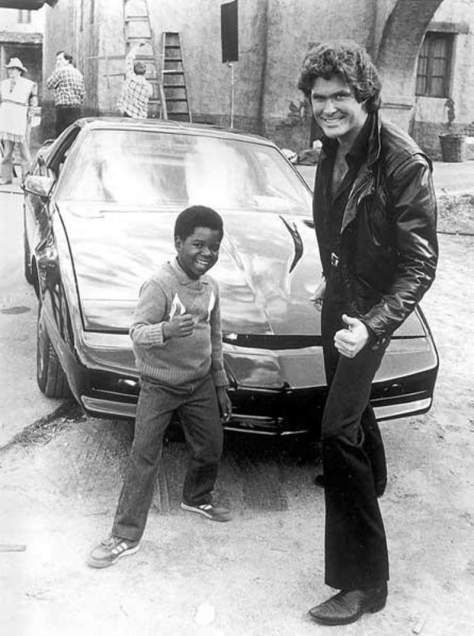
And I’ve seen this photo:

You see, what we have here, friends, is a sci-fi musical comedy in which all the songs are the catchiest, cheesiest ’80s pop you can imagine. And it’s brilliant.

It tells the story of a bunch of aliens, led by the super-serious ABCD (pronounced ‘Absid’, naturally), who fly around space in a ship shaped like a massive Flying V guitar.

These aliens are tasked with exploring the galaxy and studying anything they find in order to try to locate the source of Rock & Roll. Guess where they end up? That’s right, Venus Earth.

Here’s one of them, STUVWXYZ. About as inconspicuous as a toe up the arse

More specifically, they land in the town of Speelburgh (ahem), where local prettyboy Frankie rules his fellow teenagers with an iron fist.

As the lead singer of his band The Pack, he’s somehow managed to impose some sort of musical dictatorship banning anyone else in the town from playing instruments or singing.

This includes his girlfriend Dee Dee (singer Pia Zadora), who fancies herself as the next big musical sensation but is being held back by Frankie’s harsh singbargo.

Enter the Rock Aliens, who you’d better believe are going to ruddy well sing and dance all they want because it’s all they know. And once they do, the rest of the Speelburgh teens – Dee Dee included – are blown away by their new musical style (which is basically Devo).

Mind you, Dee Dee’s got some singing skills too. Pia Zadora’s pretty good in this, actually

ABCD quickly takes a shine to Dee Dee, by which I mean his head literally explodes and his limbs fall off the first time he sees her. That’s not a figure of speech, that actually happens.

For some reason this doesn’t put Dee Dee off and the two fall for each other, with ABCD asking Dee Dee to join his band.

Dee Dee is thrilled, but how will she react when she discovers that ABCD and his bandmates are aliens? And is Frankie really going to let this weird prick win his girlfriend over? Dramaaaaaa.

I genuinely uttered the phrase “what the fuck is this all about” five or six times throughout the course of Voyage Of The Rock Aliens. And that’s no bad thing.

For example, you’ve got the opening sequence, set on another planet, in which Pia Zadora (playing someone else) and Jermaine Jackson sing their new single for no reason at all: after which Jackson fucks off and is never seen again.

“Let’s get out of here, Michael.” “I’m not Michael.” “You’re not?” “No, I’m Pia Zadora.” HAHAHA, YOU THOUGHT I MEANT JERMAINE JACKSON, OH CHRIST WHAT A TWIST

Then there’s the bizarre subplot involving two escaped mental patients, one of whom (The Hills Have Eyes‘ Michael Berryman) falls in love and sees the error of his ways.

These are but a few moments of madness: others include a robot helper (voiced by Peter ‘Optimus Prime’ McCulloch) disguising itself as a fire hydrant, an odd dance number set in a ladies’ toilet, and a giant mutant octopus thing which is sitting in the nearby lake waiting to take over the town.

Then there’s Ruth Gordon playing a bizarre sheriff who has a surprising lack of tact when phoning the families of accident victims:

“Am I speaking to the widow of John S. Lamont?”

“You must be mistaken, I’m not a widow.”

“The hell you’re not!”

This being a musical, the songs are naturally of great importance, and anyone into cheesy ’80s pop will be in heaven.

Each track is delightfully catchy and yet charmingly shit, with nonsensical lyrics all over the shop (“It’s the nature of the beast / I’m keeping up my status quota”) that often don’t have anything to do with the story. Which is sort of the point of songs in a musical, but fuck it, I’m giving it a pass.

The best of the bunch is definitely the opening track though (the one with Jermaine Jackson in it). Curious? Enjoy:

Of all the ’80s sci-fi musical comedies I’ve seen over the years, Voyage of The Rock Aliens is undoubtedly the best. It’s also undoubtedly the only, but let’s not try to ruin the mood.

Get some similarly ’80s-minded friends around, shit fancy dress optional, turn the volume as loud as it can go without the neighbours coming round to cave your face in, and enjoy a helping of delicious ’80s cheese so plentiful that you’ll having dreams about hairspray, synthesisers and robot fire hydrants for weeks to come.

Saturday Matinee: Macross: Do You Remember Love?

Remembering Macross: Do You Remember Love?

By Victor de la Cruz

Source: 3rd World Geeks

There have been so many anime movies that have come and gone. A lot of them have, deservedly so, have been called classics and must-watch animes. You’ve got your My Neighbor Totoro, Ghost in the Shell, Weathering with You, Your Name and Akira. They are undoubtedly classics in their own right and every anime fan needs to see them. But there always seems to be one anime film that’s left out of the conversation for one reason or another. I’m here to shine a spotlight on that anime that usually gets lost in the shuffle when people list down great anime movies.

That movie is Macross: Do You Remember Love?

But before I do talk about Macross: Do You Remember Love?, I do have to talk about my very complicated relationship with the first Macross franchise. Like most anime fans, the very first contact I had with Macross wasn’t actually called Macross. It was from Robotech. Now, Robotech was this weird mishmash of three animes, namely, Super Dimension Fortress Macross, Super Dimension Cavalry Southern Cross and Genesis Climber MOSPEADA. The original Japanese animes had nothing to do with each other. However, the people over at Harmony Gold had the bright idea to attempt to link these three disparate shows. The writers did a good job with what they were given but this did greatly affect how the later chapters, more specifically the Southern Cross story, was almost totally revamped to retrofit it into the overarching story. Thankfully, as it was the first chapter in Robotech, Macross was hardly touched story-wire. Basically, if all you have is the Robotech version of Macross, you’re still getting pretty much the original story.

I also have to mention that my first experience with Do You Remember Love? isn’t by watching the movie. The first time I did see the movie was the Clash of the Bionoids dub. And, god help me, I loved it! I managed to catch this by pure accident while channel surfing when I was a kid. Seeing they actually pushed out a movie based on Robotech (because I didn’t know any better then) blew my mind and maybe that was a part of why I loved it so much. It would be an easy excuse to say I was young and foolish to like something as bad as the dubbing done in Clash of the Bionoids. But there’s just something so earnest in the performances! Oh, I also didn’t know they cut out a lot of stuff from the original film but, hey, I didn’t know there was an unedited version back then! Of course, now that I’ve seen the original cut, it’s hard to go back to Clash of the Bionoids unless it’s to kind of laugh at some of the dialogue.

Anyway, back to Do You Remember Love? and why I believe it deserves to be called a classic. For one thing, just look at it! Despite it being released way back in 1984, a good 35 years ago now, Do You Remember Love? still looks incredible. I can’t deny they touched up the film to bring everything into high resolution. But even so, you gotta admire the amount of detail the animators put into each frame of animation here! The number of little things, like lights flashing on the screen, the wires that stick out of a console, how the shadows lay on objects realistically, the tiny details of the Valkyrie stabilization thrusters looks outstanding.

The animation of how the Valkyrie also transform from mode to mode so seamlessly is also incredible. Of course, you also have to love those spiraling missiles the Valkyrie fire at the enemy Zentradi and how well animated those things are. Considering this was way before computer animation was a thing, that means you had a bunch of animators drawing up each and every frame of those missiles careening at wild directions while making it look real. They did a fantastic job on Do You Remember Love?

I also have to commend the writers of managing to streamline the entire 36 episode arc into something that would fit into roughly a couple of hours. Well, it’s not exactly streamlining as Do You Remember Love? alters the story quite a bit. But the changes they did do make sense. The movie actually starts right in the middle of the Macross’ journey back to Earth and ends after the defeat of the Zentradi leader Boddole Zer. This does leave out a good chunk of story but it also cuts out the more boring parts. We get to see the Macross transform without having the long, complicated episode explaining how they figured out to do so. We don’t have the Macross return to Earth only to be exiled to deep space. We also don’t get the aftermath of the Macross War and see the Zentradi have difficulty integrating in human society. These may be part of the entire drama of Macross. But, by cutting out these more slower parts, Do You Remember Love? gets into the meatier part of the entire story, which does makes things more satisfying.

Of course, no talk about Do You Remember Love? can be made without talking about the phenomenal final act of the film. The big battle where the loose forces of the Zentradi, Meltradi and remaining humans join forces to attack Boddole Zer while Lynn Minmay sings the titular song. There’s just something to the entire buildup to the song and the beautiful simplicity of the lyrics that makes it come off as more awesome than it should be. Of course, it certainly doesn’t hurt that Mari Iijima, who does both the normal and singing voices of Lynn Minmay, sounds really ethereal with her performance of the song. There’s also a kind of beautiful message in the scene where a simple love song can touch even the hardest of hearts to make them do the right thing.

I’m not saying Do You Remember Love? is a flawless anime film. I actually have to say I have some problems with it. The melodrama can be irritating at times as the characters would suddenly start behaving like they’re in the middle of a cheap soap opera. Lynn Minmay can definitely be grating at times because of how bratty she comes off in certain scenes. And while I did give high praise to the writers for focusing on the more important elements of the series, there are a couple of times when things just seem to happen in order to move the story forward.

However, these shortcomings should not really detract from how great Do You Remember Love? actually is. There’s just an overall epic feel to the story and the animation, despite its age, seems to have richer details than the anime movies we get today. But it’s that really memorable final act that really clinches it for me. The song, while nothing great in itself, feels much more epic in scale because of everything that accompanies it. Honestly, I would’ve watched it for those final ten minutes and still feel satisfied with how well done everything is.

I honestly think Macross: Do You Remember Love? deserves a little love as it seems to have been lost in the shuffle of all of the other anime films out there. If you’re interested in watching it, you’re in luck! The entire movie is available on YouTube on the Macross channel. It’s not in super hi-def but the high quality animation will make you forget it isn’t.

Give it a watch if you can spare a couple of hours. You can thank me later.

Have you seen Macross: Do You Remember Love? What did you think of it? What other classic anime films do you think deserves a little more attention? Let me know in the comments section below!

Déjà Vu All Over Again

The Matrix, resurrected

By John Semley

Source: The Baffler

MIDWAY THROUGH 1999’S THE MATRIX, Keanu Reeves’s hacker-cum-cyberpunk-messiah Neo sees a black cat shivering in a doorway. Then, he sees it again. “Woah,” he utters, in that trademark, flat Keanu Reeves way. “Déjà vu . . . ” The phenomenon, Trinity (Carrie-Anne Moss) tells him, means big trouble. In the titular world-scale digital simulation in which the bulk of the film unfolds, déjà vu signals a computer glitch: a case of the simulation tweaking its code in real time.

One can’t help but be reminded of this idea watching The Matrix Resurrections, a long-gap sequel to the original sci-fi trilogy, which ended with Reeves’s Neo striking a détente between the machine overlords that enslaved mankind within a counterfeit reality and the fleshy human resistors who opposed them. The new film opens as the original does, following a heavily-armed SWAT team as they swarm a seedy motel room where a leather-clad hacker is plonking away at a computer terminal. The scene expands to introduce a new character, Bugs (Jessica Henwick), who notes to her compatriot that this familiar scene is a training module, designed to hone the skills of the digital heavies who patrol the parameters of the matrix. Or rather, a version of it that exists within the original matrix. It’s sixty years after the events of the last film, and nearly twenty years after its release. Things have gotten deeper—if only slightly.

The simulation now includes a popular video game trilogy—called, of course, The Matrix—that re-stages the events of the original films. Neo, too, is back, in his guise as Thomas Anderson. This time he’s not a computer programmer but a video game designer, whose “great ambition was to make a game indistinguishable from reality.” He’s the chief architect of the Matrix game trilogy, which has just seen a sequel green-lit within the fiction of both the matrix and The Matrix. (Matrix Resurrections was itself promoted with a tie-in video game demo, The Matrix Awakens.) Like William James’s image of our world resting on an infinite regress of rocks, it seems like it’s matrixes all the way down.

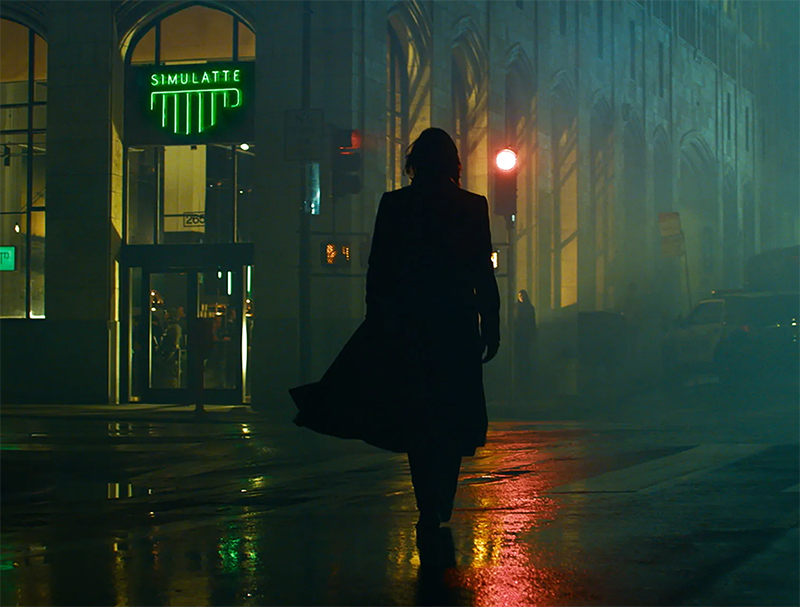
The planned game sequel prompts much hand-wringing. Characters bat ideas back and forth in an open-concept office, trying to get to the heart of what made the original Matrix work. Resurrections abounds with this sort of dorky meta-humor. There are jokes about the game design firm’s parent company being Warner Bros. (the actual film’s producer) and jokes about déjà vu. A fourth-wave coffee shop is called “Simulatte.” That kind of thing. It’s the sort of stuff that elicits barking, staccato guffaws from in-the-know audience members that quickly fade into barely bemused titters. It’s meant to be cute, but it’s mostly annoying.

Still, the film is not without its charms. Some of the early action scenes crack along reliably, playing with inversions of gravity and time, like a fleeter Christopher Nolan flick. And the notion of revisiting the world of the matrix is not without appeal. After all, the original film forecasted a world of digital disenfranchisement that is now, under the auspices of our current Silicon Valley overlords, regarded as aspirational. (In a telling touch, Resurrections moves the action from an implied Chicago to the Bay Area, explicitly marked by familiar landmarks and San Francisco PD cruisers.) And with its image of two pills representing diverging ideological bents, The Matrix provided a ready-made vocabulary that has been embraced in our real world, where everyone is redpilledblackpilledDanpilled, or Tedpilled. But Resurrections never manages to meaningfully intervene in the very conditions it seems to be diagnosing—and which the series had already diagnosed, decades ago. Like postmodernity itself, the state of digital dependency dramatized by The Matrix cannot be alleviated. It can only be mediated, with increasing levels of irony and winking self-awareness.

To wit: Resurrections is not about digitization, or the metaphysics of reality, or the broken promise of the cyberpunk genre. It is about movie reboots. Here, Neo must be liberated again, literally remaking his quest from the original film, with the obstacles re-skinned and old foes appearing in new guises (Jonathan Groff, playing the meddling computer program Smith, is a hunkier, paler imitation of the menacing Hugo Weaving). Characters snipe about how humanity is merely reframing the same handful of archetypal themes and ideas. “We’re still telling the same stories we’ve always told,” says one game designer, sounding like he’s been watching too many Jordan Peterson YouTubes. “Just with different names, different faces.” This may well be true. But it also feels like a cop-out. Especially because the original Matrix, as imagined by sororal duo Lilly and Lana Wachowski, felt genuinely inventive. It blended Terminator-styled dystopian sci-fi with Hong Kong wire-fu action and state-of-the-art special effects, all draped in the industrial liveries of a turn-of-the-millennium goth club. It may not have been wholly new. But it was thrilling remix. It spoke to the ennui of America at the “end of history.” It captured the soul-deadening, Dilbert-esque daily doldrums explored in films like Fight Club and Office Space. It also played straight to the anxiety around “Y2K” and the mounting cultural panic that home computers and toaster ovens might break down or turn against their owners. The Matrix felt like it was speaking to its time. Now, movies seem to chatter only among themselves.

There’s plenty of precedent here, of course: Ready Player Onethe recent Space Jam sequel; and the new Spider-Man movie, which draws together two decades worth of sticky narrative threads spun across three distinct franchises. Corporate wheeling-and-dealing is increasingly allegorized onscreen, to the point that many blockbusters are now about their own production. Within ten years, we’ll see Aaron Sorkin hoisting an Oscar overhead, rewarded by his peers for helming a chatty drama about the backroom legal finagling that saw a Star Wars-branded lightsaber licensed to the movie Free Guy. Hollywood is already lodged in the post-postmodern rabbit hole, with little to show for it. The culture is glitching, looping, stuck in some long, static interregnum, like a radio drifting between channels. If a new Matrix movie felt grimly inevitable in such a climate, it also had great potential.

And I suppose it’s nice that director Lana Wachowski (going solo this time) returned to wield some control over a story that would otherwise be expropriated however-which-way by the studio. But she has only a passing interest in the new convolutions of the simulation itself. Wachowski is more invested in revisiting Neo and Trinity’s wrenching, realities-spanning romance. Rather than the heady ideas at play in the premise—which have been by-and-large replaced by geeky in-jokes—she wants to explore (again) the profound power of love as some supernatural force. At its worst, the Wachowski worldview recalls that classic Simpsons joke: the secret ingredient is always capital-l Love.

This strain of touchy-feely sci-fi certainly has its admirers, and I sometimes count myself among them. But I find the Wachowskis’ sappiness (however earnest) more tolerable when enlivened by their stylistic and technical inventiveness. The rote, underdog rhythms of Speed Racer (2008) only work because they unfold within an aesthetic landscape that splits the difference between La Chinoise and Paper MarioThe Matrix’s heavy hooey about fate and choice and freeing one’s mind is leavened because, well, the movie is entertaining as hell. But now, the ideas are stale (2003’s The Matrix Reloaded already introduced the concept of its story being a remake), and the action settles into tedium: graceful bullet-time ballets are replaced by crunchy, John Wick-style fights and repetitive CGI set pieces that see Neo stopping hails of bullets with his hands, over and over and over again.

Perhaps there’s something modestly clever in the major meta-gesture of this newest Matrix—in its idea of the matrix reproducing its own destruction in the form of an interactive video game. After all, the notion that the very systems that delude us offer self-contained safe spaces for relieving those delusions is apt. Like capital, the matrix survives by evolving quicker than the forces that oppose it. If we take this message seriously, then the goodly thing to do is to ignore The Matrix Resurrections and all corporatized entertainments. To put down Twitter and TikTok and smooch our spouses; build a snowman with the kiddies; clink some beers with a gaggle of good buddies.

That we should all invest not in our virtual existences, but the fleshy, loving, contingent relationships of real life, is a perfectly decent message. That the Wachowskis have been repeating this tired line for two decades speaks despairingly to the conditions of our own, present-day dystopia. Resurrections is suspended between cyberpunk trappings that were already shopworn circa 1999 and the intellectual prison of high-concept meta-mongering. It is a movie of the interregnum, one that could have been auto-generated by it. In this way, The Matrix does manage to speak to the times. Again.

Saturday Matinee: In Time

A thought-provoking sci-fi thriller set in the future that taps into some of the most troubling inequities and problems of our era, the lack of time.

By Frederic and Mary Ann Brussat

Source: Spirituality and Practice

The best science fiction always uses some trend or policy of the present as a foundation and projects it into the future with a picture of some possible results. Through this glimpse of tomorrow, we can ponder anew the spiritual or philosophical ramifications of what we are doing today. In The Adjustment Bureau, we were given a chance to assess the idea of free will or the alternative of following a plan mapped out by God. In Gattaca the idea of genetically engineered perfection is explored. Writer and director Andrew Niccol who wrote and directed the latter thriller is also at the helm of this thought-provoking sci-fi drama that has many resonances with today’s world.

The Preeminence of Time

A search on Google for “time” yields more than 11 billion hits whereas there are fewer than 3 billion hits for “money” and 241 million hits for “sex.” Time is very much on our minds and at the hub of our concerns. We speak of “having” and “saving” and “wasting” time but we never seem to find a way of “conquering” it. We are caught up in the obsessive-compulsive need to make the most of the time we have each day. Pagers and cell phones are taken everywhere. We don’t want to miss a moment of connection.

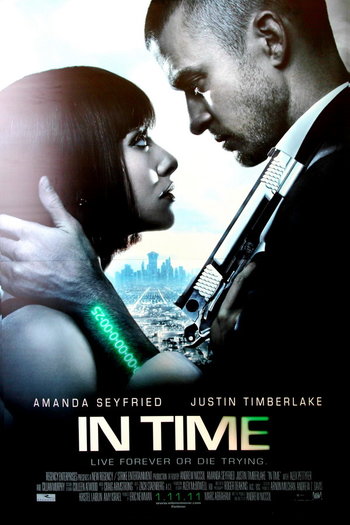
In Time is set in a future dystopia where living zones separate the rich from the poor. Will Salas (Justin Timberlake) lives in a ghetto zone with his mother Rachel (Olivia Wilde). She looks very young since all aging stops at 25.

Will works in a factory and she has a job as well, but still it is hard to make ends meet. Time in this society is literally money. Each person has a timer on his or her arm and at 25 you are given one year of free time after which you die — unless you can find a way to get more time. Wages are doled out in days of added longevity. All expenses (rent, a cup of coffee, clothes, phone calls) are paid for with time and scanners are used to deduct the time for the purchase. The biggest fear in the ghetto is that your time will run out unexpectedly. That is exactly what happens to Will’s mother.

Time Is Strange

“Time is stranger and deeper than anything else in our lives.”
— Jacob Needleman

The biggest dream in the ghetto is acquiring a surplus of years and the prospect of immortality. When Will saves a young man with a century on his clock, the fellow gives the years to him and then commits suicide. An intrepid “Timekeeper,” Raymond Leon (Cillian Murphy), is convinced that Will stole the years from the dead man. He launches a man hunt for him. Also hot on Will’s trail are some nasty time thieves.

Caught in Time

“Time is the element in which we exist. We are either borne along with it or drowned in it.”
— Joyce Carol Oates

Will begins a daring journey into the zone for the time rich called New Greenwich. After winning more than a millennium at a casino, he meets Sylvia (Amanda Seyfried), the daughter of Philippe Weis (Vincent Kartheiser), an immensely wealthy and powerful banker who has been exploiting the poor by making high interest time loans. A believer in “Darwinian capitalism,” he’s stored up enough years to be immortal. But Sylvia thinks there must be more to life than the favored existence she knows. She is intrigued by Will’s wild ideas about changing the system which favors the rich over the poor and allows many to die so a few can be immortal. After he takes her hostage when the Timekeeper is closing in on him, Sylvia doesn’t take very long to pledge her allegiance to what becomes their own mutual crusade. They begin robbing time banks and giving time to the poor and the down-and-out.

In Time is a winning sci-fi thriller that taps into some of the troubling problems of our era, such as the view of time as money, the growing gap between the rich and the poor, and all the ways that we waste time and fail to value every moment. It is also a meditation on the healing and restorative medicine of generosity and sharing. Writer and director Niccol has given us a cautionary tale about the possible future consequences of class consciousness, the high cost of trying to stay young or live forever, and the need for something more meaningful than just spending time to get ahead of the game.

Saturday Matinee: Midnight Special

Source: Deep Focus Review

People put their faith in the strangest things. Some feel their god will return to cast down judgment on humankind. Others are certain beings from another solar system planted genetic material on Earth to create life. And some believe, or perhaps not, that a flying spaghetti monster lives in the sky. Here’s another one: Folk music history tells us a train called the Southern Pacific Golden Gate Limited ran near Sugar Land prison in Texas, where legendary Blues man Lead Belly heard it passing. He and other inmates believed the train represented some sign of hope that soon they would be set free. Lead Belly later popularized a song about it, called “Midnight Special”, featuring a lyric in which he asks the train to “shine a light on me”. Apart from memorable covers by Harry Belafonte, Bob Dylan, and Credence Clearwater Revival, Lead Belly’s folk song informs the title of writer-director Jeff Nichols’ fourth film, Midnight Special.

People in the film believe some strange things, too. Some of them believe a young boy will grant their way to salvation, while the government believes that same boy is a threat to national security. But more on the specifics later. These belief systems pervade Nichols’ screenplay, a slow-burner infused with soulful character depth and science-fiction underpinnings. Midnight Special has much in common with Nichols’ excellent Take Shelter (2011), about a working-class family plagued by the father’s apocalyptic premonitions. That otherwise grassroots, southern-fried suspenser contains fantastical elements, though really it’s about the extremes people will go to chase what they believe. Nichols has explored similar American spirituality in his other two films, Shotgun Stories (2007) and Mud (2011). Each of his films demonstrates the potential danger inherent to blindly following our beliefs and convictions.

Nichols’ calculated opening demands the audience take time to figure out what’s happening and why, who the good guys are, and in the end, what just came to pass. It’s a picture audiences must feel their way through in the best possible way. An Amber Alert blares across the television screen, a reporter notifying us a young boy named Alton has been kidnapped by a man named Roy. As the shot pulls back, we find ourselves in a motel room with Roy (Michael Shannon, severe as ever) and Alton (Jaeden Lieberher), who, behind an ever-present pair of swimming goggles, reads a comic book by flashlight. Also in the room is a crew-cut man of action, Lucas (Joel Edgerton). They’re waiting until the sun goes down to continue their getaway. Lucas drives fast and without headlights, wearing night vision headgear to see the highway in the pitch dark.

Nichols cross-cuts to things at “The Ranch”—a Texas compound not unlike David Koresh’s Branch Davidians—populated by old-world types in hand-sewn garb. They’re led by a quietly intense organizer named Calvin (Sam Shepard), who wants Alton returned to him. The FBI raids The Ranch and puts everyone on buses to a secure location. They ask questions about Calvin’s people buying guns and about Alton’s kidnapping. A bookish NSA specialist named Sevier (Adam Driver) wants to know about Alton, who came in contact with him, and what they know about the boy’s abilities. And so we must wonder, why so many questions about this boy? The answer: When Alton is exposed to the sun, beams of light shoot from his eyes; he seems to speak in tongues; he can give people visions; in space, satellites meant to detect nuclear explosions spy an energy source emitting from him; he also picks up radio signals in his head.

But what is he? Nichols never answers that question outright. Over time, we learn Roy is Alton’s father, and Lucas is Roy’s friend, and together they’re protecting Alton from The Ranch and the government. All parties concerned feel a great power exists inside the boy and, though they don’t completely understand it, they fearfully pursue and defend him. Soon Alton’s mother (Kirsten Dunst) joins Roy and Lucas, aware of the entire plan. We learn all of Alton’s peculiarities have a hidden encryption, coordinates that point to a certain spot on a specific day. Everything depends on getting him there on time. And gradually, as men from The Ranch get closer to recapturing Alton, and the government goons track down their perceived threat, we get a greater—but not clearer—sense of what might occur if and when Alton arrives at his destination.

Rather than frustrating, that lack of transparency is engrossing, as Nichols drops hints here and there, while he binds us to the often moving, unquestionably engaging proceedings through subtle character work. So what is Alton? He finds great interest reading a Superman comic, so perhaps he’s something like Superman, a powerful alien. Perhaps he’s a messiah sent to protect people at The Ranch. Maybe he’s an advanced form of human with mutant powers, a time traveler, a living weapon, or an inter-dimensional being. Whatever the answer, it’s less important than the real-life descriptions of the humans on Nichols’ journey. His actors carry impressive weight and gravitas, particularly Shannon, who has appeared in each of Nichols’ films. But the entire cast brings substance to their performances, involving the audience in the tense, measured development of the story.

Both narratively and technically, Nichols has used the films of Steven Spielberg and John Carpenter to inform Midnight Special, but not in such a way that it feels distractingly derivative. From the perspective that the film operates as a road movie driving toward some manner of grandiose sci-fi conclusion, the film feels like Close Encounters of the Third Kind; the ending, too, resembles Spielberg’s wondrous 1977 effort. Elsewhere, Starman (1984) comes into play, as everyone who meets Alton gravitates to his kindness, soulful sureness, and power, just as everyone in Carpenter’s film found Jeff Bridges’ alien character a kind of angelic figure. Even the ending seems to combine the finales of these two films, with a touch of E.T.: The Extra-Terrestrial. The film also bears some similarity to Tomorrowland, although the association is undoubtedly unintentional. All the while, Adam Stone’s textured 35mm lensing captures familiar lens flares and widescreen compositions from Carpenter and Spielberg that influenced Nichols.

Questions about what happens in its marvelous climactic scenes aside, Midnight Special shines a light on the audience by offering a unique combination of the realistic and out-of-this-world. Nichols develops thoroughly dimensional characters, even among the not-irredeemable “villains” of the story. The director cares about Roy’s heavy brow and Sevier’s sense of unsure awe; with them, he develops intimate moments that effectively resonate further than the sci-fi gimmick. He never overplays the drama, such as a scene in which Alton tells his father not to worry about him. Roy replies, “I like worrying about you.” The understatedness of Nichols’ drama, the poignancy, renders a picture about how people react to what they believe or do not understand. Some embrace it; some fear it. No matter the reaction, Nichols finds a way to represent that through an engaging metaphor in his profoundly affecting and, in many ways extraordinary thriller.

Watch Midnight Special on Hoopla here: https://www.hoopladigital.com/title/14507307

Saturday Matinee: 1984

A scary reminder of how easily totalitarian ideas and ideals crop up in societies and take fierce hold.

Film Review by Frederic and Mary Ann Brussat

Source: Spirituality & Practice

Winston Smith lives on Airstrip One, a part of Oceania. He resides in a shabby one-room apartment where his movements are monitored by a two-way telescreen. Winston works for the Ministry of Truth, where he rewrites history according to the party line.

Big Brother dominates the lives of Oceania citizens through psychological manipulation via the media. The totalitarian state seems to be in a constant state of war with either Eurasia or Eastasia. Hate rallies are designed to encourage allegiance to Big Brother; dissenters are publicly executed; and natural sexual behavior is forbidden.

Winston defies the authorities when he begins keeping a diary of his feelings. He goes a step further by beginning a love affair with Julia, another rebellious individual. O’Brien, a member of the privileged Inner Party, befriends Winston but later betrays him. The maverick is taken by the Thought Police to the Ministry of Love. Then in the notorious Room 101, O’Brien proceeds to torture and brainwash Winston. His ultimate goal is to replace the man’s love for Julia with love for Big Brother.

This screen version of 1984 is unrelentingly grim and ominous. Airstrip One seems more like a dank and dreary prison than a city. John Hurt is just right as Winston Smith, a stubborn individualist who refuses to reduce his life to a series of reductive slogans. Despite the haggard look, this British actor vividly conveys his character’s inner fire. Suzanna Hamilton plays Julia as flinty outsider who savors sex and sees it as a sacrament. In his final screen performance, Richard Burton plays O’Brien with convincing clout; he is an efficient bureaucrat whose cool demeanor masks an ugly love of raw power.

Although screenplay writer and director Michael Radford (Another Time, Another Place) gives the drama’s ending a twist that goes against the grain of George Orwell’s 1984, this intense film version of the book succeeds very well in depicting the totalitarian tendencies which tend to crop up in societies all over the world. The human spirit is violated when war is made into a vehicle for peace, when truth is twisted into disinformation and language is turned upside down; when loyalty to the state is built upon paranoia and neighbor begins betraying neighbor; and when surveillance takes away personal privacy and makes all dissent a crime. While many refuse to acknowledge the present reality of this Orwellian nightmare, others know that creeping totalitarianism thrives best when it moves quietly in the shadows.

Watch 1984 on Hoopla here: https://www.hoopladigital.com/title/11080278