Saturday Matinee: Death Machine

THE DAILY DIG: DEATH MACHINE (1994)

“DEATH MACHINE” HAS ALL THE WORKINGS TO BE A CULT SCI-FI HORROR FILM, RIPE FOR REDISCOVERY AND A PROPER US RELEASE FINALLY.

By Bobby Lisse:

Source: Morbidly Beautiful

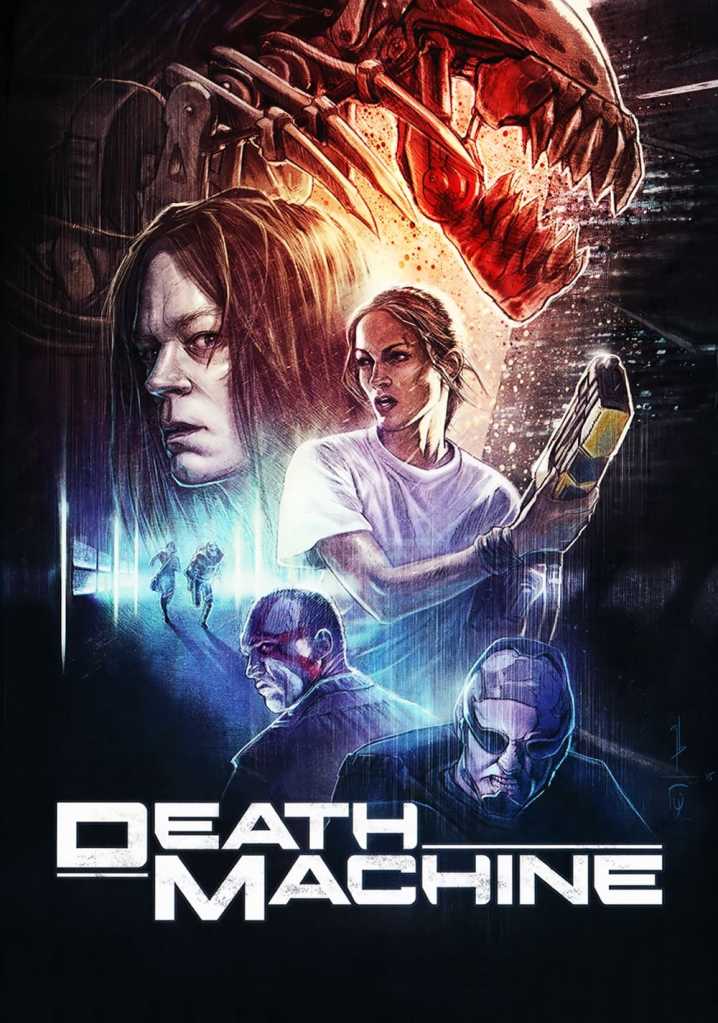
A weapons manufacturer tries to cover up its mistakes with a super soldier program while a morally sound executive does her best to uncover their evil plot and the scientist behind it all plots to maim and destroy it all. Let’s dig into 1994’s “Death Machine”, directed by Stephen Norrington!

AS I SEE IT

The directorial debut from Stephen Norrington, and reportedly the effort that landed him the director’s chair for BladeDeath Machine is a good movie with an arsenal of flaws.

Set in the future, which is now past, 2003, we follow the company Chaank that provides military weapons. Their failed Robocop-like super-soldier suit has malfunctioned and caused a slaughter of civilians. Now they’re back to the drawing board, so to speak, though the bottom line is always more important. In steps Scott Ridley who instructs the board they will just be pivoting.

The mad scientist behind the creation, Jack Dante, secretly creates a psycho-death bot named Warbeast. And once the fun starts, this metal death force shreds everyone in its path.

The story has interesting points, such as the evil corporation, the righteous humanist alliance, and the mad genius hellbent on domination. But the acting and script fall off a cliff a little more than halfway through the film. The sets are great, and the animation on the Warbeast is chaotic and amazing, which makes sense because the Director used to cut his teeth in creature effects on films like Aliens and Alien 3. 

The homages are off the charts.

Some of the examples I picked up on were sound effects from DoomMasters of the Universe toys that decorate Dante’s office, a Daffy Duck impression from Brad Dourif, a battle cry from Street Fighter, as well as the Warbeast resembling a Mouser from Teenage Mutant Ninja Turtles. The names of the characters as well are tributary. Some are identical: John Carpenter, Scott Ridley (Ridley Scott), Jack Dante (Joe Dante), Weyland, Yutani (Alien).

There was too much whimsy and cheeky humor inserted for the tone of the film and could have used some fine-tuning. But I feel it was just on the cusp of being a classic sci-fi/horror.

FAMOUS FACES

Brad Dourif (Dante): you know him, you love him, he’s everyone’s favorite good guy. He always brings the same quality of maniacal energy and really excels as the bad guy, but no role was as iconic and great as that of our friend Chuck in Child’s Play. 

He has since become a Rob Zombie regular (31 and Three from Hell), but Richard Brake (Ridley) showed he has the propensity for villainy in what I felt was an underappreciated role. He really stood out, and it was a shame he was killed off so early as he seemed to have an insurmountable level of maddening bravado.

William Hootkins (John Carpenter) is probably most famous as Porkins (Red Six) in Star Wars. He also played Eckhart in Tim Burton’s Batman.

Rachel Weisz has a brief cameo in this her first feature, and would later go on to star in The Mummy series and marry James Bond.

OF GRATUITOUS NATURE

The inclusion of the heartbreaking and gut-wrenching story of Cale’s daughter getting her arm flayed in a garbage disposal does nothing for the greater good of the story. It affords Pouget an opportunity to display another emotion in her repertoire. At this point, however, the script already jumped the shark.

HEARTTHROB

Ely Pouget (Hayden Cale) is a great leading lady for this genre, and her skills are emphasized in the first half of the film. She’s got Ripley’s bad-ass woman card in my opinion, and she’s beautiful to boot. She seems to have hardly aged since 1994 in most recent photographs as well.

RIPE FOR A REMAKE

This is one of those odd, hardly heard of, 90’s films that deserved better. I know it’s been given numerous cuts and a so-called definitive cut, but it could really stand to use some sound editing and unbiased clipping. It’s not sacred ground, but I would rather it see a clean pass rather than a clean slate.

SPAWNS

No progeny to report.

WHERE TO WATCH

An uncut Blu-ray was released in Germany (the version I watched). If you don’t feel like paying up for it, you can stream on Amazon Prime, Roku, Vudu, or Plex.

Saturday Matinee: Cold Souls

You may say it’s my soul, but it looks to me like a garbanzo bean

By Roger Ebert

Source: RogerEbert.com

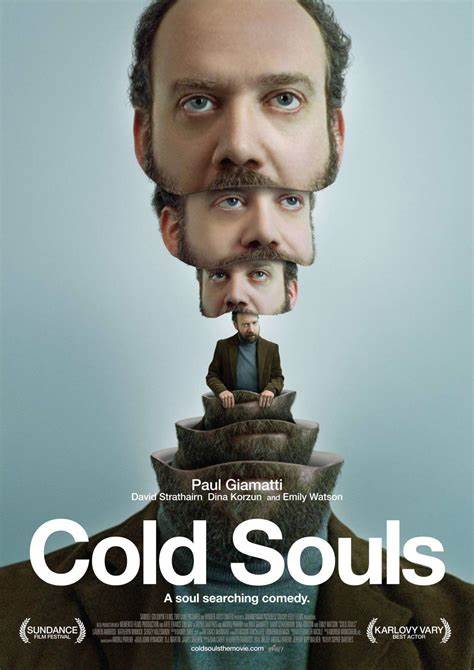
Would an actor sell his own soul for a great performance? No, but he might pawn it. Paul Giamatti is struggling through rehearsals for Chekhov’s “Uncle Vanya” and finds the role is haunting every aspect of his life. His soul is weighed down, it tortures him, it makes his wife miserable. He sees an article in the New Yorker about a new trend: People are having their souls extracted for a time, to lighten the burden.

The man who performs this service is Dr. Flintstein, whose Soul Storage service will remove the soul (or 95 percent of it, anyway) and hold it in cold storage. As played by a droll David Strathairn, whose own soul seems in storage for this character, Flintstein makes his service sound perfectly routine. He’s the type of medical professional who focuses on the procedure and not the patient. Giamatti, playing an actor named after himself, has some questions, as would we all, but he signs up.

“Cold Souls” is a demonstration of the principle that it is always wise to seek a second opinion. The movie is a first feature written and directed by Sophie Barthes, whose previous film was a short about a middle-aged condom tester who considers buying a box labeled “Happiness” at the drugstore. Clearly this is a filmmaker who would enjoy having dinner with Charlie Kaufman. Perhaps inspired by Kaufman’s screenplay for “Being John Malkovich,” she also credits Dead Souls, the novel by Gogol about a Russian landowner who buys up the souls of his serfs.

Gogol was writing satire, and so is Barthes. We hope that medical intervention can help us do what we cannot do on our own: Focus better, look younger, lose weight, cheer up, be smarter. If only it were as simple as taking a pill. Or, in Giamatti’s case, lying on his back to be inserted into a machine looking uncannily like a pregnant MRI scanner.

His soul is successfully extracted and kept in an airtight canister. He’s allowed to see it. It has the size and appearance of a chickpea. Lightened of the burden, he becomes a different actor: easygoing, confident, upbeat, energetic — and awful. Rehearsals are a disaster, and he returns to Flintstein, demanding his old soul back.

This is not easily done, for reasons involving Nina (Dina Korzun), a sexy Russian courier in the black market for souls. A Russian soul is made available to Giamatti, with alarming results. All of this is dealt with in the only way that will possibly work, which is to say, with very straight faces. The material could be approached as a madcap comedy, but it’s funnier this way, as a neurotic, self-centered actor goes through even more anguish than Chekhov ordinarily calls for.

I suppose “Cold Souls” is technically science fiction. There’s a subset involving a world just like the one we inhabit, with only one element changed. In an era of Frankenscience, “Cold Souls” objectifies all the new age emoting about the soul and inserts it into the medical-care system. Certainly if you have enough money to sidestep your insurance company, a great many cutting-edge treatments are available. And soul extraction is not such a stretch when you reflect that personality destruction, in the form of a pre-frontal lobotomy, was for many years medically respectable. Insert an ice pick just so, and your worries are over.

I enjoy movies like this, which play with the logical consequences of an idea. Barthes takes her notion and runs with it, and Giamatti and Strathairn follow fearlessly. The movie is rather evocative about the way we govern ourselves from the inside out. One of Nina’s problems is that she has picked up little pieces from the souls of all other people she has carried. Don’t we all?

____________________

Watch Cold Souls on Plex here: https://watch.plex.tv/movie/cold-souls

Saturday Matinee: Everything Everywhere All at Once

“Everything Everywhere All at Once” Review — Don’t Forget To Breathe

By Sergiu Inizian

Source: Medium

In 2016, Daniel Scheinert and Daniel Kwan (known collectively as Daniels) premiered their feature debut at the Sundance Film Festival. Swiss Army Man stunned audiences with a bizarre premise and is still one of the oddest films to come out of the prestigious festival.

It is a movie in which the emotional weight gets swallowed by a nevertheless entertaining childish cinematic approach. But it’s also a test run for Everything Everywhere All at Once, a whirlwind of a movie that brings so much more to the screen than downright weirdness.

The Daniels tell the story of Evelyn (Michelle Yeoh), a Chinese-American woman who runs a laundromat with her easy-going husband, Waymond (Ke Huy Quan). She is discouraged by life, has marital problems, and is unable to communicate with her daughter, Joy (Stephanie Hsu). On top of it all, she is at a loss when trying to challenge her father (James Hong) about past trauma or present issues.

Yeoh infuses so much dignity into Evelyn, a struggling mother who quietly looks for answers to her personal problems while trying to put the family business in order. Her two priorities are organizing a Chinese New Year party and successfully dealing with an IRS audit.

But, in the IRS building, a wholly changed Waymond introduces her to the Multiverse, a collection of realities that hosts endless versions of Evelyn. This is revealed to her because she is the one powerful enough to combat an entity that desires to destroy the fabric of reality.

What ensues next is a kaleidoscopic montage of possibility that showcases the protagonist’s alternate lives with gripping vigor. This interdimensional music video entertains through dynamic genre mashups, marvelous colors, and an eclectic Son Lux soundtrack. The directors decorate their psychedelic narrative with an abundance of references that range from arthouse drama to “Avengers-style” heroics and to completely silly antics.

At the center of the polychromatic experience, Evelyn is tasked to make sense of it all. Michelle Yeoh is fearless in her multifaceted role, bringing nuance and honesty to a captivating madhouse of a film. Within the Multiverse, Yeoh’s wide-open eyes pierce through all the outlandish embroidery and stand as the film’s brightest marvels.

Underneath the sci-fi-infused cinematic experience, the Daniels reveal an attentive treatment of sorrow, generational conflict, and reconciliation. The portrayal of familial disconnect especially absorbed me: Evelyn is both a mother and daughter and yet she finds herself in the middle of a discord that spans three generations. In Everything Everywhere All at Once, the fractures of reality pale in comparison to the emotional ruptures that define Evelyn’s family.

While the visual experience of the massive Multiverse can be overwhelming at times, the directors know when to hit the pause button and insert quiet moments, allowing the characters to shine. Ke Huy Quan steals the show in these scenes, especially in the universe in which Evelyn is a famous actress. He brings so much authenticity to the kind, hopeful Waymond and his presence is a fitting companion to Yeoh’s mesmerizing performance.

In Everything Everywhere All at Once, the Daniels create so many layers for the seemingly mundane story of Evelyn. It’s a breathtaking journey that deals with life’s “what-ifs” and entertains through sheer ambition. It also embraces a charming message which showcases the wonder of cinema and the craft of the quirky directorial pair: regardless of how seemingly ordinary a destiny is, it always involves plenty of fantasy, mystery, and hope.

____________________

Watch Everything Everywhere All at Once on Hoopla here: https://www.hoopladigital.com/movie/everything-everywhere-all-at-once-michelle-yeoh/16497128

When Black Mirror’s Dystopia Becomes Our Reality

Exploring the Impact of Black Mirror’s Predictive Technologies on Society and Ethics

By Nolan Clarke

Source: Medium

In the eerie twilight between fiction and reality, the anthology series “Black Mirror” has captivated audiences with its unnerving portrayal of technological advancements and their potential consequences. As we stand on the brink of a new era, it’s both fascinating and disconcerting to contemplate which of these technologies might soon transcend the screen and become part of our everyday lives. In this exploration, we delve into the dark corridors of possibility, uncovering the most disturbing technologies from “Black Mirror” that could become real in the near future.

The Grains of Memory: ‘The Entire History of You’

In the episode ‘The Entire History of You’, characters have ‘grains’ implanted behind their ears, recording everything they see and hear. This technology is not too far off from the reality we are inching towards with the continuous advancement in augmented reality (AR) and wearable tech. Companies like Google and Facebook are already experimenting with AR glasses. Imagine a world where every conversation and every event in your life is recorded, rewound, and scrutinized. The implications for privacy and mental health are profound, opening up a pandora’s box of ethical dilemmas.

The Echoes of Social Acceptance: ‘Nosedive’

In ‘Nosedive’, society is ruled by social ratings, with every interaction affecting one’s societal status. This dystopian vision mirrors the existing social credit systems and online rating platforms. China’s social credit system, for instance, rewards or punishes citizens based on their behavior. The psychological impact of living in a society where one’s worth is constantly judged and quantified is alarming, leading to a performative existence devoid of authenticity.

The Haunting Presence of the Dead: ‘Be Right Back’

This episode brings to life an AI that imitates the deceased, based on their online presence. With advancements in AI and deep learning, creating digital personas of the departed is not far-fetched. Companies are already developing chatbots based on deceased individuals’ online data. The moral implications are significant, raising questions about grief, closure, and the ethics of digitally resurrecting the dead.

The Tyranny of Surveillance: ‘Arkangel’

‘Arkangel’ presents a future where children are monitored through neural implants, giving parents omnipresent surveillance capabilities. This reflects the growing trend of helicopter parenting and the use of technology to track children. With GPS trackers and smartphone monitoring apps already prevalent, the leap to neural implants doesn’t seem too distant. The invasion of privacy and loss of childhood independence are stark reminders of the dangers of over-surveillance.

The Price of Convenience: ‘Crocodile’

In ‘Crocodile’, memories can be externally accessed and displayed. With tech giants already exploring brain-computer interfaces, the concept of accessing thoughts or memories isn’t purely fictional. Neuralink, for instance, aims to create devices that can be implanted in the human brain. The ethical implications of such technology are immense, potentially threatening the very sanctity of our thoughts and experiences.

The Dark Side of Entertainment: ‘White Bear’

‘White Bear’ shows a world where punishment is turned into a form of entertainment. While this may seem extreme, the proliferation of reality TV and online shaming cultures points towards a society increasingly desensitized to the exploitation of human suffering for entertainment. The blurring lines between justice and voyeurism highlight a disturbing aspect of human nature.

Conclusion: A Reflection on Our Path Forward

As these “Black Mirror” technologies creep from fiction to reality, we must tread cautiously, balancing innovation with ethical responsibility. We stand at a crossroads, where the choices we make today will shape the morality and humanity of our technological tomorrow. In the end, it’s not just about the technology we create, but the reflection of ourselves that we see in it — a black mirror showing us who we might become if we’re not careful.

Saturday Matinee: The Wandering Earth II

By Simon Abrams

Source: RogerEbert.com

Time runs out in carefully marked units in the mainland Chinese sci-fi disaster pic “The Wandering Earth II,” a sturdy prequel to the record-smashing adaptation of Liu Cixin’s novel. In “The Wandering Earth II,” the apocalyptic problems faced by this movie’s Chinese characters—along with their international peers from the United Earth Government (UEG)—have already happened. Because in “The Wandering Earth,” the planet has already left its orbit thanks to some high-powered rocket engines, which have pushed the Earth out of harm’s way (aka a crash course with the Sun). Set in the near-future—a range of dates that includes 2044, 2058, and 2065—“The Wandering Earth II” follows China’s men and women of action as they lead the planet out of the solar system and into the previous movie.

Both “The Wandering Earth” and its sequel are flashy, state-approved cornball spectacles about humanity’s resilience (especially the Chinese). Both movies were produced with gargantuan budgets that would make even James Cameron blink, and they both look fantastic thanks to director Frant Gwo’s eye for panoramic scope and paperback cover-worthy details. The main difference between these two blockbusters is that the protagonists of “The Wandering Earth II” must repeatedly choose to be hopeful despite perpetually impending disasters, each one of which is neatly labeled and foregrounded with pulpy on-screen text like “The Lunar Crisis in 12 hours” and “Nuclear explosion in 3 hours.”

In this way, Gwo (“The Sacrifice”) and his five credited co-writers succeed in refocusing our attention on scenes of ticking-clock suspense, sandwiched between syrupy—and mostly satisfying—melodramatic interludes, where square-jawed astronauts and UEG diplomats struggle to do what we know is a foregone conclusion.

Most of “The Wandering Earth II” follows the superhuman efforts needed to jumpstart the Moving Mountain Project, the mission to first build and then deploy the globe-shifting engines needed to push the Earth out of harm’s way. The UEG’s Chinese delegation, led by the paternal diplomat Zhezhi Zhou (Li Xuejian), recommends prioritizing the Moving Mountain Project instead of the Digital Life Project. This radical initiative would transfer human participants’ consciousnesses into artificially intelligent computer programs. Some Digital Life supporters try to sabotage the Moving Mountain Project, including a deadly attack on the Space Elevator transportation ships that send UEG representatives from the Earth to the Moon.

Nobody living through the events of “The Wandering Earth II” knows what we know: That the Moving Mountain project succeeds and eventually becomes the Wandering Earth project, which comes under threat by a HAL 9000-esque artificial intelligence (A.I.) named MOSS in the first film. Still, multiple scientists, government officials, and space adventurers—mostly Chinese—believe in their work’s vital necessity, whether they’re punching out saboteurs or detonating one of a couple hundred nuclear devices scattered around the moon. There’s a lot of hand-wringing and teeth-gnashing along the way, mostly from English and Russian-speaking UEG members, all of whom speak in stilted, poorly dubbed dialogue. But Chinese astronauts, like “The Wandering Earth” co-leads Liu Peiqiang (“Wolf Warrior 2” star Wu Jing) and Han Duoduo (Wang Zhi), always prove Zhou’s slogan-simple maxim: “In times of crisis, unity above all.”

Some melancholic (and occasionally maudlin) flashbacks and dialogue emphasize the personal motives of one-note characters who, in the movie’s best scenes, are just parts of a beautiful post-human landscape. Liu remembers his wife and young daughter while melancholic scientist Tu Hengyu (Andy Lau) talks with his dead child after he uploads her personality into an experimental A.I. program; she cries a lot and sometimes responds with existentially troubling questions like, “Where am I, daddy? I want to get out.” We’re then periodically reminded of the next impending crisis—“the moon disintegrates in 50 hours”—in between solar storms and nuclear explosions. Somehow, “The Wandering Earth II” never feels tonally unbalanced or narratively convoluted, partly because Gwo and his collaborators keep their movie’s plot focused on feats of action-adventure heroism.

“The Wandering Earth II” only seems relatively unambitious because it’s more focused on sap-happy human emotions than on dystopian intrigue. Both movies are still essentially showcases for beautiful and expensive-looking computer graphics. But “The Wandering Earth II”—a brittle and, at heart, old-fashioned space opera—would be insufferable if Gwo and his ensemble cast members didn’t sell you on the possibility that someday, people who are as selfless, monomaniacal, and capable as Liu and Tu could exist.

“The Wandering Earth II” is also like “The Wandering Earth” because it’s just the right mix of silly and somber. Hurt, scared people wonder about the recent past, but always from a rare position of forward-thinking emotional clarity. (“She’s dead, and that’s it. That’s the reality.”) So when humanity must inevitably save the day, their accomplishments are appropriately surreal and awesome. 

Saturday Matinee: The Artifice Girl

By Sheila O’Malley

Source: RogerEbert.com

The fears and possibilities of Artificial Intelligence have probably lurked in the human brain since human beings started telling stories. Pygmalion and his statue could be seen as members of the AI Universe. So, too, Mary Shelley’s Frankenstein. But A.I. has moved out of science-fiction and into reality, impacting various workplaces in ways which would have seemed far-fetched just a couple of years ago. Franklin Ritch’s “The Artifice Girl” is a thought-provoking film that examines the ethics of A.I., moving into even the existential aspects of the concept of artificial intelligence. Any deep inquiry into A.I. is also an inquiry into what it means to be human. Ritch, who wrote, directed, and also appears in the film, keeps the story tightly controlled, so the sole focus is on the mental and emotional challenges facing us when we’re dealing with our preconceived notions of reality and authenticity.

This calls to mind “Blade Runner,” and its source material, Philip K. Dick’s Do Androids Dream of Electric Sheep? If a memory is implanted into an android’s brain, a “personal” memory of a childhood that never happened, then isn’t that memory a real thing to the android? The android can’t tell the difference. It feels real. At a certain point, what is or is not “real” is irrelevant. This is when things get unsettling, and “The Artifice Girl” sits in that very unsettling place.

Broken up into three sections, each of which is about half an hour long, “The Artifice Girl” starts off in a very small, dark, windowless room, where a man named Gareth (Ritch) has been brought in for questioning. The two agents in charge (Sinda Nichols and David Girard) take a very rough approach, terrifying and intimidating Gareth (who is not as naive as he initially appears). The issue is an ongoing project designed to combat the spread of pedophiles and predators operating online, devising technological ways to lure these perverted creeps out into the open. Their newest tactic is Cherry (Tatum Matthews), a digitally created nine-year-old girl who hangs out in chat rooms, going on live chats, logging her persistent viewers, the ones who show up, who message her. She’s an effective decoy. She has also developed beyond her original programming, beyond the humans who designed her.

“The Artifice Girl” isn’t plot-heavy. Each scene occurs in a single location, making the film extremely claustrophobic. The characters sit or stand, or pace in windowless rooms, grappling with weighty subjects, throwing around references to the Turing Test, game theory, the uncanny valley, and NLP; all while trying to deal with the complications surrounding either the sentience of “Cherry“, or their own perception of her sentience. In one scene, Gareth and the two agents argue over whether or not Cherry, the digitized child, can consent to something. She looks so real. The thought of her in all those chat rooms is horrifying. It’s almost like the “adults” in charge of Cherry have to keep reminding themselves: “She’s not real, she’s not real, she’s not real.”

To speak more about how the story is structured would be to give too much away. Ritch’s script is thoughtful and intense, making “The Artifice Girl” a mentally engaging and challenging work. The small cast is excellent, particularly young Matthews, whose dialogue is dauntingly technical and delivered in a monotone. There’s a lot of dialogue, and yet “The Artifice Girl” doesn’t feel like it’s too “talky” (except for the third and final scene, where the long monologues drag). The issues at hand are intellectual and cerebral as much as emotional. There’s a great moment where Cherry, the A.I., is being questioned about what she feels about something. Cherry replies, in a flat voice, “Human nature is not something I aspire to.” Considering all she has “seen” online, one can’t blame her.

____________________

Watch The Artifice Girl on Hoopla here: https://www.hoopladigital.com/title/16151819

Saturday Matinee: Acción Mutante

By Steve Harcourt

Source: NerdSpan

Although made in a ’90s ‘B-Movie’ style, Acción Mutante can be either viewed as a schlocky, gore laden, science fiction romp or a politically astute piece of social commentary in an innocuous wrapper. It could also, potentially, be both.

In a dystopian future where the world is ruled by the glamorous and ‘good looking’ people, the disfigured and disabled are marginalised and treated as second class citizens destined for a life of poverty.  Fighting against this tyranny is a disparate band of characters, who call themselves mutants, using the name ‘Acción Mutante’ for their terrorist acts.  For several years since the imprisonment of their leader ‘Ramon’ (Antonio Resines), the group, comprising of conjoined twins ‘Alex’ (Álex Angulo) & ‘Juan’ (Juan Viadas), ‘Quimicefa’ (Saturnino García), ‘Manitas’ (Karra Elejalde), ‘Chepa’ (Ion Gabella), and ‘M.A’ (Alfonso Martínez), have been ineptly continuing the fight, leading to many high profile blunders, especially when they try to kidnap someone.  Upon his release, ‘Ramon’ immediately puts into motion a new plan to kidnap Patricia Orujo (Frédérique Feder), the daughter of the boss of the Orujo business empire (Fernando Guillén), and ransom her for 10,000,000 ‘ecus’ on a distant mining planet.  This plan rapidly spirals out of control…

As a writer, producer and director, Álex de la Iglesia has become more well known for films such as The Oxford MurdersLa Comunidad, and The Last Circus since Acción Mutante, his first directorial feature. This film was a brash introduction to what was he was later to create.  With production being aided by Augustin and Pedro Almodóvar, and with several well known Spanish actors on board, this was by no means an effort made with little talent behind him and it shows what people saw in him, even then.

What he has made is, essentially, an obvious attack on the bourgeoisie and their ilk with commentary on the disabled and the way society treats them, all put together in a ‘Troma-esque’ black comedy. In the amount of gore, and especially the style of the gore, the Troma influence is apparent and it would sit comfortably alongside many Troma films.  There is also an obvious influence in some scenes from Almodóvar, such as the party scene, where you may even notice Rossy De Palma, an Almodóvar regular. There are also some similarities to other European directors’ early work, such as Jean Pierre Jeunet & Marc Caro (Delicatessen), especially in terms of characters, which is not a bad thing.

These characters are a mixed bag, with some being broadly comedic and others being very one dimensional heroes or villains.  What is clear is that a certain amount of hokey fun was had by the cast. They do a good job in hamming it up in the right manner for this kind of B-Movie with some good interplay, some clever idiosyncrasies, and some nice set pieces.  Plot-wise, the pacing and structure are a little flawed. As the second half falls apart a bit, losing some of the good premise along the way, which is a shame. Much more could have been made of this premise and instead it treads a slightly simpler path with a cheaper, trashier angle.  Having said that, it does still tend to work, but just not quite how you thought it was going to.

There are a couple of problematic areas, namely some excessive violence that is unnecessary and some misogynistic elements which are troubling.  When the film originally came out on VHS, the BBFC (British Board of Film Classification) made some cuts, which have been put back in this DVD version, and we probably would have been better off without them as they do not enhance the plot or its coherence at all. I had previously only seen the VHS version and in no way was this better.  As for the misogyny, it is pretty obvious that these elements are there, but I would be interested to hear what Álex de la Iglesia and producer Pedro Almodóvar have to say about it and whether they were making a particular point, as Almodóvar has a history of strong female characters and is often called a feminist.

Overall, I would say that if you’re a fan of the Troma-style of bonkers, splatter, comedy B-Movie, then you will find something to like here. This needs to be taken as a relatively stupid, schlocky comedy with some obvious social and political points to be made. However, I have read that there are some more specific points made for a Spanish audience that may not be immediately apparent for an international audience.  As someone from the UK, I didn’t pick up on anything in particular, but that doesn’t mean it’s not there. Potentially, it could contain further depth.  So, while it is problematic, it does show the signs of better work that was to come from Álex de la Iglesia, and can be enjoyed as an oddball thing of its own.

____________________

Watch Acción Mutante on Hoopla here: https://www.hoopladigital.com/title/15772689

Saturday Matinee: Lessons of Darkness

By Martin Purvis

Source: The Film Sufi

Werner Herzog’s documentary films lie at an extreme distance from the Anglo-American tradition of documentary filmmaking. Part of that distance can be linked to the distinction between two fundamental stances towards the depiction of reality: “Objectivism” and “Interactionism”, which I have discussed in other essays, for example, Avatar (2009), Close-Up (1990), and SiCKO (2007). American documentarians generally align themselves with Objectivism and hold that they are presenting an objective view of reality. An extreme form of this approach is “direct cinema”, which seeks to create the illusion that the filmmaker is an invisible “fly on the wall” and has no impact on the subjects being filmed, thereby supposedly ensuring scientific objectivity. But even in more conventional American documentaries with explicitly polemical content, there is a presumption that objective reality, independent of any observer, is being presented. Continental European documentary filmmakers, on the other hand, have had a tendency to lean towards Interactionism and have made more personal films in which the filmmaker and his or her point of view is a confessed part of the narrative. Herzog is so much on the Interactionist side of the ledger that his documentary films not only include his personal perspective, but seem primarily to be his own personal essays about the world – he, himself, is an implicit focus of the film, and the “reality” depicted is self-consciously Herzog’s own reality. Lessons of Darkness (Lektionen in Finsternis, 1992), which was shot in Kuwait in the immediate aftermath of the First Gulf War (1990-91) is one such example of Herzog’s style.

Although focussed on the harrowing events and ravages that happened in Iraq and Kuwait during that time, Lessons of Darkness has clear-cut affinities with Herzog’s first documentary Fata Morgana (1971), which was shot in Africa. In that earlier film Herzog edited footage that he had (seemingly randomly) shot in the African Sahel and tried to fashion a dark vision about man’s hopeless ineffectiveness, and consequently likely impermanent existence, on the planet – an ephemeral existence like a mirage. Some twenty years later, with Lessons of Darkness, Herzog again collected footage, this time in Kuwait, and then assembled his photographic essay in post-production, and again his vision is one of dark apocalypse and pessimism concerning man’s prospects for a sustainable future. In fact both Fata Morgana and Lessons of Darkness contain vague commentary that suggests that humankind on Earth is being clinically observed, with amazement and horror, by a visitor from another planet. However, in neither film is there any real narrative or sequence of events that could amount to a story – they are both more or less personal essays of despair. But if we assert that they are both cinematic commentaries, we have also to concede that neither of these two films provides an explicit disquisition or argument, or even has a clearly articulated thesis. What we are really presented with is just a suggestive sequence of images, on which the viewer reflectively fills in many of the blanks and faces a greater-than-usual task of constructing his or her own story or vision. This process of placing much of the narrative burden on the viewer essentially fails with Fata Morgana (which was almost a random collection of lurid images of garish and pathetic human folly), but is more successful with Lessons of Darkness, primarily because the viewer in this case is more likely to bring to the film considerable familiarity with what happened during the “First Gulf War”and use that material for his own imaginative reconstructions.

The greater part of Lessons of Darkness consists of lurid scenes of fires in the Kuwaiti oilfields burning out of control and spewing gargantuan clouds of smoke. These images are interspersed with images of devastation, both at the physical and human level, and with human firefighters seemingly overmatched in their efforts to quell the multiple, raging infernos. The images are apparently meant to be abstractly horrific, and there is almost no spoken dialogue and no explicit reference to the Gulf War, or to specific places, or to any historical context. To set some kind of context, Lessons of Darkness opens with images of wasteland and destruction, and the prologue refers to a planet “in our solar system” which evidently has undergone a catastrophic war. So the viewer sees things simultaneously with respect to two overarching narrative perspectives: the real Gulf War and an abstract metaphorical fable of how bizarre humankind’s self-destructive impulses might be to a detached, external observer. The film is then presented partitioned into thirteen chapters, each identified by apocalyptic, perhaps oracular, intertitles which suggest chapters to some sort of apocryphal Book of Revelations.

  1. “A Capital City”. This section features an opening voiceover narration with images of Kuwait City filmed from a low-flying helicopter, ominously suggesting that this doomed city will soon be utterly destroyed by warfare (it wasn’t, and this footage was filmed after the conflict).
  2. “The War”. Here is shown footage of the aerial bombing of Iraq as seen via night-vision video cameras. Although this section is relatively short and no mention of “Operation of Desert Storm” is made, the context is likely to be familiar to a worldwide audience, since it was widely viewed on CNN.
  3. “After the Battle”. Images of war devastation are presented.
  4. “Torture Chambers”. This thankfully brief section is one of the most memorable, though difficult to bear, sections in the film. First is shown what is apparently the insides of one of the torture chambers run by Saddam Hussein’s government, and it features a mute display of mechanical devices designed to inflict unbearable pain. Then an Arab woman is shown who was been rendered almost permanently speechless by having been forced by the authorities to witness her own sons being tortured to death.
  5. “Satan’s National Park”. Helicopter footage of what seems to be a vast marshland are revealed to be in fact entirely flooded with oil.
  6. “Childhood”. Another Arab mother is shown, this time with a young, disturbed boy who has been rendered speechless by what he has witnessed during the conflict. As with the woman shown earlier, the horror of what happened is not shown, it is only something so unspeakable that one cannot bear to think about it. The viewer’s imagination then fills in the blanks.
  7. “And A Smoke Arose Like The Smoke From A Furnace”. Here, 23 minutes into the film, the raging fires take over the screen. Again, they are filmed from low-flying helicopters.
  8. “A Pilgrimage”. Now the (American) firefighters are shown, sometimes relatively up close and at other times at a distance and dwarfed by the towering flames of the fires that burn endlessly. This section shows the firefighters using explosives to try to put out the fire.
  9. “A Dinosaur’s Feast”. This is more or less a continuation of the previous section showing the firefighters, but now emphasizing some of the huge construction and excavation machines employed in their work. The machinery has monster-like appearances, with arching cranes, serpentine bodies, and huge digging claws.
  10. “Protuberances” – a brief section showing closeups of oil–and-mud swamps bubbling and frothing, and evoking more nightmarish images of Hell.
  11. “The Drying Up of the Wells”. The oil-covered firefighters are shown, often in slow-motion, intensely engaged in the mechanics of their operations. The functional nature of these activities is incomprehensible to the typical viewer, and it all appears perhaps as an abstract Ballet Mécanique from the dark side. The macabre strangeness of it all, and the degree to which these operations seem to be foreign to what we might call normal human intercourse, are worth comparing to Louis Malle’s documentary, Humain, Trop Humain (1974).
  12. “Life Without Fire”. With many of the fires now apparently having been extinguished, the voiceover commentary of the interplanetary visitor expresses wonder as these strange creatures to him (i.e. the firefighters) engage in the baffling act of relighting an extinguished geyser of oil. He comments: “Has life without fire become unbearable for them? . . . . . Others, seized by madness, follow suit. . . . . Now they are content, now there’s something to extinguish again.”
  13. “I am So Weary of Sighing, O Lord, Grant That the Night Cometh”. The final portion returns to the fires, themselves, carrying with it an air of resignation and gloom.

Herzog’s fascination with fire extends to a fascination with its opposite, darkness (hence the title). The demonic forces that lurk inside the hearts of men seem to be beyond civilized understanding or rational control. These issues of cruelty and madness are as elemental as fire, itself, and are not confined to the Middle East [1]. This apparently was Herzog’s project: not to focus on just the particular horror of what happened in one part of the globe, but to fashion a fiction that would portray a more universal damnation. To this end, he opens the film with his own fabricated quotation (“The collapse of the stellar universe will occur, like creation, in grandiose splendor”) which he probably attributes to Blaise Pascal in order to give it the appropriate resonance – Pascal is perhaps not so well-known to English-speaking audiences, but his genius occupies a peculiarly iconic place in the European mind.

The horror that Herzog attempts to convey by his images of man-made Hell is enhanced by its unspeakable nature – it is beyond human articulation. Instead of a deafening roar from the fires drowning out occasional shouts from the firefighters, much of the stoundtrack is filled with funereal, dirge-like orchestral music from Mahler, Prokofieff, Verdi, Wagner, and Arvo Part. The unspeakable nature of this horror is explicitly referenced by the two mothers: one mother is unable to speak comprehensibly, and the child of the other mother has been rendered speechless by rational choice. It is left to our imaginations to fill out these nightmares.

Notes:

  1. For example, consider the use of germ warfare by the Japanese during the Second Sino-Japanese War (1937-45). Here is a quotation from an article on the subject (Judith Miller, “When Germ Warfare Happened”City Journal, (Spring 2010)):

“The methods were brutal. Army trucks dumped gallons of deadly germs alongside roads and railway lines linking Chinese towns so that infections would spread from town to town; planes dropped porcelain bombs containing infected fleas on dozens of villages, causing devastating outbreaks of bubonic plague. The Japanese laced more than 1,000 wells in the area of Harbin with typhoid bacilli. They also inserted typhus into bottles of lemonade that children loved to drink in the summer, Harris reported. In Nanking, they distributed anthrax-filled chocolate and cake to hungry children. The Japanese discovered that packing fountain pens and walking sticks with deadly germs was a particularly effective way of secretly disseminating them. In 1940, Major General Ishii sent a train carrying 70 kilograms of typhus bacterium, 50 kilograms of cholera germs, and 5 kilograms of plague-infected fleas to the city of Hangzhou, a holiday resort favored by Shanghai’s wealthy. From there, the germs were dumped into ponds and reservoirs and spread by aerial spraying, contaminating all life in fields of wheat and millet during the harvest.”