
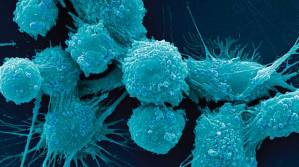
Terror Cells

prostate_cells2

Ain’t no cure for dystopian biology

By Barbara Ehrenreich

Source: The Baffler

At around the turn of the millennium, some disturbing findings surfaced in the biomedical literature. Macrophages—immune cells whose function is to attack and kill microbes and other threats to the body—do not gather at tumor sites to destroy cancer cells, as had been optimistically imagined. Instead, they encourage the cancer cells to continue their mad reproductive rampage. Frances Balkwill, the British cell biologist who performed some of the key studies of treasonous immune cell behavior, described her colleagues in the field as being “horrified.”

By and large, medical science continues to present a happy face to the public. Self-help books and websites go right on advising cancer patients to boost their immune systems in order to combat the disease; patients should eat right and cultivate a supposedly immune-boosting “positive attitude.” Better yet, they are urged to “visualize” the successful destruction of cancer cells by the body’s immune cells, following guidelines such as:

• Cancer cells are weak and confused, and should be imagined as something that can fall apart like ground hamburger.

• There is an army of different kinds of white blood cells that can overwhelm the cancer cells.

• White blood cells are aggressive and want to seek out and attack the cancer cells.

At a more respectable level of discourse, Harvard physician Jerome Groopman wrote an entire 2012 New Yorker article on scientific attempts to enlist the immune system against cancer—without ever once mentioning that certain types of immune cells have a tendency to go over to the other side.

But the evidence for immune cell collusion with cancer keeps piling up. Macrophages supply cancer cells with chemical growth factors and help build the new blood vessels required by a growing tumor. So intimately are they involved with the deadly progress of cancer that they can account for up to 50 percent of a tumor’s mass. Macrophages also appear to be necessary if the cancer is to progress to its deadliest phase, metastasis. When cancerous mice were treated to eliminate all their macrophages, their tumors stopped metastasizing.

A May 2014 paper in the journal Cancer Cell offers a chilling account of the macrophage–cancer cell interaction. Macrophages are among the most mobile cells in the body, capable of moving through the bloodstream or creeping, like amoebae, by extending pseudopods and pulling themselves along. When macrophages encounter breast cancer cells, they do not do what we would like them to do, which is to attack and engulf the “enemy.” Instead, the Cancer Cell article suggests, the macrophages release a growth factor that encourages the cancer cells to elongate themselves into a mobile, invasive form poised for metastasis. These elongated cancer cells, in turn, release a chemical that further activates the macrophages—leading to the release of more growth factor, and so on. A positive feedback loop is established. Or, to put it more colorfully, the macrophages and cancer cells seem to excite one another to the point where the cancer cells are pumped up and ready to set out from the breast in search of fresh lebensraum—in the lungs, for example, or the liver or brain.

You will find little of this drama in the article itself, and not only because it is a scientific paper that happens to have seventeen coauthors. Their data focuses entirely on the chemical exchange between the two types of cells—which is a little like describing a human flirtation entirely in terms of hormones and pheromones. But what goes on among the living cells in the body? How many cells (macrophages and cancer cells) are required before the positive feedback loop can take off? Do the macrophages and cancer cells actually touch one another, perhaps briefly fusing cell membranes, or do the chemical messages they exchange travel through the intercellular matrix? And then there are the deeper, perhaps unanswerable, questions, like what’s in this for the macrophages, which by enabling metastasis seal their own doom? Or for that matter, what’s in it for the cancer cells, which will die along with the organism they destroy?

Kill, Eat, Repeat

If science seems to balk at the behavior of individual cells (and small groups of cells), this is because twentieth-century biology, in its reductionist zeal, tended to zip right past cells to get to the more glamorous molecular level. Cancer research came to focus on the DNA mutations that predispose cells to a career of selfish reproduction. Immunology downplayed macrophages in favor of an obsession with antibodies—the protein molecules that can mark a “foreign” cell, like a microbe, for destruction—although it is chiefly macrophages that do the destroying. My first thesis advisor at Rockefeller University won a Nobel Prize for elucidating the structure of antibody molecules. My second thesis advisor got far less recognition, and a much smaller lab, for his work on how macrophages kill and digest their prey.

Part of the appeal of molecules over cells is that molecules can be collected in test tubes like any nonliving chemical, stored in a refrigerator, and analyzed at leisure by the usual chemical methods. Cells can be pulverized and fractionated into their constituent molecules, of course, but living cells have to be observed with the patience of an ethnologist studying chimpanzee behavior in the wild. After months of biochemical studies of macrophages, I once had a chance to see a living one under a phase contrast microscope and was surprised, in my naïveté, to find that it was moving, its surface rippling and corrugating like that of a sea anemone. The cells of our body are analogs of, and evolutionary descendants of, the unicellular creatures that preceded multicellular life and, in a sense, are tiny animals themselves.

Only very recently, new techniques in microscopy have made it possible to track the behavior of individual cells in living tissue, and the resulting images reveal striking degrees of individuality. If you calculate the bulk average of movements within a sample group of cells, most cells turn out to be going their own way, on paths far from the average. Cancer cells within a tumor exhibit “extreme diversity.” NK, or “natural killer,” cells, which, like macrophages, attack targets like microbes, do not always kill. A 2013 article reports that about half of the NK cells sit out the fight, leaving a minority of them to become what their human observers call “serial killers.”

Individual cells have no mental life—no thoughts or feelings—at least none that we can imagine, if only because they lack nervous systems. But macrophages and NK cells are capable of “memory,” or different responses to stimuli they have encountered before. Risking anthropomorphism, scientists now speak of “decision-making” by individual cells such as macrophages. The cells sniff the chemicals in their microenvironment, seem to weigh their options, and then decide whether to attack or withdraw, move forward or remain where they are. As one science news site put it:

Cells are constantly making decisions about what to do, where to go or when to divide. Many of these decisions are hard-wired in our DNA or strictly controlled by external signals and stimuli. Others, though, seem to be made autonomously by individual cells.

Just a decade ago, any talk about cellular “decision-making” would have been taken for whimsy. Cells, as we knew them then, were programmed both genetically and epigenetically (through chemical modifications to DNA occurring during development) to perform their functions in the body. Heart cells beat, intestinal cells secrete digestive enzymes, nerve cells conduct electrical signals, etc.—and those that falter at their tasks obligingly commit suicide through a process called apoptosis. Furthermore, most body cells, most of the time, are fixed in place by glue-like attachments to other cells. Individual cells have no decisions to make, we used to think, because they have no choice but to serve the organism by tirelessly carrying out their assigned roles.

But that old deterministic model of cell behavior offered little insight into cellular rebellions such as cancer. Many cells may be exposed to a carcinogen, but only some turn into cancer cells, and of those, only a fraction go on to a career of metastasis. “Decisions” are made. As for macrophages, collusion with cancer cells is only one of the ways they can undermine the organism. Overly ambitious macrophages play a central role in autoimmune diseases and the many inflammatory ailments, like arthritis, that plague the elderly. In coronary artery disease, macrophages pile up on the arterial walls, where they fatten themselves on lipids until there is no space in the artery for blood to flow through. The macrophages are doing what comes naturally to them: eating. Unfortunately, there is no central authority to tell them to desist lest the whole multicellular contraption that is the body come to grief.

As an analogy to the erratic immune system (which includes macrophages, NK cells, and a host of other cell types, including antibody-producing lymphocytes), biology teachers often invoke the military. Any human society within a spear’s throw of potential enemies needs some kind of defensive force—minimally, an armed group who can defend against invaders. But there are risks to maintaining a garrison: the warriors may get greedy and turn against their own people, demanding ever more food and other resources. Similarly, in the case of the body, without immune cells we would be helpless in the face of invading microbes. With them, we face the possibility of insurrection and self-inflicted death.

Dystopian Biology

It is disconcerting to think of the biological self, or body, as a collection of tiny selves. The image that comes to mind is the grotesque portrait of a super-sized king in the frontispiece of Hobbes’s Leviathan: on close inspection, the king turns out to be composed of hundreds of little people crowded into his arms and torso. Hobbes’s point was that human societies need autocratic leaders; otherwise they risk degenerating into a “war of all against all.” But no “king” rules the body. Despite, or sometimes because of, all the communications—chemical and electrical—that connect the tissues and cells of the body, chaos can always break out.

It would be nice to think that the brain, with which we do our thinking, is a more tightly disciplined place, set off as it is from the turmoil of the body by the blood–brain barrier, like a computer kept in a dust-free, air-conditioned room. But living brain cells are not entirely predictable. The glial cells that support and nourish neurons can become cancerous (as, more rarely, can neurons themselves). Then too, the brain has its own army of macrophages, or microglia as they are called, and overactive microglia can, like macrophages in other parts of the body, create damaging inflammations, leading to neurodegenerative diseases. Bizarrely enough, new research this year shows that breast cancer cells sometimes “disguise” themselves as neurons, penetrate the blood–brain barrier, and start fresh tumors in the brain. If individual cells have functions, they do not always seem to know it.

It took science until 2012 to officially acknowledge that nonhuman animals possess feelings and consciousness. It may take a bit longer for biology to admit that the cells in our bodies are not simply automata, that they possess, if not consciousness, at least some sort of agency. As recently as 2008, an article on the confusing taxonomy of macrophages proposed that a new, “more informative” classification “should be based on the fundamental macrophage functions,” which are defined as “host defence, wound healing and immune regulation.” What about macrophages’ role in abetting cancer—or in instigating life-threatening inflammatory diseases? What “functions” do these activities represent? The “wisdom of the body,” which supposedly keeps the body unified as a single sustainable organism, does not always apply at the microscopic level, where an individual cell can sabotage the entire operation.

Natural selection should weed out cellular traitors, you might think, since people who are vulnerable to cancer, autoimmune diseases, and pathological inflammation—at least at early ages—are less likely to reproduce. The truth is, though, that we do not know for sure what natural selection means at the cellular level. Often, when a person with cancer is subjected to chemotherapy, some of the cancer cells survive through what can only be called natural selection. A victory at the cellular level may mean defeat for the organism.

This is madness, of course. But then, who are we, as human beings, to be appalled by the irresponsible “decisions” of our body’s cells? We too are biological organisms, supposedly doing our best to survive and promote the survival of our kin. And we too, like rogue cells in our bodies, can be murderous, suicidal, and systematically destructive of our physical habitats. We, of all creatures, should appreciate the perversity, as well as the clockwork precision, of biology.

The Control-Matrix is Crashing because the Truth-Seekers are Winning

36da1558948450f9941d79cffcde69e0

By Phillip J. Watt

Source: The Mind Unleashed

The way the masses view the world is a farce. Every single mainstream perspective is either purposely deceptive, or completely misses the point. Even the people in places of influence who we’re meant to trust have either sold out, or are just plain ignorant to the facts. There’s no need to have a heavy heart though; the matrix of control is crashing because the truth-seekers are dealing heavy blows to the false narratives that have for too long shaped the collective mindset of humanity.

Of course the internet can be celebrated for being the primary mechanism which has amplified the sharing of information across location, race, culture and belief systems. In retrospect, the powers-that-will-no-longer-be would be kicking themselves for not trying harder to institute their insidious plan for humanity prior to the birth and growth of the world-wide-web.

Make no mistake though; they have been very successful on many fronts. For example, try to imagine a world where:

      • most journalists don’t report the real news;
      • the majority of doctors don’t truly understand the causes of poor health and how to legitimately resolve it;
      • a high proportion of politicians don’t know how the money supply works and what the agenda is of those who control it;
      • many so-called expert scientists ‘believe’ in a discredited philosophy which resembles a dogmatic religion;
      • the majority of teachers don’t realize they’re teaching a system of indoctrination that nowhere near gets close to the information and critical thinking that should be afforded our kids; and

the masses are not only ill-informed, divided and feverishly fighting against each other over small and irrelevant topics, but they’re also sleepwalking through one of the most majestic and reverent realities that could have ever been conceptualized.

Well, welcome to our world.

As we begin what we call the 21st Century, every system that should be designed to facilitate the health and vitality of the people has been hacked with lies, deception, dysfunction and disharmony. It’s easy to think that this is an embarrassment for our species because it’s beneath our intelligence and ethical capacity, yet there’s no need to lose faith in the inevitable betterment of humanity, including the way in which we organize and economize our societies.

Why? Because all of this dysfunction has been an effective driver of the collective awakening that is rising in the hearts and minds of humanity.

The inspiring fact is that more and more people are slowly waking up and realizing we all have the opportunity to come to our own, informed opinion on the truth, pertaining to both the spiritual and systemic realities. So many more people now understand the mainstream news is not to be taken seriously as its not where we can find information which is aligned with the deeper truths. They’re also acknowledging that we have the choice on what we decide to personally stand and fight for, as well as the legacy we leave for our children and our future generations.

Beware though; once we exit the matrix of control we’re faced with some serious challenges. We have a lot of inner work to do, such as designing a philosophy that ensures we’re at peace, as well as exercising patience in the quest to take back our liberties and design a legitimate and honorable future for humanity.

That’s why we’ve got to feel for those who have been long aware of the many dysfunctions of our world, especially those who have not learned peace and patience. Slowly they’ve watched:

    • the military-industrial-media-politico-banking complex increase their power and continue their pillage across the world;
    • pharmaceutical monopolies amplifying the drugging of society, as well as keeping many of us sick so that they maximize their profits;
    • movements rise up only to be vilified and disassembled, such as the Occupy Movement;
    • science turned into a corporate institution, as well as further hijacked by an inaccurate and small-minded philosophy of reality;
    • wars purposely created with millions of people dying for the whims of the shadow empire;
    • radical extremists massaged into proxy armies to do dirty work for the collapsing power structure;
    • air, medicine, food and water becoming purposely more toxic;
    • governmental policy increasingly being determined by corporate/elite interests;
    • police being militarized all around the globe;
    • the education model struggling to become less of an indoctrination system; and
    • the agenda of global governance becoming closer to fruition.

Some people have known about much of this for decades, so we should commend them for continuing to fight the good fight. They might have witnessed some disheartening developments, yet as much as all this sounds dire, they’ve also seen millions of people disengage from the propaganda narratives and align themselves with the systemic and spiritual pathways that will be the next stage of our evolution.

The point is that even though we need to be patient and persevere, we should recognize and celebrate the achievements that have been made so far. As I discussed in a previous article called “Whilst the Old System Crashes a New One is Being Built”, there are:

    • economists who want to transform the Keynesian model to legitimate alternatives;
    • teachers who understand the massive holes in the indoctrination system called public education;
    • scientists who want to evolve the way energy is created and shared;
    • health practitioners who see the limits of mechanistic and pharmacological medicine and the need for the reintroduction of natural and plant-based therapies;
    • journalists who demand that the media monopolies need to be disassembled;
    • environmentalists who want to transition the way food is grown and distributed;
    • community leaders who aim to reintegrate them to better support its members;
    • politicians who understand the democratic system has been hijacked by big money;
    • activists who campaign for revolutions in our value systems; and
    • futurists who want to change the systemic template for our societal health and well-being.

There are many beautiful souls who are leading the charge by attempting to redesign our society back into alignment with the natural laws of our universe. We should be one of them, regardless of which way we personally decide to contribute.

To do that, we all need to be super clear within ourselves what we believe and what we want to change. There are many ways to do it too, so finding our passions and strengths is critical to playing our own small part in the shift.

It is simply no longer acceptable to keep our heads in the sand; either we’re a minion of the system or we’re not. Of course its difficult to completely disconnect from the way resources flow through the control channels, yet that needn’t stop us from talking about it, sharing information online and somehow contributing, no matter how small, to local and global movements which aim to transition humanity into the new paradigm of abundance.

After all, the truth is what it is, and it is exposing itself to the world by powerfully flowing through all of us.

Ultimately, we needn’t wait for the zombie apocalypse because its already arrived. Most people are good people, yet the masses have been brainwashed into thinking in ways that are absolutely nowhere near aligned to the truth. They might be sleepwalking through a time where the tipping point for the conscious society builds, but that doesn’t mean they’re not salvageable. That’s why we all have a responsibility to help facilitate waking up the collective so that together we’re more empowered and informed to really bring about a future of justice and honor that we can all be proud of.

To do so, let me give you some advice. Don’t get frustrated, don’t be rude, don’t belittle, don’t condemn. We all had to wake up at one stage so its hypocritical if we are. Instead, be calm, be cool, be real, be articulate. Know the information that you advocate like the back of your hand. If we want to be successful in helping others to face the delusions then we need to ensure their defense mechanisms aren’t raised so they’re more likely to be open and receptive to embrace the truth.

And one more thing; hang in there guys and be patient, we’ve still got a long, arduous way to go but we know all the effort will be worth every second.

ABOUT THE AUTHOR
Phillip J. Watt lives in Australia. His written work deals with topics from ideology to society, as well as self-development. Follow him on Facebook or visit his website.

The Upheaval Dialogues: 2012 Reconsidered

2012_1

By Christopher Knowles

Source: The Secret Sun

Before my trip to New Hampshire I was working on a post arguing that the 2012 prophecies were not incorrect but simply premature. That 2012 seemed to mark a turning point of a sort, a distinct change in the worldwide weather, if you will. You can point to to 2012 and see a number of trends that have metastasized since then, in the geopolitical situation, but also in our politics, in the economy, in social relations.

A lot of this is cynical manipulation, a reaction to the legitimate threat once posed by the Occupy movement. We’re seeing a lot of gamesmanship at work, a lot of people being given the rope with which to hang themselves. That will become more apparent by this time next year. Politics at every level is all smoke and mirrors today- believe nothing you see.

But there’s something much deeper at work. We’re seeing mass die-offs of wildlife, particularly that of sealife, all over the world. Most troubling are the mass die-offs of bees, animals that our food supply is so dependent on. Whether through carbon emissions or through geoengineering, we’re also seeing dangerous levels of pollen on the increase and the attendant increase in respiratory illness.

And there have been attendant signs in the sky- the Sun seems to have gone quiet, perhaps presaging a long and difficult period of solar inactivity, one that could presage a mini-ice age. After years of mocking “believers,” scientists are once again recognizing that there are two giants beyond Pluto (one may be a brown dwarf)*.

What effect they might have on our planet is debatable (some claim they are the source of all the invaders we’ve come to worry so much about; asteroids, meteors, etc), there’s no shortage of “Nibiru” scare mongers on the Internet preaching apocalypse one minute, then selling “survival” trinkets and gimcracks in order to stave off your doom the next.

We’ve also seen strange signs on the earth- a rise in earthquake and volcanic activity (a major volcano could block out the Sun for many parts of the world, causing famine), an increase in gigantic sinkholes (massive hollowing out of the surface layer of the earth) and in the Pacific, violent typhoons. Hurricane season in the Atlantic has been relatively quiet since 2012’s Superstorm, but that might be the literal calm before the storm.

And of course, there is the endless drumbeat of war. There is the endless slaughter and massive displacement in the Middle East (with ancient Gnostic sects such as the Druze, Yazidi and Alawites targeted for genocide by Jihadists) and the growing tension in Eastern Europe. There’s also the uptick in terrorism in Europe (Charlie Hebdo, the attack in France today), although intolerable is not even a speck of the carnage people elsewhere in the world suffer on a daily basis, especially as struggles between Sunni and Shi’a Muslims escalate to global proportions. Syria, Yemen, Pakistan…the list of sectarian carnage is mind-numbing.

Toothless NATO protectorates like Sweden are easy targets for the Sino-Russian ascendancy, which is why the US is moving heavy artillery in the area. But the state of constant war is such that drone pilots are reporting record levels of stress and burn-out.

Poltical and social tensions have increased in this country, though in comparison to what’s going on in the rest of the world it seems like a footnote (certainly the endless political bickering on the ‘Net does). On a personal level, I’m seeing so many people I care about under serious stress. It’s as if the entire solar system is in convulsions, from the macrocosm to the microcosm.

As many of us warned about, the corporate Christianity of the 80s and 90s has sparked an enormous backlash, with many young people walking away from religion (and pretty much everything else) entirely. Church leaders are now realizing the error of their shotgun wedding to partisan politics, even as Christianity rises in ways once unimagined in Africa, Russia and China.

But the collapse of religious faith especially among vulnerable working class populations has left a huge void, one which pandemic drug abuse is filling.

A deep and abiding nihilism has gripped the entire world– not just the West– and all of the chaos and upheaval we are seeing now is a symptom of that. 

What is going to heal that?

Science is increasingly proving itself to be corrupt and compromised. Transhumanism (now just a fading dream, despite some of the hysteria you still see) won’t fill the void, virtual reality (which never has and probably never will live up to its hype) won’t fill the void, forcing the world in a Borghive will just make magnify the problem, just as the Internet can turn a quiet, Type B “nice guy” or “nice girl” into a raging, misanthropic troll.

So was 2012 the turning point? The beginning of a period of upheaval? Hollywood sells us the myth of overnight apocalypse (“The Day After Tomorrow”) but history teaches us that periods of upheaval are slow in getting started, so much so that they are hardly recognized as such until it’s too late.

History also teaches us that chaos has its own genius and often turns on the men who seek to unleash it for their own benefit. We’re not seeing true chaos on a worldwide scale yet, but the beast is straining at its leash, that’s for certain.

And you can also bet the farm that we’ll see what Jacques Vallee calls the “Control System” awake from its slumber. It already has, though that too has largely gone unnoticed. But not for much longer.

You will live in interesting times…

UPDATE: Speaking of which, are you watching what’s going on in the Chinese Stock Market?

UPDATE: The weaponization of space is proceeding apace, ostensibly to counter threats from China and Russia. There are strange linguistic undertones in the press release, however….


*The reason I don’t pay any attention to astronomers’ bold claims of distant solar systems is that they have no friggin’ idea what’s floating around in ours. Or they do and are lying about it. Either way.

The Right Happiness is Felt on a Genetic Level

Happiness

A new study from UCLA and the University of North Carolina suggests that not all happiness is equal, and different types of happiness have different effects on the expression of inflammatory genes and antibody/antiviral genes. Participants of the study with high levels of hedonic happiness (the type of happiness that comes from consummatory self-gratification)  had high levels of inflammatory gene expression and low levels of antibody/antiviral gene expression. Participants with high levels of eudomonic happiness (the kind you get from working towards a noble goal and searching for meaning in life) had low levels of inflammatory gene expression and high levels of antibody/antiviral gene expression.

According to Steven Cole, UCLA professor of medicine and co-author of the study:

What this study tells us is that doing good and feeling good have very different effects on the human genome, even though they generate similar levels of positive emotion. Apparently, the human genome is much more sensitive to different ways of achieving happiness than are conscious minds.

Lead author Professor Barbara L. Fredrickson of UNC suggests that:

We can make ourselves happy through simple pleasures, but those ‘empty calories’ don’t help us broaden our awareness or build our capacity in ways that benefit us physically. At the cellular level, our bodies appear to respond better to a different kind of well-being, one based on a sense of connectedness and purpose.

…Most people are happy in both ways,” she said. And the secret to long-term good health may depend on keeping the two in balance.

Sources:

http://www.pnas.org/content/110/33/13684

http://www.newsobserver.com/2013/08/02/3079003/unc-researcher-not-all-happiness.html

Our Genes Respond Positively to The Right Kind of Happiness