What the Media Still Isn’t Telling You About Russiagate

By Ray McGovern

Source: AntiWar.com

Two years ago last Saturday (May 7, 2020) Adam Schiff (D, California), Chair of the House Intelligence Committee, was forced to perform what Nixon co-conspirator John Ehrlichman famously called a “modified limited hangout.”

On that day, Schiff released sworn testimony that there was zero technical evidence that Russia – or anyone else – hacked those DNC emails so prejudicial to Hillary Clinton (later published by WikiLeaks).

Now, please, before you put me in Putin’s or Trump’s pocket, read on: The testifier was Shawn Henry, the head of the cybersecurity firm CrowdStrike. For reasons former FBI Director James Comey would never really explain, he deferred to CrowdStrike to do the forensic work on the DNC computers that were supposedly “hacked.” Comey told Congress that CrowdStrike “would share with us what they saw.”

In June 2019, it was revealed that CrowdStrike never produced an un-redacted or final forensic report for the government because the FBI never required it to, according to the Justice Department.

Are you starting to smell a rat? What about the “modified limited hangout”?

Well, if some or all of this is news to you, it is because the NY Times and other major media have deep-sixed it for exactly two years now, and counting. It gets worse – much worse.

What Did Schiff Know and When Did He Know It?

Fasten your seatbelts: It was on December 5, 2017 that Shawn Henry gave sworn testimony to the House Intelligence Committee – see the official transcript. Henry testified that there was no technical evidence that Russia, or any other entity, hacked the DNC emails that were published by WikiLeaks just before the Democratic Convention in July 2016. (The emails showed how the deck had been stacked against Bernie Sanders – in the primaries, for example.)

Shawn Henry is a longtime protégé of former FBI Director Robert Mueller and headed Mueller’s FBI cyber investigation unit. After retiring from the FBI in 2012, he took a senior position at CrowdStrike. At his testimony on Dec. 5, 2017, he had Graham M. Wilson, a partner at Perkins Coie, as well as David C. Lashway of Baker & McKenzie in support.

Falling Silently in the Forest

Veteran Intelligence Professionals for Sanity, relying on (1) the extensive expertise and professional experience of two members who happened to have been Technical Directors at NSA, (2) the revelations of Edward Snowden, and (3) the immutable principles of physics, had already concluded that the accusation of that Russian hack on the DNC was phony. (That Brennan’s CIA “believed” it to be credible helped not a whit.)

Below is how we began “Allegations of Hacking are Baseless,” our Memorandum of December 12, 2016 (a year before Shawn Henry was forced to choose between telling the truth or perjuring himself). We wrote:

New York Times report on Monday alluding to “overwhelming circumstantial evidence” leading the CIA to believe that Russian President Vladimir Putin “deployed computer hackers with the goal of tipping the election to Donald J. Trump” is, sadly, evidence-free. This is no surprise, because harder evidence of a technical nature points to an inside leak, not hacking – by Russians or anyone else. (See: “US Intel Vets Dispute Russia Hacking Claims.”)

We even included a brief tutorial on the difference between a “hack” and a leak, but we were already, in Dec. 2016 going up against deeply encrusted popular “belief” based on intelligence-corporate media connivance.

‘Modified Limited Hangout’

Schiff was able to hide Shawn Henry’s testimony for two and a half years. Under considerable pressure from a new Director of National Intelligence, who threatened to release the testimony himself, Schiff finally relented and released it (as mentioned above) on May 7, 2020. As for Establishment media, the transcript of Henry’s testimony fell like the proverbial tree in the forest with no one around to hear it.

Did the NY Times, et al. get “The Memo” ordering all to avoid Henry’s testimony like the plague? Actually, in this particular case, corporate media had quite enough incentive of their own to hide from media consumers the fact that “Russian hacking,” the cornerstone of Russia-gate, was a crock, and that viewers and listeners had been had.

When I wrote about the released – well, sort of released – Shawn Henry transcript the following day, there was a wealth of background information to provide context to this sordid affair. I included a four-minute discussion I had had with Schiff just five days after Trump took office, a reminder that the Dems were well into “Russian hacking” as the centerpiece of Russia-gate from the very start. (That clip, and lots else, is embedded here)

So Schiff knew on Dec. 5, 2017 that “Russian hacking” of those DNC emails was bogus. I was recently asked, why do you suppose he did not tell Robert Mueller, the “Inspector Javert” in hot pursuit of “Russian election interference,” whose $32-million investigation of Russia-gate lasted from May 2017 till March 2019? Good question. Did Shawn Henry misplace the telephone number of Mueller, his old boss and mentor? Or did Mueller know, and despite knowing, continued his Javert-like chase until after the mid-terms in November 2018. (That worked for the Democrats; and, not incidentally, Schiff took back the reins of the Intelligence Committee.)

Most of Americans have no idea how they’ve been had on Russia-gate. And the NYTimes, et al. have every reason to keep them in the dark about “Russian hacking.” Most people have little idea as to how the steady drumming on Russian perfidy has conditioned them not only to distrust “the Russians,” but to hate them. (What, after all, could be more hateful than for being responsible for giving us four years of Trump?) Sadly – and admittedly – it cannot be considered unreasonable to be convinced that everything out of Trump’s mouth is a lie and that he would never ever tell the truth about Russia – given what Obama and others call his “bromance” with Putin.

There are, of course, dangerous implications in all this for what Americans may be asked in terms of confronting Russia on Ukraine.

On wider Russia-gate issues over the past five years and my tree-falling-in-forest attempts to expose the malfeasance of our corporate-captive media, readers may wish to review this.

Cyberwar: #RussiaGate Is US

By Rob Williams

Source: Project Censored

The following is a critical book review of Kathleen Hall Jamieson’s Cyberwar: How Russian Hackers and Trolls Helped Elect A President – What We Don’t, Can’t, And Do Know (Oxford: Oxford University Press, 2018).

“Russia hacked the 2016 US election!”

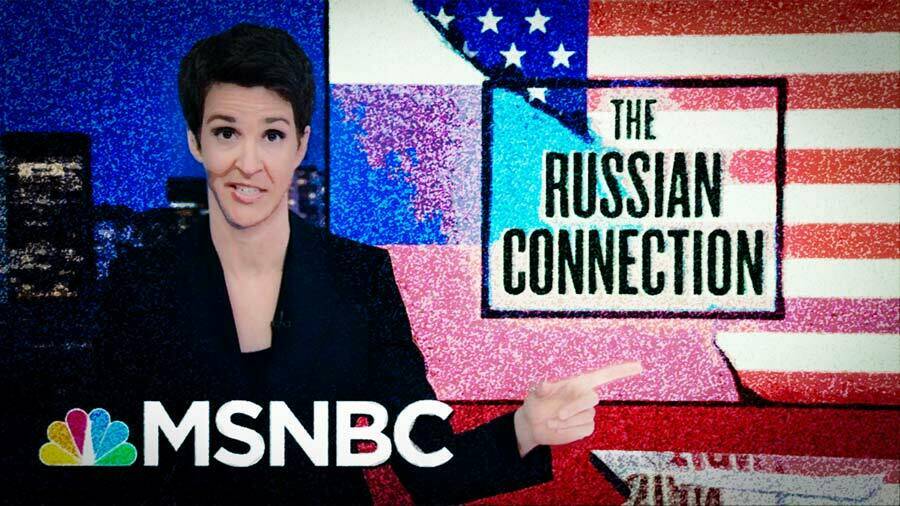
Since November 2016, the US “news” chatterati – pundits and poets, priests, prognosticators and politicians – have repeated this statement ad nauseum. The #RussiaGate story has become a commonly-accepted article of faith amongst the US neoliberal faithful – disgruntled Clintonistas, bereaved “Bernie Bros,” US news flaks, and anyone else who dislikes the current occupant of the White House. If the “Russia hacked the 2016 US election” meme warriors had a high-viz US standard bearer, it would probably be popular MSNBC performance artist Rachel “All Russia, All The Time” Maddow, who serves up the #RussiaGate sauce with reckless abandon to high TeeVee viewer ratings, earning somewhere between $30 and $40 K daily in salary. (LINK to RM mashup here).

And now, we have a scholarly book published by Oxford University Press with an epic title – Cyberwar: How Russian Hackers and Trolls Helped Elect A President – What We Don’t, Can’t, And Do Know – that purports to prove that Russia’s cyber-meddling helped sabotage the HRC campaign, swinging the 2016 US presidential election in favor of DJT.

To approach Cyberwar, first consider everything on the table re: the 2016 US presidential election.

Here‘s just a short list.

Witness the two most unpopular presidential candidates in US political history (one of whom confidently encouraged the other to run, convinced she could beat him); massive and well-documented bipartisan digital vote count manipulation (“electile dysfunction”) courtesy the 2002 “Help America Vote Act” (Orwell would be impressed); the grotesque (human) nature of Donald J Trump and Republicans’ comical attempts to first displace and then eventually come to terms with his 2016 candidacy; the complete corruption of the national Democratic Party leadership, which did everything it could to crown HRC the Dem standard bearer, from systematically undermining insurgent Vermont “progressive” Bernie Sanders’ presidential bid (read the 110 page report “Democracy Lost” for detailed descriptions of how the DNC manipulated 2016 Democratic primary outcomes in 11 swing states) to diverting DNC fundraising – millions of dollars collected from the pockets of ordinary Americans – away from so-called “down ballot” local office races and into HRC presidential campaign coffers during the heated months of 2016.

There’s so much more, but I’ll simply stop there.

Rather than looking in the 2016 mirror, however, US blames…Russians?

To be clear, I approached Cyberwar with an open mind. I am a big fan of the book’s author, distinguished US media scholar Kathleen Hall Jamieson (KHJ), longtime badass in the world of political communications scholarship, and current Elizabeth Ware Packard Professor at the Annenberg School for Communication at the University of Pennsylvania and the Director of the Annenberg Public Policy Center. Jamieson’s got street cred. However, after a close read and re-read of KHJ’s new book, including all the footnotes, Cyberwar left me unconvinced by its “more or less” central conclusion – “Russia trolled and hacked the 2016 US election, sorta!” In fact, I’d suggest that Cyberwar is a deeply problematic book, a fascinating scholarly study in “manufacturing consent” – the term Edward Herman and Noam Chomsky borrowed from Walter Lippman to title their 1988 book of the same name – describing how US elites “massage” US news channels like the New York Times, “filtering” into public view the “news” stories most beneficial to their strategic goals, while downplaying or censoring other worthy “news” stories of significance.

To fully understand my critique of Cyberwar, start with Jamieson’s credulous acceptance of “facts” provided by the US “intelligence community” (my new favorite Orwellian trope) re: the Russian government’s “interference” to advance her Cyberwar case. More on that in a moment. In the meantime, here is KHJ’s central Cyberwar claim, summarized in a single long sentence, slightly paraphrased for brevity, from her book’s conclusion: “In the run up to the 2016 US presidential election, Russian trolls and hackers carried out a strategically systematic and ultimately successful communications campaign to discredit Democratic presidential candidate Hillary Rodham Clinton and support Republican presidential candidate Donald J. Trump through sufficiently widespread messaging that focused on issues compatible with Trump’s strategic needs, addressing constituencies he had to mobilize and demobilize, by employing persuasive, visually evocative and well-targeted content that was amplified in swing states through sharing, liking, and commenting.” (p. 203).

It’s a mouthful, I know, and when you read it over a few times, removing both Clinton and Trump’s names, you quickly realize that this is what ANY strategic political campaign using digital tools –Cyberspace’s unique power and reach – would set out to do to try and win any election, anywhere. Russian president Vladimir Putin himself concedes that Russia wages “campaigns of political influence” wherever and whenever they can, just as the US and other powerful countries do and have done for decades, using as many communications tools as they can leverage.

So – how does Jamieson set out to prove Russian Cyberwar? She divides her book into four parts.

Part One of Jamieson’s book explores “who did it, why, and what research says about it might matter.” Here, KHJ flags the Internet Research Agency (IRA), a Russian troll farm, and introduces the reader to her previous ground-breaking work on communications effects research – how techniques like agenda-setting, framing, priming and “contagion creation” have worked over time to influence US voter decisions, and thus, perhaps, election outcomes. Big caveat here, that KHJ leaves unacknowledged. To wit – presumably, Russian “trolls” share the same primary goal as ALL trolls on the Internet, namely, maximizing audience engagement (and thus profit) through the creation and deployment of relevant content, with their chief “currency” being click-throughs, likes, shares, retweets, etc.

In Part Two of Cyberwar, Jamieson looks at what she calls “the prerequisites of [Russian] troll influence.” “Were the extent and virality of Russian social media content and the nature, coverage, and exposure of Russian-hacked Democratic materials,” she asks, “sufficient and sufficiently persuasive to plausibly affect the outcome of an election decided in three states by about 78,000 votes?” (p. 65). Hint – her final answer is a circumspectly strong “maybe.”

Part Three of Cyberwar finds KHJ considering “how the Russians affected the news and debate agendas in the last month of the presidential campaign.” Here, Jamieson looks at how “Russian hacked content” (her words) transformed the nature of US news coverage surrounding HRC in the month before the 2016 election, with a particular focus on the “drip drip drip” impact of “WikiLeak’d” emails illegally obtained from Democratic National Committee (DNC) servers, as well as FBI director James Comey’s role, during October 2016, in reopening the investigation into “newly-found” HRC emails, which KHJ argues helped shape public impressions around HRC for undecided US voters in the days just before the election.

Jamieson uses Cyberwar Part Four to provide a brief summary of “what we don’t, can’t, and do know about how Russian hackers and trolls helped elect Donald Trump.” “My case that the uses of Russian-hacked (emphasis added) Democratic materials influenced voters is built on scholars’ understandings of the effects of linguistic priming, media agenda setting, and framing the susceptibilities of late deciders, the dispositions of those who view both candidates unfavorably, the effects of imbalances in the amount of negative information available about alternative candidates, and scholarship on how debates affect voter attitudes,” Jamieson concludes. “It is scaffolded on evidence that the hacked content not only altered the media and debate agendas but also increased the negative press about Clinton. And it is bolstered by the possibility that Russian access and anticipated use of illegally gotten or fabricated Democratic content shaped a key decision by FBI director Comey.” (210)

To be fair, Cyberwar is an engaging read. Jamieson is a fine scholarly writer, and she has a field day digging into the aesthetics of individual Russian troll farm memes – complete with pictures. (The “Army Of Jesus” Facebook page, purportedly created by Russian trolls, features a boxing glove clad HRC sporting devil horns engaged in a fierce arm-wrestling match with Aryan Jesus himself. Hilarious.) KHJ also does a credible job tracing the evolution of the US news narrative around HRC in the weeks leading up to the 2016 election, showing how pivotal moments may have influenced voter perceptions about both HRC and DJT.

However! Individual Russian troll farm memes and evolving US “news” media coverage negatively impacting HRC do NOT a strategic Kremlin-led messaging campaign make.

Cyberwar continually flirts with a central question (which has become a story routinely told by US “news” media outlets)  – “Was Russian troll farming some sort of Kremlin-staged strategic cyber-op?” – without ever really answering it. The result is a book-length begging of this very important question, and here we come to the primary problem with Cyberwar– and it’s a whopper. Jamieson build her case for the Russian “tanking” of HRC’s candidacy on two central assumptions, both unproven.

Assumption #1: Jamieson implicitly asserts in Cyberwar that the Russians “hacked” into the Democratic National Committee (DNC) computer servers (as well as other hacks) and obtained digital copies of thousands of what became publicly damning emails from members of the DNC leadership team – Clinton campaign advisor John Podesta, HRC herself, and others – and then (by extension) tried to leverage the contents of these stolen documents for months in US social media spaces (and, by extension, influenced the shaping of US news narratives about HRC.) Interestingly, KHJ sneaks in “Russia hacked” and “Russian-stolen Democratic content” language into the last third of her book, without directly addressing this BIG rhetorical move or providing any proof that the Russians did so. Instead, she appears to implicitly draw on “evidence” for Russian hacking provided by the US “intelligence community” – former FBI director turned Trump special prosecutor Bob Mueller, former director of national intelligence James Clapper, and former National Security Agency director Michael Hayden chief among them. (Mueller, Clapper, Hayden – three US government officials who have all been less than honest with the American people, and I’m being generous.)

The counternarrative to the “Russia hacked into the DNC computers” story? Information was “leaked” from inside the DNC, not hacked from the outside. How might we know? Former NSA cryptographer Bill Binney, former CIA official Ray McGovern, and many other members of the 2003-founded Veteran Intelligence Professionals for Sanity (VIPS) argue that, based on their review of computer bit rate information, the stolen DNC content traveled at bandwidth rates too high to have been an external “hack,” but rather an internal “leak.” The reality? We’ll never know for sure, because the DNC refused to hand over their compromised computer servers to the FBI, instead contracting with Crowd Strike, a private US cybersecurity firm, to ascertain affirmative Russian hacking involvement (#Surprise!). For interested readers, NSA whistleblower Bill Binney discusses his “leak versus hack” conclusions on this recent episode of Brass Check TV between 1:27 – 1:37 here.

Assumption #2: In Cyberwar, Jamieson implies that WikiLeaks closely collaborated with the Russian government, or at the very least (it’s a bit hard to tell from her lack of analysis here), Putin used WikiLeaks as its public relations machine to destroy HRC’s reputation and elevate DJT as a presidential candidate. In other words, from his Ecuadorian embassy prison, Assange was in close cahoots with Putin, Cyberwar implies, or at the very least, Assange served as a “useful idiot” for the Kremlin. Here again, KHJ offers no proof, other than continually flagging the usual suspects, Russian troll farmers and hackers, as well as other sources such as the popular RT (formerly Russia Today) news channel for alleged disinformation shenanigans, such as broadcasting an exclusive in-depth interview between independent British journalist John Pilger and WikiLeaks’ co-founder Julian Assange on November 6, 2016, two days before the election.

Side note – this interview, entitled “Secret World of US Election,” is fascinating (see here).

RT/Russia Today now carries a variety of US news shows  hosted by US news journalists now unable to find access to the US airwaves, individuals like former MSNBC journalist Ed Schultz (now deceased), former US talk show host Larry King, and Pulitzer Prize winning former New York Times foreign correspondent Chris Hedges. Ironically, RT’s news content is often much more in-depth than any stories provided by the US corporate commercial TeeVee channels – watch any episode of Chris Hedges’ “On Contact,” for example, to hear perspectives on US politics you’ll rarely find on any other US news channel. On December 31, 2018, RT aired an episode of Larry King’s program talking with longtime Russia expert and War With Russia? author Stephen Cohen, and the show begins with King parroting the “Russia interfered in the US election” meme, a claim Cohen respectfully disputes before launching into a cogent and thoughtful analysis of the importance of a 21st century US-Russia “partnership” (not “friendship”) instead of more US/NATO aggression on Russia’s borders,  and how DJT’s overtures to Russia have been continually hamstrung by US political and media elites. Here’s a link for further listening. It bears repeating, and King and Cohen discuss this at some length, that Cohen’s point of view re: Russia is now considered “radical” in US policy-making circles, despite the Cold War between the US and Russia having been officially over for thirty years.

Back to WikiLeaks and the organization’s alleged conspiring with the Kremlin. Suffice to say, as the world’s first truly “stateless” news organization, WikiLeaks’ role as a powerful platform for publishing information provided by corporate and state insiders-turned-whistleblowers has been consistently credible and accurate, as well as proving a colossal PITA for US political and economic elites on all sides of the aisle. And yes, Assange and WikiLeaks have reserved special ire for the Clintons, and indeed, Assange admitted to actively working with the DJT campaign in the months leading up to the 2016 US presidential election. To implicitly blame the Russians for WikiLeaks’ behavior, however, as KHJ does in Cyberwar, is disingenuous at best.

Here’s a single example of this troublesome conflation based on faulty assumptions from page 149 pf KHJ’s Cyberwaranalysis: In early October 2016, Jamieson asserts, “a DHS-ODNI intelligence report confirmed that the Russians were behind the hacking of the DNC…and a first tranche of Russian-hacked Podesta emails was WikiLeak’d.” She then goes on to detail (rightly in my estimation) the damning impact of these documents on US news coverage of HRC’s campaign. But read her sentence above again to understand the broad leaps she is making, which go well beyond Russian troll farmers.

And here is the rub. At day’s end, Jamieson’s case for Russian Cyberwar squarely rests on these two assumptions, both unproven. The result? KHJ makes mountains out of molehills – amateurish Russian troll farming on Facebook and Twitter, and (maybe?) a “campaign of influence targeting HRC” is transmogrified, in her implicit final analysis AND by uncritical coverage of her Cyberwar book in the popular US news media, into Putin’s Russian government strategically penetrating to the very heart of the US electoral process, “gaming” the outcome against HRC and in favor of DJT. In this tense geopolitical moment, when corporate for-profit and “deep state” US “news” media mouthpieces supporting the Empire’s “full-spectrum dominance” of planet Earth on the Pentagon’s behalf are blindly thrashing about looking for someone (or some country) to blame, Cyberwar only adds fuel to the fires of the #RussiaGate hysteria.

Bigger picture? Even more troublesome for any American who still believes in the transformative power of free, open, and democratic discourse are the ways in which the two-year-old #RussiaGate tale is now being leveraged by US elites here in the “Homeland.” “Behavioral microtargeting,” a digital communications strategy pioneered in 2016 by UK-based Cambridge Analytica CEO Alexander Nix, Trump chief strategist Steve Bannon, and Facebook (unwittingly?) through “data breaches” of 50 million (with an M) Facebook user accounts, is now being used in state and local political races around the US as a viable political strategy. Social media censorship, meanwhile, is emerging as a strategic US synergistic state/corporate response to so-called “fake news” – witness neoliberal think tank Atlantic Council’s recent collaboration with Facebook to “purge” more than 800 “suspect” Facebook accounts, or Google’s “algorithmic censorship,” gaming its algorithm to marginalize US news outlets – TruthDig, Alternet, TruthOut, WWSA – critical of the US imperial status quo, or the complete purging of controversial independent analyst and so-called “conspiracy theorist” Alex Jones from pretty much ALL mainstream (read corporate) US digital platforms – all happened within the past year. And, as US comedienne Michelle Wolf pointed out at the annual Washington Press Club banquet last spring, MOUNDS of money are being made by US neoliberal “news” outlets – clicks, ratings, book sales – through this sort of Trump-bashing and fear-mongering, while pressing issues impacting the lives of ordinary Americans – “still no clean water in Flint, Michigan!” – are completely ignored. #RussiaGate, in sum, is now a rationale for demonizing, marginalizing, and censoring any US individual or organization that does not tow the #RussiaGate party line.

Despite the US news-induced hysteria surrounding the #RussiaGate tale, voices of reason persist. Most prominent include Rolling Stone investigative journalist Matt Taibbi, LA-based nightclub comedian Jimmy Dore (who regularly covers the excesses of the #RussiaGate story with his comedic colleagues on is popular YouTube channel “The Jimmy Dore Show”), and Nation reporter Aaron Maté, whose December 28, 2018 article calls BS on the #Russiagate nonsense. The complete title of Maté’s article? “New Studies Show Pundits Are Wrong About Russian Social-Media Involvement in US Politics – Far from being a sophisticated propaganda campaign, it was small, amateurish, and mostly unrelated to the 2016 election.” (read Maté’s piece here). Maté, who has covered the #RussiaGate story extensively since 2016, provides in-depth analysis of two new reports alleging Russian cyber meddling – one produced by the University of Oxford’s Computational Propaganda Research Project and the other by the US consulting corporation with deep ties to the national security state, New Knowledge. I encourage interested readers to take the time to read his story.

Maté’s conclusion, meanwhile, is worth quoting here at length:

Based on all of this data, we can draw this picture of Russian social-media activity: It was mostly unrelated to the 2016 election; microscopic in reach, engagement, and spending; and juvenile or absurd in its content. This leads to the inescapable conclusion, as the New Knowledge study acknowledges, that “the operation’s focus on elections was merely a small subset” of its activity. They qualify that “accurate” narrative by saying it “misses nuance and deserves more contextualization.” Alternatively, perhaps it deserves some minimal reflection that a juvenile social-media operation with such a small focus on elections is being widely portrayed as a seismic threat that may well have decided the 2016 contest.

Indeed.

Would that Kathleen Hall Jamieson was not a bit more “nuanced” in “contextualizing” her Cyberwar analysis.

What to do? The best answer is critical media literacy education – moving beyond partisan politics and moral panics to more thoughtfully engage these important political questions in open dialogue and debate.

Until we do so, we will continue to be enthralled by the #RussiaGate tale, with potentially deleterious geopolitical consequences. (Again, Cohen’s interview with Larry King is a good starting place).

To wit, in Pogo’s famous phrase – “we have met the enemy and he is US.”

Senate Report on Russian Interference Was Written By Disinformation Warriors Behind Alabama ‘False Flag Operation’

Hailed by Congress and the media as defenders of democracy, high-tech Russiagate hustlers Jonathon Morgan and Ryan Fox have been exposed for waging “an elaborate ‘false flag’ operation” to swing the 2017 Alabama senate race.

By Dan Cohen

Source: Gray Zone

On December 17, two reports detailing ongoing Russian interference operations commissioned by the Senate Intelligence Committee were made public. They generated a week’s worth of headlines and sent members of Congress and cable news pundits into a Cold War frenzy. According to the report, everything from the Green Party’s Jill Stein to Instagram to Pokemon Go to the African American population had been used and confused by the deceptive Facebook pages of a private Russian troll farm called the Internet Research Agency.

Nevermind that 56% of the troll farm’s pages appeared after the election, that 25% of them were seen by no one, or that their miniscule online presence paled in comparison to the millions of dollars spent on social media by the two major presidential campaigns and their supporters to sway voters. This was an act of war that demanded immediate government action.

According to Sen. Mark Warner, the Democratic chair of the Senate Intelligence Committee, the reports were “a wake up call” and a “bombshell” that was certain to bring “long-overdue guardrails when it comes to social media”. His Republican counterpart on the committee, North Carolina Senator Richard Burr, hailed the research papers as “proof positive that one of the most important things we can do is increase information sharing between the social media companies who can identify disinformation campaigns and the third-party experts who can analyze them.”

But the authors of one of the reports soon suffered a major blow to their credibility when it was revealed that they had engaged in what they called a “Russian style” online disinformation operation aimed to swing a hotly contested special senate election. The embarrassing revelation has already resulted in one of the authors having his Facebook page suspended.

The well-funded deception was carried out by New Knowledge, a private cyber intelligence firm founded by two self-styled disinformation experts who are veterans of the Obama administration: Jonathon Morgan and Ryan Fox.

‘It may be designed to manipulate you’

Morgan began his career as a product manager at AOL before founding a series of start ups, some with funding from the United States Agency for International Development and Silicon Valley billionaire Pierre Omidyar’s Omidyar Network. Once a Brookings Institution researcher and special advisor to the Obama White House and State Department, Morgan founded Data for Democracy, a volunteer organization said to use “public data to monitor the election system for signs of fraud.” Morgan also developed technology for the Defense Advanced Research Projects Agency (DARPA), the arm of the Department of Defense created for basic, applied technological research, and futuristic war toys.

Rising through the ranks of the national security apparatus, Morgan ultimately emerged as a go-to source for credulous reporters seeking to blame Hillary Clinton’s loss to Donald Trump on Russian disinformation.

In an interview with the local CBS affiliate in Austin, Texas, Morgan told viewers that feelings of discontent were telltale signs that they had been duped by Russian disinformation. “If it makes you feel too angry or really provokes that type of almost tribal response, then it may be designed to manipulate you… People should be concerned about things that encourage them to change their behavior,” he warned.

Fox, for his part, is a 15-year veteran of the National Security Agency and was a computer analyst for the Joint Special Operations Command (JSOC) military unit. JSOC is notorious for its spree of atrocities across the Middle East including digging their bullets out of dead pregnant women’s bodies in Afghanistan. Comparatively little information is available about Fox’s background.

Since receiving an $11 million investment from venture capital firm, GGV Capital, in August 2017, New Knowledge has positioned itself as one of the leading private intelligence firms taking on the scourge of Russian disinformation. The outfit made its biggest splash on December 17th when it published one of the two Senate Intelligence Committee-commissioned reports.

The report, titled “The Tactics and Tropes of the Internet Research Agency,” was oversseen by Renee DiResta, a former Wall Street trader and tech specialist who was recruited by Obama’s State Department to devise strategies for combating online ISIS propaganda. The New York Times described DiResta as one among a small group of “hobbyists” who “meticulously logged data and published reports on how easy it was to manipulate social media platforms.”

The hobby lobby of online obsessives converged at New Knowledge this year to sound the alarm on supposed Russian disinformation. In a New York Times op-ed published as Americans went to cast their votes in the midterm elections, Morgan and Fox alleged that the Kremlin was secretly running hundreds of propaganda websites in an effort to swing the outcomes. That assertion ran counter to the narrative the two operatives had been spinning out just months before.

In an interview earlier in the year, Ryan Fox suggested that despite the Trump administration’s multiple rounds of sanctions against Russia, Vladimir Putin was so satisfied with the state of U.S. affairs that the Kremlin had actually cut back on its supposed interference. “Strategically, are they content with the way things are? Does it play in their favor to do anything right now? That’s a valid question,” Fox said. “Keep up the momentum, keep poking away. But do they have to implement drastic measures like hacking the DNC and exposing thousands of emails? Probably not.”

More recently, Fox claimed to have identified hundreds of Russian-controlled Facebook and Twitter accounts active in France’s Yellow Vest movement, which has raged against the country’s neoliberal leadership and sparked anxiety among centrist elites across the Atlantic.

However, Fox produced no evidence to support his incendiary accusation, prompting reporters to qualify his assertions as “very likely” and write that he merely “believes” Russian interference took place.

Drafting the dubious bot dashboard

Morgan is also one the developers of the Hamilton 68 dashboard, an online project dedicated to inflaming public outrage over online Russian bots. Funded by the German Marshall Fund’s Alliance for Securing Democracy – which is itself backed by NATO and USAID – Hamilton 68 claims to track hundreds of accounts supposedly linked to Russian influence operations. The effort has largely succeeded in drawing positive media attention despite one of its founders, Clint Watts, admitting that the Twitter accounts it follows may actually be real people who are not Russian at all.

When Morgan was asked what techniques Hamilton 68 uses to identify Russian influence operations, he offered a confident-sounding but ultimately empty answer: “We developed some techniques for determining who matters in a conversation… Using some of those techniques, we’ve identified a subset of accounts that we’re very confident are core to furthering the Russian narrative in response to mainstream events.”

Because Morgan and his colleagues have explicitly refused to name the accounts monitored by Hamilton 68, his claims can never be proven.

In a lengthy profile of the musicologist-turned-New Knowledge “online detective” Kris Shaffer, Foreign Policy described the supposed methodology he employed to identify Russian disinfo operations: “By working with massive datasets of tweets, Facebook posts, and online articles, he is able to map links between accounts, similarities in the messages they post, and shared computer infrastructure.”

The article added an extraordinarily revealing disclaimer: “This method of analysis is in its infancy, remains a fairly blunt instrument, and still requires human intervention. It sometimes mistakes real people who post anti-imperialist arguments about U.S. foreign policy for Kremlin trolls, for example.”

It may have been that New Knowledge had no knowledge at all of Kremlin botnets, but their reports were nonetheless treated as gospel by droves of credulous reporters eager to make their name in the frenzied atmosphere of Russiagate.

“We orchestrated an elaborate ‘false flag’ operation”

According to an internal New Knowledge report first seen by the New York Times, the firm carried out a multi-faceted influence operation designed to undermine a 2017 bid by right-wing Republican former state supreme court judge Roy Moore for an open Alabama senate seat. By its own admission, New Knowledge’s campaign capitalized on the the sexual assault allegations against Moore to “enrage and energize Democrats” and “depress turnout” among Republicans.

To accomplish this, the New Knowledge team created a Facebook page aimed at appealing to conservative Alabamians by encouraging them to endorse an obscure patio supply salesman-turned-write-in candidate named Mac Watson. They hoped the subterfuge would peel votes away from Moore. It was precisely the kind of tactic that New Knowledge claims Russian troll farms carry out to sow divisions among the American electorate.

Morgan told the New York Times the effort stopped there. But the New Knowledge report says the Facebook page “boosted” Watson’s campaign and even arranged interviews for him with The Montgomery Advertiser and the Washington Post. At the same time, Watson’s Twitter following mysteriously jumped from 100 to about 10,000.

Of the dozens of conservative Alabamian Facebook pages the Watson campaign messaged, the New Knowledge-run page was the only one that responded to it. “You are in a particularly interesting position and from what we have read of your politics, we would be inclined to endorse you”, they wrote. New Knowledge then “asked Mr. Watson whether he trusted anyone to set up a super PAC that could receive funding and offered advice on how to sharpen his appeal to disenchanted Republican voters.”

While Watson communicated with the deceptive Facebook page, the New Knowledge operators never revealed their identity, and the page disappeared the day after the vote. “It was weird,” Watson commented to the New York Times. “The whole thing was weird.”

New Knowledge then sought to manufacture a link between Roy Moore’s campaign and the Kremlin by claiming thousands of his Twitter followers were Russian bots. Mainstream media outlets credulously ran with the narrative, insinuating that the Christian theocrat Moore was secretly backed by Russia.

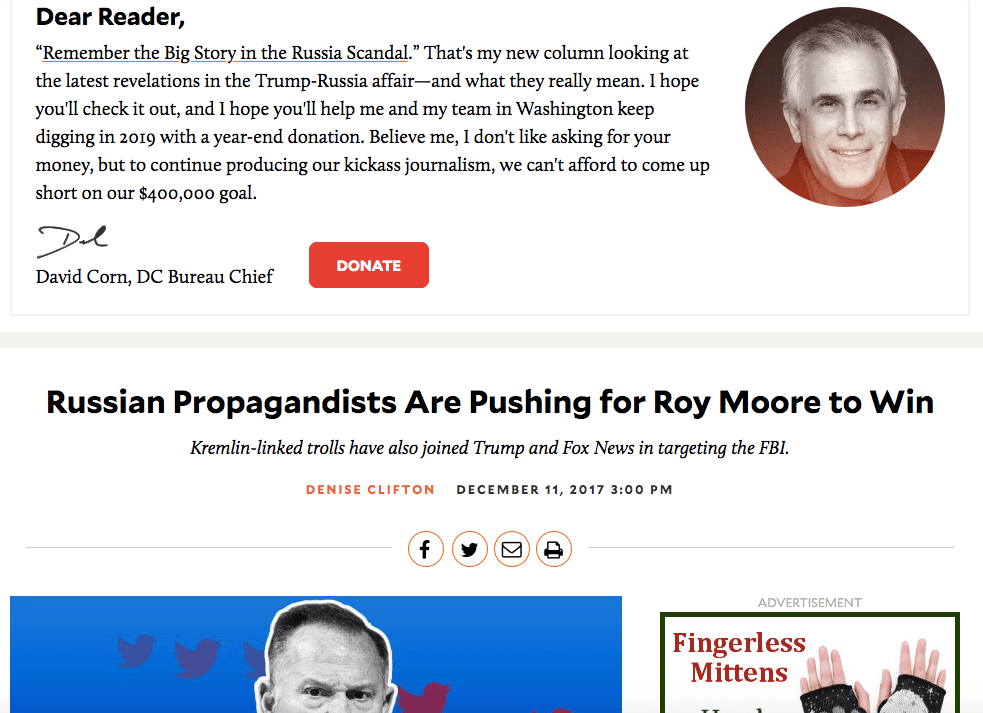
The Montgomery Observer first reported the alleged link: Russian invasion? Roy Moore sees spike in Twitter followers from land of Putin. From there, it was picked up by Mother Jones, whose headline read: Russian Propagandists Are Pushing for Roy Moore to Win. But there was no proof of any Russian connection to the accounts. To bolster its evidence-free claim, Mother Jones simply turned to Hamilton 68, the highly suspect Russian influence monitoring system that Morgan helped design.

Today, as can be seen below, Mother Jones is using a bogus story generated by a disinformation campaign to raise funds for more Russiagate coverage.

As the Russian bot narrative peaked, Moore blamed the Jones campaign for manufacturing the scare. “It’s not surprising that they’d choose the favorite topic of MSNBC and the Fake News outlets — the Russia conspiracy. Democrats can’t win this election on the issues and their desperation is on full display.”

Moore’s opponent, Jones, said he had no knowledge of the operation.

Moore was roundly mocked in liberal circles as a conspiratorial crank, but New Knowledge’s internal report contained a stunning admission: “We orchestrated an elaborate ‘false flag’ operation that planted the idea that the Moore campaign was amplified on social media by a Russian botnet,” its authors revealed.

While the New York Times says the internal report does not confirm that New Knowledge purchased the bot account themselves, the accounts’ flagrant use of Cyrillic language and profile pictures of famous singers including Britney Spears, Christina Aguilera and Avril Lavigne strongly suggest that whoever bought them went to extreme lengths to leave the appearance of a Russian hand.

Disinfo ops to “strengthen American democracy”

The Alabama disinformation campaign was carried out through a network of Silicon Valley tech entrepreneurs and former Obama administration officials who have joined the private sector to leverage liberal anti-Trump outrage into profits.

Billionaire Reid Hoffman, who co-founded the employment networking site LinkedIn, provided $100,000 for the black ops campaign. The money was then pipelined through American Engagement Technologies, which is headed by Mikey Dickerson, a former Google engineer who founded the United State Digital Service. Dickerson is also Executive Director of the New Data Project, an organization dedicated to “testing new approaches” and “serving as an advanced technology research lab for progressives.”

A colleague of Hoffman’s claimed the purpose of his investments was to “strengthen American democracy.”

Since the New York Times’ exposé, Facebook released a statement announcing its suspension of “five accounts run by a multiple individuals for engaging in coordinated inauthentic behavior,” including Morgan’s account. The social media platform has opened an investigation, though it has not revealed what the other pages are or who operated them.

The headline of the New York Times story about the Facebook suspensions appeared to have been crafted to keep the focus on Russia while deflecting scrutiny from the group of Democratic Party-linked hustlers that orchestrated the disinformation operation. It read: “Facebook Closes 5 Accounts Tied to Russia-Like Tactics in Alabama Senate Race.”

For his part, Sen. Jones has demanded an investigation. “I think we’ve all focused too much on just the Russians and not picked up on the fact that some nefarious groups, whether they’re right or left, could take those same playbooks and start interfering with the elections for their own benefit,” he said. “I’d like to see the Federal Election Commission and the Justice Department look at this to see if there were any laws being violated and, if there were, prosecute those responsible.”

Facing an inquiry for possible violations of election laws, Morgan issued a mealy-mouthed statement claiming he “did not participate in any campaign to influence the public and any characterization to the contrary misrepresents the research goals, methods and outcome of the project.”

https://twitter.com/jonathonmorgan/status/1075575821362958337

While the impact of the disinformation campaign on the Alabama senate race may never be quantified, the cynicism behind it is hard to understate. A group of Democratic Party operatives with close ties to the national security state waged a cynical campaign of online deception against the American public, while marketing themselves as the guardians against from foreign interference. Few, if any, Russian hackers could have done as much damage to the already worn fabric of American democracy as they have.


Still Waiting for Evidence of a Russian Hack

More than two years after the allegation of Russian hacking of the 2016 U.S. presidential election was first made, conclusive proof is still lacking and may never be produced, says Ray McGovern.

By Ray McGovern

Source: Consortium News

If you are wondering why so little is heard these days of accusations that Russia hacked into the U.S. election in 2016, it could be because those charges could not withstand close scrutiny. It could also be because special counsel Robert Mueller appears to have never bothered to investigate what was once the central alleged crime in Russia-gate as no one associated with WikiLeaks has ever been questioned by his team.

Veteran Intelligence Professionals for Sanity — including two “alumni” who were former National Security Agency technical directors — have long since concluded that Julian Assange did not acquire what he called the “emails related to Hillary Clinton” via a “hack” by the Russians or anyone else. They found, rather, that he got them from someone with physical access to Democratic National Committee computers who copied the material onto an external storage device — probably a thumb drive. In December 2016 VIPS explained this in some detail in an open Memorandum to President Barack Obama.

On January 18, 2017 President Obama admitted that the “conclusions” of U.S. intelligence regarding how the alleged Russian hacking got to WikiLeaks were “inconclusive.” Even the vapid FBI/CIA/NSA “Intelligence Community Assessment of Russian Activities and Intentions in Recent U.S. Elections” of January 6, 2017, which tried to blame Russian President Vladimir Putin for election interference, contained no direct evidence of Russian involvement.  That did not prevent the “handpicked” authors of that poor excuse for intelligence analysis from expressing “high confidence” that Russian intelligence “relayed material it acquired from the Democratic National Committee … to WikiLeaks.”  Handpicked analysts, of course, say what they are handpicked to say.

Never mind. The FBI/CIA/NSA “assessment” became bible truth for partisans like Rep. Adam Schiff (D-CA), ranking member of the House Intelligence Committee, who was among the first off the blocks to blame Russia for interfering to help Trump.  It simply could not have been that Hillary Clinton was quite capable of snatching defeat out of victory all by herself.  No, it had to have been the Russians.

Five days into the Trump presidency, I had a chance to challenge Schiff personally on the gaping disconnect between the Russians and WikiLeaks. Schiff still “can’t share the evidence” with me … or with anyone else, because it does not exist.

WikiLeaks

It was on June 12, 2016, just six weeks before the Democratic National Convention, that Assange announced the pending publication of “emails related to Hillary Clinton,” throwing the Clinton campaign into panic mode, since the emails would document strong bias in favor of Clinton and successful attempts to sabotage the campaign of Bernie Sanders.  When the emails were published on July 22, just three days before the convention began, the campaign decided to create what I call a Magnificent Diversion, drawing attention away from the substance of the emails by blaming Russia for their release.

Clinton’s PR chief Jennifer Palmieri later admitted that she golf-carted around to various media outlets at the convention with instructions “to get the press to focus on something even we found difficult to process: the prospect that Russia had not only hacked and stolen emails from the DNC, but that it had done so to help Donald Trump and hurt Hillary Clinton.”  The diversion worked like a charm.  Mainstream media kept shouting “The Russians did it,” and gave little, if any, play to the DNC skullduggery revealed in the emails themselves. And like Brer’ Fox, Bernie didn’t say nothin’.

Meanwhile, highly sophisticated technical experts, were hard at work fabricating “forensic facts” to “prove” the Russians did it.  Here’s how it played out:

June 12, 2016: Assange announces that WikiLeaks is about to publish “emails related to Hillary Clinton.”

June 14, 2016: DNC contractor CrowdStrike, (with a dubious professional record and multiple conflicts of interest) announces that malware has been found on the DNC server and claims there is evidence it was injected by Russians.

June 15, 2016: “Guccifer 2.0” affirms the DNC statement; claims responsibility for the “hack;” claims to be a WikiLeaks source; and posts a document that the forensics show was synthetically tainted with “Russian fingerprints.”

The June 12, 14, & 15 timing was hardly coincidence. Rather, it was the start of a pre-emptive move to associate Russia with anything WikiLeaks might have been about to publish and to “show” that it came from a Russian hack.

Enter Independent Investigators

A year ago independent cyber-investigators completed the kind of forensic work that, for reasons best known to then-FBI Director James Comey, neither he nor the “handpicked analysts” who wrote the Jan. 6, 2017 assessment bothered to do.  The independent investigators found verifiable evidence from metadata found in the record of an alleged Russian hack of July 5, 2016 showing that the “hack” that day of the DNC by Guccifer 2.0 was not a hack, by Russia or anyone else.

Rather it originated with a copy (onto an external storage device – a thumb drive, for example) by an insider — the same process used by the DNC insider/leaker before June 12, 2016 for an altogether different purpose. (Once the metadata was found and the “fluid dynamics” principle of physics applied, this was not difficult to disprove the validity of the claim that Russia was responsible.)

One of these independent investigators publishing under the name of The Forensicator on May 31 published new evidence that the Guccifer 2.0 persona uploaded a document from the West Coast of the United States, and not from Russia.

In our July 24, 2017 Memorandum to President Donald Trump we stated, “We do not know who or what the murky Guccifer 2.0 is. You may wish to ask the FBI.”

Our July 24 Memorandum continued: “Mr. President, the disclosure described below may be related. Even if it is not, it is something we think you should be made aware of in this general connection. On March 7, 2017, WikiLeaks began to publish a trove of original CIA documents that WikiLeaks labeled ‘Vault 7.’ WikiLeaks said it got the trove from a current or former CIA contractor and described it as comparable in scale and significance to the information Edward Snowden gave to reporters in 2013.

“No one has challenged the authenticity of the original documents of Vault 7, which disclosed a vast array of cyber warfare tools developed, probably with help from NSA, by CIA’s Engineering Development Group. That Group was part of the sprawling CIA Directorate of Digital Innovation – a growth industry established by John Brennan in 2015. [ (VIPS warned President Obama of some of the dangers of that basic CIA reorganization at the time.]

Marbled

“Scarcely imaginable digital tools – that can take control of your car and make it race over 100 mph, for example, or can enable remote spying through a TV – were described and duly reported in the New York Times and other media throughout March. But the Vault 7, part 3 release on March 31 that exposed the “Marble Framework” program apparently was judged too delicate to qualify as ‘news fit to print’ and was kept out of the Times at the time, and has never been mentioned since.

“The Washington Post’s Ellen Nakashima, it seems, ‘did not get the memo’ in time. Her March 31 article bore the catching (and accurate) headline: ‘WikiLeaks’ latest release of CIA cyber-tools could blow the cover on agency hacking operations.’

“The WikiLeaks release indicated that Marble was designed for flexible and easy-to-use ‘obfuscation,’ and that Marble source code includes a “de-obfuscator” to reverse CIA text obfuscation.

“More important, the CIA reportedly used Marble during 2016. In her Washington Post report, Nakashima left that out, but did include another significant point made by WikiLeaks; namely, that the obfuscation tool could be used to conduct a ‘forensic attribution double game’ or false-flag operation because it included test samples in Chinese, Russian, Korean, Arabic and Farsi.”

A few weeks later William Binney, a former NSA technical director, and I commented on Vault 7 Marble, and were able to get a shortened op-ed version published in The Baltimore Sun.

The CIA’s reaction to the WikiLeaks disclosure of the Marble Framework tool was neuralgic. Then Director Mike Pompeo lashed out two weeks later, calling Assange and his associates “demons,” and insisting; “It’s time to call out WikiLeaks for what it really is, a non-state hostile intelligence service, often abetted by state actors like Russia.”

Our July 24 Memorandum continued:  “Mr. President, we do not know if CIA’s Marble Framework, or tools like it, played some kind of role in the campaign to blame Russia for hacking the DNC. Nor do we know how candid the denizens of CIA’s Digital Innovation Directorate have been with you and with Director Pompeo. These are areas that might profit from early White House review.  [ President Trump then directed Pompeo to invite Binney, one of the authors of the July 24, 2017 VIPS Memorandum to the President, to discuss all this.  Binney and Pompeo spent an hour together at CIA Headquarters on October 24, 2017, during which Binney briefed Pompeo with his customary straightforwardness. ]

“We also do not know if you have discussed cyber issues in any detail with President Putin. In his interview with NBC’s Megyn Kelly he seemed quite willing – perhaps even eager – to address issues related to the kind of cyber tools revealed in the Vault 7 disclosures, if only to indicate he has been briefed on them. Putin pointed out that today’s technology enables hacking to be ‘masked and camouflaged to an extent that no one can understand the origin’ [of the hack] … And, vice versa, it is possible to set up any entity or any individual that everyone will think that they are the exact source of that attack.

“‘Hackers may be anywhere,’ he said. ‘There may be hackers, by the way, in the United States who very craftily and professionally passed the buck to Russia. Can’t you imagine such a scenario? … I can.’

New attention has been drawn to these issues after I discussed them in a widely published 16-minute interview last Friday.

In view of the highly politicized environment surrounding these issues, I believe I must append here the same notice that VIPS felt compelled to add to our key Memorandum of July 24, 2017:

“Full Disclosure: Over recent decades the ethos of our intelligence profession has eroded in the public mind to the point that agenda-free analysis is deemed well nigh impossible. Thus, we add this disclaimer, which applies to everything we in VIPS say and do: We have no political agenda; our sole purpose is to spread truth around and, when necessary, hold to account our former intelligence colleagues.

“We speak and write without fear or favor. Consequently, any resemblance between what we say and what presidents, politicians and pundits say is purely coincidental.” The fact we find it is necessary to include that reminder speaks volumes about these highly politicized times.

The media and the Mueller indictment: A conspiracy theory to end all conspiracy theories

By Patrick Martin

Source: WSWS.org

The announcement Friday by the US Department of Justice that a federal grand jury has returned criminal indictments against 13 Russian citizens and three Russian companies, charging illegal activities in the 2016 US presidential election, has become the occasion for a barrage of war propaganda in the American corporate media.

Leading the charge is the New York Times, which published a front-page “news” lead Sunday, authored by Peter Baker. The article was published online Saturday evening under the headline, “Trump’s Conspicuous Silence Leaves a Struggle Against Russia Without a Leader.” In the newspaper’s print edition, the “struggle” was upgraded to a “war … being fought on the American side without a commander in chief.”

The indictments, the Times argues, “underscored the broader conclusion by the American government that Russia is engaged in a virtual war against the United States through 21st-century tools of disinformation and propaganda.” It noted that only a few days ago, the Trump administration “formally blamed Russia for an expansive cyberattack last year called NotPetya and threatened unspecified ‘international consequences’.”

Given that the US government has just issued a series of strategy documents that, among other conclusions, suggest that a significant cyberattack on the United States could justify retaliation with nuclear weapons, the implications of the argument put forward on the front page of the Times are chilling: What cyberattack could be more significant than an effort to hijack the US presidential election? By the logic of the leading “newspaper of record,” the US government would be justified in responding militarily to an alleged Russian election operation.

What is propounded in the media coverage is a conspiracy theory to end all conspiracy theories. The New York Times, the Washington Post, and much of the media are espousing paranoid views that were once associated with the John Birch Society, which notoriously claimed that President Dwight Eisenhower was a card-carrying member of the Communist Party.

This supposed conspiracy is described in breathless terms in media accounts: “sophisticated,” “massive,” of “breathtaking” scope, one with “tentacles” that “reached deeply into American political life.” Even if one accepts the facts of the indictment as alleged—and that is hardly a legitimate assumption, given the capacity of the FBI and other intelligence agencies for fabrication—nothing in the indictment comes close to supporting what is being claimed by the Times and other media outlets.

The 37-page document details an alleged operation of individuals in Russia to establish false identities on social media platforms and use them to influence political discussion in the US during the election. Conspicuously absent is any indication of direct Russian government involvement in the operation, which was funded by a Russian multimillionaire. Nor is there any claim that the Trump campaign collaborated with the activities of the Russian operatives, or that these activities had any impact on the course of the election.

Only two Russians actually traveled to the United States, visiting several states for what is described in the indictment, with inadvertent humor, as “intelligence-gathering” on the US political scene. The total resources for the effort, under $15 million, could not pay for a serious campaign in a single major US state, let alone influence a presidential election on which billions of dollars were being expended by the Democrats and Republicans.

The claim that this half-baked operation played any significant role in the outcome of the election is an absurdity. There were ample reasons for tens of millions of Americans, particularly working people, to be hostile to the campaign of Hillary Clinton, the favorite of Wall Street and the Pentagon. She ran a campaign of complacency and entitlement promising nothing to those suffering after eight years of supposed “economic recovery” under the Obama administration. That a section of working people, in desperation, cast their votes for Trump only testifies to the reactionary blind alley of the corporate-controlled two-party system.

One fact in the indictment is of genuine significance: the operation began in April 2014. This was well before Donald Trump was on anyone’s campaign radar screen except perhaps his own, and only a month after the right-wing US-backed political coup in Ukraine, which mobilized fascist mobs in the streets of Kyiv to drive an elected pro-Russian president out of office and replace him with an American stooge.

The Ukraine operation was the culmination of a decades-long effort costing an estimated $5 billion, according to Assistant Secretary of State Victoria Nuland. In other words, the supposed Russian operation in the US election was, if anything, a pinprick response to the devastating US attack on Russian influence in Ukraine, a country with long historical and ethnic ties to Russia, and with a large minority of its population speaking Russian at home.

The primary purpose of the indictment was to provide the media with a flimsy basis for headlines screaming about a massive operation by Russia to undermine American democracy.

What is fueling this campaign? First, there is the effort to condition the population for war with Russia.

The Times and the Democratic Party are acting as the media and political spokesmen for a section of the US military-intelligence apparatus that objects to any turning away from the ferociously anti-Russian axis of US foreign policy established during the second term of the Obama administration.

The US military-intelligence apparatus is escalating its anti-Russian military provocations, most recently with an airstrike against Russian forces in Syria, apparently the most significant loss of life in a US-Russia conflict in history. The very fact that the Putin regime has downplayed the incident is an indication of its fears that this could become the spark for a much wider conflagration.

Second, there is the effort to present all social opposition within the United States as the product of Russian operations. The ruling class is terrified of the mounting social tensions within the United States. It is this fear that is motivating the extremely rapid moves to censor the Internet and suppress free speech.

The same issue of the Times that claims Russia is at war with the United States carried an attack on Facebook, headlined, “To Stir Discord in 2016, Russians Turned Most Often to Facebook.” According to the Times, Russia used the most widely used social media platform to foment political and social discontent in the United States. The implication: Facebook must implement even more aggressive censorship methods.

It would be fatally wrong to underestimate the right-wing character of the political conceptions being propounded by the Times and Democrats through the anti-Russian campaign. In the 20th century, only dictatorial regimes were able to get away with lying on the scale now being carried out by the advocates of the anti-Russia narrative. But Hitler’s “big lie” and Stalin’s doctoring of history are the political forerunners of the campaign being waged by the intelligence agents who work in the guise of “editors” and “journalists” at the Times.


Related Articles:

Goofy Indictments Divert Attention from Criminal Abuses at the FBI and DOJ

Mueller Indictment – The “Russian Influence” Is A Commercial Marketing Scheme

The Acceleration of Censorship in America

By Joe Lauria

Source: The Unz Review

Under increasing pressure from a population angry about endless wars and the transfer of wealth to the one percent, American plutocrats are defending themselves by suppressing critical news in the corporate media they own. But as that news emerges on RT and dissident websites, they’ve resorted to the brazen move of censorship, which is rapidly spreading in the U.S. and Europe. I know because I was a victim of it.

At the end of October, I wrote an article for Consortium News about the Democratic National Committee and Hillary Clinton’s campaign paying for unvetted opposition research that became the basis for much of the disputed story about Russia allegedly interfering in the 2016 presidential election.

The piece showed that the Democrats’ two paid-for sources that have engendered belief in Russia-gate are at best shaky. First was former British spy Christopher Steele’s largely unverified dossier of second- and third-hand opposition research portraying Donald Trump as something of a Russian Manchurian candidate.

And the second was CrowdStrike, an anti-Putin private company, examining the DNC’s computer server to dubiously claim discovery of a Russian “hack.” CrowdStrike, it was later discovered, had used faulty software it was later forced to rewrite. The company was hired after the DNC refused to allow the FBI to look at the server.

My piece also described the dangerous consequences of partisan Democratic faith in Russia-gate: a sharp increase in geopolitical tensions between nuclear-armed Russia and the U.S., and a New McCarthyism that is spreading fear — especially in academia, journalism and civil rights organizations — about questioning the enforced orthodoxy of Russia’s alleged guilt.

After the article appeared at Consortium News, I tried to penetrate the mainstream by then publishing a version of the article on the HuffPost, which was rebranded from the Huffington Post in April this year by new management. As a contributor to the site since February 2006, I am trusted by HuffPost editors to post my stories directly online. However, within 24 hours of publication on Nov. 4, HuffPost editors retracted the article without any explanation.

This broke with the earlier principles of journalism that the Web site espoused. For instance, in 2008, Arianna Huffington told radio host Don Debar that, “We welcome all opinions, except conspiracy theories.” She said: “Facts are sacred. That’s part of our philosophy of journalism.”

But Huffington stepped down as editor in August 2016 and has nothing to do with the site now. It is run by Lydia Polgreen, a former New York Times reporter and editor, who evidently has very different ideas. In April, she completely redesigned the site and renamed it HuffPost.

Before the management change, I had published several articles on the Huffington Post about Russia without controversy. For instance, The Huffington Post published my piece on Nov. 5, 2016, that predicted three days before the election that if Clinton lost she’d blame Russia. My point was confirmed by the campaign-insider book Shattered, which revealed that immediately after Clinton’s loss, senior campaign advisers decided to blame Russia for her defeat.

On Dec. 12, 2016, I published another piece, which the Huffington Post editors promoted, called, “Blaming Russia To Overturn The Election Goes Into Overdrive.” I argued that “Russia has been blamed in the U.S. for many things and though proof never seems to be supplied, it is widely believed anyway.”

After I posted an updated version of the Consortium News piece — renamed “On the Origins of Russia-gate” — I was informed 23 hours later by a Facebook friend that the piece had been retracted by HuffPost editors. As a reporter for mainstream media for more than a quarter century, I know that a newsroom rule is that before the serious decision is made to retract an article the writer is contacted to be allowed to defend the piece. This never happened. There was no due process. A HuffPost editor ignored my email asking why it was taken down.

Support from Independent Media

Like the word “fascism,” “censorship” is an over-used and mis-used accusation, and I usually avoid using it. But without any explanation, I could only conclude that the decision to retract was political, not editorial.

I am non-partisan as I oppose both major parties for failing to represent millions of Americans’ interests. I follow facts where they lead. In this case, the facts led to an understanding that the Jan. 6 FBI/NSA/CIA intelligenceassessment” on alleged Russian election interference, prepared by what then-Director of National Intelligence James Clapper called “hand-picked” analysts, was based substantially on unvetted opposition research and speculation, not serious intelligence work.

The assessment even made the point that the analysts were not asserting that the alleged Russian interference was a fact. The report contained this disclaimer: “Judgments are not intended to imply that we have proof that shows something to be a fact. Assessments are based on collected information, which is often incomplete or fragmentary, as well as logic, argumentation, and precedents.”

Under deadline pressure on Jan. 6, Scott Shane of The New York Times instinctively wrote what many readers of the report must have been thinking: “What is missing from the public report is what many Americans most eagerly anticipated: hard evidence to back up the agencies’ claims that the Russian government engineered the election attack. … Instead, the message from the agencies essentially amounts to ‘trust us.’”

Yet, after the Jan. 6 report was published, leading Democrats asserted falsely that the “assessment” represented the consensus judgment of all 17 U.S. intelligence agencies – not just the views of “hand-picked” analysts from three – and much of the U.S. mainstream media began treating the allegations of Russian “hacking” as fact, not as an uncertain conclusion denied by both the Russian government and WikiLeaks, which insists that it did not get the two batches of Democratic emails from the Russian government.

Yet, because of the oft-repeated “17 intelligence agencies” canard and the mainstream media’s over-hyped reporting, the public impression has built up that the accusations against Russia are indisputable. If you ask a Russia-gate believer today what their faith is based on, they will invariably point to the Jan. 6 assessment and mock anyone who still expresses any doubt.

For instance, an unnamed former CIA officer told The Intercept last month, “You’ve got all these intelligence agencies saying the Russians did the hack. To deny that is like coming out with the theory that the Japanese didn’t bomb Pearl Harbor.”

That the supposedly dissident Intercept would use this quote is instructive about how unbalanced the media’s reporting on Russia-gate has been. We have film of Japanese planes attacking Pearl Harbor and American ships burning – and we have eyewitness accounts of thousands of U.S. soldiers and sailors. Yet, on Russia-gate, we have only the opinions of “hand-picked” intelligence officials who themselves admit their opinions aren’t fact. No serious editor would allow a self-interested and unnamed source to equate Russia-gate and Pearl Harbor in print.

In this atmosphere, it was easy for HuffPost editors to hear complaints from readers and blithely ban my story. But before it was pulled, 125 people had shared it. Ray McGovern, a former CIA analyst, then took up my cause, being the first to write about the HuffPost censorship on his blog. McGovern included a link to a .pdf file that I captured of the censored HuffPost story. It has since been republished on numerous other websites.

Journalist Max Blumenthal tweeted about it. British filmmaker and writer Tariq Ali posted it on his Facebook page. Ron Paul and Daniel McAdams interviewed me at length about the censorship on their TV program. ZeroHedge wrote a widely shared piece and someone actually took the time, 27 minutes and 13 seconds to be exact, to read the entire article on YouTube. I began a petition to HuffPost’s Polgreen to either explain the retraction or restore the article. It has gained more than 2,000 signatures so far. If a serious fact-check analysis was made of my article, it must exist and can and should be produced.

Watchdogs & Media Defending Censorship

Despite this support from independent media, a senior official at Fairness and Accuracy in Reporting, I learned, declined to take up my cause because he believes in the Russia-gate story. I also learned that a senior officer at the American Civil Liberties Union rejected my case because he too believes in Russia-gate. Both of these serious organizations were set up precisely to defend individuals in such situations on principle, not preference.

In terms of their responsibilities for defending journalism and protecting civil liberties, their personal opinions about whether Russia-gate is real or not are irrelevant. The point is whether a journalist has the right to publish an article skeptical of it. I worry that amid the irrational fear spreading about Russia that concerns about careers and funding are behind these decisions.

One online publication decidedly took the HuffPost’s side. Steven Perlberg, a media reporter for BuzzFeed, asked the HuffPost why they retracted my article. While ignoring me, the editors issued a statement to BuzzFeed saying that “Mr. Lauria’s self-published” piece was “later flagged by readers, and after deciding that the post contained multiple factually inaccurate or misleading claims, our editors removed the post per our contributor terms of use.” Those terms include retraction for “any reason,” including, apparently, censorship.

Perlberg posted the HuffPost statement on Twitter. I asked him if he inquired of the editors what those “multiple” errors and “misleading claims” were. I asked him to contact me to get my side of the story. Perlberg totally ignored me. He wrote nothing about the matter. He apparently believed the HuffPost and that was that. In this way, he acquiesced with the censorship.

BuzzFeed, of course, is the sensationalist outlet that irresponsibly published the Steele dossier in full, even though the accusations – not just about Donald Trump but also many other individuals – weren’t verified. Then on Nov. 14, BuzzFeed reporter Jason Leopold wrote one of the most ludicrous of a long line of fantastic Russia-gate stories, reporting that the Russian foreign ministry had sent money to Russian consulates in the U.S. “to finance the election campaign of 2016.” The scoop generated some screaming headlines before it became clear that the money was to pay for Russian citizens in the U.S. to vote in the 2016 Duma election.

That Russia-gate has reached this point, based on faith and not fact, was further illustrated by a Facebook exchange I had with Gary Sick, an academic who served on the Ford and Carter national security staffs. When I pressed Sick for evidence of Russian interference, he eventually replied: “If it walks like a duck and talks like a duck…” When I told him that was a very low-bar for such serious accusations, he angrily cut off debate.

When belief in a story becomes faith-based or is driven by intense self-interest, honest skeptics are pushed aside and trampled. True-believers disdain facts that force them to think about what they believe. They won’t waste time making a painstaking examination of the facts or engage in a detailed debate even on something as important and dangerous as a new Cold War with Russia.

This is the most likely explanation for the HuffPost‘s censorship: a visceral reaction to having their Russia-gate faith challenged.

Why Critical News is Suppressed

But the HuffPost’s action is hardly isolated. It is part of a rapidly growing landscape of censorship of news critical of American corporate and political leaders who are trying to defend themselves from an increasingly angry population. It’s a story as old as civilization: a wealthy and powerful elite fending off popular unrest by trying to contain knowledge of how the elite gain at the others’ expense, at home and abroad.

A lesson of the 2016 campaign was that growing numbers of Americans are fed up with three decades of neoliberal policies that have fabulously enriched the top tier of Americans and debased a huge majority of everyone else. The population has likewise grown tired of the elite’s senseless wars to expand their own interests, which they to conflate with the entire country’s interests.

America’s bipartisan rulers are threatened by popular discontent from both left and right. They were alarmed by the Bernie Sanders insurgency and by Donald Trump’s victory, even if Trump is now betraying the discontented masses who voted for him by advancing tax and health insurance plans designed to further crush them and benefit the rich.

Trump’s false campaign promises will only make the rulers’ problem of controlling a restless population more difficult. Americans are subjected to economic inequality greater than in the first Gilded Age. They are also subjected today to more war than in the first Gilded Age, which led to the launch of American overseas empire. Today American rulers are engaged in multiple conflicts following decades of post-World War II invasions and coups to expand their global interests.

People with wealth and power always seem to be nervous about losing both. So plutocrats use the concentrated media they own to suppress news critical of their wars and domestic repression. For example, almost nothing was reported about militarized police forces until the story broke out into the open in the Ferguson protests and now the story has been buried again.

Careerist journalists readily acquiesce in this suppression of news to maintain their jobs, their status and their lifestyles. Meanwhile, a growing body of poorly paid freelancers compete for the few remaining decent-paying gigs for which they must report from the viewpoint of the mainstream news organizations and their wealthy owners.

To operate in this media structure, most journalists know to excise out the historical context of America’s wars of domination. They know to uncritically accept American officials’ bromides about spreading democracy, while hiding the real war aims.

Examples abound: America’s role in the Ukraine coup was denied or downplayed; a British parliamentary report exposing American lies that led to the destruction of Libya was suppressed; and most infamously, the media promoted the WMD hoax and the fable of “bringing democracy” to Iraq, leading to the illegal invasion and devastation of that country. A recent example from November is a 60 Minutes reporton the Saudi destruction of Yemen, conspicuously failing to mention America’s crucial role in the carnage.

I’ve pitched numerous news stories critical of U.S. foreign policy to a major American newspaper that were rejected or changed in the editorial process. One example is the declassified Defense Intelligence Agency document of August 2012 that accurately predicted the rise of the Islamic State two years later.

The document, which I confirmed with a Pentagon spokesman, said the U.S. and its Turkish, European and Gulf Arab allies, were supporting the establishment of a Salafist principality in eastern Syria to put pressure on the Syrian government, but the document warned that this Salafist base could turn into an “Islamic State.”

But such a story would undermine the U.S. government’s “war on terrorism” narrative by revealing that the U.S.-backed strategy actually was risking the expansion of jihadist-held territory in Syria. The story was twice rejected by my editors and to my knowledge has never appeared in corporate media.

Another story rejected in June 2012, just a year into the Syrian war, was about Russia’s motives in Syria being guided by a desire to defeat the growing jihadist threat there. Corporate media wanted to keep the myth of Russia’s “imperial” aims in Syria alive. I had to publish the article outside the U.S., in a South African daily newspaper.

In September 2015 at the U.N. General Assembly, Russian President Vladimir Putin confirmed my story about Russia’s motives in Syria to stop jihadists from taking over. Putin invited the U.S. to join this effort as Moscow was about to launch its military intervention at the invitation of the Syrian government. The Obama administration, still insisting on “regime change” in Syria, refused. And the U.S. corporate media continued promoting the myth that Russia intervened to recapture its “imperial glory.”

It was much easier to promote the “imperial” narrative than report Putin’s clear explanation to French TV channel TF1, which was not picked up by American media.

“Remember what Libya or Iraq looked like before these countries and their organizations were destroyed as states by our Western partners’ forces?” Putin said. “These states showed no signs of terrorism. They were not a threat for Paris, for the Cote d’Azur, for Belgium, for Russia, or for the United States. Now, they are the source of terrorist threats. Our goal is to prevent the same from happening in Syria.”

But don’t take Putin’s word for it. Then Secretary of State John Kerry knew why Russia intervened. In a leaked audio conversation with Syrian opposition figures in September 2016, Kerry said: “The reason Russia came in is because ISIL was getting stronger, Daesh was threatening the pos­sibility of going to Damascus, and that’s why Russia came in because they didn’t want a Daesh government and they supported Assad.”

Kerry admitted that rather than seriously fight the Islamic State in Syria, the U.S. was ready to use its growing strength to pressure Assad to resign, just as the DIA document that I was unable to report said it would. “We know that this was growing, we were watching, we saw that Daesh was growing in strength, and we thought Assad was threatened. We thought, how­ever, we could probably manage that Assad might then negotiate, but instead of negotiating he got Putin to support him.” Kerry’s com­ment suggests that the U.S. was willing to risk the Islamic State and its jihadist allies gaining power in order to force out Assad.

Why Russia Is Targeted

Where are independent-minded Western journalists to turn if their stories critical of the U.S. government and corporations are suppressed? The imperative is to get these stories out – and Russian media has provided an opening. But this has presented a new problem for the plutocracy. The suppression of critical news in their corporate-owned media is no longer working if it’s seeping out in Russian media and through dissident Western news sites.

Their solution has been to brand the content of the Russian television network, RT, as “propaganda” since it presents facts and viewpoints that most Americans have been kept from hearing.

As a Russian-government-financed English-language news channel, RT also gives a Russian perspective on the news, the way CNN and The New York Times give an American perspective and the BBC a British one. American mainstream journalists, from my experience, arrogantly deny suppressing news and believe they present a universal perspective, rather than a narrow American view of the world.

The viewpoints of Iranians, Palestinians, Russians, North Koreans and others are never fully reported in the Western media although the supposed mission of journalism is to help citizens understand a frighteningly complex world from multiple points of view. It’s impossible to do so without those voices included. Routinely or systematically shutting them out also dehumanizes people in those countries, making it easier to gain popular support to go to war against them.

Russia is scapegoated by charging that RT or Sputnik are sowing divisions in the U.S. by focusing on issues like homelessness, racism, or out-of-control militarized police forces, as if these divisive issues didn’t already exist. The U.S. mainstream media also seems to forget that the U.S. government has engaged in at least 70 years of interference in other countries’ elections, foreign invasions, coups, planting stories in foreign media and cyber-warfare, which Russian media crucially points out.

Now, these American transgressions are projected exclusively onto Moscow. There’s also a measure of self-reverence in this for “successful” people, like some journalists, with a stake in an establishment that underpins the elite, demonstrating how wonderfully democratic they are compared to those ogres in Russia.

The overriding point about the “Russian propaganda” complaint is that when America’s democratic institutions, including the press and the electoral process, are crumbling under the weight of corruption that the American elites have created or maintained, someone else needs to be blamed.

The Jan. 6 intelligence assessment on alleged Russian election meddling is a good example of this. A third of its content is an attack on RT for “undermining American democracy” by reporting on Occupy Wall Street, the protest over the Dakota pipeline and, of all things, holding a “third party candidate debates,” at a time when 71% of American millennials say they want a third party.

According to the Jan. 6 assessment, RT’s offenses include reporting that “the US two-party system does not represent the views of at least one-third of the population and is a ‘sham.’” RT also “highlights criticism of alleged US shortcomings in democracy and civil liberties.” In other words, reporting newsworthy events and giving third-party candidates a voice undermines democracy.

The assessment also says all this amounts to “a Kremlin-directed campaign to undermine faith in the US Government and fuel political protest,” but those protests by are against privileges of the wealthy and the well-connected, a status quo that the intelligence agencies were in essence created to protect.

There are also deeper reasons why Russia is being targeted. The Russia-gate story fits neatly into a geopolitical strategy that long predates the 2016 election. Since Wall Street and the U.S. government lost the dominant position in Russia that existed under the pliable President Boris Yeltsin, the strategy has been to put pressure on getting rid of Putin to restore a U.S. friendly leader in Moscow. There is substance to Russia’s concerns about American designs for “regime change” in the Kremlin.

Moscow sees an aggressive America expanding NATO and putting 30,000 NATO troops on its borders; trying to overthrow a secular ally in Syria with terrorists who threaten Russia itself; backing a coup in Ukraine as a possible prelude to moves against Russia; and using American NGOs to foment unrest inside Russia before they were forced to register as foreign agents.

Accelerated Censorship in the Private Sector

The Constitution prohibits government from prior-restraint, or censorship, though such tactics were imposed, largely unchallenged, during the two world wars. American newspapers voluntarily agreed to censor themselves in the Second World War before the government dictated it.

In the Korean War, General Douglas MacArthur said he didn’t “desire to reestablish wartime censorship” and instead asked the press for self-censorship. He largely got it until the papers began reporting American battlefield losses. On July 25, 1950, “the army ordered that reporters were not allowed to publish ‘unwarranted’ criticism of command decisions, and that the army would be ‘the sole judge and jury’ on what ‘unwarranted’ criticism entailed,” according to a Yale University study on military censorship.

After excellent on-the-ground reporting from Vietnam brought the war home to America, the military reacted by instituting, initially in the first Gulf War, serious control of the press by “embedding” reporters from private media companies. They accepted the arrangement, much as World War II newspapers censored themselves.

It is important to realize that the First Amendment does not apply to private companies, including the media. It is not illegal for them to practice censorship. I never made a First Amendment argument against the HuffPost, for instance. However, under pressure from Washington, even in peacetime, media companies can do the government’s dirty work to censor or limit free speech for the government.

In the past few weeks, we’ve seen an acceleration of attempts by corporations to inhibit Russian media in the U.S. Both Google and Facebook, which dominate the Web with more than 50 percent of ad revenue, were at first resistant to government pressure to censor “Russian propaganda.” But they are coming around.

Eric Schmidt, executive chairman of Alphabet, Google’s parent company, said on Nov. 18 that Google would “derank” articles from RT and Sputnik in the Google searches, making the stories harder for readers to find. The billionaire Schmidt claimed Russian information can be “repetitive, exploitative, false, [or] likely to have been weaponized,” he said. That is how factual news critical of U.S. corporate and political leadership is seen by them: as a weapon threatening their rule.

“My own view is that these patterns can be detected, and that they can be taken down or deprioritized,” Schmidt said.

Though Google would essentially be hiding news produced by RT and Sputnik, Schmidt is sensitive to the charge of censorship, even though there’s nothing legally to stop him.

“We don’t want to ban the sites. That’s not how we operate,” Schmidt said cynically. “I am strongly not in favor of censorship. I am very strongly in favor of ranking. It’s what we do.”

But the “deranking” isn’t only aimed at Russian sites; Google algorithms also are taking aim at independent news sites that don’t follow the mainstream herd – and thus are accused of spreading Russian or other “propaganda” if they question the dominant Western narratives on, say, the Ukraine crisis or the war in Syria. A number of alternative websites have begun reporting a sharp fall-off of traffic directed to their sites from Google’s search engines.

Responding to a deadline from Congress to act, Facebook on Nov. 22 announced that it would inform users if they have been “targeted” by Russian “propaganda.” Facebook’s help center will tell users if they liked or shared ads allegedly from the St. Petersburg-based Internet Research Agency, which supposedly bought $100,000 in ads over a two-year period, with more than half these ads coming after the 2016 U.S. election and many not related to politics.

The $100,000 sum over two years compares to Facebook’s $27 billion in annual revenue. Plus, Facebook only says it “believes” or it’s “likely” that the ads came from that firm, whose links to the Kremlin also have yet to be proved.

Facebook described the move as “part of our ongoing effort to protect our platforms and the people who use them from bad actors who try to undermine our democracy.” Congress wants more from Facebook, so it will not be surprising if users will eventually be alerted to Russian media reports as “propaganda” in the future.

While the government can’t openly shut down a news site, the Federal Communications Commission’s upcoming vote on whether to deregulate the Internet by ending net neutrality will free private Internet companies in the U.S. to further marginalize Russian and dissident websites by slowing them down and thus discouraging readers from viewing them.

Likewise, as the U.S. government doesn’t want to be openly seen shutting down RT operations, it is working around the edges to accomplish that.

After the Department of Justice forced, under threat of arrest, RT to register its employees as foreign agents under the Foreign Agents Registration Act, State Department spokeswoman Heather Nuaert said that “FARA does not police the content of information disseminated, does not limit the publication of information or advocacy materials, and does not restrict an organization’s ability to operate.” She’d earlier said that registering would not “impact or affect the ability of them to report news and information. We just have them register. It’s as simple as that.”

The day after Nuaert spoke the Congressional press office stripped RT correspondents of their Capitol Hill press passes, citing the FARA registration. “The rules of the Galleries state clearly that news credentials may not be issued to any applicant employed ‘by any foreign government or representative thereof.’ Upon its registration as a foreign agent under the Foreign Agents Registration Act (FARA), RT Network became ineligible to hold news credentials,” read the letter to RT.

But Russia-gate faithful ignore these aggressive moves and issue calls for even harsher action. After forcing RT to register, Keir Giles, a Chatham House senior consulting fellow, acted as though it never happened. He said in a Council on Foreign Relations Cyber Brief on Nov. 27: “Although the Trump administration seems unlikely to pursue action against Russian information operations, there are steps the U.S. Congress and other governments should consider.”

I commented on this development on RT America. It would also have been good to have the State Department’s Nuaert answer for this discrepancy about the claim that forced FARA registrations would not affect news gathering when it already has. My criticism of RT is that they should be interviewing U.S. decision-makers to hold them accountable, rather than mostly guests outside the power structure. The decision-makers could be called out on air if they refuse to appear.

Growing McCarthyite Attacks

Western rulers’ wariness about popular unrest can be seen in the extraordinary and scurrilous attack on the Canadian website globalresearch.ca. It began with a chilling study by the North Atlantic Treaty Organization into the relatively obscure website, followed by a vicious hit piece on Nov. 18 by the Globe and Mail, Canada’s largest newspaper. The headline was: “How a Canadian website is being used to amplify the Kremlin’s view of the world.”

“What once appeared to be a relatively harmless online refuge for conspiracy theorists is now seen by NATO’s information warfare specialists as a link in a concerted effort to undermine the credibility of mainstream Western media – as well as the North American and European public’s trust in government and public institutions,” the Globe and Mail reported.

“Global Research is viewed by NATO’s Strategic Communications Centre of Excellence – or StratCom – as playing a key accelerant role in helping popularize articles with little basis in fact that also happen to fit the narratives being pushed by the Kremlin, in particular, and the Assad regime.” The website never knew it had such powers.

I’ve not agreed with everything I’ve read on the site. But it is a useful clearinghouse for alternative media.

Numerous Consortium News articles are republished there, including a handful of mine. But the site’s typical sharing and reposting on the Internet is seen by NATO as a plot to undermine the Free World.

“It uses that reach to push not only its own opinion pieces, but ‘news’ reports from little-known websites that regularly carry dubious or false information,” the he Globe and Mail reported. “At times, the site’s regular variety of international-affairs stories is replaced with a flurry of items that bolster dubious reportage with a series of opinion pieces, promoted on social media and retweeted and shared by active bots.”

The newspaper continued, “’That way, they increase the Google ranking of the story and create the illusion of multi-source verification,’ said Donara Barojan, who does digital forensic research for [StratCom]. But she said she did not yet have proof that Global Research is connected to any government.”

This sort of smear is nothing more than a blatant attack on free speech by the most powerful military alliance in the world, based on the unfounded conviction that Russia is a fundamental force for evil and that anyone who has contacts with Russia or shares even a part of its multilateral world view is suspect.

Such tactics are spreading to Europe. La Repubblica newspaper in Italy wrote a similar hit piece against L’Antidiplomatico, a dissident website. And the European Union is spending €3.8 million to counter Russian “propaganda.” It is targeting Eurosceptic politicians who repeat what they hear on Russian media.

High-profile individuals in the U.S. are also now in the crosshairs of the neo-McCarthyite witch hunt. On Nov. 25 The Washington Post ran a nasty hit piece on Washington Capitals’ hockey player Alex Ovechkin, one of the most revered sports figures in the Washington area, simply because he, like 86 percent of other Russians, supports his president.

“Alex Ovechkin is one of Putin’s biggest fans. The question is, why?” ran the headline. The story insidiously implied that Ovechkin was a dupe of his own president, being used to set up a media campaign to support Putin, who is under fierce and relentless attack in the United States where Ovechkin plays professional ice hockey.

“He has given an unwavering endorsement to a man who U.S. intelligence agencies say sanctioned Russian meddling in last year’s presidential election,” write the Post reporters, once again showing their gullibility to U.S. intelligence agencies that have provided no proof for their assertions (and even admit that they are not asserting their opinion as fact).

Less prominent figures are targeted too. John Kiriakou, a former CIA agent who blew the whistle on torture and was jailed for it, was kicked off a panel in Europe on Nov. 10 by a Bernie Sanders supporter who refused to appear with Kiriakou because he co-hosts a show on Radio Sputnik.

At the end of November, Reporters Without Borders, an organization supposedly devoted to press freedom, tried to kick journalist Vanessa Beeley off a panel in Geneva to prevent her from presenting evidence that the White Helmets, a group that sells itself as a rescue organization inside rebel-controlled territory in Syria, has ties to Al Qaeda. The Swiss Press Club, which hosted the event, resisted the pressure and let Beeley speak.

But as a consequence the club director said its funding was slashed from the Swiss government.

Russia-gate’s Hurdles

Much of this spreading mania and intensifying censorship traces back to Russia-gate. Yet, it remains remarkable that the corporate media has failed so far to prove any significant Russian interference in the U.S. election at all. Nor have the intelligence agencies, Congressional investigations and special prosecutor Robert Mueller. His criminal charges so far have been for financial crimes and lying to federal authorities on topics unrelated to any “collusion” between the Trump campaign and Russians to “hack” Democratic emails.

There will likely be more indictments from Mueller, even perhaps a complaint about Trump committing obstruction of justice because he said on TV that he fired Comey, in part, because of the “Russia thing.” But Trump’s clumsy reaction to the “scandal,” which he calls “fake news” and a “witch hunt,” still is not proof that Putin and the Russians interfered in the U.S. election to achieve the unlikely outcome of Trump’s victory.

The Russia-gate faithful assured us to wait for the indictment of retired Lt. Gen. Michael Flynn, briefly Trump’s national security adviser. But again there was nothing about pre-election “collusion,” only charges that Flynn had lied to the FBI about conversations with the Russian ambassador regarding policy matters during the presidential transition, i.e., after the election.

One of Flynn’s conversations was about trying unsuccessfully to comply with an Israeli request to get Russia to block a United Nations resolution censuring Israel’s settlements on Palestinian land.

As journalist Yasha Levine tweeted: “So the country that influenced US policy through Michael Flynn is Israel, not Russia. But Flynn did try to influence Russia, not the other way around. Ha-ha. This is the smoking gun? What a farce.”

The media is becoming a victim of its own mania. In its zeal to push this story reporters are making a huge number of amateurish mistakes on stories that are later corrected. Brian Ross of ABC News was suspended for erroneously reporting that Trump had told Flynn to contact the Russians before the election, and not after.

There remain a number of key hurdles to prove the Russia-gate story. First, convincing evidence is needed that the Russian government indeed did “hack” the Democratic emails, both those of the DNC and Clinton’s campaign chairman John Podesta – and gave them to WikiLeaks. Then it must be linked somehow to the Trump campaign. If it were a Russian hack it would have been an intelligence operation on a need-to-know basis, and no one in the Trump team needed to know. It’s not clear how any campaign member could have even helped with an overseas hack or could have been an intermediary to WikiLeaks.

There’s also the question of how significant the release of those emails was anyway. They did provide evidence that the DNC tilted the primary campaign in favor of Clinton over Sanders; they exposed the contents of Clinton’s paid speeches to Wall Street, which she was trying to hide from the voters; and they revealed some pay-to-play features of the Clinton Foundation and its foreign donations. But – even if the Russians were involved in providing that information to the American people – those issues were not considered decisive in the campaign.

Clinton principally pinned her loss on FBI Director James Comey for closing and then reopening the investigation into her improper use of a private email server while Secretary of State. She also spread the blame to Russia (repeating the canard about “seventeen [U.S. intelligence] agencies, all in agreement”), Bernie Sanders, the inept DNC and other factors.

As for vaguer concerns about some Russian group “probably” buying $100,000 in ads, mostly after Americans had voted, as a factor in swaying a $6 billion election, it is too silly to contemplate. That RT and Sputnik ran pieces critical of Hillary Clinton was their right, and they were hardly alone. RT and Sputnik‘s reach in the U.S. is minuscule compared to Fox News, which slammed Clinton throughout the campaign, or for that matter, MSNBC, CNN and other mainstream news outlets, which often expressed open disdain for Republican Donald Trump but also gave extensive coverage to issues such as the security concerns about Clinton’s private email server.

Another vague Russia-gate suspicion stemming largely from Steele’s opposition research is that somehow Russia bribed or blackmailed Trump because of past business with Russians. But there are evidentiary and logical problems with these theories, since some lucrative deals fell through (and presumably wouldn’t have if Trump was being paid off).

Some have questioned how Trump could have supported detente with Russia without being beholden to Moscow in some way. But Jeffrey Sommers, a political scientist at the University of Wisconsin, wrote a convincing essay explaining adviser Steve Bannon’s influence on Trump’s thinking about Russia and the need for cooperation between the two powers to solve international problems.

Without convincing evidence, I remain a Russia-gate skeptic. I am not defending Russia. Russia can defend itself. However, amid the growing censorship and the dangerous new McCarthyism, I am trying to defend America — from itself.


An earlier version of this story appeared on Consortium News.

Tomorrow Belongs to the Corporatocracy

By C.J. Hopkins

Source: The Unz Review

Back in October of 2016, I wrote a somewhat divisive essay in which I suggested that political dissent is being systematically pathologized. In fact, this process has been ongoing for decades, but it has been significantly accelerated since the Brexit referendum and the Rise of Trump (or, rather, the Fall of Hillary Clinton, as it was Americans’ lack of enthusiasm for eight more years of corporatocracy with a sugar coating of identity politics, and not their enthusiasm for Trump, that mostly put the clown in office.)

In the twelve months since I wrote that piece, we have been subjected to a concerted campaign of corporate media propaganda for which there is no historical precedent. Virtually every major organ of the Western media apparatus (the most powerful propaganda machine in the annals of powerful propaganda machines) has been relentlessly churning out variations on a new official ideological narrative designed to generate and enforce conformity. The gist of this propaganda campaign is that “Western democracy” is under attack by a confederacy of Russians and white supremacists, as well as “the terrorists” and other “extremists” it’s been under attack by for the last sixteen years.

I’ve been writing about this campaign for a year now, so I’m not going to rehash all the details. Suffice to say we’ve gone from Russian operatives hacking the American elections to “Russia-linked” persons “apparently” setting up “illegitimate” Facebook accounts, “likely operated out of Russia,” and publishing ads that are “indistinguishable from legitimate political speech” on the Internet. This is what the corporate media is presenting as evidence of “an unprecedented foreign invasion of American democracy,” a handful of political ads on Facebook. In addition to the Russian hacker propaganda, since August, we have also been treated to relentless white supremacist hysteria and daily reminders from the corporate media that “white nationalism is destroying the West.” The negligible American neo-Nazi subculture has been blown up into a biblical Behemoth inexorably slouching its way towards the White House to officially launch the Trumpian Reich.

At the same time, government and corporate entities have been aggressively restricting (and in many cases eliminating) fundamental civil liberties such as freedom of expression, freedom of the press, the right of assembly, the right to privacy, and the right to due process under the law. The justification for this curtailment of rights (which started in earnest in 2001, following the September 11 attacks) is protecting the public from the threat of “terrorism,” which apparently shows no signs of abating. As of now, the United States has been in a State of Emergency for over sixteen years. The UK is in a virtual State of Emergency. France is now in the process of enshrining its permanent State of Emergency into law. Draconian counter-terrorism measures have been implemented throughout the EU. Not just the notorious American police but police throughout the West have been militarized. Every other day we learn of some new emergency security measuredesigned to keep us safe from “the terrorists,” the “lone wolf shooters,” and other “extremists.”

Conveniently, since the Brexit referendum and unexpected election of Trump (which is when the capitalist ruling classes first recognized that they had a widespread nationalist backlash on their hands), the definition of “terrorism” (or, more broadly, “extremism”) has been expanded to include not just Al Qaeda, or ISIS, or whoever we’re calling “the terrorists” these days, but anyone else the ruling classes decide they need to label “extremists.” The FBI has designated Black Lives Matter “Black Identity Extremists.” The FBI and the DHS have designated Antifa “domestic terrorists.” Hosting corporations have shut down several white supremacist and neo-Nazi websites, along with their access to online fundraising. Google is algorithmically burying leftist news and opinion sources such as Alternet, Counterpunch, Global Research, Consortium News, and Truthout, among others. Twitter, Facebook, and Google have teamed up to cleanse the Internet of “extremist content,” “hate speech,” and whatever else they arbitrarily decide is inappropriate. YouTube, with assistance from the ADL (which deems pro-Palestinian activists and other critics of Israel “extremists”) is censoring “extremist” and “controversial” videos, in an effort to “fight terrorist content online.” Facebook is also collaborating with Israel to thwart “extremism,” “incitement of violence,” and whatever else Israel decides is “inflammatory.” In the UK, simply reading “terrorist content” is punishable by fifteen years in prison. Over three thousand people were arrested last year for publishing “offensive” and “menacing” material.

Whatever your opinion of these organizations and “extremist” persons is beside the point. I’m not a big fan of neo-Nazis, personally, but neither am I a fan of Antifa. I don’t have much use for conspiracy theories, or a lot of the nonsense one finds on the Internet, but I consume a fair amount of alternative media, and I publish in CounterPunch, The Unz Review, ColdType, and other non-corporate journals. I consider myself a leftist, basically, but my political essays are often reposted by right-wing and, yes, even pro-Russia blogs. I get mail from former Sanders supporters, Trump supporters, anarchists, socialists, former 1960s radicals, anti-Semites, and other human beings, some of whom I passionately agree with, others of whom I passionately disagree with. As far as I can tell from the emails, none of these readers voted for Clinton, or Macron, or supported the TPP, or the debt-enslavement and looting of Greece, or the ongoing restructuring of the Greater Middle East (and all the lovely knock-on effects that has brought us), or believe that Trump is a Russian operative, or that Obama is Martin Luther Jesus-on-a-stick. What they share, despite their opposing views, is a general awareness that the locus of power in our post-Cold War age is primarily corporate, or global capitalist, and neoliberal in nature. They also recognize that they are being subjected to a massive propaganda campaign designed to lump them all together (again, despite their opposing views) into an intentionally vague and undefinable category comprising anyone and everyone, everywhere, opposing the hegemony of global capitalism, and its non-ideological ideology (the nature of which I’ll get into in a moment).

As I wrote in that essay a year ago, “a line is being drawn in the ideological sand.” This line cuts across both Left and Right, dividing what the capitalist ruling classes designate “normal” from what they label “extremist.” The traditional ideologicalparadigm, Left versus Right, is disappearing (except as a kind of minstrel show), and is being replaced, or overwritten, by a pathological paradigm based upon the concept of “extremism.”

* * *

Although the term has been around since the Fifth Century BC, the concept of “extremism” as we know it today developed in the late Twentieth Century and has come into vogue in the last three decades. During the Cold War, the preferred exonymics were “subversive,” “radical,” or just plain old “communist,” all of which terms referred to an actual ideological adversary. In the early 1990s, as the U.S.S.R. disintegrated, and globalized Western capitalism became the unrivaled global-hegemonic ideological system that it is today, a new concept was needed to represent the official enemy and its ideology. The concept of “extremism” does that perfectly, as it connotes, not an external enemy with a definable ideological goal, but rather, a deviation from the norm. The nature of the deviation (e.g., right-wing, left-wing, faith-based, and so on) is secondary, almost incidental. The deviation itself is the point. The “terrorist,” the “extremist,” the “white supremacist,” the “religious fanatic,” the “violent anarchist” … these figures are not rational actors whose ideas we need to intellectually engage with in order to debate or debunk. They are pathological deviations, mutant cells within the body of “normality,” which we need to identify and eliminate, not for ideological reasons, but purely in order to maintain “security.”

A truly global-hegemonic system like contemporary global capitalism (the first of this kind in human history), technically, has no ideology. “Normality” is its ideology … an ideology which erases itself and substitutes the concept of what’s “normal,” or, in other words, “just the way it is.” The specific characteristics of “normality,” although not quite arbitrary, are ever-changing. In the West, for example, thirty years ago, smoking was normal. Now, it’s abnormal. Being gay was abnormal. Now, it’s normal. Being transgender is becoming normal, although we’re still in the early stages of the process. Racism has become abnormal. Body hair is currently abnormal. Walking down the street in a semi-fugue state robotically thumbing the screen of a smartphone that you just finished thumbing a minute ago is “normal.” Capitalism has no qualms with these constant revisions to what is considered normal, because none of them are threats to capitalism. On the contrary, as far as values are concerned, the more flexible and commodifiable the better.

See, despite what intersectionalists will tell you, capitalism has no interest in racism, misogyny, homophobia, xenophobia, or any other despotic values (though it has no problem working with these values when they serve its broader strategic purposes). Capitalism is an economic system, which we have elevated to a social system. It only has one fundamental value, exchange value, which isn’t much of a value, at least not in terms of organizing society or maintaining any sort of human culture or reverence for the natural world it exists in. In capitalist society, everything, everyone, every object and sentient being, every concept and human emotion, is worth exactly what the market will bear … no more, no less, than its market price. There is no other measure of value.

Yes, we all want there to be other values, and we pretend there are, but there aren’t, not really. Although we’re free to enjoy parochial subcultures based on alternative values (i.e., religious bodies, the arts, and so on), these subcultures operate within capitalist society, and ultimately conform to its rules. In the arts, for example, works are either commercial products, like any other commodity, or they are subsidized by what could be called “the simulated aristocracy,” the ivy league-educated leisure classes (and lower class artists aspiring thereto) who need to pretend that they still have “culture” in order to feel superior to the masses. In the latter case, this feeling of superiority is the upscale product being sold. In the former, it is entertainment, distraction from the depressing realities of living, not in a society at all, but in a marketplace with no real human values. (In the absence of any real cultural values, there is no qualitative difference between Gerhard Richter and Adam Sandler, for example. They’re both successful capitalist artists. They’re just selling their products in different markets.)

The fact that it has no human values is the evil genius of global capitalist society. Unlike the despotic societies it replaced, it has no allegiance to any cultural identities, or traditions, or anything other than money. It can accommodate any form of government, as long as it plays ball with global capitalism. Thus, the window dressing of “normality” is markedly different from country to country, but the essence of “normality” remains the same. Even in countries with state religions (like Iran) or state ideologies (like China), the governments play by the rules of global capitalism like everyone else. If they don’t, they can expect to receive a visit from global capitalism’s Regime Change Department (i.e., the US military and its assorted partners).

Which is why, despite the “Russiagate” hysteria the media have been barraging us with, the West is not going to war with Russia. Nor are we going to war with China. Russia and China are developed countries, whose economies are entirely dependent on global capitalism, as are Western economies. The economies of every developed nation on the planet are inextricably linked. This is the nature of the global hegemony I’ve been referring to throughout this essay. Not American hegemony, but global capitalist hegemony. Systemic, supranational hegemony (which I like to prefer “the Corporatocracy,” as it sounds more poetic and less post-structural).

We haven’t really got our minds around it yet, because we’re still in the early stages of it, but we have entered an epoch in which historical events are primarily being driven, and societies reshaped, not by sovereign nation states acting in their national interests but by supranational corporations acting in their corporate interests. Paramount among these corporate interests is the maintenance and expansion of global capitalism, and the elimination of any impediments thereto. Forget about the United States (i.e., the actual nation state) for a moment, and look at what’s been happening since the early 1990s. The US military’s “disastrous misadventures” in Iraq, Libya, Afghanistan, Syria, and the former Yugoslavia, among other exotic places (which have obviously had nothing to do with the welfare or security of any actual Americans), begin to make a lot more sense. Global capitalism, since the end of the Cold War (i.e, immediately after the end of the Cold War), has been conducting a global clean-up operation, eliminating actual and potential insurgencies, mostly in the Middle East, but also in its Western markets. Having won the last ideological war, like any other victorious force, it has been “clear-and-holding” the conquered territory, which in this case happens to be the whole planet. Just for fun, get out a map, and look at the history of invasions, bombings, and other “interventions” conducted by the West and its assorted client states since 1990. Also, once you’re done with that, consider how, over the last fifteen years, most Western societies have been militarized, their citizens placed under constant surveillance, and an overall atmosphere of “emergency” fostered, and paranoia about “the threat of extremism” propagated by the corporate media.

I’m not suggesting there’s a bunch of capitalists sitting around in a room somewhere in their shiny black top hats planning all of this. I’m talking about systemic development, which is a little more complex than that, and much more difficult to intelligently discuss because we’re used to perceiving historico-political events in the context of competing nation states, rather than competing ideological systems … or non-competing ideological systems, for capitalism has no competition. What it has, instead, is a variety of insurgencies, the faith-based Islamic fundamentalist insurgency and the neo-nationalist insurgency chief among them. There will certainly be others throughout the near future as global capitalism consolidates control and restructures societies according to its values. None of these insurgencies will be successful.

Short some sort of cataclysm, like an asteroid strike or the zombie apocalypse, or, you know, violent revolution, global capitalism will continue to restructure the planet to conform to its ruthless interests. The world will become increasingly “normal.” The scourge of “extremism” and “terrorism” will persist, as will the general atmosphere of “emergency.” There will be no more Trumps, Brexit referendums, revolts against the banks, and so on. Identity politics will continue to flourish, providing a forum for leftist activist types (and others with an unhealthy interest in politics), who otherwise might become a nuisance, but any and all forms of actual dissent from global capitalist ideology will be systematically marginalized and pathologized.

This won’t happen right away, of course. Things are liable to get ugly first (as if they weren’t ugly enough already), but probably not in the way we’re expecting, or being trained to expect by the corporate media. Look, I’ll give you a dollar if it turns out I’m wrong, and the Russians, terrorists, white supremacists, and other “extremists” do bring down “democracy” and launch their Islamic, white supremacist, Russo-Nazi Reich, or whatever, but from where I sit it looks pretty clear … tomorrow belongs to the Corporatocracy.

The Silencing of Dissent

By Chris Hedges

Source: Information Clearing House

The ruling elites, who grasp that the reigning ideology of global corporate capitalism and imperial expansion no longer has moral or intellectual credibility, have mounted a campaign to shut down the platforms given to their critics. The attacks within this campaign include blacklisting, censorship and slandering dissidents as foreign agents for Russia and purveyors of “fake news.”

No dominant class can long retain control when the credibility of the ideas that justify its existence evaporates. It is forced, at that point, to resort to crude forms of coercion, intimidation and censorship. This ideological collapse in the United States has transformed those of us who attack the corporate state into a potent threat, not because we reach large numbers of people, and certainly not because we spread Russian propaganda, but because the elites no longer have a plausible counterargument.

The elites face an unpleasant choice. They could impose harsh controls to protect the status quo or veer leftward toward socialism to ameliorate the mounting economic and political injustices endured by most of the population. But a move leftward, essentially reinstating and expanding the New Deal programs they have destroyed, would impede corporate power and corporate profits. So instead the elites, including the Democratic Party leadership, have decided to quash public debate. The tactic they are using is as old as the nation-state—smearing critics as traitors who are in the service of a hostile foreign power. Tens of thousands of people of conscience were blacklisted in this way during the Red Scares of the 1920s and 1950s. The current hyperbolic and relentless focus on Russia, embraced with gusto by “liberal” media outlets such as The New York Times and MSNBC, has unleashed what some have called a virulent “New McCarthyism.”

The corporate elites do not fear Russia. There is no publicly disclosed evidence that Russia swung the election to Donald Trump. Nor does Russia appear to be intent on a military confrontation with the United States. I am certain Russia tries to meddle in U.S. affairs to its advantage, as we do and did in Russia—including our clandestine bankrolling of Boris Yeltsin, whose successful 1996 campaign for re-election as president is estimated to have cost up to $2.5 billion, much of that money coming indirectly from the American government. In today’s media environment Russia is the foil. The corporate state is unnerved by the media outlets that give a voice to critics of corporate capitalism, the security and surveillance state and imperialism, including the network RT America.

My show on RT America, “On Contact,” like my columns at Truthdig, amplifies the voices of these dissidents—Tariq Ali, Kshama Sawant, Mumia Abu-Jamal, Medea Benjamin, Ajamu Baraka, Noam Chomsky, Dr. Margaret Flowers, Rania Khalek, Amira Hass, Miko Peled, Abby Martin, Glen Ford, Max Blumenthal, Pam Africa, Linh Dinh, Ben Norton, Eugene Puryear, Allan Nairn, Jill Stein, Kevin Zeese and others. These dissidents, if we had a functioning public broadcasting system or a commercial press free of corporate control, would be included in the mainstream discourse. They are not bought and paid for. They have integrity, courage and often brilliance. They are honest. For these reasons, in the eyes of the corporate state, they are very dangerous.

The first and deadliest salvo in the war on dissent came in 1971 when Lewis Powell, a corporate attorney and later a Supreme Court justice, wrote and circulated a memo among business leaders called “Attack on American Free Enterprise System.” It became the blueprint for the corporate coup d’état. Corporations, as Powell recommended in the document, poured hundreds of millions of dollars into the assault, financing pro-business political candidates, mounting campaigns against the liberal wing of the Democratic Party and the press and creating institutions such as the Business Roundtable, The Heritage Foundation, the Manhattan Institute, the Cato Institute, Citizens for a Sound Economy, the Federalist Society and Accuracy in Academia. The memo argued that corporations had to fund sustained campaigns to marginalize or silence those who in “the college campus, the pulpit, the media, and the intellectual and literary journals” were hostile to corporate interests.

Powell attacked Ralph Nader by name. Lobbyists flooded Washington and state capitals. Regulatory controls were abolished. Massive tax cuts for corporations and the wealthy were implemented, culminating in a de facto tax boycott. Trade barriers were lifted and the country’s manufacturing base was destroyed. Social programs were slashed and funds for infrastructure, from roads and bridges to public libraries and schools, were cut. Protections for workers were gutted. Wages declined or stagnated. The military budget, along with the organs of internal security, became ever more bloated. A de facto blacklist, especially in universities and the press, was used to discredit intellectuals, radicals and activists who decried the idea of the nation prostrating itself before the dictates of the marketplace and condemned the crimes of imperialism, some of the best known being Howard Zinn, Noam Chomsky, Sheldon Wolin, Ward Churchill, Nader, Angela Davis and Edward Said. These critics were permitted to exist only on the margins of society, often outside of institutions, and many had trouble making a living.

The financial meltdown of 2008 not only devastated the global economy, it exposed the lies propagated by those advocating globalization. Among these lies: that salaries of workers would rise, democracy would spread across the globe, the tech industry would replace manufacturing as a source of worker income, the middle class would flourish, and global communities would prosper. After 2008 it became clear that the “free market” is a scam, a zombie ideology by which workers and communities are ravaged by predatory capitalists and assets are funneled upward into the hands of the global 1 percent. The endless wars, fought largely to enrich the arms industry and swell the power of the military, are futile and counterproductive to national interests. Deindustrialization and austerity programs have impoverished the working class and fatally damaged the economy.

The establishment politicians in the two leading parties, each in service to corporate power and responsible for the assault on civil liberties and impoverishment of the country, are no longer able to use identity politics and the culture wars to whip up support. This led in the last presidential campaign to an insurgency by Bernie Sanders, which the Democratic Party crushed, and the election of Donald Trump.

Barack Obama rode a wave of bipartisan resentment into office in 2008, then spent eight years betraying the public. Obama’s assault on civil liberties, including his use of the Espionage Act to prosecute whistleblowers, was worse than those carried out by George W. Bush. He accelerated the war on public education by privatizing schools, expanded the wars in the Middle East, including the use of militarized drone attacks, provided little meaningful environmental reform, ignored the plight of the working class, deported more undocumented people than any other president, imposed a corporate-sponsored health care program that was the brainchild of the right-wing Heritage Foundation, and prohibited the Justice Department from prosecuting the bankers and financial firms that carried out derivatives scams and inflated the housing and real estate market, a condition that led to the 2008 financial meltdown. He epitomized, like Bill Clinton, the bankruptcy of the Democratic Party. Clinton, outdoing Obama’s later actions, gave us the North American Free Trade Agreement (NAFTA), the dismantling of the welfare system, the deregulation of the financial services industry and the huge expansion of mass incarceration. Clinton also oversaw deregulation of the Federal Communications Commission, a change that allowed a handful of corporations to buy up the airwaves.

The corporate state was in crisis at the end of the Obama presidency. It was widely hated. It became vulnerable to attacks by the critics it had pushed to the fringes. Most vulnerable was the Democratic Party establishment, which claims to defend the rights of working men and women and protect civil liberties. This is why the Democratic Party is so zealous in its efforts to discredit its critics as stooges for Moscow and to charge that Russian interference caused its election defeat.

In January there was a report on Russia by the Office of the Director of National Intelligence. The report devoted seven of its 25 pages to RT America and its influence on the presidential election. It claimed “Russian media made increasingly favorable comments about President-elect Trump as the 2016 US general and primary election campaigns progressed while consistently offering negative coverage of Secretary [Hillary] Clinton.” This might seem true if you did not watch my RT broadcasts, which relentlessly attacked Trump as well as Clinton, or watch Ed Schultz, who now has a program on RT after having been the host of an MSNBC commentary program. The report also attempted to present RT America as having a vast media footprint and influence it does not possess.

“In an effort to highlight the alleged ‘lack of democracy’ in the United States, RT broadcast, hosted, and advertised third party candidate debates and ran reporting supportive of the political agenda of these candidates,” the report read, correctly summing up themes on my show. “The RT hosts asserted that the US two-party system does not represent the views of at least one-third of the population and is a ‘sham.’ ”

It went on:

RT’s reports often characterize the United States as a ‘surveillance state’ and allege widespread infringements of civil liberties, police brutality, and drone use.

RT has also focused on criticism of the US economic system, US currency policy, alleged Wall Street greed, and the US national debt. Some of RT’s hosts have compared the United States to Imperial Rome and have predicted that government corruption and “corporate greed” will lead to US financial collapse.

Is the corporate state so obtuse it thinks the American public has not, on its own, reached these conclusions about the condition of the nation? Is this what it defines as “fake news”? But most important, isn’t this the truth that the courtiers in the mainstream press and public broadcasting, dependent on their funding from sources such as the Koch brothers, refuse to present? And isn’t it, in the end, the truth that frightens them the most? Abby Martin and Ben Norton ripped apart the mendacity of the report and the complicity of the corporate media in my “On Contact” show titled “Real purpose of intel report on Russian hacking with Abby Martin & Ben Norton.”

The blacklist published by the shadowy and anonymous site PropOrNot in November 2016 soon followed. The blacklist was composed of 199 sites PropOrNot alleged, with no evidence, “reliably echo Russian propaganda.” More than half of those sites were far-right, conspiracy-driven ones. But about 20 of the sites were major left-wing outlets including AlterNet, Black Agenda Report, Democracy Now!, Naked Capitalism, Truthdig, Truthout, CounterPunch and the World Socialist Web Site. The blacklist and the spurious accusations that these sites disseminated “fake news” on behalf of Russia were given prominent play in The Washington Post in a story headlined “Russian propaganda effort helped spread ‘fake news’ during the election, experts say.” The reporter, Craig Timberg, wrote that the goal of the Russian propaganda effort, according to “independent researchers who have tracked the operation,” was “punishing Democrat Hillary Clinton, helping Republican Donald Trump and undermining faith in American democracy.” Last December, Truthdig columnist Bill Boyarsky wrote a good piece about PropOrNot, which to this day remains essentially a secret organization.

The owner of The Washington Post, Jeff Bezos, also the founder and CEO of Amazon, has a $600 million contract with the CIA. Google, likewise, is deeply embedded within the security and surveillance state and aligned with the ruling elites. Amazon recently purged over 1,000 negative reviews of Hillary Clinton’s new book, “What Happened.” The effect was that the book’s Amazon rating jumped from 2 1/2 stars to five stars. Do corporations such as Google and Amazon carry out such censorship on behalf of the U.S. government? Or is this censorship their independent contribution to protect the corporate state?

In the name of combating Russia-inspired “fake news,” Google, Facebook, Twitter, The New York Times, The Washington Post, BuzzFeed News, Agence France-Presse and CNN in April imposed algorithms or filters, overseen by “evaluators,” that hunt for key words such as “U.S. military,” “inequality” and “socialism,” along with personal names such as Julian Assange and Laura Poitras, the filmmaker. Ben Gomes, Google’s vice president for search engineering, says Google has amassed some 10,000 “evaluators” to determine the “quality” and veracity of websites. Internet users doing searches on Google, since the algorithms were put in place, are diverted from sites such as Truthdig and directed to mainstream publications such as The New York Times. The news organizations and corporations that are imposing this censorship have strong links to the Democratic Party. They are cheerleaders for American imperial projects and global capitalism. Because they are struggling in the new media environment for profitability, they have an economic incentive to be part of the witch hunt.

The World Socialist Web Site reported in July that its aggregate volume, or “impressions”—links displayed by Google in response to search requests—fell dramatically over a short period after the new algorithms were imposed. It also wrote that a number of sites “declared to be ‘fake news’ by the Washington Post’s discredited [PropOrNot] blacklist … had their global ranking fall. The average decline of the global reach of all of these sites is 25 percent. …”

Another article, “Google rigs searches to block access to World Socialist Web Site,” by the same website that month said:

During the month of May, Google searches including the word “war” produced 61,795 WSWS impressions. In July, WSWS impressions fell by approximately 90 percent, to 6,613.

Searches for the term “Korean war” produced 20,392 impressions in May. In July, searches using the same words produced zero WSWS impressions. Searches for “North Korea war” produced 4,626 impressions in May. In July, the result of the same search produced zero WSWS impressions. “India Pakistan war” produced 4,394 impressions in May. In July, the result, again, was zero. And “Nuclear war 2017” produced 2,319 impressions in May, and zero in July.

To cite some other searches: “WikiLeaks,” fell from 6,576 impressions to zero, “Julian Assange” fell from 3,701 impressions to zero, and “Laura Poitras” fell from 4,499 impressions to zero. A search for “Michael Hastings”—the reporter who died in 2013 under suspicious circumstances—produced 33,464 impressions in May, but only 5,227 impressions in July.

In addition to geopolitics, the WSWS regularly covers a broad range of social issues, many of which have seen precipitous drops in search results. Searches for “food stamps,” “Ford layoffs,” “Amazon warehouse,” and “secretary of education” all went down from more than 5,000 impressions in May to zero impressions in July.

The accusation that left-wing sites collude with Russia has made them theoretically subject, along with those who write for them, to the Espionage Act and the Foreign Agent Registration Act, which requires Americans who work on behalf of a foreign party to register as foreign agents.

The latest salvo came last week. It is the most ominous. The Department of Justice called on RT America and its “associates”—which may mean people like me—to register under the Foreign Agent Registration Act. No doubt, the corporate state knows that most of us will not register as foreign agents, meaning we will be banished from the airwaves. This, I expect, is the intent. The government will not stop with RT. The FBI has been handed the authority to determine who is a “legitimate” journalist and who is not. It will use this authority to decimate the left.

This is a war of ideas. The corporate state cannot compete honestly in this contest. It will do what all despotic regimes do—govern through wholesale surveillance, lies, blacklists, false accusations of treason, heavy-handed censorship and, eventually, violence.


Chris Hedges, spent nearly two decades as a foreign correspondent in Central America, the Middle East, Africa and the Balkans. He has reported from more than 50 countries and has worked for The Christian Science Monitor, National Public Radio, The Dallas Morning News and The New York Times, for which he was a foreign correspondent for 15 years.