Libeled by the Washington Post in a ‘False News’ McCarthyite Attack on Alternative Media

america-under-communism

By Dave Lindorff

Source: This Can’t Be Happening

Is the Pentagon behind this massive hit on independent journalism?

Depicting Perpetual Crimes committed by Corporate Culture and its Mainstream Media

index-1-229x300

Russian Novels Combating Global Capitalist Nightmare

By Andre Vltchek

Source: Dissident Voice

Imagine Moscow being taken over by some international corporate cartel. By a monster which has its own factories and office buildings, security services, private prisons, re-education (‘training’) centers, and its obedient mass media outlets. Imagine that it also has detailed databases on almost everyone who really matters in the capital.

Imagine that human lives suddenly don’t matter. People are only expected to produce and consume; they become fully disposable.

Imagine that the once greatly educated Russia with its legendary artists and philosophers is gradually getting reduced to an unimaginably primitive level. Suddenly, there is US pop trash flying about everywhere, and the greatest entertainment for the masses comes from watching countless television ‘reality shows’, including those that graphically depict, candidly, how both men and women are shitting and pissing in the capital’s public toilets.

That’s what you get when reading a witty, provocative and thoroughly outrageous novel by Sergei Minaev, called R.A.B.; 521 pages of it!

In all his novels, including Soulless, The Telki, Media Sapiens and R.A.B., Minaev masterfully depicts the perpetual crimes committed by corporate culture and its mainstream media. Brutally and candidly he describes an apocalyptic society constructed on the soulless, merciless and murderous principles of the modern Western-style capitalist system.

In such a world, nothing is sacred anymore. The ‘elites’ are having great fun hunting on the outskirts of the city, not for some animals, but for homeless people living in abandoned pipelines (R.A.B.). A US mainstream television news channel, together with its local counterpart, manage to trigger a military conflict between Georgia and Russia, after hiring several combat helicopters and retired soldiers, killing real people, just in order to increase their ratings. And several terrorist attacks in Moscow are being paid for and staged by other big media conglomerates (Media Sapiens).

Minaev is not crying; he is definitely far from being a ‘bleeding heart’. He is tough and cynical. His characters are mostly ruthless super-yuppies from Moscow, go-getters, living a fast life, taking drugs, partying in luxury clubs, having sex literally with everything that moves (Soulless).

But they get burned, destroyed, brought to near suicide.

They have no ideology, no political views. They laugh at, they insult everything and everybody, but deep inside they are actually suffering from a horrible void, from emptiness. In those rare moments of honesty, they admit to each other and to themselves, that they are actually still longing for at least ‘something pure and decent’, uncorrupted by the global market-fundamentalist regime and its ‘values’ and ‘culture’.

*****

In R.A.B. Minaev goes much further. His yuppies (paradoxically, the mid and upper-level managers) start a rebellion against the system. They go on strike, march through the streets, and build barricades. They begin demanding social justice. They burn down their own offices.

They do it after their Russian toy-producing company (and other companies all over the city) gets swallowed by a US-based multi-national corporation, which immediately begins dismantling all social benefits, while injecting uncertainty and fear into the workplace. A multi-national also opens a horrid toy factory on the outskirts of Moscow, which then employs desperate immigrants from the Central Asian republics.

The privately-owned mass media outlets first confront the protesters, and then follow up with pro-corporate propaganda and in the end the corporate security services and the army. Many people disappear. Others are locked up in the offices and secret prisons of the corporations, and tortured. Those who survive become ‘unemployable’, their names permanently on the blacklist.

But what does Minaev really call for? Is it a true revolution?

Yes and no. He does not believe that in the countries that have been conquered by market fundamentalism and by unbridled consumerism, a ‘real revolution’ is possible. He does not think that the people there have any ideals or any zeal left. At the same time, at least some of his characters are clearly unwilling to surrender.

It is chilling to read R.A.B. while at the same time those ‘rebellions’ in Greece, France, Spain and the U.K. are taking place.

One of the main characters of R.A.B. confronts the demonstrators: It is not a revolution! You are all parts of the system. You just want a better deal for yourself. Through this rebellion, you are actually negotiating with the cartel of the corporations. If you get what you are asking for, you’ll happily remain where you are and carry on as if nothing happened.

*****

Then Minaev does exactly what no Western writer would dare to do. He begins to argue that to destroy the system, there has to be an armed struggle. Otherwise no real change could ever be achieved.

The suppressed rebellion of the yuppies eventually triggers much a wider movement, and soon there are real battles raging in several provincial capitals.

The end of the novel is open. The main character of R.A.B. is destroyed. He loses the love of his life (in desperation she commits suicide); he has no job, no money and no place to go. But he is still alive. Russia is still alive. It is obvious that no matter what, it will never accept this monstrous system that was forced on it by the West.

*****

It all may sound like an insane fantasy, but. in fact, what Minaev writes about is not too far from the nightmares that Russia was descending into right after Gorbachev allowed the country (USSR) to fall apart, and then Yeltsin introduced unbridled privatization and gave unprecedented concessions to foreign corporations. During that period, Russia went through something that could be easily described as a social genocide. Life expectancy dropped to the levels of war-torn countries in Africa. Lawlessness ruled. All ideals were ridiculed and spat at. A big number of Russian intellectuals were bought and organized by the West into countless NGO’s. The lowest grade of Western pop and entertainment torpedoed Russian culture. During those dark days, the West finally succeeded in bringing Russia to its knees.

Not even two decades later, a new Russia is once again proud, strong and confident.

It rose to its feet, it began successfully producing again, and it underwent a tremendous and positive social transformation.

Just one week ago I returned from the Russian Far East, from the cities of Vladivostok, Khabarovsk and Petropavlovsk Kamchatski. Wherever I went, I witnessed new and impressive infrastructure. I encountered a confident, hard working nation, which was working hard to restore at least some of the socialist structures and benefits that it used to enjoy in the past.

The new, present-day Russia is much closer to China; much more impressed by the Chinese system, than by what it was forced to adopt in the past; during the “pro-Western era” which is now generally considered to be synonymous to a national disaster.

Russian writers played an important role in describing the horrors of the Gorbachev/Yeltsin years, and of the brutal global economic, political and ‘cultural’ regime injected by the West to all the corners of the Planet. From an outrageous Eduard Limonov’s novel It’s Me, Eddie to Minaev’s R.A.B., Russian literature has been daring, insulting, direct and brutally honest.

While Limonov and Minaev sell millions of copies of their books at home, their work is virtually unknown in the West. I found no English translations when searching on Amazon.com, and elsewhere.

In his New York-based Eddie, Limonov is calling openly for terrorist acts against the Western regime, while some of Minaev’s characters also believe in an armed struggle, although of a more conventional type.

Nothing is spared. When the US toy-producing corporation demands a special tax from its employees in Russia, for “helping out those poor children in the Third World”, the main character of R.A.B. thinks: “well, they can now use that money to buy coffins for children they employ and kill in Indonesia or Thailand”. When the tax goes slightly up, he comments: “now they will have enough funds to dig at least a few mass graves”.

All this is simply too outrageous for Western readers. Or more precisely, the ‘book business’ most likely ‘thinks’ that it is.

The fact remains that despite what is constantly repeated by Western propaganda, those who read Russian can clearly see and appreciate that Russian literature is actually much more free, daring and rebellious than its counterpart in the West.

When several Russian bestselling novelists are calling openly for combat against the global regime (the same regime which is, until now, at least partially, controlling the economy of their country), one has no choice but to be impressed by the level of freedom in the country which allows such work to be published and then promoted.

But in the West, you would never know all this, unless you spoke Russian. It is because in the West (and in its ‘client’ states and colonies) you are being extremely well ‘protected’ from such uncomfortable (and the regime would even say ‘dangerous’) thoughts!


André Vltchek is a novelist, filmmaker, and investigative journalist. He has covered wars and conflicts in dozens of countries. His latest book is Exposing Lies of the Empire.

Rigged

delegates

By David Swanson

Source: Let’s Try Democracy

The 2016 Republican presidential primary was rigged. It wasn’t rigged by the Republicans, the Democrats, Russians, space aliens, or voters. It was rigged by the owners of television networks who believed that giving one candidate far more coverage than others was good for their ratings. The CEO of CBS Leslie Moonves said of this decision: “It may not be good for America, but it’s damn good for CBS.” Justifying that choice based on polling gets the chronology backwards, ignores Moonves’ actual motivation, and avoids the problem, which is that there ought to be fair coverage for all qualified candidates (and a democratic way to determine who is qualified).

The 2016 Democratic presidential primary was rigged. It wasn’t rigged by bankers, misogynists, Russians, Republicans, or computer hackers. It was rigged by the Democratic National Committee and its co-conspirators in the media, many of whom have helpfully confessed (in case it wasn’t obvious) in emails leaked from the DNC and from John Podesta. The DNC chose Hillary Clinton and worked hard to make sure that she “won.” Nobody has produced a hint of evidence as to who leaked the emails that added unnecessary confirmation of this rigging, but they should be thanked for informing us, whoever they are.

The FBI investigation of Hillary Clinton’s misuse of email was as rigged as the non-prosecution of the CEO of Wells Fargo. The U.S. political system is bought and paid for. Without millions of dollars to funnel to television networks for advertising, any candidate is rigged right out of participating. This rigging of the system is not fixed by someone like Donald Trump pretending for a while that he won’t take bribes, that he’ll spend only his own money, because most people don’t have that kind of money to spend. This rigging is not fixed by making someone like Hillary Clinton take her bribes through her family foundation or requiring that her political action committees remain theoretically separate from the campaign they are collaborating hand-in-glove with, because money buys power.

The debates are rigged by a private entity with no official status that calls itself the Commission on Presidential Debates and transforms open debates among multiple candidates into exclusively bipartisan joint appearances with many large and fine points negotiated beforehand.

Actual governance of the United States is rigged. Congress plans to attempt to ram through a number of intensely unpopular measures just after the election, including a supplemental spending bill for more wars and including the Trans-Pacific Partnership. The hope is that most people will have tuned out after the election circus, and that most of them will forget what happened 2 or 4 years later.

The demonization of Vladimir Putin is rigged. Nobody has seen evidence that he or his government did us the favor of informing us of the DNC’s corruption. He proposed a ban on cyber “war” that was rejected by the United States, for goodness sake. There’s no evidence that Russia shot down an airplane in Ukraine or invaded Ukraine or seized Crimea or plotted attacks on the United States. The United States pulled out of the ABM treaty, expanded NATO to Russia’s border, built missile bases, arranged military “exercises,” facilitated a Ukrainian coup, and pushed a string of hostile lies. Russia has shown even more restraint than your typical U.S. voter (who usually sits home and does not vote, especially in primaries).

Military spending is rigged. Nobody knows it amounts to over half of U.S. discretionary spending.  Nobody knows it’s as much in the U.S. as in the rest of the world (allies and otherwise) combined. Nobody pays attention to the bribes from war profiteers, or to the threats held over Congress members to pull weapons jobs out of districts or states. Supporters of both big candidates claim their candidate plans to cut military spending. Both candidates have said the exact opposite. The debates and interviews steer clear of the whole topic.

The shapes of the districts are blatantly rigged by gerrymandering. The existence of the Senate, in which Rhode Island and Wyoming each have as much say as California is rigged against the popular will. The electoral college is rigged against the popular will and in favor of concentrating national campaigns in a handful of “swing states.”

Voter registration is rigged. A handful of states have now made it automatic, as most states have long-since done for military draft registration. In the rest of the country, thousands of young people run around registering voters, imagining they are engaged in “activism.” Meanwhile, the right to vote can be denied to anyone by claiming they aren’t registered.

People’s names are stripped from voting rolls through a so-called justice system that brands them as felons, and through the careful rigging of those rolls by corrupt and partisan state governments that intentionally strip out people likely to vote for a particular party. This includes racial profiling. Bob Fitrakis, Harvey Wasserman, Greg Palast and others have reported extensively on these practices.

Election day is rigged as well. It’s not a holiday. Most people have to work. Poor districts and racial minority districts tend to have fewer machines and longer lines. ID requirements are used to deny people the right to vote. Intimidation and racial profiling by partisan activists serve the same function of rigging the election. The myths and lies about the virtually nonexistent phenomenon of “voter fraud” also serve to rig the election.

The election machines are also rigged. That is to say: instead of verifiable paper ballots publicly hand-counted in front of observers from all interested parties in each polling place, we have a faith-based system of voting on black-box machines that can never, even in theory, be checked for accuracy. These machines have been very easily hacked in demonstrations. These machines have visibly flipped votes before the eyes (and cameras) of countless voters. These machines have almost certainly played a key role in flipping the results of numerous elections.

Now, the wider the margin of victory, the less likely an electronic flipping. And the fact that machines can easily be used to steal an election does not mean that they always will be. But it was very odd during the late summer of 2016 to watch the U.S. media announce that these machines were totally unreliable — just what many of us had been saying for years. But the media said this in order to accuse Russia of planning to sabotage the coming U.S. election, or in order to accuse Russia of exactly what these media reports themselves did: plant seeds of doubt in U.S. minds.

Those doubts should be there. People should watch for visible problems with machines and with partisan and racist intimidators, and report all such to 1-866-OUR-VOTE, to county clerks, to secretaries of state, and to corporate and independent media. Then we should work for necessary reforms, including a respectful cessation of the U.S. government’s routine practice of interfering in elections and overthrowing governments in other people’s countries — a practice that has clearly resulted in the U.S. media projecting such behavior on others.

Ultimately, an unrigging of the U.S. system might take the form of amending the U.S. Constitution to slip in words like these:

The rights protected by the Constitution of the United States are the rights of natural persons only.

Artificial entities, such as corporations, limited liability companies, and other entities, established by the laws of any State, the United States, or any foreign state shall have no rights under this Constitution and are subject to regulation by the People, through Federal, State, or local law. The privileges of artificial entities shall be determined by the People, through Federal, State, or local law.

The judiciary shall not construe the spending of money to influence elections to be speech under the First Amendment.

All elections for President and members of the United States House of Representatives and the United States Senate shall be entirely publicly financed. No political contributions shall be permitted to any federal candidate, from any other source, including the candidate. No political expenditures shall be permitted in support of any federal candidate, or in opposition to any federal candidate, from any other source, including the candidate. The Congress shall, by statute, provide limitations on the amounts and timing of the expenditures of such public funds and provide criminal penalties for any violation of this section.

State and local governments shall regulate, limit, or prohibit contributions and expenditures, including a candidate’s own contributions and expenditures, for the purpose of influencing in any way the election of any candidate for state or local public office or any state or local ballot measure.

The right of the individual U.S. citizen to vote and to directly elect all candidates by popular vote in all pertinent local, state, and federal elections shall not be violated. Citizens will be automatically registered to vote upon reaching the age of 18 or upon becoming citizens at an age above 18, and the right to vote shall not be taken away from them. Votes shall be recorded on paper ballots, which shall be publicly counted at the polling place. Election day shall be a national holiday.

Nothing contained in this amendment shall be construed to abridge the freedom of the press. During a designated campaign period of no longer than six months, free air time shall be provided in equal measure to all candidates for federal office on national, state, or district television and radio stations, provided that each candidate has, during the previous year, received the supporting signatures of at least five percent of their potential voting-age constituents. The same supporting signatures shall also place the candidate’s name on the ballot and require their invitation to participate in any public debate among the candidates for the same office.

The Media Can’t Get Its Story Straight on Election Hacking

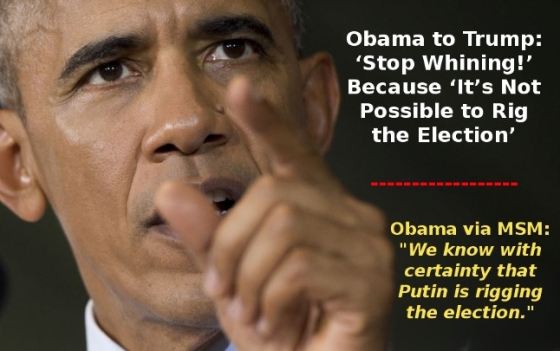
obamariggedelections

By Dan Engelke

Source: Who.What.Why.

In August, the corporate media was falling all over itself with breathless coverage on how Russia is interfering in the US election. Back then, stories citing experts suggested that voting machines were vulnerable to tampering that could change the outcome of the vote. A month later, something curious happened.

By September, government officials were doing all they could to tamp down those concerns, and the media duly reported their reassurances.

Should the public be comforted that election mischief will be homegrown?

The articles, usually citing active government officials, serve a dual purpose in reassuring the public: First, there is no way Russia can hack the election, despite cyber hacks in the Illinois and Arizona voter registration banks. Meanwhile, the message is also to insist Russian President Vladimir Putin is still giving orders to disrupt US cyberspace. This latter message culminated in the Obama administration publicly blaming the Russian government for trying to influence the election in early October.

Voter System vs Election System

The Washington Post began the trend on August 31 with the definitive headline “There’s Almost No Chance Our Elections Can Be Hacked by the Russians. Here’s why.”

The Post cites two major obstacles for potential (Russian) disruption of our election. One is the difference between the “voter system” and the “election system.” The voter system involves registered voter databases throughout the country, while the election system refers to voting machines and paper ballots.

According to executive director Merle King of the state-funded Center for Election Systems in Georgia, the public conflates these two issues about the election, and that leads to a lot of confusion.

The second hindrance for potential hackers is the decentralized voting process, the Post reported. A major positive for vote security, according to the Post, is that local jurisdictions set their own rules for how votes will be counted.

This claim is buttressed by a letter sent by state election officials to Florida voters which notes the public safeguards already in place for our voting process — including (1) layers of encryption for voting machines, (2) thumb drive backups of votes, (3) lack of internet connection to voting machines, and (4) a review of votes after an election.

The Los Angeles Times followed on September 8 with a report titled “Could Russian Hackers Mess with the US Election Results? It Wouldn’t Be Easy; Here’s Why.”

The Times also highlights the decentralized nature of the voting system as a safeguard against tampering. However, while the Post viewed the system as sophisticated, the Times saw the state-run and community-monitored systems as too cumbersome to be susceptible to any hacking.

Quoted again is Merle King, along with Connecticut Secretary of State Denise Merrill, and FBI Director James Comey. Pamela Smith of Verified Voting — an organization that highlights the susceptibility to election rigging — is also sourced to reassure readers that the upcoming election is safe, thanks to an uptick in paper ballot usage.

Russia’s Goal Not Hacking — But Scandal

On September 10, Washington, D.C.-based political newspaper The Hill worked the same dual agenda with “Hacking the Election is Nearly Impossible. But that’s not Russia’s Goal.”

Like the previous articles in the Washington Post and LA Times, The Hill presents the decentralized process of US elections as an impenetrable obstacle to Russian hacking. Bolstering the claims of election security in the piece are Florida’s Secretary of State Ken Detzner, Colorado’s Secretary of Wayne Williams, Pennsylvania Department of State spokesperson Wanda Murren, and Wisconsin’s Administrator of State Elections Division Michael Hass. The only non-governmental official quoted is Chris Porter, an administrator of strategic intelligence at cybersecurity firm FireEye Horizons.

Porter cited examples of Russian election tampering in the Ukraine and efforts to “create scandal,” despite their inability to hack the election.

The Chicago Tribune got its turn on September 14, quoting Assistant to the President for Homeland Security and Counterterrorism Lisa Monaco, who reiterated the safety of the election thanks to the decentralization of the voting process.

These assertions of election security and passive blame on Russia culminated in early October with the Obama administration publicly accusing “senior-most officials in Russia” of tampering with the election, despite their claimed inability to do so.

Taking a Screwdriver to the Election

Let’s go back to August to see why certain experts said that elections could indeed be tampered with.

Princeton professor Andrew Appel made headlines in August after hacking the Sequoia AVC Advantage electronic voting machine in seven minutes. Such machines are used in Louisiana, New Jersey, Virginia and Pennsylvania.

“[Appel] summoned a graduate student named Alex Halderman, who could pick the machine’s lock in seven seconds. Clutching a screwdriver, he deftly wedged out the four ROM chips — they weren’t soldered into the circuit board, as sense might dictate — making it simple to replace them with one of his own: A version of modified firmware that could throw off the machine’s results, subtly altering the tally of votes, never to betray a hint to the voter. The attack was concluded in minutes.”

Former government officials working in the cyber sphere have also warned of election tampering. Former White House counterterrorism czar Richard Clarke asserted: “Yes, It’s Possible to Hack the Election” on August 18.

“I have had three jobs that together [under Bill Clinton, George W. Bush, and Barack Obama] taught me at least one thing: If it’s a computer, it can be hacked.”

Special Interests and the Machines

Clarke sees the decentralized election system as the access point for potential tampering —rather than a potential safeguard. While there are safeguards, such as the voter tabulation through paper ballots, almost no state exclusively uses paper ballots. Instead, voting machines — even allowing votes from home — produce no paper ballot record and thus no way to ensure the “correct” vote was cast.

Furthermore, Clark argues paper ballot receipts from the voting machines are only used in the case of a recount — something today’s sophisticated hackers are aware of and would seek to avoid.

“My first reaction to all this government reassurance was ‘are you kidding me?’” Dr. Jonathan Simon of the Election Defense Alliance told WhoWhatWhy. “There is all this concern about outside hacking, but absolutely no talk of internal rigging.”

While Simon points out that there are many election safeguards, connections to special interests by those that control voting machines provides easy access to election rigging.

“Anyone who could stand to profit off certain policies — the Koch brothers, for example — have a better chance of rigging the election due to their connections to voting systems like Dominion, SES and their satellite companies,” Simon explained. “Russia, China, nor any terrorist group in the Middle East have a connection like that.”

Despite encryption and the lack of an Internet connection, Simon claims that there are other ways to change voting results.

“In a memory card, which is used in optical scanner-verified voting, three lines of code to flip votes one way or another can be entered into 7,000 or 8,000 lines of code virtually without detection. Multiple memory cards can be manipulated like this at the push of a button.”

Why Overlook Potential Domestic Hacking?

With articles by outside experts in August claiming the election could be hacked, followed in September with articles by government officials claiming it could not be — by Russia — it raises the question: why overlook domestic tampering?

“These are relatively unsophisticated and simple ways to rig the election,” Simon concluded.

Washington moves to silence WikiLeaks

germanywikileaks-12d90

By Bill Van Auken

Source: WSWS.org

The cutting off of Internet access for Julian Assange, the founder of WikiLeaks, is one more ugly episode in a US presidential election campaign that has plumbed the depths of political degradation.

Effectively imprisoned in the Ecuadorian embassy in London for over four years, Assange now is faced with a further limitation on his contact with the outside world.

On Tuesday, the Foreign Ministry of Ecuador confirmed WikiLeaks’ charge that Ecuador itself had ordered the severing of Assange’s Internet connection under pressure from the US government. In a statement, the ministry said that WikiLeaks had “published a wealth of documents impacting on the US election campaign,” adding that the government of Ecuador “respects the principle of non-intervention in the internal affairs of other states” and “does not interfere in external electoral processes.” On that grounds, the statement claimed, the Ecuadorian government decided to “restrict access” to the communications network at its London embassy.

This statement from the bourgeois government of Ecuadorian President Rafael Correa is a study in hypocrisy and cowardice. By abetting the US government’s suppression of WikiLeaks, Quito has intervened in the US elections on the side of the ruling establishment and against the rights of the American people. If Correa expects that his professed sensitivity toward the “principle of non-intervention” will be reciprocated, he should recall the fate of Honduran President Manuel Zelaya, who was toppled in a coup orchestrated by then-Secretary of State Hillary Clinton in 2009.

WikiLeaks cited reports that Secretary of State John Kerry had demanded that the government of Ecuador carry out the action “on the sidelines of the negotiations” surrounding the abortive Colombian peace accord last month in Bogota. The US government intervened to prevent any further exposures that could damage the campaign of Clinton, who has emerged as the clear favorite of the US military and intelligence complex as well as the Wall Street banks.

Whether the State Department was the only entity placing pressure on Ecuador on behalf of the Clinton campaign, or whether Wall Street also intervened directly, is unclear. The timing of the Internet cutoff, in the immediate aftermath of the release of Clinton’s Goldman Sachs speeches, may be more than coincidental.

In the spring of 2014, the government of Ecuador agreed to transfer more than half of its gold reserves to Goldman Sachs Group Inc. for three years, in an attempt to raise cash to cover a growing deficit brought on by the collapse in oil prices. It reportedly sent 466,000 ounces of gold to Goldman Sachs, worth about $580 million at the time, in return for “high security” financial instruments and an anticipated profit on its investment. It is hardly a stretch of the imagination to believe that such a relationship would give Goldman Sachs considerable leverage in relation to the Ecuadorian government.

In any case, it is evident that the US ruling establishment is growing increasingly desperate to stanch the flow of previously secret emails and documents that are exposing the real character not only of Clinton, but of capitalist politics as a whole. While WikiLeaks has released over 17,000 emails from the account of Clinton campaign manager and top establishment Democrat John Podesta, it is believed that there are more than 33,000 still to come.

The transcripts of Clinton’s speeches to Goldman Sachs and other top banks and employers’ groups, for which she was paid on average $200,000 per appearance, are the most incriminating. They expose the workings of the oligarchy that rules America and the thinking and actions of a politician prepared to do anything to advance the interests of this ruling stratum, while simultaneously accruing ever greater riches and power for herself.

While on the campaign trail, Clinton has postured as a “progressive,” determined to hold Wall Street’s feet to the fire. But in her speeches to Goldman Sachs, she made clear her unconditional defense of the banks and financial houses. Under conditions of popular outrage against the bankers and their role in dragging millions into crisis in the financial meltdown of 2008, Clinton gave speeches praising the Wall Street financiers and insisting that they were best equipped to regulate themselves. She apologized to them for supporting the toothless Dodd-Frank financial regulatory law, saying that it had to be enacted for “political reasons.”

In front of her Wall Street audiences, Clinton made clear she had no inhibitions about ordering mass slaughter abroad. While telling her public audiences that she supports a “no-fly zone” in Syria as a humanitarian measure to save lives, she confidentially acknowledged to her Goldman Sachs audience that such an action is “going to kill a lot of Syrians” and become “an American and NATO involvement where you take a lot of civilians.” In the same speech she declared her willingness to bomb Iran.

The emails have laid bare the nexus of corrupt connections between the State Department, the Clinton Foundation, her various campaigns and her network of financial and corporate donors, which together constitute a quasi-criminal influence-peddling enterprise that could best be described as “Clinton, Inc.”

The revelations contained in the WikiLeaks material have been ignored or downplayed by the corporate media, which instead has focused unrelentingly on the charges of sexual misconduct leveled against Clinton’s Republican rival, Donald Trump.

The Clinton camp itself has sought to deflect any questions regarding what the candidate said in her speeches or the corrupt operations of her campaign by claiming, with no evidence whatsoever, that the material released by WikiLeaks had been hacked by the Russian government and therefore cannot be trusted.

This line of argumentation serves not only to divert attention from the WikiLeaks material, but also to further the Clinton campaign’s neo-McCarthyite claims of Kremlin intervention on behalf of Trump and advance a propaganda campaign aimed at preparing popular opinion for a direct military confrontation with Russia.

There is an air of desperation in the attempt to quash the WikiLeaks material. CNN news anchor Chris Cuomo, an open supporter of Clinton, went so far as to lie to his audience, claiming it was illegal for them to access the emails and insisting they could obtain any information on them only through the filter of the corporate media.

Well before the release of documents related to the Democratic Party, the determination of ruling circles to suppress WikiLeaks had found repeated and violent expression. State Department officials have come forward with a report that in 2010, in the midst of WikiLeaks’ mass release of State Department cables exposing US imperialist operations around the world, Clinton, then secretary of state, asked subordinates, “Can’t we just drone this guy?” She recently said she could not remember the remark, but if she made it, it was a joke.

During the same period, however, Clinton supporter and longtime Democratic campaign operative Bob Beckel declared in a television interview in relation to Assange: “A dead man can’t leak stuff. This guy’s a traitor, he’s treasonous, and he has broken every law of the United States… there’s only one way to do it: illegally shoot the son of a bitch.”

To this point, the American ruling class has limited itself to judicial frame-ups and character assassination, counting on the help of its servants within both the media and the pseudo-left, large sections of which have either joined the witch-hunt against Assange or downplayed his victimization.

The principal vehicle for this campaign of persecution had been fabricated allegations of sexual misconduct pursued by Swedish authorities acting in league with the US and British governments. Earlier this year, the UN’s Working Group on Arbitrary Detention issued findings that Assange had been “deprived of his liberty in an arbitrary manner,” meaning the body had reached the conclusion that the Swedish case constituted a politically motivated frame-up.

In the midst of the current attempt to silence Assange, an even more bizarre and filthy frame-up has been concocted, attempting to smear the WikiLeaks founder with charges of taking Russian money as well as pedophilia.

At the center of these allegations is a little known online dating service, Toddandclare.com, which first attempted to lure Assange into a supposed deal to film an ad for the site, for which he supposedly would be paid $1 million, to be provided by the Russian government. When WikiLeaks rejected this preposterous provocation, the same site claimed that Assange had been charged with inappropriate contact through the site with an eight-year-old Canadian child visiting the Bahamas. This accusation was then invoked in an attempt to pressure the UN to drop its demand for an end to the persecution of Assange.

Even a cursory investigation makes clear that these allegations constitute a grotesque fabrication. Bahamian police have stated that there are no charges or any case whatsoever against Assange. The dating service has no business address, working phone number or corporate presence anywhere in the US, having all the earmarks of a dummy company created by US intelligence for the purpose of hounding Assange.

The use of such tactics is a measure of how terrified the US ruling class has become in the face of growing mass hostility to both major political parties and their two abhorrent candidates. Their fear is that the relentless exposure of the inner workings of a government of the rich, by the rich and for the rich is robbing the existing political setup of what little legitimacy it had left within the population, and creating the conditions for a political radicalization within the working class and social upheavals, whoever is elected on November 8.


Related Article:

Real Reason Trump’s Being Treated Like He’s Crazy for Refusing to Accept Election Results by Rob Kall

The Cyber-War on Wikileaks

By

Source: CounterPunch

When the ruling class is in panic, their first reaction is to hide the panic.

They react out of cynicism: when their masks are revealed, instead of running around naked, they usually point the finger at the mask they wear. These days the whole world could witness a postmodern version of the infamous quote “Let them eat cake”, attributed to Marie-Antoinette, queen of France during the French Revolution.

As a reaction to WikiLeaks publishing his emails, John Podesta, the man behind Hillary Clinton’s campaign, posted a photo of a dinner preparation, saying “I bet the lobster risotto is better than the food at the Ecuadorian Embassy”.

A similar version of vulgar cynicism emerged earlier this month when Hillary Clinton reacted to the claim that she reportedly wanted to “drone” WikiLeaks founder Julian Assange (“Can’t we just drone this guy?”) when she was the US Secretary of State. Instead of denying her comments, Clinton said that she doesn’t recall any such joke, “It would have been a joke if it had been said, but I don’t recall that”.

One doesn’t have to read between the lines to understand that if Hillary Clinton had said that, she would have considered it a joke. But when emperors joke, it usually has dire consequences for those who are the objects of their “humor.”

Cyber-war Not with Russia…but WikiLeaks

During the last few months I have visited Julian Assange in the Ecuadorian Embassy in London several times and each time I came out of the Embassy, where he is spending his fifth year in political asylum under legitimate fear he might be extradited to the US, my thought was the following one: although he lives, without his family, in a postmodern version of solitary confinement (even prisoners are allowed to walk for up to one hour a day), although he has no access to fresh air or sunlight for more than 2000 days, although the UK government recently denied him safe passage to a hospital for an MRI scan, if his access to the internet would be cut off this would be the most severe attack on his physical and mental freedom.

The last time I saw him, which was only two weeks ago, he expressed the fear that, because he had already published leaks concerning US elections and with more to come, the US might find various ways to silence him, including pressuring Ecuador or even shutting down the internet.

What seemed a distant possibility only two weeks ago, soon became a self-fulfilling prophecy.

When the Obama administration recently announced that it is, as Biden said, planing an “unprecedented cyber covert action against Russia”, the first victim was not Putin, but precisely Julian Assange whose internet was cut off just a day after Biden’s self-contradictory proclamation.

No wonder Edward Snowden reacted immediately by saying that “nobody told Joe Biden what ‘covert operation’ means.

According to the U.S. Department of Defense’s Dictionary of Military and Associated Terms, a covert operation is “an operation that is so planned and executed as to conceal the identity of or permit plausible denial by the sponsor.”

It is no secret anymore that the Ecuadorian government has come under extreme pressure since Assange leaked the Democratic National Committee email database. We don’t know yet whether the US pressured Ecuador to shut down the internet, but it is clear that the present US government and the government to come is fighting a war with WikiLeaks which is all but “covert”. Is it really a coincidence that Julian Assange’s internet access was cut off shortly after publication of Clinton’s Goldman Sachs speeches?

If at the beginning we still had a “soft” version of postmodern McCarthyism, with Hillary calling everyone opposed to her campaign a Russian spy (not only Assange, but also Donald Trump and Jill Stein), then with Obama’s recent intervention it became more serious.

With Obama’s threat of a cyber-war, the “soft” McCarthyism didn’t only acquire geopolitical significance, but at the same time a new mask was revealed: Obama is obviously trying to cement the public debate and make the Russian threat “real”, or at least to use it as a weapon in order to help Clinton to get elected. Moreover, this new twist in something that has already become much more than only US elections (US elections are never only US elections!), shows not only how Obama is ready to strengthen Hillary’s campaign, but it also reveals that a cyber war is already in the making.

It is not a cyber war with Russia, but with WikiLeaks.

And it is not the first time.

What would Clausewitz say?

In 2010, when the Collateral Murder video was published, the Afghan and Iraq war logs were released, and we witnessed one of the most sinister attacks on freedom of speech in recent history. VISA, Mastercard, Diners, American Express and Paypal imposed a banking blockade on WikiLeaks, although WikiLeaks had not been charged with any crime at either state, federal or international level. So if the US government successfully convinced payment companies representing more than 97% of the global market to shut down an independent publisher, why wouldn’t they pressure Ecuador or any other state or company to cut off the internet?

The US is not only rhetorically trying to “get” Assange (it is worth to check out the Assassinate Assange video for evidence of the verbal masturbation of US officials), he poses a serious threat to the major elite factions in the US to remain in power. No wonder panic is rising in the US, which is now going even so far that a 16-year-old boy in Britain has been arrested on criminal charges related to the alleged hacking of email accounts used by CIA director John Brennan, which WikiLeaks published in October 2016.

What WikiLeaks obviously successfully challenged–and maybe one day (“history is written by the victors”, remember?) it will be learned in military strategy– is what the Prussian general and military theorist Carl von Clausewitz would call the “centre of gravity” (Schwerpunkt), which is the “central feature of the enemy’s power”.

Instead of speaking about the Russians, we should start speaking about the Schwerpunkt of the actual leaks, their real essence. Just take the following quotes by Hillary Clinton exposed by WikiLeaks, which reveal her true nature and the politics behind her campaign: “We are going to ring China with missile defence”, “I want to defend fracking” and climate change environmentalists “should get a life”, “you need both a public and a private position”, “my dream is a hemispheric common market, with open trade and open borders”.

What WikiLeaks has shown is not only that Hillary is a hawkish war-monger, first it was Libya (over 1,700 of the 33,000 Clinton emails published by WikiLeaks reference Libya), then it was Syria (at a Goldman Sachs conference she explicitly stated she would like to intervene in Syria), tomorrow it will be another war.

It is now clear – and this is the real “centre of gravity” where we should focus our attention – that the future Clinton cabinet may already been filled with Wall Street people like Obama’s was. No wonder WikiLeaks revelations create utter panic not only in the Democratic Party itself but also the Obama administration.

One question remains, isn’t WikiLeaks, by leaking all these dirty secrets, influencing the US elections? Yes, it certainly is, but the current criticism misses its point: isn’t the very point of organisations such as WikiLeaks to publish the material they have and to influence public opinion?

The question should finally be turned around: isn’t the US mainstream media the one influencing the US elections? And isn’t Obama, by announcing a cyber-war with Russia, influencing the elections?

WikiLeaks is not only influencing the US elections, but transforming the US elections – as they should have been from the very beginning – into a global debate with serious geopolitical consequences at stake. What WikiLeaks is doing is revealing this brutal fight for power, but, as the old saying goes, “when a wise man points at the Moon, the idiot looks at the finger”. Instead of looking at the finger pointing to Russia, we should take a look at the leaks themselves.

If democracy and transparency means anything today, we should say: let them leak!


Srećko Horvat is a philosopher and activist. He is co-author, with Slavoj Žižek, of What Does Europe Want? (Columbia University Press, 2014) and author of The Radicality of Love (Polity Press, 2015). Together with Yanis Varoufakis he co-created the movement DiEM 25. https://diem25.org/

The Odor of Desperation

screen-shot-2016-10-18-at-8-59-54-pm

By James Howard Kunstler

Source: Kunstler.com

It must be obvious even to nine-year-old casual observers of the scene that the US national election is hacking itself. It doesn’t require hacking assistance from any other entity. The two major parties could not have found worse candidates for president, and the struggle between them has turned into the most sordid public spectacle in US electoral history.

Of course, the Russian hacking blame-game story emanates from the security apparatus controlled by a Democratic Party executive establishment desperate to preserve its perks and privileges . (I write as a still-registered-but-disaffected Democrat). The reams of released emails from Clinton campaign chairman John Podesta, and other figures in HRC’s employ, depict a record of tactical mendacity, a gleeful eagerness to lie to the public, and a disregard for the world’s opinion that are plenty bad enough on their own. And Trump’s own fantastic gift for blunder could hardly be improved on by a meddling foreign power. The US political system is blowing itself to pieces.

I say this with the understanding that political systems are emergent phenomena with the primary goal of maintaining their control on the agencies of power at all costs. That is, it’s natural for a polity to fight for its own survival. But the fact that the US polity now so desperately has to fight for survival shows how frail its legitimacy is. It wouldn’t take much to shove it off a precipice into a new kind of civil war much more confusing and irresolvable than the one we went through in the 1860s.

Events and circumstances are driving the US insane literally. We can’t construct a coherent consensus about what is happening to us and therefore we can’t form a set of coherent plans for doing anything about it. The main event is that our debt has far exceeded our ability to produce enough new wealth to service the debt, and our attempts to work around it with Federal Reserve accounting fraud only makes the problem worse day by day and hour by hour. All of it tends to undermine both national morale and living standards, while it shoves us into the crisis I call the long emergency.

It’s hard to see how Russia benefits from America becoming the Mad Bull of a floundering global economy. Rather, the Evil Russia meme seems a projection of our country’s own insecurities and contradictions. For instance, we seem to think that keeping Syria viciously destabilized is preferable to allowing its legitimate government to restore some kind of order there. Russia has been on the scene attempting to prop up the Assad government while we are on the scene there doing everything possible to keep a variety of contestants in a state of incessant war. US policy in Syria has been both incoherent and tragically damaging to the Syrians.

The Russians stood aside while the US smashed up Iraq, Afghanistan, and Libya. We demonstrated adequately that shoving sovereign nations into civic failure is not the best way to resolve geopolitical tensions. Why would it be such a bad thing for the US to stand aside in Syria and see if the Russians can rescue that country from failure? Because they might keep a naval base there on the Mediterranean? We have scores of military bases around the region.

It’s actually pretty easy to understand why the Russians might be paranoid about America’s intentions. We use NATO to run threatening military maneuvers near Russia’s borders. We provoked Ukraine — formerly a province of the Soviet state — to become a nearly failed state, and then we complained foolishly about the Russian annexation of Crimea — also a former territory of the Soviet state and of imperial Russia going back centuries. We slapped sanctions on Russia, making it difficult for them to participate in international banking and commerce.

What’s really comical is the idea that Russia is using the Internet to mess with our affairs — as if the USA has no cyber-warfare ambitions or ongoing operations against them (and others, such as hacking Angela Merkel’s personal phone). News flash: every country with access to the Internet is in full hacking mode around the clock against every other country so engaged. Everybody’s doing it. It is perhaps a projection of America’s ongoing rape hysteria that we think we’re special victims of this universal activity.


Related Article:

Update from Craig Murray: “I can tell you with 100% certainty that it is not any Russian state actor or proxy that gave the Democratic National Committee and Podesta material to WikiLeaks.”

A Redditor Just Proved Clinton Proxies Tried to Frame Julian Assange

sweden_assange222

(Editor’s note: While the case presented by the research isn’t hard evidence, it it highly suspicious and deserving of further investigation. But don’t expect any investigation from corporate media, many members of which have been outed by Wikileaks as shills for Hillary Clinton.)

By Gary Barnes

Source: TruthKings.com

Redditor account Bopbopi posted an image this morning which follows the deceitful tale of the website, ToddandClare.com.

What you should know about the website:

This website is a supposed dating site whereas Julian Assange was allegedly offered $1 million to help create a video. It is supposedly owned by an Indiana couple, but has ties to the Bahamas. The UN opened a case on Assange and it is suspected this specific case is the fuel behind getting him extradited, possibly to the United States. But when you have a look at the site (which I encourage you to do), you will notice it is an extremely amateur website (search dating sites on Google and compare). How did an unknown dating site suddenly come up with $1 million dollars and why did they happen to choose Julian Assange as their desired contract worker?

Assange is now being accused of having cybersex with an 8-year old on the website. To be honest, most of the profiles appear to be fake (again, compare with other dating sites and draw your own conclusions).

Now check out the timeline posted on the previously cited Reddit account:

frameUpdate:

As of 10/21/16, ToddAndClare.com has posted the following message on their landing page:

Company Statement 10/21/2016

Following a serious hack of our website, to protect our members we’ve taken the decision to close the network until further notice. If you are a member of Todd and Clare requiring support, please contact us.

Further updates will be published on our blog.

We thank all our members, business partners, and associates for your support.

The Todd and Clare team