Researchers Find Massive Anti-Russian ‘Bot Army’

By Peter Cronau

Source: Consortium News

A team of researchers at the University of Adelaide have found that as many as 80 percent of tweets about the 2022 Russia-Ukraine invasion in its early weeks were part of a covert propaganda campaign originating from automated fake “bot” accounts.

An anti-Russia propaganda campaign originating from a “bot army” of phony automated Twitter accounts flooded the internet at the start of the war.

The research shows that of the more than 5 million tweets studied, 90.2 percent (both bot and non-bot) came from accounts that were pro-Ukraine, with fewer than 7 percent of the accounts being classed as pro-Russian.

The university researchers also found these automated tweets had been purposely used to drive up fear amongst people targeted by them, boosting a high level of statistically measurable “angst” in the online discourse.

The research team analysed a massively unprecedented 5,203,746 tweets, sent with key hashtags, in the first two weeks of the Russian invasion of Ukraine from Feb. 24. The researchers looked at predominately English-language accounts. A calculated 1.8 million unique Twitter accounts in the dataset posted at least one English-language tweet.

The results were published in August in a research paper, titled “#IStandWithPutin versus #IStandWithUkraine: The interaction of bots and humans in discussion of the Russia/Ukraine war,” by the University of Adelaide’s School of Mathematical Science.

The size of the sample under study, of over 5-million tweets, dwarfs other recent studies of covert propaganda in social media surrounding the Ukraine war. 

The little-reported Stanford University/Graphika research on Western disinformation, analysed by Declassified Australia in September, examined just under 300,000 tweets from 146 Twitter accounts.

The Meta/Facebook research on Russian disinformation reported widely by mainstream media, including by the Australian Broadcasting Corporation (ABC) a fortnight later, looked at only 1,600 Facebook accounts.

Reports on the new research have appeared in only a few independent media sites, and on Russia’s RT.  The ground-breaking study exposing a massive anti-Russia social media disinformation campaign has been effectively ignored by Western establishment media, showing how stories that don’t fit the desired pro-Western narrative are routinely buried. 

Disinformation Blitz Krieg

The Adelaide University researchers unearthed a massive organised pro-Ukraine influence operation underway from the early stages of the conflict. Overall, the study found automated “bot” accounts to be the source of between 60 to 80 percent of all tweets in the dataset. 

The published data shows that in the first week of the Ukraine-Russia war there was a huge mass of pro-Ukrainian hashtag bot activity. Approximately 3.5 million tweets using the hashtag #IStandWithUkraine were sent by bots in that first week. 

In fact, it was like someone had flicked a switch at the start of the war as pro-Ukraine bot activity suddenly burst into life. In that first day of the war the #IStandWithUkraine hashtag was used in as many as 38,000 tweets each hour, rising to 50,000 tweets an hour by day three of the war. 

By comparison, the data shows that in the first week there was an almost total absence of pro-Russian bot activity using the key hashtags. During that first week of the invasion, pro-Russian bots were sending off tweets using the #IStandWithPutin or #IStandWithRussia hashtags at a rate of only several hundred per hour.

Given the apparent long-range planning for the invasion of Ukraine, cyber experts expressed surprise that Russian cyber and internet responses were so laggard. A researcher at the Centre for Security Studies in Switzerland, said: “The [pro-Russian] cyber operations we have seen do not show long preparation, and instead look rather haphazard.”

After being apparently left flatfooted, the #IStandWithPutin hashtag mainly from automated bots, eventually fired up a week after the start of the war. That hashtag started appearing in higher numbers on  March 2, day 7 of the war. It reached 10,000 tweets per hour just twice over the next two days, still way behind the pro-Ukraine tweeting activity. 

The #IStandWithRussia hashtag use was even smaller, reaching only 4,000 tweets per hour. After just two days of operation, the pro-Russian hashtag activity had dropped away almost completely. The study’s researchers noted the automated bot accounts “likely used by Russian authorities,” were “removed likely by pro-Ukrainian authorities.”

The reaction against these pro-Russian accounts had been swift. On March 5, after the #IStandWithPutin hashtag had trended on Twitter, the company announced it had banned over 100 accounts using the hashtag for violating its “platform manipulation and spam policy” and participating in “coordinated inauthentic behaviour.”

Later that month, the Ukraine Security Service (SBU) reportedly raided five “bot farms”’ operating inside the country. The Russia-linked bot operators were reportedly operating through 100,000 fake social media accounts spreading disinformation that was “intended to inspire panic among Ukrainian masses.”

Ukrainian security forces unearthed a pro-Russian automated “bot army” operating out of an apartment in March 2022. The raid found 100 sets of GSM-gateways, left, and 10,000 sim cards, right, operating 100,000 fake bot accounts. (SBU)

Unfiltered Research

The landmark Adelaide University research differs from these earlier revelations in another most unique and spectacular way. 

While the Stanford-Graphika and Meta research was produced by researchers who have long-term deep ties to the U.S. national security state, the Adelaide University researchers are remarkably independent. The academic team is from the university’s School of Mathematical Science.

Using mathematical calculations, they set out to predict and model people’s psychological traits based on their digital footprint.

Unlike the datasets selected and provided for the Stanford/Graphika and the Meta research, the data the Adelaide University team accessed did not come from accounts that had been detected for breaching guidelines and shut down by Meta or Twitter. 

Joshua Watt is one of the lead researchers on the university team, and is a Master of Philosophy candidate in applied mathematics.

He told Declassified Australia that the dataset of 5 million tweets was accessed directly by the team from Twitter accounts on the internet using an academic license giving access to the Twitter API.

The “Application Programming Interface” is a data communication software tool that allows researchers to directly retrieve and analyse Twitter data.

The fake tweets and automated bot accounts had not been detected and removed by Twitter before being analysed by the researchers, although some were possibly removed in Twitter’s March sweep.

Watt told Declassified Australia that in fact many of the bot accounts behind the 5 million tweets studied are likely to be still up and running.

Declassified Australia contacted Twitter to ask what action they may have taken to remove the fake bot accounts identified in the University of Adelaide research. They had not responded by the time of going to press.

Critical Tool in Info War

This new research paper confirms mounting fears that social media has covertly become what the researchers call “a critical tool in information warfare playing a large role in the Russian invasion of Ukraine.”

The Adelaide University researchers tried their best to be noncommittal in describing the activities of the fake Twitter accounts, although they had found the vast majority – over 90 percent – were anti-Russian messages. They stated: “Both sides in the Ukrainian conflict use the online information environment to influence geopolitical dynamics and sway public opinion.”

They found the two main participating sides in the propaganda war have their own particular goals and style. “Russian social media pushes narratives around their motivation, and Ukrainian social media aims to foster and maintain external support from Western countries, as well as promote their military efforts while undermining the perception of the Russian military.”

While the research findings concentrated on automated Twitter bots, there were also findings on the use of hashtags by non-bot tweeters. They found significant information flows from non-bot pro-Russian accounts, but no significant flows from non-bot pro-Ukraine accounts.

As well as being far more active, the pro-Ukraine side was found to be far more advanced in its use of automated bots. The pro-Ukrainian side used more “astroturf bots” than the pro-Russians. Astroturf bots are hyper-active political bots that continuously follow many other accounts to increase followers of that account.

Social Media Role in Boosting Fear

Crucially, the University of Adelaide researchers also investigated the psychological influence the fake automated bot accounts had on the online conversation during those early weeks of the war. 

These conversations in a target audience may develop over time into support or opposition towards governments and policies – but they may also have more instant effects influencing the target audiences’ immediate decisions.

The study found that it was the tweets from the fake “bot” accounts that most drove an increase in conversations surrounding “angst” amongst people targeted by them. They found these automated bot accounts increased “the use of words in the angst category which contains words related to fear and worry, such as ‘shame,’ ‘terrorist,’ ‘threat, ‘panic.’”

By combining the “angst” messaging with messages about “motion” and geographical locations, the researchers found “the bot accounts are influencing more discussion surrounding moving/fleeing/going or staying.” The researchers believe this effect may well have been to influence Ukrainians even away from the conflict zones to flee from their homes.

The research shows that fake automated social media “bot” accounts do manipulate public opinion by shaping the discourse, sometimes in very specific ways. The results provide a chilling indication of the very real malign effects that mass social media disinformation campaigns can have on an innocent civilian population. 

Origins of Twitter Bot Accounts

The researchers report that the overwhelming level of Twitter disinformation that was anti-Russian was from bots “likely [organised] by pro-Ukrainian authorities.”

The researchers asserted no further findings about the origin of the 5 million tweets, but did find that some bots “are pushing campaigns specific to certain countries [unnamed], and hence sharing content aligned with those timezones.” The data does show that the peak time for a selection of pro-Ukrainian bot activity occurred between 6pm and 9pm across U.S. time zones.

Some indication of the origin and the targeting of the messages could be deduced from the specific languages used in the 5 million tweets. Over 3.5 million tweets, or 67 percent, were in the English language, with fewer that 2 percent in Russian and Ukrainian. 

In May 2022, the National Security Agency (NSA) director and U.S. cyber command chief, General Paul Nakasone, revealed that the Cyber Command had been conducting offensive Information Operations in support of Ukraine.

“We’ve conducted a series of operations across the full spectrum: offensive, defensive, [and] information operations,” Nakasone said. 

Nakasone said the U.S. has been conducting operations aimed at dismantling Russian propaganda. He said the operations were lawful, conducted through policy determined by the U.S. Defense Department and with civilian oversight.

Nakasone said the U.S. seeks to tell the truth when conducting an information operation, unlike Russia.

U.S. Cyber Command had deployed to Ukraine a “hunt forward” cyber team in December to help shore up Ukraine’s cyber defences and networks against active threats in anticipation of the invasion.

A newly formed European Union cyber rapid response team consisting of 12 experts joined the Cyber Command team to look for active cyber threats inside Ukrainian networks and to strengthen the country’s cyber defences.

The U.S. has invested $40 million since 2017 in helping Ukraine buttress its information technology sector. According to U.S. Deputy Secretary of State Wendy Sherman, the investments have helped Ukrainians “keep their internet on and information flowing, even in the midst of a brutal Russian invasion.”

Wars & Lies in Our Pockets

With the rise of the internet, war and armed conflict will never be the same. Analysts have noted that the Russian invasion of Ukraine has ushered in a “new digital era of military, political and economic conflict” being manipulated by “laptop generals and bot armies.”

“In all dimensions of this conflict, digital technology plays a key role – as a tool for cyberattacks and digital protest, and as an accelerator for flows of information and disinformation,” wrote analysts at the Heinrich Boll Stiftung in Brussels. “Propaganda has been a part of war since the beginning of history, but never before could it be so widely spread beyond an actual conflict area and targeted to so many different audiences.”

Joshua Watt, one of the lead researchers on the University of Adelaide team that conducted the landmark study, summed it up: “In the past, wars have been primarily fought physically, with armies, air force and navy operations being the primary forms of combat. However, social media has created a new environment where public opinion can be manipulated at a very large scale.”

“CNN brought once-distant wars into our living rooms,” another analyst stated, “but TikTok and YouTube and Twitter have put them in our pockets.”

We are all carrying around with us a powerful source of information and news media – and also, most certainly, disinformation that’s coming relentlessly at us from influence operations run by “bad actors” whose aim is to deceive.

The 500 Years Old WESTERN HEGEMONY is Coming to an END and the World is about to ENTER a VERY DANGEROUS PERIOD

For 500 years the world has been run from Europe or the US: that’s about to change and nobody is sure what its replacement will look like

By Timofey Bordachev

Source: The 21st Century

The most dramatic and unique aspect of the current state of affairs in international politics is that we cannot count on the ability of a single state, or a group of sufficiently powerful countries, to play a leadership role in the future.

This means it is difficult for us to imagine who will be able to force states to comply with the rules of conduct in their foreign policy, and how such strictures can even be enforced.

Indeed, the question of why individuals, or in this case countries, should abide by regulations is the most fundamental one in political philosophy.

And despite all the imperfections of the power method, humanity has not yet invented any other way of achieving such goals, even in minimal amounts, other than by force.

Over the last 500 years, the rules of international communication have been created within the narrow community of Western countries, first in Europe, before in the 20th century the US joined in, providing the power needed to enforce the system.

At first, this was done through the balance of power of leading European states, joined by Russia in 1762.

After the international order that had emerged in the mid-17th century came under attack from revolutionary France, control of the rules became a matter for a small group of major empires.

They, led by Russia and Britain, defeated Napoleon and in 1815 created an order which had at its heart a general agreement that mutiny in international affairs was unacceptable.

By the end of the nineteenth century, politics had become global, but the European powers, including Russia, could still control the rest through brute force and their colossal military-industrial superiority.

The dramatic events of 1914-1945 brought the US to the forefront of global politics, as the leader of the Western community on a global scale.

International institutions, starting with the United Nations, were established with the primary objective of preserving the monopoly position of the West.

This, however, required the emergence of formal institutions of justice in the form of international law, or the participation in the highest UN body, the Security Council, of the Soviet Union and China, which were inherently hostile to US and Western European interests.

The institutional form of Western power dominance has become overbearing and the main question now is whether it can be preserved.

Therefore, the collapse of US and Western European power positions in international politics entails not just a change of leadership, but a revision of the existing institutions and rules at the global level.

In other words, the entire formal international order that has emerged after World War II (and in reality over the last few centuries) will cease to exist.

It was based on a special system of rights and privileges for a limited group of great powers, and later the illusion of fairness of which was created by international institutions led by the UN.

It was this system that played the role of the main legitimizing principle of the existing world order, although in practice it was often replaced by the West’s ability to exert a decisive influence on world affairs

Thus, the collapse of international political institutions will very probably prove to be a consequence of the disappearance of their power base, whose presence has been unchallenged for several centuries.

We are now witnessing the destruction of both the formal and the real basis of the international order. In all likelihood, this process can no longer be stopped.

The coming period will be a time of defining the new global power base, and it is difficult to say yet which players, and to what extent, will become part of it.

What is important is that the top states of the present time – the US, Russia, China and India – are not close to each other, especially in terms of values and understanding of the basic principles of international rules.

The greatest problem so far is the behaviour of the US and certain Western European countries, which, for internal reasons, are pursuing an aggressive policy towards the outside world.

These states have embarked on a very troubling path of qualitative changes in the basic things that make up the social, gender and, consequently, political structures of society. For most other civilizations, this path is a challenge and will be rejected.

We also do not know the extent to which the internal development of the West depends on the spread of its ideals, as it did in previous periods.

In the event that the trends emerging in the West will, like revolutionary France, the Bolshevik regime or Nazi Germany, demand not just recognition from others, but expansion globally, the future will become very worrying.

We can already see that the conflict between the values favored by the West and the foundations of domestic legitimacy in a number of countries, is becoming a ground for aggravated political relations.

It would, however, be a mistake to hope that the other great and middle powers confronting the West are completely united in their understanding of the foundations of justice at the domestic level.

Even if Russia, India, China or Brazil now demonstrate a common understanding of the basic principles of a “proper” world order, this does not mean that they have the same vision of a better domestic order.

This is all the more true of the states of the Islamic world and other major developing countries. Their conservative values are often in conflict with those of the West, but this does not mean that they can create unity between themselves.

In other words, the new international order will, for the first time, be without a reliable link with the domestic ambitions of the leading powers, and this is indeed a qualitative change compared to all the historical eras we discussed.

Such a phenomenon seems very important because we have no experience of understanding how relations between states will develop under such conditions.

Brute force could become the only relatively tangible basis to assert the order, but this may not be enough to make the conditions imposed by it sustainable, even in the short term.

Another unique feature of today’s revolutionary situation is that the revision of the international order is not being carried out by one or a few powers – it has now become the business of the world’s majority.

The countries that make up about 85% of the world’s population are in one way or another no longer prepared to live with conditions created without their direct involvement.

That said, their resistance is often expressed without direct intention and depends on the power capabilities of the particular power.

What from the point of view of Russia or Iran looks like lack of resolve in dealing with the US may seem like a great challenge for Kazakhstan or another young sovereign country – after all, their entire socio-economic system was created to exploit a liberal world order.

The fragile states of Africa, or the former Soviet space, are far less capable of behaving consistently than the prosperous monarchies of the Persian Gulf. China, though now the second most powerful economic power, is also aware of its weaknesses.

But all this does not change the most important thing – even if the destruction of the existing status quo takes the form of soft sabotage rather than decisive military action, it does not simply reflect a general discontent with Western authoritarianism, but creates a new order, and the basic features of this are as yet undetermined.

In the coming years, most countries in the world will seek to make the most of the weakening of the power base of international politics in their self-interest.

So far, these actions constitute a constructive conflict, since they objectively undermine a system based on fantastic injustice.

However, as time goes on the US-EU bloc will weaken and lock itself away, and Russia or China will never be strong enough to take their place.

And in the perspective of the next 10 to 15 years, the international community will face the problem of replacing the power monopoly of the West with new universal instruments of coercion, the nature and content of which are still unknown to us.

A war Russia set to win

The Europeans have been nicely played by the Americans

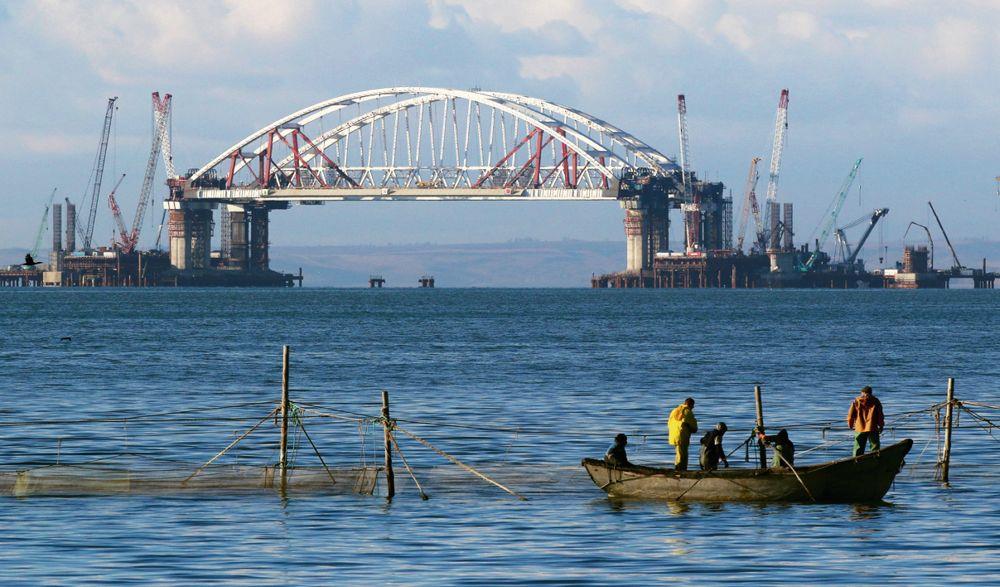
Breached: With the attack on the Crimean Bridge, Ukrainian President Zelenskyy has crossed a red line that Moscow had warned him against. Reuters

By MK Bhadrakumar

Source: The Tribune of India

Two massive terrorist strikes misfired spectacularly and a terrible beauty is born in the Ukraine war. These two carefully planned attacks in quick succession — on Nord Stream gas pipelines and Crimean Bridge — were intended as a knockout blow to Russia. According to President Vladimir Putin, people ‘who want to finally sever ties between Russia and the EU, weaken Europe’ are behind the Nord Stream blasts. He named the US, Ukraine and Poland as ‘beneficiaries’.

Last Wednesday, Russia’s domestic intelligence service FSB identified Ukraine’s military intelligence chief, Kyrylo Budanov, as the mastermind behind the Crimean attack. The New York Times and Washington Post also pointed fingers at Kiev, quoting ‘sources’. While Nord Stream-1 has been crippled, one of the strings of Nord Stream-2 remains intact. Putin said last week that the pipeline could be restored and Russia could deliver about 27 billion cubic metres of gas. ‘The ball is on the side of the European Union, if they want — let’s turn on the tap,’ he said.

But mum’s the word from Brussels. It is a profoundly embarrassing moment for the EU. The triumphalism has vanished as Europe is threatened by years of recession caused by the blowback from sanctions against Russia, where the US insisted on the cut off of energy ties with Moscow. The EU has now become a captive market for Big Oil and is left to buy LNG from the US at the asking price, which is six to seven times higher than the domestic price in the US. (Contracted price for long-term Russian supply for Germany used to be about $280 per 1,000 cubic metres as against the current market price hovering around $2,000.)

Plainly put, the Europeans have been nicely played by the Americans. India should take note of the US’ sense of entitlement. Basically, the Biden administration created a contrived energy crisis whose real aim is war profiteering.

The Crimean Bridge attack of October 8 is much more serious. Zelenskyy has crossed a red line that Moscow had repeatedly warned him against. Putin has disclosed that there have also been three terrorist attacks against the Kursk NPP. Russians will settle for nothing less than the ouster of the Zelenskyy regime.

Russia’s retaliation against Ukraine’s ‘critical infrastructure’, something Moscow refrained from so far, has serious implications. Since October 9, Russia has begun systematically targeting Ukraine’s power system and railways. Noted Russian military expert Vladislav Shurygin told Izvestia that if this tempo was kept up for a week or so, it ‘will disrupt the entire logistics of the Ukrainian military — system for transporting personnel, military equipment, ammunition, related cargo, as well as the functioning of military and repair plants.’

The Americans are cocooned in a surreal world of their self-serving narrative that Russia ‘lost’ the war. In the real world, though, Ivan Tertel, KGB chief in Belarus, who has an insider view of Moscow, said last Tuesday that with Russia boosting its troop strength in the war zone — 3 lakh troops who have been mobilised plus 70,000 volunteers — and the deployment of advanced weaponry, ‘the military operation will enter a key phase. According to our estimates, a turning point will come in the period from November of this year to February of next year.’

Policy-makers and strategists in Delhi should make a careful note of the timeline. The bottom line is, Russia is looking for an all-out victory and will not settle for anything less than a friendly government in Kiev. Western politicians, including Biden, understand that there is nothing stopping the Russians now. The US’ weapon kitty is running dry as Kiev keeps asking for more.

When asked whether he’d meet Biden at the G20 in Bali, Putin derisively remarked on Friday, ‘He (Biden) should be asked whether he is ready to hold such negotiations with me or not. To be honest, I don’t see any need, by and large. There is no platform for any negotiations for the time being.’

However, Washington has not yet thrown in the towel and the Biden administration remains obsessed with exhausting the Russian military — even at the cost of Ukraine’s destruction. And, for the Russians too, there is still much to be worked out on the battlefield: the oppressed Russian populations in Odessa (which suffered unspeakable atrocities from the neo-Nazis), Mykolaiv, Zaporizhya, Dnipropetrovsk, Kharkov are expecting ‘liberation’. It’s a highly emotive issue for Russia. Again, the overarching agenda of ‘demilitarisation’ and ‘denazification’ of Ukraine must be taken to its logical conclusion.

When all that is over, Putin knows Biden will not even want to meet him. Hungarian PM Viktor Orban said last week, ‘Anyone who seriously believes that the war can be ended through Russian-Ukrainian negotiations lives in another world. Reality looks different. In reality, such issues can only be discussed between Washington and Moscow. Today, Ukraine is able to fight only because it receives military assistance from the United States…

‘At the same time, I do not see President Biden as the person who would really be suitable for such serious negotiations. President Biden has gone too far. Suffice it to recall his statements to Russian President Putin.’

India should expect the defeat of the US and NATO, which completes the transition to a multipolar world order. Sadly, Indian elites are yet to purge their ‘unipolar predicament’. Europe, including Britain, is devastated and there is palpable discontent over the US’s ‘transatlantic leadership’. Indo-Pacific strategy is hopelessly adrift. New power centres are emerging in India’s extended neighbourhood, as the OPEC’s rebuff to Washington shows. A profound adjustment is needed in the Indian strategic calculus.

The endless proxy war, by design

While privately conceding that its ally Ukraine is not “capable of winning the war,” the Biden administration keeps fueling it.

By Aaron Maté

Source: Aaron Maté Substack

Russia’s invasion of Ukraine has presented the White House with a geopolitical crisis that it played a critical role in creating. In February 2014, Victoria Nuland, a current senior State Department official and former Dick Cheney advisor, was caught on tape plotting the installation of a new Ukrainian government – a plan, she stressed, that would involve Biden and his then-top aide, and current National Security Advisor, Jake Sullivan. Weeks later, the democratically elected Ukrainian president Viktor Yanukovych was ousted and replaced by Washington-backed leaders – including a prime minister selected by Nuland.

The regime change in Kiev made Biden the most influential US political figure in Ukraine, as underscored by the lucrative Burisma board seat gifted to his son Hunter. While the Biden family and other well-connected players profited, Ukraine fell into civil war. In the eastern Donbas region, Kremlin-backed Ukrainian rebels took up arms against a fascist-infused coup government that cracked down on Russian culture and countenanced murderous assaults on dissidents. Rather than promote the 2015 Minsk II accords — the agreed-upon formula for ending the Donbas conflict – the US fueled the fight with a weapons and training program that turned Ukraine into a NATO proxy. Influential US politicians left no doubt about their intentions. As the Donbas war raged, lawmakers declared that they were using Ukraine to “fight Russia over there” (Adam Schiff) and vowed to “make Russia pay a heavier price,” (John McCain). In February of this year, Russia invaded to bring the eight-year fight to an end, leaving Ukraine to pay the heaviest price of all.

The Biden administration shunned multiple opportunities to prevent the Russian assault. When Russia submitted draft peace treaties in December 2021, the White House refused to even discuss the Kremlin’s core demands: a pledge of neutrality for Ukraine, and the rollback of NATO military forces in post-1997 member states that neighbor Russia. At the final round of talks on implementing Minsk II in early February, the “key obstacle,” the Washington Post reported, “was Kyiv’s opposition to negotiating with the pro-Russian separatists.” Siding with Ukraine’s far-right, which had threatened to overthrow Volodymyr Zelensky if he signed a peace deal, the US made no effort to encourage diplomacy. Emboldened to escalate its war on the Donbas, the Ukrainian government then massively increased shelling on rebel-held areas in the days immediately preceding Russa’s February 24th invasion.

Looking back at the pre-invasion period, Jack Matlock, the US ambassador to the Soviet Union under Bush I, now concludes that “if Ukraine had been willing to abide by the Minsk agreement, recognize the Donbas as an autonomous entity within Ukraine, avoid NATO military advisors, and pledge not to enter NATO,” then Russia’s war “probably would have been prevented.”

For Washington, preventing the war would have interfered with longstanding objectives. As US policymakers have openly recognized, Ukraine’s historical, geographical, and cultural links to Russia could be used as a tool to achieve regime change in Moscow, or, at minimum, leave it “weakened.”

As Ukraine enters another winter of war, this time facing an intensified Russian assault, the Biden administration is apparently in no mood to end a crisis that it helped start.

How “Food Shortages” & Economic Collapse Protects the Status Quo

Engineered Food & Poverty Crises Secure Continued US Dominance

By Colin Todhunter

Source: Off-Guardian

In March 2022, UN Secretary-General Antonio Guterres warned of a “hurricane of hunger and a meltdown of the global food system” in the wake of the crisis in Ukraine.

Guterres said food, fuel and fertiliser prices were skyrocketing with supply chains being disrupted and added this is hitting the poorest the hardest and planting the seeds for political instability and unrest around the globe.

According to the International Panel of Experts on Sustainable Food Systems, there is currently sufficient food and no risk of global food supply shortages.

We see an abundance of food but skyrocketing prices. The issue is not food shortage but speculation on food commodities and the manipulation of an inherently flawed global food system that serves the interests of corporate agribusiness traders and suppliers of inputs at the expense of people’s needs and genuine food security.

The war in Ukraine is a geopolitical trade and energy conflict. It is largely about the US engaging in a proxy war against Russia and Europe by attempting to separate Europe from Russia and imposing sanctions on Russia to harm Europe and make it further dependent on the US.

Economist Professor Michael Hudson recently stated that ultimately the war is against Europe and Germany. The purpose of the sanctions is to prevent Europe and other allies from increasing their trade and investment with Russia and China.

Neoliberal policies since the 1980s have hollowed out the US economy. With its productive base severely weakened, the only way for the US to maintain hegemony is to undermine China and Russia and weaken Europe.

Hudson says that, beginning a year ago, Biden and the US neocons attempted to block Nord Stream 2 and all (energy) trade with Russia so that the US could monopolise it itself.

Despite the ‘green agenda’ currently being pushed, the US still relies on fossil fuel-based energy to project its power abroad. Even as Russia and China move away from the dollar, the control and pricing of oil and gas (and resulting debt) in dollars remains key to US attempts to retain hegemony.

The US knew beforehand how sanctions on Russia would play out. They would serve to divide the world into two blocks and fuel a new cold war with the US and Europe on one side with China and Russia being the two main countries on the other.

US policymakers knew Europe would be devastated by higher energy and food prices and food importing countries in the Global South would suffer due to rising costs.

It is not the first time the US has engineered a major crisis to maintain global hegemony and a spike in key commodity prices that effectively trap countries into dependency and debt.

In 2009, Andrew Gavin Marshall described how in 1973 – not long after coming off the gold standard – Henry Kissinger was integral to manipulating events in the Middle East (the Arab-Israeli war and the ‘energy crisis’). This served to continue global hegemony for the US, which had virtually bankrupted itself due to its war in Vietnam and had been threatened by the economic rise of Germany and Japan.

Kissinger helped secure huge OPEC oil price rises and thus sufficient profits for Anglo-American oil companies that had over-leveraged themselves in North Sea oil. He also cemented the petrodollar system with the Saudis and subsequently placed African nations, which had embarked on a path of (oil-based) industrialisation, on a treadmill of dependency and debt due to the spike in oil prices.

It is widely believed that the high-priced oil policy was aimed at hurting Europe, Japan and the developing world.

Today, the US is again waging a war on vast swathes of humanity, whose impoverishment is intended to ensure they remain dependent on the US and the financial institutions it uses to create dependency and indebtedness – the World Bank and IMF.

Hundreds of millions will experience (are experiencing) poverty and hunger due to US policy. These people (the ones that the US and Pfizer et al supposedly cared so much about and wanted to get a jab into each of their arms) are regarded with contempt and collateral damage in the great geopolitical game.

Contrary to what many believe, the US has not miscalculated the outcome of the sanctions placed on Russia. Michael Hudson notes energy prices are increasing, benefiting US oil companies and US balance of payments as an energy exporter. Moreover, by sanctioning Russia, the aim is to curtail Russian exports (of wheat and gas used for fertiliser production) and for agricultural commodity prices to therefore increase. This too will also benefit the US as an agricultural exporter.

This is how the US seeks to maintain dominance over other countries.

Current policies are designed to create a food and debt crisis for poorer nations especially. The US can use this debt crisis to force countries to continue privatising and selling off their public assets in order to service the debts to pay for the higher oil and food imports.

This imperialist strategy comes on the back of ‘COVID relief’ loans which have served a similar purpose. In 2021, an Oxfam review of IMF COVID-19 loans showed that 33 African countries were encouraged to pursue austerity policies. The world’s poorest countries are due to pay $43 billion in debt repayments in 2022, which could otherwise cover the costs of their food imports.

Oxfam and Development Finance International have also revealed that 43 out of 55 African Union member states face public expenditure cuts totalling $183 billion over the next five years.

The closure of the world economy in March 2020 (‘lockdown’) served to trigger an unprecedented process of global indebtedness.

Conditionalities mean national governments will have to capitulate to the demands of Western financial institutions. These debts are largely dollar-denominated, helping to strengthen the US dollar and US leverage over countries.

The US is creating a new world order and needs to ensure much of the Global South remains in its orbit of influence rather than ending up in the Russian and especially Chinese camp and its belt road initiative for economic prosperity.

Post-COVID, this is what the war in Ukraine, sanctions on Russia and the engineered food and energy crisis are really about.

Back in 2014, Michael Hudson stated that the US has been able to dominate most of the Global South through agriculture and control of the food supply. The World Bank’s geopolitical lending strategy has transformed countries into food deficit areas by convincing them to grow cash crops – plantation export crops – not to feed themselves with their own food crops.

The oil sector and agribusiness have been joined at the hip as part of US geopolitical strategy.

The dominant notion of ‘food security’ promoted by global agribusiness players like Cargill, Archer Daniel Midland, Bunge and Louis Dreyfus and supported by the World Bank is based on the ability of people and nations to purchase food. It has nothing to do with self-sufficiency and everything to do with global markets and supply chains controlled by giant agribusiness players.

Along with oil, the control of global agriculture has been a linchpin of US geopolitical strategy for many decades. The Green Revolution was exported courtesy of oil-rich interests and poorer nations adopted agri-capital’s chemical- and oil-dependent model of agriculture that required loans for inputs and related infrastructure development.

It entailed trapping nations into a globalised food system that relies on export commodity mono-cropping to earn foreign exchange linked to sovereign dollar-denominated debt repayment and World Bank/IMF ‘structural adjustment’ directives. What we have seen has been the transformation of many countries from food self-sufficiency into food deficit areas.

And what we have also seen is countries being placed on commodity crop production treadmills. The need for foreign currency (US dollars) to buy oil and food entrenches the need to increase cash crop production for exports.

The World Trade Organization’s Agreement on Agriculture (AoA) set out the trade regime necessary for this type of corporate dependency that masquerades as ‘global food security’.

This is explained in a July 2022 report by Navdanya International – Sowing Hunger, Reaping Profits – A Food Crisis by Design – which notes international trade laws and trade liberalisation has benefited large agribusiness and continue to piggyback off the implementation of the Green Revolution.

The report states that US lobby and trade negotiations were headed by former Cargill Investors Service CEO and Goldman Sachs executive – Dan Amstutz – who in 1988 was appointed chief negotiator for the Uruguay round of GATT by Ronald Reagan. This helped to enshrine the interests of US agribusiness into the new rules that would govern the global trade of commodities and subsequent waves of industrial agriculture expansion.

The AoA removed protection of farmers from global market prices and fluctuations. At the same time, exceptions were made for the US and the EU to continue subsidising their agriculture to the advantage of large agribusiness.

Navdanya notes:

“With the removal of state tariff protections and subsidies, small farmers were left destitute. The result has been a disparity in what farmers earn for what they produce, versus what consumers pay, with farmers earning less and consumers paying more as agribusiness middlemen take the biggest cut.”

‘Food security’ has led to the dismantling of food sovereignty and food self-sufficiency for the sake of global market integration and corporate power.

We need look no further than India to see this in action. The now repealed recent farm legislation in India was aimed at giving the country the ‘shock therapy’ of neoliberalism that other countries have experienced.

The ‘liberalising’ legislation was in part aimed at benefiting US agribusiness interests and trapping India into food insecurity by compelling the country to eradicate its food buffer stocks – so vital to the nation’s food security – and then bid for food on a volatile global market from agribusiness traders with its foreign reserves.

The Indian government was only prevented from following this route by the massive, year-long farmer protest that occurred.

The current crisis is also being fuelled by speculation. Navdanya cites an investigation by Lighthouse Reports and The Wire to show how speculation by investment firms, banks and hedge funds on agricultural commodities are profiting off rising food prices. Commodity future prices are no longer linked to actual supply and demand in the market but are based purely on speculation.

Archer Daniels Midland, Bunge, Cargill and Louis Dreyfus and investment funds like Black Rock and Vanguard continue to make huge financial killings, resulting in the price of bread almost doubling in some poorer countries.

The cynical ‘solution’ promoted by global agribusiness to the current food crisis is to urge farmers to produce more and seek better yields as if the crisis is that of underproduction. It means more chemical inputs, more genetic engineering techniques and suchlike, placing more farmers in debt and trapped in dependency.

It is the same old industry lie that the world will starve without its products and requires more of them. The reality is that the world is facing hunger and rising food prices because of the system big agribusiness has instituted.

And it is the same old story – pushing out new technologies in search of a problem and then using crises as justification for their rollout while ignoring the underlying reasons for such crises.

Navdanya sets out possible solutions to the current situation based on principles of agroecology, short supply lines, food sovereignty and economic democracy – policies that have been described at length in many articles and official reports over the years.

As for fighting back against the onslaught on ordinary people’s living standards, support is gathering among the labour movement in places like the UK. Rail union leader Mick Lynch is calling for a working class movement based on solidarity and class consciousness to fight back against a billionaire class that is acutely aware of its own class interests.

For too long, ‘class’ has been absent from mainstream political discourse. It is only through organised, united protest that ordinary people will have any chance of meaningful impact against the new world order of tyrannical authoritarianism and the devastating attacks on ordinary people’s rights, livelihoods and standards of living that we are witnessing.

The US is pushing the situation towards a clash of major nuclear powers

By Valery Kulikov

Source: New Eastern Outlook

With its actions in recent months, the United States is blatantly pushing the international situation towards a clash of major nuclear powers. This is true of Washington’s blatantly provocative moves against both Russia and China.

US officials continue to inflame the situation, intimidating their own and the world public with “imaginary nuclear threats” from Russia by spreading fake information. For example, during a speech at the UN General Assembly, US President Biden cited non-existent quotes from Putin. Foreign Ministry Spokeswoman Maria Zakharova called it at least “indecent” that US President Joe Biden falsely quoted Russian leader Vladimir Putin when he “attributed” to the Russian President saying that “our country threatens the world with nuclear weapons”. According to her, someone took advantage of the White House head’s inability to reflect on difficult subjects.

The anti-Russian actions of Joe Biden and members of his administration are now harshly criticized by numerous politicians and media both within and outside the US. The US President was harshly criticized in particular by Fox News political observer Tucker Carlson, who said that Biden was guilty of wanting to destroy Russia for the sake of American hegemony in the world.

Russian President Vladimir Putin has repeatedly reminded the Russian and international public in his recent speeches that Washington is pushing Kiev to move hostilities to Russian territory and has recently even resorted to nuclear blackmail. “Washington, London and Brussels are directly pushing Kiev to transfer hostilities to our territory, and they are already openly saying that Russia must be defeated by all means on the battlefield, followed by the deprivation of economic, political, cultural and any kind of sovereignty, and the complete pillaging of our country,” the Russian leader said in a televised address on September 21. “We are talking not only about Western-encouraged shelling of the Zaporozhye NPP, which threatens a nuclear disaster, but also about statements by some high-ranking representatives of some NATO states about the possibility and admissibility of using weapons of mass destruction, nuclear weapons, against Russia,” Putin explained.

As highlighted in an article by Russia’s Ambassador to the US Anatoly Antonov published in The National Interest magazine, Washington’s actions are pushing the situation towards a clash of major nuclear powers. Western countries appear to be testing Russia’s mettle. “Today it is obvious that the United States is directly involved in the military actions of the Kiev regime. Washington is openly building up the supply of lethal weapons to Ukraine and provides it with intelligence. They jointly plan military operations against the Russian Armed Forces. Ukrainians are being trained to use NATO military hardware in a fight,” the article notes.

Following US media reports in late September that the US was allegedly developing plans to hit the Russian military and political leadership and the Kremlin, the Russian Embassy in Washington commented on the hoaxes, stressing that this was someones’ delusion. The Russian Embassy expressed the hope that such delusional reasoning does not reflect the official position of the US military establishment, as Washington must be well aware of the escalating nature of such reckless rhetoric.

The fact that the US is actively working for an armed clash with Russia is evidenced not only by numerous policies, but also by documents.

The Swedish newspaper Nya Dagbladet, for example, published what it admitted was a “shocking document” about how the US was planning an armed conflict with Russia and an energy crisis in Europe in January. The source of this information was a “leak” from the RAND Corporation, the leading US think-tank responsible for making recommendations to the White House. The report, which was obtained by a Swedish publication, states in particular that one of the reasons for an armed clash between the West and Russia would be its push for military intervention in Ukraine in response to the aggressive foreign policy pursued by the Kiev regime under instructions from Washington. According to the pervasive key objective of this cynical strategy, as described in the document, one of the most important US objectives has been to destroy cooperation not only between Germany and Russia, but also between Berlin and Paris, dragging both of these Western European countries into the conflict in Ukraine.

As the European media is already reporting, although there are still hopes and opportunities to stop the Western-initiated conflict with Russia, they are being increasingly dashed by unprecedented propaganda, the spread of war hysteria through the media and the fanatical insanity of Western politicians. All this shows that military decisions have long been made and there is less and less realistic possibility of stopping the conflict. This has been seriously illustrated by the active calls by the US and its NATO allies for their citizens to urgently leave Russian territory, which, in a well-known historical analogy, is usually done on the eve of the outbreak of a serious armed conflict.

On September 28, the US Embassy in Moscow, for example, called on compatriots to urgently leave the territory of the Russian Federation. In particular, one of the recent reports published on the Embassy’s website said: “US citizens should not travel to Russia and those residing or travelling in Russia should depart Russia immediately while limited commercial travel options remain”.

The Polish Foreign Ministry on September 27 also advised its citizens “leave [Russian] territory using the available commercial and private means”. At the same time, Polish citizens are warned that “in case of a drastic deterioration of the security situation, the closure of borders or other unforeseen circumstances, evacuation may prove significantly impeded or even impossible”. At the same time, according to the Deputy Minister of Interior and Administration Błażej Poboży, an inspection of bomb shelters, even those that are not in the possession of the city authorities, has been launched on the territory of Poland.

The Italian Embassy in Moscow, Latvian Foreign Minister Edgars Rinkēvičs, the Lithuanian Foreign Ministry and several other NATO foreign ministries also advised fellow citizens to leave Russia on September 29.

Although the Latvian authorities admit that the situation on the Latvian-Russian border is stable, calm and under strict control, the country introduced an emergency situation for the next three months. At the same time, the North Atlantic Alliance Command reported the deployment of two HIMARS MLRSs by the US in Latvia, ostensibly in preparation for the NAMEJS exercise.  The exact same MLRSs are already being actively used by the US in military operations in Ukraine to shell Donbas territory by the Kiev regime under the guidance of US military advisors.

While the current US leadership has long acted adventurously and irresponsibly towards the people of eastern Ukraine and the Russian Federation, supporting and fomenting hostilities with its arms deliveries, it must understand that a nuclear conflict, if it occurs, cannot remain a regional issue. And if, through the fault of the White House, the conflict with Moscow descends into nuclear war, such war would be global. It will primarily destroy the United States, as well as the countries where NATO armaments are located and from where the security of Russia and Russian citizens will be threatened. And Washington should be clear that this risk is higher than what the current US political elite expects.

Brainwashed for War With Russia

By Ray McGovern

Source: AntiWar.com

Thanks to Establishment media, the sorcerer apprentices advising President Joe Biden – I refer to Secretary of State Antony Blinken, national security adviser Jacob Sullivan, and China specialist Kurt Campbell – will have no trouble rallying Americans for the widest war in 77 years, starting in Ukraine, and maybe spreading to China. And, shockingly, under false pretenses.

Most Americans are oblivious to the reality that Western media are owned and operated by the same corporations that make massive profits by helping to stoke small wars and then peddling the necessary weapons. Corporate leaders, and Ivy-mantled elites, educated to believe in U.S. “exceptionalism,” find the lucre and the luster too lucrative to be able to think straight. They deceive themselves into thinking that (a) the US cannot lose a war; (b) escalation can be calibrated and wider war can be limited to Europe; and (c) China can be expected to just sit on the sidelines. The attitude, consciously or unconsciously, “Not to worry. And, in any case, the lucre and luster are worth the risk.”

The media also know they can always trot out died-in-the-wool Russophobes to “explain,” for example, why the Russians are “almost genetically driven” to do evil (James Clapper, former National Intelligence Director and now hired savant on CNN); or Fiona Hill (former National Intelligence Officer for Russia), who insists “Putin wants to evict the United States from Europe … As he might put it: “Goodbye, America. Don’t let the door hit you on the way out.”

Absent a miraculous appearance of clearer heads with a less benighted attitude toward the core interests of Russia in Ukraine, and China in Taiwan, historians who survive to record the war now on our doorstep will describe it as the result of hubris and stupidity run amok. Objective historians may even note that one of their colleagues – Professor John Mearsheimer – got it right from the start, when he explained in the autumn 2014 issue of Foreign Affairs “Why the Ukraine Crisis is the West’s Fault.”

Historian Barbara Tuchman addressed the kind of situation the world faces in Ukraine in her book “The March of Folly: From Troy to Vietnam.” (Had she lived, she surely would have updated it to take Iraq, Afghanistan, Syria, and Ukraine into account). Tuchman wrote:

“Wooden-headedness…plays a remarkably large role in government. It consists in assessing a situation in terms of preconceived fixed notions while ignoring or rejecting any contrary signs. It is acting according to wish while not allowing oneself to be deflected by the facts.”

Six Years (and Counting) of Brainwashing

Thanks to US media, a very small percentage of Americans know that:

  • 14 years ago, then US Ambassador to Russia (current CIA Director) William Burns was warned by Russian Foreign Minister Sergei Lavrov that Russia might have to intervene in Ukraine, if it were made a member of NATO. The Subject Line of Burns’s Feb. 1, 2008 Embassy Moscow cable (#182) to Washington makes it clear that Amb. Burns did not mince Lavrov’s words; the subject line stated: “Nyet means nyet: Russia’s NATO enlargement redlines.”Thus, Washington policymakers were given forewarning, in very specific terms, of Russia’s redline regarding membership for Ukraine in NATO. Nevertheless, on April 3, 2008, a NATO summit in Bucharest asserted: “NATO welcomes Ukraine’s and Georgia’s Euro-Atlantic aspirations for membership in NATO. We agreed today that these countries will become members of NATO.”
  • 8 years ago, on Feb. 22, 2014, the US orchestrated a coup in Kiev – rightly labeled “the most blatant coup in history’, insofar as it had already been blown on YouTube 18 days prior. Kiev’s spanking new leaders, handpicked and identified by name by US Assistant Secretary of State Victoria Nuland in the YouTube-publicized conversation with the U.S. ambassador in Kiev, immediately called for Ukraine to join NATO.
  • 6 years ago, in June 2016, Russian President Vladimir Putin told Western reporters of his concern that so-called antiballistic missiles sites in Romania and Poland could be converted overnight to accommodate offensive strike missiles posing a threat to Russia’s own nuclear forces. (See this unique video, with English subtitles, from minute 37 to 49.) There is a direct analogy with the 1962 Cuban missile crisis when Moscow put offensive strike missiles in Cuba and President John Kennedy reacted strongly to the existential threat that posed to the US.
  • On December 21, 2021, President Putin told his most senior military leaders:“It is extremely alarming that elements of the US global defense system are being deployed near Russia. The Mk 41 launchers, which are located in Romania and are to be deployed in Poland, are adapted for launching the Tomahawk strike missiles. If this infrastructure continues to move forward, and if US and NATO missile systems are deployed in Ukraine, their flight time to Moscow will be only 7–10 minutes, or even five minutes for hypersonic systems. This is a huge challenge for us, for our security.” [Emphasis added.]
  • On December 30, 2021, Biden and Putin talked by phone at Putin’s urgent request. The Kremlin readout stated:
  • On February 12, 2022, Ushakov briefed the media on the telephone conversation between Putin and Biden earlier that day.
  • On February 24, 2022, Russia invaded Ukraine.

Unprovoked?

The US insists that Russia’s invasion was “unprovoked”. Establishment media dutifully regurgitate that line, while keeping Americans in the dark about such facts (not opinion) as are outlined (and sourced) above. Most Americans are just as taken in by the media as they were 20 years ago, when they were told there were weapons of mass destruction in Iraq. They simply took it on faith. Nor did the guilty media express remorse – or a modicum of embarrassment.

The late Fred Hiatt, who was op-ed editor at the Washington Post, is a case in point. In an interview with the Columbia Journalism Review [CJR, March/April 2004] he commented:

“If you look at the editorials we wrote running up [to the war], we state as flat fact that he [Saddam Hussein] has weapons of mass destruction.” “If that’s not true, it would have been better not to say it.”

(My journalism mentor, Robert Parry, had this to say about Hiatt’s remark. “Yes, that is a common principle of journalism, that if something isn’t real, we’re not supposed to confidently declare that it is.”)

It’s worse now. Russia is not Iraq. And Putin has been so demonized over the past six years that people are inclined to believe the likes of James Clapper to the effect there’s something genetic that makes Russians evil. “Russia-gate” was a big con (and, now, demonstrably so), but Americans don’t know that either. The consequences of prolonged demonization are extremely dangerous – and will become even more so in the next several weeks as politicians vie to be the strongest in opposing and countering Russia’s “unprovoked” attack on Ukraine.

THE Problem

Humorist Will Rogers had it right:

“The problem ain’t what people know. It’s what people know that ain’t so; that’s the problem.”

Challenging America’s Lords of Illusion with a Million Contrary Rumble Views

By Ron Unz

Source: The Unz Review

In Roger Zelazny’s classic 1967 science fiction novel Lord of Light, humans on a distant planet have employed technological devices to establish themselves as gods of the Hindu pantheon, each having particular aspects and attributes. Mara is the Lord of Illusion, able to reshape the perceived world in the minds of all those around him. Such an ability is powerful but not invincible since the physical reality remains unchanged, and Mara is slain in the very first chapter.

I think that story stands as an effective metaphor for America’s strengths in today’s world. Our country is so utterly dominant in the distribution of information and propaganda, including the electronic and social media, that we can easily persuade most of the world to accept as truth our manufactured illusions. But we cannot alter the underlying reality, perhaps leading to disastrous ultimate consequences.

Russia possesses a nuclear arsenal equal to our own and its revolutionary hypersonic weapons provide it considerable superiority in delivery systems. Lieutenant-General Igor Kirillov serves as the head of Russia’s Radiation, Chemical, and Biological Defense Forces, and a couple of weeks ago he held a public briefing at which he suggested that elements of the American government had probably been responsible for unleashing the global Covid epidemic.

I mentioned his explosive accusations in a column, but otherwise they seem to have been almost entirely ignored in both the American mainstream and even alternative media. Instead, the only significant American response was that Twitter suspended the official account of the Russian Foreign Ministry after it distributed the remarks of that top Russian general.

Once again, except for a column of my own, the censorship Twitter had suddenly imposed upon the Russian government for such accusatory statements passed almost entirely unnoticed by American mainstream and alternative media outlets alike.

Major declarations by top Russian military leaders surely receive extensive coverage in Russia’s own domestic media, so I’d assume that a substantial fraction of the Russian population now believes that the Covid virus which has killed more than 15 million people worldwide may have been an American product, engineered and released by our national security apparatus. But a near-total media embargo—extending to alternative outlets—has ensured that such notions remain completely excluded from American minds. Apparently, our editors follow the principle “What we don’t know can’t hurt us.”

Over the last couple of years I have been repeatedly struck by the complete unwillingness of virtually any mainstream or alternative Western journalist to take notice of the very strong evidence of America’s culpability in the Covid epidemic, evidence that I have presented in a long series of articles first beginning in April 2020.

Earlier this month I sent this plaintive note to a member of America’s elite establishment with whom I’ve been friendly for many years:

…the whole situation just staggers the imagination.

For the same of argument, let’s assume I’m correct and there’s at least a pretty good chance that the blowback from an unauthorized biowarfare attack has now killed a million Americans.

Can you think of anything in the history of the world let alone the history of America that’s comparable to that? As I argued in one of my recent articles, it’s probably 1000x a greater worldwide disaster than Chernobyl.

And the notion that absolutely no one is willing to discuss it is just unbelievable. It’s not like Stalin’s NKVD will ship them off to the Gulag if they say anything. I mean it’s one thing if people are fearful of being shot, but it’s another thing if they’re merely fearful of being criticized on Twitter…

I just can’t understand why absolutely no one is willing to take a public stand on this issue. Once all the facts came out more than a year ago, I assumed the dam would break any week.

And his reply:

It is quite amazing.

From the very beginning of the epidemic, our media and propaganda organs, whether mainstream or alternative, have successfully insulated the American public from the crucial information that might allow them to properly understand what had happened in their lives. As I noted in my original April 2020 article:

As the coronavirus gradually began to spread beyond China’s own borders, another development occurred that greatly multiplied my suspicions. Most of these early cases had occurred exactly where one might expect, among the East Asian countries bordering China. But by late February Iran had become the second epicenter of the global outbreak. Even more surprisingly, its political elites had been especially hard-hit, with a full 10% of the entire Iranian parliament soon infected and at least a dozen of its officials and politicians dying of the disease, including some who were quite senior. Indeed, Neocon activists on Twitter began gleefully noting that their hated Iranian enemies were now dropping like flies.

Let us consider the implications of these facts. Across the entire world the only political elites that have yet suffered any significant human losses have been those of Iran, and they died at a very early stage, before significant outbreaks had even occurred almost anywhere else in the world outside China. Thus, we have America assassinating Iran’s top military commander on Jan. 2nd and then just a few weeks later large portions of the Iranian ruling elites became infected by a mysterious and deadly new virus, with many of them soon dying as a consequence. Could any rational individual possibly regard this as a mere coincidence?

In a later article I emphasized that Iran’s top leadership had certainly recognized these obvious facts at the time:

By early March 2020, the Iranian general overseeing his country’s biowarfare defense had already begun suggesting that Covid was a Western biological attack against his country and China, and a couple of days later the semiofficial Iranian news agency FARS quoted Iran’s top Revolutionary Guards military commander as declaring:

Today, the country is engaged in a biological battle. We will prevail in the fight against this virus, which might be the product of an American biological [attack], which first spread in China and then to the rest of the world…America should know that if it has done so, it will return to itself.

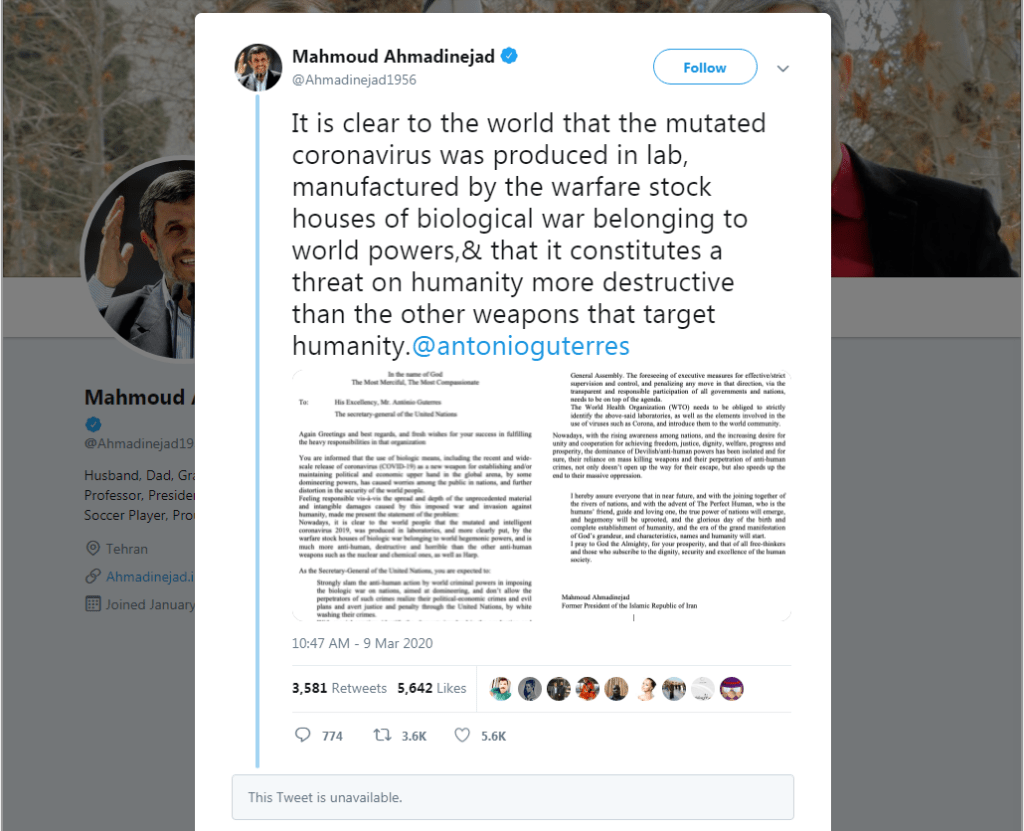
Soon afterward, Iran’s Supreme Leader Ali Khamenei took the same public position, while populist former president Mahmoud Ahmadinejad became especially vocal on Twitter for several months, even directing his formal accusations to UN Secretary-General Antonio Guterres. Just a single one of his numerous Tweets drew many thousands of Retweets and Likes.

Iranian radio and television and its international news service repeatedly carried these stories, backed by supportive interviews with a top political aide to Malaysia’s former prime minister. But America’s overwhelming domination over the English-language global media ensured that this major international controversy never came to my attention at the time it occurred.

The blockade preventing these Iranian charges from reaching the English-speaking world was further facilitated by American control over the basic infrastructure of the Internet. Just one month earlier, Iran’s PressTV channel for Britain had been deleted by YouTube, following the earlier removal of its main global channel. Most recently, the American government took the unprecedented action of seizing PressTV‘s Internet domain, completely eliminating all access to that website.

The original Covid outbreak had struck Wuhan at the height of China’s confrontation with the United States. By March 2020 official Chinese media was reporting that the virus might have been brought to that city by American military personnel when they participated in the World Military Games held there, with an official spokesman for China’s Foreign Ministry creating a diplomatic incident when he Tweeted out those accusations.

I’ve been told that such theories of American responsibility have become endemic on Chinese social media, and last year China’s second largest official news agency briefly summarized my own views on its website.

Similarly, Sputnik News, a mainstream Russian media outlet with 20 million visits per month, recently published a short interview with me regarding the likely origins of Covid. Around the same time, a leading Iranian television channel interviewed me for five hours in preparation for a series they plan to broadcast in the near future.

Government officials and the general public of Russia, Iran, and China both seem increasingly aware of these important facts and the controversial scenario they suggest, so I find it difficult to understand how legitimate American national interests are served by keeping that same information away from the American people. Yet this continuing climate of near-absolute censorship has been maintained not only within the mainstream media but also by nearly all alternative journalists and outlets. Even when American figures of the greatest public stature and credibility have broken their silence, their statements have been ignored across almost the entire alternative media landscape.

Prof. Jeffrey Sachs of Columbia University is the very high-ranking American academic who had served as the chairman of the Covid Commission established by the Lancet, a leading medical journal. In May he co-authored an important article in the prestigious PNAS journal arguing that the virus had probably been produced in a lab and calling for an independent inquiry into its true origins.

This bombshell declaration, which should have reached the front pages of the New York Times, was instead ignored by virtually every mainstream and alternative media outlet.

The following month, he reiterated his views while speaking at a small think-tank gathering in Spain, and a short clip of his remarks went super-viral, being retweeted out more than 11,000 times and attracting over a million views.

With the exception of an article in the London Daily Mail, this further bombshell was again entirely ignored by all outlets in both the mainstream and alternative press.

Finally, earlier this month he gave a lengthy and remarkably candid interview to Current Affairs, a small alternative media webzine, in which he focused on the strong evidence he had encountered of an apparent cover-up of Covid’s possible origins by individuals associated with the American government:

Once again, virtually no alternative journalist reported those astonishing allegations by the academic figure who had been best placed to make them.

When I brought his recent interview to the attention of several prominent mainstream individuals whom I personally know, they found it absolutely stunning. But apparently nearly every journalist in America thought otherwise, so its impact on the public debate has been almost nil.

Last week I published an account of the shocking McCain/POW scandal uncovered by the late Sydney Schanberg. Despite his stellar journalistic reputation and the mountain of evidence he had accumulated, his findings were totally ignored by the entire media, including by the Times, where he himself had previously served as one of the top editors. This notion of a story being too big or too dangerous for the media to cover certainly applies to the origins of the Covid epidemic.

Furthermore, the strategies used to suppress challenges to establishmentarian dogma may have grown much more sophisticated and effective. A couple of weeks ago I discussed this possibility in the aftermath of the Alex Jones trial, suggesting that techniques of “cognitive infiltration” may have been deployed against alternative organizations and activists, diverting them into blind alleys that dissipate their energies and severely damage their public credibility:

I speculated that the huge, sudden rise of a massive anti-vaxxing movement in America might be an example of this. A couple of years ago, vaccine issues were almost invisible, but soon after questions arose regarding the true origins of the Covid virus, the vaccination controversy moved to the absolute center stage of American public life, completely dominating the thoughts of most of those willing to challenge official orthodoxy on any other matter.

As a result, I suspect that a thousand times as much time and effort has recently been devoted to debating the safety and efficacy of Covid vaccines than to investigating the true origins of the disease that made them necessary. And individuals or organizations who proclaim their fear that Bill Gates is the architect of a diabolical plot to exterminate most of the human race are hardly likely to be taken seriously by credible journalists or academics on any other matters.

The difficult year or two of lockdown conditions under which so many Americans had suffered fostered the social isolation that naturally allowed even the most fantastical ideas to take root among the fearful. Such an environment would have been ideal for the successful promotion across the Internet of debilitating nonsense promoted by organized propaganda-operatives.

Thus, since early 2020, the likely reality of an event of monumental historical importance—the unauthorized release of a military bioweapon that has killed so many millions worldwide—has been successfully suppressed within America and the rest of the West. In the past, other dramatic events such as the JFK assassination and the 9/11 attacks quickly sparked large-scale movements of citizen-activism challenging the questionable official narrative, but there currently exists no similar “Covid Truth Movement.”

Despite this unfortunate situation, there are some signs of hope, indications of a few embers that might eventually burst into flame.

First, growing coverage in the Russian, Iranian, and Chinese media may help pierce the wall of silence maintained by Western outlets, especially because the latter have become so severely discredited by their extremely skewed coverage of the conflict in Ukraine and the confrontation over Taiwan. At the very least, alternative journalists may finally gain the necessary courage to begin seriously exploring the origins of Covid.

In addition, Jeffrey Sachs, an extremely senior figure in the mainstream Covid firmament, has seemingly become willing to break the conspiracy of silence and raise issues that have been suppressed for more than two years. Although media outlets have scrupulously avoided publishing his statements, his public stature raises the possibility of successfully circumventing such gatekeepers.

Meanwhile, the facts are still out there. I recently reread my original April 2020 article that first raised these issues, and although more than two years have passed I found little in the text that I would wish to change.

Just days after that piece ran, our entire webzine was banned by Facebook and all our pages were deranked by Google. But although those harsh actions successfully suppressed what had been the viral spread of that article, they also underscored the potential importance of the arguments being made.

Over the next two years, I greatly expanded that first work into a lengthy series of articles, comprehensively covering the topic. Taken together, those pieces have now been viewed more than a half-million times, and the entire collection is now available both as a freely downloadable eBook and also as an Amazon paperback.

Even more heartening has been the growing viewership of my video presentations. Back in February, just before the outbreak of the Ukraine war diverted all attention in a different direction, I was interviewed several times by small podcasters, and these shows have attracted considerable audiences. Totaling around four hours of discussion, they have now accumulated over a million views on Rumble, with more than half of these coming during the last few weeks. Circumventing media gatekeepers is a crucial step in piercing the veil of ignorance maintained by the West’s reigning Lords of Illusion, and recognizing the reality of our global disaster.

Kevin Barrett, FFWN • February 16, 2022 • 15m

Video Link

Geopolitics & Empire • February 1, 2022 • 75m

Video Link

Red Ice TV • February 3, 2022 • 130m

Video Link

Related Reading: