The US State Department has openly discussed shutting down RT, the Russian news network. Assistant Secretary of State Victoria Nuland was asked about the idea of shutting the company down at a meeting at the Brookings Institute. She said no, paying lip service to the Freedom of Speech, but citing RT’s limited reach as the real reason.
The incident goes to demonstrate exactly how much censorship exists in the United States. RT broadcasts a narrative that is undoubtedly pro-Russian. Now that the pro-Russian narrative is at odds with the Pro-US narrative, the government is willing to openly discuss simply shutting off American access to the network.
This isn’t the first time that RT was targeted by government officials. The Chair of the US Broadcasting Board of Governors equated RT to terrorist groups when he said:
“We are facing a number of challenges from entities like Russia Today which is out there pushing a point of view, the Islamic State in the Middle East and groups like Boko Haram.”
Why would such a question be asked of a State Department official to begin with? Because the US State Department is responsible for large portions of America’s propaganda efforts.
This is the United States of America. We are supposed to have a free press, but if you push a point of view contrary to the government’s, you’re likely to lose your broadcasting license. Regimes in the past held book burnings to remove unfavorable opinions from circulation. The US government doesn’t need to be so boorish. They simply remove the book from libraries or revoke the broadcasting license of the outlet that won’t read the government’s script.
As unrest erupts from Oakland to Egypt, there’s one weapon of war that has come to define the militarized police state: tear gas.
And while a St. Louis judge ruled recently that limits must be placed on the use of tear gas in Ferguson, he didn’t rule that tear gas should only be implemented as a last resort.
Around the country, contingents of peaceful protesters are being confronted by assemblies of heavily militarized police officers that regularly use chemical agents to disperse crowds. But usually the act of getting doused with chemicals is so infuriating that it only incites chaos.
People have a good reason to be afraid of tear gas, considering it’s a banned agent of war under the 1993 Chemical Weapons Convention. Here’s the catch – there’s a clause in the treaty that includes an exception for domestic use. Yes, it’s illegal for the US military to use tear gas against ISIS, but cool to use against American citizens.
The US ensured the exception, claiming it was afraid the convention may prohibit lethal injection. Because of this caveat for riot control, countries around the world regularly and irresponsibly use chemical agents against their own populations. In American cities like Ferguson, police deploy tear gas at the drop of a hat, often at cameramen and journalists.
Despite all of the apocalyptic imagery associated with the weapon, government officials maintain tear gas is perfectly safe, including Ferguson police chief Tom Jackson, who said ”There are complaints about the response from some people… but to me, nobody got hurt seriously, and I’m happy about that.”
He forgot to say yet, considering how Ferguson police are using tear gas canisters from the Cold War era and are so old, there’s a severe risk of shrapnel flying into crowds. Make no mistake, this “less than lethal” weapon can actually be quite deadly. Look no further than Palestine, where a man was killed from a tear gas canister hitting him at close range in 2011. Or in Egypt, when a policeman shot tear gas into a caravan holding 37 protesters, choking and killing them all.
Horrifyingly, tear gas also causes amputations and miscarriages. In Bahrain, Physicians for Human Rights reported that many pregnant women had miscarriages after exposure with the chemical agent. Officials assure there are no long term health effects, but that hasn’t been proven given the lack of long term studies. Sven-Eric Jordt, a leading expert in tear gas, says
“I frankly think that we don’t know much about the long-term effects, especially in civilian exposure…There’s very few follow-up studies. These are very active chemicals that can cause quite significant injury. I’m very concerned that, as use has increased, tear gas has been normalized. The attitude now is like, this is safe and we can use it as much as we want.”
And boy, do we. As the world’s leading military and arms supplier, the US is also the biggest producer of less than lethal weaponry. During Egypt’s revolution, while police gunned down protesters and made mass arrests, they liberally used tear gas that read “Made in the USA” (at a little place called Combined Systems International of Jamestown, Pennsylvania). According to VisionGain, the non-lethal weapons market has exploded over the last decade, and is worth a whopping 1.6 billion dollars this year.
Somehow the government has convinced the American people that using tear gas is perfectly harmless, despite stark evidence to the contrary. So, next time it tries to sell us another war because *this leader gasses his own people*, remember that claim isn’t so far from home.
Editor’s note: This is a revised article from last year followed by recent podcasts and videos on the topic.
One of the ways corrupt people and institutions retain power is by discouraging criticism and discussions that could lead to organized opposition. A classic tactic is to vilify targets as unpatriotic, disloyal, traitorous, heretical, dangerous, crazy, etc. Think about what happened to critics of capitalism during the peak of the cold-war hysteria. George Orwell’s 1984 depicted how governments could also manipulate language, history, media and other information in order to diminish critical thought (which leads to critical speech and organizing) and to control thought. The creation of a Big Brother-style police/surveillance state is another way to create a climate of fear and foster a culture which discourages the sharing of knowledge about certain topics and prevents people from taking action.
This should be kept in mind when discussing 9/11, because those who still have complete faith in government and corporate media (an increasingly shrinking number), have been conditioned to ignore, deny or dismiss any information that would lead them to question the official story. The most common knee-jerk reaction is to defend the official story by labeling all alternative narratives “conspiracy theory”. Though this argument is not as convincing today, when political scandals and crimes are almost a daily occurrence, the association between “conspiracy theories” and negative terms such as “crazy” and “wacko” are deeply ingrained in the culture, and not by accident.
The term “conspiracy theory” was not used as an ad hominem attack until shortly after the assassination of John F. Kennedy. Documented evidence shows the CIA needed to develop new and more effective ways to attack and discredit those who dared to question the Warren Commission Report. So when one counters questions about the official narrative with “That’s just a crazy conspiracy theory” they’re actually using a psy-op attack developed by and for a conspiracy. Because of experience and greater proliferation of information through the internet, fewer people are naive enough to deny extremely wealthy and powerful people would conspire to protect their position and interests. History and hard evidence shows it would be crazier to suppose that they don’t.
Another common argument is “The government is too incompetent to pull off something of that scale and keep it a secret”. It’s true that aspects of the government are incompetent, but the incompetence is generally limited to things they care little about such as medical and educational systems, the food system, domestic infrastructure, safety, financial regulation, disaster relief, fair elections, etc. When it comes to things they prioritize such as wars, bailouts, black budgets, black ops, cronyism, crowd control, surveillance, propaganda, etc., the US government is extremely effective. And the higher up the hierarchy, the easier it is to keep secrets. All it takes is a relatively small number of people in key positions, and through division of labor, compartmentalization, formation of policies conducive to conspiring, and covert actions and communications protected under the cloak of “national security” (with help from a mass culture of conformity, credulity and fear). One should also keep in mind that governments are not monolithic and are comprised of factions with conflicting interests which can be used, manipulated and/or compromised by players involved in the conspiracy (not just within U.S. government but in foreign governments and the private sector as well).
Some simply can’t accept that individuals and factions within U.S. government could intentionally cause an attack such as 9/11 or let it happen. This speaks to the power of corporate media and establishment propaganda on different levels. It shows how a significant majority of Americans can be kept completely ignorant of decades of violent imperialist policy around the world and how false flags have been used to start wars through history. There’s also a long history of state violence against its own people and on American soil going back to the genocide of Native Americans, murders of countless slaves and people of color, multiple massacres of labor activists, assassination of leaders such as JFK, RFK, MLK, Black Panthers, and MOVE, the 93 WTC bombing, WACO, OK City bombing, etc. There’s also ample documentation proving the US government has at least considered actions not dissimilar to 9/11 such as Operation Northwoods and Project for a New American Century. What this argument presupposes is that powerful and wealthy (mostly) white men are inherently more trustworthy, empathetic, and righteous than “Muslim fanatics” or any other “enemy” most Americans have been conditioned to fear and hate.
Other attacks against independent 9/11 researchers include dismissals like “9/11 is no longer relevant” and/or “there’s more important problems to deal with so we need to move on”. I would argue that when such crimes occur that have harmed and killed vast numbers of people and is responsible for countless casualties and elimination of civil liberties more than a decade after due to policies supposedly justified by the event, we have a moral obligation to uncover who did it and why. There’s no peace without justice and no justice as long as the truth behind such nation-changing crimes remains suppressed. Of course there’s always plenty of immediate and equally important issues to address, but those who don’t know history are condemned to repeat it. More specifically, those who benefit most from historical events such as 9/11 are motivated to repeat it while those who only know a distorted version of history while remaining ignorant of the truth are more likely to let it happen again.
Because of the work of “conspiracy theorists” we are now more aware of the scope of government/corporate criminality and connections between government, wall street, war-profiteers, and the criminal underworld. For example, without the work of independent JFK researchers we wouldn’t be aware of Operation Northwoods which many now view as a false flag template used for 9/11. Gaining a better understanding of how and why 9/11 happened helps us put current geopolitical events in context while providing insight into how such operations work and how they can be counteracted.
There’s also the “straw man” argument which creates the illusion of having refuted a proposition by replacing an argument with a superficially similar yet non-equivalent proposition and refuting it without ever having refuted the original position. This is particularly easy to do with complex high profile incidents such as 9/11 and the JFK assassination, where there can be a wide array of theories and speculation due to the complexity of the narrative, widespread interest, deep secrecy and disinformation or misinformation from “useful idiots” and/or those who would benefit from keeping crucial information hidden.
Discussing controversial subjects is never easy but it’s always rewarding when people turn out to be more receptive and thoughtful than one might suspect. Though corporate media does its best to defend the official stories, more people than ever are waking up. On this 9/11 anniversary with the potential for another war on the horizon, it’s as good a day as any to talk about it, share this information and help others wake up.
9/11/14 Update:
On the 9/3/14 episode of “Guns and Butter” Tod Fletcher uses a contextual approach to analyzing events at the Pentagon, explores origins and elements of the hijacker story (ie. telephone calls from the planes, analysis of eyewitness reports, physical debris, photo/video evidence, black boxes and FBI involvement) and investigates means, motive and opportunity.
Project Censored 9/8/14: With the anniversary of the September 11 attacks at hand, Peter and Mickey speak with Ken Jenkins, organizers of the annual 911 Film Festival in Oakland, California, about questions that still linger 13 years after the attacks. Then Shahid Buttar of the Bill of Rights Defense Committee talks about the scope and implications of the ongoing federal surveillance activities against Americans, and how to resist them. The program concludes with Robbie Martin of Media Roots, speaking about his new documentary “American Anthrax.”
Activist/comedian Lee Camp, best known for his Moment of Clarity YouTube channel and podcasts (and who follows the fine tradition of stand-up social critics such as George Carlin or Bill Hicks), is host of the new RT program “Redacted Tonight”. Not surprisingly it’s an expert blend of humor and news, and you can watch the entire premier episode here:
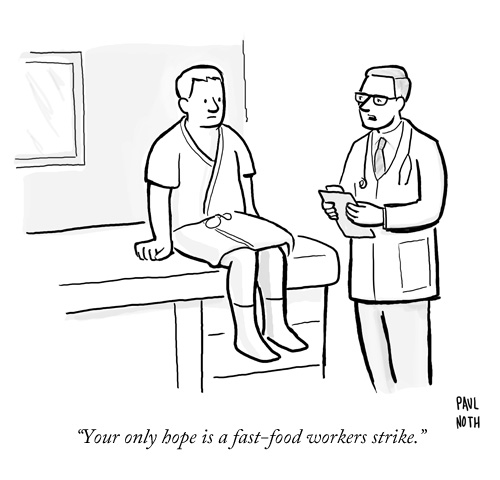
Today is the day of the largest global fast food strike yet, targeting major chain restaurants including McDonald’s, Burger King, Wendy’s, Taco Bell and KFC. Organized with the help of Fast Food Forward, the Service Employees International Union and a number of regional activist organizations, fast food workers in 150 cities and 33 countries (including Morocco, Japan, India, Belgium, Germany, Brazil, Argentina and New Zealand) are taking action for better pay and working conditions.
Sarah Kendzior describes the nature of the struggle that fast food employees commonly experience in the following excerpt from “The Minimum Wage Worker Strikes Back”:
Jenina dropped out of nursing school after her mother lost her job, because she needed the tuition money to pay bills. Her income from McDonald’s, where she started working as a high school senior, helps support her mother and younger sister. Patrick’s Chipotle income helps support his mother, a makeup artist who has struggled to find steady work since the recession. Krystal’s Taco Bell income helps support her son; her sister, who lives with her and works at Jack in the Box; and now, her newborn daughter.
Every worker I interview is supporting someone: an unemployed parent, a child, a sibling, a friend. Most of their friends and family members work in fast food or other service industries. Everyone is in their twenties or older. All but one is African-American.
They dream of different jobs. The women want to be nurses, the men want to work in the automotive or culinary industries. But no one can pay for training when they cannot save for day to day, much less for the future.
As a result, fast food workers are turning to activism: not out of ideological motives, but because overturning the economic system seems more feasible than purchasing the credentials for a new career.
5/7 RT interviews a survivor of the Odessa massacre who witnessed police complicity in the violence:
5/6 Mark Dice on the NSA and freedom of speech:
5/6 A NextNewsNetwork report on a test of the limits of religious freedom in Oklahoma:
5/5 Before Snowden there was NSA whistleblower Russ Tice, who has had suspiciously less corporate media coverage. Fortunately WeAreChange and other independent journalists are helping to get his message out:
5/5 GlobalResearchTV posted this PressTV report linking chaos in Ukraine to US policy:
War activists, like peace activists, push for an agenda. We don’t think of war activists as “activists” because they rotate in and out of government positions, receive huge amounts of funding, have access to big media, and get meetings with top officials just by asking — without having to generate a protest first.
They also display great contempt for the public and openly discuss ways to manipulate people through fear and nationalism — further shifting their image away from that of popular organizers. But war activists are not journalists, not researchers, not academics. They don’t inform or educate. They advocate. They just advocate for something that most of the time, and increasingly, nobody wants.
William Kristol and Robert Kagan and their organization, the Foreign Policy Initiative, stand out as exemplary war activists. They’ve modified their tone slightly since the days of the Project for the New American Century, an earlier war activist organization. They talk less about oil and more about human rights. But they insist on U.S. domination of the world. They find any success by anyone else in the world a threat to the United States.
And they demand an ever larger and more frequently used military, even if world domination can be achieved without it. War, for these war activists, is an end in itself. As was much more common in the 19th century, these agitators believe war brings strength and glory, builds character, and makes a nation a Super Power.
Kristol recently lamented U.S. public opposition to war. He does have cause for concern. The U.S. public is sick of wars, outraged by those in Iraq and Afghanistan, and insistent that new ones not be begun. In September, missile strikes into Syria were successfully opposed by public resistance. In February, a new bill to impose sanctions on Iran and commit the United States to joining in any Israeli-Iranian war was blocked by public pressure. The country and the world are turning against the drone wars.
The next logical step after ending wars and preventing wars would be to begin dismantling the infrastructure that generates pressure for wars. This hasn’t happened yet. During every NCAA basketball game the announcers thank U.S. troops for watching from 175 nations. Weapons sales are soaring. New nukes are being developed. NATO has expanded to the edge of Russia. But the possibility of change is in the air. A new peace activist group at WorldBeyondWar.org has begun pushing for war’s abolition.
Here’s Kristol panicking:
“A war-weary public can be awakened and rallied. Indeed, events are right now doing the awakening. All that’s needed is the rallying. And the turnaround can be fast. Only 5 years after the end of the Vietnam war, and 15 years after our involvement there began in a big way, Ronald Reagan ran against both Democratic dovishness and Republican détente. He proposed confronting the Soviet Union and rebuilding our military. It was said that the country was too war-weary, that it was too soon after Vietnam, for Reagan’s stern and challenging message. Yet Reagan won the election in 1980. And by 1990 an awakened America had won the Cold War.”
Here’s Kagan, who has worked for Hillary Clinton and whose wife Victoria Nuland has just been stirring up trouble in Ukraine as Assistant Secretary of State. This is from an article by Kagan much admired by President Barack Obama:
“As Yan Xuetong recently noted, ‘military strength underpins hegemony.’ Here the United States remains unmatched. It is far and away the most powerful nation the world has ever known, and there has been no decline in America’s relative military capacity — at least not yet.”
This pair is something of a good-cop/bad-cop team. Kristol bashes Obama for being a wimp and not fighting enough wars. Kagan reassures Obama that he can be master of the universe if he’ll only build up the military a bit more and maybe fight a couple more wars here and there.
The response from some Obama supporters has been to point out that their hero has been fighting lots of wars and killing lots of people, thank you very much. The response from some peace activists is to play to people’s selfishness with cries to bring the war dollars home. But humanitarian warriors are right to care about the world, even if they’re only pretending or badly misguided about how to help.
It’s OK to oppose wars both because they kill huge numbers of poor people far from our shores and because we could have used the money for schools and trains. But it’s important to add that for a small fraction of U.S. military spending we could ensure that the whole world had food and clean water and medicine. We could be the most beloved nation. I know that’s not the status the war activists are after. In fact, when people begin to grasp that possibility, war activism will be finished for good.
David Swanson is a peace pundit, antiwar author and talk radio host. He is syndicated by PeaceVoice. His books include War No More. He hosts Talk Nation Radio.
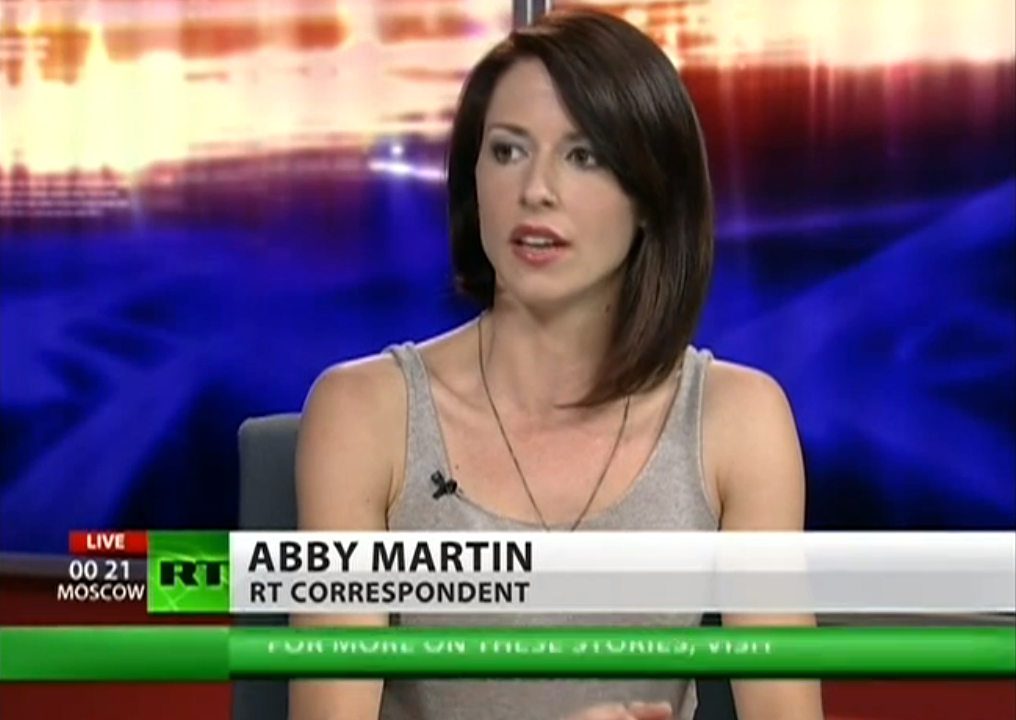
More about the Foreign Policy Initiative from Abby Martin, who was recently a target of their attacks:
Last week, Seattle’s alternative weekly paper The Stranger published an exposé on their city’s new wireless mesh network, part of a $2.7 million project purchased by the Department of Homeland Security. The Seattle Police Department refused to answer more than a dozen questions about the network (which was fast-tracked by Seattle City Council with very little process for review and approval) including whether it’s operational, who can access its data, what it might be used for, whether the SPD has used or intends to use it to geo-locate people’s devices via MAC addresses or other identifiers, and how accurately it would be able to track people.
On November 12, Anthony Gucciardi and Mikael Thalen released reports on Infowars and Storyleak featuring leaked documents on the surveillance mesh posted by an anonymous whistleblower earlier this year. Some of the findings are recapped in the video below:
Shortly after the leaks went public (Tuesday evening) Seattle Police Spokesperson Sgt. Sean Whitcomb announced “The wireless mesh network will be deactivated until city council approves a draft policy and until there’s an opportunity for vigorous public debate.” While it’s fortunate they were forced to do this due to public pressure, it contradicted previous statements SPD had made to the local press in the wake of The Stranger article. As reported by RT:
The SPD told The Stranger previously that the system was not being used, but anyone with a smart phone who wandered through the jurisdiction covered by the digital nodes could still notice that their devices were being discovered by the internet-broadcasting boxes, just as a person’s iPhone or Android might attempt to connect to any network within reach. In theory, law enforcement could take the personal information transmitted as the two devices talk to each other and use that intelligence to triangulate the location of a person, even within inches.
When the SPD was approached about the system last week, they insisted that it wasn’t even in operation yet. David Ham of Seattle’s KIRO-7 News asked, however, how come “we could see these network names if it’s not being used?”
“Well, they couldn’t give us an explanation,” Ham said at the time.
“They now own a piece of equipment that has tracking capabilities so we think that they should be going to city council and presenting a protocol for the whole network that says they won’t be using it for surveillance purposes,” Jamela Debelak of the American Civil Liberties Union told the network.
Now just days later, the SPD has admitted to The Stranger that indeed the mesh network was turned on — it just wasn’t supposed to be.
“SPD maintains it has not been actively using the network — it was operational without being operated, having been turned on for DHS grant-mandated testing and then never turned off — so shutting it down won’t hamper any current SPD activities,” The Stranger reported.
Are we supposed to believe the SPD “forgot” to shut the system off or trust that they would leave it operational without anyone operating it in light of the fact that they lied to reporters about the system being on a few days earlier? Both seem unlikely, as does promises that they’ll have enough safeguards in place to prevent misuse of the information they collect.
As RT previously reported, the DHS has been quietly rolling out similar surveillance grids in other cities including Oakland and Las Vegas. At this point, all Americans must remain extra vigilant to stay on top of such Orwellian schemes and do everything within power to shut them down.
UPDATE 11/28: Infowars just released this follow-up report revealing SPD had in fact NOT shut down the surveillance grid after publicly announcing that they would. This is further evidence that government lies and/or is incompetent at doing anything not a high priority for them (like shutting off surveillance grids), as if anyone needed more evidence.
UPDATE 12/9: Seattle police just announced today that the last of the surveillance nodes had finally been shut off last Friday (12/6). According to The Stranger:
Today, an SPD spokesperson said the department had turned off the final nodes in the network on Friday—156 could be disabled remotely, which happened weeks ago (though 19 had to be double-checked in person), but 8 had to be deactivated manually by a technician. Those are now off.
Today, I also received a copy of a letter sent from SPD Chief Jim Pugel to city councilperson Bruce Harrell about the mesh network. The full text is below the jump, but the relevant points are: (a) the department says the technology needs “more vetting with the ACLU and other stakeholders before a public hearing” and (b) Chief Pugel’s assertion that the network does not have the capability to track or record a person’s movements, but that SPD’s draft policies about its use “will cover any non-video technology” anyway.
The department, Pugel says, should be ready for a briefing with the council member earlier next year.




 After the Crash