A Low-Trust Society Is an Impoverished Society

By Charles Hugh Smith

Source: Of Two Minds

The sole remaining reservoirs of trust in American life are personal networks, local enterprises and local institutions.

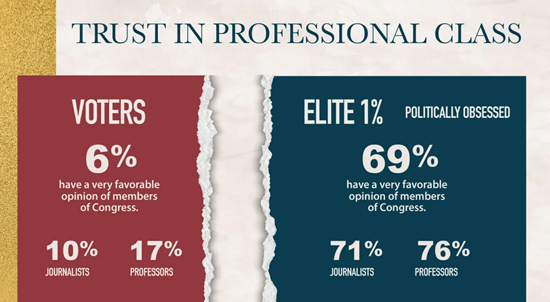
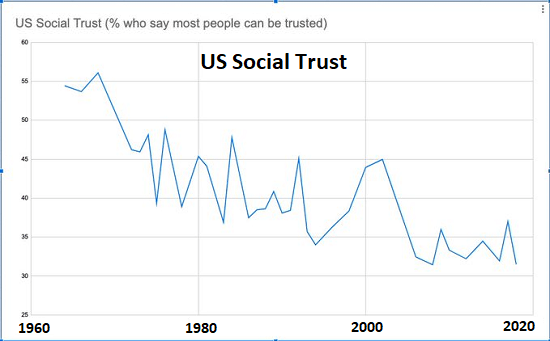
It’s not exactly news that social trust has declined significantly in the United States. Surveys find that public trust in institutions and the professional classes that dominate those institutions has cratered. (see chart below) Social trust–our confidence that other people are trustworthy–has also fallen to multi-decade lows.

This was not the case in decades past. Americans maintained high levels of trust in their institutions, government and fellow citizens. The decline in social trust is across the entire spectrum: our trust in institutions, professional elites and our fellow Americans has declined precipitously.

The causes of this decay of social trust can be debated endlessly, but several factors are obvious:

1. Institutions forfeited the trust of the citizenry by withholding / editing realities to serve the interests of hidden agendas and insiders’ careers. The Vietnam War was pursued on fabrications, as was the second Gulf War to topple Saddam. Watergate eroded trust on multiple levels, as did the Church Committee’s investigation of America’s security agencies’ domestic spying / over-reach.

2. The managerial / professional elites at the top of the nation’s institutions no longer put the citizenry’s interests above their own. The public’s trust has eroded as institutions are primarily viewed as vehicles for self-enrichment and career advancement: healthcare CEOs pay themselves millions, higher education is bloated with layers of non-teaching administration, defense contractors and the Pentagon have greased the revolving door to the benefit of incumbents and insiders, and so on, in an endless parade of self-serving cloaked with smirking PR claims of “serving the public.”

The shift from a high-trust society to a low-trust society is consequential economically, politically and socially. Low-trust societies have stagnant economies, as nobody trusts anyone they don’t know personally or through personally trusted networks, and nobody trust institutions to function effectively or fulfill their stated mission to serve the public good.

Faced with incompetent, unaccountable, corrupt bureaucracies and a culture overflowing with scams, frauds, imposters and get-rich-quick schemes, people give up and drop out. Rather than start a business and accept all the risks just to get dumped on or ripped off, they don’t even try to start a business. Given the financial insecurity that is now the norm, they decide not to get married or have children.

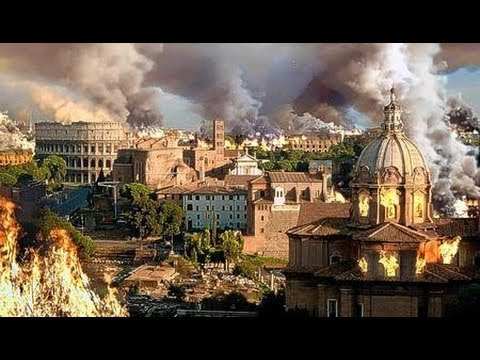
The vast trading networks of the Roman Empire were based on personal trusted networks and trust in Rome’s functionaries / institutions. The owners of trading ships dealt with trusted captains and merchants, who then paid duties to Roman functionaries in Alexandria and other major trading ports.

In other words, tightly bound personal trusted networks work well as long as the state institutions that bind the entire economy are trusted as fair and reliable–not perfect, of course, but efficient and “good enough.”

But when public institutions are viewed as unfair, unreliable, corrupt or incompetent, the entire economy decays. Even personal trusted networks cannot survive in an economy of unfair, unreliable, corrupt or incompetent state bureaucracies and private institutions.

The American economy is now dominated by enormous privately owned and managed monopolies and cartels that are the private-sector equivalent of self-serving state bureaucracies. Big Tech, Big Pharma, Big Healthcare, Big Ag, Big Finance, etc., are even worse than state bureaucracies because there are no legal requirements for transparency or recourse. Try getting a response from a Big Tech corporation when you’ve been shadow-banned or sent to Digital Siberia.

The sole remaining reservoirs of trust in American life are personal networks, local enterprises and local institutions. These are not guaranteed, of course; in many locales, even these reservoirs have been drained. But in other locales, enterprises and institutions such as the county water utility, the local newspaper, the local community college, etc. continue to earn the trust of the public by performing the services they exist to provide effectively and at a reasonable cost.

The larger the institution and the greater its wealth and power, the lower the social trust–for good reasons. The greater the influence of the managerial elites, the greater the disconnect from the everyday experiences of the citizenry and customers, and the more extreme the self-serving PR.

Sure, I trust Big Tech, Big Pharma, Big Healthcare, Big Finance–to rip me off, profiteer, send me obfuscating bills, jack up junk fees, make it impossible to contact them, and send me to Digital Siberia if I complain.

The divide between the elites and the commoners should prompt us to examine the low-trust path we’re sliding down:

In a society in which everything is phony, low quality or fraudulent, you’re taking a chance trusting anyone you don’t know personally–and even that can be risky now that self-aggrandizing flim-flam is the last remaining path to financial security for non-elites.

A low-trust society is an impoverished society, economically stagnant and socially threadbare. That’s where we are now, and the more fragmented, greedy, self-serving, desperate and deranged we become, the lower the odds that we’ll find the means to rebuild trust.

Sadly, we already know that anyone claiming to “rebuild trust” is spouting PR designed to mask self-enrichment. We also know that the vast army of well-paid flacks, factotums, enforcers, happy-story apologists, lackeys, toadies and sell-out minions are declaring “everything’s great!”

Just mumble, “Uh, sure” and continue to Tune in (to degrowth), drop out (of hyper-consumerism and debt-serfdom) and turn on (to self-reliance and relocalizing capital and agency).

Rule by Criminals: When Dissidents Become Enemies of the State

By John & Nisha Whitehead

Source: The Rutherford Institute

In these days of worldwide confusion, there is a dire need for men and women who will courageously do battle for truth.”— Martin Luther King Jr.

When exposing a crime is treated as committing a crime, you are being ruled by criminals.

In the current governmental climate, obeying one’s conscience and speaking truth to the power of the police state can easily render you an “enemy of the state.”

The government’s list of so-called “enemies of the state” is growing by the day.

Wikileaks founder Julian Assange is merely one of the most visible victims of the police state’s war on dissidents and whistleblowers.

Five years ago, on April 11, 2019, police arrested Assange for daring to access and disclose military documents that portray the U.S. government and its endless wars abroad as reckless, irresponsible, immoral and responsible for thousands of civilian deaths.

Included among the leaked materials was gunsight video footage from two U.S. AH-64 Apache helicopters engaged in a series of air-to-ground attacks while American air crew laughed at some of the casualties. Among the casualties were two Reuters correspondents who were gunned down after their cameras were mistaken for weapons and a driver who stopped to help one of the journalists. The driver’s two children, who happened to be in the van at the time it was fired upon by U.S. forces, suffered serious injuries.

There is nothing defensible about crimes such as these perpetrated by the government.

When any government becomes almost indistinguishable from the evil it claims to be fighting—whether that evil takes the form of war, terrorism, torture, drug trafficking, sex trafficking, murder, violence, theft, pornography, scientific experimentations or some other diabolical means of inflicting pain, suffering and servitude on humanity—that government has lost its claim to legitimacy.

These are hard words, but hard times require straight-talking.

It is easy to remain silent in the face of evil.

What is harder—what we lack today and so desperately need—are those with moral courage who will risk their freedoms and lives in order to speak out against evil in its many forms.

Throughout history, individuals or groups of individuals have risen up to challenge the injustices of their age. Nazi Germany had its Dietrich Bonhoeffer. The gulags of the Soviet Union were challenged by Aleksandr Solzhenitsyn. America had its color-coded system of racial segregation and warmongering called out for what it was, blatant discrimination and profiteering, by Martin Luther King Jr.

And then there was Jesus Christ, an itinerant preacher and revolutionary activist, who not only died challenging the police state of his day—namely, the Roman Empire—but provided a blueprint for civil disobedience that would be followed by those, religious and otherwise, who came after him.

Indeed, it is fitting that we remember that Jesus Christ—the religious figure worshipped by Christians for his death on the cross and subsequent resurrection—paid the ultimate price for speaking out against the police state of his day.

A radical nonconformist who challenged authority at every turn, Jesus was a far cry from the watered-down, corporatized, simplified, gentrified, sissified vision of a meek creature holding a lamb that most modern churches peddle. In fact, he spent his adult life speaking truth to power, challenging the status quo of his day, and pushing back against the abuses of the Roman Empire.

Much like the American Empire today, the Roman Empire of Jesus’ day had all of the characteristics of a police state: secrecy, surveillance, a widespread police presence, a citizenry treated like suspects with little recourse against the police state, perpetual wars, a military empire, martial law, and political retribution against those who dared to challenge the power of the state.

For all the accolades poured out upon Jesus, little is said about the harsh realities of the police state in which he lived and its similarities to modern-day America, and yet they are striking.

Secrecy, surveillance and rule by the elite. As the chasm between the wealthy and poor grew wider in the Roman Empire, the ruling class and the wealthy class became synonymous, while the lower classes, increasingly deprived of their political freedoms, grew disinterested in the government and easily distracted by “bread and circuses.” Much like America today, with its lack of government transparency, overt domestic surveillance, and rule by the rich, the inner workings of the Roman Empire were shrouded in secrecy, while its leaders were constantly on the watch for any potential threats to its power. The resulting state-wide surveillance was primarily carried out by the military, which acted as investigators, enforcers, torturers, policemen, executioners and jailers. Today that role is fulfilled by the NSA, the FBI, the Department of Homeland Security and the increasingly militarized police forces across the country.

Widespread police presence. The Roman Empire used its military forces to maintain the “peace,” thereby establishing a police state that reached into all aspects of a citizen’s life. In this way, these military officers, used to address a broad range of routine problems and conflicts, enforced the will of the state. Today SWAT teams, comprised of local police and federal agents, are employed to carry out routine search warrants for minor crimes such as marijuana possession and credit card fraud.

Citizenry with little recourse against the police state. As the Roman Empire expanded, personal freedom and independence nearly vanished, as did any real sense of local governance and national consciousness. Similarly, in America today, citizens largely feel powerless, voiceless and unrepresented in the face of a power-hungry federal government. As states and localities are brought under direct control by federal agencies and regulations, a sense of learned helplessness grips the nation.

Perpetual wars and a military empire. Much like America today with its practice of policing the world, war and an over-arching militarist ethos provided the framework for the Roman Empire, which extended from the Italian peninsula to all over Southern, Western, and Eastern Europe, extending into North Africa and Western Asia as well. In addition to significant foreign threats, wars were waged against inchoate, unstructured and socially inferior foes.

Martial law. Eventually, Rome established a permanent military dictatorship that left the citizens at the mercy of an unreachable and oppressive totalitarian regime. In the absence of resources to establish civic police forces, the Romans relied increasingly on the military to intervene in all matters of conflict or upheaval in provinces, from small-scale scuffles to large-scale revolts. Not unlike police forces today, with their martial law training drills on American soil, militarized weapons and “shoot first, ask questions later” mindset, the Roman soldier had “the exercise of lethal force at his fingertips” with the potential of wreaking havoc on normal citizens’ lives.

A nation of suspects. Just as the American Empire looks upon its citizens as suspects to be tracked, surveilled and controlled, the Roman Empire looked upon all potential insubordinates, from the common thief to a full-fledged insurrectionist, as threats to its power. The insurrectionist was seen as directly challenging the Emperor.  A “bandit,” or revolutionist, was seen as capable of overturning the empire, was always considered guilty and deserving of the most savage penalties, including capital punishment. Bandits were usually punished publicly and cruelly as a means of deterring others from challenging the power of the state.  Jesus’ execution was one such public punishment.

Acts of civil disobedience by insurrectionists. Much like the Roman Empire, the American Empire has exhibited zero tolerance for dissidents such as Julian Assange, Edward Snowden and Chelsea Manning who exposed the police state’s seedy underbelly. Jesus was also branded a political revolutionary starting with his attack on the money chargers and traders at the Jewish temple, an act of civil disobedience at the site of the administrative headquarters of the Sanhedrin, the supreme Jewish council.

Military-style arrests in the dead of night. Jesus’ arrest account testifies to the fact that the Romans perceived Him as a revolutionary. Eerily similar to today’s SWAT team raids, Jesus was arrested in the middle of the night, in secret, by a large, heavily armed fleet of soldiers.  Rather than merely asking for Jesus when they came to arrest him, his pursuers collaborated beforehand with Judas. Acting as a government informant, Judas concocted a kiss as a secret identification marker, hinting that a level of deception and trickery must be used to obtain this seemingly “dangerous revolutionist’s” cooperation. 

Torture and capital punishment. In Jesus’ day, religious preachers, self-proclaimed prophets and nonviolent protesters were not summarily arrested and executed. Indeed, the high priests and Roman governors normally allowed a protest, particularly a small-scale one, to run its course. However, government authorities were quick to dispose of leaders and movements that appeared to threaten the Roman Empire. The charges leveled against Jesus—that he was a threat to the stability of the nation, opposed paying Roman taxes and claimed to be the rightful King—were purely political, not religious. To the Romans, any one of these charges was enough to merit death by crucifixion, which was usually reserved for slaves, non-Romans, radicals, revolutionaries and the worst criminals.

Jesus was presented to Pontius Pilate “as a disturber of the political peace,” a leader of a rebellion, a political threat, and most gravely—a claimant to kingship, a “king of the revolutionary type.” After Jesus is formally condemned by Pilate, he is sentenced to death by crucifixion, “the Roman means of executing criminals convicted of high treason.”  The purpose of crucifixion was not so much to kill the criminal, as it was an immensely public statement intended to visually warn all those who would challenge the power of the Roman Empire. Hence, it was reserved solely for the most extreme political crimes: treason, rebellion, sedition, and banditry. After being ruthlessly whipped and mocked, Jesus was nailed to a cross.

Jesus—the revolutionary, the political dissident, and the nonviolent activist—lived and died in a police state. Any reflection on Jesus’ life and death within a police state must take into account several factors: Jesus spoke out strongly against such things as empires, controlling people, state violence and power politics. Jesus challenged the political and religious belief systems of his day. And worldly powers feared Jesus, not because he challenged them for control of thrones or government but because he undercut their claims of supremacy, and he dared to speak truth to power in a time when doing so could—and often did—cost a person his life.

Unfortunately, the radical Jesus, the political dissident who took aim at injustice and oppression, has been largely forgotten today, replaced by a congenial, smiling Jesus trotted out for religious holidays but otherwise rendered mute when it comes to matters of war, power and politics.

Yet for those who truly study the life and teachings of Jesus, the resounding theme is one of outright resistance to war, materialism and empire.

What a marked contrast to the advice being given to Americans by church leaders to “submit to your leaders and those in authority,” which in the American police state translates to complying, conforming, submitting, obeying orders, deferring to authority and generally doing whatever a government official tells you to do.

Telling Americans to blindly obey the government or put their faith in politics and vote for a political savior flies in the face of everything for which Jesus lived and died.

Will we follow the path of least resistance—turning a blind eye to the evils of our age and marching in lockstep with the police state—or will we be transformed nonconformists “dedicated to justice, peace, and brotherhood”?

As Martin Luther King Jr. reminds us in a powerful sermon delivered 70 years ago, “This command not to conform comes … [from] Jesus Christ, the world’s most dedicated nonconformist, whose ethical nonconformity still challenges the conscience of mankind.”

Ultimately, as I make clear in my book Battlefield America: The War on the American People and in its fictional counterpart The Erik Blair Diaries, this is the contradiction that must be resolved if the radical Jesus—the one who stood up to the Roman Empire and was crucified as a warning to others not to challenge the powers-that-be—is to be an example for our modern age.


The “Phantom Legion” Problem

By Charles Hugh Smith

Source: Of Two Minds

Everything is presented as rock-solid until it falls apart.

Of the many signs of systemic decay in the late Roman Empire, one of particular relevance to our era is the Phantom Legion, military units that on paper were at full strength–and paid accordingly–but which were in reality no longer there: the paymaster collected the silver wages and recorded the unit’s roll of officers and soldiers, but it was all make-believe.

When the Empire’s wealth seems limitless, graft, embezzlement and fraud all seem harmless to those skimming the wealth. Look, the Empire is forever, what harm is there in my little self-interested skim?

This rot starts at the top, of course, and then seeps into every nook and cranny of the system. When those at the top are getting fabulously wealthy on modest salaries while claiming to serve the public, the signal is clear: go ahead and maximize your own private gain at the expense of the public and the state. Civic virtue–the backbone of the Empire–decayed into self-interest, incompetence and indulgence.

The “Phantom Legion” Problem has another wrinkle: the legion is reported at full strength, but the actual number of soldiers is far lower than the reported number, and the competence of the officers is so low that the legion is incapable of performing its duties. In other words, the numbers don’t reflect the actual utility-value of the legion as a combat unit: the soldiers may be ill-trained, ill-equipped and poorly fed, and the officers inexperienced, corrupt or just waiting for their term of duty to end.

In the present day, this is how The Phantom Legion Problem manifests: the agency / institution is reported at full strength and fully capable of performing all its duties, but beneath the surface it’s lacking experienced staff and competent leadership, and much of the staffing is in unproductive, dead-wood administrative positions.

Taking healthcare as an example, we find experienced frontline caregivers are retiring and not being replaced with equivalent numbers of staff with the equivalent experience. We find caregivers are burning out due to crushing workloads, or quitting the profession in order to have a family and get their life back.

Meanwhile, the number of administrators increases, soaking up the system’s funding with endlessly expanding compliance data entry, reports, etc., all of which adds additional burdens on those actually providing care.

There’s always enough money to increase administrators’ salaries, but not enough to maintain essential systems or hire more caregivers.

The Phantom Legion Problem plays out in many ways in modern bureaucracies. The number of sworn officers in a police department may appear adequate but if many are assigned to desks, the PD is not actually at full strength.

If administrators are advanced due to their PR and financial skills rather than on their competence in actually leading the organization, the Phantom Legion problem is already terminal. the rot starts at the top, and those actually carrying the weight fulfilling the organization’s mission burn out, get disgusted and give up.

The problem with The Phantom Legion Problem is there is every incentive to hide the decay of systemic competence and capability behind glowing annual reports and ginned-up numbers. Only those within the organization know the truth and they are under pressure to keep quiet, lest they find themselves on the slow train to Siberia.

Here is how systems decay and collapse: everything is reported at full strength, but the numbers don’t reflect reality. Everything is presented as rock-solid until it falls apart. Everyone outside the system is in disbelief while insiders wondered how it held together as long as it did.

Born in a Police State: The Deep State’s Persecution of Its Most Vulnerable Citizens

By John & Nisha Whitehead

Source: The Rutherford Institute

“When the song of the angels is stilled, when the star in the sky is gone, when the kings and princes are home, when the shepherds are back with their flocks, the work of Christmas begins: to find the lost, to heal the broken, to feed the hungry, to release the prisoner, to rebuild the nations, to bring peace among the people, to make music in the heart.”—Howard Thurman, theologian and civil rights activist

The Christmas story of a baby born in a manger is a familiar one.

The Roman Empire, a police state in its own right, had ordered that a census be conducted. Joseph and his pregnant wife Mary traveled to the little town of Bethlehem so that they could be counted. There being no room for the couple at any of the inns, they stayed in a stable (a barn), where Mary gave birth to a baby boy, Jesus. Warned that the government planned to kill the baby, Jesus’ family fled with him to Egypt until it was safe to return to their native land.

Yet what if Jesus had been born 2,000 years later?

What if, instead of being born into the Roman police state, Jesus had been born at this moment in time? What kind of reception would Jesus and his family be given? Would we recognize the Christ child’s humanity, let alone his divinity? Would we treat him any differently than he was treated by the Roman Empire? If his family were forced to flee violence in their native country and sought refuge and asylum within our borders, what sanctuary would we offer them?

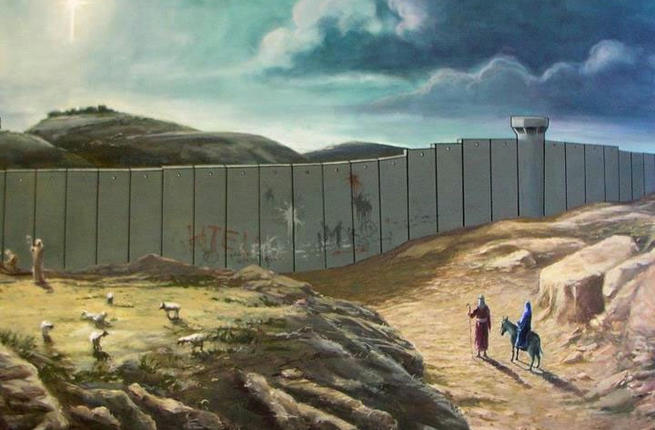
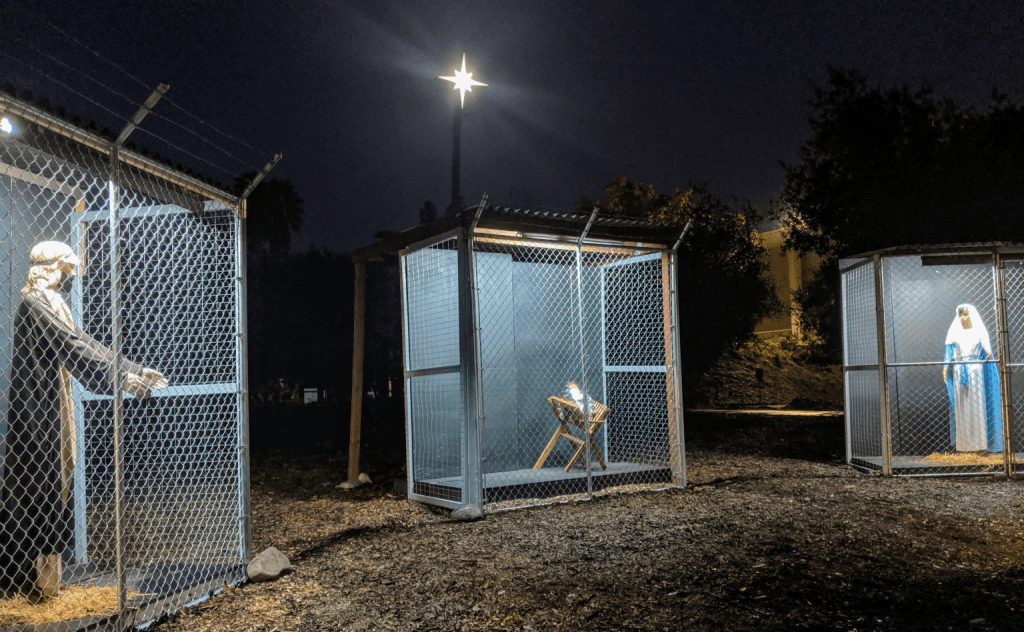
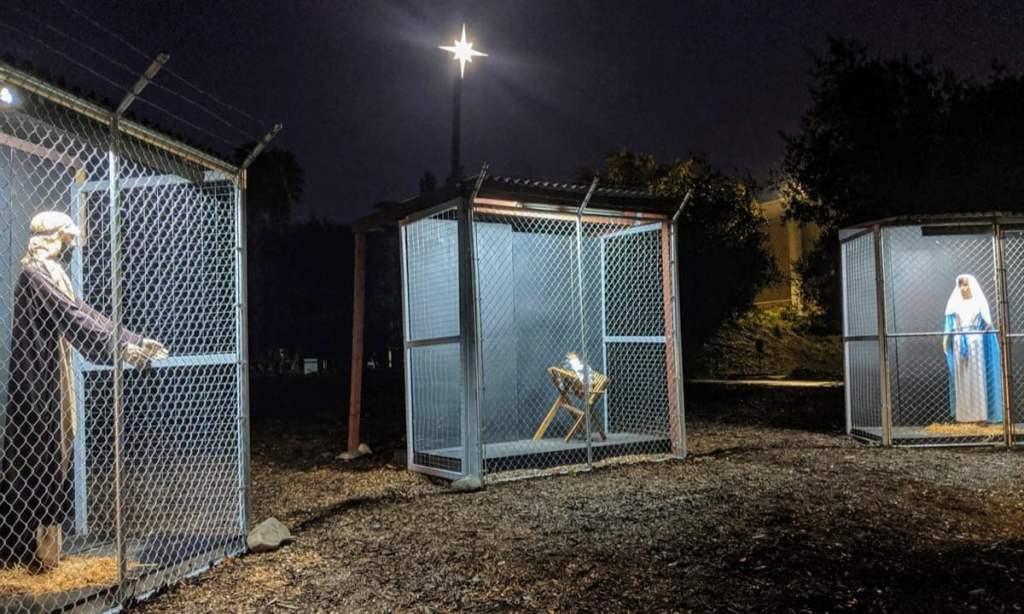
A singular number of churches across the country have asked those very questions in recent years, and their conclusions were depicted with unnerving accuracy by nativity scenes in which Jesus and his family are separated, segregated and caged in individual chain-link pens, topped by barbed wire fencing.

Those nativity scenes were a pointed attempt to remind the modern world that the narrative about the birth of Jesus is one that speaks on multiple fronts to a world that has allowed the life, teachings and crucifixion of Jesus to be drowned out by partisan politics, secularism, materialism and war, all driven by a manipulative shadow government called the Deep State.

The modern-day church has largely shied away from applying Jesus’ teachings to modern problems such as war, poverty, immigration, etc., but thankfully there have been individuals throughout history who ask themselves and the world: what would Jesus do?

What would Jesus—the baby born in Bethlehem who grew into an itinerant preacher and revolutionary activist, who not only died challenging the police state of his day (namely, the Roman Empire) but spent his adult life speaking truth to power, challenging the status quo of his day, and pushing back against the abuses of the Roman Empire—do about the injustices of our  modern age?

Dietrich Bonhoeffer asked himself what Jesus would have done about the horrors perpetrated by Hitler and his assassins. The answer: Bonhoeffer was executed by Hitler for attempting to undermine the tyranny at the heart of Nazi Germany.

Aleksandr Solzhenitsyn asked himself what Jesus would have done about the soul-destroying gulags and labor camps of the Soviet Union. The answer: Solzhenitsyn found his voice and used it to speak out about government oppression and brutality.

Martin Luther King Jr. asked himself what Jesus would have done about America’s warmongering. The answer: declaring “my conscience leaves me no other choice,” King risked widespread condemnation as well as his life when he publicly opposed the Vietnam War on moral and economic grounds.

Even now, despite the popularity of the phrase “What Would Jesus Do?” (WWJD) in Christian circles, there remains a disconnect in the modern church between the teachings of Christ and the suffering of what Jesus in Matthew 25 refers to as the “least of these.”

Yet this is not a theological gray area: Jesus was unequivocal about his views on many things, not the least of which was charity, compassion, war, tyranny and love.

After all, Jesus—the revered preacher, teacher, radical and prophet—was born into a police state not unlike the growing menace of the American police state. When he grew up, he had powerful, profound things to say, things that would change how we view people, alter government policies and change the world. “Blessed are the merciful,” “Blessed are the peacemakers,” and “Love your enemies” are just a few examples of his most profound and revolutionary teachings.

When confronted by those in authority, Jesus did not shy away from speaking truth to power. Indeed, his teachings undermined the political and religious establishment of his day. It cost him his life. He was eventually crucified as a warning to others not to challenge the powers-that-be.

Can you imagine what Jesus’ life would have been like if, instead of being born into the Roman police state, he had been born and raised in the American police state?

Consider the following if you will.

Had Jesus been born in the era of the America police state, rather than traveling to Bethlehem for a census, Jesus’ parents would have been mailed a 28-page American Community Survey, a mandatory government questionnaire documenting their habits, household inhabitants, work schedule, how many toilets are in your home, etc. The penalty for not responding to this invasive survey can go as high as $5,000.

Instead of being born in a manger, Jesus might have been born at home. Rather than wise men and shepherds bringing gifts, however, the baby’s parents might have been forced to ward off visits from state social workers intent on prosecuting them for the home birth. One couple in Washington had all three of their children removed after social services objected to the two youngest being birthed in an unassisted home delivery.

Had Jesus been born in a hospital, his blood and DNA would have been taken without his parents’ knowledge or consent and entered into a government biobank. While most states require newborn screening, a growing number are holding onto that genetic material long-term for research, analysis and purposes yet to be disclosed.

Then again, had Jesus’ parents been undocumented immigrants, they and the newborn baby might have been shuffled to a profit-driven, private prison for illegals where they first would have been separated from each other, the children detained in make-shift cages, and the parents eventually turned into cheap, forced laborers for corporations such as Starbucks, Microsoft, Walmart, and Victoria’s Secret. There’s quite a lot of money to be made from imprisoning immigrants, especially when taxpayers are footing the bill.

From the time he was old enough to attend school, Jesus would have been drilled in lessons of compliance and obedience to government authorities, while learning little about his own rights. Had he been daring enough to speak out against injustice while still in school, he might have found himself tasered or beaten by a school resource officer, or at the very least suspended under a school zero tolerance policy that punishes minor infractions as harshly as more serious offenses.

Had Jesus disappeared for a few hours let alone days as a 12-year-old, his parents would have been handcuffed, arrested and jailed for parental negligence. Parents across the country have been arrested for far less “offenses” such as allowing their children to walk to the park unaccompanied and play in their front yard alone.

Rather than disappearing from the history books from his early teenaged years to adulthood, Jesus’ movements and personal data—including his biometrics—would have been documented, tracked, monitored and filed by governmental agencies and corporations such as Google and Microsoft. Incredibly, 95 percent of school districts share their student records with outside companies that are contracted to manage data, which they then use to market products to us.

From the moment Jesus made contact with an “extremist” such as John the Baptist, he would have been flagged for surveillance because of his association with a prominent activist, peaceful or otherwise. Since 9/11, the FBI has actively carried out surveillance and intelligence-gathering operations on a broad range of activist groups, from animal rights groups to poverty relief, anti-war groups and other such “extremist” organizations.

Jesus’ anti-government views would certainly have resulted in him being labeled a domestic extremist. Law enforcement agencies are being trained to recognize signs of anti-government extremism during interactions with potential extremists who share a “belief in the approaching collapse of government and the economy.”

While traveling from community to community, Jesus might have been reported to government officials as “suspicious” under the Department of Homeland Security’s “See Something, Say Something” programs. Many states, including New York, are providing individuals with phone apps that allow them to take photos of suspicious activity and report them to their state Intelligence Center, where they are reviewed and forwarded to law-enforcement agencies.

Rather than being permitted to live as an itinerant preacher, Jesus might have found himself threatened with arrest for daring to live off the grid or sleeping outside. In fact, the number of cities that have resorted to criminalizing homelessness by enacting bans on camping, sleeping in vehicles, loitering and begging in public has doubled.

Viewed by the government as a dissident and a potential threat to its power, Jesus might have had government spies planted among his followers to monitor his activities, report on his movements, and entrap him into breaking the law. Such Judases today—called informants—often receive hefty paychecks from the government for their treachery.

Had Jesus used the internet to spread his radical message of peace and love, he might have found his blog posts infiltrated by government spies attempting to undermine his integrity, discredit him or plant incriminating information online about him. At the very least, he would have had his website hacked and his email monitored.

Had Jesus attempted to feed large crowds of people, he would have been threatened with arrest for violating various ordinances prohibiting the distribution of food without a permit. Florida officials arrested a 90-year-old man for feeding the homeless on a public beach.

Had Jesus spoken publicly about his 40 days in the desert and his conversations with the devil, he might have been labeled mentally ill and detained in a psych ward against his will for a mandatory involuntary psychiatric hold with no access to family or friends. One Virginia man was arrested, strip searched, handcuffed to a table, diagnosed as having “mental health issues,” and locked up for five days in a mental health facility against his will apparently because of his slurred speech and unsteady gait.

Without a doubt, had Jesus attempted to overturn tables in a Jewish temple and rage against the materialism of religious institutions, he would have been charged with a hate crime. More than 45 states and the federal government have hate crime laws on the books.

Had anyone reported Jesus to the police as being potentially dangerous, he might have found himself confronted—and killed—by police officers for whom any perceived act of non-compliance (a twitch, a question, a frown) can result in them shooting first and asking questions later.

Rather than having armed guards capture Jesus in a public place, government officials would have ordered that a SWAT team carry out a raid on Jesus and his followers, complete with flash-bang grenades and military equipment. There are upwards of 80,000 such SWAT team raids carried out every year, many on unsuspecting Americans who have no defense against such government invaders, even when such raids are done in error.

Instead of being detained by Roman guards, Jesus might have been made to “disappear” into a secret government detention center where he would have been interrogated, tortured and subjected to all manner of abuses. Chicago police have “disappeared” more than 7,000 people into a secret, off-the-books interrogation warehouse at Homan Square.

Charged with treason and labeled a domestic terrorist, Jesus might have been sentenced to a life-term in a private prison where he would have been forced to provide slave labor for corporations or put to death by way of the electric chair or a lethal mixture of drugs.

Indeed, as I make clear in my book Battlefield America: The War on the American People and in its fictional counterpart The Erik Blair Diaries, given the nature of government then and now, it is painfully evident that whether Jesus had been born in our modern age or his own, he still would have died at the hands of a police state.

Thus, as we draw near to Christmas with its celebration of miracles and promise of salvation, we would do well to remember that what happened in that manger on that starry night in Bethlehem is only the beginning of the story. That baby born in a police state grew up to be a man who did not turn away from the evils of his age but rather spoke out against it.

We must do no less.

Yes, Jesus Would Have Been Branded a Domestic Extremist Today

By John & Nisha Whitehead

Source: The Rutherford Institute

“When the song of the angels is stilled, when the star in the sky is gone, when the kings and princes are home, when the shepherds are back with their flocks, the work of Christmas begins: to find the lost, to heal the broken, to feed the hungry, to release the prisoner, to rebuild the nations, to bring peace among the people, to make music in the heart.”—Howard Thurman, theologian and civil rights activist

The Christmas story of a baby born in a manger is a familiar one.

The Roman Empire, a police state in its own right, had ordered that a census be conducted. Joseph and his pregnant wife Mary traveled to the little town of Bethlehem so that they could be counted. There being no room for the couple at any of the inns, they stayed in a stable (a barn), where Mary gave birth to a baby boy, Jesus. Warned that the government planned to kill the baby, Jesus’ family fled with him to Egypt until it was safe to return to their native land.

Yet what if Jesus had been born 2,000 years later.

What if, instead of being born into the Roman police state, Jesus had been born at this moment in time? What kind of reception would Jesus and his family be given? Would we recognize the Christ child’s humanity, let alone his divinity? Would we treat him any differently than he was treated by the Roman Empire? If his family were forced to flee violence in their native country and sought refuge and asylum within our borders, what sanctuary would we offer them?A singular number of churches across the country have asked those very questions in recent years, and their conclusions were depicted with unnerving accuracy by nativity scenes in which Jesus and his family are separated, segregated and caged in individual chain-link pens, topped by barbed wire fencing.

Those nativity scenes were a pointed attempt to remind the modern world that the narrative about the birth of Jesus is one that speaks on multiple fronts to a world that has allowed the life, teachings and crucifixion of Jesus to be drowned out by partisan politics, secularism, materialism and war, all driven by a manipulative shadow government called the Deep State.

The modern-day church has largely shied away from applying Jesus’ teachings to modern problems such as war, poverty, immigration, etc., but thankfully there have been individuals throughout history who ask themselves and the world: what would Jesus do.

What would Jesus—the baby born in Bethlehem who grew into an itinerant preacher and revolutionary activist, who not only died challenging the police state of his day (namely, the Roman Empire) but spent his adult life speaking truth to power, challenging the status quo of his day, and pushing back against the abuses of the Roman Empire—do about the injustices of our  modern age.

Dietrich Bonhoeffer asked himself what Jesus would have done about the horrors perpetrated by Hitler and his assassins. The answer: Bonhoeffer was executed by Hitler for attempting to undermine the tyranny at the heart of Nazi Germany.

Aleksandr Solzhenitsyn asked himself what Jesus would have done about the soul-destroying gulags and labor camps of the Soviet Union. The answer: Solzhenitsyn found his voice and used it to speak out about government oppression and brutality.

Martin Luther King Jr. asked himself what Jesus would have done about America’s warmongering. The answer: declaring “my conscience leaves me no other choice,” King risked widespread condemnation as well as his life when he publicly opposed the Vietnam War on moral and economic grounds.

Even now, despite the popularity of the phrase “What Would Jesus Do?” (WWJD) in Christian circles, there remains a disconnect in the modern church between the teachings of Christ and the suffering of what Jesus in Matthew 25 refers to as the “least of these.

Yet this is not a theological gray area: Jesus was unequivocal about his views on many things, not the least of which was charity, compassion, war, tyranny and love.

After all, Jesus—the revered preacher, teacher, radical and prophet—was born into a police state not unlike the growing menace of the American police state. When he grew up, he had powerful, profound things to say, things that would change how we view people, alter government policies and change the world. “Blessed are the merciful,” “Blessed are the peacemakers,” and “Love your enemies” are just a few examples of his most profound and revolutionary teachings.

When confronted by those in authority, Jesus did not shy away from speaking truth to power. Indeed, his teachings undermined the political and religious establishment of his day. It cost him his life. He was eventually crucified as a warning to others not to challenge the powers-that-be.

Can you imagine what Jesus’ life would have been like if, instead of being born into the Roman police state, he had been born and raised in the American police state.

Consider the following if you will.

Had Jesus been born in the era of the America police state, rather than traveling to Bethlehem for a census, Jesus’ parents would have been mailed a 28-page American Community Survey, a mandatory government questionnaire documenting their habits, household inhabitants, work schedule, how many toilets are in your home, etc. The penalty for not responding to this invasive survey can go as high as $5,000.

Instead of being born in a manger, Jesus might have been born at home. Rather than wise men and shepherds bringing gifts, however, the baby’s parents might have been forced to ward off visits from state social workers intent on prosecuting them for the home birth. One couple in Washington had all three of their children removed after social services objected to the two youngest being birthed in an unassisted home delivery.

Had Jesus been born in a hospital, his blood and DNA would have been taken without his parents’ knowledge or consent and entered into a government biobank. While most states require newborn screening, a growing number are holding onto that genetic material long-term for research, analysis and purposes yet to be disclosed.

Then again, had Jesus’ parents been undocumented immigrants, they and the newborn baby might have been shuffled to a profit-driven, private prison for illegals where they first would have been separated from each other, the children detained in make-shift cages, and the parents eventually turned into cheap, forced laborers for corporations such as Starbucks, Microsoft, Walmart, and Victoria’s Secret. There’s quite a lot of money to be made from imprisoning immigrants, especially when taxpayers are footing the bill.

From the time he was old enough to attend school, Jesus would have been drilled in lessons of compliance and obedience to government authorities, while learning little about his own rights. Had he been daring enough to speak out against injustice while still in school, he might have found himself tasered or beaten by a school resource officer, or at the very least suspended under a school zero tolerance policy that punishes minor infractions as harshly as more serious offenses.

Had Jesus disappeared for a few hours let alone days as a 12-year-old, his parents would have been handcuffed, arrested and jailed for parental negligence. Parents across the country have been arrested for far less “offenses” such as allowing their children to walk to the park unaccompanied and play in their front yard alone.

Rather than disappearing from the history books from his early teenaged years to adulthood, Jesus’ movements and personal data—including his biometrics—would have been documented, tracked, monitored and filed by governmental agencies and corporations such as Google and Microsoft. Incredibly, 95 percent of school districts share their student records with outside companies that are contracted to manage data, which they then use to market products to us.

From the moment Jesus made contact with an “extremist” such as John the Baptist, he would have been flagged for surveillance because of his association with a prominent activist, peaceful or otherwise. Since 9/11, the FBI has actively carried out surveillance and intelligence-gathering operations on a broad range of activist groups, from animal rights groups to poverty relief, anti-war groups and other such “extremist” organizations.

Jesus’ anti-government views would certainly have resulted in him being labeled a domestic extremist. Law enforcement agencies are being trained to recognize signs of anti-government extremism during interactions with potential extremists who share a “belief in the approaching collapse of government and the economy.

While traveling from community to community, Jesus might have been reported to government officials as “suspicious” under the Department of Homeland Security’s “See Something, Say Something” programs. Many states, including New York, are providing individuals with phone apps that allow them to take photos of suspicious activity and report them to their state Intelligence Center, where they are reviewed and forwarded to law-enforcement agencies.

Rather than being permitted to live as an itinerant preacher, Jesus might have found himself threatened with arrest for daring to live off the grid or sleeping outside. In fact, the number of cities that have resorted to criminalizing homelessness by enacting bans on camping, sleeping in vehicles, loitering and begging in public has doubled.

Viewed by the government as a dissident and a potential threat to its power, Jesus might have had government spies planted among his followers to monitor his activities, report on his movements, and entrap him into breaking the law. Such Judases today—called informants—often receive hefty paychecks from the government for their treachery.

Had Jesus used the internet to spread his radical message of peace and love, he might have found his blog posts infiltrated by government spies attempting to undermine his integrity, discredit him or plant incriminating information online about him. At the very least, he would have had his website hacked and his email monitored.

Had Jesus attempted to feed large crowds of people, he would have been threatened with arrest for violating various ordinances prohibiting the distribution of food without a permit. Florida officials arrested a 90-year-old man for feeding the homeless on a public beach.

Had Jesus spoken publicly about his 40 days in the desert and his conversations with the devil, he might have been labeled mentally ill and detained in a psych ward against his will for a mandatory involuntary psychiatric hold with no access to family or friends. One Virginia man was arrested, strip searched, handcuffed to a table, diagnosed as having “mental health issues,” and locked up for five days in a mental health facility against his will apparently because of his slurred speech and unsteady gait.

Without a doubt, had Jesus attempted to overturn tables in a Jewish temple and rage against the materialism of religious institutions, he would have been charged with a hate crime. More than 45 states and the federal government have hate crime laws on the books.

Had anyone reported Jesus to the police as being potentially dangerous, he might have found himself confronted—and killed—by police officers for whom any perceived act of non-compliance (a twitch, a question, a frown) can result in them shooting first and asking questions later.

Rather than having armed guards capture Jesus in a public place, government officials would have ordered that a SWAT team carry out a raid on Jesus and his followers, complete with flash-bang grenades and military equipment. There are upwards of 80,000 such SWAT team raids carried out every year, many on unsuspecting Americans who have no defense against such government invaders, even when such raids are done in error.

Instead of being detained by Roman guards, Jesus might have been made to “disappear” into a secret government detention center where he would have been interrogated, tortured and subjected to all manner of abuses. Chicago police have “disappeared” more than 7,000 people into a secret, off-the-books interrogation warehouse at Homan Square.

Charged with treason and labeled a domestic terrorist, Jesus might have been sentenced to a life-term in a private prison where he would have been forced to provide slave labor for corporations or put to death by way of the electric chair or a lethal mixture of drugs.

Indeed, as I make clear in my book Battlefield America: The War on the American People and in its fictional counterpart The Erik Blair Diaries, given the nature of government then and now, it is painfully evident that whether Jesus had been born in our modern age or his own, he still would have died at the hands of a police state.

Thus, as we draw near to Christmas with its celebration of miracles and promise of salvation, we would do well to remember that what happened in that manger on that starry night in Bethlehem is only the beginning of the story. That baby born in a police state grew up to be a man who did not turn away from the evils of his age but rather spoke out against it.

We must do no less.

The Christmas Baby Born in a Police State: Then and Now

By John W. Whitehead & Nisha Whitehead

Source: The Rutherford Institute

“When the song of the angels is stilled, when the star in the sky is gone, when the kings and princes are home, when the shepherds are back with their flocks, the work of Christmas begins: to find the lost, to heal the broken, to feed the hungry, to release the prisoner, to rebuild the nations, to bring peace among the people, to make music in the heart.” ― Howard Thurman

The Christmas story of a baby born in a manger is a familiar one.

The Roman Empire, a police state in its own right, had ordered that a census be conducted. Joseph and his pregnant wife Mary traveled to the little town of Bethlehem so that they could be counted. There being no room for the couple at any of the inns, they stayed in a stable (a barn), where Mary gave birth to a baby boy, Jesus. Warned that the government planned to kill the baby, Jesus’ family fled with him to Egypt until it was safe to return to their native land.

Yet what if Jesus had been born 2,000 years later?

What if, instead of being born into the Roman police state, Jesus had been born at this moment in time? What kind of reception would Jesus and his family be given? Would we recognize the Christ child’s humanity, let alone his divinity? Would we treat him any differently than he was treated by the Roman Empire? If his family were forced to flee violence in their native country and sought refuge and asylum within our borders, what sanctuary would we offer them?

A singular number of churches across the country have asked those very questions in recent years, and their conclusions were depicted with unnerving accuracy by nativity scenes in which Jesus and his family are separated, segregated and caged in individual chain-link pens, topped by barbed wire fencing.

Those nativity scenes were a pointed attempt to remind the modern world that the narrative about the birth of Jesus is one that speaks on multiple fronts to a world that has allowed the life, teachings and crucifixion of Jesus to be drowned out by partisan politics, secularism, materialism and war, all driven by a manipulative shadow government called the Deep State.

The modern-day church has largely shied away from applying Jesus’ teachings to modern problems such as war, poverty, immigration, etc., but thankfully there have been individuals throughout history who ask themselves and the world: what would Jesus do?

What would Jesus—the baby born in Bethlehem who grew into an itinerant preacher and revolutionary activist, who not only died challenging the police state of his day (namely, the Roman Empire) but spent his adult life speaking truth to power, challenging the status quo of his day, and pushing back against the abuses of the Roman Empire—do about the injustices of our  modern age?

Dietrich Bonhoeffer asked himself what Jesus would have done about the horrors perpetrated by Hitler and his assassins. The answer: Bonhoeffer was executed by Hitler for attempting to undermine the tyranny at the heart of Nazi Germany.

Aleksandr Solzhenitsyn asked himself what Jesus would have done about the soul-destroying gulags and labor camps of the Soviet Union. The answer: Solzhenitsyn found his voice and used it to speak out about government oppression and brutality.

Martin Luther King Jr. asked himself what Jesus would have done about America’s warmongering. The answer: declaring “my conscience leaves me no other choice,” King risked widespread condemnation as well as his life when he publicly opposed the Vietnam War on moral and economic grounds.

Even now, despite the popularity of the phrase “What Would Jesus Do?” (WWJD) in Christian circles, there remains a disconnect in the modern church between the teachings of Christ and the suffering of what Jesus in Matthew 25 refers to as the “least of these.”

Yet this is not a theological gray area: Jesus was unequivocal about his views on many things, not the least of which was charity, compassion, war, tyranny and love.

After all, Jesus—the revered preacher, teacher, radical and prophet—was born into a police state not unlike the growing menace of the American police state. When he grew up, he had powerful, profound things to say, things that would change how we view people, alter government policies and change the world. “Blessed are the merciful,” “Blessed are the peacemakers,” and “Love your enemies” are just a few examples of his most profound and revolutionary teachings.

When confronted by those in authority, Jesus did not shy away from speaking truth to power. Indeed, his teachings undermined the political and religious establishment of his day. It cost him his life. He was eventually crucified as a warning to others not to challenge the powers-that-be.

Can you imagine what Jesus’ life would have been like if, instead of being born into the Roman police state, he had been born and raised in the American police state?

Consider the following if you will.

Had Jesus been born in the era of the America police state, rather than traveling to Bethlehem for a census, Jesus’ parents would have been mailed a 28-page American Community Survey, a mandatory government questionnaire documenting their habits, household inhabitants, work schedule, how many toilets are in your home, etc. The penalty for not responding to this invasive survey can go as high as $5,000.

Instead of being born in a manger, Jesus might have been born at home. Rather than wise men and shepherds bringing gifts, however, the baby’s parents might have been forced to ward off visits from state social workers intent on prosecuting them for the home birth. One couple in Washington had all three of their children removed after social services objected to the two youngest being birthed in an unassisted home delivery.

Had Jesus been born in a hospital, his blood and DNA would have been taken without his parents’ knowledge or consent and entered into a government biobank. While most states require newborn screening, a growing number are holding onto that genetic material long-term for research, analysis and purposes yet to be disclosed.

Then again, had Jesus’ parents been undocumented immigrants, they and the newborn baby might have been shuffled to a profit-driven, private prison for illegals where they first would have been separated from each other, the children detained in make-shift cages, and the parents eventually turned into cheap, forced laborers for corporations such as Starbucks, Microsoft, Walmart, and Victoria’s Secret. There’s quite a lot of money to be made from imprisoning immigrants, especially when taxpayers are footing the bill.

From the time he was old enough to attend school, Jesus would have been drilled in lessons of compliance and obedience to government authorities, while learning little about his own rights. Had he been daring enough to speak out against injustice while still in school, he might have found himself tasered or beaten by a school resource officer, or at the very least suspended under a school zero tolerance policy that punishes minor infractions as harshly as more serious offenses.

Had Jesus disappeared for a few hours let alone days as a 12-year-old, his parents would have been handcuffed, arrested and jailed for parental negligence. Parents across the country have been arrested for far less “offenses” such as allowing their children to walk to the park unaccompanied and play in their front yard alone.

Rather than disappearing from the history books from his early teenaged years to adulthood, Jesus’ movements and personal data—including his biometrics—would have been documented, tracked, monitored and filed by governmental agencies and corporations such as Google and Microsoft. Incredibly, 95 percent of school districts share their student records with outside companies that are contracted to manage data, which they then use to market products to us.

From the moment Jesus made contact with an “extremist” such as John the Baptist, he would have been flagged for surveillance because of his association with a prominent activist, peaceful or otherwise. Since 9/11, the FBI has actively carried out surveillance and intelligence-gathering operations on a broad range of activist groups, from animal rights groups to poverty relief, anti-war groups and other such “extremist” organizations.

Jesus’ anti-government views would certainly have resulted in him being labeled a domestic extremist. Law enforcement agencies are being trained to recognize signs of anti-government extremism during interactions with potential extremists who share a “belief in the approaching collapse of government and the economy.”

While traveling from community to community, Jesus might have been reported to government officials as “suspicious” under the Department of Homeland Security’s “See Something, Say Something” programs. Many states, including New York, are providing individuals with phone apps that allow them to take photos of suspicious activity and report them to their state Intelligence Center, where they are reviewed and forwarded to law-enforcement agencies.

Rather than being permitted to live as an itinerant preacher, Jesus might have found himself threatened with arrest for daring to live off the grid or sleeping outside. In fact, the number of cities that have resorted to criminalizing homelessness by enacting bans on camping, sleeping in vehicles, loitering and begging in public has doubled.

Viewed by the government as a dissident and a potential threat to its power, Jesus might have had government spies planted among his followers to monitor his activities, report on his movements, and entrap him into breaking the law. Such Judases today—called informants—often receive hefty paychecks from the government for their treachery.

Had Jesus used the internet to spread his radical message of peace and love, he might have found his blog posts infiltrated by government spies attempting to undermine his integrity, discredit him or plant incriminating information online about him. At the very least, he would have had his website hacked and his email monitored.

Had Jesus attempted to feed large crowds of people, he would have been threatened with arrest for violating various ordinances prohibiting the distribution of food without a permit. Florida officials arrested a 90-year-old man for feeding the homeless on a public beach.

Had Jesus spoken publicly about his 40 days in the desert and his conversations with the devil, he might have been labeled mentally ill and detained in a psych ward against his will for a mandatory involuntary psychiatric hold with no access to family or friends. One Virginia man was arrested, strip searched, handcuffed to a table, diagnosed as having “mental health issues,” and locked up for five days in a mental health facility against his will apparently because of his slurred speech and unsteady gait.

Without a doubt, had Jesus attempted to overturn tables in a Jewish temple and rage against the materialism of religious institutions, he would have been charged with a hate crime. Currently, 45 states and the federal government have hate crime laws on the books.

Had anyone reported Jesus to the police as being potentially dangerous, he might have found himself confronted—and killed—by police officers for whom any perceived act of non-compliance (a twitch, a question, a frown) can result in them shooting first and asking questions later.

Rather than having armed guards capture Jesus in a public place, government officials would have ordered that a SWAT team carry out a raid on Jesus and his followers, complete with flash-bang grenades and military equipment. There are upwards of 80,000 such SWAT team raids carried out every year, many on unsuspecting Americans who have no defense against such government invaders, even when such raids are done in error.

Instead of being detained by Roman guards, Jesus might have been made to “disappear” into a secret government detention center where he would have been interrogated, tortured and subjected to all manner of abuses. Chicago police have “disappeared” more than 7,000 people into a secret, off-the-books interrogation warehouse at Homan Square.

Charged with treason and labeled a domestic terrorist, Jesus might have been sentenced to a life-term in a private prison where he would have been forced to provide slave labor for corporations or put to death by way of the electric chair or a lethal mixture of drugs.

Indeed, as I make clear in my book Battlefield America: The War on the American People and in its fictional counterpart The Erik Blair Diaries, given the nature of government then and now, it is painfully evident that whether Jesus had been born in our modern age or his own, he still would have died at the hands of a police state.

Thus, as we draw near to Christmas with its celebration of miracles and promise of salvation, we would do well to remember that what happened in that manger on that starry night in Bethlehem is only the beginning of the story. That baby born in a police state grew up to be a man who did not turn away from the evils of his age but rather spoke out against it.

We must do no less.

What If the Christ Child Had Been Born in the American Police State?

By John W. Whitehead

Source: The Rutherford Institute

“When the song of the angels is stilled, when the star in the sky is gone, when the kings and princes are home, when the shepherds are back with their flocks, the work of Christmas begins: to find the lost, to heal the broken, to feed the hungry, to release the prisoner, to rebuild the nations, to bring peace among the people, to make music in the heart.” ― Howard Thurman

The Christmas story of a baby born in a manger is a familiar one.

The Roman Empire, a police state in its own right, had ordered that a census be conducted. Joseph and his pregnant wife Mary traveled to the little town of Bethlehem so that they could be counted. There being no room for the couple at any of the inns, they stayed in a stable (a barn), where Mary gave birth to a baby boy, Jesus. Warned that the government planned to kill the baby, Jesus’ family fled with him to Egypt until it was safe to return to their native land.

Yet what if Jesus had been born 2,000 years later?

What if, instead of being born into the Roman police state, Jesus had been born at this moment in time? What kind of reception would Jesus and his family be given? Would we recognize the Christ child’s humanity, let alone his divinity? Would we treat him any differently than he was treated by the Roman Empire? If his family were forced to flee violence in their native country and sought refuge and asylum within our borders, what sanctuary would we offer them?

A singular number of churches across the country have asked those very questions in recent years, and their conclusions were depicted with unnerving accuracy by nativity scenes in which Jesus and his family are separated, segregated and caged in individual chain-link pens, topped by barbed wire fencing.

Those nativity scenes were a pointed attempt to remind the modern world that the narrative about the birth of Jesus is one that speaks on multiple fronts to a world that has allowed the life, teachings and crucifixion of Jesus to be drowned out by partisan politics, secularism, materialism and war, all driven by a manipulative shadow government called the Deep State.

The modern-day church has largely shied away from applying Jesus’ teachings to modern problems such as war, poverty, immigration, etc., but thankfully there have been individuals throughout history who ask themselves and the world: what would Jesus do?

What would Jesus—the baby born in Bethlehem who grew into an itinerant preacher and revolutionary activist, who not only died challenging the police state of his day (namely, the Roman Empire) but spent his adult life speaking truth to power, challenging the status quo of his day, and pushing back against the abuses of the Roman Empire—do about the injustices of our  modern age?

Dietrich Bonhoeffer asked himself what Jesus would have done about the horrors perpetrated by Hitler and his assassins. The answer: Bonhoeffer was executed by Hitler for attempting to undermine the tyranny at the heart of Nazi Germany.

Aleksandr Solzhenitsyn asked himself what Jesus would have done about the soul-destroying gulags and labor camps of the Soviet Union. The answer: Solzhenitsyn found his voice and used it to speak out about government oppression and brutality.

Martin Luther King Jr. asked himself what Jesus would have done about America’s warmongering. The answer: declaring “my conscience leaves me no other choice,” King risked widespread condemnation when he publicly opposed the Vietnam War on moral and economic grounds.

Even now, despite the popularity of the phrase “What Would Jesus Do?” (WWJD) in Christian circles, there remains a disconnect in the modern church between the teachings of Christ and the suffering of what Jesus in Matthew 25 refers to as the “least of these.”

Yet this is not a theological gray area: Jesus was unequivocal about his views on many things, not the least of which was charity, compassion, war, tyranny and love.

After all, Jesus—the revered preacher, teacher, radical and prophet—was born into a police state not unlike the growing menace of the American police state. When he grew up, he had powerful, profound things to say, things that would change how we view people, alter government policies and change the world. “Blessed are the merciful,” “Blessed are the peacemakers,” and “Love your enemies” are just a few examples of his most profound and revolutionary teachings.

When confronted by those in authority, Jesus did not shy away from speaking truth to power. Indeed, his teachings undermined the political and religious establishment of his day. It cost him his life. He was eventually crucified as a warning to others not to challenge the powers-that-be.

Can you imagine what Jesus’ life would have been like if, instead of being born into the Roman police state, he had been born and raised in the American police state?

Consider the following if you will.

Had Jesus been born in the era of the America police state, rather than traveling to Bethlehem for a census, Jesus’ parents would have been mailed a 28-page American Community Survey, a mandatory government questionnaire documenting their habits, household inhabitants, work schedule, how many toilets are in your home, etc. The penalty for not responding to this invasive survey can go as high as $5,000.

Instead of being born in a manger, Jesus might have been born at home. Rather than wise men and shepherds bringing gifts, however, the baby’s parents might have been forced to ward off visits from state social workers intent on prosecuting them for the home birth. One couple in Washington had all three of their children removed after social services objected to the two youngest being birthed in an unassisted home delivery.

Had Jesus been born in a hospital, his blood and DNA would have been taken without his parents’ knowledge or consent and entered into a government biobank. While most states require newborn screening, a growing number are holding onto that genetic material long-term for research, analysis and purposes yet to be disclosed.

Then again, had Jesus’ parents been undocumented immigrants, they and the newborn baby might have been shuffled to a profit-driven, private prison for illegals where they first would have been separated from each other, the children detained in make-shift cages, and the parents eventually turned into cheap, forced laborers for corporations such as Starbucks, Microsoft, Walmart, and Victoria’s Secret. There’s quite a lot of money to be made from imprisoning immigrants, especially when taxpayers are footing the bill.

From the time he was old enough to attend school, Jesus would have been drilled in lessons of compliance and obedience to government authorities, while learning little about his own rights. Had he been daring enough to speak out against injustice while still in school, he might have found himself tasered or beaten by a school resource officer, or at the very least suspended under a school zero tolerance policy that punishes minor infractions as harshly as more serious offenses.

Had Jesus disappeared for a few hours let alone days as a 12-year-old, his parents would have been handcuffed, arrested and jailed for parental negligence. Parents across the country have been arrested for far less “offenses” such as allowing their children to walk to the park unaccompanied and play in their front yard alone.

Rather than disappearing from the history books from his early teenaged years to adulthood, Jesus’ movements and personal data—including his biometrics—would have been documented, tracked, monitored and filed by governmental agencies and corporations such as Google and Microsoft. Incredibly, 95 percent of school districts share their student records with outside companies that are contracted to manage data, which they then use to market products to us.

From the moment Jesus made contact with an “extremist” such as John the Baptist, he would have been flagged for surveillance because of his association with a prominent activist, peaceful or otherwise. Since 9/11, the FBI has actively carried out surveillance and intelligence-gathering operations on a broad range of activist groups, from animal rights groups to poverty relief, anti-war groups and other such “extremist” organizations.

Jesus’ anti-government views would certainly have resulted in him being labeled a domestic extremist. Law enforcement agencies are being trained to recognize signs of anti-government extremism during interactions with potential extremists who share a “belief in the approaching collapse of government and the economy.”

While traveling from community to community, Jesus might have been reported to government officials as “suspicious” under the Department of Homeland Security’s “See Something, Say Something” programs. Many states, including New York, are providing individuals with phone apps that allow them to take photos of suspicious activity and report them to their state Intelligence Center, where they are reviewed and forwarded to law-enforcement agencies.

Rather than being permitted to live as an itinerant preacher, Jesus might have found himself threatened with arrest for daring to live off the grid or sleeping outside. In fact, the number of cities that have resorted to criminalizing homelessness by enacting bans on camping, sleeping in vehicles, loitering and begging in public has doubled.

Viewed by the government as a dissident and a potential threat to its power, Jesus might have had government spies planted among his followers to monitor his activities, report on his movements, and entrap him into breaking the law. Such Judases today—called informants—often receive hefty paychecks from the government for their treachery.

Had Jesus used the internet to spread his radical message of peace and love, he might have found his blog posts infiltrated by government spies attempting to undermine his integrity, discredit him or plant incriminating information online about him. At the very least, he would have had his website hacked and his email monitored.

Had Jesus attempted to feed large crowds of people, he would have been threatened with arrest for violating various ordinances prohibiting the distribution of food without a permit. Florida officials arrested a 90-year-old man for feeding the homeless on a public beach.

Had Jesus spoken publicly about his 40 days in the desert and his conversations with the devil, he might have been labeled mentally ill and detained in a psych ward against his will for a mandatory involuntary psychiatric hold with no access to family or friends. One Virginia man was arrested, strip searched, handcuffed to a table, diagnosed as having “mental health issues,” and locked up for five days in a mental health facility against his will apparently because of his slurred speech and unsteady gait.

Without a doubt, had Jesus attempted to overturn tables in a Jewish temple and rage against the materialism of religious institutions, he would have been charged with a hate crime. Currently, 45 states and the federal government have hate crime laws on the books.

Had anyone reported Jesus to the police as being potentially dangerous, he might have found himself confronted—and killed—by police officers for whom any perceived act of non-compliance (a twitch, a question, a frown) can result in them shooting first and asking questions later.

Rather than having armed guards capture Jesus in a public place, government officials would have ordered that a SWAT team carry out a raid on Jesus and his followers, complete with flash-bang grenades and military equipment. There are upwards of 80,000 such SWAT team raids carried out every year, many on unsuspecting Americans who have no defense against such government invaders, even when such raids are done in error.

Instead of being detained by Roman guards, Jesus might have been made to “disappear” into a secret government detention center where he would have been interrogated, tortured and subjected to all manner of abuses. Chicago police have “disappeared” more than 7,000 people into a secret, off-the-books interrogation warehouse at Homan Square.

Charged with treason and labeled a domestic terrorist, Jesus might have been sentenced to a life-term in a private prison where he would have been forced to provide slave labor for corporations or put to death by way of the electric chair or a lethal mixture of drugs.

Indeed, as I show in my book Battlefield America: The War on the American People, given the nature of government then and now, it is painfully evident that whether Jesus had been born in our modern age or his own, he still would have died at the hands of a police state.

Thus, as we draw near to Christmas with its celebrations and gift-giving, we would do well to remember that what happened on that starry night in Bethlehem is only part of the story. That baby in the manger grew up to be a man who did not turn away from evil but instead spoke out against it, and we must do no less.

Sacrifice for Thee But None For Me

By Charles Hugh Smith

Source: Of Two Minds

The banquet of consequences for the Fed, the elites and their armies of parasitic flunkies and factotums is being laid out, and there won’t be much choice in the seating.

Words can be debased just like currencies. Take the word sacrifice. The value of the original has been debased by trite, weepy overuse to the point of cliche. Like other manifestations of derealization and denormalization, this debasement is invisible, profound and ultimately devastating.

Consider the overworked slogan of implied shared sacrifice: we’re all in this together. Pardon my cynicism, but doesn’t this sound like what the first class passengers in the lifeboats shouted to the doomed steerage passengers on the sinking Titanic?

Here is the ice-cold reality of America in 2020: Sacrifice for Thee But None For Me. This isn’t a new trend, of course. Any measurable sacrifices shared by all the socio-economic classes ended with World War II in 1945, and since then it’s been one long slide to Sacrifice for Thee But None For Me.

We’ve seen this slide to decay and collapse many times in history. The elites who once gained social status and political power by making real sacrifices on behalf of the nation / empire become entirely self-serving, accumulating ever greater wealth and power by transferring all the sacrifices and risks onto the lower classes.

Peter Turchin, author of War and Peace and War: The Rise and Fall of Empires, describes how civic virtue is gradually replaced by personal greed and self-interest.

This excerpt perfectly captures the current zeitgeist:

“Virtus included the ability to distinguish between good and evil and to act in ways that promoted good, and especially the common good. Unlike Greeks, Romans did not stress individual prowess, as exhibited by Homeric heroes or Olympic champions. The ideal of hero was one whose courage, wisdom, and self-sacrifice saved his country in time of peril.

Unlike the selfish elites of the later periods, the aristocracy of the early Republic did not spare its blood or treasure in the service of the common interest. When 50,000 Romans, a staggering one fifth of Rome’s total manpower, perished in the battle of Cannae, as mentioned previously, the senate lost almost one third of its membership. This suggests that the senatorial aristocracy was more likely to be killed in wars than the average citizen….

The wealthy classes were also the first to volunteer extra taxes when they were needed… A graduated scale was used in which the senators paid the most, followed by the knights, and then other citizens. In addition, officers and centurions (but not common soldiers!) served without pay, saving the state 20 percent of the legion’s payroll….

The richest 1 percent of the Romans during the early Republic was only 10 to 20 times as wealthy as an average Roman citizen.”

Now compare that to the situation in Late Antiquity when

“An average Roman noble of senatorial class had property valued in the neighborhood of 20,000 Roman pounds of gold. There was no ‘middle class’ comparable to the small landholders of the third century B.C.; the huge majority of the population was made up of landless peasants working land that belonged to nobles. These peasants had hardly any property at all, but if we estimate it (very generously) at one tenth of a pound of gold, the wealth differential would be 200,000! Inequality grew both as a result of the rich getting richer (late imperial senators were 100 times wealthier than their Republican predecessors) and those of the middling wealth becoming poor.”

Compare this to the America of World War II and the America of today. Wealthy, politically influential families such as the Kennedys could only retain their influence if their sons served in positions of combat leadership, and Joe Kennedy was killed in the European theater after volunteering for a highly risky air mission. John F. Kennedy very nearly lost his life in the South Pacific.

And how do our era’s crop of presidents and presidential contenders fare by comparison? The idea that flesh and blood should ever be at risk in defense of the nation /empire–perish the thought.

As Turchin sagely observed, it’s not just the limitless greed and avoidance of sacrifice of the elite that generates destabilizing inequality–it’s the eradication of the middle class as all the risks and sacrifices were shifted from the self-serving top to the middle and lower classes.

As I’ve often noted, risk cannot be made to disappear, it can only be transferred to others. In the grand scheme of things, the inherent risks of globalization and financialization have all been transferred to the middle and working classes (however you define them). The elite class enjoys the near-infinite support of the Federal Reserve and it’s ability to print near-infinite sums of currency to bail out the greediest, most self-serving scum of parasites and speculators.

Meanwhile, all the sacrifices required to support this unfair, corrupt, predatory system have been transferred to the middle and working classes via sleight of hand. The sacrifices weren’t transparent and up front; they were cloaked in the decline of job security, in ever-higher costs, in the decline of social mobility and the erosion of the purchasing power of wages.

The elites’ economist flunkies and factotums claimed that bailing out the freeloaders, parasites and speculators would benefit “the little people” because the grand trade-off delivered by the Federal Reserve (as correspondent R.J. pointed out to me) was: no more financial panics, which caused much misery in the working class due to business failures causing layoffs and unemployment.

But globalization, financialization and the rise of cartel-state monopolies have eviscerated the middle and working classes far more effectively and permanently than any brief financial panic, while greatly enriching the elite class–a rise in wealth that is backstopped by the Federal Reserve: profits are the elites to keep while their losses are socialized, i.e. transferred to the lower classes.

Job security, the purchasing power of wages and social mobility–nothing vital to the middle or working classes is backstopped by the Fed; the Fed’s one and only job is backstopping the wealth of our parasitic, predatory elite.

Sacrifice for Thee But None For Me. The banquet of consequences for the Fed, the elites and their armies of parasitic flunkies and factotums is being laid out, and there won’t be much choice in the seating.