Chance Encounters as the Walls Close In

By Edward Curtin

Source: Behind the Curtain

“A treasure stumbled upon, suddenly; not gradually accumulated, by adding one to one. The accumulation of learning, ‘adding to the sum-total of human knowledge’; lay that burden down, that baggage, that impediment. Take nothing for your journey; travel light.”   – Norman O. Brown, Love’s Body

These are “heavy” times, colloquially speaking.  Forebodings everywhere.  Everything broken.  People on edge, nervous, filled with anxiety about they know not what since it seems to be everything. The economy, politics, elections, endless propaganda, the war in Ukraine, censorship, the environment, nuclear war, Covid/vaccines, a massive world-wide collapse, the death of democratic possibilities, the loss of all innocence as a very weird and dangerous future creeps upon us, etc. Only the most anesthetized don’t feel it.

The anxiety has increased even as access to staggering amounts of knowledge – and falsehoods – has become available with the click of a button into the digital encyclopedia.  The CIA’s MK-Ultra mind control program has gone digital.  The more information, the more insubstantial the world seems, but it is not an insubstantiality that connects to hope or faith but to despair.  Across the world people are holding their breath.  What’s next?

Roberto Calasso, the late great Italian writer, wrote that we live in “the unnamable present,” which seems accurate.  Information technology, with its easily available marriage of accurate and fraudulent information, affects people at the fathomless depths of the mind and spirit.  Yet it is taken-for-granted that the more such technological information there is available, as well as the ease with which one can add one’s two-cents to it, is a good thing, even as those powerful deep-state forces that control the Internet pump out an endless stream of purposely dissembling and contradictory messages.  Delusions of omnipotence and chaos everywhere, but not in the service of humanity.  Such chaos plays in chords D and C – Depressing and Controlling.

In the midst of this unnamable present, all of us need to dream of beauty and liberation even as we temporarily rely on digital technology for news of the wider world.  For the local news we can step outside and walk and talk to people, but we can’t endlessly travel everywhere, so we rely on the Internet for reports from elsewhere.  Even as we exercise great effort to discern facts from fictions through digital’s magic emanations, we hunger for some deeper experiences than the ephemerality of this unnamable world.  Without it we are lost in a forest of abstractions.

While recently dawdling on a walk, I stopped to browse through tables of free books on the lawn of my local library.  I was looking for nothing but found something that startled me: a few descriptive words of a child’s experience.  I chanced to pick up an old (1942), small autobiography by the English historian, A. L. Rowse – A Cornish Childhood.  The flyleaf informed me that it was the story of his pre-World War I childhood in a little Cornish village in southwestern England.  The son of a china-clay worker and mother of very modest means, Rowse later went on to study at Oxford and became a well-known scholar and author of about a hundred books.  In other words, a man whose capacious mind was encyclopedic long before the Internet offered its wares of information about everything from A to Z.

Since my grandfather, the son of an Irish immigrant father and English mother, had spent his early years working in a bobbin factory in Bradford, England, a polluted mill town in the north, before sailing at age 11 from Liverpool to New York City aboard the Celtic with his four younger siblings sans parents, I had an interest in what life was like for poor children in England during that era.  How circumstances influenced them: two working-class boys, one who became an Oxford graduate and well-known author; the other who became a NYC policeman known only to family and friends.  The words Rowse wrote and I read echoed experiences that I had had when young; I wondered if my grandfather had experienced something similar.  Rowse writes this on pages 16-17 where I randomly opened the book:

A little group of thatched cottages in the middle of the village had a small orchard attached; and I remember well the peculiar purity of the blue sky seen through the white clusters of apple-blossom in spring. I remember being moon-struck looking at it one morning early on my way to school. It meant something for me; what I couldn’t say. It gave me an unease at heart, some reaching outwards toward perfection such as impels men into religion, some sense of the transcendence of things, of the fragility of our hold upon life . . . . I could not know then that it was an early taste of aesthetic sensation, a kind of revelation which has since become a secret touchstone of experience for me, an inner resource and consolation. . . . In time it became my creed – if that word can be used of a religion which has no dogma, no need of dogma; for which this ultimate aesthetic experience, this apprehension of the world and life as having value essentially in the moment of being apprehended qua beauty, I had no need of religion. . . . in that very moment it seemed that time stood still, that for a moment time was held up and one saw experience as through a rift across the flow of it, a shaft into the universe. But what gave such poignancy to the experience was that, in the very same moment that one felt time standing still, one knew at the back of the mind, or with another part of it, that it was moving inexorably on, carrying oneself and life with it. So that the acuity of the experience, the reason why it moved one so profoundly, was that at bottom it was a protest of the personality against the realization of its final extinction. Perhaps, therefore, it was bound up with, a reflex action from, the struggle for survival. I could get no further than that; and in fact have remained content with that.

I quote so many of Rowse’s words because they seem to contain two revelations that pertain to our current predicament. One a revelation that opens onto hope; the other a revelation of hopelessness. On the one hand, Rowse writes beautifully about how a patch of blue sky through apple blossoms (and his reading Wordsworth’s Intimations of Immortality) could open his heart and soul to deep aesthetic consolation.  Calasso, in discussing “absolute literature” and the Bhagavad Gita in Literature and the Gods, refers to this experience with the word ramaharsa or horripilation, the happiness of the hairs.  It is that feeling one has when one experiences a thrill so profound that a shiver goes down one’s spine and one experiences an epiphany.  Your hairs and other body parts stand up, whether it’s from a patch of blue, a certain spiritual or erotic/love encounter, or a line of poetry that takes your breath away.  Such a thrill often happens through a serendipitous stumbling.

For Rowse, the epiphany was bounded, like a beautiful bird with its wings clipped; it was an “aesthetic experience” that seemed to exclude something genuinely transcendent in the experiential and theological sense. Maybe it was more than that when he was young, but when this scholar described it in his 39th year, this intellectual could only say it was aesthetic.

C. S. Lewis, in the opening pages of The Abolition of Man, echoing Coleridge’s comment about two tourists at a waterfall, one who calls the waterfall pretty and the other who calls it sublime (Coleridge endorsing the later and dismissing the former with disgust), writes, “The feelings which make a man call an object sublime are not sublime feelings but feelings of veneration.” In other words, the sublime nature of a patch of blue sky through apple blossoms in the early morn cannot be reduced to a person’s subjective feelings but is objectively true and a crack into the mystery of transcendence. To see it as a protest against one’s personal extinction and to be content to “get no further than that” is to foreclose the possibility that what the boy felt was not what the man thought; or to quote Wordsworth about what seems to have happened to Rowse: “Shades of the prison house begin to close/Upon the growing boy,” and that is that.

But we are even a longer way gone from when Rowse wrote his remembrances.  In our secular Internet age, first society and now its technology, not aesthetics or the religion of art, have replaced God for many people, who, like Rowse, have lost the ability to experience the divine.  It embarrasses them.  Something – an addiction to pseudo-knowledge? – blocks their willingness to be open to surpassing the reasoning mind.  We think we are too sophisticated to bend that low even when looking up. “The pseudomorphism between religion and society” has passed unobserved, as Calasso puts it:

It all came together not so much in Durkheim’s [French sociologist 1858-1917] claim that “the religious is the social,’ but in the fact that suddenly such a claim sounded natural. What was left in the end was naked society, but invested now with all the powers inherited, or rather burgled, from religion. The twentieth century would see its triumph. The theology of society severed every tie, renounced all dependence, and flaunted the distinguishing feature: the tautological, the self-advertising. The power and impact of totalitarian regimes cannot be explained unless we accept that the very notion of society has appropriated an unprecedented power, one previously the preserve of religion. . . . Being anti-social would become the equivalent of sinning against the Holy Ghost. . . . Society became the subject above all subjects, for whose sake everything is justified.

For someone like Rowse, the Oxford scholar and bibliophile, writing in the midst of WW II about his childhood before WW I, an exquisite aesthetic explanation suffices to explain his experience, one that he concludes was perhaps part of an evolutionary reflex action connected to the struggle for survival.  Thus this epiphany of beauty is immured in sadness rather than opening out into possible hope.  Lovely as his description is, it is caged in inevitability, as if to say: Here is your bit of beauty on your way to dusty death.  It is a denial of freedom, of spiritual reality, of what Lewis refers to for brevity’s sake as ‘the Tao,’ what the Chinese have long meant as the great thing, the correspondence between the outer and the inner, a reality beyond causality and the controlling mind.

Now even beauty has been banned behind machine experiences.  But the question of beauty is secondary to the nature of reality and our connection to it.  The fate of the world depends upon it.  When the world is too much with us and doom and gloom are everywhere, where can we turn to find a way forward to find a place to stand to fight the evils of nuclear weapons, poverty, endless propaganda, and all the other assorted demons marauding through our world?

It will not be to machines or more information, for they are the essence of too-muchness.  It will not come from concepts or knowledge, which Nietzsche said made it possible to avoid pain.  I believe it will only come from what he suggested: “To make an experiment of one’s very life – this alone is freedom of the spirit, this then became for me my philosophy.”  And before you might think, “Look where it got him, stark raving mad,” let me briefly explain.  Nietzsche may seem like an odd choice to suggest as insightful when it comes to openness to a spiritual dimension to experience since he is usually but erroneously seen as someone who “killed God.”  Someone like Gandhi might seem more appropriate with his “experiments with truth.”  And of course Gandhi is very appropriate.  But so too are Emerson, Thoreau, Jung, and many others, at least in my limited sense of what I mean by experiment.  I mean experimenting-experiencing (both derived from the same Latin word, expereri, to try or test) by assuming through an act of faith or suspension of disbelief that if we stop trying to control everything and open ourselves to serendipitous stumbling, what may seem like simply beautiful aesthetic experiences may be apertures into a spiritual energy we were unaware of.  James W. Douglass explores this possibility in his tantalizing book, Lightning East to West: Jesus, Gandhi, and the Nuclear Age, when he asks and then explores this question: “Is there a spiritual reality, inconceivable to us today, which corresponds in history to the physical reality which Einstein discovered and which led to the atomic bomb?”

I like to think that my grandfather, although a man not very keen on things spiritual, might have, in his young years amidst the grime and fetid air of Bradford, chanced to look up and saw a patch of blue sky through the rising smoke and felt the “happiness of the hairs” that opened a crack in his reality to let the light in.

Roberto Calasso quotes this from Nietzsche:

That huge scaffolding and structure of concepts to which the man who must clings in order to save himself in the course of life, for the liberated intellect is merely a support and a toy for his daring devices. And should he break it, he shuffles it around and ironically reassembles it once more, connecting what is least related and separating what is closest. By doing so he shows that those needful ploys are of no use to him and that he is no longer guided by concepts but by intuitions.

I have an intuition that there are hierophanies everywhere, treasures to be stumbled upon – by chance.  If we let them be.

My eyes already touch the sunny hill,
going far ahead of the road I have begun.
So we are grasped by what we cannot grasp;
It has its inner light, even from a distance –

And changes us, even if we do not reach it,
Into something else, which, hardly sensing it, we already are;
A gesture waves us on, answering our own wave. . .
But what we feel is the wind in our faces.

– Rainer Maria Rilke, “A Walk”

The End of Reality?

By Edward Curtin

Source: Behind the Curtain

In 1888,  the year before he went insane, Friedrich Nietzsche wrote the following in Twilight of the Idols:

We have got rid of the real world: what world is left?  The apparent world perhaps? … But no!  Along with the real world we’ve done away with the apparent world as well.

So, if you feel you also may be going insane in the present climate of digital screen life, where real is unreal but realer than real, the apparent is cryptic, and up is down, true is false, and what you see you don’t, it has a history.  One hundred and thirty-two years ago, Nietzsche added that “something extraordinarily nasty and evil is about to make its debut.”  We know it did, and the bloody butcher’s bench known as the twentieth century was the result. Nihilism stepped onto center stage and has been the star of the show ever since, straight through to 2020.  Roberto Calasso puts it this way in Literature and the Gods:

Here we are, announces Nietzsche, and it would be hard not to hear a mocking ring in his voice.  We thought we were living in a world where the fog had lifted, a disenchanted, ascertainable, verifiable world.  And instead everything has gone back to being a ‘fable’ again.  How are we to get our bearings … This is the paralysis, the peculiar uncertainty of modern times, a paralysis that all since have experienced.

Obviously, we haven’t gotten our bearings.  We are far more adrift today on a stormy electronic sea where the analogical circle of life has been replaced by the digital, and “truths” like numbers click into place continuously to lead us in wrong, algorithm-controlled directions. The trap is almost closed.

Of course, Nietzsche did not have the Internet, but he lived at the dawn of the electric era, when space-time transformations were occurring at a rapid pace.  Inventions such as photography, the phonograph, the telephone, electricity, etc. were contracting space and time and a disembodied “reality” was being born.  With today’s Internet and digital screen life, the baby is full-grown and completely disembodied.  It does nothing but look at its image that is looking back into a lifeless void, whose lost gaze can’t figure out what it’s seeing.

Take, for example, the phonograph, invented by Thomas Edison in 1878.  If you could record a person’s voice, and if that person died, were you then listening to the voice of a living person or one who was dead?  If the person whose voice was recorded was alive and was miles away, you had also compressed earthly space. The phonograph suppressed absence, conjured ghosts, and seemed to overcome time and death as it captured the flow of time in sound.  It allowed a disembodied human voice to inhabit a machine, an early example of downloading.

“Two ruling ambitions in modern technology,” writes John Durham Peters in his wonderful book, Speaking into the Air, “appear in the phonograph: the creation of artificial life and the conjuring of the dead.”

Many people started to hear voices, and these people were not called deluded. Soon, with the arrival of cinema, they would see ghosts as well.  Today, speaking ghosts are everywhere, hiding in hand-held devices. It’s Halloween all year round as we are surrounded by electronic zombies in a screen culture.

This technological annihilation of space and time that was happening at a frenetic pace was the material background to Nietzsche’s thought.  His philosophical and epistemological analyses emerged from German intellectual life of his time as well, where theologians and philosophers were discovering that knowledge was relative and had to be understood in situ, i.e., within its historical and social place or context.

Without going into abstruse philosophical issues here, suffice it to say, Nietzsche was suggesting that not only was God dead because people killed him, but that knowledge was a fiction that changed over time and was a human construction.  All knowledge, not just science, had to be taken “as if” it were true.  This was a consoling mental trick but falsely reassuring, for most people could not accept this, since “knowledge” was a protection racket from pain and insanity. It still is. In other words, not only had people murdered God, but they had slain absolutes as well. This left them in the lurch, not knowing if what they knew and believed were really true, or sort of true – maybe, perhaps. The worm of uncertainty had entered modern thought through modern thought.

While the average person did not delve into these revolutionary ideas, they did, through the inventions that were entering their lives, and the news about Darwin, science, religion, etc., realize, however vaguely, that something very strange and dramatic was under way. Life was passing from substance to shadow because of human ingenuity.

It is similar to what so many feel today: that reality and truth are moving beyond their grasp as technological forces that they voluntarily embrace push everyday life towards some spectral denouement.  An inhuman, trans-human, on-line electronic life where everything is a parody of everything that preceded it, like an Andy Warhol copy of a copy of a Campbell’s soup can with a canned mocking laugh track that keeps repeating itself.  All this follows from the nineteenth century relativization of knowledge, or what at least was taken as such, for to say all knowledge is relative is an absolute statement.  That contradiction goes to the heart of our present dilemma.

This old feeling of lostness is perhaps best summarized in a few lines from Mathew Arnold’s 19th century poem, “Dover Beach”:

The Sea of Faith
Was once, too, at the full, and round earth’s shore
Lay like the folds of a bright girdle furled.
But now I only hear
Its melancholy, long, withdrawing roar,
Retreating, to the breath
Of the night-wind, down the vast edges drear
And naked shingles of the world.

But that was then.  Today, the Joker’s sardonic laughter would suffice.

***

I am sitting outside as I write, sipping a glass of wine before dinner.  Although New England fall weather is approaching, a nasty mosquito is buzzing around my head.  I hear it.  I am in killer mode since these bastards love to bite me.  This is real life.  If I went into the house and connected to the Internet on the computer screen – news, social media, anything – I would be entering another dimension.  Screen life, not real life. The society of the spectacle. No real mosquitoes, no wine, no trees swaying in the evening breeze.

In his novel, The Sun Also Rises, written between Nietzsche’s time and now, Ernest Hemingway, a man who surely lived in the physical world, writes of how Robert Cohn, the boxing champion from Princeton University, wants Jake Barnes, the book’s protagonist, to take a trip with him to South America.  As they sit and talk in Paris, Barnes says no, and tells Cohn, “All countries look just like the moving pictures.”

Whether Hemingway was being ironic or not, or simply visionary, I don’t know.  For in the 1920s, before passports and widespread tourism, there were many places you could only see if you traveled to them and they would never appear in moving pictures, while today there is almost no place that is not available to view beforehand on the internet or television.  So why go anywhere if you’ve already seen it all on a screen? Why travel to nowhere or to where you have already been?  Déjà vu all over again, as Yogi Berra put it and everyone laughed.  Now the laugh is on us.

***

This is neither an argument nor a story.  It’s real.  I am trying to get my bearings in a disorienting situation. Call it a compass, a weather-vane, a prayer.  You can call me Al or Ishmael.  Call me crazy.  Perhaps this writing is just an “as if.”

***

About fifteen years ago, I was teaching at a college where most communication was done via email.  I was, as they say, out of the loop since I didn’t do email. I was often asked why I didn’t, and I would repeatedly reply, like Melville’s Bartleby, because “I prefer not to.”  Finally, in order to keep my job, I succumbed and with the laptop computer they provided me, I went “on-line.”  There were 6,954.7 emails in my in-box from the past three years.  In those three years, I had performed all my duties scrupulously and hadn’t missed a beat.  Someone showed me how to delete the emails, which I did without reading any, but I had entered the labyrinth. I went electronic.  My reality changed. I am still searching for Ariadne’s thread.

***

But I am not yet a machine and refuse the invitation to become one.  It’s a very insistent invitation, almost an order.  Neil Postman (Oh such a rich surname!) sums it up well in Technopoly: The Surrender of Culture to Technology:

The fundamental metaphorical message of the computer, in short, is that we are machines – thinking machines, to be sure, but machines nonetheless.  It is for this reason that the computer is the quintessential, incomparable, near perfect machine for Technopoly.  It subordinates the claims of our nature, our biology, our emotions, our spirituality.  The computer claims sovereignty over the whole range of human experience, and supports its claim by showing that it ‘thinks’ better than we can…John McCarthy, the inventor of the term ‘artificial intelligence’…claims that ‘even machines as simple as thermostats can be said to have beliefs…What is significant about this response is that it has redefined the meaning of the word ‘belief’ … rejects the view that humans have internal states of mind that are the foundation of belief and argues instead that ‘belief’ means only what someone or something does … rejects the idea that the mind is a biological phenomenon … In other words, what we have here is a case of metaphor gone mad.

Postman wrote that in 1992, before the computer and the internet became ubiquitous and longer before on-line living had become de rigueur – before it was being shoved down our throats as it is today under the cover of COVID-19.

There is little doubt that we are being pushed to embrace what Klaus Schwab, the Executive Chairman of the World Economic Forum (WEF), calls COVID-19:The Great Reset, that involves a total acceptance of the electronic, on-line life.  On-line learning, on-line news, on-line everything – only an idiot (from Greek, idiotes, a private person who pays not attention to public affairs) would fail to see what is being promoted.  And who controls the electronic life and internet?  Not you, not I, but the powers that be, the intelligence agencies and the power elites. Goodbye  body, goodbye blood – “I don’t think we should ever shake hands ever again, to be honest with you,” said Dr. Anthony Fauci, the director of the National Institute of Allergy and Infectious Diseases (NIAID) in support of human estrangement.

Peter Koenig, one of the most astute investigators of this propaganda effort, puts it this way:

The panacea of the future will be crowned by the Pearl of the Fourth Industrialization – Artificial intelligence (AI). It will be made possible by a 5G electromagnetic field, allowing the Internet of Things (IoT). Schwab and Malleret [Schwab’s co-author] won’t say, beware, there is opposition. 5G could still be blocked. The 5G existence and further development is necessary for surveillance and control of humanity, by digitizing everything, including human identity and money.

It will be so simple, no more cash, just electronic, digital money – that is way beyond the control of the owner, the truthful earner of the money, as it can be accessed by the Global Government and withheld and / or used for pressuring misbehaving citizens into obeying the norms imposed from above. You don’t behave according to our norms, no money to buy food, shelter and health services, we let you starve. No more travel. No more attending public events. You’ll be put gradually in your own solitary confinement. The dictatorial and tyrannical global commandeering by digital control of everything is the essence of the 4th Age of Industrialization – highly promoted by the WEF’s Great Reset.

***

Like everything, of course, this push to place life under the aegis of cyberspace has a history, one that deifies the machine and attempts to convince people that they too are machines without existential freedom.  Thus the ongoing meme pumped out for the past three decades has been that we are controlled by our brains and that the brain is a computer and vice versa. Brain research has received massive government funding. Drugs have been offered as the solution to every human problem. So-called diseases and disorders have been created through the Diagnostic and Statistical Manual of  Mental Disorders (DSM) and matched to pharmaceutical drugs (or the revers) for scandalous profits. And the mind has been reduced to a figment of deluded  imaginations. People are machines; that’s the story, marvelous machines.  They have no freedom.

If one wishes an example of techno-fascism, there is one from the art world. Back in the 1920s and 1930s there was an art movement known as Futurism.  Its leader proponent was an Italian Fascist, friend of Mussolini, Filippo Tommaso Marinetti.  The futurists claimed that all life revolves around the machine, that the machine was god, that it was beyond human control and had to be obeyed.  They extolled war and speed and claimed that humans were no more significant than stones.  Patriotism, militarism, strength, method, and the kingdom of experts were their blueprint for a corporate fascist state.  The human eye and mind would be re-educated to automatically obey the machine’s dictates.

Now we have cyberspace, digital machines, and the internet, an exponential extension of the machine world of the 1930s and the rise of Mussolini, Fascism, and Hitler.  That this online world is being pushed as the new and future normal by trans-national elite forces should not be surprising.  If human communication becomes primarily digitally controlled on-line and on screens, those who control the machines will have achieved the most powerful means of mind control ever invented. That will be MKULTRA on a vast scale.  Surveillance will be complete.

Yes, there are places on the internet where truth is and will be told, such as this site where you are reading this; but as we can see from today’s growing censorship across the web, those power elites and intelligence forces who  control the companies that do their bidding will narrow the options for dissenting voices. Such censorship starts slowly, and then when one looks again, it is a fait accompli. The frog in the pan of slowly heating cold water never realizes it is being killed until it is too late. Free speech is now being strangled. Censorship is widespread.

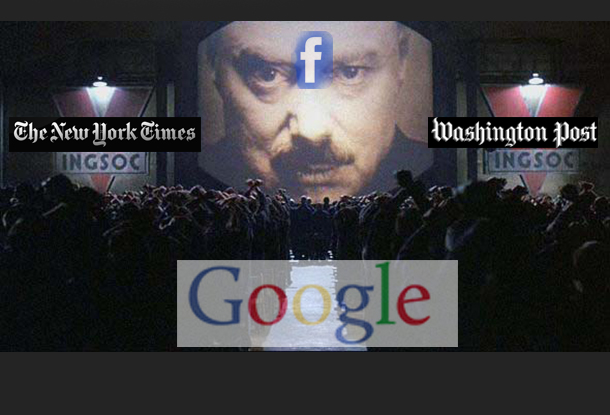
The purpose of so much internet propaganda is to confuse, obsess, depress, and then repress the population. The overlords accomplish this by the “peculiar linking together of opposites – knowledge with ignorance, cynicism with fanaticism – [which] is one of the chief distinguishing marks of Oceanic society,” writes Orwell in Nineteen Eighty-Four.  “The official ideology abounds with contradictions even where there is no practical reason for them.”  One look into one’s life will suffice to see how the overlords have set people against each other.  It’s a classic tactic.  Divide and conquer. Trump vs. Biden, Democrats vs. Republicans, whites vs. blacks, liberals vs. conservatives. Pure mind games. Contradictions every day to create social disorientation.  Orwell describes Doublethink as follows:

Doublethink means the power of holding two contradictory beliefs in one’s mind simultaneously, and accepting both of them.  The Party intellectual knows in which direction his memories must be altered; he therefore knows he is playing tricks with reality; but by the exercise of doublethink he also satisfies himself that reality is not violated.  The process has to be conscious, or it would not be carried out with sufficient precision, but it also has to be unconscious, or it would bring with it a feeling of falsity and hence of guilt…To tell deliberate lies while genuinely believing them, to forget any fact that has become inconvenient, and then, when it becomes necessary again, to draw it back from oblivion for just as long as it is needed, to deny the existence of objective reality and all the while to take account of the reality which one denies – all this is indispensably necessary…If one is to rule, and to continue ruling, one must be able to dislocate the sense of reality. [author’s emphasis]

Nietzsche said that along with the real world we have done away with the apparent as well.  Digital online life has accomplished that.  It has allowed the rulers – through the media who are the magicians who serve them – to create counterfeit news and doctored videos at will, to present diametrically opposed points of view within the same paragraph, and to push breaking news items so fast that no one half-way sane could keep up with their magic shows. Nietzsche obviously didn’t foresee this technology, but he sensed the madness that the relativity of knowledge and the technology of his day would usher in.

***

The popular 1990s term “Information Superhighway,” meaning the internet and all digital telecommunications, was the perfect term to describe this lunacy. Get on that highway and go as fast as you can while trying to catch the meaning of all the information flashing past you as you speed to nowhere.  For not only does censorship, propaganda, disinformation, mixed messages, and contradictions line the road you are traveling, but contextless information overload is so heavy that even if you were stopped in a traffic jam, there is too much information to comprehend.  And if you think this Superhighway is a freeway, think again, for the cost is high. No one puts out their hand and asks you to pay up; but the more you travel down this road you’ll notice you are missing a bit of flesh here and some blood there.  And without a speed pass, you are considered road kill.

To make matters much worse, they say we need 5G to go much faster.

Paul Virilio, who has devoted himself to the study of speed (dromology), puts it this way in Open Sky:

The speed of the new optoelectronic and electroacoustic milieu becomes the final void (the void of the quick), a vacuum that no longer depends on the interval between places or things and so on the world’s very extension, but on the interface of an instantaneous transmission of remote appearances, on a geographic and geometric retention in which all volume, all relief vanishes.

***

And yet I don’t have a simple answer to the internet dilemma. You are reading it on-line and I am posting it there.  It is very convenient and quick. And yet…and yet….

Can we just walk away from it?  Maybe.  Perhaps like those few who, in Ursula K. Le Guin’s excruciating story, “The Ones Who Walk Away From Omelas,” we may decide the price for our conveniences and so-called happiness is too high and that there are hidden victims that this techno-scientific “progress” creates beneath its veneer of efficiency.  Others, us, our children, all children, who are reaching out not for speed and machines, but for the human touch that the on-line propagandists hope to destroy.  In Le Guin’s story, the price nearly all the citizens of Omelas are willing to pay for their happiness and comfort is the imprisonment of a single child.  Perhaps we should consider what we are doing to all the world’s children and their futures.

My friend Gary recently sent me this letter.  I believe it sums up what many people feel. There is a vast hunger for reality and truth. The analog life. How to live it – the question hangs in the air as the artificial intelligence/digital controllers try to reduce us to machines.

Although apparently it isn’t clear if Twain ever said this, it’s still a great quote:  (“If you don’t read the newspaper, you’re uninformed.  If you do, you’re misinformed.”)  To which “amen” is the only appropriate response.

I continue to daily stay abreast of events through the web, and these days much of what passed for “progressive media” simply regurgitates the covid madness as if it had been delivered on stone tablets – rather than by the same MSM that lie to us daily about literally ANYTHING of any importance.

There are days I wonder “why” I continue to bother to follow the unfolding madness as if it made some “difference.”  I could certainly play guitar more, and I might even get it together to write a few pieces on the nature of our collective madness, for which I have studiously assembled copious notes.  I really don’t need any more information or examples – I think I have things covered on that front.

Instead I find myself daily doing the little dance we’re all familiar with – uncomfortable with being “uninformed” – yet at almost every turn finding myself being routinely – “misinformed” – and so having to sift through the endless debris to have any chance at developing any coherent understanding of the world.

So yes, I totally get the draw of just saying to hell with the internet.  After years of shifting through the endless propaganda operations our generation has been subject too, I have no doubt you and I see through most the nonsense for what it is before we even have the proof in hand.  Once the rose-colored glasses of ‘American exceptionalism’ are off, one can almost sense and see through the lies in real time even as they are being uttered.

Reading Gary’s words reminded me of those of the Trappist monk Thomas Merton’s definition of the Unspeakable:

It is the void that contradicts everything that is spoken even before the words are said, the void that gets into the language of public and official declarations at the very moment when they are pronounced, and makes them ring dead with the hollowness of the abyss.  It is the void out of which Eichmann drew the punctilious exactitude of his obedience…

Yes, real time, real life – as we do our little dances.

Can we do our little dances and preserve reality?  I’m not sure.