The real Hunger Games: the Capitalist recipe to maximise profits while ‘having fun’

peacekeeper

By Sky Wanderer

Source: Investment Watch

Introduce a political economy upon the arbitrary axiom that Capitalism is the one and only economic system for mankind, and introduce a narcissistic moral philosophy that you as a Capitalist represent unsurpassable objective moral virtues.

You as a Capitalist hire politicians to implement policy as per your moral and economic philosophy and redefine ‘democracy’ as the political system to sustain Capitalism. Then from such position of self-established authority, abolish unions and all labour-representation, thus force your employees into a race-to-the-bottom contest to compete for jobs by accepting lower and lower wages.

Give decent jobs and benefits to only those who belong to your noble circles. For everyone else reintroduce slavery in the form of “workfare”. The goal is that you pay the lowest wages for jobs done by the fittest slaves, who will survive the contest. If you wish, you can call the contest “real Hunger Games”.

To speed up the process, extend the race-to-the-bottom into global scope so that you will have access to the cheapest and fittest labour everywhere on the planet. Never mind that your slaves will have to live out of a suitcase and every time when you lay them off and labour demand calls them elsewhere, they will have to relocate to yet another continent.

To further accelerate the process, make good use of your 3rd-world colonies, your Mideast colonising wars and your secretly sponsored mercenaries (ISIS). Via your “leftist” assistants, organise a massive refugee crisis to import the cheapest possible workforce via your war-refugees and economic migrants. These migrants are the fittest contestants who – glad just to escape your bombs – will worship you as their saviours and will work for you for literally zero payment. The migrants will not only boost your profits to sky-high levels but will rapidly pull down the overall wages of your domestic employees.

Meanwhile keep increasing the prices so your slaves can’t pay for food, energy, heat and shelter from their next-to-zero incomes. If some of them attempt to survive by taking bank-loans to acquire shelter, education and meet other basic needs, but they can’t repay the loans from their low incomes, you can just evict them from their homes via your banks.

When you made them homeless this way, make sure their ugly presence won’t spoil the beauty of your city. Install pretty anti-homeless spikes, so when they crush onto the pavement they will die, and you can just collect their bodies. To project your capitalist moral virtues into eternity, incorporate the beauty of your anti-homeless spikes into the modern concept of art and beauty.

Introduce private banking to enable yourself to creating new money when you wish. This way you can easily indebt the entire society, soon you can even purchase the whole planet.

Meanwhile dismantle public healthcare, so those of your slaves who are still alive but get sick, will die without treatment. Eliminate (privatise) all affordable public services, destroy the public sphere, abolish all public spaces and welfare benefits. To have a dandy excuse for such policy, make sure to keep the country in ever increasing debt by taking countless £ billions of government loans, and transfer the responsibility of these odious debts onto your slaves. Refer to these debts as the reason for the crisis, then refer to the crisis as the reason for these debts, then refer to the debts and the crisis as the reason for austerity and spending cuts. Then you can increase the public debt again and continue the same loop ad infinitum.

Make sure your very own mainstream media and academia would never reveal the truth that the never-ending crisis and mass-unemployment are due to your private banking and debt- and profit-mongering dysfunctional capitalist system, and keep the real disastrous indicators of the state of economy in secret.

Instead of admitting the truth, use the divide et impera strategy to make your victims blame themselves and one another. To increase the fun, produce reality shows where the still active part of your slaves will blame the disabled and the unemployed, meanwhile make the local poor blame the immigrant poor for the overall misery that you inflicted. Then establish offices where the local poor dressed as fancy clerks will evict the immigrant poor, meanwhile watch how all of them are begging for their lives until they give up and commit suicide.

Enjoy!

Report: Flint lead filters provide inadequate protection for residents

12424867_102316463489123_1674206032_n

By Shannon Jones

Source: WSWS.org

Federal and state officials are warning Flint residents that the lead filters they are using may be inadequate to protect them from the effects of elevated levels of lead in the city’s drinking water.

The warning came Friday after random samples collected from 26 residences since the final week of December came back with lead levels higher than the filters are designed to handle. The highest reading among the 26 homes was 4,000 parts per billion (ppb). The filters are not rated to handle lead levels above 150 ppb. The tests covered 3,900 homes.

After more than two years of lies and cover-up by federal, state and local officials, Flint residents are in a restive mood. Megan Kreger, a member of the local activist group Water You Fighting For, told the WSWS, “I didn’t believe it [about the lead filters] from the beginning. It has only finally hit the press.

“There has been fraud and negligence at all levels. It is a humanitarian disaster. We should not be living without clean water when we are only one hour away from one of the largest bodies of fresh water in the world.”

She rejected claims that Flint water is now safe for bathing. “My boyfriend took a shower before the Rachel Maddow town hall [over the weekend] and got the worst rash he has ever gotten. It almost looked like chicken pox.”

The US Environmental Protection Agency (EPA) recommends action be taken when lead levels exceed 15 ppb, though there is no safe level of lead exposure. Mark Durno of the EPA said the affected residents have now been contacted. The state had previously insisted that drinking filtered water was safe.

In the wake of the findings, Michigan Governor Rick Snyder urged all Flint residents to have their water tested as soon as possible. Dr. Eden Well, chief medical executive of the state’s Department of Health and Human Services (DHHS), advised children under six and pregnant women to drink only bottled water.

In an effort at damage control, Snyder sent a letter to state employees Friday, stating “what happened in Flint can never be allowed to happen again anywhere in our state.” The governor has tried to deflect all blame for the crisis to the Michigan Department of Environmental Quality (DEQ) and lower-ranking officials.

The DEQ said Monday that it has undertaken a five-part strategy to determine whether Flint water is safe to drink. The DEQ said it is working on a plan to make sure that residents with high lead-blood levels get their water tested.

Another issue of concern to Flint residents is that filters only have a limited life span, after which they are no longer effective. This is particularly true if the faucet where the filter is installed is the only source of water in the home.

Further, many Flint homes have older faucets that will not accommodate the water filters provided by the state. Over the weekend some 300 plumber volunteers installed new faucets free of charge in some 1,100 Flint homes, still a fraction of the city’s residences.

Federal officials said they were not sure why recent samples came back showing elevated levels of lead. Despite the findings, the EPA did not call on residents to stop using the lead filters. More testing is being planned.

The report on lead filters comes as state officials on Friday informed residents at more than 250 addresses living in areas of Genesee County outside of Flint that their water may also be tainted.

Dana, an auto parts worker who lives just outside of Flint, said she had just learned that her water may be dangerous to drink. “This is crazy. I live in the county and they just posted a whole bunch of addresses that might be affected. It appears it is impacting more than just the city of Flint. They had us misled. They told us it was fine. I was making coffee with the tap water every morning.

“It is an outrage. It is getting worse and worse. Everyone in the government is to blame. We as citizens do not know what is going on.”

Soon after the switch by the city of Flint in 2014 from its traditional water source, the Detroit water system, to the polluted Flint River, residents began to complain of foul-tasting, discolored water coming out of their taps. Nevertheless, citizens were repeatedly told the water was safe.

It later emerged that the highly corrosive water from the Flint River was leaching lead from the city’s antiquated piping, poisoning the city’s 100,000 residents. Even after the switch back to the Detroit water system in October, lead levels remain dangerously high due to the damage already done to the city’s water pipes.

Ten deaths from the deadly Legionnaires’ virus have also been traced to Flint water.

In another development, the US Department of Agriculture rejected a request by Snyder to extend the Women, Infants and Children (WIC) program to Flint residents up to the age of 10. A department spokesperson said federal law limited the program to children under age five. The program provides grants to states for supplemental foods, health referrals and nutrition information to pregnant and postpartum women with infant children.

Health professionals say proper nutrition is important in mitigating the long-term effects of lead poisoning in children. Children are especially vulnerable to lead, since their developing brains and nervous systems are more sensitive to toxins. The city has a child poverty rate of nearly 67 percent, 10 percentage points higher than Detroit.

According to the Michigan DHHS, 130,095 people in Genesee County, where Flint is located, are using food stamp assistance now, compared with 87,847 in 2005.

The report on continued high levels of lead in Flint’s water supply comes as Michigan’s Attorney General Bill Schuette says the state may not provide legal counsel for seven DEQ employees who are the subject of a class action lawsuit by Flint residents. Schuette has asked a federal judge to decide the matter of representation.

The lawsuit alleges the state endangered Flint residents by switching the city’s water source to the Flint River. In addition to the DEQ employees, the lawsuit also names Snyder, the state of Michigan, the city of Flint, two former emergency managers, the former Flint mayor and three city employees.

It has been filed on behalf of 10 plaintiffs, but seeks class action status for all Flint residents. It seeks compensatory and punitive damages, the creation of a medical monitoring fund and the appointment of a monitor to oversee Flint water.

The suit does not name federal officials, however the Obama administration’s EPA is deeply implicated in the cover-up of the lead poisoning danger. As early as April 2015, the highest-level EPA official in Michigan was aware that Flint water was not being treated for corrosion control, but said nothing. This, despite the fact that water professionals understand that such treatment is necessary if highly corrosive water like that from the Flint River is being used for drinking because of the danger of lead leaching from old piping.

Snyder has claimed he did not become aware of problems with Flint’s drinking water until October 1, 2015.

Poisoning Black Cities

CYcJy0hWwAAswen

They drowned New Orleans. Now they have poisoned Flint, Michigan. The corporate campaign to ethnically cleanse U.S. cities knows no bounds. Michigan’s emergency financial manager law is “part of Wall Street’s tool kit to starve, bulldoze, redline, over-price, oppressively police, and even poison Black people out of the urban centers.”

By Glen Ford

Source: Black Agenda Report

“Michigan’s emergency financial manager system is the lead-tipped point of the spear that is gutting urban Black America.”

It has taken the poisoning of an entire city of 100,000 people – 52 percent of them Black – to draw national attention to the human effects of systematic corporatization of the public sphere under neoliberal U.S. capitalism. Republican Governor Rick Synder promises to “fix” the ruined water infrastructure of Flint, Michigan, now hopelessly corroded and saturated with lead – a repair that could cost as much as $1.5 billion. But, even if Snyder is forced to resign, as demonstrators demand, or is jailed, as filmmaker Michael Moore would prefer, it won’t fix the irreparably damaged brains of the city’s children or prevent a cascade of Flint-like catastrophes from unfolding across the country.

We are experiencing another Katrina moment, a dreadful epiphany in which the nature of the beast that is preying upon us becomes horrifically clear. Michigan’s emergency financial manager system – a weapon of corporate dictatorship imposed selectively on heavily Black and brown cities and school systems – is the lead-tipped point of the spear that is gutting urban Black America. It is not a unique instrument – and certainly not a Republican invention – but part of Wall Street’s tool kit to starve, bulldoze, redline, over-price, oppressively police, and even poison Black people out of the urban centers.

“A Katrina moment.”

Katrina should have been the wake-up call, a decade ago, but the hegemonic influence of the bankster-infested Democratic Party in Black America muted the warning, that the Lords of Capital were determined to eject Blacks from valuable real estate by any means necessary. After their success in expelling 100,000 Black people from New Orleans under cover of a hurricane, the corporate designers of the New American City stepped up the pace of gentrification, deploying every soft and hard tool available to them. The Black-removal machine was revved up to maximum, erasing Black urban majorities and pluralities with dizzying speed.

Having met little organized resistance, the corporate ethnic cleansers grew bolder. Republicans like Rick Synder get elected by trashing Black people; they hardly need an economic motivation for race-baiting. Corporate Democrats are more subtle. Rick Snyder wasn’t the first governor to disenfranchise Black urbanites in Michigan; his Democratic predecessor, Jennifer Granholm, a reputed “liberal,” appointed emergency managers to lord it over mostly Black Benton Harbor, Highland Park, Pontiac, and the Detroit Public Schools (where teachers have been on a sick-out to protest the ghastly conditions wrought by that bipartisan legacy of plantation-like governance).

“The Black-removal machine is erasing Black urban majorities and pluralities with dizzying speed.”

The Obama administration was a full partner in the deal that finalized the bankrupting of Detroit, providing federal funds to protect prime city assets necessary for future “revitalization” (to benefit anticipated new residents) but uttering not a word in protest of the disenfranchisement of the current, 83 percent Black population. The U.S. Justice Department failed to file a brief in support of the local NAACP’s appeal to the federal courts, that Michigan’s emergency financial manager law is racially selective, sparing financially troubled “municipalities with majority-white populations” from financial oversight while negating the votes of more than half of the state’s Black citizenry. “You do not throw out the right to vote on the basis of economic distress,” said Detroit NAACP president Rev. Dr. Wendell Anthony.

On the contrary, that’s exactly what corporations do when they set an economic or political goal that cannot be achieved at the local ballot box: they disenfranchise the uncooperative voters. In the United States, Black votes are the easiest to nullify, because huge numbers of whites don’t think Blacks are worthy of full citizenship. They take pleasure in bringing Detroit low, and in the enforced shrinking of Black New Orleans, never considering that the weakening of democratic norms will ultimately expose whites to the whims of Capital, as well. It is the oldest story in the United States.

“Corporate tentacles encroach upon the traditional powers of ‘too-Black’ cities until there is little left for the local government to tax or administer.”

White racism thus shapes the corporate model for direct rule by moneyed interests. Typically, the urban disenfranchisement process begins with the public schools, which become overwhelmingly Black and brown ahead of the general population. Locally elected inner city school boards are swept away in favor of state or direct mayoral control, while suburbanites retain the old, hands-on democratic model. (The Michigan legislature took over Detroit’s schools in 1999.) Corporate tentacles encroach upon the traditional powers of “too-Black” cities in ways not visible to ordinary citizens – through regional agencies, special industrial and development zones, targeted tax abatements, etc. – until there is little left for the local Black government to tax or administer except its largely impoverished constituents. Black governance is discredited – even though, in the last stages of urban distress, there are few resources with which to govern. The city writhes in protracted pain until “rescued” by the state for the purpose of corporate makeover (“renaissance”) and repopulation.

The corporate rulers and their minions must be held responsible for all of the pain that is inflicted on the people of intentionally distressed cities, whose residents are stripped of the means to defend themselves against the tortures, humiliations and various poisons of the state.

Terrorizing School Children in the American Police State

stpp

By Henry Giroux

Source: Counterpunch

Americans live in an age, to rephrase, W.E.B. Dubois, in which violence has become the problem of the twenty-first century. As brutalism comes to shape every public encounter, democratic values and the ethical imagination wither under the weight of neoliberal capitalism and post-racial racism. Giving way to the poisonous logics of self-interest, privatization, and the unfettered drive for wealth, American society reneges on the social contract and assumes the role of a punishing state.[i] Under the regime of a predatory neoliberalism, compassion and respect for the other are viewed increasingly with contempt while the spectacle of violence titillates the multitudes and moves markets. A free-market mentality now drives and corrupts politics, destroys social protections, celebrates a hyper-competitiveness, and deregulates economic activity. As politics is emptied of any sense of social responsibility, the apostles of casino capitalism preach that allegedly amoral economic activity exacts no social costs, and in doing so they accelerate the expanding wasteland of disposable goods and people.[ii] One consequence is a vast and growing landscape of human suffering, amplified by a mass-mediated metaphysics of retribution and violence that more and more creeps into every commanding institution of American society, now serving a myriad of functions such as sport, spectacle, entertainment, and punishment. Alain Badiou rightly calls those who run our current political system a “regime of gangsters.”[iii] These so called gangsters produce a unique form of social violence. According to Badiou, they:

Privatize everything. Abolish help for the weak, the solitary, the sick and the unemployed. Abolish all aid for everyone except the banks. Don’t look after the poor; let the elderly die. Reduce the wages of the poor, but reduce the taxes on the rich. Make everyone work until they are ninety. Only teach mathematics to traders, reading to big property-owners and history to on-duty ideologues. And the execution of these commands will in fact ruin the lives  of millions of people.[iv]

Increasingly, institutions such as schools, prisons, detention centers, and our major economic, cultural and social institutions are being organized around the production of violence. Rather than promote democratic values and a respect for others or embrace civic values, they often function largely to humiliate, punish, and demonize any vestige of social responsibility. Violence both permeates and drives foreign policy, dominates popular culture, and increasingly is used to criminalize a wide range of social behaviors, especially among African-Americans.[v] In part, the totality of violence in American society can be understood in terms of its doubling function. At one level, violence produces its own legitimating aesthetic as part of a broader spectacle of entertainment, offering consumers the pleasure of instant gratification, particularly in the visibility and celebration of extreme violence. This is evident in television series such as Game of Thrones and Hannibal, endless Hollywood films such as Dread (2012), Django (2012), and Mad Max: Fury Road (2015), and video games such as Grand Theft Auto 4 (2008), and Mortal Combat (2011), and Battlefield Hardline (2015).

At another level, violence functions as a brutalizing practice used by the state to squelch dissent, incarcerate poor minorities of class and color, terrorize immigrants, wage a war on minority youth, and menace individuals and groups considered disposable or a threat. Not only does such violence destroy the conditions and institutions necessary to develop a democratic polity, it also accelerates abusive forms of punitiveness and control that extend from the prisons to other institutions such as schools. In this instance, violence becomes the ultimate force propagating what might be called punishment creep. The punishment creep that has moved from prisons to other public spheres now has a firm grip on both schools and the daily rituals of everyday life. Margaret Kimberly captures one instance of the racist underside of punishment creep. She writes: “Black people are punished for driving, for walking down the street, for having children, for putting their children in school, for acting the way children act, and even for having children who are killed by other people. We are punished, in short, because we still exist.”[vi]

Violence in America has always been defined partly by a poisonous mix of chauvinism, exceptionalism, and terrorism that runs through a history marked by genocidal assaults against indigenous Native Americans, the brutality of slavery, and a persistent racism that extends from the horror of lynchings and chain gangs to a mass incarceration state that criminalizes black behavior and subjects many black youth to the shameful dynamics of the school-to-prison-pipeline and unprecedented levels of police abuse. Violence is the premier signature of what Ta-Nehisi Coates calls “The Dreamers,” those individuals and groups who have “signed on, either actively or passively, to complicity in everything from police shootings to real estate redline, which crowds blacks into substandard housing in dangerous neighborhoods…The Dream is about the totality of white supremacy in American history and its cumulative weight on African-Americans, and how one attempts to live with that.”[vii] In part, violence whether produced by the state, corporations, or racist individuals is difficult to abstract from an expression of white supremacy, which functions as an index for demanding “the full privileges of the state.”[viii]

Police violence against African-Americans has become highly visible and thrust into the national spotlight as a result of individuals recording acts of police abuse with their cell phones and other tools of the new technologies. In the last few years, there has been what seems like a torrent of video footage showing unarmed black people being assaulted by the police. For instance, there is the shocking video of Walter Scott being shot in the back after fleeing from his car; Eric Garner dying as a result of being put in a chock hold by a white policeman who accused him of illegally selling cigarettes; the tragic killing of Freddie Gray who after making eye contact with a police officer was put in a police van and purposely given a jarring ride that resulted in his death; and the needless shooting of 12 year-old Tamir Rice for playing with a pellet gun in the snow in a park, and so it goes. All of these deaths are morally indefensible and are symptomatic of the deep-seated racism and propensity for violence in many police forces in the United States.

Yet, as Jeah Lee observes, while such crimes have attracted national attention, the “use of force by cops in schools…. has drawn far less attention [in spite of the fact that] over the past five years at least 28 students have been seriously injured, and in one case shot to death, by so-called school resource officers—sworn, uniformed police assigned to provide security on k-12 campuses.”[ix] Increasingly as public schools hand over even routine disciplinary problems to the police, there is a resurgence of cops in schools. There are over 17,000 school resource officers in more than half of the schools in the United States.[x] In spite of the fact that violence in schools have dropped precipitously, school resource officers are the fastest growing segment of law enforcement.

In part, the militarizing of schools and the accompanying surge of police officers are driven by the fear of school shootings, particularly in the aftermath of the Columbine High School tragedy in 1999, and the massacre that took place at Sandy Hook Elementary School in 2013, both of which have been accentuated by the ever present wave of paranoia that followed the terrorist attacks of 9/11.[xi] What advocates of putting police in the schools refuse to acknowledge is that the presence of police in schools has done nothing to stop such mass shootings. While the fear of school shootings are overestimated, the fact remains that schools are still one of the safest places for children to be. Caught under the weight of a culture of fear and a rush to violence, many young people in schools are the most recent victims of a punishing state in a society that “remains in a state of permanent, endless war,” a war that is waged through militarized policies at home and abroad. [xii]

What has become clear is that cops in schools do not make schools safer. Erik Eckholm reporting for the New York Times stated that judges, youth advocates, parents, and other concerned citizens “are raising alarm about what they have seen in the schools where officers are already stationed: a surge in criminal charges against children for misbehavior that many believe is better handled in the principal’s office.”[xiii] In Texas, police officers have written “more than 100,000 misdemeanor tickets each year” and many of these students “face hundreds of dollars in fines, community service, and in some cases, a lasting record that could affect applications for jobs or the military.”[xiv] The transformation of disciplinary problems into criminal violations has often resulted in absurd if not tragic results. For instance, in 2009, in Richardson, Texas “a 14-year old boy with Asperger’s syndrome was given a $364 police citation for using an expletive in his classroom.”[xv] It gets even more ludicrous. “A 12-year-old student in Stuart, Florida, was arrested in November 20008 for ‘disrupting a school function.’ The ‘disruption’ was that the student had ‘passed gas.’”[xvi]

Similarly, a number of civil rights groups have reported that the presence of police in schools often “means more suspensions, which disproportionately affect minority students.” [xvii] Many of the young people who end up in court are poor black and brown students, along with students with disabilities. What must be recognized is that schools in general have become combat zones where it is routine for many students to be subjected to metal detectors, surveillance cameras, uniformed security guards, weapons searches, and in some cases SWAT team raids and police dogs sniffing for drugs.[xviii] Under such circumstances, the purpose of schooling appears to be to contain and punish young people, especially those marginalized by race and class, rather than educate them. What is beyond doubt is that “Arrests and police interactions… disproportionately affect low-income schools with large African-American and Latino populations.”[xix] For the many disadvantaged students being funnelled into the “school-to-prison pipeline,” schools ensure that their futures look grim indeed, as their educational experiences acclimatize them to forms of carceral treatment.[xx] There is more at work here than a flight from responsibility on the part of educators, parents, and politicians who support and maintain policies that fuel this expanding edifice of law enforcement against the young and disenfranchised. Underlying the repeated decisions to turn away from helping young people is the growing sentiment that youth, particularly minorities of color and class, constitute a threat to adults and the only effective way to deal with them is to subject them to mind-crushing punishment. Students being miseducated, criminalized, and arrested through a form of penal pedagogy in prison-type schools provides a grave reminder of the degree to which the ethos of containment and punishment now creeps into spheres of everyday life that were largely immune in the past from this type of state and institutional violence.

No longer are schools spaces of joy, critical teaching, and support, as too many are now institutions of containment and control that produce pedagogies of conformity and oppression and in the name of teaching to the test serve to kill the imagination. Within such schools, the lesson that young people are learning about themselves is that they can’t engage in critical thinking, be trusted, rely on the informed judgments of teachers and administrators, and that their behavior is constantly subject to procedures that amount to both an assault on their dignity and a violation of their civil liberties. Schools have become institutions in which creativity is viewed as a threat, harsh discipline a virtue, and punishment the reward for not conforming to what amounts to the dictates of a police state. How many more images of young school children in handcuffs do we have to witness before it becomes clear that the educational system is broken, reduced largely to a punishing factory defined by a culture of fear and an utter distrust of young people?

According to the Advancement Project, schools have become increasingly intolerant of young people, imposing draconian zero tolerance policies on them by furthering a culture steeped in criminalizing often minor, if not trivial, student behaviors. What is truly alarming is not only the ways in which young people are being ushered into the criminal justice system and treated less as students than as criminals, but the harsh violence to which they are often subjected by school resource officers. According to a report by Mother Jones, Jonathan Hardin, a Louisville Metro Police officer, in 2014 “was fired after his alleged use of force in two incidents at Olmsted Academy North middle school: He was accused of punching a 13-year-old student in the face for cutting the cafeteria line, and a week later of putting another 13-year-old student in a chokehold, allegedly knocking the student unconscious and causing a brain injury.”[xxi] In a second incident that year, “Cesar Suquet, then a 16-year-old high school student in Houston, was being escorted by an officer out of the principal’s office after a discussion about Suquet’s confiscated cell phone. Following a verbal exchange, police officer Michael Y’Barbo struck Suquet at least 18 times with a police baton, injuring him on his head, neck and elsewhere.”[xxii] Y’Barbo claimed that beating a student with a police baton was “reasonable and necessary” and “remains on regular assignment including patrol.”[xxiii] There are have also been incidents where students have been shot, suffered brain injuries, and have been psychologically traumatized. Jaeah Lee cites a young black high school student in Detroit who after a troubling interaction with a school police officer speaks for many young people about the dread and anxiety that many students experience when police occupy their schools. He states that “”Many young people today have fear of the police in their communities and schools.”[xxiv]

If one important measure of a democracy is how a society treats its children, especially young children who are black, brown, or suffer from disabilities, there can be little doubt that American society is failing. As the United States increasingly models its schools after prisons, students are no longer viewed as a social investment in the future. A deadly mixture of racism and violence in the 21st century has become increasingly evident in the violence being waged against young people in American schools. If students in general are now viewed as a potential threat, black students are regarded increasingly as criminals. One result is that schools increasingly have come to resemble war zones, spaces marked my distrust, fear, and demonization. With more police in the schools than ever before, security has become more important than providing children with a critical education and supportive learning environment. As authority in many of the schools is often handed over to the police and security forces who are now asked to deal with all alleged disciplinary problems, however broadly defined, the power and autonomy of teachers and school administrators are weakened at the expense of the safety of the students. This loss of authority is clear in New York City where school administrators have no control over security forces who report directly to local police departments.

In most cases, the disciplinary problems that take place in schools involve trivial the infractions such as violating a dress code, scribbling on a desk, or holding a 2-inch toy gun. The assault on children in the public schools suggest that black and brown children cannot view schools as safe places where they can be given a quality education. Instead, schools have become sites of control, testing, and punishment all too eager to produce pedagogies of repression, and more than willing to erect, once again, what has been called the school-to-prison pipeline, especially for youth of color. Roxane Gay is right in observing that

Black children are not allowed to be children. They are not allowed to be safe, not at home, not at pool parties, not driving or sitting in cars listening to music, not walking down the street, not in school. For black children, for black people, to exist is to be endangered. Our bodies receive no sanctity or safe harbor.[xxv]

It is inconceivable that in an alleged democracy poor minorities at all grade levels in the public schools are subjected to shameful criminal practices such as being handcuffed and carted off to jail for minor incidents— and that such draconian practices could take place in a society that views itself as a democracy. Stripped of their public mission as institutions that nurture young people to become informed, critically engaged citizens, schools have become punishing factories all too willing to turn disciplinary authority over to the police and to usher students into the harsh bureaucracy of the criminal justice system.[xxvi]

One recent example of a particularly disturbing incident of police brutality was captured in a series of videos recorded in West Spring High School in South Carolina. Prior to the incident being filmed, a young black student named Shakara took out her cellphone in class. The teacher asked her for it and when she refused to hand it over, she was asked to leave the class. The teacher then called the vice principal. Rather than attempt to defuse the situation, the vice principal called for a School Resource Officer.  At this point, Officer Ben Fields enters the classroom. One of Shakira’s classmates, Niya Kenny, asked her classmates to start filming because as she put it: “I told them to start filming because we know his reputation–well, I know it.” In what follows, as filmed by one of the students, Officer Ben Fields approaches the young woman, appears to give her no time to stand up and proceeds by grabbing her left arm while placing his right arm around her neck; he then lifts her desk, pulls her out of her seat, slams her to the ground, and drags her across the floor before handcuffing her. The video is difficult to watch given the extreme level of violence used against a high school student. The young woman was arrested as was Kenny, who both filmed the incident and loudly protested the treatment of Shakara. Fields was fired soon afterwards, but incredulously both students are being charged with “disturbing schools, a crime punishable by up to ninety days in jail or a thousand dollar fine.”[xxvii]

What has emerged after the incident went viral was information indicating that Fields had a previous reputation for being aggressive with students, and he was viewed as a threat by many students who nicknamed him “Officer Slam.” Moreover, he had a previous record of violently assaulting people.[xxviii] The question that should be asked as a result of this shocking act of police violence against a young black girl is not how Fields got a job in a school working with children, but what kind of society believes that police should be in the school in the first place. Whatever happened to teacher and administrator responsibility? Sadly, it was a school administrator who called in the police at Spring Valley High School because the student would not turn over her phone. Even worse, when Sheriff Leon Lott announced his decision to fire Fields, he pointed out that the classroom teacher and administrator supported actions of the police officer and made it clear that “they also had no problems with the physical part.”[xxix] Both the teacher and administrator should be fired. This incident was in all probability a simple disciplinary problem that should have been handled by responsible educators. Students should not be treated like criminals. It is one thing to not assume responsibility for students, but another to subject them to brutal assaults by the police.

Lawlessness runs deep in American society and has been normalized. Brutal attacks on defenseless children rarely get the attention they deserve and when they do the corporate media refuses to acknowledge that America has become a suicidal society willing even to sacrifice its own children to an expanding punishing state that protects the interests of the corporate and financial elite.[xxx] How else to explain the shameless defense of such a brutal assault against a young black girl by pundits such as CNN’s Harry Houck and Don Lemon, who implied that such violence was warranted because Shakara did not respect the officer, as if the beating of a black child by a police officer, who happens also to be a body-builder, who can lift 300 pounds, justifies such actions. This is a familiar script in which black people are often told that whatever violence they are subject to is legitimate because they acted out of place, did not follow rules that in reality oppress them, or simply refused to fall in line. The other side of this racist script finds expression in those who argue that any critique of the police endangers public safety. In this dangerous discourse, the police are the victims, a line of argument recently voiced in different ways by both President Obama and by James Comey, the director of the Federal Bureau of Investigation. This discourse not only refuses to recognize the growing visibility of police violence, it shores up one of the foundations of the authoritarian state, suggesting that the violence propagated by the police should not be subject to public scrutiny. As an editorial in the New York Times pointed out, this “formulation implies that for the police to do their jobs, they need to have free rein to be abusive. It also implies that the public would be safer if Americans with cellphones never started circulating videos of officers battering suspects in the first place….This trend is straight out of Orwell.”[xxxi]

Educators, young people, parents and others concerned about violence in schools need to organize and demand that the police be removed from school. Not only is their presence a waste of taxpayer’s money and an interference with children’s education, have they also pose a threat to student safety.[xxxii] Instead of putting police in schools, money should be spent on more guidance teachers, social workers, teachers, community intervention workers, and other professionals who are educated and trained to provide a safe and supportive environment for young people. It is particularly crucial to support those social services, classroom practices, and policies that work to keep students in schools. Everything possible should be done to dismantle the school-to-prison pipeline and the underlying forces that produce it. At the same time, more profound change must take place on a national level since the violence waged by the police is symptomatic of a society now ruled by a financial elite who trade in cruelty, punishment, and despair. American society is broken, and the violence to which it appears addicted to will continue until the current configurations of power, politics, inequality, and injustice are eliminated.

The increasing visibility of police brutality in schools and in the streets speaks to a larger issue regarding the withering of democracy in the United States and the growing lawlessness that prevails in a society in which violence is both a spectacle and sport–and one of the few resources left to use to address social problems. America is paying a horrible price for turning governance at all levels over to people for whom violence serves as the default register for addressing important social issues. The Spring Valley High School case is part of a larger trend that has turned schools across the country into detention centers and educators into hapless bystanders as classroom management is ceded to the police. What we see in this incident and many others that have not attracted national attention because they are not caught on cellphones are the rudiments of a growing police state. Violence is now a normalized and celebrated ideal for how America defines itself–an ideal that views democracy as an excess or, even worse, a pathology. This is something Americans must acknowledge, interrogate, and resist if they don’t want to live under a system of total terror and escalating violence.

Notes.

[i] I have taken up this theme in The Violence of Organized Forgetting (San Francisco: City Lights Books, 2014).

[ii] Brad Evans and Henry A. Giroux, Disposable Futures: The Seduction of Violence in the Age of the Spectacle (San Francisco: City Lights Books, 2015).

[iii] Alain Badiou, The Rebirth of History (London: Verso, 2012), 12.

[iv] Ibid., 13.

[v] Jody Sokolower, “Schools and the New Jim Crow: An Interview With Michelle Alexander,” Truthout, (June 4, 2013). http://www.truth-out.org/news/item/16756-schools-and-the-new-jim-crow-an-interview-with-michelle-alexander

[vi]. Margaret Kimberly, “Jail for Sending Their Kid to School? How America Treats Black Women and Children Like Criminals” AlterNet, (May 9, 2012). Online:

http://www.alternet.org/story/155330/jail_for_sending_their_kid_to_school_how_america_treats_black_women_and_children_like_criminals/

[vii] Mary Ann Gwinn, “Author Ta-Nehisi Coates: ‘In this country, white is receiving the full privileges of the state,’” The Seattle Times (October 14, 2015). Online: http://www.seattletimes.com/entertainment/books/qa-with-ta-nehisi-coates-author-of-between-the-world-and-me/

[viii] Ibid.

[ix] Jeah Lee, “Chokeholds, Brain Injuries, Beatings: When School Cops Go Bad,” Mother Jones (July 14, 2015). Online: http://www.motherjones.com/politics/2015/05/police-school-resource-officers-k-12-misconduct-violence

[x] Amy Goodman, “When School Cops Go Bad: South Carolina Incident Highlights Growing Police Presence in Classrooms,” Democracy Now!, (October 27, 2015).Online: http://www.democracynow.org/2015/10/28/when_school_cops_go_bad_south

[xi] Jessica Glenza, “’Good guys’ with guns: how police officers became fixtures in US schools,” The Guardian (October 28, 2015). Online: http://www.theguardian.com/us-news/2015/oct/28/sworn-police-officers-us-schools-guns

[xii] Glenn Greenwald, “Arrest of 14-Year-Old Student for Making a Clock: the Fruits of Sustained Fearmongering and Anti-Muslim Animus,” The Intercept (September 16, 2015). https://theintercept.com/2015/09/16/arrest-14-year-old-student-making-clock-fruits-15-years-fear-mongering-anti-muslim-animus/

[xiii] Erik Eckholm, “With Police in Schools, More Children in Court,” The New York Times, (April 12, 2013). Online: http://www.nytimes.com/2013/04/12/education/with-police-in-schools-more-children-in-court.html

[xiv] Ibid., Eckholm, “With Police in Schools, More Children in Court.”

[xv] Advancement Project, Test, Punish, and Push Out: How ‘Zero Tolerance’ and High-Stakes Testing Funnel Youth in the School-To-Prison Pipeline (Washington, D.C.: Advancement Project, March 2010). Online at: http://www.advancementproject.org/sites/default/files/publications/rev_fin.pdf

[xvi] Ibid., Advancement Project.

[xvii] Greg Toppo, “Civil rights groups: Cops in schools don’t make students safer,” USA Today, (October 28, 2015). Online: http://www.usatoday.com/story/news/2015/10/28/school-resource-officer-civil-rights/74751574/

[xviii] Criminal InJustice Kos, “Criminal InJustice Kos: Interrupting the School to Prison Pipeline,” DailyKos (March 30, 2011). Online at: http://www.dailykos.com/story/2011/03/30/960807/-Criminal-InJustice-Kos:-Interrupting-the-School-to-Prison-Pipeline

[xix] Smartypants, “A Failure of Imagination,” Smartypants Blog Spot (March 3, 2010). Online at: http://immasmartypants.blogspot.com/2010/03/failure-of-imagination.html

[xx] See Mark P. Fancher, Reclaiming Michigan’s Throwaway Kids: Students Trapped in the School-to Prison Pipeline (Michigan: ACLU, 2011). Online at: http://www.njjn.org/uploads/digital_library/resource_1287.pdf; and Advancement Project, Test, Punish, and Push Out: How ‘Zero Tolerance’ and High-Stakes Testing Funnel Youth in the School-To-Prison Pipeline (Washington, D.C.: Advancement Project, March 2010). Online at: http://www.advancementproject.org/sites/default/files/publications/rev_fin.pdf

[xxi] Ibid., Lee, “Chokeholds, Brain Injuries, Beatings: When School Cops Go Bad.”

[xxii] Ibid., Lee, “Chokeholds, Brain Injuries, Beatings: When School Cops Go Bad.”

[xxiii] Ibid., Chokeholds, Brain Injuries, Beatings: When School Cops Go Bad.”

[xxiv] Ibid., Lee, “Chokeholds, Brain Injuries, Beatings: When School Cops Go Bad.”

[xxv] Roxane Gay, “Where Are Black Children Safe?,” New York Times, (October 27, 2015). Online: http://www.nytimes.com/2015/10/30/opinion/where-are-black-children-safe.html

[xxvi] See: William Ayers, Rick Ayers, Bernardine Dohrn, eds. Zero Tolerance: Resisting the Drive for Punishment in Our Schools :A Handbook for Parents, Students, Educators, and Citizens (New York: The New Press, 2001); Henry A. Giroux, Youth in a Suspect Society (New York: Palgrave, 2009); Judith Kafka, The History of “Zero Tolerance” in American Public Schooling (New York: Palgrave, 2013).

[xxvii] Rashad, Arisha, Scott, Lyla and the rest of the ColorofCange Team, “ Editorial,” Color of Change (October 27, 2015). Email correspondence.

[xxviii] Andrew Emett, “Same Cop Who Attacked School Girl Also Caught Assaulting Army Vet in Similar Takedown,” Free Thought Project.com, (October 27, 2015); http://thefreethoughtproject.com/cop-slammed-high-school-girl-ground-assaulted-army-vet-similar-takedown/ ; see also Ibid., Goodman, “When School Cops Go Bad: South Carolina Incident Highlights Growing Police Presence in Classrooms.”

[xxix] Amy Davidson, “What Niya Kenny Saw,” The New Yorker (October 30, 2015). Online: http://www.newyorker.com/news/amy-davidson/what-niya-kenny-saw?mbid=nl_151031_Daily&CNDID=14760251&spMailingID=8208167&spUserID=MjY0MzU4NDM2ODAS1&spJobID=783800743&spReportId=NzgzODAwNzQzS0

[xxx] Sonali Kolhatkar, “Police Are the Greatest Threat Facing Black Kids in Schools,” Truth Dig, (October 27, 2015). http://www.truthdig.com/report/item/police_are_the_greatest_threat_facing_black_kids_in_school_20151028

[xxxi] Editorial, “Political Lies About Police Brutality,” The New York Times, (October 27, 2015). Online: http://www.nytimes.com/2015/10/27/opinion/political-lies-about-police-brutality.html?_r=0

[xxxii] See, for instance, Amanda Petteruti, Just Policy Institute, Education Under Arrest: The Case against Police in Schools,” Just Policy Institute (2011). http://www.justicepolicy.org/uploads/justicepolicy/documents/educationunderarrest_fullreport.pdf

 

Henry A. Giroux currently holds the McMaster University Chair for Scholarship in the Public Interest in the English and Cultural Studies Department and a Distinguished Visiting Professorship at Ryerson University. His most recent books are America’s Education Deficit and the War on Youth (Monthly Review Press, 2013) and Neoliberalism’s War on Higher Education (Haymarket Press, 2014). His web site is www.henryagiroux.com.

The New American Order

natsec

1% Elections, The Privatization of the State, a Fourth Branch of Government, and the Demobilization of “We the People” 

By Tom Engelhardt

Source: TomDispatch.com

Have you ever undertaken some task you felt less than qualified for, but knew that someone needed to do? Consider this piece my version of that, and let me put what I do understand about it in a nutshell: based on developments in our post-9/11 world, we could be watching the birth of a new American political system and way of governing for which, as yet, we have no name.

And here’s what I find strange: the evidence of this, however inchoate, is all around us and yet it’s as if we can’t bear to take it in or make sense of it or even say that it might be so.

Let me make my case, however minimally, based on five areas in which at least the faint outlines of that new system seem to be emerging: political campaigns and elections; the privatization of Washington through the marriage of the corporation and the state; the de-legitimization of our traditional system of governance; the empowerment of the national security state as an untouchable fourth branch of government; and the demobilization of “we the people.”

Whatever this may add up to, it seems to be based, at least in part, on the increasing concentration of wealth and power in a new plutocratic class and in that ever-expanding national security state. Certainly, something out of the ordinary is underway, and yet its birth pangs, while widely reported, are generally categorized as aspects of an exceedingly familiar American system somewhat in disarray.

1. 1% Elections

Check out the news about the 2016 presidential election and you’ll quickly feel a sense of been-there, done-that. As a start, the two names most associated with it, Bush and Clinton, couldn’t be more familiar, highlighting as they do the curiously dynastic quality of recent presidential contests.  (If a Bush or Clinton should win in 2016 and again in 2020, a member of one of those families will have controlled the presidency for 28 of the last 36 years.)

Take, for instance, “Why 2016 Is Likely to Become a Close Race,” a recent piece Nate Cohn wrote for my hometown paper.  A noted election statistician, Cohn points out that, despite Hillary Clinton’s historically staggering lead in Democratic primary polls (and lack of serious challengers), she could lose the general election.  He bases this on what we know about her polling popularity from the Monica Lewinsky moment of the 1990s to the present.  Cohn assures readers that Hillary will not “be a Democratic Eisenhower, a popular, senior statesperson who cruises to an easy victory.”  It’s the sort of comparison that offers a certain implicit reassurance about the near future.  (No, Virginia, we haven’t left the world of politics in which former general and president Dwight D. Eisenhower can still be a touchstone.)

Cohn may be right when it comes to Hillary’s electability, but this is not Dwight D. Eisenhower’s or even Al Gore’s America. If you want a measure of that, consider this year’s primaries. I mean, of course, the 2015 ones. Once upon a time, the campaign season started with candidates flocking to Iowa and New Hampshire early in the election year to establish their bona fides among party voters. These days, however, those are already late primaries.

The early primaries, the ones that count, take place among a small group of millionaires and billionaires, a new caste flush with cash who will personally, or through complex networks of funders, pour multi-millions of dollars into the campaigns of candidates of their choice.  So the early primaries — this year mainly a Republican affair — are taking place in resort spots like Las Vegas, Rancho Mirage, California, and Sea Island, Georgia, as has been widely reported. These “contests” involve groveling politicians appearing at the beck and call of the rich and powerful, and so reflect our new 1% electoral system. (The main pro-Hillary super PAC, for instance, is aiming for a kitty of $500 million heading into 2016, while the Koch brothers network has already promised to drop almost $1 billion into the coming campaign season, doubling their efforts in the last presidential election year.)

Ever since the Supreme Court opened up the ultimate floodgates with its 2010 Citizens United decision, each subsequent election has seen record-breaking amounts of money donated and spent. The 2012 presidential campaign was the first $2 billion election; campaign 2016 is expected to hit the $5 billion mark without breaking a sweat.  By comparison, according to Burton Abrams and Russell Settle in their study, “The Effect of Broadcasting on Political Campaign Spending,” Republicans and Democrats spent just under $13 million combined in 1956 when Eisenhower won his second term.

In the meantime, it’s still true that the 2016 primaries will involve actual voters, as will the election that follows. The previous election season, the midterms of 2014, cost almost $4 billion, a record despite the number of small donors continuing to drop. It also represented the lowest midterm voter turnout since World War II. (See: demobilization of the public, below — and add in the demobilization of the Democrats as a real party, the breaking of organized labor, the fragmenting of the Republican Party, and the return of voter suppression laws visibly meant to limit the franchise.) It hardly matters just what the flood of new money does in such elections, when you can feel the weight of inequality bearing down on the whole process in a way that is pushing us somewhere new.

2. The Privatization of the State (or the U.S. as a Prospective Third-World Nation)

In the recent coverage of the Hillary Clinton email flap, you can find endless references to the Clintons of yore in wink-wink, you-know-how-they-are-style reporting; and yes, she did delete a lot of emails; and yes, it’s an election year coming and, as everyone points out, the Republicans are going to do their best to keep the email issue alive until hell freezes over, etc., etc.  Again, the coverage, while eyeball gluing, is in a you’ve-seen-it-all-before, you’ll-see-it-all-again-mode.

However, you haven’t seen it all before. The most striking aspect of this little brouhaha lies in what’s most obvious but least highlighted.  An American secretary of state chose to set up her own private, safeguarded email system for doing government work; that is, she chose to privatize her communications.  If this were Cairo, it might not warrant a second thought.  But it didn’t happen in some third-world state.  It was the act of a key official of the planet’s reigning (or thrashing) superpower, which — even if it wasn’t the first time such a thing had ever occurred — should be taken as a tiny symptom of something that couldn’t be larger or, in the long stretch of history, newer: the ongoing privatization of the American state, or at least the national security part of it.

Though the marriage of the state and the corporation has a pre-history, the full-scale arrival of the warrior corporation only occurred after 9/11.  Someday, that will undoubtedly be seen as a seminal moment in the formation of whatever may be coming in this country.  Only 13 years later, there is no part of the war state that has not experienced major forms of privatization.  The U.S. military could no longer go to war without its crony corporations doing KP and guard duty, delivering the mail, building the bases, and being involved in just about all of its activities, including training the militaries of foreign allies and even fighting.  Such warrior corporations are now involved in every aspect of the national security state, including torture, drone strikes, and — to the tune of hundreds of thousands of contract employees like Edward Snowden — intelligence gathering and spying.  You name it and, in these years, it’s been at least partly privatized.

All you have to do is read reporter James Risen’s recent book, Pay Any Price, on how the global war on terror was fought in Washington, and you know that privatization has brought something else with it: corruption, scams, and the gaming of the system for profits of a sort that might normally be associated with a typical third-world kleptocracy.  And all of this, a new world being born, was reflected in a tiny way in Hillary Clinton’s very personal decision about her emails.

Though it’s a subject I know so much less about, this kind of privatization (and the corruption that goes with it) is undoubtedly underway in the non-war-making, non-security-projecting part of the American state as well.

3. The De-legitimization of Congress and the Presidency

On a third front, American “confidence” in the three classic check-and-balance branches of government, as measured by polling outfits, continues to fall.  In 2014, Americans expressing a “great deal of confidence” in the Supreme Court hit a new low of 23%; in the presidency, it was 11%, and in Congress a bottom-scraping 5%.  (The military, on the other hand, registers at 50%.)  The figures for “hardly any confidence at all” are respectively 20%, 44%, and more than 50%.  All are in or near record-breaking territory for the last four decades.

It seems fair to say that in recent years Congress has been engaged in a process of delegitimizing itself.  Where that body once had the genuine power to declare war, for example, it is now “debating” in a desultory fashion an “authorization” for a war against the Islamic State in Syria, Iraq, and possibly elsewhere that has already been underway for eight months and whose course, it seems, will be essentially unaltered, whether Congress authorizes it or not.

What would President Harry Truman, who once famously ran a presidential campaign against a “do-nothing” Congress, have to say about a body that truly can do just about nothing?  Or rather, to give the Republican war hawks in that new Congress their due, not quite nothing.  They are proving capable of acting effectively to delegitimize the presidency as well.  House Majority Leader John Boehner’s invitation to Israeli Prime Minister Benjamin Netanyahu to undercut the president’s Iranian nuclear negotiations and the letter signed by 47 Republican senators and directed to the Iranian ayatollahs are striking examples of this.  They are visibly meant to tear down an “imperial presidency” that Republicans gloried in not so long ago.

The radical nature of that letter, not as an act of state but of its de-legitimization, was noted even in Iran, where fundamentalist Supreme Leader Ali Khamenei proclaimed it “a sign of a decline in political ethics and the destruction of the American establishment from within.” Here, however, the letter is either being covered as a singularly extreme one-off act (“treason!”) or, as Jon Stewart didon “The Daily Show,” as part of a repetitive tit-for-tat between Democrats and Republicans over who controls foreign policy.  It is, in fact, neither.  It represents part of a growing pattern in which Congress becomes an ever less effective body, except in its willingness to take on and potentially take out the presidency.

In the twenty-first century, all that “small government” Republicans and “big government” Democrats can agree on is offering essentially unconditional support to the military and the national security state.  The Republican Party — its various factions increasingly at each other’s throats almost as often as at those of the Democrats — seems reasonably united solely on issues of war-making and security.  As for the Democrats, an unpopular administration, facing constant attack by those who loath President Obama, has kept its footing in part by allying with and fusing with the national security state.  A president who came into office rejecting torture and promoting sunshine and transparency in government has, in the course of six-plus years, come to identify himself almost totally with the U.S. military, the CIA, the NSA, and the like.  While it has launched an unprecedented campaign against whistleblowers and leakers (as well as sunshine and transparency), the Obama White House has proved a powerful enabler of, but also remarkably dependent upon, that state-within-a-state, a strange fate for “the imperial presidency.”

4. The Rise of the National Security State as the Fourth Branch of Government

One “branch” of government is, however, visibly on the rise and rapidly gaining independence from just about any kind of oversight.  Its ability to enact its wishes with almost no opposition in Washington is a striking feature of our moment.  But while the symptoms of this process are regularly reported, the overall phenomenon — the creation of a de facto fourth branch of government — gets remarkably little attention.  In the war on terror era, the national security state has come into its own.  Its growth has been phenomenal.  Though it’s seldom pointed out, it should be considered remarkable that in this period we gained a second full-scale “defense department,” the Department of Homeland Security, and that it and the Pentagon have become even more entrenched, each surrounded by its own growing “complex” of private corporations, lobbyists, and allied politicians.  The militarization of the country has, in these years, proceeded apace.

Meanwhile, the duplication to be found in the U.S. Intelligence Community with its 17 major agencies and outfits is staggering.  Its growing ability to surveil and spy on a global scale, including on its own citizens, puts the totalitarian states of the twentieth century to shame.  That the various parts of the national security state can act in just about any fashion without fear of accountability in a court of law is by now too obvious to belabor.  As wealth has traveled upwards in American society in ways not seen since the first Gilded Age, so taxpayer dollars have migrated into the national security state in an almost plutocratic fashion.

New reports regularly surface about the further activities of parts of that state.  In recent weeks, for instance, we learned from Jeremy Scahill and Josh Begley of the Intercept that the CIA has spent years trying to break the encryption on Apple iPhones and iPads; it has, that is, been aggressively seeking to attack an all-American corporation (even if significant parts of its production process are actually in China).  Meanwhile, Devlin Barrett of the Wall Street Journal reported that the CIA, an agency barred from domestic spying operations of any sort, has been helping the U.S. Marshals Service (part of the Justice Department) create an airborne digital dragnet on American cell phones.  Planes flying out of five U.S. cities carry a form of technology that “mimics a cellphone tower.” This technology, developed and tested in distant American war zones and now brought to “the homeland,” is just part of the ongoing militarization of the country from its borders to its police forces.  And there’s hardly been a week since Edward Snowden first released crucial NSA documents in June 2013 when such “advances” haven’t been in the news.

News also regularly bubbles up about the further expansion, reorganization, and upgrading of parts of the intelligence world, the sorts of reports that have become the barely noticed background hum of our lives.  Recently, for instance, Director John Brennan announced a major reorganization of the CIA meant to break down the classic separation between spies and analysts at the Agency, while creating a new Directorate of Digital Innovation responsible for, among other things, cyberwarfare and cyberespionage.  At about the same time, according to the New York Times, the Center for Strategic Counterterrorism Communications, an obscure State Department agency, was given a new and expansive role in coordinating “all the existing attempts at countermessaging [against online propaganda by terror outfits like the Islamic State] by much larger federal departments, including the Pentagon, Homeland Security and intelligence agencies.”

This sort of thing is par for the course in an era in which the national security state has only grown stronger, endlessly elaborating, duplicating, and overlapping the various parts of its increasingly labyrinthine structure.  And keep in mind that, in a structure that has fought hard to keep what it’s doing cloaked in secrecy, there is so much more that we don’t know.  Still, we should know enough to realize that this ongoing process reflects something new in our American world (even if no one cares to notice).

5. The Demobilization of the American People

In The Age of Acquiescence, a new book about America’s two Gilded Ages, Steve Fraser asks why it was that, in the nineteenth century, another period of plutocratic excesses, concentration of wealth and inequality, buying of politicians, and attempts to demobilize the public, Americans took to the streets with such determination and in remarkable numbers over long periods of time to protest their treatment, and stayed there even when the brute power of the state was called out against them.  In our own moment, Fraser wonders, why has the silence of the public in the face of similar developments been so striking?

After all, a grim new American system is arising before our eyes.  Everything we once learned in the civics textbooks of our childhoods about how our government works now seems askew, while the growth of poverty, the flatlining of wages, the rise of the .01%, the collapse of labor, and the militarization of society are all evident.

The process of demobilizing the public certainly began with the military.  It was initially a response to the disruptive and rebellious draftees of the Vietnam-era.  In 1973, at the stroke of a presidential pen, the citizen’s army was declared no more, the raising of new recruits was turned over to advertising agencies (a preview of the privatization of the state to come), and the public was sent home, never again to meddle in military affairs.  Since 2001, that form of demobilization has been etched in stone and transformed into a way of life in the name of the “safety” and “security” of the public.

Since then, “we the people” have made ourselves felt in only three disparate ways: from the left in the Occupy movement, which, with its slogans about the 1% and the 99%, put the issue of growing economic inequality on the map of American consciousness; from the right, in the Tea Party movement, a complex expression of discontent backed and at least partially funded by right-wing operatives and billionaires, and aimed at the de-legitimization of the “nanny state”; and the recent round of post-Ferguson protests spurred at least in part by the militarization of the police in black and brown communities around the country.

The Birth of a New System

Otherwise, a moment of increasing extremity has also been a moment of — to use Fraser’s word — “acquiescence.”  Someday, we’ll assumedly understand far better how this all came to be.  In the meantime, let me be as clear as I can be about something that seems murky indeed: this period doesn’t represent a version, no matter how perverse or extreme, of politics as usual; nor is the 2016 campaign an election as usual; nor are we experiencing Washington as usual.  Put together our 1% elections, the privatization of our government, the de-legitimization of Congress and the presidency, as well as the empowerment of the national security state and the U.S. military, and add in the demobilization of the American public (in the name of protecting us from terrorism), and you have something like a new ballgame.

While significant planning has been involved in all of this, there may be no ruling pattern or design.  Much of it may be happening in a purely seat-of-the-pants fashion.  In response, there has been no urge to officially declare that something new is afoot, let alone convene a new constitutional convention.  Still, don’t for a second think that the American political system isn’t being rewritten on the run by interested parties in Congress, our present crop of billionaires, corporate interests, lobbyists, the Pentagon, and the officials of the national security state.

Out of the chaos of this prolonged moment and inside the shell of the old system, a new culture, a new kind of politics, a new kind of governance is being born right before our eyes. Call it what you want. But call it something. Stop pretending it’s not happening.

Tom Engelhardt is a co-founder of the American Empire Project and the author of The United States of Fear as well as a history of the Cold War, The End of Victory Culture. He is a fellow of the Nation Institute and runs TomDispatch.com. His latest book is Shadow Government: Surveillance, Secret Wars, and a Global Security State in a Single-Superpower World(Haymarket Books).

[Note: My special thanks go to my friend John Cobb, who talked me through this one.  Doing it would have been inconceivable without him.  Tom]

Follow TomDispatch on Twitter and join us on Facebook. Check out the newest Dispatch Book, Rebecca Solnit’s Men Explain Things to Me, and Tom Engelhardt’s latest book, Shadow Government: Surveillance, Secret Wars, and a Global Security State in a Single-Superpower World

Neoliberalism Is Changing Our World Without Our Even Noticing

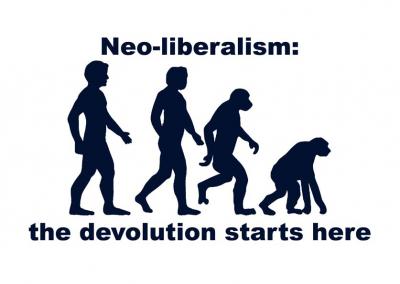
neo_liberalism_devolution_via_permanentculturenow.com_

Wendy Brown charts the ‘stealth revolution’ that’s transforming every aspect of society — and now has democracy in its sights.

By Hans Rollmann

Source: PopMatters

‘Neoliberalism’ is a much confused and maligned term these days. Progressive activists deploy it derisively as a general sort of derogatory label; learned professors write articles on the topic without really saying anything more penetrating. It’s as over-used an idiom as globalization (or as capitalism and socialism were 70 years ago). Even Anti-Flag take up the subject in their 2012 track “The Neoliberal Anthem”: “Strap in and watch the world decay!” they proclaim. Blunt, but not inaccurate.

Yet for all its confounded usages, what exactly does it signify?

In a 2013 review essay in the Los Angeles Review of Books that is more useful – if less straightforward – than Anti-Flag, Michael W. Clune described neoliberalism as “an economic doctrine that favors privatization, deregulation, and unfettered free markets over public institutions and government.” (”What Was Neoliberalism?”, 26 February 2013)

But it’s much more than that. Now, in Undoing the Demos: Neoliberalism’s Stealth Revolution, political theorist Wendy Brown contributes a truly useful text on an over-wrought topic, and one which focuses not only on the economic manifestations of neoliberalism, but on its broader effects on our political and social thinking. “Neoliberalism is a distinctive mode of reason, of the production of subjects, a ‘conduct of conduct,’ and a ‘scheme of valuation,’” she writes. It’s a mode of thinking, and the manner in which it emerges can be infinitely varied. We must be alert to neoliberalism’s “inconstancy and plasticity”, she warns, and its ability to reconfigure itself in new guises. Neoliberalism “takes diverse shapes and spawns diverse content and normative details, even different idioms. It is globally ubiquitous, yet disunified and nonidentical with itself in space and over time.” It’s a slippery beast, in other words – hard to define and even harder to see when it’s happening.

Brown’s work is an important and vital contribution at this time insofar as it takes aim at the beating heart of neoliberalism: its insinuation in the very institutions and identities which were hitherto used to limit its spread; institutions which, it was once hoped, would sustain deeper and more profound values implicit to democratic society and human sociality.

Brown is less interested than other scholars in the grim economics of neoliberalism: what she focuses on is its implicit threat to democracy. She opens her book by charting the emergence and contestation between ‘homo politicus’ and ‘homo oeconomicus’; between the human who uses politics to shape their world, and the human who is driven by self-interest and sees the world as always already shaped by economics. French philosopher Michel Foucault discussed this dichotomy in his 1978-79 College de France lectures on the Birth of Biopolitics, and Brown analyzes what Foucault saw – and failed to see – about this early emergence of neoliberal rationality.

In a superb if lamentably short section on gender she also discusses the question: “Does homo economicus have a gender? Does human capital? Is there a femina domestica invisibly striating or supplementing these figures…?” Her point is that “liberalism’s old gender problem is intensified by neoliberalism”, or that neoliberalism impacts women with particular vehemence.

Having discussed Foucault’s early charting of neoliberal political rationality, and expanded on his ideas in light of neoliberalism’s trajectory in the past 30 years, Brown analyzes some modern examples of neoliberalism’s diverse expressions. She looks at how it has insinuated itself in governance – in the notion of building consensus, rather than appreciating contestation; in the depoliticization of government; in the valorization of benchmarking and best practices. All of these deliver destructive blows against democratic political will, against the notion that humans can determine their own destiny and ought to shape their own reality. Instead of making their own decisions, governments appoint ‘external consultants’ to tell them what they should be doing; instead of inventing new ideas and ways of doing things, governments survey ‘best practices’ and see what everyone else is doing. It represents, in many ways, the triumph of mediocrity.

Neoliberal rationality infects law and legal reason, as well. Brown offers an in-depth analysis of the Citizens United case, which protected the right of corporations and the wealthy to dominate democratic elections in the US with their overwhelming power of capital. She also offers one of the best and most thorough analyses of how neoliberal rationality is destroying higher education: the post-WWII dream of an educated and equal society has been twisted into an economistic view, which holds that universities exist only to enhance capital; and that the purpose of an education is not to become better able to contribute to the broader political community, but rather to enhance one’s own ability to generate further capital.

Brown’s book is theoretical yet accessible; it’s an important and vital interjection which reveals and casts bare the neoliberal rationality that increasingly governs our world.

Dismantling Neoliberal Rationality

There’s an implicit warning in Brown’s text, which she addresses briefly but is worth some additional reflection. Audre Lorde famously cautioned against using the master’s tools to dismantle the master’s house, and increasingly this is precisely the direction in which efforts to limit the ravages of neoliberal thinking have turned, using economistic arguments in an effort to preserve institutions and principles that are premised on other-than-economistic values. Some examples serve to illustrate this.

In the ‘80s and ‘90s, public-private partnerships (P3’s) emerged as a neoliberal strategy transferring control and responsibility for public infrastructure – roads, bridges, hospitals, schools – into private hands. The basic argument held that the private sector, not beholden to political interests but rather to principles of efficiency and maximization of cost and utility, would prove more efficient custodians of public infrastructure. This neoliberal argument piggybacked nicely onto the drive to lower taxes. In an environment where lower taxes resulted in reduced state budgets, maximizing cost and efficiency would ensure public dollars stretched as far as possible.

This argument was received sympathetically by a public which had been worked up (by conservative pundits and politicians) into a collective sense of outrage over personal tax obligations and a sense of diminishing consumer power. It struck an affective chord, even though it was not based on any solid research. Yet P3’s became a dominant and accepted approach to building and maintaining public infrastructure and services.

In the past decade, efforts to fight back against public-private partnerships have achieved some limited success and have taken as their point of departure the fact that these partnerships are in fact not very efficient or effective. The private sector, it turns out, is often even more inefficient and ineffective than the public sector, given that it is driven by values such as greed and profit as opposed to public accountability. Analyses of several P3 projects have revealed massive cost over-runs, invariably subsidized by taxpayers to a cost far in excess of what it would have cost the state to produce the infrastructure on its own. (”The Problem with Public-Private Partnerships”, by Toby Sanger and Corina Crawley, CCPA, 1 April 2009) Contractual stipulations often guarantee corporate profits at public expense, requiring the state to assume all the risk, using public funds to rescue projects when private partners fail or walk away, and in some cases even using public funds to top-up corporate profits that fail to meet agreed-upon projections. (”Ontario Auditor breaks new ground with review of public private partnerships methodology”, by Keith Reynolds, Policy Note, 5 January 2015)

All this is true, and revealing the truly ineffective and inefficient nature of P3s has been critical to turning them back in many cases. However, there’s a problem with this. These campaigns against P3s adopt the same economistic principles as were used to promote the notion of P3s in the first place: namely, that efficiency, cost maximization and capital enhancement ought to be the driving principles of the demos, or public state. The implicit argument is that P3s are wrong not because they transfer public ownership into private hands, but because they do so inefficiently and at the expense of the taxpayer. Granted, there is often a reference to P3s being ‘unaccountable’ to the public, but this is rarely interrogated or explored as deeply as it should be. In fact, it ought to lie at the core of public resistance to P3s. Public-private partnerships are wrong simply because the state ought never to allow public goods to fall under private control, even if it might save more money. Economization ought never to hold sway over the values, principles and political power of the public.

Similarly, neoliberal logic has infected other efforts to fight back against neoliberal initiatives. Labour unions – a common target of neoliberalism—are increasingly defended on the basis that they benefit the economy (through ensuring consistent and safe workplace practices as well as strong wages to bolster consumer spending in the community), rather than on the simpler basis that workers deserve the right to control their working conditions. Efforts to reduce tuition fees for out-of-province/state or international students are often predicated on the notion that their economic contribution to the local economy exceeds the value of their fiscal contribution to the university through tuition fees. Nowhere – or rarely – is the argument presented that post-secondary ought to be a public good and universal right in and of itself.

The danger, in other words, is that efforts to resist neoliberalism are increasingly being expressed in such a way that they serve to entrench and legitimize neoliberal values – economization, efficiency, capital enhancement—rather than questioning or challenging the desirability and social and political consequences of those values in the first place.

Brown acknowledges the urgency of the problem. It’s quite possible, she observes, for neoliberal economic policy to be paused or reversed but for “the deleterious effects of neoliberal reason on democracy” to survive, undermining the potential for substantive, entrenched change. Without tackling neoliberal reason, neoliberal economics and governance will inevitably emerge again. It is the ongoing sense of surrender to the inevitability of economics; of the bottom line; of finance as key determiner of what is politically possible, that dooms the political potential of democracy. Although only emerging at the end of the book, this is one of the key lessons it offers: that efforts to resist or reverse the ravages of neoliberal economics are fatally flawed when “NGOs, nonprofits, schools, neighborhood organizations, and even social movements that understand themselves as opposing neoliberal economic policies may nonetheless be organized by neoliberal rationality.”

Fascism’s Forbidden Face

Brown comes close to a forbidden truth in closing. She notes, with great delicacy and hesitation, the similarities between neoliberal rationality and fascism. “This is not to say that neoliberalism is fascism or that we live in fascist times,” comes the inevitable caveat. But what if it is an emerging form of fascism?

One of the troubling trends that’s emerged in recent decades and needs to be challenged more forcefully is the notion that it’s intellectually taboo, inaccurate or excessive to call something ‘fascist’, or to draw analogies to fascist states like Nazi Germany. An example of this taboo is ‘Godwin’s Law’ – the notion that referring to Hitler (or by extension, fascism broadly) destroys the credibility of your argument. It’s a trendy term, but intellectually dangerous. The fact is, fascism was – and is – very real, and the notion that no one should talk about fascism as seriously emerging in the present day is very much a product of our neoliberal era.

In fact we do need to talk about it. The skepticism with which the term ‘fascism’ is treated; the dismissal of arguments which make reference to Nazis, all collaborate in erasing and masking the very real resemblances that exist between historical fascism and contemporary forms of governance like neoliberalism. In its demand for self-sacrifice to the heartless whole – a demand iterated, for instance, in the sacrifice of millions of homeowners and mortgage defaulters in order to save the banks during the subprime mortgage crisis – neoliberal rationality resembles the demand for citizen self-sacrifice that characterized fascism.

George Orwell (in his remarkable book review of Adolf Hitler’s Mein Kampf) warned against underrating the emotional appeal of fascism. While socialism and even capitalism offered a vision of the good life – fewer working-hours, health and education, leisure and pleasure – people appear inevitably lured by the attraction of struggle and self-sacrifice. “Whereas Socialism, and even capitalism in a more grudging way, have said to people ‘I offer you a good time,’ Hitler has said to them ‘I offer you struggle, danger and death,’ and as a result a whole nation flings itself at his feet,” he wrote. The same could easily be said of neoliberalism: people have a remarkable knack of voting for economic tough-guys who promise to make life harder on individuals and communities in order to ‘save the economy’, whatever that’s supposed to mean.

Brown’s book is essential reading not only for academics but for anyone concerned with our collective political future, and with the defense of democratic politics. Her book ends on a grim note: “Despair” is the title of its final section. Brown has eloquently elucidated the problem, and made a profound contribution to understanding the complex nature of neoliberal rationality and its threat to democracy.

So what is the solution? Brown doesn’t have one, but notes there is no alternative but to keep struggling to find an alternative. We have reached a state of “civilizational despair”, she writes; modernism is dead and with it the hope and belief that we can create a better world. How do we counter this despair, and re-inject hope and alternatives into the world? Such a task “is incalculably difficult, bears no immediate reward, and carries no guarantee of success. Yet what, apart from this work, could afford the slightest hope for a just, sustainable, and habitable future?”


Hans Rollmann is a writer and editor based in Eastern Canada. He’s a columnist, writer and opinions editor with the online news magazine TheIndependent.ca as well as editor of Landwash, a journal of literary and creative arts published out of Newfoundland and Labrador. His work has appeared in a range of other publications both print and online, from Briarpatch Magazine to Feral Feminisms. In addition to a background in radio-broadcasting, union organizing and archaeology, he’s currently completing a PhD in Gender, Feminist & Women’s Studies in Toronto. He can be reached by email at hansnf@gmail.com or @hansnf on Twitter.