
US seizes PressTV.com and 32 other Iranian media website domains

By Kevin Reed

Source: WSWS.org

The Biden administration’s Department of Justice (DoJ) confirmed on Tuesday that the US had seized 33 websites affiliated with the Iranian Islamic Radio and Television Union (IRTVU) and three others operated by Kata’ib Hizballah (Hezbollah Brigades), an Iraqi Shia group supported by Iran.

In a press statement, the DoJ stated that the website domains—including the English and French language PressTV.com based in Teheran—were “in violation of US sanctions.” The statement said that the US Office of Foreign Assets and Control (OFAC) had “designated IRTVU as a Specially Designated National (SDN)” during the Trump administration in October 2020 for “being owned or controlled by the Islamic Revolutionary Guard Corps Quds Force (IRGC).”

The DoJ also said that organizations labeled as SDNs are “prohibited from obtaining services, including website and domain services, in the United States without an OFAC license” and that IRTVU “and others like it” are not news organizations but are used to launch “disinformation campaigns and malign influence operations.” It also claimed that the 33 website addresses were owned in the US by IRTVU which “did not obtain a license from OFAC prior to utilizing the domain names.”

In the case of Kata’ib Hizballah (KH), the DoJ says that it was both designated an SDN by OFAC and as a Foreign Terrorist Organization by the Department of State in July 2009. It claims that KH has “committed, directed, supported or posed a significant risk of committing acts of violence against Coalition and Iraqi Security Forces” and also did not obtain an OFAC license prior to acquiring the domain names.

Whatever the public justifications provided for its aggressive act, the transparent political purpose of the Biden administration’s website seizures is the effort to ratchet up pressure on Iran amid ongoing negotiations in Vienna over the 2015 nuclear agreement and following the June 18 selection of the hardline conservative Ebrahim Raisi as the next Iranian president.

Iran’s foreign ministry on Wednesday called the seizure an example of a “systematic effort to distort freedom of speech on a global level and silence independent voices in media.”

One of the seized sites, Al-Masirah, is not owned by Iran, but by Ansarullah, the movement of the Houthis in Yemen, a faction the US has claimed to be “proxies” of Iran. The news outlet is headquartered in Beirut, Lebanon.

In a statement reported by RT, Al Masirah said it was “not surprised” by the seizure, as it “comes from those that have supervised the most heinous crimes against our people.” The website shutdown , “reveals, once again, the falsehood of the slogans of freedom of expression and all the other headlines promoted by the United States of America, including its inability to confront the truth,” the statement said.

Indicating the broader political aims of the website seizures, the Associated Press (AP) reported that the US took over the domain name of the news website Palestine Today, which publishes the views of Gaza-based Islamic militant groups Hamas and Islamic Jihad, redirecting the site to the same takedown notice.

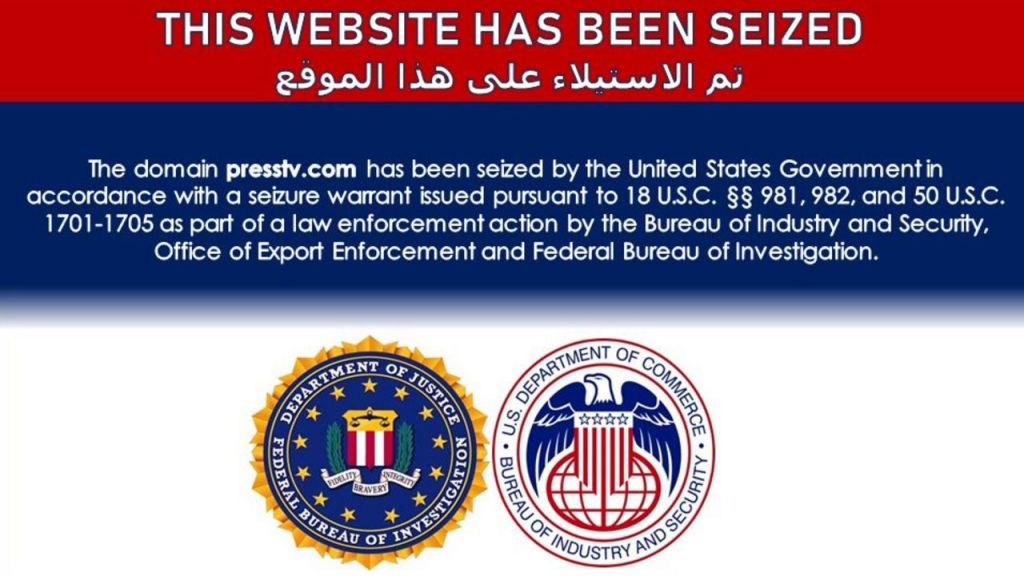
Visits to the seized websites bring up a graphic with the headline, “This website has been seized” and a message that says the domain has been taken offline due to a “seizure warrant” issued under the authority of US code involving civil and criminal forfeiture and special powers given to the president during “unusual and extraordinary threat; declaration of national emergency.”

Some of the websites have been operating for many years, such as PressTV.com which was launched in 2007. The Wikipedia entry for the Iranian news and documentary network says that the annual budget of PressTV was $8.3 million and it had 400 employees worldwide as of 2009.

AP reported that most of the seized domains are .net, .com and .tv domains. The .net and .com domains are considered generic “top level domains” (TLDs) and they are controlled by the global provider of the domain name registry, Verisign, based in Reston, Virginia. The contract with Verisign is managed jointly by the US-based non-profit Internet Corporation for Assigned Names and Numbers (ICANN) and the US Department of Commerce.

The domain .tv is “owned by the Pacific Island nation of Tuvalu but administered by the US company Verisign,” according to AP. Other news and media domains which are owned by Iran, such as the website PressTV.ir which also publishes in English, have not been affected by the seizures.

similar action was taken by the DoJ under the Trump administration in November 2020, when the FBI seized 27 domain names it claimed were used by Iran’s IRGC to spread a “global covert influence campaign.” Coming from the number one worldwide purveyor of “influence campaigns” involving money, murder and military occupation, the unsubstantiated accusations against the Iran-based media outlets must be completely rejected as part of the preparations for further wars of aggression in the Middle East and Central Asia.

Meanwhile, the use by Biden of designations made by both the Obama and Trump administrations makes clear the fundamental agreement over foreign policy between the two parties of Wall Street and the US military-intelligence apparatus regardless of whether it is the Democrats or Republicans that control the executive or legislative branches of government.

West’s Information War Continues

By Gunnar Ulson

Source: Land Destroyer

YouTube has recently deleted the latest channel used by Iranian state media’s PressTV. The move follows attacks on the Iranian media outlet by US-based social media giant Facebook earlier this year. 

PressTV’s own take on the deletion in its article, “Google renews attack on YouTube account of Iran’s Press TV,” would note: 

Google has for the seventh time targeted Iranian broadcaster Press TV, blocking the English-language news network’s access to its official YouTube account without any prior notice.

The US tech giant shut YouTube accounts of Press TV late on Tuesday, citing “violations of community guidelines.”

Iranian state media is only the most recent target of US censorship and information warfare, with YouTube, Facebook and Twitter having also recently de-platformed government accounts in Myanmar as well as a concerted effort by these same networks to either de-platform or undermine the credibility of Russian and Chinese state media.  

The use of ambiguous justifications like “violations of community guidelines” which themselves can be ambiguous and open to interpretation, helps demonstrate the political nature of what is clearly a campaign of censorship. 

YouTube and other US-based social media platforms, still dominating the global social media industry, attempt to portray targets of what is clearly politically-motivated censorship as “fake news” or somehow engaged in dangerous “disinformation,” while the accounts of Western-based media organizations actually involved in very real disinformation, often times in promotion of sanctions and warfare having a direct impact on millions of lives, remain online and in good standing. 

Western Monopoly Challenged 

Beyond social media, the UK had recently ousted Chinese state media, CGTN, which was met by Beijing in turn shutting down BBC broadcasts in China. 

More recently, China-based BBC reporter John Sudworth would flee to Taiwan, fearing legal actions for his outrageous, one-sided propaganda regarding Xinjiang.

The BBC’s own article, “BBC China correspondent John Sudworth moves to Taiwan after threats,” deliberately attempts to portray Sudworth as a victim of “threats” rather than a foreign agent involved in political interference under the guise of journalism finally facing legitimate legal actions. The BBC article laments: 

The number of international media organisations reporting from China is shrinking. Last year China expelled correspondents for the New York Times, the Washington Post and the Wall Street Journal, among others.

And in September 2020, the last two reporters working in China for Australian media flew home after a five-day diplomatic standoff.

The Foreign Correspondents’ Club (FCC) of China says foreign journalists are “being caught up in diplomatic rows out of their control”.

In reality, these foreign “journalists” aren’t being “caught up in diplomatic rows,” they are the primary actors helping drive these rows. 

It’s worth mentioning leaked documents revealing the BBC, among others including Reuters, signing secret contracts with the British Foreign Office to carry out influence operations both inside Russia and along Russia’s peripheries in Eastern Europe. 

It is without doubt that the BBC engages in similar activities inside and along China’s borders as well, with Sudworth’s own work clearly aimed at advancing Western foreign policy, not investigating or reporting actual news. 

Years ago, the notion of Western nations fearing alternative media enough to engage in sweeping, transparent censorship against outlets like PressTV or CGTN, or the Western media fleeing or backpedalling in countries they’ve maintained offices in for years, would seem unthinkable. 

The information war waged by Western nations is indeed heating up, but it is not the one-sided exercise of monopoly it used to be. 

Today, alternative media, both state-sponsored and independent, poses a serious challenge to the West’s monopoly over the creation and flow of global information. Only through the West’s control over a relatively new form of media, social media, is the West’s edge maintained. 

For Iranian, Chinese, Russian and the media of many other nations seeking to introduce balance to the global conversation, the West’s hitherto control over social media remains a serious hurdle. 

US-based social media networks have been key to advancing Western foreign policy objectives, and perhaps especially in the realm of promoting and executing so-called “color revolutions.” 

Russia and China’s recent pledge to work closer together to counter Western-sponsored “color revolution” and “disinformation” might benefit from a multipolar alternative to US-based social media platforms like Facebook, Twitter and YouTube. 

While Russia and China both have their own domestic alternatives which have proved an effective measure to protect their own respective information space, the creation of a wider-appealing platform for nations along their peripheries, targeted by Western disinformation, could help give state-sponsored and independent alternative media the space it needs to finally balance out the lopsided advantage the West artificially maintains through censorship across its own networks.

The creation of both sovereign information space within nations and shared space between nations but outside of the control of Western censorship would be infinitely useful. When long-standing media organizations like PressTV struggle to reach audiences for a lack of alternatives to Facebook, Twitter and YouTube, the utility of such space becomes clearer still. 

Video News Roundup

5/7 RT interviews a survivor of the Odessa massacre who witnessed police complicity in the violence:

5/6 Mark Dice on the NSA and freedom of speech:

5/6 A NextNewsNetwork report on a test of the limits of religious freedom in Oklahoma:

5/5 Before Snowden there was NSA whistleblower Russ Tice, who has had suspiciously less corporate media coverage. Fortunately WeAreChange and other independent journalists are helping to get his message out:

5/5 GlobalResearchTV posted this PressTV report linking chaos in Ukraine to US policy:

5/5 Lee Camp on the military-industrial complex:


News Video Roundup

3/3: PressTV interviews Dan Dicks of Press for Truth on the erosion of freedom of the press in the U.S.

3/3: Gerald Celente speaks out on the rash of recent banker suicides and speculation on a connection to a coming global economic collapse at NextNewsNetwork.

3/4: At Global Research TV, geopolitical analysts from across the board explain how the Ukrainian coup has been deliberately provoked by outside agents to promote a combination of US, EU, NATO and IMF interests, and the possible implications.

3/4: Excellent episode of Breaking the Set in which Abby Martin covers the Ukraine conflict and Washington DC’s shadow lobbyists.

3/5: An inspiring story from WeAreChange.org about libertarian crossfit gym owner Danny Lopez-Calleja who overcame drug abuse and homelessness to become a catalyst for change.

3/6: Over 80 people were shot during riots in Kiev a few weeks ago. Now new evidence is coming out that opposition snipers were behind shootings of police and protesters on both sides:

On the lighter side, the Onion reports on disturbing findings from a new marijuana study. It’s even funnier (or more disturbing) watching it stoned.