After the Crash

Dispatches From a Long Recovery (Est. 10/2024)

After the Crash

Why Are We Still Working?

intcap2

By Mike Dowson

Source: NewMatilda.com

This may be an opportune moment to consider the question. Especially if you’re not actually working.

You may have retired. Perhaps you’ve just left university, considering your options. Perhaps you’re taking a welcome break.

Maybe you have no choice but to take a break. Did you retire early because your job was axed? Has the casual work you depend on dried up? Have you been unable to find a job, despite your qualifications?

Perhaps, as you read this, you’re at work, filling in time, forgoing a holiday. Or at the beach, while the kids play in the surf, watching for emails on your phone.

Of course, it’s obvious why we work. Money. You don’t get something for nothing. And everything is so expensive these days.

If anything, most of us need to work more. Both spouses, extra hours, second jobs. Would anyone, except an idiot, seriously suggest we should all be working less?

Well, actually, yes.

As long ago as 1930, the economist John Maynard Keynes predicted that, by now, people in technologically advanced societies wouldn’t need to work much at all. When Keynes said this, advances in technology were yielding extraordinary increases in productivity. The implications seemed obvious. If it took less time to produce what we needed, surely we’d work less.

It turns out that for much of the 20th Century average working hours in developed countries steadily fell. Then, around the 1970s, the trend plateaued. In some countries, it reversed and working hours began to climb again. This occurred at the same time women were entering the workforce in great numbers so total workforce participation also increased.

In Australia, by the new millennium, many full time employees were working more than their grandparents had.

What happened? Did technology fail to deliver the gains Keynes expected?

On the contrary. Technological advancement outstripped even the giddy imaginations of futurists from a century ago. We can grow food, dig up minerals, make fridges and bridges, move things and ourselves around the planet and share knowledge and information much faster with a fraction of the workforce it once took.

But if staggering productivity gains haven’t manifested as lower working hours, where did they go?

Some prominent economists, including some Nobel laureates, have grappled with this question.

Gary Becker observed that our appetite for material goods has expanded along with our ability to produce them. Instead of working less hours, we opted for bigger houses with more gadgets, which we replace more often.

This process has been fuelled by a deluge of marketing, which persuades us to consume things we previously didn’t recognise a need for.

Does that explain it? Anthropologist David Graeber doesn’t think so. If it continually takes fewer human hours to produce these things, shouldn’t we be able to afford them without working more? What are all these working hours producing?

Graeber argues that, although productive jobs have, in fact, been steadily automated away just as predicted, we have also seen a vast proliferation of new jobs that only seem to exist to keep people working.

Consider this. Productivity growth has stalled in Australia. How can this be? Technology hasn’t stopped advancing. The time we should be winning back through productivity gains must be getting reabsorbed.

Productivity returns are highest in capital-intensive industries like mining and manufacturing. As those jobs disappear, either replaced by technology, or lost altogether, the workforce moves into labour-intensive industries like hospitality and professional services. This dilutes the gains in the other industries.

At the same time, unemployment has been trending up since 2008. Young people especially, are out of work. The number of underemployed people, who would work more if they could, is also high. More jobs are casual.

There’s a downward trend in job prospects for new graduates. Some of them settle for part-time work or a free internship. Many find work which is unrelated to primary qualification. That’s now more likely to be in a job without benefits, or multiple such jobs.

There’s another factor. Our lives are now longer relative to our working lives. We tend to start full-time work later, after years of study, and more of life is spent in retirement. Many jobless older people are struggling with the cost of living. Many would work more if they could.

Instead of everyone working less, what seems to be happening is that experienced workers, in professions which are still in demand, are working more, while the young, the old, and those with skills which no longer attract investment have difficulty finding work.

MIT academics Andrew McAfee and Erik Brynjolfsson refer to this as the great decoupling. For many years, real GDP per capita and median income rose in tandem. Since the 1970s, wages as a percentage of GDP have fallen dramatically, while corporate profits as a percentage of GDP are now at their highest level, despite recurring economic shocks.

To put it simply, labour isn’t as important to growth as it used to be.

There is nothing in the economic outlook or current government policy settings which suggests this trend is going to change.

Automation, artificial intelligence and robotics are encroaching on more human occupations. The Committee for Economic Development of Australia (CEDA) has estimated that as many as 40 per cent of the jobs that are left are vulnerable to replacement by technology over the next decade.

No matter how many politicians chant the jobs mantra for the media, more productive jobs are going to disappear.

The terrible irony in this situation is that there is so much that needs to be done.

Among the underemployed graduates I personally know of, there is a psychologist, a soil chemist and a biodiversity specialist. Have we run out of things to do in the areas of mental health, agriculture and the environment?

Mental illness is widespread. Our food bowl is under threat from climate change. We have a mass extinction on our hands.

What we don’t have, apparently, is sufficient money to invest in making full use of the talent that is available to face these challenges.

Why? What failure of collective enterprise could result in this absurd incongruity?

Capital, like technology, is largely blind to human need. Capital goes where the profit is. If there was profit in healing minds and saving species, some of it would go there. While there is more profit in alcohol, gambling and deforestation, more of it will go there.

People don’t register their desire for a healthy society by shopping for it. Capital doesn’t get that signal through the market. The argument that consumers somehow direct the course of civilisation by choosing dolphin-friendly tuna and “eco” cleaning products is stupid and facile. The factors that most affect our destiny are not options in the supermarket.

If a healthy society is something we want, we have to act collectively. Since few people are active major shareholders, for the time being that task tends to fall to governments.

Whether enacted via direct spending, or by creating incentives for private investment, government initiatives are funded from collective surplus – in other words, tax revenue or borrowing against future earnings increases. Despite political spin to the contrary, our tax is low compared to the OECD as a proportion of GDP.

The great decoupling has coincided with rising inequality. Those with money to invest get rich. Those with only labour to sell miss out. Capital doesn’t like to pay for labour, and it doesn’t like to pay tax either.

But why, if our labour isn’t needed for profit, are we still working?

Faced with a looming crisis in social services, but committed ideologically to low taxation, successive Australian governments used tax concessions to turn superannuation and real estate – where most Australians keep their wealth – into a mini-capitalist alternative to social security.

Of course, this only works while people have jobs that provide super and sufficient income to buy housing. And it doesn’t help the real economy, the place where we apply technological innovation to produce things of real value, especially things we can export.

Nevertheless, one group of people enriched themselves through property investment, pushing up the value of real estate around the country in the process. Another group of people became affluent with nothing more than a job that paid super and a home in a good location.

With commodity revenue pouring in from overseas, it was easy to believe we had discovered some kind of magic prosperity formula. But the surplus generated from commodities mostly wasn’t invested back into productive activity. Instead it was turned into tax cuts and other benefits. These had broad electoral appeal but favoured the wealthy, and encouraged further speculation.

The real estate boom didn’t make the country richer. Nor did it make housing more accessible. It simply transferred wealth from one group of people to another. In the process, it put a basic need out of reach of many, including young people, and diverted investment from the productive economy. It also lured a huge number of Australians into precarious debt.

Contrary to popular opinion, encouraged by unscrupulous politics, we have relatively low government debt, but we now have the largest per capita private debt in the world.

So why are we still working? Because we’re in debt.

Middle-aged people are the ones working long hours. They’re also the ones buying houses. And they’re the ones with the most credit card debt as well.

The generation before them had affordable housing, job security and a real social safety net. They’re not so fortunate, but for the ones after them, a steady job with enough for a deposit has become a kind of Holy Grail, and social security is survival at best.

The current trend points to a time when a young graduate might start adult life with a HECS debt, go into credit card debt on a part-time job and a free internship, and eventually get into massive debt to own a flat her grandparents could have bought with ease.

She might even find a job in financial services, if they haven’t all been automated. It’s the sector that helps wealthy people turn their money into more money. It’s also where ordinary people go to borrow money for a house.

Debt is profitable. Even during the great decoupling, as productive jobs disappear, and real wages fall, it’s proven possible to harness the aspirations of ordinary people for profit, without any of the effort or intelligence required for developing new productive capacity, by simply enticing a greater proportion of personal income into servicing debt.

The mining boom is over. Not that it was ever as important as the miners like to claim. Manufacturing continues its long decline. The banks have been warned they are overexposed.

Whatever combination of policy levers is applied, we need to create the conditions that direct investment into producing things that we and the world need, while caring for our environment and our population. We don’t need to direct it in into unearned private wealth at the expense of our neighbours, our country and future generations.

Our current class of politicians has so far failed to even acknowledge our present circumstances, let alone articulate a credible vision for change. Many of them became rich from property investment. Our Prime Minister is a former banker.

Naturally, the people who’ve done well for themselves are reluctant to sacrifice their advantage. Nevertheless, we have to change the narrative around “wealth creation” from one which is essentially about personal enrichment from gaming the system, to one which is about mutual benefit through innovation and productivity.

Change has come, whether we like it or not. If we respond intelligently, taking advantage of the potential we have developed through our education system, we may very well end up working less, but not in a divided society, with many of us struggling to survive.

The Mad Violence of Casino Capitalism

AmericanRoulette

By

Source: Counterpunch

American society is morally bankrupt and politically broken, and its vision of the future appears utterly dystopian. As the United States descends into the dark abyss of an updated form of totalitarianism, the unimaginable has become imaginable in that it has become possible not only to foresee the death of the essential principles of constitutional democracy, but also the birth of what Hannah Arendt once called the horror of dark times. The politics of terror, a culture of fear, and the spectacle of violence dominate America’s cultural apparatuses and legitimate the ongoing militarization of public life and American society.

Unchecked corporate power and a massive commodification, infantilization, and depoliticization of the polity have become the totalitarian benchmarks defining American society. In part, this is due to the emergence of a brutal modern-day capitalism, or what some might call neoliberalism. This form of neoliberal capitalism is a particularly savage, cruel, and exploitative regime of oppression in which not only are the social contract, civil liberties and the commons under siege, but also the very notion of the political, if not the planet itself. The dystopian moment facing the United States, if not most of the globe, can be summed up in Fred Jameson’s contention “that it is easier to imagine the end of the world than to imagine the end of capitalism.” He goes on to say that “We can now revise that and witness the attempt to imagine capitalism by way of imagining the end of the world.”1

One way of understanding Jameson’s comment is through the ideological and affective spaces in which the neoliberal subject is produced and market-driven ideologies are normalized. Capitalism has made a virtue out of self-interest and the pursuit of material wealth and in doing so has created a culture of shattered dreams and a landscape filled with “Broken highways, bankrupt cities, collapsing bridges, failed schools, the unemployed, the underpaid and the uninsured: all suggest a collective failure of will. These shortcomings are so endemic that we no longer know how to talk about what is wrong, much less set about repairing it.”[i]

Yet, there is a growing recognition that casino capitalism is driven by a kind of mad violence and form of self-sabotage and that if it does not come to an end what we will experience in all probability is the destruction of human life and the planet itself. Certainly, more recent scientific reports on the threat of ecological disaster from researchers at the University of Washington, NASA, and the Intergovernmental Panel on Climate Change reinforce this dystopian possibility.2 The undermining of public trust and public values has now given way to a market-driven discourse that produces a society that has lost any sense of democratic vision and social purpose and in doing so resorts to state terrorism, the criminalization of social problems, and culture of cruelty. Institutions that were once defined to protect and enhance human life now function largely to punish and maim.

As Michael Yates points out throughout this book, capitalism is devoid of any sense of social responsibility and is driven by an unchecked desire to accumulate capital at all costs. As power becomes global and politics remains local, ruling elites no longer make political concessions to workers or any other group that they either exploit or consider disposable.

Security and crisis have become the new passwords for imposing a culture of fear and for imposing what Giorgio Agamben has called a permanent state of exception and a technology of government repression.[ii] A constant appeal to a state of crisis becomes the new normal for arming the police, curtailing civil liberties, expanding the punishing state, criminalizing everyday behavior, and supressing dissent. Fear now drives the major narratives that define the United States and give rise to dominant forms of power free from any sense of moral and political conviction, if not accountability.

In the midst of this dystopian nightmare, there is the deepening abyss of inequality, one that not only separates the rich from the poor, but also increasingly relegates the middle and working classes to the ranks of the precariat. Concentrations of wealth and income generate power for the financial elite and unchecked misery for most people, a fear/insecurity industry, and a growing number of social pathologies.

Michael Yates in The Great Inequality provides a road map for both understanding the registers that produce inequality as well as the magnitude of the problems it poses across a range of commanding spheres extending from health care and the political realm to the environment and education. At the same time, he exposes the myths that buttress the ideology of inequality. These include an unchecked belief in boundless economic growth, the notion that inequality is chosen freely by individuals in the market place, and the assumption that consumption is the road to happiness. Unlike a range of recent books on inequality, Yates goes beyond exposing the mechanisms that drive inequality and the panoply of commanding institutions that support it. He also provides a number of strategies that challenge the deep concentrations of wealth and power while delivering a number of formative proposals that are crucial for nurturing a radical imagination and the social movements necessary to struggle for a society that no longer equates capitalism with democracy.

As Yates makes clear throughout this book, money now engulfs everything in this new age of disposability. Moreover, when coupled with a weakening of movements to counter the generated power of capitalists, the result has been a startling increase in the influence of predatory capitalism, along with inequities in wealth, income, power, and opportunity. Such power breeds more than anti-democratic tendencies, it also imposes constraints, rules, and prohibitions on the 99 percent whose choices are increasingly limited to merely trying to survive. Capitalists are no longer willing to compromise and have expanded their use of power to dominate economic, political, and social life. For Yates, it is all the more crucial to understand how power works under the reign of global capitalism in order to grasp the magnitude of inequality, the myriad of factors that produce it, and what might be done to change it.

Accompanying the rise of a savage form of capitalism and the ever-expanding security state is the emergence of new technologies and spaces of control. One consequence is that labor power is increasing produced by machines and robotic technologies which serve to create “a large pool of more or less unemployed people.” Moreover, as new technologies produce massive pools of unused labor, it also is being used as a repressive tool for collecting “unlimited biometric and genetic information of all of its citizens.”[iii]

The ongoing attack on the working class is matched by new measures of repression and surveillance. This new weaponized face of capitalism is particularly ominous given the rise of the punishing state and the transformation of the United States from a democracy in progress to a fully developed authoritarian society.   Every act of protest is now tainted, labeled by the government and mainstream media as either treasonous or viewed as a potential act of terrorism. For example, animal rights activists are put on the terrorist list. Whistleblowers such as Edward Snowden are painted as traitors. Members of the Black Lives Matter movement are put under surveillance,[iv] all electronic communication is now subject to government spying, and academics who criticize government policy are denied tenure or worse.

Under neoliberalism, public space is increasingly converted into private space undermining those sphere necessary for developing a viable sense of social responsibility, while also serving to transform citizenship into mostly an act of consumption. Under such circumstances, the notion of crisis is used both to legitimate a system of economic terrorism as well as to accentuate an increasing process of depoliticization. Within this fog of market induced paralysis, language is subject to the laws of capitalism, reduced to a commodity, and subject to the “tyranny of the moment….emaciated, impoverished, vulgarized and squeezed out of the meanings it was resumed to carry.”[v]

As the latest stage of predatory capitalism, neoliberalism is part of a broader economic and political project of restoring class power and consolidating the rapid concentration of capital, particularly financial capital.[vi] As a political project it includes “the deregulation of finance, privatization of public services, elimination and curtailment of social welfare programs, open attacks on unions, and routine violations of labor laws.”[vii] As an ideology, it casts all dimensions of life in terms of market rationality, construes profit making as the arbiter and essence of democracy, consuming as the only operable form of citizenship, and upholds the irrational belief that the market can both solve all problems and serve as a model for structuring all social relations. As a mode of governance, it produces identities, subjects, and ways of life driven by a survival-of-the fittest-ethic, grounded in the idea of the free, possessive individual, and committed to the right of ruling groups and institutions to exercise power removed from matters of ethics and social costs. As a policy and political project, it is wedded to the privatization of public services, the dismantling of the connection of private issues and public problems, the selling off of state functions, liberalization of trade in goods and capital investment, the eradication of government regulation of financial institutions and corporations, the destruction of the welfare state and unions, and the endless marketization and commodification of society.

Nothing engenders the wrath of conservatives more than the existence of the government providing a universal safety net, especially one that works, such as either Medicare or Social Security. As Yates points out, government is viewed by capitalists as an institution that gets in the way of capital. One result is a weakening of social programs and provisions. As Paul Krugman observes regarding the ongoing conservative attacks on Medicare, “The real reason conservatives want to do away with Medicare has always been political: It’s the very idea of the government providing a universal safety net that they hate, and they hate it even more when such programs are successful.”[viii] In opposition to Krugman and other liberal economists, Michael Yates argues rightly in this book that the issue is not simply preserving Medicare but eliminating the predatory system that disavows equality of wealth, power, opportunity, and health care for everyone.

Neoliberalism has put an enormous effort into creating a commanding cultural apparatus and public pedagogy in which individuals can only view themselves as consumers, embrace freedom as the right to participate in the market, and supplant issues of social responsibility for an unchecked embrace of individualism and the belief that all social relation be judged according to how they further one’s individual needs and self-interests. Matters of mutual caring, respect, and compassion for the other have given way to the limiting orbits of privatization and unrestrained self-interest, just as it is has become increasingly difficult to translate private troubles into larger social, economic, and political considerations. One consequence is that it has become more difficult for people to debate and question neoliberal hegemony and the widespread misery it produces for young people, the poor, middle class, workers, and other segments of society– now considered disposable under neoliberal regimes which are governed by a survival-of-the fittest ethos, largely imposed by the ruling economic and political elite. Unable to make their voices heard and lacking any viable representation in the process makes clear the degree to which the American public, in particular, are suffering under a democratic deficit producing a profound dissatisfaction that does not always translate into an understanding of how neoliberal capitalism has destroyed democracy or what it might mean to understand and challenge its diverse apparatuses of persuasion and power. Clearly, the surge of popularity behind the presidential candidacy of a buffoon such as Donald Trump testifies to both a deep seated desire for change and the forms it can take when emotion replaces reason and any viable analysis of capitalism and its effects seem to be absent from a popular sensibility.

What Michael Yates makes clear in this incisive book on inequality is that democratic values, commitments, integrity, and struggles are under assault from a wide range of sites in an age of intensified violence and disposability. Throughout the book he weaves a set of narratives and critiques in which he lays bare the anti-democratic tendencies that are on display in a growing age of lawlessness and disposability. He not only makes clear that inequality is not good for the economy, social bonds, the environment, politics, and democracy, Yates also argues that capitalism in the current historical moment is marked by an age that thrives on racism, xenophobia, the purported existence of an alleged culture of criminality, and a massive system of inequality that affects all aspects of society. Worth repeating is that at the center of this book, unlike so many others tackling inequality, is an attempt to map a number of modalities that give shape and purpose to widespread disparities in wealth and income, including the underlying forces behind inequality, how it works to secure class power, how it undermines almost every viable foundation needed for a sustainable democracy, and what it might mean to develop a plan of action to produce the radical imagination and corresponding modes of agency and practice that can think and act outside of the reformist politics of capitalism.

Unlike so many other economists such as Paul Krugman and Joseph Stiglitz who address the issue of inequality, Yates refuses the argument that the system is simply out of whack and can be fixed. Nor does he believe that capitalism can be described only in terms of economic structures. Capitalism is both a symbolic pathological economy that produces particular dispositions, values, and identities as well as oppressive institutional apparatuses and economic structures. Yates goes even further arguing that capitalism is not only about authoritarian ideologies and structures, it is also about the crisis of ideas, agency, and the failure of people to react to the suffering of others and to the conditions of their own oppression. Neoliberal capitalism has no language for human suffering, moral evaluation, and social responsibility. Instead, it creates a survival-of-the fittest ethos buttressed by a discourse that is morally insensitive, sadistic, cannibalistic, and displays a hatred of those whose labor cannot be exploited, do not buy into the consumerist ethic, or are considered other by virtue of their race, class, and ethnicity. Neoliberalism is the discourse of shadow games, committed to highlighting corporate power and making invisible the suffering of others, all the while leaving those considered disposable in the dark to fend for themselves.

Yates makes visible not only the economic constraints that bear down on the poor and disposable in the neoliberal age of precarity, he also narrates the voices, conditions, hardships and suffering workers have to endure in a variety of occupations ranging from automobile workers and cruise ship workers to those who work in restaurants and as harvester on farms. He provides a number of invaluable statistics that chart the injuries of class and race under capitalism but rather than tell a story with only statistics and mind boggling data, he also provides stories that give flesh to the statistics that mark a new historical conjuncture and a wide range of hardships that render work for most people hell and produce what has been called the hidden injuries of class. Much of what he writes is informed by a decade long research trip across the United States in which he attempted to see first-hand what the effects of capitalism have been on peoples’ lives, the environment, work, unions, and other crucial spheres that inform everyday life. His keen eye is particularly riveting as he describes his teaming up with Cesar Chavez and the United Farm Workers in the 1970s and his growing disappointment with a union that increasingly betrayed its own principles.

For Yates, the capitalist system is corrupt, malicious, and needs to be replaced. Capitalism leaves no room for the language of justice, the social, or, for that matter, democracy itself. In fact, one of its major attributes is to hide its effects of power, racial injustice, militarized state violence, domestic terrorism, and new forms of disposability, especially regarding those marginalized by class and race. The grotesque inequalities produced by capitalism are too powerful, deeply rooted in the social and economic fabric, and unamenable to liberal reforms.  Class disparities constitute a machinery of social death, a kind of zombie-like machine that drains life out of most of the population poisoning both existing and future generations.

The politics of disposability has gone mainstream as more and more individuals and groups are now considered surplus and vulnerable, consigned to zones of abandonment, surveillance, and incarceration. At one level, the expansive politics of disposability can be seen in the rising numbers of homeless, the growing army of debt-ridden students, the increasingly harsh treatment of immigrants, the racism that fuels the school-to-prison pipeline, and the growing attack on public servants. On another level, the politics of disposability has produced a culture of lawlessness and cruelty evident by the increasing rollback of voting rights, the war waged against women’s reproductive rights, laws that discriminate against gays, the rise of the surveillance state, and the growing militarization of local police forces. Yates argues convincingly that there is a desperate need for a new language for politics, solidarity, shared responsibilities, and democracy itself. Yates sees in the now largely departed Occupy Movement an example of a movement that used a new discourse and set of slogans to highlight inequality, make class inequities visible, and to showcase the workings of power in the hands of the financial elite. For Yates, Occupy provided a strategy that can be and is being emulated by a number of groups, especially those emerging in the black community in opposition to police violence. Such a strategy begins by asking what a real democracy looks like and how does it compare to the current society in which we live. One precondition for individual and social agency is that the horizons for change must transcend the parameters of the existing society, and the future must be configured in such a way as to not mimic the present.

What is remarkable about The Great Inequality is that Yates does not simply provide a critique of capitalism in its old and new forms, he also provides a discourse of possibility developed around a number of suggested policies and practices designed to not reform capitalism but to abolish it. This is a book that follows in the manner of Dr. Martin Luther King’s call to break the silence. In it Yates functions as a moral witness in reporting on the hardships and suffering produced by grotesque forms of inequality. As such, he reveals the dark threats that capitalism in its ruthlessly updated versions poses to the planet. Yet, his narrative is never far from either hope or a sense that there is a larger public for whom his testimony matters and that such a public is capable of collective resistance. The Great Inequality also serves to enliven the ethical imagination, and speak out for those populations now considered outcast and voiceless. Yates provides a furious reading of inequality and the larger structure of capitalism. In doing so he exhibits a keen and incisive intellect along with a welcomed sense of righteous fury.

Notes.

[i] Tony Judt, Ill Fares the Land, (New York, N.Y.: The Penguin Press, 2010), p. 12.

[ii] Giorgio Agamben, “The Security State and a theory of destituent power,” Philosophers for Change, (February 25, 2014). Online:

The security state and a theory of destituent power

[iii] Ibid., Agamben, “The Security State and a theory of destituent power,”

[iv] George Joseph, “Exclusive: feds regularly monitored black lives matter since ferguson,” Intercept (July 24, 2015). Online: https://firstlook.org/theintercept/2015/07/24/documents-show-department-homeland-security-monitoring-black-lives-matter-since-ferguson/; Deirdre Fulton, “Exposed: Big Brother Targets Black Lives:Government spying can be an ‘effective way to chill protest movements,’ warns Center for Constitutional Rights,” CommonDreams (July 24, 2015). Online: http://www.commondreams.org/news/2015/07/24/exposed-big-brother-targets-black-lives

[v] Zygmunt Bauman and Leonidas Donskis, Moral Blindness: The loss of Sensitivity in Liquid Modernity, (Cambridge, UK: Polity Press, 2013), p. 46.

[vi] I have taken up the issue of neoliberalism extensively in Henry A. Giroux, Against the Terror of Neoliberalism (Boulder: Paradigm, 2008) . See also, David Harvey, A Brief History of Neoliberalism (New York: Oxford University Press, 2007); Manfred B. Steger and Ravi K. Roy, Neoliberalism: A Very Short Introduction (New York: Oxford University Press, 2010); Gerad Dumenil and Dominique Levy, The Crisis of Neoliberalism (Cambridge: Harvard University Press, 2011). Henry A. Giroux, Twilight of the Social (Boulder: Paradigm, 2013); Henry A. Giroux, and in Against the Violence of Organized Forgetting: Beyond America’s Disimagination Machine (San Francisco: City Lights, 2014);

Wendy Brown, Undoing the Demos: Neoliberalism’s Stealth Revolution (Cambridge: Zone Books 2015).

[vii] Michael D. Yates, “Occupy Wall Street and the Significance of Political Slogans,” Counterpunch, (February 27, 2013). Online:http://www.counterpunch.org/2013/02/27/occupy-wall-street-and-the-significance-of-political-slogans/

[viii] Paul Krugman, “Zombies Against Medicare,” New York Times (July 27, 2015). Online: http://www.nytimes.com/2015/07/27/opinion/zombies-against-medicare.html?_r=0

This essay is excerpted from the introduction to The Great Inequality by Michael D. Yates.

Henry A. Giroux currently holds the McMaster University Chair for Scholarship in the Public Interest in the English and Cultural Studies Department and a Distinguished Visiting Professorship at Ryerson University. His most recent books are America’s Education Deficit and the War on Youth (Monthly Review Press, 2013) and Neoliberalism’s War on Higher Education (Haymarket Press, 2014). His web site is www.henryagiroux.com.

The lottery and social despair in America

1fab0b8ba5546a67810419e62958f0cc

By Andre Damon

Source: WSWS.org

This mania, so generally condemned, has never been properly studied. No one has realized that it is the opium of the poor. Did not the lottery, the mightiest fairy in the world, work up magical hopes? The roll of the roulette wheel that made the gamblers glimpse masses of gold and delights did not last longer than a lightning flash; whereas the lottery spread the magnificent blaze of lightning over five whole days. Where is the social force today that, for forty sous, can make you happy for five days and bestow on you—at least in fancy—all the delights that civilization holds?

Balzac, La Rabouilleuse, 1842

The jackpot in the US Powerball lottery has hit $800 million, since there were no winners in Wednesday’s drawing. In the current round, which began on December 2, over 431 million tickets have been sold, a figure substantially larger than America’s population.

Go into any corner store in America and you will see workers of every age and race waiting in line to buy lottery tickets. With the current round, the lines are longer than ever. Americans spend over $70 billion on lottery tickets each year. In West Virginia, America’s second-poorest state, the average person spent $658.46 on lottery tickets last year.

Powerball players pick six random numbers when they purchase their tickets, with a certain percentage of sales going to the jackpot. If no winning ticket is sold, the jackpot rolls over to the next round.

The totals for the Mega Millions and Powerball national lotteries have been growing every year. This year’s jackpot has eclipsed 2012’s record of $656.5 million, the $390 million payout in 2007 and the $363 million prize in 2000. The jackpots have grown in direct proportion to ticket sales.

State-run gambling programs such as Powerball have been promoted by Democrats and Republicans alike as a solution to state budget shortfalls, even as the politicians slash taxes on corporations and wealthy individuals and gut social programs. From the standpoint of government revenue, lotteries and casinos are nothing more than a back-door regressive tax, soaking up money from the poor in proportion to the growth of social misery.

The boom in lotteries is global. Lottery sales grew 9.9 percent worldwide in 2014, after growing 4.9 percent in 2013.

Psychology Professor Kate Sweeny has noted that lottery sales grow when people feel a lack of control over their lives, particularly over their economic condition. “That feeling of self-control is very important to psychological well-being,” Sweeny says.

There is ample reason for American workers to feel they have no control over their lives. According a recent survey by Bankrate.com, more than half of Americans do not have enough cash to cover an unexpected expense of $500 or more—roughly the price of four name-brand tires.

Some 62 percent of Americans have savings of less than $1,000, and 21 percent do not have any savings at all. Most Americans are one medical emergency or one spell of unemployment from financial ruin.

For all the talk about “economic recovery” by the White House, the real financial state of most American households is far worse than before the 2008 financial crisis and recession. As of 2013, Americans were almost 40 percent poorer than they were in 2007, according to a recent survey by the Pew Research Center. While a large portion of the decline in household wealth is attributable to the collapse of the housing bubble, falling wages and chronic mass unemployment have played major roles.

The yearly income of a typical US household dropped by a massive 12 percent, or $6,400, in the six years between 2007 and 2013, according to the Federal Reserve’s latest survey of consumer finances. A large share of this decline has taken place during the so-called recovery presided over by the Obama administration.

In addition to becoming poorer, America has become much more economically polarized. According to a separate Pew survey, for the first time in more than four decades “middle-income households” no longer constitute the majority of American society. Instead, the majority of households are either low- or high-income. Pew called its findings “a demographic shift that could signal a tipping point” in American society.

“Is the lottery the new American dream?” asked USA Today, commenting on this month’s Powerball jackpot. The observation is truer than the authors intended. For American workers, achieving the “American Dream” of a stable job and one’s own home is becoming increasingly unrealizable.

Following more than 10 million foreclosures during the financial crisis, America’s home ownership rate has hit the lowest level in two decades, and for young households, the rate of home ownership is the lowest it has been since the 1960s.

For the tens of millions of America’s poor, and the more than 100 million on the threshold of poverty, the dream of winning the lottery has replaced the “American Dream” of living a decent life. A lottery ticket is a chance to escape to a fantasy world where money is not a constant, nagging worry, where one is not insulted and bullied at a low-wage job by bosses whose pay is matched only by their incompetence. The lottery is, as Balzac aptly described it, the “opium of the poor.”

Using the same phrase to describe religion, Marx noted that the “illusory happiness of the people” provided by the solace of religion is, in fact, a silent protest and distorted “demand for their real happiness.” It is the intolerable social conditions that compel masses of people to seek consolation in a lottery ticket that will propel them into revolutionary struggles.

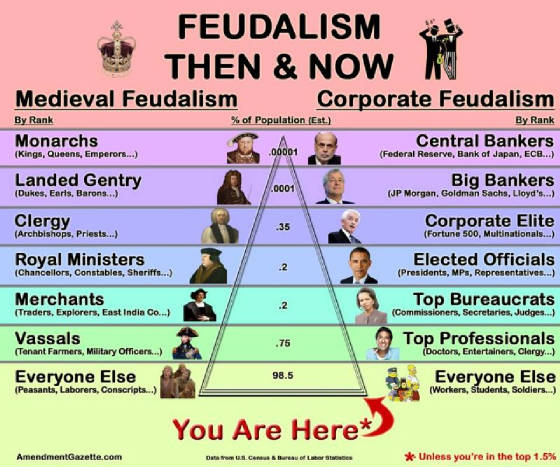
An Introduction to Technofeudalism Ascending

feudalism-then-and-now-hierarchy.jpg.w560h467

By SARTRE

Source: BATR.org

The future of the planetary Reign of Terror has never been clearer. The pattern for global governance has been set into motion and operates under a model that has been used throughout much of history. The modern day version of command and control can be effectively described as Technofeudalism. The purpose of this introduction is to provide an outline of the arguments used by Steven Yates, Ph.D. The link to this significant treatise is provided below. In addition News With Views maintains an extensive archives of Dr. Yates’ work. Invest the time to read the entire essay for a full understanding of the linkage behind Technofeudalis and the course for top down dominance.

Technofeudalism Ascending comprises nine sections. Dr. Yates provides the following preface.

My book Four Cardinal Errors (2011) introduced the idea of technofeudalism. Though a bit of a mouthful, this is the best term for the political economy towards which an intergenerational superelite has been directing as much of the world as possible for at least a century. This existence of this group, I argue, is the foremost political-economic reality of our times.

Their goal, I argued in Four Cardinal Errors, is to institute corporate controlled global governance: de facto world government, managed for private profit and for control over national governments and populations. Technofeudalism is the resulting political economy. While preserving some of the vocabulary and outward features of market capitalism, technofeudalism has almost nothing to do with free markets, or free enterprise, as generally understood. It is about instituting whatever policies, instigating whatever wars, bringing about whatever revolutions, and causing whatever levels of misery are deemed necessary for enforced mass compliance. Its tools include both neoliberal and neoconservative ideology, artificial scarcity, education reduced to job training, and fear induction through constant pontificating about “terrorism” amidst random and often-depraved acts of violence, reducing as many as possible to a status of permanently cash-strapped, mentally paralyzed subjects — living amidst the most advanced technology in human history, but equivalent to serfs (“owned” as de facto property by “their” governments, employers, etc., as in medieval feudal systems of old). Hence, the term technofeudalism.

Introduction:  Why Technofeudalism? (Technofeudalism is the best term for a kind of political economy that has been coming together very gradually for much of the past century, but accelerating in recent decades: it is technologically advanced but populations are controlled by various means and, in effect, made into serfs who are tied to whatever work they can find and to government programs. Technofeudalism is driven by those I call the superelite—a group of globalist-minded extended families whose primary motivation is wealth and power. It illustrates the primary problem of practical political philosophy and strategy: how to contain that minority in our midst that is drawn to power.)

  1. The End of History? (The collapse of the Soviet Union seemed to leave the world at a major turning point; Communism was dead, the combination of market capitalism and liberal democracy seemed to be catching on everywhere, and the U.S. was the sole superpower. It seemed conceivable that it really was, as Francis Fukuyama described, the end of history.)
  1. The Neoliberal Illusion.  (Things began to unravel almost at once, as trade deals such as NAFTA began to put an end to the largest financially independent middle class in history. Neoliberal ideology proved to have a dark side, as wealth began to be redistributed upward and millions of people ended up out of work.)
  1. Precariatization and the Destruction of the American Mind.  (Higher education faced multiple crises: rising radical left “scholarship” in the humanities, a rising corporate or business mindset in expanding administrations, the collapse of the academic job market creating conditions where control was possible, and the impoverishing of faculty via adjunctification, one species of the creation of a precariat — workers in an environment of part-time, temporary, and short term work. Liberal arts learning itself came under assault, as the thinking skills it provides threaten a political economy of power, domination, precarity, and corruption.)
  1. The Empire of Corruption.  (Ensuing decades have seen rising corruption and financial manipulation which eventually caused the 2008 meltdown and have brought about a steadily lowering of the standard of living in the U.S. Supreme Court decisions such as Citizens United ensure a bought-and-paid-for political class, and articles now appear in refereed journals indicating that the U.S. is now a plutocratic oligarchy.)
  1. The Global Corporatist Leviathan.  (If the present political system is plutocratic oligarchy, the correct term for the present economy is corporatism, with technofeudalism its broader political-economic-technocratic instrument. Poor education ensures a systematic confusion between capitalism and corporatism. Under corporatism, corporations are in the driver’s seat behind governments, as we can see from their latest effort to dominate a section of the world’s economy: the Trans-Pacific Partnership.)
  1. The New Serfdom.  (You are living in a feudal system when there is one set of rules for those with power and another set of rules for those without power, with only token representation. Technofeudalism emerges in that its subjects are technologically advanced serfs — surrounded by technology but tied to low-wage work or to a government-based support system.)
  1. “What Can We Do?”  (You can educate yourself on issues ranging from the possibilities of expatriation to that of peoples separating politically from empires, which may become possible as a very severe downturn, worse than the Great Recession — a Greater Depression — is almost certainly inevitable.)
  1. Preparing for the Greater Depression.  (The world is on the verge of having to face the realities of financialization that will bring on the Greater Depression. You can prepare by building proper skills now. It is conceivable that the global superelite is planning on a Greater Depression. You should prepare anyway.)
  1. Grounds for Hope: Real Sustainability and the Cycles of History.  (Technofeudalism will prove unsustainable. It may be put in place, but its structure and the mindset that gave rise to it will cause it to decay and eventually disintegrate. We have come this way before, as empires have risen and fallen before. This provides hope, in that with the collapse of the technofeudalist state, separation and the building of a world of small states will become possible — again if we begin to prepare now.)

This summary outline attempts to persuade the compelling case to review the entire critique. Filling in the connections and relationships to achieve the eternal objective of worldwide ascendancy in an age of technological supremacy, means that the return to a feudal society becomes the undeniable 21th century danger.

Technofeudalism is based upon herding marginal and unneeded humans into ghettos of subsistent serfdom existence. The technocrats who administer the process of dehumanization become the executioners of civilization. Utopia for the select, built on the misery of the masses is a future not worth living. This fact is exactly the objective of the globalist. Destroying resistance through marginalizing survival rules a feudal society. However, building the achievement of a renaissance culture is based upon the liberation of the human spirit and decentralization of authority.

The global elites depend on acquiesce of the masses to accept and adopt the tyrannical systems and indoctrination methods propagated by the technocratic matrix. Liberty is despised by authoritarians. Technofeudalism is the enemy of all human beings. Once armed with the knowledge of this threat, what will be the response of the populace targeted for slavery or extinction?


On the Meaning of “Middle Class” and the State of the Middle Class

and_wearing_shoes_middle_class_k_750725

By Dr. Nicholas Partyka

Source: The Hampton Institute

When politicians talk, one of the recurring themes about which they spew platitudes is the economy. It would be the subject of another essay to unpack what is meant by “the economy” when politicians and other capitalist elements use that term. This aside, in discussing the economy there is a phrase that politicians use with such alacrity that it has become trite. This phrase is, “middle class”. Politicians, pundits, and social commentators deploy this term in many contexts, but almost always appealing to its ubiquity of membership, critical role in democracy, and moral virtue in their speeches. These constant references to the middle class in the popular political discourse have rendered this term impenetrably vague. If we listen to politicians then one would be led to believe that most Americans are members of this middle class, whose health and prosperity the politicians never tire of proclaiming as their highest priority. Speeches are one thing, reality another. Let us interrogate this concept of the “middle class”, and see what to make of this notion that plays such a prominent role in American political discourse on the economy.

With an election year looming, and a Presidential election at that, with their seemingly always lengthening election cycle, the phrase “middle class” will only be heard more and more frequently from now until after November 2016. The President’s recent invocation of the phrase “middle class economics” is only the latest salvo between the two dominant capitalist political parties, as they try to position themselves in the public’s mind as the true defender of – the almost apotheosized- middle class. Candidates and their supporters will be arguing more and more vigorously about which party, or which policies, will do more to help this middle class. About the only thing that candidates from both parties will agree on is that the middle class is in trouble, and that economic policies should be designed which maximally promote the welfare of this class. The two major political parties in this country have divergent views about what kinds of policies best aid this alleged middle class. However, both parties are attempting to win votes by claiming to be champions of the middle class, a class with which a great many Americans still continue to identify themselves.

We’re going to explore two distinct, but interrelated questions in what follows. First, we’ll want to know, Who and how many, people are middle class? Second, we’ll want to ask, What does it mean to be middle class? The answers to these questions will likely have to be made relative to particular societies at particular times; though some generalization is possible. To begin we’ll look at what it has meant historically to be middle class. Then we’ll look more in depth into the meaning of being middle class in the contemporary American context. What we will find is a great deal more confusion and ambiguity about this notion of a “middle class”. So much so that we should start to wonder if this notion retains any usefulness.
The Middle Classes, Historically

For most of history being middle class simply meant occupying, however tenuously, a social status that was between that of a slave and that of a noble. Basically, the middle class was composed of everyone who was not technically a chattel slave, and lacking the noble pedigree of a true aristocrat. In most societies of the ancient world this simple definition would indeed make most people middle class. However, this understanding glosses over the highly variegated nature of socio-economic positions possible between technical chattel slavery and blue-blooded nobility. For instance, debt bondage and serfdom, both forms of un-free labour, would not cause one to be dropped from the middle class on this accounting. For example, in the ancient world slaves were often employed as overseers, that is in a management capacity. It would not have been uncommon for slave overseers to sometimes direct the labour of technically free men.

We can see in certain socio-political cleavages that splits have occurred in many contexts between the lower ranks of these middle classes and the higher elements of this class. Middle classes have struggled against entrenched aristocracy and nobility at many points in history for social advancement and political inclusion. However, almost always, in the critical moment, the higher elements of these middle classes would betray the interests of the lower elements, whose bodies, blood and ballots had been used to gain them inclusion. Marx would come to call these “higher elements” of the middle classes petit-bourgeoisie, signifying the much greater material, and indeed much more importantly, aspirational affinity with the bourgeoisie than the proletariat.

Two examples will suffice here. In ancient Greece we see the demos, or “the people” engaging in political struggle for inclusion in the political life of the polis. But who is this demos? First, Greeks used the word demos in two distinct ways. In one sense, we might call the wide sense, it meant the whole citizen body of city-state in general. In the narrow sense, on the other hand, the demos meant the ‘common people’, the ‘lower classes’, the aporoi, the propertyless. This group included a very wide range of socio-economic and political situations, and certainly contained an upper and lower group. The main cleavage within the ranks of the demos is between the better off elements and those struggling to get by. It goes without saying that slaves would not be counted among the demos. Those who are struggling are more, or in worst case entirely, dependent on others for their livelihood. The Greeks called Thetes and Banausoi. The former we might call day-labourers or wage earners, the latter we could translate loosely as artisans. These were the lowest two of Solon’s five social classes, and while not slaves, were subject to various kinds of forced labour. Though some artisans and merchants could be quite wealthy, most were not. Most merchants, as opposed to retailers, though were likely to be foreigners, and thus not eligible for citizenship.

When we focus on the internal political conflicts of the Greek polis of the Classical period (roughly the 5th and 4th centuries BC), what we see is a struggle over citizenship, that is over access to political participation in government. While the socio-economic and political realities of the ancient world are complex, in the main the conflicts were between an urban middle class of mainly artisans and middling farmers on the one hand, and the traditional land-owning oligarchy which monopolized political power on the other.[1] The political struggles over demokratia in this period revolved mainly around whether or not the banausoi and thetes should be given citizenship rights. Chiefly important among the rights of citizens were the right to vote in the Assembly, to hold public office, the serve as a juror in the dikasteria, to bring matters before the courts; at Athens in particular, citizens would be entitled to receive a share in any disbursement of the polis‘s dividends from the proceeds of the Laurium silver mines.

The demos was the main agent of social change in the ancient Greek polis, the traditional aristocracy certainly saw it this way. They saw “middle class” elements as being too politically ambitious, which is in part why they deploy the term pejoratively. By “middle class elements” the traditional aristocracy would have lumped together both very wealthy artisans, and much more humble enterprises, all of whom were united in not being aristocrats by blood lineage. Wealthy merchants and artisans might themselves employ slaves both for carrying out production, as well as the overseeing of this work, but they lacked the “best” kind of background. This made them unsuitable for political participation in the eyes of established elites. Smaller artisans and merchants, who didn’t have exorbitant wealth to recommend them, would have been thought only the more unsuited to political life.

All of the main institutions of Classical Greek demokratia were devices designed to help poor and working-class free men defend themselves from the depredations of their richer counterparts. Rule by majority vote in an Assembly, ekklesia, open to all citizens; freedom of speech, parrhesia, in the assembly; large popular courts of law, dikasteria, composed of fellow citizens; rule of law, isonomia, as passed by the Assembly and administered in the courts; the belief that political power should be scrutinized, subject to euthyna, are all practices that helped the aporoi defend their highly precarious social position from the predatory behavior of wealthy citizens. As one eminent scholar describes, “Since the majority of citizens everywhere owned little or no property, the propertied class complained that demokratia was the rule of demos in the narrower sense and in effect the domination of the poor over the rich.”[2]

In the ancient Greek polis political participation was usually restricted to those native adult men who could meet a certain property qualification. In the main, in order to be a citizen one had to possess enough wealth to afford to outfit themselves with the hoplite panopoly. This was the complete set of armaments associated with the heavy armed infantry. If one could afford to buy one’s own armor, and afford the leisure time to learn to fight as part of a phalanx formation, then one was considered worthy to participate in the political life of the polis. The idea being that if one was wealthy enough to afford the hoplite panopoly then one had enough of a stake in the success and survival of the polis to be entitled to a role in the government of the city-state. Those “old money” and nouveau riche aristocrats who were wealthy enough could afford to outfit themselves with horses as well as more ornate armor and weapons, and thus the traditional prestige associated with the cavalry. The question of democracy in the ancient Greek world, was thus a struggle over the inclusion of those who could not afford the traditional citizenship qualification based on the connection of wealth and military service, and who because they were not slaves could make legitimate claims to be entitled to such inclusion.

Renaissance Italy serves as another great example. In the rise of the classic northern Italian city-state podestaral form of communal government there was employed in the popular political discourse a term, the popolo. Loosely translated, it means the people. However, once again we’ll see that this notion of the people actually covers over a major divergence within between well-off members and working-class members. As one scholar claims, “When, therefore, the long and venomous struggle broke out between the popolo (the “people”) and the nobility, the popular movement drew its force and numbers from the middle classes, not from the poor, the day labourers, or the unskilled”.[3]

The political conflict in 13th century northern Italian city-states was, much like in the ancient Greek world, fundamentally about participation. Beginning in the 12th century, a political conflict between church and secular authorities saw the rise of communal governments in all the major Renaissance city-states in northern Italy. At the time, this form of government was identified with the self-government of local magnates and aristocrats instead of more alien authorities imposed by church leaders in Rome. In this early phase of commune government, “The nobility dominated the consulate, manipulated the general assembly, and ruled the city, except where the emperor successfully intervened, as at Vicenza, Siena, and Volterra, or where the political power of the Bishop persisted.”[4]

It was against this restricted form of government that the political forces of the popolo were arrayed in the 13th century. By organizing for combat against the military forces of the nobility, the popolo was able to seize power in the commune and change the structure of commune government, in that it was able to secure more participation for those in its ranks; or more correctly, some of those in its ranks. The popolo, much like the demos, was a class composed of better off artisans, tradesman, merchants, et cetera. It was a class of persons who had to work for a living, that is they had to do physical labour themselves to achieve their subsistence. These people were free, in that they were not slaves or serfs, but were not aristocrats, they did not possess the right kind of lineage. Political participation was at this time still restricted to those who did have the proper kind of aristocratic genealogy.

Much as in the case of the ancient Greek world, the main political cleavage in the Renaissance northern Italian city-state between the popolo and nobilitas largely concerned the way individuals made a living. Nobles owned large landed estates, and derived their wealth and status from being able to control the labour of others, i.e. vassals and serfs. Those who were not aristocrats could be wealthy, could own land, but typically had to work themselves. That is, the typical member of the popolo could not control the labour of others to the same extent that a noble could. The political conflicts of the 13th century were not simplistic conflicts between land owners and merchants, the reality was much more complicated than that.

Both popolo and nobilitas would be distinguished from a day-labourer in that they would be considered independent in the right sort of way, they would be considered the people who had real freedom. What distinguishes the position of the poorest classes is that they are dependent on others for their livelihood. Thus, for example, the serf is dependent on the lord, the tenant farmer on the land-owner, and the day-labourer on the employer who pays him. These kinds of people would have been considered not really free in the right way, especially politically. Though all God’s children would have been understood to be free, some were not considered free enough to be worthy of inclusion in government.

In what would become an unfortunate recurring tendency, once the leading – i.e. the wealthiest- elements in the “middle class”, the popolo, achieved inclusion in communal government, they allied with the old aristocracy and turned against the lower, more ‘middling’ elements in the popolo to suppress their continued agitations for further liberalization of political participation. Thus, as one scholar puts it,

“Up to about the middle of the thirteenth century, it was in the interest of bankers and -long-distance traders to batter the entrenched communal oligarchy with an eye to loosening the political monopoly of the old consular families, mostly of noble lineage… But after about 1250 or 1260, having fully achieved their aims and in fact now menaced by the political ambitions of the middle classes, they broke with the popolo, thereby dividing and undermining the popular movement”.[5]

With the erosion of nobility and its traditional privileges across Europe and North America from the 17th century onward, as well as the formal abolition of chattel slavery in these societies, this traditional understanding of middle classes is not sufficient for the world we inhabit. Being neither a slave nor a noble will not help many locate their social position in contemporary societies, when these societies do not formally legally recognize slavery or nobility. As capitalism remade societies across western Europe and North America in this same period, it reshaped the nature of the classes that composed those societies. Thus, a new way to understand what the middle-class is will be needed.
The Idea of the Middle Class in Post-WWII America

There are some who are reluctant to define the middle class using income measurements. The alternative proposed by many of these critics is a more aspirational definition based on consumption. This definition is based on both the level and the kind of consumption desired by individuals who aspire to be middle-class, ie. who desire to live what is deemed a middle-class lifestyle. Most of the essential features of this conception of the middle class are derived from the experience of Americans post WWII. The vast pool of purchasing power accumulated by US citizens during the war led in the post-war period to rising standards of living for a wide swath of the population. The patterns of consumption, the norms and values, of what we today consider definitional of the middle class in America were originated to a large extent in this period.

It was in this period that the idea of the “American Dream”, as it is currently understood, originates. This post-war vision of increasingly wealthy Americans achieving higher material standards of living is the well-spring of many of the elements of middle-class-ness that we take for granted. The conception of middle-class-ness as consisting of things like widespread home ownership, ownership of a motor vehicle or vehicles, stable long-term employment, ability to send children to college, take a family vacation, et cetera, was born during this era.

If we try to understand the middle class this way, we should investigate what the patterns of consumption for a middle-class individual, or family, today requires in terms of income, and how many Americans actually possess the financial means to afford this lifestyle. According to one recent report, it was estimated that a middle-class “American dream” lifestyle would cost $130,000 a year for a family of four.[6] The median income for individual income-earners in the US in 2013 was around $52,000, not even half of that estimated cost. According to a 2010 study by the Commerce Department only a family with two income-earners in the 75th percentile or above could afford the middle-class lifestyle described in the previous report. [7] According to data from a 2014 report by the Congressional Research Service only around 20% of American household could afford this price tag of a “middle-class” lifestyle.

If one takes only the items listed as “essential” in the report cited in the previous paragraph the total cost of a middle-class lifestyle, which is still above the current median income. This accounting clearly leaves out other important expenses, like taxes, that one will incur, as well as makes impossible any expenditure on important items like savings, and recreation. Now, of course food prices change, and fuel prices change, and these effect how wealthy consumers feel, as decreases in food and fuel costs can be transferred to increase consumption of “extras” like college savings for children, or family vacations. One should also note that this report categorized cell phone and internet expenditure as an “extra”. In today’s world these things are properly considered more akin to utilities, they are essentials for living.

Clearly, the level of income needed for achievement of a characteristically middle-class, or “American dream”, lifestyle is out of reach for a great many individuals and families. This is likely part of why the percentage of those identifying themselves as lower-class, or lower-middle class in recent surveys has increased.[8] Indeed, even a family with two income-earners, in the 25th percentile only has an income about equivalent to the median. Meanwhile, as of 2010, an individual income-earner in the 50th percentile only made around $25,000. The rising costs of college, the continued stagnation of wages – especially at the lowest ends of the labour market – as well as the reductions in employer-based pension and benefit programs for most workers have a contributed to making the mid-twentieth century American vision of middle-class existence more and more out of reach for large swaths of Americans.

The post-war American experience, if put in proper context, is the product of a historically unprecedented epoch. According to the research presented by Thomas Piketty in his book Capital in the Twenty-First Century, the middle part of the twentieth century was the only time in the last 300 years that his law of capital (r>g) was reversed.[9] This was a special period in which the growth rate exceeded the return to capital, and thus workers received increasing wages, and increasing purchasing power. It was in this historically unique period that the main expectations, norms, values, and status symbols of modern American “middle-class” lifestyle were born.

If we look the heyday of the American middle class in the 1950s and 1960s what we see is a transformation of American society born of a historical accident. Piketty’s research demonstrates that income inequality in the US basically plateaued over these decades, after decreasing sharply during the period from 1913-1945, that is the period of the World Wars and the Great Depression. What the French call “les trente glorieuses”, and others have called a pax Americana, was the direct result of the tumult of the wars and economic crises of the first half of the twentieth century. Workers in the western world generally experienced a boom, in that they experienced rising living standards, wages, and benefits. In Europe these benefits often took the form of national programs, while in America they were largely employer-based; healthcare and retirement are good examples. It was in this environment of rising levels of access to material consumption that the dominant aspects of the outlook of the middle class in America took shape.

Without the devastating effects of two world wars and an economic depression of immense scale, governments, especially in the US, would not have made the concessions that they did to workers, to organized labour in particular. The need to secure consistent, reliable production of vital war supplies, which might be disrupted by labour agitation, inclined the US government to enter the fray of industrial warfare on the side of workers during the First World War; at least to the extent required to ensure production for war. The Great Depression was an important cause of the establishment of the main pillars of the American welfare system in the 1930s. Labour unions achieved even greater privileges during the Second World War, as the leadership of organized labour organizations were increasingly co-opted by the corporate interests they were supposed to oppose. As a result of the need to take sometimes drastic measures to fight two wars and a titanic economic depression the US government enacted policies which resulted in a reduction in income inequality. This reduction in inequality combined with rising levels of material consumption, due to workers increased ability to bargain collectively with the support of the legal apparatus of the state, define this unprecedented period in economic history.
Middle Class Confusion

Clarification about the meaning of “middle class” is especially important because Americans seem to be confused about this notion of “middle class”, about who is in it, and what it means to be in it. It is a well-know and, much commented on, phenomenon in American political culture that almost everyone tends to perceive themselves as “middle-class”. What makes this fact interesting, and thus worthy of the decades of commentary and analysis it has received, is the startling economic inequality that coexists with this perception.

Though the rates of self-identification with being middle-class have varied over time, a healthy portion of Americans still identify as being middle class. Even now, after decades of erosion in the position of workers due to stagnating wages, reductions in benefits, cuts to social programs and education, increasing international competition, and the shifting of various kinds of work to the global south and other peripheral economies, as well as more recently the effects of the 2008 financial crisis, 44% of people surveyed in one recent survey self-identified as being middle-class. [10] Indeed this figure has fallen over the years of the Great Recession, self-identification as middle-class fell from 53% in 2008, to 49% in 2012, and then to 44% in 2014. Thus, even in bad times, as a great many people are still struggling, a great many people continue to perceive themselves as middle-class.

There is no one universally accepted way to define the middle-class. Perhaps this is part of the reason why politicians are able to make so much political hay with it. This is also part of how it is possible for a great many rather wealthy see themselves as middle-class at the same time as many of the working poor. It is also part of how many super-wealthy individuals come to perceive others less wealthy than themselves, though still obscenely wealthy, as ‘merely’ middle-class.[11] This lack of a consensus about a definition is certainly one of the reasons there is so much confusion about the middle-class, and who belongs to it, and how one belongs to it.

Conventionally, the middle is understood as everyone in the second, third, and fourth income quintiles. Basically, everyone who is not in the top-fifth or the bottom-fifth of income earners is defined as middle-class. In America today this definition of middle-class is roughly equivalent to those earning between $30,000 and $80,000 a year.[12] This is quite a large middle-class. One might think that it is rather too large. Indeed, how can one assimilate the experiences of an individual, or even more a family, living on $30,000 to one making $80,000? One could, I think quite properly, say that these two sets of experiences are so incommensurable materially as to make them awkward members of a common middle-class. Let us note in this connection that the federal government defines the poverty threshold for a family of four as a bit less than $24,000 a year. So, it would seem hard to think the experiences of family living on about 25% more than the poverty level would be anything like those of a family making more than two and a half times that amount.

That this conception is too wide to be very useful, and for the reasons I alluded to, is admitted by the fact that, at least colloquially, we have adopted the distinctions between ‘upper’ and ‘lower’ middle class. This distinction testifies to the difference in material position of individuals, or families, in the upper and lower ends of the middle. The lifestyle, the patterns of consumption, level of access to opportunity, and much else, varies so much between these groups that the distinction suggests itself, and is so patently apparent that no one questions its propriety.

Perhaps then we should narrow our definition of middle-class to only the third income quintile. This understanding of middle-class would include those making roughly $40,000 to $65,000. Even the top end of this range would still be half of what one estimate suggests a middle-class lifestyle would cost. Moreover, only about 15% of income earners would count as middle-class on this way of understanding the middle class. [13] This fact would certainly seem inconsistent with the widespread perception that the middle-class is the numerically largest class. Even if we expand back to our original range of $30-80,000, only about 40% of income earners would be middle-class. While this figure has the virtue of appearing to match up quite closely with the level of self-reported identification as being middle-class, it suffers from the vagueness we noted above. The upper limit of the 4th income quintile is north of $100,000. I do not think it is a stretch to say the material circumstances of a “middle-class” family making anywhere from the median to the upper limit has much in common with those families earning closer to the lower threshold of “middle class”.

By several ways of trying to understand the middle class we come up with results that fall short of matching our expectations and common perceptions. We seem to end up with either an unhelpfully expansive notion of the middle-class that encompasses individuals and families with greatly divergent material circumstances. Or, one ends up with a more precise statistical conception of the middle class, but wherein fewer persons are understood to be middle-class than commonly report being so in surveys. Part of explaining this confusion about the middle-class is the fact that Americans are either unaware or deeply confused about the nature of the distribution of wealth in this country. Many people report feeling like they are middle-class, but only as a result of ignorance or confusion about the nature of wealth inequality in America. Indeed, it would be crazy to deny that part of one’s perception of class position is the relative position of others. Were more Americans aware of the real nature of the distribution of wealth they would likely feel less middle-class, and more lower-class. According to the results of one recent research study, a representative sample of Americans reported thinking that the share of total income possessed by the middle class in America, i.e. the second through fourth income quintiles, was just north of 40%. Respondents also reported thinking the third income quintile alone possesses over 10% of total national wealth. In fact, the real share possessed by the first through fourth income quintiles combined is less than 20%, and the third quintile alone possesses closer to 5% than greater than the 10% that was reported.[14]

Another important aspect of the explanation for why there is so much confusion about the middle class is the confusion individuals face given their precarious position in the socio-economic hierarchy. Given how much inequality has risen over the last few decades there has been an increase in the perception that the post-war American middle-class lifestyle is out of reach for a great many hard-working people. Rising inequality combined with the effects of a calamitous financial crises, followed by years of recession, caused many to report falling in social class. The youngest cohort especially was hard hit, with now 49% reporting being in the lower or lower-middle class. It also caused many who identify as middle-class to feel this status increasingly precarious. Indeed, according to a Pew Research study from 2014 almost as many Americans reported being lower-class as middle-class, and the spread between the two was a mere 4%.[15]
The Working Class

We have seen now that this notion of the “middle class” is highly problematic. When we attempt a rational accounting of it, what we find is that our social reality confounds many of the expectations that most Americans have when they talk about the middle class. We find that though many Americans report in surveys that they are middle-class, the middle class is small, and shrinking. Once we distinguish upper from lower in the middle class, the true middle is really a small part of the income spectrum. One cannot get too far below the median income for one to be more lower class than middle class, nor can one get too far above without becoming upper-middle, or even elite. For instance, $100,000 in income would put one at the upper limit of the fourth income quintile, while an income at or above $150,000 would place one among the top 10% of income-earners. One cannot thus get too far beyond the $80,000 average income of the fourth income quintile without ending up less middle class than upper class.

If we judge belonging to the middle class as a function of ability to consume, then again we find that the traditional middle-class lifestyle ideal is increasingly out of reach for large swaths of the American population. What we see now is that we need a new way to think about class, about the socio-economic positions that people occupy and how these are best described. Getting a handle on what class one belongs to is important, especially in these election cycles, as appeals for votes are made to members of the various social classes that compose the electorate. How is one to know which kind of candidate or policy to vote for if one does not know what candidates or policies will advance their interests? And how is one to know what will advance one’s interests if one does know have an accurate understanding of their own socio-economic reality?

Rather than muddle on with this vague notion of a middle class, we should substitute a new understanding of class and class relations. This understanding of class should emphasize the role that working conditions play in determining socio-economic position, or class. This understanding will of course have much overlap with the dominant income-based understanding. For indeed, working conditions and wage rates are often highly correlated in market economies, that is, typically the lower the pay the worse the working conditions (in one form or another) and vice versa. When we take the kinds of jobs people work into account, the picture that emerges is one which demonstrates the importance of thinking in terms of a working class rather than a middle class. When we start putting working conditions in the forefront of our conception of social class we gain a much accurate, and explanatory conception of class.

One example that helps demonstrate this need for an understanding of class based on working conditions is the practice of “flex-time”. In the upper end of the labour market this concept is instantiated by programs that allow workers to do their work on their own schedule, freeing workers of the need to always be in the office during the traditional working day. This allows workers to achieve a better work-life balance, by having more flexibility with the time they need to devote to work. On the lower end of the labour market flex-time typically takes the form of on-call forms of scheduling. This is an extension of the logic of the “just-in-time” inventory management systems that have come to dominate manufacturing industries, and applied to the labour force of a variety of businesses, but especially retail firms. The idea, in both cases, is to only have as much as it needed of both on hand at any one time, so as to free up capital from unnecessary investment in extra stock or extra labour.
Conclusion

Have middle classes existed in history, yes. Did a middle class exist in the US during the middle part of the twentieth century, yes. However, in both cases these answers must be qualified, if the nuance of reality is not to be lost. Yet, in appending these qualifications we change the nature of the answers, and thus must come to see the original answer as importantly flawed. In both cases we find the reality of the middle class(es) does not match up with our modern expectations and perceptions about the middle class. In the first case, one might be subject to various forms of un-free labour despite still being technically not a slave, and thus free but by no means rich, or even independent. In the latter case, we find that this ideal of the middle class was quite restricted, and the alleged golden age of its reign was certainly not seen as such by the many marginalized groups of that era. We also see that its very existence occurs because of the confluence of historical circumstances that would be near impossible to re-create.

The idea of being “middle class” is also a source of confusion when compared to modern thinking about the middle class, and its role in society. Indeed, much of the meaning of being “middle class” has always involved poor people, those who work for wages for a living, aping the consumption trends of their ‘social betters’. Thus, even while during the classic 19th century hay-day of industrialization the middle class, ie. the petit bourgeoisie, was fairly small it nonetheless transmitted its social norms, consumption patterns, taste in art and décor, to those below them on the social ladder. It was not this middling class, but rather the working class, the proletariat, whose consumption, aping the middle class above them, drove the rise of a “middle class society”. This process of transmittal of social norms, values, and patterns of consumption is eloquently detailed by Thorsten Veblen in his Theory of the Leisure Class.

Today, this notion of the middle class, a remnant of the mid-century post-war Pax Americana, stands in the way of proper thinking about the role of class in society and the role of class in individuals’ lives. We need to be free of this notion if we’re going to able to correctly perceive how class works, and how it has changed. Remember that this notion of the middle class in post-war America was built on stable, long-term employment, with benefits, and pension plans, that paid enough to own a home, buy a car, household appliances, vacations, college educations, and more. In today’s economy these kinds of employment features of increasingly harder to come by for increasingly large segments of the labour market.

What one finds is that as automation increases, and as services increasingly dominate over production, more and more workers are forced into ever more precarious forms of employment. These tenuous relationships serve employers desire for flexibility, ie. ability to (re)move capital quickly, but increase burdens on working class people; especially on their time. Instead of thinking of themselves as “middle class”, these workers should more correctly perceive themselves to be part of what Guy Standing calls the Precariat[16]. The Precariat is already a class in-itself, but the ideology of the middle class in the US prevents it to a great extent from developing into a class for-itself. Opposed to this class is what Standing calls the Salariat, that is, the minority of a firms’ workers who are central to operations. These are core workers who typically earn a salary, have benefits, sick time, vacation days, and many of the other trappings of the fabled American middle class lifestyle.

Politicians will continue to talk in speeches, interviews, and the like about a middle class that supposedly exists in America, and how they will do the most to help it, typically by enacting the policies that will allow it to flourish. From what we have seen here working class people should no longer be duped into thinking that those politicians are addressing them. The rhetoric that dominates our politics simply does not match the reality of the contemporary economy, in particular the labour market. When we adopt a more appropriate view of class we see an economy characterized not by a broad-based and prosperous middle class, but rather by increasing inequality. We see a labour market where trends in job conditions and benefits very much resemble those in real wages. When we adopt a different view of class we see a very different answer to the question, Is there a middle class in America? No, not in a way that matches the mid-century American ideal.

Notes

[1] For a thorough analysis of the political and social conflict in the ancient Greek world see, G.E.M. de Ste. Croix’s The Class Struggle in the Ancient Greek World. 1981. Cornell University Press, 1998.

[2] De Ste. Croix 1998, 284

[3] Martines, Lauro. Power and Imagination; City-States in Renaissance Italy. 1979. Vintage Books, 1980; 40.

[4] Martines 1980, 29.

[5] Martines 1980, 61

[9] In Piketty’s equation (r) = after tax rate of return to capital, and (g) = the rate of growth of per capita income, a proxy for economic growth. For further information about Piketty’s research see my review of his book for The Hampton Institute.

[16] See his book, The Precariat: The New Dangerous Class. Bloomsbury Academic; 2011.

On the State of “Careers”

Bar Code on Bald Man's Neck

By Klint Finley

Source: Technoccult

Is digital journalism a viable career? Financial journalist and media pundit Felix Salmon says no.

His lengthy and dismal assessment of the future of journalism as a career path — ie, a job where your salary increases over time and you make enough money to support a family — was, shall we say, widely panned by other journalists who think he’s being a negative nancy and discouraging young people from entering the field. Personally, I think things are even worse than Salmon says.

Now, Salmon and I are in pretty good posiitons. Him more so than I, but neither of us is cranking out Examiner.com articles for $0 a pop just to build a portfolio in hopes of landing a staff writer job at a community newspaper that pays less than an entry level job at Home Depot. Neither of us is cranking out 10+ “stories” a day for a clickbait site just to make rent. Neither one of us just got laid off from a major urban daily after 20 years. We’re part of the lucky few that get paid a living wage, or better, to produce journalism.

But it’s not just journalism. The entire economy is now geared towards turning humans into fungible commodities. And it’s hard to build a career in an environment where there’s no point in asking for a raise because there are hundreds, perhaps thousands, of people who would do your job for even less than you do.

This is nothing new to billions of manual laborers who are used to being treated like cogs in a machine. But once upon a time unions were able to help workers actually band together to demand things like predictable hours and livable working conditions. That has changed. but the do what you love mantra managed to turn those few jobs that robots can’t yet do into sub-minimum wage gigs that require graduate degrees.

You might think you can escape this fate by becoming a programmer. But code bootcamps are cranking out hundreds of people who can crank out CRUD apps all day. And when you start to go grey, the tech industry will toss you out like an 8-track tape.

I don’t mean to imply that all precariat — from the middle class white guy with a PhD to Rwandan woman who came to the U.S. with nothing — are equally affected by this mechanization of humanity. But we are all affected.

The answer isn’t in picking the right career for the machine age. It’s changing the system.

Lara Trace Hentz

INDIAN COUNTRY NEWS

In Saner Thought

"It is the duty of every man, as far as his ability extends, to detect and expose delusion and error"..Thomas Paine

ZEDJournAI

Human in Algorithms

Rooster Crows

From the Roof Top

Aisle C

I See This

The Free

blog of the post capitalist transition.. Read or download the novel here + latest relevant posts

अध्ययन-अनुसन्धान(Essential Knowledge of the Overall Subject)

अध्ययन-अनुसन्धानको सार