Why Americans Must Demolish the Political Duopoly and Create a New Progressive Alliance

the-evil-and-corrupt-duopoly

By Thomas Baldwin

Source: Dandelion Salad

A Call to Action!

“Insanity is doing the same thing over and over again and expecting different results.”– Albert Einstein

Duopoly: “preponderant influence or control by two political powers.”

Demolish: “to destroy by breaking apart; to put an end to.”

Corporate fascism (or Corporatism): “the complete merger of corporate and state entities to create a political entity.”

The United States is experiencing a serious crisis and most Americans know it. Our government and the Washington establishment is disintegrating at near breath taking speed. It could well be the most serious situation in at least a hundred years. For years now several authors have described our government in Washington as being “broken” or “dysfunctional”. But these words seem inadequate any longer.

It is much more like a “living” entity which is dying and is in a critical state; all vital signs are poor. Crises are generated in Washington from incompetence and corruption. Little or nothing gets done; few if any serious problems are addressed. Everything is addressed as “partisan.” But that is a delusion because as I will mention later there is really only one party with two different factions serving the corporate fascists. When the two factions finally agree on something, then it is called “bipartisan” because the two political parties appear to be constantly fighting over power and money. What, if anything, is to be done about this evil charade?

Read the full article at  Dandelion Salad.

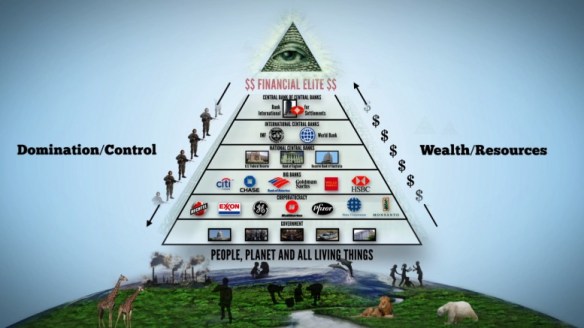
The Great Ponzi Scheme of the Global Economy

FollowTheMoney-Bank-Pyramid

By Michael Hudson and Chris Hedges

Source: CounterPunch

CHRIS HEDGES: We’re going to be discussing a great Ponzi scheme that not only defines not only the U.S. but the global economy, how we got there and where we’re going. And with me to discuss this issue is the economist Michael Hudson, author of Killing the Host: How Financial Parasites and Debt Destroy the Global Economy. A professor of economics who worked for many years on Wall Street, where you don’t succeed if you don’t grasp Marx’s dictum that capitalism is about exploitation. And he is also, I should mention, the godson of Leon Trotsky.

I want to open this discussion by reading a passage from your book, which I admire very much, which I think gets to the core of what you discuss. You write,

“Adam Smith long ago remarked that profits often are highest in nations going fastest to ruin. There are many ways to create economic suicide on a national level. The major way through history has been through indebting the economy. Debt always expands to reach a point where it cannot be paid by a large swathe of the economy. This is the point where austerity is imposed and ownership of wealth polarizes between the One Percent and the 99 Percent. Today is not the first time this has occurred in history. But it is the first time that running into debt has occurred deliberately.” Applauded. “As if most debtors can get rich by borrowing, not reduced to a condition of debt peonage.”

So let’s start with the classical economists, who certainly understood this. They were reacting of course to feudalism. And what happened to the study of economics so that it became gamed by ideologues?

HUDSON: The essence of classical economics was to reform industrial capitalism, to streamline it, and to free the European economies from the legacy of feudalism. The legacy of feudalism was landlords extracting land-rent, and living as a class that took income without producing anything. Also, banks that were not funding industry. The leading industrialists from James Watt, with his steam engine, to the railroads …

HEDGES: From your book you make the point that banks almost never funded industry.

HUDSON: That’s the point: They never have. By the time you got to Marx later in the 19th century, you had a discussion, largely in Germany, over how to make banks do something they did not do under feudalism. Right now we’re having the economic surplus being drained not by the landlords but also by banks and bondholders.

Adam Smith was very much against colonialism because that lead to wars, and wars led to public debt. He said the solution to prevent this financial class of bondholders burdening the economy by imposing more and more taxes on consumer goods every time they went to war was to finance wars on a pay-as-you-go basis. Instead of borrowing, you’d tax the people. Then, he thought, if everybody felt the burden of war in the form of paying taxes, they’d be against it. Well, it took all of the 19th century to fight for democracy and to extend the vote so that instead of landlords controlling Parliament and its law-making and tax system through the House of Lords, you’d extend the vote to labor, to women and everybody. The theory was that society as a whole would vote in its self-interest. It would vote for the 99 Percent, not for the One Percent.

By the time Marx wrote in the 1870s, he could see what was happening in Germany. German banks were trying to make money in conjunction with the government, by lending to heavy industry, largely to the military-industrial complex.

HEDGES: This was Bismarck’s kind of social – I don’t know what we’d call it. It was a form of capitalist socialism…

HUDSON: They called it State Capitalism. There was a long discussion by Engels, saying, wait a minute. We’re for Socialism. State Capitalism isn’t what we mean by socialism. There are two kinds of state-oriented–.

HEDGES: I’m going to interject that there was a kind of brilliance behind Bismarck’s policy because he created state pensions, he provided health benefits, and he directed banking toward industry, toward the industrialization of Germany which, as you point out, was very different in Britain and the United States.

HUDSON: German banking was so successful that by the time World War I broke out, there were discussions in English economic journals worrying that Germany and the Axis powers were going to win because their banks were more suited to fund industry. Without industry you can’t have really a military. But British banks only lent for foreign trade and for speculation. Their stock market was a hit-and-run operation. They wanted quick in-and-out profits, while German banks didn’t insist that their clients pay as much in dividends. German banks owned stocks as well as bonds, and there was much more of a mutual partnership.

That’s what most of the 19th century imagined was going to happen – that the world was on the way to socializing banking. And toward moving capitalism beyond the feudal level, getting rid of the landlord class, getting rid of the rent, getting rid of interest. It was going to be labor and capital, profits and wages, with profits being reinvested in more capital. You’d have an expansion of technology. By the early twentieth century most futurists imagined that we’d be living in a leisure economy by now.

HEDGES: Including Karl Marx.

HUDSON: That’s right. A ten-hour workweek. To Marx, socialism was to be an outgrowth of the reformed state of capitalism, as seemed likely at the time – if labor organized in its self-interest.

HEDGES: Isn’t what happened in large part because of the defeat of Germany in World War I? But also, because we took the understanding of economists like Adam Smith and maybe Keynes. I don’t know who you would blame for this, whether Ricardo or others, but we created a fictitious economic theory to praise a rentier or rent-derived, interest-derived capitalism that countered productive forces within the economy. Perhaps you can address that.

HUDSON: Here’s what happened. Marx traumatized classical economics by taking the concepts of Adam Smith and John Stuart Mill and others, and pushing them to their logical conclusion. Progressive capitalist advocates – Ricardian socialists such as John Stuart Mill – wanted to tax away the land or nationalize it. Marx wanted governments to take over heavy industry and build infrastructure to provide low-cost and ultimately free basic services. This was traumatizing the landlord class and the One Percent. And they fought back. They wanted to make everything part of “the market,” which functioned on credit supplied by them and paid rent to them.

None of the classical economists imagined how the feudal interests – these great vested interests that had all the land and money – actually would fight back and succeed. They thought that the future was going to belong to capital and labor. But by the late 19th century, certainly in America, people like John Bates Clark came out with a completely different theory, rejecting the classical economics of Adam Smith, the Physiocrats and John Stuart Mill.

HEDGES: Physiocrats are, you’ve tried to explain, the enlightened French economists.

HUDSON: The common denominator among all these classical economists was the distinction between earned income and unearned income. Unearned income was rent and interest. Earned incomes were wages and profits. But John Bates Clark came and said that there’s no such thing as unearned income. He said that the landlord actually earns his rent by taking the effort to provide a house and land to renters, while banks provide credit to earn their interest. Every kind of income is thus “earned,” and everybody earns their income. So everybody who accumulates wealth, by definition, according to his formulas, get rich by adding to what is now called Gross Domestic Product (GDP).

HEDGES: One of the points you make in Killing the Host which I liked was that in almost all cases, those who had the capacity to make money parasitically off interest and rent had either – if you go back to the origins – looted and seized the land by force, or inherited it.

HUDSON: That’s correct. In other words, their income is unearned. The result of this anti-classical revolution you had just before World War I was that today, almost all the economic growth in the last decade has gone to the One Percent. It’s gone to Wall Street, to real estate …

HEDGES: But you blame this on what you call Junk Economics.

HUDSON: Junk Economics is the anti-classical reaction.

HEDGES: Explain a little bit how, in essence, it’s a fictitious form of measuring the economy.

HUDSON: Well, some time ago I went to a bank, a block away from here – a Chase Manhattan bank – and I took out money from the teller. As I turned around and took a few steps, there were two pickpockets. One pushed me over and the other grabbed the money and ran out. The guard stood there and saw it. So I asked for the money back. I said, look, I was robbed in your bank, right inside. And they said, “Well, we don’t arm our guards because if they shot someone, the thief could sue us and we don’t want that.” They gave me an equivalent amount of money back.

Well, imagine if you count all this crime, all the money that’s taken, as an addition to GDP. Because now the crook has provided the service of not stabbing me. Or suppose somebody’s held up at an ATM machine and the robber says, “Your money or your life.” You say, “Okay, here’s my money.” The crook has given you the choice of your life. In a way that’s how the Gross National Product accounts are put up. It’s not so different from how Wall Street extracts money from the economy. Then also you have landlords extracting …

HEDGES: Let’s go back. They’re extracting money from the economy by debt peonage. By raising …

HUDSON: By not playing a productive role, basically.

HEDGES: Right. So it’s credit card interest, mortgage interest, car loans, student loans. That’s how they make their funds.

HUDSON: That’s right. Money is not a factor of production. But in order to have access to credit, in order to get money, in order to get an education, you have to pay the banks. At New York University here, for instance, they have Citibank. I think Citibank people were on the board of directors at NYU. You get the students, when they come here, to start at the local bank. And once you are in a bank and have monthly funds taken out of your account for electric utilities, or whatever, it’s very cumbersome to change.

So basically you have what the classical economists called the rentier class. The class that lives on economic rents. Landlords, monopolists charging more, and the banks. If you have a pharmaceutical company that raises the price of a drug from $12 a shot to $200 all of a sudden, their profits go up. Their increased price for the drug is counted in the national income accounts as if the economy is producing more. So all this presumed economic growth that has all been taken by the One Percent in the last ten years, and people say the economy is growing. But the economy isn’t growing …

HEDGES: Because it’s not reinvested.

HUDSON: That’s right. It’s not production, it’s not consumption. The wealth of the One Percent is obtained essentially by lending money to the 99 Percent and then charging interest on it, and recycling this interest at an exponentially growing rate.

HEDGES: And why is it important, as I think you point out in your book, that economic theory counts this rentier income as productive income? Explain why that’s important.

HUDSON: If you’re a rentier, you want to say that you earned your income by …

HEDGES: We’re talking about Goldman Sachs, by the way.

HUDSON: Yes, Goldman Sachs. The head of Goldman Sachs came out and said that Goldman Sachs workers are the most productive in the world. That’s why they’re paid what they are. The concept of productivity in America is income divided by labor. So if you’re Goldman Sachs and you pay yourself $20 million a year in salary and bonuses, you’re considered to have added $20 million to GDP, and that’s enormously productive. So we’re talking in a tautology. We’re talking with circular reasoning here.

So the issue is whether Goldman Sachs, Wall Street and predatory pharmaceutical firms, actually add “product” or whether they’re just exploiting other people. That’s why I used the word parasitism in my book’s title. People think of a parasite as simply taking money, taking blood out of a host or taking money out of the economy. But in nature it’s much more complicated. The parasite can’t simply come in and take something. First of all, it needs to numb the host. It has an enzyme so that the host doesn’t realize the parasite’s there. And then the parasites have another enzyme that takes over the host’s brain. It makes the host imagine that the parasite is part of its own body, actually part of itself and hence to be protected.

That’s basically what Wall Street has done. It depicts itself as part of the economy. Not as a wrapping around it, not as external to it, but actually the part that’s helping the body grow, and that actually is responsible for most of the growth. But in fact it’s the parasite that is taking over the growth.

The result is an inversion of classical economics. It turns Adam Smith upside down. It says what the classical economists said was unproductive – parasitism – actually is the real economy. And that the parasites are labor and industry that get in the way of what the parasite wants – which is to reproduce itself, not help the host, that is, labor and capital.

HEDGES: And then the classical economists like Adam Smith were quite clear that unless that rentier income, you know, the money made by things like hedge funds, was heavily taxed and put back into the economy, the economy would ultimately go into a kind of tailspin. And I think the example of that, which you point out in your book, is what’s happened in terms of large corporations with stock dividends and buybacks. And maybe you can explain that.

HUDSON: There’s an idea in superficial textbooks and the public media that if companies make a large profit, they make it by being productive. And with …

HEDGES: Which is still in textbooks, isn’t it?

HUDSON: Yes. And also that if a stock price goes up, you’re just capitalizing the profits – and the stock price reflects the productive role of the company. But that’s not what’s been happening in the last ten years. Just in the last two years, 92 percent of corporate profits in America have been spent either on buying back their own stock, or paid out as dividends to raise the price of the stock.

HEDGES: Explain why they do this.

HUDSON: About 15 years ago at Harvard, Professor Jensen said that the way to ensure that corporations are run most efficiently is to make the managers increase the price of the stock. So if you give the managers stock options, and you pay them not according to how much they’re producing or making the company bigger, or expanding production, but the price of the stock, then you’ll have the corporation run efficiently, financial style.

So the corporate managers find there are two ways that they can increase the price of the stock. The first thing is to cut back long-term investment, and use the money instead to buy back their own stock. But when you buy your own stock, that means you’re not putting the money into capital formation. You’re not building new factories. You’re not hiring more labor. You can actually increase the stock price by firing labor.

HEDGES: That strategy only works temporarily.

HUDSON: Temporarily. By using the income from past investments just to buy back stock, fire the labor force if you can, and work it more intensively. Pay it out as dividends. That basically is the corporate raider’s model. You use the money to pay off the junk bond holders at high interest. And of course, this gets the company in trouble after a while, because there is no new investment.

So markets shrink. You then go to the labor unions and say, gee, this company’s near bankruptcy, and we don’t want to have to fire you. The way that you can keep your job is if we downgrade your pensions. Instead of giving you what we promised, the defined benefit pension, we’ll turn it into a defined contribution plan. You know what you pay every month, but you don’t know what’s going to come out. Or, you wipe out the pension fund, push it on to the government’s Pension Benefit Guarantee Corporation, and use the money that you were going to pay for pensions to pay stock dividends. By then the whole economy is turning down. It’s hollowed out. It shrinks and collapses. But by that time the managers will have left the company. They will have taken their bonuses and salaries and run.

HEDGES: I want to read this quote from your book, written by David Harvey, in A Brief History of Neoliberalism, and have you comment on it.

“The main substantive achievement of neoliberalism has been to redistribute rather than to generate wealth and income. [By] ‘accumulation by dispossession’ I mean … the commodification and privatization of land, and the forceful expulsion of peasant populations; conversion of various forms of property rights (common collective state, etc.) into exclusive private property rights; suppression of rights to the commons; … colonial, neocolonial, and the imperial processes of appropriation of assets (including natural resources); … and usury, the national debt and, most devastating at all, the use of the credit system as a radical means of accumulation by dispossession. … To this list of mechanisms, we may now add a raft of techniques such as the extraction of rents from patents, and intellectual property rights (such as the diminution or erasure of various forms of common property rights, such as state pensions, paid vacations, and access to education, health care) one through a generation or more of class struggle. The proposal to privatize all state pension rights, pioneered in Chile under the dictatorship is, for example, one of the cherished objectives of the Republicans in the US.”

This explains the denouement. The final end result you speak about in your book is, in essence, allowing what you call the rentier or the speculative class to cannibalize the entire society until it collapses.

HUDSON: A property right is not a factor of production. Look at what happened in Chicago, the city where I grew up. Chicago didn’t want to raise taxes on real estate, especially on its expensive commercial real estate. So its budget ran a deficit. They needed money to pay the bondholders, so they sold off the parking rights to have meters – you know, along the curbs. The result is that they sold to Goldman Sachs 75 years of the right to put up parking meters. So now the cost of living and doing business in Chicago is raised by having to pay the parking meters. If Chicago is going to have a parade and block off traffic, it has to pay Goldman Sachs what the firm would have made if the streets wouldn’t have been closed off for a parade. All of a sudden it’s much more expensive to live in Chicago because of this.

But this added expense of having to pay parking rights to Goldman Sachs – to pay out interest to its bondholders – is counted as an increase in GDP, because you’ve created more product simply by charging more. If you sell off a road, a government or local road, and you put up a toll booth and make it into a toll road, all of a sudden GDP goes up.

If you go to war abroad, and you spend more money on the military-industrial complex, all this is counted as increased production. None of this is really part of the production system of the capital and labor building more factories and producing more things that people need to live and do business. All of this is overhead. But there’s no distinction between wealth and overhead.

Failing to draw that distinction means that the host doesn’t realize that there is a parasite there. The host economy, the industrial economy, doesn’t realize what the industrialists realized in the 19th century: If you want to be an efficient economy and be low-priced and under-sell competitors, you have to cut your prices by having the public sector provide roads freely. Medical care freely. Education freely.

If you charge for all of these, you get to the point that the U.S. economy is in today. What if American factory workers were to get all of their consumer goods for nothing. All their food, transportation, clothing, furniture, everything for nothing. They still couldn’t compete with Asians or other producers, because they have to pay up to 43% of their income for rent or mortgage interest, 10% or more of their income for student loans, credit card debt. 15% of their paycheck is automatic withholding to pay Social Security, to cut taxes on the rich or to pay for medical care.

So Americans built into the economy all this overhead. There’s no distinction between growth and overhead. It’s all made America so high-priced that we’re priced out of the market, regardless of what trade policy we have.

HEDGES: We should add that under this predatory form of economics, you game the system. So you privatize pension funds, you force them into the stock market, an overinflated stock market. But because of the way companies go public, it’s the hedge fund managers who profit. And it’s those citizens whose retirement savings are tied to the stock market who lose. Maybe we can just conclude by talking about how the system is fixed, not only in terms of burdening the citizen with debt peonage, but by forcing them into the market to fleece them again.

HUDSON: Well, we talk about an innovation economy as if that makes money. Suppose you have an innovation and a company goes public. They go to Goldman Sachs and other Wall Street investment banks to underwrite the stock to issue it at $40 a share. What’s considered a successful float is when, immediately, Goldman and the others will go to their insiders and tell them to buy this stock and make a quick killing. A “successful” flotation doubles the price in one day, so that at the end of the day the stock’s selling for $80.

HEDGES: They have the option to buy it before anyone else, knowing that by the end of the day it’ll be inflated, and then they sell it off.

HUDSON: That’s exactly right.

HEDGES: So the pension funds come in and buy it at an inflated price, and then it goes back down.

HUDSON: It may go back down, or it may be that the company just was shortchanged from the very beginning. The important thing is that the Wall Street underwriting firm, and the speculators it rounds up, get more in a single day than all the years it took to put the company together. The company gets $40. And the banks and their crony speculators also get $40.

So basically you have the financial sector ending up with much more of the gains. The name of the game if you’re on Wall Street isn’t profits. It’s capital gains. And that’s something that wasn’t even part of classical economics. They didn’t anticipate that the price of assets would go up for any other reason than earning more money and capitalizing on income. But what you have had in the last 50 years – really since World War II – has been asset-price inflation. Most middle-class families have gotten the wealth that they’ve got since 1945 not really by saving what they’ve earned by working, but by the price of their house going up. They’ve benefited by the price of the house. And they think that that’s made them rich and the whole economy rich.

The reason the price of housing has gone up is that a house is worth whatever a bank is going to lend against it. If banks made easier and easier credit, lower down payments, then you’re going to have a financial bubble. And now, you have real estate having gone up as high as it can. I don’t think it can take more than 43% of somebody’s income to buy it. But now, imagine if you’re joining the labor force. You’re not going to be able to buy a house at today’s prices, putting down a little bit of your money, and then somehow end up getting rich just on the house investment. All of this money you pay the bank is now going to be subtracted from the amount of money that you have available to spend on goods and services.

So we’ve turned the post-war economy that made America prosperous and rich inside out. Somehow most people believed they could get rich by going into debt to borrow assets that were going to rise in price. But you can’t get rich, ultimately, by going into debt. In the end the creditors always win. That’s why every society since Sumer and Babylonia have had to either cancel the debts, or you come to a society like Rome that didn’t cancel the debts, and then you have a dark age. Everything collapses.


Michael Hudson’s new book, Killing the Host is published in e-format by CounterPunch Books and in print by Islet. He can be reached via his website, mh@michael-hudson.com. Chris Hedges’s latest book is Days of Destruction, Days of Revolt, illustrated by Joe Sacco.

The Rise of the Corporatocracy

‘Stop Drinking the Kool-Aid, America: Political Fiction in an Age of Televised Lies’

20120527040549-stop-drinking-kool-aid

By John W. Whitehead

Source: A Government of Wolves

“We’ve got to face it. Politics have entered a new stage, the television stage. Instead of long-winded public debates, the people want capsule slogans—‘Time for a change’—‘The mess in Washington’—‘More bang for a buck’—punch lines and glamour.”— A Face in the Crowd (1957)

Politics is entertainment.

It is a heavily scripted, tightly choreographed, star-studded, ratings-driven, mass-marketed, costly exercise in how to sell a product—in this case, a presidential candidate—to dazzled consumers who will choose image over substance almost every time.

This year’s presidential election, much like every other election in recent years, is what historian Daniel Boorstin referred to as a “pseudo-event”: manufactured, contrived, confected and devoid of any intrinsic value save the value of being advertised. It is the end result of a culture that is moving away from substance toward sensationalism in an era of mass media.

As author Noam Chomsky rightly observed, “It is important to bear in mind that political campaigns are designed by the same people who sell toothpaste and cars.” In other words, we’re being sold a carefully crafted product by a monied elite who are masters in the art of making the public believe that they need exactly what is being sold to them, whether it’s the latest high-tech gadget, the hottest toy, or the most charismatic politician.

Tune into a political convention and you will find yourself being sucked into an alternate reality so glossy, star-studded, emotionally charged and entertaining as to make you forget that you live in a police state. The elaborate stage show, the costumes, the actors, the screenplay, the lighting, the music, the drama: all carefully calibrated to appeal to the public’s need for bread and circuses, diversion and entertainment, and pomp and circumstance.

Politics is a reality show, America’s favorite form of entertainment, dominated by money and profit, imagery and spin, hype and personality and guaranteed to ensure that nothing in the way of real truth reaches the populace.

After all, who cares about police shootings, drone killings, SWAT team raids, asset forfeiture schemes, private prisons, school-to-prison pipelines, overcriminalization, censorship or any of the other evils that plague our nation when you can listen to the croonings of Paul Simon, laugh along with Sarah Silverman, and get misty-eyed over the First Lady’s vision of progress in America.

But make no mistake: Americans only think they’re choosing the next president.

In truth, however, they’re engaging in the illusion of participation culminating in the reassurance ritual of voting. It’s just another Blue Pill, a manufactured reality conjured up by the matrix in order to keep the populace compliant and convinced that their vote counts and that they still have some influence over the political process.

Stop drinking the Kool-Aid, America.

The nation is drowning in debt, crippled by a slowing economy, overrun by militarized police, swarming with surveillance, besieged by endless wars and a military industrial complex intent on starting new ones, and riddled with corrupt politicians at every level of government. All the while, we’re arguing over which corporate puppet will be given the honor of stealing our money, invading our privacy, abusing our trust, undermining our freedoms, and shackling us with debt and misery for years to come.

Nothing taking place on Election Day will alleviate the suffering of the American people.

The government as we have come to know it—corrupt, bloated and controlled by big-money corporations, lobbyists and special interest groups—will remain unchanged. And “we the people”—overtaxed, overpoliced, overburdened by big government, underrepresented by those who should speak for us and blissfully ignorant of the prison walls closing in on us—will continue to trudge along a path of misery.

With roughly 22 lobbyists per Congressman, corporate greed will continue to call the shots in the nation’s capital, while our elected representatives will grow richer and the people poorer. And elections will continue to be driven by war chests and corporate benefactors rather than such values as honesty, integrity and public service. Just consider: it’s estimated that more than $5 billion will be spent on the elections this year, yet not a dime of that money will actually help the average American in their day-to-day struggles to just get by.

And the military industrial complex will continue to bleed us dry. Since 2001 Americans have spent $10.5 million every hour for numerous foreign military occupations, including in Iraq and Afghanistan. There’s also the $2.2 million spent every hour on maintaining the United States’ nuclear stockpile, and the $35,000 spent every hour to produce and maintain our collection of Tomahawk missiles. And then there’s the money the government exports to other countries to support their arsenals, at the cost of $1.61 million every hour for the American taxpayers.

Then again, when faced with the grim, seemingly hopeless reality of the American police state, it’s understandable why Americans might opt for escapism. “Humankind cannot bear too much reality,” T. S. Eliot once said. Perhaps that is one reason we are so drawn to the unreality of the American political experience: it is spectacle and fiction and farce all rolled up into one glossy dose of escapism.

Frankly, escapism or not, Americans should be mad as hell.

Many of our politicians live like kings. Chauffeured around in limousines, flying in private jets and eating gourmet meals, all paid for by the American taxpayer, they are far removed from those they represent. Such a luxurious lifestyle makes it difficult to identify with the “little guy”—the roofers, plumbers and blue-collar workers who live from paycheck to paycheck and keep the country running with their hard-earned dollars and the sweat of their brows.

Conveniently, politicians only seem to remember their constituents in the months leading up to an election, and yet “we the people” continue to take the abuse, the neglect, the corruption and the lies. We make excuses for the shoddy treatment, we cover up for them when they cheat on us, and we keep hoping that if we just stick with them long enough, eventually they’ll treat us right.

People get the government they deserve.

No matter who wins the presidential election come November, it’s a sure bet that the losers will be the American people.

As political science professor Gene Sharp notes in starker terms, “Dictators are not in the business of allowing elections that could remove them from their thrones.” As I make clear in my book Battlefield America: The War on the American People, the Establishment—the shadow government and its corporate partners that really run the show, pull the strings and dictate the policies, no matter who occupies the Oval Office—are not going to allow anyone to take office who will unravel their power structures. Those who have attempted to do so in the past have been effectively put out of commission.

So what is the solution to this blatant display of imperial elitism disguising itself as a populist exercise in representative government?

Stop playing the game. Stop supporting the system. Stop defending the insanity. Just stop.

Washington thrives on money, so stop giving them your money. Stop throwing your hard-earned dollars away on politicians and Super PACs who view you as nothing more than a means to an end. There are countless worthy grassroots organizations and nonprofits working in your community to address real needs like injustice, poverty, homelessness, etc. Support them and you’ll see change you really can believe in in your own backyard.

Politicians depend on votes, so stop giving them your vote unless they have a proven track record of listening to their constituents, abiding by their wishes and working hard to earn and keep their trust.

Stop buying into the lie that your vote matters. Your vote doesn’t elect a president. Despite the fact that there are 218 million eligible voters in this country (only half of whom actually vote), it is the electoral college, made up of 538 individuals handpicked by the candidates’ respective parties, that actually selects the next president. The only thing you’re accomplishing by taking part in the “reassurance ritual” of voting is sustaining the illusion that we have a democratic republic. What we have is a dictatorship, or as political scientists Martin Gilens and Benjamin Page more accurately term it, we are suffering from an “economic élite domination.”

A healthy, representative government is hard work. It takes a citizenry that is informed about the issues, educated about how the government operates, and willing to make the sacrifices necessary to stay involved, whether that means forgoing Monday night football in order to attend a city council meeting or risking arrest by picketing in front of a politician’s office.

It takes a citizenry willing to do more than grouse and complain. We must act—and act responsibly—keeping in mind that the duties of citizenship extend beyond the act of voting.

Most of all, it takes a citizenry that cares enough to get mad and get active. As Howard Beale declares in the 1976 film Network:

“I want you to get up right now, sit up, go to your windows, open them and stick your head out and yell, ‘I’m as mad as hell and I’m not going to take this anymore.’ Things have got to change. But first, you’ve gotta get mad!…You’ve got to say, ‘I’m as mad as hell, and I’m not going to take this anymore!’ Then we’ll figure out what to do about the depression and the inflation and the oil crisis. But first get up out of your chairs, open the window, stick your head out, and yell, and say it.”


Wikileaks Emails Bring New Attention to Hillary Victory Fund “Money Laundering” Charges

index

By Pam Martens and Russ Martens

Source: Wall Street on Parade

The problem with conspiracy theorists is that, quite frequently, the theorists lack adequate imagination. That seems to be the case when it comes to the Democratic National Committee’s behind-the-scenes machinations to muscle Hillary Clinton into the White House while plotting against her main challenger, Bernie Sanders. That conclusion stems from the trove of 20,000 DNC emails dumped into the public sphere by Wikileaks last Friday.

The leaked emails have cost Debbie Wasserman Schultz her job as Chair of the DNC but other top DNC officials captured in devious plots against Sanders in the email exchanges still have their jobs – or at least no official firings have been announced. This makes the conspiracies seem more like a DNC business model.

The DNC’s own charter demands that it treat all Democratic primary candidates fairly and impartially, but top DNC officials made a mockery of that mandate. In addition to conjuring up ways to smear Clinton challenger Bernie Sanders during the primary battles, the leaked emails show a coordinated effort to cover up what the Sanders camp called “money laundering” between the Hillary Victory Fund and the DNC.

Despite the fact that the Sanders campaign had no such active arrangement with the DNC, the DNC agreed to participate in the Hillary Victory Fund, a joint fundraising committee that sluiced money to both Hillary’s main candidate committee, Hillary for America, as well as into the DNC. To a much tinier degree, funds also went to dozens of separate State Democratic committees.

On May 2 of this year, the Sanders campaign released a statement charging Clinton with “looting funds meant for the state parties to skirt fundraising limits on her presidential campaign,” and exploiting “the rules in ways that let her high-dollar donors like Alice Walton of Wal-Mart fame and the actor George Clooney and his super-rich Hollywood friends skirt legal limits on campaign contributions.”

Despite Clinton’s promise to rein in tax dodges by hedge funds, Wall Street On Parade reported in April that major hedge fund titans were also big donors to the Hillary Victory Fund. We wrote at the time:

“Federal Election Commission records show that S. Donald Sussman, founder of hedge fund Paloma Partners, gave $343,400 to the Hillary Victory Fund while also donating $2.5 million to Priorities USA, the Super Pac supporting Hillary. Hedge Fund billionaire George Soros donated $343,400 to the Hillary Victory Fund while sluicing a whopping $7 million into Priorities USA to enhance Hillary’s efforts to move into the Oval Office.”

Today, reporters Ken Vogel and Isaac Arnsdorf of Politico have provided significant new details from the leaked emails to show how the DNC worked behind the scenes to control the media’s handling of revelations involving the Hillary Victory Fund.

Vogel was criticized by some media outlets when the Wikileaks emails revealed he had allowed a DNC official to review one of his articles critical of the joint fundraising operation prior to publication. Erik Wemple of the Washington Post has provided some necessary clarity to that issue here.

The Clinton camp and the DNC had attempted publicly to defend the joint fundraising operation as providing critical help to State Committees in order to help down-ticket candidates. But today, Vogel and Arnsdorf report the following:

“Between the creation of the victory fund in September and the end of last month, the fund had brought in $142 million, the lion’s share of which — 44 percent — has wound up in the coffers of the DNC ($24.4 million) and Hillary for America ($37.6 million), according to a POLITICO analysis of FEC filings. By comparison, the analysis found that the state parties have kept less than $800,000 of all the cash brought in by the committee — or only 0.56 percent.”

Vogel and Arnsdorf also detail how the DNC attempted to stonewall reporters on the topic, writing:

“The emails show the officials agreeing to withhold information from reporters about the Hillary Victory Fund’s allocation formula, working to align their stories about when — or if — the DNC had begun funding coordinated campaign committees with the states.”

The Politico reporters also note that Hillary Clinton’s campaign attorney, Marc Elias of law firm Perkins Coie, also appears in a Wikileaks email suggesting media strategy to the DNC:

“ ‘The DNC should push back DIRECTLY at Sanders and say that what he is saying is false and harmful to the Democratic party,’ Marc Elias, an attorney who advises the DNC and the Clinton campaign, wrote in an email to DNC officials. [DNC] CEO Amy Dacey responded ‘I do think there is too much of this narrative out there — I also worry since they are emailing to their list (which has overlap with ours!)’

“In another email, Miranda, the [DNC] communications director, suggested that the campaign tell other journalists seeking to follow POLITICO’s story that “Politico got it wrong.” But the rest of his email failed to indicate any errors in POLITICO’s story, nor did the DNC or the Clinton campaign seek a correction.”

Politico’s latest revelations build on the allegations in the class action lawsuit that has been filed against the DNC and Wasserman Schultz by Sanders’ supporters. One document submitted in that lawsuit came from a previous hack of the DNC server by an individual known as Guccifer 2.0. That document shows that even after Bernie Sanders had announced he was entering the race on April 30, 2015, the DNC was brainstorming on how it could advance Hillary Clinton to the top of the ticket. The memo is described as follows in the lawsuit:

“Among the documents released by Guccifer 2.0 on June 15th is a two-page Microsoft Word file with a ‘Confidential’ watermark that appears to be a memorandum written to the Democratic National Committee regarding ‘2016 GOP presidential candidates’ and dated May 26, 2015. A true and correct copy of this document (hereinafter, ‘DNC Memo’) is attached as Exhibit 1. The DNC Memo presents, ‘a suggested strategy for positioning and public messaging around the 2016 Republican presidential field.’ It states that, ‘Our goals in the coming months will be to frame the Republican field and the eventual nominee early and to provide a contrast between the GOP field and HRC.’ [HRC means Hillary Rodham Clinton.] The DNC Memo also advises that the DNC, ‘[u]se specific hits to muddy the waters around ethics, transparency and campaign finance attacks on HRC.’ In order to ‘muddy the waters’ around Clinton’s perceived vulnerabilities, the DNC Memo suggests ‘several different methods’ of attack including: (a) ‘[w]orking through the DNC’ to ‘utilize reporters’ and create stories in the media ‘with no fingerprints’; (b) ‘prep[ping]’ reporters for interviews with GOP candidates and having off-the-record conversations with them; (c) making use of social media attacks; and (d) using the DNC to ‘insert our messaging’ into Republican-favorable press.” [Read the full memorandum here.]

The response to all of this from Hillary Clinton has further enraged Sanders’ supporters. After the emails were leaked and written about in the media over the weekend, Hillary Clinton made Wasserman Schultz the honorary chairperson of her 50-state program and President Obama praised Wasserman Schultz in a statement that can only be described as bizarre, given the contents of the leaked emails. Obama said on Sunday:

“For the last eight years, Chairwoman Debbie Wasserman Schultz has had my back. This afternoon, I called her to let her know that I am grateful. Her leadership of the DNC has meant that we had someone who brought Democrats together not just for my re-election campaign, but for accomplishing the shared goals we have had for our country.”

Apparently, missing from those “shared goals” is allowing a fair primary process within the Democratic party or a challenge to the political machine that controls Washington.


Related Article: IRS Will Investigate Clinton Foundation ‘Pay-to-Play’ Corruption Accusations

Proving She Can Do Anything She Wants, Clinton Hires Disgraced DNC Chair for Own Campaign

1107afterforum1

By Clair Bernish

Source: The Free Thought Project

A spectacular implosion has beset the Democratic Party following the Wikileaks release of memos and emails proving, well, just about every accusation from independent media and Sanders supporters made throughout the past year — many of which had been mocked publicly as conspiracies by party insiders.

In the latest jaw-dropper over the nearly 20,000-document leak deserving of the title, DNC-Gate, already-loathed Democratic National Committee Chair Debbie Wasserman Schultz — shamed into resignation from decisive evidence of party collusion with corporate presstitutes against Sanders, among multiple other once-conspiracies — has been dutifully scooped up in an act of mordant hubris by none other than her teflon idol, Hillary Clinton.

“There’s simply no one better at taking the fight to the Republicans than Debbie,” Clinton pontificated on her loyal lackey, “which is why I am glad that she has agreed to serve as honorary chair of my campaign’s 50-state program to gain ground and elect Democrats Robby Mooin every part of the country, and will continue to serve as a surrogate for my campaign nationally, in Florida, and in other states.”

Yes, the former secretary of state did, in fact, say exactly what Sanders’ adherents, Republicans, and responsible journalists have been screaming about for months — Wasserman Schultz will continue to serve as a Clinton campaign proxy.

At least one thing is too patently obvious to warrant Clinton-esque deception.

As the daytime drama cum reality show now masquerading as the Democratic Party kicks off its convention in Philadelphia today, complete with tens of thousands of protesters of every stripe, Bernie Sanders issued a statement praising Wasserman Schultz’ scandal-tinged resignation.

“Debbie Wasserman Schultz has made the right decision for the future of the Democratic Party,” the Guardian quoted Sanders, adding party leaders must “always remain impartial in the presidential nominating process, something which did not occur in the 2016 race.”

Such moralizing, however, glistens only with a gilded glint given Sanders’ refusal to withdraw support for the establishment monarch, Hillary Clinton — in fact, the choice to remain loyal in the face of staggering coordination against his own campaign only lends credence to widely-held suspicions he’d been sheepdogging for Hillary for the duration. For Sanders to continue to plead fealty to the party whose insiders secretly denigrated his faith, derided his ardent supporters, and unscrupulously plotted his downfall either betrays his surreptitious role as longstanding Hillary shill, or denotes an ethically-void capitulation to the manufacturers of his demise.

Rendered effectively moot by both the DNC-Clinton alliance and his own lackluster lack of retort, Sanders’ affirmation of Wasserman Schultz’ rightful, humiliating self-removal from the helm merited little more than a footnote in the party’s bizarre damage-control scramble on the eve of its quadrennial main event.

In an apparent attempt to besmirch the legitimacy of the massive document drop — and distract from the telling contents — DNC officials proffered a ridiculous Russian red herring.

“Mrs. Clinton’s campaign manager, Robby Mook, argued on ABC’s ‘This Week’ that the emails were leaked ‘by the Russians for the purpose of helping Donald Trump’ citing ‘experts’ but offering no other evidence,” the New York Times reported. “Mr. Mook also suggested that the Russians might have good reason to support Mr. Trump: The Republican nominee indicated in an interview with The New York Times last week that he might not back NATO nations if they came under attack from Russia — unless he was first convinced that the countries had made sufficient contributions to the Atlantic alliance.”

Mook only slightly elaborated on this gelastic allegation for CNN, stating:

“What’s disturbing to us is that experts are telling us Russian state actors broke into the DNC, stole these emails, and other experts are now saying that the Russians are releasing these emails for the purpose of actually helping Donald Trump.”

He added, “I don’t think it’s coincidental that these emails are being released on the eve of our convention here” in Philadelphia.

Though Mook unsurprisingly failed to provide even a smidgen of evidence — much less names — to back up his claim, apparently the public should rest assured, because, he promised humorlessly:

“This isn’t my assertion. This is what experts are telling us.”

In echo-chamber support of this theoretical Russian plot — which the Trump camp and others have written off to absurd musings of an unraveling party — the Clinton campaign attested in a statement cited by the Guardian:

“This is further evidence the Russian government is trying to influence the outcome of the election.”

A similar accusation of Russian infiltration, dutifully parroted by corporate media in June, cited nameless, unverified DNC and U.S. ‘officials’ and anonymous ‘security experts’ claiming “Russian government hackers” penetrated the DNC’s network and, reported the Washington Post, had “so thoroughly compromised the DNC’s system that they were able to read all email and chat traffic.”

Of course, Russian officials wholly denied the claim, offering a far more sound explanation for the breach:

“Usually these kinds of leaks take place not because hackers broke in, but, as any professional will tell you, because someone simply forgot the password or set the simple password 123456,” mused President Putin’s top Internet advisor, German Kimeko, according to RIA Novosti state news agency cited by the Post. “Well, it’s always simpler to explain this away as the intrigues of enemies, rather than one’s own incompetence.”

Floundering under the weight of leaks revealing its slavish devotion to Clinton and inability to remain neutral while mendaciously claiming the contrary throughout the election season, the DNC might have effectively swindled a rift so broad as to be insurmountable.

As the convention gets underway, Sanders delegates and protesters might be sufficiently enraged to splinter from the Democratic Party so blatantly servile to its establishment darling against the conspicuous will of the people — with or without support from their populist hero, Bernie Sanders, himself.

Hillary Clinton’s Email Absolution: Two Parties, One Criminal Regime

1015636467

By Eric Draitser

Source: StopImperialism.org

What was your reaction when you heard FBI Director James Comey announce to the world that the Bureau would not be recommending that charges be filed against Hillary Clinton over her handling of emails while she was Secretary of State?  Did you do a humorous spit take with your coffee like some modern day Danny Thomas?  Were you frozen in place like Americans were on November 22, 1963?  Did your jaw hit the floor with your tongue rolling out like a flabbergasted cartoon character?

Chances are you weren’t the least bit surprised that no charges were recommended.  But what does that tell you about our political system?

That millions of Americans weren’t remotely caught off guard by the exculpation of Hillary Clinton is less a commentary about American attitudes than it is a clear indication of the all-pervasive criminality that is at the heart of America’s political ruling class.  And the fact that such criminality is seen as par for the course demonstrates once again that the rule of law is more a rhetorical veneer than a juridical reality.

But consider further what the developments of recent days tell us both about the US and, perhaps even more importantly, the perception of the US internationally. For while Washington consistently wields as weapons political abstractions such as transparency, corruption, and freedom, it is unwilling to apply to itself those same cornerstones of America’s collective self-conception. Hypocrisy is perhaps not strong enough a word.

Not Even Hiding It Anymore…    

Remember the good old days when corrupt politicians committed their crimes in smoke-filled rooms, making handshake deals in quiet corners of luxury hotel suites or over lobster at five star restaurants? Those things certainly still happen, but the transgressions, like all things, seem to have lost a bit of their classiness. It may not be the Plaza Hotel, but the Phoenix airport was no less a scene of wanton lawlessness and impropriety when former President, and soon to be First Gentleman, Bill Clinton met privately with Attorney General Loretta Lynch.

The meeting, which only came to light thanks to the work of local ABC15 morning anchor Christopher Sign, has been widely criticized by pundits and legal experts from both sides of the political spectrum.  Naturally, questions about impropriety, and potential illegal tampering in a federal investigation, were immediately raised once the meeting was made public.  Of course, nothing was done to alleviate any of those concerns, calling into question the very impartiality of the investigation.

But the larger story has to do with symbolic message being sent by the meeting.  Specifically, there is one set of laws for American citizens, and an entirely different set of laws for political elites like the Clintons.

Moreover, there’s more to it than just criminality.  There is the air of superiority which oozes from every action taken by the Clintons who have made hundreds of millions of dollars unscrupulously pandering to, and serving the interests of, the financial elite of Wall Street and the corporate oligarchy.  That feeling of invincibility is what drives someone like Bill Clinton to demand that the FBI surrounding him at the Phoenix airport dictate to bystanders that there are to be “no photos, no pictures, no cell phones.”  To make such a demand is to see oneself as above the law, above the First Amendment, above the plebs, as it were.

And this sort of behavior is what we’ve come to expect from the Clintons.  Who can forget the seemingly endless rap sheet that the dynamic Democrat duo has earned over the decades?  The Whitewater Scandal, in many ways a template for the Clinton email scandal, involved shady business practices and political insider dealing by the Clintons and their real estate developer cronies.  And, like the email scandal, Whitewater was an example of the Clintons deliberately destroying records that likely implicate them in very serious crimes.

As the New York Times reported in 1992, “The Clintons and Mr. McDougal disagree about what happened to Whitewater’s records. Mr. McDougal says that at Mr. Clinton’s request they were delivered to the Governor’s mansion. The Clintons say many of them have disappeared. Many questions about the enterprise cannot be fully answered without the records.”

So it seems the Clintons have this nasty habit of committing crimes and then destroying the records of those crimes and claiming complete ignorance about what happened.  For you and me, such a flimsy excuse would go over like a lead balloon, likely leading to jail time.  For the Clintons, the controversy quietly fades away and slips down the memory hole.

And then of course there’s the mysterious death of Deputy White House Counsel Vince Foster, the man who filed three years of delinquent Whitewater corporate tax returns, and then was subsequently found dead a month later.  While his death was officially ruled a suicide, the serendipitous development for the Clintons led to speculation that Foster was killed on the order of the Clintons in order to silence a potentially damning source of information about Clinton misdeeds.

Indeed, some claim that evidence exists that Foster was in fact murdered, including the statements from one of the lead prosecutors investigating the death, Miguel Rodriguez, who claims that photos showed a gunshot wound on Foster’s neck, a wound that was not mentioned in the official report.  Whether true or not, the speculation about the Clintons’ involvement in a political assassination has only grown.

But of course there are so many more scandals it’s hard to keep count.  From appointments of Clinton Foundation donors to key State Department positions in a sort of “pay for play” scheme, to the salaries paid to people like Hillary’s Deputy Chief of Staff Huma Abedin who, while working for the State Department, alsoworked for Teneo, a consulting firm run by another close Clinton crony.  And who could forget the Clinton Foundation and the myriad conflict of interest issues, lack of transparency, and outright criminality associated with it?

This article would go on for tens of thousands more words were it to chronicle all of Clinton’s scandals.  But the true focus here is not even simply on Clinton crimes, but rather on the culture of corruption and lawlessness that exists unfettered in Washington; it is the endemic corruption that the Clintons represent, perhaps better than anyone.

Corruption and Malfeasance: As American as Apple Pie

It is difficult to encapsulate in a few short paragraphs the multi-layered forms of corruption that are embedded in the very fabric of America’s political culture. Perhaps it could be best separated into three distinct, though interrelated, categories: the open door, the closed door, and the revolving door.

The open door of corruption and criminality represents the kind of wrongdoing that takes place out in the open, in full view of the public, but which is treated as anything but criminal.  Whether it be lying the US into wars of aggression – the Iraq War was based on lies about weapons of mass destruction, the war on Libya was sold on the pretext of lies about civilians being murdered by the government – or simply the obviously corrupt form of campaign financing that allows Wall Street and the corporate elites to bankroll the alleged “democracy” that the US so proudly proselytizes the world over; these forms of corruption and criminality are in many ways the bedrock of American politics.

As the International Military Tribunal at Nuremberg famously stated, “To initiate a war of aggression…is not only an international crime; it is the supreme international crime, differing only from other war crimes in that it contains within itself the accumulated evil of the whole.” By this very definition, every political leader in the US going back decades is guilty of war crimes.

Going further, one can draw on the legacy of Franklin Roosevelt who, in a now legendary speech at Madison Square Garden in 1936, unequivocally proclaimed:

We had to struggle with the old enemies of peace–business and financial monopoly, speculation, reckless banking, class antagonism, sectionalism, war profiteering. They had begun to consider the Government of the United States as a mere appendage to their own affairs. We know now that Government by organized money is just as dangerous as Government by organized mob. Never before in all our history have these forces been so united against one candidate as they stand today. They are unanimous in their hate for me–and I welcome their hatred.

But today, rather than welcoming the hatred of Wall Street and the corporate oligarchy, America’s politicians pander to them, grovel before them, kiss their rings in hopes of securing for themselves a financially and professionally lucrative future. So deep is the rot that most Americans passively accept this as business as usual, failing to understand that it is anything but acceptable.

The closed door forms of criminality are often completely concealed from public view, and what does become known is only thanks to courageous actions by reporters and whistleblowers.  Take for instance the activities of the CIA, only a fraction of which were exposed by the Church and Pike Committees, which included obviously criminal activities ranging from the overthrow of governments to assassination of political leaders to domestic spying and propaganda, all of which being blatantly illegal.

But the closed door also conceals the activities of prominent political figures such as Hillary Clinton, whosesecret lobbying for things like right wing coup governments in Honduras, shows the degree to which politicians literally conspire in secret.  Clinton, like so many of her colleagues, also grovels at the feet of Wall Street financiers, including taking massive payoffs for speeches with the tacit wink-wink-nudge-nudge that goes along with them.

Finally, the revolving door is one of the shining examples of America’s political corruption, or perhaps better put, complete subservience to the corporate oligarchy.  When key government officials leave public life and head to that oft-lionized “private sector,” what they are actually providing is access – access to government for corporations and capital.

When the head of the Centers for Disease Control (CDC) leaves her government post and takes a job as President of Merck & Co. Inc’s vaccine division, no one bats an eye.

When the architect of Obamacare, who before working on the health plan was an executive at one of the nation’s largest health insurance providers, leaves her government job and takes a position with Johnson & Johnson’s government affairs and policy group, it garners barely a passing comment.

When Wall Street executives take positions at head of the Treasury Department – Tim Geithner and Hank Paulsen both worked for Goldman Sachs, as just one example – it is simply “the way things are.”  This revolving door form of political corruption may not be anything new, but it is so rarely defined as corruption.  But that’s exactly what it is.

However, none of this prevents Washington from publicly admonishing other countries for their corruption problems.  Russia? Zimbabwe? Venezuela? China? Nigeria? All corrupt.  United States? Well, er, ummm…Democracy! Freedom!  This is the sort of reflexive hypocrisy that typifies American exceptionalism or, as the rest of the world might call it, the arrogance of empire.


Related Podcast:

Progressive Commentary Hour – 7.19.16