The Fourth Turn, Turn, Turn

By Charles Hugh Smith

Source: Of Two Minds

The cycles of The Fourth Turning, Fischer and Turchin are all in alignment at this point in history..

The 1997 book The Fourth Turning: An American Prophecy proposed a cyclical pattern of four 20-year generations which culminate in a national crisis every 80 years. The book identifies these dates as Fourth Turnings: 1781 (Revolutionary War), 1861 (Civil War) and 1941 (global war). add 80 years and voila, 2021.

I use the term Fourth Turning generically to describe an existential crisis that decisively changes the course of national identity and history.

In other words, we don’t have to accept the book’s theory of generational dynamics to accept an 80-year cycle. There are other causal dynamics in play that also tend to cycle: the credit (Kondratieff) cycle, for example.

While each of the previous existential crises were resolved positively, positive outcomes are not guaranteed: dissolution and collapse are also potential outcomes.

David Hackett Fischer’s book The Great Wave: Price Revolutions and the Rhythm of History proposes another cycle: humans expand their numbers and consumption until they’ve exploited and depleted all available resources.

As resources become scarce, societies and economies unravel as humans do not respond well to rising prices generated by scarcities.

The unraveling continues until consumption is realigned with the resources available. In the past this meant either a mass die-off that drastically reduced human numbers and consumption (for example, The Black Plague), a decline in fertility that slowly reduced population to fit resources, mass migration to locales with more resources or the discovery and exploitation of a new scalable energy source that enabled a new cycle of rising consumption.

The 14th century Black Death reduce Europe’s population by roughly 40%, enabling depleted forests to regrow and depleted agricultural land to restore fertility.

Once the human population regained its numbers and consumption in the 17th century, wood was once again under pressure as the key source of energy, shipbuilding, housing, etc.

The development of steam power and the technologies of mining enabled the exploitation of coal, which soon replaced wood as the primary energy source.

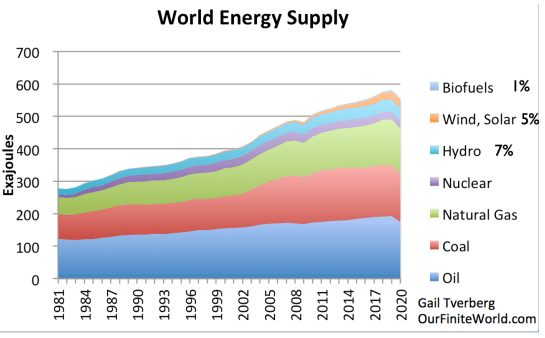
Oil and natural gas added to the energy humans could tap, followed (at a much more modest level) by nuclear power. Despite gargantuan investments, the recent push to develop solar and wind energy has yielded very modest results, as globally these sources provide about 5% of total energy consumption. (See chart below)

It’s self-evident that despite breezy claims of endless expansion of consumption, the global human population has now exceeded the resources available for practical extraction. Energy, fresh water, wild fisheries and fertile soils have all been exploited and the easy/cheap-to-extract resources have been depleted.

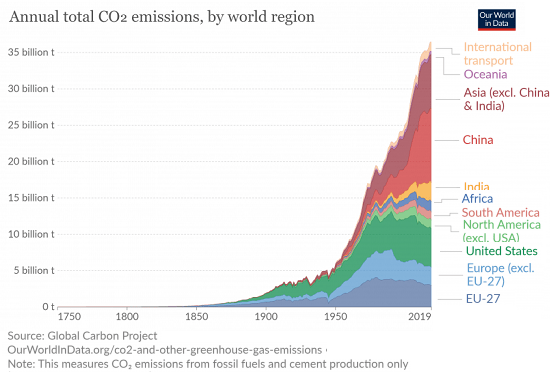
(The chart below of global CO2 emissions is a proxy for energy / resource consumption.)

So once again it’s crunch-time: either we proactively reduce consumption to align with available resources, or Nature will do it for us via scarcities.

Peter Turchin proposed another socio-economic cycle of 50 years in his book Ages of Discord: in the integrative stage, people find reasons to cooperate. In the disintegrative stage at the end of the cycle, people no longer find much common ground or reasons to cooperate. Political, social and financial extremes proliferate, culminating in a rolling crisis.

In Turchin’s analysis, the previous 50-year age of discord began around 1970, and the current era of discord began in 2020. Those who lived through the domestic terrorism, urban decay, stagflation and political/social/legal crises of the 1970s recall how inter-related crises dominated the decade.

In my analysis, the last period of discord in the 1970s was “saved” by the supergiant oil fields discovered in the 60s coming online in the late 1970s and early 1980s. That oil enabled a 40-year boom which is now ending, with no new scalable source of energy available to replace oil, much less enable an expansion of consumption.

In other words, the cycles of The Fourth Turning, Fischer and Turchin are all in alignment at this point in history. We have proliferating political, social and financial extremes and a forced transition to lower consumption to align with declining energy.

Turn, turn, turn. Right when we need to cooperate on transforming a high-consumption, bubble-dependent “waste is growth” Landfill Economy to declining consumption / Degrowth, we’re beset by discord and demographic pressures, as the promises made to the elderly back when it was expected that there would always be 5 workers per retiree cannot possibly be kept now that the worker-retiree ratio is 2-to-1 and there are no limits on healthcare spending for the elderly.

Humans are happy to expand their numbers and consumption and much less happy to consume less. They tend to start revolutions and wars in vain attempts to secure enough resources to maintain their profligate consumption and expansion.

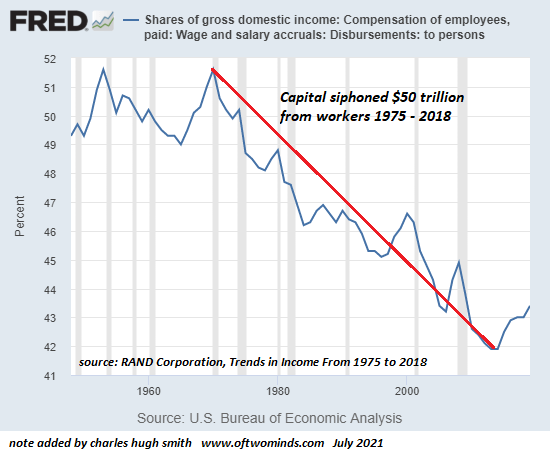
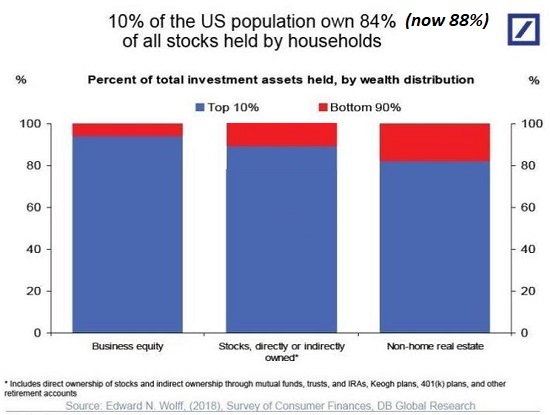
Today’s extremes of wealth and income inequality are optimized to spark political discord and revolts. The wealthiest 20% will be able to pay higher prices, but the bottom 40% will not. The middle 40% will find their disposable income, i.e. their income left over after paying for essentials, will drop to near-zero.

When 80% of the populace are crunched financially, revolutions and the overthrow of governments follow.

As I’ve outlined in previous posts, global inequalities are widening as the Core exploits its built-in advantages at the expense of the vulnerable Periphery.

Core nations will be much better able to maintain their consumption at the expense of the Periphery nations, which will experience sharp declines in purchasing power and consumption.

Previous Fourth Turnings have been resolved one way or another within 5 to 7 years. If this Turning began in 2020, we can expect resolution by 2025 – 2027.

As I explained in my book Global Crisis, National Renewal, those nations that embrace Degrowth will manage the transition, while those that cling to the endless-expansion, bubble-dependent Waste Is Growth model will fail.

This is why I keep talking about making Plans A, B and C to preserve optionality and reduce financial commitments and consumption now rather than passively await crises over which we will have little direct control.

As I’ve endeavored to explain, those anticipating decades of time to adjust are overlooking the systemic fragilities of the current global financial/supply systems. Tightly bound systems of interconnected dependency chains have been optimized to work perfectly in an era of expansion. They’re not optimized to gradually adjust to contraction; they’re optimized to break and trigger domino-like breakdowns in interconnected chains.

We don’t control these macro-trends, we only control our response.
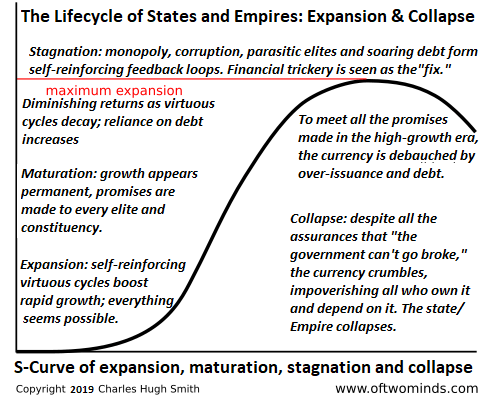
The Age of Discord

By Charles Hugh Smith

Source: Of Two Minds

It’s very difficult to find common ground that supports cooperation in the disintegrative stage of scarcities, rising prices, catastrophically centralized power and social discord.

Today’s topic echoes Peter Turchin’s 2016 book, Ages of Discord, which I have often referenced in blog posts.

I’ll also discuss two other books I’ve often referenced, Global Crisis: War, Climate Change and Catastrophe in the Seventeenth Century by Geoffrey Parker and The Great Wave: Price Revolutions and the Rhythm of History by David Hackett Fischer.

Turchin proposes repeating cycles of history of social integration (people finding reasons to cooperate) and disintegration (people finding reasons to not cooperate).

Clearly, we’re in a disintegrative stage.

Fischer proposed a repeating cycle of history in which humans expand their numbers and economy to consume all available resources.

Once all the low-hanging fruit has been consumed, scarcities arise, pushing prices above what commoners can afford, and the result is economic stagnation and social/political revolution.

Either humans exploit a new energy source at scale to provide for the larger population and higher consumption per person, or the population and consumption decline to fit available resources.

Parker covers the mutually reinforcing climate, political, social and economic crises of the 17th century. A long cycle of cold, wet summers reduced crop yields, leading to hunger and strife.

Parker also identifies another cause of the tumultuous, war-plagued 1600s: political leaders had consolidated too much power, enabling them to pursue disastrous wars without any restraint from competing domestic social-political interests.

Clearly, we’re in Fischer’s stage of overshoot and resource scarcity and Parker’s extremes of centralized power free to pursue catastrophic wars of choice.

In the 1600s, those launching wars reckoned a clean, decisive victory was within easy reach. In every case, the wars dragged on inconclusively or generated even wider conflicts.

In the end, all the wars were settled diplomatically, not by military victory. The military gains were nil while the destruction was widespread and devastating.

Fischer details how poorly humans respond to scarcity and higher prices, also known as inflation or more. accurately, as the decline in purchasing power of money and labor. As scarcities and higher prices take their toll, society unravels: crime and social disorder accelerate.

What we’re seeing in real time is a “circle the wagons” mentality of weeding out everyone but the True Believers in every movement. Litmus tests are handy for this test: answer wrong on any question and you’re cast out: heretic!

It’s not enough to tick one “progressive” or “conservative” box; you have to tick them all or you’re a heretic who cannot be trusted. If you leave one box unticked, you might untick a few more in the days ahead.

This puts pressure on everyone to declare their loyalty to the “party” even if the loyalty is just for show. This dishonesty pleases those demanding every box be ticked but this forced loyalty creates an illusion of solidarity that unravels under pressure.

Officials vie to offer pledges of loyalty to Chinese President Xi Jinping ahead of 20th Party Congress

Exacerbating this is social media, which rewards those promoting the most extreme and divisive positions and deranges the populace by substituting recognition online, which encourages disintegration, for real-world engagement, which encourages moderation and cooperation.

Online, it’s easy to be all-or-nothing: there should be no restrictions on social media, or we should just pull the plug and shut the whole mess down.

In the real world, these are knotty, nuanced problems. The Founding Fathers would not have tolerated sedition under the guise of free speech. The social order can only be maintained if every participant adheres to standards of civility and the common good.

When put under stress, humans harden their positions as a defensive measure. They become more argumentative and less tolerant, more strident in insisting that the One True Thing is the answer to our problems.

This leads to magical thinking, for example, that we can replace hydrocarbons with fusion or wind and solar. When the physical and cost limits of minerals are presented as impassable obstacles, people respond with denial: there must be a way to keep everything the same.

Humans have an easy time expanding their population and consumption per person and a hard time consuming less.

It’s very difficult to find common ground that supports cooperation in the disintegrative stage of scarcities, rising prices, catastrophically centralized power and social discord.

This requires accepting that we can cooperate with people on one issue even though all the other boxes of our group/party/movement are left unticked.

History suggests the disintegrative stage will run its course and consumption will realign with available resources one way or another, and the best we can do is preserve our own sanity, community and willingness to nurture small patches of common ground that support productive cooperation.

Unrealistically Great Expectations

By Charles Hugh Smith

Source: Of Two Minds

Our expectations have continued ever higher even as the pie is shrinking..

Let’s see if we can tie together four social dynamics: the elite college admissions scandal, the decline in social mobility, the rising sense of entitlement and the unrealistically ‘great expectations’ of many Americans.

As many have noted, the nation’s financial and status rewards are increasingly flowing to the top 5%, what many call a winner-take-all or winner-take-most economy.

This is the primary source of widening wealth and income inequality: wealth and income are disproportionately accruing to the top slice of earners and owners of productive capital.

This concentration manifests in a broad-based decline in social mobility: it’s getting harder and harder to break into the narrow band (top 5%) who collects the lion’s share of the economy’s gains.

Historian Peter Turchin has identified the increasing burden of parasitic elites as one core cause of social and economic collapse. In Turchin’s reading, economies that can support a modest-sized class of parasitic elites buckle when the class of elites expecting a free pass to wealth and power expands faster than what the economy can support.

The same dynamic applies to productive elites: as I have often mentioned, graduating 1 millions STEM (science, technology, engineering, math) PhDs doesn’t magically guarantee 1 million jobs will be created for the graduates.

Such a costly and specialized education was once scarce, but now it’s relatively common, and this manifests in the tens of thousands of what I call academic ronin, i.e. PhDs without academic tenure or stable jobs in industry.

This glut is a global: I’ve known many people with PhDs from top universities in the developed world who have struggled to find a tenured professorship or a high-level research position anywhere in the world.

In other words, what was once a surefire ticket to status, security and superior pay is no longer surefire.

No wonder wealthy parents are so anxious to fast-track their non-superstar offspring by hook or by crook.

There is an even larger dynamic in play. As I explained here recently, the economic pie is shrinking, not just the pie of gains that can be distributed but the pie of opportunity.

Would parents and students be so anxious about their prospects if opportunities abounded for average students? The narrowing of opportunities to secure a stable career and livelihood is driving the frenzy to get into an elite university.

As everyone seeks an advantage, there’s a vast expansion of people with advanced diplomas: what was once relatively scarce (and thus valuable) is no longer scarce and therefore no longer very valuable.

The soaring cost of the middle-class membership basics–home ownership, healthcare and access to college–has drastically reduced the number of households who can afford these basics.

Two generations ago, just about any frugal working-class household with two wage-earners could save up a down payment for a modest home and later, save enough to put their children through the local state college.

Now, even two relatively well-paid wage earners in Left and Right Coast urban areas cannot afford to buy a house or put their kids through college. They are lucky to afford the rent, never mind buying a house.

As the number of upper-middle class slots declines, expectations have risen.This manifests in two ways: a rising sense of entitlement, which broadly speaking is the belief that the material security of middle class life should be available without great sacrifice.

The second manifestation is is higher expectations of material life in general: not only should we all have access to healthcare, college and home ownership, we also “deserve” to eat out every day, own luxury brand items, take resort vacations, and so on.

In a recent pre-recording conversation with a podcast host, we were talking about the number of average workers who think very little (apparently) of buying a $15 breakfast and/or a $20 lunch for themselves every day, plus an expensive coffee or beverage. This contrasts with the “old school” expectations which reserved lunches in restaurants for executives with expense accounts or The Boss. Everyone else filled a thermos with coffee at home and packed a brown bag lunch (or kau-kau tin in Hawaii).

From this perspective, $25 a day is $125 a week or $6,250 annually (a 50-week year). That’s $12,500 annually for a two wage-earner household. Five years of foregoing this luxury yields a nest egg of $62,500, a down payment for a $300,000 house, or the full cost of a four-year university education for two students who attend the local state university and who live at home.

(Sidebar note: a kind person gave us a $50 gift certificate to a popular casual-dining breakfast-lunch cafe. I reckoned we’d get a nice chunk of change after ordering two basic sandwiches and one beer. The $50 didn’t cover the three items, much less the tip. I nearly fell out of my chair. Over $50 for two sandwiches and a beer? And yet the place is jammed with people young and old, and I wondered: is everyone here earning $200,000+ annually, i.e. a top 5% income? If not, how can they afford such a costly luxury?)

As I noted earlier this month in the blog, the Federal Reserve’s obsession with generating a “wealth effect” by inflating bubbles in stocks and housing have enriched owners of capital at the expense of the young.

But even if we set aside the perverse and destructive impact of this disastrous policy, the economy is changing in structural ways. Scarcity value is becoming, well, scarcer. Global competition has reduced the scarcity value of education, ordinary labor and capital, and so the gains flowing to these has declined accordingly.

Yet our expectations have continued ever higher even as the pie is shrinking. Common sense suggests realigning expectations with a realistic appraisal of what’s possible and what sacrifices are necessary is a good first step.