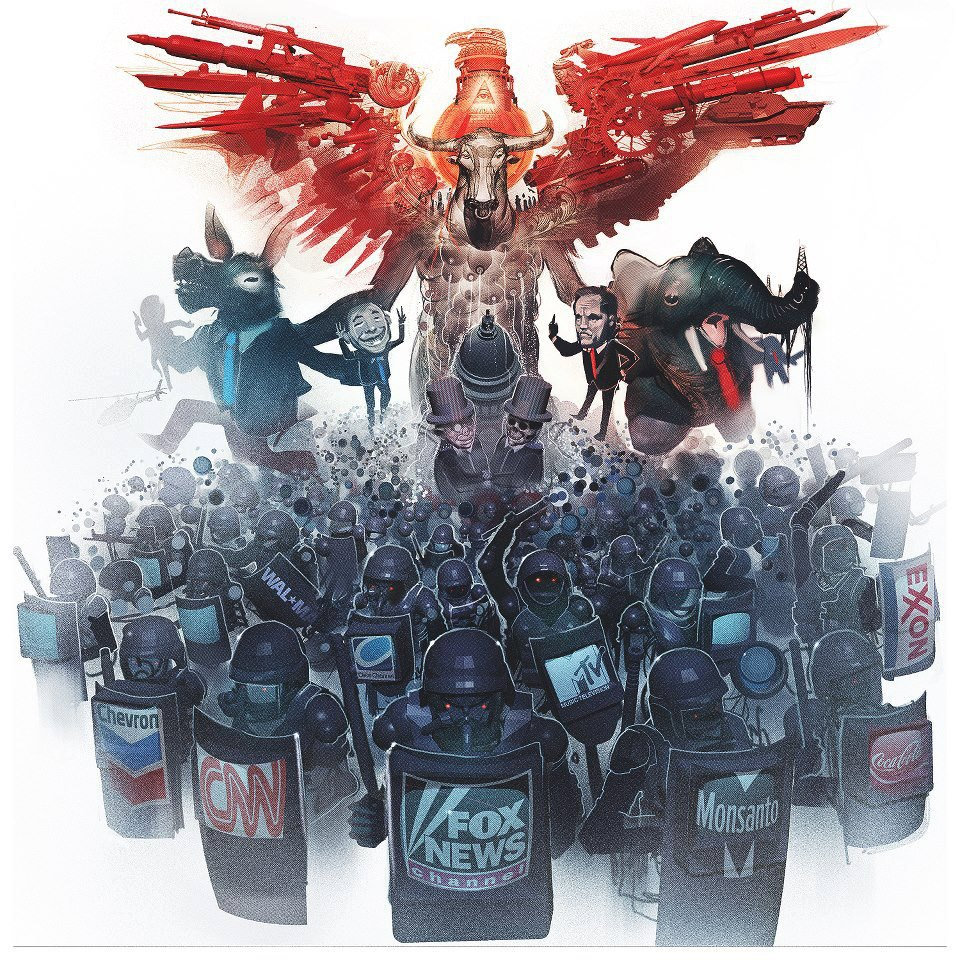
The Ultimate All-American Slush Fund

How A New Budget Loophole Could Send Pentagon Spending Soaring Even Higher
By Julia Gledhill and William D. Hartung

Source: TomDispatch

On June 3rd, President Joe Biden signed a bill into law that lifted the government’s debt ceiling and capped some categories of government spending. The big winner was — surprise, surprise! — the Pentagon.

Congress spared military-related programs any cuts while freezing all other categories of discretionary spending at the fiscal year 2023 level (except support for veterans). Indeed, lawmakers set the budget for the Pentagon and for other national security programs like nuclear-related work developing nuclear warheads at the Department of Energy at the level requested in the administration’s Fiscal Year 2024 budget proposal — a 3.3% increase in military spending to a whopping total of $886 billion. Consider that preferential treatment of the first order and, mind you, for the only government agency that’s failed to pass a single financial audit! 

Even so, that $886 billion hike in Pentagon and related spending is likely to prove just a floor, not a ceiling, on what will be allocated for “national defense” next year. An analysis of the deal by the Wall Street Journal found that spending on the Pentagon and veterans’ care — neither of which is frozen in the agreement — is likely to pass $1 trillion next year.

Compare that to the $637 billion left for the rest of the government’s discretionary budget. In other words, public health, environmental protection, housing, transportation, and almost everything else the government undertakes will have to make do with not even 45% of the federal government’s discretionary budget, less than what would be needed to keep up with inflation. (Forget addressing unmet needs in this country.)

And count on one thing: national security spending is likely to increase even more, thanks to a huge (if little-noticed) loophole in that budget deal, one that hawks in Congress are already salivating over how best to exploit. Yes, that loophole is easy to miss, given the bureaucratese used to explain it, but its potential impact on soaring military budgets couldn’t be clearer. In its analysis of the budget deal, the Congressional Budget Office noted that “funding designated as an emergency requirement or for overseas contingency operations would not be constrained” by anything the senators and House congressional representatives had agreed to.

As we should have learned from the 20 years of all-American wars in Afghanistan and Iraq, the term “overseas contingency” can be stretched to cover almost anything the Pentagon wants to spend your tax dollars on. In fact, there was even an “Overseas Contingency Operations” (OCO) account supposedly reserved for funding this country’s seemingly never-ending post-9/11 wars. And it certainly was used to fund them, but hundreds of billions of dollars of Pentagon projects that had nothing to do with the conflicts in Iraq or Afghanistan were funded that way as well. The critics of Pentagon overspending quickly dubbed it that department’s “slush fund.”

So, prepare yourself for “Slush Fund II” (coming soon to a theater near you). This time the vehicle for padding the Pentagon budget is likely to be the next military aid package for Ukraine, which will likely be put forward as an emergency bill later this year.  Expect that package to include not only aid to help Ukraine fend off Russia’s ongoing brutal invasion but tens of billions of dollars more to — yes, of course! — pump up the Pentagon’s already bloated budget.

Senator Lindsey Graham (R-SC) made just such a point in talking with reporters shortly after the debt-ceiling deal was passed by Congress. “There will be a day before too long,” he told them, “where we’ll have to deal with the Ukrainian situation. And that will create an opportunity for me and others to fill in the deficiencies that exist from this budget deal.”

Senate Majority Leader Chuck Schumer (D-NY) made a similar point in a statement on the Senate floor during the debate over that deal. “The debt ceiling deal,” he said, “does nothing to limit the Senate’s ability to appropriate emergency/supplemental funds to ensure our military capabilities are sufficient to deter China, Russia, and our other adversaries and respond to ongoing and growing national security threats.”

One potential (and surprising) snag in the future plans of those Pentagon budget boosters in both parties may be the position of House Speaker Kevin McCarthy (R-CA). He has, in fact, described efforts to increase Pentagon spending beyond the level set in the recent budget deal as “part of the problem.” For the moment at least, he openly opposes producing an emergency package to increase the Pentagon budget, saying:

“The last five audits the Department of Defense [have] failed. So there’s a lot of places for reform [where] we can have a lot of savings. We’ve plussed it up. This is the most money we’ve ever spent on defense — this is the most money anyone in the world has ever spent on defense. So I don’t think the first answer is to do a supplemental.”

The Massive Overfunding of the Pentagon

The Department of Defense is, of course, already massively overfunded. That $886 billion figure is among the highest ever — hundreds of billions of dollars more than at the peak of the Korean or Vietnam wars or during the most intensely combative years of the Cold War. It’s higher than the combined military budgets of the next 10 countries combined, most of whom are, in any case, U.S. allies. And it’s estimated to be three times what the Chinese military, the Pentagon’s “pacing threat,” receives annually. Consider it an irony that actually “keeping pace” with China would involve a massive cut in military spending, not an increase in the Pentagon’s bloated budget.

It also should go without saying that preparations to effectively defend the United States and its allies could be achieved for so much less than is currently lavished on the Pentagon.  A new approach could easily save significantly more than $100 billion in fiscal year 2024as proposed by Representatives Barbara Lee (D-CA) and Mark Pocan (D-WI) in the People Over Pentagon Act, the preeminent budget-cut proposal in Congress. An illustrative report released by the Congressional Budget Office (CBO) in late 2021 sketched out three scenarios, all involving a less interventionist, more restrained approach to defense that would include greater reliance on allies. Each option would reduce America’s 1.3-million-strong active military force (by up to one-fifth in one scenario). Total savings from the CBO’s proposed changes would, over a decade, be $1 trillion.

And a more comprehensive approach that shifted away from the current “cover the globe” strategy of being able to fight (though, as the history of this century shows, not always win) wars virtually anywhere on Earth on short notice — without allies, if necessary — could save hundreds of billions more over the next decade. Cutting bureaucracy and making other changes in defense policy could also yield yet more savings. To cite just two examples, reducing the Pentagon’s cohort of more than half-a-million private contract employees and scaling back its nuclear weapons “modernization” program would save significantly more than $300 billion extra over a decade.

But none of this is even remotely likely without concerted public pressure to, as a start, keep members of Congress from adding tens of billions of dollars in spending on parochial military projects that channel funding into their states or districts. And it would also mean pushing back against the propaganda of Pentagon contractors who claim they need ever more money to provide adequate tools to defend the country.

Contractors Crying Wolf

While demanding ever more of our tax dollars, the giant military-industrial corporations are spending all too much of their time simply stuffing the pockets of their shareholders rather than investing in the tools needed to actually defend this country. A recent Department of Defense report found that, from 2010-2019, such companies increased by 73% over the previous decade what they paid their shareholders. Meanwhile, their investment in research, development, and capital assets declined significantly. Still, such corporations claim that, without further Pentagon funding, they can’t afford to invest enough in their businesses to meet future national security challenges, which include ramping up weapons production to provide arms for Ukraine.

In reality, however, the financial data suggests that they simply chose to reward their shareholders over everything and everyone else, even as they experienced steadily improving profit margins and cash generation. In fact, the report pointed out that those companies “generate substantial amounts of cash beyond their needs for operations or capital investment.” So instead of investing further in their businesses, they choose to eat their “seed corn” by prioritizing short-term gains over long-term investments and by “investing” additional profits in their shareholders. And when you eat your seed corn, you have nothing left to plant next year.

Never fear, though, since Congress seems eternally prepared to bail them out. Their businesses, in fact, continue to thrive because Congress authorizes funding for the Pentagon to repeatedly grant them massive contracts, no matter their performance or lack of internal investment. No other industry could get away with such maximalist thinking.

Military contractors outperform similarly sized companies in non-defense industries in eight out of nine key financial metrics — including higher total returns to shareholders (a category where they leave much of the rest of the S&P 500 in the dust). They financially outshine their commercial counterparts for two obvious reasons: first, the government subsidizes so many of their costs; second, the weapons industry is so concentrated that its major firms have little or no competition.

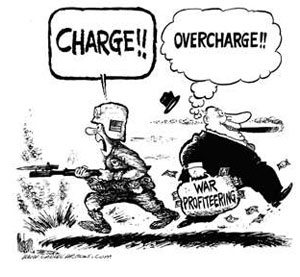
Adding insult to injury, contractors are overcharging the government for the basic weaponry they produce while they rake in cash to enrich their shareholders. In the past 15 years, the Pentagon’s internal watchdog has exposed price gouging by contractors ranging from Boeing and Lockheed Martin to lesser-known companies like TransDigm Group. In 2011, Boeing made about $13 million in excess profits by overcharging the Army for 18 spare parts used in Apache and Chinook helicopters. To put that in perspective, the Army paid $1,678.61 each for a tiny helicopter part that the Pentagon already had in stock at its own warehouse for only $7.71.

The Pentagon found Lockheed Martin and Boeing price gouging together in 2015. They overcharged the military by “hundreds of millions of dollars” for missiles. TransDigm similarly made $16 million by overcharging for spare parts between 2015 and 2017 and even more in the following two years, generating nearly $21 million in excess profits. If you can believe it, there is no legal requirement for such companies to refund the government if they’re exposed for price gouging.

Of course, there’s nothing new about such corporate price gouging, nor is it unique to the arms industry. But it’s especially egregious there, given how heavily the major military contractors depend on the government’s business. Lockheed Martin, the biggest of them, got a staggering 73% of its $66 billion in net sales from the government in 2022. Boeing, which does far more commercial business, still generated 40% of its revenue from the government that year. (Down from 51% in 2020.)

Despite their reliance on government contracts, companies like Boeing seem to be doubling down on practices that often lead to price gouging. According to Bloomberg News, between 2020 and 2021, Boeing refused to provide the Pentagon with certified cost and pricing data for nearly 11,000 spare parts on a single Air Force contract. Senator Elizabeth Warren (D-MA) and Representative John Garamendi (D-CA) have demanded that the Pentagon investigate since, without such information, the department will continue to be hard-pressed to ensure that it’s paying anything like a fair price, whatever its purchases.

Curbing the Special Interest Politics of “Defense”

Reining in rip-offs and corruption on the part of weapons contractors large and small could save the American taxpayer untold billions of dollars. And curbing special-interest politics on the part of the denizens of the military-industrial-congressional complex (MICC) could help open the way towards the development of a truly defensive global military strategy rather than the current interventionist approach that has embroiled the United States in the devastating and counterproductive wars of this century.

One modest step towards reining in the power of the arms lobby would be to revamp the campaign finance system by providing federal matching funds, thereby diluting the influential nature of the tens of millions in campaign contributions the arms industry makes every election cycle. In addition, prohibiting retiring top military officers from going to work for arms-making companies — or, at least, extending the cooling off period to at least four years before they can do so, as proposed by Senator Warren — would also help reduce the undue influence exerted by the MICC.

Last but not least, steps could be taken to prevent the military services from giving Congress their annual wish lists — officially known as “unfunded priorities lists” — of items they want added to the Pentagon budget. After all, those are but another tool allowing members of Congress to add billions more than what the Pentagon has even asked for to that department’s budget.

Whether such reforms alone, if adopted, would be enough to truly roll back excess Pentagon spending remains to be seen. Without them, however, count on one thing: the department’s budget will almost certainly continue to soar, undoubtedly reaching $1 trillion or more annually within just the next few years.  Americans can’t afford to let that happen.

How $21 Trillion in U.S. Tax Money Disappeared. “Full Scope Audit” of the Pentagon

The Fall of the American Empire

By W.J. Astore

Source: Bracing Views

Why do empires fall?  Sometimes, it’s easy to identify a cause.  Whether led by the Kaiser or by Hitler, Germany’s Second and Third Empires were destroyed by world wars.  Germany’s ambition was simply too great, its militarism too dominant, its policies too harsh to win long-term converts, its leaders too blinded by the pursuit of power, its enemies too many to conquer or otherwise neutralize.

Other imperial falls are more complex.  What caused Rome’s fall?  (Leaving aside the eastern part of the empire, which persisted far longer as the Byzantine Empire.)  Barbarians and their invasions, say some.  The enervating message and spirit of Christianity, said the historian Edward Gibbon.  Rome’s own corruption and tyranny, say others.  Even lead in Roman water pipes has been suggested as a contributing cause to Rome’s decline and fall.  Taking a longer view, some point to the rise of Islam in the 7th century and its rapid expansion into previously Roman territories as the event that administered the final coup de grâce to a dying empire.

America’s empire, it is clear, is now in decline, and a key reason is imperial overstretch as manifested by endless wars and overspending on the military (with literally trillions of dollars being thrown away on fruitless wars).  An especially fine summary is Alfred McCoy’s article at TomDispatch.com.  As McCoy notes:

In effect, the president and his team, distracted by visions of shimmering ships and shiny planes (with their predictable staggering future cost overruns), are ready to ditch the basics of global dominion: the relentless scientific research that has long been the cutting edge of U.S. military supremacy.  And by expanding the Pentagon while slashing the State Department, Trump is also destabilizing that delicate duality of U.S. power by skewing foreign policy ever more toward costly military solutions (that have proved anything but actual solutions) …

In just one extraordinary year, Trump has destabilized the delicate duality that has long been the foundation for U.S. foreign policy: favoring war over diplomacy, the Pentagon over the State Department, and narrow national interest over international leadership. But in a globalizing world interconnected by trade, the Internet, and the rapid proliferation of nuclear-armed missiles, walls won’t work. There can be no Fortress America.

In this passage, McCoy stresses the damage being done by the Trump administration.  But Trump is just the culmination of certain trends, e.g. favoring the Pentagon over the State Department is nothing new, as I wrote about here in 2010.  And America has been in love with shimmering ships and shiny planes for generations, with several administrations supporting the F-35 jet fighter, a program that may end up costing as much as $1.4 trillion.  Plenty of money for weapons that kill; not so much for medicines that cure: that’s imperial America in a nutshell.

I would stress that America’s strength overseas was (and is) always based on its strength at home in areas such as science, education, infrastructure, medicine, manufacturing, and exports.  But what we’ve witnessed over the last 40 years is an immense and wasteful “investment” in wars and weapons even as our country itself has hollowed out. Science is now marked by the denial of facts (such as global warming). Education is all about students as consumers, with an overall decline in standards and performance. Infrastructure is crumbling. Medicine is too expensive and America’s overall health and life expectancy are both in decline. Manufacturing and exports have withered (except for the production and export of weapons, naturally).

As a result of all this, America is running a national debt of roughly 20 trillion dollars.  The future is being sacrificed for the present, a tragic reality reflected in the latest Republican tax cut, which benefits the richest Americans the most, along with big corporations, and which will likely add another trillion to the national debt.

In short, America’s foreign decline is mirrored (and driven) by its domestic decline as reflected by its choices.  Looking at the USA today, you get the sense it’s the best of times for the richest few, and the worst of times for so many Americans struggling with health care debt, student loan debt, and the uncertainty of low-wage jobs that could be outsourced at any moment.  At the same time, the American political scene is driven by fear: of immigrants, of a nuclear war with North Korea, of Russian meddling (real or imagined), of growing Chinese power, and of the perpetually-hyped threat of terrorist attacks on “the Homeland.”

Empires can fall very quickly, as the “thousand-year” Third Reich did, or they can fall ever so slowly, as the Roman Empire did.  But fall they do.  What is in the cards for the United States?


The Military Industrial Complex Strikes Again: War Spending Will Bankrupt America

By John W. Whitehead

Source: The Rutherford Institute

Why throw money at defense when everything is falling down around us? Do we need to spend more money on our military (about $600 billion this year) than the next seven countries combined? Do we need 1.4 million active military personnel and 850,000 reserves when the enemy at the moment — ISIS — numbers in the low tens of thousands? If so, it seems there’s something radically wrong with our strategy. Should 55% of the federal government’s discretionary spending go to the military and only 3% to transportation when the toll in American lives is far greater from failing infrastructure than from terrorism? Does California need nearly as many active military bases (31, according to militarybases.com) as it has UC and state university campuses (33)? And does the state need more active duty military personnel (168,000, according to Governing magazine) than public elementary school teachers (139,000)?”— Steve Lopez, Los Angeles Times

Mark my words, America’s war spending will bankrupt the nation.

For that matter, America’s war spending has already bankrupted the nation to the tune of more than $20 trillion dollars.

Now the Trump Administration is pushing for a $4.4 trillion budget for fiscal year 2019 that would add $7 trillion to the already unsustainable federal deficit in order to sustain America’s military empire abroad and dramatically expand the police state here at home. Trump also wants American taxpayers to cover the cost of building that infamous border wall.

Truly, Trump may turn out to be, as policy analyst Stan Collender warned, “the biggest deficit- and debt-increasing president of all time.”

For those in need of a quick reminder: “A budget deficit is the difference between what the federal government spends and what it takes in. The national debt, also known as the public debt, is the result of the federal government borrowing money to cover years and years of budget deficits.”

Right now, the U.S. government is operating in the negative on every front: it’s spending far more than what it makes (and takes from the American taxpayers) and it is borrowing heavily (from foreign governments and Social Security) to keep the government operating and keep funding its endless wars abroad.

This is how military empires fall and fail: by spreading themselves too thin and spending themselves to death.

It happened in Rome. It’s happening again.

Not content to merely police the globe, in recent decades, America has gradually transformed its homeland into a battlefield with militarized police and weapons better suited to a war zone.

Since taking office, President Trump—much like his predecessors—has marched in lockstep with the military. Now Trump wants $716 billion to expand America’s military empire abroad and billions more to hire cops, build more prisons and wage more profit-driven war-on-drugs/war-on-terrorism/war-on-crime programs that eat away at the Fourth Amendment while failing to make the country any safer.

Even the funds requested for infrastructure will do little to shore up the nation’s crumbling roads, bridges, railways, highways, power grids and dams.

No matter how your break it down, this is not a budget aimed at perfecting the Union, establishing justice, insuring domestic tranquility, providing for the common defense, promoting general welfare, or securing the blessings of liberty for the American people.

No, this is a budget aimed at pandering to the powerful money interests (military, corporate and security) that run the Deep State and hold the government in its clutches.

So much for Trump’s campaign promises to balance the budget and drain the swamps of corruption.

The glaring economic truth is that at the end of the day, it’s the military industrial complex—and not the sick, the elderly or the poor—that is pushing America towards bankruptcy.

As investigative journalist Uri Friedman puts it, for more than 15 years now, the United States has been fighting terrorism with a credit card, “essentially bankrolling the wars with debt, in the form of purchases of U.S. Treasury bonds by U.S.-based entities like pension funds and state and local governments, and by countries like China and Japan.”

The illicit merger of the armaments industry and the Pentagon that President Dwight D. Eisenhower warned us against more than 50 years ago has come to represent perhaps the greatest threat to the nation’s fragile infrastructure today.

Having been co-opted by greedy defense contractors, corrupt politicians and incompetent government officials, America’s expanding military empire is bleeding the country dry at a rate of more than $15 billion a month (or $20 million an hour)—and that’s just what the government spends on foreign wars.

That does not include the cost of maintaining and staffing the 1000-plus U.S. military bases spread around the globe.

Incredibly, although the U.S. constitutes only 5% of the world’s population, America boasts almost 50% of the world’s total military expenditure,  spending more on the military than the next 19 biggest spending nations combined.

In fact, the Pentagon spends more on war than all 50 states combined spend on health, education, welfare, and safety.

War is not cheap.

Although the federal government obscures so much about its defense spending that accurate figures are difficult to procure, we do know that since 2001, the U.S. government has spent more than $1.8 trillion in the wars in Afghanistan and Iraq (that’s $8.3 million per hour).

That doesn’t include wars and military exercises waged around the globe, which are expected to push the total bill upwards of $12 trillion by 2053.

Mind you, these ongoing wars—riddled by corruption, graft and bumbling incompetence—have done little to keep the country safe while enriching the military industrial complex—and private defense contractors—at taxpayer expense.

Just recently, for example, a leading accounting firm concluded that one of the Pentagon’s largest agencies “can’t account for hundreds of millions of dollars’ worth of spending.”

Just consider the fact that it costs American taxpayers $2.1 million per year for each soldier deployed in Afghanistan.

Imagine what you could do with that money if it were spent on domestic needs here at home.

Unfortunately, that’s not going to happen anytime soon, not as long as the money interests in Washington keep calling the shots and profiting from the spoils of war.

War has become a huge money-making venture, and America, with its vast military empire, is one of its best buyers and sellers. Not only does the U.S. have the largest defense budget, it also ranks highest as the world’s largest arms exporter.

The American military-industrial complex has erected an empire unsurpassed in history in its breadth and scope, one dedicated to conducting perpetual warfare throughout the earth.

For example, while erecting a security surveillance state in the U.S., the military-industrial complex has perpetuated a worldwide military empire with American troops stationed in 177 countries (over 70% of the countries worldwide).

In the process, billions have been spent erecting luxury military installations throughout the world.

For example, the U.S. Embassy built in Iraq, dubbed “Fortress Baghdad,” covers 104 acres and boasts a “city within a city” that includes six apartment buildings, a Marine barracks, swimming pool, shops and 15-foot-thick walls. Camp Anaconda in Iraq, like many U.S. military bases scattered across the globe, was structured to resemble a mini-city with pools, fast food restaurants, miniature golf courses and movie theaters.

While most Americans can scarcely afford the cost of heating and cooling their own homes, the American government spends $20 billion annually just to provide air conditioning for military installations in Iraq and Afghanistan.

In essence, what we’re doing is “we’re air conditioning the desert over there in Afghanistan, Iraq, and other places,” noted retired brigadier general Steven Anderson, a former chief logistician for Gen. David Petraeus in Iraq.

Think about that for a minute.

There’s a good reason why “bloated,” “corrupt” and “inefficient” are among the words most commonly applied to the government, especially the Department of Defense and its contractors.

For instance, a study by the Government Accountability Office found that $70 billion worth of cost overruns by the Pentagon were caused by management failures. To put that in perspective, that equates to one and a half times the State Department’s entire $47 billion annual budget.

Fraud is rampant.

A government audit, for example, found that defense contractor Boeing has been massively overcharging taxpayers for mundane parts, resulting in tens of millions of dollars in overspending. As the report noted, the American taxpayer paid:

$71 for a metal pin that should cost just 4 cents; $644.75 for a small gear smaller than a dime that sells for $12.51: more than a 5,100 percent increase in price. $1,678.61 for another tiny part, also smaller than a dime, that could have been bought within DoD for $7.71: a 21,000 percent increase. $71.01 for a straight, thin metal pin that DoD had on hand, unused by the tens of thousands, for 4 cents: an increase of over 177,000 percent.

Price gouging has become an accepted form of corruption within the American military empire.

And if you think gas prices at home can get high, just consider what the American taxpayer is being forced to shell out overseas: once all the expenses of delivering gas to troops in the field are factored in, we’re paying between $18-30 per gallon for gas in Iraq and Afghanistan.

Incredibly, despite reports of corruption, abuse and waste, the mega-corporations behind much of this ineptitude and corruption continue to be awarded military contracts worth billions of dollars.

The rationale may keep changing for why American military forces are in Afghanistan, Iraq and elsewhere, but the one that remains constant is that those who run the government are feeding the appetite of the military industrial complex.

What began in 2001 as part of an alleged effort to root out al Qaeda has turned into a goldmine for the military industrial complex and its army of private contractors.

Just consider: the Pentagon in 2008 spent more money every five seconds in Iraq than the average American earned in a year.

Yet Congress and the White House want taxpayers to accept that the only way to reduce the nation’s ballooning deficit is by cutting “entitlement” programs such as Social Security and Medicare?

As Martin Luther King Jr. recognized, under a military empire, war and its profiteering will always take precedence over the people’s basic human needs.

Simply put, we cannot afford to maintain our over-extended military empire.

Money is the new 800-pound gorilla,” remarked a senior administration official involved in Afghanistan. “It shifts the debate from ‘Is the strategy working?’ to ‘Can we afford this?’ And when you view it that way, the scope of the mission that we have now is far, far less defensible.”

Or as one commentator noted, “Foreclosing the future of our country should not be confused with defending it.”

Inevitably, military empires collapse.

As Cullen Murphy, author of Are We Rome? and editor-at-large of Vanity Fair writes:

A millennium hence America will be hard to recognize. It may not exist as a nation-state in the form it does now—or even exist at all. Will the transitions ahead be gradual and peaceful or abrupt and catastrophic? Will our descendants be living productive lives in a society better than the one we inhabit now? Whatever happens, will valuable aspects of America’s legacy weave through the fabric of civilizations to come? Will historians someday have reason to ask, Did America really fall?

The problem we wrestle with is none other than a distorted American empire, complete with mega-corporations, security-industrial complexes and a burgeoning military. And it has its sights set on absolute domination.

Eventually, however, all military empires fail.

At the height of its power, even the mighty Roman Empire could not stare down a collapsing economy and a burgeoning military. Prolonged periods of war and false economic prosperity largely led to its demise. As historian Chalmers Johnson predicts:

The fate of previous democratic empires suggests that such a conflict is unsustainable and will be resolved in one of two ways. Rome attempted to keep its empire and lost its democracy. Britain chose to remain democratic and in the process let go its empire. Intentionally or not, the people of the United States already are well embarked upon the course of non-democratic empire.

I would suggest that what we have is a confluence of factors and influences that go beyond mere comparisons to Rome.

It is a union of Orwell’s 1984 with its shadowy, totalitarian government—i.e., fascism, the union of government and corporate powers—and a total surveillance state with a military empire extended throughout the world.

As we have seen with the militarizing of the police, the growth of and reliance on militarism as the solution for our problems both domestically and abroad affects the basic principles upon which American society should operate.

We must keep in mind that a military empire will be ruled not by lofty ideals of equality and justice but by the power of the sword. Those in the military are primarily trained to conduct warfare, not preserve the peace.

Here’s the kicker, though: if the American empire falls and the American economy collapses—and with it the last vestiges of our constitutional republic—it will be the government and its trillion-dollar war budgets that are to blame.

Of course, the government has already anticipated this breakdown.

That’s why the government has transformed America into a war zone, turned the nation into a surveillance state, and labelled “we the people” as enemy combatants.

For years now, the government has worked with the military to prepare for widespread civil unrest brought about by “economic collapse, loss of functioning political and legal order, purposeful domestic resistance or insurgency, pervasive public health emergencies, and catastrophic natural and human disasters.”

Having spent more than half a century exporting war to foreign lands, profiting from war, and creating a national economy seemingly dependent on the spoils of war, the war hawks long ago turned their profit-driven appetites on us, bringing home the spoils of war—the military tanks, grenade launchers, Kevlar helmets, assault rifles, gas masks, ammunition, battering rams, night vision binoculars, etc.—and handing them over to local police, thereby turning America into a battlefield.

As I make clear in my book Battlefield America: The War on the American People, this is how the police state wins and “we the people” lose.

More than 50 years ago, President Dwight Eisenhower warned us not to let the profit-driven war machine endanger our liberties or democratic processes.

We failed to heed his warning.

As Eisenhower recognized in a speech given to the American Society of Newspaper Editors, on Apr. 16, 1953, the consequences of allowing the military-industrial complex to wage war, exhaust our resources and dictate our national priorities are beyond grave:

“Every gun that is made, every warship launched, every rocket fired signifies, in the final sense, a theft from those who hunger and are not fed, those who are cold and are not clothed. This world in arms is not spending money alone. It is spending the sweat of its laborers, the genius of its scientists, the hopes of its children. The cost of one modern heavy bomber is this: a modern brick school in more than 30 cities. It is two electric power plants, each serving a town of 60,000 population. It is two fine, fully equipped hospitals. It is some fifty miles of concrete pavement. We pay for a single fighter plane with a half million bushels of wheat. We pay for a single destroyer with new homes that could have housed more than 8,000 people… This is not a way of life at all, in any true sense. Under the cloud of threatening war, it is humanity hanging from a cross of iron.”

Wonder Woman Is a Hero Only The Military-Industrial Complex Could Create

By Jonathan Cooke

Source: TruePublica

For a while I have been pondering whether to write a review of the newly released Wonder Woman, to peel back the layers of comic-book fun to reveal below the film’s disturbing and not-so-covert political and militaristic messages.

There is usually a noisy crowd who deride any such review with shouts of “Lighten up, it’s only a movie!” – as though popular culture is neither popular nor culture, the soundtrack to our lives that slowly shapes our assumptions and our values, and does so at a level we rarely examine critically.

My argument is that this much-praised Gal Gadot vehicle – seemingly about a peace-loving superhero, Wonder Woman, from the DC Comics stable – is actually carefully purposed propaganda, designed to force-feed aggressive western military intervention, dressed up as humanitarianism, to unsuspecting audiences.

In short, this is straight-up propaganda for the military-industrial complex. It would have looked and sounded identical had it been scripted by a joint team from the Pentagon and the Israel Defense Forces.

My reticence to review the film has lifted after reading the latest investigations of Tom Secker and Matthew Alford into the manifold ways the U.S. military and security services interfere in Hollywood, based on a release of 4,000 pages of documents under Freedom of Information requests.

In their new book National Security Cinema, the pair argue that the Pentagon, CIA and National Security Agency have meddled in the production of at least 800 major Hollywood movies and 1,000 TV titles. That is likely to be only the tip of the iceberg, as they concede:

“It is impossible to know exactly how widespread this military censorship of entertainment is because many files are still being withheld.”

They write that their book “details how U.S. government involvement also includes script rewrites on some of the biggest and most popular films, including James Bond, the Transformers franchise, and movies from the Marvel and DC cinematic universes.”

The need for Pentagon toys

This isn’t just about minor adjustments, but wholesale collusion between film-makers and the military: “If there are characters, action or dialogue that the DoD [Department of Defense] don’t approve of then the film-maker has to make changes to accommodate the military’s demands. If they refuse then the Pentagon packs up its toys and goes home. To obtain full cooperation the producers have to sign contracts — Production Assistance Agreements — which lock them into using a military-approved version of the script.”

The fact that script-writers, producers and directors on these mega-budget pictures know their film may never make it into production if it does not get a thumbs-up from the Pentagon inevitably influences the choice of subjects, the political and military premises of selected films, and the story lines.

One movie, Countermeasures, was ditched after the military objected to a script that “included references to the Iran-Contra scandal … Similarly Fields of Fire and Top Gun 2 were never made because they couldn’t obtain military support, again due to politically controversial aspects of the scripts.”

One can imagine just how stringent the conditions imposed by the Pentagon must be, if it felt compelled to reject a movie like Top Gun 2, the sequel to the “flyboys with toys” killing fest that starred a young Tom Cruise.

The two authors add: “The documents also record the pro-active nature of the military’s operations in Hollywood and that they are finding ways to get involved during the earliest stages of development, ‘when characters and storylines are most easily shaped to the Army’s benefit’.”

Bad apples, not bad institutions

In addition, film-makers are pressured into changing scripts that suggest institutional or systemic problems in the U.S. security agencies.

The two authors observe that producer Jerry Bruckheimer has admitted that the script of the film Enemy of the State was changed under pressure from the NSA so that the wrongdoings at the heart of the film would be the responsibility of a single individual, not the agency itself.

“This idea of using cinema to pin the blame for problems on isolated rogue agents or bad apples, thus avoiding any notion of systemic, institutional or criminal responsibility, is right out of the CIA/DOD’s playbook,” they observe.

So not only are movies critical of U.S. and western politics and militarism almost certain to be off-limits for a big-budget production, but that void is certain to be filled by film proposals the studio is confident will win approval from the Pentagon, CIA and NSA.

And this is, of course, on top of the fact that the Hollywood money-men are themselves part of a larger globalized financial elite that depends on the proceeds of the homeland security industry, arms manufacturers and war profiteers. These financiers are certain to prefer funding films that support a neoliberal worldview at home and a neoconservative policy of warmongering abroad.

As Secker and Alford conclude: “In societies already eager to use our hard power overseas, the shaping of our popular culture to promote a pro-war mindset must be taken seriously.

Gal Gadot and the IDF

All of this is the context for deciphering the egregious propaganda in favor of western military violence, and the portrayal of peace-seeking as “appeasement”, that is Wonder Woman.

There has been plenty of guffawing at Middle East countries, including Lebanon, for seeking to ban Wonder Woman because it stars Gal Gadot, an Israeli beauty queen turned actress.

In fact, it is understandable that the Lebanese might object to a film heavily promoting Gadot as the world’s savior, given that she served in the Israeli army, one that brutally occupied parts of their country for two decades, until 2000, and continues to maintain a belligerent occupation of the Palestinians.

But there is also an undeniable irony to Gadot playing an Amazonian goddess who opposes the militarism of men, and cannot bear to see the suffering of children in war, when in real life she publicly cheered on the Israeli army’s massive bombardment in 2014 of the imprisoned population of Gaza, which led to the killing of some 500 Palestinian children there.

But more importantly, it is not just that Gadot, a former IDF soldier, is now the face of Wonder Woman; it is that the film’s superhero character too almost perfectly embodies the shared militaristic values of the IDF and the Pentagon. If there is one film whose script suggests it was jointly engineered by the Pentagon and Israeli army, it is Wonder Woman.

Hillary Clinton as Wonder Woman?

The film is set near the end of the First World War, a cataclysmic confrontation between two colonial powers, Britain and Germany, each trying to assert its dominance in Europe. The film-makers blur their focus sufficiently to gloss over the problem that there were no good guys in that “war to end all wars”. Instead in true Hollywood fashion, the First World War is presented simply as a prelude (or prequel) to the Second World War and the rise of the Nazis.

The Germans are murderous villains, while the British are the flawed – until Gadot shows them the error of their ways – defenders of humanity. In fact, the film prefers to cast the anti-German side as “Allies”, the humane members of the world community, represented by the U.S. – Chris Pine is the male lead and Gadot’s love interest – and a ragtag support group that includes a Scot, a native American, and a generic Arab, presumably symbolizing “moderate” Arab states like Saudi Arabia, Egypt and Jordan.

The British leadership is trying to find ways to make peace and bring the war to an end, but is stymied by an evil presence. A German super-general, Erich Ludendorff (Danny Huston), believes he can win the war decisively by developing a horrifying gas that will wipe out men, women and children, forcing the British to surrender on his terms. To demonstrate his power, he tests the gas on innocent villagers on the front lines in Belgium.

All of this might sound disconcertingly familiar to anyone who has been following the western media-scripted coverage that has for several years now been trying to promote more aggressive “humanitarian intervention” in Syria – and before that, in Libya and Iraq.

Is Ludendorff supposed to be Bashar Assad, the evil Syrian president who – as long as we discount the dissenting voices of some experts – has twice used the chemical weapon sarin against innocent civilians?

Are the British leaders, seeking a peace deal with the Germans, supposed to be those “appeasers” in the West who have stood in the way of “intervention” in Syria, blocking no-fly zones and bombing runs that could bring down the Syrian government?

And in an even more disturbing, if now outdated, parallel, given the film’s insistent identity politics, is Wonder Woman – the Amazonian who brings peace through overpowering military violence – a stand-in for Hillary Clinton? When the movie was in production, the filmmakers must have assumed it would be released as Clinton was enjoying her early months in office as the first female U.S. president.

The use of Wonder Woman to justify Clinton’s well-documented blood lust–the woman who laughed as “our rebels” murderously sodomized Libya’s Col Gaddafi, saying: “We came, we saw, he died” – would have proved timely had the U.S. election turned out differently.

War is Peace, Ignorance is Strength

Those who have not seen the film, and take it seriously as entertainment, may wish to skip this section, which includes a significant spoiler.

The source of man’s evil in Wonder Woman is the only surviving Greek god, Ares, who is hiding somewhere in the human world. Wonder Woman believes she can end all war and human suffering only if she can locate Ares and kill him – before he kills her.

No one in the human world, of course, believes Wonder Woman, and foolishly they dismiss her ideas as lunacy. And for a while Wonder Woman makes a terrible mistake in thinking the German Ludendorff (Saddam / Gaddafi / Assad) is Ares. It is late in the film that she discovers she has been on the wrong scent.

Humankind’s ultimate enemy is not Ludendorff, but the kindly Sir Patrick Morgan (David Thewlis), the British leader who has spent the entire film counseling for negotiations and peace with the Germans.

The ultimate evil, the wolves in sheep’s clothing, Wonder Woman finds, are  those among us who preach fraternity, compassion and turning the other cheek. They make possible the killing of the innocents.

Those who appear to care, those who seem to offer a route out of bloodshed and war – those who defeat the aims and threaten the profits of the military-industrial complex – are in truth nothing more than appeasers. Their efforts are certain, even intended, to lead to greater suffering.

Militarism, superior firepower, and an absolute belief in the justness of one’s cause, as Wonder Woman is reminded by her Amazonian tutors during her childhood Krav Maga training (Gadot was herself an Israeli army combat trainer) are the way to save mankind from the evildoers.

There is no time to delay, to stand back, to question or to negotiate. Wonder Woman is outraged by the dithering of the men around her. She wants to be at the front line as soon as possible, to kick ass.

“War is peace, freedom is slavery, ignorance is strength” – and all of it is good for business, the film Wonder Woman concludes in truly Orwellian fashion.

A veneer of identity politics

Of course, this story – like all effective propaganda – is supposed to work its magic at a subconscious level, where it cannot be interrogated by our reason and our critical faculties. But even so, a few critics – themselves enthusiastic liberal interventionists – seem to have intuited the movie’s message.

Perhaps not surprisingly, a reviewer with the clearest sense of how the film panders to the pro-war sentiments and identity politics of many liberals is the film critic of the conservative Washington Free Beacon.

Sonny Bunch applauds the way the film “highlights the need for the strong to intervene on behalf of the weak and the oppressed, and treats as villains quislings who sue for a peace that will bring only more destruction.

But he also understands how the film has been crafted to make its war-mongering more palatable to liberals. Wonder Woman, he writes, proves “you could slap an identity politics veneer on just about any neoconservative policy and progressives would lap it up. … Liberal interventionism is back, baby!”

Drooling from liberals

And sure enough, the community of largely liberal film reviewers has mostly drooled over Wonder Woman. Despite dire acting from Gadot, preposterous dialogue and a risible screenplay, the film has racked up an astounding 92 percent approval rating from critics on the review aggregator website Rotten Tomatoes.

Here is a brief selection of their assessments:

Dana Stevens, of Slate: “This is a movie about battling evil that pauses to ask what evil is and whether it’s necessary to understand its nature in order to defeat it.”

Mick LaSalle, of the San Francisco Chronicle: “What lingers … is the feeling of hope that the movie brings, that it someday might be possible for female rationality to defeat male brutality.”

Richard Brody, of the New Yorker: Wonder Woman is “an entry in the genre of wisdom literature that shares hard-won insights and long-pondered paradoxes of the past with a sincere intimacy.”

A. O. Scott, of the New York Times: “Her sacred duty is to bring peace to the world. Accomplishing it requires a lot of killing, but that’s always the superhero paradox. … Unlike most of her male counterparts, its heroine is not trying to exorcise inner demons or work out messiah issues. She wants to function freely in the world, to help out when needed and to be respected for her abilities. No wonder she encounters so much resistance.”

The paradoxes of power

Wonder Woman grapples with the paradoxes of military power every American interventionist and Israeli patriot understands. To save the “beautiful children”, she must sometimes rush to intervene and kill with extreme prejudice, even if the other side’s children are among those who are sacrificed.

Wonder Woman wants to “function freely”: she must enjoy the right to go wherever her interests take her. She cannot be shackled by borders in her quest for justice. She is there to “help out” others in trouble, even if she alone gets to decide who needs help and what counts as trouble. And she needs “respect”, and is prepared to force others to accord it to her, through her superior strength if need be.

She will face “much resistance” because others are jealous of her power and her freedoms. They are the evildoers, and they must and will be defeated.

Is it any surprise that in the Hollywood-Pentagon-IDF world of Wonder Woman, the values of a female superhero sound exactly like those of the military men who run the West’s wars?

Now roll on “Wonder Woman 2: Time to Intervene (Humanely)”.

Trump proposes huge hike in military and police spending

discretionary_spending_pie_2015_enacted

By Patrick Martin

Source: WSWS.org

The Trump administration sent instructions to federal agencies Monday proposing a $54 billion increase in spending for the Pentagon, the intelligence agencies and the Department of Homeland Security, to be offset by $54 billion in cuts for other agencies, mainly those involved in domestic social services and regulation of business.

Trump’s budget outline sets the stage for his first address to Congress on Tuesday. It provides further evidence that the Trump administration will be dedicated to radically rolling back social spending to finance a dramatic escalation of military operations, both in the neo-colonial wars in the Middle East and against the United States’ ‘great power’ rivals: China and Russia.

Federal departments are being told to file budget requests for the fiscal year that begins October 1, 2017 based on the numbers they were given by the Office of Management and Budget. Each agency will be responsible for working out the cuts required to meet proposed reductions, while the Pentagon, CIA and DHS will propose expanded operations with the additional funds they are to be awarded.

There were no details made public about the exact budget ceilings given to each federal department, but White House officials made it clear that foreign aid programs in the State Department and anti-pollution regulation through the Environmental Protection Agency (EPA) would suffer some of the largest cuts.

The total budget of the EPA is only $9 billion, so many other domestic programs are certain to be hard-hit, involving such departments as Education, Labor, Transportation, Agriculture (which includes food stamps), Housing and Urban Development and Health and Human Services.

The biggest federal social programs, Social Security, Medicare and Medicaid, are not affected by the budget order, which involves only funding for so-called discretionary programs, those financed through annual congressional appropriations. Entitlement programs, where benefits are paid out automatically to those who establish their eligibility, are covered by a separate budget process.

OMB Director Mick Mulvaney appeared at the White House press briefing Monday afternoon to explain the action taken by the Trump administration. He emphasized that setting what he called the “top-line budget number” for each department was only the start of a protracted process.

The OMB will use the figures from each department and agency to prepare a budget outline to be submitted to Congress on March 16. A full budget will not be ready until sometime in May, Mulvaney said. He also indicated that while spending on Social Security, Medicare and Medicaid were not addressed in the action taken Monday, “entitlement reform”—i.e., cuts in these critical programs—would be a subject of discussion with congressional leaders later in the budget process.

Press reports identified the three White House officials who have played the main roles in the initial budgeting: Mulvaney, who was confirmed on February 16 as budget director; National Economic Council Director Gary Cohn, the former president of Goldman Sachs, the huge investment bank; and Stephen K. Bannon, Trump’s chief strategist, the former chief executive of the fascistic Breitbart News site, who exercises increasingly broad sway over all White House policy decisions.

While no details have yet been released of what the $54 billion increase in military-police spending will pay for, the scale of the increase, in and of itself, shows the real character of the Trump administration. This is to be a government of war abroad and mass repression at home.

Trump himself touched on this theme in typically rambling and unfocused remarks to a meeting of the National Governors Association Monday. “We never win a war,” he said. “We never win. And we don’t fight to win. We don’t fight to win. So we either got to win, or don’t fight at all.”

He continued, telling the governors, “My first budget will be submitted to the Congress next month. This budget will be a public safety and national security budget, very much based on those two with plenty of other things, but very strong. And it will include a historic increase in defense spending to rebuild the depleted military of the United States of America at a time we most need it.”

Additional money for the Pentagon is likely to go to a dramatically increased tempo of operations in Iraq and Syria. Defense Secretary James Mattis delivered proposals to the White House Monday for an offensive against Islamic State in Iraq and Syria (ISIS), as required by an executive order issued by Trump last month. No details are available yet, but any acceleration of the bombing campaign, let alone the deployment of significant numbers of the US ground troops, would increase the cost of that war by many billions.

The $54 billion increase would also presumably include funds for the construction of Trump’s planned wall on the US-Mexico border, as well as a massive increase in spending on detention facilities for the hundreds of thousands of immigrants to be rounded up under the executive orders already issued by the White House.

The federal budget is operating under the constraints imposed by the 2011 Budget Control Act, the bipartisan legislation negotiated by the Obama White House, the Republican-controlled House of Representatives, and a Democratic-controlled Senate. This set up the so-called sequester process, under which all discretionary spending is subject to a budget freeze, for both domestic and military programs.

Each year, increased spending for programs under the sequester has been worked out on the basis of roughly equal increases for domestic and military programs. Last year, for fiscal year 2016, Congress approved $543 billion for domestic discretionary programs and $607 billion for the military. The Trump White House plan would thus represent a cut of about 10 percent for domestic programs, and an increase of nearly that amount for the military.

Any significant change in the sequester process would require support from congressional Democrats, particularly in the Senate, where the Republican party holds only a narrow 52-48 edge, and any major legislation would require a 60-vote majority to pass.

Several congressional Republican leaders criticized the White House plan as insufficiently skewed to the military. House Armed Services Committee Chairman Mac Thornberry of Texas issued a statement criticizing the “low budget number” and adding, “The administration will have to make clear which problems facing our military they are choosing not to fix.”

Senator John McCain of Arizona, chairman of the Senate Armed Services Committee, declared that the Trump plan is “a mere 3 percent above President Obama’s defense budget, which has left our military underfunded, undersized and unready.”

For all the statements by Trump and the Republicans bemoaning the supposedly “depleted” state of the US military, the United States spends more on its armed forces than the next 15 countries in the world combined. The military budget is only inadequate if the mission of the US military is assumed to be the conquest of the entire planet and the subduing of all armed resistance from any quarter—which is actually the perspective of the American ruling elite.

We Have Met the Alien and He Is Us

73e633dab43437b78c926c0403c06bcc

By William Astore

Source: TomDispatch.com

We Are The Empire
Of U.S. Military Interventions, Alien Disaster Movies, and Star Wars
By William J. Astore

Perhaps you’ve heard the expression: “We have met the enemy and he is us.” Cartoonist Walt Kelly’s famed possum, Pogo, first uttered that cry. In light of alien disaster movies like the recent sequel Independence Day: Resurgence and America’s disastrous wars of the twenty-first century, I’d like to suggest a slight change in that classic phrase: we have met the alien and he is us.

Allow me to explain. I grew up reading and watching science fiction with a fascination that bordered on passion. In my youth, I also felt great admiration for the high-tech, futuristic nature of the U.S. military. When it came time for college, I majored in mechanical engineering and joined the U.S. Air Force. On graduating, I would immediately be assigned to one of the more high-tech, sci-fi-like (not to say apocalyptic) military settings possible: Air Force Space Command’s Cheyenne Mountain.

For those of you who don’t remember the looming, end-of-everything atmosphere of the Cold War era, Cheyenne Mountain was a nuclear missile command center tunneled out of solid granite inside an actual mountain in Colorado. In those days, I saw myself as one of the good guys, protecting America from “alien” invasions and the potential nuclear obliteration of the country at the hands of godless communists from the Soviet Union. The year was 1985 and back then my idea of an “alien” invasion movie was Red Dawn, a film in which the Soviets and their Cuban allies invade the U.S., only to be turned back by a group of wolverine-like all-American teen rebels. (Think: the Vietcong, American-style, since the Vietnam War was then just a decade past.)

Strange to say, though, as I progressed through the military, I found myself growing increasingly uneasy about my good-guy stature and about who exactly was doing what to whom. Why, for example, did we invade Iraq in 2003 when that country had nothing to do with the attacks of 9/11? Why were we so focused on dominating the Earth’s resources, especially its oil? Why, after declaring total victory over the “alien” commies in 1991 and putting the Cold War to bed for forever (or so it seemed then), did our military continue to strive for “global reach, global power” and what, with no sense of overreach or irony, it liked to call “full-spectrum dominance”?

Still, whatever was simmering away inside me, only when I retired from the Air Force in 2005 did I fully face what had been staring back at me all those years: I had met the alien, and he was me.

The Alien Nature of U.S. Military Interventions

The latest Independence Day movie, despite earning disastrous reviews, is probably still rumbling its way through a multiplex near you. The basic plot hasn’t changed: ruthless aliens from afar (yet again) invade, seeking to exploit our precious planet while annihilating humanity (something that, to the best of our knowledge, only we are actually capable of). But we humans, in such movies as in reality, are a resilient lot. Enough of the plucky and the lucky emerge from the rubble to organize a counterattack. Despite being outclassed by the aliens’ shockingly superior technology and awe-inspiring arsenal of firepower, humanity finds a way to save the Earth while — you won’t be surprised to know — thoroughly thrashing said aliens.

Remember the original Independence Day from two decades ago? Derivative and predictable it may have been, but it was also a campy spectacle — with Will Smith’s cigar-chomping military pilot, Bill Pullman’s kickass president in a cockpit, and the White House being blown to smithereens by those aliens. That was 1996. The Soviet Union was half-a-decade gone and the U.S. was the planet’s “sole superpower.” Still, who knew that seven years later, on the deck of an aircraft carrier, an all-too-real American president would climb out of a similar cockpit in a flight suit, having essentially just blown part of the Middle East to smithereens, and declare his very own “mission accomplished” moment?

In the aftermath of the invasion of Afghanistan and the “shock and awe” assault on Iraq, the never-ending destructiveness of the wars that followed, coupled with the U.S. government’s deployment of deadly robotic drones and special ops units across the globe, alien invasion movies aren’t — at least for me — the campy fun they once were, and not just because the latest of them is louder, dumber, and more cliché-ridden than ever. I suspect that there’s something else at work as well, something that’s barely risen to consciousness here: in these years, we’ve morphed into the planet’s invading aliens.

Think about it. Over the last half-century, whenever and wherever the U.S. military “deploys,” often to underdeveloped towns and villages in places like Vietnam, Afghanistan, or Iraq, it arrives very much in the spirit of those sci-fi aliens. After all, it brings with it dazzlingly destructive futuristic weaponry and high-tech gadgetry of all sorts (known in the military as “force-multipliers”). It then proceeds to build mothership-style bases that are often like American small towns plopped down in a new environment. Nowadays in such lands, American drones patrol the skies (think: the Terminator films), blast walls accented with razor wire and klieg lights provide “force protection” on the ground, and the usual attack helicopters, combat jets, and gunships hover overhead like so many alien craft. To designate targets to wipe out, U.S. forces even use lasers!

In the field, American military officers emerge from high-tech vehicles to bark out commands in a harsh “alien” tongue. (You know: English.) Even as American leaders offer reassuring words to the natives (and to the public in “the homeland”) about the U.S. military being a force for human liberation, the message couldn’t be more unmistakable if you happen to be living in such countries: the “aliens” are here, and they’re planning to take control, weapons loaded and ready to fire.

Other U.S. military officers have noticed this dynamic. In 2004, near Samarra in Iraq’s Salahuddin province, for instance, then-Major Guy Parmeter recalled asking a farmer if he’d “seen any foreign fighters” about. The farmer’s reply was as simple as it was telling: “Yes, you.” Parmeter noted, “You have a bunch of epiphanies over the course of your experience here [in Iraq], and it made me think: How are we perceived, who are we to them?”

Americans may see themselves as liberators, but to the Iraqis and so many other peoples Washington has targeted with its drones, jets, and high-tech weaponry, we are the invaders.

Do you recall what the aliens were after in the first Independence Day movie? Resources. In that film, they were compared to locusts, traveling from planet to planet, stripping them of their valuables while killing their inhabitants. These days, that narrative should sound a lot less alien to us. After all, would Washington have committed itself quite so fully to the Greater Middle East if it hadn’t possessed all that oil so vital to our consumption-driven way of life? That’s what the Carter Doctrine of 1980 was about: it defined the Persian Gulf as a U.S. “vital interest” precisely because, to quote former Deputy Secretary of Defense Paul Wolfowitz’s apt description of Iraq, it “floats on a sea of oil.”

Of Cold War Memories and Imperial Storm Troopers

Whether anyone notices or not, alien invasion flicks offer a telling analogy when it comes to the destructive reality of Washington’s global ambitions; so, too, do “space operas” like Star Wars. I’m a fan of George Lucas’s original trilogy, which appeared in my formative years. When I saw them in the midst of the Cold War, I never doubted that Darth Vader’s authoritarian Empire in a galaxy far, far away was the Soviet Union. Weren’t the Soviets, whom President Ronald Reagan would dub “the evil empire,” bent on imperial domination? Didn’t they have the equivalent of storm troopers, and wasn’t it our job to “contain” that threat?

Like most young Americans then, I saw myself as a plucky rebel, a mixture of the free-wheeling, wisecracking Han Solo and the fresh-faced, idealistic Luke Skywalker. Of course, George Lucas had a darker, more complex vision in mind, one in which President Richard Nixon, not some sclerotic Soviet premier, provided a model for the power-mad emperor, while the lovable Ewoks in The Return of the Jedi — with their simple if effective weaponry and their anti-imperial insurgent tactics — were clearly meant to evoke Vietnamese resistance forces in an American war that Lucas had loathed. But few enough Americans of the Cold War-era thought in such terms. (I didn’t.) It went without question that we weren’t the heartless evil empire. We were the Jedi! And metaphorically speaking, weren’t we the ones who, in the end, blew up the Soviet Death Star and won the Cold War?

How, then, did an increasingly gargantuan Pentagon become the Death Star of our moment? We even had our own Darth Vader in Dick Cheney, a vice president who actually took pride in the comparison.

Think for a moment, dear reader, about the optics of a typical twenty-first-century U.S. military intervention. As our troops deploy to places that for most Americans might as well be in a galaxy far, far away, with all their depersonalizing body armor and high-tech weaponry, they certainly have the look of imperial storm troopers.

I’m hardly the first person to notice this. As Iraq war veteran Roy Scranton recently wrote in the New York Times, “I was the faceless storm trooper, and the scrappy rebels were the Iraqis.” Ouch.

American troops in that country often moved about in huge MRAPs (mine-resistant, ambush-protected vehicles) described to me by an Army battalion commander as “ungainly” and “un-soldier like.” Along with M1 Abrams tanks and Bradley fighting vehicles, those MRAPs were the American equivalents of the Imperial Walkers in Star Wars. Such vehicles, my battalion commander friend noted drolly, were “not conducive to social engagements with Iraqis.”

It’s not the fault of the individual American soldier that, in these years, he’s been outfitted like a Star Wars storm trooper. His equipment is designed to be rugged and redundant, meaning difficult to break, but it comes at a cost. In Iraq, U.S. troops were often encased in 80 to 100 pounds of equipment, including a rifle, body armor, helmet, ammunition, water, radio, batteries, and night-vision goggles. And, light as they are, let’s not forget the ominous dark sunglasses meant to dim the glare of Iraq’s foreign sun.

Now, think how that soldier appeared to ordinary Iraqis — or Afghans, Yemenis, Libyans, or almost any other non-Western people. Wouldn’t he or she seem both intimidating and foreign, indeed, hostile and “alien,” especially while pointing a rifle at you and jabbering away in a foreign tongue? Of course, in Star Wars terms, it went both ways in Iraq. A colleague told me that during her time there, she heard American troops refer to Iraqis as “sand people,” the vicious desert raiders and scavengers of Star Wars. If “they” seem like vicious aliens to us, should we be surprised that we just might seem that way to them?

Meanwhile, consider the American enemy, whether the Taliban, al-Qaeda, or any of our other opponents of this era. Typically unburdened by heavy armor and loads of equipment, they move around in small bands, improvising as they go. Such “terrorists” — or “freedom fighters,” take your pick — more closely resemble (optically, at least) the plucky human survivors of Independence Day or the ragtag yet determined rebels of Star Wars than heavy patrols of U.S. troops do.

Now, think of the typical U.S. military response to the nimbleness and speed of such “rebels.” It usually involves deploying yet more and bigger technologies. The U.S. has even sent its version of Imperial Star Destroyers (we call them B-52s) to Syria and Iraq to take out “rebels” riding their version of Star Wars “speeders” (i.e. Toyota trucks).

To navigate and negotiate the complex “human terrain” (actual U.S. Army term) of “planets” like Iraq and Afghanistan, U.S. troops call on a range of space-age technologies, including direction-finding equipment, signal intercept, terrain modeling, and satellite navigation using GPS. The enemy, being part of that “human terrain,” has little need for such technology to “master” it. Since understanding alien cultures and their peculiar “human terrains” is not its forte, the U.S. military has been known to hire anthropologists to help it try to grasp the strange behaviors of the peoples of Planet Iraq and Planet Afghanistan.

Yet unlike the evil empire of Star Wars or the ruthless aliens of Independence Day, the U.S. military never claimed to be seeking total control (or destruction) of the lands it invaded, nor did it claim to desire the total annihilation of their populations (unless you count the “carpet bombing” fantasies of wannabe Sith Lord Ted Cruz). Instead, it promised to leave quickly once its liberating mission was accomplished, taking its troops, attack craft, and motherships with it.

After 15 years and counting on Planet Afghanistan and 13 on Planet Iraq, tell me again how those promises have played out.

In a Galaxy Far, Far Away

Consider it an irony of alien disaster movies that they manage to critique U.S. military ambitions vis-à-vis the “primitive” natives of far-off lands (even if none of us and few of the filmmakers know it). Like it or not, as the world’s sole superpower, dependent on advanced technology to implement its global ambitions, the U.S. provides a remarkably good model for the imperial and imperious aliens of our screen life.

We Americans, proud denizens of the land of the gun and of the only superpower left standing, don’t, of course, want to think of ourselves as aliens. Who does? We go to movies like Independence Day or Star Wars to identify with the outgunned rebels. Evidence to the contrary, we still think of ourselves as the underdogs, the rebels, the liberators. And so — I still believe — we once were, a long time ago in a galaxy far, far away.

We need to get back to that time and that galaxy. But we don’t need a high-tech time machine or sci-fi wormhole to do so. Instead, we need to take a long hard look at ourselves. Like Pogo, we need to be willing to see the evidence of our own invasive nature. Only then can we begin to become the kind of land we say we want to be.


A TomDispatch regular, William Astore is a retired lieutenant colonel (USAF) and history professor. He blogs at Bracing Views.