Freedom Rider: Russiagate and the surveillance duopoly

By Margaret Kimberley

Source: Intrepid Report

Republican and Democratic Party dueling over Russiagate provides us with a teachable moment. It should teach us to disrespect and discredit the law enforcement system as it exists in this country. We must oppose the surveillance state altogether and we should not be tricked by duopoly theatrics into thinking that either of the evil twins are acting in our interests.

Local cops plant drugs and weapons in order to arrest and convict anyone they want. They kill an average of three people every single day. Cash bail keeps the poor in jail not because they are necessarily dangerous, but because they are poor. Those are just some facts in the litany of oppression used by law enforcement against mostly poor, black people. But there is another order of wrong doing that engulfs the whole world.

The Foreign Intelligence Surveillance Act (FISA) created a system which determines when the federal government may spy on anyone suspected of acting on behalf of a foreign agent. FISA set up a rubber stamp kangaroo court with only a handful of warrants being rejected in the forty year history of this law.

FISA authority was used to keep Donald Trump campaign adviser Carter Page under surveillance in 2016. Republicans claim that the warrant was granted as a result of the Christopher Steele opposition research dossier that was paid for by Hillary Clinton’s campaign. No one knows if this assertion is true, but the fight over declassifying the memo predictably turned into political theater. Republicans said the memo would end the suspicion of Trump collusion with the Russian government and Democrats asserted that the system would fall apart if the memo was ever declassified and released.

If Republicans are correct the FISA warrant was problematic and the case for collusion is tainted. Democrats now make the case for declassifying their own memo and continuing the foolish spectacle of irrelevance. Despite the drama, both assertions are beside the point. The larger and more important issue is that the American justice system is decidedly unjust.

Prosecutors are among the worst criminals in this country. From small towns to federal courthouses they wield power that few can circumvent. Rich people need not worry because they exist in a bubble with laws of their own making. Public officials bow down to them and happily violate statutes in order to keep them happy. It is all rotten and the case for and against Trump is an opportunity to discuss how few rights we have and how the system is rigged against all but the apex predators at the top of the food chain.

Instead of making the case for tearing up this monstrosity, otherwise intelligent people are pointing fingers and choosing one disreputable side over the other. Every Republican voted to extend the FISA program. They were joined by Democrats like Congressman Adam Schiff, who leads the case for collusion, and who has made a name for himself by stoking the Russiagate fire. Schiff cried the loudest against releasing the Republican memo and claimed that declassification would pose a threat to the nation. When he had the chance to do something for the judicial system he joined with the people he allegedly opposes and supported continuing the FISA travesty. Our individual rights are obviously of little concern to Schiff. Then again he is a former prosecutor so little can be expected of him in this regard.

Russiagate is a sinkhole of political confusion and that is precisely why it was created. It began with Hillary Clinton’s campaign, a lackluster effort meant to continue the neo-liberal agenda, make war, and do little else. She had nothing to offer voters and hung her hat on making Trump look like “Putin’s puppet.” Had she done a minimal effort there would have been no need for pay offs to British spies or whipped up Russophobia. The entire Democratic Party was complicit in the debacle and they welcomed a tale of collusion in order to deflect the blame they so richly deserved.

The sorry spectacle continues as Republicans are equally determined to keep Trump in office and make their dreams of kleptocracy and diminished governmental authority a reality. Democrats are looking to explain away a string of electoral failures and maintain the illusion of being the inclusive party when they are merely shadows of the hard right Republicans.

Let all the memos be released. There should be no sanctity bestowed upon government secrets. They are a ruse meant to cover up for worldwide gangsterism. Defending the FBI, CIA, NSA or any of the other “intelligence community” agencies is to be a dupe of the highest order. Police in Baltimore and other cities may plant drugs and weapons on suspects, but the mega-killers lie about weapons in entire nations and cause death and suffering on a mass scale.

Sooner or later Russiagate will play out. Whatever the result, this country will still be the one that locks up more of its people than any other. It will still be a threat to world peace. When the wheels of injustice grind on, only fools will have chosen between the two corrupt parties.


Margaret Kimberley’s Freedom Rider column appears weekly in BAR, and is widely reprinted elsewhere. She maintains a frequently updated blog as well as at freedomrider.blogspot.com. Ms. Kimberley lives in New York City, and can be reached via e-Mail at Margaret.Kimberley(at)BlackAgendaReport.com.
Biggest Nunes Memo Revelations Have Little To Do With Its Content

By Caitlin Johnstone

Source: Consortium News

It’s fitting that the ever-tightening repetitive loops of America’s increasingly schizophrenic partisan warfare finally hit peak shrillness and skyrocketed into a white noise singularity on Groundhog Day. Right now, we’re right about at the part of the movie where Bill Murray is driving over a cliff in a pickup truck with a large rodent behind the wheel.

If you only just started paying attention to U.S. politics in 2017 what I’m about to tell you will blow your mind, so you might want to sit down for this: believe it or not, there was once a time when both of America’s mainstream political parties weren’t screeching every single day that there was news about to break any minute now which would obliterate the other party forever. No Russiagate, no Nunes memo, no Rachel Maddow red yarn graphs, no Sean Hannity “tick tock,” no nothing. People screaming that the end is nigh and it’s all about to come crashing down were relegated to street corners and the occasional Infowars appearance, not practicing mainstream political punditry for multimillion dollar salaries on MSNBC and Fox News.

I’m not saying it’s a bad thing that Americans are starting to look critically at the power dynamics in their country, but the partisan filters they’ve pulled over their eyes are causing mass confusion and delusion. Now everyone who questions the CIA is a Russian agent and the term “deep state” suddenly means “literally anyone who doesn’t like Donald Trump.” Your take on the contents of the Nunes memo will put you in one of two radically different political dimensions depending on which mainstream cult you’ve subscribed to, and it will cause you to completely miss the point of the entire ordeal.

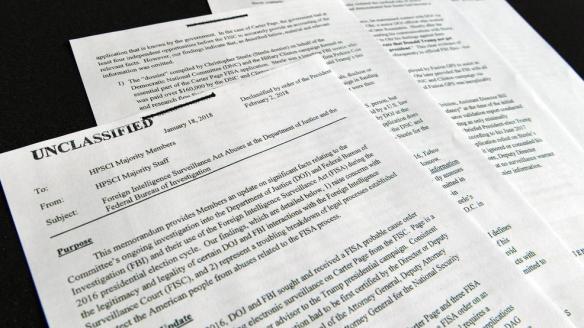
The part of the memo that has everyone talking today reads as follows: “Furthermore, Deputy Director McCabe testified before the Committee in December 2017 that no surveillance warrant would have been sought from the FISC without the Steele dossier information.”

This refers to a surveillance warrant requested by the FBI’s then-Deputy Director Andrew McCabe from the Foreign Intelligence Surveillance Court seeking permission to spy on the communications of Carter Page, a member of the 2016 Trump campaign. The controversy revolves around the claim that this surveillance warrant would never have even been requested if not for the clearly biased, Clinton-funded, and error-riddled Christopher Steele dossier which is acknowledged even by its former MI6 author to be 10 to 30 percent inaccurate.

Combine that with the fact that this has never been made clear to the public, and baby you’ve got yourself a scandal. The FBI knowingly using extremely tainted evidence from one presidential campaign to get permission to spy on another would indeed be a very big deal.

There are some problems with the “BOOM! Bigger than Watergate!” exclamations that pro-Trump partisans have been parading around about this, however. The first is that the memo is only an internal communication between Republican congressmen; it’s not a sworn testimony or legal transcript or anything legally binding. It’s basically just some Republican ideas about what happened. The assertions made therein are reportedly being hotly contested by Democrats with knowledge of the situation, which is in turn being disputed by Republicans.

Another thing putting a damper on the GOP’s “KABOOM!” parade is the fact that the memo’s contents are not even entirely new; CNN reported way back in April of last year that sources had informed them that the Steele dossier had been used to get a FISA warrant on the Trump campaign. Additionally, even if every single allegation in the memo is true, the revelations are still arguably far less earth shattering than the Edward Snowden revelations of 2013 exposing the NSA’s sprawling domestic espionage network, so the expectation that these less significant new revelations would cause a radical transformation in U.S. politics when the Snowden revelations did not seems highly unrealistic.

Nonetheless, there have been some extremely important revelations as a result of this memo; they just haven’t come from the contents of the memo itself. In the same way that cybersecurity analysts observe the metadata underlying hacked files rather than the contents of the files themselves, political analysts have been pointing out that a lot can be learned about the political establishment by looking at its response to the possibility of the memo’s release.

“Memo is clearly not a blockbuster. We can tell so by reading it. Which makes Dems’ frantic efforts to prevent anyone from reading it seem even more bizarre,” observed TYT’s Michael Tracey. “Veracity of memo’s claims aside, we were told that its release would undermine the rule of law. So, just checking: is the rule of law still in tact?” he added later.

“Now it is clear to all,” WikiLeaks’ Julian Assange tweeted. “The claims about how the ‘Nunes’ memo would destroy ‘national security’ were lies. Classification stickers are used by bureaucrats trying to obtain ‘political security’ for their cronies.”

“One effect of the memo – it’s an example of how extensively we overclassify information,” wrote National Review’s David French. “I’m highly dubious that any information disclosed threatens national security in any way, shape, or form. I’d be willing to bet the Dem response is similarly harmless. Release it.”

Indeed, both the FBI and high-profile Democrats have been claiming that the memo’s unredacted release would pose a national security threat, with California Congressman (and virulent Russiagater) Eric Swalwell going so far to call it “brainwashing.” A CNN panelist wandered completely off the paddock and suggested that yesterday may have been America’s last day as a democracy. Why were they all flipping out so hysterically over a release of information that plainly poses no threat to the American people?

In addition to Assange’s assertion that government secrecy has far less to do with national security than political security (a claim he has made before which seems to be proving correct time and time again), there’s the jarring question posed by Republican Congressman Thomas Massie: “who made the decision to withhold evidence of FISA abuse until after Congress voted to renew FISA program?”

Whoa, Nelly. Hang on. What is he talking about?

It would be understandable if you were unaware of the debate over the reauthorization of FISA surveillance which resulted in unconditional bipartisan approval last month – the mainstream media barely touched it. In point of fact, though, the very surveillance practices alleged to have been abused in this hotly controversial memo are the same which was waved through by both the House and the Senate, and by the very same people promoting the memo in many cases.

The McCabe testimony was in December. FISA was renewed in January. Why is all this just coming out now? If the Republicans truly believed that McCabe said what the memo claims he said, why wasn’t the public informed before their elected representatives renewed the intelligence community’s dangerously intrusive surveillance approval? Was this information simply forgotten about until after those Orwellian powers had been secured?

Of course not. Don’t be an idiot.

This makes the kicking, screaming, wailing and gnashing of teeth by the political establishment make a lot more sense, doesn’t it? Now suddenly we’re looking at a he-said, she-said partisan battle over an issue which can only be resolved with greater and greater transparency of more and more government documents, and we can all see where that’s headed. In their rush to win a partisan battle and shield their president from the ongoing Russiagate conspiracy theory, the Republicans may have exposed too much of the establishment foundation upon which both parties are built.

The term “deep state” does not mean “Democrats and Never-Trumpers” as Republican pundits would have you believe, nor does the term refer to any kind of weird, unverifiable conspiracy theory. The deep state is in fact not a conspiracy theory at all, but simply a concept used in political analysis for discussing the undeniable fact that unelected power structures exist in America, and that they tend to form alliances and work together in some sense.

There is no denying the fact that plutocrats, intelligence agencies, defense agencies and the mass media are both powerful and unelected, and there is no denying the fact that there are many convoluted and often conflicting alliances between them. All that can be debated is the manner and extent to which this is happening.

The deep state is America’s permanent government, the U.S. power structures that Americans don’t elect. These power structures plainly have a vested interest in keeping America’s Orwellian surveillance structures in place, as evidenced by the intelligence community’s menacingly urgent demand for FISA renewal back in December. If there’s any thread to be pulled that really could make waves in the way Official Washington (hat tip to the late Robert Parry) operates, it is in the plot holes between the bipartisan scramble toward unconditional surveillance renewal and the highly partisan battle over exposing the abuse of those very powers.

If we’re going to see a gap in the bars of our cages, that’s a great place to keep our eyes trained, so keep watching. Watch what happens in a partisan war where both parties have a simultaneous interest in revealing as little of the game as possible and exposing the other party. Things could get very interesting.

The Nunes Memo Only Partially “Vindicates” Trump, But it Fully Indicts the FBI and the FISA Court

By Thomas L. Knapp

Source: The Fifth Column

On February 2, US president Donald Trump approved public release of a memo from the US House Intelligence Committee concerning FBI malfeasance in its applications for warrants to surveil Carter Page, a former member of his campaign team.

The following day, Trump triumphantly tweeted that the memo “totally vindicates” him in the ongoing “Russiagate” probe. It doesn’t really do that — proving a negative is always difficult — but it does add a great deal of credibility to his charge that the probe is a politically driven witch hunt rather than a serious criminal investigation.

According to the memo, the FBI based the probable cause claim in its multiple surveillance applications to Foreign Intelligence Surveillance Court judge on two pieces of “evidence”:

1) A “minimally corroborated” (the FBI’s own words) dossier of political opposition research on Donald Trump, compiled by a British former spy in the pay of Trump’s political opponents; and

2) A Yahoo! News article based — although the FBI denied it — on leaks from that same foreign operative.

The memo also claims that at no point did the FBI apprise the judge of the political origins or “minimal corroboration” of the memo.

If these claims are true, then what happened was the equivalent of crazy Uncle J. Edgar going before a judge and using a picture of me with a Frisbee [TM] in the air behind me, taken by my angry ex-wife, as probable cause to believe that I’m from Mars, then asking for a warrant to search my garage for flying saucers.

As you may recall, this is the same FBI which (and the same FBI director who) amassed mountains of evidence that Trump’s opponent in the 2016 presidential election had committed multiple felonies in her grossly negligent handling of classified information as Secretary of State, yet recommended against prosecuting her because, well, she’s Hillary Clinton.

And as you may also recall, this is the same FISA court that, between 1979 and 2013 approved 35,434 warrant requests and denied 12.

How many of those 35,434 requests were backed by evidence no more substantial than that described in the Nunes memo?

How much more dumb and evidenceless did those 12 denied requests have to be to not get a pass?

And why did the same Republican Congress which just released this memo recently vote to renew Section 702 of the Foreign Intelligence Surveillance Act, giving even more expansive powers to organizations which have clearly used those powers abusively and without regard to even minimal standards of evidence?

Inquiring minds want to know.

Did Trump and/or his campaign team “collude” with the Russian government to manipulate the 2016 presidential election? I don’t know. But I do know that disguising a circus as an investigation isn’t likely  to shed real light on the matter.


Thomas L. Knapp (Twitter: @thomaslknapp) is director and senior news analyst at the William Lloyd Garrison Center for Libertarian Advocacy Journalism (thegarrisoncenter.org). He lives and works in north central Florida.

Release of Nunes memo throws anti-Russia campaign into disarray

By Andre Damon

Source: WSWS.org

The Democratic Party was thrown into disarray Friday after the publication of a classified memo exposing as a factionally-motivated witch-hunt the investigation by leading intelligence agencies into the Trump administration’s alleged collusion with Russia.

The so-called Nunes memo, which Democratic lawmakers, US intelligence agencies, and major newspapers had been seeking to block for days, alleges that the FBI under the Obama administration used discredited sources and withheld key information to initiate a wiretap of former Trump campaign adviser Cater Page.

The Democrats responded to the prospective release of the Nunes memo with undisguised hysteria, declaring that it threatened National Security and was insufficiently deferential to the US intelligence agencies. Now that the memo has been released, Democrats’ claim that it contains sensitive national security secrets has been exposed as lies.

The memo, written by Republican House Intelligence Committee Chairman Devin Nunes, claims that the FBI obtained a Foreign Intelligence Surveillance (FISA) court authorization to wiretap Page in the fall of 2016 based on a memo compiled by former British intelligence official Christopher Steele.

The so-called Steele dossier, which was released to the public last year, made lurid allegations that Russian government officials had recordings of Trump engaging in “perverted sexual acts” with prostitutes “which have been arranged/monitored by the FSB [Russian intelligence service].” According to the Nunes memo, FBI director James Comey called the Steele Dossier “salacious and unverified” in congressional testimony in June 2017.

In perhaps its most explosive passage, the memo alleges that Andrew McCabe, a deputy FBI director who just stepped down this past week, testified before the House Intelligence Committee in December that “no surveillance warrant would have been sought… without the Steele dossier information.”

In addition, the FISA application “ignored or concealed [Steele’s] anti-Trump financial and ideological motivations,” i.e. the fact that his “research” had been funded by the Clinton campaign.

The Republican memo does not specify what information was collected by the wiretap, or whether it captured any conversations with Trump.

The contents of the memo are another demonstration of the manufactured and partisan character of the anti-Russia campaign and the Democrats’ allegations that Trump “colluded” with Russia. What is playing out is a partisan battle between two criminal and reactionary factions of the state apparatus, centering ultimately around differences over foreign policy.

The release of the memo once again underscores the fact that the US intelligence agencies have massively intervened in US politics. This is true not only with regard to the concocted narrative about “collusion” between Trump and Russia, but equally so with James Comey’s public announcement about re-opening an investigation into Hillary Clinton’s emails just days before the presidential vote, which Clinton claimed may have cost her the election.

The memo has undermined the aura of professional impartiality that the Democrats and their semi-official news outlets, the New York Times and the Washington Post, have sought to cultivate around the so-called “intelligence community.”

The real fear of Democrats is that the exposure of the anti-Russia campaign will undermine the credibility of the FBI. “The selective release and politicization of classified information sets a terrible precedent and will do long-term damage to the intelligence community and our law enforcement agencies,” declared Rep. Adam Schiff of California, the ranking Democrat on the House Intelligence Committee, on Friday.

Schiff added, “If potential intelligence sources know that their identities might be compromised when political winds arise, those sources of vital information will simply dry up, at great cost to our national security.”

But all such arguments about “national security” have been rendered absurd by the release of the document, which contained no sensitive information besides the wrongdoing of the FBI and the Democrats—including Schiff himself.

In an editorial published Friday, ahead of the document’s publication, the New York Times accused congressional Republicans of “undermining the credibility of the law enforcement community,” which they had “once defended so ardently.”

It was left to the satirical news website the Onion to point out the obvious absurdity of such arguments:

Stressing that such an action would be highly reckless, FBI Director Christopher Wray warned Thursday that releasing the “Nunes Memo” could potentially undermine faith in the massive, unaccountable government secret agencies of the United States. “Making this memo public will almost certainly impede our ability to conduct clandestine activities operating outside any legal or judicial system on an international scale,” said Wray, noting that it was essential that mutual trust exist between the American people and the vast, mysterious cabal given free rein to use any tactics necessary to conduct surveillance on U.S. citizens or subvert religious and political groups.

Responding to the Democrats’ allegations that the publication of the document would threaten “national security,” journalist Glen Greenwald tweeted, “What conceivable argument is there that any part of the Nunes Memo could jeopardize national security?”

The Times editorial effectively argues that no documents critical of the actions of the US intelligence apparatus should be published. To make this point, the Times quotes Democratic Senator Ron Wyden, who argued against the release of the memo on the grounds that the public would “see this release as proof that selective classification is used more often to deceive them than to protect them.”

But it is, of course true that “selective classification” is used to deceive the American people. This was demonstrated by the release of the classified Pentagon Papers in 1971, which documented how flagrantly and extensively the Kennedy, Johnson, and Nixon administrations lied to the American people about the Vietnam War.

As The Post, the recently-released film by Stephen Spielberg effectively documents, the New York Times and Washington Post made the decision at the time to defy the Nixon administration and publish the Pentagon Papers, rejecting the spurious argument that their publication would harm “national security.”

The editorial published in the Times Friday reads like a cruder version of the arguments put forward by the Nixon White House to block the release of the Pentagon Papers. If one were to take the editorial at face value, one would conclude that, if the Times had the Nunes memo in its sole possession, it would never have published it.

The Times has become little more than a mouthpiece for the US intelligence agencies, whose aim is to prevent the dissemination of any information that they see as harmful to the interests of the American ruling class and the capitalist state.