Zelensky, media lackeys caught in most dangerous lie yet

By Alexander Rubinstein

Source: The Grayzone

With Kiev exposed for a lie that could have triggered a third world war, it is time to examine past deceptions that Western media promoted.

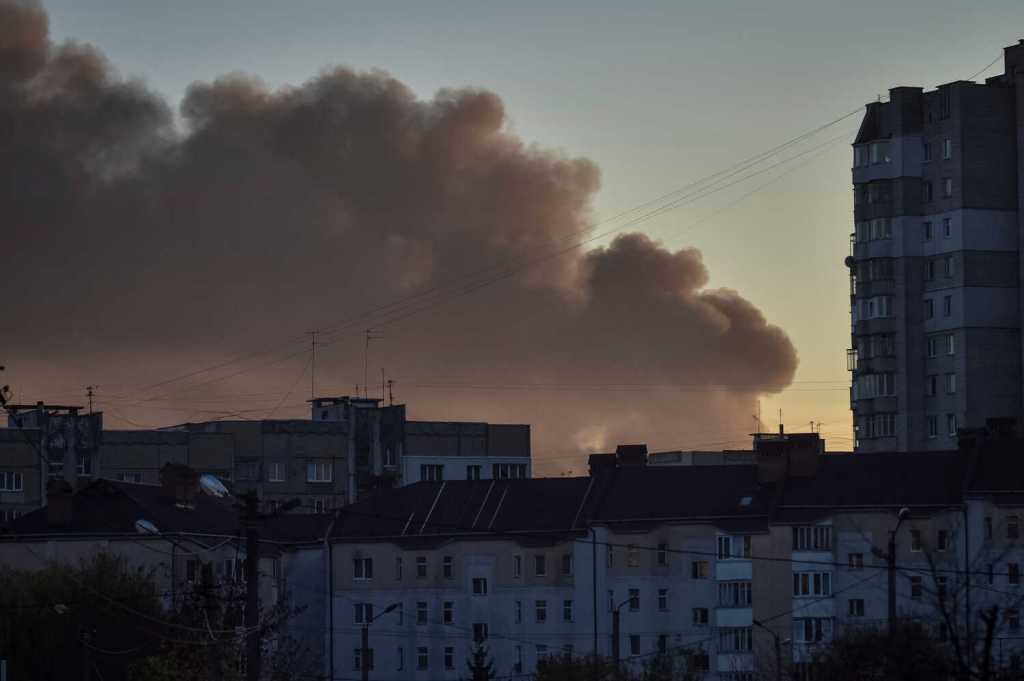
A missile that exploded on Polish soil on November 15 killed two civilians and destroyed farm equipment. Ukrainian President Volodymyr Zelensky and Western corporate media rushed to blame the explosion on Russia in apparent hopes of triggering NATO’s Article 5, which requires NATO states to defend one another militarily when attacked by a hostile force.

Polish and NATO members including US President Joseph Biden have since confirmed the missile that struck Poland was, in fact, a Ukrainian S-300 anti-aircraft missile. Yet Zelensky is sticking to his line, blaming Russia for the strike, while NATO Secretary-General Jens Stoltenberg still insists that “Russia bears ultimate responsibility.” Meanwhile, the media outlets that reflexively pointed the finger at Russia have been forced to take a step back from their initial reporting.

“Russian missiles hit Poland, the territory of our friendly country. People died,” Zelensky insisted on November 15, the night of the attack. “The longer Russia feels impunity, the more threats there will be to anyone within reach of Russian missiles. To fire missiles at NATO territory! This is a Russian missile attack on collective security! This is a very significant escalation. We must act.”

Zelensky held firm the following day, despite mounting evidence that his own country’s air defenses were responsible, declaring “I have no doubt that this is not our missile… I believe that this was a Russian missile, based on our military reports.” By this time, most analysts rejected the Ukrainian president’s assessment, including the founder of the US government-sponsored intelligence cutout Bellingcat, who wrote “At this point I think it’s fair anyone saying that a Russian missile hit Poland based on the current evidence is being irresponsible.”

A Russian attack on NATO member Poland could have triggered Article 5 of the North Atlantic Treaty Organization which compels its member states to consider “an attack against one Ally” to be “an attack against all Allies.” Such a mobilization would have amounted to World War III.

Despite the clear risk of such a catastrophic escalation – or perhaps because of it – Western corporate media immediately blamed Russia for the strike, never even posing the question of why Russia would consider Polish farmland such an important military target that it would be willing to risk a full-scale war with the 30-member NATO alliance. 

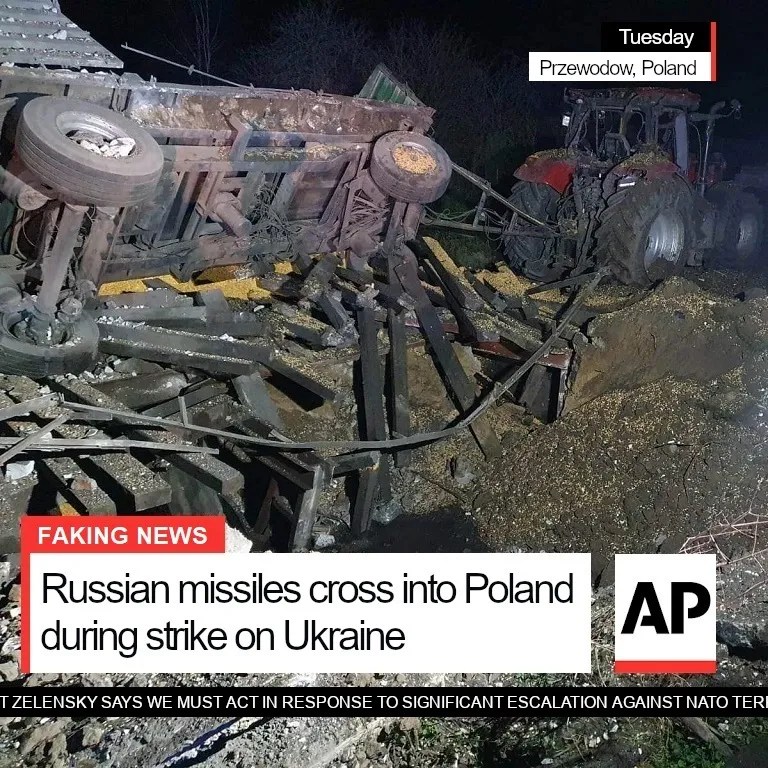
Initially, the Associated Press ran with the headline “Russian missiles cross into Poland during strike on Ukraine.” The article cited a “senior US intelligence official,” and later, “a second person.” 

On November 16, AP began redirecting the link to its original article to a correction that stated, “The Associated Press reported erroneously, based on information from a senior American intelligence official who spoke on condition of anonymity, that Russian missiles had crossed into Poland and killed two people. Subsequent reporting showed that the missiles were Russian-made and most likely fired by Ukraine in defense against a Russian attack.”

Time Magazine ran with the headline, “Russian Missiles Cross Into Poland During Strike, Killing Two,” and cited the AP report.

Fox News similarly announced, “Russian missiles cross into NATO member Poland, kill 2: senior US intelligence official, citing the Associated Press. MSNBC also blamed a “Russian missile” for the strike in its headline.

Then there was CNN, which reported, “Poland says Russian-made missile killed two, will consider invoking NATO Article 4.” NATO Article 4 deals with the meetings between NATO states that are to take place in the event one of them is “threatened” and would theoretically precede any invocation of Article 5. Like CNN, Reuters cited the Polish Foreign Ministry and ran the headline, “Poland says Russian rocket hit its territory as NATO weighs response.”

The New York Times stated in the second sentence of its report on the missile strike that “the blast came as Russia fired roughly 90 missiles into Ukraine.” Two lines later, the Times stated “local media suggests a Russian missile strike.” Readers of the paper of record would have to scroll down several times to even read that Russian officials denied responsibility.

Earlier in the war, in an article on “Ukraine’s online propaganda,” the New York Times sought to downplay the Ukrainian government’s penchant for pushing fake news, arguing that Kiev’s information war merely “dramatize[s] tales of Ukrainian fortitude and Russian aggression.” The article quoted an unnamed Twitter user, who wrote, “Why can’t we just let people believe some things? … If the Russians believe it, it brings fear. If the Ukrainians believe it, it gives them hope.”

The US media’s support for Ukraine’s propaganda efforts meant that it covered some of the most suspicious events without a hint of skepticism, and thereby encouraged more. 

These questionable incidents included the following:

  • On March 8, Western media reported that a Mariupol maternity hospital was attacked by Russian aircraft. Zelensky claimed the attack was evidence of Russian “genocide” against Ukraine. However, a key witness – a pregnant woman in the hospital photographed by AP – stated that no such airstrike occurred, and that nearby explosions were caused by Ukrainian artillery shells.

On March 16, the Ukrainian government blamed a targeted Russian airstrike for destroying the Mariupol Dramatic Theater and causing anywhere from 300 to 600 deaths. Western corporate media promoted the Ukrainian narrative of the event despite a total absence of footage showing a missile strike, no images or evidence of large numbers of dead civilians inside, no images or evidence of any attempted rescue, and testimony by Mariupol locals asserting the Azov Battalion fighters that controlled the theater’s grounds staged the explosion to provoke NATO military intervention. Photographic evidence showed that Azov fighters removed all vehicles from the theater’s parking lot one day before the explosion.

The Kramatorsk train station bombing that was blamed on Russia despite the fact the Tochka-U missile responsible for the blast contained a serial number matching others in Ukraine’s arsenal and originated from Ukrainian-controlled territory.

As the war grinds on, elements in the Biden administration appear to be growing impatient with the tall tales of their Ukrainian clients. “This is getting ridiculous,” an unnamed NATO official told the Financial Times on November 16. “The Ukrainians are destroying our confidence and they are openly lying. This is more destructive than the missile.”
AP Editor Said She “Can’t Imagine” A US Intelligence Official Being Wrong

By Caitlin Johnstone

Source: CaitlinJohnstone.com

The Associated Press journalist who reported a US intelligence official’s false claim that Russia had launched missiles at Poland last week has been fired.

As we discussed previously, AP’s anonymously sourced report which said “A senior U.S. intelligence official says Russian missiles crossed into NATO member Poland, killing two people” went viral because of the massive implications of direct hot warfare erupting between Russia and the NATO alliance. AP subsequently retracted its story as the mainstream political/media class came to accept that it was in fact a Ukrainian missile that had struck Poland.

AP’s firing of reporter James LaPorta looks at this time to be the end point of any accountability for the circulation of this extremely dangerous falsehood. AP spokesperson Lauren Easton says no disciplinary action will be taken against the editors who waved the bogus story through, and to this day the public has been kept in the dark about the identity of the US official who fed such extremely egregious misinformation/disinformation to the public through the mainstream press.

It is utterly inexcusable for AP to continue to protect the anonymity of a government official who fed them such a profoundly significant falsehood. This didn’t just affect AP staff, it affected the whole world; we deserve to know what happened and who was responsible, and AP has no business obstructing that knowledge from us.

LaPorta’s firing looks like this is yet another instance where the least powerful person involved in a debacle is being made to take the fall for it. A powerful intelligence official will suffer no consequences for feeding false information to the press — thereby ensuring that it will happen again — and no disciplinary action will be taken against LaPorta’s superiors, despite the absolute buffoonery that subsequent reporting has revealed on their part.

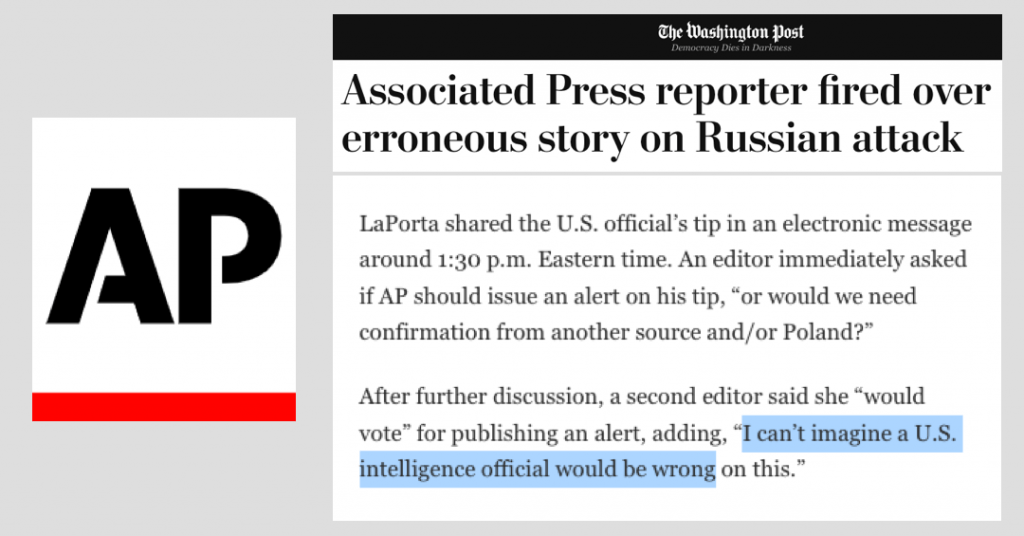
In an article titled “Associated Press reporter fired over erroneous story on Russian attack,” The Washington Post reports the following (emphasis added):

Internal AP communications viewed by The Post show some confusion and misunderstanding during the preparations of the erroneous report.

LaPorta shared the U.S. official’s tip in an electronic message around 1:30 p.m. Eastern time. An editor immediately asked if AP should issue an alert on his tip, “or would we need confirmation from another source and/or Poland?”

After further discussion, a second editor said she “would vote” for publishing an alert, adding, “I can’t imagine a U.S. intelligence official would be wrong on this.”

“I can’t imagine a US intelligence official would be wrong on this.”

Can you imagine not being able to imagine a US intelligence official being wrong? This would be an unacceptable position for any educated adult to hold, much less a journalist, still less an editor, and still less an editor of one of the most influential news agencies on earth.

These are the people who publish the news reports we read to find out what’s happening in the world. This is the baby-brained level of thinking these people are serving the public interest with.

Antiwar commentator Daniel Larison writes the following of the AP editor’s shocking quote:

Skepticism about official claims should always be the watchword for journalists and analysts. These are claims that need more scrutiny than usual rather than less. If you can’t imagine that an intelligence official could get something important wrong, whether by accident or on purpose, you are taking far too many things for granted that need to be questioned and checked out first.

Intelligence officials of many governments feed information to journalists and have done so practically ever since there was a popular press to feed information to, and that information certainly should not be trusted just because an official source hands it over. It is also always possible for intelligence officials to just get things wrong, whether it is because they are relying on faulty information or because they were too hasty in reaching conclusions about what they think they know.

Whether the AP’s source was feeding them a line or was simply mistaken, a claim as provocative and serious as this one should have been checked out much more thoroughly before it got anywhere near publication. The AP report in this case seems to have been a combination of a story that was “too good to check” and a culture of deference to official sources in which the editors didn’t feel compelled to make the effort to check.

Indeed, the only reason the press receive such explicit protections in the US Constitution is because they are supposed to hold the powerful to account. If the editors of a wildly influential news agency will just unquestioningly parrot whatever they are fed by government officials while simultaneously protecting those officials with anonymity, they are not holding the powerful to account, and are in fact not meaningfully different from state propagandists.

They are state propagandists. Which is probably why they are sipping lattes in the AP newsroom while Julian Assange languishes in prison.

As Jacobin’s Branko Marcetic observed, this is far from the first time AP has given the cover of anonymity to US government officials circulating bogus claims of potentially dangerous consequence, like the time it reported an official’s evidence-free assertion which later proved false that Iran had carried out an attack on four oil tankers off the coast of the United Arab Emirates, or the time it let another one anonymously claim that “Iran may try to take advantage of America’s troop withdrawals from Iraq and Afghanistan.”

So to recap  —

  • Powerful government official who fed AP a false story: Zero accountability
  • AP editor who asked if a report should immediately be published upon receipt of the story: Zero accountability
  • Second AP editor who says she can’t imagine a U.S. intelligence official would be wrong:  Zero accountability
  • Journalist who wrote the story: Singular accountability

In a sane society, power and responsibility would go hand in hand. A disaster would be blamed on the most powerful people involved in its occurrence. In our society it’s generally the exact opposite, with the rank-and-file taking all of the responsibility and none of the power.

Our rulers lie to us, propagandize us, endanger us, impoverish us, destroy journalism, start wars, kill our biosphere and make our world dark and confusing, and they suffer no consequences for it. We cannot allow them to continue holding all of the power and none of the responsibility. This is backwards and must end.

War Without End

What is wrong with the United States of America?

By Philip Giraldi

Source: The Unz Review

Prussian Major General Carl von Clausewitz famously drew on his own experience in the Napoleonic Wars to examine war as a political phenomenon. In his 1832 book “On War” he provided a frequently quoted pithy summary of war versus peace, writing in terms of politico-military strategy that “War is a mere continuation of politics by other means.” In other words, war-making is a tool provided to statesmen to achieve a nation’s political objectives when all else fails.

One can reject the ultimate amorality of Clausewitz’s thinking about war while also recognizing that some nations have historically speaking exploited war-making as a tool for physical expansion and the appropriation of foreigners’ resources. As far back as the Roman Republic, the country’s elected leaders doubled as heads of its consular armies, which were expected to go out each spring to expand the imperium. More recently, Britain notably engaged in almost constant colonial wars over the course of centuries to establish what was to become history’s largest empire.

America’s dominant neocons characteristically believe they have inherited the mantle of empire and of the war powers that go hand-in-hand with that attribute, but they have avoided other aspects of the transition in turning the United States into a nation made and empowered by war. First of all, what comes out the other end after one has initiated hostilities with another country is unpredictable. Starting with Korea and continuing with Vietnam, Afghanistan, Iraq as well as other minor operations in Latin America, Africa and Asia, American war-making has brought nothing but grief on those on the receiving end with little positive to show for the death, destruction and accumulated debt. Also forgotten in the rush to use force is the raison d’etre to have a federal national government at all, which is to bring tangible benefit to the American people. There has been none of that since 9/11 and even before, while Washington’s hard-line stance on what has become a proxy war against Russia over Ukraine promises more pain – perhaps disastrously so – and no real gain.

If one has any doubt that going to war has become the principal function of both Democrats and Republicans in Washington, it is only necessary to consider several stories that have appeared in the past several weeks. The first comes from the Republican side, and it includes a possibly positive development. House Minority leader Republican Kevin McCarthy warned two weeks ago that the GOP will not necessarily continue to write a “blank check” for Ukraine if they obtain the House majority in next month’s election, reflecting his party’s growing skepticism about unlimited financial support for the corrupt regime in place in Kiev. McCarthy explained “I think people are gonna be sitting in a recession and they’re not going to write a blank check to Ukraine. They just won’t do it. … It’s not a free blank check.”

America’s uncritical support for Ukraine, which has been a contrivance by the White House and media since the fighting started, has led to a growing number of Republicans, particularly some of those aligned with Donald Trump’s “America First” approach, to challenge the need for massive federal spending abroad at a time of record-high inflation at home. Since Russia launched its invasion in February, Congress has approved tens of billions in emergency security and humanitarian assistance for Ukraine, while the Biden administration has shipped billions more worth of weapons and equipment from military inventories, all done with only limited or even no oversight of where the money and weapons are winding up.

But, unfortunately, the GOP is far from unified on its approach to Ukraine-Russia. Congressman Liz Cheney demonstrated that her apple did not fall far from her father’s tree, taking some time off from trying to hang Donald Trump to denounce what she refers to as the “Putin wing of the Republican Party.” She put it this way: “You know, the Republican Party is the party of Reagan, the party that essentially won the Cold War. And you look now at what I think is really a growing Putin wing of the Republican Party.”

Cheney criticized Fox News for “running propaganda” on the issue and in particular called out Fox host Tucker Carlson as “the biggest propagandist for Putin on that network… You really have to ask yourself, whose side is Fox on in this battle? And how could it be that you have a wing of the Republican Party that thinks that America would be standing with Putin as he conducts that brutal invasion of Ukraine?”

Cheney notably did not address the issue of how the war developed in the first place because the US and UK preferred saber rattling to diplomacy with Moscow. Or why the United States feels compelled to tip-toe to the brink of a possible nuclear war over a foreign policy issue that is of no real national interest to the American people. And where did she make her comments? At the McCain Institute in Arizona. Yes, that’s a legacy of Senator John McCain another Republican who never saw a war he couldn’t enthusiastically support.

Both President Joe Biden and Speaker of the House Nancy Pelosi have confirmed that the US is in with Ukraine until “victory” is obtained, whatever that is supposed to mean, while other Administration officials have indicated that the actual purpose of the fighting is to weaken Russia and remove President Putin. White House press secretary Karine Jean-Pierre glibly spouted the party line when asked about McCarthy’s comments. She thanked congressional leaders for bipartisan work to “support Ukraine to defend itself from Russia’s war crimes and atrocities,” adding that “We will continue to work with Congress and continue to monitor those conversations on these efforts and support Ukraine as long as it takes. We are going to keep that promise that we’re making to the brave Ukrainians who are fighting every day, to fight for their freedom and their democracy.”

Perhaps more bizarre than Cheney’s comments is the tale of a letter that was prepared by thirty Democratic Party progressives urging US support for negotiations to end the fighting in Ukraine. The letter was prepared in June but not released until last week before being quickly retracted under pressure on the following day. Pramila Jayapal, who heads the Congressional Progressive Caucus, said it was retracted because it “was being conflated with [the] comments” made by McCarthy over his warning about budget cutting for Ukraine. Jayapal referred to the letter as a “distraction,” but what she really meant was that her group had no desire to make common cause with the Republicans over any issue, including war and peace in an escalating conflict that is manifestly pointless.

A clueless Jayapal also took pains to contradict the message put out by her own group, emphasizing that there has been no opposition to the administration’s Ukraine policy from Democrats in Congress. She said Democrats “have strongly and unanimously supported and voted for every package of military, strategic, and economic assistance to the Ukrainian people.” She doubled down on the White House message, affirming that the war in Ukraine will only end with diplomacy after “a Ukrainian victory.”

So basically, anyone talking sense about Ukraine in Washington is being shut down by forces within the political parties themselves working together with a compliant national media that is mis-representing everything that is taking place on the ground. It is a formula for tragedy as the Biden administration has shown no sign of seeking diplomacy with Russia to end the conflict despite the president’s recent surprising warning that the world is now facing the highest risk of nuclear “Armageddon,” which he, of course, blames on Putin. Given all of that, in my humble opinion a government that is unable or unwilling to take reasonable steps to protect its own citizens while also avoiding a possible nuclear catastrophe that could end up engulfing the entire world is fundamentally evil and has lost all legitimacy. It should recognize that fact before submitting its resignation.

Poland, NATO Agree Deadly Polish Border ‘Russian Attack’ Was Errant Ukrainian Missile

By Tyler Durden

Source: Zero Hedge

A mere less than 24 hours ago, before the dust had settled from the explosion and before investigators could come to any definitive conclusions after the deadly incident on the Polish border village of Przewodów, the Western public was already being harangued and forewarned to stay away from ‘conspiracy theories’ as the early mainstream headlines – pushed especially based on an anonymous US official in an Associated Press report – were fast out the gate with “Russian missiles hit Poland, killing two”

“Article 5” – the NATO collective defense treaty which many had long worried would be the first invoked act leading to WWIII, began trending on Twitter, as Western officials issued confident statements of ‘solidarity’.  Almost immediately and without evidence, Ukraine’s President Volodymyr Zelensky demanded “action” from the West over the supposed brazen aggression against a NATO member. “Hitting NATO territory with missiles… This is a Russian missile attack on collective security! This is a really significant escalation. Action is needed,” Zelensky said his Tuesday night video address.

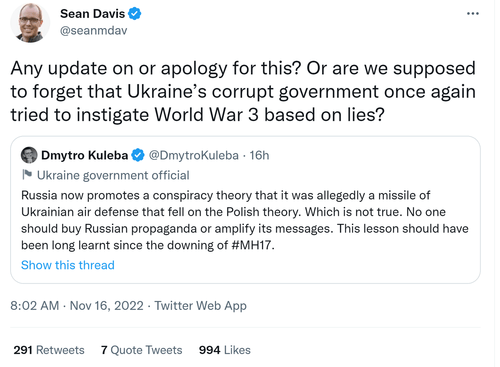
And then as missile crash site images widely circulated on the internet, leading even Western sources to express doubt that the projectile was launched by Russia, enter no less than the foreign minister of Ukraine, who attempted to preempt what he slammed as a developing Russia-promoted “conspiracy theory”. Like with many other aspects to this war, some of the most obvious common sense questions were quickly declared “off limits” before they could even be asked. 

Warsaw then stopped just short of any talk of Article 5, but then floated Article 4 as the basis of an emergency NATO security meeting for Wednesday, which calls for “consultations” in the event a NATO country is under threat. 

But what a difference a few hours, and a skeptical refusal to blindly jump on the war! bandwagon, makes. First, as we reported overnight, President Joe Biden explicitly said that based on preliminary information, it is “unlikely” that the rocket strike in Poland originated in Russia. Oops. This as based on the available emerging evidence it seemed clear the culprit was more likely an errant Ukrainian anti-air missile. “It’s unlikely in the minds of [sic] the trajectory that it was fired from Russia. But we’ll see,” Biden had said. But this admission conveniently came well after the US president seized the ‘fog of war’ moment to unveil another massive $37 billion emergency aid package for Ukraine almost simultaneous to the border incident.

Now on Wednesday, Poland and NATO officials have also done a reversal of the initial kneejerk ‘blame Russia’ reporting which momentarily sent the world into a frenzy of anxiety over the prospect of WWIII. Polish President Andrzej Duda has said the explosion that killed two people now appears to be an “unfortunate accident” and not an “intentional attack.”

What is left to say after all of this? Here are the facts

Recall that the initial reaction out of Moscow was that either Ukraine or Poland was staging a “deliberate provocation” in so quickly hurling blame on Russia for an aggressive act. Warsaw officials had even in the hours after demanded that Russia make an apology if it was an accident.

But President Duda alongside NATO HQ is quickly reversing the entire narrative, according to more from Axios

  • Duda added that the projectile that caused the blast was “most likely” Russian-made, but officials have “no proof at the moment that it was a missile fired by the Russian side.”
  • Ukraine has previously denied it was to blame for the blast and accused Moscow of a “serious escalation.” Russia also denied responsibility.

Of course, it’s always been the case that Ukraine’s anti-air missile arsenal is entirely “Russian-made” – particularly its S-300s.

NATO Secretary General Jens Stoltenberg issued a similar assessment, saying it was most likely an errant Ukrainian missile:

“Our preliminary analysis suggests that the incident was likely caused by a Ukrainian air defence missile fired to defend Ukrainian territory against Russian cruise missile attacks,” the NATO Secretary General told reporters after an emergency meeting of the alliance’s Security Council. 

He stressed that the investigation into the explosion is still ongoing but that there is “no indication that this was the result of a deliberate attack. And we have no indication that Russia is preparing offensive military actions against NATO.”

To be expected, he quickly followed by still laying blame on Russia for the overall war and series of events which led to the deadly border explosion. “But let me be clear. This is not Ukraine’s fault. Russia bears ultimate responsibility, as it continues its illegal war against Ukraine,” the NATO chief said.

Without addressing Zelensky’s prior day shrill rush to get NATO to declare military action based on collective security, Stoltenberg stressed, “this is not Ukraine’s fault.” As NATO defense officials continue to meet to determine a way forward, and as the whole drama has clearly fizzled out (again, only after it emerged it was Ukraine’s rocket), likely the alliance will quietly move on in a “nothing to see here” manner.

But what about the next time a similar border tragedy or incident on NATO-land plays out? Will the same “Russia is attacking NATO!” narrative prevail before anyone is allowed to ask simple questions? Will the war drums beat before there’s so much as a forensic investigation? Will there be a mushroom cloud before pesky rational skepticism disrupts the “consensus”? As the past ten years of war in Syria and Western intervention there have demonstrated, this is the likely inevitable scenario of how NATO and Russia will stumble into direct conflict at this rate.

In the meantime, as for the below still lingering question, we won’t hold our breath…

The US is pushing the situation towards a clash of major nuclear powers

By Valery Kulikov

Source: New Eastern Outlook

With its actions in recent months, the United States is blatantly pushing the international situation towards a clash of major nuclear powers. This is true of Washington’s blatantly provocative moves against both Russia and China.

US officials continue to inflame the situation, intimidating their own and the world public with “imaginary nuclear threats” from Russia by spreading fake information. For example, during a speech at the UN General Assembly, US President Biden cited non-existent quotes from Putin. Foreign Ministry Spokeswoman Maria Zakharova called it at least “indecent” that US President Joe Biden falsely quoted Russian leader Vladimir Putin when he “attributed” to the Russian President saying that “our country threatens the world with nuclear weapons”. According to her, someone took advantage of the White House head’s inability to reflect on difficult subjects.

The anti-Russian actions of Joe Biden and members of his administration are now harshly criticized by numerous politicians and media both within and outside the US. The US President was harshly criticized in particular by Fox News political observer Tucker Carlson, who said that Biden was guilty of wanting to destroy Russia for the sake of American hegemony in the world.

Russian President Vladimir Putin has repeatedly reminded the Russian and international public in his recent speeches that Washington is pushing Kiev to move hostilities to Russian territory and has recently even resorted to nuclear blackmail. “Washington, London and Brussels are directly pushing Kiev to transfer hostilities to our territory, and they are already openly saying that Russia must be defeated by all means on the battlefield, followed by the deprivation of economic, political, cultural and any kind of sovereignty, and the complete pillaging of our country,” the Russian leader said in a televised address on September 21. “We are talking not only about Western-encouraged shelling of the Zaporozhye NPP, which threatens a nuclear disaster, but also about statements by some high-ranking representatives of some NATO states about the possibility and admissibility of using weapons of mass destruction, nuclear weapons, against Russia,” Putin explained.

As highlighted in an article by Russia’s Ambassador to the US Anatoly Antonov published in The National Interest magazine, Washington’s actions are pushing the situation towards a clash of major nuclear powers. Western countries appear to be testing Russia’s mettle. “Today it is obvious that the United States is directly involved in the military actions of the Kiev regime. Washington is openly building up the supply of lethal weapons to Ukraine and provides it with intelligence. They jointly plan military operations against the Russian Armed Forces. Ukrainians are being trained to use NATO military hardware in a fight,” the article notes.

Following US media reports in late September that the US was allegedly developing plans to hit the Russian military and political leadership and the Kremlin, the Russian Embassy in Washington commented on the hoaxes, stressing that this was someones’ delusion. The Russian Embassy expressed the hope that such delusional reasoning does not reflect the official position of the US military establishment, as Washington must be well aware of the escalating nature of such reckless rhetoric.

The fact that the US is actively working for an armed clash with Russia is evidenced not only by numerous policies, but also by documents.

The Swedish newspaper Nya Dagbladet, for example, published what it admitted was a “shocking document” about how the US was planning an armed conflict with Russia and an energy crisis in Europe in January. The source of this information was a “leak” from the RAND Corporation, the leading US think-tank responsible for making recommendations to the White House. The report, which was obtained by a Swedish publication, states in particular that one of the reasons for an armed clash between the West and Russia would be its push for military intervention in Ukraine in response to the aggressive foreign policy pursued by the Kiev regime under instructions from Washington. According to the pervasive key objective of this cynical strategy, as described in the document, one of the most important US objectives has been to destroy cooperation not only between Germany and Russia, but also between Berlin and Paris, dragging both of these Western European countries into the conflict in Ukraine.

As the European media is already reporting, although there are still hopes and opportunities to stop the Western-initiated conflict with Russia, they are being increasingly dashed by unprecedented propaganda, the spread of war hysteria through the media and the fanatical insanity of Western politicians. All this shows that military decisions have long been made and there is less and less realistic possibility of stopping the conflict. This has been seriously illustrated by the active calls by the US and its NATO allies for their citizens to urgently leave Russian territory, which, in a well-known historical analogy, is usually done on the eve of the outbreak of a serious armed conflict.

On September 28, the US Embassy in Moscow, for example, called on compatriots to urgently leave the territory of the Russian Federation. In particular, one of the recent reports published on the Embassy’s website said: “US citizens should not travel to Russia and those residing or travelling in Russia should depart Russia immediately while limited commercial travel options remain”.

The Polish Foreign Ministry on September 27 also advised its citizens “leave [Russian] territory using the available commercial and private means”. At the same time, Polish citizens are warned that “in case of a drastic deterioration of the security situation, the closure of borders or other unforeseen circumstances, evacuation may prove significantly impeded or even impossible”. At the same time, according to the Deputy Minister of Interior and Administration Błażej Poboży, an inspection of bomb shelters, even those that are not in the possession of the city authorities, has been launched on the territory of Poland.

The Italian Embassy in Moscow, Latvian Foreign Minister Edgars Rinkēvičs, the Lithuanian Foreign Ministry and several other NATO foreign ministries also advised fellow citizens to leave Russia on September 29.

Although the Latvian authorities admit that the situation on the Latvian-Russian border is stable, calm and under strict control, the country introduced an emergency situation for the next three months. At the same time, the North Atlantic Alliance Command reported the deployment of two HIMARS MLRSs by the US in Latvia, ostensibly in preparation for the NAMEJS exercise.  The exact same MLRSs are already being actively used by the US in military operations in Ukraine to shell Donbas territory by the Kiev regime under the guidance of US military advisors.

While the current US leadership has long acted adventurously and irresponsibly towards the people of eastern Ukraine and the Russian Federation, supporting and fomenting hostilities with its arms deliveries, it must understand that a nuclear conflict, if it occurs, cannot remain a regional issue. And if, through the fault of the White House, the conflict with Moscow descends into nuclear war, such war would be global. It will primarily destroy the United States, as well as the countries where NATO armaments are located and from where the security of Russia and Russian citizens will be threatened. And Washington should be clear that this risk is higher than what the current US political elite expects.

THE WEST’S FALSE NARRATIVE ABOUT RUSSIA AND CHINA

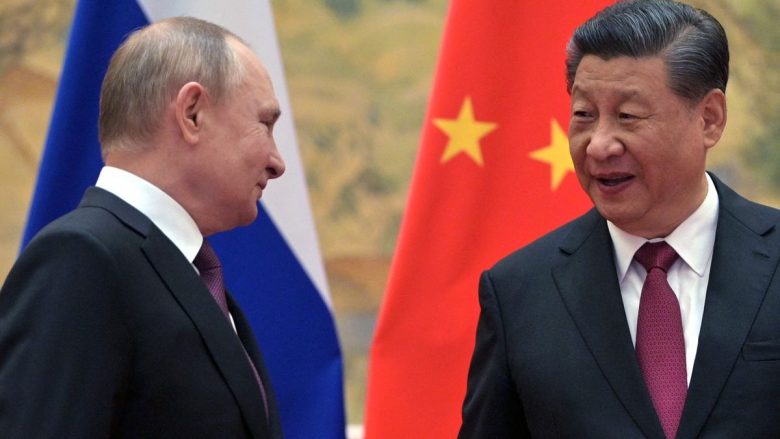
Vladimir Putin meets with Xi Jinping in Beijing just weeks before the invasion of Ukraine. Photograph: SPUTNIK/Reuters

By Jeffrey Sachs

Source: New Cold War

The world is on the edge of nuclear catastrophe in no small part because of the failure of Western political leaders to be forthright about the causes of the escalating global conflicts. The relentless Western narrative that the West is noble while Russia and China are evil is simple-minded and extraordinarily dangerous. It is an attempt to manipulate public opinion, not to deal with very real and pressing diplomacy.
___________________________

The essential narrative of the West is built into US national security strategy. The core US idea is that China and Russia are implacable foes that are “attempting to erode American security and prosperity.” These countries are, according to the US, “determined to make economies less free and less fair, to grow their. militaries, and to control information and data to repress their societies and expand their influence.”

The irony is that since 1980 the US has been in at least 15 overseas wars of choice (Afghanistan, Iraq, Libya, Panama, Serbia, Syria, and Yemen just to name a few), while China has been in none, and Russia only in one (Syria) beyond the former Soviet Union. The US has military bases in 85 countries, China in 3, and Russia in 1 (Syria) beyond the former Soviet Union.

President Joe Biden has promoted this narrative, declaring that the greatest challenge of our time is the competition with the autocracies, which “seek to advance their own power, export and expand their influence around the world, and justify their repressive policies and practices as a more efficient way to address today’s challenges.” US security strategy is not the work of any single US president but of the US security establishment, which is largely autonomous, and operates behind a wall of secrecy.

The overwrought fear of China and Russia is sold to a Western public through manipulation of the facts. A generation earlier George W. Bush, Jr. sold the public on the idea that America’s greatest threat was Islamic fundamentalism, without mentioning that it was the CIA, with Saudi Arabia and other countries, that had created, funded, and deployed the jihadists in Afghanistan, Syria, and elsewhere to fight America’s wars.

Or consider the Soviet Union’s invasion of Afghanistan in 1980, which was painted in the Western media as an act of unprovoked perfidy. Years later, we learned that the Soviet invasion was actually preceded by a CIA operation designed to provoke the Soviet invasion! The same misinformation occurred vis-à-vis Syria. The Western press is filled with recriminations against Putin’s military assistance to Syria’s Bashar al-Assad beginning in 2015, without mentioning that the US supported the overthrow of al-Assad beginning in 2011, with the CIA funding a major operation (Timber Sycamore) to overthrow Assad years before Russia arrived.

Or more recently, when US House Speaker Nancy Pelosi recklessly flew to Taiwan despite China’s warnings, no G7 foreign minister criticised Pelosi’s provocation, yet the G7 ministers together harshly criticised China’s “overreaction” to Pelosi’s trip.

The Western narrative about the Ukraine war is that it is an unprovoked attack by Putin in the quest to recreate the Russian empire. Yet the real history starts with the Western promise to Soviet President Mikhail Gorbachev that NATO would not enlarge to the East, followed by four waves of NATO aggrandisement: in 1999, incorporating three Central European countries; in 2004, incorporating 7 more, including in the Black Sea and Baltic States; in 2008, committing to enlarge to Ukraine and Georgia; and in 2022, inviting four Asia-Pacific leaders to NATO to take aim at China.

Nor do the Western media mention the US role in the 2014 overthrow of Ukraine’s pro-Russian president Viktor Yanukovych; the failure of the Governments of France and Germany, guarantors of the Minsk II agreement, to press Ukraine to carry out its commitments; the vast US armaments sent to Ukraine during the Trump and Biden Administrations in the lead-up to war; nor the refusal of the US to negotiate with Putin over NATO enlargement to Ukraine.

Of course, NATO says that is purely defensive, so that Putin should have nothing to fear. In other words, Putin should take no notice of the CIA operations in Afghanistan and Syria; the NATO bombing of Serbia in 1999; the NATO overthrow of Moammar Qaddafi in 2011; the NATO occupation of Afghanistan for 15 years; nor Biden’s “gaffe” calling for Putin’s ouster (which of course was no gaffe at all); nor US Defence Secretary Lloyd Austin stating that the US war aim in Ukraine is the weakening of Russia.

At the core of all of this is the US attempt to remain the world’s hegemonic power, by augmenting military alliances around the world to contain or defeat China and Russia. It’s a dangerous, delusional, and outmoded idea. The US has a mere 4.2% of the world population, and now a mere 16% of world GDP (measured at international prices). In fact, the combined GDP of the G7 is now less than that of the BRICS (Brazil, Russia, India, China, and South Africa), while the G7 population is just 6 percent of the world compared with 41 percent in the BRICS.
There is only one country whose self-declared fantasy is to be the world’s dominant power: the US. It’s past time that the US recognised the true sources of security: internal social cohesion and responsible cooperation with the rest of the world, rather than the illusion of hegemony. With such a revised foreign policy, the US and its allies would avoid war with China and Russia, and enable the world to face its myriad environment, energy, food and social crises.

Above all, at this time of extreme danger, European leaders should pursue the true source of European security: not US hegemony, but European security arrangements that respect the legitimate security interests of all European nations, certainly including Ukraine, but also including Russia, which continues to resist NATO enlargements into the Black Sea. Europe should reflect on the fact that the non-enlargement of NATO and the implementation of the Minsk II agreements would have averted this awful war in Ukraine. At this stage, diplomacy, not military escalation, is the true path to European and global security.

Joe Biden’s Secret War in Ukraine

American soldiers are already “boots on the ground”

By Philip Giraldi

Source: The Unz Review

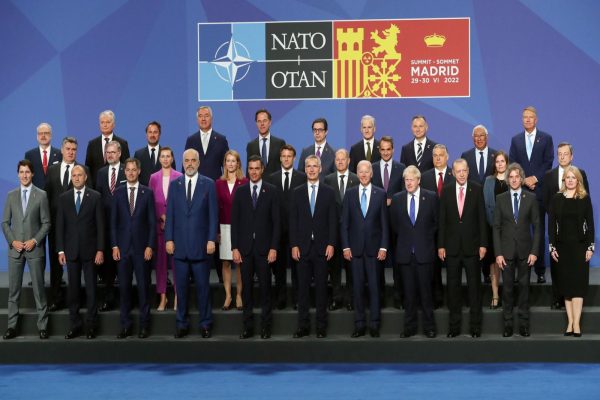
The White House keeps insisting that it will not directly involve American soldiers in the war in Ukraine, but it keeps taking steps that will inevitably lead to a large-scale open combat role for the US against Russia. Among the most recent moves to increase the pressure on the Kremlin, Biden revealed at a NATO summit meeting in Madrid on June 29th that the US will establish a permanent headquarters in Poland for the Fifth Army Corps, maintain an additional rotational brigade of thousands of troops in Romania and bolster other deployments in the Baltic states. Also, the number of US troops in Europe, currently approaching 100,000, will be increased. Biden also was pleased to learn that Turkey had been enticed to drop its objection to Finland and Sweden joining NATO.

On the way to the NATO summit aboard Air Force One, Biden’s National Security Adviser Jake Sullivan advised that “By the end of the summit what you will see is a more robust, more effective, more combat credible, more capable and more determined force posture to take account of a more acute and aggravated Russian threat.” Presumably Sullivan was reading from a prepared script, but the objective surely seemed to be to heighten tension with Moscow rather than attempt to reduce it and come to some kind of diplomatic settlement.

NATO Secretary General Jens Stoltenberg also did his bit. In an astonishing display of derriere kissing, he responded that the new US force posture commitments were demonstrative of Biden’s strong leadership. What Stoltenberg did not mention was that Biden has been lying for some time about the presence of US military personnel in Ukraine. He let the cat out of the bag back in March, when he told troops belonging to the 82nd Airborne division in Poland that they would soon be going to Ukraine, observing that “You’re going to see when you’re there, and some of you have been there, you’re gonna see —” It was an admission that US forces are already in place inside Ukraine even though the White House quickly did damage control, asserting that the president continues to be opposed to American soldiers being directly engaged in the fighting. Biden also claimed that the US was working to “keep the massacre [of Ukrainians] from continuing.” Again, the language was hardly designed to make some room for a possible accommodation with Russia to negotiate an end to the fighting.

And now there is a New York Times report entitled “Commando Network Coordinates Flow of Weapons in Ukraine, Officials Say: A secretive operation involving US Special Operations forces hints at the scale of the effort to assist Ukraine’s still outgunned military.”

The article describes a more active US role in Ukraine than the Biden Administration has been willing to admit publicly. Back in February, before intervened in Ukraine, the US reportedly withdrew its own 150 military instructors, many of whom were training Ukrainian soldiers on newly acquired American produced weapons. However, some Central Intelligence Agency (CIA) paramilitary operatives and special ops troops continued their service in the country secretly, directing most of the intelligence flow the US is sharing with Ukrainian forces. In addition to that, special ops soldiers from Washington’s NATO allies have been managing the movement of weapons and equipment into Ukraine and providing some specialized training. It has also been reported that British SAS commandos are actually guarding President Volodymyr Zelensky. The NYT specifies, citing American and other Western officials, that the soldiers and CIA officers are currently not on the front lines with Ukrainian troops. Also according to the Times, even though the US and NATO member states have not acknowledged the presence of their paramilitaries soldiers in operational roles in Ukraine, Russia and other intelligence services around the world are aware of this.

The New York Times report appears to be generally correct, though it does omit some details, some of which I have been hearing from former colleagues in the intelligence services. There has been considerable overt training at the Grafenwoehr German army base as well as at the Ramstein US Air Base to familiarize the Ukrainians with the new weapons arriving. Other NATO countries are also participating in the training. Meanwhile, the cadres of special operations soldiers and intelligence personnel operating primarily in western Ukraine are not in uniform and many of them are working under various contrived cover designations, including sometimes loose affiliations with foreign embassies and NGOs. There are also a conventional CIA Station, a group from the National Security Agency and a Military Attache’s office in the recently reopened US Embassy in Kiev.

All of the above means that Biden and other western leaders have been dissimulating regarding their active participation in the Russia-Ukraine conflict. Apart from his possible gaffe, Biden will not admit that there are American boots already on the ground, but they are there and are playing a major role in both logistics and intelligence sharing. The potential downside for the president could come when some of these soldiers in mufti get killed or, worse, captured and start to talk about their role.

Retired US Air Force Lt. Col. Karen Kwiatkowski, a former analyst for the US Department of Defense, observes that deploying plausibly deniable non-uniformed personnel “is completely typical of the initial stages of a US-backed long war, and for long-term political manipulation of the target country. This is the future that neoconservative ‘strategists’ in DC and their British and European allies imagine for Ukraine. Rather than a negotiated conclusion, with a new Ukrainian role as a neutral and productive country, independent of both Russian and US political influences, the US government and CIA see Ukraine as an expendable yet useful satrap in its competition with the Russian Federation.”

Former CIA analyst Larry Johnson sees the activity in stark terms, while also commenting that the CIA has not won a semi-clandestine insurgent war in forty years. He observes that “Ukraine is a proxy; the West is trying to destroy Russia, it’s that simple. It would be one thing if Russia was the most evil, oppressive, authoritarian regime in the world. It’s nowhere even close. Even though the West keeps trying to portray Russia as such. The fact of the matter is, the West wants the resources that Russia has and it wants to control Russia. [But] Russia is not about to be controlled.”

In other words, Washington might be seeking an unending war entangling Russia and limiting its options globally. The Biden Administration has staked its reputation and possible political future on enabling Ukraine to survive without succumbing to Russian territorial demands. It is a risky and even dangerous policy, both in practical terms and politically. The persistence of the Ukrainians in their defense is largely a product of US and Western Europe guarantees that they will do all that is necessary to support Zelensky and his regime, which is already seeking $750 billion in aid for “reconstruction.” If western military casualties begin to surface, the political support for the Ukraine war will begin to fade in Washington and elsewhere and there will be consequences in the upcoming midterm US elections in November.

A final comment on the Times piece is in response to the question why it has appeared at all at the present time. The mainstream media has been a cheerleader for aggressive US support of Ukraine and Zelensky, but now it is beginning to step back from that position, as have also the Washington Post and other media outlets. Perhaps they are becoming convinced that the game plan being promoted by Washington and its European allies is unlikely to succeed at great cost to the respective economies. Larry Johnson puts it this way: “I think the purpose of this article coming out now is just to lay the groundwork for why we can’t put or shouldn’t put any more US military personnel or even CIA personnel inside Ukraine because continuing to put US personnel…inside Ukraine to train is becoming too risky because of Russia’s success on the battlefield.” One might also add that it is exceptionally dangerous. A misstep or even a deliberate false flag coming from either side could easily make the war go nuclear.

NATO — The Most Dangerous Military Alliance on the Planet

Together We Are Wrong — by Mr. Fish

By Chris Hedges

Source: ScheerPost

The North Atlantic Treaty Organization (NATO), and the arms industry that depends on it for billions in profits, has become the most aggressive and dangerous military alliance on the planet. Created in 1949 to thwart Soviet expansion into Eastern and Central Europe, it has evolved into a global war machine in Europe, the Middle East, Latin America, Africa and Asia. 

NATO expanded its footprint, violating promises to Moscow, once the Cold War ended, to incorporate 14 countries in Eastern and Central Europe into the alliance. It will soon add Finland and Sweden. It bombed Bosnia, Serbia and Kosovo. It launched wars in Afghanistan, Iraq, Syria and Libya, resulting in close to a million deaths and some 38 million people driven from their homes. It is building a military footprint in Africa and Asia. It invited Australia, Japan, New Zealand and South Korea, the so-called “Asia Pacific Four,” to its recent summit in Madrid at the end of June. It has expanded its reach into the Southern Hemisphere, signing a military training partnership agreement with Colombia, in December 2021. It has backed Turkey, with NATO’s second largest military, which has illegally invaded and occupied parts of Syria as well as Iraq. Turkish-backed militias are engaged in the ethnic cleansing of Syrian Kurds and other inhabitants of north and east Syria. The Turkish military has been accused of war crimes – including multiple airstrikes against a refugee camp andchemical weapons use – in northern Iraq. In exchange for President Recep Tayyip Erdoğan’s permission for Finland and Sweden to join the alliance, the two Nordic countries have agreed to expand their domestic terror laws making it easier to crack down on Kurdish and other activists, lift their restrictions on selling arms to Turkey and deny support to the Kurdish-led movement for democratic autonomy in Syria.

It is quite a record for a military alliance that with the collapse of the Soviet Union was rendered obsolete and should have been dismantled. NATO and the militarists had no intention of embracing the “peace dividend,” fostering a world based on diplomacy, a respect of spheres of influence and mutual cooperation. It was determined to stay in business. Its business is war. That meant expanding its war machine far beyond the border of Europe and engaging in ceaseless antagonism toward China and Russia. 

NATO sees the future, as detailed in its “NATO 2030: Unified for a New Era,” as a battle for hegemony with rival states, especially China, and calls for the preparation of prolonged global conflict.

“China has an increasingly global strategic agenda, supported by its economic and military heft,” the NATO 2030 initiative warned. “It has proven its willingness to use force against its neighbors, as well as economic coercion and intimidatory diplomacy well beyond the Indo-Pacific region. Over the coming decade, China will likely also challenge NATO’s ability to build collective resilience, safeguard critical infrastructure, address new and emerging technologies such as 5G and protect sensitive sectors of the economy including supply chains. Longer term, China is increasingly likely to project military power globally, including potentially in the Euro-Atlantic area.”

The alliance has spurned the Cold War strategy that made sure Washington was closer to Moscow and Beijing than Moscow and Beijing were to each other. U.S. and NATO antagonism have turned Russia and China into close allies. Russia, rich in natural resources, including energy, minerals and grains, and China, a manufacturing and technological behemoth, are a potent combination. NATO no longer distinguishes between the two, announcing in its most recent mission statement that the “deepening strategic partnership” between Russian and China has resulted in “mutually reinforcing attempts to undercut the rules-based international order that run counter to our values and interests.” 

On July 6, Christopher Wray, director of the FBI, and Ken McCallum, director general of Britain’s MI5, held a joint news conference in London to announce that China was the “biggest long-term threat to our economic and national security.” They accused China, like Russia, of interfering in U.S. and U.K. elections. Wray warned the business leaders they addressed that the Chinese government was “set on stealing your technology, whatever it is that makes your industry tick, and using it to undercut your business and dominate your market.”

This inflammatory rhetoric presages an ominous future.

One cannot talk about war without talking about markets. The political and social turmoil in the U.S., coupled with its diminishing economic power, has led it to embrace NATO and its war machine as the antidote to its decline.

Washington and its European allies are terrified of China’s trillion-dollar Belt and Road Initiative (BRI) meant to connect an economic bloc of roughly 70 nations outside U.S. control. The initiative includes the construction of rail lines, roads and gas pipelines that will be integrated with Russia. Beijing is expected to commit $1.3 trillion to the BRI by 2027. China, which is on track to become the world’s largest economy within a decade, has organized the Regional Comprehensive Economic Partnership, the world’s largest trade pact of 15 East Asian and Pacific nations representing 30 percent of global trade. It already accounts for 28.7 percent of the Global Manufacturing Output, nearly double the 16.8 percent of the U.S. 

China’s rate of growth last year was an impressive  8.1 percent, although slowing to around 5 percent this year.  By contrast, the U.S.’s growth rate in 2021 was 5.7 percent — its highest since 1984 — but is predicted to fall below 1 percent this year, by the New York Federal Reserve.

If China, Russia, Iran, India and other nations free themselves from the tyranny of the U.S. dollar as the world’s reserve currency and the international Society for Worldwide Interbank Financial Telecommunication (SWIFT), a messaging network financial institutions use to send and receive information such as money transfer instructions, it will trigger a dramatic decline in the value of the dollar and a financial collapse in the U.S. The huge military expenditures, which have driven the U.S. debt to $30 trillion, $ 6 trillion more than the U.S.’s entire GDP, will become untenable. Servicing this debt costs $300 billion a year. We spent more on the military in 2021, $ 801 billion which amounted to 38 percent of total world expenditure on the military, than the next nine countries, including China and Russia, combined. The loss of the dollar as the world’s reserve currency will force the U.S. to slash spending, shutter many of its 800 military bases overseas and cope with the inevitable social and political upheavals triggered by economic collapse. It is darkly ironic that NATO has accelerated this possibility.

Russia, in the eyes of NATO and U.S. strategists, is the appetizer. Its military, NATO hopes, will get bogged down and degraded in Ukraine. Sanctions and diplomatic isolation, the plan goes, will thrust Vladimir Putin from power. A client regime that will do U.S. bidding will be installed in Moscow.

NATO has provided more than $8 billion in military aid to Ukraine, while the US has committed nearly $54 billion in military and humanitarian assistance to the country.

China, however, is the main course. Unable to compete economically, the U.S. and NATO have turned to the blunt instrument of war to cripple their global competitor. 

The provocation of China replicates the NATO baiting of Russia.

NATO expansion and the 2014 US-backed coup in Kyiv led Russia to first occupy Crimea, in eastern Ukraine, with its large ethnic Russian population, and then to invade all of Ukraine to thwart the country’s efforts to join NATO. 

The same dance of death is being played with China over Taiwan, which China considers part of Chinese territory, and with NATO expansion in the Asia Pacific. China flies warplanes into Taiwan’s air defense zone and the U.S. sends naval shipsthrough the Taiwan Strait which connects the South and East China seas. Secretary of State Antony Blinken in May called China the most serious long-term challenge to the international order, citing its claims to Taiwan and efforts to dominate the South China Sea. Taiwan’s president, in a Zelensky-like publicity stunt, recently posed with an anti-tank rocket launcher in a government handout photo.

The conflict in Ukraine has been a bonanza for the arms industry, which, given the humiliating withdrawal from Afghanistan, needed a new conflict. Lockheed Martin’s stock prices are up 12 percent. Northrop Grumman is up 20 percent. The war is being used by NATO to increase its military presence in Eastern and Central Europe. The U.S. is building a permanent military base in Poland. The 40,000-strong NATO reaction force is being expanded to 300,000 troops. Billions of dollars in weapons are pouring into the region.

The conflict with Russia, however, is already backfiring. The ruble has soared to a seven-year high against the dollar. Europe is barreling towards a recession because of rising oil and gas prices and the fear that Russia could terminate supplies completely. The loss of Russian wheat, fertilizer, gas and oil, due to Western sanctions, is creating havoc in world markets and a humanitarian crisis in Africa and the Middle East. Soaring food and energy prices, along with shortages and crippling inflation, bring with them not only deprivation and hunger, but social upheaval and political instability. The climate emergency, the real existential threat, is being ignored to appease the gods of war.

The war makers are frighteningly cavalier about the threat of nuclear war. Putin warned NATO countries that they “will face consequences greater than any you have faced in history” if they intervened directly in Ukraine and ordered Russian nuclear forces to be put on heightened alert status. The proximity to Russia of U.S. nuclear weapons based in Belgium, Germany, Italy, Netherlands and Turkey mean that any nuclear conflict would obliterate much of Europe. Russia and the United States control about 90 percent of the world’s nuclear warheads, with around 4,000 warheads each in their military stockpiles, according to the Federation of American Scientists.

President Joe Biden warned that the use of nuclear weapons in Ukraine would be “completely unacceptable” and “entail severe consequences,” without spelling out what those consequences would be. This is what U.S. strategists refer to as “deliberate ambiguity.” 

The U.S. military, following its fiascos in the Middle East, has shifted its focus from fighting terrorism and asymmetrical warfare to confronting China and Russia. President Barack Obama’s national-security team in 2016 carried out a war game in which Russia invaded a NATO country in the Baltics and used a low-yield tactical nuclear weapon against NATO forces. Obama officials were split about how to respond. 

“The National Security Council’s so-called Principals Committee—including Cabinet officers and members of the Joint Chiefs of Staff—decided that the United States had no choice but to retaliate with nuclear weapons,” Eric Schlosser writes in The Atlantic. “Any other type of response, the committee argued, would show a lack of resolve, damage American credibility, and weaken the NATO alliance. Choosing a suitable nuclear target proved difficult, however. Hitting Russia’s invading force would kill innocent civilians in a NATO country. Striking targets inside Russia might escalate the conflict to an all-out nuclear war. In the end, the NSC Principals Committee recommended a nuclear attack on Belarus—a nation that had played no role whatsoever in the invasion of the NATO ally but had the misfortune of being a Russian ally.” 

The Biden administration has formed a Tiger Team of national security officials to run war games on what to do if Russia uses a nuclear weapon, according to The New York Times. The threat of nuclear war is minimized with discussions of “tactical nuclear weapons,” as if less powerful nuclear explosions are somehow more acceptable and won’t lead to the use of bigger bombs. 

At no time, including the Cuban missile crisis, have we stood closer to the precipice of nuclear war. 

“A simulation devised by experts at Princeton University starts with Moscow firing a nuclear warning shot; NATO responds with a small strike, and the ensuing war yieldsmore than 90 million casualties in its first few hours,” The New York Times reported.

The longer the war in Ukraine continues — and the U.S. and NATO seem determined to funnel billions of dollars of weapons into the conflict for months if not years — the more the unthinkable becomes thinkable. Flirting with Armageddon to profit the arms industry and carry out the futile quest to reclaim U.S. global hegemony is at best extremely reckless and at worst genocidal.