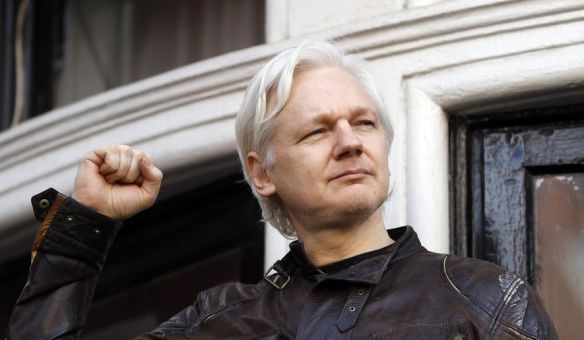
Assange and the Unforgivable Sin of Disemboweling Official Narratives

By Charles Hugh Smith

Source: Of Two Minds

The entire global status quo is on the cusp of the S-Curve decline phase.

There is really only one unforgivable sin in the political realm, and that’s destroying the official narrative by revealing the facts of the matter. This is why whistleblowers who make public the secret machinery of the elaborately artful lies underpinning all official narratives are hounded to the ends of the Earth.

Employees of state entities such as Ellsberg, Manning and Snowden are bound by vows of secrecy and threatened by the promise of severe punishment. Outsiders such as Assange are even further beyond the pale because they can’t be accused of being traitors, as they never took the vows of secrecy required by the Deep State.

The single most damaging revelation to all the elaborate lies that make up official narratives is the truth revealed in official emails, documents and conversations. This is why virtually every document and correspondence is now “classified,” so anyone releasing even a mundane scrap can be sentenced to rot in federal prison.

In a recent C-SPAN interview, author Nomi Prins explained the incredible difficulty of accessing papers in presidential libraries now due to virtually everything being classified. Freedom of Information Act (FOIA) applications must be filed, and researchers must wait years to gain access to routine correspondence that was freely available to all a decade or so ago.

Official paranoia has a 100% correlation with the amount of damage done to official narratives by any leaks of the facts of the matter. What are they so afraid of? Here’s the dynamic in play: the more fragile the narrative, the greater the dependence on half-truths and lies, the greater the official urgency to crush all whistleblowers and maintain a Stasi-like vigilance against any murmurs of dissent or doubt.

If the entire contraption wasn’t so vulnerable to exposure and so dependent on lies, why the infinite paranoia? This paranoia extends past the present system of lies into the past, as exposing the lies in decades past calls into question the official narratives of today.

Any doubt is extremely dangerous, as if even a single thread is pulled loose, the entire fabric of ginned-up statistics, false assurances, half-truths and outright lies unravels. Once the Pentagon Papers revealed the facts of the war in Vietnam, support for the official narrative collapsed essentially overnight.

In the immortal words of Jean-Claude Juncker, when it becomes serious you have to lie, and it’s now serious all the time.

The entire global status quo is on the cusp of the S-Curve decline phase. Hence the vulnerability to disruption of its official narratives and the panicky paranoia of its handlers.


Conjuring Up the Next Depression

By Chris Hedges

Source: TruthDig

During the financial crisis of 2008, the world’s central banks, including the Federal Reserve, injected trillions of dollars of fabricated money into the global financial system. This fabricated money has created a worldwide debt of $325 trillion, more than three times global GDP. The fabricated money was hoarded by banks and corporations, loaned by banks at predatory interest rates, used to service interest on unpayable debt or spent buying back stock, providing millions in compensation for elites. The fabricated money was not invested in the real economy. Products were not manufactured and sold. Workers were not reinstated into the middle class with sustainable incomes, benefits and pensions. Infrastructure projects were not undertaken. The fabricated money reinflated massive financial bubbles built on debt and papered over a fatally diseased financial system destined for collapse.

What will trigger the next crash? The $13.2 trillion in unsustainable U.S. household debt? The $1.5 trillion in unsustainable student debt? The billions Wall Street has invested in a fracking industry that has spent $280 billion more than it generated from its operations? Who knows. What is certain is that a global financial crash, one that will dwarf the meltdown of 2008, is inevitable. And this time, with interest rates near zero, the elites have no escape plan. The financial structure will disintegrate. The global economy will go into a death spiral. The rage of a betrayed and impoverished population will, I fear, further empower right-wing demagogues who promise vengeance on the global elites, moral renewal, a nativist revival heralding a return to a mythical golden age when immigrants, women and people of color knew their place, and a Christianized fascism.

The 2008 financial crisis, as the economist Nomi Prins points out, “converted central banks into a new class of power brokers.” They looted national treasuries and amassed trillions in wealth to become politically and economically omnipotent. In her book “Collusion: How Central Bankers Rigged the World,” she writes that central bankers and the world’s largest financial institutions fraudulently manipulate global markets and use fabricated, or as she writes, “fake money,” to inflate asset bubbles for short-term profit as they drive us toward “a dangerous financial precipice.”

“Before the crisis, they were just asleep at the wheel, in particular, the Federal Reserve of the United States, which is supposed to be the main regulator of the major banks in the United States,” Prins said when we met in New York. “It did a horrible job of doing that, which is why we had the financial crisis. It became a deregulator instead of a regulator. In the wake of the financial crisis, the solution to fixing the crisis and saving the economy from a great depression or recession, whatever the terminology that was used at any given time, was to fabricate trillions and trillions of dollars out of an electronic ether.”

The Federal Reserve handed over an estimated $29 trillion of this fabricated money to American banks, according to researchers at the University of MissouriTwenty-nine trillion dollars! We could have provided free college tuition to every student or universal health care, repaired our crumbling infrastructure, transitioned to clean energy, forgiven student debt, raised wages, bailed out underwater homeowners, formed public banks to invest at low interest rates in our communities, provided a guaranteed minimum income for everyone and organized a massive jobs program for the unemployed and underemployed. Sixteen million children would not go to bed hungry. The mentally ill and the homeless—an estimated 553,742 Americans are homeless every night—would not be left on the streets or locked away in our prisons. The economy would revive. Instead, $29 trillion in fabricated money was handed to financial gangsters who are about to make most of it evaporate and plunge us into a depression that will rival that of the global crash of 1929.

Kevin Zeese and Margaret Flowers write on the website Popular Resistance, “One-sixth of this could provide a $12,000 annual basic income, which would cost $3.8 trillion annually, doubling Social Security payments to $22,000 annually, which would cost $662 billion, a $10,000 bonus for all U.S. public school teachers, which would cost $11 billion, free college for all high school graduates, which would cost $318 billion, and universal preschool, which would cost $38 billion. National improved Medicare for all would actually save the nation trillions of dollars over a decade.”

An emergency clause in the Federal Reserve Act of 1913 allows the Fed to provide liquidity to a distressed banking system. But the Federal Reserve did not stop with the creation of a few hundred billion dollars. It flooded the financial markets with absurd levels of fabricated money. This had the effect of making the economy appear as if it had revived. And for the oligarchs, who had access to this fabricated money while we did not, it did.

The Fed cut interest rates to near zero. Some central banks in Europe instituted negative interest rates, meaning they would pay borrowers to take loans. The Fed, in a clever bit of accounting, even permitted distressed banks to use these no-interest loans to buy U.S. Treasury bonds. The banks gave the bonds back to the Fed and received a quarter of a percent of interest from the Fed. In short, the banks were loaned money at virtually no interest by the Fed and then were paid interest by the Fed on the money they borrowed. The Fed also bought up worthless mortgage assets and other toxic assets from the banks. Since Fed authorities could fabricate as much money as they wanted, it did not matter how they spent it.

“It’s like going to someone’s old garage sale and saying, ‘I want that bicycle with no wheels. I’ll pay you 100 grand for it. Why? Because it’s not my money,’ ” Prins said.

“These people have rigged the system,” she said of the bankers. “There is money fabricated at the top. It is used to pump up financial assets, including stock. It has to come from somewhere. Because money is cheap there’s more borrowing at the corporate level. There’s more money borrowed at the government level.”

“Where do you go to repay it?” she asked. “You go into the nation. You go into the economy. You extract money from the foundational economy, from social programs. You impose austerity.”

Given the staggering amount of fabricated money that has to be repaid, the banks need to build greater and greater pools of debt. This is why when you are late in paying your credit card the interest rate jumps to 28 percent. This is why if you declare bankruptcy you are still responsible for paying off your student loan, even as 1 million people a year default on student loans, with 40 percent of all borrowers expected to default on student loans by 2023. This is why wages are stagnant or have declined while costs, from health care and pharmaceutical products to bank fees and basic utilities, are skyrocketing. The enforced debt peonage grows to feed the beast until, as with the subprime mortgage crisis, the predatory system fails because of massive defaults. There will come a day, for example, as with all financial bubbles, when the wildly optimistic projected profits of industries such as fracking will no longer be an effective excuse to keep pumping money into failing businesses burdened by debt they cannot repay.

“The 60 biggest exploration and production firms are not generating enough cash from their operations to cover their operating and capital expenses,” Bethany McLean writes of the fracking industry in an articletitled “The Next Financial Crisis Lurks Underground” that appeared in The New York Times. “In aggregate, from mid-2012 to mid-2017, they had negative free cash flow of $9 billion per quarter.”

The global financial system is a ticking time bomb. The question is not if it will explode but when it will explode. And once it does, the inability of the global speculators to use fabricated money with zero interest to paper over the debacle will trigger massive unemployment, high prices for imports and basic services, and a devaluation in which the dollar will become nearly worthless as it is abandoned as the world’s reserve currency. This manufactured financial tsunami will transform the United States, already a failed democracy, into an authoritarian police state. Life will become very cheap, especially for the vulnerable—undocumented workers, Muslims, poor people of color, girls and women, anti-capitalist and anti-imperialist critics branded as agents of  foreign powers—who will be demonized and persecuted for the collapse. The elites, in a desperate bid to cling to their unchecked power and obscene wealth, will disembowel what is left of the United States.

The Coming Collapse

By Chris Hedges

Source: Occupy.com

The Trump administration did not rise, prima facie, like Venus on a half shell from the sea. Donald Trump is the result of a long process of political, cultural and social decay. He is a product of our failed democracy. The longer we perpetuate the fiction that we live in a functioning democracy, that Trump and the political mutations around him are somehow an aberrant deviation that can be vanquished in the next election, the more we will hurtle toward tyranny. The problem is not Trump. It is a political system, dominated by corporate power and the mandarins of the two major political parties, in which we don’t count. We will wrest back political control by dismantling the corporate state, and this means massive and sustained civil disobedience, like that demonstrated by teachers around the country this year. If we do not stand up we will enter a new dark age.

The Democratic Party, which helped build our system of inverted totalitarianism, is once again held up by many on the left as the savior. Yet the party steadfastly refuses to address the social inequality that led to the election of Trump and the insurgency by Bernie Sanders. It is deaf, dumb and blind to the very real economic suffering that plagues over half the country. It will not fight to pay workers a living wage. It will not defy the pharmaceutical and insurance industries to provide Medicare for all. It will not curb the voracious appetite of the military that is disemboweling the country and promoting the prosecution of futile and costly foreign wars.

It will not restore our lost civil liberties, including the right to privacy, freedom from government surveillance, and due process. It will not get corporate and dark money out of politics. It will not demilitarize our police and reform a prison system that has 25 percent of the world’s prisoners although the United States has only 5 percent of the world’s population. It plays to the margins, especially in election seasons, refusing to address substantive political and social problems and instead focusing on narrow cultural issues like gay rights, abortion and gun control in our peculiar species of anti-politics.

This is a doomed tactic, but one that is understandable. The leadership of the party, the Clintons, Nancy Pelosi, Chuck Schumer, Tom Perez, are creations of corporate America. In an open and democratic political process, one not dominated by party elites and corporate money, these people would not hold political power. They know this. They would rather implode the entire system than give up their positions of privilege. And that, I fear, is what will happen. The idea that the Democratic Party is in any way a bulwark against despotism defies the last three decades of its political activity. It is the guarantor of despotism.

Trump has tapped into the hatred that huge segments of the American public have for a political and economic system that has betrayed them. He may be inept, degenerate, dishonest and a narcissist, but he adeptly ridicules the system they despise. His cruel and demeaning taunts directed at government agencies, laws and the established elites resonate with people for whom these agencies, laws and elites have become hostile forces. And for many who see no shift in the political landscape to alleviate their suffering, Trump’s cruelty and invective are at least cathartic.

Trump, like all despots, has no ethical core. He chooses his allies and appointees based on their personal loyalty and fawning obsequiousness to him. He will sell anyone out. He is corrupt, amassing money for himself—he made $40 million from his Washington, D.C., hotel alone last year—and his corporate allies. He is dismantling government institutions that once provided some regulation and oversight. He is an enemy of the open society. This makes him dangerous. His turbocharged assault on the last vestiges of democratic institutions and norms means there will soon be nothing, even in name, to protect us from corporate totalitarianism.

But the warnings from the architects of our failed democracy against creeping fascism, Madeleine Albright among them, are risible. They show how disconnected the elites have become from the zeitgeist. None of these elites have credibility. They built the edifice of lies, deceit and corporate pillage that made Trump possible. And the more Trump demeans these elites, and the more they cry out like Cassandras, the more he salvages his disastrous presidency and enables the kleptocrats pillaging the country as it swiftly disintegrates.

The press is one of the principal pillars of Trump’s despotism. It chatters endlessly like 18th-century courtiers at the court of Versailles about the foibles of the monarch while the peasants lack bread. It drones on and on and on about empty topics such as Russian meddling and a payoff to a porn actress that have nothing to do with the daily hell that, for many, defines life in America. It refuses to critique or investigate the abuses by corporate power, which has destroyed our democracy and economy and orchestrated the largest transfer of wealth upward in American history.

The corporate press is a decayed relic that, in exchange for money and access, committed cultural suicide. And when Trump attacks it over “fake news,” he expresses, once again, the deep hatred of all those the press ignores. The press worships the idol of Mammon as slavishly as Trump does. It loves the reality-show presidency. The press, especially the cable news shows, keeps the lights on and the cameras rolling so viewers will be glued to a 21st-century version of “The Cabinet of Dr. Caligari.” It is good for ratings. It is good for profits. But it accelerates the decline.

All this will soon be compounded by financial collapse. Wall Street banks have been handed $16 trillion in bailouts and other subsidies by the Federal Reserve and Congress at nearly zero percent interest since the 2008 financial collapse. They have used this money, as well as the money saved through the huge tax cuts imposed last year, to buy back their own stock, raising the compensation and bonuses of their managers and thrusting the society deeper into untenable debt peonage. Sheldon Adelson’s casino operations alone got a $670 million tax break under the 2017 legislation. The ratio of CEO to worker pay now averages 339 to 1, with the highest gap approaching 5,000 to 1.

This circular use of money to make and hoard money is what Karl Marx called “fictitious capital.” The steady increase in public debt, corporate debt, credit card debt and student loan debt will ultimately lead, as Nomi Prins writes, to “a tipping point—when money coming in to furnish that debt, or available to borrow, simply won’t cover the interest payments. Then debt bubbles will pop, beginning with higher yielding bonds.”

An economy reliant on debt for its growth causes our interest rate to jump to 28 percent when we are late on a credit card payment. It is why our wages are stagnant or have declined in real terms—if we earned a sustainable income we would not have to borrow money to survive. It is why a university education, houses, medical bills and utilities cost so much. The system is designed so we can never free ourselves from debt.

However, the next financial crash, as Prins points out in her book “Collusion: How Central Bankers Rigged the World,” won’t be like the last one. This is because, as she says, “there is no Plan B.” Interest rates can’t go any lower. There has been no growth in the real economy. The next time, there will be no way out. Once the economy crashes and the rage across the country explodes into a firestorm, the political freaks will appear, ones that will make Trump look sagacious and benign.

And so, to quote Vladimir Lenin, what must be done?

We must invest our energy in building parallel, popular institutions to protect ourselves and to pit power against power. These parallel institutions, including unions, community development organizations, local currencies, alternative political parties and food cooperatives, will have to be constructed town by town. The elites in a time of distress will retreat to their gated compounds and leave us to fend for ourselves. Basic services, from garbage collection to public transportation, food distribution and health care, will collapse. Massive unemployment and underemployment, triggering social unrest, will be dealt with not through government job creation but the brutality of militarized police and a complete suspension of civil liberties.

Critics of the system, already pushed to the margins, will be silenced and attacked as enemies of the state. The last vestiges of labor unions will be targeted for abolition, a process that will soon be accelerated given the expected ruling in a case before the Supreme Court that will cripple the ability of public-sector unions to represent workers. The dollar will stop being the world’s reserve currency, causing a steep devaluation. Banks will close. Global warming will extract heavier and heavier costs, especially on the coastal populations, farming and the infrastructure, costs that the depleted state will be unable to address. The corporate press, like the ruling elites, will go from burlesque to absurdism, its rhetoric so patently fictitious it will, as in all totalitarian states, be unmoored from reality. The media outlets will all sound as fatuous as Trump. And, to quote W.H. Auden, “the little children will die in the streets.”

As a foreign correspondent I covered collapsed societies, including the former Yugoslavia. It is impossible for any doomed population to grasp how fragile the decayed financial, social and political system is on the eve of implosion. All the harbingers of collapse are visible: crumbling infrastructure; chronic underemployment and unemployment; the indiscriminate use of lethal force by police; political paralysis and stagnation; an economy built on the scaffolding of debt; nihilistic mass shootings in schools, universities, workplaces, malls, concert venues and movie theaters; opioid overdoses that kill some 64,000 people a year; an epidemic of suicides; unsustainable military expansion; gambling as a desperate tool of economic development and government revenue; the capture of power by a tiny, corrupt clique; censorship; the physical diminishing of public institutions ranging from schools and libraries to courts and medical facilities; the incessant bombardment by electronic hallucinations to divert us from the depressing sight that has become America and keep us trapped in illusions. We suffer the usual pathologies of impending death. I would be happy to be wrong. But I have seen this before. I know the warning signs. All I can say is get ready.

How America Became an Oligarchy

OLIGARCHY

By Ellen Brown

Source: Counterpunch

“The politicians are put there to give you the idea that you have freedom of choice. You don’t. . . . You have owners.”

— George Carlin, The American Dream

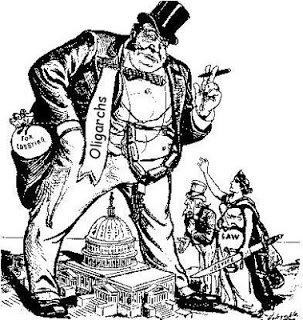
According to a new study from Princeton University, American democracy no longer exists. Using data from over 1,800 policy initiatives from 1981 to 2002, researchers Martin Gilens and Benjamin Page concluded that rich, well-connected individuals on the political scene now steer the direction of the country, regardless of – or even against – the will of the majority of voters. America’s political system has transformed from a democracy into an oligarchy, where power is wielded by wealthy elites.

“Making the world safe for democracy” was President Woodrow Wilson’s rationale for World War I, and it has been used to justify American military intervention ever since. Can we justify sending troops into other countries to spread a political system we cannot maintain at home?

The Magna Carta, considered the first Bill of Rights in the Western world, established the rights of nobles as against the king. But the doctrine that “all men are created equal” – that all people have “certain inalienable rights,” including “life, liberty and the pursuit of happiness” – is an American original. And those rights, supposedly insured by the Bill of Rights, have the right to vote at their core. We have the right to vote but the voters’ collective will no longer prevails.

In Greece, the left-wing populist Syriza Party came out of nowhere to take the presidential election by storm; and in Spain, the populist Podemos Party appears poised to do the same. But for over a century, no third-party candidate has had any chance of winning a US presidential election. We have a two-party winner-take-all system, in which our choice is between two candidates, both of whom necessarily cater to big money. It takes big money just to put on the mass media campaigns required to win an election involving 240 million people of voting age.

In state and local elections, third party candidates have sometimes won. In a modest-sized city, candidates can actually influence the vote by going door to door, passing out flyers and bumper stickers, giving local presentations, and getting on local radio and TV. But in a national election, those efforts are easily trumped by the mass media. And local governments too are beholden to big money.

When governments of any size need to borrow money, the megabanks in a position to supply it can generally dictate the terms. Even in Greece, where the populist Syriza Party managed to prevail in January, the anti-austerity platform of the new government is being throttled by the moneylenders who have the government in a chokehold.

How did we lose our democracy? Were the Founding Fathers remiss in leaving something out of the Constitution? Or have we simply gotten too big to be governed by majority vote?

Democracy’s Rise and Fall

The stages of the capture of democracy by big money are traced in a paper called “The Collapse of Democratic Nation States” by theologian and environmentalist Dr. John Cobb. Going back several centuries, he points to the rise of private banking, which usurped the power to create money from governments:

The influence of money was greatly enhanced by the emergence of private banking. The banks are able to create money and so to lend amounts far in excess of their actual wealth. This control of money-creation . . . has given banks overwhelming control over human affairs. In the United States, Wall Street makes most of the truly important decisions that are directly attributed to Washington.

Today the vast majority of the money supply in Western countries is created by private bankers. That tradition goes back to the 17th century, when the privately-owned Bank of England, the mother of all central banks, negotiated the right to print England’s money after Parliament stripped that power from the Crown. When King William needed money to fight a war, he had to borrow. The government as borrower then became servant of the lender.

In America, however, the colonists defied the Bank of England and issued their own paper scrip; and they thrived. When King George forbade that practice, the colonists rebelled.

They won the Revolution but lost the power to create their own money supply, when they opted for gold rather than paper money as their official means of exchange. Gold was in limited supply and was controlled by the bankers, who surreptitiously expanded the money supply by issuing multiple banknotes against a limited supply of gold.

This was the system euphemistically called “fractional reserve” banking, meaning only a fraction of the gold necessary to back the banks’ privately-issued notes was actually held in their vaults. These notes were lent at interest, putting citizens and the government in debt to bankers who created the notes with a printing press. It was something the government could have done itself debt-free, and the American colonies had done with great success until England went to war to stop them.

President Abraham Lincoln revived the colonists’ paper money system when he issued the Treasury notes called “Greenbacks” that helped the Union win the Civil War. But Lincoln was assassinated, and the Greenback issues were discontinued.

In every presidential election between 1872 and 1896, there was a third national party running on a platform of financial reform. Typically organized under the auspices of labor or farmer organizations, these were parties of the people rather than the banks. They included the Populist Party, the Greenback and Greenback Labor Parties, the Labor Reform Party, the Antimonopolist Party, and the Union Labor Party. They advocated expanding the national currency to meet the needs of trade, reform of the banking system, and democratic control of the financial system.

The Populist movement of the 1890s represented the last serious challenge to the bankers’ monopoly over the right to create the nation’s money. According to monetary historian Murray Rothbard, politics after the turn of the century became a struggle between two competing banking giants, the Morgans and the Rockefellers. The parties sometimes changed hands, but the puppeteers pulling the strings were always one of these two big-money players.

In All the Presidents’ Bankers, Nomi Prins names six banking giants and associated banking families that have dominated politics for over a century. No popular third party candidates have a real chance of prevailing, because they have to compete with two entrenched parties funded by these massively powerful Wall Street banks.

Democracy Succumbs to Globalization

In an earlier era, notes Dr. Cobb, wealthy landowners were able to control democracies by restricting government participation to the propertied class. When those restrictions were removed, big money controlled elections by other means:

First, running for office became expensive, so that those who seek office require wealthy sponsors to whom they are then beholden. Second, the great majority of voters have little independent knowledge of those for whom they vote or of the issues to be dealt with. Their judgments are, accordingly, dependent on what they learn from the mass media. These media, in turn, are controlled by moneyed interests.

Control of the media and financial leverage over elected officials then enabled those other curbs on democracy we know today, including high barriers to ballot placement for third parties and their elimination from presidential debates, vote suppression, registration restrictions, identification laws, voter roll purges, gerrymandering, computer voting, and secrecy in government.

The final blow to democracy, says Dr. Cobb, was “globalization” – an expanding global market that overrides national interests:

[T]oday’s global economy is fully transnational. The money power is not much interested in boundaries between states and generally works to reduce their influence on markets and investments. . . . Thus transnational corporations inherently work to undermine nation states, whether they are democratic or not.

The most glaring example today is the secret twelve-country trade agreement called the Trans-Pacific Partnership. If it goes through, the TPP will dramatically expand the power of multinational corporations to use closed-door tribunals to challenge and supersede domestic laws, including environmental, labor, health and other protections.

Looking at Alternatives

Some critics ask whether our system of making decisions by a mass popular vote easily manipulated by the paid-for media is the most effective way of governing on behalf of the people. In an interesting Ted Talk, political scientist Eric Li makes a compelling case for the system of “meritocracy” that has been quite successful in China.

In America Beyond Capitalism, Prof. Gar Alperovitz argues that the US is simply too big to operate as a democracy at the national level. Excluding Canada and Australia, which have large empty landmasses, the United States is larger geographically than all the other advanced industrial countries of the OECD (Organization for Economic Cooperation and Development) combined. He proposes what he calls “The Pluralist Commonwealth”: a system anchored in the reconstruction of communities and the democratization of wealth. It involves plural forms of cooperative and common ownership beginning with decentralization and moving to higher levels of regional and national coordination when necessary.

Dr. Alperovitz is co-founder of an initiative called The Next System Project, aimed at defining the issues in a national political debate as a first step to realizing the possible. He quotes Prof. Donald Livingston, who asked in 2002:

What value is there in continuing to prop up a union of this monstrous size? . . . [T]here are ample resources in the American federal tradition to justify states’ and local communities’ recalling, out of their own sovereignty, powers they have allowed the central government to usurp.

Taking Back Our Power

If governments are recalling their sovereign powers, they might start with the power to create money, which was usurped by private interests while the people were asleep at the wheel. State and local governments are not allowed to print their own currencies; but they can own banks, and all depository banks create money when they make loans, as the Bank of England recently acknowledged.

The federal government could take back the power to create the national money supply by issuing its own Treasury notes as Abraham Lincoln did. Alternatively, it could issue some very large denomination coins as authorized in the Constitution; or it could nationalize the central bank and use quantitative easing to fund infrastructure, education, job creation, and social services, responding to the needs of the people rather than the banks.

The freedom to vote carries little weight without economic freedom – the freedom to work and to have food, shelter, education, medical care and a decent retirement. President Franklin Roosevelt maintained that we need an Economic Bill of Rights. If our elected representatives were not beholden to the moneylenders, they might be able both to pass such a bill and to come up with the money to fund it.

Ellen Brown is an attorney, founder of the Public Banking Institute, and author of twelve books including the best-selling Web of Debt. Her latest book, The Public Bank Solution, explores successful public banking models historically and globally. Her 300+ blog articles are at EllenBrown.com. Listen to “It’s Our Money with Ellen Brown” on PRN.fm.