
This gallery contains 46 photos.

This gallery contains 46 photos.

Given its richness and complexity, it would be impossible to give an accurate overview of contemporary Nicaraguan society without years of research and experience within the country. What I humbly offer is just one visitor’s perspective of aspects of the culture picked up from about three week’s worth of experiences and interactions with a small cross-section of the population (mostly poor and middleclass people working as cab drivers, tour guides, museum docents, restaurant/shop employees, and agricultural workers) as well as tourists and expats.
What becomes apparent to visitors to Nicaragua soon after getting off the plane is the country’s pride in two of its most famous figures, revolutionary Augusto Sandino and poet Rubén Darío. Images of them can be seen on posters and decorating various items in gift shops within the airport, and in almost every town and city one can find them depicted on murals and statue monuments (other popular figures include Carlos Fonseca, Che Guevara and Hugo Chavez). The culture’s love for poetry is also expressed through its annual International Poetry Festival which has been hosted in Granada since 2005 (parts of which I was fortunate enough to witness while I was there).
Another sign of Nicaragua’s love for language arts and literacy is the ubiquity of bookstores and libraries which can be found in even the smallest towns. Roots of this aspect of the culture goes as far back as the late 19th century when the Spanish-American literary movement known as Modernismo was started by Rubén Darío who was born in Matagalpa and raised in León (where he also died). Another factor is the Sandinista Literacy Campaigns of 1980 and 2005-2009 whose mission was not just to eradicate illiteracy but to increase political awareness and nurture attitudes and skills related to creativity, production, co-operation, discipline and analytical thinking.
A sophistication of political thought and sense of social consciousness in Nicaraguan society was made apparent to me through extended conversations on history and current events with tour guides of diverse backgrounds (who were the locals I happened to speak with for the longest periods of time due to the nature of the activity) as well as shorter exchanges with random people encountered during the trip. While my impressions of the culture may be biased due to comparatively low levels of political awareness I usually sense when conversing with most U.S. citizens (not including readers & followers of this blog) and more frequent interactions with Nicaraguans from progressive organizations I intentionally sought out to support, I’ve heard similar or related observations from other travelers and expats. I feel it’s a real phenomenon that could be a result of the Literacy Campaigns as well as having collectively experienced relatively recent violent dictatorship, revolution, counter-revolution and widespread poverty. Just as individuals of more privileged backgrounds and little experience dealing with loss tend to have less empathy and understanding of moral complexity than those who have lived through tragedy and hardship, perhaps the same could be said of societies?
Other shared, seemingly culturally determined traits I’ve noticed was a sense of directness and sincerity and willingness to treat everyone as human beings. This is especially true regarding dealings with tourists from the U.S. I was a little surprised to experience no sense of resentment directed towards me for being from the country whose government has been the source of so much pain and suffering. Imagine if some country’s government propped up tyrants in the U.S. or supported militant terrorist groups with money and weapons (which the CIA has done in many places including the U.S.). Would we be as charitable towards the citizens of that country? In fact, from speaking to a docents at the Carlos Fonseca Museum, and León’s Museum of the Revolution, even former adversaries on different sides of the revolution have for the most part resolved their differences and resumed relationships as friends, family and fellow citizens. But this isn’t to say there aren’t differences in political perspectives and opinions on the current government.
One of the more surprising opinions I heard was from a young eco-tour guide in Jinotega who was a recent graduate of a college in León. He mentioned that he was doubtful that Nicaragua would be much different had the Samoza regime stayed in power. This was a bit shocking for me in light of what I’ve heard about Samoza’s human rights abuses but it made me think of how things might have changed or stayed the same. It’s likely the crackdown on dissidents would continue or worsen, but would the economy have been improved had the revolution and embargo never happened, or would it have been the same or worse due to increasing militarization and corruption? In either case, it seems unlikely Nicaragua would avoid long term economic harm caused by structural adjustment policies demanded by the International Monetary Fund and World Bank. In contrast to the guide in Jinotega was the eco-tour guide in Matagalpa who took me and other tourists to Mombacho Volcano. He made it clear that he felt Nicaragua had greatly improved since the overthrow of Samoza, embedding his views into the tour by talking about how during the Samoza regime prisoners would sometimes be dropped from helicopters into active volcanoes. He also took pride in the fact that Nicaraguans now have access to free education and healthcare.
The most memorable and moving conversation was with Hugo, a docent at the Museum of the Revolution in León who fought for the Sandinistas as a young man. Through an interpreter he told me of the impact the revolution has had on his life. Many of his siblings and relatives were forced to leave the country and many of his comrades died in battle. He seemed disappointed that there has not been greater improvements as a result of the massive struggle and sacrifice. He mentioned how after the revolution some Sandinista veterans were given parcels of land but many were given less support than they deserved and were promised in terms of land, pensions and healthcare. Hugo himself was struggling economically. As a side-gig he also sold bootleg documentary dvds outside the museum, one of which I purchased (FSLN: Un Pueblo en Armas). Despite his personal hardships, he made it clear that he remains a patriot and has no regrets about fighting the Somoza regime.
One topic that often arose unprompted was upcoming plans for a new canal allowing ships to travel back and forth from the Atlantic Ocean through the San Juan River and Lake Nicaragua to the Pacific Ocean. Though such ideas were proposed nearly 200 years ago, just last year Nicaragua’s National Assembly approved a concession agreement with the Hong Kong Nicaragua Canal Development Investment Company (HKND) giving them the rights to construct and manage the canal for 50 years. In January HKND CEO Wang Jing and President Daniel Ortega issued a statement that construction of the canal would begin in December 2014. Across the board, Nicaraguans I spoke with seemed excited about the plans but conflicted. The most skeptical opinion came from the eco-tour guide in Jinotega who took me to Lake Apanas. Though he acknowledged the potential benefits it would have for Nicaragua’s economy, he was well aware of the inevitable negative impact it would have on indigenous species and ecosystems. At the same time, he seemed resigned to the fact that coming changes are inevitable. He pointed out that Lake Apanas was artificially created to produce hydroelectric power for several towns. Once thriving trees and farmland are now underwater, but the area is now a habitat of different and diverse flora and fauna which supports the local economy through recreation, tourism and fishing. Other people I spoke with about the canal voiced concerns about whether Nicaragua would truly benefit from the project or if it would create a flow-through economy in which most workers and contractors would be brought from China and primarily Chinese corporations reaped the profits.
Another topic that frequently came up (most likely because the livelihoods of many people I spoke with are largely dependent on it), was the rise of Nicaragua’s tourism industry within the past few years. While its effect of boosting the economy is widely acknowledged, it has also in some cases led to problems such as gentrification, inadequate access to land and resources reserved for tourists and foreign owned corporations, commodification or loss of culture. I’ve also witnessed first-hand how Nicaraguan service sector workers have had to tolerate rude behavior from entitled wealthy tourists or expats doing their visa runs. To their credit, the workers showed incredible patience and professionalism, much more, I suspect, than employees and native citizens in the U.S. would show towards foreign tourists and expats had the tables been turned.
The following are just some of the more trivial miscellaneous observations that seemed odd or interesting to me from a visitor’s perspective:
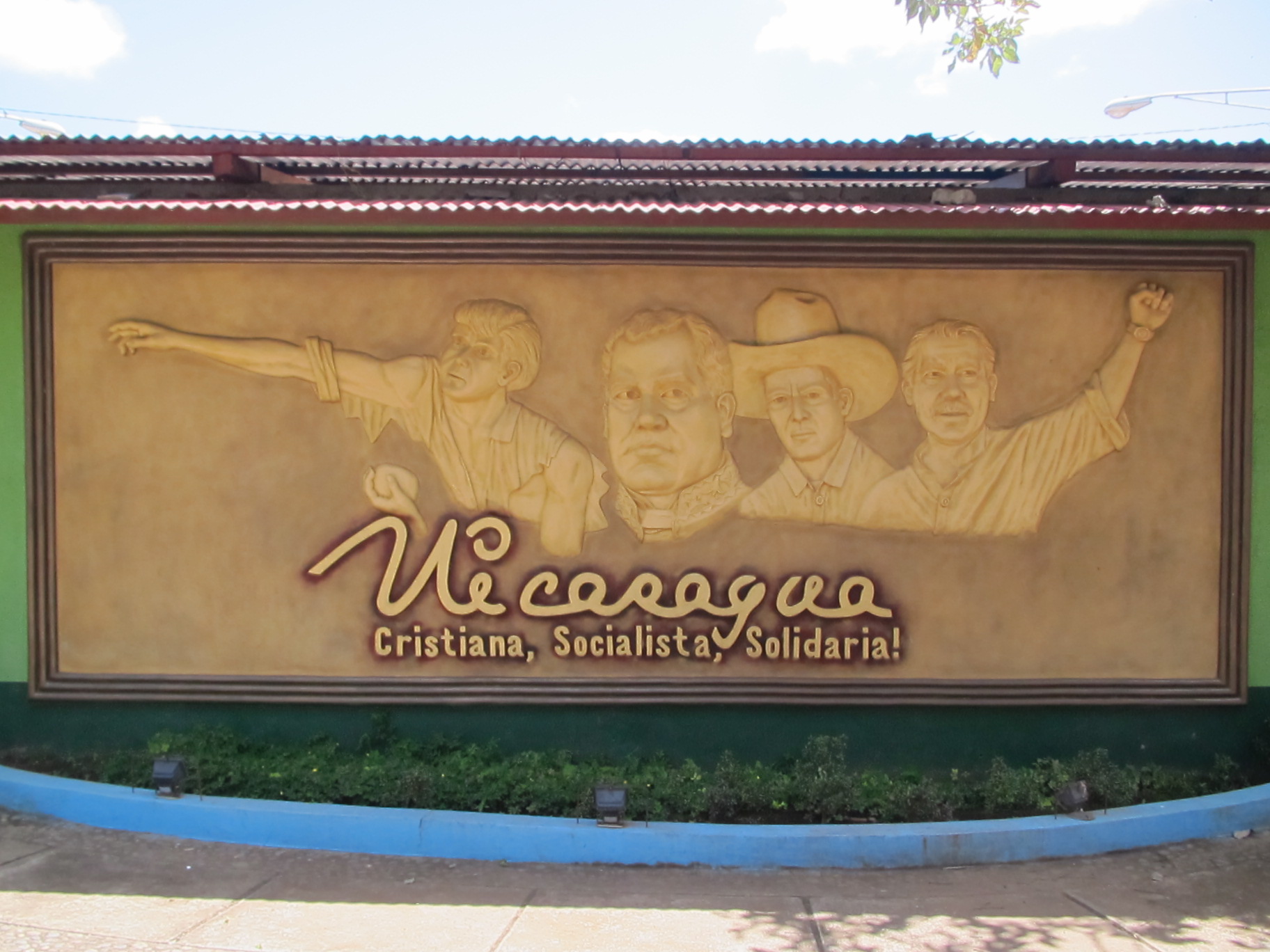
To have even a basic understanding of Nicaraguan culture it’s important to first know a little about the land’s history. In the Pre-Columbian era, the region now called Nicaragua was inhabited by several tribes culturally related to Aztec and Maya civilizations. Not long after Christopher Columbus first reached Nicaragua in 1502, an attempt was made to conquer the region by Gil González Dávila in the 1520s. On April 17, 1523, Dávila first met with Cacique Diriangen, leader of the Dirian peoples. Dávila gave the tribe a three day deadline to become Christians but rather than comply Diriangen led an attack, making him the first known resistance fighter of Nicaragua.
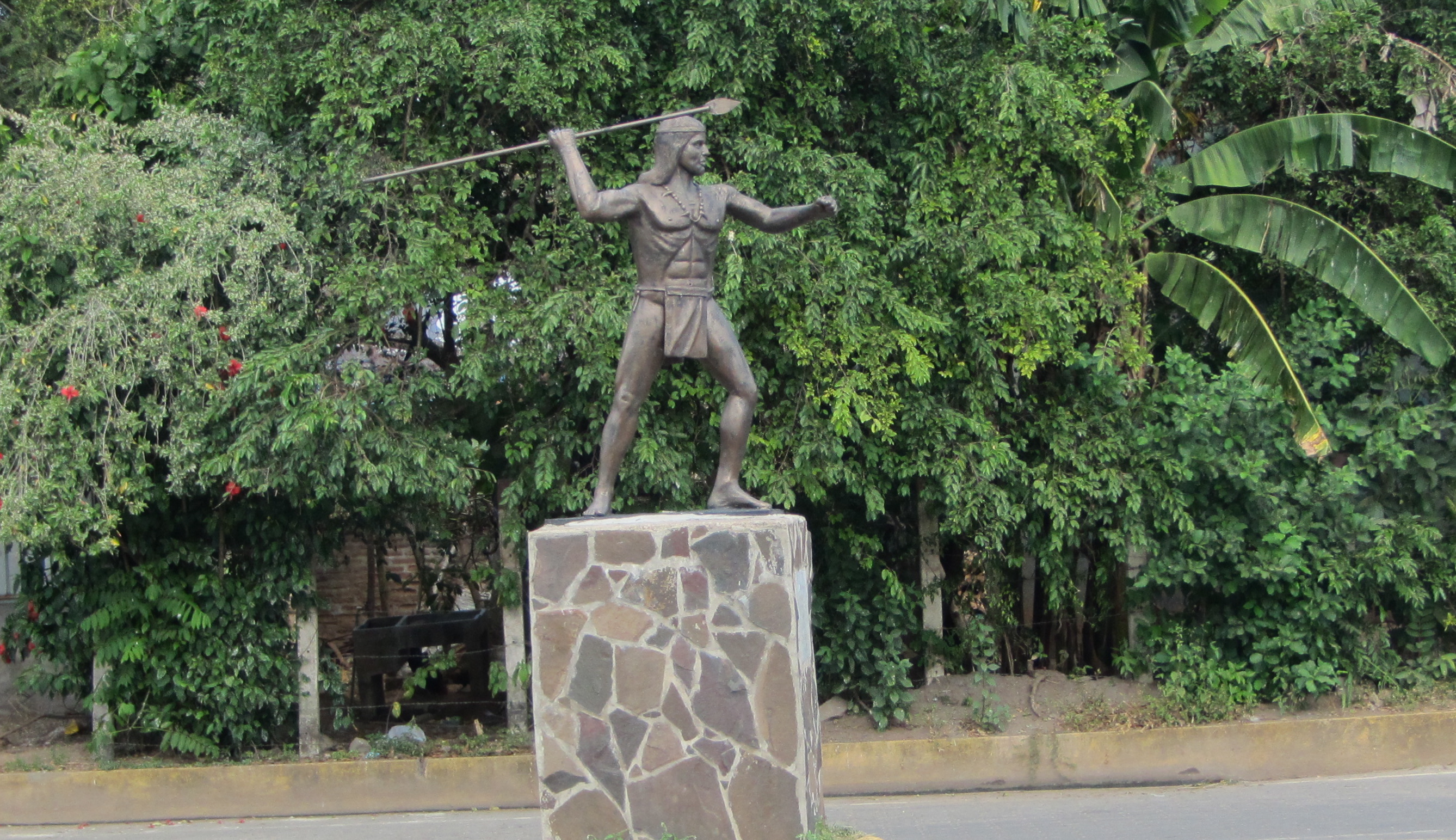
A statue of Diriangen at the entrance to the town of Diria.
During over 300 years of colonization, countless indigenous people died of diseases, rival conquistadors waged war on each other, Caribbean pirates raided cities along Lake Nicaragua, British forces fought the Spanish in Nicaragua during a sub-conflict of the the Seven Years’ War, and in 1610 Momotombo volcano erupted, destroying the old capital city of León. In 1838, Nicaragua became an independent republic. Within a few decades, during a power struggle between León and Granada, filibusterer William Walker was hired by the government of León to fight on their side but he exploited the region’s instability and briefly established himself as President of Nicaragua before being forced out of the country a few years later. Three decades of conservative rule followed, during which the U.S. began formulating plans to build a canal across Nicaragua (which may soon become a reality with funding from Chinese corporations). However, when the U.S. shifted their plans to Panama, President Jose Santos Zelaya attempted to negotiate with European partners. Because of the potential threat Zelaya posed to U.S. hegemony and his ambitions to unite the Central American nations, the U.S. government compelled him to resign with the threat of military force and funding of conservative opposition groups, replacing him with a series of puppet regimes. Attempting to prevent insurrection, Nicaragua was occupied by U.S. Marines from 1912 to 1933. From 1927 (the start of Somoza’s rise to power though the National Guard), national hero Augusto César Sandino led a guerrilla war against the conservative government and the U.S. Marines. Shortly after a peace agreement was reached with a newly elected Sacasa administration, the Marines left Nicaragua and the head of the National Guard, Anastasio Somoza García ordered Sandino’s assassination. Sandino was killed by National Guard troops on February 21, 1934. His body was hidden and never found. In 1937 Somoza ousted the Sacasa government in a rigged election.
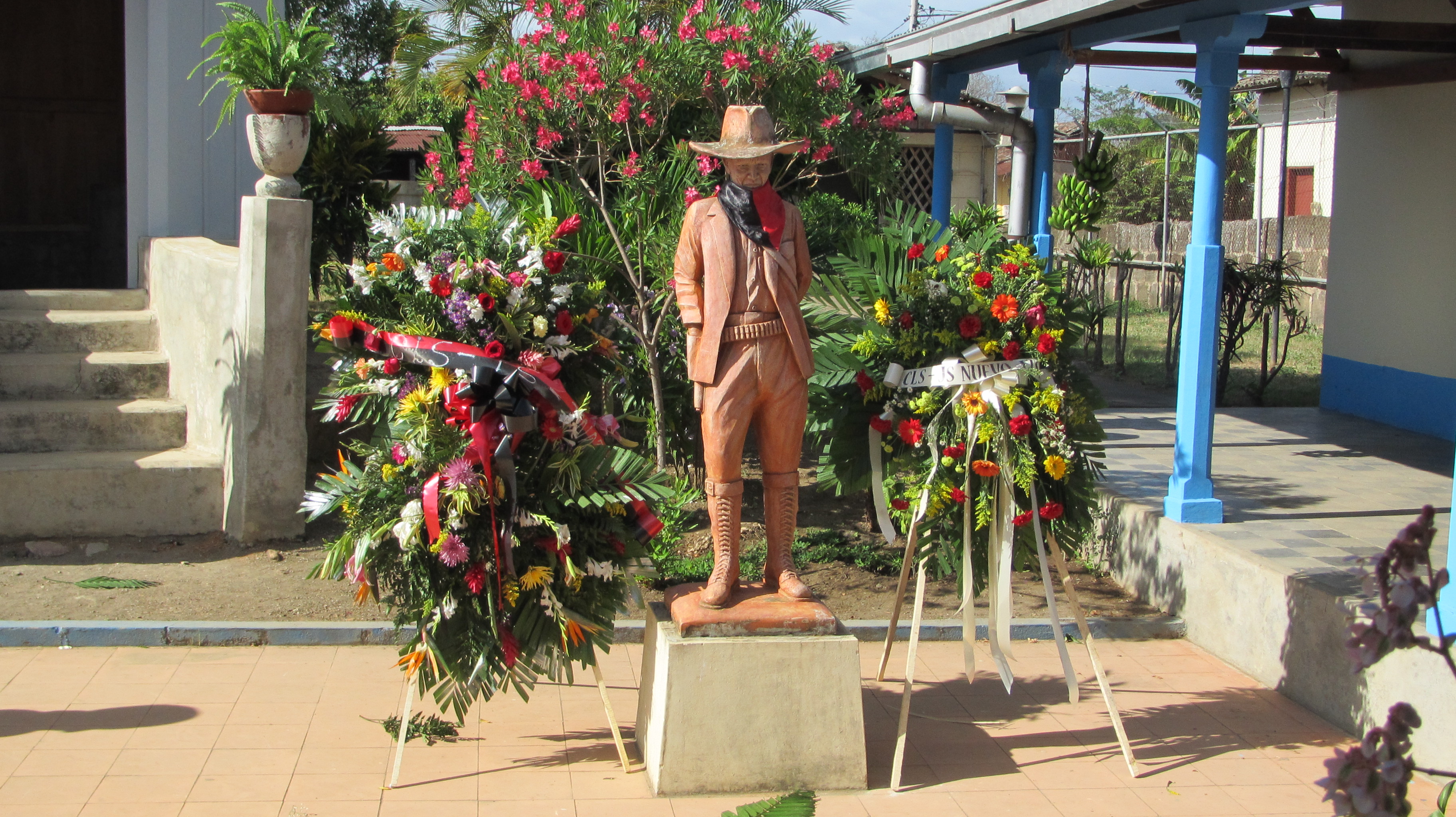
A statue of Sandino at the Augusto C. Sandino Library, a museum located in the house where he grew up in the town of Niquinohomo (Valley of the Warriors).
The Somoza regime was Nicaragua’s longest lasting hereditary military dictatorship, having ruled for 43 years. The father of the dynasty, Anastasio Somoza García, was famously called “our son of a bitch” by FDR and was assassinated by 27 year old poet Rigoberto López Pérez in León in 1956. In response to increasingly corrupt and reactionary policies of the Somoza government, Carlos Fonseca, Silvio Mayorga, and Tomás Borge led the formation of the Sandinista National Liberation Front (Frente Sandinista de Liberación Nacional or FSLN, named after and inspired by Augusto Sandino) in 1961. In 1972 a major earthquake hit Managua killing 6000 people, injuring tens of thousands and leaving hundreds of thousands homeless. President Anastasio Somoza Debayle mishandled the situation by failing to distribute essential aid and supplies. When it was later revealed that the government was siphoning relief money for personal gain, popularity and membership of the FSLN greatly increased. Hundreds of Chilean refugees also joined their ranks after a CIA-backed coup assassinated Chilean president Salvador Allende in 1973 and installed the dictator Augusto Pinochet the following year.
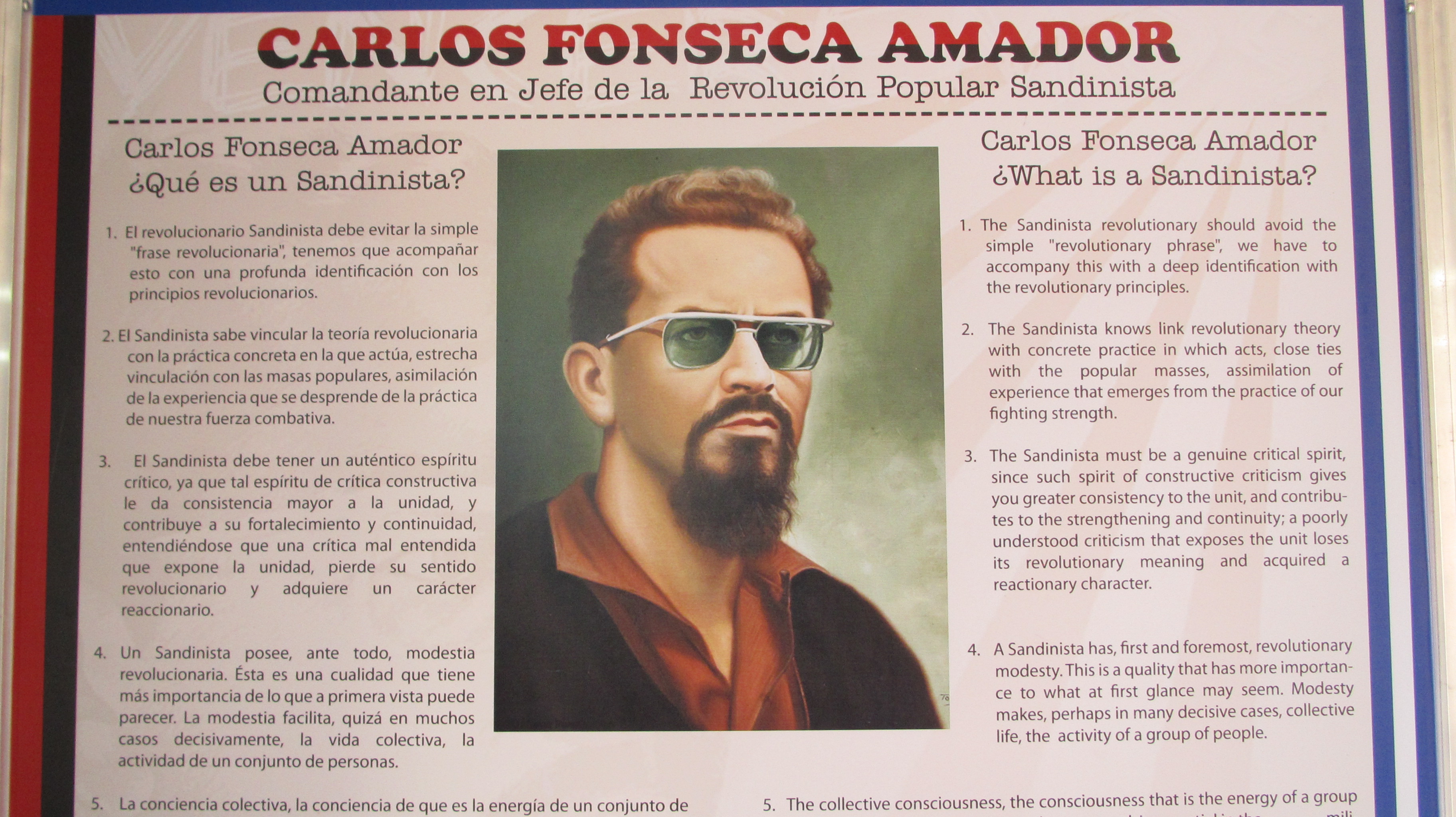
A display at the Carlos Fonseca Museum in Matagalpa.
When Pedro Joaquin Chamorro, editor of the national newspaper and critic of Somoza, was assassinated by the government on January 10, 1978, a mass insurrection was triggered. By the end of Summer, armed youths took over Matagalpa while factions of the FSLN and civilian recruits had the National Guard under siege in Managua, Masaya, León, Chinandega and Estelí. On July 19, 1979, FSLN forces entered the capital and officially assumed power. Just two days before, Anastasio Somoza Debayle resigned and fled to Miami. He was killed a year later by a rocket attack from members of the Argentinian Revolutionary Workers Party while in exile in Paraguay.
Though the Sandinista government inherited a country in ruins and over a billion dollars in debt, they had an ambitious platform which included:
The Sandinistas had early successes with their education and literacy programs but were soon hindered by emerging conflicts with counter-revolutionary Contra forces heavily financed, armed and trained by the CIA. Investigations into the Iran-Contra scandal revealed some of the funding was acquired through arms sales to Iran and drug shipments to U.S. inner cities (read Gary Webb’s Dark Alliance for more about this). Despite strong support for the opposition by the U.S., the FSLN’s Daniel Ortega won the 1984 elections. Less than a year later the Reagan administration implemented a complete embargo on U.S. trade with Nicaragua that would last five years. By the late 80s, the continuing Contra campaign was notorious for human rights violations, corruption and terrorism. In August 1987, Costa Rican president Oscar Arias Sanchez created a peace accord which led to a ceasefire signed by Contra and Sandinista representatives a year later. Disillusioned by conflict and economic strife (made worse by Reagan’s embargo), Nicaraguan voters elected conservative administrations throughout the 1990s and early 2000s but seeing little improvement and much corruption, they reelected FSLN member Daniel Ortega in 2006 and 2011. So far, there has not yet been radical reforms that corporate investors feared and that more radical liberals hoped for, but Ortega has maintained a skepticism towards capitalism while simultaneously maintaining relations with the U.S. and rivals such as Iran, Libya and Venezuela.
As for how the average Nicaraguan feels about their current situation, opinions seem to vary but I plan to share some of the impressions I got in a future post.
Those who spend their lives within the belly of the beast see mostly the insides of the belly. Traveling outside the beast gives one a better idea of what the beast looks like and the impact of its actions on the world. For those who missed the 1/31 post (my last “live” post before this one), for the past few weeks I’ve been traveling through Central America. More specifically, exploring various towns, cities and nature reserves across Nicaragua. Though my primary reason for being there was for vacation, I took it as an opportunity to learn much about the region’s culture, environment, and often turbulent past. Though I’m sure much has happened while I was away (I’m still catching up on news), within the next few days I hope to share some of what I learned and experienced on the trip.
For others who might be planning vacations to other countries combining recreation and education, the importance of having at least a basic grasp of the native language (or traveling with fluent bilingual people) shouldn’t be underestimated. It greatly enriches interactions not only because locals can express themselves more authentically in their primary language, but it could help reduce potential social tensions. While many less developed nations including Nicaragua are increasingly economically dependent on the tourism industry, tourists need to be aware of problems their presence may cause or contribute to such as gentrification, cultural commodification and cultural dilution. U.S. tourists speaking in native tongues might not solve such problems, but it at least symbolically helps counteract inherent power imbalances while making possible more conscious consumer choices such as supporting smaller ecotourism, agritourism and community-based establishments which may not offer the same level of English language services and materials as larger, often foreign-owned businesses which cater to English language speakers. Greater fluency in the native language also allows tourists to acquire and compare more information on essential expenditures such as transportation, lodging and food, resulting in options of higher quality or greater practicality (and preferably locally-owned) for less money.
That being said, I’m definitely not fluent in Spanish but was fortunate enough to travel with someone who is. Without my travel partner I wouldn’t have been able to experience nearly as much as I did. Among the highlights:
There’s lots I’m leaving out, including visits to various cultural museums in different towns, some of which I plan to feature in future posts.

Following the modest successes of “Repo Man” and “Sid and Nancy”, director Alex Cox took a chance on an Acid Western filmed in Nicaragua about soldier-of-fortune William Walker. Featuring a script by cult screenwriter Rudy Wurlitzer, a great soundtrack by Joe Strummer of the Clash, and an excellent performance by Ed Harris in the title role, “Walker” (1987) is unlike any historical biopic made before or since. The stylistic madness of the film reflects the madness of Walker’s misadventures. A sense of absurdity and inevitability is added to the proceedings through intentional anachronisms. While this may take viewers out of the story, it also makes it impossible to ignore parallels between the colonialist, imperialist attitudes of Walker’s time and U.S foreign policy of the 1980s and today.
While the film failed at the box-office in the U.S., it became the second highest grossing film in Nicaragua at the time. Walker is a rare film that not only has a radical message but its production was a radical political act in itself, having economically supported the Sandinista government.
INDIAN COUNTRY NEWS
"It is the duty of every man, as far as his ability extends, to detect and expose delusion and error"..Thomas Paine
Human in Algorithms
From the Roof Top
I See This
blog of the post capitalist transition.. Read or download the novel here + latest relevant posts
अध्ययन-अनुसन्धानको सार
 After the Crash