Facebook’s New Propaganda Partners

By Alan Mcleod

Source: FAIR

Media giant Facebook recently announced (Reuters, 9/19/18) it would combat “fake news” by partnering with two propaganda organizations founded and funded by the US government: the National Democratic Institute (NDI) and the International Republican Institute (IRI). The social media platform was already working closely with the NATO-sponsored Atlantic Council think tank (FAIR.org, 5/21/18).

In a previous FAIR article (8/22/18), I noted that the “fake news” issue was being used as a pretext to attack the left and progressive news sites. Changes to Facebook’s algorithm have reduced traffic significantly for progressive outlets like Common Dreams (5/3/18), while the pages of Venezuelan government–backed TeleSur English and the independent Venezuelanalysis were shut down without warning, and only reinstated after a public outcry.

The Washington, DC–based NDI and IRI are staffed with senior Democratic and Republican politicians; the NDI is chaired by former Secretary of State Madeleine Albright, while the late Sen. John McCain was the longtime IRI chair. Both groups were created in 1983 as arms of the National Endowment for Democracy (NED), a Cold War enterprise backed by then–CIA director William Casey (Jacobin, 3/7/18). That these two US government creations, along with a NATO offshoot like the Atlantic Council, are used by Facebook to distinguish real from fake news is effectively state censorship.

Facebook’s collaboration with the NED organizations is particularly troubling, as both have aggressively pursued regime change against leftist governments overseas. The NDI undermined the Sandinista government of Nicaragua in the 1980s, and continues to do so to this day, while the IRI claimed a key role in the 2002 coup against leftist President Hugo Chávez of Venezuela, announcing that it had

served as a bridge between the nation’s political parties and all civil society groups to help Venezuelans forge a new democratic future…. We stand ready to continue our partnership with the courageous Venezuelan people.

The Reuters report (9/19/18) mentioned that Facebook was anxious to better curate what Brazilians saw on their feeds in the run-up to their presidential elections, which pits far-right Jair Bolsonaro against leftist Fernando Haddad. The US government has a long history of undermining democracy in Brazil, from supporting a coup in 1964 against the progressive Goulart administration to continually spying on leftist President Dilma Rousseff (BBC, 7/4/15) in the run-up to the parliamentary coup against her in 2016 (CounterSpin, 6/2/17).

Soon after it partnered with the Atlantic Council, Facebook moved to delete accounts and pages connected with Iranian broadcasting channels (CNBC, 8/23/18), while The Intercept (12/30/17) reported that in 2017 the social media platform met with Israeli government officials to discuss which Palestinian voices it should censor. Ninety-five percent of Israeli government requests for deletion were granted. Thus the US government and its allies are effectively using the platform to silence dissenting opinion, both at home and on the world stage, controlling what Facebook‘s 2 billion users see and do not see.

Progressives should be deeply skeptical that these moves have anything to do with their stated objective of promoting democracy. Bloomberg Businessweek (9/29/17) reported that the far-right Alternative fur Deutschland (AfD) party went to Facebook headquarters for discussions with US companies about how it could use the platform for recruitment and micro-targeting in the 2017 elections. AfD tripled its previous vote share, becoming the third-largest party in Germany, the far right’s best showing since World War II.

Public trust in government is at 18 percent—an all-time low (Pew, 12/14/17). There is similar mistrust of Facebook, with only 20 percent of Americans agreeing social media sites do a good job separating fact from fiction. And yet, worldwide, Facebook is a crucial news source. Fifty-two percent of Brazilians, 61 percent of Mexicans, and 51 percent of Italians and Turks use the platform for news; 39 percent of the US gets their news from the site.

This means that, despite the fact that even its own public mistrusts it, the US government has effectively become the arbiter of what the world sees and hears, with the ability to marginalize or simply delete news from organizations or countries that do not share its opinions. This power could be used at sensitive times, like elections. This is not an idle threat. The US created an entire fake social network for Cubans that aimed to stir unrest and overthrow the Cuban government, according to the Guardian (4/3/14).

That a single corporation has such a monopoly over the flow of worldwide news is already problematic, but the increasing meshing of corporate and US government control over the means of communication is particularly worrying. All those who believe in free and open exchange of information should oppose Facebook becoming a tool of US foreign policy.

Nicaragua Defeats The Not-So-Soft Coup

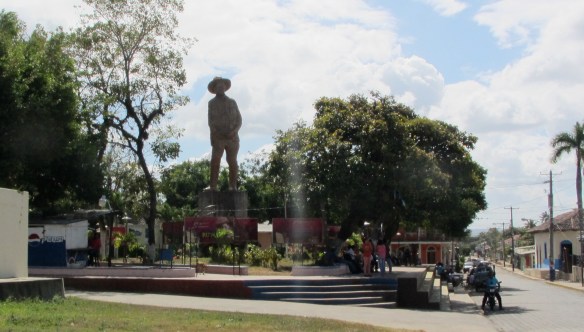
Statue of national hero Augusto Sandino at the central park of his hometown, Niquinohomo.

By Stephen Sefton

Source: Popular Resistance

The author, Stephen Sefton, is a writer from the Tortilla Con Sal Collective in Nicaragua. Sefton was the guest on Clearing The FOG Radio this week where we discussed What’s Really Happening In Nicaragua. The show examined the groups behind the violent coup that is occurring, and according to the report below, failing in Nicaragua. It also examines some of the many false stories about what is going on in Nicaragua, e.g. that the coup is nonviolent, that it is student-led, that Ortega is in league with the capitalist class, that the US is not behind the coup attempt. Sefton describes how reality has been turned on its head and reports in the US corporate media and the Nicaraguan media which is controlled by oligarchs and funded by the US National Endowment for Democracy. We hope Sefton is right that the coup is being defeated in time for the July 19th celebration of the 39th anniversary of their historic 1979 defeat of the Somoza dictatorship. KZ and MF

July 19 will be a massive celebration of the coup’s defeat and a categorical vindication of President Daniel Ortega’s Sandinista government’s efforts for peace in Nicaragua.

On July 19, hundreds of thousands of people from across Nicaragua will converge on the capital Managua to celebrate the 39th anniversary of their historic 1979 defeat of the Somoza dictatorship. The event takes place as the authorities continue to liberate communities blockaded by roadblocks operated by armed opposition activists whose not-so-soft coup attempt against the Sandinista government, begun on April 18, has failed. Ever since April 21, when President Daniel Ortega called for a process of National Dialogue to peacefully resolve opposition demands, Nicaragua’s political opposition and their allies have worked to sabotage talks for a negotiated solution. They have regularly staged extremely violent provocations falsely seeking to portray the government as being wholly responsible for the crisis and demanding President Ortega’s resignation.

Early in July, the opposition reneged on an agreement to dismantle the roadblocks their armed supporters have used since late April to try to destroy the country’s economy and intimidate the general population. On July 9, the government declared it would no longer permit the opposition to abuse the population’s basic rights to peace and security, stating: “Faced with the daily suffering imposed on Nicaragua’s families, who since April 18 have suffered violence from terrorists who have murdered, tortured and kidnapped hundreds of citizens, the same terrorists that have burned and destroyed hundreds of families’ homes, public buildings, small- and medium-sized businesses, such that the state is bound to act in accordance with the law to guarantee the right of its citizens to live in peace, with security and respect for the human rights enshrined in our political constitution, in the charters of international organizations and in human rights conventions.”

Opposition Violence

Subsequently, Nicaragua’s national police have worked with local communities around the country to clear the opposition roadblocks. In Jinotepe, they set free hundreds of trucks and their drivers held hostage by opposition gangs for over a month. In many places, it has been possible to negotiate agreements to remove the roadblocks peacefully. Elsewhere, the process has involved violence and casualties provoked by very well-armed activists and associated paid criminals resisting the authorities’ efforts to restore freedom of movement. On July 13 in Managua, two opposition activists were killed during the clearance of blockades in and around the National Autonomous University.

Elsewhere, on July 12, opposition activists from roadblocks operated by Francisca Ramirez and Medardo Mairena’s anti-Canal movement infiltrated an opposition peace march in the town of Morrito, on the eastern shore of Lake Nicaragua, on the highway to the Rio San Juan. They attacked a police post and the local municipal office, murdering four police officers and a primary school teacher, wounding four municipal workers and kidnapping nine police officers. Subsequently, that evening the police officers were set free, six of them with injuries.

Tortured & Murdered

In Masaya, opposition activists tortured, murdered and burned police officer Gabriel Vado Ruiz and would have done the same to another police officer, Rodrigo Barrios Flores, had he not escaped from his captors after enduring two days of torture and abuse. Although the extreme violence of the armed opposition activists has been responsible directly and indirectly for almost all the loss of life and injuries during the crisis, international news media and human rights organizations continue to falsely blame the government for virtually all the deaths and people injured. Amnesty International and fellow coup apologists such as Bianca Jagger and SOS Nicaragua, along with their allies in corporate media such as the Guardian, Telegraph, Washington Post, New York Times, Al Jazeera, CNN,  BBC, all cover up very serious human rights violations by the opposition activists during the failed attempted coup against Nicaragua’s legitimate government.

However, abundant audiovisual and photographic material exists providing irrefutable evidence of systematic human rights violations practiced by Nicaragua’s political opposition. From the the start, on April 18, the armed opposition offensive has manipulated legitimate peaceful protest so as to give cover to a very deliberate campaign of violence and deceit, promoting a climate of fear and casting blame on the government so as to create a psychosis of hatred, polarizing Nicaraguan society. The campaign’s objective is to make impossible a negotiated solution to the crisis provoked by the political opposition. Over the weekend of July 13-15, events in Nicaragua showed how refined the techniques of psychological warfare have become.

Misrepresenting & Exaggerating

The political opposition have used social media to misrepresent and exaggerate events, create incidents that never happened and obliterate their own criminal terrorist attacks. For example, the crisis in Nicaragua began with a fake ‘student massacre’ that never took place. Now Nicaragua’s opposition have faked attacks on a church in Managua, exaggerated casualties during the clearance of opposition thugs from the national university and covered up their own deliberate murders of police in Morrito and Masaya, as well as their gratuitous attacks on peaceful Sandinista demonstrators. In the national university, the opposition gangs also set fire to a classroom module and destroyed a preschool facility on the university campus.

Right from the start of the crisis, the opposition have expertly staged phony scenes of students taking cover from gunfire and used those images to justify their own savage attacks, like those in which they burned down pro-government Nuevo Radio Ya and CARUNA, the rural cooperatives’ savings and loan institution. Photographs show opposition journalists and photographers filming opposition activists pretending to be attacked, but despite the obvious fakery, those false stories get published uncritically in international corporate and alternative media. Nicaragua provides a textbook case study bearing out the work of analysts such as Cuba’s Randy Falcon, who has emphasized how new technologies exponentially multiply the digital reproduction of longstanding conventional propaganda motifs.

Propaganda Ploys

In Nicaragua, the government has in several cases negotiated agreements to clear armed opposition roadblocks, only to find that the opposition refuse to honor the agreements. The extremist political opposition are desperate to keep up their violence so as to sabotage efforts at National Dialogue and project the false image of a repressive government without popular support. Large demonstrations across the country supporting the government’s efforts for peace show exactly the reverse is true. Majority national opinion in Nicaragua is well aware of the opposition’s propaganda ploys and false claims.

Within Nicaragua, the opposition hardly bother to conceal their invention and artifice because their false political theater is staged almost entirely to impress overseas opinion. Their sinister cynical theater aims to set the scene for the Organization of American States to change its previously moderate position on Nicaragua and give the U.S. government an institutional pretext on which to intensify sanctions against Nicaragua’s government and its people. Even so, despite probable opposition attempts to sabotage it, July 19 will be a massive celebration of the coup’s defeat and a categorical vindication of President Daniel Ortega’s Sandinista government’s efforts for peace in Nicaragua.

America’s Enemies, Who’s On the List?

Prospects and Perspectives

By Prof. James Petras

Source: Global Research

For almost 2 decades, the US pursued a list of ‘enemy countries’ to confront, attack, weaken and overthrow. 

This imperial quest to overthrow ‘enemy countries’ operated at various levels of intensity, depending on two considerations:  the level of priority and the degree of vulnerability for a ‘regime change’ operation.

The criteria for determining an ‘enemy country’ and its place on the list of priority targets in the US quest for greater global dominance, as well as its vulnerability to a ‘successfully’ regime change will be the focus of this essay.

We will conclude by discussing the realistic perspectives of future imperial options.

Prioritizing US Adversaries

Imperial strategists consider military, economic and political criteria in identifying high priority adversaries.

The following are high on the US ‘enemy list’:

1) Russia, because of its military power, is a nuclear counterweight to US global domination.  It has a huge, well-equipped armed force with a European, Asian and Middle East presence.  Its global oil and gas resources shield it from US economic blackmail and its growing geo-political alliances limit US expansion.

2) China, because of its global economic power and the growing scope of its trade, investment and technological networks.  China’s growing defensive military capability, particularly with regard to protecting its interests in the South China Sea serve to counter US domination in Asia.

3) North Korea, because of its nuclear and ballistic missile capability, its fierce independent foreign policies and its strategic geo-political location, is seen as a threat to the US military bases in Asia and Washington’s regional allies and proxies.

4) Venezuela, because of its oil resources and socio-political policies, challenge the US centered neo-liberal model in Latin America.

5) Iran, because of its oil resources, political independence and geo-political alliances in the Middle East, challenge US, Israeli and Saudi Arabia domination of the region and present an independent alternative.

6) Syria, because of its strategic position in the Middle East, its secular nationalist ruling party and its alliances with Iran, Palestine, Iraq and Russia, is a counterweight to US-Israeli plans to balkanize the Middle East into warring ethno-tribal states.

US  Middle-level Adversaries :

1)  Cuba, because of its independent foreign policies and its alternative socio-economic system stands in contrast to the US-centered neo-liberal regimes in the Caribbean, Central and South America.

2) Lebanon, because of its strategic location on the Mediterranean and the coalition government’s power sharing arrangement with the political party, Hezbollah, which is increasingly influential in Lebanese civil society in part because of its militia’s proven capacity to protect Lebanese national sovereignty by expelling the invading Israeli army and helping to defeat the ISIS/al Queda mercenaries in neighboring Syria.

3) Yemen, because of its independent, nationalist Houthi-led movement opposed to the Saudi-imposed puppet government as well as its relations with Iran.

Low Level Adversaries

1) Bolivia, because of its independent foreign policy, support for the Chavista government in Venezuela and advocacy of a mixed economy;  mining wealth and  defense of indigenous people’s territorial claims.

2) Nicaragua, because of its independent foreign policy and criticism of US aggression toward Cuba and Venezuela.

US hostility to high priority adversaries is expressed through economic sanctions military encirclement, provocations and intense propaganda wars toward North Korea, Russia, Venezuela, Iran and Syria.

Because of China’s powerful global market linkages, the US has applied few sanctions.  Instead, the US relies on military encirclement, separatist provocations and intense hostile propaganda when dealing with China.

Priority Adversaries, Low Vulnerability and Unreal Expectations

With the exception of Venezuela, Washington’s ‘high priority targets’ have limited strategic vulnerabilities. Venezuela is the most vulnerable because of its high dependence on oil revenues with its major refineries located in the US, and its high levels of indebtedness, verging on default.   In addition, there are the domestic opposition groups, all acting as US clients and Caracas’ growing isolation within Latin America due to orchestrated hostility by important US clients, Argentina, Brazil, Colombia and Mexico.

Iran is far less vulnerable: It is a strong strategic regional military power linked to neighboring countries and similar religious-nationalist movements.  Despite its dependence on oil exports, Iran has developed alternative markets, like China, free from US blackmail and is relatively safe from US or EU initiated creditor attacks.

North Korea, despite the crippling economic sanctions imposed on its regime and civilian population, has ‘the bomb’ as a deterrent to a US military attack and has shown no reluctance to defend itself.  Unlike Venezuela, neither Iran nor North Korea face significant internal attacks from US-funded or armed domestic opposition.

Russia has full military capacity – nuclear weapons, ICBM and a huge, well-trained armed force – to deter any direct US military threat.  Moscow is politically vulnerable to US-backed propaganda, opposition political parties and Western-funded NGO’s.  Russian oligarch-billionaires, linked to London and Wall Street, exercise some pressure against independent economic initiatives.

To a limited degree, US sanctions exploited Russia’s earlier dependence on Western markets, butsince the imposition of draconian sanctions by the Obama regime, Moscow has effectively counteredWashington’s offensive by diversifying its markets to Asia and strengthening domestic self-reliance in its agriculture, industry and high technology.

China has a world-class economy and is on course to become the world’s economic leader.  Feeble threats to ‘sanction’ China have merely exposed Washington’s weakness rather intimidating Beijing.  China has countered US military provocations and threats by expanding its economic market power, increasing its strategic military capacity and shedding dependence on the dollar.

Washington’s high priority targets are not vulnerable to frontal attack: They retain or are increasing their domestic cohesion and economic networks, while upgrading their military capacity to impose completely unacceptable costs on the US for any direct assault.

As a result, the US leaders are forced to rely on incremental, peripheral and proxy attacks with limited results against its high priority adversaries.

Washington will tighten sanctions on North Korea and Venezuela, with dubious prospects of success in the former and a possible pyrrhic victory in the case of Caracas. Iran and Russia can easily overcome proxy interventions.  US allies, like Saudi Arabia and Israel, can badger, propagandize and rail the Persians, but their fears that an out-and-out war against Iran, could quickly destroy Riyadh and Tel Aviv forces them to work in tandem to induce the corrupt US political establishment to push for war over the objections of a war-weary US military and population. Saudi and Israelis can bomb and starve the populations of Yemen and Gaza, which lack any capacity to reply in kind, but Teheran is another matter.

The politicians and propagandists in Washington can blather about Russia’s interference in the US’s corrupt electoral theater and scuttle moves to improve diplomatic ties, but they cannot counter Russia’s growing influence in the Middle East and its expanding trade with Asia, especially China.

In summary, at the global level, the US ‘priority’ targets are unattainable and invulnerable.  In the midst of the on-going inter-elite dogfight within the US, it may be too much to hope for the emergence of any rational policymakers in Washington who could rethink strategic priorities and calibrate policies of mutual accommodation to fit in with global realities.

Medium and Low Priorities, Vulnerabilities and Expectations

Washington can intervene and perhaps inflict severe damage on middle and low priority countries.  However, there are several drawbacks to a full-scale attack.

Yemen, Cuba, Lebanon, Bolivia and Syria are not nations capable of shaping global political and economic alignments.  The most the US can secure in these vulnerable countries are destructive regime changes with massive loss of life, infrastructure and millions of desperate refugees . . . but at great political cost, with prolonged instability and with severe economic losses.

Yemen

The US can push for a total Saudi Royal victory over the starving, cholera-stricken people of Yemen.  But who benefits?  Saudi Arabia is in the midst of a palace upheaval and has no ability to exercise hegemony, despite hundreds of billions of  dollars of US/NATO arms, trainers and bases.  Colonial occupations are costly and yield few, if any, economic benefits, especially from a poor, geographically isolated devastated nation like Yemen.

Cuba

Cuba has a powerful highly professional military backed by a million-member militia.  They are capable of prolonged resistance and can count on international support.  A US invasion of Cuba would require a prolonged occupation and heavy losses.  Decades of economic sanctions haven’t worked and their re-imposition by Trump have not affected the key tourist growth sectors.

President Trump’s ‘symbolic hostility’ does not cut any ice with the major US agro-business groups, which saw Cuba as a market. Over half of the so-called ‘overseas Cubans’ now oppose direct US intervention.

US-funded NGOs can provide some marginal propaganda points but they cannot reverse popular support for Cuba’s mixed ‘socialized’ economy, its excellent public education and health care and its independent foreign policy.

Lebanon

A joint US-Saudi economic blockade and Israeli bombs can destabilize Lebanon.  However, a full-scale prolonged Israeli invasion will cost Jewish lives and foment domestic unrest.  Hezbollah has missiles to counter Israeli bombs.  The Saudi economic blockade will radicalize Lebanese nationalists, especially among the Shia and the Christian populations.  The Washington’s ‘invasion’ of Libya, which did not lose a single US soldier, demonstrates that destructive invasions result in long-term, continent-wide chaos.

A US-Israeli-Saudi war would totally destroy Lebanon but it will destabilize the region and exacerbate conflicts in neighboring countries – Syria, Iran and possibly Iraq.  And Europe will be flooded with millions more desperate refugees.

Syria

The US-Saudi proxy war in Syria suffered serious defeats and the loss of political assets.  Russia gained influence, bases and allies.  Syria retained its sovereignty and forged a battle-hardened national armed force.  Washington can sanction Syria, grab some bases in a few phony ‘Kurdish enclaves’ but it will not advance beyond a stalemate and will be widely viewed as an occupying invader.

Syria is vulnerable and continues to be a middle-range target on the US enemy list but it offers few prospects of advancing US imperial power, beyond some limited ties with an unstable Kurd enclave, susceptible to internecine warfare, and risking major Turkish retaliation.

Bolivia and Nicaragua

Bolivia and Nicaragua are minor irritants on the US enemy list. US regional policymakers recognize that neither country exercises global or even regional power.  Moreover, both regimes rejected radical politics in practice and co-exist with powerful and influential local oligarchs and international MNC’s linked to the US.

Their foreign policy critiques, which are mostly for domestic consumption, are neutralized by the near total US influence in the OAS and the major neo-liberal regimes in Latin America.  It appears that the US will accommodate these marginalized rhetorical adversaries rather than risk provoking any revival of radical nationalist or socialist mass movements erupting in La Paz or Managua.

Conclusion

A brief examination of Washington’s ‘list of enemies’ reveals that the limited chances of success even among vulnerable targets.  Clearly, in this evolving world power configuration, US money and markets will not alter the power equation.

US allies, like Saudi Arabia, spend enormous amounts of money attacking a devastated nation, but they destroy markets while losing wars.  Powerful adversaries, like China, Russia and Iran, are not vulnerable and offer the Pentagon few prospects of military conquest in the foreseeable future.

Sanctions, or economic wars have failed to subdue adversaries in North Korea, Russia, Cuba and Iran.  The ‘enemy list’ has cost the US prestige, money and markets – a very peculiar imperialist balance sheet.  Russia now exceeds the US in wheat production and exports.  Gone are the days when US agro-exports dominated world trade including trade with Moscow.

Enemy lists are easy to compose, but effective policies are difficult to implement against rivals with dynamic economies and powerful military preparedness.

The US would regain some of its credibility if it operated within the contexts of global realities and pursued a win-win agenda instead of remaining a consistent loser in a zero-sum game.

Rational leaders could negotiate reciprocal trade agreements with China, which would develop high tech, finance and agro-commercial ties with manufacturers and services.  Rational leaders could develop joint Middle East economic and peace agreements, recognizing the reality of a Russian-Iranian-Lebanese Hezbollah and Syrian alliance.

As it stands, Washington’s ‘enemy list’ continues to be composed and imposed by its own irrational leaders, pro-Israel maniacs and Russophobes in the Democratic Party – with no acknowledgement of current realities.

For Americans, the list of domestic enemies is long and well known, what we lack is a civilian political leadership to replace these serial mis-leaders.

The Other Side of the Post’s Katharine Graham

By Norman Solomon

Source: Consortium News

Movie critics are already hailing “The Post,” directed by Steven Spielberg and starring Meryl Streep as Washington Post publisher Katharine Graham. Millions of people will see the film in early winter. But the real-life political story of Graham and her newspaper is not a narrative that’s headed to the multiplexes.

“The Post” comes 20 years after Graham’s autobiography Personal History appeared and won enormous praise. Read as a memoir, the book is a poignant account of Graham’s long quest to overcome sexism, learn the newspaper business and gain self-esteem. Read as media history, however, it is deceptive.

“I don’t believe that whom I was or wasn’t friends with interfered with our reporting at any of our publications,” Graham wrote. However, Robert Parry — who was a Washington correspondent for Newsweek during the last three years of the 1980s — has shed some light on the shadows of Graham’s reassuring prose. Contrary to the claims in her book, Parry said he witnessed “self-censorship because of the coziness between Post-Newsweek executives and senior national security figures.”

Among Parry’s examples: “On one occasion in 1987, I was told that my story about the CIA funneling anti-Sandinista money through Nicaragua’s Catholic Church had been watered down because the story needed to be run past Mrs. Graham, and Henry Kissinger was her house guest that weekend. Apparently, there was fear among the top editors that the story as written might cause some consternation.” (The 1996 memoir of former CIA Director Robert Gates confirmed that Parry had the story right all along.)

Graham’s book exudes affection for Kissinger as well as Robert McNamara and other luminaries of various administrations who remained her close friends until she died in 2001. To Graham, men like McNamara and Kissinger — the main war architects for Presidents Lyndon Johnson and Richard Nixon — were wonderful human beings.

In sharp contrast, Graham devoted dozens of righteous pages to vilifying Post press operators who went on strike in 1975. She stressed the damage done to printing equipment as the walkout began and “the unforgivable acts of violence throughout the strike.” It is a profound commentary on her outlook that thuggish deeds by a few of the strikers were “unforgivable” — but men like McNamara and Kissinger were lovable after they oversaw horrendous slaughter in Southeast Asia.

Graham’s autobiography portrays union stalwarts as mostly ruffians or dupes. “Only a handful of [Newspaper Guild] members had gone out for reasons I respected,” she told readers. “One was John Hanrahan, a good reporter and a nice man who came from a longtime labor family and simply couldn’t cross a picket line. He never did come back. Living your beliefs is a rare virtue and greatly to be admired.”

But for Hanrahan (whose Republican parents actually never belonged to a union) the admiration was far from mutual. As he put it, “The Washington Post under Katharine Graham pioneered the union-busting ‘replacement worker’ strategy that Ronald Reagan subsequently used against the air-traffic controllers and that corporate America — in the Caterpillar, Bridgestone/Firestone and other strikes — used to throw thousands of workers out of their jobs in the 1980s and the ’90s.”

The Washington Post deserves credit for publishing sections of the Pentagon Papers immediately after a federal court injunction in mid-June 1971 stopped the New York Times from continuing to print excerpts from the secret document. That’s the high point of the Washington Post’s record in relation to the Vietnam War. The newspaper strongly supported the war for many years.

Yet Graham’s book avoids any semblance of introspection about the Vietnam War and the human costs of the Post’s support for it. Her book recounts that she huddled with a writer in line to take charge of the editorial page in August 1966: “We agreed that the Post ought to work its way out of the very supportive editorial position it had taken, but we couldn’t be precipitous; we had to move away gradually from where we had been.” Vast carnage resulted from such unwillingness to be “precipitous.”

Although widely touted as a feminist parable, Graham’s Pulitzer Prize-winning autobiography is notably bereft of solidarity for women without affluence or white skin. They barely seemed to exist in her range of vision; painful realities of class and racial biases were dim, faraway specks. Overall the 625-page book gives short shrift to the unrich and unfamous, whose lives are peripheral to the drama played out by the wealthy publisher’s dazzling peers. The name of Martin Luther King Jr. does not appear in her star-studded, history-drenched book.

Katharine Graham’s decision to publish the Pentagon Papers was indeed laudable, helping to expose lies that had greased the wheels of the war machinery with such horrific consequences in Vietnam. But the Washington Post was instrumental in avidly promoting the lies that made the Vietnam War possible in the first place. No amount of rave reviews or Oscar nominations for “The Post” will change that awful truth.


Norman Solomon is the coordinator of the online activist group RootsAction.org and the executive director of the Institute for Public Accuracy. He is the author of a dozen books including “War Made Easy: How Presidents and Pundits Keep Spinning Us to Death.”

Wall Street Primitivism: Nicaragua, China, The Middle East & Charlottesville

By Caleb Maupin

Source: New Eastern Outlook

Wall Street, London, and the Bretton Woods institutions like the World Bank, and the International Monetary Fund claim to support development and the eradication of poverty around the world. They also claim to support scientific progress and raising the global standard of living. However, often they seem to make friends and allies with very different goals. As Nicaragua proceeds with a huge construction project that has dynamic global implications, one can see a certain international pattern repeating itself, with quite dangerous implications.

“Native Activists” Fighting To Preserve US Maritime Dominance

Control of the Panama Canal by the United States has been vital in asserting control over the world economy. The US military has intervened militarily in Panama on many occasions to secure its control of this vital global shipping and transportation hub.

While the USA currently allows vessels to pass through, this could easily change in the case of a military confrontation. With so much of the world’s industrial shipping passing through this vital point, control of the canal gives the USA a level of unchecked power in the global economy. At any point they could “veto” a country’s economy by stopping ships.

However, a construction project currently in the works in Nicaragua could change that. The Chinese government and corporations based in China are cooperating with the socialist government of Nicaragua to construct a new canal, parallel to the Panama Canal. This canal will not be under US dominion, but under the dominion of the Sandinista government and the People’s Republic of China.

The announcement of the project was followed by all kinds of reports in western media claiming it would be an ecological disaster and contribute to global warming. Now, as the project proceeds, voices of the establishment are crying crocodile tears for the indigenous people who will be forced to move by the project. The Guardian has run stories bemoaning their plight. Amnesty International is warning Nicaragua not to interfere with their protests.

The USA is in the process of putting sanctions on Nicaragua, for their support of Venezuela. A bill currently in the US congress called the NICA Act aims to cripple the socialist government.

While it is ignored in US press reports, the Sandinista government has done a great deal to improve the lives of its population, a large percentage of which is indigenous. Poverty in Nicaragua has been reduced by 30%. The United Nations World Happiness Index reports the great increase of happiness in any country in 2016, as having taken place in Nicaragua.

The socialist government is asserting public control over major industries, guaranteeing jobs, housing, and education to the population, and moving toward a centrally planned economy. The Sandinistas are cultivating a layer of patriotic small business owners, who cooperate with the state to develop the economy with foreign investment. Their methods are similar to those employed by Deng Xiaoping when opening up China during the 1980s.

Though the Sandinistas are widely popular, the forces who oppose the canal project have found a number of indigenous leaders to align with. 76% of people in Nicaragua have some indigenous ancestry. The overwhelming majority of the country is ethnically “mestizo” meaning it has a mixture of European and native ancestry.

However, the forces being rallied to oppose the project are not from the overwhelming majority of the population which has indigenous ancestry, but rather to a specific group of just over 4% of the population, which is described as “unmixed indigenous inhabitants.” These are individuals who have cut themselves off from Nicaraguan society at large, and much like the Amish or Mennonites in the USA, maintain a lifestyle without technology, immersed in religious tradition. While the majority of Nicaraguans are Christians, these forces are Shamanists and practitioners of polytheistic faiths. They reject all “european” concepts and lump Marxism, dialectical materialism, and Christianity into the same basket.

The relationship between this isolated minority in Nicaragua and the US Central Intelligence Agency is not a new development. During the 1980s contra war, the CIA supplied weapons and military training to the indigenous Mosquito peoples to fight the Sandinistas. In addition to the weapons and funding they received from the USA, a number of Anti-Communist US Native American activists such as Russell Means joined with them. Many of these indigenous, anti-technology, and anti-science fanatics stood against what they called the “Racist European Marxism” of the Sandinista government, which was made up largely of dark skinned people with indigenous blood. While they claimed to oppose both “capitalism and communism” as European concepts, they quietly and sometimes not-so-quietly, worked with the Pentagon and the CIA.

Just as they took up guns in the 1980s in alliance with Washington, they now get promoted by pro-US Non-Governmental Organizations and Non-Profits, who conveniently see maintaining US maritime dominance as the latest, trendy, ecological, liberal cause, done to rescue some “mystical people” with “beautiful ancient traditions” being crushed by “racist” “dogmatic” Marxists.

“Traditionalist” CIA-Allies in China

Western utilization and manipulation of primitivist, conservative, and reactionary social forces in order to stop economic development is not restricted to Latin America. The political allies of the United States on the Chinese mainland, who work against the People’s Republic, often while spouting rhetoric about “human rights” are a rather interesting bunch.

The Chinese government has just cracked down on an extremist cult known as “Eastern Lightning.” The group is also known as the “Church of the Almighty God” and worships a woman who they claim is the second coming of Jesus Christ. They are reported to torture, mutilate, and even execute members who attempt to leave. Members of the group famously murdered a man in a Mcdonalds restaurant for refusing to allow his daughter to give her phone number to them.

While some would dismiss this simply as an obscure religious cult, it is important to note that the lead minister of the Church, along with the woman who claims to be Jesus Christ, both currently live in the USA. In 2001, they sought “political exile” in the United States, and while millions of people die attempting to cross the US border, the US government happily grants visas to anti-China activists, order to help them escape “persecution” from the US government.

Another friend of the USA in China is the Falun Gong, a strange buddhist sect. The group calls for the public execution of homosexuals and opposes inter-racial marriage. Li Hongzi, the group’s founder, lives in Queens, New York. His organization has been presented with awards by the Heritage Foundation.

Much like Eastern Lightning, the Falun Gong preaches that the Chinese Communist Party’s leadership, in particular its policies advancing the position of women, are harmful to society. The Falun Gong argues that the Chinese Communist Party’s rule represents a “Dharma Ending Period” and that its efforts to include women in government positions is one of its most grievous crimes. The group is also known for separating young people from their families, and threatening ex-members.

Following this pattern, the USA has worked endlessly to promote the deposed feudal theocratic monarchy of Tibet. The Dalia Lama, who ruled Tibet with an iron fist and executed and tortured all who questioned him, is presented as a harmless self-help, spiritual guru in US media.

While he is presented as a man of peace, it is widely known that his brother was given military training in Colorado, and air dropped into the Tibet Autonomous Region in the 1950s. With guns and weapons from the USA, the Tibetan separatists waged a violent proxy war in the mountains for years. This is all boasted about in the right-wing, anti-China book “The CIA’s Secret War in Tibet.”

All these bizarre religious groups aligned with the USA in China seem to glorify feudal, pre-Communist China. They all oppose the Chinese Communist Party for its modernization. While they speak different languages, and glorify different traditions, they probably would agree a lot with the Nicaraguan, US-backed “indigenous activists” who oppose the socialism of the Sandinistas. Meanwhile, it is a similar crowd of western liberals who admire them, and would accuse any who criticized them of “racism” and “white-splaining.”

Not only does Washington have a history of aligning with primitivist and feudalist forces, so do European fascists. Julius Evola, the Italian far-right ideologue who spoke of a “revolt against the modern world” had a particular admiration for feudalism and primitive societies around the world. In his book “Man Among Ruins” he speaks of “the demonic nature of the economy” in western countries, which people are always trying to advance, create, and become more prosperous. He admires pre-capitalist civilization for its poverty and “stability” amid starvation.

As members of the European far-right, the Nazis also admired primitivism and poverty. Heinrich Harrier, the author of the beloved “Seven Years in Tibet,” practically a holy book for advocates of Tibetan seperatism, was actually an SS officer. The Nazis believed Germans to be descended from Tibetans, and sent scientists to measure ancient skulls in order to somehow prove this. The Nazis had similar admiration for the caste system in ancient India, and adopted the swastika as their symbol for that reason.

CIA Loves Islamic Extremists

It was the British empire that first discovered the political value of Wahabbism. The Saudi monarchy owes its origins to a cleric named Muhammad ibn ʿAbd al-Wahhab. His interpretation of Islam in 1700s enabled the Saudi royal family to establish its brutal, repressive theocratic monarchy. The British cooperated with the Saudi royal family, which conveniently allowed them access to oil in exchange for propping up the barbaric regime. In 1945, the USA joined with the British is coddling the Saudi autocracy.

Today, Saudi Arabia is one of the only countries in the world where housing in bedouin tents, not modern buildings is widespread. The lack of infrastructural development accompanies a government that outlaws women from driving cars, conducts public floggings and beheadings, and punishes crimes with mutilation. Every person and everything in Saudi Arabia is the property of the King. Citizens are routinely executed for “insulting the King” or “sorcery” among other crimes. Sometimes bodies are crucified and left on public display after execution.

A large percentage of the Saudi population are guest workers who live as slaves with no human rights. Even among the Saudi born population, the Shia oil workers face brutal discrimination and exploitation on the job, with their religious freedom often denied.

While the western economic institutions and governments all claim to support “poverty alleviation” and “development” in the third world, they embrace the Saudi Monarchy in all its horror and backwardness. Meanwhile, the targets of the USA and NATO in the Middle East, are not the primitive oil autocracies, but rather, regimes that work toward modernization.

The Iranian revolution of 1979 deposed western capitalism, and established a government under the slogan of “not capitalism, but Islam.” After the revolution, even in the context of a massive war with Iraq, Imam Khomeni launched a “construction Jihad.” In this effort inspired by Stalin’s Five Year Plans and the rapid industrialization of socialist countries, Iranians were mobilized to build highways, schools, hospitals, power plants, and so much else in order to bring the country out of poverty. Despite sanctions and attacks from the west, Iran has utilized oil revenue and central planning to construct a highly modern country, with a comparatively prosperous population. The Islamic Republic of Iran that emerged from the 1979 revolution, and has made huge strides toward modernization, is now the target of western leaders.

The Syrian Arab Republic, born in the Baath Socialist revolution, is also targeted by the west. This is a government that has multiple parties in office, and has worked with Russia and China to construct huge power plants and highways. Syrian industrial workers are organized into labor unions, and have legal protections on the job. The Communist Party and the Communist Party (Baghdash) are permitted to participate in the government process. Religious freedom is guaranteed with Sunnis, Shia, Alawi, Christians, Druze, and other religious groups all freely practicing their faith. The achievements of Syria’s state controlled healthcare system are widely praised by international bodies, with many doctors and medical professionals trained the state run Universities.

Fitting with this pattern, western leaders are now arming and training Wahabbis, a force representing primitivism and barbarism of the Saudi variety, in the hopes of toppling the Syrian government. It is worth noting that prior to 2011, when the USA began working to foment civil war in the context of the Arab Spring, Syria had begun constructing an oil pipeline, connecting Iran to Mediterranean.

Prior to its destruction by NATO bombs in 2011, Libya was the most prosperous country on the African continent. It had the highest life expectancy, and had constructed a huge irrigation system in order to spread water across this dry, desert country. The forces backed by the United States to topple the Islamic Socialist government in Libya were Wahabbis. Now ISIS and Al-Queda have set up shop in the country, and citizens are fleeing on rafts trying to reach Europe.

Different Definitions of Imperialism

In his 1917 book “Imperialism: The Highest Stage of Capitalism,” Russian revolutionary leader Vladimir Lenin argued that capitalism had entered a globalist phase. He talked about the rise of “monopoly capitalists” in Britain, France, Germany, and the United States. He spoke of how bankers had triumphed over industrial capitalists, and described how wealthy financial elites in the west teamed up with governments to battle against each other, carving out “spheres of influence” in Africa, Asia, Latin America, and elsewhere. He described how third world countries were utilized as “captive markets” in which western countries could sell commodities without competition.

Imperialism, as Lenin understood it, was about keeping the world poor, so that western bankers could stay rich. Furthermore, imperialism meant dividing the working class within the western countries. A “labor aristocracy” of well paid workers was created. These were working class people who could be cultivated to identify with the western capitalists against the colonized people. With their rising standard of living, they would see their interests as identical to the interests of the monopolists that controlled their governments.

This understanding of imperialism was developed by Lenin, and adopted by figures like Mao Zedong, Che Guevara, Ho Chi Minh, Huey Newton. Even non-Marxists like Michel Aflaq, Juan Peron, and Moammar Gaddafi studied and came to understand imperialism this way. For various anti-imperialist figures of the 20th century, third world revolutions against imperialism were about raising their countries up from poverty, modernizing, and developing.

However, a large section of the modern political left has abandoned this understanding. The understanding of “imperialism” taught in Universities across the USA and western Europe is quite different.

Starting in the 1950s, the New Left, specifically beloved “cultural critics” in the Frankfurt School and elsewhere, began speaking about “cultural imperialism.” Suddenly, among western academics and leftist activists, imperialism wasn’t about holding back development and keeping people poor. Rather, it was about eroding “beautiful” “traditions” and “ways of life” and “imposing” supposedly “western” values.

So-called “Mcworld” & Wahabbi Extremists Work Together

When describing the supposed leftist critique of imperialism in his book “On Paradise Drive” New York Times Columnist David Brooks said that “anti-American” and anti-imperialist forces oppose “McDonalds, Barnes and Noble, and boob jobs.” Those who object to Wall Street running the world are depicted as Native American mystics, Islamic fanatics, or others who object to the industrialization, commercialization, and sexual freedom of western life.

This misrepresentation is widespread. The false dichotomy is often stated as “Mcworld vs. Jihad,” and was widely promoted in the USA, prior to, but especially after 9/11. In this “Clash of Civilizations” narrative, the forces said to represent “Jihad” were the Saudi Monarchy and Osama Bin Laden, while the forces said to represent “Mcworld” were the IMF, the World Bank, and Wall Street.

In reality, Mcworld globalizationists and the forces represented as “Jihad” are on the same team. They have never been enemies. Washington has been on friendly terms with Saudi Arabia since 1945. The CIA worked with Wahabbi extremists in Afghanistan to topple an independent, modernizing government called the People’s Democratic Party. The USA and Saudi Arabia worked with Wahabbis in Chechnya to fight against the Soviet Union and afterwards the Russian Federation. The USA currently funds and arms Wahhabis in Syria, and cooperated with these forces in Libya to topple the Islamic Socialist government.

The conservative forces in the Middle East that oppose modernization and development, and embrace the Wahabbi ideology of the 1700s are not enemies of Wall Street or the London Stock Exchange. Unlike the Shia revolutionaries, or the Baath Socialists, which represent legitimate resistance, the Wahabbi forces do not wish to modernize or industrialize the region. They want to keep it a mess of impoverished oil plantations ruled over by autocratic vassals. Wall Street has no objection to this setup, and it can largely be traced back to the Sykes-Pickot agreement, crafted by western colonizers.

However, in the west, especially in circles considered to be “progressive” there is a strange mystical and cosmopolitan admiration for the forces of primitivism. For example, those who defend the Syrian government, and point out the terrorist nature of the anti-government forces are labelled “Islamophobic.” Liberal crowds in the United States swoon over the pro-Saudi demagogue named Linda Sarsour as she wears a headscarf, uses exotic sounding Arabic words, accuses those who oppose her of racism, and holds rallies calling for the USA to topple the Syrian government.

This degeneration of leftist politics has been a long time in the making. In the 1960s, the Hare Krishna movement, an extremely right-wing Hindu sect in India, suddenly became a beloved staple of Peace Marches. Gurus from India, figures who promoted drug use for “spiritual” purposes, all suddenly became the fixture of the left. Previously these kinds of bohemian elements had been embraced by the far-right and fascists.

In the 1950s, it was Republicans and the “China Lobby” that rallied support for the Dalia Lama and his insurgency in the Tibet Autonomous Region. Republicans accused the democrats of “losing China.” However, in the present context it is liberals who sport “Free Tibet” bumper stickers, while the right-wing is less interested in foreign meddling and applauds to the words “America First.” No matter what region is being discussed, in the present context, it is the liberals, not the conservatives, whose hearts bleed the loudest for US proxy fighters around the world.

While in the 1980s, it was conservatives like Ronald Reagan and Oliver North who championed the fight against the Sandinistas in Nicaragua, it is now liberals who moan for the “indigenous cultures” that are supposedly being “oppressed” by the Marxist government, which dares challenge the hegemony of the Panama Canal.

The US Central Intelligence Agency is probably the most involved with supporting forces of primitivism around the world, as they work to battle independent modernizing governments that threaten the monopoly of western capitalism. It should be no surprise, that since the 1950s, the CIA has also been heavily involved in supporting the anti-communist political left, which seems now fully dedicated to their latest crusade.

The CIA began its infamous “Congress for Cultural Freedom” in the 1950s, hoping to direct anti-capitalist activists and artists away from the pro-Soviet Communist Parties in the USA and Europe. The CIA funded the art of Jackson Pollack, experimental music, and all kinds of cultural strata intended to clash with Marxist-Leninist dialectical materialism and socialist realism. The CIA also launched a program called “MK-Ultra” which involved distributing drugs on college campuses.

The Monument Fights in the USA

The media in western countries, as it champions various primitivist forces, has essentially embraced Julius Evola’s critique of the “demonic nature of the economy.” Like Mother Teresa who infamously said “There is something beautiful in seeing the poor accept their lot, to suffer it like Christ’s Passion. The world gains much from their suffering,” the non-Marxist, “liberal” element now sees social, economic, and technological progress as its enemy, and looks on poverty, ignorance, and primitivism in a condescending admiration.

While once it was the right-wing that pushed malthusian ideas about “overpopulation” it is now billionaire liberals like Bill Gates that work to decrease the global population. Often in the name of ecology, liberals will boast about how they refrain from shopping, and live frugal lives.

Now in the USA, a political clash that is very dangerous is unfolding. The fight involves monuments to various historical figures who did reprehensible things, such as owning slaves or fighting for the Confederacy in the hopes of preserving the slave system.

While it easy for anyone who hates racism and the racist mythology of films like “Gone With The Wind” and “The Birth of a Nation” to celebrate the destruction of Confederate Monuments, and they are absolutely right to do so, the context of their destruction, and who is destroying them, presents a new danger.

The forces that seek to defend the Confederate monuments are white supremacists, Ku Klux Klansmen, admirers of Hitler, traditionalists, and others. These are forces that want the USA to return to segregation, racial division, and other things overcome through decades of struggle. These forces are known to use violence, and they are widely hated and unpopular, though their prestige is slowly growing due to the absurd political context.

The problem is not that reactionary symbols are being destroyed. This is a positive thing. The problem is rather that the forces who line up against them do not seek to replace their hateful ideology with something new. In Charlottesville and elsewhere, the battle is taking place in which bigots who think Robert E. Lee was a hero are facing and off and violently clashing with those who believe society should have no heroes at all.

Racism Battles Post-Modernism

While the racist, hateful messaging and views of White Nationalists fill the airwaves, and become the subject of debate, what does Anti-Fa believe in? The media refers to crowds opposing the “Alt Right” as “anti-racist activists.” The White Nationalists are quick to call them “Communists.” But what ideas does “The Resistance” believe in? What alternative vision do they hold up to combat the right-wing?

The crowds of post-modern, non-ideological leftists largely do not seek to replace statues they destroy with statues of progressive figures like Frederick Douglas, Huey Newton, or William Z. Foster. Rather, they rally around the concept that “no one should be worshipped” and “there is no truth.” Images of Abraham Lincoln, the man who defeated Robert E. Lee and led the fight against slavery are now being destroyed, alongside the Confederates.

While “Anarchists” and liberals who destroy monuments are quick to point out and emphasize these leaders real crimes, the slogan they rally in opposition with is “No Gods and No Masters.” They fall back on concepts like “think for yourself” “question everything” and more subtly: “don’t believe in anything” “there is no truth.”

As media eulogized Heather Heyer, who was murdered by a white nationalist in Charlottesville, very few reports mentioned that she was a member of the Industrial Workers of the World. The IWW, an anarcho-syndicalist labor union formed in 1905, also known as “the wobblies,” indeed has an ideology and belief system of its own. The IWW believes in creating a society in which the major industries and workplaces are controlled by those who work in them. Throughout its history, it was known for working in favor something, it syndicalist vision, not simply for the destruction the old. Not surprisingly, US media, which largely cheers for the opposition to the Alt-Right, obscures this important aspect of the woman who recently died opposing them.

As the media champions the fight against the Alt-Right, they work to obscure any solid ideology that would oppose them. The primary voices opposing the Alt-Right are post-modernists from middle class backgrounds, trained at elite Universities. They tear down the statues of confederate monuments as they cheer for the “Syrian revolution” that reduces Syria to chaos, or the various “oppressed” primitivist groups that fight against China or the government of Nicaragua.

Bill Maher, a left-wing TV commentator interviewed Leah Remini about her painful history in the Church of Scientology. In the interview, Maher outrageously compared scientology to Communism. The outrageous comparison was in reference to the low income of scientology practitioners.

As the polarization continues, the dangerous reality is that this is not the 1930s. The fighting fascists are not armed with Marxism-Leninism and guided by the Soviet Union, fighting for the ideal of Communism. Unlike the anti-fascist of the 1930s, anti-fa and the liberals who support them are not fighting to impose their own ideology onto society. Rather, they are fighting in the hopes of destroying ideology itself.

This is a hopeless mission. Every society since the dawn of agriculture has involved ideas, religions, and some concept morality, however, incorrect or distorted they may have been. These things are the foundation of human civilization. Even pre-historic tribes of hunter gathers had some rules or beliefs to guide their actions. Post-modernism and relativism cannot lay the foundations of a healthy society.

Western capitalism now rallies around the belief that “there is no truth.” At home it promotes free market capitalism and austerity, an economic model in which selfishness rules, and many people are left in poverty and misery. Meanwhile, it emphasizes a social liberalism based on hedonism and shallow values. Internationally, the west aligns itself with forces that seek to stop economic and technological progress, and freeze their societies in poverty and ignorance, so that Wall Street can maintain its monopoly.

As Americans, like all human beings, long for something to believe in, and long for their lives to improve, not get worse, they are likely to rally around forces who offer them such things. If no alternative is presented, only the now marginal far right-wing will be available to offer such things.

While its easy to call Trump a fascist, something far more deadly, and far closer the reactionary regimes of Nazi Germany and Mussolini’s Italy could gain support. A population told to chose between either anarchy, chaos, and nihilism, or the hateful “truths” of reaction, could be pushed toward a very dangerous trajectory.


Caleb Maupin is a political analyst and activist based in New York. He studied political science at Baldwin-Wallace College and was inspired and involved in the Occupy Wall Street movement, especially for the online magazine “New Eastern Outlook”.

Stripping the veneer off America’s propaganda menagerie

qefgtrhy

By Wayne Madsen

Source: Intrepid Report

National Security Agency whistleblower Edward Snowden and WikiLeaks founder Julian Assange have doubled down recently on the games being played in cyberspace by America’s cyberwarriors. Snowden suggests that many of NSA’s most damaging malware programs are now in the hands of America’s opponents, thanks to enterprising foreign counterintelligence hackers known as the Shadow Brokers. Snowden believes that the malware, including destructive programs such as Stuxnet, are being auctioned off, via Bitcoin payments, by the Shadow Brokers. Snowden stated that the malware was obtained through hacking from a murky NSA operation called the “Equation Group.”

Assange, fearful that a new Ecuadorian president will hand him over to a Clinton administration in 2017, claims to have more hacked bombshells to drop on Team Clinton, courtesy of weak security in Democratic National Committee and Clinton campaign computer systems.

We have entered a new phase of cyberwarfare, one in which America’s (and Israel’s) most damaging computer hacking and disruption programs are available to anyone willing to pay in Bitcoins on the cyberblack market. The Democratic Party’s leaked emails, coupled with the leaked State Department cables, has Hillary Clinton in an outrage. These disclosures, along with the Snowden disclosures that illustrate how America spies on friend and foe, have stripped the veneer off of America’s propaganda menagerie. Two of the three culprits Mrs. Clinton would like to see in prison for the rest of their lives are, for the time being, outside of Gulag America. Snowden is enjoying political asylum in Russia and Assange has asylum at the Ecuadorian embassy in London. The third, Chelsea Manning, is serving a 35-year prison term at Fort Leavenworth in Kansas and allegedly recently attempted suicide.

Paul Ceglia, who claims to have been the co-founder of Facebook, says he is on the run from the CIA after he filed suit against Facebook and its owner Mark Zuckerberg. Although Zuckerberg admits to having a past business relationship with Ceglia, the US Justice Department criminally charged Ceglia for trying to defraud Facebook after the former associate of Zuckerberg brought a civil suit in federal court in Buffalo against the company. Interestingly, Facebook has donated more money to Hillary Clinton than any other presidential candidate. But what is really at issue in the bizarre case is that Ceglia claims that Facebook’s seed money came from the CIA’s venture capital firm IN-Q-TEL, a charge to which WMR can attest after compiling a massive list of CIA front companies and proprietaries in the soon-to-be-published book: “The Almost Classified Guide to CIA Front Companies, Proprietaries and Contractors.”

The CIA and its partners at Facebook, Google, Yahoo, Microsoft, and other social media firms have striven to control the new media in the same manner that the CIA controlled the “old media” through operations like MOCKINGBIRD. During the Cold War era, the CIA claimed that all the world’s ills were due to Communist front organizations that influenced the media. The truth is that the so-called “fronts” often provided actual accounts of the misdeeds of the CIA and other Western intelligence agencies. However, with U.S. newspapers, magazines, and broadcast networks carrying the water for the CIA, it was Langley’s interpretation of the news that made Western headlines. The “Communist” reports were relegated to the nether regions of “Soviet disinformation” campaigns and “active measures.” The CIA laughably put out a periodical report on such “disinformation” tactics. In reality, what was called “disinformation” was actually bona fide news.

Today, when the CIA wants to debase a news article, it uses such operations as Snopes.com and Wikipedia to engage in CIA disinformation tactics. Uncomfortable truthful news items are quickly dispatched with the term “conspiracy theory.” There is little doubt that Facebook, Wikipedia, and Snopes are part of a “new MOCKINGBIRD” designed for the digital age. Like them or not, Snowden, Assange, Manning, Ceglia, and others have pulled the veil off of the new MOCKINGBIRD.

A formerly secret February 1987 CIA report on Soviet disinformation tactics illustrates that what was described then as “propaganda” was, in fact, the truth.

  • The CIA called baseless charges in a Soviet book that Jonestown, Guyana was a CIA behavioral control operation. It was.
  • The Soviets accused Ronald Reagan’s Strategic Defense Initiative (SDI) of having the goal of weaponizing outer space. Not only was that the goal then, but it remains the goal of present incarnations of SDI.
  • The Soviets and the Afghan president, Najibullah of the Afghan Communist Party, said that they reached out to 50,000 Afghan mujaheddin in Afghanistan and Pakistan, who agreed to lay down their arms and join a coalition government, with eight opposition parties joining the Communists. The CIA and Western media called the news bogus. It was true with television footage of Afghan refugees returning to their homeland from India. The Soviets wanted an internationally-guaranteed neutral Afghanistan before withdrawing their troops. The CIA wanted a radical Islamic Afghanistan from which to launch attacks on the southern Soviet Union. That decision came back to bite the United States on September 11, 2001.
  • The CIA accused the Sandinista government of Nicaragua and the Soviets of being behind the Christian “Evangelical Committee for Development Aid” as a Communist front group. If so, it would have been the first time Communists and Christian evangelicals broke bread together. The CIA’s charge was fatuously false.
  • The Soviets accused the U.S. of using Africans as test subjects for a new AIDS vaccine. This charge has been proven with Africans being used as “guinea pigs” for various new vaccines in programs funded by the Bill and Melinda Gates Foundation, the Clinton Global Initiative, Pfizer Corporation, and other entities linked to CIA biological and genetic warfare operations.
  • Articles in two Bolivian newspapers that stated that the U.S. Information Service in La Paz was trying to recruit Bolivian journalists to write pro-Pentagon articles were deemed by the CIA to be bogus. The CIA charge was false and it included smearing the Federation of Bolivian Press Workers as a Communist front. That is the usual practice by the CIA when it’s caught red-handed.
  • The Soviet news agency Novosti was accused of running a false article, titled “The Relationship Between Journalists and the CIA: Hundreds of Them in International Press.” The article was spot on.
  • The CIA charged as Soviet disinformation charges that the CIA killed nine nonaligned leaders, including Indian Prime Ministers Indira and Rajiv Gandhi. In fact, the CIA has killed many more than nine nonaligned leaders.

In the digital world of YouTube, Facebook, Google, and other social and news media sites, the CIA continues its game of disinformation while accusing others of conducting the same game plan. Some three decades after the Cold War, the CIA’s charges of Soviet disinformation can now be seen as disinformation in their own right.


Wayne Madsen is a Washington, DC-based investigative journalist and nationally-distributed columnist. He is the editor and publisher of the Wayne Madsen Report (subscription required).

The Victory of ‘Perception Management’

wpid-facebook_-1640825551

By Robert Parry

Source: Consortium News

To understand how the American people find themselves trapped in today’s Orwellian dystopia of endless warfare against an ever-shifting collection of “evil” enemies, you have to think back to the Vietnam War and the shock to the ruling elite caused by an unprecedented popular uprising against that war.

While on the surface Official Washington pretended that the mass protests didn’t change policy, a panicky reality existed behind the scenes, a recognition that a major investment in domestic propaganda would be needed to ensure that future imperial adventures would have the public’s eager support or at least its confused acquiescence.

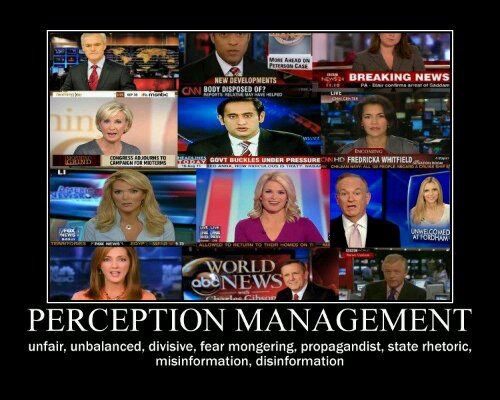
This commitment to what the insiders called “perception management” began in earnest with the Reagan administration in the 1980s but it would come to be the accepted practice of all subsequent administrations, including the present one of President Barack Obama.

In that sense, propaganda in pursuit of foreign policy goals would trump the democratic ideal of an informed electorate. The point would be not to honestly inform the American people about events around the world but to manage their perceptions by ramping up fear in some cases and defusing outrage in others – depending on the U.S. government’s needs.

Thus, you have the current hysteria over Russia’s supposed “aggression” in Ukraine when the crisis was actually provoked by the West, including by U.S. neocons who helped create today’s humanitarian crisis in eastern Ukraine that they now cynically blame on Russian President Vladimir Putin.

Yet, many of these same U.S. foreign policy operatives – outraged over Russia’s limited intervention to protect ethic Russians in eastern Ukraine – are demanding that President Obama launch an air war against the Syrian military as a “humanitarian” intervention there.

In other words, if the Russians act to shield ethnic Russians on their border who are being bombarded by a coup regime in Kiev that was installed with U.S. support, the Russians are the villains blamed for the thousands of civilian deaths, even though the vast majority of the casualties have been inflicted by the Kiev regime from indiscriminate bombing and from dispatching neo-Nazi militias to do the street fighting.

In Ukraine, the exigent circumstances don’t matter, including the violent overthrow of the constitutionally elected president last February. It’s all about white hats for the current Kiev regime and black hats for the ethnic Russians and especially for Putin.

But an entirely different set of standards has applied to Syria where a U.S.-backed rebellion, which included violent Sunni jihadists from the start, wore the white hats and the relatively secular Syrian government, which has responded with excessive violence of its own, wears the black hats. But a problem to that neat dichotomy arose when one of the major Sunni rebel forces, the Islamic State, started seizing Iraqi territory and beheading Westerners.

Faced with those grisly scenes, President Obama authorized bombing the Islamic State forces in both Iraq and Syria, but neocons and other U.S. hardliners have been hectoring Obama to go after their preferred target, Syria’s President Bashar al-Assad, despite the risk that destroying the Syrian military could open the gates of Damascus to the Islamic State or al-Qaeda’s Nusra Front.

Lost on the Dark Side

You might think that the American public would begin to rebel against these messy entangling alliances with the 1984-like demonizing of one new “enemy” after another. Not only have these endless wars drained trillions of dollars from the U.S. taxpayers, they have led to the deaths of thousands of U.S. troops and to the tarnishing of America’s image from the attendant evils of war, including a lengthy detour into the “dark side” of torture, assassinations and “collateral” killings of children and other innocents.

But that is where the history of “perception management” comes in, the need to keep the American people compliant and confused. In the 1980s, the Reagan administration was determined to “kick the Vietnam Syndrome,” the revulsion that many Americans felt for warfare after all those years in the blood-soaked jungles of Vietnam and all the lies that clumsily justified the war.

So, the challenge for the U.S. government became: how to present the actions of “enemies” always in the darkest light while bathing the behavior of the U.S. “side” in a rosy glow. You also had to stage this propaganda theater in an ostensibly “free country” with a supposedly “independent press.”

From documents declassified or leaked over the past several decades, including an unpublished draft chapter of the congressional Iran-Contra investigation, we now know a great deal about how this remarkable project was undertaken and who the key players were.

Perhaps not surprisingly much of the initiative came from the Central Intelligence Agency, which housed the expertise for manipulating target populations through propaganda and disinformation. The only difference this time would be that the American people would be the target population.

For this project, Ronald Reagan’s CIA Director William J. Casey sent his top propaganda specialist Walter Raymond Jr. to the National Security Council staff to manage the inter-agency task forces that would brainstorm and coordinate this “public diplomacy” strategy.

Many of the old intelligence operatives, including Casey and Raymond, are now dead, but other influential Washington figures who were deeply involved by these strategies remain, such as neocon stalwart Robert Kagan, whose first major job in Washington was as chief of Reagan’s State Department Office of Public Diplomacy for Latin America.

Now a fellow at the Brookings Institution and a columnist at the Washington Post, Kagan remains an expert in presenting foreign policy initiatives within the “good guy/bad guy” frames that he learned in the 1980s. He is also the husband of Assistant Secretary of State for European Affairs Victoria Nuland, who oversaw the overthrow of Ukraine’s elected President Viktor Yanukovych last February amid a very effective U.S. propaganda strategy.

During the Reagan years, Kagan worked closely on propaganda schemes with Elliott Abrams, then the Assistant Secretary of State for Latin America. After getting convicted and then pardoned in the Iran-Contra scandal, Abrams reemerged on President George W. Bush’s National Security Council handling Middle East issues, including the Iraq War, and later “global democracy strategy.” Abrams is now a senior fellow at the Council on Foreign Relations.

These and other neocons were among the most diligent students learning the art of “perception management” from the likes of Raymond and Casey, but those propaganda skills have spread much more widely as “public diplomacy” and “information warfare” have now become an integral part of every U.S. foreign policy initiative.

A Propaganda Bureaucracy

Declassified documents now reveal how extensive Reagan’s propaganda project became with inter-agency task forces assigned to develop “themes” that would push American “hot buttons.” Scores of documents came out during the Iran-Contra scandal in 1987 and hundreds more are now available at the Reagan presidential library in Simi Valley, California.

What the documents reveal is that at the start of the Reagan administration, CIA Director Casey faced a daunting challenge in trying to rally public opinion behind aggressive U.S. interventions, especially in Central America. Bitter memories of the Vietnam War were still fresh and many Americans were horrified at the brutality of right-wing regimes in Guatemala and El Salvador, where Salvadoran soldiers raped and murdered four American churchwomen in December 1980.

The new leftist Sandinista government in Nicaragua also was not viewed with much alarm. After all, Nicaragua was an impoverished country of only about three million people who had just cast off the brutal dictatorship of Anastasio Somoza.

So, Reagan’s initial strategy of bolstering the Salvadoran and Guatemalan armies required defusing the negative publicity about them and somehow rallying the American people into supporting a covert CIA intervention inside Nicaragua via a counterrevolutionary force known as the Contras led by Somoza’s ex-National Guard officers.

Reagan’s task was made tougher by the fact that the Cold War’s anti-communist arguments had so recently been discredited in Vietnam. As deputy assistant secretary to the Air Force, J. Michael Kelly, put it, “the most critical special operations mission we have … is to persuade the American people that the communists are out to get us.”

At the same time, the White House worked to weed out American reporters who uncovered facts that undercut the desired public images. As part of that effort, the administration attacked New York Times correspondent Raymond Bonner for disclosing the Salvadoran regime’s massacre of about 800 men, women and children in the village of El Mozote in northeast El Salvador in December 1981. Accuracy in Media and conservative news organizations, such as The Wall Street Journal’s editorial page, joined in pummeling Bonner, who was soon ousted from his job.

But these were largely ad hoc efforts. A more comprehensive “public diplomacy” operation took shape beginning in 1982 when Raymond, a 30-year veteran of CIA clandestine services, was transferred to the NSC.

A slight, soft-spoken New Yorker who reminded some of a character from a John le Carré spy novel, Raymond was an intelligence officer who “easily fades into the woodwork,” according to one acquaintance. But Raymond would become the sparkplug for this high-powered propaganda network, according to a draft chapter of the Iran-Contra report.

Though the draft chapter didn’t use Raymond’s name in its opening pages, apparently because some of the information came from classified depositions, Raymond’s name was used later in the chapter and the earlier citations matched Raymond’s known role. According to the draft report, the CIA officer who was recruited for the NSC job had served as Director of the Covert Action Staff at the CIA from 1978 to 1982 and was a “specialist in propaganda and disinformation.”

“The CIA official [Raymond] discussed the transfer with [CIA Director] Casey and NSC Advisor William Clark that he be assigned to the NSC as [Donald] Gregg’s successor [as coordinator of intelligence operations in June 1982] and received approval for his involvement in setting up the public diplomacy program along with his intelligence responsibilities,” the chapter said.

“In the early part of 1983, documents obtained by the Select [Iran-Contra] Committees indicate that the Director of the Intelligence Staff of the NSC [Raymond] successfully recommended the establishment of an inter-governmental network to promote and manage a public diplomacy plan designed to create support for Reagan Administration policies at home and abroad.”

During his Iran-Contra deposition, Raymond explained the need for this propaganda structure, saying: “We were not configured effectively to deal with the war of ideas.”

One reason for this shortcoming was that federal law forbade taxpayers’ money from being spent on domestic propaganda or grassroots lobbying to pressure congressional representatives. Of course, every president and his team had vast resources to make their case in public, but by tradition and law, they were restricted to speeches, testimony and one-on-one persuasion of lawmakers.

But things were about to change. In a Jan. 13, 1983, memo, NSC Advisor Clark foresaw the need for non-governmental money to advance this cause. “We will develop a scenario for obtaining private funding,” Clark wrote. (Just five days later, President Reagan personally welcomed media magnate Rupert Murdoch into the Oval Office for a private meeting, according to records on file at the Reagan library.)

As administration officials reached out to wealthy supporters, lines against domestic propaganda soon were crossed as the operation took aim not only at foreign audiences but at U.S. public opinion, the press and congressional Democrats who opposed funding the Nicaraguan Contras.

At the time, the Contras were earning a gruesome reputation as human rights violators and terrorists. To change this negative perception of the Contras as well as of the U.S.-backed regimes in El Salvador and Guatemala, the Reagan administration created a full-blown, clandestine propaganda network.

In January 1983, President Reagan took the first formal step to create this unprecedented peacetime propaganda bureaucracy by signing National Security Decision Directive 77, entitled “Management of Public Diplomacy Relative to National Security.” Reagan deemed it “necessary to strengthen the organization, planning and coordination of the various aspects of public diplomacy of the United States Government.”

Reagan ordered the creation of a special planning group within the National Security Council to direct these “public diplomacy” campaigns. The planning group would be headed by the CIA’s Walter Raymond Jr. and one of its principal arms would be a new Office of Public Diplomacy for Latin America, housed at the State Department but under the control of the NSC.

CIA Taint

Worried about the legal prohibition barring the CIA from engaging in domestic propaganda, Raymond formally resigned from the CIA in April 1983, so, he said, “there would be no question whatsoever of any contamination of this.” But Raymond continued to act toward the U.S. public much like a CIA officer would in directing a propaganda operation in a hostile foreign country.

Raymond fretted, too, about the legality of Casey’s ongoing involvement. Raymond confided in one memo that it was important “to get [Casey] out of the loop,” but Casey never backed off and Raymond continued to send progress reports to his old boss well into 1986. It was “the kind of thing which [Casey] had a broad catholic interest in,” Raymond shrugged during his Iran-Contra deposition. He then offered the excuse that Casey undertook this apparently illegal interference in domestic politics “not so much in his CIA hat, but in his adviser to the president hat.”

As a result of Reagan’s decision directive, “an elaborate system of inter-agency committees was eventually formed and charged with the task of working closely with private groups and individuals involved in fundraising, lobbying campaigns and propagandistic activities aimed at influencing public opinion and governmental action,” the draft Iran-Contra chapter said. “This effort resulted in the creation of the Office of Public Diplomacy for Latin America and the Caribbean in the Department of State (S/LPD), headed by Otto Reich,” a right-wing Cuban exile from Miami.

Though Secretary of State George Shultz wanted the office under his control, President Reagan insisted that Reich “report directly to the NSC,” where Raymond oversaw the operations as a special assistant to the President and the NSC’s director of international communications, the chapter said.

“Reich relied heavily on Raymond to secure personnel transfers from other government agencies to beef up the limited resources made available to S/LPD by the Department of State,” the chapter said. “Personnel made available to the new office included intelligence specialists from the U.S. Air Force and the U.S. Army. On one occasion, five intelligence experts from the Army’s 4th Psychological Operations Group at Fort Bragg, North Carolina, were assigned to work with Reich’s fast-growing operation.”

A “public diplomacy strategy paper,” dated May 5, 1983, summed up the administration’s problem. “As far as our Central American policy is concerned, the press perceives that: the USG [U.S. government] is placing too much emphasis on a military solution, as well as being allied with inept, right-wing governments and groups. …The focus on Nicaragua [is] on the alleged U.S.-backed ‘covert’ war against the Sandinistas. Moreover, the opposition … is widely perceived as being led by former Somozistas.”

The administration’s difficulty with most of these press perceptions was that they were correct. But the strategy paper recommended ways to influence various groups of Americans to “correct” the impressions anyway, removing what another planning document called “perceptional obstacles.”

“Themes will obviously have to be tailored to the target audience,” the strategy paper said.

Casey’s Hand

As the Reagan administration struggled to manage public perceptions, CIA Director Casey kept his personal hand in the effort. On one muggy day in August 1983, Casey convened a meeting of Reagan administration officials and five leading ad executives at the Old Executive Office Building next to the White House to come up with ideas for selling Reagan’s Central American policies to the American people.

Earlier that day, a national security aide had warmed the P.R. men to their task with dire predictions that leftist governments would send waves of refugees into the United States and cynically flood America with drugs. The P.R. executives jotted down some thoughts over lunch and then pitched their ideas to the CIA director in the afternoon as he sat hunched behind a desk taking notes.

“Casey was kind of spearheading a recommendation” for better public relations for Reagan’s Central America policies, recalled William I. Greener Jr., one of the ad men. Two top proposals arising from the meeting were for a high-powered communications operation inside the White House and private money for an outreach program to build support for U.S. intervention.

The results from the discussions were summed up in an Aug. 9, 1983, memo written by Raymond who described Casey’s participation in the meeting to brainstorm how “to sell a ‘new product’ – Central America – by generating interest across-the-spectrum.”

In the memo to then-U.S. Information Agency director Charles Wick, Raymond also noted that “via Murdock [sic] may be able to draw down added funds” to support pro-Reagan initiatives. Raymond’s reference to Rupert Murdoch possibly drawing down “added funds” suggests that the right-wing media mogul had been recruited to be part of the covert propaganda operation. During this period, Wick arranged at least two face-to-face meetings between Murdoch and Reagan.

In line with the clandestine nature of the operation, Raymond also suggested routing the “funding via Freedom House or some other structure that has credibility in the political center.” (Freedom House would later emerge as a principal beneficiary of funding from the National Endowment for Democracy, which was also created under the umbrella of Raymond’s operation.)

As the Reagan administration pushed the envelope on domestic propaganda, Raymond continued to worry about Casey’s involvement. In an Aug. 29, 1983, memo, Raymond recounted a call from Casey pushing his P.R. ideas. Alarmed at a CIA director participating so brazenly in domestic propaganda, Raymond wrote that “I philosophized a bit with Bill Casey (in an effort to get him out of the loop)” but with little success.

Meanwhile, Reich’s Office of Public Diplomacy for Latin America (S/LPD) proved extremely effective in selecting “hot buttons” that would anger Americans about the Sandinistas. He also browbeat news correspondents who produced stories that conflicted with the administration’s “themes.” Reich’s basic M.O. was to dispatch his propaganda teams to lobby news executives to remove or punish out-of-step reporters – with a disturbing degree of success. Reich once bragged that his office “did not give the critics of the policy any quarter in the debate.”

Another part of the office’s job was to plant “white propaganda” in the news media through op-eds secretly financed by the government. In one memo, Jonathan Miller, a senior public diplomacy official, informed White House aide Patrick Buchanan about success placing an anti-Sandinista piece in The Wall Street Journal’s friendly pages. “Officially, this office had no role in its preparation,” Miller wrote.

Other times, the administration put out “black propaganda,” outright falsehoods. In 1983, one such theme was designed to anger American Jews by portraying the Sandinistas as anti-Semitic because much of Nicaragua’s small Jewish community fled after the revolution in 1979.

However, the U.S. embassy in Managua investigated the charges and “found no verifiable ground on which to accuse the GRN [the Sandinista government] of anti-Semitism,” according to a July 28, 1983, cable. But the administration kept the cable secret and pushed the “hot button” anyway.

Black Hats/White Hats

Repeatedly, Raymond lectured his subordinates on the chief goal of the operation: “in the specific case of Nica[ragua], concentrate on gluing black hats on the Sandinistas and white hats on UNO [the Contras’ United Nicaraguan Opposition].” So Reagan’s speechwriters dutifully penned descriptions of Sandinista-ruled Nicaragua as a “totalitarian dungeon” and the Contras as the “moral equivalent of the Founding Fathers.”

As one NSC official told me, the campaign was modeled after CIA covert operations abroad where a political goal is more important than the truth. “They were trying to manipulate [U.S.] public opinion … using the tools of Walt Raymond’s trade craft which he learned from his career in the CIA covert operation shop,” the official admitted.

Another administration official gave a similar description to The Miami Herald’s Alfonso Chardy. “If you look at it as a whole, the Office of Public Diplomacy was carrying out a huge psychological operation, the kind the military conduct to influence the population in denied or enemy territory,” that official explained. [For more details, see Parry’s Lost History.]

Another important figure in the pro-Contra propaganda was NSC staffer Oliver North, who spent a great deal of his time on the Nicaraguan public diplomacy operation even though he is better known for arranging secret arms shipments to the Contras and to Iran’s radical Islamic government, leading to the Iran-Contra scandal.

The draft Iran-Contra chapter depicted a Byzantine network of contract and private operatives who handled details of the domestic propaganda while concealing the hand of the White House and the CIA. “Richard R. Miller, former head of public affairs at AID, and Francis D. Gomez, former public affairs specialist at the State Department and USIA, were hired by S/LPD through sole-source, no-bid contracts to carry out a variety of activities on behalf of the Reagan administration policies in Central America,” the chapter said.

“Supported by the State Department and White House, Miller and Gomez became the outside managers of [North operative] Spitz Channel’s fundraising and lobbying activities. They also served as the managers of Central American political figures, defectors, Nicaraguan opposition leaders and Sandinista atrocity victims who were made available to the press, the Congress and private groups, to tell the story of the Contra cause.”

Miller and Gomez facilitated transfers of money to Swiss and offshore banks at North’s direction, as they “became the key link between the State Department and the Reagan White House with the private groups and individuals engaged in a myriad of endeavors aimed at influencing the Congress, the media and public opinion,” the chapter said.

The Iran-Contra draft chapter also cited a March 10, 1985, memo from North describing his assistance to CIA Director Casey in timing disclosures of pro-Contra news “aimed at securing Congressional approval for renewed support to the Nicaraguan Resistance Forces.”

The chapter added: “Casey’s involvement in the public diplomacy effort apparently continued throughout the period under investigation by the Committees,” including a 1985 role in pressuring Congress to renew Contra aid and a 1986 hand in further shielding the Office of Public Diplomacy for Latin America from the oversight of Secretary Shultz.

A Raymond-authored memo to Casey in August 1986 described the shift of the S/LPD office – where Robert Kagan had replaced Reich – to the control of the Bureau of Inter-American Affairs, which was headed by Assistant Secretary of State Elliott Abrams, who had tapped Kagan for the public diplomacy job.

Even after the Iran-Contra scandal unraveled in 1986-87 and Casey died of brain cancer on May 6, 1987, the Republicans fought to keep secret the remarkable story of the public diplomacy apparatus. As part of a deal to get three moderate Republican senators to join Democrats in signing the Iran-Contra majority report, Democratic leaders agreed to drop the draft chapter detailing the CIA’s domestic propaganda role (although a few references were included in the executive summary). But other Republicans, including Rep. Dick Cheney, still issued a minority report defending broad presidential powers in foreign affairs.

Thus, the American people were spared the chapter’s troubling conclusion: that a secret propaganda apparatus had existed, run by “one of the CIA’s most senior specialists, sent to the NSC by Bill Casey, to create and coordinate an inter-agency public-diplomacy mechanism [which] did what a covert CIA operation in a foreign country might do. [It] attempted to manipulate the media, the Congress and public opinion to support the Reagan administration’s policies.”

Kicking the Vietnam Syndrome

The ultimate success of Reagan’s propaganda strategy was affirmed during the tenure of his successor, George H.W. Bush, when Bush ordered a 100-hour ground war on Feb. 23, 1991, to oust Iraqi troops from Kuwait, which had been invaded the previous August.

Though Iraqi dictator Saddam Hussein had long been signaling a readiness to withdraw – and Soviet President Mikhail Gorbachev had negotiated a withdrawal arrangement that even had the blessings of top U.S. commanders in the field – President Bush insisted on pressing ahead with the ground attack.

Bush’s chief reason was that he – and his Defense Secretary Dick Cheney – saw the assault against Iraq’s already decimated forces as an easy victory, one that would demonstrate America’s new military capacity for high-tech warfare and would cap the process begun a decade earlier to erase the Vietnam Syndrome from the minds of average Americans.

Those strategic aspects of Bush’s grand plan for a “new world order” began to emerge after the U.S.-led coalition started pummeling Iraq with air strikes in mid-January 1991. The bombings inflicted severe damage on Iraq’s military and civilian infrastructure and slaughtered a large number of non-combatants, including the incineration of some 400 women and children in a Baghdad bomb shelter on Feb. 13. [For details, see Consortiumnews.com’s “Recalling the Slaughter of Innocents.”]

The air war’s damage was so severe that some world leaders looked for a way to end the carnage and arrange Iraq’s departure from Kuwait. Even senior U.S. military field commanders, such as Gen. Norman Schwarzkopf, looked favorably on proposals for sparing lives.

But Bush was fixated on a ground war. Though secret from the American people at that time, Bush had long determined that a peaceful Iraqi withdrawal from Kuwait would not be allowed. Indeed, Bush was privately fearful that the Iraqis might capitulate before the United States could attack.

At the time, conservative columnists Rowland Evans and Robert Novak were among the few outsiders who described Bush’s obsession with exorcising the Vietnam Syndrome. On Feb. 25, 1991, they wrote that the Gorbachev initiative brokering Iraq’s surrender of Kuwait “stirred fears” among Bush’s advisers that the Vietnam Syndrome might survive the Gulf War.

“There was considerable relief, therefore, when the President … made clear he was having nothing to do with the deal that would enable Saddam Hussein to bring his troops out of Kuwait with flags flying,” Evans and Novak wrote. “Fear of a peace deal at the Bush White House had less to do with oil, Israel or Iraqi expansionism than with the bitter legacy of a lost war. ‘This is the chance to get rid of the Vietnam Syndrome,’ one senior aide told us.”

In the 1999 book, Shadow, author Bob Woodward confirmed that Bush was adamant about fighting a war, even as the White House pretended it would be satisfied with an unconditional Iraqi withdrawal. “We have to have a war,” Bush told his inner circle of Secretary of State James Baker, national security adviser Brent Scowcroft and Gen. Colin Powell, according to Woodward.

“Scowcroft was aware that this understanding could never be stated publicly or be permitted to leak out. An American president who declared the necessity of war would probably be thrown out of office. Americans were peacemakers, not warmongers,” Woodward wrote.

The Ground War

However, the “fear of a peace deal” resurfaced in the wake of the U.S.-led bombing campaign. Soviet diplomats met with Iraqi leaders who let it be known that they were prepared to withdraw their troops from Kuwait unconditionally.

Learning of Gorbachev’s proposed settlement, Schwarzkopf also saw little reason for U.S. soldiers to die if the Iraqis were prepared to withdraw and leave their heavy weapons behind. There was also the prospect of chemical warfare that the Iraqis might use against advancing American troops. Schwarzkopf saw the possibility of heavy U.S. casualties.

But Gorbachev’s plan was running into trouble with President Bush and his political subordinates who wanted a ground war to crown the U.S. victory. Schwarzkopf reached out to Gen. Powell, chairman of the Joint Chiefs of Staff, to make the case for peace with the President.

On Feb. 21, 1991, the two generals hammered out a cease-fire proposal for presentation to the NSC. The peace deal would give Iraqi forces one week to march out of Kuwait while leaving their armor and heavy equipment behind. Schwarzkopf thought he had Powell’s commitment to pitch the plan at the White House.

But Powell found himself caught in the middle. He wanted to please Bush while still representing the concerns of the field commanders. When Powell arrived at the White House late on the evening of Feb. 21, he found Bush angry about the Soviet peace initiative. Still, according to Woodward’s Shadow, Powell reiterated that he and Schwarzkopf “would rather see the Iraqis walk out than be driven out.”

In My American Journey, Powell expressed sympathy for Bush’s predicament. “The President’s problem was how to say no to Gorbachev without appearing to throw away a chance for peace,” Powell wrote. “I could hear the President’s growing distress in his voice. ‘I don’t want to take this deal,’ he said. ‘But I don’t want to stiff Gorbachev, not after he’s come this far with us. We’ve got to find a way out’.”

Powell sought Bush’s attention. “I raised a finger,” Powell wrote. “The President turned to me. ‘Got something, Colin?’,” Bush asked. But Powell did not outline Schwarzkopf’s one-week cease-fire plan. Instead, Powell offered a different idea intended to make the ground offensive inevitable.

“We don’t stiff Gorbachev,” Powell explained. “Let’s put a deadline on Gorby’s proposal. We say, great idea, as long as they’re completely on their way out by, say, noon Saturday,” Feb. 23, less than two days away.

Powell understood that the two-day deadline would not give the Iraqis enough time to act, especially with their command-and-control systems severely damaged by the air war. The plan was a public-relations strategy to guarantee that the White House got its ground war. “If, as I suspect, they don’t move, then the flogging begins,” Powell told a gratified president.

The next day, at 10:30 a.m., a Friday, Bush announced his ultimatum. There would be a Saturday noon deadline for the Iraqi withdrawal, as Powell had recommended. Schwarzkopf and his field commanders in Saudi Arabia watched Bush on television and immediately grasped its meaning.

“We all knew by then which it would be,” Schwarzkopf wrote. “We were marching toward a Sunday morning attack.”

When the Iraqis predictably missed the deadline, American and allied forces launched the ground offensive at 0400 on Feb. 24, Persian Gulf time.

Though Iraqi forces were soon in full retreat, the allies pursued and slaughtered tens of thousands of Iraqi soldiers in the 100-hour war. U.S. casualties were light, 147 killed in combat and another 236 killed in accidents or from other causes. “Small losses as military statistics go,” wrote Powell, “but a tragedy for each family.”

On Feb. 28, the day the war ended, Bush celebrated the victory. “By God, we’ve kicked the Vietnam Syndrome once and for all,” the President exulted, speaking to a group at the White House. [For more details, see Robert Parry’s Secrecy & Privilege.]

So as not to put a damper on the post-war happy feelings, the U.S. news media decided not to show many of the grisliest photos, such as charred Iraqi soldiers ghoulishly still seated in their burned-out trucks where they had been incinerated while trying to flee. By that point, U.S. journalists knew it wasn’t smart for their careers to present a reality that didn’t make the war look good.

Enduring Legacy

Though Reagan’s creation of a domestic propaganda bureaucracy began more than three decades ago – and Bush’s vanquishing of the Vietnam Syndrome was more than two decades ago – the legacy of those actions continue to reverberate today in how the perceptions of the American people are now routinely managed. That was true during last decade’s Iraq War and this decade’s conflicts in Libya, Syria and Ukraine as well as the economic sanctions against Iran and Russia.

Indeed, while the older generation that pioneered these domestic propaganda techniques has passed from the scene, many of their protégés are still around along with some of the same organizations. The National Endowment for Democracy, which was formed in 1983 under the supervision of Walter Raymond’s NSC operation, is still run by the same neocon, Carl Gershman, and has an even bigger budget, now exceeding $100 million a year.

Gershman and his NED played important behind-the-scenes roles in instigating the Ukraine crisis by financing activists, journalists and other operatives who supported the coup against elected President Yanukovych. The NED-backed Freedom House also beat the propaganda drums. [See Consortiumnews.com’s “A Shadow Foreign Policy.”]

Two other Reagan-era veterans, Elliott Abrams and Robert Kagan, have both provided important intellectual support for continuing U.S. interventionism around the world. Earlier this year, Kagan’s article for The New Republic, entitled “Superpowers Don’t Get to Retire,” touched such a raw nerve with President Obama that he hosted Kagan at a White House lunch and crafted the presidential commencement speech at West Point to deflect some of Kagan’s criticism of Obama’s hesitancy to use military force.

A New York Times article about Kagan’s influence over Obama reported that Kagan’s wife, Assistant Secretary of State Victoria Nuland, apparently had a hand in crafting the attack on her ostensible boss, President Obama.

According to the Times article, the husband-and-wife team share both a common world view and professional ambitions, Nuland editing Kagan’s articles and Kagan “not permitted to use any official information he overhears or picks up around the house” – a suggestion that Kagan’s thinking at least may be informed by foreign policy secrets passed on by his wife.

Though Nuland wouldn’t comment specifically on Kagan’s attack on President Obama, she indicated that she holds similar views. “But suffice to say,” Nuland said, “that nothing goes out of the house that I don’t think is worthy of his talents. Let’s put it that way.”

Misguided Media

In the three decades since Reagan’s propaganda machine was launched, the American press corps also has fallen more and more into line with an aggressive U.S. government’s foreign policy strategies. Those of us in the mainstream media who resisted the propaganda pressures mostly saw our careers suffer while those who played along moved steadily up the ranks into positions of more money and more status.

Even after the Iraq War debacle when nearly the entire mainstream media went with the pro-invasion flow, there was almost no accountability for that historic journalistic failure. Indeed, the neocon influence at major newspapers, such as the Washington Post and the New York Times, only has solidified since.

Today’s coverage of the Syrian civil war or the Ukraine crisis is so firmly in line with the State Department’s propaganda “themes” that it would put smiles on the faces of William Casey and Walter Raymond if they were around today to see how seamlessly the “perception management” now works. There’s no need any more to send out “public diplomacy” teams to bully editors and news executives. Everyone is already onboard.

Rupert Murdoch’s media empire is bigger than ever, but his neocon messaging barely stands out as distinctive, given how the neocons also have gained control of the editorial and foreign-reporting sections of the Washington Post, the New York Times and virtually every other major news outlet. For instance, the demonizing of Russian President Putin is now so total that no honest person could look at those articles and see anything approaching objective or evenhanded journalism. Yet, no one loses a job over this lack of professionalism.

The Reagan administration’s dreams of harnessing private foundations and non-governmental organizations have also come true. The Orwellian circle has been completed with many American “anti-war” groups advocating for “humanitarian” wars in Syria and other countries targeted by U.S. propaganda. [See Consortiumnews.com’s “Selling ‘Peace Groups’ on US-Led Wars.”]

Much as Reagan’s “public diplomacy” apparatus once sent around “defectors” to lambaste Nicaragua’s Sandinistas by citing hyped-up human rights violations now the work is done by NGOs with barely perceptible threads back to the U.S. government. Just as Freedom House had “credibility” in the 1980s because of its earlier reputation as a human rights group, now other groups carrying the “human rights” tag, such as Human Rights Watch, are in the forefront of urging U.S. military interventions based on murky or propagandistic claims. [See Consortiumnews.com’s “The Collapsing Syria-Sarin Case.”]

At this advanced stage of America’s quiet surrender to “perception management,” it is even hard to envision how one could retrace the many steps that would lead back to the concept of a democratic Republic based on an informed electorate. Many on the American Right remain entranced by the old propaganda theme about the “liberal media” and still embrace Reagan as their beloved icon. Meanwhile, many liberals can’t break away from their own wistful trust in the New York Times and their empty hope that the media really is “liberal.”

To confront the hard truth is not easy. Indeed, in this case, it can cause despair because there are so few voices to trust and they are easily drowned out by floods of disinformation that can come from any angle – right, left or center. Yet, for the American democratic Republic to reset its goal toward an informed electorate, there is no option other than to build institutions that are determinedly committed to the truth.

Investigative reporter Robert Parry broke many of the Iran-Contra stories for The Associated Press and Newsweek in the 1980s. You can buy his latest book, America’s Stolen Narrative, either in print here or as an e-book (from Amazon and barnesandnoble.com). You also can order Robert Parry’s trilogy on the Bush Family and its connections to various right-wing operatives for only $34. The trilogy includes America’s Stolen Narrative. For details on this offer, click here.

The Vindication of Daniel Ortega

0,,4477394_4,00

By toni solo

Source: Axis of Logic

North American and European economies continue to be stuck with intractable, if for the moment moderate, stagflation. Prices for most household purchases steadily increase while majority incomes stagnate. By contrast, corporate incomes increase, subsidized by Western government and Central Bank policy. The resulting increase in inequality is clearly a deliberate policy outcome responding to the weakening of Western economies relative to global counterparts led by China and Russia.

Among those counterparts, Latin America, for long one of the world’s most unequal regions, is playing a leading role demonstrating how to reduce inequality. That is true to some extent in Brazil and Argentina, but it is particularly the case in the bloc of countries grouped in the Bolivarian Alternative for the Americas (ALBA). Western governments and corporate media regularly criticise the governments of ALBA members like Venezuela, Bolivia, Ecuador and Nicaragua while omitting the solidity and consistency of those countries’ economic and social success over the last seven or eight years. Nicaragua is a perfect example of that pattern, having achieved the highest regional decline in inequality along with Bolivia and Ecuador.

A July 2013 World Bank paper “Deconstructing the Decline in Inequality in Latin America” shows that ALBA members Bolivia, Ecuador and Nicaragua are the countries that had most reduced inequality as of 2011. Nicaragua had the highest average GINI coefficient year-on-year fall of  2.6% between 2000 and 2011. The figures for Bolivia and Ecuador are 2.05 and 1.99 respectively. In terms of an overall decline in the GINI coefficient in the region the figures for the period covered by the World Bank report are that Bolivia’s dropped 15.5%, followed by Nicaragua (12.2%), Argentina (10.7%), Peru (8.7%) and Venezuela (8.5%). (The figure for Ecuador is absent because data prior to 2003 were unavailable.)

Nicaragua in macro
Nicaragua is a Central American and Caribbean country with a population now of over 6 million. For decades it was the second poorest country in the Americas. Devastated by a US government contrived war in the 1980s, from 1990 to 2007 the country was governed on neoliberal principles dictated by foreign donor governments and multilateral financial institutions like the World Bank and the International Monetary Fund. In January 2007, President Daniel Ortega took office leading the second democratically elected government of the Frente Sandinista de Liberación Nacional.

2007 was the year in which global economic crisis followed the collapse of the Western financial system. Despite Western propaganda to the contrary, the effects of that crisis clearly persist. Even so, over the last five years, in that highly adverse international economic environment, Nicaragua has maintained better growth than its Central American neighbours, averaging over 5% a year. That success is the result of socialist inspired policies, responsive to the country’s emphatically Christian culture, based on the fundamental principles of solidarity and shared responsibility in all areas of national life.

The 2013 report of the United Nation’s Economic Commission for Latin America and the Caribbean (ECLAC) places Nicaragua among the more successful regional economies on a variety of indicators. For example, between 2010 and 2013, foreign direct investment more than doubled from US$491m to US$1004m, representing a much greater percentage improvement than in Costa Rica (43.5%), Honduras (8.7%) and Guatemala (40.5%). In El Salvador, the same indicator almost doubled, but at a much lower level from US$117m to US$224m.

Nicaragua’s international trade is now well over twice the value of its exports in 2005. In Latin America and the Caribbean in 2013, only Peru had higher fixed capital growth than Nicaragua as a percentage of GDP. Nicaragua’s figure of 29.2% is about 7% greater than Costa Rica and Honduras and over double that of El Salvador or Guatemala. Price inflation has held at around 7% for the last three years. Foreign external debt is around 31% of GDP. Foreign reserves are over twice those of 2006. In August 2013, two years after Nicaragua exited its last IMF programme, the IMF’s deputy director for the western hemisphere declared Nicaragua’s economy to be solid and stable.

Global context
The current crisis in the West suggests similarities with the prolonged economic crisis in North America and Europe from 1873 to 1896. The Western powers resolved that crisis through a virulent burst of imperialist aggression, setting the stage for the global wars of the 20th Century. Since the end of World War 2 in 1945, the appearance of democracy in the West has depended on externalizing onto the majority world the costs of mitigating and managing inequality in Europe and North America.

A key witness to that fact is former French President Jacques Chirac who in the 2008 documentary “10 mai Africaphonie” stated, with uncharacteristic honesty, “We forget one thing…namely that much of the money in our wallets comes precisely from the exploitatation over centuries of Africa. Not completely, but a lot of it comes from the exploitation of Africa. So we have to show a bit of common sense. I won’t say generosity, but common sense, some justice to render to Africans… you might say ….what was taken from them. As much as necessary, if we want to avoid the worst convulsions or difficulties with the political consequences these might bring in the near future.”

As the West’s neocolonial options recede, most clearly in Asia and Latin America, the United States and its European allies embrace more than ever the logic of fascism, the alliance of corporate interests and coercive government. Domestically, their policies protect wealthy elites while cutting back on provision for education, health care and social security. Overseas, to intimidate Iran, destroy Libya and attack Syria, NATO country governments have allied themselves with feudal tyrannies like Saudi Arabia and Qatar and with Al Qaeda and other terrorist groups.

To intimidate Russia, they have funded, trained and supported murderous neonazi groups in Ukraine while deploying military resources including missile systems around Russia’s borders. To intimidate China, they harrass North Korea, encourage Japanese nationalism and increase military deployments in the Pacific. Extensive military deployment is also a key element of Western efforts to reset their countries’ neocolonial control in Africa in response to China’s growing influence there.

The perfidious dollar
Underlying these developments is the end of global dollar hegemony and the steady emergence of multipolar alternatives. China, Russia and various countries in Asia and Latin America are conducting trade more and more in their own currencies or even, in the Latin American and Caribbean ALBA framework, in kind. As Western economic dominance declines, especially relative to Russia and China, the United States and the European Union compensate increasingly overseas with terrorist subversion and outright military aggression. Their corrupt political and economic system staggers like a zombie from one crisis to the next.

The Western powers cling to vestiges of their former global power by continuing to dominate the world’s financial system and through ruthless military barbarism. Their financial dominance persists in large part because commodity prices, especially oil and gas are denominated internationally in dollars. In 1971, the US government floated the dollar in order more freely to fund the Vietnam War and its broader imperialist foreign policy. Since then, in effect, only the United States has been able to use its own credit to fund economic growth and finance deficit spending.

Every other country has needed dollars in order to ensure their people’s economic development, mainly to guarantee energy needs and attract foreign investment. Even the wealthy Eurozone countries and Japan are subject to that dollar hegemony. The US Federal Reserve and its Primary Dealer network manage dollar liquidity in the global financial system. The Primary Dealers are all subsidiaries of crooked, giant North American, European and Japanese global financial corporations, too big to fail and too big to jail. They act in close collusion with the Federal Reserve and the other Western Central Banks, monitoring and managing international financial, currency and commodities markets.

Low wages and deregulation
The various mechanisms of dollar hegemony necessarily promote deep inequality around the world because international competition to earn dollars via exports encourages low wages, restricting domestic demand in the exporting countries. Ever since the 1980s the pernicious low wage effects of dollar hegemony have been progressively compounded by neoliberal propaganda for radical deregulation, urging low taxes, attacking organized labour and dismantling financial and commercial controls, especially of international capital flows. Incomes in the West began to stagnate as the rate of profit for Western corporations slowed and former well paid jobs were outsourced overseas.

The demise of the Soviet Union signalled a deregulation boom. In Europe and North America, mergers and acquisitions increasingly concentrated corporate power, strengthening the drive for deregulation. The resulting fraudulent financial innovation and free transfer of capital across the world lead to the Long Term Capital Management debacle and the Mexican, Russian and Asian currency crises of the 1990s. Despite these disastrous outcomes and the subsequent Enron and Worldcom scandals, deregulation continued to drive asset bubbles and easy credit so as to compensate for stagnant incomes, especially in the United States, leading directly to the crisis of 2007.

Poverty reduction in Nicaragua
This dead hand of decrepit neoliberal corporate capitalism was choking the Central American economies when Daniel Ortega took office as President of Nicaragua’s second democratically elected Sandinista government in January 2007. In such a dismal international economic context, poverty reduction represented a monumental challenge. Even so, President Ortega’s Sandinista government quickly set out in an extremely determined way to reduce poverty with a policy program whose many components are worth listing, if only because they show what can be done by an extremely poor country despite largely adverse international conditions. Extreme poverty in Nicaragua has been cut from over 17%  in 2006 to just over 5% now.

Addressing intractable balance of payments difficulties, the government sought to broaden Nicaragua’s trade with Latin America, the Russian Federation, Asia  and elswhere. Similarly, the government diversified its development cooperation, maintaining links with traditional partners in North America, Europe and Asia but also deepening its relationships with Venezuela, Cuba, Mexico and Brazil. Attracting greater foreign investment was also a key policy objective. Joining the ALBA framework, led by Venezuela and Cuba, freed up around US$500 million a year to invest primarily in production but also in major social programs.

To give Nicaragua’s overwhemingly agricultural economy much needed domestic stimulus, government programmes have prioritized small and medium producers of basic grains, cattle and coffee. The cooperative sector received support and resources to develop existing production cooperatives and form new ones. Small and medium sized businesses benefited from greater access to credit. The government has prioritized tourism, ensuring that it integrates closely with other sectors of the economy, especially small and medium sized businesses.

Economic democracy
This democratization of the Nicaraguan economy has radically transformed the position of women. Flagship programmes like Zero Hunger and Zero Usury, as well as property titling programmes and social housing are all directed at women beneficiaries. President Daniel Ortega’s insistence on genuine democracy and national reconciliation made possible tripartite agreement on a minimum wage framework between government, labour unions and employers organizations. Since 2010, that framework has ensured an annual increase in the minimum wage several percentage points greater than the rate of inflation.

In the last three years, those domestic stimulus measure were accompanied by administrative measures relating to equitable tax and social security reform which have helped significantly increase government revenue and stabilize the social security system for the foreseeable future. As Nicaragua’s economy generates progressively more formal employment, both tax revenue and social security income benefit. ECLAC reports that while formal employment has declined throughout the rest of the region, in Nicaragua it has grown steadily through 2012 and 2013

One key mechanism reducing inequality has been to use subsidies in the most sensitive areas affecting ordinary families’ costs. Apart from free health care and education, the government subsidizes the cost of public transport. Bus companies in the capital Managua receive preferential prices for fuel, oil, tyres and spare parts in exchange for pegging fares at 10 US cents. Taxis in Managua as well as inter-urban and acuatic transport in the rest of the country also receive similar benefits enabling the Transport Ministry and local municipalities to negotiate favourable fare tariffs for transport users.

Low income families benefit from subsidized electricity for consumers using under 150Kw a month. The government also operates a retail network offering basic food stuffs at preferential prices through local general stores. Over 58,000 families have benefited from subsidized or free housing. Low-income families nationwide have benefited from a free construction materials program enabling impoverished families to repair defective roofs.

Other social investment programs include assistance for people, especially children, with disability as well as food support for vulnerable groups such as the elderly. The Amor para los más Chiquitos programme has helped around 32,000 very young children at risk, ensuring they enjoy care, education and attention rather than ending up on the streets. That programme has worked with over 420,000 families providing advice and guidance in the care of young children under 6 years old. The government’s efforts to promote social stability also encompass property titling programs that have issued over 180,000 title deeds bringing security of tenure to over 800,000 people.

Health, education, infrastructure
Health and education are crucial expenses for most families in Nicaragua as everywhere else. The availability of free public health care has made a massive difference to low income families who cannot afford private care. The government is steadily equipping the public health system with the resources it needs to improve its services year by year. Emphasising preventive health care, government vaccination programs applied over 4,100,000 doses in 2013. The Casa Materna programme, almost tripling facilities to assist expectant mothers in rural areas, has helped the government reduce maternal mortality, which fell 35% from 2007 to 50 deaths per 100,000 live births in 2012.

Likewise in education, government expenditure improving infrastructure is accompanied by a range of programmes supporting low income families. The Merienda Escolar programme for adequate nutrition for primary school children, ensures provision of meals for over 1,000,000 pre-school and primary school children. Low income families also get help with schooling inputs. Apart from regular primary and secondary education, the government has invested heavily in vocational technical training for young people and improved access to education in rural areas. Follow up to the successful literacy programs of the government’s early years is consolidating the eradication of illiteracy. Education programmes for children with special needs include the integration of children with slight disability into the regular school system as well as dedicated programmes for children whose disability is more severe.

The transformation of government social and economic policy is physically much more obvious in terms of energy and infrastructure. National road, port and airport infrastructure has been almost completely renovated. Construction is on schedule of the new oil refinery being built near León with the Venezuelan State oil company PDVSA. Dependence on oil fired thermal generating stations has dropped from over 80% to less than 50% of the country’s generating capacity thanks to investment in renewable energy sources. Work on the long delayed Brazilian financed Tumarin hydroelectric project on Nicaragua’s Caribbean Coast should begin later this year. Also by the end of this year the results of the feasibility studies for the Interoceanic Canal will permit work to begin on that epoch making project and its sub-projects. These include an interoceanic rail link and pipeline, new airports and two deep water ports on the country’s Pacific and Caribbean coasts.

Confidence, security, democracy
Domestic and international confidence has been fundamental in making all this transformational social and economic investment happen. Despite a comparative lack of resources, Nicaragua’s police and army are acknowledged to have the best record in the region combating narcotics and other organized crime. Overseas, Nicaragua’s community oriented policing is recognized as a model, largely because the country has prevented the spread of the gang culture prevalent in neighbouring El Salvador and Honduras. While common delinquency remains a persistent problem, enhanced security in rural areas has been crucial in encouraging the small and medium farm production that has transformed Nicaragua’s agricultural economy since 2006.

The success of the Sandinista government’s economic policies has resulted from consensus-building  with private business organizations and labour unions by means of constant consultation with all sectors of the national economy. Similarly, government social policy has been developed in close collaboration with the country’s municipal authorities. Many resources and implementation of much social and economic policy have been channelled through the country’s 153 local authorities. The positive impact of that strategic partnership is most obvious from investment in improved municipal infrastructure, in sports facilities for young people and in support for local small and medium sized businesses.

Another fundamental component in the success of President Ortega’s social and economic strategy  has been the deliberate and active promotion of the role of women. Previously, women in Nicaragua were in effect structurally excluded from both economic and political life, denied their legitimate role in decision making and as economic agents. Nicaragua is now acknowledged among the world leaders in guaranteeing political representation for women. Less well known is the transformational role of women in Nicaragua’s economy through access to resources via government programs like Zero Hunger and Zero Usury and ensuring property titles to families previously without secure tenure. All those programs prioritize women beneficiaries.

More specific to Nicaragua has been the consolidation of the country’s Caribbean Coast into the national economy. That process has been a continuation of the historic autonomy project for Nicaragua’s Caribbean coast initiated under the first Sandinista government in the 1980s. In the next five to ten years, the economy of the Caribbean coast is likely to change radically. It has become an ever more popular tourist destination. The recovery in 2012 of Nicaragua’s maritime territory, usurped for decades by Colombia, has opened up new commercial opportunities. The Interoceanic Canal and its sub-projects will definitively end the area’s historic and geographic separation from Nicaragua’s Pacific coast.

Daniel Ortega – Central America’s leading regional statesman

Based on broad consultation and consensus, President Daniel Ortega has implemented strategic policies through a ministerial team led operationally by Rosario Murillo, successfully managing all the various complex factors in relation to social investment, the macro and domestic aspects of economic policy, infrastructure development and energy policy, fiscal and administrative reform, trade and agricultural renewal and security. He has done so constrained by the continuing international economic crisis and in the face of relentless, vicious national and international disinformation campaigns. But the results speak for themselves and explain why Nicaragua’s political opposition have been unable to muster more than 10% support nationally for well over a year, while support for President Ortega is consistently well over 60%.

Aside from the incomparable figure of Fidel Castro, Daniel Ortega is the most outstanding statesman of Central America and the Caribbean of the last thirty years. Rosario Murillo stands with Dilma Rousseff and Cristina Kirchner among Latin America’s women leaders transforming the region’s societies and economies. Under the leadership of Daniel Ortega and Rosario Murillo, Nicaragua’s government team has proved by any measure to be among the most effective in Latin America and the Caribbean. Many Western government officials will acknowledge that in private. Multilateral organizations have recognized it publicly for years now. It is long past time for the Western corporate and alternative media to recognize it too.