If You Ever Start Trusting U.S. Businessmen, Remember Henry Ford

By Mickey Z.

Source: Dissident Voice

Henry Ford, the autocratic magnate who despised unions, tyrannized workers, and fired any employee caught driving a competitor’s model, was also an outspoken anti-Semite.

In 1918, he bought and ran a newspaper, The Dearborn Independent, that became an anti-Jewish forum. The May 22, 1920 headline blared, “The International Jew: The World’s Problem,” and thus began a series of ninety-two articles, including “The Jewish Associates of Benedict Arnold” and “The Gentle Art of Changing Jewish Names.”

By 1923, the Independent’s national circulation reached 500,000. Reprints of the articles were soon published in a four-volume set called The International Jew, which was translated into sixteen different languages.

The New York Times reported in 1922 that there was a widespread rumor circulating in Berlin claiming that Henry Ford was financing Adolf Hitler’s nationalist and anti-Semitic movement in Munich,” write James and Suzanne Pool in their book Who Financed Hitler. They add:

“Novelist Upton Sinclair wrote in The Flivver King, a book about Ford, that the Nazis got forty-thousand dollars from Ford to reprint anti-Jewish pamphlets in German translations, and that an additional $300,000 was later sent to Hitler through an intermediary.”

Ford’s plants in Germany adopted an Aryan-only hiring policy in 1935 before Nazi law required it. A year later, Ford fired Erich Diestel, manager of the automobile company’s German plants, simply because he had a Jewish ancestor.

An appreciative Adolf Hitler kept a large picture of the automobile pioneer beside his desk, explaining, “We look to Heinrich Ford as the leader of the growing Fascist movement in America.”

Hitler hoped to support such a movement by offering to import some shock troops to the U.S. to help Ford run for president.

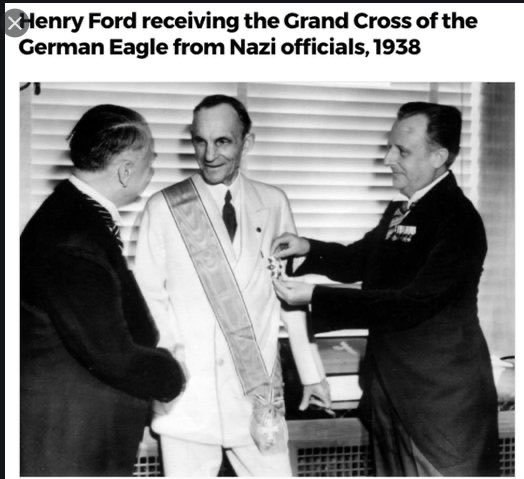
In 1938, on Henry Ford’s 75th birthday, he was awarded the Grand Cross of the Supreme Order of the German Eagle from the Führer himself.

He was the first American (General Motors’ James Mooney would be second) and only the fourth person in the world to receive the highest decoration that could be given to any non-German citizen. An earlier honoree was none other than a kindred spirit named Benito Mussolini.

When appraising history and today’s Titans of Capitalism™, keep your guard up…

Ukraine Stays with the West But Russia Is Winning and Has the Receipts

By Margaret Kimberley

Source: Black Agenda Report

A delegation of African leaders travelled to Ukraine and Russia to help broker peace. But the collective west insists on prolonging the conflict.

The war in Ukraine grinds on and the Ukrainian army is being destroyed by Russia with great loss of life. One would think that Ukraine would be grateful for any and all peace efforts, but it is being used as a proxy by the United States and its NATO allies, the collective west. The seeds of this catastrophe began long before Russia’s special military operation. The European Union and NATO nations brought anti-Russian right-wing forces to power in 2014 in a coup against the elected Ukrainian president. If not for them there would be no war at all.

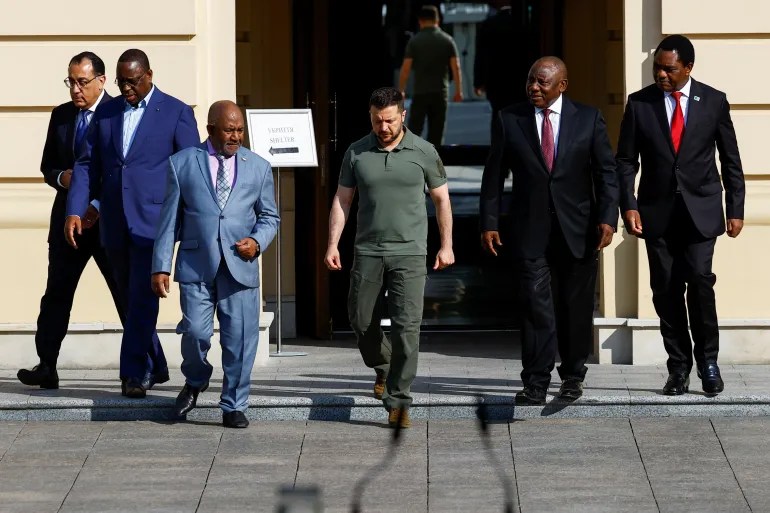
Their degree of culpability became clear recently when a delegation of African leaders traveled to Ukraine and Russia as part of a peacemaking initiative. The party included heads of state of Senegal, Egypt, Zambia, Comoros, Uganda, Republic of Congo, and South Africa. Comoros President Azali Assoumani is the current chair of the African Union. The group was greeted in Kiev by air raid sirens used to create the appearance that a Russian missile attack was underway. President Zelensky was barely polite, thanking South African president Cyril Ramaphosa and others for coming but letting them know that everything was Russia’s fault and that he had no interest whatsoever in peace talks. 

Not only is Ukraine a de facto U.S. colony which lives and dies by Washington’s whims, but it is also a deeply racist country. Much of its population is still attached to Nazi ideology and the politics of World War II collaborator Stephan Bandera. 

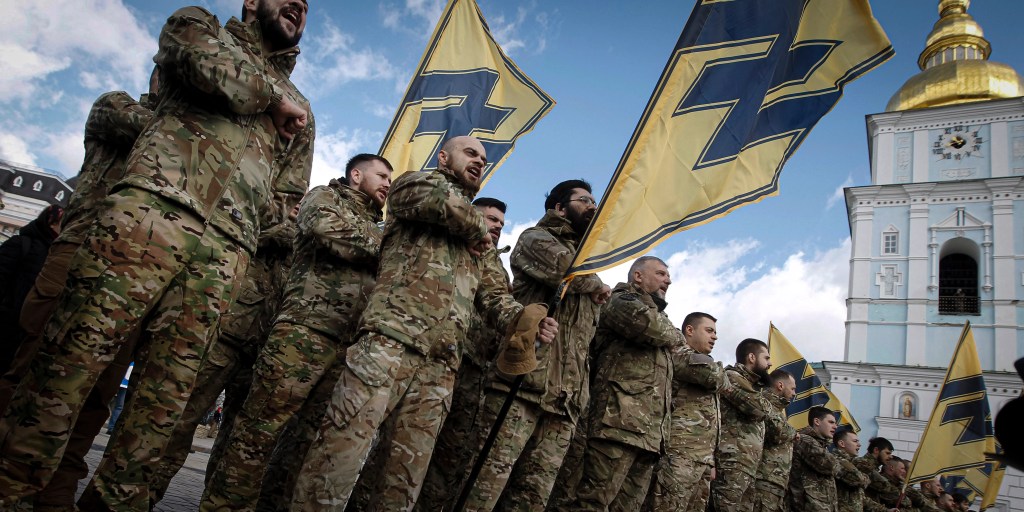
Nazi salutes, swastikas and other insignias are common there. So much so that the New York Times recently felt obliged to wonder in feigned innocence why these symbols are worn openly. The simple and obvious answer is that Ukraine is full of Nazis. Any likelihood that the same people would listen to Africans were indeed slim. 

Ukraine was joined in racial superiority theater by Poland. Media and security staff accompanying the presidents were delayed there and the delegation had to travel without them. When the manufactured drama was no longer needed the delegation arrived in St. Petersburg, Russia and met with president Vladimir Putin who had a surprise of his own. 

Putin listened politely to the 10-point plan and then interrupted with a surprise of his own. He not only reminded them the conflict began in 2014 but pointed out that Russia has been ready for peace ever since Turkey brokered negotiations with Ukraine in April 2022. Ukraine was on the verge of signing an agreement until its collective west friends, the US and UK in particular, scuttled the plan. 

The Treaty on Permanent Neutrality and Guarantees of Security of Ukraine offered security guarantees for Ukraine in exchange for a commitment to remain neutral, meaning that NATO membership would be off the table. Putin pointed out that as soon as Russian forces left Kiev the agreement was thrown into “the dustbin.” Just as in the case of the Minsk Agreements, the collective west offered treachery instead of peace.

The African leaders have their own self-interest which sent them to Russia. Their nations’ supplies of grain and fertilizer have been disrupted by the western sanctions and restrictions on trade with Russia. Earlier agreements on this trade have worked against Africans, as Putin pointed out, “These European neo-colonial powers, technically the US, have once again deceived the international community and the Africa countries in need: 31.7 million tonnes were exported and only three percent reached Africa’s needy countries. Is this not deception?”

It is all to the good that the international community works together to end this war, but the west is only interested in escalating and Ukraine pays the price. The collective west excels in creating propaganda and bullying its allies. The rest of the world is working to escape U.S. and NATO domination as Ukrainians die in large numbers.

Ukraine’s love of Nazi symbolism reveals why that country is content to turn its population into cannon fodder. Meanwhile western insistence on escalation brings the entire world to the brink. Yet there is still no honest discussion about how the war began, or how the Nordstream pipeline exploded. Russia is still painted as the villain and the people of this country go into another presidential election year in the dark.

Russia is not just winning on the battlefield. Nation after nation has declared an intention to use currencies other than the dollar for trade or to join the BRICS. But the collective west cannot accept defeat. The threat they represent to the world cannot be underestimated.

First There Were Neo-Nazis, Then There Were No Nazis, Then There Were

By Patrick Lawrence

Source: Scheerpost

I tell you, serving as a New York Times correspondent these days cannot be easy. You have to convey utter nonsense to your readers while maintaining a straight face and a serious demeanor. You have to suggest the Russians may have exploded a drone over the Kremlin, that they may have blown up their own gas pipeline, that their president is an out-of-touch psychotic, that their soldiers in Ukraine are drunkards using faulty equipment, that they attack with “human hordes” (Orientalism, anyone?) and on and on—all the while affecting the gravitas once associated with the traditional “Timesman.” You try it sometime.

I am reminded of that pithy passage in Daniel Boorstin’s regrettably overlooked book, The Image. “The reporter’s task,” Boorstin wrote in 1962, “is to find a way of weaving these threads of unreality into a fabric that the reader will not recognize as entirely unreal.”

Boorstin reflected on America’s resort to imagery, illusion, and distortion as Washington geared up its gruesome follies in Vietnam. The reporter’s task is a whole lot harder now, given how much farther we have wandered into illusion and distortion since Boorstin’s day.  

And now we have the case of Thomas Gibbons–Neff, a square-jawed former Marine covering the Ukraine war for The Times—strictly to the extent the Kyiv regime permits him to do so, as he explains with admirable honesty. This guy is serious times 10, he and his newspaper want us to know.  

Tom’s job this week is to persuade us that all those Ukrainian soldiers wearing Nazi insignia, idolizing Jew-murdering, Russophobic collaborators with the Third Reich, gathering ritually in Nazi-inspired cabals, marching through Kyiv in Klan-like torch parades are not what you think. Nah, our Tom tells us. They look like neo–Nazis, they act like neo–Nazis, they dress like neo–Nazis, they profess Fascist and neo–Nazi ideologies, they wage this war with the Wehrmacht’s visceral hatred of Russians—O.K., but whyever would you think they are neo–Nazis? 

They are just regular guys. They wear the Wolfsangel, the Schwarze sonne, the black sun, the Totenkopf, or Death’s Head—all Nazi symbols—because they are proud of themselves, and these are the kinds of things proud people wear. I was just wearing mine the other day. 

The slipping and sliding starts early in “Nazi Symbols on Ukraine’s Front Lines Highlight Thorny Issues of History,” the piece Gibbons–Neff published in Monday’s editions. He begins with three photographs of neo–Nazi Ukrainian soldiers, SS insignia plainly visible, that the Kyiv regime has posted on social media, “then quietly deleted,” since the Russian intervention began last year. “The photographs, and their deletions,” Gibbons–Neff writes, “highlight the Ukrainian military’s complicated relationship with Nazi imagery, a relationship forged under both Soviet and German occupation during World War II.”

Complicated relationship with Nazi imagery? Stop right there, Mr. Semper fi.  Ukraine’s neo–Nazi problem is not about a few indiscreetly displayed images. Sorry. The Ukrainian army’s “complicated relationship” is with a century of ultra-right ideology drawn from Mussolini’s Fascism and then the German Reich. As is well-known and documented, the neo–Nazis who infest the Armed Forces of Ukraine, the AFU—among many other national institutions—have made idols of such figures as Stepan Bandera, the freakishly murderous nationalist who allied with the Nazi regime during the war.

This history is a matter of record, as briefly outlined here, but Gibbons–Neff alludes to none of it. It’s merely a matter of poor image-making, you see. In support of this offensive whitewash, Gibbons–Neff has the nerve to quote a source from none other than Bellingcat, which was long, long back exposed as a CIA and MI6 cutout and which is now supported by the Atlantic Council, the NATO–funded, spook-infested think tank based in Washington. 

“What worries me, in the Ukrainian context, is that people in Ukraine who are in leadership positions, either they don’t or they’re not willing to acknowledge and understand how these symbols are viewed outside of Ukraine,” a Bellingcat “researcher” named Michael Colborne tells Gibbons–Neff. “I think Ukrainians need to increasingly realize that these images undermine support for the country.”

Think about that. The presence of Nazi elements in the AFU is not a worry. The worry is merely whether clear signs of Nazi sympathies might cause some members of the Western alliance to decide they no longer want to support Nazi elements in the AFU. I am reminded of that Public Broadcasting news segment last year, wherein a provincial governor is featured with a portrait of Bandera behind him. PBS simply blurred the photograph and ran the interview with another of the courageous, admirable Ukrainians to which we are regularly treated.

I hardly need remind paying-attention readers that the neo–Nazis-who-are-not-neo–Nazis were for years well-reported as simply neo–Nazis in the years after the U.S.–cultivated coup in 2014. The Times, The Washington Post, PBS, CNN—the whole sorry lot—ran pieces on neo–Nazi elements in the AFU and elsewhere. In March 2018, Reuters published a commentary by Jeff Cohen under the headline “Ukraine’s Neo–Nazi Problem.” Three months later The Atlantic Council, for heaven’s sake, published a paper, also written by Cohen, titled, “Ukraine’s Got a Real Problem with Far–Right Violence (And no, RT Didn’t Write This Headline).” I recall, because it was so surprising coming from the council, that the original head on that paper was “Ukraine’s Got a Neo–Nazi Problem,” but that version now seems lost to the blur of stealth editing. 

Then came the Russian intervention, and Poof! There are no more neo–Nazis in Ukraine. There are only these errant images that are of no special account. And to assert there are neo–Nazis in Ukraine—to have some semblance of memory and a capacity to judge what is before one’s eyes—“plays into Russian propaganda,” Gibbons–Neff warns us. It is to “give fuel to his”—Vladimir Putin’s—“false claims that Ukraine must be de–Nazified.” For good measure Gibbons–Neff gets out the old Volodymyr-Zelensky-is-Jewish chestnut, as if this is proof of… of something or other.

My mind goes to that lovely Donovan lyric from the Scottish singer’s Zen enlightenment phase. Remember “There Is a Mountain?” The famous lines went, “First there is a mountain/ Then there is no mountain/ Then there is.” There were neo–Nazis in Ukraine, then there were no neo–Nazis, and now there are neo–Nazis but they aren’t neo–Nazis after all. 

There are a few things to think about as we consider Thomas Gibbons–Neff’s story, other than the fact that it is horse-droppings as a piece of journalism. For one thing, nowhere in it does he quote or reference any member of the AFU—no one wearing a uniform, no one sporting one of these troubling insignia. Various image-managing officials speak to him about the neo–Nazis who-are-not-neo–Nazis, but we never hear from any neo–Nazi-who-is-not-a-neo–Nazi to explain things as a primary source, so to say. I wager Gibbons–Neff never got within 20 miles of one: He wouldn’t dare, for then he would have to quote one of these insignia-sporting people saying that of course he was a neo–Nazi. Can’t you read, son? 

For another, Gibbons–Neff resolutely avoids dilating his lens such that the larger phenomenon comes into view. It all comes down to those three unfortunate insignia in those three deleted photographs. The parades, the corridors of neo–Nazi flags, the ever-present swastikas, the reenactments of all-night SS rituals, the glorification of Nazis and Nazi collaborators, the Russophobic blood lust: Sure, it can all be explained, except that our Timesman does not go anywhere near any of this.

Gibbons–Neff’s story follows by 10 days an even more contorted piece of pretzel-like rubbish published in The Kyiv Independent, a not-independent daily that has been supported by various Western governments. This is by one Illia Ponomarenko, a reporter much-lionized in the West, and appeared under the headline, “Why some Ukrainian soldiers use Nazi-related insignia.”

This is the kind of piece that is so bad it tips into fun. “No, Ukraine does not have ‘a Nazi problem,’” Ponomarenko states flatly, and this is the last flat sentence we get in this piece. “Just like in many places around the world, people with far-right and neo–Nazi views, driven by their ideology, are prone to joining the military and participating in conflicts,” he writes. And then this doozy, where begins a riot of irrationality:

It is, of course, true that, for instance, the Azov Battalion was originally founded by neo–Nazi and far-right groups (as well as many soccer ultra-fans), which brought along with it the typical aesthetics—not only neo–Nazi insignia but also things like Pagan rituals or names like “The Black Corps,” the official newspaper of Nazi Germany’s major paramilitary organization Schutzstaffel (SS).

But worry not, readers. It is merely an aesthetic, part of a harmless, misunderstood “subculture”: 

In the oversimplified memory of some around the world, particularly within various militaristic subcultures, symbols representing the Wehrmacht, Nazi Germany’s Armed Forces, and the SS are seen to reflect a super-effective war machine, not the perpetrators of one of the greatest crimes against humanity in human history.

But of course. SS insignia, Wehrmacht iconography: Seen it everywhere people admire super-effective war machines. Remember this logic next time some liberal flamer proposes to persecute a MAGA supporter who partakes of this “subculture.”

Has Tom Gibbons–Neff given us a rewrite job? Having been around the block for a good long time, I have seen this kind of thing often enough—correspondents scoring off the local dailies to look deep and penetrating back on the foreign desk. It is also possible, assuming for a moment Gibbons–Neff’s editors still read other newspapers, that they asked him for just such a piece after seeing Ponomarenko’s. Either way, we get this in Ponomarenko’s recognizably illogical style:

Questions over how to interpret such symbols are as divisive as they are persistent, and not just in Ukraine. In the American South, some have insisted that today, the Confederate flag symbolizes pride, not its history of racism and secession. The swastika was an important Hindu symbol before it was co-opted by the Nazis. 

If you are going to reach, Tom, may as well reach for the stars.

We have a New York Times correspondent quoting Ukraine’s Defense Ministry and Bellingcat, an intel cutout that is part of a NATO think tank, and then rather too closely, I would say, aping a Western-supported newspaper in Kyiv. Yes, Virginia, I believe we all got ourselves one of them there echo chambers, just the way the Deep State likes ’em.

Last March, Gibbons–Neff was interviewed by The New York Times. Yes, they do this sort of thing down there on Eighth Avenue, where they simply cannot get enough of themselves. It is enlightening. The unfortunate Times reporter assigned as the straight man asked, as our intrepid correspondent self-aggrandized, “What have been the biggest challenges in covering the war?” Gibbons–Neff’s reply is pricelessly revealing. 

“Wrestling with access and being allowed to go certain places to see things that you need the press officer for, or permission from the military unit,” the fearless ex–Marine explains. “Ukrainians know how to manage the press fairly well. So navigating those parameters and not rubbing anyone the wrong way has always been tough.”

Forget about bombs, missiles, gore, the fog of war, courageous sergeants, trench stench, grenades, or any of the other horrors of battle. Gibbons–Neff’s big problems as he pretends to cover the Ukraine war are maintaining access, getting the Kyiv gatekeepers’ permission to go someplace, and avoiding annoying the regime’s authorities. 

Does this tell you everything you want to know about our Timesman or what? 

It is always interesting to ask why a piece such as this appears when it does. Dead silence for months on the neo–Nazi question, and then suddenly a long explainer that does its best to avoid explaining anything. Always interesting to ask, never easy to answer. 

It could be that a lot of stuff on these awful people is sifting out from under the carpet. Or maybe something big is on the way and this piece is preemptive. Or maybe either Gibbons–Neff or his editors saw the Ponomarenko piece as an opportunity to dispose of one of the Kyiv regime’s most embarrassing features. 

Or maybe the larger context counts here. As mentioned in this space last week, The Times’s Steve Erlanger recently suggested from Brussels that NATO might do a postwar Germany job with Ukraine: Welcome the west of the country to the alliance and let the eastern provinces go for an indefinite period, unification the long-term objective. Late last week Foreign Affairs ran a fantastical piece by Andriy Zagorodnyuk, formerly a Ukrainian defense minister and now, yes indeedy, a distinguished fellow at the Atlantic Council. It appeared under the headline, “To Protect Europe, Let Ukraine Join NATO—Right Now.” 

Zagorodnyuk’s argument is as loopy as his subhead, “No Country Is Better at Stopping Russia.” But these kinds of assertions, dreamily hyperbolic as they may be, have a purpose. They serve to enlarge the field of acceptable discourse. They inch us closer to normalizing the thought that Ukraine must be accepted in the North Atlantic alliance for our sake, the sake of the West, no matter how provocative such a move will prove.

This suggest that Gibbons–Neff’s piece, along with the one he followed in the Kyiv paper, are by way of a cleanup job. The Western press, working closely with intelligence agencies, did its best to prettify the savage jihadists attempting to bring down the Assad government in Damascus, you will recall. Remember the “moderate rebels?” Maybe Gibbons–Neff is on an equally dishonorable errand. 

Semper fi, huh? Always faithful to what?

RESISTING TYRANNY DEPENDS ON THE COURAGE TO NOT CONFORM

By Barry Brownstein

Source: Waking Times

Social psychologist Roy Baumeister begins his book Evil: Inside Human Violence and Cruelty, with a proposition that will be counterintuitive to many: “Evil usually enters the world unrecognized by the people who open the door and let it in. Most people who perpetrate evil do not see what they are doing as evil.”

Dismissing evildoers as “insane” is an attempt to absolve both them and you of responsibility. Baumeister observes, “People do become extremely upset and abandon self-control, with violent results, but this is not insanity.” If only “insane” people commit “evil” acts, you might reason there is no need to strengthen spiritual and moral muscles. You might skip the reflection, study, and practice that builds spiritual and moral strength.

Would you, Baumeister asks, “obey orders to kill innocent civilians? Would you help torture someone? Would you stand by passively while the secret police hauled your neighbors off to concentration camps?” Baumeister writes, “Most people say no. But when such events actually happen, the reality is quite different.” Today, to the point, will you obey orders to fire upon people who refuse to comply with mandates?

In one of the most instructive books about Nazi Germany, Ordinary Men: Reserve Police Battalion 101 and the Final Solution in Poland, historian Christopher Browning explores why most people say yes and commit heinous acts even when given latitude to say no.

The men of Police Battalion 101 were not specially selected psychopathic killers. Initially, the Battalion was set up to enforce Nazi rule in occupied Poland. Eventually, their mission changed, bringing them to be the genocidal murderers of Jews they were charged with rounding up. Browning explains, “The bulk of the killers were not specially selected but drawn at random from a cross-section of German society, and they did not kill because they were coerced by the threat of dire punishment for refusing.” Mostly they were “middle-aged reserve policemen.” Battle had not driven these men to depravity, “they had not been fired on nor had they lost comrades.”

Browning explores one of their initial murderous actions, “shooting some 1,500 Jews in the Polish village of Józefów in the summer of 1942.” Major Wilhelm Trapp addressed his men before the shooting began: “Pale and nervous, with choking voice and tears in his eyes, Trapp visibly fought to control himself as he spoke. The Battalion, he said plaintively, had to perform a frightfully unpleasant task. This assignment was not to his liking; indeed, it was highly regrettable, but the orders came from the highest authorities.”

Trapp provided a “justification” for the coming slaughter—Jews were damaging Germany and threatening German troops—but then Trapp “made an extraordinary offer: if any of the older men among them did not feel up to the task that lay before him, he could step out.” The task, Trapp outlined, was the immediate killing of all women, children, and the elderly.

Only twelve of the approximately 500 in the Battalion initially took Trapp’s offer to “step out.” Browning estimated “10 to 20 percent of those actually assigned to the firing squads” extricated themselves “by less conspicuous methods or asked to be released from the firing squads once the shooting had begun.” Yet for most of the police, killing became second nature: “Many reserve policemen who were horrified in the woods outside Józefów… subsequently became casual volunteers for numerous firing squads and ‘Jew hunts.’”

Browning’s research provides insights into the mindsets that fueled obedience: “Who would have ‘dared,’ one policeman declared emphatically, to ‘lose face’ before the assembled troops.” Another said, “No one wants to be thought a coward.”

Not all who followed orders lacked moral consciousness: “Another policeman—more aware of what truly required courage—said quite simply, ‘I was cowardly.’”

Some rationalized their atrocities: “It was possible for me to shoot only children. My neighbor then shot the mother and I shot the child that belonged to her, because I reasoned with myself that after all without its mother the child could not live any longer.”

To escape moral culpability, others offered the excuse of what difference could they make: “Without me [shooting] the Jews were not going to escape their fate anyway.” How many managers are saying today, what difference can I make? If I don’t fire the unvaccinated, someone else will.

Browning explains, “The men’s concern for their standing in the eyes of their comrades was not matched by any sense of human ties with their victims. The Jews stood outside their circle of human obligation and responsibility.” Today, hospital administrators are firing workers with robust natural immunity who faithfully served during the pandemic and refuse the vaccine. Like the men in the Battalion, these administrators are just following orders.

What would have happened that terrible day in 1942 if more policemen recognized the humanity of the “other” and had the courage to not conform? Today, what would happen if more businesses, like In-N-Out Burger, refuse to obey government edicts? In October, Stephen Davis, a Florida fire battalion chief, “was fired for refusing to discipline department employees listed as unvaccinated.” What would happen if more managers had the courage of Chief Davis? Without obedience, tyranny fails.

During this time of Covid, we can learn lessons from Browning’s book about how we treat people who make choices different from our own. We can notice when we fail to see the humanity in others. We can become aware when we justify an us vs. them mindset. We can question our perceptions. To wait for Biden or Fauci to change first is to ignore our power of choice.

Lessons Learned

Browning reflects on the actions of the Battalion and asks, “If obedience to orders out of fear of dire punishment is not a valid explanation, what about ‘obedience to authority’ in the more general sense used by Stanley Milgram?”

Browning wonders if there is “a ’deeply ingrained behavior tendency’ to comply with the directives of those positioned hierarchically above, even to the point of performing repugnant actions in violation of ‘universally accepted’ moral norms.” Browning explains,

The notions of ‘loyalty, duty, discipline,’ requiring competent performance in the eyes of authority, become moral imperatives overriding any identification with the victim. Normal individuals enter an ‘agentic state’ in which they are the instrument of another’s will. In such a state, they no longer feel personally responsible for the content of their actions but only for how well they perform.

Browning recounts, “Milgram made direct reference to the similarities between human behavior in his experiments and under the Nazi regime. He concluded, ‘Men are led to kill with little difficulty.’”

Importantly, “Milgram himself notes that people far more frequently invoke authority than conformity to explain their behavior, for only the former seems to absolve them of personal responsibility.” Yet, in the Battalion case, “Many policemen admitted responding to the pressures of conformity—how would they be seen in the eyes of their comrades?—not authority.” Based on his research, Browning concludes, “Conformity assumes a more central role than authority at Józefów.”

The Covidocracy demands we all conform and shames those who make different choices. Browning explains the dangers of a culture of shame: “The shame culture, making conformity a prime virtue, impelled ordinary Germans in uniform to commit terrible crimes rather than suffer the stigma of cowardice and weakness and the ‘social death’ of isolation and alienation vis-à-vis their comrades.”

The segregation of Jews was an enabler of evil actions. Browning points to pervasive banishment of Jews from German society “and the resulting exclusion of the Jewish victims from any common ground with the perpetrators made it all the easier for the majority of the policemen to conform to the norms of their immediate community (the battalion) and their society at large (Nazi Germany).”

For some policemen who did not shoot, their commercial ties shaped their view of human beings. One said, “Through my business experience, especially because it extended abroad, I had gained a better overview of things. Moreover, through my earlier business activities I already knew many Jews.”

Harvard social psychologist Gordon Allport developed his famed contact hypothesis in the 1940s: “Increasing exposure to out-group members will improve attitudes toward that group and decrease prejudice and stereotyping.” Commercial ties bring people together.

Today, politicians work overtime demonizing, mocking, and punishing “out-group members” who won’t obey their dictates.

A Story of Nonconformity

Recently Tim, a reader and business owner from New Zealand, sent me his powerful testimony in an email:

Fifty odd years ago, as a young child I went to Ranui Primary School in suburban Auckland. There were two Māori boys in my class of 9-year-olds. Sometimes through the day they would make short comments to each other in Māori.

If the teacher heard them do it, he would keep our entire class in detention after school for 15 to 30 minutes. I always hated it because one of the boys was my friend, and a regular playmate of mine after school. The other one, used to walk home from school with me too, they were my friends.

But most of the class blamed these two Māori boys for us all being locked in after school. The majority of the kids disliked and bullied them in my class.

I couldn’t do it; I couldn’t dislike them because they were my friends. Perhaps even then as a boy I could see what our teacher was doing.

Our teacher was using the rest of the class as a weapon against those two young boys by encouraging the spiteful and discriminating attitudes towards them.

Tim’s choice to not conform to social pressure made all the difference to his Māori friends. Did Tim’s ability to see the humanity in others help him become a successful entrepreneur? After all, entrepreneurs succeed when they help serve the needs of others.

Tim continued his testimony:

Today, 50 years later, I am again feeling the same way as I did back in my Ranui Primary School class. The teacher is telling us all that we will continue to be locked in until 90% (or whatever) of the country is vaccinated. And further, we are told that it is the fault of the 20% (or so) that have so far chosen not to accept the two shots in the arm.

As a country, we are all encouraged to heap blame and hate towards anyone who has decided to not vaccinate.

Regardless of my own vaccination status, I have friends and family who I refuse to hate or blame.

I lay the blame exactly where it belongs. At the feet of my Primary School teacher for our detentions, not my two boyhood friends.

And at the feet of our Prime Minister for her lockdown rules, not my friends and family who have chosen to decline an injection that they don’t trust, rightly or wrongly.

Be like Tim. Be like the 10-20% of Battalion 101 who didn’t conform. Our scorn should be towards those who demand our obedience and split America into an in-group and an out-group. Become more aware when you allow your thinking to be hijacked by propaganda.

Many in the Battalion didn’t understand their crimes until decades after the war ended. Don’t wait to reflect until a future historian writes a book about how you supported tyranny by placing conformity above human rights.

Today Charles Eisenstein points out, “Many people trust the authorities and willingly comply with their rules. They face no dilemma, no initiatory moment, no self-defining world-creating choice point, not yet.”

Conforming, lacking courage, will not spare you from choices that life will demand of you. Eisenstein challenges us: “As the authorities’ narratives devolve into absurdity and their rules devolve into oppression, more and more of us face this choice: … To do what you know is right, or to cave in to the pressure, consoling yourself with words you don’t believe. ‘I had no choice.’”

We all have a personal responsibility for preserving freedom. The price of abdicating our responsibility is high. As Browning puts it, Germans paid a high price for “placing uncritical trust in the ‘firm leadership’ of seemingly well-intentioned political authority between 1933 and 1945.”