The Conflict In Ukraine Has Evolved Into A War Between The United States And Russia

By Michael Snyder

Source: End of the American Dream

Let’s be honest about what is really going on in Ukraine.  The United States is providing most of the funding, most of the equipment, most of the ammunition, most of the high level intelligence and much of the training.  That makes the United States a direct participant in the conflict.  Yes, many other NATO countries are also contributing in various ways, and that makes them direct participants as well.  But the mainstream media here in the western world continues to insist that this is Ukraine’s war and that we are just helping them out.  Without a doubt, Ukraine has lost an enormous number of soldiers over the course of 2022, but at this point the Ukrainians are really a junior partner in the war.  If the U.S. and NATO had not intervened on an epic scale, the war would already be over and Russia would have won.  Unfortunately, now that we are so deeply invested in the conflict there is no easy way out, and that has very serious implications for all of us.

So much of the death and destruction that we have already witnessed could have been avoided so easily, and we should be constantly pushing our politicians to find a peaceful way out of this mess before nuclear weapons are used.  Back in 2020, I published a book in which I specifically warned that war with Russia would be coming, and a lot of people thought that I was nuts to say such a thing.  But sure enough we now have a war with Russia.

And the Russians are very clear about who they are really fighting.  Earlier this month, Russian Foreign Minister Sergey Lavrov boldly declared that the U.S. and NATO are “directly participating” in the conflict in Ukraine…

“You shouldn’t say that the US and NATO aren’t taking part in this war, you are directly participating in it,” Lavrov said in a video call with reporters. “And not just by providing weapons but also by training personnel. You are training their military on your territory, on the territories of Britain, Germany, Italy, and other countries.”

I wish that this wasn’t true.

Sadly, in this particular case Lavrov is quite correct.

Most Americans don’t realize this, but Ukrainian soldiers are being flown into the United States all the time.  The following comes from a BBC article about one location in Kansas where Ukrainian officers have been receiving “strategic training”…

Senior-level Ukrainian officers have been studying in the US state of Kansas, thousands of miles from Russia’s invasion and the battlefields of Donbas.

Outside the Fort Leavenworth army base, wheat fields are starting to turn. Wide, open prairie land, with softly rolling hills, stretches for miles, and the sky is huge.

This quintessentially Kansas landscape has become the backdrop for generations of international soldiers, who head to the US base to receive strategic training.

Of course Ukrainians are also being trained in the UK and in other NATO countries as well.

Unless we actually want to be considered direct participants in the war, we should not be doing this.

All of us should also be deeply alarmed by how much money we are giving to Ukraine.

According to the Kiel Institute, as of October 3rd the U.S. had already given 54.43 billion dollars worth of military and non-military aid to the Ukrainians…

Eventually I tracked down a database operated by the Kiel Institute, a German think tank. They have been tracking total military and non-military aid to Ukraine since the beginning of the conflict. Their numbers include all aid from Jan. 24, 2022 to Oct. 3, 2022 (the data is scheduled for an update on Dec. 6).

According to Kiel, the U.S. has transferred military and non-military aid worth $54.43 billion to the government of Ukraine. The database Kiel has maintained is by far the most granular and detailed accounting of what the U.S. government has provided to Ukraine, including descriptions of the individual batches of military equipment. If you’re interested, you can check it out here.

Needless to say, more aid has been authorized for the Ukrainians since October 3rd.

So the grand total is even higher now.

At this point we have actually spent far, far more money on the war than the Ukrainians have.

The Ukraine military is now outfitted with cutting edge equipment and ammunition, but all of that money is being spent in other ways as well.

Vast hordes of international mercenaries have been hired to fight, and your tax dollars are paying for them.

You see, the truth is that the Ukrainian army that existed at the beginning of the war has mostly been destroyed.  To replace them, Ukraine conscripted a whole bunch of new soldiers, and they also hired large numbers of mercenaries from other nations in Europe.

Yes, there are some western Europeans and Americans among the mercenaries, but the vast majority of them appear to be from the poorer countries of eastern Europe.

Unfortunately, most of us don’t seem to care that these poor mercenaries are being fed into an endless meatgrinder that is unlike anything that we have seen since the worst days of World War I

As Russia moved fresh formations to the area in recent weeks, including reinforcements previously in the Kherson region, the fighting in the Bakhmut sector has descended into trench warfare reminiscent of the first world war.

Over the weekend, images emerged of Ukrainian soldiers in flooded, muddy trenches and battlefields dotted with the stumps of trees cut down by withering artillery barrages.

For a moment, I would like for you to consider what it is like to be a soldier on the front lines in eastern Ukraine.

Imagine standing in a muddy trench that is filled up with water up to your waist.  Your teeth are chattering like crazy because of the bitter cold, but you don’t dare crawl out of the trench because you are likely to be killed.  Your socks are soaked, your underwear is soaked and everything else you are wearing is soaked.  Both sides are endlessly shelling one another, and so it is almost impossible for you to sleep.  There are dead bodies all around you for as far as the eye can see, and you just hope that you will be able to make it through another day somehow.

At military hospitals all across eastern Ukraine, there is an endless parade of the dead and the wounded.  The following comes from the New York Times

For almost an hour, the stream of Ukrainian casualties in the eastern city of Bakhmut seemed unending: Ambulances, an armored personnel carrier and private vehicles all screamed to a halt, one after another, and disgorged the wounded in front of the city’s only military hospital.

A soldier propped up by his comrades, his face a mass of mangled flesh, walked in the main gate. The dark green stretcher that awaited him was one of several still covered in blood.

Sadly, there is no end to the war in sight.

In fact, both sides just continue to escalate matters.  The Ukrainians are now regularly shelling targets inside Russian territory, and the Russians are now systematically going after power and water systems all over Ukraine.

This is going to be an extremely bitter winter for both the Ukrainians and the Russians.

And as this war intensifies, there is a growing risk that someone could eventually use weapons of mass destruction.

Once that happens, there will be no going back.

US ‘success’ is Ukraine’s disaster

In adopting “Success is confrontation” as a credo toward Russia, NATO states have invited catastrophe and undermined Ukrainian voices for peace.

( Jeff J. Mitchell/Getty Images)

By Aaron Maté

Source: Aaron Maté Substack

In recent weeks, the New York Times reports, “Moscow has opened what amounts to a separate war: missile and drone strikes aimed at destroying Ukraine’s infrastructure, degrading the quality of life for millions of civilians in an effort to demoralize them.” Russia’s attacks, the Washington Post adds, have “battered Ukraine to the brink of a humanitarian disaster,” cutting off electricity, heat and running water. Ukrainian officials estimate that Russia has damaged or destroyed half of Ukraine’s energy infrastructure. “This winter will be life-threatening for millions of Ukrainians,” a senior World Health Organization official warns.

Russia claims that it only targets infrastructure that serves a military purpose. No matter what legal rationale Moscow can construe, the attacks are a clear act of collective punishment against Ukrainian civilians.

Without ignoring Russia’s criminal liability, another reality can be acknowledged: The fact that Russia “opened” a “separate war” on civilian infrastructure eight months into the invasion, and not beforehand, also results from decisions taken by Ukraine’s far-right and their allies in Washington.

The intensified Russian strikes were predicted by NATO states, whose leaders chose to prolong the proxy war by shunning diplomacy and — most likely — blowing up possible off-ramps, namely the now-forgotten Nord Stream 2 pipeline. The New York Times reported in September that Western officials were “baffled” that Russia, at that point, had “avoided escalating the war” and “made only limited attempts to destroy critical infrastructure”, leading them to fear that “the most dangerous moments are yet to come.” Rather than seeking a diplomatic solution, the US-led NATO alliance chose to help push Ukraine into the predicted danger. After all, the US “strategy for the war,” the Washington Post noted that same month, has entailed “fueling a war with global consequences, while attempting to remain agnostic about when and how Kyiv might strike a deal to end it.”

One does not need to justify Russia’s actions to acknowledge that the Kremlin, by contrast, has adopted positions that offered the chance of a preferable – or at minimum, pursuable – negotiated settlement.

The Minsk II Accords, the framework for ending the post-2014 Donbas war between Kiev and Russia-backed Ukrainian rebels, were officially supported by both Ukraine and the U.S., yet both refused to implement them. Ukraine’s far-right nationalists intimidated President Volodymyr Zelensky into abandoning his peace mandate with direct threats of a coup and even murder. The Biden administration, by refusing to even discuss NATO expansion prior to the invasion; sitting idle as Zelensky refused to negotiate with the Donbas rebels; and apparently sabotaging a Ukraine-Russia peace deal in April, has effectively taken the nationalists’ side.

Even Ukrainian officials and establishment US media outlets concede that Russia’s current war aim is to compel diplomacy.  The strikes on Ukrainian infrastructure, the New York Times notes, “are meant to force Kyiv to the negotiating table.”

“It is clear they want to impose certain conditions, they want to make us negotiate,” Ukrainian Air Force spokesman Col. Yuriy Ihnat said. But Ukrainian officials, the Times adds, “are in no mood to negotiate.”

Kremlin spokesperson Dmitry Peskov has issued the same message, describing the strikes as “the consequences” of Ukraine’s unwillingness to “enter into negotiation.”

Ukrainians have every right to reject negotiations with their invader. Yet there can also be no denying that a significant percentage of the population – including people around Zelensky — has, for years, favored positions that could have avoided the war, and end it today.

Goodbye G20, hello BRICS+

The increasingly irrelevant G20 Summit concluded with sure signs that BRICS+ will be the way forward for Global South cooperation.

By Pepe Escobar

Source: The Cradle

The redeeming quality of a tense G20 held in Bali – otherwise managed by laudable Indonesian graciousness – was to sharply define which way the geopolitical winds are blowing.

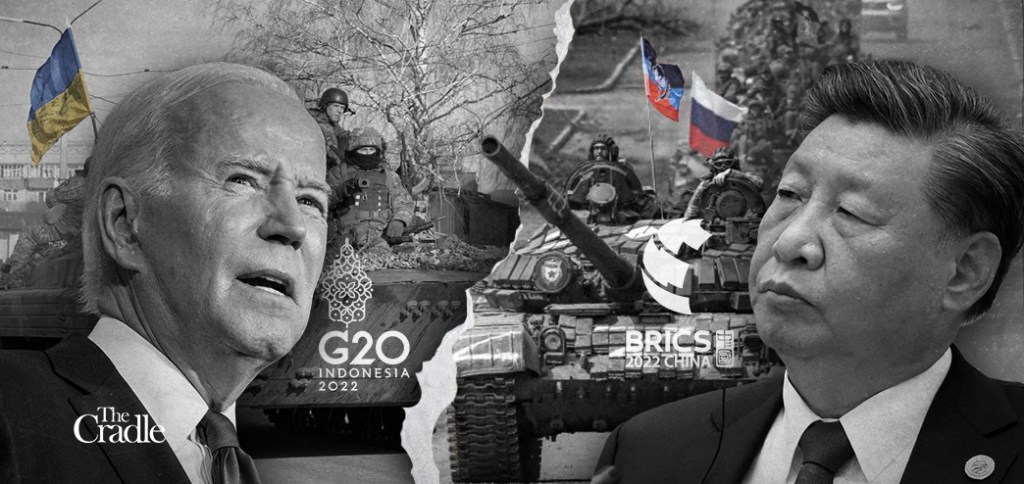
That was encapsulated in the Summit’s two highlights: the much anticipated China-US presidential meeting – representing the most important bilateral relationship of the 21st century – and the final G20 statement.

The 3-hour, 30-minute-long face-to-face meeting between Chinese President Xi Jinping and his US counterpart Joe Biden – requested by the White House – took place at the Chinese delegation’s residence in Bali, and not at the G20 venue at the luxury Apurva Kempinski in Nusa Dua.

The Chinese Ministry of Foreign Affairs concisely outlined what really mattered. Specifically, Xi told Biden that Taiwan independence is simply out of the question. Xi also expressed hope that NATO, the EU, and the US will engage in “comprehensive dialogue” with Russia. Instead of confrontation, the Chinese president chose to highlight the layers of common interest and cooperation.

Biden, according to the Chinese, made several points. The US does not seek a New Cold War; does not support “Taiwan independence;” does not support “two Chinas” or “one China, one Taiwan”; does not seek “decoupling” from China; and does not want to contain Beijing.

However, the recent record shows Xi has few reasons to take Biden at face value.

The final G20 statement was an even fuzzier matter: the result of arduous compromise.

As much as the G20 is self-described as “the premier forum for global economic cooperation,” engaged to “address the world’s major economic challenges,” the G7 inside the G20 in Bali had the summit de facto hijacked by war. “War” gets almost double the number of mentions in the statement compared to “food” after all.

The collective west, including the Japanese vassal state, was bent on including the war in Ukraine and its “economic impacts” – especially the food and energy crisis – in the statement. Yet without offering even a shade of context, related to NATO expansion. What mattered was to blame Russia – for everything.

The Global South effect

It was up to this year’s G20 host Indonesia – and the next host, India – to exercise trademark Asian politeness and consensus building. Jakarta and New Delhi worked extremely hard to find wording that would be acceptable to both Moscow and Beijing. Call it the Global South effect.

Still, China wanted changes in the wording. This was opposed by western states, while Russia did not review the last-minute wording because Foreign Minister Sergey Lavrov had already departed.

On point 3 out of 52, the statement “expresses its deepest regret over the aggression of the Russian Federation against Ukraine and demands the complete and unconditional withdrawal of armed forces from the territory of Ukraine.”

“Russian aggression” is the standard NATO mantra – not shared by virtually the whole Global South.

The statement draws a direct correlation between the war and a non-contextualized “aggravation of pressing problems in the global economy – slowing economic growth, rising inflation, disruption of supply chains, worsening energy, and food security, increased risks to financial stability.”

As for this passage, it could not be more self-evident: “The use or threat of use of nuclear weapons is inadmissible. The peaceful resolution of conflicts, efforts to address crises, as well as diplomacy and dialogue, are vital. Today’s era must not be of war.”

This is ironic given that NATO and its public relations department, the EU, “represented” by the unelected eurocrats of the European Commission, don’t do “diplomacy and dialogue.”

Fixated with war

Instead the US, which controls NATO, has been weaponizing Ukraine, since March, by a whopping $91.3 billion, including the latest presidential request, this month, of $37.7 billion. That happens to be 33 percent more than Russia’s total (italics mine) military spending for 2022.

Extra evidence of the Bali Summit being hijacked by “war” was provided by the emergency meeting, called by the US, to debate what ended up being a Ukrainian S-300 missile falling on a Polish farm, and not the start of WWIII like some tabloids hysterically suggested.

Tellingly, there was absolutely no one from the Global South in the meeting – the sole Asian nation being the Japanese vassal, part of the G7.

Compounding the picture, we had the sinister Davos master Klaus Schwab once again impersonating a Bond villain at the B20 business forum, selling his Great Reset agenda of “rebuilding the world” through pandemics, famines, climate change, cyber attacks, and – of course – wars.

As if this was not ominous enough, Davos and its World Economic Forum are now ordering Africa – completely excluded from the G20 – to pay $2.8 trillion to “meet its obligations” under the Paris Agreement to minimize greenhouse gas emissions.

The demise of the G20 as we know it

The serious fracture between Global North and Global South, so evident in Bali, had already been suggested in Phnom Penh, as Cambodia hosted the East Asia Summit this past weekend.

The 10 members of ASEAN had made it very clear they remain unwilling to follow the US and the G7 in their collective demonization of Russia and in many aspects China.

The Southeast Asians are also not exactly excited by the US-concocted IPEF (Indo-Pacific Economic Framework), which will be irrelevant in terms of slowing down China’s extensive trade and connectivity across Southeast Asia.

And it gets worse. The self-described “leader of the free world” is shunning the extremely important APEC (Asia-Pacific Economic Cooperation) summit in Bangkok at the end of this week.

For very sensitive and sophisticated Asian cultures, this is seen as an affront. APEC, established way back in 1990s to promote trade across the Pacific Rim, is about serious Asia-Pacific business, not Americanized “Indo-Pacific” militarization.

The snub follows Biden’s latest blunder when he erroneously addressed Cambodia’s Hun Sen as “prime minister of Colombia” at the summit in Phnom Penh.

Lining up to join BRICS

It is safe to say that the G20 may have plunged into an irretrievable path toward irrelevancy. Even before the current Southeast Asian summit wave – in Phnom Penh, Bali and Bangkok – Lavrov had already signaled what comes next when he noted that “over a dozen countries” have applied to join BRICS (Brazil, Russia, India, China, South Africa).

Iran, Argentina, and Algeria have formally applied: Iran, alongside Russia, India, and China, is already part of the Eurasian Quad that really matters.

Turkey, Saudi Arabia, Egypt, and Afghanistan are extremely interested in becoming members. Indonesia just applied, in Bali. And then there’s the next wave: Kazakhstan, UAE, Thailand (possibly applying this weekend in Bangkok), Nigeria, Senegal, and Nicaragua.

It’s crucial to note that all of the above sent their Finance Ministers to a BRICS Expansion dialogue in May. A short but serious appraisal of the candidates reveals an astonishing unity in diversity.

Lavrov himself noted that it will take time for the current five BRICS to analyze the immense geopolitical and geoeconomic implications of expanding to the point of virtually reaching the size of the G20 – and without the collective west.

What unites the candidates above all is the possession of massive natural resources: oil and gas, precious metals, rare earths, rare minerals, coal, solar power, timber, agricultural land, fisheries, and fresh water. That’s the imperative when it comes to designing a new resource-based reserve currency to bypass the US dollar.

Let’s assume that it may take up to 2025 to have this new BRICS+ configuration up and running. That would represent roughly 45 percent of confirmed global oil reserves and over 60 percent of confirmed global gas reserves (and that will balloon if gas republic Turkmenistan later joins the group).

The combined GDP – in today’s figures – would be roughly $29.35 trillion; much larger than the US ($23 trillion) and at least double the EU ($14.5 trillion, and falling).

As it stands, BRICS account for 40 percent of the global population and 25 percent of GDP. BRICS+ would congregate 4.257 billion people: over 50 percent of the total global population as it stands.

BRI embraces BRICS+

BRICS+ will be striving towards interconnection with a maze of institutions: the most important are the Shanghai Cooperation Organization (SCO), itself featuring a list of players itching to become full members; strategic OPEC+, de facto led by Russia and Saudi Arabia; and the Belt and Road Initiative (BRI), China’s overarching trade and foreign policy framework for the 21st century. It is worth pointing out that early all crucial Asian players have joined the BRI.

Then there are the close links of BRICS with a plethora of regional trade blocs: ASEAN, Mercosur, GCC (Gulf Cooperation Council), Eurasia Economic Union (EAEU), Arab Trade Zone, African Continental Free Trade Area, ALBA, SAARC, and last but not least the Regional Comprehensive Economic Partnership (RCEP), the largest trade deal on the planet, which includes a majority of BRI partners.

BRICS+ and BRI is a match everywhere you look at it – from West Asia and Central Asia to the Southeast Asians (especially Indonesia and Thailand). The multiplier effect will be key – as BRI members will be inevitably attracting more candidates for BRICS+.

This will inevitably lead to a second wave of BRICS+ hopefuls including, most certainly, Azerbaijan, Mongolia, three more Central Asians (Uzbekistan, Tajikistan, and gas republic Turkmenistan), Pakistan, Vietnam, and Sri Lanka, and in Latin America, a hefty contingent featuring Chile, Cuba, Ecuador, Peru, Uruguay, Bolivia, and Venezuela.

Meanwhile, the role of the BRICS’s New Development Bank (NDB) as well as the China-led Asia Infrastructure Investment Bank (AIIB) will be enhanced – coordinating infrastructure loans across the spectrum, as BRICS+ will be increasingly shunning dictates imposed by the US-dominated IMF and the World Bank.

All of the above barely sketches the width and depth of the geopolitical and geoeconomic realignments further on down the road – affecting every nook and cranny of global trade and supply chain networks. The G7’s obsession in isolating and/or containing the top Eurasian players is turning on itself in the framework of the G20. In the end, it’s the G7 that may be isolated by the BRICS+ irresistible force.

Putin’s Sledgehammer

By Mike Whitney

Source: The Unz Review

“The Ukrainians are in bad shape… It won’t be long before the Ukrainians run out of food. It won’t be long before they freeze… They have done all that we can reasonably expect them to do. It’s time to negotiate…. before the offensive begins, because once it begins, there will be no further discussion between Moscow and Kiev until it is over to the satisfaction of the Russians.” Colonel Douglas MacGregor, “War in Ukraine; Quiet Before the Storm”, 15 minute-mark

“Strictly speaking, we haven’t started anything yet.” Russian President Vladimir Putin

The relentless attacks on Ukraine’s electrical grid, fuel-storage units, railway hubs, and Command-and-Control centers mark the beginning of a second and more lethal phase of the war. The increased tempo of the high-precision, long-range missile attacks suggests that Moscow is laying the groundwork for a major winter offensive that will be launched as soon as Russia’s 300,000 reservists join their formations in east Ukraine. Kiev’s refusal to negotiate a settlement that addresses Russia’s core security concerns, has left Russian president Vladimir Putin with no other option but to defeat Ukrainian forces on the battlefield and impose a settlement through force-of-arms. The impending winter offensive is designed to deliver the knock-out punch Russia needs to achieve its strategic objectives and bring the war to swift end. This is from Reuters:

Russian missile strikes have crippled almost half of Ukraine’s energy system, the government said on Friday, and authorities in the capital Kyiv warned that the city could face a “complete shutdown” of the power grid as winter sets in.

With temperatures falling and Kyiv seeing its first snow, officials were working to restore power nationwide after some of the heaviest bombardment of Ukrainian civilian infrastructure in nine months of war.

The United Nations says Ukraine’s electricity and water shortages threaten a humanitarian disaster this winter.

“Unfortunately Russia continues to carry out missile strikes on Ukraine’s civilian and critical infrastructure. Almost half of our energy system is disabled,” Prime Minister Denys Shmyhal said….

“We are preparing for different scenarios, including a complete shutdown,” Mykola Povoroznyk, deputy head of the Kyiv city administration, said in televised comments.” (“Ukraine says half its energy system crippled by Russian attacks, Kyiv could ‘shutdown’”, Reuters)

Until recently, Russia had avoided targets that would dramatically impact civilian activities, but now military leaders have returned to a more conventional approach. Presently, the military is destroying whatever facilities, transformers, storage units, substations, rail yards and energy depots that allow Ukraine to continue to wage war. Clearly –as the bigger and more powerful state — it was always within Russia’s ability to take a sledgehammer to Ukraine and break it into a million pieces, but Putin chose to hold back hoping that Kiev would come to its senses and see the hopelessness of its cause. And –despite the deluge of western propaganda to the contrary– the outcome of this war has never been in doubt. Russia is going to impose a settlement on Kiev and that settlement will require the government to cut all ties with NATO and to sign a treaty declaring its neutrality into perpetuity. Russia is not going to allow a hostile military alliance to place its missile sites and combat troops on its western flank. That won’t happen.

Unfortunately, Russia’s military operation is going to greatly increase the suffering of the Ukrainian people who find themselves locked in a cage-match between the Washington and Moscow. This is from the World Socialist Web Site:

Poverty in Ukraine has increased more than tenfold since the outbreak of the US/NATO-Russia war, according to the latest data from the World Bank (WB). Officially, 25 percent of the country’s population is now poor, up from supposedly just 2 percent before February 2022… With officials predicting that the poverty rate could rise to as much as 60 percent or more next year, levels of deprivation are emerging in Ukraine that have not been witnessed on the European continent since the end of World War II.

Unemployment is now running at 35 percent, and salaries have fallen by as much as 50 percent over the spring and summer for some categories of workers. … according to the International Monetary Fund, Ukraine’s public debt has now soared to 85 percent of GDP…. A recently released joint study by the World Health Organization and Ukraine’s Ministry of Health found that 22 percent of people in Ukraine cannot access essential medicines. For the country’s 6.9 million internally displaced, that number rises to 33 percent.

The medications that are hardest to get—those that treat blood pressure, heart problems and pain, as well as sedatives and antibiotics—reveal a population struggling to cope with decades of poverty-induced ill health and the physical and psychological trauma of war.

While US and NATO officials are able to dispatch massive amounts of firepower to Ukraine’s front lines within a matter of weeks, the delivery of life-saving humanitarian goods is seemingly an impossible logistical challenge.” (“Poverty skyrockets in Ukraine”, World Socialist Web Site)

Washington’s proxy-war on Moscow has inflicted incalculable suffering on the people of Ukraine who now face plunging temperatures, dwindling food supplies, a crashing economy and a growing shortage of essential medications. And despite the chest-thumping bravado over the recapturing of Kherson, the Ukrainian people will now be forced to flee their battered homeland by the millions seeking refuge in Europe which has already slipped into a post-industrial slump brought on by Uncle Sam’s reckless provocations. How many of these working-class Ukrainians would have preferred that their leaders reach an accommodation with Putin (regarding his legitimate security concerns) rather than engaging the Russian army in a pointless war which has cost them their homes, their jobs, their cities, and (for many) their lives? And do the people outside the country who claim to “Stand With Ukraine” realize that they are actually supporting the impoverishment and immiseration of millions of civilians that are caught in a geopolitical crossfire between Washington and Russia? Anyone who genuinely cares about Ukraine should support Ukrainian neutrality and an end to NATO expansion. That is the only way this war is going to end. Russian security will be achieved by-way of a treaty or an iron-fist. The choice is Ukraine’s. This is from an article titled ‘Russia Is Right: The U.S. Is Waging a Proxy War in Ukraine‘:

“The war in Ukraine isn’t just a conflict between Moscow and Kyiv, Russian Foreign Minister Sergei Lavrov recently declared. It is a “proxy war” in which the world’s most powerful military alliance … is using Ukraine as a battering ram against the Russian state … Lavrov is … not wrong. Russia is the target of one of the most ruthlessly effectively proxy wars in modern history.”

The US foreign policy establishment does not care about Ukraine or the Ukrainian people. The country is merely a launching pad for Washington’s war on Russia. That is why the CIA toppled the democratically-elected government in Kiev in 2014 and that is why the CIA armed and trained Ukrainian paramilitaries to fight the Russian military in 2015 (7 years before the invasion!) Here’s some background from a 2015 article at Yahoo News:

“The CIA is overseeing a secret intensive training program in the U.S. for elite Ukrainian special operations forces and other intelligence personnel, according to five former intelligence and national security officials familiar with the initiative. The program, which started in 2015, is based at an undisclosed facility in the Southern U.S., according to some of those officials….

“The United States is training an insurgency,” said a former CIA official, adding that the program has taught the Ukrainians how “to kill Russians.”

…the CIA and other U.S. agencies could support a Ukrainian insurgency, should Russia launch a large-scale incursion.

…“We’ve been training these guys now for eight years. They’re really good fighters. …representatives from both countries also believe that Russia won’t be able to hold on to new territory indefinitely because of stiff resistance from Ukrainian insurgents, according to former officials.

If the Russians launch a new invasion, “there’s going to be people who make their life miserable,” said the former senior intelligence official…

“All that stuff that happened to us in Afghanistan,” said the former senior intelligence official, “they can expect to see that in spades with these guys.” (“CIA-trained Ukrainian paramilitaries may take central role if Russia invades”, Yahoo News)

There it is in black and white. The plan to use Ukraine as a staging-ground for conducting a proxy-war on Russia preceded the invasion by at least 7 years. The Obama administration and their neocon allies set a trap for Russia in order to drag them into an Afghanistan-like quagmire that would deplete their resources and kill as many Russian servicemen as possible. As Defense Secretary Lloyd Austin recently admitted, the US wants to “weaken” Russia so it is unable to project power beyond its borders. Washington seeks unhindered access to Central Asia so it can encircle China with military bases and nuclear missiles. The US intends to control China’s growth while dominating the world’s most populous and prosperous region of the next century, Asia. But first, Washington must crush Russia, collapse its economy, isolate it from the global community, demonize it in its media, and topple its leaders. Ukraine is seen as the first phase in a much broader strategy aimed at regime change (in Moscow) followed by the forced fragmentation of the Russian state. The ultimate objective is the preservation of Washington’s preeminent role in the global order.

Putin’s winter offensive threatens to derail Washington’s plan to drag the conflict out for as long as possible. In the weeks and months ahead, Russia is going to intensify its assault on Ukraine’s critical infrastructure. Most of the country will be plunged into darkness, fuel supplies will dry up, food and water will become scarcer, communications will be cut off, and all rail-traffic will cease. Millions of civilians will flee to Europe while the entire country slowly grinds to a standstill. At the same time that Russian battalions overtake cities and towns east of the Dnieper, the Russian army will block vital supply-lines from Poland cutting off the flow of lethal weaponry and combat troops headed to the front. This, in turn, will lead to widespread capitulation among Ukrainian fighting units operating in the field which will force Zelensky to the negotiating table. Eventually, Russia will prevail and its legitimate security demands will be met. Here’s how Colonel Douglas MacGregor summed it up in a recent interview:

“What’s coming in the future is a very massive offensive... the kind of offensive that I and many other military analysts expected at the beginning; Very decisive operations, multiple operational axes designed to effectively annihilate the enemy on the ground. And that’s what’s coming now, that’s what lies in the future.” (Colonel Douglas MacGregor, “War in Ukraine; Quiet Before the Storm”, you tube)

When the ground freezes, Russia’s offensive will begin.

Zelensky, media lackeys caught in most dangerous lie yet

By Alexander Rubinstein

Source: The Grayzone

With Kiev exposed for a lie that could have triggered a third world war, it is time to examine past deceptions that Western media promoted.

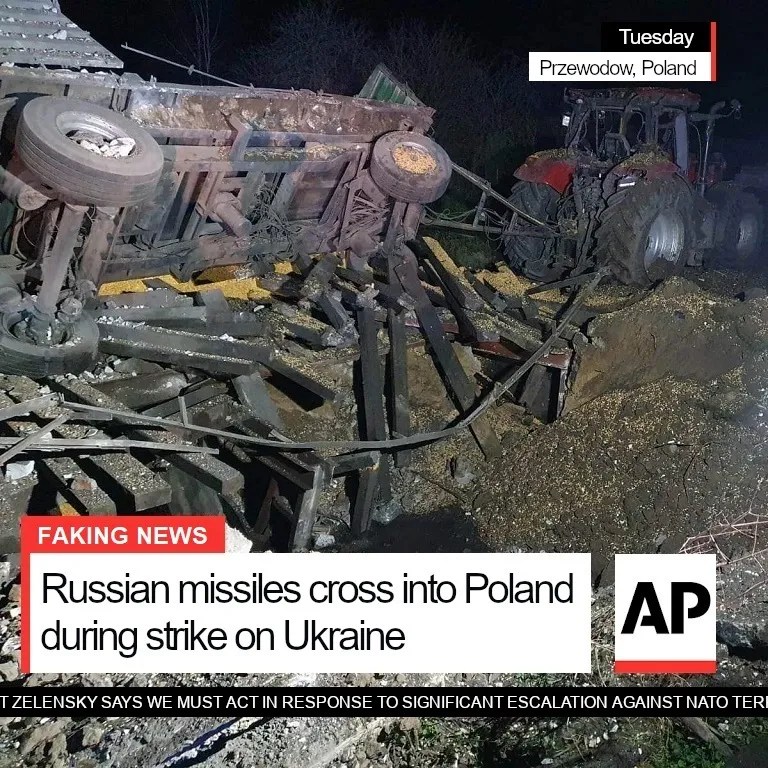
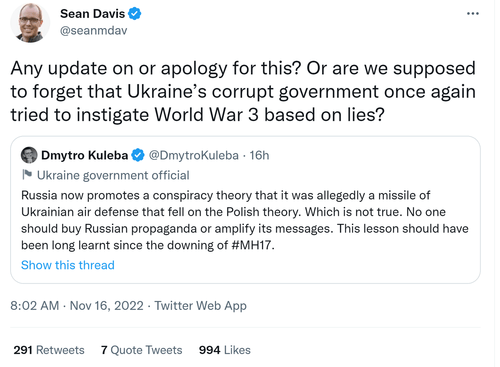
A missile that exploded on Polish soil on November 15 killed two civilians and destroyed farm equipment. Ukrainian President Volodymyr Zelensky and Western corporate media rushed to blame the explosion on Russia in apparent hopes of triggering NATO’s Article 5, which requires NATO states to defend one another militarily when attacked by a hostile force.

Polish and NATO members including US President Joseph Biden have since confirmed the missile that struck Poland was, in fact, a Ukrainian S-300 anti-aircraft missile. Yet Zelensky is sticking to his line, blaming Russia for the strike, while NATO Secretary-General Jens Stoltenberg still insists that “Russia bears ultimate responsibility.” Meanwhile, the media outlets that reflexively pointed the finger at Russia have been forced to take a step back from their initial reporting.

“Russian missiles hit Poland, the territory of our friendly country. People died,” Zelensky insisted on November 15, the night of the attack. “The longer Russia feels impunity, the more threats there will be to anyone within reach of Russian missiles. To fire missiles at NATO territory! This is a Russian missile attack on collective security! This is a very significant escalation. We must act.”

Zelensky held firm the following day, despite mounting evidence that his own country’s air defenses were responsible, declaring “I have no doubt that this is not our missile… I believe that this was a Russian missile, based on our military reports.” By this time, most analysts rejected the Ukrainian president’s assessment, including the founder of the US government-sponsored intelligence cutout Bellingcat, who wrote “At this point I think it’s fair anyone saying that a Russian missile hit Poland based on the current evidence is being irresponsible.”

A Russian attack on NATO member Poland could have triggered Article 5 of the North Atlantic Treaty Organization which compels its member states to consider “an attack against one Ally” to be “an attack against all Allies.” Such a mobilization would have amounted to World War III.

Despite the clear risk of such a catastrophic escalation – or perhaps because of it – Western corporate media immediately blamed Russia for the strike, never even posing the question of why Russia would consider Polish farmland such an important military target that it would be willing to risk a full-scale war with the 30-member NATO alliance. 

Initially, the Associated Press ran with the headline “Russian missiles cross into Poland during strike on Ukraine.” The article cited a “senior US intelligence official,” and later, “a second person.” 

On November 16, AP began redirecting the link to its original article to a correction that stated, “The Associated Press reported erroneously, based on information from a senior American intelligence official who spoke on condition of anonymity, that Russian missiles had crossed into Poland and killed two people. Subsequent reporting showed that the missiles were Russian-made and most likely fired by Ukraine in defense against a Russian attack.”

Time Magazine ran with the headline, “Russian Missiles Cross Into Poland During Strike, Killing Two,” and cited the AP report.

Fox News similarly announced, “Russian missiles cross into NATO member Poland, kill 2: senior US intelligence official, citing the Associated Press. MSNBC also blamed a “Russian missile” for the strike in its headline.

Then there was CNN, which reported, “Poland says Russian-made missile killed two, will consider invoking NATO Article 4.” NATO Article 4 deals with the meetings between NATO states that are to take place in the event one of them is “threatened” and would theoretically precede any invocation of Article 5. Like CNN, Reuters cited the Polish Foreign Ministry and ran the headline, “Poland says Russian rocket hit its territory as NATO weighs response.”

The New York Times stated in the second sentence of its report on the missile strike that “the blast came as Russia fired roughly 90 missiles into Ukraine.” Two lines later, the Times stated “local media suggests a Russian missile strike.” Readers of the paper of record would have to scroll down several times to even read that Russian officials denied responsibility.

Earlier in the war, in an article on “Ukraine’s online propaganda,” the New York Times sought to downplay the Ukrainian government’s penchant for pushing fake news, arguing that Kiev’s information war merely “dramatize[s] tales of Ukrainian fortitude and Russian aggression.” The article quoted an unnamed Twitter user, who wrote, “Why can’t we just let people believe some things? … If the Russians believe it, it brings fear. If the Ukrainians believe it, it gives them hope.”

The US media’s support for Ukraine’s propaganda efforts meant that it covered some of the most suspicious events without a hint of skepticism, and thereby encouraged more. 

These questionable incidents included the following:

  • On March 8, Western media reported that a Mariupol maternity hospital was attacked by Russian aircraft. Zelensky claimed the attack was evidence of Russian “genocide” against Ukraine. However, a key witness – a pregnant woman in the hospital photographed by AP – stated that no such airstrike occurred, and that nearby explosions were caused by Ukrainian artillery shells.

On March 16, the Ukrainian government blamed a targeted Russian airstrike for destroying the Mariupol Dramatic Theater and causing anywhere from 300 to 600 deaths. Western corporate media promoted the Ukrainian narrative of the event despite a total absence of footage showing a missile strike, no images or evidence of large numbers of dead civilians inside, no images or evidence of any attempted rescue, and testimony by Mariupol locals asserting the Azov Battalion fighters that controlled the theater’s grounds staged the explosion to provoke NATO military intervention. Photographic evidence showed that Azov fighters removed all vehicles from the theater’s parking lot one day before the explosion.

The Kramatorsk train station bombing that was blamed on Russia despite the fact the Tochka-U missile responsible for the blast contained a serial number matching others in Ukraine’s arsenal and originated from Ukrainian-controlled territory.

As the war grinds on, elements in the Biden administration appear to be growing impatient with the tall tales of their Ukrainian clients. “This is getting ridiculous,” an unnamed NATO official told the Financial Times on November 16. “The Ukrainians are destroying our confidence and they are openly lying. This is more destructive than the missile.”

AP Editor Said She “Can’t Imagine” A US Intelligence Official Being Wrong

By Caitlin Johnstone

Source: CaitlinJohnstone.com

The Associated Press journalist who reported a US intelligence official’s false claim that Russia had launched missiles at Poland last week has been fired.

As we discussed previously, AP’s anonymously sourced report which said “A senior U.S. intelligence official says Russian missiles crossed into NATO member Poland, killing two people” went viral because of the massive implications of direct hot warfare erupting between Russia and the NATO alliance. AP subsequently retracted its story as the mainstream political/media class came to accept that it was in fact a Ukrainian missile that had struck Poland.

AP’s firing of reporter James LaPorta looks at this time to be the end point of any accountability for the circulation of this extremely dangerous falsehood. AP spokesperson Lauren Easton says no disciplinary action will be taken against the editors who waved the bogus story through, and to this day the public has been kept in the dark about the identity of the US official who fed such extremely egregious misinformation/disinformation to the public through the mainstream press.

It is utterly inexcusable for AP to continue to protect the anonymity of a government official who fed them such a profoundly significant falsehood. This didn’t just affect AP staff, it affected the whole world; we deserve to know what happened and who was responsible, and AP has no business obstructing that knowledge from us.

LaPorta’s firing looks like this is yet another instance where the least powerful person involved in a debacle is being made to take the fall for it. A powerful intelligence official will suffer no consequences for feeding false information to the press — thereby ensuring that it will happen again — and no disciplinary action will be taken against LaPorta’s superiors, despite the absolute buffoonery that subsequent reporting has revealed on their part.

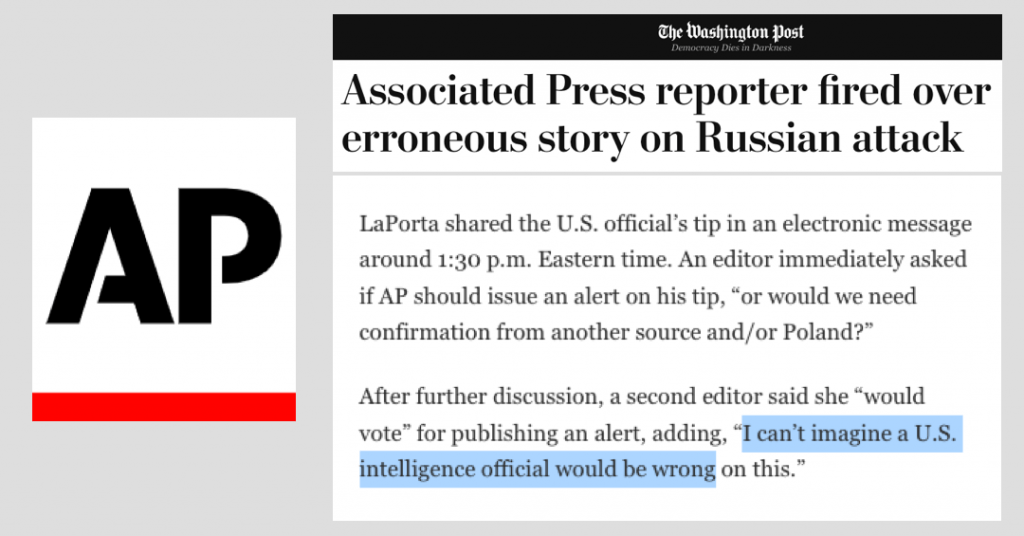
In an article titled “Associated Press reporter fired over erroneous story on Russian attack,” The Washington Post reports the following (emphasis added):

Internal AP communications viewed by The Post show some confusion and misunderstanding during the preparations of the erroneous report.

LaPorta shared the U.S. official’s tip in an electronic message around 1:30 p.m. Eastern time. An editor immediately asked if AP should issue an alert on his tip, “or would we need confirmation from another source and/or Poland?”

After further discussion, a second editor said she “would vote” for publishing an alert, adding, “I can’t imagine a U.S. intelligence official would be wrong on this.”

“I can’t imagine a US intelligence official would be wrong on this.”

Can you imagine not being able to imagine a US intelligence official being wrong? This would be an unacceptable position for any educated adult to hold, much less a journalist, still less an editor, and still less an editor of one of the most influential news agencies on earth.

These are the people who publish the news reports we read to find out what’s happening in the world. This is the baby-brained level of thinking these people are serving the public interest with.

Antiwar commentator Daniel Larison writes the following of the AP editor’s shocking quote:

Skepticism about official claims should always be the watchword for journalists and analysts. These are claims that need more scrutiny than usual rather than less. If you can’t imagine that an intelligence official could get something important wrong, whether by accident or on purpose, you are taking far too many things for granted that need to be questioned and checked out first.

Intelligence officials of many governments feed information to journalists and have done so practically ever since there was a popular press to feed information to, and that information certainly should not be trusted just because an official source hands it over. It is also always possible for intelligence officials to just get things wrong, whether it is because they are relying on faulty information or because they were too hasty in reaching conclusions about what they think they know.

Whether the AP’s source was feeding them a line or was simply mistaken, a claim as provocative and serious as this one should have been checked out much more thoroughly before it got anywhere near publication. The AP report in this case seems to have been a combination of a story that was “too good to check” and a culture of deference to official sources in which the editors didn’t feel compelled to make the effort to check.

Indeed, the only reason the press receive such explicit protections in the US Constitution is because they are supposed to hold the powerful to account. If the editors of a wildly influential news agency will just unquestioningly parrot whatever they are fed by government officials while simultaneously protecting those officials with anonymity, they are not holding the powerful to account, and are in fact not meaningfully different from state propagandists.

They are state propagandists. Which is probably why they are sipping lattes in the AP newsroom while Julian Assange languishes in prison.

As Jacobin’s Branko Marcetic observed, this is far from the first time AP has given the cover of anonymity to US government officials circulating bogus claims of potentially dangerous consequence, like the time it reported an official’s evidence-free assertion which later proved false that Iran had carried out an attack on four oil tankers off the coast of the United Arab Emirates, or the time it let another one anonymously claim that “Iran may try to take advantage of America’s troop withdrawals from Iraq and Afghanistan.”

So to recap  —

  • Powerful government official who fed AP a false story: Zero accountability
  • AP editor who asked if a report should immediately be published upon receipt of the story: Zero accountability
  • Second AP editor who says she can’t imagine a U.S. intelligence official would be wrong:  Zero accountability
  • Journalist who wrote the story: Singular accountability

In a sane society, power and responsibility would go hand in hand. A disaster would be blamed on the most powerful people involved in its occurrence. In our society it’s generally the exact opposite, with the rank-and-file taking all of the responsibility and none of the power.

Our rulers lie to us, propagandize us, endanger us, impoverish us, destroy journalism, start wars, kill our biosphere and make our world dark and confusing, and they suffer no consequences for it. We cannot allow them to continue holding all of the power and none of the responsibility. This is backwards and must end.

The Military Industrial Complex Wants You To Be More Media (l)literate!

By Nolan Higdon

Source: Project Censored

A September 2022 report from Tessa Jolls, president of the Center for Media Literacy, titled “Building Resiliency: Media Literacy as a Strategic Defense Strategy for the Transatlantic,” read like a blueprint for how to indoctrinate students in corporatism and militarism under the auspices of  media literacy education. Jolls received a Fulbright-NATO Security Studies Award to study “aspects of the current information ecosystem and the state of media literacy in NATO countries.”

For historical context, the North Atlantic Treaty Organization (NATO) was created after World War II during the Cold War and has long since outlived its stated purpose of stopping the spread of communism. Indeed, as political sociologists such as Peter Phillips have noted, NATO has morphed into a global army that engages in questionable conflicts and other human rights abuses in an effort to serve the “transnational capitalist class.” 

Just like the crisis of “fake news,” media literacy can and is being weaponized by organizations and individuals seeking to increase their power by influencing the public’s perception of reality. For example, Steve Bannon, former White House Chief Strategist for President Donald Trump has a long history of spreading false information. Form 2012-18, he was the executive chairman of Breitbart’s website which has been caught manipulating videosmanufacturing stories, and spreading baseless conspiracies. Starting with Bannon’s tenure, Breitbart published articles lauding media literacy as a way to combat “fake news,” while touting that its founder, Andrew Breitbart, integrated media literacy into the platform. However, their consistent spreading of false information seems to run counter to traditional definitions of media literacy. 

The standard U.S. definition of media literacy is “the ability to access, analyze, evaluate, create, and act using all forms of communication.” In response to the post-2016 moral panic over fake news, there was a demand for more media literacy education in schools. This provided a window of opportunity for media companies – which had long sought to enter the classroom to advertise products and collect student data- to move at rapid speed to indoctrinate students with their corporate propaganda. 

Jolls’ report aids these efforts by arguing that corporations’ “allocations for media literacy education are few and far between.” Jolls’ report speaks to the military industrial complex when it calls for “funding and programming from all corners: government, foundations, and the private sector (tech and media companies, other corporations).” The military industrial complex refers to the relationship between the military and related defense and national security industries. In fact, Big-Tech emerged from and continues to serve the same military industrial complex. 

Rather than advocate for a critical media literacy education that would account for the power dynamics invested in NATO and its long history of working against democracy and social justice, Jolls’ lauds the “values that NATO states” arguing that they represent an “excellent foundation” for “media literacy initiatives.” To normalize NATO values in the educational process, Jolls suggests what amounts to a psychological operations campaign (PSYOP) to spread NATO’s version of media literacy to the public through “mass media, media aggregators such as AP, Reuters and LexisNexis, social media and influencers.” The report calls on NATO to “nurture grassroots efforts,” which sounds more like astroturfing.

Jolls’ report ignores that members of the very same military and intelligence community that she lauds have been producing and spreading fake news to U.S. citizens from Operation Mockingbird in the 20th century up through the present on various social media platforms. It dismisses the public’s rejection of empowering the military industrial complex to determine truth for the citizenry. For example, in 2022, critics from the left and the right successfully lobbied to have the Department of Homeland Security scrap its Disinformation Governance Board because it was reminiscent of the Ministry of Truth in George Orwell’s 1984

Instead, Jolls is following the lead of similar media literacy projects from the military industrial complex such as the NewsGuard browser extension. Known as an “Internet Trust Tool,” NewsGuard’s Advisory Board includes numerous people who served in the military and intelligence community as well as bureaucrats known for opposing the interests of educators. Yet, NewsGuard positions itself as an objective tool for educators while its rating system is ideologically driven. It touts the legitimacy of establishment and legacy media sources that echo the status quo – even when they have been proven to spread false information – and downgrades independent and alternative media outlets that challenge powerful institutions of government, industry, and the military. Jolls’ mirrors NewsGuard’s top-down approach to media literacy education calling on NATO leaders to determine “the intent and purposes for media literacy interventions” by choosing the “social problem or behavior or ideology” or issue for educators to focus on.   

It is clear that we do need a critical media literacy curriculum in the U.S., but that is not what Jolls and her ilk are promoting. A true media literacy education empowers students to be autonomous and sophisticated media users, who ask their own questions about who controls media messaging and interrogate the power structures behind them. When a student is left dependent on the military industrial complex to analyze content for them, it is not education, it is indoctrination. 

Poland, NATO Agree Deadly Polish Border ‘Russian Attack’ Was Errant Ukrainian Missile

By Tyler Durden

Source: Zero Hedge

A mere less than 24 hours ago, before the dust had settled from the explosion and before investigators could come to any definitive conclusions after the deadly incident on the Polish border village of Przewodów, the Western public was already being harangued and forewarned to stay away from ‘conspiracy theories’ as the early mainstream headlines – pushed especially based on an anonymous US official in an Associated Press report – were fast out the gate with “Russian missiles hit Poland, killing two”

“Article 5” – the NATO collective defense treaty which many had long worried would be the first invoked act leading to WWIII, began trending on Twitter, as Western officials issued confident statements of ‘solidarity’.  Almost immediately and without evidence, Ukraine’s President Volodymyr Zelensky demanded “action” from the West over the supposed brazen aggression against a NATO member. “Hitting NATO territory with missiles… This is a Russian missile attack on collective security! This is a really significant escalation. Action is needed,” Zelensky said his Tuesday night video address.

And then as missile crash site images widely circulated on the internet, leading even Western sources to express doubt that the projectile was launched by Russia, enter no less than the foreign minister of Ukraine, who attempted to preempt what he slammed as a developing Russia-promoted “conspiracy theory”. Like with many other aspects to this war, some of the most obvious common sense questions were quickly declared “off limits” before they could even be asked. 

Warsaw then stopped just short of any talk of Article 5, but then floated Article 4 as the basis of an emergency NATO security meeting for Wednesday, which calls for “consultations” in the event a NATO country is under threat. 

But what a difference a few hours, and a skeptical refusal to blindly jump on the war! bandwagon, makes. First, as we reported overnight, President Joe Biden explicitly said that based on preliminary information, it is “unlikely” that the rocket strike in Poland originated in Russia. Oops. This as based on the available emerging evidence it seemed clear the culprit was more likely an errant Ukrainian anti-air missile. “It’s unlikely in the minds of [sic] the trajectory that it was fired from Russia. But we’ll see,” Biden had said. But this admission conveniently came well after the US president seized the ‘fog of war’ moment to unveil another massive $37 billion emergency aid package for Ukraine almost simultaneous to the border incident.

Now on Wednesday, Poland and NATO officials have also done a reversal of the initial kneejerk ‘blame Russia’ reporting which momentarily sent the world into a frenzy of anxiety over the prospect of WWIII. Polish President Andrzej Duda has said the explosion that killed two people now appears to be an “unfortunate accident” and not an “intentional attack.”

What is left to say after all of this? Here are the facts

Recall that the initial reaction out of Moscow was that either Ukraine or Poland was staging a “deliberate provocation” in so quickly hurling blame on Russia for an aggressive act. Warsaw officials had even in the hours after demanded that Russia make an apology if it was an accident.

But President Duda alongside NATO HQ is quickly reversing the entire narrative, according to more from Axios

  • Duda added that the projectile that caused the blast was “most likely” Russian-made, but officials have “no proof at the moment that it was a missile fired by the Russian side.”
  • Ukraine has previously denied it was to blame for the blast and accused Moscow of a “serious escalation.” Russia also denied responsibility.

Of course, it’s always been the case that Ukraine’s anti-air missile arsenal is entirely “Russian-made” – particularly its S-300s.

NATO Secretary General Jens Stoltenberg issued a similar assessment, saying it was most likely an errant Ukrainian missile:

“Our preliminary analysis suggests that the incident was likely caused by a Ukrainian air defence missile fired to defend Ukrainian territory against Russian cruise missile attacks,” the NATO Secretary General told reporters after an emergency meeting of the alliance’s Security Council. 

He stressed that the investigation into the explosion is still ongoing but that there is “no indication that this was the result of a deliberate attack. And we have no indication that Russia is preparing offensive military actions against NATO.”

To be expected, he quickly followed by still laying blame on Russia for the overall war and series of events which led to the deadly border explosion. “But let me be clear. This is not Ukraine’s fault. Russia bears ultimate responsibility, as it continues its illegal war against Ukraine,” the NATO chief said.

Without addressing Zelensky’s prior day shrill rush to get NATO to declare military action based on collective security, Stoltenberg stressed, “this is not Ukraine’s fault.” As NATO defense officials continue to meet to determine a way forward, and as the whole drama has clearly fizzled out (again, only after it emerged it was Ukraine’s rocket), likely the alliance will quietly move on in a “nothing to see here” manner.

But what about the next time a similar border tragedy or incident on NATO-land plays out? Will the same “Russia is attacking NATO!” narrative prevail before anyone is allowed to ask simple questions? Will the war drums beat before there’s so much as a forensic investigation? Will there be a mushroom cloud before pesky rational skepticism disrupts the “consensus”? As the past ten years of war in Syria and Western intervention there have demonstrated, this is the likely inevitable scenario of how NATO and Russia will stumble into direct conflict at this rate.

In the meantime, as for the below still lingering question, we won’t hold our breath…