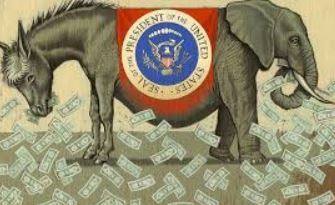
America’s ‘Unlimited Imperialists’


By Francis Boyle

Source: Consortium News

Historically the latest eruption of American militarism in the 21st Century is akin to that of America opening the 20th Century by means of the U.S.-instigated Spanish-American War in 1898.

The then Republican administration of President William McKinley grabbed their colonial empire from Spain in Cuba, Puerto Rico, Guam, and the Philippines; inflicted a near genocidal war against the Filipino people; while at the same time illegally annexing the Kingdom of Hawaii and subjecting the Native Hawaiian people (who call themselves the Kanaka Maoli) to genocidal conditions.

Additionally, McKinley’s military and colonial expansion into the Pacific was also designed to secure America’s economic exploitation of China pursuant to the euphemistic rubric of the “open door” policy.   But over the next four decades America’s aggressive presence, policies, and practices in the so-called “Pacific” Ocean would ineluctably pave the way for Japan’s attack at Pearl Harbor on Dec. 7, 1941, and thus America’s precipitation into the ongoing Second World War.

Today a century later, the serial imperial aggressions launched, waged, and menaced by the neoconservative Republican Bush Junior administration, then the neoliberal Democratic Obama administration and now the reactionary Trump administration threaten to set off World War III.

This Time the Stakes are Higher

By shamelessly exploiting the terrible tragedy of September 11, the Bush Junior administration set forth to steal a hydrocarbon empire from the Muslim states and peoples of color living in Central Asia, the Middle East and Africa under the bogus pretexts of (a) fighting a war against “international terrorism” or “Islamic fundamentalism”; and/or (b) eliminating weapons of mass destruction; and/or (c) promoting democracy; and/or (d) self-styled humanitarian intervention and its avatar “responsibility to protect” (R2P).

Only this time the geopolitical stakes are infinitely greater than they were a century ago:  control and domination of the world’s hydrocarbon resources and thus the very fundaments and energizers of the global economic system – oil and gas.

The Bush Junior and Obama administrations targeted the remaining hydrocarbon reserves of Africa, Latin America (e.g., the Pentagon’s reactivating the Fourth Fleet in 2008), and Southeast Asia for further conquest and domination, together with the strategic choke-points at sea and on land required for their transportation (e.g., Syria, Yemen, Somalia, Djibouti).  Today the U.S. Fourth Fleet threatens oil-rich Venezuela and Ecuador, along with Cuba.

Toward accomplishing that first objective, in 2007, the neoconservative Bush Junior administration announced the establishment of the U.S. Pentagon’s Africa Command (AFRICOM) in order to better control, dominate, steal, and exploit both the natural resources and the variegated peoples of the continent of Africa, the very cradle of our human species.

In 2011 Libya and the Libyans proved to be the first victims to succumb to AFRICOM under the neoliberal Obama administration, thus demonstrating the truly bi-partisan and non-partisan nature of U.S. imperial foreign policy decision-making. Let us put aside as beyond the scope of this article, the American conquest, extermination, and ethnic cleansing of the Native Americans from the face of the continent.

Since America’s instigation of the Spanish-American War in 1898, U.S. foreign policy decision-making has been alternatively conducted by reactionary imperialists, conservative imperialists, and liberal imperialists for the past 120 years and counting.

Trump is just another representative for U.S. imperialism and neoliberal capitalism. He forthrightly and proudly admitted that the United States is in the Middle East in order to steal their oil. At least he was honest about it. Unlike his predecessors who lied about the matter going back to President George Bush Sr. with his War for Persian Gulf oil against Iraq in 1991. Just recently, Trump publicly threatened illegal U.S. military intervention against oil-rich Venezuela and now he’s poised to strike Syria.

It’s About Power, Not Just Resources

But oil and other resources are not the only U.S. motive. Enforcing its global power and undermining or removing leaders who defy it are also at play.

As my teacher, mentor, and friend, the late, great Professor Hans Morgenthau, who coined the term “unlimited imperialism” in his seminal 1948 critique of U.S. foreign policy, Politics Among Nations, said:

          “The outstanding historic examples of unlimited imperialism are the expansionist policies of Alexander the Great, Rome, the Arabs in the seventh and eighth centuries, Napoleon I, and Hitler. They all have in common an urge toward expansion which knows no rational limits, feeds on its own successes and, if not stopped by a superior force, will go on to the confines of the political world. This urge will not be satisfied so long as there remains anywhere a possible object of domination–a politically organized group of men which by its very independence challenges the conqueror’s lust for power. It is, as we shall see, exactly the lack of moderation, the aspiration to conquer all that lends itself to conquest, characteristic of unlimited imperialism, which in the past has been the undoing of the imperialistic policies of this kind…”

Since September 11, 2001, it is the Unlimited Imperialists along the lines of Alexander, Rome, Napoleon, and Hitler who have been in charge of conducting American foreign policy decision-making.  The factual circumstances surrounding the outbreaks of both the First World War and the Second World War currently hover like twin Swords of Damocles over the heads of all humanity.


Francis Boyle is a professor of international law at the University of Illinois Urbana-Champaign. Among his many books is “Destroying World Order.”

The ‘Values,’ ‘Vision,’ and ‘Democracy’ of an Inauthentic Opposition

Average Americans, whose economic survival is threatened, have no political party to represent them, including deceptive Democrats who claim to be their champions and blame others when their deception fails, says Paul Street.

By Paul Street

Source: Consortium News

Never underestimate the capacity of the United States’ Inauthentic Opposition Party, the corporate Democrats, for self-congratulatory delusion and the externalization of blame.

Look, for example, at the Democratic National Committee’s (DNC) recently filed 66-page lawsuit against Russia, WikiLeaks, and the 2016 Donald Trump campaign. The document accuses Russia of “mount[ing] a brazen attack on the American democracy,” “destabilize[ing] the U.S. political environment” on Trump’s (and Russia’s) behalf, and “interfering with our democracy….”

“The [RussiaGate] conspiracy,” the DNC Complaint says, “undermined and distorted the DNC’s ability to communicate the [Democratic] party’s values and vision to the American electorate” and “sowed discord within the Democratic Party at a time when party unity was essential…”

Yes, Russia, like numerous other nations living under the global shadow of the American Superpower, may well have tried to have some surreptitious say in 2016 U.S. presidential election. (Why wouldn’t the Kremlin have done that, given the very real and grave threats Washington and its Western NATO allies have posed for many years to post-Soviet-era Russian security and peace in Eastern Europe?)

Still, charging Russia with interfering with US-“American democracy” is like me accusing the Washington Capital’s star left winger Alex Ovechkin of interfering with my potential career as a National Hockey League player (I’m middle aged and can’t skate backwards). The U.S. doesn’t have a functioning democracy to undermine, as numerous careful studies (see this,this,this,this,this,this,this,this, and this) have shown.

We have, rather, a corporate and financial oligarchy, an open plutocracy. U.S.-Americans get to vote, yes, but the nation’s “unelected dictatorship of money” reigns nonetheless in the United States, where, as leading liberal political scientists Benjamin Page (Northwestern) and Marin Gilens (Princeton) find, “government policy…reflects the wishes of those with money, not the wishes of the millions of ordinary citizens who turn out every two years to choose among the preapproved, money-vetted candidates for federal office.”

Our Own Oligarchs

Russia and WikiLeaks “destabilized the U.S. political environment”? Gee, how about the 20 top oligarchic U.S. mega-donors who invested more than $500 million combined in disclosed campaign contributions (we can only guess at how much “dark,” that is undisclosed, money they gave) to candidates and political organizations in the 2016 election cycle? The 20 largest organizational donors also gave a total of more than $500 million. The foremost plutocratic election investors included hard right-wing billionaires like casino owner Sheldon Adelson ($83 million disclosed to Republicans and right-wing groups), hedge-fund manager Paul Singer ($26 million to Republicans and the right), hedge fund manager Robert Mercer ($26 million) and packaging mogul Richard Uihlein ($24 million).

How about the multi-billionaire Trump’s own real estate fortune, which combined with the remarkable free attention the corporate media oligopoly granted him to help catapult the orange-tinted fake-populist beast past his more traditional Republican primary opponents? And what about the savagely unequal distribution of wealth and income in Barack Obama’s America, so extreme in the wake of the Great Recession that Hillary’s primary campaign rival Bernie Sanders could credibly report that the top tenth of the upper U.S.1% possessed nearly as much wealth as the nation’s bottom 90%? Such extreme disparity helped doom establishment, Wall Street- and Goldman Sachs-embroiled candidates like Jeb Bush, Marco Rubio, and Mrs. Clinton in 2016. Russia and WikiLeaks did not create that deep, politically- and neoliberal-policy-generated socioeconomic imbalance.

Double Vision

And just what were the Democratic Party “values and vision” that Russia, Trump, and WikiLeaks supposedly prevented the DNC and the Clinton team from articulating in 2016? As the distinguished political scientist and money-politics expert Thomas Ferguson and his colleagues Paul Jorgensen and Jie Chen noted in an important study released three months ago, the Clinton campaign “emphasized candidate and personal issues and avoided policy discussions to a degree without precedent in any previous election for which measurements exist….it deliberately deemphasized issues in favor of concentrating on what the campaign regarded as [Donald] Trump’s obvious personal weaknesses as a candidate.” Strangely enough, the Twitter-addicted reality television star Trump had a lot more to say about policy than the former First Lady, U.S. Senator, and Secretary of State Hillary Clinton, a wonkish Yale Law graduate.

The Democrats “values and vision” in 2016 amounted pretty much to the accurate but hardly inspiring or mass-mobilizing notion that Donald Trump was an awful person who was unqualified for the White House. Clinton ran almost completely on candidate character and quality. This was a blunder of historic proportions, given Clinton’s own highly problematic character brand. Any campaign needs a reasonably strong policy platform to stand on in case of candidate difficulties.

By Ferguson, Jorgenson, and Chen’s account, Hillary’s peculiar policy silence was about U.S. oligarchs’ campaign money. Thanks to candidate Trump’s bizarre nature and his declared isolationism and nationalism, Clinton achieved remarkable campaign finance success with normally Republican-affiliated capitalist sectors less disposed to abide the standard, progressive-sounding policy rhetoric of Democratic Party candidates than their more liberal counterparts.

One ironic but “fateful consequence” of her curious connection to conservative business interests was her “strategic silence about most important matters of public policy. … Misgivings of major contributors who worried that the Clinton campaign message lacked real attractions for ordinary Americans were rebuffed. The campaign,” Ferguson, Jorgenson, and Chen wrote, “sought to capitalize on the angst within business by vigorously courting the doubtful and undecideds there, not in the electorate.”

Other Clinton mistakes included failing to purchase television ads in Michigan, failing to set foot in Wisconsin after the Democratic National Convention, and getting caught telling wealthy New York City campaign donors that Trump’s white supporters were “a basket of” racist, sexist, nativist, and homophobic “deplorables.” This last misstep was a Freudian slip of the neoliberal variety. It reflected and advanced the corporate Democrats’ longstanding alienation of and from the nation’s rural and industrial and ex-industrial “heartland.”

Fake Progressives

As left historian Nancy Fraser noted after Trump was elected, the Democrats, since at least the Bill Clinton administration, had joined outwardly progressive forces like feminism, antiracism, multiculturalism, and LGBTQ rights to “financial capitalism.” This imparted liberal “charisma” and “gloss” to “policies that …devastated…what were once middle-class lives” by wiping out manufacturing, weakening unions, slashing wages, and increasing the “precarity of work.”

To make matters worse, Fraser rightly added, the “progressive neoliberal” blue-and digital-zone Democrats “compounded” the “injury of deindustrialization” with “the insult of progressive moralism,” which rips red-and analog-zone whites as culturally retrograde (recall candidate Obama’s problematic 2008 reflection on how rural and small-town whites “cling to religion and guns”) and yet privileged by the simple color of their skin.

Such insults from elite, uber-professional class neo-liberals like Obama (Harvard Law) and the Clintons (Yale Law) would sting less in the nation’s “flyover zones” if the those uttering them had not spent their sixteen years in the White House governing blatantly in accord with the wishes of Wall Street, Silicon Valley, and the leading multinational corporations. Like Bill Clinton’s two terms, the Obama years were richly consistent with Sheldon Wolin’s early 2008 description of the Democrats as an “inauthentic opposition” whose dutiful embrace of “centrist precepts” meant they would do nothing to “substantially revers[e] the drift rightwards” or “significantly alter the direction of society.”

The fake-“progressive” Obama presidency opened with the expansion of Washington’s epic bailout of the very parasitic financial elites who recklessly sparked the Great Recession (this with no remotely concomitant expansion of federal assistance to the majority middle- and working-class victims), the abandonment of campaign pledges to restore workers’ right to organize (through the immediately forgotten Employee Free Choice Act), and the kicking of Single Payer health care advocates to the curb as Obama worked with the big drug and insurance syndicates to craft a corporatist, profit-friendly health insurance reform. Obama’s second term ended with him doggedly (if unsuccessfully) championing the arch-authoritarian global-corporatist Trans Pacific Partnership.

This Goldman Sachs and Citigroup-directed policy record was no small part of what demobilized the Democrats’ mass electoral base in ways that “destabilized the U.S. political environment” to the benefit of the reactionary populist Trump, whose Mercer family-backed proto-fascistic strategist and Svengali Steve Bannon was smartly attuned to the Democrats’ elitist class problem.

There was a major 2016 presidential candidate who ran with genuinely progressive “values and vision” – Bernie Sanders. The most remarkable finding in Ferguson, Jorgenson, and Chen’s study is that the self-declared “democratic socialist” Sanders came tantalizingly close to winning the Democratic presidential nomination with no support from Big Business. The small-donor Sanders campaign was “without precedent in American politics not just since the New Deal, but across virtually the whole of American history … a major presidential candidate waging a strong, highly competitive campaign whose support from big business was essentially zero.”

Sanders was foiled by the big-money candidate Clinton’s advance control of the Democratic National Committee and convention delegates. Under a formal funding arrangement it worked up with the Democratic National Committee (DNC) in late September of 2015, the depressing “lying neoliberal warmonger” Hillary’s campaign was granted advance control of all the DNC’s “strategic decisions.” The Democratic Party’s presidential caucuses and primaries were rigged against Sanders in ugly ways that provoked a different lawsuit last year – a class-action suit against the DNC on behalf of Sanders’ supporters. The complaint was dismissed by a federal judge who ruled on the side of DNC lawyers by agreeing that the DNC was within its rights to violate their party’s charter and bylaws by selecting its candidate in advance of the primaries.

How was that for the noble “values and vision” that “American democracy” inspires atop the not-so leftmost of the nation’s two major and electorally viable political parties?

Under Cover of Russia-gate

That’s what “sowed discord within the Democratic Party at a time when party unity was essential…” Russia didn’t do it. Neither did WikiLeaks or the Trump campaign. The Clinton campaign and the Democratic Party establishment – themselves funded by major U.S. oligarchs like San Francisco hedge-fund billionaire Tom Steyer– did that on their own.

Could Sanders – the most popular politician in the U.S. (something rarely reported in a “mainstream” corporate media that could barely cover his giant campaign rallies even as it obsessed over Trump’s every bizarre Tweet) – have defeated the orange-tinted beast in the general election? Perhaps, though much of the oligarchic funding Hillary got would have gone to Trump if “socialist” Bernie had been the Democratic nominee. It is unlikely that Sanders could have accomplished much as president in a nation long controlled by the capitalist oligarchy in numerous ways that go far beyond campaign finance alone.

Meanwhile, under the cover of RussiaGate, the still-dismal and dollar-drenched corporate-imperial Democrats seem content to continue tilting to the center-right, purging Sanders-style progressives from the party’s leadership and citing the party’s special election victories (Doug Jones and Conor Lamb) against deeply flawed and Trump-backed Republicans in two bright-red voting districts (the state of Alabama and a fading Pennsylvania canton) as proof that tepid neoliberal centrism is still (even after Hillary’s stunning defeat) the way to go.

Along the way, the Inauthentic Opposition’s candidate roster for the upcoming Congressional mid-term election is loaded with an extraordinary number of contenders with U.S. military and intelligence backgrounds, consistent with Congressional Democrats repeated votes to give massive military and surveillance-state funds and power to a president they consider (accurately enough) unbalanced and dangerous.

The trick, the neoliberal “CIA Democrats” think, is to run conservative, Wall Street-backed imperial and National Security State veterans who pretend (see Eric Draitser’s recent piece on “How Clintonites Are Manufacturing Faux Progressive Congressional Campaigns”) to be aligned with majority-progressive left-of-center policy sentiments and values. It’s still very much their party.

Whatever happens during the next biennial electoral extravaganza, “the crucial fact” remains, in Wolin’s words nine years ago, “that for the poor, minorities, the working class and anti-corporatists there is no opposition party working on their behalf” in the United States – the self-declared homeland and headquarters of global democracy.


Paul Street is an independent radical-democratic policy researcher, journalist, historian, author and speaker based in Iowa City, Iowa, and Chicago, Illinois.  He is the author of seven books. His latest is They Rule: The 1% v. Democracy (Paradigm, 2014)

The Fall of the American Empire

By W.J. Astore

Source: Bracing Views

Why do empires fall?  Sometimes, it’s easy to identify a cause.  Whether led by the Kaiser or by Hitler, Germany’s Second and Third Empires were destroyed by world wars.  Germany’s ambition was simply too great, its militarism too dominant, its policies too harsh to win long-term converts, its leaders too blinded by the pursuit of power, its enemies too many to conquer or otherwise neutralize.

Other imperial falls are more complex.  What caused Rome’s fall?  (Leaving aside the eastern part of the empire, which persisted far longer as the Byzantine Empire.)  Barbarians and their invasions, say some.  The enervating message and spirit of Christianity, said the historian Edward Gibbon.  Rome’s own corruption and tyranny, say others.  Even lead in Roman water pipes has been suggested as a contributing cause to Rome’s decline and fall.  Taking a longer view, some point to the rise of Islam in the 7th century and its rapid expansion into previously Roman territories as the event that administered the final coup de grâce to a dying empire.

America’s empire, it is clear, is now in decline, and a key reason is imperial overstretch as manifested by endless wars and overspending on the military (with literally trillions of dollars being thrown away on fruitless wars).  An especially fine summary is Alfred McCoy’s article at TomDispatch.com.  As McCoy notes:

In effect, the president and his team, distracted by visions of shimmering ships and shiny planes (with their predictable staggering future cost overruns), are ready to ditch the basics of global dominion: the relentless scientific research that has long been the cutting edge of U.S. military supremacy.  And by expanding the Pentagon while slashing the State Department, Trump is also destabilizing that delicate duality of U.S. power by skewing foreign policy ever more toward costly military solutions (that have proved anything but actual solutions) …

In just one extraordinary year, Trump has destabilized the delicate duality that has long been the foundation for U.S. foreign policy: favoring war over diplomacy, the Pentagon over the State Department, and narrow national interest over international leadership. But in a globalizing world interconnected by trade, the Internet, and the rapid proliferation of nuclear-armed missiles, walls won’t work. There can be no Fortress America.

In this passage, McCoy stresses the damage being done by the Trump administration.  But Trump is just the culmination of certain trends, e.g. favoring the Pentagon over the State Department is nothing new, as I wrote about here in 2010.  And America has been in love with shimmering ships and shiny planes for generations, with several administrations supporting the F-35 jet fighter, a program that may end up costing as much as $1.4 trillion.  Plenty of money for weapons that kill; not so much for medicines that cure: that’s imperial America in a nutshell.

I would stress that America’s strength overseas was (and is) always based on its strength at home in areas such as science, education, infrastructure, medicine, manufacturing, and exports.  But what we’ve witnessed over the last 40 years is an immense and wasteful “investment” in wars and weapons even as our country itself has hollowed out. Science is now marked by the denial of facts (such as global warming). Education is all about students as consumers, with an overall decline in standards and performance. Infrastructure is crumbling. Medicine is too expensive and America’s overall health and life expectancy are both in decline. Manufacturing and exports have withered (except for the production and export of weapons, naturally).

As a result of all this, America is running a national debt of roughly 20 trillion dollars.  The future is being sacrificed for the present, a tragic reality reflected in the latest Republican tax cut, which benefits the richest Americans the most, along with big corporations, and which will likely add another trillion to the national debt.

In short, America’s foreign decline is mirrored (and driven) by its domestic decline as reflected by its choices.  Looking at the USA today, you get the sense it’s the best of times for the richest few, and the worst of times for so many Americans struggling with health care debt, student loan debt, and the uncertainty of low-wage jobs that could be outsourced at any moment.  At the same time, the American political scene is driven by fear: of immigrants, of a nuclear war with North Korea, of Russian meddling (real or imagined), of growing Chinese power, and of the perpetually-hyped threat of terrorist attacks on “the Homeland.”

Empires can fall very quickly, as the “thousand-year” Third Reich did, or they can fall ever so slowly, as the Roman Empire did.  But fall they do.  What is in the cards for the United States?


America’s Enemies, Who’s On the List?

Prospects and Perspectives

By Prof. James Petras

Source: Global Research

For almost 2 decades, the US pursued a list of ‘enemy countries’ to confront, attack, weaken and overthrow. 

This imperial quest to overthrow ‘enemy countries’ operated at various levels of intensity, depending on two considerations:  the level of priority and the degree of vulnerability for a ‘regime change’ operation.

The criteria for determining an ‘enemy country’ and its place on the list of priority targets in the US quest for greater global dominance, as well as its vulnerability to a ‘successfully’ regime change will be the focus of this essay.

We will conclude by discussing the realistic perspectives of future imperial options.

Prioritizing US Adversaries

Imperial strategists consider military, economic and political criteria in identifying high priority adversaries.

The following are high on the US ‘enemy list’:

1) Russia, because of its military power, is a nuclear counterweight to US global domination.  It has a huge, well-equipped armed force with a European, Asian and Middle East presence.  Its global oil and gas resources shield it from US economic blackmail and its growing geo-political alliances limit US expansion.

2) China, because of its global economic power and the growing scope of its trade, investment and technological networks.  China’s growing defensive military capability, particularly with regard to protecting its interests in the South China Sea serve to counter US domination in Asia.

3) North Korea, because of its nuclear and ballistic missile capability, its fierce independent foreign policies and its strategic geo-political location, is seen as a threat to the US military bases in Asia and Washington’s regional allies and proxies.

4) Venezuela, because of its oil resources and socio-political policies, challenge the US centered neo-liberal model in Latin America.

5) Iran, because of its oil resources, political independence and geo-political alliances in the Middle East, challenge US, Israeli and Saudi Arabia domination of the region and present an independent alternative.

6) Syria, because of its strategic position in the Middle East, its secular nationalist ruling party and its alliances with Iran, Palestine, Iraq and Russia, is a counterweight to US-Israeli plans to balkanize the Middle East into warring ethno-tribal states.

US  Middle-level Adversaries :

1)  Cuba, because of its independent foreign policies and its alternative socio-economic system stands in contrast to the US-centered neo-liberal regimes in the Caribbean, Central and South America.

2) Lebanon, because of its strategic location on the Mediterranean and the coalition government’s power sharing arrangement with the political party, Hezbollah, which is increasingly influential in Lebanese civil society in part because of its militia’s proven capacity to protect Lebanese national sovereignty by expelling the invading Israeli army and helping to defeat the ISIS/al Queda mercenaries in neighboring Syria.

3) Yemen, because of its independent, nationalist Houthi-led movement opposed to the Saudi-imposed puppet government as well as its relations with Iran.

Low Level Adversaries

1) Bolivia, because of its independent foreign policy, support for the Chavista government in Venezuela and advocacy of a mixed economy;  mining wealth and  defense of indigenous people’s territorial claims.

2) Nicaragua, because of its independent foreign policy and criticism of US aggression toward Cuba and Venezuela.

US hostility to high priority adversaries is expressed through economic sanctions military encirclement, provocations and intense propaganda wars toward North Korea, Russia, Venezuela, Iran and Syria.

Because of China’s powerful global market linkages, the US has applied few sanctions.  Instead, the US relies on military encirclement, separatist provocations and intense hostile propaganda when dealing with China.

Priority Adversaries, Low Vulnerability and Unreal Expectations

With the exception of Venezuela, Washington’s ‘high priority targets’ have limited strategic vulnerabilities. Venezuela is the most vulnerable because of its high dependence on oil revenues with its major refineries located in the US, and its high levels of indebtedness, verging on default.   In addition, there are the domestic opposition groups, all acting as US clients and Caracas’ growing isolation within Latin America due to orchestrated hostility by important US clients, Argentina, Brazil, Colombia and Mexico.

Iran is far less vulnerable: It is a strong strategic regional military power linked to neighboring countries and similar religious-nationalist movements.  Despite its dependence on oil exports, Iran has developed alternative markets, like China, free from US blackmail and is relatively safe from US or EU initiated creditor attacks.

North Korea, despite the crippling economic sanctions imposed on its regime and civilian population, has ‘the bomb’ as a deterrent to a US military attack and has shown no reluctance to defend itself.  Unlike Venezuela, neither Iran nor North Korea face significant internal attacks from US-funded or armed domestic opposition.

Russia has full military capacity – nuclear weapons, ICBM and a huge, well-trained armed force – to deter any direct US military threat.  Moscow is politically vulnerable to US-backed propaganda, opposition political parties and Western-funded NGO’s.  Russian oligarch-billionaires, linked to London and Wall Street, exercise some pressure against independent economic initiatives.

To a limited degree, US sanctions exploited Russia’s earlier dependence on Western markets, butsince the imposition of draconian sanctions by the Obama regime, Moscow has effectively counteredWashington’s offensive by diversifying its markets to Asia and strengthening domestic self-reliance in its agriculture, industry and high technology.

China has a world-class economy and is on course to become the world’s economic leader.  Feeble threats to ‘sanction’ China have merely exposed Washington’s weakness rather intimidating Beijing.  China has countered US military provocations and threats by expanding its economic market power, increasing its strategic military capacity and shedding dependence on the dollar.

Washington’s high priority targets are not vulnerable to frontal attack: They retain or are increasing their domestic cohesion and economic networks, while upgrading their military capacity to impose completely unacceptable costs on the US for any direct assault.

As a result, the US leaders are forced to rely on incremental, peripheral and proxy attacks with limited results against its high priority adversaries.

Washington will tighten sanctions on North Korea and Venezuela, with dubious prospects of success in the former and a possible pyrrhic victory in the case of Caracas. Iran and Russia can easily overcome proxy interventions.  US allies, like Saudi Arabia and Israel, can badger, propagandize and rail the Persians, but their fears that an out-and-out war against Iran, could quickly destroy Riyadh and Tel Aviv forces them to work in tandem to induce the corrupt US political establishment to push for war over the objections of a war-weary US military and population. Saudi and Israelis can bomb and starve the populations of Yemen and Gaza, which lack any capacity to reply in kind, but Teheran is another matter.

The politicians and propagandists in Washington can blather about Russia’s interference in the US’s corrupt electoral theater and scuttle moves to improve diplomatic ties, but they cannot counter Russia’s growing influence in the Middle East and its expanding trade with Asia, especially China.

In summary, at the global level, the US ‘priority’ targets are unattainable and invulnerable.  In the midst of the on-going inter-elite dogfight within the US, it may be too much to hope for the emergence of any rational policymakers in Washington who could rethink strategic priorities and calibrate policies of mutual accommodation to fit in with global realities.

Medium and Low Priorities, Vulnerabilities and Expectations

Washington can intervene and perhaps inflict severe damage on middle and low priority countries.  However, there are several drawbacks to a full-scale attack.

Yemen, Cuba, Lebanon, Bolivia and Syria are not nations capable of shaping global political and economic alignments.  The most the US can secure in these vulnerable countries are destructive regime changes with massive loss of life, infrastructure and millions of desperate refugees . . . but at great political cost, with prolonged instability and with severe economic losses.

Yemen

The US can push for a total Saudi Royal victory over the starving, cholera-stricken people of Yemen.  But who benefits?  Saudi Arabia is in the midst of a palace upheaval and has no ability to exercise hegemony, despite hundreds of billions of  dollars of US/NATO arms, trainers and bases.  Colonial occupations are costly and yield few, if any, economic benefits, especially from a poor, geographically isolated devastated nation like Yemen.

Cuba

Cuba has a powerful highly professional military backed by a million-member militia.  They are capable of prolonged resistance and can count on international support.  A US invasion of Cuba would require a prolonged occupation and heavy losses.  Decades of economic sanctions haven’t worked and their re-imposition by Trump have not affected the key tourist growth sectors.

President Trump’s ‘symbolic hostility’ does not cut any ice with the major US agro-business groups, which saw Cuba as a market. Over half of the so-called ‘overseas Cubans’ now oppose direct US intervention.

US-funded NGOs can provide some marginal propaganda points but they cannot reverse popular support for Cuba’s mixed ‘socialized’ economy, its excellent public education and health care and its independent foreign policy.

Lebanon

A joint US-Saudi economic blockade and Israeli bombs can destabilize Lebanon.  However, a full-scale prolonged Israeli invasion will cost Jewish lives and foment domestic unrest.  Hezbollah has missiles to counter Israeli bombs.  The Saudi economic blockade will radicalize Lebanese nationalists, especially among the Shia and the Christian populations.  The Washington’s ‘invasion’ of Libya, which did not lose a single US soldier, demonstrates that destructive invasions result in long-term, continent-wide chaos.

A US-Israeli-Saudi war would totally destroy Lebanon but it will destabilize the region and exacerbate conflicts in neighboring countries – Syria, Iran and possibly Iraq.  And Europe will be flooded with millions more desperate refugees.

Syria

The US-Saudi proxy war in Syria suffered serious defeats and the loss of political assets.  Russia gained influence, bases and allies.  Syria retained its sovereignty and forged a battle-hardened national armed force.  Washington can sanction Syria, grab some bases in a few phony ‘Kurdish enclaves’ but it will not advance beyond a stalemate and will be widely viewed as an occupying invader.

Syria is vulnerable and continues to be a middle-range target on the US enemy list but it offers few prospects of advancing US imperial power, beyond some limited ties with an unstable Kurd enclave, susceptible to internecine warfare, and risking major Turkish retaliation.

Bolivia and Nicaragua

Bolivia and Nicaragua are minor irritants on the US enemy list. US regional policymakers recognize that neither country exercises global or even regional power.  Moreover, both regimes rejected radical politics in practice and co-exist with powerful and influential local oligarchs and international MNC’s linked to the US.

Their foreign policy critiques, which are mostly for domestic consumption, are neutralized by the near total US influence in the OAS and the major neo-liberal regimes in Latin America.  It appears that the US will accommodate these marginalized rhetorical adversaries rather than risk provoking any revival of radical nationalist or socialist mass movements erupting in La Paz or Managua.

Conclusion

A brief examination of Washington’s ‘list of enemies’ reveals that the limited chances of success even among vulnerable targets.  Clearly, in this evolving world power configuration, US money and markets will not alter the power equation.

US allies, like Saudi Arabia, spend enormous amounts of money attacking a devastated nation, but they destroy markets while losing wars.  Powerful adversaries, like China, Russia and Iran, are not vulnerable and offer the Pentagon few prospects of military conquest in the foreseeable future.

Sanctions, or economic wars have failed to subdue adversaries in North Korea, Russia, Cuba and Iran.  The ‘enemy list’ has cost the US prestige, money and markets – a very peculiar imperialist balance sheet.  Russia now exceeds the US in wheat production and exports.  Gone are the days when US agro-exports dominated world trade including trade with Moscow.

Enemy lists are easy to compose, but effective policies are difficult to implement against rivals with dynamic economies and powerful military preparedness.

The US would regain some of its credibility if it operated within the contexts of global realities and pursued a win-win agenda instead of remaining a consistent loser in a zero-sum game.

Rational leaders could negotiate reciprocal trade agreements with China, which would develop high tech, finance and agro-commercial ties with manufacturers and services.  Rational leaders could develop joint Middle East economic and peace agreements, recognizing the reality of a Russian-Iranian-Lebanese Hezbollah and Syrian alliance.

As it stands, Washington’s ‘enemy list’ continues to be composed and imposed by its own irrational leaders, pro-Israel maniacs and Russophobes in the Democratic Party – with no acknowledgement of current realities.

For Americans, the list of domestic enemies is long and well known, what we lack is a civilian political leadership to replace these serial mis-leaders.

The Military Industrial Complex Strikes Again: War Spending Will Bankrupt America

By John W. Whitehead

Source: The Rutherford Institute

Why throw money at defense when everything is falling down around us? Do we need to spend more money on our military (about $600 billion this year) than the next seven countries combined? Do we need 1.4 million active military personnel and 850,000 reserves when the enemy at the moment — ISIS — numbers in the low tens of thousands? If so, it seems there’s something radically wrong with our strategy. Should 55% of the federal government’s discretionary spending go to the military and only 3% to transportation when the toll in American lives is far greater from failing infrastructure than from terrorism? Does California need nearly as many active military bases (31, according to militarybases.com) as it has UC and state university campuses (33)? And does the state need more active duty military personnel (168,000, according to Governing magazine) than public elementary school teachers (139,000)?”— Steve Lopez, Los Angeles Times

Mark my words, America’s war spending will bankrupt the nation.

For that matter, America’s war spending has already bankrupted the nation to the tune of more than $20 trillion dollars.

Now the Trump Administration is pushing for a $4.4 trillion budget for fiscal year 2019 that would add $7 trillion to the already unsustainable federal deficit in order to sustain America’s military empire abroad and dramatically expand the police state here at home. Trump also wants American taxpayers to cover the cost of building that infamous border wall.

Truly, Trump may turn out to be, as policy analyst Stan Collender warned, “the biggest deficit- and debt-increasing president of all time.”

For those in need of a quick reminder: “A budget deficit is the difference between what the federal government spends and what it takes in. The national debt, also known as the public debt, is the result of the federal government borrowing money to cover years and years of budget deficits.”

Right now, the U.S. government is operating in the negative on every front: it’s spending far more than what it makes (and takes from the American taxpayers) and it is borrowing heavily (from foreign governments and Social Security) to keep the government operating and keep funding its endless wars abroad.

This is how military empires fall and fail: by spreading themselves too thin and spending themselves to death.

It happened in Rome. It’s happening again.

Not content to merely police the globe, in recent decades, America has gradually transformed its homeland into a battlefield with militarized police and weapons better suited to a war zone.

Since taking office, President Trump—much like his predecessors—has marched in lockstep with the military. Now Trump wants $716 billion to expand America’s military empire abroad and billions more to hire cops, build more prisons and wage more profit-driven war-on-drugs/war-on-terrorism/war-on-crime programs that eat away at the Fourth Amendment while failing to make the country any safer.

Even the funds requested for infrastructure will do little to shore up the nation’s crumbling roads, bridges, railways, highways, power grids and dams.

No matter how your break it down, this is not a budget aimed at perfecting the Union, establishing justice, insuring domestic tranquility, providing for the common defense, promoting general welfare, or securing the blessings of liberty for the American people.

No, this is a budget aimed at pandering to the powerful money interests (military, corporate and security) that run the Deep State and hold the government in its clutches.

So much for Trump’s campaign promises to balance the budget and drain the swamps of corruption.

The glaring economic truth is that at the end of the day, it’s the military industrial complex—and not the sick, the elderly or the poor—that is pushing America towards bankruptcy.

As investigative journalist Uri Friedman puts it, for more than 15 years now, the United States has been fighting terrorism with a credit card, “essentially bankrolling the wars with debt, in the form of purchases of U.S. Treasury bonds by U.S.-based entities like pension funds and state and local governments, and by countries like China and Japan.”

The illicit merger of the armaments industry and the Pentagon that President Dwight D. Eisenhower warned us against more than 50 years ago has come to represent perhaps the greatest threat to the nation’s fragile infrastructure today.

Having been co-opted by greedy defense contractors, corrupt politicians and incompetent government officials, America’s expanding military empire is bleeding the country dry at a rate of more than $15 billion a month (or $20 million an hour)—and that’s just what the government spends on foreign wars.

That does not include the cost of maintaining and staffing the 1000-plus U.S. military bases spread around the globe.

Incredibly, although the U.S. constitutes only 5% of the world’s population, America boasts almost 50% of the world’s total military expenditure,  spending more on the military than the next 19 biggest spending nations combined.

In fact, the Pentagon spends more on war than all 50 states combined spend on health, education, welfare, and safety.

War is not cheap.

Although the federal government obscures so much about its defense spending that accurate figures are difficult to procure, we do know that since 2001, the U.S. government has spent more than $1.8 trillion in the wars in Afghanistan and Iraq (that’s $8.3 million per hour).

That doesn’t include wars and military exercises waged around the globe, which are expected to push the total bill upwards of $12 trillion by 2053.

Mind you, these ongoing wars—riddled by corruption, graft and bumbling incompetence—have done little to keep the country safe while enriching the military industrial complex—and private defense contractors—at taxpayer expense.

Just recently, for example, a leading accounting firm concluded that one of the Pentagon’s largest agencies “can’t account for hundreds of millions of dollars’ worth of spending.”

Just consider the fact that it costs American taxpayers $2.1 million per year for each soldier deployed in Afghanistan.

Imagine what you could do with that money if it were spent on domestic needs here at home.

Unfortunately, that’s not going to happen anytime soon, not as long as the money interests in Washington keep calling the shots and profiting from the spoils of war.

War has become a huge money-making venture, and America, with its vast military empire, is one of its best buyers and sellers. Not only does the U.S. have the largest defense budget, it also ranks highest as the world’s largest arms exporter.

The American military-industrial complex has erected an empire unsurpassed in history in its breadth and scope, one dedicated to conducting perpetual warfare throughout the earth.

For example, while erecting a security surveillance state in the U.S., the military-industrial complex has perpetuated a worldwide military empire with American troops stationed in 177 countries (over 70% of the countries worldwide).

In the process, billions have been spent erecting luxury military installations throughout the world.

For example, the U.S. Embassy built in Iraq, dubbed “Fortress Baghdad,” covers 104 acres and boasts a “city within a city” that includes six apartment buildings, a Marine barracks, swimming pool, shops and 15-foot-thick walls. Camp Anaconda in Iraq, like many U.S. military bases scattered across the globe, was structured to resemble a mini-city with pools, fast food restaurants, miniature golf courses and movie theaters.

While most Americans can scarcely afford the cost of heating and cooling their own homes, the American government spends $20 billion annually just to provide air conditioning for military installations in Iraq and Afghanistan.

In essence, what we’re doing is “we’re air conditioning the desert over there in Afghanistan, Iraq, and other places,” noted retired brigadier general Steven Anderson, a former chief logistician for Gen. David Petraeus in Iraq.

Think about that for a minute.

There’s a good reason why “bloated,” “corrupt” and “inefficient” are among the words most commonly applied to the government, especially the Department of Defense and its contractors.

For instance, a study by the Government Accountability Office found that $70 billion worth of cost overruns by the Pentagon were caused by management failures. To put that in perspective, that equates to one and a half times the State Department’s entire $47 billion annual budget.

Fraud is rampant.

A government audit, for example, found that defense contractor Boeing has been massively overcharging taxpayers for mundane parts, resulting in tens of millions of dollars in overspending. As the report noted, the American taxpayer paid:

$71 for a metal pin that should cost just 4 cents; $644.75 for a small gear smaller than a dime that sells for $12.51: more than a 5,100 percent increase in price. $1,678.61 for another tiny part, also smaller than a dime, that could have been bought within DoD for $7.71: a 21,000 percent increase. $71.01 for a straight, thin metal pin that DoD had on hand, unused by the tens of thousands, for 4 cents: an increase of over 177,000 percent.

Price gouging has become an accepted form of corruption within the American military empire.

And if you think gas prices at home can get high, just consider what the American taxpayer is being forced to shell out overseas: once all the expenses of delivering gas to troops in the field are factored in, we’re paying between $18-30 per gallon for gas in Iraq and Afghanistan.

Incredibly, despite reports of corruption, abuse and waste, the mega-corporations behind much of this ineptitude and corruption continue to be awarded military contracts worth billions of dollars.

The rationale may keep changing for why American military forces are in Afghanistan, Iraq and elsewhere, but the one that remains constant is that those who run the government are feeding the appetite of the military industrial complex.

What began in 2001 as part of an alleged effort to root out al Qaeda has turned into a goldmine for the military industrial complex and its army of private contractors.

Just consider: the Pentagon in 2008 spent more money every five seconds in Iraq than the average American earned in a year.

Yet Congress and the White House want taxpayers to accept that the only way to reduce the nation’s ballooning deficit is by cutting “entitlement” programs such as Social Security and Medicare?

As Martin Luther King Jr. recognized, under a military empire, war and its profiteering will always take precedence over the people’s basic human needs.

Simply put, we cannot afford to maintain our over-extended military empire.

Money is the new 800-pound gorilla,” remarked a senior administration official involved in Afghanistan. “It shifts the debate from ‘Is the strategy working?’ to ‘Can we afford this?’ And when you view it that way, the scope of the mission that we have now is far, far less defensible.”

Or as one commentator noted, “Foreclosing the future of our country should not be confused with defending it.”

Inevitably, military empires collapse.

As Cullen Murphy, author of Are We Rome? and editor-at-large of Vanity Fair writes:

A millennium hence America will be hard to recognize. It may not exist as a nation-state in the form it does now—or even exist at all. Will the transitions ahead be gradual and peaceful or abrupt and catastrophic? Will our descendants be living productive lives in a society better than the one we inhabit now? Whatever happens, will valuable aspects of America’s legacy weave through the fabric of civilizations to come? Will historians someday have reason to ask, Did America really fall?

The problem we wrestle with is none other than a distorted American empire, complete with mega-corporations, security-industrial complexes and a burgeoning military. And it has its sights set on absolute domination.

Eventually, however, all military empires fail.

At the height of its power, even the mighty Roman Empire could not stare down a collapsing economy and a burgeoning military. Prolonged periods of war and false economic prosperity largely led to its demise. As historian Chalmers Johnson predicts:

The fate of previous democratic empires suggests that such a conflict is unsustainable and will be resolved in one of two ways. Rome attempted to keep its empire and lost its democracy. Britain chose to remain democratic and in the process let go its empire. Intentionally or not, the people of the United States already are well embarked upon the course of non-democratic empire.

I would suggest that what we have is a confluence of factors and influences that go beyond mere comparisons to Rome.

It is a union of Orwell’s 1984 with its shadowy, totalitarian government—i.e., fascism, the union of government and corporate powers—and a total surveillance state with a military empire extended throughout the world.

As we have seen with the militarizing of the police, the growth of and reliance on militarism as the solution for our problems both domestically and abroad affects the basic principles upon which American society should operate.

We must keep in mind that a military empire will be ruled not by lofty ideals of equality and justice but by the power of the sword. Those in the military are primarily trained to conduct warfare, not preserve the peace.

Here’s the kicker, though: if the American empire falls and the American economy collapses—and with it the last vestiges of our constitutional republic—it will be the government and its trillion-dollar war budgets that are to blame.

Of course, the government has already anticipated this breakdown.

That’s why the government has transformed America into a war zone, turned the nation into a surveillance state, and labelled “we the people” as enemy combatants.

For years now, the government has worked with the military to prepare for widespread civil unrest brought about by “economic collapse, loss of functioning political and legal order, purposeful domestic resistance or insurgency, pervasive public health emergencies, and catastrophic natural and human disasters.”

Having spent more than half a century exporting war to foreign lands, profiting from war, and creating a national economy seemingly dependent on the spoils of war, the war hawks long ago turned their profit-driven appetites on us, bringing home the spoils of war—the military tanks, grenade launchers, Kevlar helmets, assault rifles, gas masks, ammunition, battering rams, night vision binoculars, etc.—and handing them over to local police, thereby turning America into a battlefield.

As I make clear in my book Battlefield America: The War on the American People, this is how the police state wins and “we the people” lose.

More than 50 years ago, President Dwight Eisenhower warned us not to let the profit-driven war machine endanger our liberties or democratic processes.

We failed to heed his warning.

As Eisenhower recognized in a speech given to the American Society of Newspaper Editors, on Apr. 16, 1953, the consequences of allowing the military-industrial complex to wage war, exhaust our resources and dictate our national priorities are beyond grave:

“Every gun that is made, every warship launched, every rocket fired signifies, in the final sense, a theft from those who hunger and are not fed, those who are cold and are not clothed. This world in arms is not spending money alone. It is spending the sweat of its laborers, the genius of its scientists, the hopes of its children. The cost of one modern heavy bomber is this: a modern brick school in more than 30 cities. It is two electric power plants, each serving a town of 60,000 population. It is two fine, fully equipped hospitals. It is some fifty miles of concrete pavement. We pay for a single fighter plane with a half million bushels of wheat. We pay for a single destroyer with new homes that could have housed more than 8,000 people… This is not a way of life at all, in any true sense. Under the cloud of threatening war, it is humanity hanging from a cross of iron.”

A Tale of Two Americas: Where the Rich Get Richer and the Poor Go to Jail

By John W. Whitehead

Source: The Rutherford Institute

“It is said that no one truly knows a nation until one has been inside its jails. A nation should not be judged by how it treats its highest citizens, but its lowest ones.” ― Nelson Mandela

This is the tale of two Americas, where the rich get richer and the poor go to jail.

Aided and abetted by the likes of Attorney General Jeff Sessions—a man who wouldn’t recognize the Constitution if it smacked him in the face—the American dream has become the American scheme: the rich are getting richer and more powerful, while anyone who doesn’t belong to the power elite gets poorer and more powerless to do anything about the nation’s steady slide towards fascism, authoritarianism and a profit-driven police state.

Not content to merely pander to law enforcement and add to its military largesse with weaponry and equipment designed for war, Sessions has made a concerted effort to expand the police state’s power to search, strip, seize, raid, steal from, arrest and jail Americans for any infraction, no matter how insignificant.

Now Sessions has given state courts the green light to resume their practice of jailing individuals who are unable to pay the hefty fines imposed by the American police state. In doing so, Sessions has once again shown himself to be not only a shill for the Deep State but an enemy of the people.

First, some background on debtors’ prisons, which jail people who cannot afford to pay the exorbitant fines imposed on them by courts and other government agencies.

Congress banned debtors’ prisons in 1833.

In 1983, the U.S. Supreme Court ruled the practice to be unconstitutional under the Fourteenth Amendment’s Equal Protection clause.

“Despite prior attempts on the federal level and across the country to prevent the profound injustice of locking people in cages because they are too poor to pay a debt,” concludes The Atlantic, “the practice persists every day.”

Where things began to change, according to The Marshall Project, was with the rise of “mass incarceration.” As attorney Alec Karakatsanis stated, “In the 1970s and 1980s, we started to imprison more people for lesser crimes. In the process, we were lowering our standards for what constituted an offense deserving of imprisonment, and, more broadly, we were losing our sense of how serious, how truly serious, it is to incarcerate. If we can imprison for possession of marijuana, why can’t we imprison for not paying back a loan?”

By the late 1980s and early 90s, “there was a dramatic increase in the number of statutes listing a prison term as a possible sentence for failure to repay criminal-justice debt.” During the 2000s, the courts started cashing in big-time “by using the threat of jail time – established in those statutes – to squeeze cash out of small-time debtors.”

Fast-forward to the present day which finds us saddled with not only profit-driven private prisons and a prison-industrial complex but also, as investigative reporter Eli Hager notes, “the birth of a new brand of ‘offender-funded’ justice [which] has created a market for private probation companies. Purporting to save taxpayer dollars, these outfits force the offenders themselves to foot the bill for parole, reentry, drug rehab, electronic monitoring, and other services (some of which are not even assigned by a judge). When the offenders can’t pay for all of this, they may be jailed – even if they have already served their time for the offense.”

Follow the money trail. It always points the way.

Whether you’re talking about the government’s war on terrorism, the war on drugs, or some other phantom danger dreamed up by enterprising bureaucrats, there is always a profit-incentive involved.

The same goes for the war on crime.

At one time, the American penal system operated under the idea that dangerous criminals needed to be put under lock and key in order to protect society. Today, the flawed yet retributive American “system of justice” is being replaced by an even more flawed and insidious form of mass punishment based upon profit and expediency.

Sessions’ latest gambit plays right into the hands of those who make a profit by jailing Americans.

Sharnalle Mitchell was one such victim of a system for whom the plight of the average American is measured in dollars and cents. As the Harvard Law Review recounts:

On January 26, 2014, Sharnalle Mitchell was with her children in Montgomery, Alabama when police showed up at her home to arrest her. Mitchell was not accused of a crime. Instead, the police came to her home because she had not fully paid a traffic ticket from 2010. The single mother was handcuffed in front of her children (aged one and four) and taken to jail. She was ordered to either pay $2,800 or sit her debt out in jail at a rate of fifty dollars a day for fifty-nine days. Unable to pay, Mitchell wrote out the numbers one to fifty-eight on the back of her court documents and began counting days.

This is not justice.

This is yet another example of how greed and profit-incentives have not only perverted policing in America but have corrupted the entire criminal justice system.

As the Harvard Law Review concludes:

[A]s policing becomes a way to generate revenue, police start to “see the people they’re supposed to be serving not as citizens with rights, but as potential sources of revenue, as lawbreakers to be caught.” This approach creates a fugitive underclass on the run from police not to hide illicit activity but to avoid arrest for debt or seizure of their purportedly suspicious assets… In turn, communities … begin to see police not as trusted partners but as an occupying army constantly harassing them to raise money to pay their salaries and buy new weapons. This needs to end.

Unfortunately, the criminal justice system has been operating as a for-profit enterprise for years now, covertly padding its pockets through penalty-riddled programs aimed at maximizing revenue rather than ensuring public safety.

All of those seemingly hard-working police officers and code-enforcement officers and truancy officers and traffic cops handing out ticket after ticket after ticket: they’re not working to make your communities safer—they’ve got quotas to fill.

Same goes for the courts, which have come to rely on fines, fees and exorbitant late penalties as a means of increased revenue. The power of these courts, magnified in recent years through the introduction of specialty courts beyond your run-of-the-mill traffic court (drug court, homeless court, veterans court, mental health court, criminal court, teen court, gambling court, prostitution court, community court, domestic violence court, truancy court), is “reshaping the American legal system—with little oversight,” concludes the Boston Globe.

And for those who can’t afford to pay the court fines heaped on top of the penalties ($302 for jaywalking, $531 for an overgrown yard, or $120 for arriving a few minutes late to court), there’s probation (managed by profit-run companies that tack on their own fees, which are often more than double the original fine) or jail time (run by profit-run companies that charge inmates for everything from food and housing to phone calls at outrageous markups), which only adds to the financial burdens of those already unable to navigate a costly carceral state.

“When bail is set unreasonably high, people are behind bars only because they are poor,” stated former Attorney General Loretta Lynch. “Not because they’re a danger or a flight risk — only because they are poor. They don’t have money to get out of jail, and they certainly don’t have money to flee anywhere. Other people who do have the means can avoid the system, setting inequality in place from the beginning.”

In “Policing and Profit,” the Harvard Law Review documents in chilling detail the criminal justice system’s efforts to turn a profit at the expense of those who can least afford to pay, thereby entrapping them in a cycle of debt that starts with one minor infraction:

In the late 1980s, Missouri became one of the first states to let private companies purchase the probation systems of local governments. In these arrangements, municipalities impose debt on individuals through criminal proceedings and then sell this debt to private businesses, which pad the debt with fees and interest. This debt can stem from fines for offenses as minor as rolling through a stop sign or failing to enroll in the right trash collection service. In Ferguson, residents who fall behind on fines and don’t appear in court after a warrant is issued for their arrest (or arrive in court after the courtroom doors close, which often happens just five minutes after the session is set to start for the day) are charged an additional $120 to $130 fine, along with a $50 fee for a new arrest warrant and 56 cents for each mile that police drive to serve it. Once arrested, everyone who can’t pay their fines or post bail (which is usually set to equal the amount of their total debt) is imprisoned until the next court session (which happens three days a month). Anyone who is imprisoned is charged $30 to $60 a night by the jail. If an arrestee owes fines in more than one of St. Louis County’s eighty-one municipal courts, they are passed from one jail to another to await hearings in each town.

Ask yourself this: at a time when crime rates across the country remain at historic lows (despite Sessions’ inaccurate claims to the contrary), why does the prison population continue to grow?

The prison population continues to grow because of a glut of laws that criminalize activities that should certainly not be outlawed, let alone result in jail time. Overcriminalization continues to plague the country because of legislators who work hand-in-hand with corporations to adopt laws that favor the corporate balance sheet. And when it comes to incarceration, the corporate balance sheet weighs heavily in favor of locking up more individuals in government-run and private prisons.

As Time reports, “The companies that build and run private prisons have a financial interest in the continued growth of mass incarceration. That is why the two major players in this game—the Corrections Corporation of America and the GEO Group—invest heavily in lobbying for punitive criminal justice policies and make hefty contributions to political campaigns that will increase reliance on prisons.”

It’s a vicious cycle that grows more vicious by the day.

According to The Atlantic, “America spends $80 billion a year incarcerating 2.4 million people.” But the costs don’t end there. “When someone goes to prison, nearly 65 percent of families are suddenly unable to pay for basic needs such as food and housing… About 70 percent of those families are caring for children under the age of 18.”

Then there are the marked-up costs levied against the inmate by private companies that provide services and products to government prisons. Cereal and soup for five times the market price. $15 for a short phone call.

The Center for Public Integrity found that “prison bankers collect tens of millions of dollars every year from inmates’ families in fees for basic financial services. To make payments, some forego medical care, skip utility bills and limit contact with their imprisoned relatives… Inmates earn as little as 12 cents per hour in many places, wages that have not increased for decades. The prices they pay for goods to meet their basic needs continue to increase.”

Worse, as human rights attorney Jessica Jackson points out, “the fines and fees system has turned local governments into the equivalent of predatory lenders.” For instance, Jackson cites:

Washington state charges a 12% interest rate on all its criminal debt. Florida adds a 40% fee that goes into the pockets of a private collections agency. In California, penalties can raise a $100 fine to $490, or $815 if the initial deadline is missed. A $500 traffic ticket can actually cost $1,953, even if it is paid on time. And so we are left with countless tales of lives ruined—people living paycheck to paycheck who cannot afford a minor fine, and so face ballooning penalties, increasing amounts owed, a suspended license, jail time, and being fired from their jobs or unable to find work.

This isn’t the American Dream I grew up believing in.

This certainly isn’t the American Dream my parents and grandparents and those before them worked and fought and sacrificed to achieve.

This is a cold, calculated system of profit and losses.

Now you can shrug all of this away as a consequence of committing a crime, but that just doesn’t cut it. Especially not when average Americans are being jailed for such so-called crimes as eating SpaghettiOs (police mistook them for methamphetamine), not wearing a seatbelt, littering, jaywalking, having homemade soap (police mistook the soap for cocaine), profanity, spitting on the ground, farting, loitering and twerking.

There is no room in the American police state for self-righteousness. Not when we are all guilty until proven innocent.

As I make clear in my book Battlefield America: The War on the American People, this is no longer a government “of the people, by the people, for the people.”

It is fast becoming a government “of the rich, by the elite, for the corporations,” and its rise to power is predicated on shackling the American taxpayer to a debtors’ prison guarded by a phalanx of politicians, bureaucrats and militarized police with no hope of parole and no chance for escape.

The End of Empire

The brutality abroad is matched by a growing brutality at home.

By

The American empire is coming to an end. The U.S. economy is being drained by wars in the Middle East and vast military expansion around the globe. It is burdened by growing deficits, along with the devastating effects of deindustrialization and global trade agreements. Our democracy has been captured and destroyed by corporations that steadily demand more tax cuts, more deregulation and impunity from prosecution for massive acts of financial fraud, all the while looting trillions from the U.S. treasury in the form of bailouts. The nation has lost the power and respect needed to induce allies in Europe, Latin America, Asia and Africa to do its bidding. Add to this the mounting destruction caused by climate change and you have a recipe for an emerging dystopia. Overseeing this descent at the highest levels of the federal and state governments is a motley collection of imbeciles, con artists, thieves, opportunists and warmongering generals. And to be clear, I am speaking about Democrats, too.

The empire will limp along, steadily losing influence until the dollar is dropped as the world’s reserve currency, plunging the United States into a crippling depression and instantly forcing a massive contraction of its military machine.

Short of a sudden and widespread popular revolt, which does not seem likely, the death spiral appears unstoppable, meaning the United States as we know it will no longer exist within a decade or, at most, two. The global vacuum we leave behind will be filled by China, already establishing itself as an economic and military juggernaut, or perhaps there will be a multipolar world carved up among Russia, China, India, Brazil, Turkey, South Africa and a few other states. Or maybe the void will be filled, as the historian Alfred W. McCoy writes in his book “In the Shadows of the American Century: The Rise and Decline of US Global Power,” by “a coalition of transnational corporations, multilateral military forces like NATO, and an international financial leadership self-selected at Davos and Bilderberg” that will “forge a supranational nexus to supersede any nation or empire.”

Under every measurement, from financial growth and infrastructure investment to advanced technology, including supercomputers, space weaponry and cyberwarfare, we are being rapidly overtaken by the Chinese. “In April 2015 the U.S. Department of Agriculture suggested that the American economy would grow by nearly 50 percent over the next 15 years, while China’s would triple and come close to surpassing America’s in 2030,” McCoy noted. China became the world’s second largest economy in 2010, the same year it became the world’s leading manufacturing nation, pushing aside a United States that had dominated the world’s manufacturing for a century. The Department of Defense issued a sober report titled “At Our Own Peril: DoD Risk Assessment in a Post-Primacy World.” It found that the U.S. military “no longer enjoys an unassailable position versus state competitors,” and “it no longer can … automatically generate consistent and sustained local military superiority at range.” McCoy predicts the collapse will come by 2030.

Empires in decay embrace an almost willful suicide. Blinded by their hubris and unable to face the reality of their diminishing power, they retreat into a fantasy world where hard and unpleasant facts no longer intrude. They replace diplomacy, multilateralism and politics with unilateral threats and the blunt instrument of war.

This collective self-delusion saw the United States make the greatest strategic blunder in its history, one that sounded the death knell of the empire—the invasion of Afghanistan and Iraq. The architects of the war in the George W. Bush White House, and the array of useful idiots in the press and academia who were cheerleaders for it, knew very little about the countries being invaded, were stunningly naive about the effects of industrial warfare and were blindsided by the ferocious blowback. They stated, and probably believed, that Saddam Hussein had weapons of mass destruction, although they had no valid evidence to support this claim. They insisted that democracy would be implanted in Baghdad and spread across the Middle East. They assured the public that U.S. troops would be greeted by grateful Iraqis and Afghans as liberators. They promised that oil revenues would cover the cost of reconstruction. They insisted that the bold and quick military strike—“shock and awe”—would restore American hegemony in the region and dominance in the world. It did the opposite. As Zbigniew Brzezinski noted, this “unilateral war of choice against Iraq precipitated a widespread delegitimation of U.S. foreign policy.”

Historians of empire call these military fiascos, a feature of all late empires, examples of “micro-militarism.” The Athenians engaged in micro-militarism when during the Peloponnesian War (431-404 B.C.) they invaded Sicily, suffering the loss of 200 ships and thousands of soldiers and triggering revolts throughout the empire. Britain did so in 1956 when it attacked Egypt in a dispute over the nationalization of the Suez Canal and then quickly had to withdraw in humiliation, empowering a string of Arab nationalist leaders such as Egypt’s Gamal Abdel Nasser and dooming British rule over the nation’s few remaining colonies. Neither of these empires recovered.

“While rising empires are often judicious, even rational in their application of armed force for conquest and control of overseas dominions, fading empires are inclined to ill-considered displays of power, dreaming of bold military masterstrokes that would somehow recoup lost prestige and power,” McCoy writes. “Often irrational even from an imperial point of view, these micromilitary operations can yield hemorrhaging expenditures or humiliating defeats that only accelerate the process already under way.”

Empires need more than force to dominate other nations. They need a mystique. This mystique—a mask for imperial plunder, repression and exploitation—seduces some native elites, who become willing to do the bidding of the imperial power or at least remain passive. And it provides a patina of civility and even nobility to justify to those at home the costs in blood and money needed to maintain empire. The parliamentary system of government that Britain replicated in appearance in the colonies, and the introduction of British sports such as polo, cricket and horse racing, along with elaborately uniformed viceroys and the pageantry of royalty, were buttressed by what the colonialists said was the invincibility of their navy and army. England was able to hold its empire together from 1815 to 1914 before being forced into a steady retreat. America’s high-blown rhetoric about democracy, liberty and equality, along with basketball, baseball and Hollywood, as well as our own deification of the military, entranced and cowed much of the globe in the wake of World War II. Behind the scenes, of course, the CIA used its bag of dirty tricks to orchestrate coups, fix elections and carry out assassinations, black propaganda campaigns, bribery, blackmail, intimidation and torture. But none of this works anymore.

The loss of the mystique is crippling. It makes it hard to find pliant surrogates to administer the empire, as we have seen in Iraq and Afghanistan. The photographs of physical abuse and sexual humiliation imposed on Arab prisoners at Abu Ghraib inflamed the Muslim world and fed al-Qaida and later Islamic State with new recruits. The assassination of Osama bin Laden and a host of other jihadist leaders, including the U.S. citizen Anwar al-Awlaki, openly mocked the concept of the rule of law. The hundreds of thousands of dead and millions of refugees fleeing our debacles in the Middle East, along with the near-constant threat from militarized aerial drones, exposed us as state terrorists. We have exercised in the Middle East the U.S. military’s penchant for widespread atrocities, indiscriminate violence, lies and blundering miscalculations, actions that led to our defeat in Vietnam.

The brutality abroad is matched by a growing brutality at home. Militarized police gun down mostly unarmed, poor people of color and fill a system of penitentiaries and jails that hold a staggering 25 percent of the world’s prisoners although Americans represent only 5 percent of global population. Many of our cities are in ruins. Our public transportation system is a shambles. Our educational system is in steep decline and being privatized. Opioid addiction, suicide, mass shootings, depression and morbid obesity plague a population that has fallen into profound despair. The deep disillusionment and anger that led to Donald Trump’s election—a reaction to the corporate coup d’état and the poverty afflicting at least half of the country—have destroyed the myth of a functioning democracy. Presidential tweets and rhetoric celebrate hate, racism and bigotry and taunt the weak and the vulnerable. The president in an address before the United Nations threatened to obliterate another nation in an act of genocide. We are worldwide objects of ridicule and hatred. The foreboding for the future is expressed in the rash of dystopian films, motion pictures that no longer perpetuate American virtue and exceptionalism or the myth of human progress.

“The demise of the United States as the preeminent global power could come far more quickly than anyone imagines,” McCoy writes. “Despite the aura of omnipotence empires often project, most are surprisingly fragile, lacking the inherent strength of even a modest nation-state. Indeed, a glance at their history should remind us that the greatest of them are susceptible to collapse from diverse causes, with fiscal pressures usually a prime factor. For the better part of two centuries, the security and prosperity of the homeland has been the main objective for most stable states, making foreign or imperial adventures an expendable option, usually allocated no more than 5 percent of the domestic budget. Without the financing that arises almost organically inside a sovereign nation, empires are famously predatory in their relentless hunt for plunder or profit—witness the Atlantic slave trade, Belgium’s rubber lust in the Congo, British India’s opium commerce, the Third Reich’s rape of Europe, or the Soviet exploitation of Eastern Europe.”

When revenues shrink or collapse, McCoy points out, “empires become brittle.”

“So delicate is their ecology of power that, when things start to go truly wrong, empires regularly unravel with unholy speed: just a year for Portugal, two years for the Soviet Union, eight years for France, eleven years for the Ottomans, seventeen for Great Britain, and, in all likelihood, just twenty-seven years for the United States, counting from the crucial year 2003 [when the U.S. invaded Iraq],” he writes.

Many of the estimated 69 empires that have existed throughout history lacked competent leadership in their decline, having ceded power to monstrosities such as the Roman emperors Caligula and Nero. In the United States, the reins of authority may be in the grasp of the first in a line of depraved demagogues.

“For the majority of Americans, the 2020s will likely be remembered as a demoralizing decade of rising prices, stagnant wages, and fading international competitiveness,” McCoy writes. The loss of the dollar as the global reserve currency will see the U.S. unable to pay for its huge deficits by selling Treasury bonds, which will be drastically devalued at that point. There will be a massive rise in the cost of imports. Unemployment will explode. Domestic clashes over what McCoy calls “insubstantial issues” will fuel a dangerous hypernationalism that could morph into an American fascism.

A discredited elite, suspicious and even paranoid in an age of decline, will see enemies everywhere. The array of instruments created for global dominance—wholesale surveillance, the evisceration of civil liberties, sophisticated torture techniques, militarized police, the massive prison system, the thousands of militarized drones and satellites—will be employed in the homeland. The empire will collapse and the nation will consume itself within our lifetimes if we do not wrest power from those who rule the corporate state.

“The Richest Nation On Earth” Why Are Many Americans Broke?

By Timothy Gatto

Source: OpEdNews.com

I’m going to talk about some things that many people take for granted and that most writers not will write about. I’m going to throw a lot of information and figures out in this article and I really hope that people start to think about what these facts and figures really mean.

I want to preface this that I am not a mathematician nor am I an economist. I am however, someone who can read and the figures on going to give you come directly from the government. I didn’t make these numbers up.

Many people have read some of my articles know that I detest the fact that 55% of our national budget is comprised of our so-called “defense budget”. Many Americans have written and talked about the fact that this nation is involved “in endless war”. What most people don’t realize is how much of our national treasure is devoted to our military.

Let me start by telling how much this nation spends on our so-called “defense budget”. This money that we spend isn’t to defend people of the United States, these funds go to enrich the defense contractors and the people who fund our politicians in Congress.

This is the part where I throw the amounts that fund our so-called “defense budget”:

$2,988,083.00 is the total amount for the US budget. Out of this almost $3 trillion, $582 billion dollars go to the Department of Defense. This doesn’t include all the money that goes to the defense investigative agency the DIA, or to the CIA, or to the NSA, or to the FBI or any other intelligence agencies.

The number of people in the United States in 2017 is 326,474,083. If Congress cut the defense budget for 25% by closing overseas bases and cutting the number military that serve in our endless war machine, we would save $145 billion dollars. If you divide that number by the number of people living in the United States, every man woman and child, it would come out to almost $485,260,952. If Congress only returned 5% of that money “as a dividend” to the American people that would mean a windfall of almost $25,000. A family of four would receive hundred thousand dollars.

I’m not supposing that the government would do anything of the sort, I’m just throwing some numbers around to make people think. We always hear the United States is the richest nation on earth, and this just illustrates where all our wealth is going. Many people explain that the defense industry and shore up our economy and we stop producing arms and having a large military it would hurt the United States economically. What I’m saying is that if we cut the military spending by 25% we would not only give a windfall to the American people, but we could also rebuild our infrastructure and pay down our national debt.

If people honestly looked at those numbers, it should make them angry. How many aircraft carriers do we need to defend the people of the United States? How many cruise missiles do we need to protect the people of the United States? How many spy agencies do we need to protect us from our so-called enemies? We have an ocean on each side of the United States. We have enemies across the world that we ourselves have created. One only must look at the demonization of Russia to understand how United States makes an enemy. The United States needs an enemy to justify the amount of money spent on the military. We are all being sold a giant bill of goods that is unjustifiable and really is criminal when you look at how much money we spend.

I am not isolationist nor my pacifist, I’m just someone who holds citizenship in a country that has lost its perspective.

I would also like to point out that the recent fires in California should be looked at by every citizen in the United States. There are anomalies about these fires vaporizing brick, melting glass and vaporizing steel. There also anomalies where houses were demolished by this fire, yet trees next to these houses were not touched by fire. There also videos on YouTube that showed a tree burning from the inside out. What disturbs me is that many of the videos I looked at looked much like the anomalies that happened at the World Trade Center. I’m not explaining the fires, but I would like people to look at these videos and judge for yourself. I wasn’t going to write about this, but I felt an obligation to at least mention it.

Instead of just accepting the way America puts its money into our war Department, we should demand accountability and justification for all that they do. As a retired servicemember with over 20 years in the United States Army I feel that the military is out of control. Never in my lifetime have I seen military spending on the scale with no discernible enemy creeping up on our shores. As citizens I believe that every American should hold count Congress accountable for this wasteful military spending that should really go to rebuilding United States infrastructure and creating an economy that consumes things instead of just treading water to stay alive. “As the richest nation on earth” we should be helping our citizens instead of interfering in the affairs of other nations. As an American citizen I am angry as hell and I believe that every citizen should feel the same anger that I feel.


Tim Gatto is Ret. US Army and has been writing against the Duopoly for the last decade. He has two books on Amazon, “Kimchee Days, or Stoned-Cold Warriors” and “Complicity to Contempt”.