IN THY BODY DO I DWELL (THE PHYSICAL CONSTRUCT AS HOST)

By Kingsley Dennis

Source: Waking Times

The body is coming back into sight as a site for experimentation and as a target for a type of quasi-transcendence. Within the inverted world of the lesser reality, the physical body has always been recognized as the vehicle through which life is experienced. In other words, it is our avatar whilst in this realm. As such, it has always been a site of contestation.

In some religious circles, the body is seen as a material distraction from the Divine and its influence was seen as needing to be repressed and subjugated (which may include certain physical deprivations, including self-harm). Various religio-spiritual perspectives have regarded the physical body as an obstacle, a barrier, to a sense of the sacred. The other extreme is that the body is regarded as the ideal vehicle for experiencing the sensual and sensuous – it is a vessel for indulgence and decadent experience. Still, there has been no consensus reached over how to regard the vehicle of the human physical body.

In my earlier book – Hijacking Reality – I noted how recent narratives are trying to place the human body as a site of weakness. That is, the body is open and vulnerable to disease and infection; it succumbs to aging and exhaustion; it disallows the human being from the full range of experiences. In this light, narratives of transhumanism are attempting to gain ground as a way of offering an alternative to the ‘weak body.’ These, as I had discussed, are attempts to drive the human experience deeper into materialism and a technocratic agenda for a digital-hybridization program within our societies.

The Inversion is steering ever forward into deeper and deeper realms of materialism. It is utilizing a narrative of quasi-transcendence through embedding deeper into the myth of technological salvation. The lines are not so much being drawn but being blurred. American writer Philip K. Dick, famous for his science fiction books that question the nature and validity of reality, spoke about the blurring of boundaries between body and environment in his 1972 speech “The Android and the Human” –

“Our environment, and I mean our man-made world of machines, artificial constructs, computers, electronic systems, interlinking homeostatic components—all of this is in fact beginning more and more to possess what the earnest psychologists fear the primitive sees in his environment: animation. In a very real sense our environment is becoming alive, or at least quasi-alive, and in ways specifically and fundamentally analogous to ourselves.1″

This quasi-aliveness of the environment that Dick speaks about is the animating stage where relations between the human body and the material world begin to blur (and merge). Much of Western spiritual-mystical practice is interpreted as a somatically-felt experience. The body is the instrument that receives and grounds the experience, whether it be in terms of the ‘great flash,’ ‘illuminating light,’ or the ‘bodily rush.’ The body is the human instrument for receiving, transforming, and sometimes transferring, energies. There are many ‘bodies’ in spiritual-mystic traditions, including the etheric, the astral, the ecstatic, the subtle, the higher, and others; the physical, material body is recognized as the densest of them all. Also, it is the ‘easy target’ since it resides fully within the material world and is open to social engineering and influence.

The body in history has always been a site of focus. It has helped define the experience of self/other and the outer/inner and has been regarded as the material vessel for the spiritual impulse. Perhaps for this reason, many societies around the world have, at one time or another, attempted to suppress the power and expression of the human body. It could be that the controlling agencies within the inverted world regard the balanced, correctly functioning human body as a portal for appropriately navigating the perceptive wavelengths of reality. Many of the mystical traditions placed a strong emphasis on the purification of the human body; on it being free from toxins and corruptive influences. In this way, the physical vessel was said to receive the ‘illuminations,’ or the ‘mercy’ of the sacred, divine impulse.

The body acts as an antenna for the nourishing inspirations/energies for the soul. What better way to block these illuminations than to corrupt the body’s purity through a polluting environment – socially, psychologically, and biologically. As such, the body has always been a site for the convergence of power and control. This body-power relationship has been a major theme in the work of French philosopher Michel Foucault. Foucault has deconstructed, in his critical history of modernity, how the body has been fought over as a site of power. The physical body is also regarded as a location of resistance against the establishment powers. It is a fixed place where an individual can be located, found, and held accountable. And now that our physical movements are continually tracked through the digital infosphere, there is even less chance to escape the eye of authoritative surveillance. If we cannot escape from our bodies then, it would appear, we are forever within the system.

The human body has always been accepted as a unit within the social matrix. This has also been expanded to define bodies in terms of social institutions: we have the body politic, the social body, the scientific body, the medical body, the body of an organization, etc. The once sacred site of the body, which was the vessel for somatic spiritual experiences, has been adopted, or co-opted, into a social construction of bodies that belong under control and subjugation of external authorities. In Gnostic terms, the body’s site of power has been referred to as those of the ‘sleepers’ and the ‘wakers.’ Sleepers are those whose inner self has yet to break through the layers of the body’s social conditioning.

The somatic spiritual experience has been seen as a threat to hierarchical societies because it exists beyond their bounds of power. This is one reason why ecstatic experiences, whether through spiritual or other means, have been suppressed, outlawed, and discredited by orthodox religions and mainstream institutions alike. Ecstatic experiences that can break down the thinking patterns and conditioning structures of the Inversion are alarming for institutions of socio-political power. How can you control, regulate, and discipline a body, energy, or experience that has no physical location? Such intangible forces, such as the power of baraka, are positively infectious and beyond bounds.[i] As cultural historian Morris Berman notes:

“The goal of the Church (any church) is to obtain a monopoly on this vibratory experience, to channel it into its own symbol system, when the truth is that the somatic response is not the exclusive property of any given religious leader or particular set of symbols. 2″

In recent times, there has been an increasing focus on what is termed the innate consciousness of the body, and which has been revealed through such techniques as muscle testing. It is innate because it is inborn (born in and of the body), and it is instinctual. Somatic consciousness then is another word for our intuitive intelligence. It is an intelligence that can be communicated through the body, and it is this which threatens those that seek to control the dreaming mind of humanity. However, the matrix of reality is not a clean-cut realm.

We exist in an anthropological environment where nature and culture cannot be neatly divided. The physical realm is a fusion of the real/imagined, and where subject/object is blurred. Yet now, this hybridity is being further enforced and coalesced through genetic engineering, implants, augmented reality, and the sciences of nanotechnology, biotechnology, and information technology (including artificial intelligence). The Inversion is attempting to gain our willing compliance through offering a form of transcendence that goes beyond the body and the bodily senses.

The Galactic Gaze

The dreaming mind has always been tempted and awed by the stars beyond. There is perhaps no living person who has not gazed up into the night firmament and wondered about the cosmos out there. And perhaps, there have been those persons who upon gazing up wondered whether they were not living within some kind of bubble. The dreamer’s world has often been depicted as a bubble reality, most notably by the Renaissance alchemists, as in this well-known engraving:
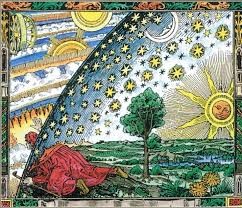
The Philosopher’s Stone lies outside of the realm of the Inversion; it can only be grasped by one who has exited from the dreamer’s reality bubble (or perceptual prison). For most people, the spiralling star tapestry of the cosmos is the first step of the beyond. Reason enough, then, for this to have become the new destination for the modern pioneers within the lesser reality.

The break from the body begins at an early age through social conditioning. To some extent, all individuals have to relinquish some of the contact they have with the innate intelligence of the body (including the body of the natural world) by being incorporated into the ‘social body.’ And as the social body becomes increasingly enmeshed within the digitized landscape, this alienation from the body will only likewise increase. Modern culture’s love affair with decadence, and the rise of sexualization and drug indulgence, all contribute to a desensitization of the body – even when the body is the medium of experience, such as in sexual experiences. As noted, this is a targeting of the ‘pure body’ so as to corrupt its potential for deciphering deeper layers within the Inversion. The body-medium for the life experience is also viewed by transhumanists as a hindrance upon the evolutionary journey toward an ‘immortal society’ that is destined for the stars.

This view is more keenly taken by mostly western and ‘elite’ types who have begun to feed themselves upon a modern cosmic-religious mythic consciousness. This is what Jasun Horsley refers to as a ‘Galactic religion,’ which seeks transcendence/ascension by leaving the planet and colonizing others. It is a ‘rich geek’ religion based on accelerating technologies and pushed by the major tech-titan companies. As Horsley notes, rather than ascension, it is the reverse: ‘It has to do with dissociation, the attempt of the traumatized psyche to split off from the body and float off into fantasy land, beyond the reach of reality and all the pain it entails. Bodies frozen on ice, souls lost in space, free, free from the terrible travails of the body.’3 In such contexts as these, and more, there is a trauma being experienced through the physical body. Trauma can be related to dysfunctional energy being trapped within the body, causing discomfort and disease. In an attempt to escape the body of the planet we are being forced to ‘techno-transcend’ the limitations of the biological human body.

To travel into the stars, we are told, requires us to upload our consciousness into machinic devices and/or ethereal cloudscapes. In a bid to escape the confines of a depleting ‘prison planet’ we are being asked to put our faith – and our consciousness – into a new techno-prison. Yet who shall be the new guards? This could entail the trauma of a new birth – re-enacting the prongs of the biological birth passage yet through entry into yet another realm of the Inversion. There seems to be no genuine exit of the dreaming mind through consciousness upload – only a leap into another programmable maze, yet this time perhaps with less benevolent programmers.

In the western psyche there appears to be an ongoing splintering between ‘inner space’ exploration and ‘outer space’ exploration. The techno-dream of space colonization is the new favoured trend whilst the inner space research of the psyche is promoted as a dangerous and trickster landscape. Outer space is the new undiscovered realm that offers hope against the twilight of the body (including the body of the earth). And yet such ‘Galactic pioneers’ seem driven less by a unified perception and more by forces arising within their splintered psyches that they have failed to integrate. These are the subconscious forces that grasp at survival, at any cost, and would willingly walk over the bodies of others to secure their own survival. Leaving the planetary body is only for the ‘lucky’ few, whilst the rest must remain grounded – or with their minds in cloudscape orbit. The trick of the Inversion is that there are endless doors to keep walking through, yet no exit to awaken out of. By walking out of one dreamworld into another we may think we are free, yet we remain imprisoned within the dream still. Or worse, we unknowingly become our very own prison guards.

No rockets will ever create enough thrust to take us where we truly need to go, for awakening from the gravity of the Inversion is an inner-space journey. It is the colonizing of the quiet kind – of ourselves. By striving to attain the orbital Overview Effect we are missing the real point, which is the ‘Inner view’ from within ourselves.

The Body as the Holy Host

The Inversion – our inverted world reality construct – is unsure what to make of the human physical body. Is it our saviour – our holy host? –  or a danger to our own progress and a threat to the agenda of others? As I have written previously,[ii] the narratives of a new biopower have brought to the fore a medical-political establishment within many of our societies worldwide. The biology of control is now a major player within the current realm of lived experience. There is now a noticeable rush to gain a political-corporate control over the access, use, and sovereignty of the human body. In a very real sense, it is the individual’s last line of physical defence. Each individual is a conscious entity (a spiritual essence) that is operating within this material realm through the vehicle of the physical body. As such, we are uniting with a biological partner. We are a merged being: as it is said, a union of flesh and spirit. Whilst the spirit – the essential being – is immortal, it has to abide in its physical incarnation by the biological limitations of the bodily host. Because of this crucial fact, external control agendas are determined to not only gain power over the outer aspects of the body (it’s freedoms, utility, mobility, etc.,) but also, via interventions, to have control over its internal functioning (DNA code, intra-communication, and more).

The human body functions upon many varied levels and acts as many things – including as a receiver, filter, and transmitter of energies and information. It is only the false, manipulated narrative that posits the human body as a ‘biohazard.’ By using this designation, external agencies of authority can seek to further contain and control the movement of the body as well as gaining internal access through chemical and pharmaceutical interventions. These possibilities were foreseen by many, not least by the social philosopher and author Aldous Huxley. Even as far back as the 1950s, Huxley envisaged the encroachment of scientism to gain increasing intervention into the human body:

Meanwhile pharmacology, biochemistry and neurology are on the march, and we can be quite certain that, in the course of the next few years, new and better chemical methods for increasing suggestibility and lowering psychological resistance will be discovered. Like everything else, these discoveries may be used well or badly. They may help the psychiatrist in his battle against mental illness, or they may help the dictator in his battle against freedom.4

And yet, this is still a viewpoint based on the material and physical sciences. It does not represent a deeper, spiritual perspective. This was to be provided by the Austrian philosopher and proponent of spiritual science, Rudolf Steiner. In talks given during September-October 1917, Steiner had the presence of vision to discuss the later potential interventions and influence over the human body. He said that: ‘Taking a “sound point of view,” people will invent a vaccine to influence the organism as early as possible, preferably as soon as it is born, so that this human body never even gets the idea that there is a soul and a spirit.’5

Clearly, this shows that the human physical body is a site of target in an attempt to curb or block reception of spiritual forces. Through what may appear to be a ‘sound point of view,’ a range of socio-cultural narratives will be created and propagated, according to Steiner, that will push an agenda of increased medical intervention. And these medically backed ideas have the aim ‘to find a vaccine that will drive all inclination towards spirituality out of people’s souls when they are still very young, and this will happen in a roundabout way through the living body.’6 Humanity has arrived at that time now, if we observe current events and their related consequences. We are now at a time within the 21st century where we are witnessing the transmutation of living beings – and bodies. The human being has arrived at a threshold previously unknown to it, and there are forces compelling the human to step over and through it. It is a threshold that will recode environments and bodies. The threshold is the point where a genetic deterritorialization process can begin, and from which we may witness the emergence of a new organism different from the current one. It is a threshold of recombination and recodification; a new assemblage that represents yet another phase within the Inversion. From here on, we are biologically vulnerable to an encroaching machinic impulse that, by its very nature, will morph bodily combinations into machinic connections.

Our bodies are reaching an exhaustion point. The crises we now face across the body of the earth is from a collapse of the individual, social, and psychological body. Already, the social mind is in trauma, and the body is showing this illness or dis-ease. The Inversion has made sure that the biological and psychological dimension has coalesced. The ripple of a bodily trauma is being felt across the planetary membrane as people are forced to unnaturally detach from the physical world around them. New physical arrangements of dislocation (lockdowns) and social avoidance are becoming established practices within our societies. These unnatural ordinances are creating cognitive and bodily dissonance. Bio-traumas have arisen that are affecting our sensibilities. New bodily phobias have been set in motion. This is the newly inverted threshold – a threshold of deterritorialization that has enforced a changing perception of the body. We are sensing alterations in human bodily awareness and receptivity. There is a deprivation too. The body is being pulled back from its natural organic terrain. It is being made to retreat from physical presence and away from the reassuring touch. It is as if the body is being reconfigured to devolve away from the sensual and into a new digitally articulated sensate. This bodily aliveness is being substituted by decomposition and the fear of decay and deterioration.

In the modern age, death has replaced sex as the modern taboo. The sanitized environment of the hospital has replaced the home as the place for passing away. The experience of death and dying has become detached from community life with the effect that emotion and closeness has been replaced by medical management. The dying body has become inverted into a thing of disgust and embarrassment. Death has now become something shameful – a forbidden process. Death is a modern scandal. Modern life has internalized the rejection of death, and we are coded to cringe at the thought of bodily deterioration. Death is a loser. To die is to lose, to fail. There is no room for failure within the deepening layers of machinic materialism and computational competition. Death can be replaced by tech-assisted immortality in the new ‘posthuman future.’ Alternatively, the body can be transcended through transhumanism so that death no longer haunts the halls of the physical flesh. These are the new imaginings in the realm of machinic desire. Humanity is on the threshold of venturing into an Inversion of codified imagination and upturned desires. Desire has overtaken pleasure, and it is the social sphere within the Inversion that creates and sustains this desirous torment and torture of the unattainable. And within the unattainable, greater forms of external control must be endorsed to compensate. For this reasoning, current forces have begun to establish new pathways of control over life processes. And this, by intent and not coincidence, aligns with the rise of the machinic impulse. The question that now needs to be asked is whether the machine impulse is evolutionary or devolutionary in terms of human life upon this planet.

References

Dick, Philip K. (1995) The Shifting Realities of Philip K. Dick: Selected Literary and Philosophical Writings (ed. Lawrence Sutin). New York: Vintage Books, p183

Berman, Morris (1990) Coming to Our Senses: Body and Spirit in the Hidden History of the West. New York: HarperCollins, 146.

Horsley, J. (2018). Prisoner of Infinity: UFOs, Social Engineering, and the Psychology of Fragmentation. London, Aeon Books, p189

Huxley, A. (1959). Brave New World Revisited. London, Chatto & Windus, p107-8

Steiner, Rudolf (2008) The Fall of the Spirits of Darkness. Forest Row: Rudolf Steiner Press, p85

Steiner, Rudolf (2008) The Fall of the Spirits of Darkness. Forest Row: Rudolf Steiner Press, p199-200

[i] Baraka, a prominent concept in Islamic mysticism, refers to a flow of grace and spiritual power that can be transmitted.

[ii] Hijacking Reality: The Reprogramming & Reorganization of Human Life

Don’t Bow Down to a Dictatorial Government. America Is a Prison Disguised as Paradise

By John & Nisha Whitehead

Source: The Rutherford Institute

“If all that Americans want is security, they can go to prison. They’ll have enough to eat, a bed and a roof over their heads. But if an American wants to preserve his dignity and his equality as a human being, he must not bow his neck to any dictatorial government.”— President Dwight D. Eisenhower

The government wants us to bow down to its dictates.

It wants us to buy into the fantasy that we are living the dream, when in fact, we are trapped in an endless nightmare of servitude and oppression.

Indeed, with every passing day, life in the American Police State increasingly resembles life in the dystopian television series The Prisoner.

First broadcast 55 years ago in the U.S., The Prisonerdescribed as “James Bond meets George Orwell filtered through Franz Kafka”—confronted societal themes that are still relevant today: the rise of a police state, the loss of freedom, round-the-clock surveillance, the corruption of government, totalitarianism, weaponization, group think, mass marketing, and the tendency of human beings to meekly accept their lot in life as prisoners in a prison of their own making.

Perhaps the best visual debate ever on individuality and freedom, The Prisoner centers around a British secret agent who abruptly resigns only to find himself imprisoned in a virtual prison disguised as a seaside paradise with parks and green fields, recreational activities and even a butler.

While luxurious, the Village’s inhabitants have no true freedom, they cannot leave the Village, they are under constant surveillance, all of their movements tracked by militarized drones, and stripped of their individuality so that they are identified only by numbers.

“I am not a number. I am a free man,” is the mantra chanted in each episode of The Prisoner, which was largely written and directed by Patrick McGoohan, who also played the title role of Number Six, the imprisoned government agent.

Throughout the series, Number Six is subjected to interrogation tactics, torture, hallucinogenic drugs, identity theft, mind control, dream manipulation, and various forms of social indoctrination and physical coercion in order to “persuade” him to comply, give up, give in and subjugate himself to the will of the powers-that-be.

Number Six refuses to comply.

In every episode, Number Six resists the Village’s indoctrination methods, struggles to maintain his own identity, and attempts to escape his captors. “I will not make any deals with you,” he pointedly remarks to Number Two, the Village administrator a.k.a. prison warden. “I’ve resigned. I will not be pushed, filed, stamped, indexed, debriefed or numbered. My life is my own.”

Yet no matter how far Number Six manages to get in his efforts to escape, it’s never far enough.

Watched by surveillance cameras and other devices, Number Six’s attempts to escape are continuously thwarted by ominous white balloon-like spheres known as “rovers.”

Still, he refuses to give up.

“Unlike me,” he says to his fellow prisoners, “many of you have accepted the situation of your imprisonment, and will die here like rotten cabbages.”

Number Six’s escapes become a surreal exercise in futility, each episode an unfunny, unsettling Groundhog’s Day that builds to the same frustrating denouement: there is no escape.

As journalist Scott Thill concludes for Wired, “Rebellion always comes at a price. During the acclaimed run of The Prisoner, Number Six is tortured, battered and even body-snatched: In the episode ‘Do Not Forsake Me Oh My Darling,’ his mind is transplanted to another man’s body. Number Six repeatedly escapes The Village only to be returned to it in the end, trapped like an animal, overcome by a restless energy he cannot expend, and betrayed by nearly everyone around him.”

The series is a chilling lesson about how difficult it is to gain one’s freedom in a society in which prison walls are disguised within the seemingly benevolent trappings of technological and scientific progress, national security and the need to guard against terrorists, pandemics, civil unrest, etc.

As Thill noted, “The Prisoner was an allegory of the individual, aiming to find peace and freedom in a dystopia masquerading as a utopia.”

The Prisoner’s Village is also an apt allegory for the American Police State, which is rapidly transitioning into a full-fledged Surveillance State: it gives the illusion of freedom while functioning all the while like a prison: controlled, watchful, inflexible, punitive, deadly and inescapable.

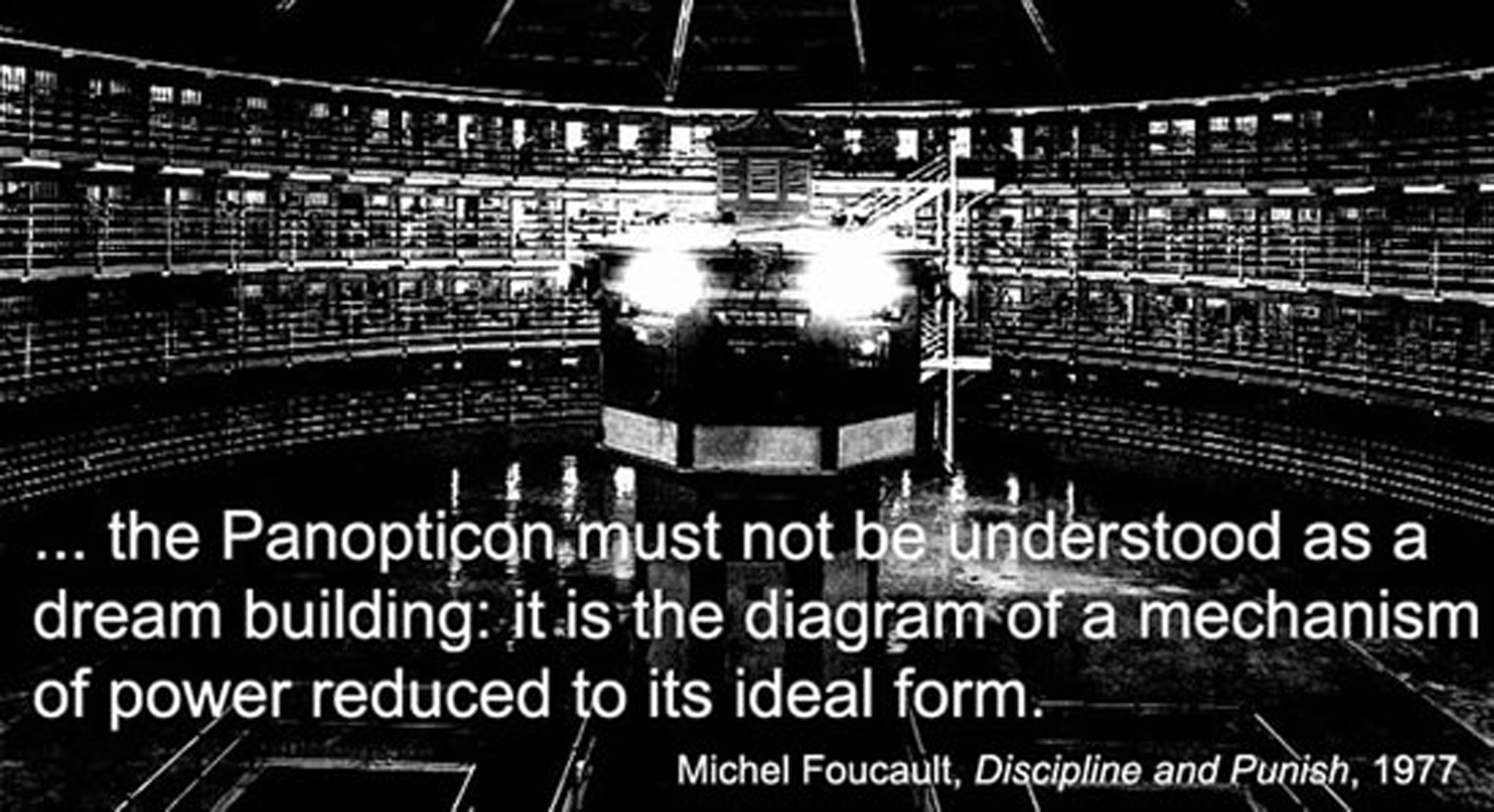
The American Surveillance State, much like The Prisoner’s Village, is a metaphorical panopticon, a circular prison in which the inmates are monitored by a single watchman situated in a central tower. Because the inmates cannot see the watchman, they are unable to tell whether or not they are being watched at any given time and must proceed under the assumption that they are always being watched.

Eighteenth century social theorist Jeremy Bentham envisioned the panopticon prison to be a cheaper and more effective means of “obtaining power of mind over mind, in a quantity hitherto without example.”

Bentham’s panopticon, in which the prisoners are used as a source of cheap, menial labor, has become a model for the modern surveillance state in which the populace is constantly being watched, controlled and managed by the powers-that-be while funding its existence.

Nowhere to run and nowhere to hide: this is the mantra of the architects of the Surveillance State and their corporate collaborators.

Government eyes are watching you.

They see your every move: what you read, how much you spend, where you go, with whom you interact, when you wake up in the morning, what you’re watching on television and reading on the internet.

Every move you make is being monitored, mined for data, crunched, and tabulated in order to amass a profile of who you are, what makes you tick, and how best to control you when and if it becomes necessary to bring you in line.

When the government sees all and knows all and has an abundance of laws to render even the most seemingly upstanding citizen a criminal and lawbreaker, then the old adage that you’ve got nothing to worry about if you’ve got nothing to hide no longer applies.

Apart from the obvious dangers posed by a government that feels justified and empowered to spy on its people and use its ever-expanding arsenal of weapons and technology to monitor and control them, we’re approaching a time in which we will be forced to choose between bowing down in obedience to the dictates of the government—i.e., the law, or whatever a government official deems the law to be—and maintaining our individuality, integrity and independence.

When people talk about privacy, they mistakenly assume it protects only that which is hidden behind a wall or under one’s clothing. The courts have fostered this misunderstanding with their constantly shifting delineation of what constitutes an “expectation of privacy.” And technology has furthered muddied the waters.

However, privacy is so much more than what you do or say behind locked doors. It is a way of living one’s life firm in the belief that you are the master of your life, and barring any immediate danger to another person (which is far different from the carefully crafted threats to national security the government uses to justify its actions), it’s no one’s business what you read, what you say, where you go, whom you spend your time with, and how you spend your money.

Unfortunately, George Orwell’s 1984—where “you had to live—did live, from habit that became instinct—in the assumption that every sound you made was overheard, and, except in darkness, every movement scrutinized”—has now become our reality.

We now find ourselves in the unenviable position of being monitored, managed, corralled and controlled by technologies that answer to government and corporate rulers.

Consider that on any given day, the average American going about his daily business will be monitored, surveilled, spied on and tracked in more than 20 different ways, by both government and corporate eyes and ears.

A byproduct of this new age in which we live, whether you’re walking through a store, driving your car, checking email, or talking to friends and family on the phone, you can be sure that some government agency is listening in and tracking your behavior.

This doesn’t even begin to touch on the corporate trackers that monitor your purchases, web browsing, Facebook posts and other activities taking place in the cyber sphere.

Stingray devices mounted on police cars to warrantlessly track cell phones, Doppler radar devices that can detect human breathing and movement within in a home, license plate readers that can record up to 1800 license plates per minutesidewalk and “public space” cameras coupled with facial recognition and behavior-sensing technology that lay the groundwork for police “pre-crime” programspolice body cameras that turn police officers into roving surveillance cameras, the internet of things: all of these technologies (and more) add up to a society in which there’s little room for indiscretions, imperfections, or acts of independence—especially not when the government can listen in on your phone calls, read your emails, monitor your driving habits, track your movements, scrutinize your purchases and peer through the walls of your home.

As French philosopher Michel Foucault concluded in his 1975 book Discipline and Punish, “Visibility is a trap.”

This is the electronic concentration camp—the panopticon prison—the Village—in which we are now caged.

It is a prison from which there will be no escape. Certainly not if the government and its corporate allies have anything to say about it.

As Glenn Greenwald notes:

“The way things are supposed to work is that we’re supposed to know virtually everything about what [government officials] do: that’s why they’re called public servants. They’re supposed to know virtually nothing about what we do: that’s why we’re called private individuals. This dynamic – the hallmark of a healthy and free society – has been radically reversed. Now, they know everything about what we do, and are constantly building systems to know more. Meanwhile, we know less and less about what they do, as they build walls of secrecy behind which they function. That’s the imbalance that needs to come to an end. No democracy can be healthy and functional if the most consequential acts of those who wield political power are completely unknown to those to whom they are supposed to be accountable.”

None of this will change, no matter which party controls Congress or the White House, because despite all of the work being done to help us buy into the fantasy that things will change if we just elect the right candidate, we’ll still be prisoners of the Village.

So how do you escape? For starters, resist the urge to conform to a group mind and the tyranny of mob-think as controlled by the Deep State.

Think for yourself. Be an individual.

As McGoohan commented in 1968, “At this moment individuals are being drained of their personalities and being brainwashed into slaves… As long as people feel something, that’s the great thing. It’s when they are walking around not thinking and not feeling, that’s tough. When you get a mob like that, you can turn them into the sort of gang that Hitler had.”

You want to be free? Remove the blindfold that blinds you to the Deep State’s con game, stop doping yourself with government propaganda, and break free of the political chokehold that has got you marching in lockstep with tyrants and dictators.

As I make clear in my book Battlefield America: The War on the American People and in its fictional counterpart The Erik Blair Diaries, until you come to terms with the fact that the government is the problem (no matter which party dominates), you’ll never stop being prisoners.

Freedom Is a Myth: We Are All Prisoners of the Police State’s Panopticon Village

“We’re run by the Pentagon, we’re run by Madison Avenue, we’re run by television, and as long as we accept those things and don’t revolt we’ll have to go along with the stream to the eventual avalanche…. As long as we go out and buy stuff, we’re at their mercy… We all live in a little Village. Your Village may be different from other people’s Villages, but we are all prisoners.”— Patrick McGoohan

By John W. Whitehead

Source: The Rutherford Institute

First broadcast in Great Britain 50 years ago, The Prisoner—a dystopian television series described as “James Bond meets George Orwell filtered through Franz Kafka”—confronted societal themes that are still relevant today: the rise of a police state, the freedom of the individual, round-the-clock surveillance, the corruption of government, totalitarianism, weaponization, group think, mass marketing, and the tendency of humankind to meekly accept their lot in life as a prisoner in a prison of their own making.

Perhaps the best visual debate ever on individuality and freedom, The Prisoner (17 episodes in all) centers around a British secret agent who abruptly resigns only to find himself imprisoned, monitored by militarized drones, and interrogated in a mysterious, self-contained, cosmopolitan, seemingly tranquil retirement community known only as the Village. The Village is an idyllic setting with parks and green fields, recreational activities and even a butler.

While luxurious and resort-like, the Village is a virtual prison disguised as a seaside paradise: its inhabitants have no true freedom, they cannot leave the Village, they are under constant surveillance, their movements are tracked by surveillance drones, and they are stripped of their individuality and identified only by numbers.

The series’ protagonist, played by Patrick McGoohan, is Number Six.

Number Two, the Village administrator, acts as an agent for the unseen and all-powerful Number One, whose identity is not revealed until the final episode.

“I am not a number. I am a free man,” was the mantra chanted on each episode of The Prisoner, which was largely written and directed by McGoohan.

In the opening episode (“The Arrival”), Number Six meets Number Two, who explains to him that he is in The Village because information stored “inside” his head has made him too valuable to be allowed to roam free “outside.”

Throughout the series, Number Six is subjected to interrogation tactics, torture, hallucinogenic drugs, identity theft, mind control, dream manipulation, and various forms of social indoctrination and physical coercion in order to “persuade” him to comply, give up, give in and subjugate himself to the will of the powers-that-be.

Number Six refuses to comply.

In every episode, Number Six resists the Village’s indoctrination methods, struggles to maintain his own identity, and attempts to escape his captors. “I will not make any deals with you,” he pointedly remarks to Number Two. “I’ve resigned. I will not be pushed, filed, stamped, indexed, debriefed or numbered. My life is my own.”

Yet no matter how far Number Six manages to get in his efforts to escape, it’s never far enough.

Watched by surveillance cameras and other devices, Number Six’s getaways are continuously thwarted by ominous white balloon-like spheres known as “rovers.” Still, he refuses to give up. “Unlike me,” he says to his fellow prisoners, “many of you have accepted the situation of your imprisonment, and will die here like rotten cabbages.”

Number Six’s escapes become a surreal exercise in futility, each episode an unfunny, unsettling Groundhog’s Day that builds to the same frustrating denouement: there is no escape.

As journalist Scott Thill concludes for Wired, “Rebellion always comes at a price. During the acclaimed run of The Prisoner, Number Six is tortured, battered and even body-snatched: In the episode ‘Do Not Forsake Me Oh My Darling,’ his mind is transplanted to another man’s body. Number Six repeatedly escapes The Village only to be returned to it in the end, trapped like an animal, overcome by a restless energy he cannot expend, and betrayed by nearly everyone around him.”

The series is a chilling lesson about how difficult it is to gain one’s freedom in a society in which prison walls are disguised within the trappings of technological and scientific progress, national security and so-called democracy.

As Thill noted when McGoohan died in 2009, “The Prisoner was an allegory of the individual, aiming to find peace and freedom in a dystopia masquerading as a utopia.”

The Prisoner’s Village is also an apt allegory for the American Police State: it gives the illusion of freedom while functioning all the while like a prison: controlled, watchful, inflexible, punitive, deadly and inescapable.

The American Police State, much like The Prisoner’s Village, is a metaphorical panopticon, a circular prison in which the inmates are monitored by a single watchman situated in a central tower. Because the inmates cannot see the watchman, they are unable to tell whether or not they are being watched at any given time and must proceed under the assumption that they are always being watched.

Eighteenth century social theorist Jeremy Bentham envisioned the panopticon prison to be a cheaper and more effective means of “obtaining power of mind over mind, in a quantity hitherto without example.”

Bentham’s panopticon, in which the prisoners are used as a source of cheap, menial labor, has become a model for the modern surveillance state in which the populace is constantly being watched, controlled and managed by the powers-that-be and funding its existence.

Nowhere to run and nowhere to hide: this is the new mantra of the architects of the police state and their corporate collaborators (Facebook, Amazon, Netflix, Google, Instagram, etc.).

Government eyes are watching you.

They see your every move: what you read, how much you spend, where you go, with whom you interact, when you wake up in the morning, what you’re watching on television and reading on the internet.

Every move you make is being monitored, mined for data, crunched, and tabulated in order to form a picture of who you are, what makes you tick, and how best to control you when and if it becomes necessary to bring you in line.

When the government sees all and knows all and has an abundance of laws to render even the most seemingly upstanding citizen a criminal and lawbreaker, then the old adage that you’ve got nothing to worry about if you’ve got nothing to hide no longer applies.

Apart from the obvious dangers posed by a government that feels justified and empowered to spy on its people and use its ever-expanding arsenal of weapons and technology to monitor and control them, we’re approaching a time in which we will be forced to choose between obeying the dictates of the government—i.e., the law, or whatever a government official deems the law to be—and maintaining our individuality, integrity and independence.

When people talk about privacy, they mistakenly assume it protects only that which is hidden behind a wall or under one’s clothing. The courts have fostered this misunderstanding with their constantly shifting delineation of what constitutes an “expectation of privacy.” And technology has furthered muddied the waters.

However, privacy is so much more than what you do or say behind locked doors. It is a way of living one’s life firm in the belief that you are the master of your life, and barring any immediate danger to another person (which is far different from the carefully crafted threats to national security the government uses to justify its actions), it’s no one’s business what you read, what you say, where you go, whom you spend your time with, and how you spend your money.

Unfortunately, George Orwell’s 1984—where “you had to live—did live, from habit that became instinct—in the assumption that every sound you made was overheard, and, except in darkness, every movement scrutinized”—has now become our reality.

We now find ourselves in the unenviable position of being monitored, managed and controlled by our technology, which answers not to us but to our government and corporate rulers.

Consider that on any given day, the average American going about his daily business will be monitored, surveilled, spied on and tracked in more than 20 different ways, by both government and corporate eyes and ears.

A byproduct of this new age in which we live, whether you’re walking through a store, driving your car, checking email, or talking to friends and family on the phone, you can be sure that some government agency, whether the NSA or some other entity, is listening in and tracking your behavior.

This doesn’t even begin to touch on the corporate trackers that monitor your purchases, web browsing, Facebook posts and other activities taking place in the cyber sphere.

Stingray devices mounted on police cars to warrantlessly track cell phones, Doppler radar devices that can detect human breathing and movement within in a home, license plate readers that can record up to 1800 license plates per minute, sidewalk and “public space” cameras coupled with facial recognition and behavior-sensing technology that lay the groundwork for police “pre-crime” programs, police body cameras that turn police officers into roving surveillance cameras, the internet of things: all of these technologies add up to a society in which there’s little room for indiscretions, imperfections, or acts of independence—especially not when the government can listen in on your phone calls, monitor your driving habits, track your movements, scrutinize your purchases and peer through the walls of your home.

As French philosopher Michel Foucault concluded in his 1975 book Discipline and Punish, “Visibility is a trap.”

This is the electronic concentration camp—the panopticon prison—the Village—in which we are now caged.

It is a prison from which there will be no escape if the government gets it way.

As Glenn Greenwald notes:

“The way things are supposed to work is that we’re supposed to know virtually everything about what [government officials] do: that’s why they’re called public servants. They’re supposed to know virtually nothing about what we do: that’s why we’re called private individuals. This dynamic – the hallmark of a healthy and free society – has been radically reversed. Now, they know everything about what we do, and are constantly building systems to know more. Meanwhile, we know less and less about what they do, as they build walls of secrecy behind which they function. That’s the imbalance that needs to come to an end. No democracy can be healthy and functional if the most consequential acts of those who wield political power are completely unknown to those to whom they are supposed to be accountable.”

Even now, the Trump Administration is working to make some of the National Security Agency’s vast spying powers permanent.

In fact, Attorney General Jeff Sessions is pushing for Congress to permanently renew Section 702 of the Foreign Intelligence Surveillance Act, which allows government snoops to warrantlessly comb through and harvest vast quantities of our communications.

And just like that, we’re back in the Village, our escape plans foiled, our future bleak.

Except this is no surprise ending: for those who haven’t been taking the escapist blue pill, who haven’t fallen for the Deep State’s phony rhetoric, who haven’t been lured in by the promise of a political savior, we never stopped being prisoners.

So how do we break out?

For starters, wake up. Resist the urge to comply.

The struggle to remain “oneself in a society increasingly obsessed with conformity to mass consumerism,” writes Steven Paul Davies, means that superficiality and image trump truth and the individual. The result is the group mind and the tyranny of mob-think.

Think for yourself. Be an individual. As McGoohan commented in 1968, “At this moment individuals are being drained of their personalities and being brainwashed into slaves… As long as people feel something, that’s the great thing. It’s when they are walking around not thinking and not feeling, that’s tough. When you get a mob like that, you can turn them into the sort of gang that Hitler had.”

In a media-dominated age in which the lines between entertainment, politics and news reporting are blurred, it is extremely difficult to distinguish fact from fiction. We are so bombarded with images, dictates, rules and punishments and stamped with numbers from the day we are born that it is a wonder we ever ponder a concept such as freedom. As McGoohan declared, “Freedom is a myth.”

In the end, as I make clear in my book Battlefield America: The War on the American People, we are all prisoners of our own mind.

In fact, it is in the mind that prisons are created for us. And in the lockdown of political correctness, it becomes extremely difficult to speak or act individually without being ostracized. Thus, so often we are forced to retreat inwardly into our minds, a prison without bars from which we cannot escape, and into the world of video games and television and the Internet.

We have come full circle from Bentham’s Panopticon to McGoohan’s Village to Huxley’s Brave New World.

As cultural theorist Neil Postman observed:

What Orwell feared were those who would ban books. What Huxley feared was that there would be no reason to ban a book, for there would be no one who wanted to read one. Orwell feared those who would deprive us of information. Huxley feared those who would give us so much that we would be reduced to passivity and egoism. Orwell feared we would become a captive audience. Huxley feared the truth would be drowned in a sea of irrelevance. Orwell feared that we would become a captive culture. Huxley feared we would become a trivial culture, preoccupied with some equivalent of the feelies, the orgy porgy, and the centrifugal bumblepuppy. As Huxley remarked in Brave New World Revisited, the civil libertarians and rationalists who are ever on the alert to oppose tyranny “failed to take into account man’s almost infinite appetite for distractions.” In Brave New World, they are controlled by inflicting pleasure. In short, Orwell feared that what we hate would ruin us. Huxley feared that what we love will ruin us.

You want to be free? Break out of the circle.

Abandoning the Ship of Fools: Postmodernist and Wildist Responses to Civilization

220px-Narrenschiff_(1549)

By Jeriah Bowser

Source: The Hampton Institute

Once upon a time there was a people who lived with the Sea; living in connection, intimacy, and harmony with their aquatic environment for a very long time. Then one day a dangerous and powerful man had a bold idea. He thought that if he could build a Ship to sail over the Sea, he might find a better world to live in, a Paradise. He had a hard time convincing others that this Paradise was something to pursue, however, so in order to accomplish this he had to enslave lots of other sea-people to make the voyage possible. The sea-people, under threat of violence and death, built a large ship out of dead plant and animal people, stocked the ship with supplies, and took their place at the oars of the slave-galley. This great Ship then sailed away from the sea-people’s ancestral homeland and headed into the great unknown. After a long time at sea, the slaves forgot they were slaves. As they adapted to their new life of labor and hardship aboard the Ship, they forgot what life was like as sea-people and began identifying with the Ship and its mission. As they forgot how to live on their own away from the Ship, their survival and happiness became inextricably bound up with the Ship and the Captain, until they no longer saw themselves as slaves at all, but as willing participants onboard this fantastic adventure. Their language, culture, rituals, and mythology transformed to reflect their new way of life. They now worshipped the Captain and Paradise Gods as they saw themselves fundamentally separated from the Sea and its ways. The Captain created laws and morals with which to guide correct behavior aboard the Ship. They created rituals for themselves which gave them context for their roles on the Ship and gave meaning to their lives of labor and struggle. They lost all contact with their former ways of being and understanding the world. They were truly unanchored in the world; the Ship being their only reference point for Truth and Deception, Meaning and Nihilism, Beauty and Ugliness, Community and Individuality, Pleasure and Suffering, Sacredness and Profanity.

After a while, some of the slaves felt uncomfortable with what they perceived as unjust treatment aboard the Ship. They were tired of being beaten and starved and worked to death and wanted a better life. But instead of abandoning the Ship, they simply asked for more participation. The slaves had forgotten what life was like before the voyage, they couldn’t imagine living without the Ship and the Captain. They had begun identifying with the Ship and its mission so much that they wanted an equal role in participating.They were tired of just rowing and thought that the Navigator’s job might be fun, along with some of the other jobs on board the Ship that were usually reserved for the Captain’s friends. When this discontent reached a certain point, there would be mutinies where the slaves would demand equal access to the Ship, they demanded equal rights. The Captain, being a shrewd man, would listen to their requests and grant them greater access to the Ship. He even let some of the slaves take the wheel for a few minutes on special occasions; it was always a great spectacle when a slave would be called up from the galleys to the captain’s chair for a few minutes, turning the wheel this way and that, grinning idiotically as a rush of power, purpose, and meaning rushed through the slave until their turn was up and they were sent back down to the galleys. The hope of getting a turn at the wheel inspired much enthusiasm and loyalty to the project. Of course, no-one, not even the Captain perhaps, knew that the wheel had been broken for a long time now – it was merely a symbol. Even if the wheel did work, the Ocean current the Ship was now in was much too strong to break out of with a mere wheel turn. The Ship was now caught in a force much larger than itself, it had started on a voyage which it now had no control over.

One day, a few of the more clever slaves got together and started whispering to each other about some things that seemed strange about the whole affair. They couldn’t really put their finger on exactly what was wrong, they just felt that… something was wrong, so they began poking around and investigating. Some of these clever slaves had access to navigation equipment and, after much calculation, discovered that not only was the wheel broken, but the Ship was caught in a huge ocean current that was going in a giant circle and heading nowhere which meant that… there was no Paradise. This was very troubling news. Another member shared that he had discovered a mask with the Captain’s face on it – it seemed that the all-powerful Captain was a mere puppet. Was he in hiding? Was he still alive? Who had killed him? Was he ever real? These were even more troubling discoveries. A few others gained access to the forbidden areas of the Ship: the secret rooms and cellars where the Ships records were stored. As they began exploring the dark and musty belly of the Ship, they discovered that the Ship itself was starting to sink – water was slowly leaking in through the rotting hull and pulling the Great Ship down. Terrified and angry at having been lied to, they decided to try and jettison from the Ship as quickly as possible. They tore apart a section of a storeroom and, using the lumber and tools from the Ship, made a small dinghy together. They launched their dinghy one dark and stormy night, and spent a long time celebrating and high-fiving each other, full of self-congratulatory exhilaration at having escaped the fate of the other slaves. What they didn’t yet realize, however, was that they were caught in the same current as the Mother-Ship. They were headed for the same fate, they had no bearings in the great Sea, no ability to change their course even if they did know where they were, and their dinghy (having been made of the same tools and materials as the Mother-Ship) was already starting to rot and leak.
*****************
The mythology of the Ship of Fools is very old, it is first attributed to Plato, a 4th century BCE Greek philosopher. He used the Ship as an analogy for the fragility and irrationality of a democratic society, as only a strong Captain (a rigidly Rational and authoritarian political system) could maintain order and keep the Ship on course. Some have translated Plato’s metaphor (as well as the remainder of the Republic) as a work of psychology a well, as we mustn’t allow the chaos of our irrational desires and whims (the passengers) distract us or drown out the one voice of Reason (the Captain) in our heads. [1] Various philosophers and writers have since used this metaphor as a literary device and point of philosophical inquiry. Michel Foucault, a 20th century French postmodernist, used the story as a reference point in his book, “Madness and Civilization,” where he explored the history of the social construction of mental illness. In Foucault’s book, he talks about the mythological and historical legacy of the legend and discovered that there were indeed floating insane asylums – the “Narrenschiffs” – which carried those deemed insane from port to port in Europe, particularly in Germany, in the early 15th century. These floating asylums were eventually retired in favor of prison-like insane asylums, which eventually became our mental hospitals.[2] Sebastian Brant, a late-fifteenth century German theologian, used the mythology of the Ship of Fools as a satirical device as he mocked politicians, academics, and various prophets of Modernism during his time.[3] Ted Kaczynski used the Ship of Fools as a metaphor for industrial capitalism in order to critique the role that leftism/reformism plays in distracting and co-opting dissent, and his essay on the topic is considered to be Ted’s most coherent and accessible work.[4] In Max Horkheimer and Theodore Adorno’s landmark 1947 book, “Dialectic of Enlightenment,” they explore this myth by working from Homer’s epic poem, “The Odyssey.” Horkheimer and Adorno portray the epic story of Odysseus as a metaphor for humanity’s journey away from wildness and into civilization. [5]

Since my first introduction to this myth, I felt that it was heavy with archetypal symbolism which begged to be explored. I searched for an explanation which would satisfy my curiosity, but found none that sufficed. It looks like this task has fallen to me.

The Ocean is steeped in archetypal symbolism, most of it revolving around the theme of wildness, as it is the largest and most inaccessible wilderness on our planet. Jung described the Ocean as the very embodiment of the unconscious, with our consciousness a tiny island in the midst of it. [6] While every corner of land on our planet has been thoroughly mapped, every animal or plant we come across has been catalogued and placed on an evolutionary tree, and every “resource” depleted for human consumption, the Ocean still remains vast, mysterious, and elusive from the greedy hands of Science and Progress. The Sea still holds its own against those who would colonize it, although it is slowly being killed despite its resistance. As such, the Ocean holds great symbolism as our unconscious shadow side, our repressed hidden instincts and urges, the dark and dangerous animal that lies in us all.

In my retelling of the Ship of Fools, the Ocean also represents our ancestral homeland, as (according to evolutionary biologists) mammals came from the Ocean and I believe a part of us still recognizes that. I feel it when I stand on a beach and find myself staring out into the vast wild ancestral homeland of my species. I also made the Ocean our home because having a land-destination brings up to possibility of a destination and a potential rescue, it dangles the carrot of Paradise out in front of the Ship. No, there is no land, no destination, no possibility of a safe landing, there will be no survivors washing ashore. There is just more Ocean everywhere you look, more wildness, there is no escaping it. This also brings up the point that there never was a destination in the first place, just an inevitable return and release to wildness.

The Ship is an excellent metaphor for Civilization, as it is the great technological project that carries us to Paradise. Although I found scant mentions of ships in Jungian symbolism (not that I am an authority on Jung), the few mentions of it I did find present the Ship as the Animus (male quality) to the Anima (feminine quality) of the Sea. Therefore, ships refer to the Ego-consciousness and masculine energy, as these man-made floating islands rise above and ride on top of the vast feminine unconscious that is the Sea.[7] Trying my hand at depth psychology, I find that it also represents Technology, as a Ship is a piece of advanced technology which requires division of labor, slavery, private property, objectification, and anthropocentrism to exist. The presence of a slave-galley requires all of those ideas to become systemic and normalized, as well as the ever-present but invisible social violence of civilization which keeps the slaves rowing. A ship is made of dead trees, tar, rope, metal hardware, cloth sails, etc. It is a floating human container made of tree corpses, a vessel built out of and predicated on death. This technological vessel of death allows us to float a few feet above the reality of wildness, allowing us to act like the Ocean isn’t there while we go about our business aboard the floating Machine. It is literally a manufactured barrier between us and the cold, dark, mysterious reality of the Ocean. But no Ship is infinite. No matter what materials they are made out of, they will eventually succumb to the law of return: wood will eventually rot, metal will eventually rust, and fiberglass will eventually break down. The thin barrier between us and wildness will eventually erode; our model of infinite growth on a finite planet will have to face reality sooner or later.

The cultural transition of the slaves into willing participants represents the process of domestication. This is also known as trauma-bonding, colonization, or the Stockholm syndrome. When an animal becomes totally dependent on their domesticators for survival, approval, meaning, and validation, we begin to identify with our oppressors, releasing our hatred/resistance towards them and accepting their needs, beliefs, and desires as our own. [8] This takes place on many levels, and when a culture has become domesticated enough we will begin adapting our language, symbols, mythology, and rituals to correspond to our new reality. The old ways of understanding the world no longer make sense in a new world of separation, trauma, and domination. Mythology is a means of situating oneself within a community, a way of deriving meaning from a seemingly chaotic and uncontrollable reality. Ritual is a way of initiating one into and reaffirming cultural mythology. In the civilized world, our rituals reflect our mythology perfectly: we participate in self-destructive, dangerous, and meaningless rites of passage such as gang initiations, getting drunk, graduating high school, getting our driver’s license, or having sex, and our initiation societies are those which inculcate us further into Empire: academia, military, business, and street gangs invite us in, given us our identities, give us a role within a community, and use us until they are done with us and they find another young person desperate for meaning and purpose in their life. Aboard the Ship, we completely lose our bearings to reality as we are swept away into the future. All of our symbols reflect those of the Ship: we understand ourselves and the world around us only through the medium of Ship language and culture. We forget that another way of being in the world ever existed or even could exist.

The Captain represents God, Morality, Modernism, Science, and Objective Truth. The Captain is whatever or whomever currently holds Truth and Power. Of course, there actually is no Captain, nor was there ever, but that doesn’t stop everyone onboard from emphatically believing in his existence and striving to live their lives in ways that are acceptable to the Great Captain. His presence in this story is important for two reasons. One, it is important to realize that domestication is never a voluntary activity. That is, it is always done through oppression, violence, and Trauma. The slaves did not join this Ship voluntarily, they were forced into it – civilization is predicated on violent domination and slavery. Two, the Captain represents the ever-present specter of Morality/Truth/Power within civilized cultures. The Captain may have never existed, or he may have died a long time ago. It makes no difference to domesticated people, for once he has colonized us we reserve a special place for Him in our heads: He is always watching, and any infraction of His rules brings swift judgment from above in the form of conscience/guilt.

The slave revolts that take place aboard the Ship are the central focus of Kaczynski’s version of the story, as he was focused on exposing leftism/reformism as ultimately futile within the larger context of the Ship’s course. Conversations on “rights” or “equality” always take place within the larger context of civilization. “Granting Rights” is a legal term, it uses the language of Power, it means granting a person or a living thing a privileged position within the hierarchical structure of Power; it does not mean destroying the power structure. The critics of Wildism will point out that this itself is a privileged position: we must not care about the injustices of oppressed groups of people in order to take such a dismissive stand. This entirely misses the point. Do I want cops to be able to kill black people whenever they want? Do I want men to able to assault women whenever they want? Of course not. Leftism acts as a co-opting tool, it obfuscates power by playing with symbols. Police brutality in the US did not end with “racial equality,” because equality in this context means giving people with darker skin equal access to systems of oppressive power. I don’t want white cops killing anybody and I don’t want black cops killing anybody. I don’t want men assaulting anybody and I don’t want women assaulting anybody. I don’t want Latino lawyers or women presidents, I don’t think giving historically oppressed people an opportunity to share in oppression is progress at all… but of course it is Progress. Leftism serves as a safety-valve for cultural resistance. When the pressure gets a bit high, oppressed cultures can let off steam by participating in symbolic protests or fighting for equality, so long as they don’t actually challenge the dominant narrative, as long as they never question or challenge Civilization or Progress. Now, that doesn’t mean that resistance is always leftist/reformist, it just means that resistance to domination/oppression/domestication often gets subverted into some bullshit political agenda that challenges nothing and changes nothing.

The instances of slaves taking the wheel is of course a metaphor for the political system in general, as the entire puppet show is a complete distraction and has no bearing on the course of the Ship. The wheel has been broken for a long time, and even if a group of people genuinely tried to fix the wheel and steer the Ship somewhere else, they would find themselves trapped in the Ocean current. We are caught up in forces way beyond our comprehension or control. Civilization is experiencing massive overshoot, and the planet simply cannot continue supporting this way of being. But the wheel still sits there, tempting us to try and do something, fix something, if we can just be creative and committed enough… but even this great symbol of Hope and Progress will go down with the Ship.

The clever slaves represent the postmodernists – those who, having investigated the Ship and its Captain, have figured out that we have been duped, and are therefore trying to escape by jettisoning from the Mother-Ship. A noble effort, for sure, but ultimately doomed because they never looked past the Ship itself to see what lies beneath. Their survival craft is built with the same materials as the Mother-Ship, the postmodernists have not let go of any of the pillars of civilization but have instead tried to re-imagine them through language games and attempts at subjective Truth. Except for a thoroughly consistent rejection of Power and Objective Truth, the rest of the pillars of civilization remain present throughout much postmodern work: Anthropocentrism, Androcentrism, Progress, Atomization, Dualism, Hierarchy… the gang’s all here, sometimes questioned but never examined to their origins and then rejected. The postmodernists went all the way to the cellar of the Ship, but they stopped at the hull. They never tried to look past the thin barrier of death that lay between them and wildness, they never questioned what was on the other side, they simply took the Ship as an unfortunate but necessary reality and tried to rebuild a new Ship from some spare materials. Those clever slaves found themselves again stranded in the middle of nowhere in a rotting and leaking dinghy, this time without even the reassuring lies of Objective Truth to comfort them. They are truly a sorry lot. With no cultural mythology, context, or ritual to guide them, without connection, they are aimlessly and meaninglessly floating next to the Mother-Ship, caught in a current of impending destruction, in an Ocean of terrifying wildness.

Postmodernism has failed to provide meaning or connection primarily because it begins its search for meaning within the confines of civilization. Any course or book on Western philosophy begins with the Ancient Greeks: the Pre-Socratics. They call this period of time “Premodernism” and proceed from there, accepting the words and thoughts of these thoroughly domesticated humans as somehow representing our origins as humans. Postmodernism accepts radical disconnection/domestication/Trauma as a given, fast-forwards 8000 years, and then wonders why we are so disconnected/domesticated/Traumatized today.

Postmodernists ask a lot of really good questions; they relentlessly critique and question Power and Objective Truth, and they understand that Modernism has failed us miserably. However, they offer nothing better! In fact, one could make the argument that telling a thoroughly domesticated/traumatized person that Truth is subjective is almost a cruel joke; without context for understanding subjective experience, without connection, subjective Truth is terrifying and overwhelming. It is no favor to tell a civilized person that their entire framework for understanding reality is false, you leave them stranded on a leaky dinghy in the Ocean, with no context for how to find meaning in the universe, no guidance for situating themselves within their human and biotic communities, no advice for restoring connection and returning to wildness.

To return to the Ship metaphor, what other option is there? What are the anti-modernists, the anarcho-primitivists, the rewilders, and Wildists doing? Well, we are either actively sabotaging the Ship by attempting to burn it down and drilling holes in the hull, or we are literally jumping Ship – actively seeking a return to wildness and embracing the dark icy chill of the unknown. We know that the wheel of political change is a joke, there is no Paradise, the Captain is a lying sadistic tyrant (who doesn’t actually exist), the postmodernist dinghy is doomed to failure, and to stay aboard the Ship is to go down with it… so we are done with the whole thing. This does not mean that we will escape any of the consequences of civilization or that we will somehow survive the impending collapse of the Ship and the rise of Wildness, it simply means that we are done rowing and believing in the Ship, in Paradise, in the Captain, or in any false hope of rescue. Like the postmodernists, we emphatically reject any notion of Objective Truth, but our rejection is grounded in the context of relationship and connection. Our growing connection to the wildness both inside and outside of us orients us as we abandon Ship, as we allow the great terrifying, wild mystery of the Ocean consume us, destroy us, heal us, and take us home.

Notes


[1] “Republic: Book Six” – Plato

[2] “Madness and Civilization” – Michel Foucault (1964)

[3] “Ship of Fools” – Sebastian Brant (1494)

[5] “Dialectic of Enlightenment” – Max Horkheimer and Theodore Adorno (1944)

[6] “The Portable Jung” – C.G. Jung, edited by Joseph Campbell (1976)

[7] “The Archetypes and the Collective Unconscious” – C.G. Jung (1981)

[8] Frantz Fanon has explored this phenomenon of trauma-bonding, or colonization, exhaustively.I cannot more highly recommend his works for those interested in exploring the impacts of domestication on humans.