
America’s Addiction to War Comes with a 15 Trillion Dollar Price Tag

To surmount the debt crisis, America needs to stop feeding the Military-Industrial Complex, the most powerful lobby in Washington.
By Jeffrey D. Sachs

Source: Information Clearing House

In the year 2000, the U.S. government debt was $3.5 trillion, equal to 35% of the Gross Domestic Product (GDP). By 2022, the debt was $24 trillion, equal to 95% of GDP. The U.S. debt is soaring, hence America’s current debt crisis. Yet both Republicans and Democrats are missing the solution: stopping America’s wars of choice and slashing military outlays.

Suppose the government’s debt had remained at a modest 35% of GDP, as in 2000. Today’s debt would be $9 billion, as opposed to $24 trillion. Why did the U.S. government incur the excess $15 trillion in debt?

The single biggest answer is the U.S. government’s addiction to war and military spending. According to the Watson Institute at Brown University, the cost of U.S. wars from fiscal year 2001 to fiscal year 2022 amounted to a whopping $8 trillion, more than half of the extra $15 trillion in debt. The other $7 trillion arose roughly equally from budget deficits caused by the 2008 financial crisis and the Covid-19 pandemic.

Facing down the military-industrial lobby is the vital first step to putting America’s fiscal house in order.

To surmount the debt crisis, America needs to stop feeding the Military-Industrial Complex (MIC), the most powerful lobby in Washington. As President Dwight D. Eisenhower famously warned on January 17, 1961, “In the councils of government, we must guard against the acquisition of unwarranted influence, whether sought or unsought, by the military-industrial complex. The potential for the disastrous rise of misplaced power exists and will persist.” Since 2000, the MIC led the U.S. into disastrous wars of choice in Afghanistan, Iraq, Syria, Libya, and now Ukraine.

The Military-Industrial Complex long ago adopted a winning political strategy by ensuring that the military budget reaches into every Congressional district. The Congressional Research Service recently reminded Congress that, “Defense spending touches every Member of Congress’s district through pay and benefits for military servicemembers and retirees, economic and environmental impact of installations, and procurement of weapons systems and parts from local industry, among other activities.” Only a brave member of Congress would vote against the military-industry lobby, yet bravery is certainly no hallmark of Congress.

America’s annual military spending is now around $900 billion, roughly 40% of the world’s total, and greater than the next 10 countries combined. U.S. military spending in 2022 was triple that of China. According to Congressional Budget Office, the military outlays for 2024-2033 will be a staggering $10.3 trillion on current baseline. A quarter or more of that could be avoided by ending America’s wars of choice, closing down many of America’s 800 or so military bases around the world, and negotiating new arms control agreements with China and Russia.

Yet instead of peace through diplomacy, and fiscal responsibility, the MIC regularly scares the American people with a comic-book style depictions of villains whom the U.S. must stop at all costs. The post-2000 list has included Afghanistan’s Taliban, Iraq’s Saddam Hussein, Syria’s Bashar al-Assad, Libya’s Moammar Qaddafi, Russia’s Vladimir Putin, and recently, China’s Xi Jinping. War, we are repeatedly told, is necessary for America’s survival.
 

A peace-oriented foreign policy would be opposed strenuously by the military-industrial lobby but not by the public. Significant public pluralities already want less, not more, U.S. involvement in other countries’ affairs, and less, not more, US troop deployments overseas. Regarding Ukraine, Americans overwhelmingly want a “minor role” (52%) rather than a “major role” (26%) in the conflict between Russia and Ukraine. This is why neither Biden nor any recent president has dared to ask Congress for any tax increase to pay for America’s wars. The public’s response would be a resounding “No!”

While America’s wars of choice have been awful for America, they have been far greater disasters for countries that America purports to be saving. As Henry Kissinger famously quipped, “To be an enemy of the United States can be dangerous, but to be a friend is fatal.” Afghanistan was America’s cause from 2001 to 2021, until the U.S. left it broken, bankrupt, and hungry. Ukraine is now in America’s embrace, with the same likely results: ongoing war, death, and destruction.

The military budget could be cut prudently and deeply if the U.S. replaced its wars of choice and arms races with real diplomacy and arms agreements. If presidents and members of congress had only heeded the warnings of top American diplomats such as William Burns, the U.S. Ambassador to Russia in 2008, and now CIA Director, the U.S. would have protected Ukraine’s security through diplomacy, agreeing with Russia that the U.S. would not expand NATO into Ukraine if Russia also kept its military out of Ukraine. Yet relentless NATO expansion is a favorite cause of the MIC; new NATO members are major customers of U.S. armaments.

The U.S. has also unilaterally abandoned key arms control agreements. In 2002, the U.S. unilaterally walked out of the Anti-Ballistic Missile Treaty. And rather than promote nuclear disarmament—as the U.S. and other nuclear powers are required to do under Article VI the Nuclear Non-Proliferation Treaty—the Military-Industrial Complex has sold Congress on plans to spend more than $600 billion by 2030 to “modernize” the U.S. nuclear arsenal.

Now the MIC is talking up the prospect of war with China over Taiwan. The drumbeats of war with China are stoking the military budget, yet war with China is easily avoidable if the U.S. adheres to the One-China policy that properly underpins U.S.-China relations. Such a war should be unthinkable. More than bankrupting the U.S., it could end the world.

Military spending is not the only budget challenge. Aging and rising healthcare costs add to the fiscal woes. According to the Congressional Budget Office, debt will reach 185 percent of GDP by 2052 if current policies remain unchanged. Healthcare costs should be capped while taxes on the rich should be raised. Yet facing down the military-industrial lobby is the vital first step to putting America’s fiscal house in order, needed to save the U.S., and possibly the world, from America’s perverse lobby-driven politics.
Bono Is Doing Illustrations For The Atlantic Now, Because Everything’s Fake And Stupid

By Caitlin Johnstone

Source: CaitlinJohnstone.com

So U2 singer Bono is literally just doing illustrations for the imperialist propaganda rag The Atlantic now, because that’s the sort of thing that happens in a dystopian civilization during the death throes of a globe-spanning empire.

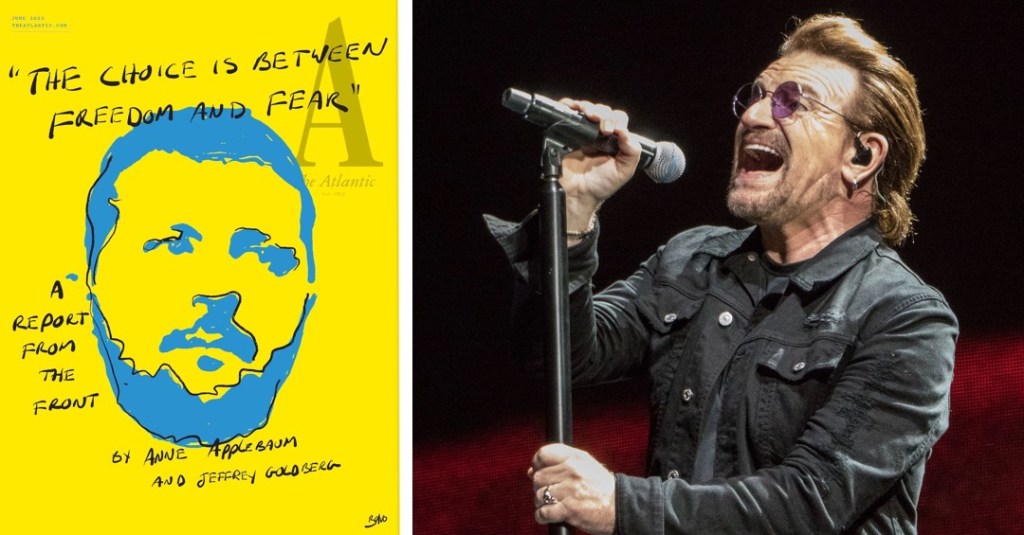
A Washington Post article titled “Bono likes to sketch Atlantic covers, so the magazine hired him” reports that “Bono is into Atlantic cover fanfic — so much so that he was invited to illustrate the magazine’s June cover featuring Ukrainian President Volodymyr Zelensky.” 

Bono’s latest contribution to the mountain of cringe-inducing Zelensky moments we’ve been seeing for the past year provides a cover image for an article by lifelong war propagandists Anne Applebaum and Jeffrey Goldberg. The article endorses a Ukrainian offensive to recapture Crimea, which experts largely agree would be the move most likely to trigger a nuclear war in this conflict.

Here’s a paragraph from Applebaum and Goldberg’s article, just to give you a taste of the infantile “Good Guys vs Bad Guys” framing that western liberals are being fed by mass media war propagandists these days:

“Sometimes, the war is described as a battle between autocracy and democracy, or between dictatorship and freedom. In truth, the differences between the two opponents are not merely ideological, but also sociological. Ukraine’s struggle against Russia pits a heterarchy against a hierarchy. An open, networked, flexible society—one that is both stronger at the grassroots level and more deeply integrated with Washington, Brussels, and Silicon Valley than anyone realized—is fighting a very large, very corrupt, top-down state. On one side, farmers defend their land and 20‑something engineers build eyes in the sky, using tools that would be familiar to 20‑something engineers anywhere else. On the other side, commanders send waves of poorly armed conscripts to be slaughtered—just as Stalin once sent shtrafbats, penal battalions, against the Nazis—under the leadership of a dictator obsessed with ancient bones. ‘The choice,’ Zelensky told us, ‘is between freedom and fear.’”

Many westerners felt their first stirrings of youthful rebellious passions while listening to U2 songs like “Sunday Bloody Sunday” and “Pride (In the Name of Love)”, but nowadays Bono’s voice is heard saying that he has “grown very fond” of war criminal George W Bush, praising capitalism at the World Economic Forum, teaming up with warmonger Lindsey Graham to promote US empire narratives about Syria, and  singing “Stand by Ukraine” in support of US empire narratives in a Kyiv subway. And just when it looks like he can’t become any more of a tool of the empire, he gets hired by one of the world’s worst militarist smut rags to draw a cover image of Zelensky.

Because that’s just how things go in a highly controlled society where mainstream culture is designed to serve the powerful. A society where the minds of the public are continually being shaped by mass-scale psychological manipulation to ensure that they keep thinking, speaking, working, consuming and voting in ways which serve the rich and powerful. Everything that gets elevated to the top of mainstream attention facilitates this agenda (or is at least harmless to it), and as soon as it becomes potentially threatening to this agenda it is either corrected or marginalized away from mainstream attention.

This dynamic can cause some truly jaw-dropping flotsam and jetsam to surface in the roilings of our cultural waters, like Simpsons characters waving Ukrainian flags, or an opera about a drone operator sponsored by General Dynamics.

Here’s Responsible Statecraft’s Connor Echols on that last one:

This fall, DC denizens will be treated to the world premiere of “Grounded,” an opera following an Air Force ace named Jess whose unexpected pregnancy forces her to leave behind her beloved F-16 and join the “chair force.”

Throughout the show, the “hot shot” pilot wrestles with the mental impact of firing rockets from a drone in Afghanistan from a trailer in Las Vegas. “As Jess tracks terrorists by day and rocks her daughter to sleep by night, the boundary between her worlds becomes dangerously permeable,” an ad tells us.

The production is brought to you by presenting sponsor General Dynamics, one of the world’s largest weapons companies (and, wouldn’t you know it, the maker of Jess’s favorite plane). Playwright George Brant wrote the libretto, which will be brought to life by mezzo-soprano Emily D’Angelo and Tony-winning composer Jeanine Tesori.

You’ll also see things like “humanitarian intervention” champion Samantha Power enthusiastically tweeting about the collaboration between the Sesame Street franchise and the CIA cutout USAID in Iraq:

You see things like this all the time under the shadow of the US empire, and individually they don’t look like much, but once you start noticing them you come to recognize them as symptoms of the profoundly diseased civilization that we are living in. One where our heart strings are pulled in the most obnoxious ways imaginable to get us to support capitalism, empire and oligarchy, where we are manipulated into espousing values systems which benefit powerful sociopaths under the cover of noble-sounding causes. Where we are trained like rats to support systems that are driving our species toward extinction because our rulers gave lip service to humanitarianism and waved a rainbow flag.

This is what dystopia looks like. Like a bunch of thought-controlled automatons mindlessly marching toward ecocide and omnicide to a beat played out by screens who tell them every day and in every way that there is no higher purpose than this. Like military industrial complex-funded feminist rock operas about drone operators and Cookie Monster helping Samantha Power psychologically colonize Iraqi children. Like Bono coming home from singing a heartfelt number about the assassination of Martin Luther King Jr to illustrate a cover for a war propaganda piece in The Atlantic.

It’s like they’re pouring concrete over our hearts. Sewing blindfolds over our souls. Numbing us, distracting us, sedating us, so that the local riff raff won’t interfere in the workings of the imperial machine. They’re killing off something beautiful and sacred in humanity, and they’re doing it to roll out some of the ugliest visions this planet has ever seen.

The Enemy From Within

The war industry, a state within a state, disembowels the nation, stumbles from one military fiasco to the next, strips us of civil liberties and pushes us towards suicidal wars with Russia and China.

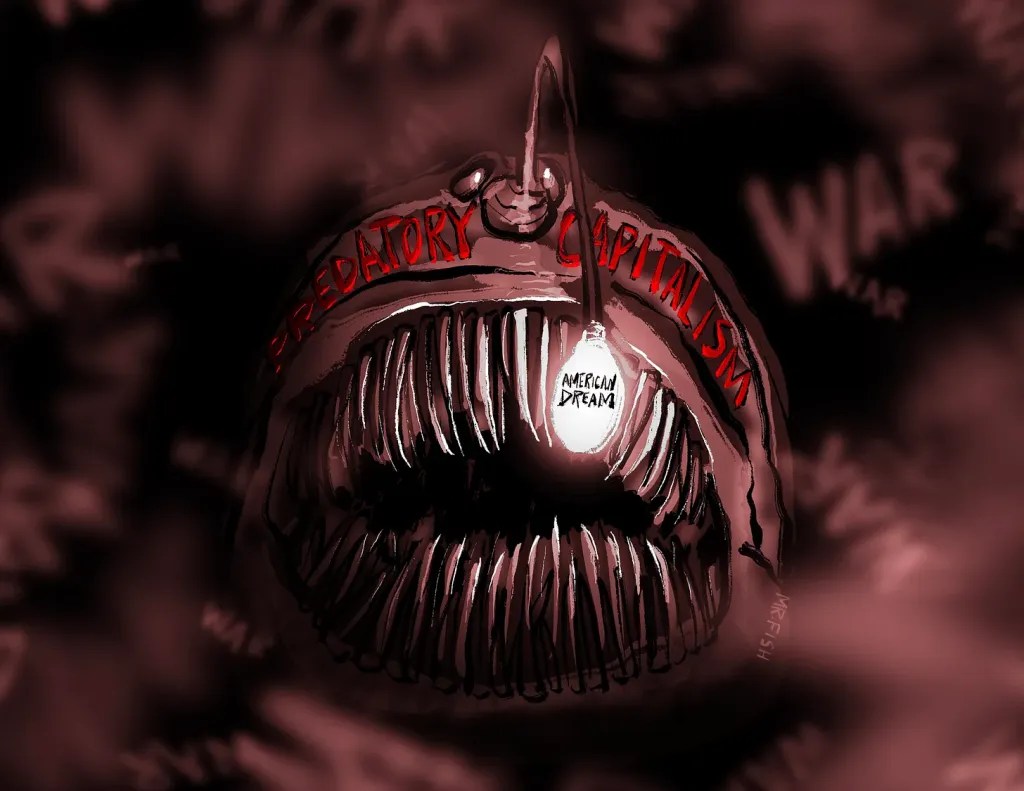
You Are What They Eat – by Mr. Fish

By Chris Hedges

Source: ScheerPost

America is a stratocracy, a form of government dominated by the military. It is axiomatic among the two ruling parties that there must be a constant preparation for war. The war machine’s massive budgets are sacrosanct. Its billions of dollars in waste and fraud are ignored. Its military fiascos in Southeast Asia, Central Asia and the Middle East have disappeared into the vast cavern of historical amnesia. This amnesia, which means there is never accountability, licenses the war machine to economically disembowel the country and drive the Empire into one self-defeating conflict after another. The militarists win every election. They cannot lose. It is impossible to vote against them. The war state is a Götterdämmerung, as Dwight Macdonald writes, “without the gods.”

Since the end of the Second World War, the federal government has spent more than half its tax dollars on past, current and future military operations. It is the largest single sustaining activity of the government. Military systems are sold before they are produced with guarantees that huge cost overruns will be covered. Foreign aid is contingent on buying U.S. weapons. Egypt, which receives some $1.3 billion in foreign military financing, is required to devote it to buying and maintaining U.S. weapons systems. Israel has received $158 billion in bilateral assistance from the U.S. since 1949, almost all of it since 1971 in the form of military aid, with most of it going towards arms purchases from U.S. weapons manufacturers. The American public funds the research, development and building of weapons systems and then buys these same weapons systems on behalf of foreign governments. It is a circular system of corporate welfare. 

Between October 2021 and September 2022, the U.S. spent $877 billion on the military, that’s more than the next 10 countries, including China, Russia, Germany, France and the United Kingdom combined. These huge military expenditures, along with the rising costs of a for-profit healthcare system, have driven the U.S. national debt to over $31 trillion, nearly $5 trillion more than the U.S.’s entire Gross Domestic Product (GDP). This imbalance is not sustainable, especially once the dollar is no longer the world’s reserve currency. As of January 2023, the U.S. spent a record $213 billion servicing the interest on its national debt. 

The public, bombarded with war propaganda, cheers on their self-immolation. It revels in the despicable beauty of our military prowess. It speaks in the thought-terminating clichés spewed out by mass culture and mass media. It imbibes the illusion of omnipotence and wallows in self-adulation.

The intoxication of war is a plague. It imparts an emotional high that is impervious to logic, reason or fact. No nation is immune. The gravest mistake made by European socialists on the eve of the First World War was the belief that the working classes of France, Germany, Italy, the Austro-Hungarian Empire, Russia and Great Britain would not be divided into antagonistic tribes because of disputes between imperialist governments. They would not, the socialists assured themselves, sign on for the suicidal slaughter of millions of working men in the trenches. Instead, nearly every socialist leader walked away from their anti-war platform to back their nation’s entry into the war. The handful who did not, such as Rosa Luxemburg, were sent to prison.

A society dominated by militarists distorts its social, cultural, economic and political institutions to serve the interests of the war industry. The essence of the military is masked with subterfuges — using the military to carry out humanitarian relief missions, evacuating civilians in danger, as we see in the Sudan, defining military aggression as “humanitarian intervention” or a way to protect democracy and liberty, or lauding the military as carrying out a vital civic function by teaching leadership, responsibility, ethics and skills to young recruits. The true face of the military — industrial slaughter — is hidden.

The mantra of the militarized state is national security. If every discussion begins with a question of national security, every answer includes force or the threat of force. The preoccupation with internal and external threats divides the world into friend and foe, good and evil. Militarized societies are fertile ground for demagogues. Militarists, like demagogues, see other nations and cultures in their own image – threatening and aggressive. They seek only domination. 

It was not in our national interest to wage war for two decades across the Middle East. It is not in our national interest to go to war with Russia or China. But militarists need war the way a vampire needs blood.

After the collapse of the Soviet Union, Mikhail Gorbachev and later Vladimir Putin lobbied to be integrated into western economic and military alliances. An alliance that included Russia would have nullified the calls to expand NATO — which the U.S. had promised it  would not do beyond the borders of a unified Germany — and have made it impossible to convince countries in eastern and central Europe to spend billions on U.S. military hardware. Moscow’s requests were rebuffed. Russia was made the enemy, whether it wanted to be or not. None of this made us more secure. Washington’s decision to interfere in Ukraine’s domestic affairs by backing a coup in 2014 triggered a civil war and Russia’s subsequent invasion. 

But for those who profit from war, antagonizing Russia, like antagonizing China, is a good business model. Northrop Grumman and Lockheed Martin saw their stock prices increase by 40 percent and 37 percent respectively as a result of the Ukraine conflict. 

A war with China, now an industrial giant, would disrupt the global supply chain with devastating effects on the U.S. and global economy. Apple produces 90 percent of its products in China. U.S. trade with China was $690.6 billion last year. In 2004, U.S. manufacturing output was more than twice China’s. China’s output is now nearly double that of the United States. China produces the largest number of ships, steel and smartphones in the world. It dominates the global production of chemicals, metals, heavy industrial equipment and electronics. It is the world’s largest rare earth mineral exporter, its greatest reserve holder and is responsible for 80 percent of its refining worldwide. Rare earth minerals are essential to the manufacture of computer chips, smartphones, television screens, medical equipment, fluorescent light bulbs, cars, wind turbines, smart bombs, fighter jets and satellite communications. 

War with China would result in massive shortages of a variety of goods and resources, some vital to the war industry, paralyzing U.S. businesses. Inflation and unemployment would rocket upwards. Rationing would be implemented. The global stock exchanges, at least in the short term, would be shut down. It would trigger a global depression. If the U.S. Navy was able to block oil shipments to China and disrupt its sea lanes, the conflict could potentially become nuclear.

In “NATO 2030: Unified for a New Era,” the military alliance sees the future as a battle for hegemony with rival states, especially China. It calls for the preparation of prolonged global conflict. In October 2022, Air Force General Mike Minihan, head of Air Mobility Command, presented his “Mobility Manifesto” to a packed military conference. During this unhinged fearmongering diatribe, Minihan argued that if the U.S. does not dramatically escalate its preparations for a war with China, America’s children will find themselves “subservient to a rules based order that benefits only one country [China].”

According to the New York Times, the Marine Corps is training units for beach assaults, where the Pentagon believes the first battles with China may occur, across “the first island chain” that includes, “Okinawa and Taiwan down to Malaysia as well as the South China Sea and disputed islands in the Spratlys and the Paracels.”.

Militarists drain funds from social and infrastructure programs. They pour money into research and development of weapons systems and neglect renewable energy technologies. Bridges, roads, electrical grids and levees collapse. Schools decay. Domestic manufacturing declines. The public is impoverished. The harsh forms of control the militarists test and perfect abroad migrate back to the homeland. Militarized Police. Militarized drones. Surveillance. Vast prison complexes. Suspension of basic civil liberties. Censorship.

Those such as Julian Assange, who challenge the stratocracy, who expose its crimes and suicidal folly, are ruthlessly persecuted. But the war state harbors within it the seeds of its own destruction. It will cannibalize the nation until it collapses. Before then, it will lash out, like a blinded cyclops, seeking to restore its diminishing power through indiscriminate violence. The tragedy is not that the U.S. war state will self-destruct. The tragedy is that we will take down so many innocents with us.

The Impending Economic Collapse – A Cause of Current Conflict

By Phil Butler

Source: New Eastern Outlook

Brazil’s Luiz Inacio Lula da Silva has called on BRICS nations to create an alternative to replace the dollar in foreign trade. Other experts suggest President Joe Biden’s policies will destroy America’s middle class for good. The news comes when China and Russia strengthen ties with Brazil and Latin America. Brazil’s leader questioned the institution of the U.S. dollar as the world’s trade currency in the first place and asked why each country could not trade in its currency.

This brings to the forefront the historical moment when the gold standard was abolished in favor of the current system. When President Richard Nixon moved to abolish the gold standard as a commitment mechanism, his administration ushered in decades of relative volatility and made hard currency.

The exchange of gold was severely curtailed through the Bretton Woods international monetary agreement of 1944. When the International Monetary Fund was established, the U.S. Dollar became the most potent currency in the world. Initially, the role of the IMF was only to assist with international transactions, but as we see today, that institution has far overstepped its original purpose. Today, the IMF is a leverage arm for the United States and a few European nations to fund countries/regimes that align with its policy. The U.S., for instance, has an almost 20% share of contributions to the fund.

The primary purpose of remaining off the gold standard is that the government can print money endlessly, with two primary goals. First, a massive defense budget and needless proxy wars would not be possible if the United States were on the gold standard. Secondly, the people who control the central banks cannot extract interest on national debts that are currently out of control. So, the fiat currency supposedly backed by the “full faith and credit” of the government, the dollar, is worth what lying politicians and finance ministers say it is.

One look at the worldwide bond market reveals a disturbing imbalance. The U.S., which now has over $51 trillion in outstanding debt, has borrowed more to finance wars and programs than China, Japan, Germany, Italy, France, the U.K., and Canada combined. The American taxpayer is responsible for almost 40% of all the foreign debt in the world. And the outlook for the short and long-term future could be better.

President Joe Biden wants to borrow even more when his administration conducts a proxy war against Russia in Ukraine. With billions flowing into Europe’s most corrupt country, Americans are on the precipice of an economic catastrophe not seen since the Great Depression.

According to the Bipartisan Policy Center in Washington and the Congressional Budget Office, the government will no longer be able to pay everyone — including bondholders, Social Security recipients, and federal employees — sometime this summer or early this fall. A New York Times report from late March outlines the situation. But the problem is far worse than many experts suggest. No matter which way lawmakers move, the U.S. has almost insurmountable fiscal issues. The ramifications will be dire whether or not they raise the debt limit. And if the BRICS countries go off the dollar as a trade currency… Well.

Many experts predict that American greenbacks won’t be worth the printed paper if the world stops using the U.S. dollar as its world currency reserve. Moreover, if the dollar loses its value significantly, every American who owes a credit card loan or a home mortgage will find it ten times harder to pay off those debts.

To make matters worse, millions of jobs will be sacrificed for the Federal Reserve to get any financial stability. Analysis from RSM International shows that the central banks must “induce” a recession to get America’s economic situation in check. And the dollar being made useless by the larger world community was not a factor in their analysis.

The bottom line is if we were still on the gold standard, this would be fine. The gold standard reduced the risks of such economic crises and recessions. Income levels were higher when we were on the bullion-backed system. More importantly, the gold standard created hard limits on printing money and limiting military spending. For more intuition on this, this Barron’s report reveals how our current failing system came into being. The information also serves as a crystal ball for what will happen.

As confidence in the dollar wanes and U.S. policy overseas gets more aggressive toward BRICS nations and others, the tipping point of the American hegemony draws closer.

China, Russia and India Versus USA, EU and Japan: Axis Powers of a New Global Cold War?

By Gilbert Mercier

Source: New Junkie Post

The birth of a bipolar world order?

Since 2014, which marked the first Russian intervention in Ukraine, a new global geopolitical dynamic has amplified under conflicting impulses. The areas of direct, or more often proxy conflicts, have been in many senses contained with some sort of cynical pressure-cooker mechanism. If empires always seek hegemony, sane geopolitics imply balance to avoid slipping into World War scenarios. We have presently reached a Cold War-like balance between two blocks: the West and their satellites on one side, against BRICS nations and their affiliates on the other side. In the best case scenario, this new cold war could give birth to a lasting bipolar world order: curiously enough, following pretty closely Orwell’s cartography of Oceania & Eurasia.

The West is defined by the US empire and its vassals

The two axes of powers must be explained more precisely. On one side “the West” includes US, UK, EU, Canada, Japan, South Korea and Australia. The command headquarters of this imperial structure are of course located in the United States of America. The empire’s military muscle is NATO. As for the junior members such as the UK, European Union and Japan, they are, despite some claims of the contrary the vassals of big Uncle Sam.

One factor could be viewed as a miscalculation by Vladimir Putin. In many ways his decision last year to start a military operation in Ukraine had a paradoxical effect. The intervention was an attempt by Russia to prevent Ukraine from joining NATO & the EU, but this has failed as Western military gears as well as direct assistance have poured in. Just like in Afghanistan in the 1980’s Russia was effectively sucked into a West proxy war. Meanwhile, NATO has found a new raison d’etre with Finland now officially a member and Sweden soon also to become one. The general paranoia used in Western media to depict Putin as the ultimate bogeyman has worked wonders on Europe’s public opinion.

BRICS & affiliates

On the other side it is more complex as China’s dominance is more subdued than that of the US. Besides the BRICS nations of Brazil, Russia, India, China & South-Africa, other nations are gravitating into the same geopolitical orbit: notably Iran, Venezuela and African countries such as Mali and Burkina Faso. While China is clearly the biggest power within BRICS, the other two major players, which are Russia and India, also are heavyweights on an overall geopolitical and economic scale.

Russia holds vast reserves of energy products, such as gas and oil, and since the European sanctions has quickly worked on redirecting its energy production both towards China and India. India, which has become the most populous country on Earth, has just like China a considerable manufacturing power as well as a huge internal market for products and services. In other words, neither China nor India have to rely mainly on exports to sustain their respective economic growth.

Non-alignment is dead

The concept of non-alignment in a multipolar world, dear to the likes of Tito and de Gaulle, has unfortunately become a geopolitical faux pas at best, or a risky behavior for a small state wanting to stay independent at worst. Because of a lack of political will and leadership, the European Union has basically capitulated from asserting itself as a third block to become a provincial entity of the US empire. The notion of true non-alignment might have run its course in this new bipolar order.

As matter of fact, one of the Ukraine war’s major side effects has been to speed up the process of obedient realignment of the EU to the US. European leaders with their respective media propaganda divisions (either state or corporate controlled) have managed to convince the bulk of their public opinion that the ogre Vladimir Putin and Russia had to be defeated in Ukraine as if the hordes from a memory of the Red Army were about to invade Europe. The Ukraine war has been sold in Europe as a war of necessity to counter an existential threat that was never really there. Public opinion largely bought it, and the financial rewards are pouring into the coffers of the military-industrial complex, as well as US and Qatari energy businesses of natural gas liquefaction, to replace the well-organized Russian gas supply Europe used to get before the sanctions against Russia.

Ukraine war cannot be won on the battle fields

Despite what most people are lead to believe in the West, a military victory by Ukrainian forces, even with full logistic support from NATO in equipment and training is quasi impossible. After all, a lesson should be learned from Afghanistan where the Taliban managed to defeat the mighty alliance. If the EU and the United States cared for the welfare of Ukrainians, they would come to the realization that only a diplomatic solution can resolve the crisis. A sine qua non condition of diplomacy is that it requires concessions on all sides.

For example, let’s take the case of Crimea. It has a complex history. During the 15th century Crimea was under control of the Ottoman Empire. In 1783, the Russian Empire of Tsarina Catherine the Great annexed Crimea after a conflict with Turkey. Lastly, under the authority of Nikita Khrushchev, the USSR gave Crimea to Ukraine in 1954. Therefore, Crimea was Russian for 171 years while it was Ukrainian for only 60 years. The weight of history, in this case, should tilt the balance in favor of Russia.

Military-industrial complex Uber Alles

Wars have always been capitalism‘s best friend. Ultimately they are seldom about the lofty notions of patriotism but systematically about profits. Ukraine’s Western proxy adventure is no exception. As matter of fact, it has been a gargantuan bonanza for the global military-industrial complex and its stockholder war profiteers. Case in point: since Russia started its military operation in Ukraine in February 2022, the United States has spent $30 billion in military equipment which was shipped to Ukraine. This is according to the US Department of Defense.

For its part the European Union is planning a 74 billion Euros increase in military spending within three years. This trend of huge increase in military spending affects all the EU 27 members, as they are allocating bigger shares of their respective GDPs to this weapons race. In December 2022, the European Defense Agency proudly announced that EU defense spending had surpassed 200 billion Euros for the first time in the union’s history. What an accomplishment!

Needless to say, military-industrial consortium and their unscrupulous stockholders have collected huge dividends from the death and destruction business. Stocks in the so-called aerospace & defense area of the market have been incredibly profitable for investors and are therefore in high demand. On average, most defense-company stocks have seen their values increase by 25 to 30 percent since February 2022.

Naturally, in terms of military spending, the United States represents the lions’ share with a whopping 38 percent of the global military spending. It is an astronomical $800 billion a year or 3.1 percent of the US GDP. Unfortunately other major powers are catching up. In second place comes China with $293 billion or 1.7 percent of its GDP; then India with $76.6 billion; the UK with 68.4 billion; Russia with $65.9 billion or 3.1 percent of GDP; France and Germany with $56 billion each; and Japan with $54 billion. In France, despite a very concerning debt, the Macron administration has announced that 413 billion Euros will be spent on the military between 2024 and 2030.

Taiwan: the Ukraine of the far-east?

With Russia sucked into what can be called a military quagmire in Ukraine, one has to wonder if the Oceania empire, with its Washington nevralgic center, would not indeed want to take advantage or even provoke a Chinese move to take over Taiwan, in accordance to the One-China precept. This could create a Ukrainian-like situation for China in Taiwan. Instead of having the obedient EU to absorb part of the cost in the West, in the Pacific it could be US vassals such as Japan, South-Korea and Australia that could get involved into a proxy war with China, and therefore increase their military spending in US equipment. Trillion of dollars would be wasted in resources to allow the chess masters of geopolitics to keep playing their mindless criminal games. Everywhere, the brutal Russian roulette folly of capitalism, either state or corporate, would thrive while all populations suffer.

US to double its ‘defense’ budget

Signe’s second toon du jour SIGN17e Military

By Drago Bosnic

Source: InfoBRICS.org

Back in late March, top American General Mark Milley, Chairman of the Joint Chiefs of Staff, said that the United States of America would be doubling its military budget in case the Kiev regime was defeated by Russia. At the time, Milley claimed that “not supporting Ukraine now would lead to a massive increase in future defense budgets”. He also added that “it would lead to a global conflict that has been avoided since World War II ended”.

“If that rules-based order, which is in its 80th year, if that goes out the window, then be very careful,” Milley said while testifying before the US Congress on March 23, further adding: “We’ll be doubling our defense budgets at that point because that will introduce not an era of great power competition. That’ll begin an era of great power conflict. And that’ll be extraordinarily dangerous for the whole world.”

Firstly, it should be noted that Milley’s remark about the so-called “rules-based (world) order” supposedly lasting 80 years is completely misplaced. The geopolitical situation in the last three decades has merely been a shadow of the post-WWII global order. With the US conducting virtually incessant aggression against the entire world, any notion that there are actual rules that equally apply to everyone is beyond laughable. However, his claim that Washington DC would need to double its “defense” spending is much more serious and consequential. Ironically, he’s threatening to do that while “warning” about a looming global conflict, one which is solely caused by the US itself, as it’s the only country on the planet with an openly stated strategy of “full spectrum dominance”.

Milley testified before the House Appropriations Committee-Defense on the next year’s DoD (Department of Defense) budget, alongside Defense Secretary Lloyd Austin. The figure for the Pentagon officially stands at $842 billion, $69 billion more than the $773 billion the military requested for 2023. However, the total spending on national “defense”, including work on nuclear weapons (officially under the jurisdiction of the Department of Energy), pushes that up to $886 billion. This is without including the so-called “aid” for the Kiev regime, which stood at approximately $113 billion at the beginning of 2023. However, the updated figure is now getting closer to $150 billion and there’s no indication that it will stop growing any time soon.

General Milley has repeatedly described the conflict in Ukraine as “an important national interest” and “fundamental to the United States, to Europe and to global security”. It could be argued that it’s neither of those things, as the world, the EU and the US itself all have more pressing concerns. Unfortunately, this notion is extremely unlikely to lead to any peaceful settlement, especially as the US Military Industrial Complex (MIC) keeps getting its windfall. While some members of Congress have consistently been skeptical about the “aid” for the Kiev regime, the majority still have a strong preference for the official narrative. The skeptics usually cite “the US and Kiev regime’s failure to more clearly define their strategic goals” as the primary reason for the lack of “more adamant support”.

This clearly indicates that the only “strategic goal” is to keep the war going for as long as possible, which also explains the repeated calls for the perpetual increase of the Pentagon’s budget. However, Milley’s call for doubling it is a major escalation and it’s unclear how exactly Washington DC is planning to achieve such a monumental task. Global military spending for 2022 was around $2.1 trillion, meaning that the US is already at over 40% of the world’s total with its current budget. Doubling it, even over the next several years (also taking into account other superpowers would certainly respond to it) could push that figure close to 60%. In terms of the US federal budget, it would also require further cuts to investment in healthcare, infrastructure, education, etc.

As the military currently spends approximately 15% of the entire US federal budget, obviously, doubling it would mean the percentage would go up to (or even over) 30%. Such figures are quite close to what the former Soviet Union was spending in terms of its overall budget, which was one of the major factors that contributed to its unfortunate dismantlement. On the other hand, it also forces others to drastically increase their own military spending. If China were to follow suit, its military budget would then be close to $500 billion, with Russia’s military budget approaching $200 billion. This would cause a military spending “death spiral” that would be extremely difficult (if possible at all) to control, leading the world into an unprecedented arms race.

However, this “new” Cold War could potentially be far more dangerous than the “old” one, as there would be approximately half a dozen superpowers and great powers competing for influence and a bigger geopolitical footprint. On the other hand, if the rest of the world refuses to respond in kind, such a massive increase in US military spending would only push the multipolar world into greater integration, as it would be the only way to counter US aggression without doubling their own military budgets. Either way, the US is left with a choice – further escalate, not only with Russia, but the rest of the world as well, or find an off-ramp. Otherwise, its inflation will surge so much that the “doubling” of the Pentagon’s budget will happen on its own.