HOW TO OVERCOME THE FEAR OF MORTALITY

By Gary Z McGee

Source: Waking Times

“I believe in everything; nothing is sacred. I believe in nothing; everything is sacred.” ~Tom Robbins

Some say death is a compass. Others say it’s a crossroads. Some say death is the beginning of time. Others say it’s the end of the beginning. But no matter what people say, death is nonnegotiable. It is coming for us all. We ignore this knowledge at our own great peril.

Staring into the headlights of our own death, some of us are consciously aware of these lights, but a lot of us are unconscious to them. For some of us, the lights are speeding right towards us, and death is nigh. For most of us, the lights are far off, dimly lit on the horizon. But all of us will eventually be ran over by the vehicle of Death.

So, what is a stumbling, fumbling mortal to do? How do we square the circle of knowing that we will die? How do we navigate this Mobius Strip of doom? How do we loosen the noose so that we can at least live a decent life?

Knowing how to deal with the fear of mortality is probably the most important life skill that we can have. But it’s a two-sided coin. On the one side, the fear of mortality is the fear of death. On the other side, the fear of mortality is the fear of life. Both must be honored, honed, and humored before sublimity is ours.

The fear of death:

“The more unlived your life, the greater your death anxiety. The more you fail to experience your life fully, the more you will fear death.” ~Irvin Yalom

Know this, right at the jump: There is no escape. You can’t have your cake and eat it too. A life well-lived is a life lived staring death in the face. You can’t be an adventurous artist or a drunken spirit and still be a law-abiding citizen or solid oak in a comfortable yard. If you want to get drunk, you have to accept the nausea and the hangover. If you want to say yes to sunlight and adventure, you have to say yes to filth and danger.

Everything is within you, demon and diamond, power and pain, the laughter of life and the trepidation of death. Say yes to it all, shirk nothing. Don’t try to lie to yourself. You are not going to live forever. You are not immortal. You are a butterfly in a tsunami. Don’t fight it. Surrender to it. Let it guide you. Let it drive you. Become one with the tempest. You have this one life. Make the best of it.

Reconcile your mortal fear, assimilate your existential angst, integrate your death anxiety. Defy death by confronting it head-on. Die inside it. Burn off the dross. Lose your sentimental baggage, your naivete, your innocence. Then resurrect yourself into a person with the fortitude to handle the pain. For Pain is the ultimate teacher. Especially the pain that Death teaches. Learn from it. Let it shape you. Let it sharpen you into an instrument worthy of magnificence. As Atticus cryptically stated, “Let my death be a long and magnificent life.”

In the end, death makes philosophers of us all.

The fear of life:

“Life will break you. Nobody can protect you from that, and living alone won’t either, for solitude will also break you with its yearning. You have to love. You have to feel. It is the reason you are here on earth. You are here to risk your heart. You are here to be swallowed up. And when it happens that you are broken, or betrayed, or left, or hurt, or death brushes near, let yourself sit by an apple tree and listen to the apples falling all around you in heaps, wasting their sweetness. Tell yourself you tasted as many as you could.” ~Louise Erdrich

Life will break your heart. Oh well. Let it break. Your heart was made to break open, suck the whole of experience into it—good and bad—and then come back together again. That’s what makes you stronger. Paraphrasing Samuel Becket here: Ever loving. Ever broken hearted. No matter. Love again. Break your heart open again. Break it better.

Life is less about receiving flowers, rainbows, and sunshine and more about how well you navigate thorns, storms, and darkness. Don’t avoid the thorns at the expense of the rose. Don’t avoid the storm at the expense of adventure. Don’t avoid the darkness at the expense of seeing beyond the light. Pain should not be avoided at the expense of wholeness; wholeness should be embraced at the risk of pain. As James Hillman powerfully stated, “We are composed of agonies not polarities.”

It’s what you do with these agonies that will decide the wholeness of your life. Being whole is not never breaking. Not at all. Being whole is breaking and then coming back together again stronger than you were before. And it never ends. It’s a constant: get wounded, mend your wounds, and then transform them into sacred wounds. That’s a well-lived life.

Another way of looking at the life-death-rebirth cycle is in terms of wholeness. There is no point in the cycle that is not the beginning and the end of every other point in the cycle. That is what you are. You are wholeness perceiving fractured aspects of the whole as points along the way.

During dark times, when it feels like you’ve been buried in failure and pain, remember this feeling of wholeness, and then flip the script and imagine you’ve been planted instead. Now all there is left to do is to take this wholeness and bloom into sublimity.

Discover the Sublime:

“There are heights of the soul from which even tragedy ceases to look tragic.” ~Nietzsche

When you assimilate your fear of life and death, you experience a state of cosmic sublimity. You rise above all the pains and pleasures, all the ups and downs, all the fear and angst and hunger. All the heaviness of mortality slips away into lightheartedness. Amor fati overwhelms you and all you can do is step into the powerful role of being love itself. You fall in love with being in love with your fate.

In this state of cosmic sublimity, all the pain, all the pleasure, all the ups and downs, all the fear and love of life become mere ingredients for your own immortality project, your magnum opus, your ultimate work of art.

Where a plant blooms into a flower, a human blooms into a piece of art. When you’re in the throes of an artistic process, you are flourishing. You touch the Philosopher’s Stone. The transcendent shines through the art. The sublime shines through you. It all comes together in that sacred space between life and death: surrender.

The cosmic sublime is an ontological pivot point, a perspective in which death is also rapture and resurrection, and the death of the ego is linked to creativity. It’s a movement into psychological depth.

If you want to discover the sublime, meditate on death. Meditate on eternity. Meditate on interconnectedness. Meditate on pain and probability. When you become deeply aware of your mortality it gives you a sense of purpose and energy. Find ways to transform this purpose and energy into vitality, creativity, and power. Seek expansion. Transform energy into synergy. Express the infinite in the tangible and bounded form of a work of art. Bring magic elixir back to “the tribe” and change the way the tribe sees the world.

Nature Is Not a Machine—We Treat It So at Our Peril

By Jeremy Lent

Source: resilience

From genetic engineering to geoengineering, we treat nature as though it’s a machine. This view of nature is deeply embedded in Western thought, but it’s a fundamental misconception with potentially disastrous consequences.

Climate change, avers Rex Tillerson, ex-CEO of ExxonMobil and erstwhile US Secretary of State,  “is an engineering problem, and it has engineering solutions.” This brief statement encapsulates how the metaphor of the machine underlies the way our mainstream culture views the natural world. It also hints at the grievous dangers involved in perceiving nature in this way.

This mechanistic worldview has deep roots in Western thought. The great pioneers of the Scientific Revolution, such as Galileo, Kepler, and Newton, believed they were decoding “God’s book,” which was written in the language of mathematics. God was conceived as a great clockmaker, the “artificer” who constructed the intricate machine of nature so flawlessly that, once it was set in motion, there was nothing more to do (bar the occasional miracle) than let it run its course. “What is the heart, but a spring,” wrote Thomas Hobbes, “and the nerves but so many strings?” Descartes flatly declared: “I do not recognize any difference between the machines made by craftsmen and the various bodies that nature alone composes.”

In recent decades, the mechanistic conception of nature has been updated for the computer age, with popularizers of science such as Richard Dawkins arguing that “life is just bytes and bytes and bytes of digital information” and as a result, an animal such as a bat “is a machine, whose internal electronics are so wired up that its wing muscles cause it to home in on insects, as an unconscious guided missile homes in on an aeroplane.” This digital metaphor of nature pervades our culture and is used unreflectively by those in a position to direct our society’s future. According to Larry Page, co-founder of Google, for example, human DNA is just “600 megabytes compressed, so it’s smaller than any modern operating system . . .  So your program algorithms probably aren’t that complicated.”

But nature is not in fact a machine nor a computer—and it can’t be engineered or programmed like one. Thinking of it as such is a category error with ramifications that are both deluded and dangerous.

A four-billion-year reversal of entropy

Ultimately, this machine metaphor is based on a simplifying assumption, known as reductionism, which approaches nature as a collection of tiny parts to investigate. This methodology has been resoundingly effective in many fields of inquiry, leading to some of our greatest advances in science and technology. Without it, most of the benefits of our modern world would not exist—no electrical grids, no airplanes, no antibiotics, no internet. However, over the centuries, many scientists and engineers have been so swept up by the success of their enterprise that they have frequently mistaken this assumption for reality—even when advances in scientific research uncover its limitations.

When James Watson and Francis Crick discovered the shape of the DNA molecule in 1953, they used metaphors from the burgeoning information revolution to describe their findings. The genotype was a “program” that determined the exact specifications of an organism, just like a computer program. DNA sequences formed the “master code” of a “blueprint” that contained a detailed set of “instructions” for building an individual. Prominent geneticist Walter Gilbert would begin his public lectures by pulling out a compact disk and proclaiming “This is you!”

Since then, however, further scientific research has revealed fundamental defects in this model. The “central dogma” of molecular biology, as coined by Crick and Watson, was that information could only flow one way: from the gene to the rest of the cell. Biologists now know that proteins act directly on the DNA of the cell, specifying which genes in the DNA should be activated. DNA can’t do anything by itself—it only functions when certain parts of it get switched on or off by the activities of different combinations of proteins, which were themselves formed by the instructions of DNA. This process is a vibrant, dynamic circular flow of interactivity.

This leads to a classic chicken-and-egg problem: if a cell is not determined solely by its genes, what ultimately causes it to “decide” what to do? Biologists who have researched this issue generally agree that the emergence of life on Earth was most likely a self-organized process known as autopoiesis—from the Greek words meaning self-generation—performed originally by non-living molecular structures.

These protocells essentially staged a temporary, local reversal of the Second Law of Thermodynamics which describes how the universe is undergoing an irreversible process of entropy: order inevitably becomes disordered and heat always flows from hot regions to colder regions. We see entropy in our daily lives every time we stir cream into our coffee, or break an egg for an omelet. Once the egg is scrambled, no amount of work will ever get the yolk back together again. It’s a depressing law, especially when applied to the entire universe which, according to most physicists, will eventually dissipate into a bleak expanse of cold, dark nothingness. Those first protocells, however, learned to turn entropy into order by ingesting it in the form of energy and matter, breaking it apart, and reorganizing it into forms beneficial for their continued existence—the process we know as metabolism.

Ever since then, for roughly four billion years, the defining quality of life has been its purposive self-organization. There is no programmer writing a program; no architect drawing up a blueprint. The organism is the weaver of its own fabric, using DNA as an instrument of transmission. It sculpts itself according to its own inner sense of purpose, which it inherited ultimately—like all of us—from those first autocatalytic cells: the drive to resist entropy and generate a temporary vortex of self-created order in the universe. In the words of philosopher of biology Andreas Weber,

“Everything that lives wants more of life. Organisms are beings whose own existence means something to them.”

This implies that, rather than being an aggregation of unconscious machines, life is intrinsically purposive. In recent decades, carefully designed scientific studies have revealed the deep intelligence throughout the natural world employed by organisms as they fulfil their purpose of self-generation. The inner life of a plant, biologists have discovered, is a rich plethora of complex experience. Plants have their own versions of our five senses, as well as up to fifteen other ways of sensing their environment for which we don’t have analogues. Plants act intentionally and purposefully: they have memories and learn, they communicate with each other, and can even allocate resources as a community through what biologist Suzanne Simard calls the “wood-wide web” of mycorrhizal fungi linking their roots together underground.

Extensive studies now point to the profound realization that every animal with a nervous system is likely to have some sort of subjective experience driven by feelings that, at the deepest level, are shared by all of us. Bees have been shown to feel anxious when their hives are shaken. Fish will make trade-offs between hunger and pain, avoiding part of an aquarium where they’re likely to get an electric shock, even if that’s where the food is—until they get so hungry that they’re willing to take a risk. Octopuses, one of the earliest groups to evolve separately from other animals about 600 million years ago, live predominantly solitary lives, but just like humans, get cozy with others when given a dose of the “love-drug” MDMA.

The ideology of human supremacy

As we confront the existential crises of the twenty-first century, the mechanistic thinking that brought us to this place may be driving us headlong toward catastrophe. As each new global problem appears, attention gets focused on short-term, mechanistic solutions, rather than probing deeper systemic causation. In response to the worldwide collapse of butterfly and bee populations, for example, some researchers have designed tiny airborne drones to pollinate trees as artificial substitutes for their disappearing natural pollinators.

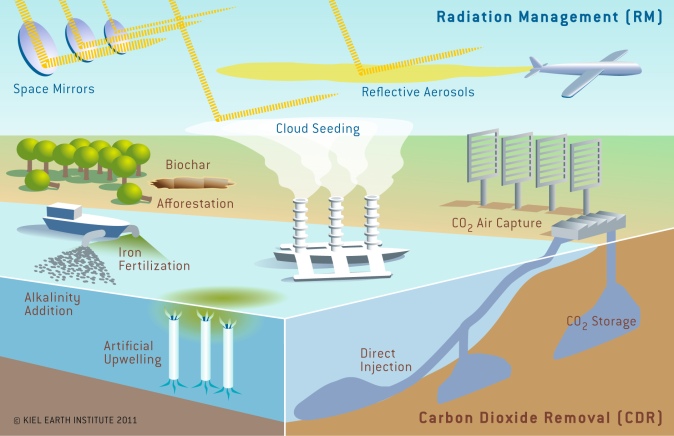
As the stakes get higher through this century, the dangers arising from this mechanistic metaphor of nature will only become more harrowing. Already, in response to the acceleration of climate breakdown, the techno-dystopian idea of geoengineering is becoming increasingly acceptable. Following Tillerson’s misconceived logic, rather than disrupt the fossil fuel-based growth economy, policymakers are beginning to seriously countenance treating the Earth as a gigantic machine that needs fixing, and developing massive engineering projects to tinker with the global climate.

Given the innumerable nonlinear feedback loops that generate our planet’s complex living systems, the law of unintended consequences looms menacingly large. The eerily named field of “solar radiation management”, for example, which has received significant financing from Bill Gates, envisages spraying particles into the stratosphere to cool the Earth by reflecting the Sun’s rays back into space. The risks are enormous, such as causing extreme shifts in precipitation around the world and exacerbating damage we’ve already done to the ozone layer. Additionally, once begun, it could never be stopped without immediate catastrophic rebound heating; it would further increase ocean acidification; and would likely turn the blue sky into a perpetual white haze. These types of feedback effects, arising from the innumerable nonlinear dynamic interdependencies of Earth’s complex systems, get marginalized by a worldview that ultimately sees our planet as a machine requiring a quick fix.

Further, there are deep moral issues that arise from confronting the inherent subjectivity of the natural world. Ever since the Scientific Revolution, the root metaphor of nature as a machine has infiltrated Western culture, inducing people to view the living Earth as a resource for humans to exploit without regard for its intrinsic value. Ecological philosopher Eileen Crist describes this as human supremacy, pointing out that seeing nature as a “resource” permits anything to be done to the Earth with no moral misgivings. Fish get reclassified as “fisheries,” and farm animals as “livestock”—living creatures become mere assets to be exploited for profit. Ultimately, it is the ideology of human supremacy that allows us to blow up mountaintops for coal, turn vibrant rainforest into monocropped wastelands, and trawl millions of miles of ocean floor with nets that scoop up everything that moves.

Once we recognize that other animals with a nervous system are not machines, as Descartes proposed, but likely experience subjective feelings similar to humans, we must also reckon with the unsettling moral implications of factory farming. The stark reality is that around the world, cows, chicken, and pigs are enslaved, tortured, and mercilessly slaughtered merely for human convenience. This systematic torment administered in the name of humanity to over 70 billion animals a year—each one a sentient creature with a nervous system as capable of registering excruciating pain as you or I—quite possibly represents the greatest cataclysm of suffering that life on Earth has ever experienced.

The “quantum jazz” of life

What, then, are metaphors of life that more accurately reflect the findings of biology—and might have the adaptive consequence of influencing our civilization to behave with more reverence toward our nonliving relatives on this beleaguered planet which is our only home?

Frequently, when cell biologists describe the mind-boggling complexity of their subject, they turn to music as a core metaphor. Denis Noble entitled his book on cellular biology The Music of Life, depicting it as “a symphony.” Ursula Goodenough describes patterns of gene expression as “melodies and harmonies.” While this metaphor rings truer than nature as a machine, it has its own limitations: a symphony is, after all, a piece of music written by a composer, with a conductor directing how each note should be played. The awesome quality of nature’s music arises from the fact that it is self-organized. There is no outside agent telling each cell what to do.

Perhaps a more illustrative metaphor would be a dance. Cell biologists increasingly refer to their findings in terms of “choreography,” and philosopher of biology Evan Thompson writes vividly how an organism and its environment relate to each other “like two partners in a dance who bring forth each other’s movements.”

Another compelling metaphor is an improvisational jazz ensemble, where a self-organized group of musicians spontaneously creates fresh melodies from a core harmonic theme, riffing off each other’s creativity in a similar way to how evolution generates complex ecosystems. Geneticist Mae-Wan Ho captures this idea with her portrayal of life as “quantum jazz,” describing it as “an incredible hive of activity at every level of magnification in the organism . . . locally appearing as though completely chaotic, and yet perfectly coordinated as a whole.”

What might our world look if we saw ourselves as participating in a coherent ensemble with all sentient beings interweaving together to collectively reverse entropy on Earth? Perhaps we might begin to see humanity’s role, not to re-engineer a broken planet for further exploitation, but to attune with the rest of life’s abundance, and ensure that our own actions harmonize with the Earth’s ecological rhythms. In the profound words of 20th century humanitarian Albert Schweitzer, “I am life that wills to live, in the midst of life that wills to live.” How, we may ask, might our future trajectory change if we were to reconstruct our civilization on this basis?

QUESTIONS OF OUR TIME – TIME NOW TO GET BACK TO OURSELVES?

By Kingsley L. Dennis

Source: Waking Times

‘And the Old Ones say:

look outward seriously
look inward intently
look outward carefully
look inward diligently
look outward respectfully
look inward humbly’

Jack Forbes

As human beings we seek the beautiful, and this gives us joy. But our lives have made everything complicated. We make ourselves complicated – life is being played around us like a game. This may not sound comfortable, or even correct, to some people. If it’s a game, then why is there so much sorrow and pain? This is the perennial question. Yet like a game, we have choices, and we make our moves. And there are players and gameplays going on all around us. And it seems that the game is rigged. One person who knew this well was Alan Watts. He often spoke about how life should not be lived as a fast journey and that existence in the universe should be recognized as being basically playful. Life is more like music, Watts used to say. And we play music – we don’t ‘work’ music. And in music, the end of the composition is not the point of the composition; otherwise, all conductors would play fast; or some composers would choose only to write the finales. We don’t go to concerts just to hear the final chord being played. We don’t engage in a dance in order to end it (unless we got tricked into it!). And yet, as Alan Watts was so keen in observing, our social systems condition us into grading our lives. Our schooling compels us into chasing grades and making our quotas and then paying our bills. And we keep believing, hoping, wishing, for the ‘great thing’ in life to come whilst we are rushing through our lives with hardly a notice of what we’re leaving behind in our rear-view mirrors. We end up living to retire. And when we retire, we imagine we have ‘finally arrived.’ And yet to where? Do we feel any different? We have a small pot of savings and almost no energy. And then we are told to wait it out. Until what? When? The final curtain? Perhaps only when it is too late do we realize that we were cheated down the whole line. And yet we followed it. We kept racing along in order to keep up or to hold onto what we were told was success. And yet – was it ever ‘our’ success? Did we miss the whole point?

Being human is about trying to create meaning for ourselves – and to enjoy it as much as possible along the way. The life we have is where we have arrived by ourselves and the steps and choices we made. We should not let ‘another mind’ make those choices for us. And most of all, we should not allow ourselves to be played for victims. We may be under the sway of other forces, yet only to the point that we are ignorant of them. Our power comes through recognizing and identifying those other forces that seek to influence and control our thoughts and actions. We need to optimize our lives by optimizing our perspective and understanding. Ignorance may seem to be a social requirement yet knowledge, understanding, creativity, and wisdom are the truer imperatives. Despite what may appear to the contrary at times, there is incredible capacity for goodness within the human race.

The majority of people in the world are good people. They wish for peace and to not do harm to others. There are many sympathetic, caring, and courageous people in the world. Unfortunately, our systems are run by the minority, and these systems are largely corrupt; and the decent people within these systems become corrupted by association or exposure. The main issue is that most of us do not look after our minds. We don’t think it is necessary. We are not aware of the malicious impacts that infiltrate and influence us on an almost daily basis. This unawareness – or ignorance – leaves people open and vulnerable. Many people have become alienated from their own minds. This is where manipulations creep in, such as mob mentality and crowd behavior. Only a large body of people with ‘alienated minds’ can become so influenced by political propaganda, consumerist advertising, and social management. Mass psychosis is only possible through a collective mindset that has become alienated from a transcendental source. In this state, we are prisoners to the impulses that steer our unconscious. We are susceptible to neuroses and psychic illness. We may believe we have freedom when we do not. The forces of bondage are subtle and often insidious. It is a necessity that human civilization returns to the fundamental recognition of the person as a human being.

Being human is about being simple. Or rather, it is about recognizing the essential things. Yet this is no simple thing to do. We are needing to get back to ourselves in so many ways. To begin, we must learn not to take things personally. There are so many ways that life attempts to get us to engage with external strife. It tries to pull us out of ourselves. When, for example, we are criticized or insulted we tend to lash out. We are conditioned to attack in order to defend. Is not a well-known aphorism, ‘Attack is the best line of defense?’ Sometimes this is phrased as – the best defense is a good offense. Yet long before these catchy phrases got circulated through our systems there was a better truism: turn the other cheek. Retaliation feeds the psychosis within the individual and the collective. If we give away our emotional and psychic energy, then we also give away our freedom. The ego must be reined in, yet not abolished. It is through the form of the ego that we can find the realm of the essential self. The ego exists as a signpost that the essential inner self is also there. As Buddhist monk Thich Nhat Hanh says – ‘If love exists, there are other things that exist also. There is ignorance, there is violence, there is craving.’ These external ‘other things’ – the violence and the suffering – can be, and are, manipulated and exacerbated. Yet the essential inner self remains as a pure, undiluted and uncorrupted form. We should allow it to speak to us and manifest in our lives. This is the human question.

Morality and meaning only have significance when they come from a genuine source. Otherwise it is a ‘projected’ form, created from social mores and cultural biases. We are the ultimate touchstone for our sense of reality. We need to have a clean lens and clear vision. And we should begin from the basics – the simple human things. There is a story which tells of a spiritual seeker who after some time comes upon a spiritual master that she feels is genuine and whom she wishes to learn from. The seeker asks the master if he will accept her as a pupil.

‘Why do you seek a spiritual path?’ asks the teacher.

‘Because I wish to be a generous and virtuous person; I wish to be balanced, mindful, caring, and to be in service for humanity. This is my goal’ said the seeker.

‘Well,’ replied the teacher, ‘these are not goals on the spiritual path; these are the very basics of being human which we need before we even begin to learn.’

What people may consider to be ‘spiritual’ is often none other than necessary human nutrition – a daily requirement for living. Yet like our other nutrition, eating, it has to be correctly integrated into our lives without making a song and dance about it. And, of course, not forgetting the saying that goes – ‘If you insist on buying poor food, you must be prepared to dislike it at the serving.’

It often feels like we spend our days trying to grasp at life, trying to understand it, with ways that are not adequate. It is like trying to capture the ocean with a bucket. The ocean stands magnificently before us, and yet our modern societies teach us to run through our lives anxiously as if with empty buckets in our hands. Personal fulfilment is not only about accomplishment; it is also a question of what we can give through each of our individual imperfections.

Here is a story that helps to illustrate this:

A man had two large pots, each hung on an end of a pole which he carried across his neck. One of the pots had a crack in it, and while the other pot was perfect and always delivered a full portion of water at the end of the long walk from the stream to his house, the cracked pot arrived only half full.

For a full two years this went on daily, with the man delivering only one and a half pots full of water to his house. Of course, the perfect pot was proud of its accomplishments, feeling accepted and appreciated. But the poor cracked pot was ashamed of its own imperfection, and miserable that it was able to accomplish only half of what it had been made to do. After two years of what it perceived to be a bitter failure, it spoke to the man one day by the stream.

“I am ashamed of myself, and I want to apologize to you.”

“Why?” asked the man. “What are you ashamed of?”

“I have been able, for these past two years, to deliver only half my load because this crack in my side causes water to leak out all the way back to your house. Because of my flaws, you have to do all of this work, and you don’t get full value from your efforts,” the pot said.

The man felt sorry for the old cracked pot, and in his compassion, he said, “As we return to my house, I want you to look at the beautiful flowers along the path. It will make you feel better.”

Indeed, as they went up the hill, the old cracked pot took notice of the sun warming the beautiful wild flowers on the side of the path, and this made it feel a little happier. But at the end of the path, it still felt bad because it had leaked out half its load, and so again the Pot apologized to the man for its failure.

The man said to the pot, “Did you notice that there were flowers only on your side of your path, but not on the other pot’s side? That’s because I have always known about your flaw, and I took advantage of it. I planted flower seeds on your side of the path, and every day while we walk back from the stream, you’ve been watering them. For two years I have been able to pick these beautiful flowers to take home to my wife. With you being just the way you are, you have given beauty and meaning to me every day.”

As the Spiritual Tsunami Arrives, How Will You Be?

By Open

Source: Wake Up World

When people reach the end of their lives and look back, it’s not the things they did do that they regret. It’s the things they didn’t. You have a dream in your heart, that wasn’t realised, or a gift or a skill that wasn’t fully explored. That’s the real tragedy. Right now humanity is as a ship, sailing into tumultuous seas. It’s not in this kind of energy that you sit back and dither. It calls for positive action, expression of being, excitement and adventure. These are the energies that will carry you through, and light up your life.

Coming into Your Element

Recently I’ve been bowled over by the strength of character some people come forwards with when something dramatic happens, like the bushfires in Australia, the mountains of snow in North America or the floods, earthquakes and volcanoes activating around the world. Plenty go into fear and panic, whereas others settle into their element and come into their own. Why is that?

Perhaps it’s because the second group have realised something fundamental – that you cannot control reality. You cannot prescribe or insure the future. When you get up in the morning, you cannot even be sure that you’ll make it to the end of the day.

If you live this way long enough, there comes a point where you move into complete acceptance of yourself and the mortality of life. Why not then be spurred on by it? When you know in your heart there is nothing to lose, in the same beat, paradoxically, you may realise there is everything to gain. Whatever you feel to do or express, what point is there in holding back?

Propagating Fear?

When I speak of the tremendous transformation the earth is going into, when I speak of the immanent galactic superwave, the escalating impact of cosmic rays or how Solar Forcing and the Pole Shift are taking us into climate crisis, I know some accuse me of ‘propagating fear’. In a seminar I once recall someone challenging if my approach was safe? My response was, ‘is the universe safe?’ Is enlightenment safe? In a self-realised being there is no fear, because it has been confronted and resolved out. Since plenty are working towards self realisation, then fear becomes an invaluable tool – a gateway through which to let go and expand.

The real propagation of fear is encouraging people to avoid, to deny, to distract, to go back into their shell. This also includes painting a ‘rosy’, ‘love and light spiritual’ gloss. It is what it is!

Humanity has been suppressed, blocked and pushed down for aeons – enslaved into a limiting reality construct for the benefit of just a few. It’s a sophisticated donkey and carrot delusion – offering ever greater complexity of gadgets and widgets and soft comforts that you strive ever harder to acquire ‘out there’.  It’s a game of smoke and mirrors to distract people from the true source of their contentment, empowerment and fulfillment – the unleashing and expression of their own soul from within.

For what else is the Universe about, if not the expression of Self?

The Path to Riches

When people come to the tumultuous realisation that it’s not about what we can acquire or attain out there, but rather that the revelation of Self is the real path to ‘riches’, then life takes off. There’s always an abundance of possibility in this moment to express something new about yourself. And when the proverbial Tsunami rolls in, that’s when the opportunity and the encouragement is at its greatest.

And neither does this mean that somehow you should now disengage from society or your job or from being in relationship. Far from it. Engage like you never have before – in a new way, a vibrant way, an honest and authentic way, and above all, without fear of the outcome.

You will make mistakes for sure. You will push buttons (‘big red ones’ as I describe in the film below), you’ll find yourself at times in emotional minefields. That’s okay, there’s no other way to truly learn, to evolve and grow, to become ever more sophisticated in your beingness. Go for it, and you’ll become rich beyond measure.

Breaking out of Poverty Consciousness

Neither is it about ‘not having’ either. It’s not about living in forced renunciation. When you unleash the authentic beingness of the soul, then the energy of this transforming reality will shape around you in ways you could never have imagined.

Someone whose truly wealthy where resources are concerned, is not governed by the resources, not attached to them. They ask only one question, “do I have enough to take the step that I’m being invited to take now?” Assuming you do, take the step, letting go of the worry if you’ll have enough ten steps down the path. Let the future take care of itself.

We need to break out of this old poverty consciousness. There’s a whole Universe of energy moving through this transformational moment!

Gateways of Possibility

Every so often, either on the journey of the soul or else in the wider movement of the field, window’s of opportunity open – gateways of possibility. These are where reality is transforming strongly, where it’s transmuting into something else, something new. We are in such a window right now, and it offers those prepared to be courageous enormous opportunity for realisation and growth – to strip off the layers and reveal more of their True Self. There can be nothing more rewarding.  And most importantly, you’ll find there will always be enough resources to be You – the authentic expression of You.

Expect this transformation to be a ‘transmutation’. Meaning that the new emerges through the breakdown of the old. So if you’re truely embarking through this corridor, then you’ll witness both at the same time.

Therefore don’t fear the breakdown. See it as an opportunity to embody something new, something that the emergence in you is beckoning.

Don’t expect either to know the answer. Don’t expect that you’ll know the path forwards. Mostly you only see the purpose as you look back and everything suddenly clicks in with that “aha” moment: “yes, this is why that happened. Yes, this is what I learned and gained from it.”

Cultivate the Spirit of Excitement and Adventure

Excitement and adventure are vibrant and powerful energies to carry you successfully through these times. But think about it, there can’t be adventure and excitement in a construct where everything is pre-planned and known, where everything is insured and assured. It’s in the very moment of not knowing that the vibrancy and excitement of adventure are activated.

That’s why I ask the question, ‘As the Spiritual Tsunami arrives, how will you be?’ Whether you’ve realised it or not, we are ALREADY in the Tsunami. It’s already happening and unfolding. Great transformation is in full swing. And therefore great opportunity to reveal and know yourself. The possibility of great adventure and excitement is shaping a path, step by step, in front of us. How does that encourage you now to be? In all those limiting circumstances you’ve found yourself boxed in by, what does it encourage you now to do?

Finally, I ask the question, in this great transformation happening all around us, what on earth is the point of playing it small?


Your Life Is Not Limited To One Path

By Joe Martino

Source: Collective Evolution

It is no secret that life can sometimes feel like a limited paved road laid out before us that we feel the need to stick to. Look at how we are brought up. Most of the time we come into the world and begin gaining our perceptions from those closest to us –our parents. As time goes on we find ourselves in school. Throughout that time we also begin watching what others do around us, what we see on TV and in movies.

What is happening is we are observing and creating an idea of how life should be; the best way to play the game. But what is ‘best?’

How many times have we heard “That’s not the best decision” or “That’s not the best decision for the whole family.” When you look at either statement you realize that “best” is subjective. What the “best” is to one person may not be the “best” to another. Even further, both of the perceptions of “best” are created from whatever belief systems each have created in their own lives. This is the key factor to realize.

We Get Trapped in Belief Systems

In either case, both scenarios have one thing in common, a belief system of what the “best” choice or decision is. When we create a belief system like this, we limit how we view things. We no longer feel what is “best,” but instead we analyze and define “best” based on a story; often a story from the past, based on entirely different times than the present moment.

Let’s take the example of a child coming out of high school today.  9 times out of 10, that child will be told, and may even believe, that the “best” decision they can make for their life is to continue their education at university or college. It does not matter that they do not know what they want to study, or that the education system will potentially cost them $100,000+, many will state that is best -and even have pride about it.

Next, they would be told to get a job so they can buy a house, as owning and buying a house is a smart decision. Should this child begin their life based on these belief systems, more often than not they will take this idea of what is “BEST” throughout the rest of their life. They will judge their decisions by this, express emotions based on this, develop self-esteem based on this and so forth. From then on, every decision they make will be based on this belief system handed down and taught to them.

Even getting specific, what to study in school, what type of job to get, what type of car to buy, how to spend and save money, what type of house to buy and so on. What is really happening with all of this? We are defining the ideal life or what’s “best” and then we limit our life to a small scope of how things should be.

The Deep Truth

Here is the absolute truth, ready? None of it has any real truth to it. It’s just all a belief system. Perception, ideas! But we often live by this and it becomes so real in our minds that we become stuck thinking this is the way to do it. Then when depression and anxiety follow, as we may believe we are stuck, we forget to look back on the belief system that is often caging us and our reality into a small tight space we often don’t deeply resonate with.

Look at our world. We often all chase the same thing, the same stuff because that is what we have been sold as the ideal life. Each area of the world has its own version of this. Who’s life are you really living? Whose dreams are you chasing and carrying out? We take on these beliefs and we begin to sacrifice ourselves, our health, and our soul desires so we can carry out someone else’s idea of “best” that we grabbed onto.

Back to the child from the example above. Now they have grown into a young man or woman and are in a job they don’t truly like. But it pays the bills and lives up to the idea of “best” that has been given to them. Most of the time, people around them will all reinforce that their decisions are the “best” because they have all been sold on the same belief system. “You have to make sacrifices, you have to work really hard to have a good life!” is what we are told. But who says what is “good?” Even when that grown up child is expressing their sadness or frustration for the reality they are in, we continue to reinforce it to protect the idea of ‘the best.’

We take this entirely expansive creative individual playing in an expansive playground called Earth and we confine them to this tiny little narrow path of what the “best” is. Instead of spending their life being able to make any choice they choose, they stay limited to what they have been sold as the “best” even if they don’t truly love it.

Even Deeper

Then you have the even deeper part, we then look upon and judge others when they make “the wrong decisions.” Look at how we view those who change their minds about what they want to play with all the time. What do we say about those people? “They need to make up their mind and get their life on track.” What track? There is a track? Says who? “They didn’t make a smart decision with their money or their house so they are going to pay for it later.” Who says some decisions are better than others? Is it not an experience either way?

You are the creator of your life and reality. You can choose to play and create whatever type of life you choose. And guess what? If you make a decision and start creating a particular life then you realize you want to create something new, you are free to do this!

No matter what story we tell ourselves like: “it’s too late, I can’t change this now, it’s too costly” etc. know that these are all egoic illusions. You are never limited to whatever life you have created even if you have been doing it for 30 years. Remember to ask yourself: the life you are chasing, the goals you have set, who’s goals are they really? Where did you first hear of them? Are they from your heart? Or are they what you have been sold?

Look inside yourself at what YOU TRULY want and how you wish to express yourself and create. Start there, and create from that space. You will see very quickly that you can create anything you choose.

Remember, there is no right or wrong path here. It’s about looking back on what we choose, where we are at and saying “Is this where I want to be? Am I feeling peace? Expressing my deepest self? Am I inspired about where I am at?” and if you aren’t, you create a new path and see how that feels. Follow how you FEEL, not what you seek as right or wrong. Our life reflects our state of consciousness.

Slow suicide and the abandonment of the world

By Edward Curtin

Source: Intrepid Report

“The condition of alienation, of being asleep, of being unconscious, of being out of one’s mind, is the condition of the normal man. Society highly values its normal man. It educates children to lose themselves and to become absurd, and thus to be normal. Normal men have killed perhaps 100,000,000 of their fellow normal men in the last fifty years. Our behavior is a function of our experience. We act the way we see things. If our experience is destroyed, our behavior will be destructive. If our experience is destroyed, we have lost our own selves.”—R.D. Laing, The Politics of Experience, 1967

“The artist is the man who refuses initiation through education into the existing order, remains faithful to his own childhood being, and thus becomes ‘a human being in the spirit of all times, an artist.’”—Norman O. Brown, Life Against Death

Most suicides die of natural causes, slowly and in silence.

But we hear a lot about the small number of suicides, by comparison, who kill themselves quickly by their own hands. Of course their sudden deaths elicit shock and sadness since their deaths, usually so unexpected even when not a surprise, allow for no return. Such sudden once-and-for-all endings are even more jarring in a high-tech world where people are subconsciously habituated to thinking that everything can be played back, repeated, and rewound, even lives.

If the suicides are celebrities, the mass media can obsess over why they did it. How shocking! Wasn’t she at the peak of her career? Didn’t he finally seem happy? And then the speculative stories will appear about the reasons for the rise or fall of suicide rates, only to disappear as quickly as the celebrities are dropped by the media and forgotten by the public.

The suicides of ordinary people will be mourned privately by their loved ones in their individual ways and in the silent recesses of their hearts. A hush will fall over their departures that will often be viewed as accidental.

And the world will roll on as the earth absorbs the bodies and the blood. “Where’s it all going all this spilled blood,” writes the poet Jacques Prévert. “Murder’s blood . . . war’s blood . . . blood of suicides . . . the earth that turns and turns with its great streams of blood.”

Of such suicides Albert Camus said, “Dying voluntarily implies you have recognized, even instinctively, the ridiculous character of that habit [of living], the absence of any profound reason for living, the insane character of that daily agitation, and the uselessness of suffering.” He called this feeling the absurd, and said it was widespread and involved the feeling of being an alien or stranger in a world that couldn’t be explained and didn’t make sense. Assuming this experience of the absurd, Camus wished to explore whether suicide was a solution to it. He concluded that it wasn’t.

Like Camus, I am interested in asking what is the meaning of life. “How to answer it?” he asked in The Myth of Sisyphus. He added that “the meaning of life is the most urgent of questions.” But I don’t want to explore his line of reasoning to his conclusions, whether to agree or disagree. I wish, rather, to explore the reasons why so many people choose to commit slow suicide by immersing themselves in the herd mentality and following a way of life that leads to inauthenticity and despair; why so many people so easily and early give up their dreams of a life of freedom for a proverbial mess of pottage, which these days can be translated to mean a consumer’s life, one focused on staying safe by embracing conventional bromides and making sure to never openly question a system based on systemic violence in all its forms; why, despite all evidence to the contrary, so many people embrace getting and spending and the accumulation of wealth in the pursuit of a chimerical “happiness” that leaves them depressed and conscience dead. Why so many people do not rebel but wish to take their places on this ship of fools.

So what can we say about the vast numbers of people who commit slow suicide by a series of acts and inactions that last a long lifetime and render them the living dead, those whom Thoreau so famously said were the mass of people who “lead lives of quiet desperation”? Is the meaning of life for them simply the habit of living they fell into at the start of life before they thought or wondered what’s it all about? Or is it the habit they embraced after shrinking back in fear from the disturbing revelations thinking once brought them? Or did they ever seriously question their place in the lethal fraud that is organized society, what Tolstoy called the Social Lie? Why do so many people kill their authentic selves and their consciences that could awaken them to break through the social habits of thought, speech, and action that lead them to live “jiffy lube” lives, periodically oiled and greased to smoothly roll down the conventional highway of getting and spending and refusing to resist the murderous actions of their government?

An unconscious despair rumbles beneath the frenetic surface of American society today. An unspoken nothingness. I think the Italian writer Robert Calasso says it well: “The new society is an agnostic theocracy based on nihilism.” It’s as though we are floating on nothing, sustained by nothing, in love with nothing—all the while embracing any thing that a materialistic, capitalist consumer culture can throw at us. We are living in an empire of illusions, propagandized and self-deluded. Most people will tell you they are stressed and depressed, but will often add—“who wouldn’t be with the state of the world”—ignoring their complicity through the way they have chosen compromised, conventional lives devoid of the spirit of rebellion.

I keep meeting people who, when I ask them how they are, will respond by saying, “I’m hanging in there.”

Don’t common sayings intimate unconscious truths? Hang—among its possible derivatives is the word “habit” and the meaning of “coming to a standstill.” Stuck in one’s habits, dangling over nothing, up in the air, going nowhere, hanging by a string. Slow suicides. The Beatles’ sang it melodically: “He’s a real nowhere man/Sitting in his nowhere land/Making all his nowhere plans for nobody/Doesn’t have a point of view/Knows not where he’s going to/Isn’t he a bit like you and me.” It’s a far cry from having “the world on a string,” as Harold Arlen wrote many years before.

Maybe if we listen to how people talk or what popular culture throws up, we will learn more through creative associations than through all the theories the experts have to offer.

There have been many learned tomes over the years trying to explain the act of suicide, an early and very famous one being Emile Durkheim’s groundbreaking sociological analysis Suicide (1897). In thousands of books and articles other thinkers have approached the subject from various perspectives—psychological, philosophical, biological, etc. They contain much truth and a vast amount of data that appeal to the rational mind seeking general explanations. But in the end, general explanations are exactly that—general—while a mystery usually haunts the living whose loved ones have killed themselves.

But what about the slow suicides, those D. H. Lawrence called the living dead (don’t let “the living dead eat you up”), those who have departed the real world for a conscienceless complacency from which they can cast aspersions on those whose rebellious spirits give them little rest. Where are the expert disquisitions about them?

We’ve had more than a century of pseudo-scientific studies of suicide and the world has gotten much worse. More than a century of psychotherapy and people have grown progressively more depressed. Large and increasing numbers are drugged to the teeth with pharmaceutical drugs and television and the Internet and cell phones and shopping and endless talk about food and diets and sports and nothing. Talk to talk, surface to surface. Pundits pontificate daily in streams of endless bullshit for which they are paid enormous sums as they smile with their fake whiter-than-white teeth flashing from their makeup masks. People actually listen to these fools to “inform” themselves. They even watch television news and think they know what is happening in the world. We are drowning in a “universe of disembodied data,” as playwright John Steppling has so aptly phrased it. People obsessively hover over their cell phones, searching for the key that will unlock the cells they have locked themselves in. Postliteracy, mediated reality, and digital dementia have become the norm. Minds are packaged and commodified. Perhaps you think I exaggerate, but I feel that madness is much more the norm today than when Laing penned his epigraphic comment.

Not stark raving screaming madness, just a slow, whimpering acceptance of an insane society whose very fabric is toxic and which continues its God-ordained mission of spreading death and destruction around the world in the name of freedom and democracy, while so many of its walking dead citizens measure out their lives with coffee spoons. A nice madness, you could say, a pleasant, depressed and repressed madness. A madness in which people might say with T. S. Eliot’s J. Alfred Prufrock (if they still read or could remember): “I have measured out my life with coffee spoons . . . And I have seen the eternal Footman hold my coat, / and snicker, / And in short, I was afraid.”

But why are so many so afraid? Everyone has fears, but so many normal people seem extremely fearful, so fearful they choose to blend into the social woodwork so they don’t stand out as dissenters or oddballs. They kill their authentic selves; become conscience-less. And they do this in a society where their leaders are hell-bent on destroying the world and who justify their nuclear madness at every turn. I think Laing was right that this goes back to our experience. When genuine experience is denied or mystified (it’s now disappeared into digital reality), real people disappear. Laing wrote:

In order to rationalize our industrial-military complex, we have to destroy our capacity to see clearly any more what is in front of, and to imagine what is beyond, our noses. Long before a thermonuclear war can come about, we have had to lay waste our sanity. We begin with the children. It is imperative to catch them in time. Without the most thorough and rapid brainwashing their dirty minds would see through our dirty tricks. Children are not yet fools, but we shall turn them into imbeciles like ourselves, with high I. Q.s if possible. From the moment of birth, when these forces of violence, called love, as its mother and father, as their parents and their parents before them, have been. These forces are mainly concerned with destroying most of it potentialities, and on the whole this enterprise is successful. By the time the new human is fifteen or so, we are left with a being like ourselves, a half-crazed creature more or less adjusted to a mad world. This is normality in our present age. Love and violence, properly speaking, are polar opposites. Love lets the other be, but with affection and concern. Violence attempts to constrain the other’s freedom, to force him to act in the way we desire, but with ultimate lack of concern, with indifference to the other’s own existence or destiny. We are effectively destroying ourselves by violence masquerading as love . . . We live equally out of our bodies and out of our minds.

So yes, I do think most people are victims. No one chooses their parents, or to be born into poverty, or to be discriminated against for one’s race, etc. No one chooses to have their genuine experience poisoned from childhood. No one chooses to be born into a mad society. This is all true. Some are luckier than others. Suicides, fast and slow, are victims. But not just victims. This is not about blame, but understanding. For those who commit to lives of slow suicide, to the squelching of their true selves and their consciences in the face of a rapacious and murderous society, there is always the chance they can break with the norm and go sane. Redemption is always possible. But it primarily involves overcoming the fear of death, a fear that manifests itself in the extreme need to preserve one’s life, so-called social identity, and sense of self by embracing social conventions, no matter how insane they may be or whether or not they bring satisfaction or fulfillment. Whether or not they give life a meaning that goes deep.

But for those who have taken their lives and are no longer among us, hope is gone. But we can learn from their tragedies if we are truthful. For them the fear of life was primary, and death seemed like an escape from that fear. Life was too much for them. Why? We must ask. So they chose a life-in-death approach through fast suicide. Everyone is joined to them in that fear, just as everyone is joined by the fear of death. It is a question of which dominates, and when, and how much courage we can muster to live daringly. The fear of death leads one to constrict one’s life in the safe surround of conventional society in the illusion that such false security will save one in the end. Death is too much for them. So they accept a death-in-life approach that I call slow suicide.

But in the end as in the beginning and throughout our lives, there is really no escape. The more alive we are, the closer death feels because really living involves risks and living outside the cocoon of the social lie. Mr. Pumpkin Head might seize you, whether he is conceived as your boss, an accident, disease, social ostracism, or some government assassin. But the deader we feel, the further away death seems because we feel safe. Pick your poison.

But better yet, perhaps there is no need to choose if we can regain our genuine experience that parents and society, for different reasons, conspire to deny us. Could the meaning of our lives be found, not in statements or beliefs, but in true experience? Most people think of experience as inner or outer. This is not true. It is a form of conventional brainwashing that makes us schizoid. It is the essence of the neuro-biological materialism that reduces humans to unfree automatons. Proffered as the wisdom of the super intelligent, it is sheer stupidity.

All experience is in-between, not the most eloquent of phrasing, I admit, but accurate. Laing, a psychiatrist, puts it in the same way as do the mystics and those who embrace the Tao. He says, “The relation of my experience to behavior is not that of inner to outer. My experience is not inside my head. My experience of this room is outside in this room. To say that my experience is intrapsychic is to presuppose that there is a psyche that my experience is in. My psyche is my experience, my experience is my psyche.” Reverie, imagination, prayer, dream, etc., are as much outer as inner, they are modalities of experience that exist in-between. We live in-between, and if we could experience that, we would realize the meaning of life and our connection to all living beings, including those our government massacres daily, and we would awaken our consciences to our complicity in the killing. We would realize that the victims of the American killing machine are human beings like us; are us, and we, them. We would rebel.

Thoreau said a life without principle was not worth living. Yet for so many of the slow suicides the only principals they ever had were those they had in high school. Such word confusion is understandable when illiteracy is the order of the day and spelling passé. Has anyone when in high school ever had Thoreau’s admonition drummed into his head: “The ways by which you may get money almost without exception lead downward. To have done anything by which you earned money merely is to have been truly idle or worse.” Of course not, since getting a “good” living is never thought to involve living in an honest, inviting, and honorable way. It is considered a means to an end, the end being a consumer’s paradise. “As for the means of living,” Thoreau added, “it is wonderful how indifferent men of all classes are about it, even reformers, so called—whether they inherit, or earn, or steal it.” Is it any wonder so many people end up committing slow suicide? “Is it that men are too much disgusted with their own experience to speak of it?”

What the hell–TGIH!

I believe the story has it that when he was in jail for refusing the poll tax that supported slavery and the Mexican-American war, Thoreau was visited by his friend Ralph Waldo Emerson, who asked him, “Henry, what are you doing in there?” To which Thoreau responded, “Ralph, what are you doing out there?” Today, however, most folks don’t realize that being outside their cells is being in them, and such imprisonment is far from principled. That’s not a text message they’re likely to receive.

I recently met a woman, where or when I can’t recall. It might have been when walking on the open road or falling in a dreaming hole. She told me “if you look through a window, you can see the world outside. If you look in a mirror, you can see yourself outside. If you look into the outside world, you can see everyone inside out. When the inside is seen outside and the outside is seen inside, you will know what you face. Everything becomes simple then,” as she looked straight through me and my face fell off.
3 EXTRAORDINARY PARADOXES OF PERSONAL AWAKENING

By Dylan Charles

Source: Waking Times

How do you reconcile the utter madness of the world with the overwhelming joy of being alive in it?

“Paradox: a situation, person, or thing that combines contradictory features or qualities.”

Without question we live in interesting times. The deception, insanity and turmoil in our world has no end, yet when we tune in very closely to life’s pulse, we find softness and connection open to us at every step. These contradictory features of the human experience point to the dualistic nature of the universe, but ultimately offer a glimpse of a middle way, the center, where harmony resides in a sea of chaos. A seeming, but natural paradox.

“When people find one thing beautiful,
another consequently becomes ugly.
When one man is held up as good,
another is judged deficient.

Similarly, being and nonbeing balance each other;
difficult and easy define each other;
long and short illustrate each other;
high and low rest upon one another;
voice and song meld into harmony;
what is to come follows upon what has been.”

~Tao Te Ching 2

This is what personal awakening means. To create a harmonious relationship with your own life. To solve the paradox. Have you experienced any of these 3 extraordinary paradoxes of personal awakening?

1. The Awakening is Triggered by Fear and Supported by Love

Like an invading virus triggers the immune system, fear triggers the awakening. War, strife, turmoil, conspiracy, control, death, suffering, theft, abuse. This is the world we have created for ourselves. The toll of such heaviness manifests as a dense type of contagious fear, a chronic trigger that perpetuates the fight or flight response, but without an immediate or tangible threat to face directly. But there is nowhere to run or hide from the fear. We can confront it or be consumed by it. Or transmute it.

And what is to found beyond the fear? Love. An endless stream of it. In the stream the fear makes sense as a force which guides us into the stream of love.

2. Healing Hurts

The awakening is ultimately a healing process, but it’s hardly free of pain, because it is in a sense a recovery from injury or illness, like a form of forgetfulness of who you really are. As such, it actually hurts. A lot. And just like the agony of having a broken bone set, or the pain of recovering from a difficult surgery, emotional and spiritual pain is a necessary component of healing.

Letting go into whatever it is, depression, sadness, boredom, or even grief, is how healing begins. There is no out, only through. The remembrance of the pain is there to forever color the outcome of the healing process.

“If you desire healing,
let yourself fall ill
let yourself fall ill.” ~Jalaluddin Mevlana Rumi

3. The Void Has Everything We Need

Counter intuitive it may seem, but stepping out of the cultural and mental clutter and into the void, where being and non-being balance each other, reveals everything we truly need. It turns out that silence is the teacher. In silence the universe comes into focus. Time stops and morphs into timelines. Infinite possibilities all become clear at once. Everything we need to know and feel is in this space, but to get there, everything has to be stripped away.

“In the pursuit of knowledge, every day something is added. In the practice of the Tao, every day something is dropped.” ~Tao Te Ching

Final Thoughts

What lies above lies below. A proper life is about balancing the joy of being alive with the terror of being alive. Ignoring either side of the equation leads to chaos.

“Do you want to improve the world?
I don’t think it can be done.

The world is sacred.
It can’t be improved.
If you tamper with it, you’ll ruin it.
If you treat it like an object, you’ll lose it.

There is a time for being ahead,
a time for being behind;
a time for being in motion,
a time for being at rest;
a time for being vigorous,
a time for being exhausted;
a time for being safe,
a time for being in danger.

The Master sees things as they are,
without trying to control them.
She lets them go their own way,
and resides at the center of the circle.”

~Lao Tzu, Tao Te Ching

Being Our Experience

Seer

By Iam Saums with contributions from Zen Gardner

Source: ZenGardner.com

“Until we choose our own experience of life, we will never truly live.”

Common Thread:

There are over six billion unique interpretations of life in the three-dimensional construct we experience as reality.  Although human beings have the popular inclination to gravitate toward a common one to which we are bound, our true vision and nature is remarkably multiplicit.  We inevitably subject ourselves to inner and peripheral conditioning to toe the line of reality.  We become social echoes for an engineered existence that is distorted, elusive, obscure and unconscious.  Our desire for social amusement, comfort, identity, purpose and security significantly outweighs our quest to fulfill our being, creativity, destiny, love and truth.

Foundation of Illusion:

We are programmed to believe that our intelligence is the sole benefactor of our survival.  Our insatiable fascination with ourselves and our place in the world distracts us from all that is sacred.  Eventually, we exchange our passion to live with an addiction to buy.  Our genuine experiences that empower and enrich us are superseded by virtual events recorded on a sales receipt.  The measure of our fulfillment is in the quantity of our entertainment instead of the quality of our experience.  Society turns on a worthless dime, promising a wealth of abundance, happiness and meaning, though rarely ever delivers.

Wired for Reason:

We are multi-dimensional beings with eternal possibilities and infinite potential.  Our indoctrination into the complex principles and structures of the standard reality conditions, hypnotizes and manipulates us into the human imprisonment of instinct, reaction and survival.  We are akin to a clipper ship with unfastened sails, bouncing upon the social seas of happenstance.  Our body and brain is our hardware and our software is a two-dimensional program of instinct and intellect.  We are dependent upon and obliviously tethered to knowledge and logic, conditioned to be simulations in a paradigm of thought, threat and fear.

Playing the Angles:

All of us are brainwashed and spellbound by the multi-faceted filters of our own perceptions.  We are frequently presented with opportunities to choose how we behold our experience of life.  Most of us view the world through an elaborate tapestry of our analysis, fears, judgements, and wants.  Rarely do we observe the world as it truly is.  We see it the way we would like it to be.  We live from these personal fantasies and push the agendas of our positions in the pursuit of making the common reality ever more comfortable, compliant or convenient to our own desires.  We engage with an illusion of what is instead of its authenticity.

The World We Enable:

Our personal power is in our creativity, compassion, consciousness, love and transformation.  Yet, we express it most often with our drama, judgement, opinion and outrage.  It isn’t that we are purely oblivious to our truth and purpose.  We are products of the societal ethics to which we eagerly acquiesce.  It seems easier to abandon our own unique experience, existence and perception as an inauthentic and noble sacrifice instead of claiming and living the life only we were meant.  We are so powerful as human beings.  Yet, we commit to killing our lives everyday with our denial, disinterest, doubt and obedience to the enslavement of reality.

“Lay down your right.  Lay down your wrong.  Lay down the lie.  To which you belong.”

The Human God:

The human invention of God we accept and are expected to believe is primarily one of judgement, vengeance and wrath.  It is the fear beyond the myth that captivates our allegiance.  The intoxication of this false power seduces us into emulation and imitation.  Though we often fail to see the most glaring truth of this “divine” influence.  The raw power of our unattended ego imposes an experience and perception of cynicism, resignation and ridicule for anything that is not of our own clever design.  We adopt a defense of disapproval, drama, opinion and rumor rather than be present to the possibilities of acceptance, compassion and understanding.

Vital Signs:

The medical field identifies the vitality of our existence by taking our pulse, analyzing our response to stimuli, observing our breath in different areas of our body and listening to our heart.  When we meet these basic criteria, we are given a label of health and an acknowledgment of life.  Yet, the true measurement of living is found in our potential, expression and willingness to make a difference.  The true meaning of life is to serve others as much or more than ourselves for the sake of service.  When we choose to exercise this opportunity, we instantly transform our experience into one of community, purpose and possibility.

In Purpose:

Most of us live our lives in the absence of purpose.  We have a tendency to throw havoc to the wind and see what returns to us.  More often than not very little does, at least to our desire.  Unfortunately, purpose isn’t primarily exercised let alone existent in our society.  The very nature of reality does not support or sustain the extraordinary.  Our personal focus depends solely upon the what, how and why of our experience.  These are the crucial elements of our potential to empower our lives.  When we bring purpose to every facet of our experience, we express creativity, consciousness, enlightenment and transformation.

The Truth of False Power:

Each one of us has our own unique experience of life defined by our choices, the focus of our energy, the perception(s) we embrace and the destiny we fulfill.  There is no one else in this world that could or should degrade, discredit, judge or question the authenticity, intent, meaning, and worth of our experiences.  All who do simply endeavor to conceal or protect their own fears, inadequacies, insecurities and weaknesses.  We have been raised in a social environment of defense that is of great peril to the coincidental targets of our expression.  The force of the false power we project upon others ultimately diminishes the truth of our own.

Being Our Experience:

There is nothing more significant in our life than who we are being.  In a reality where being-ness has been swept under the proverbial rug of contemporary society, it is truly the only saving grace for the present and future of all.  Who we are being creates, expresses and sustains the quality of our commitment.  Our vision, empowerment, purpose and stand inspires how we truly live our lives.  Of us it requires our creativity, confidence, courage and trust to manifest our greatest experience.  Only through us will the power of our experience transcend the boundaries of reality and society and transform the world.

“The greatest experiences we will ever have are the ones we choose to create.”