FBI Make-Work Entrapment Schemes: Creating Criminals in Order to Arrest Them

By John & Nisha Whitehead

Source: The Rutherford Institute

“Whoever fights monsters should see to it that in the process he does not become a monster.”— Friedrich Nietzsche

We’re not dealing with a government that exists to serve its people, protect their liberties and ensure their happiness.

Rather, we are the unfortunate victims of the diabolical machinations of a make-works program carried out on an epic scale whose only purpose is to keep the powers-that-be permanently (and profitably) employed.

Case in point: the FBI.

The government’s henchmen have become the embodiment of how power, once acquired, can be so easily corrupted and abused. Indeed, far from being tough on crime, FBI agents are also among the nation’s most notorious lawbreakers.

Whether the FBI is planting undercover agents in churches, synagogues and mosques; issuing fake emergency letters to gain access to Americans’ phone records; using intimidation tactics to silence Americans who are critical of the government, or persuading impressionable individuals to plot acts of terror and then entrapping them, the overall impression of the nation’s secret police force is that of a well-dressed thug, flexing its muscles and doing the boss’ dirty work.

Clearly, this is not a government agency that appears to understand, let alone respect, the limits of the Constitution.

Indeed, this same government agency has a pattern and practice of entrapment that involves targeting vulnerable individuals, feeding them with the propaganda, know-how and weapons intended to turn them into terrorists, and then arresting them as part of an elaborately orchestrated counterterrorism sting.

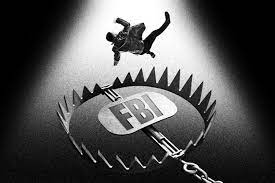
Basically, it works like this: in order to justify their crime-fighting superpowers, the FBI manufactures criminals by targeting vulnerable individuals and feeding them anti-government propaganda; then, undercover agents and informants equip the targeted individuals with the training and resources to challenge what they’ve been indoctrinated into believing is government corruption; and finally, the FBI arrests the targeted individuals for engaging in anti-government, terrorist activities.

This is what passes for the government’s perverse idea of being tough on crime.

For example, undercover FBI agents pretending to be associated with ISIS have been accused of seeking out online and befriending a 16-year-old with brain development issues, persuading him to secretly send them small cash donations in the form of gift cards, and then the moment Mateo Ventura, turned 18, arresting him for providing financial support to an Islamic terrorist group.

If convicted, the teenager could spend up to 10 years in prison.

Yet as The Intercept explains, “the only ‘terrorist’ he is accused of ever being in contact with was an undercover FBI agent who befriended him online as a 16-year-old… This law enforcement tactic has been criticized by national security researchers who have scrutinized the FBI’s role in manufacturing terrorism cases using vulnerable people who would have been unable to commit crimes without prolonged government assistance and encouragement… the Ventura case may indicate that authorities are still open to conjuring terrorists where none existed.”

In another incident, the FBI used an undercover agent/informant to seek out and groom an impressionable young man, cultivating his friendship, gaining his sympathy, stoking his outrage over injustices perpetrated by the U.S. government, then enlisting his help to blow up the Herald Square subway station. Despite the fact that Shahawar Matin Siraj ultimately refused to plant a bomb at the train station, he was arrested for conspiring to do so at the urging of his FBI informant and used to bolster the government’s track record in foiling terrorist plots. Of course, no mention was made of the part the government played in fabricating the plot, recruiting a would-be bomber, and setting him up to take the fall.

These are Machiavellian tactics with far-reaching consequences for every segment of the population, no matter what one’s political leanings, but it is especially dangerous for anyone whose views could in any way be characterized as anti-government.

As Rozina Ali writes for The New York Times Magazine, “The government’s approach to counterterrorism erodes constitutional protections for everyone, by blurring the lines between speech and action and by broadening the scope of who is classified as a threat.”

For instance, it was reported that the FBI had been secretly carrying out an entrapment scheme in which it used a front company, ANOM, to sell purportedly hack-proof phones to organized crime syndicates and then used those phones to spy on them as they planned illegal drug shipments, plotted robberies and put out contracts for killings using those boobytrapped phones.

All told, the FBI intercepted 27 million messages over the course of 18 months.

What this means is that the FBI was also illegally spying on individuals using those encrypted phones who may not have been involved in any criminal activity whatsoever.

Even reading a newspaper article is now enough to get you flagged for surveillance by the FBI. The agency served a subpoena on USA Today / Gannett to provide the internet addresses and mobile phone information for everyone who read a news story online on a particular day and time about the deadly shooting of FBI agents.

This is the danger of allowing the government to carry out widespread surveillance, sting and entrapment operations using dubious tactics that sidestep the rule of law: “we the people” become suspects and potential criminals, while government agents, empowered to fight crime using all means at their disposal, become indistinguishable from the corrupt forces they seek to vanquish.  

To go after terrorists, they become terrorists.

To go after drug smugglers, they become drug smugglers.

To go after thieves, they become thieves.

For instance, when the FBI raided a California business that was suspected of letting drug dealers anonymously stash guns, drugs and cash in its private vaults, agents seized the contents of all the  safety deposit boxes and filed forfeiture motions to keep the contents, which include millions of dollars’ worth of valuables owned by individuals not accused of any crime whatsoever.

It’s hard to say whether we’re dealing with a kleptocracy (a government ruled by thieves), a kakistocracy (a government run by unprincipled career politicians, corporations and thieves that panders to the worst vices in our nature and has little regard for the rights of American citizens), or if we’ve gone straight to an idiocracy

This certainly isn’t a constitutional democracy, however.

Some days, it feels like the FBI is running its own crime syndicate complete with mob rule and mafia-style justice.

In addition to creating certain crimes in order to then “solve” them, the FBI also gives certain informants permission to break the law, “including everything from buying and selling illegal drugs to bribing government officials and plotting robberies,” in exchange for their cooperation on other fronts.

USA Today estimates that agents have authorized criminals to engage in as many as 15 crimes a day (5600 crimes a year). Some of these informants are getting paid astronomical sums: one particularly unsavory fellow, later arrested for attempting to run over a police officer, was actually paid $85,000 for his help laying the trap for an entrapment scheme.

In a stunning development reported by The Washington Post, a probe into misconduct by an FBI agent resulted in the release of at least a dozen convicted drug dealers from prison.

In addition to procedural misconduct, trespassing, enabling criminal activity, and damaging private property, the FBI’s laundry list of crimes against the American people includes surveillance, disinformation, blackmail, entrapment, intimidation tactics, and harassment.

For example, the Associated Press lodged a complaint with the Dept. of Justice after learning that FBI agents created a fake AP news story and emailed it, along with a clickable link, to a bomb threat suspect in order to implant tracking technology onto his computer and identify his location. Lambasting the agency, AP attorney Karen Kaiser railed, “The FBI may have intended this false story as a trap for only one person. However, the individual could easily have reposted this story to social networks, distributing to thousands of people, under our name, what was essentially a piece of government disinformation.”

Then again, to those familiar with COINTELPRO, an FBI program created to “disrupt, misdirect, discredit, and neutralize” groups and individuals the government considers politically objectionable, it should come as no surprise that the agency has mastered the art of government disinformation.

The FBI has been particularly criticized in the wake of the 9/11 terrorist attacks for targeting vulnerable individuals and not only luring them into fake terror plots but actually equipping them with the organization, money, weapons and motivation to carry out the plots—entrapment—and then jailing them for their so-called terrorist plotting. This is what the FBI characterizes as “forward leaning—preventative—prosecutions.”

The FBI has also repeatedly sought to expand its invasive hacking powers to allow agents to hack into any computer, anywhere in the world.

Suffice it to say that when and if a true history of the FBI is ever written, it will not only track the rise of the American police state but it will also chart the decline of freedom in America: how a nation that once abided by the rule of law and held the government accountable for its actions has steadily devolved into a police state where justice is one-sided, a corporate elite runs the show, representative government is a mockery, police are extensions of the military, surveillance is rampant, privacy is extinct, and the law is little more than a tool for the government to browbeat the people into compliance.

This is how tyranny rises and freedom falls.

The powers-that-be are not acting in our best interests.

Almost every tyranny being perpetrated by the U.S. government against the citizenry—purportedly to keep us safe and the nation secure—has come about as a result of some threat manufactured in one way or another by our own government.

Think about it.

Cyberwarfare. Terrorism. Bio-chemical attacks. The nuclear arms race. Surveillance. The drug wars. Domestic extremism. The COVID-19 pandemic.

In almost every instance, the U.S. government (often spearheaded by the FBI) has in its typical Machiavellian fashion sown the seeds of terror domestically and internationally in order to expand its own totalitarian powers.

Consider that this very same government has taken every bit of technology sold to us as being in our best interests—GPS devices, surveillance, nonlethal weapons, etc.—and used it against us, to track, control and trap us.

Are you getting the picture yet?

The U.S. government isn’t protecting us from threats to our freedoms.

The U.S. government is creating the threats to our freedoms. It is, as I make clear in my book Battlefield America: The War on the American People and in its fictional counterpart The Erik Blair Diaries, the source of the threats to our freedoms.
A Nanny State Idiocracy: When the Government Thinks It Knows Best

By John & Nisha Whitehead

Source: The Rutherford Institute

“Whether the mask is labeled fascism, democracy, or dictatorship of the proletariat, our great adversary remains the apparatus—the bureaucracy, the police, the military.”—Simone Weil, French philosopher

It’s hard to say whether we’re dealing with a kleptocracy (a government ruled by thieves), a kakistocracy (a government run by unprincipled career politicians, corporations and thieves that panders to the worst vices in our nature and has little regard for the rights of American citizens), or if we’ve gone straight to an idiocracy

For instance, an animal welfare bill introduced in the Florida state legislature would ban the sale of rabbits in March and April, prohibit cat owners from declawing their pets, make it illegal for dogs to stick their heads out of car windows, force owners to place dogs in a harness or in a pet seatbelt when traveling in a car, and require police to create a public list of convicted animal abusers.

A Massachusetts law prohibits drivers from letting their cars idle for more than five minutes on penalty of a $100 fine ($500 for repeat offenders), even in the winter. You can also be fined $20 or a month in jail for scaring pigeons.

This overbearing Nanny State despotism is what happens when government representatives (those elected and appointed to work for us) adopt the authoritarian notion that the government knows best and therefore must control, regulate and dictate almost everything about the citizenry’s public, private and professional lives.

The government’s bureaucratic attempts at muscle-flexing by way of overregulation and overcriminalization have reached such outrageous limits that federal and state governments now require on penalty of a fine that individuals apply for permission before they can grow exotic orchids, host elaborate dinner parties, gather friends in one’s home for Bible studies, give coffee to the homeless, let their kids manage a lemonade stand, keep chickens as pets, or braid someone’s hair, as ludicrous as that may seem.

Consider, for example, that businesses in California were ordered to designate an area of the children’s toy aisle “gender-neutral” or face a fine, whether or not the toys sold are traditionally marketed to girls or boys such as Barbies and Hot Wheels. California schools are prohibited from allowing students to access websites, novels or religious works that reflect negatively on gays. And while Californians are free to have sex with whomever they choose (because that’s none of the government’s business), removing a condom during sex without consent could make you liable for general, special and punitive damages.

It’s getting worse.

Almost every aspect of American life today—especially if it is work-related—is subject to this kind of heightened scrutiny and ham-fisted control, whether you’re talking about aspiring “bakers, braiders, casket makers, florists, veterinary masseuses, tour guides, taxi drivers, eyebrow threaders, teeth whiteners, and more.”

For instance, whereas 70 years ago, one out of every 20 U.S. jobs required a state license, today, almost 1 in 3 American occupations requires a license.

The problem of overregulation has become so bad that, as one analyst notes, “getting a license to style hair in Washington takes more instructional time than becoming an emergency medical technician or a firefighter.”

This is what happens when bureaucrats run the show, and the rule of law becomes little more than a cattle prod for forcing the citizenry to march in lockstep with the government.

Overregulation is just the other side of the coin to overcriminalization, that phenomenon in which everything is rendered illegal and everyone becomes a lawbreaker.

As policy analyst Michael Van Beek warns, the problem with overcriminalization is that there are so many laws at the federal, state and local levels—that we can’t possibly know them all.

“It’s also impossible to enforce all these laws. Instead, law enforcement officials must choose which ones are important and which are not. The result is that they pick the laws Americans really must follow, because they’re the ones deciding which laws really matter,” concludes Van Beek. “Federal, state and local regulations — rules created by unelected government bureaucrats — carry the same force of law and can turn you into a criminal if you violate any one of them… if we violate these rules, we could be prosecuted as criminals. No matter how antiquated or ridiculous, they still carry the full force of the law. By letting so many of these sit around, just waiting to be used against us, we increase the power of law enforcement, which has lots of options to charge people with legal and regulatory violations.”

This is the police state’s superpower: it has been vested with the authority to make our lives a bureaucratic hell.

That explains how a fisherman can be saddled with 20 years’ jail time for throwing fish that were too small back into the water. Or why police arrested a 90-year-old man for violating an ordinance that prohibits feeding the homeless in public unless portable toilets are also made available.

The laws can get downright silly. For instance, you could also find yourself passing time in a Florida slammer for such inane activities as singing in a public place while wearing a swimsuit, breaking more than three dishes per day, farting in a public place after 6 pm on a Thursday, and skateboarding without a license.

However, the consequences are all too serious for those whose lives become grist for the police state’s mill. A few years back, police raided barber shops in minority communities, resulting in barbers being handcuffed in front of customers, and their shops searched without warrants. All of this was purportedly done in an effort to make sure that the barbers’ licensing paperwork was up to snuff.

In this way, America has gone from being a beacon of freedom to a locked down nation. And “we the people,” sold on the idea that safety, security and material comforts are preferable to freedom, have allowed the government to pave over the Constitution in order to erect a concentration camp.

We labor today under the weight of countless tyrannies, large and small, carried out in the so-called name of the national good by an elite class of governmental and corporate officials who are largely insulated from the ill effects of their actions.

We increasingly find ourselves badgered, bullied and browbeaten into bearing the brunt of their arrogance, paying the price for their greed, suffering the backlash for their militarism, agonizing as a result of their inaction, feigning ignorance about their backroom dealings, overlooking their incompetence, turning a blind eye to their misdeeds, cowering from their heavy-handed tactics, and blindly hoping for change that never comes. 

The overt signs of the despotism exercised by the increasingly authoritarian regime that passes itself off as the United States government (and its corporate partners in crime) are all around us: censorship, criminalizing, shadow banning and de-platforming of individuals who express ideas that are politically incorrect or unpopular; warrantless surveillance of Americans’ movements and communications; SWAT team raids of Americans’ homes; shootings of unarmed citizens by police; harsh punishments meted out to schoolchildren in the name of zero tolerance; community-wide lockdowns and health mandates that strip Americans of their freedom of movement and bodily integrity; armed drones taking to the skies domestically; endless wars; out-of-control spending; militarized police; roadside strip searches; privatized prisons with a profit incentive for jailing Americans; fusion centers that spy on, collect and disseminate data on Americans’ private transactions; and militarized agencies with stockpiles of ammunition, to name some of the most appalling.

Yet as egregious as these incursions on our rights may be, it’s the endless, petty tyrannies—the heavy-handed, punitive-laden dictates inflicted by a self-righteous, Big-Brother-Knows-Best bureaucracy on an overtaxed, overregulated, and underrepresented populace—that illustrate so clearly the degree to which “we the people” are viewed as incapable of common sense, moral judgment, fairness, and intelligence, not to mention lacking a basic understanding of how to stay alive, raise a family, or be part of a functioning community.

In exchange for the promise of an end to global pandemics, lower taxes, lower crime rates, safe streets, safe schools, blight-free neighborhoods, and readily accessible technology, health care, water, food and power, we’ve opened the door to lockdowns, militarized police, government surveillance, asset forfeiture, school zero tolerance policies, license plate readers, red light cameras, SWAT team raids, health care mandates, overcriminalization, overregulation and government corruption.

In the end, such bargains always turn sour.

We relied on the government to help us safely navigate national emergencies (terrorism, natural disasters, global pandemics, etc.) only to find ourselves forced to relinquish our freedoms on the altar of national security, yet we’re no safer (or healthier) than before.

We asked our lawmakers to be tough on crime, and we’ve been saddled with an abundance of laws that criminalize almost every aspect of our lives. So far, we’re up to 4500 criminal laws and 300,000 criminal regulations that result in average Americans unknowingly engaging in criminal acts at least three times a day. For instance, the family of an 11-year-old girl was issued a $535 fine for violating the Federal Migratory Bird Act after the young girl rescued a baby woodpecker from predatory cats.

We wanted criminals taken off the streets, and we didn’t want to have to pay for their incarceration. What we’ve gotten is a nation that boasts the highest incarceration rate in the world, with more than 2.3 million people locked up, many of them doing time for relatively minor, nonviolent crimes, and a private prison industry fueling the drive for more inmates, who are forced to provide corporations with cheap labor.

A special report by CNBC breaks down the national numbers:

One out of 100 American adults is behind bars — while a stunning one out of 32 is on probation, parole or in prison. This reliance on mass incarceration has created a thriving prison economy. The states and the federal government spend about $74 billion a year on corrections, and nearly 800,000 people work in the industry.

We wanted law enforcement agencies to have the necessary resources to fight the nation’s wars on terror, crime and drugs. What we got instead were militarized police decked out with M-16 rifles, grenade launchers, silencers, battle tanks and hollow point bullets—gear designed for the battlefield, more than 80,000 SWAT team raids carried out every year (many for routine police tasks, resulting in losses of life and property), and profit-driven schemes that add to the government’s largesse such as asset forfeiture, where police seize property from “suspected criminals.”

According to the Washington Post, these funds have been used to buy guns, armored cars, electronic surveillance gear, “luxury vehicles, travel and a clown named Sparkles.” Police seminars advise officers to use their “department wish list when deciding which assets to seize” and, in particular, go after flat screen TVs, cash and nice cars.

In Florida, where police are no strangers to asset forfeiture, Florida police have been carrying out “reverse” sting operations, where they pose as drug dealers to lure buyers with promises of cheap cocaine, then bust them, and seize their cash and cars. Over the course of a year, police in one small Florida town seized close to $6 million using these entrapment schemes.

We fell for the government’s promise of safer roads, only to find ourselves caught in a tangle of profit-driven red light cameras, which ticket unsuspecting drivers in the so-called name of road safety while ostensibly fattening the coffers of local and state governments. Despite widespread public opposition, corruption and systemic malfunctions, these cameras—used in 24 states and Washington, DC—are particularly popular with municipalities, which look to them as an easy means of extra cash.

One small Florida town, population 8,000, generates a million dollars a year in fines from these cameras. Building on the profit-incentive schemes, the cameras’ manufacturers are also pushing speed cameras and school bus cameras, both of which result in heft fines for violators who speed or try to go around school buses.

As I make clear in my book Battlefield America: The War on the American People and in its fictional counterpart The Erik Blair Diaries, this is what happens when the American people get duped, deceived, double-crossed, cheated, lied to, swindled and conned into believing that the government and its army of bureaucrats—the people we appointed to safeguard our freedoms—actually have our best interests at heart.

The problem with these devil’s bargains is that there is always a catch, always a price to pay for whatever it is we valued so highly as to barter away our most precious possessions.

We’ve bartered away our right to self-governance, self-defense, privacy, autonomy and that most important right of all: the right to tell the government to “leave me the hell alone.”

With Bezos at the Helm, Democracy Dies at the Washington Post Editorial Board

In the Soviet Union, everybody was aware that the media was controlled by the state. But in a corporate state like the U.S., a veneer of independence is still maintained, although trust in the media has been plummeting for years.

By Alan Macleod

Source: Mint Press News

The Washington Post’s glaring conflicts of interest have of late once again been the subject of scrutiny online, thanks to a new article denouncing a supposed attempt to “soak” billionaires in taxes. Written by star columnist Megan McArdle — who previously argued that Walmart’s wages are too high, that there is nothing wrong with Google’s monopoly, and that the Grenfell Fire was a price worth paying for cheaper buildings — the article claimed that Americans have such class envy that the government would “destroy [billionaires’] fortunes so that the rest of us don’t have to look at them.” Notably, the Post chose to illustrate it with a picture of its owner, Jeff Bezos, making it seem as if it was directly defending his power and wealth, something they have been accused of on more than one occasion.

There was considerable speculation online as to whether Bezos himself wrote the piece, so blatantly in his interest it was. Unfortunately, this sort of speculation has raged ever since the Amazon CEO bought the newspaper in 2013 for $250 million.

Undue influence

Being owned by the world’s richest individual does not mean that The Washington Post and its employees are rolling in dough themselves. Far from it: Bezos’ revolution at the newspaper, which has led to both increased pageviews and company value, has been largely based on simply squeezing workers harder than before. In an interview with the Columbia Journalism Review, management acknowledged that Post reporters are pushed to produce almost four times as many stories as their peers at The New York Times. Furthermore, the Post writes and rewrites the same story but from slightly different angles and with different headlines in order to generate more clicks, and thus more revenue. Thanks to new technology, reporters’ every keystroke is monitored and they are under constant pressure from management not to fall behind. The technique of constant surveillance is not unlike what hyper-exploited Amazon warehouse workers who wear GPS devices or Fitbit watches have to endure.

Bezos is currently worth a shade under $200 billion, with his wealth nearly doubling since the beginning of the coronavirus pandemic in 2020. With such a fortune to protect, the obvious solution is to acquire media outlets to control the narrative in the face of rising public disenchantment with rampaging inequality. Omar Ocampo, a researcher for the Program on Inequality and the Common Good at the Institute for Policy Studies, said that this is a common tactic among the super wealthy. “Billionaire ownership of major news outlets is but another tool the billionaire class deploys for the purpose of wealth defense. It gives them the power to set the terms of the agenda and influence public opinion in their favor,” Ocampo told MintPress.

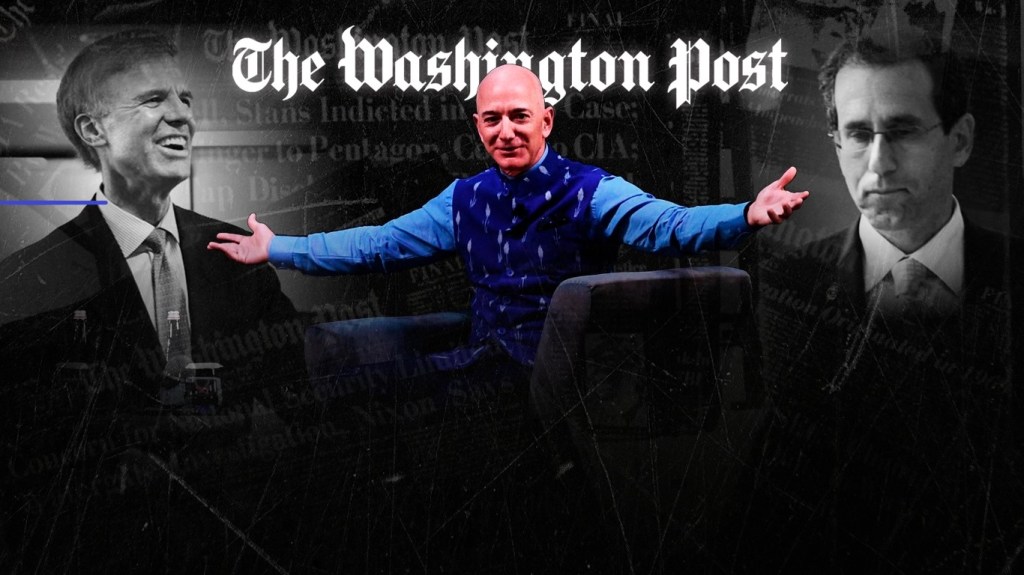
But Bezos is far from the only senior figure with questionable connections. The company’s CEO, Frederick Ryan, was a senior member of the Reagan White House, rising to become the 40th president’s assistant and later the chairman of the Ronald Reagan Presidential Foundation. He later became CEO of Politico. In the Post’s announcement of the hiring move, they themselves noted that among Ryan’s biggest achievements at their rival outlet was “helping the news organization win a lucrative advertising deal with Goldman Sachs and host presidential debates before the 2008 and 2012 Republican primaries.”

Another neoconservative in a key position is Editorial Page Editor Fred Hiatt. Under Hiatt’s tenure, anti-establishment columnists like Dan Froomkin were let go and warmongers like the late Charles Krauthammer, Paul Wolfowitz, and David Ignatius moved in. “After being so wrong on such a huge story as the invasion of Iraq, hawkish ideologue Fred Hiatt should have been terminated as editorial page editor,” Jeff Cohen, former Professor of Journalism at Ithaca College and founder of media watchdog group Fairness and Accuracy in Reporting, told MintPress, adding:

In a decent media system, someone who has been so inaccurate on so many issues as Hiatt would not be in a powerful media position two decades later. Powerful voices in U.S. media often argue that society should be a ‘meritocracy’ — with advancement based on ability or achievement. Hiatt proves that the U.S. corporate media system is just the opposite — a ‘kakistocracy’ — where the unqualified and unprincipled rise to the top.”

Other highly questionable hires include Jerusalem correspondent Ruth Eglash, who spent seven years putting out content that was often indistinguishable from Israeli government propaganda. At the time of her hire, activists highlighted the conflicts of interest she had, given her husband’s job as a PR rep for the country. In November 2020, Eglash quit the Post to become chief of communications for the Israeli ambassador to the United States and United Nations. “My experiences as a journalist have afforded me a great instinct of how to better tell Israel’s unique story,” she said, adding “a strong U.S.-Israel relationship and showcasing Israel’s successes to the world has [sic] always been a passion of mine.”

At the center of the news cosmos

The Washington Post is among the most powerful, influential, and widely-read media outlets in the United States. Its position as the dominant newspaper in the nation’s capital reinforces its place as a thought-leading, agenda-setting publication. Whatever appears in the Post will likely be in the rest of the nation’s media, so authoritative is its reputation.

There are no more important pages than its editorial section, where its board comes together to lay out the collective wisdom of its most senior journalists and editors. Through its editorial page, the senior staff lay out the newspaper’s line to others and broadcast what they see as the correct position on the most pressing issues of the day. Hence, editorials are essentially instructions to their well-heeled and influential readers in D.C. and around the country on what to think about any given subject.

This is particularly troublesome as, despite the fact the newspaper presents itself as a defender of liberty and a champion of the people (its tagline is “Democracy Dies in Darkness”), the editorial board has represented the interests of the powerful over ordinary Americans on issue after issue. The following editorials are examples of this in action.

Could we be any more pro-war?

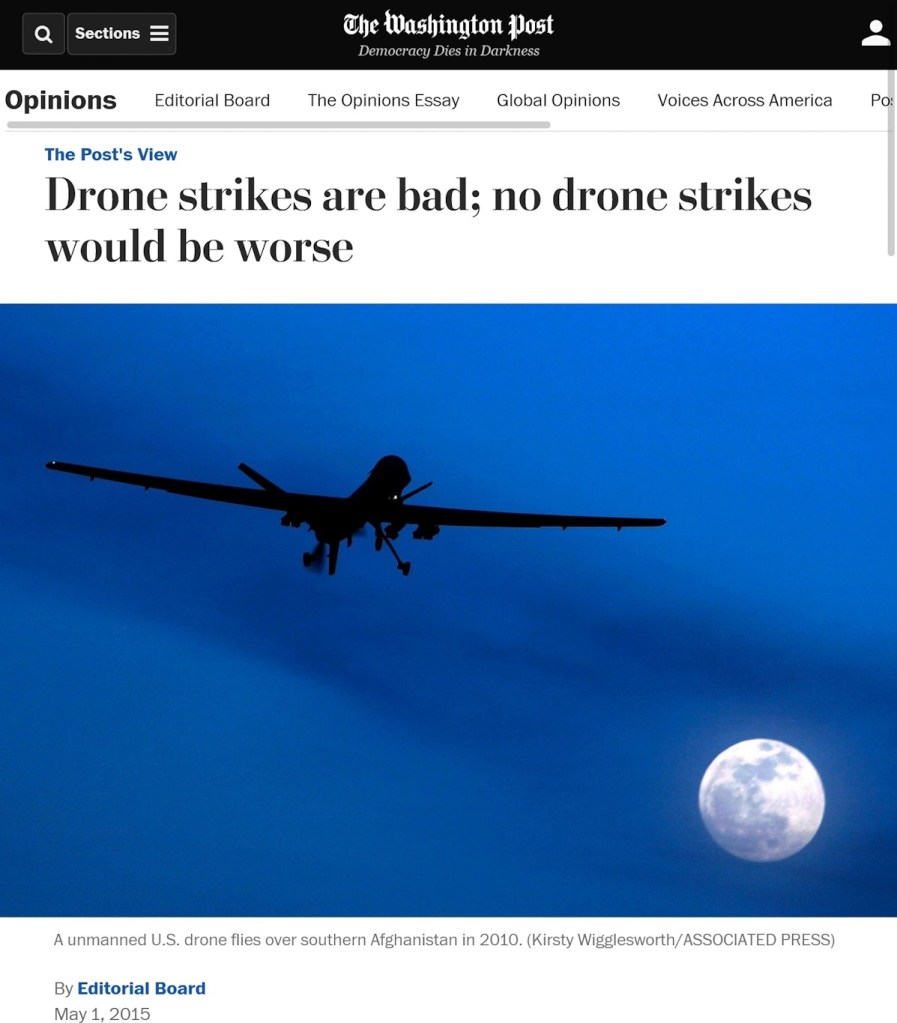
The Post’s editorial board has generally been extremely supportive of whatever conflicts the U.S. has started, and has consistently warned against ending the violence. In a 2015 editorial entitled “Drone strikes are bad; no drone strikes would be worse,” it balked at the idea of stopping the highly controversial bombing campaigns throughout the Middle East and North Africa. By that time, President Barack Obama was bombing seven countries simultaneously. Nevertheless, the Post argued that drones had successfully defeated Al-Qaeda and that the use of drone strikes “shouldn’t be up for review.”

In recent times, the rising newspaper of record has also been a driver of increased hostilities with China, describing Beijing’s military’s moves in the South China Sea as “provocations” against the U.S., spreading rumors about the COVID-19 virus’s origin, and demanding American companies like Apple “resist China’s tyranny” and begin to relocate their production facilities elsewhere to punish the Chinese government.

On Latin America too, the editorial board has proven to be extremely hawkish. It immediately endorsed a U.S.-backed far-right coup in Bolivia in 2019, insisting that “there could be little doubt who was ultimately responsible for the chaos: newly resigned President Evo Morales.” The Post condemned him for refusing to “cooperate” with “Bolivia’s more responsible leaders,” who were organizing his overthrow, and chastised him for using the word “coup” for what was going on. Morales, they concluded, was a victim of his own “insatiable appetite for power” and his inability to “accept that a majority of Bolivians wanted him to leave office.”

In 2002, the paper also supported a coup against Hugo Chavez, falsely claiming the Venezuelan president had ordered the shooting of thousands of demonstrators and absurdly asserting that “there’s been no suggestion that the United States had anything to do with [it].

The WaPo editorial board’s less than subtle take on drone warfare

In more recent times, it has demanded more action to unseat Chavez’s successor, Nicolas Maduro, including supporting U.S. sanctions that have now killed over 100,000 people, according to a United Nations rapporteur. The Post’s justification in 2017 was that Maduro was on the verge of carrying out his own “coup,” “abolish[ing] the opposition-controlled legislature, cancel[ing] future elections and establish[ing] a regime resembling that of Cuba’s” — none of which has happened. In its efforts to oust the democratically-elected leader, the Post even aligned itself with Donald Trump and endorsed far-right coup leader Juan Guaidó as “Venezuela’s legitimate president,” a position some polls have suggested as little as 3% of Venezuelans hold.

The editorial board has expressed its desire to see regime change in leftist-controlled Nicaragua, too. President Daniel Ortega, it claims, is “taking a sledgehammer” to opposition against him, while it also demands that the U.S., which has done nothing but offer “mild verbal opposition” to his rule, do more. What happened to the U.S. of the 1980s, “which spent so much money and political capital to promote democracy in Nicaragua?” they ask sadly.

In reality, of course, the U.S. is currently trying to strangle Nicaragua’s economy through sanctions. And in the 1980s, Washington’s “democracy promotion” agenda included the funding, training and arming of fascist death squads who wrought havoc across Central America, killing hundreds of thousands in genocides from which the area may never recover. The architects of the violence were found guilty in U.S. courts, while the Reagan administration was tried and convicted by the International Court of Justice on 15 counts that amount to international terrorism. That the Post’s editorial board remembers that history as “promoting democracy” is particularly worrisome.

Fake news, fake newspapers

The Washington Post was the key supporter of fake news detection system “PropOrNot,” which was almost immediately exposed as a fake operation itself, forcing the newspaper to publicly distance itself from its own reporting. Yet it was the Post itself that perpetuated the most notorious and damaging fake news story of the 21st century: the Iraqi weapons of mass destruction hoax and Saddam Hussein’s fictional links to al-Qaeda.

In a highly influential editorial entitled “Irrefutable” the Post wrote that, after watching Secretary of State Colin Powell’s speech at the United Nations, “it is hard to imagine how anyone could doubt that Iraq possesses weapons of mass destruction… And [Powell] offered a powerful new case that Saddam Hussein’s regime is cooperating with a branch of the al-Qaeda organization that is trying to acquire chemical weapons and stage attacks in Europe.”

“No page was more crucial in propelling the disastrous U.S. invasion of Iraq than the Post‘s editorial page — which beat the drums for war in a couple dozen editorials in the six months leading up to the invasion,” Cohen told MintPress, adding:

The Post’s op-ed page was almost as cartoonishly wrong on Iraq, offering little dissent or corrective to the editorial page’s jingoism — especially in that pivotal media moment following Colin Powell’s error-filled U.N. speech. While the editorial page offered up its ‘Irrefutable’ verdict, the op-ed page’s liberal voice offered an embarrassing column, headlined ‘I’m Persuaded’.”

The Post played a major role in manufacturing consent for the deadliest war since Vietnam, publishing 27 editorials in support of an invasion. As with PropOrNot, it backtracked long after the dust had settled, apologizing for its role in amping the public up to accept that war. Yet to this day it continues to push for others.

Surveillance state champion

Despite telling its readers that “Democracy Dies in Darkness,” The Washington Post certainly has a negative opinion about those individuals who work to shine a light on illegal government activities. In 2016, its editorial board demanded “no pardon for Edward Snowden,” condemning his backers like filmmaker Oliver Stone and expressing outrage that Snowden had revealed that the U.S. was spying on Russia and carrying out cyberattacks against China. In its long denunciation, it insisted that the NSA’s massive surveillance operation against the American public resulted in “no specific harm, actual or attempted.” As such, the editorial board made history by becoming the first newspaper ever to call for the imprisonment of its own source, on whose back and information it won a Pulitzer Prize.

If Snowden was not worthy of defending, then it is no surprise that the Post’s editorial team expressed their delight when Julian Assange was dragged out of the Ecuadorian Embassy in London, declaring it a “victory for the rule of law.” “Julian Assange is not a free-press hero. And he is long overdue for personal accountability,” they wrote, spreading baseless conspiracy theories that the Australian publisher worked with Russia to hack American democracy.

The Ecuadorian government of Rafael Correa, which offered asylum to the Western dissidents, also came under fire. In 2013, the Post (falsely) labeled Correa an “autocrat” and “the hemisphere’s preeminent anti-U.S. demagogue.” They also directly threatened him, writing that, “If Mr. Correa welcomes Mr. Snowden, there will be an easy way to demonstrate that Yanqui-baiting has its price.”

Of course, the Post is now intimately linked with the national security state after Amazon signed a number of deals to provide intelligence and computing services to several three-letter agencies. In 2020, the Bezos-owned Amazon Web Services signed a new deal with the CIA worth tens of billions of dollars.

The editorial board has also gone up to bat for Immigration and Customs Enforcement (ICE) multiple times, insisting that it is “the wrong target for outrage,” presenting the agency as key in the battle against art theft and nuclear proliferation. “Abolishing ICE is not a serious policy proposal,” the board wrote in 2018, despite the fact that the U.S. survived without the agency perfectly well until its creation in 2003.

Attacking any pro-people policy

The Washington Post has aggressively attempted to beat back any new political movements challenging the establishment. Chief among them has been the one around Bernie Sanders, for whom the newspaper has reserved a special ire. In 2016, it famously ran 16 negative stories on Sanders in the space of 16 hours and has used its fact-checking page to relentlessly undermine him, sometimes to bizarre effect.

“Bernie Sanders keeps saying his average donation is $27, but his own numbers contradict that,” read the headline of one article, which detailed how his average donation was actually $27.89, not $27. It also gave his statement that six men (one of whom is Bezos) hold as much wealth as the bottom half of the world’s population “three Pinocchios” — the designation just below the most egregious lie. This was because, they argued, billionaires’ wealth is tied up in stocks, not money itself, and most people own essentially nothing. Why this disproved his assertion they did not explain. Going undisclosed is that both Bezos and the Post’s chief fact-checker Glen Kessler, who is the scion of a fossil fuel baron, would stand to lose a fortune if Sanders were elected.

Likewise, the Post’s editorial board did all it could to ensure Sanders was not elected in 2016, publishing editorials such as “Bernie Sanders’s fiction-filled campaign,” which defended big banks from Sanders’s attacks; “Mr. Sanders’s shocking ignorance on his core issue,” which presented Hillary Clinton as a more credible Wall Street reformer; and “Mr. Sanders peddles fiction on free trade,” which championed the long-discredited North American Free Trade Agreement as a jobs creator. Unsurprisingly, the editorial board was also a vociferous supporter of the Trans Pacific Partnership.

In 2020, the Post was no less hostile to Sanders, publishing an editorial headlined “We should pay more attention to the Democrats who pay attention to reality,” which stated that “Mr. Sanders promises unlimited free stuff to everyone; other candidates propose smarter, more targeted approaches.”

The Post’s higher-ups have been careful to oppose virtually every piece of progressive or pro-people policy proposals. Chief among them has been healthcare. The United States is alone in the developed world in not offering some kind of universal healthcare to its population. Its privatized system is multiple times more expensive than that of comparable countries and has the worst outcomes in the West. Yet the board has consistently scare-mongered its readers, claiming “Single-payer health care would have an astonishingly high price tag,” and attacking Medicare-For-All proponents running for office. “Why go to the trouble of running for president to promote ideas that can’t work?” it asked rhetorically, before going on to insist that moving towards a healthcare system like that of Canada, Japan or Western Europe does not meet a “baseline degree of factual plausibility.”

On education, it has been just as regressive. “There are consequences to making college free,” it warned readers. Chief among these would be that private universities would make less money, which, apparently should be a major concern. “Forgiving student loans the wrong way will only worsen inequality,” ran the headline of another editorial, in which the board pretended to be ultra-left elite-hating radicals, arguing that we should not make college free because Ivy League graduates would benefit the most (around one-third of the Post’s editorial team attended an Ivy League school). It also feigned a far-left position on charter schools, pretending that essentially privatizing schools and handing them over to businesses to run would solve racial inequality in America, and that anyone who opposed them (like teachers’ unions) was no progressive.

Perhaps the most blatant conflict of interest the Post has displayed is in their committed opposition to a wealth tax. “Elizabeth Warren wants a ‘wealth tax.’ It might backfire,” they wrote, making a series of bizarre and illogical arguments against the plan, such as immigrants will stop wanting to come to the U.S. if such a tax is imposed (the threshold for paying a wealth tax is $50 million). Five months later, the board reaffirmed their position: “A wealth tax isn’t the best way to tax the rich,” they wrote, claiming that rich people “can afford the best accountants and lawyers,” and so taxing them is presumably impossible.

Of course, the Post’s owner, Jeff Bezos, has every reason to go all out to prevent a wealth tax gaining traction. A CNBC study calculated that Bezos would be forced to pay $5.7 billion annually if Warren’s tax plans came to fruition.

The Post has also taken a firm stand against serious regulation of monopolies, decrying a supposed “antitrust onslaught” against Google, spearheaded by simplistic “break-them-up” rhetoric from dishonest actors. In 2016, it also lambasted Sanders for his “oversimplified,” “crowd-pleasing” demagoguery on Wall Street regulation, insisting that there has actually been widespread reform of the financial sector since 2008, making another crash unlikely.

Unsurprisingly for an outlet owned by a poverty-wage employer, the Post has also consistently opposed a national $15 minimum wage. In March, it categorically stated that “[a] $15 minimum wage won’t happen” and Democrats should stop trying to make it happen. Instead, they advised, they should “practice the art of the possible.” This, the board explained, meant falling in line behind Arkansas arch-Republican Senator Tom Cotton to support his proposals for a creeping state-by-state rise to $10.

On the climate, too, the Post has pushed extremely regressive positions, opposing a Green New Deal outright and suggesting the atmosphere be turned into a giant free market where polluters can trade credits and speculate. “The left’s opposition to a carbon tax shows there’s something deeply wrong with the left,” they wrote. They also endorsed the highly controversial process of fracking. Seeing as the Post’s editorial board is littered with former employees of the notorious climate-change denying Wall Street Journal, its stance is perhaps not surprising.

On COVID, the Post has consistently opposed teachers’ unions calls to keep schools closed, as well as standing against $2,000 checks. A universal payout is a “bad idea” they stated, but one “whose time has come because of politics, not economics.” So committed was the editorial team’s opposition to the idea of helping the poor that it presented Republican Majority Leader Mitch McConnell as a voice of sanity in Washington.

This does not mean that the Post was against direct payments to all people. In fact, all Post employees received a $2,021 bonus from management in January as a gesture of appreciation for their work during the pandemic. Two grand for me, not for thee.

Junk-food news

The point of a fourth estate is that it is supposed to shine a light on the powerful and hold them to account. But when corporate media are largely owned and sponsored by the super wealthy themselves, the claim that this is what they do is increasingly hard to maintain. In the Soviet Union, everybody was aware that the media was controlled by the state. But in a corporate state like the U.S., a veneer of independence is still maintained, although trust in the media has been plummeting for years.

While The Washington Post presents itself as an adversarial publication standing up to power, the fact that its senior staff constantly comes to such a hardline neoliberal elitist consensus on so many issues shows how little ideological diversity there is among its staff. Democracy dies at The Washington Post editorial board.

IN ORDER TO UNDERSTAND THE WORLD TODAY YOU MUST UNLEARN THIS ONE THING

By Sigmund Fraud

Source: Waking Times

At present, we are dangerously trending toward chaos, total world war, civil war, incivility, and a complete breakdown of civil society, and to the indoctrinated, it’s difficult to understand why exactly this is happening. As the stress of this mounts, the misinformed lash out at friends, family members and strangers who do not fully subscribe to their worldview. The battle really is one of understanding how the world works, and with such epidemic false perceptions, people choose the wrong targets for their ire.

If one were to unlearn, however, many of the things we’ve been taught about how our world works, re-educate the self, and re-orient to a more complete and truthful assessment of the world today, the picture becomes more clear, things make more sense, and a pathway to unity opens up. One thing we can all agree on, though, is that we’ve all been duped in big ways, most notably in the one arena which affects everyone, everyday, at every time. Money.

False = Money is Real and the Economy is Capitalist

Trained to worship money and the idea of infinite growth, it’s tough to understand just how much unnatural stress is being introduced in our world by a financial system and world economy which is operates explicitly for the profit a few key players. The money is fiat, and its value is controlled by privately run organizations who have the power to enslave the entire world with debt.

Furthermore, the system is not capitalism, but rather something beyond capitalism. Post capitalism, perhaps, as it more closely resembles the zombie ghost of capitalism, soullessly eating everything in its path with no interest at all in sustainability.

Recently speaking on this matter, financial analyst Max Keiser explained the result of having central bank managed interest rates kept artificially low in order to enrich those at the top of the pyramid. This is one major piece of very large and hidden puzzle.

“There’s no incentive to save money, there’s only an incentive to commit fraud. So if there’s no incentive to save money, then there’s no capital, and without capital there’s no capitalism. So you have, unfortunately, now a situation where it’s the survival of the most fraudulently inclined. It’s a kakistocracy, which is rule by the least capable of a society.” ~Max Keiser

This short interview with Max Kaiser by Luke Rudkowski sheds more insight on this issue:

The system we have today is really more akin to an elaborate slave plantation. All money that we use today in public is borrowed from private banks, and we pay dearly for the privilege of using it.

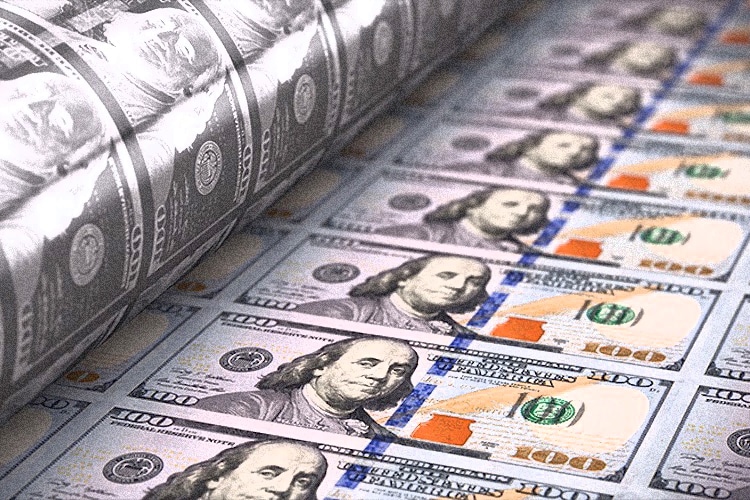
This is because money is created out of debt in a one-to-one increase in public debt. The national debt is $20 Trillion. That means the (roughly) 234 million US Americans would have to pay approximately $62,000 each to pay it off. This includes babies, children, poor people, and homeless people. There are even those who claim that it’s mathematically impossible to pay off the debt. And almost every country is in debt to every other country. It’s the height of insanity.

As former Governor of the Federal Reserve Marriner Eccles said, “If there were no debts in our money system, there wouldn’t be any money.” ~Gary ‘Z’ McGee

The stress in our world stemming from a global banking system designed to enslave is felt everywhere, from endless wars to unaffordable healthcare and evermore expensive food. Yet while few people really understand how this works, we are battling a war of propaganda and mind control.

Making sense of the world today is no easy task for those who’ve yet to abandon the standard American diet of propaganda and mental programming. Indoctrination works in a couple of key ways. Firstly, beliefs are instilled and reinforced by repetition, and secondly, undesirable beliefs are ignored and cast aside as fringe. What’s left is a mind which focuses on what it’s supposed to focus on, constructing a reality around a false and incomplete picture of the world.

This is food for thought for free thinkers, with the aim overcoming petty division in order to create a more prosperous and unified future.