It’s an open secret. The deep state is working hand in hand with Silicon Valley social media giants like Twitter, Facebook and Google to control the flow of information. That includes suppressing, censoring and sometimes outright purging dissenting voices – all under the guise of fighting fake news and Russian propaganda.
Most recently, it was revealed that Twitter’s senior editorial executive for Europe, the Middle East and Africa is an active officer in the British Army’s 77th Brigade, a unit dedicated to online warfare and psychological operations.
In other words: he specializes in disseminating propaganda.
The news left many wondering how a member of the British Armed Forces secured such an influential job in the media.
The bombshell that one of the world’s most influential social networks is controlled in part by an active psychological warfare officer was not covered at all in the New York Times, CNN, CNBC, MSNBC or Fox News, who appear to have found the news unremarkable.
But for those paying attention and for those who have been following ’MintPress News’ extensive coverage of social media censorship, this revelation was merely another example of the increasing closeness between the deep state and the fourth estate.
Amazon owner, and world’s richest man, Jeff Bezos was paid $600 million by the CIA to develop software and media for the agency, that’s more than twice as much as Bezos bought the Washington Post for, and a move media critics warn spells the end of journalistic independence for the Post.
Meanwhile, Google has a very close relationship with the State Department, its former CEO Eric Schmidt’s book on technological imperialism was heartily endorsed by deep state warmongers like Henry Kissinger, Hillary Clinton and Tony Blair.
What Lockheed Martin was to the twentieth century…technology and cyber-security companies [like Google] will be to the twenty-first.”
Another social media giant partnering with the military-industrial complex is Facebook. The California-based company announced last year it was working closely with the neoconservative think tank, The Atlantic Council, which is largely funded by Saudi Arabia, Israel and weapons manufacturers to supposedly fight foreign “fake news.”
The Atlantic Council is a NATO offshoot and its board of directors reads like a rogue’s gallery of warmongers, including the notorious Henry Kissinger, Bush-era hawks like Condoleezza Rice, Colin Powell, James Baker, the former head of the Department of Homeland Security and author of the PATRIOT Act, Michael Chertoff, a number of former Army Generals including David Petraeus and Wesley Clark and former heads of the CIA Michael Hayden, Leon Panetta and Michael Morell.
39 percent of Americans, and similar numbers of people in other countries, get their news from Facebook, so when an organization like the Atlantic Council is controlling what the world sees in their Facebook news feeds, it can only be described as state censorship on a global level.
After working with the council, Facebook immediately began banning and removing accounts linked to media in official enemy states like Iran, Russia and Venezuela, ensuring the world would not be exposed to competing ideas and purging dissident voices under the guise of fighting “fake news” and “Russian bots.”
Meanwhile, the social media platform has been partnering with the U.S. and Israeli governments to silence Palestinian voices that show the reality of life under Israeli apartheid and occupation. The Israeli Justice Minister proudly revealed that Facebook complied with 95 percent of Israeli government requests to delete Palestinian pages. At the same time, Google deleted dozens of YouTube and blog accounts supposedly connected to the government of Iran.
In the last week alone, Twitter has purged several Palestinian news pages, including Quds News Network — without warning or explanation.
Electronic Intifada co-founder Ali Abunimah wrote,
This alarming act of censorship is another indication of the complicity of major social media firms in Israel’s efforts to suppress news and information about its abuses of Palestinian rights.”
Alternative voices not welcome
The vast online purge of alternative voices has also been directed at internal “enemies.”
Publishers like Julian Assange and whistleblowers like Chelsea Manning are still being held in solitary confinement in conditions that international bodies and human rights groupscall torture, for their crime of revealing the extent of the global surveillance network and the control over the media that Western governments have built.
As attempts to re-tighten the state and corporate grip over our means of communication increases, high-quality alternative media are being hit the hardest, as algorithm changes from the media monoliths have deranked, demoted, deleted and disincentivized outlets that question official narratives, leading to huge falls in traffic and revenue.
The message from social media giants is clear: independent and alternative voices are not welcome.
One causality in this propaganda war is Daniel McAdams, Executive Director of the Ron Paul Institute for Peace and Prosperity, a public advocacy group that argues that a non-interventionist foreign policy is crucial to securing a prosperous society at home. McAdams served as Senator Paul’s foreign affairs advisor between 2001 and 2012. Before that, he was a journalist and editor for the Budapest Sun and a human rights monitor across Eastern Europe.
McAdams, who spent much of his time on Twitter calling out the war machine supported by both parties, was recently permanently banned from the platform for so-called “hateful conduct.” His crime? Challenging Fox News anchor Sean Hannity over his hour-long segment claiming to be against the “deep state,” while simultaneously wearing a CIA lapel pin. In the exchange, McAdams called Hannity “retarded,” claiming he was becoming stupider every time he watched him.
Yes, despite that word and its derivatives having been used on Twitter over ten times in the previous minute, and often much more aggressively than McAdams used it – only McAdams fell victim to Twitter’s ban hammer. Something didn’t make sense about this ban. One only needs to read the replies under any of President Trump’s tweets to see far more hateful speech than what McAdams displayed to suspect foul play.
I spoke with McAdams about the ban and began by asking him if he accepts the premise of the ban, or if he believes something else was afoot.
While NATO was busy setting up a vast network with which to accuse Russia of perpetuating propaganda from the Soviet era, Washington was suddenly swamped by a wave of hysteria. In an attempt to discredit the new US President, the dominant media accuse him of talking rubbish – in response, the President accuses them of propagating fake news. This cacophony is amplified by the swift development of the social media, which had once been intended for use as weapons of the State Department against nationalist regimes, but which today are popular forums used to combat abuse by all kinds of elites – with Washington at the top of the list.
As soon as the announcement of his surprise election was made public, and even before he had access to the White House, the immense majority of US and NATO media began screaming about the negligence and insanity of President Trump. Battle was joined between the media class and the new President, with each side accusing the other of propagating fake news.
Almost everywhere in the NATO countries – and only in these countries – political representatives began denouncing fake news. This was intended to reveal the supposed influence of Russian propaganda within the « Western democracies ». The State which has been the most seriously impacted by this campaign is France, whose President Emmanuel Macron recently announced the drafting of a law specifically aimed at fighting these « attacks on democracy », but only during « an electoral period ».
The fact that the English expression fake news is maintained in all the languages of the NATO countries attests to the Anglo-Saxon origin of the problem, when in fact the phrase designates a phenomenon as old as the world – false information.
At the origin of the campaign against « fake news » – NATO
In 2009, at the NATO summit in Strasbourg-Kehl, President Obama announçed his intention of creating an Alliance « Strategic Communication » service [1]. It took six years to implement, using elements of the 77th Brigade of the British Land Army and the 361st Civil Affairs Brigade of the United States Land Army (based in Germany and Italy).
At first, their mission was to counter communications accusing the US deep state of having itself organised the attacks of 9/11, then those accusing the Anglo-Saxons of having planned the « Arab Springs » and the war against Syria — such communications were termed « conspiracy theories ». However, the situation evolved rapidly in such a way as to convince the populations of the Alliance that Russia was continuing to apply propaganda from the Soviet era – and thus that NATO was still useful.
Finally, in April 2015, the European Union created a « Work Group for Strategic Communications – East » (East StratCom Task Force). Every week, this group addresses a report on Russian propaganda to thousands of journalists. For example, its last edition (dated 11 January 2018) accuses Sputnik of pretending that the Copenhagen zoo feeds its predators with abandoned household pets. Lord help us, the « democracies » are under attack ! Clearly, it is difficult for these specialists to find meaningful examples of Russian interference. In August of the same year, NATO inaugurated its « Centre for Strategic Communication » in Riga (Latvia). The following year, the US State Department created a Global Engagement Center which works on the same principles.
How Facebook, Hillary Clinton’s pet obsession, turned against her
In 2009, Secretary of State Hillary Clinton, at the instigation of Jared Cohen (leading member of the Policy Planning Staff ), persuaded herself that it was possible to overthrow the Islamic Republic of Iran by manipulating the social media. This theory did not have the desired affect. However, two years later, in 2011, the same Jared Cohen — since become the the CEO of Google Ideas — managed to mobilise the youth of Cairo. Although the « revolution » of Tahrir Square had not swayed the opinion of the Egyptian people, the myth of the extension of the American way of life via Facebook was born. As a result, the State Department sponsored a number of associations and assemblies to promote Facebook.
However, the US Presidential election of 2016 was a shock. An outsider, real estate promoter Donald Trump, eliminated all his rivals one by one, including Hillary Clinton, and was swept into the White House, having benefited from the advice of Facebook. For the first time, the dream of the Muse of professional politicians became reality, but worked against her. Overnight, Facebook was demonised by the dominant Press.
It became evident on this occasion that it is possible to artificially create crowd movements with the social media, but that after a few days, media users regain their senses. This is the constant fact for all systems of information manipulation — they are fleeting. The only form of lie which makes it possible to create long-term behaviour patterns supposes that one has forced the citizens into a form of minor engagement, in other words, that one has brainwashed them [2].
Indeed, Facebook understood this very well, creating its « Politics & Government Outreach Program » and handing it over to the care of Katie Harbath. It was intended to create collective emotions in favour of one client or another, but does not seek to organise lasting campaigns [3]. This is why President Macron proposes to legislate the social media only during electoral periods. He was himself elected thanks to a brief disorder created jointly by a weekly newspaper and Facebook against his rival François Fillon — an operation orchestrated by Jean-Pierre Jouyet [4]. Furthermore, Emmanuel Macron’s fear that next time the social media may be used against him fits with NATO’s desire to demonstrate the continuity of USSR-Russia propaganda. As an example of manipulation, Macron therefore cites an interview with Sputnik concerning his private life and the publishing of an allegation concerning a foreign bank account.
The Christopher Steele Report
During the US Presidential campaign, Hillary Clinton’s team ordered an inquiry on Donald Trump from an ex-agent of the British Secret Services, Christopher Steele. Ex-chief of MI6’s « Russia House », he was known for his scandalous and always unverifiable allegations. After having accused Vladimir Putin, without proof, of having commanded the poisoning of Alexander Litvinenko by Polonium 210, he accused him of having caught Donald Trump in a sex trap and blackmailing him. The Steele Report was then discretely handed to various journalists, politicians and master spies, and finally published [5].
This is the source of the hypothesis according to which, seeking to get his puppet elected and hamper the election of Hillary Clinton, the lord of the Kremlin had ordered « his » media to buy publicity on Facebook and spread lies about the ex-Secretary of State – a hypothesis which may be supported by a conversation between the Australian ambassador in London with one of Donald trump’s advisors [6]. It doesn’t matter that Russia Today and Sputnik only spent a total of a few thousand dollars for publicity which rarely concerned Mrs. Clinton, the US ruling class is persuaded that they turned back the popular tide in favour of the Democrat candidate and her 1.2 billion dollar campaign. In Washington, people persist in believing that technological inventions can be used to manipulate the human race.
It is no longer a question of noting that Donald Trump and his partisans ran their campaign on Facebook because the totality of the written and audiovisual Press was hostile to them, but pretending that Facebook was manipulated by Russia in order to prevent the election of the Muse of Washington.
The legal privilege of Google, Facebook and Twitter
By seeking to prove the interference of Moscow, the US Press underlined the exorbitant privilege enjoyed by Google, Facebook and Twitter — these three companies are not considered responsible for their content. From the point of view of US law, they are no more than transporters of information (common carrier).
The experiments carried out by Facebook, which demonstrated the possibility of creating collective emotions on one hand, and the legal non-responsibility of this company on the other, attest to an anomaly in the system.
Particularly since the privilege enjoyed by Google, Facebook and Twitter is clearly undue. Indeed, these three companies act in at least two different ways to modify the content they transport. First of all, they unilaterally censor certain messages, either via the direct intervention of their personnel, or mechanically, via hidden algorithms. Then they promote their vision of the truth to the detriment of other points of view (fact-checking).
For example, in 2012, Qatar ordered from Google Ideas, already directed by Jared Cohen, the creation of software which would make it possible to follow the progression of defections in the Syrian Arab Army. The point was to show that Syria was indeed a dictatorship, and that the people were beginning to revolt. But it very quickly became clear that this vision of affairs was false. The number of soldiers who defected never rose above 25,000 in an army of 450,000 men. This is why, after having promoted the software, Google discretely retired it.
Conversely, for seven years, Google promoted articles which relayed communiqués from the Syrian Observatory for Human Rights (SOHD). Day after day, they gave the exact count of the number of victims in both camps. Of course, these figures are imaginary – it is impossible for anyone to count them. Never, in a time of war, has a state been able to determine, on a daily basis, the number of soldiers killed in combat and the civilians killed behind the lines. And yet, in the United Kingdom, the SOHD claims to know what the people who live there, in Syria, cannot know.
Far from being just the common carriers, Google, Facebook and Twitter are the forgers of the information they transport, and as such, they ought to be counted legally responsible for their content.
The rules of the freedom of expression
Let’s imagine that the efforts of NATO and those of President Macron against Russia in terms of audiovisual Internet traffic meet with failure. It is nonetheless necessary to enter these new medias into general law.
The principles which regulate the freedom of expression are only legitimate if they are identical for all citizens and for all media. This is not the case today. While the general law applies, there is no specific rule concerning denial or the right to reply for the messages on Internet and the social media.
As always in the history of information, the old medias attempt to sabotage the new. Thus I remember the violent editorial that the French daily Le Monde dedicated in 2002 to my work on the Internet concerning the responsibility for the attacks of 9/11. What shocked the newspaper just as much as my conclusions was that the Voltaire Network was free from the financial obligations of which it felt prisoner [7]. This is the same corporatist attitude that it demonstrates again, fifteen years later, with its service, Le Decodex. Rather than developing a critique of the articles or videos of the new medias, Le Monde proposes to note the reliability of its rival Internet sites. Of course, only the sites issued by their paper colleagues find grace in their eyes, all the others are judged less trustworthy.
To shore up the campaign against the social media, the Fondation Jean-Jaures (that is to say the foundation of the Socialist Party linked to the National Endowment for Democracy) has published an imaginary poll [8]. With a display of numbers, it aims to demonstrate that unsophisticated people – the working classes and the partisans of the National Front – are gullible. It claims that 79 % of French people believe in one conspiracy theory or another. As proof of their naïveté, it points out that 9 % of them are convinced that the Earth is flat.
However, neither myself nor any of my French friends consulted by Internet have ever met any of our compatriots who believe that the Earth is flat. The figure is obviously invented and discredits the entire study. As it happens, although it is linked to the Socialist Party, the Fondation Jean-Jaures still has Gerard Collomb as its general secretary – Collomb has since become President Macron’s Minister for the Interior. This same foundation had already published, two years ago, a study aimed at discrediting the political opponents of the system that it already qualified as « conspiracy theorists » [9].
The use of information to enhance martial power goes back to the beginning of human civilization itself, where propaganda and psychological warfare went hand-in-hand with slings, arrows, swords and shields.
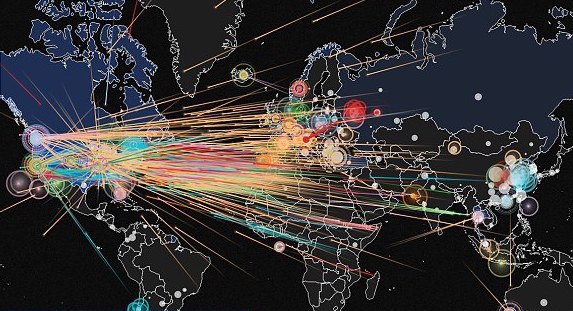
The most recent iteration of this takes the form of social media and cyberwarfare where tools are being developed and deployed to influence populations at home and abroad, to manipulate political processes of foreign states and even tap into and exploit global economic forces.
In the beginning of the 21st century, the United States held an uncontested monopoly over the tools of cyberwarfare. Today, this is changing quickly, presenting an increasingly balanced cyberscape where nations are able to defend themselves on near parity with America’s ability to attack them.
To reassert America’s control over information and the technology used to broker it, Jared Cohen, current Google employee and former US State Department staff, has proposed a US-created and dominated “international” framework regarding cyberconflict.
His op-ed in the New York Times titled, “How to Prevent a Cyberwar,” begins by admitting the very pretext the US is using to expand its control over cyberwarfare is baseless, noting that “specifics of Russia’s interference in the 2016 America election remain unclear.”
Regardless, Cohen continues by laying out a plan for reasserting American control over cyberwarfare anyway, by claiming:
Cyberweapons won’t go away and their spread can’t be controlled. Instead, as we’ve done for other destructive technologies, the world needs to establish a set of principles to determine the proper conduct of governments regarding cyberconflict. They would dictate how to properly attribute cyberattacks, so that we know with confidence who is responsible, and they would guide how countries should respond.
Cohen, unsurprisingly, nominates the US to lead and direct these efforts:
The United States is uniquely positioned to lead this effort and point the world toward a goal of an enforceable cyberwarfare treaty. Many of the institutions that would be instrumental in informing these principles are based in the United States, including research universities and the technology industry. Part of this effort would involve leading by example, and the United States can and should establish itself as a defender of a free and open internet everywhere.
Cohen never explains how this US-dominated framework will differ from existing “international” frameworks regarding conventional warfare the US regularly abuses to justify a growing collection of devastating conflicts it is waging worldwide.
And as has been repeatedly documented, the United States’ definition of a “free and open internet everywhere” is an Internet dominated by US tech companies seeking to enhance and expand US interests globally.
Cohen ironically notes that:
Cyberweapons have already been used by governments to interfere with elections, steal billions of dollars, harm critical infrastructure, censor the press, manipulate public conversations about crucial issues and harass dissidents and journalists. The intensity of cyberconflict around the world is increasing, and the tools are becoming cheaper and more readily available.
Indeed, cyberweapons have already been used, primarily by the United States.
It included the training, funding and equipping of activists years ahead of the the uprisings as well as active participation in the uprisings themselves, including providing assistance to both protesters and militants everywhere from Libya to Syria in overthrowing governments targeted by Washington for regime change.
An interactive tool created by Google was designed to encourage Syrian rebels and help bring down the Assad regime, Hillary Clinton’s leaked emails have reportedly revealed.
By tracking and mapping defections within the Syrian leadership, it was reportedly designed to encourage more people to defect and ‘give confidence’ to the rebel opposition.
The article would continue, mentioning Jared Cohen by name:
The email detailing Google’s defection tracker purportedly came from Jared Cohen, a Clinton advisor until 2010 and now-President of Jigsaw, formerly known as Google Ideas, the company’s New York-based policy think tank.
In a July 2012 email to members of Clinton’s team, which the WikiLeaks release alleges was later forwarded to the Secretary of State herself, Cohen reportedly said: “My team is planning to launch a tool on Sunday that will publicly track and map the defections in Syria and which parts of the government they are coming from.”
Would Cohen’s more recently proposed “framework” have prevented the United States’ use of these cyberweapons against sovereign states to undermine sociopolitical stability, overturn entire governments and plunge them into enduring chaos many still remain in 6 years later? Most likely not.
What Cohen and the interests he represents are truly concerned with is that nations are now not only able to recognize, prepare for and defend against US cyberwarfare, they may be capable of retaliating against the US.
Cohen’s proposal for an international framework to govern cyberwarfare simply seeks to define it in terms that leaves the US with both an uncontested monopoly over cyberwarfare as well as the means to wield it globally with absolute impunity.
It would be not unlike current “international” frameworks used to govern conflicts between nations which the US has used to justify an expansive, global campaign of extraterritorial war stretching from North Africa to Central Asia and beyond.
Such frameworks have become enablers of injustice, not a deterrence to it.
As nations from Iran to North Korea are discovering, the only true means of defending oneself from foreign military aggression is creating a plausible deterrence to dissuade foreign nations from attacking. This is done by creating a price for attacking and invading that is higher than the perceived benefits of doing so.
Nations like Russia and China have already achieved this balance with the United States in terms of conventional and nuclear warfare, and have now nearly established a similar deterrence in terms of cyber and information warfare. For the rest of the world, developing cyberdefense is not as costly as conventional military or nuclear arsenals, making cyberwarfare a corner of the battlefield unlikely to be monopolized by the US as it had done at the turn of the century.
Ensuring that no single nation ever has the opportunity to abuse such a monopoly again means exposing and confronting efforts by those like Google’s Jared Cohen and his proposal for an “international framework” for cyberwarfare that resembles the same sort of enabling the United Nations provides the US in terms of proliferating conventional conflicts across the globe.


 After the Crash