Countering NATO’s Efforts to Destroy China

NATO’s efforts to destroy Russia’s Black Sea fleet is a practice run to destroy China’s, Declan Hayes writes.

By Declan Hayes

Source: Strategic Culture Foundation

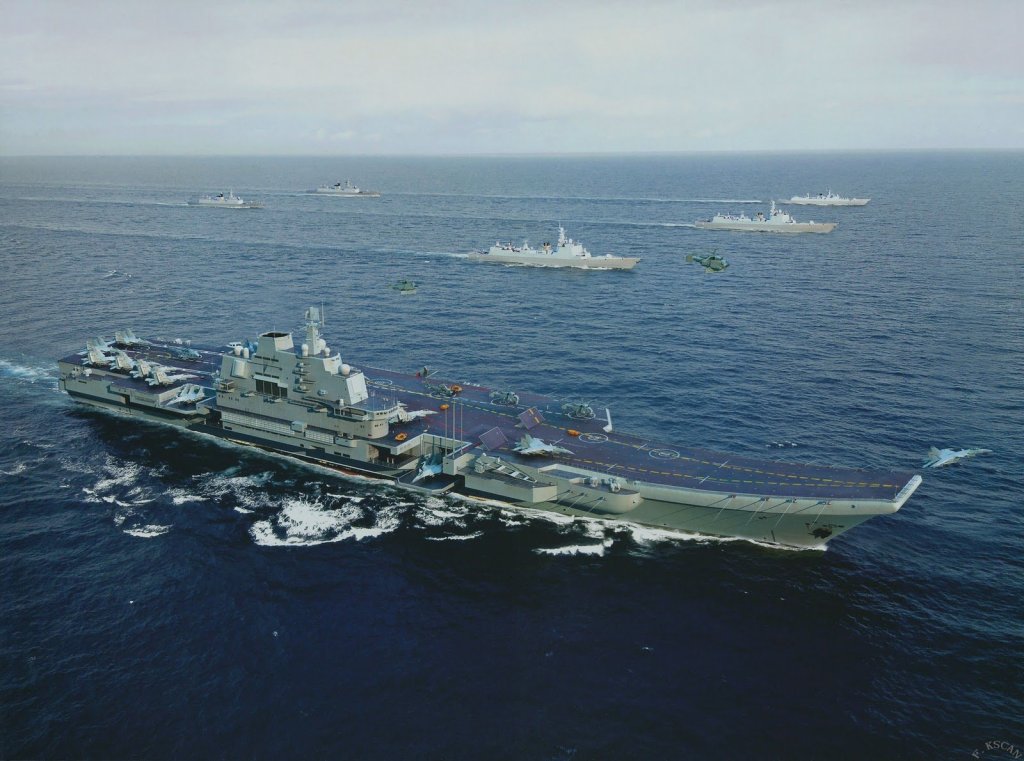
NATO’s efforts to destroy Russia’s Black Sea fleet is a practice run to destroy China’s. Although some of the soldiers guiding those air and sea drones towards Crimea may be Ukrainians, most of them are undoubtedly British and American. As, of course, are the spy planes pinpointing their Russian targets.

Although Russia has adopted a softly softly approach to all this unprecedented aggression, our focus is on the longer game where NATO is trying to contain the Russian navy and coral the Russian army and air force. To NATO, Ukrainian sovereignty is of no account one way or the other. The main objective is to herd Russia’s Armed Forces into a strategic stockade from which they have no way to drive forward. That seems to be working a charm in this NATO naval guerilla campaign against Sevastopol where NATO has exploited the grain deal corridors in much the same way that the Israeli air force hides behind civilian planes to bomb civilian Syrian targets.

Having steadied their Russian front, NATO can then turn their attention to the Chinese front which they hope will play out in a similar fashion. Because the Chinese Army has no need to cross the Russian border, it is redundant to external calculations unless it once again crosses the Yalu River.

Should a token force of 100,000 crack CPLA advisors, with Pyongyang’s blessing, sweep southwards towards the 38th Parallel, that would considerably complicate matters for China’s American friends as more maritime waters than they could presently handle would then be in play. Given that North Korea has thrown its weight behind Russia, Pyongyang would undoubtedly welcome such military help as China could provide in upgrading their missile and related technologies.

As the war against China will undoubtedly be primarily a maritime war, the Korean peninsula may not be quite in the eye of the storm, which will zero in on breaking China’s main shipping routes. As things currently stand, North Korea is just a card China can keep in reserve until it is time to play it.

Josh Kozlov, the leader of the U.S. Army’s 350th Spectrum Warfare Wing, and the British Royal United Services Institute (RUSI) are amongst the NATO worthies who have opined on the crucial role advanced electronic warfare is playing in the Black Sea and will play in the South China Sea. Given that Hansard has British Defence Secretary Ben Wallace on record calling Ukraine a “battle lab”, a good try out for the best of British hardware and software, no doubt Wallace will enjoy a good stress test against Blighty’s North Korean and Chinese electronic warfare peers.

Unelected European Union dictator Ursula von der Leyen, meanwhile, is complaining that China produces cheap electric cars. Those Chinese cads! How dare they copy Japan’s economic growth tactics.

Japan, remember Japan, when the U.S. Occupation troops used to buy their imitation watches and battery radios as a joke during the Korean war. Seiko, Mitsubishi, Toshiba and Panasonic had the last laugh there.

As will the Chinese, unless von der Leyen’s American bosses implement a naval blockade on China and thereby cut China off from her shipping routes to protect obsolete European competitors and “the rules based order”.

Although the Yanks have proposed the alternative India-Middle East-Europe Economic Corridor (IMEC) with the backing of the United Arab Emirates, Saudi Arabia, Israel, and Jordan, the world and his mother know that is all hot air to pretend that NATO has a viable alternative to China’s various economic infrastructural initiatives and that all this shadow boxing is a repeat of the prelude to The Great War when the rise of the German Navy’s dreadnoughts and the proposed Berlin Baghdad railway were seen as fatal threats to the Royal Navy’s maritime dominance.

Saudi Arabia, the UAE and the CIA hub of Jordan, which are all signed up to Team BRIICS, can expect plenty of NATO threats to come their way if they do not play ball and abandon the Chinese and, in Saudi’s case, the Indians as well, who would also want to send cargo through Saudi waters as part of China’s BRI initiative.

And though therailroad infrastructure linking Greece with Central Europe is a part of the BRI and Pakistan’s Gwadar Port is part of the China-Pakistan Economic Corridor (CPEC), NATO would feel itself entitled to hijack them as part of their mercurial “rules-based order” just as, for the same Nordstream related reasons, the oil and gas pipes beneath the Black Sea are prime targets for NATO’s Ukrainian proxies.

This is no conjecture. Senator Tom Cotton’s report spells out in great detail that NATO need to decouple from China and the Cato Institute, the Bipartisan Policy Center and Australian nut job Dr Ross Babbage have all kindly informed us how this war with China will play out more or less as we previously outlined.

Writing for AsiaNikkei, Admiral James Stavridis, who was formerly the 16th Supreme Allied Commander of NATO, tells us that that, as in Ukraine, NATO’s key advantage is in its allies, in its Filipino, Taiwanese, Korean and Japanese cannon fodder, in other words, and Forbes tells us that the key to success would be, as we said, a naval blockade.

Assuming, of course, China was not bullied into making the same mistakes Admiral Yamamoto’s Imperial Japanese Navy were forced to make when they attacked Pearl Harbor and the American colony of the Philippines. All American bluster about their god-like omnipotence aside, the Chinese High Command has a full and comprehensive appreciation of the capabilities of America’s military industrial complex and how it has progressed since China defanged it during the Korean war.

But let’s also not forget the Indo China wars where the Viêt Minh had their HQ in a Hanoi ice cream bar and the Viêt Cong had their HQ in a Saigon noodle shop and where the great British travel writer Norman Lewis made some very pertinent comments about the Chinese, the Cambodians, the Laotians and particularly the Vietnamese when he documented his experiences in French Indo China at the start of the Second IndoChina war.

Advantage at Sea—Prevailing With Integrated All-Domain Naval Power spells out how the U.S. Navy, Marine Corps and Coast Guard will, like Britannia before Yamamoto showed up, rule the waves. Because NATO is making contingency plans to lace “the straits of Hormuz, Suez, Gibraltar, Malacca, Panama, and Dover” with mines to disrupt supply chains, so must China.

But, if we leave such primitively effective sabotage operations to one side, we can expect NATO to target the digital infrastructure which underwrites the movement of some six million containers transported in approximately 61,000 ships that comprise the world’s trade outside of oil, gas and raw materials. American puppet von der Leyen, as indicated above, has already hinted at that tactic which, given China’s disproportionate power over the infrastructure through which international trade flows, makes sense from the Pentagon’s viewpoint. As they have already run many such pilot programs in insurance and banking against Russia over Ukraine, such efforts must also be factored into China’s calculus which, given China’s geographic and economic size, will be monumentally global in nature.

But then, because all politics is local, China must entice rather than coerce North Korea and Vietnam into its orbit, leaving the Vietnamese in particular with as much ambiguity as those inscrutable masters of intrigue need to defend their own interests in the East (South China) Sea. And, after Vietnam comes the Philippines, which has suffered as much from the Americans as have the Vietnamese. As with Hanoi, so also must China quietly make major diplomatic and economic inroads with Manila, whilst going easy on the jingoism. More carrot, less stick, in other words.

As regards Taiwan, all major players know there is no Chinese hurry there and that it is America and America alone which is using Taiwan as a casus belli. Finally, as regards the long-suffering people of Okinawa and all of Japan Yamamoto, in case they have not heard, is dead, assassinated by the Yanks in 1943. Not only can Japan, with or without another Yamamoto, not prevail in another war but there is no need for Japan to engage in such adventurism as there are much easier ways to commit hara-kiri than picking an unwinnable war with China to the south and Russia to the north.

The Japanese, like the Chinese, should hone their diplomatic skills, perhaps with the help of their good friends in Hanoi and Bangkok and the good people of Taiwan, where Japan and the Japanese are both much admired.

The governments of China, Vietnam, Thailand, Korea, Japan, the Philippines and those close to them have much more important things to attend to than killing each other to enhance the bottom lines of Lockheed Martin, Northrop, and BAE Systems and ensure further kickbacks for the Capitol Hill war hawks those gangsters bribe. The way forward for all of them is to work together for mutual and mutually respectful economic development, to enhance their military capabilities as needed and to ignore, as much as they can, the tone deaf war drums the Yanks and their toadies are never done beating to death.

ARE CENTRAL BANK DIGITAL CURRENCIES (CBDC) DESTINED TO FAIL?

By Timothy Alexander Guzman

Source: Silent Crow News

Since Bitcoin (BTC) was introduced to the world as an alternative to the current central bank system with a dying US dollar that is backed by nothing as its reserve currency, but now there is a plan by several governments to move ahead with implementing their own central bank digital currencies (CBDCs), which is a digital form of currency that is still backed by, you guessed it, nothing.  The Nigerian government had made the decision to be the financial guinea pig for the globalist CBDC scheme, and so far, it has failed and that’s the good news.  The bad news is that certain governments are still moving forward with the idea of using government-issued digital currencies.  In the case of Nigeria, its citizens rejected their government’s plan to issue CBDCs by restricting cash in efforts to create a cashless society and so far, it seems that it has failed in epic fashion according to an opinion piece by author Nicholas Anthony that was published by coindesk.com ‘Nigerians’ Rejection of Their CBDC Is a Cautionary Tale for Other Countries’ is a warning to governments who are willing to take the same step: 

In Nigeria, citizens have taken to the streets to protest the nation’s cash shortage, further objecting to their government’s implementation of a central bank digital currency (CBDC). The shortage came about due to cash restrictions aimed at pushing the country into a 100% cashless economy. Yet, instead of adopting the CBDC, Nigerian protesters are demanding paper money be restored.

The country’s experience strongly suggests the average citizen understands that CBDCs present a substantial risk to financial freedom while providing no unique benefit

Not only did the Nigerian people reject CBDCs, but they also demanded a return to paper currencies because they quickly found out that financial freedoms would be severely limited. 

The concerns ranged from risking financial privacy to the possibility of financial oppression by government institutions.  Anthony mentioned how “the Nigerian government has unleashed a flurry of tricks to spur adoption, but none has proven effective.”  He even gave credit to the Nigerian government in terms of using modest approaches to influence its citizens to use CBDCs and it still failed:

To its credit, the Nigerian government initially tried to encourage use through modest measures. In August 2022, it removed access restrictions so that bank accounts were no longer required to use the CBDC. Then, in October, it offered discounts if people used the CBDC to pay for cabs.  Yet, neither effort proved to be fruitful. Put simply, Nigerians prefer cash

However, the Nigerian government continued its assault on cash:

Unfortunately, the Nigerian government doubled down and moved to more drastic measures by restricting cash itself. In December the Central Bank of Nigeria began restricting cash withdrawals to 100,000 naira (US$225) per week for individuals and 500,000 naira ($1,123) for businesses.

To make matters worse, the Nigerian government also chose to redesign the currency during this time in a “move aimed at restoring the control of the Central Bank of Nigeria (CBN) over currency in circulation” and to “further deepen the push to [a] cashless economy,” according to a CBN press release

The Nigerians had a hard time adapting to the government’s restrictions on their hard earned cash, so they posted their concerns on Twitter, Tik Tok and other social media platforms to let the world know what went wrong.  Soon after, major protests erupted on the streets because of the cash shortages imposed by the Central Bank of Nigeria: 

The government decided to redesign the currency to restore control over the Central Bank of Nigeria as its governor, Godwin Emefiele claimed that “the destination, as far as I am concerned, is to achieve a 100% cashless economy in Nigeria.”  To add insult to injury, “the company that designed the Nigerian CBDC called the cash restrictions a creative use of marketing and said other countries could be expected to take similar steps.”  A top manager from a financial institutional ratings firm called Agusto and Co., Ayokunle Olumbunmi said that the central bank “doesn’t want us to be spending cash. They want us to be doing transactions electronically, but you can’t legislate a change in behavior.”  Anthony concluded that the idea of CBDCs will not go very far, “CBDCs may be popular among central bankers, but money is ultimately a tool for the people. So long as the risks outweigh the benefits, it’s unlikely any CBDC will gain traction in Africa or elsewhere.”

Nicholas Anthony was correct to point out that CBDCs will not become mainstream as several countries have already demonstrated their unwillingness to move forward with the new form of digitized currencies. 

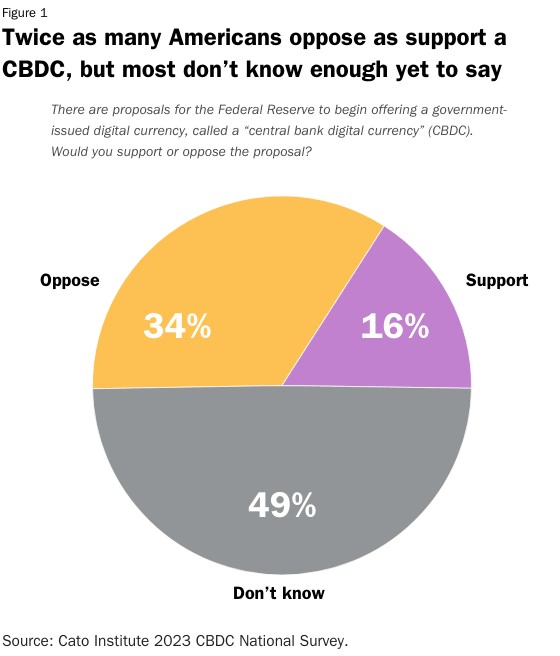
The average human being on earth understands that CBDCs is a bad idea, even in the United States where two-thirds of the population believes almost anything that their government tells them to believe are skeptical of CBDCs according to the Cato Institute, a think tank who also published an article by Nicholas Anthony on the findings of a survey that was conducted by the US federal Reserve Bank on how people view CBDCs.  Here is what they found, “Specifically, more than 66 percent of the 2,052 commenters were concerned or outright opposed to the idea of a CBDC in the United States (Figure 1).”

Bitcoin.com published an article on the GOP’s 2024 presidential candidate, Florida’s governor, Ron DeSantis who is opposed to CBDCs, ‘Ron DeSantis Vows to Prohibit CBDC, ‘Woke Politics,’ and ‘Financial Surveillance’ in Florida,’ he said “I think what the danger of the digital currency is that, one, they want to make that the sole currency, they want to get rid of crypto,” DeSantis continued, “They don’t like crypto because they can’t control crypto. So, they want to put everything in a central bank digital currency.”  There were other politicians who also have similar views on CBDCs:

DeSantis shares the view of several Republican officials who have criticized the idea of a central bank digital currency (CBDC). Minnesota congressman Tom Emmer introduced the Central Bank Digital Currency (CBDC) Anti-Surveillance State Act, while Texas senator Ted Cruz has created legislation against the government developing a CBDC. Georgia representative Marjorie Taylor Greene has also spoken out against CBDCs, and 2024 Democratic presidential candidate Robert Kennedy Jr. has warned that a central bank digital currency could lead to financial slavery

Cash is King! How the CBDC Failed in Japan and Ecuador

Cointelegraph.com, an independent digital news platform that focuses on crypto assets, blockchain technology and emerging fintech trends published an article last year written by Helen Partz based on which countries have rejected CBDCs for one reason or another titled ‘Some central banks have dropped out of the digital currency race’ mentions Japan, who is a major player in the global economy, ultimately rejected developing a CBDC scheme.  The Bank of Japan (BOJ) started testing their digital currency proof-of-concept in 2021 and had planned to finish the first phase by 2022 but in January “former BOJ official Hiromi Yamaoka advised against using the digital yen as part of the country’s monetary policy, citing risks to financial stability.” 

The BOJ issued a report in July 2022 and stated that it had no plan to establish a CBDC system since there is a “strong preference for cash and high ratio of bank account holding in Japan” and that the regulator suggested for a CBDC to be used as a “public good” and it “must complement and coexist” with “private payment services in order for Japan to achieve secure and efficient payment and settlement systems.”  However, it also said that “the fact that CBDC is being seriously considered as a realistic future option in many countries must be taken seriously,” in other words, the CBDC scheme in Japan will not move forward although several countries are still in the early stages of developing a plan for the use of CBDCs, but for Japan, cash is still and will be king well into the foreseeable future.

Ecuador is another example as its central bank, Banco Central del Ecuador (BCE) who launched its own electronic currency known as dinero electrónico (DE) in 2014 to increase some sort of financial inclusion for the public as well as to control the flow of fiat currencies.  According to Partz “As of February 2015, Ecuador managed to adopt DE as a functional means of payment, allowing qualified users to transfer money via a mobile app. The application specifically allowed citizens to open an account using a national identity number and then deposit or withdraw money via designated transaction centers.”  But industry observers were not so sure that the DE can take the form of a CBDC since Ecuador’s currency is the US dollar, and since Ecuador does not currently have its own sovereign currency, many were not so sure that they can call the DE, a form of CBDC.  “The Ecuadorian government cited the support of its dollar-based monetary system as one of the goals behind its DE platform after it started to accept U.S. dollars as legal tender in September 2000.”  It seems that Ecuador remains skeptical on any possibility that issuing CBDCs will be a success:

According to online reports, Ecuador’s DE operated from 2014 to 2018, amassing a total of 500,000 users at its peak out of a population of roughly 17 million people. The project ​​was eventually deactivated in March 2018, with the BCE reportedly citing legislation abolishing the central bank’s electronic money system. Passed in December 2021, the law stated that e-payment systems should be outsourced to private banks.

Years after dropping its central bank digital money initiative, Ecuador has apparently remained skeptical about the whole CBDC phenomenon. In August 2022, Andrés Arauz, the former general director at Ecuador’s central bank, warned eurozone policymakers that a digital euro could potentially disrupt not only privacy but also democracy

Bottom line, the CBDC will not be a standard for financial transactions for the few countries who already tried launching their versions of digital currencies. 

However, in the US, the Federal Reserve’s ‘FedNow’ was supposed to be launched sometime in July 2023.  Here is the Federal Reserve’s Press Release:

The Federal Reserve announced that the FedNow Service will start operating in July and provided details on preparations for launch.  The first week of April, the Federal Reserve will begin the formal certification of participants for launch of the service. Early adopters will complete a customer testing and certification program, informed by feedback from the FedNow Pilot Program, to prepare for sending live transactions through the system.

Certification encompasses a comprehensive testing curriculum with defined expectations for operational readiness and network experience. In June, the Federal Reserve and certified participants will conduct production validation activities to confirm readiness for the July launch.

“We couldn’t be more excited about the forthcoming FedNow launch, which will enable every participating financial institution, the smallest to the largest and from all corners of the country, to offer a modern instant payment solution,” said Ken Montgomery, first vice president of the Federal Reserve Bank of Boston and FedNow program executive. “With the launch drawing near, we urge financial institutions and their industry partners to move full steam ahead with preparations to join the FedNow Service”

For the US population, FedNow is a test that will eventually fail.  People will be skeptical about a central bank digital currency once it proves that it is used to surveil people’s spending habits and control what they spend their money on, and God forbid they are anti-war, anti-vaccine activists, homeschoolers, pro-gun supporters or conspiracy theorists, the bankers can cut them off from using CBDCs and then what happens?  Will there be riots in the streets? 

Since Bitcoin was introduced as an alternative to central bank control, the creation of the CBDC is their answer in hopes of retaining their power, but that idea is not likely to happen, it will in some way, backfire. 

When it comes to Bitcoin, it’s a different story.  In an interesting article written by Jay Speakman of beincrypto.com ‘When You Buy Bitcoin You Gain Freedom’ says that “in a world where economic and political uncertainties abound, owning Bitcoin (BTC) could provide the path toward financial freedom and autonomy. It’s no longer just about investing in a digital asset. It’s about making a revolutionary move to gain control over your finances and future.”  Speakman makes several main points on why people should own Bitcoins and one of those points is that owning sovereign cryptos such as Bitcoins, Ethereum’s and others is a step towards financial freedom:

It provides the opportunity to participate in the global economy without the limitations of traditional banking systems. Bitcoin is not subject to government regulations. At least not yet, and it is free from the inflationary policies which can erode fiat currency values. This means Bitcoin provides an alternative and potentially more secure, store of value

Another reason for owning Bitcoins is for future investment purposes:

Investing in Bitcoin is no longer simply making money. It is about investing in your future and securing your financial freedom. Bitcoin’s decentralized financial system operates independently of central authorities or governments. This means it is resistant to censorship and regulation. Bitcoin holders can make transactions without the need for banks, which are subject to government intervention

“Investment Diversification” is another reason to own Bitcoins since putting all your eggs in one basket, especially in a globalist banking system, is a bit risky:

Investing in Bitcoin can provide portfolio diversification as it is not correlated to traditional assets such as stocks and bonds. This means it may provide a hedge against inflation and market volatility, mitigating the risks associated with traditional investment portfolios

However, owning Bitcoins does have risks like everything else since the “market is notoriously volatile. Prices often fluctuate wildly based on a range of factors, from government regulations to media coverage.”  Speakman also mentions that “BTC transactions can result in a permanent loss of funds. There is also the risk of hacking and theft, as these transactions are irreversible and untraceable.” 

In conclusion, the article lays out what owning Bitcoins could mean for individuals and investors alike especially for those who do not trust the traditional banking system:

The decision to buy BTC is more than just a financial investment. It’s a move towards financial freedom, control, and security. Bitcoin’s feature of allowing individuals to act as their own banks. Providing a secure alternative to traditional banking systems which have exhibited instability and vulnerability to failures.  Furthermore, the appeal goes beyond just financial security and autonomy. The digital currency resonates with libertarians who value individual freedom and limited government intervention. Despite a torrent of dissenting voices Bitcoin continues to gain mainstream adoption. As the technology continues to mature, it may address some of the concerns raised by the dissenting voices.

Investing in digital assets may involve risks such as volatility and the potential for hacking and theft. Yet, the benefits of financial freedom outweigh the downsides. As the world becomes increasingly uncertain, owning Bitcoin could be the first step toward financial security and autonomy

When you look at the difference between CBDCs along with the system imposed by international banking cartels who still maintain some form of financial dominance versus the Bitcoin revolution, there is a difference.  CBDCs means no financial freedoms and owning Bitcoins means the exact opposite.  Even though Bitcoins are still in the early stages, there is hope in the new crypto technology.  But like everything else, you should be cautious, do not invest 100% of your net worth in just one asset, in other words, invest maybe 5% in bitcoins, and the rest? 15% in emergency preparedness (food, water filters, guns, flashlights, etc.)  20% in real estate or invest in a second passport, 20% in hard assets like gold, silver and copper, 20% in high-end watches, antiques, aged wines and liquor, collectibles etc. and the last 20% in foreign stocks especially those that are in politically stabilized environments or in gold and silver mining companies, but that’s just my opinion. 

Government-backed CBDCs will be a failure because the people already do not trust international banking cartels to totally control their finances. So, for these banks to have total control over your financial wellbeing under their CBDC scheme would be an extremely difficult task for them to manage. 

The banking cartel or the financial bureaucrats are about to discover that they will be in over their heads with an angry population.  Just imagine if the banking cartels, certain governments and their corporate conglomerates are in  control over the people’s finances, they will get to determine who eats and who will starve.  This is the ultimate power grab the globalist bankers have been dreaming about for a very long time, but will the people stop this from happening?  I’m an optimist, so I believe that they will demand their financial freedoms and that is something of value that they can hold and control in their own hands.  The case for CBDCs will be a hard sell, so central banks who are proposing this idea should think twice about what they are trying to impose on the public, if not, they will face some form of resistance just like they did in Nigeria.    

The Drumbeats of War and US-NATO Propaganda: “China is Bad” and “They are Coming to Enslave Us”

The Truth about China’s Imperial Ambitions, the Uyghurs and What the West Really Fears

By Timothy Alexander Guzman

Source: Silent Crow News

Western media outlets are playing the drumbeats of war by warning the public that a new Chinese empire is going to develop into an unstoppable force capable of ruling the world with an iron fist.  They claim that under the leadership of the Chinese Communist Party (CCP), they will control every country and human being on earth.  Overall, it’s an absurd claim.  It is fair to say that China under the leadership of the CCP has several issues that concerns the Chinese public with a social credit score system, Zero Covid policy rules and a nation-wide surveillance system that is Orwellian to say the least.  China also had a one child policy that has led to a decline in its population which was and still is problematic for its future when it comes to their labor force and economy, but they ended that policy in 2016.  Whatever faults China has, it is not looking to rule the world despite what Western countries claim especially the United States who say that Beijing’s policies reflect a growing appetite for imperial expansion.  On May 25th, 2017, Reuters published ‘China says new Silk Road not about military ambitions’ reported on what China’s Defense ministry had said about China’s future “China’s ambition to build a new Silk Road is not about seeking to expand its military role abroad nor about seeking to set up foreign bases.” The Chinese Defense Ministry spokesman Ren Guoqiang told a regular monthly news briefing conference that China’s Silk Road was not expanding militarily nor setting up bases in any sovereign country and that the accusations were “groundless.” Guoqiang said that “the new Silk Road is about cooperation and trade” and that “The Belt and Road initiative has no military or geostrategic intent. China is not seeking the right to guide global affairs, or spheres of influence, and will not interfere in the internal affairs of other countries.”

According to a report from September 23rd, 2020, by the National Herald India titled ‘China will never seek expansion, has no intention to fight either ‘Cold War’ or ‘hot war’, says Xi Jinping’ as Xi Jinping declared in a pre-recorded video sent to the United Nations meeting that “We will continue to narrow differences and resolve disputes with others through dialogue and negotiation” he continued “We will never seek hegemony, expansion, or sphere of influence. We have no intention to fight either a Cold War or a hot war with any country.”   The report also mentioned India’s Prime Minister Narendra Modi’s surprise visit to the Ladakh region a few months prior where he said that “the era of expansionism is over and that the history is proof that “expansionists” have either lost or perished” in what the report described as a “clear message” to China.  “Xi, also the General Secretary of the ruling Communist Party of China and the Commander-in-Chief of the Chinese military, said his country will not pursue development behind closed doors.” Xi made it clear that a new plan for development for growth domestically and internationally will create more opportunities for China’s economy.  Xi said the following:

Rather, we aim to foster, over time, a new development paradigm with domestic circulation as the mainstay and domestic and international circulations reinforcing each other. This will create more space for China’s economic development and add impetus to global economic recovery and growth

The report also mentioned that during the Covid-19 pandemic, US President, Donald Trump ramped up tensions with China and “demanded that China, where the coronavirus emerged, be held accountable for failure to control the virus and for allowing it to spread across the world” he continued, “As we pursue this bright future, we must hold accountable the nation which unleashed this plague onto the world: China”.  Trump’s rhetoric including his administration slapping tariffs on China’s goods surely increased tensions between Washington and Beijing.  The National Herald India quoted what Xi had said about China’s own decisions that will benefit its own economy and path of development and that it should be respected, “one should respect a country’s “independent choice of development path and model.”  Xi made a point that the world is diverse, and that it can inspire human advancements:

The world is diverse in nature, and we should turn this diversity into a constant source of inspiration driving human advancement. This will ensure that human civilisations remain colourful and diversified

Conflicts and Disagreements: China, India, and the Soviet Union

The history between China and India involved conflicts over border issues.  In 1962, China had a dispute with India over Aksai Chin and Arunachal Pradesh borders.  The conflict was mostly among ground troops of both sides which did not involve any Air force or Naval forces.  What started the conflict was China’s construction of a road that connected the Chinese regions of Tibet and Xinjiang.  However, Aksai Chin was claimed by India.  So, in the months of October and November the Sino-Indian War began.  Several violent conflicts also occurred between China and India after the 1959 Tibetan uprising due to India’s recognition of the Dalai Lama, or who is known as Gyalwa Rinpoche to the Tibetan people.  In an important note to consider, the Dalai Lama was supported by the CIA for many years.  The CIA financially supported the Dalai Lama from the late 1950s until the mid-1970s with more than $180,000 a year for the CIA’s Tibetan program to support anti-China activities and to create foreign offices within Tibet to lobby for international support which was a concern for China. 

In 1960, India had constructed a defensive policy to disrupt China’s military patrols and its logistics in what was called Forward Policy  that placed Indian outposts along the borders in the north of the McMahon Line, the eastern portion of the Line of Actual Control.   However, China did try to implement diplomatic settlements between 1960 and 1962, but India rejected the proposal allowing China to abandon diplomacy and became aggressive along the disputed borders. China defeated Indian forces in Rezang La in Chushul in the west and Tawang in the east.  China declared a ceasefire on November 20th, 1962.  The war ended as China withdrew to its areas claimed in the ‘Line of Actual Control.’  Matters became complicated when the Soviet Union sold MiG fighter aircrafts to India in a show of support since the US and the UK refused to sell arms to India.  However, tensions between China and the Soviet Union were also high during that time which was known as the ‘Sino-Soviet split’ over ideological differences in Marxist-Leninist theories during the Cold War.  There were various agreements between China and India with no progress for peace until 2006.   Although Indian officials were concerned with China’s growing military power and its relationship with Pakistan (India’s main rival), China’s Silk Road opened the doors for peace between both nations.  In October of 2011, China and India formulated border mechanisms regarding the Line of Actual Control as both resumed bilateral army exercises between China and Indian troops by early 2012.  In 2013, what was known as the Depsang standoff, India had agreed to demolish and remove several ‘live-in bunkers’ in the Chumar sector along with the removal of observation posts built along the border among other things that made the resolution of the dispute a success, so the Chinese military withdrew it forces, ending the dispute in May 2013.  Although there are some disagreements between both countries still exist over their borders policies, today China and India are part of the BRICS coalition.

The Sino-Vietnamese War of 1979

On December 21st, 1978, Vietnam launched an attack on the Khmer Rouge.  After more than 10 years of fighting, Vietnam had successfully defeated the Khmer Rouge ending Pol Pot’s reign of terror.  Then in February 1979, China had declared war with Vietnam over its borders.  Now Vietnam was facing a two-front war. China’s invasion was a surprise to the world because China supported Vietnam with its wars against France and the US.  From 1965 until 1969, China had more than 300,000 troops in the Vietnam war with more than 1,000 members from the People’s Liberation Army (PLA) who were killed with 4,300 wounded. 

However, it all changed due to China’s domination of Vietnam for centuries which created animosity among the Vietnamese government and its people towards Beijing thus creating tensions between both countries.  Conflicts on the border also developed between China and the Soviet Union in 1969 during the Sino-Soviet split, so Vietnam had a dilemma, it had to choose one of them as an ally.  On November 3, 1978, Vietnam signed the Treaty of Friendship and Cooperation with the Soviet Union that offered security assurances.  Since tensions were high at the time, more than 150,000 Chinese who were living in Vietnam had fled. Chinese leader Deng Xiaoping and CCP officials viewed Vietnam as ungrateful and traitorous.  The Chinese saw the treaty as a threat since the Soviets had a similar treaty with Mongolia which in a way allowed the Soviets to surround China.  On December 7, 1978, China’s Central Military Commission decided to launch a “limited war” along their borders and at the same time, Vietnam had invaded Cambodia to destroy the Khmer Rouge.

Since Vietnam had border clashes with the China-backed Khmer Rouge in Cambodia along with Beijing’s decision to cut aid to Hanoi, it decided to partner with Moscow.  On January 29th, 1979, for the first time, Chinese Vice-premier Deng Xiaoping went to the US and reportedly told President Jimmy Carter that “The child is getting naughty, it is time he got spanked.”   A couple of weeks later, on February 15th, China terminated the 1950 Sino-Soviet Treaty of Friendship, Alliance and Mutual Assistance and Xiaoping declared that China was going to attack Vietnam to support its ally, the Khmer Rouge of Cambodia among other reasons including the plan to reclaim the Vietnamese occupied Spratly Islands.  China wanted to prevent the Soviet Union from intervening on Vietnam’s behalf, so Xiaoping warned the Soviets that China’s forces were prepared for war.  Declaring an emergency, China deployed all of the PLA forces along the Sino-Soviet border and set up a military command station in Xinjiang, they also evacuated more than 300,000 civilians from the area.

China eventually suffered a defeat by the Vietcong since its military was not prepared to fight an experienced fighting force who previously defeated two Western powers, France, and the US.  It was reported that experienced Vietnamese ‘tank-killing teams’ destroyed or damaged more than 280 tanks and armored vehicles during the war.  China avoided the use of its Air Force and Navy since it promised the Soviets and Americans a limited war against Vietnam.  China also knew that Vietnam had an experienced military as well as having one of the best anti-air capabilities in the world.  After two short weeks of fighting, China began withdrawing its troops.  By March 16, Chinese troops had a ‘scorched-earth campaign’ in Vietnam destroying bridges, factories, mines, farms, and crops.  It is estimated that China had between 7,900 to 26,000 troops killed and between 23,000 to 37,000 wounded.  Vietnam had between 20,000 to 50,000 troops and civilians killed and wounded.  China clearly had a difficult time with Vietnam. 

China’s history with its neighbors shows that it may be difficult even today if they decided to become an imperialist power subjugating the world to its demands because it would face an uphill battle that will become economically and politically costly and that will collapse its economy and society.  Before the US became a global empire, they made sure they contained and controlled its own backyard and that was the Caribbean and Latin America after the Spanish-American War of 1898.  China would have to control its own backyard against several nations including Russia, India, Vietnam, and others.  China understands that imperial projects to dominate the world is a risk not worth taking. 

Remember, China was on the receiving end of Japanese Imperialism that practically destroyed its society.  In 1931, Imperial Japan had invaded the Chinese province of Manchuria for raw materials to fuel its industries, and by 1937 they controlled many areas of China.  The Imperial Japanese war crimes mounted against the Chinese people.  China understands the consequences of war because it sees what has happened to the US and its military adventures which has led to its decline.  It knows it will not benefit anyone, in fact wars can destabilize regions, destroy economies, and disrupt societal norms and China is not at all interested in any of that.  They want to rebuild their civilization.      

The age of empires is over.  A new multipolar world is needed now more than ever before where no single entity or centralized power could rule over any country who wants to remain sovereign.  That would start an era of lasting peace around the world.  Of course, there are no guarantees that total peace would prevail in a multipolar world because there will be bad actors who will prefer a globalized world order over countries who want sovereignty, but in a multipolar world order, wars can be avoided.  It would be a good start where sovereign countries would respect each other’s boundaries and work out their differences.  That’s the way it should be instead of a group of globalist psychopaths making geopolitical and economic decisions to change the social fabric of every country on the planet.         

Inside China: The Surveillance State

China’s internal problems is a stain on its reputation.  China’s surveillance state is indeed problematic.  In 2018, the CCP installed more than 200 million surveillance cameras with an increase in facial recognition technology nationwide.  Surveillance cameras and facial recognition networks would add to the social credit system already in place that gives Chinese citizens a score based on their “social behaviors.”  Going back to 2003, China began its Smart City pilot programs to track and analyze air quality, traffic, wastewater disposal systems, social behaviors of its residents and other areas of urban life.  We can fairly say that China’s surveillance state is rather extreme and unnecessary.  The Chinese people will increasingly voice their concerns to the CCP’s leadership in the future to scrap its surveillance capabilities because it can get out of control, but the question is, will it happen?  Only time will tell.   

The Uyghurs: China’s Problem with the East Turkestan Islamic Movement (ETIM)

One issue that has been mainly ignored in recent years by the Western mainstream media is the terrorism committed in China by the Uyghurs. Why? The Western view of China’s human rights abuses when it comes to the Uyghurs has two sides of the story.  First it benefits the Military-Industrial Complex and its future of selling arms to its allies throughout Asia including Taiwan, South Korea, and Japan.  Second, it’s the demonization of China to gain support among the American people for a future war with China because they are “bad.”  Former US President Barack Obama supported his Secretary of State Hillary Clinton and her ‘Pivot to Asia’ agenda that she had published in Foreign Policy magazine titled ‘America’s Pacific Century.’ Clinton made it clear that the US goal is to remain a global hegemonic power especially in the Asia-Pacific region:

As secretary of state, I broke with tradition and embarked on my first official overseas trip to Asia. In my seven trips since, I have had the privilege to see firsthand the rapid transformations taking place in the region, underscoring how much the future of the United States is intimately intertwined with the future of the Asia-Pacific. A strategic turn to the region fits logically into our overall global effort to secure and sustain America’s global leadership. The success of this turn requires maintaining and advancing a bipartisan consensus on the importance of the Asia-Pacific to our national interests; we seek to build upon a strong tradition of engagement by presidents and secretaries of state of both parties across many decades. It also requires smart execution of a coherent regional strategy that accounts for the global implications of our choices.

What does that regional strategy look like? For starters, it calls for a sustained commitment to what I have called “forward-deployed” diplomacy. That means continuing to dispatch the full range of our diplomatic assets — including our highest-ranking officials, our development experts, our interagency teams, and our permanent assets — to every country and corner of the Asia-Pacific region. Our strategy will have to keep accounting for and adapting to the rapid and dramatic shifts playing out across Asia. With this in mind, our work will proceed along six key lines of action: strengthening bilateral security alliances; deepening our working relationships with emerging powers, including with China; engaging with regional multilateral institutions; expanding trade and investment; forging a broad-based military presence; and advancing democracy and human rights

FOX News is one of the US mainstream media outlets that jumps into the defense of the Uyghurs when it comes to the CCP and its alleged abuses.  However, FOX News ignores the daily abuses of the Israeli regime against the Palestinians or the abuses by the Saudis against the people of Yemen who have been bombarded with US-made weapons since 2015.  To be fair, not only FOX News demonizes China, but so does the liberal media such as CNN, MSNBC, the New York Times that includes the BBC and others throughout Europe.   

One situation that is rarely discussed in the West is the terrorism incidents caused by certain groups and individuals in the Uyghur community not only against the CCP, but also against the Han Chinese, the largest ethnic majority in China.  In Violent Separatism in Xinjiang: A Critical Assessment by James Millward from the East-West Center based in Honolulu, Hawaii and Washington D.C. documented terrorist activities since the early 1990’s that accelerated after the September 11th attacks in New York City and Washington, D.C. Millward wrote the following concerning terror groups originating out of the Xinjiang region in China:

Since the 1990s, concerns about Uyghur separatism have received increasing official and media attention. These concerns have heightened since the events of 9-11 with the advent of a more robust U.S. presence in Central Asia and Chinese attempts to link Uyghur separatism to international jihadist groups. A steady flow of reports from the international media—as well as official PRC releases (a document on “East Turkistan” terrorism, a white paper on Xinjiang, and a list of terrorist groups)—have given the impression of an imminent separatist and terrorist crisis in the Xinjiang region

Some of the terror attacks that were documented occurred in as early as 1992: 

February 5, 1992: Urumqi Bus Bombs. Three were killed and twenty-three injured in two explosions on buses in Urumqi; the PRC’s 2002 document claims that other bombs were discovered and defused around the same time in a cinema and a residential building. Five men were later convicted in this case and reportedly executed in June 1995.

February 1992-September 1993: Bombings. During this period there were several explosions in Yining, Urumqi, Kashgar, and elsewhere; targets included department stores, markets, hotels, and centers of “cultural activity” in southern Xinjiang. One bomb in a building of the Nongji Company (apparently a firm concerned with agricultural equipment) in Kashgar on June 17, 1993, killed two and injured six. One bomb went off in a wing of the Seman Hotel in Kashgar, though no one was hurt in this explosion. The PRC’s 2002 document claims that in the 1993 explosions two people were killed and thirty-six injured overall

On March 9th, 2008, Reuters published an account on what took place during an attempted terrorist attack on a passenger jet on its way to Beijing China foils attempted terror attack on flight.’  The report said that “China foiled a bid to cause an air disaster on a passenger jet en route to Beijing and the plane made a safe emergency landing, an official said on Sunday, in what state media called an attempted terrorist attack.”  According to Reuters sources, “The China Southern flight originated in Urumqi, capital of the restive far western Chinese region of Xinjiang, where militant Uighurs have agitated for an independent “East Turkestan.”  On September 8th, 2011, the BBC reported that a militant Islamic group was behind a terrorist attack in the Xinjiang region that resulted in dozens of people dead.  The BBC report Islamic militant group ‘behind Xinjiang attacks said the following:

A militant Islamic group has released a video saying it was behind recent attacks in China’s Xinjiang region which left dozens of people dead, a US internet monitoring group says.  The video was made by a group calling itself the Turkistan Islamic Party.  The group, which is fighting against Chinese control of Xinjiang, says the attacks were revenge against the Beijing government.

One of the deadliest attacks experienced in China occurred on March 1st, 2014 in the Kunming Railway Station in Kunming which is located in the Yunnan province.  The BBC reported on the incident and said that ‘China separatists blamed for Kunming knife rampage’ and said that “Chinese officials have blamed separatists from the north-western Xinjiang region for a mass knife attack at a railway station that left 29 people dead and at least 130 wounded” and that “a group of attackers, dressed in black, burst into the station in the south-west city of Kunming and began stabbing people at random.”  The report also said that “Images from the scene posted online showed bodies lying in pools of blood” and that the “State news agency Xinhua said police shot at least four suspects dead.”  There were other terrorist attacks that involved the Uyghurs that only pushed the CCP to move forward with facial recognition and a social credit system associated with a criminal offending database.  By 2021, the CCP’s surveillance system expanded in the southern city of Guangzhou that allowed incoming passengers to walk through a biometric security checkpoint. 

In Xinjiang, security checkpoints and identification stations were in many places where people must show proof of ID with their faces being scanned at the same time by various cameras before they enter any supermarket, train stations or any other public place.  China’s security concerns do go beyond what is needed to protect themselves from terrorism. 

However, I do not justify any form of police state tactics against any population despite China’s extreme measures that resembles George Orwell’s 1984, however, at the same time, there are legitimate concerns involving the Uyghur population and their use of terrorism that has caused numerous deaths and injuries of innocent people.

From China to Syria: ETIM joins Al-Qaeda and the Syrian “Moderate” Rebels

One piece of information the Western media usually ignores is the fact that since 2013, there have been thousands of Uyghurs who have traveled to Syria and joined terrorist groups such as Al-Qaeda, the Syrian “Moderate Rebels” and others to fight against Bashar al-Assad’s Syrian army.  One western media news agency reported on the Uyghurs in Syria and their affiliation with US-backed terrorists who were trying to overthrow or kill Syria’s President Bashar al-Assad and that was the Associated Press (AP) who published an Exclusive story Uighurs fighting in Syria take aim at China admits a fact about the Uyghurs and their ties to terrorist groups from the Middle East and Africa and how they are using their experiences to fight China:

Since 2013, thousands of Uighurs, a Turkic-speaking Muslim minority from western China, have traveled to Syria to train with the Uighur militant group Turkistan Islamic Party and fight alongside al-Qaida, playing key roles in several battles. Syrian President Bashar Assad’s troops are now clashing with Uighur fighters as the six-year conflict nears its endgame

The AP mentioned a Uyghur by the name of Ali who said, “We didn’t care how the fighting went or who Assad was,” said Ali, “we just wanted to learn how to use the weapons and then go back to China.”  That’s what Chinese officials needed on their hands, Uyghurs traveling to Syria to learn how Al-Qaeda and others use terrorist tactics and techniques then bring that knowledge back to China.  The CCP had its hands full with the threat of terrorism on Chinese soil.  The AP outlined the facts that the Uyghurs have committed numerous crimes in China over the years: 

Uighur militants have killed hundreds, if not thousands, in attacks inside China in a decades-long insurgency that initially targeted police and other symbols of Chinese authority but in recent years also included civilians. Extremists with knives killed 33 people at a train station in 2014. Abroad, they bombed the Chinese embassy in Kyrgyzstan in September last year; in 2014, they killed 25 people in an attack on a Thai shrine popular with Chinese tourists

In a report from June 2016 by the U.S.-China Economic and Security Review Commission titled China’s Response to Terrorism’ by Murray Scot Tanner and James Bellacqua clarifies what China has been facing when it comes to terrorism:

While tracking the nature and magnitude of China’s terrorist challenges is difficult, it is clear that China faces some level of domestic terrorist threat, and that its citizens have been victims of terrorist attacks both at home and abroad.

Between 2012 and 2015, China suffered multiple domestic terrorist attacks. Reported incidents became more frequent during this period, and they also became more dispersed geographically, with major incidents occurring in Beijing and other eastern cities, in addition to China’s mostly Muslim western regions. Several of these incidents were also targeted at high-traffic urban areas, resulting in indiscriminate injury or death to civilians

In an unusual fashion, in what they call a backgrounder, the Council on Foreign Relations (CFR), a bi-partisan establishment think tank based in New York City published ‘The East Turkestan Islamic Movement (ETIM)’ explained who and what is ETIM and its longtime affiliations with terrorists: 

Reportedly founded by Hasan Mahsum, a Uighur from Xinjiang’s Kashgar region, ETIM has been listed by the State Department as one of the more extreme separatist groups. It seeks an independent state called East Turkestan that would cover an area including parts of Turkey, Kazakhstan, Kyrgyzstan, Uzbekistan, Pakistan, Afghanistan, and the Xinjiang Uighur Autonomous Region (XUAR). After Mahsum’s assassination by Pakistani troops in 2003 during a raid on a suspected al-Qaeda hideout near the Afghanistan border, the group was led by Abdul Haq, who was reportedly killed in Pakistan in 2010. In August 2014, Chinese state media released a report stating that Memetuhut Memetrozi, a co-founder of ETIM who is serving a life sentence in China for his involvement in terrorist attacks, had been indoctrinated in a madrassa in Pakistan. The report, which said Memetuhut had met Mahsum in 1997 and launched ETIM later that year, marked a rare public admission of Pakistani ties to Uighur militancy. 

Some experts say ETIM is an umbrella organization for many splinter groups, including ones that operate in Pakistan and central Asia. The Turkestan Islamic Party (TIP), for instance, is one of the most prominent groups, formed in 2006 by Uighurs who fled to Afghanistan and Pakistan in the 1990s. That group took credit for a series of attacks in several Chinese cities in 2008, including deadly bus explosions in Shanghai and Kunming. According to U.S.-based intelligence firm Stratfor, the TIP’s “claims of responsibility appear exaggerated, but the threat TIP poses cannot be ignored.” Stratfor also said that the TIP had expanded its presence on the Internet, issuing videos calling for a jihad by Uighurs in Xinjiang. Ben N. Venzke, head of the U.S.-based independent terrorism-monitoring firm IntelCenter, says it is unclear whether the TIP is separate from ETIM, but notes that the groups’ objectives are both Islamist and nationalist

In the last year of the Trump administration, despite the proof from various reports including those produced by the US and its think tanks that ETIM committed multiple terrorist attacks in mainland China, the US government removed ETIM from its terror list.  According to Germany’s Deutsche Welle (DW) US removes separatist group condemned by China from terror list reported that The United States said it would no longer designate a Chinese Uighur separatist group as a “terrorist organization” on Friday, sparking sharp condemnation from Beijing.”  This was a clear indication that Washington is doing everything it can to destabilize China.  It is a move that will allow newly trained Uyghurs to use their newly acquired skills to cause more chaos in China.  It’s basically a slap in the face:    

The East Turkestan Islamic Movement (ETIM) was removed from Washington’s terror list, US Secretary of State Mike Pompeo announced in a notice posted in the Federal Register.

“ETIM was removed from the list because, for more than a decade, there has been no credible evidence that ETIM continues to exist,” a State Department spokesperson said, news agency AFP reported

This is a typical turn of events for Washington and its long-term objective of destabilizing China by whatever means necessary to try stop its rise to power. The New World Order is becoming a multipolar world order with China, Russia and others who will compete with declining Western powers who are basically responsible for many of the wars, economic exploitation, and the colonization of the global south and that’s what Washington and its European allies are afraid of. 

US Government Propaganda on China’s Internment Camps for the Uyghurs

In an important investigation by Ben Norton and Ajit Singh of The Grayzone ‘No, the UN did not report China has ‘massive internment camps’ for Uighur Muslims starts off with an introduction on how mainstream media propaganda has claimed that China has imprisoned more than 1 million Uyghurs in designated “internment camps” but as the facts makes itself clear, it is a fabrication by the CIA and the National Endowment for Democracy (NED) that is funded by Washington’s armchair warriors:

A spokesperson from the UN Office of the High Commissioner for Human Rights (OHCHR) confirmed in a statement to The Grayzone that the allegation of Chinese “camps” was not made by the United Nations, but rather by a member of an independent committee that does not speak for the UN as a whole. That member happened to be the only American on the committee, and one with no background of scholarship or research on China.

Moreover, this accusation is based on the thinly sourced reports of a Chinese opposition group that is funded by the American government’s regime-change arm and is closely tied to exiled pro-US activists. There have been numerous reports of discrimination against Uighur Muslims in China. However, information about camps containing 1 million prisoners has originated almost exclusively from media outlets and organizations funded and weaponized by the US government to turn up the heat on Beijing

On August 10, 2018, the United Nations Committee on the Elimination of Racial Discrimination conducted a review for 179 countries who were signed on to the convention which is a process that takes place annually which also included a review for China’s compliance.  “On the day of the review, Reuters published a report with an explosive headline: “U.N. says it has credible reports that China holds million Uighurs in secret camps.”  From CNN, FOX News to the New York Times, all echoed the same propaganda that the UN had investigated China’s actions against the Uyghurs and accused Beijing of genocide, but it was all a lie.  The UN did conduct any investigation into the Uyghur internment camps “and this committee’s official website makes it clear that it is “a body of independent experts,” not UN officials.”  One individual that The Grayzone report focused on is Gay McDougall, a member of the Office of the United Nations High Commissioner for Human Rights (OHCHR):

What’s more, a look at the OHCHR’s official news release on the committee’s presentation of the report showed that the only mention of alleged re-education “camps” in China was made by its sole American member, Gay McDougall. This claim was then echoed by a Mauritanian member, Yemhelhe Mint Mohamed.

During the committee’s regular review of China, McDougall commented that she was “deeply concerned” about “credible reports” alleging mass detentions of millions of Uighurs Muslim minorities in “internment camps.” The Associated Press reported that McDougall “did not specify a source for that information in her remarks at the hearing.” (Note that the headline of the AP news wire is much weaker than that of Reuters: “UN panel concerned at reported Chinese detention of Uighurs”)

The Grayzone received an email from the OHCHR spokesperson Julia Gronnevet “confirmed that the CERD was not representative of the UN as a whole.”  She said that “You are correct that the Committee on the Elimination of Racial Discrimination is an independent body,” Gronnevet wrote. “Quoted comments were made during public sessions of the Committee when members were reviewing State parties.”  The report confirmed that McDougall’s claims were false:

Thus the OHCHR implicitly acknowledged that the comments by McDougall, the lone American member of an independent committee, were not representative of any finding by the UN as a whole. The report by Reuters is simply false

The mainstream media has tried to cover up McDougall’s lies with an “Activist group” called ‘Chinese Human Rights Defenders (CHRD), but the problem with this network is that it is supported by US regime-change operators based in, you guessed it, Washington D.C:

In addition to this irresponsible misreporting, Reuters and other Western outlets have attempted to fill in the gaps left by McDougall, referring to reports made by so-called “activist group” the Network of Chinese Human Rights Defenders (CHRD).

Conveniently left out of the story is that this organization is headquartered in Washington, DC and funded by the US government’s regime-change arm.  CHRD advocates full-time against the Chinese government, and has spent years campaigning on behalf of extreme right-wing opposition figures

CHRD is supported by one of the most notorious organizations involved in Regime-Change operations around the world, and that is the National Endowment for Democracy (NED):

However, tax documents uncovered by The Grayzone show that a significant portion of this group’s budget comes from the US government’s National Endowment for Democracy (NED), a CIA-linked soft-power group that was founded by the Ronald Reagan administration in the 1980s to push regime change against independent governments and support “free markets” around the world.

In 2012, the NED gave the Network of Chinese Human Rights Defenders $490,000. In 2013, it got a $520,000 grant from the NED

The list of funds given to CHRD from the NED continued in 2015 with $496,000, and another $412, 300 was added to its budget in 2016. 

Behind the CHRD is its international director, Renee Xia who is an anti-China activist who in the past has called upon Washington to impose sanctions on CCP officials.  She is an advocate for the release of a neoconservative Chinese dissident by the name of Liu Xiaobo:  

While Liu Xiaobo became a cause celebre of the Western liberal intelligensia, he was a staunch supporter of colonialism, a fan of the most blood-soaked US military campaigns, and a hardcore libertarian. 

As writers Barry Sautman and Yan Hairong reported in The Guardian in 2010, Liu led numerous US government-funded right-wing organizations that advocated mass privatization and the Westernization of China. He also expressed openly racist views against the Chinese. “To choose Westernisation is to choose to be human,” Liu insisted, lamenting that traditional Chinese culture had made its population “wimpy, spineless, and fucked up.”

While CHRD described Liu as an “advocate of non-violence,” he practically worshiped President George W. Bush and strongly supported the illegal US-led invasion of Iraq, as well as the war in Afghanistan. “Non-violence advocate” Liu was even a fan of America’s wars in Korea and Vietnam, which killed millions of civilians

The Grayzone mentioned an article published by The Guardian in 2010, Do supporters of Nobel winner Liu Xiaobo really know what he stands for?’ written by Barry Sautman and Yan Hairong state the fact that Liu supports Israel’s atrocities against the Palestinians and has claimed that they are the provocateurs:

Liu has also one-sidedly praised Israel’s stance in the Middle East conflict. He places the blame for the Israel/Palestine conflict on Palestinians, who he regards as “often the provocateurs”

Overall, the accusations by the CHRD against China and its imprisonment of the Uyghurs is brought to you by the CIA and its propaganda news networks from around the world:

A look at the sourcing of the Network of Chinese Human Rights Defenders’ research raises many doubts about its legitimacy. For one, the most-cited source in the CHRD report, accounting for more than one-fifth of the 101 references, is Radio Free Asia, a news agency created by the CIA during the Cold War pump out anti-China propaganda, and still today funded by the US government.

Even The New York Times has referred to Radio Free Asia as a “Worldwide Propaganda Network Built by the CIA.” Along with Voice of America, Radio Free Europe / Radio Liberty, Radio y Televisión Martí, and Middle East Broadcasting Networks, Radio Free Asia (RFA) is operated by the Broadcasting Board of Governors (BBG), a federal agency of the US government under the supervision of the State Department. Describing its work as “vital to U.S. national interests,” BBG’s primary broadcasting standard is to be “consistent with the broad foreign policy objectives of the United States.”  The near-total reliance on Washington-linked sources is characteristic of Western reporting on Uighurs Muslims in China, and on the country in general, which regularly features sensational headlines and allegations

China’s Threat to the ‘New World Order’ is the Multipolar World Order

The US and its European allies are afraid of China’s economic growth and of its political influence on the world stage, not of its supposed “imperial agenda” they consistently claim.  China is becoming part of a multipolar world where more than one country has the economic and diplomatic influence instead of the Old-World Order where a unified Western power structure led by the US and its European allies that has brought nothing more than death and destruction to most of the global south.  Their imperial expansion accelerated after World War II to become a global empire, but the world is tired of the same old political establishment from the West telling the rest of the world what to do and who they can become allies with.  China is a target of the West, but China will protect its sovereignty at all costs.  China is ready for a war. 

China will be a force economically for centuries to come with their Belt and Road Initiative (BRI) that was introduced in 2013 as a global investment project to develop an economic infrastructure strategy to invest and trade with more than 150 countries who participate in the project.  The US is worried about that, so, like spoiled children, the US House Speaker, Nancy Pelosi and then later on, fellow Democrat Senator, Ed Markey from Massachusetts and other Democrat Representatives including John Garamendi and Alan Lowenthal from California, and Don Beyer of Virginia with Aumua Amata Coleman Radewagen of American Samoa, who is a Republican with more politicians to follow suit in the future, all defiantly went to Taiwan in an effort to antagonize China to see how far will the CCP go knowing that the One-China Policy is what Beijing takes seriously, in fact, it’s the red line for them.  It was an insult, but China did not take any serious actions against the move that would have led to a world war.     

China has human rights issues and to be fair, so does the US government, for example, the US has more people in prison than any other country on the planet.  There is no doubt that the CCP has serious issues when it comes to its internal security policies, but hopefully the Chinese people and their government will work something out in the future when the threat of terrorism and other security issues are no longer a problem.  Perhaps a new beginning can emerge that will benefit China’s society.  But one thing is certain, China and its people will not be bullied by the West.  They experienced an invasion by Imperial Japan during World War II, so it is guaranteed that China will not allow something like that to happen again especially if the US planned to install a military base in Taiwan.    

China was and still is a great civilization.  China had periods of history where they flourished, for example under the Tang Dynasty (618-907), although not a perfect example because there were internal conflicts and rebellions for political reasons, but it was considered China’s golden age.  Under the Tang Dynasty, China had a rich, highly educated society that was well-governed. The Tang Dynasty has a rich history of poetry and numerous innovations with political and cultural influences throughout Asia.  China has the potential to become a great civilization once again.  

Today, China is not a threat to world peace.  What the West fears is China’s rise as an economic powerhouse along with its Russian counterpart and others who challenge US and European hegemony.  Now the rest of the world (especially the global south) can pick and choose who they trade with and who they choose as an ally.  In other words, most countries around the world will now have a choice.  They don’t have to listen to Washington anymore, they can choose whoever they want that will benefit them the most without giving up their sovereignty in doing so.  The US and Europe as a partner is risky, especially for smaller countries who in some cases, have natural resources but don’t have a formidable military that can protect themselves from western powers.  However, China, Russia and Iran have that power to challenge the West, and now the global south sees what is happening geopolitically and they feel more optimistic about the future.  A future without Uncle Sam waving his big stick and telling governments what to do will be a new start for the world.  The era of empires is over with a multipolar world order is on the horizon and that’s a fact the West is not willing to accept. 

We are closer to World War III than ever before, but the question is, where would it begin?  In the South China Sea, in the Middle East or in Eastern Europe? I believe that World War III will begin in the Middle East between Israel and Iran, but it’s hard to tell at this point, but one thing is guaranteed, China will be involved in the next world war.  They want China to become another puppet state that they can control and dominate economically and politically forever and that’s not an exaggeration.  The US and its European allies have been the dominant power on the global stage for centuries and they are not willing to give that up anytime soon, but there is a new multipolar world emerging and that would end the threat of Western hegemonic powers that has only brought misery and pain around the world.  

The international political debacle proves that the unipolar system is crumbling

By Guilherme Wilbert

Source: The Saker

With the recent political events involving such different parts of the world, but usually for the same reasons: popular dissatisfaction, rising prices, and the like. And these causes arise with the decision-making errors of Western leaders, who end up suppressing popular opinion, in what generates a kind of democratic government in the archetype but doesn’t really care about its people.

The most practical example arises when countries try to enter into military alliances without popular consultation as to whether the people agree with what is at stake. The Nordics in NATO were a very clear example of this.

The politicians who now manage the finances of powers within Europe were clearly not prepared for what is happening, mainly because in the global production chain, which involves Russia, now sanctioned, reflects much more on the sanctioning regional economy than on the sanctioned one. Plus it destroys on many economic fronts the Global South, which directly receives the reflections of these mistakes.

People who have been put through a bureaucracy because economic power has a lot of money and unfortunately are leading Europe into disaster, but without realizing it the entire Western world as we know it. With recent cases of foreign attempts to interfere in legitimately elected governments to try to stop the advance to the multipolar world, which at this point of the championship has no more brakes.

The recent death of Shinzo Abe, former prime minister of Japan (which until then was considered one of the safest countries in the world), proves that even a supposedly quiet and peaceful nation can be the target of serious terrorist attacks like the one mentioned, and this proves that the unipolarity system is disappearing, even if it takes some along the way, unfortunately.

The political debacle unfortunately caused by the cited mistakes of Western leaders such as the sanctions, has generated dissatisfaction to the extreme point of an assassination with a homemade artifact against a prominent leader of the Asian world (many may be wondering why in the reasoning Japan would be characterized as part of the “Western World” despite being in Asia and this is because Japanese diplomacy is strongly influenced by Washington, in which it functions as a kind of diplomacy semi-colonized by the Americans).

It was not avoidable, but it could be delayed

The multipolar world was going to emerge one way or another, but the mistakes of the Western leaders accelerated a process that would still take some years, and it can’t cope since it governs for less than 1 billion people (G7 population). And Operation Z in Ukraine was the trigger for a lack of diplomatic tact and will to war that even caused Ukraine’s allied leaders to fall, such as Boris Johnson.

The bankruptcy of Europe was also imminent, since the various economic dependencies, including on Russian gas, prove that the continent, despite being so-called First World, was unable to generate an economy based on a real production of resources. And all attempts to escape from this dependency would lead to at least 10 years of pipeline works and economic agreements-treaties between other countries and them.

So it’s not like it was easy either to have prevented what was predestined to happen, but it could have been delayed if there was the right diplomacy, since the war was avoidable. But how? Simple. I’ll explain.

What was Putin’s key argument? “Ukraine cannot join NATO!”

And what could the West have done? Generated a document in multilateral coordination with the appropriate entities recognizing that the security of Russia, a member of the UN Security Council, was an important issue and Ukraine would not join the Atlanticist military alliance. Or: they could put 50,000 or 100,000 troops inside Kiev to stand up to the Russians since Biden shortly before the Special Military Operation began, acknowledged that Putin would “invade Ukraine,” so they knew the risks. But they did neither.

They wanted this war but it is not going as planned because the political debacle is happening, with the leaders who support the Atlanticist platforms falling away little by little, leaving the enthusiasts of the multipolar world standing like Putin and Xi Jinping in their proper nuclear strongholds.

Moreover, it is interesting to note how parts of the Global South opposed the various diplomatic and economic sanctions on Russia, showing that they were unwilling to continue functioning as American semi-colonies in diplomatic and other matters.

It was inevitable that a totally new world would emerge out of the totally destroyed old world, because that is the natural way of what comes after destruction: reconstruction or new construction. And that is what is happening to the world at present, in that we see prominent leaders being murdered in the open or resignations due to inability of governance, clear signs of destruction.

And after the destruction will come the construction, of which we don’t know what it will look like yet, but the first bricks have already been laid.

The BRICS+ is the only economic bloc capable of guiding the birth of the multipolar world

The BRICS+ unlike any grouping of countries into an economic bloc, has no regional or cultural limitations. On the contrary, countries from all over the world that are so different are aligned in the same multipolar thinking there, in what is seen different if you consider the G7 or NAFTA, which are limiting organizations in their birth, since they don’t carry the discourse of multipolarism ingrained, besides using destabilizing agents such as NATO for a kind of stick to impose their policies on sovereign countries.

The ability to unite so many enthusiasts of the multipolar world will be the driving force of the industrial revolution that we will see happen, which will bring the world into a state of bonanza again because even war will end one day and sanctions will be seen as useless because integration has already begun to happen. Currency baskets are being considered within the BRICS+ to escape the American monetary hegemony, which is a BIG thing!

So, to close the reasoning, I conclude that the multipolar world was something that was inevitably going to happen, but it was accelerated because of the mistakes of its enemies.


Guilherme Wilbert is a law graduate interested in geopolitics and international law.

As US Prepares to Ban Ivermectin for Covid-19, More Countries in Asia Begin Using It

By Nick Corbishley

Source: Naked Capitalism

The information war takes a dark turn as the corporate media transitions from misinformation and obfuscation to outright lies and fabrication.

The campaign against ivermectin is intensifying in the US. Until recently the health authorities appeared to be quite content merely to ridicule those who take or prescribe the drug in order to treat or prevent Covid-19. A couple of weeks ago, the FDA released a now-infamous advertorial on twitter with the heading “You are not a horse. You are not a cow. Seriously, y’all. Stop it.” The subheading: “Using the drug Ivermectin to treat Covid-19 can be dangerous and even lethal. The FDA has not approved the drug for that purpose.”

It’s a subtle message that has been faithfully echoed by the corporate media: ivermectin, a tried-and-tested drug that has won its discoverers a Nobel Prize for the impact it has had on human health over the last 35 years, should only be given to animals. But now the information war is taking a darker turn, as the media transitions from misinformation and obfuscation to outright lies and fabrication.

At the end of last week, a string of American and British outlets, including The Daily Mail, Rolling Stone, Huffington Post, The Independent, Newsweek, The Guardian, and Yahoo News, ran a story about how people who had “overdosed” on the “horse dewormer” were clogging up so many beds in a hospital in Sequoyah, rural Oklahoma, that doctors were having to turn away gunshot victims. The story, sourced to local Oklahoma outlet KFOR, turned out to be completely false. On Sunday, the hospital in question released a statement that the doctor behind the allegations had not worked in its ER for two months. More to the point, the hospital “had not treated any patients due to complications relating to taking ivermectin.” There were no overdoses. And it had turned no patients away. 

In other words, everything about the story was false. A total fabrication. Yet many of the mainstream outlets that covered the story did not retract their article. Rolling Stone simply “updated” its piece with the new information. The Guardian inserted a note at the bottom of its article informing readers that Sequoyah NHS had released a statement asserting that the doctor behind the allegations that formed the entire basis of the story had not worked in its ER for two months. In other words, you have to read all the way to the end of the article to find out that its entire content is total bullshit. To make matters worse, The Guardian did not even mention the hospital’s categorical denials that it had treated patients for IVM overdose or that it had turned ER patients away.  

The Coming Crack Down 

If the goal of all this disinformation is to put people off wanting to get hold of ivermectin, it doesn’t seem to be working, which is hardly surprising given the already desperately low levels of public trust in both US health authorities and corporate media

There are certain parallels with the furore whipped up over hydroxychloroquine last year. But the case is weaker this time, primarily because IVM is one of the safest medicines on the planet and was widely recognised as such until this pandemic.   

One thing that is abundantly clear is that mocking people’s intelligence and comparing them to horses or dogs for wanting to take a certain medicine isn’t a terribly effective way of getting them to change their behaviour. All they appear to have achieved is to invoke the “Streisand effect.” More people are buying ivermectin (for human use) than ever before. In the US as a whole, prescriptions for the medicine have surged 24-fold since the pandemic began, from 3,600 a week to almost 90,000. Between mid-July and mid-August alone, they rose 400%.

In response, authorities are escalating their crack down. On September 1, the American Medical Association (AMA), American Pharmacists Association (APhA), and American Society of Health-System Pharmacists (ASHP) jointly called for an outright ban on the dispensing of ivermectin to prevent or treat COVID-19 outside of a clinical trial.

We are alarmed by reports that outpatient prescribing for and dispensing of ivermectin have increased 24-fold since before the pandemic and increased exponentially over the past few months. As such, we are calling for an immediate end to the prescribing, dispensing, and use of ivermectin for the prevention and treatment of COVID-19 outside of a clinical trial. In addition, we are urging physicians, pharmacists, and other prescribers—trusted health care professionals in their communities—to warn patients against the use of ivermectin outside of FDA-approved indications and guidance, whether intended for use in humans or animals, as well as purchasing ivermectin from online stores. Veterinary forms of this medication are highly concentrated for large animals and pose a significant toxicity risk for humans.

Demonising a “Wonder Drug” (Not My Words)

While it is true that ivermectin was first commercialised as a product for animal health in 1981, fast becoming one of the world’s biggest selling veterinary drugs, it has been used to treat humans since 1987. But most of those humans were in poor countries. As a 2017 article in Nature noted, ivermectin, perhaps more than any other drug, “is a drug for the world’s poor. For most of this century, some 250 million people have been taking it annually to combat two of the world’s most devastating, disfiguring, debilitating and stigma-inducing diseases, Onchocerciasis and Lymphatic filariasis”

“Ivermectin was a revelation. It had a broad spectrum of activity, was highly efficacious, acting robustly at low doses against a wide variety of nematode, insect and acarine parasites. It proved to be extremely effective against most common intestinal worms (except tapeworms), could be administered orally, topically or parentally and showed no signs of cross-resistance with other commonly used anti-parasitic compounds.”

Since the late ´80s more than 3.7 billion doses have been distributed globally in mass drug administration campaigns. All 3.7 billion of those doses were provided free of charge by the medicine’s developer, Merck. The company knew it would not be able to generate profits or even cover costs by selling the drug in the poverty-stricken communities afflicted by the two parasites, so it gave it away. “As much as needed for as long as needed” was the motto. It was a remarkable — and exceptionally rare — gift of generosity from a major pharmaceutical company.

Later on, it was discovered that ivermectin had many other properties. Using the drug as a long-term preventive against onchocerciasis had reduced the prevalence of other parasitic worms known as soil-transmitted helminths, which infect up to 20% of the world’s population and are a common cause of malnutrition and growth impairment in children. It was also discovered to have potent anti-viral effects.

After being used billions of times, this (in the words of Nature magazine) “enigmatic, multifaceted wonder drug” has been shown to have “an extremely good safety profile” — again Nature‘s words — as well as potential applications against a broad spectrum of diseases, from African trypanosomiasis (sleeping sickness) to schistosomiasis, one of the world’s most neglected tropical diseases that afflicts more than 200 million people worldwide; to asthma and epilepsy; to a host of RNA viruses including Zika, dengue, yellow fever, West Nile, chikungunya and HIV. It also appears to have potent anti-cancer properties. 

Today, the FDA, with a little help from the media, is doing everything it can to destroy ivermectin’s reputation. At the same time, authorities appear to be clamping down on the importation, distribution and sales of the medicine. They are also beginning to crack down on doctors who have been prescribing the drug, regardless of how much success they’ve had with it. 

A Whole Different Story Half a World Away

In Asia, the situation could not be more different. In India the Indian Council of Medical Research (ICMR) — the most important biomedical research body in India and one of the oldest and largest medical research institutes in the world — has added ivermectin in its indication for Covid-19 to its list of essential medicines.

In June, one of three national health regulator in India, the Directorate General of Health Services, (DGHS) overhauled its COVID-19 treatment guidelines and removed almost all of the repurposed medicines it had previously recommended for treating asymptomatic and mild cases, including ivermectin. This sparked concerns that India was about to reverse its approval of ivermectin as a covid treatment. But to their credit, India’s two most important national health regulators — the All India Institute of Medical Science (AIIMS) and the Indian Council of Medical Research (ICMR) — maintained their authorisation of ivermectin.  

It’s hard to keep track of just how many states in India continue to use ivermectin as a treatment or prophylaxis against covid-19. Three states that are definitely using it are Uttar Pradesh (population: 230 million), Goa and Bihar (population: 100 million), a copy of whose home quarantine treatment program can be seen here. So, too, is New Delhi.

Though the usual caveats apply about numbers being under-reported due to inadequate testing, it’s clear that things have improved across India. Since the country began its last wave of infections, in March, no state has contained the virus as effectively as Uttar Pradesh, India’s most populous region with 230 million inhabitants. If it were a country, UP would be the world’s sixth most populous, sandwiched between Pakistan (5th) and Nigeria (7th). UP has been using IVM longer than any other Indian state, including as a prophylaxis for people who come in contact with the disease. The numbers (both in terms of cases and deaths) speak for themselves. The average number of cases per day over the last seven days was just 28 — in a region with a population larger than Brazil’s! Brazil’s daily average is more than 21,000 cases. 

Graph courtesy of data scientist Juan Chamie

It’s a similar story in New Delhi, where the number of new cases is also close to zero.

Compare that to the state of Kerala, which has stopped prescribing ivermectin and other proven therapeutics and is making exhaustive use of Gilead’s largely ineffective (yet excruciatingly expensive) antiviral, remdesivir. Not only have case numbers barely declined from their mid-May peak but they are rising faster than in any other region. Despite boasting just 3% of India’s population, having one of the most advanced health systems in the country and one of the highest vaccination rates (over 50% of the population has received at least one dose), Kerala accounted for 62% of all of India’s Covid-19 cases in early August. The BBC described the region’s stubbornly high numbers as a “mystery”.

In India, nothing is quite as simple as it might seem, says Jerri-Lynn, who knows a thing or two about the subcontinent, having visited there for long periods: 

UP is a large, rural state, with a still largely agrarian economy. It’s part of the northern Indian ‘cow belt’, with low literacy rates, and a distorted sex ratio. It’s the second poorest state in India in terms of per capita income. Kerala is much richer, and has more of a service-based economy; lots of Keralites work in the Gulf states and many send remittances back home. The state has been governed by successive left-wing governments for decades, has high literacy rates, the top female sex ratio in India, and some of its best medical care, particularly on the public health side.

As I mentioned to you before, I believe Kerala recorded the first covid case in India, in a female medical student returning from China — perhaps Wuhan in Jan 2020. The state initially did a good job managing covid and was held up as an exemplar; their contact tracing system was widely praised.

The UP government is notorious for its corruption. Many would take any official UP state figures with large fistfuls of salt. This is not the case for Kerala. 

Kerala has by far the highest number of cases in the country while UP has the lowest, but is that because it is testing more and being more honest about the numbers? According to many mainstream reports (including Times of India and India Today), UP is doing more testing than any other state. Can that be true or is UP’s regional government doctoring the numbers? Or is it simply doing a very good job at keeping the virus contained, just like Mexico’s poorest region, Chiapas?   

In India’s last brutal wave the turnaround in Uttar Pradesh was so dramatic that even the World Health Organization (WHO) showcased its achievements. In a May 7 article titled “Going the Last Mile to Stop Covid-19” the WHO noted that aggressive population-wide health schemes, including home testing and “medicine kits”, had helped regain control of the virus. The one thing the WHO failed to mention in its on-the-ground reporting is what was in those medicine kits.

The Wonders of Early Treatment

One thing that is that is clear is that many doctors in India try to treat covid-19 as early and as aggressively as possible, whereas many doctors in Europe and North America prescribe nothing more than paracetamol during the first seven days. As I’ve learnt from recent direct experience, this is the equivalent of laying down a red carpet for the virus and telling it to make itself at home and go wherever it wants, do whatever it wants.  

“When we started seeing more cases, we decided to take up a door-to-door survey,” Bagalkot District Health Officer Dr Ananth Desai told New India Express in June. “When the health officials noticed people with symptoms during the survey, they tested them immediately and provided them with home isolation kits, which had medicines like Ivermectin, calcium and zinc tablets along with paracetamol. We advised the patients to start with the medication even before their Covid-19 test results came out. With these measures, we noticed that many patients recovered faster. This helped in increasing the recovery rate”.

Besides other factors such as lockdowns, travel restrictions and increased herd immunity, ivermectin has almost certainly played a part in this. But it’s impossible to know just how large a part. The fact that case numbers and deaths have tended to fall precipitously in regions where it is used widely, such as UP, New Delhi, Goa and Bihar, and have tended to remain high in regions where it isn’t, such as Kerala or Tamil Nadu (before it readopted ivermectin in June), does not constitute proof of causation. But when the same thing occurs in so many of the disparate parts of the world where ivermectin is used, a pattern begins to form that strongly supports ivermectin’s efficacy.

That doesn’t mean that it has a perfect record. In Mexico, for example, cases and deaths began surging once again in May, despite the fact that the Institute of Social Security (IMSS), which runs many of the country’s public hospitals, has been using IVM since January, albeit in very low doses. That said, it’s all but impossible to know how many doctors, public and private, are actually using the medicine. In May the newspaper Proceso reported that IMSS had repeatedly clashed with the federal government over its use of ivermectin. In June, the Mayor of Mexico City Claudia Scheinbaum announced that the city’s widespread use of IVM had reduced hospitalisations by up to 76%.    

In early August, the results of the first large randomised control trial into IVM use for Covid-19 were released. And they showed “no effect whatsoever” on the trial’s outcome goals — whether patients required extended observation in the emergency room or hospitalization. However, as we noted in a previous article, this was a trial financed by the deeply compromised Gates Foundation, which is heavily invested in the new Covid vaccines, novel treatments and their manufacturers. And the person who lead the trial, Edward Mills, is a Gates Foundation employee. And the Canadian university that performed the trial, McMaster, is also a major recipient of Gates Foundation funding.  

The results of another large RCT trialsinto ivermectin — the so-called PRINCIPLE trial taking place at Oxford University — should also be released in the coming months. Perhaps they will be more flattering. 

The case for IVM was also not helped by the discovery of irregularities in a trial conducted in Egypt. That, together with the findings of the Together trial, is now cited by many media outlets as proof positive that ivermectin does not work against covid. To reach that conclusion, they steadfastly ignore the impressive results of many other small trials, the on-the-ground experience of untold thousands of medical practitioners and nurses, and the exceptionally low prevalence of covid in many of the places IVM is being used widely.   

Ivermectin Comes Home, to Japan

As the Delta variant has swept through Asia, causing unprecedented devastation, more and more  cities, regions and countries are considering authorising the use of ivermectin. They include Tokyo, where Haruo Ozaki, chairman of the city’s Metropolitan Medical Association, has called for ivermectin and the corticosteroid dexamethasone to be used due to the authorities’ failure to distribute vaccines in time. As Lambert pointed out a couple of days ago, Ozaki’s recommendation is for off-label use under “battlefield” conditions:

[OSAKI:] I am aware that there are many papers that suggest ivermectin is effective in the prevention and treatment of corona, mainly in Central and South America and Asia. There is no effective therapeutic drug, although it is necessary to deal with patients who develop it one after another. The vaccine is not in time. At such an imminent time, there is a paper that shows ivermectin is effective for corona, so it is a natural response for clinicians to try using it. Doctor-led clinical practice. That’s why many test papers came out.

On August 13, Ivermectin was added to the Tokyo Metropolitan Medical Association’s home treatment protocol. This is not to say that the whole nation of Japan — whose soil gave birth to the unique and extraordinary microorganism that produces the avermectins (from which ivermectin is derived) — has now embraced ivermectin. Nor is it clear how may doctors in Tokyo are actually using it. But the move could be an important first step, especially if covid-19 cases, hospitalisations and deaths fall. 

Indonesia has also embraced ivermectin. On July 10, the Indonesian government secured the supply of COVID-19 treatment and created a website showing real time drug availability. Four days later the health regulator authorised the use of ivermectin for Covid-19. Then, on July 22, on July 22 Indonesia’s hospitals began using the drug. By the first week of August cases and deaths were falling.

Meanwhile, Back in the USA…

Pfizer and Merck have announced new trials for their experimental oral antiviral drugs for COVID-19. Merck said in June that the U.S. government has already agreed to pay about $1.2 billion for 1.7 million courses of molnupiravir — working out at $705 per course of treatment — if it is proven to work and is given the green light by regulators. Pfizer, meanwhile, said that if its trial of its “affordable” early treatment pill is successful, it will file for emergency approval between October and December this year.

If the authorisation process is anything like the process employed for Gilead’s Remdesivir, which is included in standard-of-care protocols throughout Europe and the US despite offering next to no real benefits (according to the WHO), and Pfizer’s booster vaccine, Pfizer will be raking in even more money from Covid by the year’s end.

Being able to take an oral antiviral therapeutic for SARS-CoV-2 at home would be a “game changer,” according to Albert Bourla, Pfizer’s CEO.

As I posited in a previous article, one of the main reasons why there has been such fierce opposition to ivermectin is that large pharmaceutical companies are developing their own antiviral therapies that will have to compete directly with ivermectin. Another reason is that if ivermectin were approved as a covid-19 treatment, it could threaten the emergency use authorisation granted to covid-19 vaccines and novel treatments, although the recent approval of Pfizer’s COMIRNATY vaccine may have changed that. 

When financial returns are the primary priority in a health care system, this is what you get. Everything is geared to churning out brand new, barely tested experimental medicines as quickly as possible, with scant communication of what potential side effects they may produce.  Throw in monopoly control of intellectual property and you have the perfect business model.  Whether the new medicines work or not or do more harm than good, they will cost an arm and a leg. And their manufacturers will probably be protected from liability. The patients’ health, well being and welfare are barely an afterthought.

Get Ready For An Economic Wake-Up Call This Holiday Season

By Brandon Smith

Source: Alt-Market.com

If we are to measure the concept of “economic recovery” in real terms, then we would have to look at the fundamentals (not stock markets) and whether or not they’re improving. Unfortunately, not all economic data is presented to the public honestly. Very often it is mired and obscured in a fog of disinformation and false standards.

I would point out, though, that there is relatively accurate information out there in certain areas of the global economy, and it tells us our economic structure is destabilizing. Beyond that, even the rigged numbers are moving into negative territory. But what does all this mean for the holiday retail season, one of the mainstream’s favorite gauges of US financial health? And, if 2019’s holiday profits sink, what does this tell us is going to happen in 2020?

First, let’s start with what we know…

Since we live in a “globalized” economy where everything is supposedly “interdependent”, it helps to examine international export numbers. The US doesn’t manufacture and export much of anything anymore beyond agricultural products, but global markets do expect us to consume the goods of other nations. A decline in exports indicates a failing global economy, but in particular a failing US consumer economy.

The obvious example would be China, which has seen plunging export data at least the past three months, though many will argue that this is merely due to tariffs and the trade war. However, it’s not just China that is showing signs of collapse.

South Korea, another major manufacturing and export hub in Asia (5th largest in the world) has seen declining exports for 11 consecutive months. South Korean shipping is crumbling in November and the media is blaming the trade war, as some SK companies would be “hit indirectly” because they sell intermediate goods to China are are linked to US companies in China. But this makes little sense. Tariffs are highly targeted to specific companies and specific goods, and so far the US has not directed major tariff attention at South Korea beyond the auto market.  Also, the new KORUS deal between Trump and SK is different only cosmetically to original trade agreements, yet, South Korean exports continue to fall.

The same situation can be seen in Japan, with Japanese exports witnessing a 9.2% year-over-year drop in October, the largest decline in 3 years. Japan has seen three consecutive months of declines in exports.

And what about Europe? While Germany, the manufacturing powerhouse of the EU, finally saw a jump in exports to the US this past month, overall the European Union has seen consistently poor export performance for the past year, and Germany itself is hovering on the edge of recession with 0.1% official GDP growth. Many economist already consider Germany to be in recession, as official GDP numbers are constantly manipulated by governments to the upside.

But let’s not forget about the US. Remember how Trump promised that the trade war would result in a renaissance for US manufacturing and that millions of industrial jobs would be returning to our shores? Well, as I’ve warned consistently for the past couple years, there is NO WAY corporations will be bringing manufacturing jobs and factories back to the US without ample incentives. Trump already gave companies tax cuts without demanding anything in return, and the cost/benefit ratio of building new factories and paying American workers top dollar versus keeping existing factories in Asia and dealing with 10%-25% tariffs just doesn’t add up to a new US rust belt renaissance.

While manufacturing jobs have increased, US manufacturing activity has declined.  Meaning, there simply isn’t enough demand for the goods being produced.  US manufacturing ISM index just sank this month and has been sinking for the past four month into negative territory. While US PMI manufacturing data jumped this month, it is still well below the 10 year average and is also very low compared to past holiday seasons, which almost always see a spike in manufacturing.  US manufacturing remains at a historic low of 11% of US GDP and production output has decline steadily since January of this year.

The question is, will the vast decline in global manufacturing translate to a crash in consumer demand?  We know that US credit dependency has skyrocketed in the past few years, but will more debt result in more profits for retailers?  This is highly unlikely, as US retail sales growth, for example, has been in decline at the same time that consumer debt has been rising.  Why?  Credit delinquencies have been relatively stable (so far) this year, so my theory is that people in the US are paying off previous debts by taking on new debt. They are kicking the can on their insolvency.

We have seen this kind of destructive credit death cycle before – Right before the crash of 2008.

So what does all this mean? And why is the media portraying the trade war with China as the cause of the global export and shipping crisis when clearly most of the world is not directly or even indirectly tied to the tariffs?

As noted above, the narrative that is being pushed is that we live in an “interdependent” and globalized world, and that nations cannot function economically without cooperation. The trade war, I believe, is a smokescreen designed by the globalist establishment to do two things specifically:

1) It is being created to hide a crash in the greater economy. Notice that almost no one in the mainstream is talking about a collapse in global production and multiple fundamentals due to DEMAND; instead they constantly talk about the trade war and exports. The trade war is becoming the scapegoat for the implosion of the market bubble engineered by globalists and central banks through a decade of stimulus measures.

The collapse of the economic bubble is being caused in part by massive debt and a lack of consumer demand due to lack of consumer savings and cash flow. The trade war has little to do with it, and I suspect we would be seeing sharp declines in the US economy in particular even without the trade war.

2) The trade war creates a false dichotomy in which many Americans will be lured into blaming China and other nations for their economic ills, and China and the rest of the world will be lured into blaming America. It also reasserts the globalist propaganda argument that when nations and economies “go rogue”, they hurt everyone; therefore, more global controls and centralization will have to be established in order to prevent nationalism from harming the rest of the world.

And what does this all have to do with the Christmas shopping season? Like the end of last year, I think we are in for another ugly holiday retail event – Perhaps far worse than before. All the manufacturing and export data indicates that this will be the case. If so, then the mainstream narrative of recovery, long perpetuated as fact by the media and the Federal Reserve for the past several years, will finally die.

The only thing that might elevate holiday numbers would be increased price inflation in goods, but I predict that even inflation misrepresented as “profits” will not save Christmas stats this year.  Some skeptics of the ongoing crash will argue that Black Friday numbers this year were the best since 2013, therefore the holiday season will be a good one.  These people don’t know their economic history.  In most cases, holiday seasons that start off with a high traffic Black Friday end with poor overall sales data, including 2013.  This is because consumers that are cash strapped are more likely to buy early during Black Friday sales and spend far less over the rest of the season.

In the mind of the average American consumer, holiday retail sales are a primary indicator of the health of the economy. A dramatic crash in Christmas retail will end the delusion of a stable US system and cause the public to start asking questions. Economics is 50% math and 50% psychology. The math in the US economy says we are in the middle of a crash. The psychological orientation of the public has been on the opposite end of spectrum, but is now slowly moving to meet with reality. When the psychological delusion ends, the game is over. And, for the globalists a new game begins.

Order out of chaos is their motto for a reason…

The global “reset” as they sometimes refer to it, has already been triggered. Going into 2020, the question is will the fantasy fall completely away to reveal the grotesque economic swamp our foundation has been built on top of? Or, will the delusion drag on for at least one more year? Given the current data, I suspect the party is over. But it is difficult to predict how the public will react to a financial crash. Sometimes people have no choice but to acknowledge the danger in front of them, but sometimes they simply bury their heads in the sand deeper and hope that by dragging out the inevitable the inevitable will become forgettable.

More Than a Threat, America’s Criminal Ways

By Gordon Duff

Source: New Eastern Outlook

It is one thing watching the news, such as it is, a mix of conspiracy theories, flummery and distraction but quite something else watching the United States under its current regime wage war and politics. We haven’t seen this kind of theatre since Goebbels, Himmler and Von Ribbentrop.

How does one describe Secretary of State Pompeo’s trip to Iraq in early May 2019? Do remember that the United States already murdered two million Iraqi civilians, that was done openly and many of those who planned that fake war backed by fake intelligence now advise Trump, names like “John Bolton” for instance.

The blubbering monstrosity Pompeo, reeling from a failed coup attempt in Venezuela, lands in Baghdad to threaten the Iraqis with 4 nuclear armed B 52s and an American aircraft carrier “racing to the scene.”

Why? The answer is simple, and Trump openly admits it, the Israelis told them to do it. Ouch!

How about Israel? Problems there? Didn’t several hundred rockets just land somewhere inside Israel? Didn’t their US financed “Iron Dome” missile defense system utterly fail? More than that, something else far more serious was exposed.

Not one social media post, not one photo, no interviews, not even a phone call to relatives in the United States was made from Israel regarding these attacks. To be clear, the attacks were in retaliation for the killing of Palestinian protesters by not just IDF forces but armed Israeli civilians.

As an aside, the real threat isn’t from inside Israel, a proven total surveillance state capable of unprecedented tyranny, but that Israel’s model is being sold to nations around the world, particularly the United States, where Facebook and Google, two companies controlled by Israeli passport holders, are leading the way to a draconian society with few nations holding the line.

That those nations are either bombed or sanctioned or both by the United States is telling.

Tyranny as Patriotism

The assumptions aren’t just wrong, they are ignorance in its purest form. Hiding behind patriotic songs, pompous rhetoric and always “hugging the flag,” America is a nation run by gangsters. Was it always that way? To an extent, that answer would be yes, but even the criminal elites, the slave traders, opium shippers, land speculators and robber barons of American history would never have imagined what today has brought.

The world is terrified of America. It is one thing for a nuclear superpower to bully the world on behalf of the wealthy elites that own America’s government. When those elites run every government, not just the US, but Europe as well, Africa and Latin America, much of Asia too, and stage fake wars, quite probably fake terror attacks, mass murders, and many suspect so-called “natural disasters,” we are in uncharted waters here.

Every advancement in science and technology is placed into the waiting hands of, well who? We can thank the controlled media, another equally theatrical organization dominated by fake opposing sides tasked with polarizing the public on issues like abortion rights, vaccinations, racial hatred and class envy, with making a Frankensteinian world possible.

The Threat of Science and Technology

Many are aware that, during World War II, science was pushed to new depths. In America it was the Manhattan Project, creating a capability of incinerating entire cities and making much of the earth’s surface uninhabitable.

In Japan, among their efforts was a biological weapons program under “Unit 731.” Headquartered in China, the Japanese developed weaponized forms of the most virulent diseases known to man, tested them on the Chinese along with American prisoners of war, and unleashed them on the world with limited success. Japan even tried spreading the Black Plague to the United States by attaching infected rats to balloons.

Japan also had a nuclear program and built several very large submarines capable of delivering aircraft off the US coast in order to do to America exactly what it did to Japan. There are records, still classified, that show both Japan and Germany exploding nuclear devices during the closing days of World War II.

Anecdotally, uranium oxide from Germany, destined for Japan by submarine in April 1945, to be used against the United States, was diverted to the Manhattan project with the vessel carrying it, the U234, docked at Portsmouth, New Hampshire. There are many such untold stories from World War II, and here is why some of them matter so much.

Let’s look at Unit 731. What happened to the scientists, the war criminals, who unleashed the plague on China’s cities? They came to the US under “Operation Paperclip,” under the auspices of CIA founder Allen Dulles and his assistant, a young Naval officer, Richard Millhouse Nixon. This was the origin of the American biological warfare program that now runs allegedly “peaceful” labs around the world in places like Tbilisi, Georgia.

These facilities are part of the reason so many fear the US. Information on the real research is more than rumors. We know the US has been collecting DNA samples from specific “target” populations, particularly in the Russian Federation, collected and collated by the same organizations that are capable of creating “designer disease.” In fact, this capability comes up in publications, demonstrating the frightening capability of tying genetically modified diseases to racial and/or ethnic markers in human DNA.

An Ethnically Cleansed Planet

Real or not, there are wide perceptions at government level, across Africa for certain but elsewhere as well, that “weaponized medical science” is misusing research into vaccines and studies of genetics to create a world as envisioned by eugenicists in the late 19th and early 20th century.

A movement funded by the wealthiest American families, America began sterilizing its “unfit,” based on race, religion or even social gossip. From Indy Week:

“In Britain, eugenic thought was more of an abstract concept of a utopian society that would prove difficult to put into practice. However, eugenic ideology found fertile ground across the Atlantic in the United States. With the rising influx of immigrants after 1890, increased urbanization and related social ills, people needed a promise of stability and a better future. Eugenics seemed to have the answers. During its heyday, it enjoyed broad support across a variety of social and political spectrums: from social reformers and humanitarians to staunch racists, from strict conservatives to progressives, and from academic and medical communities to religious circles. And it had the financial backing of some of the wealthiest capitalists in the country, including the Kellogg, Carnegie, and Harriman family fortunes.

A national Eugenics Record Office was established in 1910 to collect pedigrees of families suspected of carrying defective genes, and several organizations were formed to promote the study and practice of eugenics. These organizations would sponsor “Better Babies” and “Fitter Families” contests at state fairs across the country. Eugenics exhibits proclaimed “Some people are born to be a burden on the rest, ” with a flashing light going off every 16 seconds to signal the birth of another possibly defective human. Eugenic sermon contests were held across the nation, and biblical passages were quickly reinterpreted to show how eugenics was perfectly compatible with Christian thought. Indeed, advocates claimed, Jesus himself was a eugenicist, according to Christine Rosen’s book, Preaching Eugenics. Scary stories about degenerate family lines sometimes completely fabricated were widely disseminated.

Although eugenics may have started out as a serious science, and elements of it would later shift to the valuable studies of genetics and heredity, the ideology was hijacked by people who knew little about the science and needed a reason to justify their own prejudices. The national Eugenics Record Office would spend years amassing volumes of data on individuals and families, combining “equal portions of gossip, race prejudice, sloppy methods and leaps of logic, all caulked together by elements of actual genetic knowledge to create the glitter of a genuine science,” Edwin Black writes in War Against the Weak.

The goal of the eugenics movement in the United States was to get rid of the “bottom tenth” of society. This, eugenicists hoped to accomplish through restrictive immigration laws, miscegenation laws and forced sterilizations of the unfit. The “fit” of society were imagined as healthy, white, middle-class or higher, educated, English-speaking Protestants bearing a remarkable resemblance to the eugenicists who defined the word “fit.’”

Still the Same Game?

Were one to delve into a darker view of geopolitics than is normally publicly espoused, one where governments, perhaps themselves controlled by what is now termed the Deep State, act in a broadly criminal manner, a pattern emerges. Not all patterns are viable, some if not most are agenda driven and data is always subjective, with fakery and propaganda working its way into the accepted narrative.

One might even go further, that the “accepted narrative” is, in itself, only fakery and propaganda. In fact, stringently focused analytical models reveal exactly this truth.

What is clear is that policies are being enacted that favor lower birth rates in developing nations due to poverty, disease and war.

Moreover, there is a wealth of evidence that scientific research and technological development doesn’t stop at social engineering or even “thought control.” Modeling reveals a broad agenda of capabilities that mirrors the values of those oligarchical elites that so long ago decided a “custom bred” humanity of mindless drones controlled by elites is the only desirable future for mankind.

Thus, when the CIA or USAID builds mysterious laboratories in the dark recesses of the world, Romania, Tbilisi, Georgia, Southern Libya yet no research is published and the only “output” is occasional outbreaks of genetically engineered experimental diseases, fears and suspicions become reality.

One must remember, and this is fact, not conjecture, that the origin of Hitler’s Germany traces to Americans. Hitler’s race laws originated in America and Hitler was long a student of America’s “Black Stork” laws that mandated killing unfit children. From the Guardian:

“Various methods of eugenic euthanasia – including gassing the unwanted in lethal chambers – were a part of everyday American parlance and ethical debate some two decades before Nevada approved the first such chamber for criminal executions in 1921.

Hitler proudly told his comrades how closely he followed American eugenic legislation. ‘Now that we know the laws of heredity,’ he told a fellow Nazi, ‘it is possible to a large extent to prevent unhealthy and severely handicapped beings from coming into the world. I have studied with interest the laws of several American states concerning prevention of reproduction by people whose progeny would, in all probability, be of no value or be injurious to the racial stock.’”

Conclusion

Looking at who overtly rules America today, giving no credence to claims of a Deep State or secret societies, we are still faced with overwhelming proof that the “American democracy” is controlled by oligarchical hereditary elites that favor ethnic cleansing and elimination of those they deem unfit.

Though the seats of government may be held by those with different names, the money behind them, the think tanks, the fake institutes, are all under control by these forces.

The policies? Open ethnic cleansing for sure, overtly through sanctions and war, less openly through supporting clearly fascistic regimes around the world, a policy America adopted long ago. When the reins of control in Washington fall into the hands of right-wing extremists, these policies which are always present go a step further, as is now being seen under the Trump regime.

As Trump will be attending the 75th anniversary of the D Day landings in France, a real examination of that war and Hitler’s truncated rule of Europe, would reveal how not only did Hitler follow policies learned from America but how he was funded by Americans as well, from his earliest career to continued full partnership in war industries right up until the end of the war.

It would not be inaccurate to call Hitler a failed American experiment, one like so many others, Diem in Vietnam, the repressive regimes in South Korea, Chaing in China and ten dozen “tin pot” dictators placed in power by the CIA, with that list growing each day.

The goal? Technology and science wielded to create a world envisioned long ago, one with few people, endless power for the debauched few where the self-anointed “high born” could look down from their lofty heights on humanity as though it were a giant ant farm.


Gordon Duff is a Marine combat veteran of the Vietnam War that has worked on veterans and POW issues for decades and consulted with governments challenged by security issues. He’s a senior editor and chairman of the board of  Veterans Today and the online magazine “New Eastern Outlook.”

The curious case of the tankers

By Nat South

Source: The Saker

I have taken the opportunity to look at the recent incident involving two outbound tankers in the Gulf of Oman. I have got some questions or two, (or three) about certain parts of the incident, from a civilian mariner’s perspective mostly.

There are various conflating aspects to the event, and questions need to be asked, yet journalists do not seemingly wish to ask the awkward but necessary questions these days.

Background

The two tankers identified as the ‘Front Altair’, a Marshall Islands flagged vessel and the ‘Kokuka Courageous’, a Panama-flagged vessel.

Front Altair Kokuka Courageous
Managed by Frontline, (Norway – Bermuda) Managed by Bernhard Schulte Shipmanagement (Singapore/ Japan)
23 crew(11 Russian, 11 Philippine, 1 Georgian) 21 crew (Philippine)
Aframax – 86% loaded Handy – fully loaded
75,000 MT of Naphtha 25,000 MT Methanol
Ruwais, UAE Qatar & KSA
Taiwan Singapore
Hyundai Dubai rescued crew Coastal Ace rescued crew
Transferred by SAR boat to Iranian port Transferred to USS Bainbridge
Radio message: “torpedo attack” Japanese CEO: “flying objects”
Hit on starboard amidships – “in fire’ Hit on starboard Twice over 3-hour period – engine room fire
Stopped at 02:47GMT Stopped at 06:20GMT

Both tankers were outbound (south east) of the Strait of Hormuz. Both suffered from explosion on the starboard side, (the side facing international waters). Past AIS tracks of both vessels shown here. The U.S. Navy reported receiving distress messages at 06:12am and 07:00am.

The activity of the vessels was captured in this past AIS track video. It shows the vessels that went to the tankers, to help the crew of the tankers. The assisting vessels are: Hyundai Dubai, tug ‘E-Two’, the Coastal Ace & ‘Naji 10’.

Contradictions and questions

The US military released a video  claiming to show an Iranian naval boat removing an unexploded limpet mine from the hull of the ‘Kokuka Courageous’ in an apparent attempt to recover evidence of its participation. I will comment more about the video later on, but we have already the ludicrous situation where the information provided by the US contradicts the statement made by the Japanese ship management company, who did not believe the ship was damaged by a mine, but by flying objects. The president of Kokuka Sangyo Marine, (shipowners), Yutaka Katada, said “there is no possibility of mine attack as the attack is well above the waterline.”

https://twitter.com/nhk_news/status/1139114208463872001

Questions, questions: then there is the question of timing of an attack of a Japanese owned tanker at a time when the Japanese PM was in Iran for talks.

To add to the confusion, there were reports that the Dutch crew of the ‘Coastal Ace’ who first noted a suspicious object on the hull of the tanker. This then morphed into reports that the USS Bainbridge seeing a suspect device, as shown in the timeline provided by the US Navy.

Regarding the other tanker, ‘Front Altair’, the ‘Hyundai Dubai’ was the first ship on scene who responded to the distress message and rescued the crew. Subsequently, it seems the master of this vessel gave a report on VHF: video & audio (unconfirmed).

The audio is rather telling & factual (it is a Russian speaker apparently), as he relays information from the ‘Front Altair’, ‘torpedo attack” is mentioned. (I am assuming is it is pan, pan or urgency message; it is not a distress message).

The U.S. by releasing a grainy black & white video segment, accused Iran of removing a mine from the other tanker, ‘Kokuka Courageous’, as apparent evidence of its involvement in the attacks of the two tankers. The video raises more questions than provides answers.

If both the civilian crew of the ‘Coastal Ace’ and the ‘USS Bainbridge’ both saw the ‘mine’, late morning, then why leave the important evidence in place on the hull of the tanker for several hours? For the Iranians to pick it up later?

https://www.cusnc.navy.mil/Media/News/Display/Article/1874301/statement-regarding-shipping-vessels-in-gulf-of-oman/

USS Bainbridge (DDG 96) was operating in the vicinity and provided immediate assistance to the M/V Kokuka Courageous.”

Immediate? Note that assistance didn’t extend to making safe a suspicious device ‘immediately’.

At 11:05 a.m. local time USS Bainbridge approaches the Dutch tug Coastal Ace, which had rescued the crew of twenty-one sailors from the M/T Kokuka Courageous who had abandoned their ship after discovering a probable unexploded limpet mine on their hull following an initial explosion.”

“At 4:10 p.m. local time an IRGC Gashti Class patrol boat approached the M/T Kokuka Courageous and was observed and recorded removing the unexploded limpet mine from the M/T Kokuka Courageous.”

Timings put in bold for emphasis by author.

The poor quality of the video, apparently taken from a P-8 US navy aircraft, is astounding, given that it took place at 16:00, on a sunlit day. Compare the quality and availability of the metrics between what happened during the encounter between the ‘Admiral Vinogradov’ and the ‘USS Chancellorsville, last week:

I know that optical quality is downgraded for security reasons, but this is beyond a joke in the days of HD and high-quality images on mobile phones.

Not exactly covert, to retrieve a ‘mine’ right under the noses of the US Navy? Especially when you can see in the video people on the Iranian boat looking towards a ship (?) and quite possibly the US aircraft as well. Anyway, does it take 10 people all crowded on the bow to remove a ‘mine’? Unusual EOD method there.

Does it occur to anyone that it might be a person releasing something so that the boat can leave the tanker’s side, a mooring line attachment, a magnetic device? There is no proof to suggest it was a limpet mine removed from the tanker.

The other thing that really bugs me as someone with maritime experience, is the fact that the US Navy was quite relaxed about a fully loaded tanker with methanol with an apparent explosive device attached to the hull amidships.

I personally wouldn’t be calm, due to the implication of having a toxic, polluting and highly flammable cargo, possibly seconds from being ignited. I’d be getting an EOD team over quickly to ID it, to make it safe and hand it over as a crucial piece of evidence. Yet, I cannot ascertain that any of that actually happened while the USS Bainbridge was in the vicinity of the tanker. I guess it was better to wait a few hours and let the Iranians do it. Surreal.

Instead, it seems that the US Navy stood by idly for hours, watched and let the Iranians approach the tanker, so as to gather ‘evidence’.

Another thing, this PowerPoint from the US is rather remarkable:

I guess using a telephoto lens wasn’t appropriate, to get a close-up of the darned ‘mine’ thing. Again, compare this with the US naval person on the ‘USS Chancellorsville’, merrily snapping away at the ‘Admiral Vinogradov’.

Just on this point, I like the witticism on social media:

the Pentagon should start using Huawei cameras for better video quality”.

This a good ‘un too:

Breaking: The US Navy has confirmed that there has been a reported attack on US tankers in the Gulf of Oman.” Posted by SkyNews at 12:37 am 13 June

Credibility has gone down the drain, as the tweet is still live as I write this a day later.

I know it seems little silly observations, but some of these observations could have been made by journalists when presented with official statements. Yet the most obvious question is:

Why would Iran attack two tankers near to the Strait of Hormuz, in the vicinity of US naval forces”? Some comments provided by this Military Times article. I’ll leave that for others to comment and analyze.