
America’s Painful Self-delusion

By Allen Marshall

Source: Information Clearing House

America is the only nation brought forth by a set of beliefs, and those beliefs, captured so eloquently in our founding documents, are some of the most powerful and inspiring ever conceived. We consider this to be the land of the free, where the individual is supreme and nothing prevents us from going as far as our talents can take us. That image of America – that “brand” – is incredibly strong.

However, there’s a very large gap between that long-held image and the reality of America today. What was once a government built for the people is now a government run for the rich and powerful, one that throws the people under the bus whenever their interests differ from those of the corporate and political leaders who run the show.

And living in one world (the corrupt) while stubbornly believing you live in another (the ideal), despite mounds of evidence, causes a distinct kind of stress, often called cognitive dissonance.

Psychologists suggest that when people are in a state of cognitive dissonance, they’ll search for a way to resolve it, either by rejecting one view or the other as either wrong or unimportant. If you’re a smoker looking at the link between smoking and cancer, for example, you’ll either quit smoking or decide that the research is biased, wrong, or doesn’t apply (in other words, that you’re smart enough to quit before the long-term damage is done).

But what happens if you can’t resolve the two?

For most of us Americans, resolving our cognitive dissonance would mean either accepting that we’re impotent and living futile (and feudal) lives, or rejecting our lifestyles and actively fighting the rot in the system. If we’re not willing to do either of those, the dissonance stays – and eats at us.

People carrying this kind of ongoing, underlying stress find ways of coping with it; in America we’re doing it with self-medication, compulsive behaviors and distractions. Consider the following examples of the way we cope with the ever-present stress in our lives:

  • Drugs – Our country is awash in drugs, both legal and illegal, that keep us numb. In 2014, there were 245 million prescriptions filled for opioid pain relievers. The number of deaths from drug overdoses has risen from around 30,000 in 2005 to 64,000 in 2016. And communities across the country are being devastated by the opioid epidemic, as explained in this in-depth reporting by Cincinnati.com.
  • Drinking – People don’t only use drugs to self-medicate; drinking does the trick as well, and we’re doing a lot more of it than we used to. According to a new study in JAMA Psychiatry, overall drinking in the US increased by 11% between 2002-13, while high-risk and problem drinking rose even higher: high-risk drinking rose by 29.9%, while problem drinking rose by 50%.
  • Mental Illness – In 2015, 17.9% of adults held a diagnosis for a mental disorder, while a 2010 study found that 46.3% of children ages 13-18 had a mental disorder at some point in their young lives, and the majority of those adults and children are given prescriptions. This includes a dramatic increase in ADHD diagnoses for children: According to SharpBrains, “Among children aged 5 to 18, between 1991-92 and 2008-09, rates of ADHD diagnosis increased nearly 4-fold among boys – from 39.5 to 144.6 per 1000 – and nearly 6-fold for girls – from 12.3 and 68.5 per 1000 visits.”
  • Obesity – If drinking and drugs aren’t your thing – or even if they are – more of us are coping with stress by overeating, and it’s showing up on our waistlines. From 1990 to 2016, the average percentage of obese adults increased from 11.1% to 29.8%; when you add in the number of people who are overweight but not obese, it rises to more than two in three adults.
  • Sleeping problems – Sleep has a significant impact on our physical and mental health, and in America we’re not getting enough of it: The CDC states that 50-70 million American adults have a sleep or wakefulness disorder.
  • Media Usage – Is there any better distraction from life’s problems than media? We certainly spend a lot of our time being passively entertained: In 2016, Americans consumed an average of 10 hours of media per day, compared with 7.5 hours per day globally. Nielson reports that lower income adults spend much more time with media than do affluent adults, with adults in households with include under $25,000 watching 211 hours/month of television, versus 113 hours/month for adults in households earning $75,000 or more. (The trend is similar across other media as well.)
  • The Disease of Debt – According to the New York Fed, household debt reached a new peak in the third quarter of 2017, at $12.8 trillion. Part of our debt problem comes from the compulsive shopping we do as a distraction; the other results from denying the reality that our wages aren’t keeping up with the increase in the cost of living, meaning that we use debt to plug the gap rather than reducing our living standards to align with our reality.

We’re collectively doing so much damage to ourselves, solely to protect our psyches from the reality that the America that used to be is no longer the America we have. And who does that help? As you can see from the points above, it doesn’t help us: Instead, it helps the rich and powerful who are subverting the system. They’re corrupting everything this country once was, and by willfully refusing to acknowledge that reality, we’re inadvertently helping them to do it.

The best thing we can do – for our mental and physical health, as well as for our country – is to open our eyes to what America has become, not what we wish it still was. It’s time to face reality and take action.
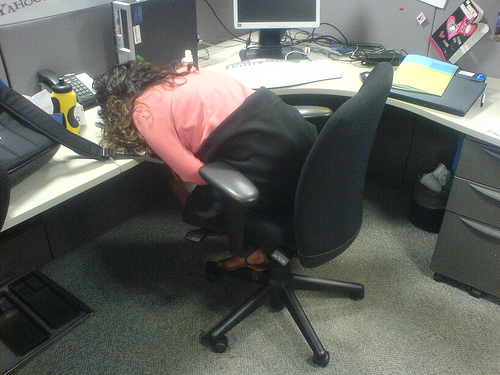
Anxiety Dream

By Miya Tokumitsu

A 1636 Dutch print depicts a tender domestic scene: a father in his nightdress walks to and fro, soothing a wakeful baby while mom gets some well-deserved sleep. The accompanying verse is equally sweet, assuring us that God, like this kindly father, will comfort us when we become gripped with anxiety and cry out in the night.

But when we wake today, heart pounding at the recollection that we have a big presentation in six hours, many of us might find a last-minute cancellation more conducive to recovering sleep than the idea of a loving God who cradles and sings to us. Adding to our anxiety is the knowledge that the loss of every minute is setting us back. There seems hardly to be sleep enough to go around, much less to share with our loved ones. We know the stats: most Americans sleep a paltry 6.8 hours per night, less than the recommended eight hours. The litany of sleep deprivation consequences is also familiar: obesity, depression, anxiety, loss of libido, and heart disease, among others.

We also instinctively understand that we have a stake in each other’s sleep. In addition to immediate hazards, like overtired drivers taking the wheel or bleary-eyed colleagues gumming up our beautiful spreadsheets, we know that widespread depression and worn-out immune systems affect society broadly, and over the long term. And yet we often understand our sleep in terms of pure individual choice.

For that reason, wilful sleep deprivation remains a cultural ideal. This you-snooze-you-lose mindset was recently captured by internet-marketplace Fiverr’s advertisement poster, which, alarm-like, blared “SLEEP DEPRIVATION IS YOUR DRUG OF CHOICE . . . YOU MIGHT BE A DOER.” After all, what is the condition of sleep, if not an absence of motivation to chase the $5 gigs the company peddles? In this same vein, a 2012 Business Insider slideshow fawned over “19 Successful People Who Barely Sleep.” Marissa Mayer, Yahoo! CEO, got pride of place as slide number one. Slide number three was Donald Trump.

An equally individualistic pro-sleep discourse does exist, primarily in click-bait articles nestled within chum boxes, which limply scold us for watching Netflix in bed. Entering this soporific terrain, sleep-evangelist Arianna Huffington urges readers of her book, The Sleep Revolution, to sleep more, prescribing rituals to maximize its quality, including pre-bedtime soaks with Epsom salts, and counting one’s blessings.

As with our wakefulness, our slumber too is motivated and shaped by anxiety. Those who do protect their eight hours often do so because it helps them perform better at work. It’s no wonder that Huffington, a boss, approves of this motivation for sleep, writing, “It would actually be better for business if employees called in tired, got a little more sleep, and then came in a bit late, rather than call in sick a few days later or, worse, show up sick, dragging themselves through the day while infecting others.”

It may appear that as a society we have conflicting sleep ideals, but really, we’re not so much of two minds as we are fumbling around, trying to work out the role that sleep plays in a prosperous life. We want to get sleep right because we know that doing so is essential to thriving individually—indeed, Thrive is the name Huffington chose for her wellness company—but we fret over the quantity, preparatory rites, and timing of our sleep because sleep lies at the juncture between the private and the social, the biological, and the cultural.

Sleep is intensely private: where, when, with (and without) whom, and how we dress and prepare for sleep are intimate and emotional decisions. But sleep is also social: we modify our behavior and expectations on the assumption that those beyond our immediate domiciles—neighbors, colleagues both local and time zones away—are slumbering at certain hours. And although sleep is private, we do want social reassurance that we are sleeping the right way and look down upon those who choose other arrangements. Just mosey over to the comment section of any website discussing infant sleep, and you’ll find accusations of “baby torture,” and remarks like, “You may think you are fine, but no. You did hurt your baby.” Just as eating habits often come with a moral or ethical motivations that imply—or outright state—the absence of such morals and ethics of those who eat differently, sleep helps constitute our identity, something we generally like to have affirmed.

Enter the market. There are seemingly endless ways to buy yourself some sleep—books like Huffington’s, herbal teas, white noise machines, Ambien, melatonin, ear plugs tucked into earplug cases, therapy. And if you want to put sleep off—stimulants from espresso to cocaine, late night TV, alarms, gyms that open at 5 am.

Contrary to Huffington’s claim to revolutionary momentousness, it seems someone’s always been around to sell sleep optimization. Historian Sasha Handley writes in her book Sleep in Early Modern England that in the seventeenth and eighteenth centuries the panoply of goods deemed ideal for proper sleep by Brits counted breathable bed linens, thermometers to help maintain ideal room temperatures, bedclothes including nightcaps and nightcap liners, even ventilators. “No other daily activity was so heavily governed by principles of good health,” Handley writes, “nor consumed as much time, money, and labour as did sleep.” Yesterday’s silver-gilt ventilator has today become a whole range of electronic devices to track your sleep and analyze which components of your psyche and environment need correction.

We may scream at each other over the “correct” way to sleep, but the truth is that where we come down on these questions—and, indeed, whether we even have a choice at all—is largely a matter of our financial resources and anxieties. As with parenting, there are multitudinous dictums competing over how to do sleep right, but few resources to actually achieve our cultural ideals. For well-to-do families, whether to co-sleep with babies may be a considered choice. No such luck for households that cannot afford a bassinet or crib. Coffee-fuelled all-nighters are technically a choice, but usually one coerced by negative economic consequences for missing a deadline. And what can Huffington say to readers who don’t have a bathtub or even a private bedroom from which to banish their phone?