Inflation Is Stealth Austerity

By Charles Hugh Smith

Source: Of Two Minds

Rather than decry austerity, which demands an open political discussion of trade-offs, we should decry inflation’s stealthy reduction of purchasing power.

Austerity–bad. Inflation–good. Oh wait–they’re the same thing: both are a reduction in purchasing power. The only difference is a reduction via austerity is upfront while inflation is a stealth reduction, obfuscated by “official” distortions and Federal Reserve mumbo-jumbo.

Consider $1,200 in wages, unemployment, stimulus, Social Security payment, etc. If this payment gets cut by 10%–$120–as a result of austerity, pay cut, reduction in hours worked, etc., recipients scream bloody murder.

But if inflation reduces the purchasing power of the $1,200 by 10%, nobody does anything but grumble that “prices keep rising while my income stays the same.” This is the classic boiled frog syndrome: inflation is like the heat being turned up so gradually that the poor frog doesn’t realize he’s about to expire.

Inflation is stealthy because the loss of purchasing power is difficult to monitor. Your $1,200 only buys what $1,080 bought in the recent past; 10% inflation reduced your income exactly the same as if austerity had subtracted the $120 upfront.

Governments and central banks love inflation because the theft goes unnoticed. The public tolerates inflation because it’s easy to passively accept this erosion in their standard of living and difficult to generate the political heat that an outright cut would spark.

Though it’s being openly engineered by the Federal Reserve, inflation appears to be a force nobody controls–unlike austerity which is so clearly a political decision. If Inflation robbed 10% of everyone’s income overnight, people might be roused from their passivity to protest.

But since the theft occurs slowly–what’s 1% a month?–and unevenly across a spectrum of goods and services, this theft doesn’t rouse the same political storm as upfront austerity.

Inflation is a form of sacrifice that few recognize as sacrifice. It seems like everyone’s income is eroded equally, but this isn’t true: the wealthy closest to the Fed’s money spigots are earning multiples of inflation from asset inflation, stock buybacks, etc. Inflation is a pinprick to the wealthy and a stilletto in the kidneys of the bottom 95%.

To the political Aristocracy, inflation is wonderful because they don’t need to ask anyone to sacrifice 10% of their income as they do with austerity; they just steal the 10% a dribble at a time and throw up their hands as if inflation is some mystery force completely beyond their control.

Ironically, austerity–an honest, upfront political decision and sacrifice–is decried, while the dishonest, stealth cut of inflation is passively accepted, even as the Federal Reserve has made a cloaked political decision to reduce the purchasing power of everyone’s income except for the New Nobility (the top 0.1%) that the Fed slavishly serves.

Rather than decry austerity, which demands an open political discussion of trade-offs, we should decry inflation’s stealthy reduction of purchasing power, a Fed policy that benefits the few at the expense of the many.

Here is the Chapwood Index of inflation, which carefully measures “apples to apples” costs of essential goods and services in each city:

As inflation erodes purchasing power, workers’ share of the economy has declined dramatically– a double-whammy of declining purchasing power and standard of living.


There’s No Going Back, We Can Only Go Forward

Photo by by Adam Brummett

By Charles Hugh Smith

Source: Of Two Minds

What I see is a global collapse of intangible capital that is invisible to most people.

It’s only natural that the conventional expectation is a return to the pre-pandemic world is just a matter of time. Whether it’s three months or six months or 18 months, “the good old days” will return just as if we turned back the clock.

I think the situation is much more akin to being injured. Since I worked for decades in construction, I’ve had numerous potentially serious injuries, including slipping off roofs, being perched on ladders that fell, my finger sliced open by a steel stud, high winds peeling a heavy sheet of plywood off a stack and sending it flying into me, etc.

Immediately after impact, your first instinct is to assess how badly you’re injured. Of course we all hope we’re not seriously hurt, but the initial adrenaline-fueled relief can be misleading: we might have suffered internal injuries that we can’t feel.

That’s the global situation: we want to assure ourselves the injury is minor and we’ll be back on our feet in no time, but I think the financial-economic injuries are severe and to some branches of global capital and labor, fatal.

Those in power around the world crave one thing above all else: control. If you can’t control the situation and key assets, then what good is your supposed power? If you can’t control the situation and key assets, your power is illusory.

Those in power cannot completely control the forces unleashed by the pandemic. The tide has turned, and everyone trying to return their corner of the world to its pre-pandemic conditions is swimming against the tide–or shoveling sand against the tide, if you prefer that analogy. In either case, they will exhaust themselves and the tide will continue on, regardless of their titanic efforts to print money and maintain control of their populaces.

In my recent book, Will You Be Richer or Poorer?: Profit, Power, and AI in a Traumatized World, I focused on intangible capital, which includes all the forms of capital that cannot be commoditized and purchased for cash like goods and services. Intangible capital includes social capital, social stability, a diverse, resilient local economy and control of one’s own capital.

What I see is a global collapse of intangible capital that is invisible to most people. This includes confidence, trust in institutions and a complacent sense that the tide is carrying us all to greater prosperity.

The tide has reversed, and the key dynamics are income, net worth and costs. As I explained in The New (Forced) Frugality (March 28, 2020), incomes are falling and will continue to fall. Since income is the foundation of asset valuations, asset values will also fall. This will reverse the “wealth effect” that supported the enormous increases in spending and borrowing globally.

When our net worth is rising, we feel wealthier and are more likely to borrow and spend more, confident that our rising wealth will support the debt and higher expenditures. When our assets are declining in value, we feel poorer and are less likely to borrow and spend.

Income is fragile and prone to instant decay, while costs are extremely resistant to declines.

Consider stock valuations: the core driver is profit, which is revenues minus costs. As revenues drop and costs rise, profits vanish literally overnight. That sudden erosion of profits is global, and it will affect companies previously perceived as bulletproof. Facebook and Google depend on advertising, and with the global economy in free-fall, what’s the point in wasting scarce cash on marketing? Essentially no one needs a $1,000 iPhone or a $40,000 Tesla. Aspirational spending is as fragile as income.

Consider real estate: commercial real estate is based on the income generated by enterprises renting space. If businesses fold or stop paying rent, the value of the property falls accordingly.

Even residential real estate is intimately connected to income: as household incomes plummet, the number of potential buyers plummets, too. Institutional buyers of houses base the value on rental income, just like commercial property. As household income plummets, fewer people can afford sky-high rents, and so supply exceeds demand and rents will fall accordingly.

Consider bonds: the value of any bond, government or corporate, is based on the yield paid to the owner. While the general expectation is that yields will fall to zero because central banks are buying bonds, this may be less of a guarantee than generally assumed. The volume of bonds being issued may well exceed central bank buying, and yields (and interest rates) will rise despite central bank intervention.

The world depends on expanding debt to pay for government services and private-sector spending. Debt is also dependent on income; lenders who issue loans to households and enterprises with faltering income are very likely to lose money as these marginal borrowers default.

As income falls, lending dries up, as lenders cannot afford to risk making loans to people and businesses that are practically guaranteed to default. This is especially true for borrowers who are already burdened by existing debts.

As incomes decline, asset values decline and borrowing dries up. Once borrowing dries up, spending dries up, and enterprises and governments must cut payrolls by any means available: don’t replace retiring employees, cut wages and benefits, and eliminate overtime and bonuses.

As stock values fall, so do the value of employee stock options–another example of the reverse wealth effect.

Meanwhile, costs will continue rising as cash-strapped governments eventually seek more tax revenues and supply-chain shocks lead to higher prices.

We cannot go back to the pre-pandemic side of the river of time, and it’s dangerous to focus on returning to a time that has already been lost. We cannot go back, we can only go forward.

The Unraveling Quickens

By Charles Hugh Smith

Source: Of Two Minds

Even if we don’t measure the erosion of intangible capital, the social and political consequences of this impoverishment are manifesting in all sorts of ways.

The central thesis of my new book Will You Be Richer or Poorer? is the financial “wealth” we’ve supposedly gained (or at least a few of us have gained) in the past 20 years has masked the unraveling of our intangible capital: the resilience of our economy, our social capital, i.e. our ability to find common ground and solve real-world problems, our sense that the playing field, while not entirely level, is not two-tiered, and our sense of economic security–have all been shredded.

The unraveling of everything that actually matters is quickening. While every “news” outlet cheerleads the stock market (“The Dow soared today as investor optimism rose… blah blah blah”), our “leadership” and our media don’t even attempt to measure what’s unraveling, much less address the underlying causes.

The hope is that if we ignore what’s unraveling, it will magically go away. But that’s not how reality works.

The unraveling is gathering momentum because prices have been pushing higher while wages lag, feeding the rising precariousness and inequality of our economy. The connection between people losing ground and social disorder/disunity has been well established by historians such as Peter Turchin Ages of Discord and David Hackett Fischer The Great Wave: Price Revolutions and the Rhythm of History.

In our era, trust in the legitimacy of our institutions is unraveling because the statistics presented as “facts” are so clearly designed to support the status quo narrative that everything’s getting better every day in every way rather than the politically unwelcome reality that the bottom 95% are losing ground and whatever they do earn and own is increasingly at risk from forces outside their control.

Economic decay leads to social and political disorder / disunity. The sudden rise of vast homeless encampments is one manifestation of the social fabric unraveling. In the political realm, the insanity of accusing Democratic candidates of being “Russian agents” matches the hysterical destructiveness of the McCarthy era in the 1950s.

It all starts with economic decay, so let’s look at some charts. Here’s a chart of income inequality which helps drive wealth inequality.

Note that the only group that benefited from the past 20 years of speculative bubbles is the top 1%. The whole idea that inflating bubbles creates a “wealth effect” that “trickles down” is preposterous, as evidenced by the decline of the middle 60% of households while the speculators and owners of bubble-assets skimmed the vast majority of income gains.

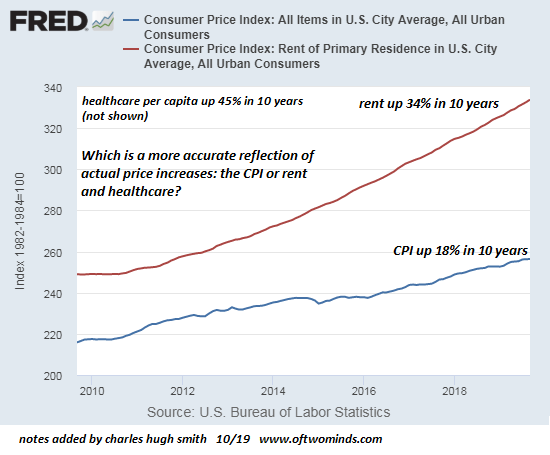
Meanwhile, we’re told inflation is less than 2% annually while rising costs have outpaced meager wage increases. What’s a more realistic measure of real-world inflation–the official Consumer Price Index (CPI) at 18% over ten years or rent and healthcare at 34% and 45%?

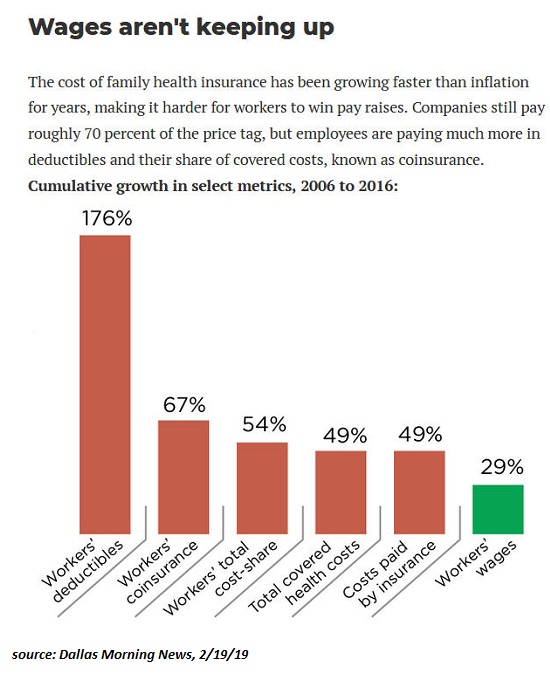
According to the Chapwood Index, real-world inflation in urban America is running 9% to 13% annually. This is more in line with reality than the bogus CPI, as evidenced by this chart of wages and healthcare costs:

Even if we don’t measure the erosion of intangible capital, the social and political consequences of this impoverishment are manifesting in all sorts of ways: large-scale social disorder is breaking out around the globe, and the political middle ground has completely vanished: no matter which way an issue is decided, one camp will refuse to accept the outcome.

The only way forward with any chance of success is to start by acknowledging the decay of our economy due to rampant financialization, legalized looting, the pathologies of “winner take most” speculation and the realities of a two-tiered system in which entrenched elites are “more equal” than the rest of us, economically, socially and politically. We have to accept the limits of technology to reverse the unraveling and assess the damage that’s already been done to our shared capital.

Acting as if the system is working just fine and the problem is perception/optics is accelerating the unraveling.

Why America is the World’s First Poor Rich Country

Or, How American Collapse is Made of a New Kind of Poverty

By Umair Haque

Source: Eudaimonia

Consider the following statistics. The average American can’t scrape together $500 for an emergency. A third of Americans can’t afford food, shelter, and healthcare. Healthcare for a family now costs $28k — about half of median income, which is $60k.

By themselves, of course, statistics say little. But together these facts speak volumes. The story they are beginning to tell is this.

America, it seems, is becoming something like the world’s first poor rich country. And that is the elephant in the room we aren’t quite grasping. After all, authoritarianism and extremism don’t arise in prosperous societies — but in troubled ones, which are growing impoverished, like America is today. What do I mean by all that?

Let’s begin with what I don’t mean. I don’t mean absolute poverty. Americans are not living on a few dollars a day, by and large, like people in, for example, Somalia or Bangladesh. America’s median income is still that of a rich country, around $50k, depending on how it’s counted. Nor do I really mean relative poverty — people living below median income. While that’s a growing problem in America, because the middle class is imploding, that is not really the true problem these numbers hint at, either.

America appears to be pioneering a new kind of poverty altogether. One for which we do not yet have a name. It is something like living at the knife’s edge, constantly being on the brink of ruin, one small step away from catastrophe and disaster, ever at the risk of falling through the cracks. It has two components — massive inflation for the basics of life, coupled with crushing, asymmetrical risk. I’ll come to what those mean shortly.

The average American has a relatively high income, that of a person in a nominally rich country. Only his income does not go very far. Most of it is eaten up by attempting to afford the basics of life. We’ve already seen how steep healthcare costs are. But then there is education. There is transport. There is interest and rent. There is media and communications. There is childcare and elderly care. All these things reduce the average American to constantly living right at the edge of ruin — one paycheck away from penury, one emergency away from losing it all.

But this isn’t true for America’s peers. In Europe, Canada, and even Australia, society invests in all these things — and the costs of basic necessities societies don’t provide are regulated. For example, I pay $50 dollars for broadband and TV in London — but $200 for the same thing in New York — yet in London, I get vastly more and better media for my money (even including, yes, American junk like Ancient Aliens). That’s regulation at work. And when basic goods like healthcare or elderly care or education are provided and managed at a social scale, that is when they are cheapest, and often of the best quality, too. Hence, healthcare costs far less in London, Paris, or Geneva — and life expectancy is longer, too.

So if you are earning $50k in America, it is a very different thing than earning $50k in France, Germany, or Sweden — in America, you must pay steeply for the basics of life, for basic necessities. Thus, incomes stretch much further in other countries, which enjoy a vastly higher quality of life, even though people there earn roughly the same amount, because they pay vastly less for basic necessities. Americans are rich, but only nominally — their money doesn’t buy nearly as much as their peers does, where it matters and counts most, for the basics of life.

What happens when societies don’t understand all the above? Well, a strange thing has happened to the American economy. While it’s true that things like TVs and Playstations have gotten cheaper, the costs of the basics of life have skyrocketed. All the things that really elevate people’s quality of life — healthcare, finance, education, transport, housing, and so on — have come to consume such a large share of the average household’s income that they have little left to save, invest, or spend on anything else. And what’s worse, while the basics of life have seen massive inflation, wages and incomes (not to mention savings and benefits and safety nets and opportunities) for most have stagnated. The result is an economy — and a society — that’s collapsing.

Yet all that is the straightforward effect of giving, for example, hedge funds control over drugs, or speculators control over housing, healthcare, and education — they will of course maximize profits, whereas investing in these things socially, or at least regulating them, minimizes real costs, and maximizes accessibility, affordability, and quality.

So the average American, who is left high and dry, must borrow, borrow, borrow, just to maintain a decent quality of life — because handing capitalism control of the basics of life has caused massive, skyrocketing inflation in necessities, while flatlining his income. Healthcare didn’t used to cost half of median income even a decade ago, after all — but now it does. So what happens when, in a decade or two, healthcare costs all of median income? How can an economy — let alone a society — function that way?

Well, what happens if the average American steps over the line? Misses a mortgage payment, gets ill and is unable to pay a few bills on time, can’t pay the costs of healthcare? Then they are punished severely and mercilessly. Their “credit rating” (note how banks and hedge funds don’t have them) is ruined. They can easily find themselves out on the street, without finance, without a second chance, without access to any kind of redress or support . And then they are rejected, shunned, and ostracized. They might not have an address anymore — so who will hire them? They are no longer a part of society — they have fallen through the cracks, and finding one’s way back is often next to impossible. Asymmetrical risk — corporations and lobbies and banks bear no risk at all, precisely because the average American bears them all now.

So Americans aren’t just absolutely or relatively poor, but poor in a new way entirely. First, the basics of life exploded in price, to the point that they are now unaffordable for many, maybe most, households. Second, Americans bear the risks of paying those unaffordable costs to an extreme degree, bearing the risks that institutions should, and so those risks are now ruinously high. A bank or hedge fund or corporation might go bankrupt, and liquidate its assets, and its owners stay rich — but if an American’s credit rating is ruined, loses his job, cannot pay his bills, or even if he declares bankruptcy, he falls through the cracks, hounded, embattled, institutionally black-marked. He finds himself outside society, with little way to get back in. Little wonder then that Americans work so much harder than anywhere else — they are always one step away from losing it all, from genuine ruin, but their peers in truly rich countries aren’t.

Marx probably would have called this immiseration. Neo-Marxist theorists call it precarity. And while there’s truth in both those ideas and perspectives, I think they miss three vital points.

We don’t see America as a poor country, but we should begin to. Americans live fairly abysmal lives — short, lonely, unhappy, full of work and stress and despair, compared to their peers. That is because they cannot afford better ones — predatory capitalism coupled with total economic mismanagement of social investments has made the basics of life ruinously unaffordable. In this way, it’s effectively a poor country — yes, there’s a tiny number of ultra-rich, but they are outliers now, off the map of the normal. Because it’s not just any kind of poverty, yesterday’s poverty, or even poverty as we are used to thinking about it.

America is pioneering a new kind of poverty. The kind of poverty that’s developed in America isn’t just bizarre and gruesome — it’s novel and unseen. It isn’t something that we understand well, economists, intellectuals, thinkers, because we have no good framework to think about it. It’s not absolute poverty like Somalia, and it’s not just relative poverty, like in gilded banana republics. It’s a uniquely American creation. It’s extreme capitalism meets Social Darwinism by way of rugged self-reliance crossed with puritanical cruelty.

The kind of poverty America’s pioneering today isn’t absolute, or even relative , but something more like perfectly tuned poverty, strategic poverty, basic poverty— nominally well-off people whose money doesn’t go far enough to make them actually live well, constantly living at the edge of ruin, and thus forced to choke down their bitter anger and serve the very systems which oppress and subjugate with more and more indignity and fear and servility by the year.

America’s still an innovator today. Unfortunately, what it’s innovating now is a new kind of poverty. Yet poverty is poverty. What happens in societies where poverty is growing? Authoritarianism rises, as people lose faith in democracy, which can’t seem to offer them working social contracts. Authoritarian soon enough becomes fascism — “this country, this land, its harvest — it is only for the true volk!”, the cry goes up, when there is not enough to go around. And the rest of the dark and grim story of the fall into the abyss you should know well enough by now. It ends in words we do not say.

Still, history, laughing, has told this tale to us many times. And it is telling it to tomorrow, again, in the tale of American collapse.

The Federal Reserve and the Global Fracture

Octopus 1912

An Interview with Finnish Journalist Antti J. Ronkainen

Michael Hudson

Source: The Unz Review

Antti J. Ronkainen: The Federal Reserve is the most significant central bank in the world. How does it contribute to the domestic policy of the United States?

Michael Hudson: The Federal Reserve supports the status quo. It would not want to create a crisis before the election. Today it is part of the Democratic Party’s re-election campaign, and its job is to serve Hillary Clinton’s campaign contributors on Wall Street. It is trying to spur recovery by resuming its Bubble Economy subsidy for Wall Street, not by supporting the industrial economy. What the economy needs is a debt writedown, not more debt leveraging such as Quantitative Easing has aimed to promote. But the Fed is in a state of denial that the U.S. and European economies are plagued by debt deflation.

The Fed uses only one policy: influencing interest rates by creating bank reserves at low give-away charges. It enables banks too make easy gains simply by borrowing from it and leaving the money on deposit to earn interest (which has been paid since the 2008 crisis to help subsidize the banks, mainly the largest ones). The effect is to fund the asset markets – bonds, stocks and real estate – not the economy at large. Banks also are heavy arbitrage players in foreign exchange markets. But this doesn’t help the economy recover, any more than the ZIRP (Zero Interest-Rate Policy) since 2001 has done for Japan. Financial markets are the liabilities side of the economy’s balance sheet, not the asset side.

The last thing either U.S. party wants is for the election to focus on this policy failure. The Fed, Treasury and Justice Department will be just as pro-Wall Street under Hillary. There would be no prosecutions of bank fraud, there would be another bank-friendly Attorney General, and a willingness to subsidize banks now that the Dodd-Frank bank reform has been diluted from what it originally promised to be.


So let’s go back to beginning. When the Great Financial Crisis escalated in 2008 the Fed’s response was to lower its main interest rate to nearly zero. Why?

The aim of lowering interest rates was to provide banks with cheap credit. The pretense was that banks might lend to help the economy get going again. But the Fed’s idea was simply to re-inflate the Bubble Economy. It aimed at restoring the value of the mortgages that banks had in their loan portfolios. The hope was that easy credit would spur new mortgage lending to bid housing prices back up – as if this would help the economy rather than simply raising the price of home ownership.

But banks weren’t going to make mortgage loans to a housing market that already was over-lent. Instead, homeowners had to start paying down the mortgages they had taken out. Banks also reduced their credit-card exposure by a few hundred billion dollars. So instead of receiving new credit, the economy was saddled with having to repay debts.

Banks did make money, but not by lending into the “real” production and consumption economy. They mainly engaged in arbitrage and speculation, and lending to hedge funds and companies to buy their own stocks yielding higher dividend returns than the low interest rates that were available.


In addition to the near zero interest rates, the Fed bought US Treasury bonds and mortgage backed securities (MBS) with almost $4 trillion during three rounds of Quantitative Easing stimulus. How have these measures affected the real economy and financial markets?

In 2008 the Federal Reserve had a choice: It could save the economy, or it could save the banks. It might have used a fraction of what became the vast QE credit – for example $1 trillion – to pay off the bad mortgages and write them down. That would have helped save the economy from debt deflation. Instead, the Fed simply wanted to re-inflate the bubble, to save banks from having to suffer losses on their junk mortgages and other bad loans.

Keeping these debts on the books, in full, let banks foreclose on defaulting homeowners. This intensified the debt-deflation, pushing the economy into its present post-2008 depression. The debt overhead is keeping it depressed.

One therefore can speak of a financial war waged by Wall Street against the economy. The Fed is a major weapon in this war. Its constituency is Wall Street. Like the Justice and Treasury Departments, it has been captured and taken hostage.

Federal Reserve chairwoman Janet Yellen’s husband, George Akerlof, has written a good article about looting and fraud as ways to make money. But instead of saying that looting and fraud are bad, the Fed has refused to regulate or move against such activities. It evidently recognizes that looting and fraud are what Wall Street is all about – or at least that the financial system would come crashing down if an attempt were made to clean it up!

So neither the Fed nor the Justice Department or other U.S. Government agencies has sanctioned or arrested a single banker for the trillions of dollars of financial fraud. Just the opposite: The big banks where the fraud was concentrated have been made even larger and more dominant. The effect has been to drive out of business the smaller banks not so involved in derivative bets and other speculation.

The bottom line is that banks made much more by getting Alan Greenspan and the Clinton-Bush Treasury officials to deregulate fraud than they could have made by traditional safe lending. But their gains have increased the economy’s overhead.


Do you believe Mike Whitney’s argument that QE was about a tradeoff between the Fed and the government: the Fed pumped the new bubble and saved the banks that the government didn’t need to bail out more banks. The government’s role was to impose austerity so that inflation and employment didn’t rise – which would have forced the Fed to raise interest rates, ending its QE program? source: http://www.counterpunch.org/2016/01/15/the-chart-that-explains-everything/]

That was a great chart that Mike put up from Richard Koo, and you should reproduce it here. It shows that the Fed’s enormous credit creation had zero effect on raising commodity prices or wages. But stock market prices doubled in just six years, 2008-15, and bond prices rose to new peaks. Banks left much of the QE credit on deposit with the Fed, earning an interest giveaway premium.

(Richard Koo: “The struggle between markets and central banks has only just begun,”

http://www.businessinsider.com/richard-koo-struggle-between-markets-and-central-banks-has-only-just-begun-2015-9?r=UK&IR=T

The important point is that the Fed (backed by the Obama Administration) refused to use this $4 trillion to revive the production-and-consumption economy. It claimed that such a policy would be “inflationary,” by which it meant raising employment and wage levels. The Fed thus accepted the neoliberal junk economics proposing austerity as the answer to any problem – austerity for the industrial economy, not the Fed’s own Wall Street constituency.


According to a Fed staff report, QE would lower the exchange rate of dollar to the other currencies causing competitiveness boost for the U.S. firms. Former finance minister of Brazil Guido Mantega, as well as the chairman of Central Bank of India Raghuram Rajan, have described the Fed’s QE as a “currency war.” What’s your take?

The Fed’s aim was simply to provide banks with low-interest credit. Banks lent to hedge funds to buy securities or make financial bets that yielded more than 0.1 percent. They also lent to companies to buy their own stock, and to corporate raiders for debt-financed mergers and acquisitions. But banks didn’t lend to the economy at large, because it already was “loaned up,” and indeed, overburdened with debt.

Lower interest rates did spur the “carry trade,” as they had done in Japan after 1990. Banks and hedge funds bought foreign bonds paying higher rates. The dollar drifted down as bank arbitrageurs could borrow from the Fed at 0.1 percent to lend to Brazil at 9 percent. Buying these foreign bonds pushed up foreign exchange rates against the dollar. That was a side effect of the Fed’s attempt to help Wall Street make financial gains. It simply didn’t give much consideration to how its QE flooding the global economy with surplus dollars would affect U.S. exports – or foreign countries.

Exchange rate shifts don’t affect export trends as much as textbook models claim. U.S. arms exports to the Near East, and many technology exports are non-competitive. However, a looming problem for most countries is what may happen when ending QE increases the dollar’s exchange rate. If U.S. interest rates go back up, the dollar will strengthen. That would increase the cost to foreign countries of paying dollar-denominated debts. Countries that borrowed all dollars at low interest will need to pay more in their own currencies to service these debts. Imagine what would happen if the Federal Reserve let interest rates rise back to a normal level of 4 or 5 percent. The soaring dollar would push debtor economies toward depression on capital account much more than it would help their exports on trade account.


You have said that QE is fracturing the global economy. What do you mean by that?

Part of the flood of dollar credit is used to buy shares of foreign companies yielding 15 to 20 percent, and foreign bonds. These dollars are turned over to foreign central banks for domestic currency. But central banks are only able to use these dollars to buy U.S. Treasury securities, yielding about 1 percent. When the People’s Bank of China buys U.S. Treasury bonds, it’s financing America’s dual budget and balance-of-payment deficits, both of which stem largely from military encirclement of Eurasia – while letting U.S. investors and the U.S. economy get a free ride.

Instead of buying U.S. Treasury securities, China would prefer to buy American companies, just like U.S. investors are buying Chinese industry. But America’s government won’t permit China even to buy gas station companies. The result is a double standard. Americans feel insecure having Chinese ownership in their companies. It is the same attitude that was directed against Japan in the late 1980s.

I wrote about this financial warfare and America’s free lunch via the dollar standard in Super Imperialism (2002) and The Bubble and Beyond (2012), and about how today’s New Cold War is being waged financially in Killing the Host (2015).


The Democrats loudly criticized the Bush administration’s $700 billion TARP-program, but backed the Fed’s QE purchases worth of almost $4 trillion during the Obama administration. How does this relate to the fact that officially, QE purchases were intended to support economic recovery?

I think you’ve got the history wrong. My Killing the Host describes how the Democrats supported TARP, while the Republican Congress opposed it on populist grounds. Republican Treasury Secretary Hank Paulson offered to use some of the money to aid over-indebted homeowners, but President-elect Obama blocked that – and then appointed Tim Geithner as Treasury Secretary. FDIC head Sheila Bair and by SIGTARP head Neil Barofsky have written good books about Geithner’s support for Wall Street (and especially for Citigroup and Goldman Sachs) against the interests of the economy at large.

If you are going to serve Wall Street – your major campaign contributors – you are going to need a cover story pretending that this will help the economy. Politicians start with “Column A”: their agenda to reimburse their campaign contributors – Wall Street and other special interests. Their public relations team and speechwriters then draw up “Column B”: what public voters want. To get votes, a rhetorical cover story is crafted. I describe this in my forthcoming J is for Junk Economics, to be published in March. It’s a dictionary of Orwellian doublethink, political and economic euphemisms to turn the vocabulary around and mean the opposite of what actually is meant.


How do TARP and QE relate to the Federal Reserve’s mandate about price stability?

There are two sets of prices: asset prices and commodity prices and wages. By “price stability” the Fed means keeping wages and commodity prices down. Calling depressed wage levels “price stability” diverts attention from the phenomenon of debt deflation – and also from the asset-price inflation that has increased the advantages of the One Percent over the 99 Percent. From 1980 to the present, the Fed has inflated the largest bond rally in history as a result of driving down interest rates from 20 percent in 1980 to nearly zero today, as you have noted.

Chicago School monetarism ignores asset prices. It pretends that when you increase the money supply, this increases consumer prices, commodity prices and wages proportionally. But that’s not what happens. When banks created credit (money), they don’t lend much to people to buy goods and services or for companies to make capital investments to employ more workers. They lend money mainly to transfer ownership of assets already in place. About 80 percent of bank loans are mortgages, and the rest are largely for stocks and bond purchases, including corporate takeovers and stock buybacks or debt-leveraged purchases. The effect is to bid up asset prices, while loading down the economy with debt in the process. This pushes up the break-even cost of doing business, while imposing debt deflation on the economy at large.

Wall Street isn’t so interested in exploiting wage labour by hiring it to produce goods for sale, as was the case under industrial capitalism in its heyday. It makes its gains by riding the wave of asset inflation. Banks also gain by making labour pay more interest, fees and penalties on mortgages, and for student loans, credit cards and auto loans. That’s the postindustrial financial mode of exploiting labor and the overall economy. The Fed’s QE program increases the price at which stocks, bonds and real estate exchange for labour, and also promotes debt leverage throughout the economy.


Why don’t economists distinguish between asset-price and commodity price inflation?

The economics curriculum has been turned into an exercise for students to pretend that a hypothetical parallel universe exists in which the rentier classes are job creators, necessary to help economies recover. The reality is that financial modes of getting rich by debt leveraging creates a Bubble Economy – a Ponzi scheme leading to austerity and shrinking markets, which always ends in a convulsion of bankruptcy.

The explanation for why this is not central to today’s economic theory is that the discipline has been captured by this neoliberal tunnel vision that overlooks the financial sector’s maneuvering to make quick trading profits in stocks, bonds, mortgages and derivatives, not to take the time and effort to develop long-term markets. Rentiers seek to throw a cloak of invisibility around how they make money. They know that if economists don’t measure their wealth and the public does not see it, voters will be less likely to bring pressure to regulate and tax it.

Today’s central economic problem is that inflating asset prices by debt leveraging extracts more interest and financial charges. When the resulting debt deflation ends up hollowing out the economy, creditors try to blame labour, or government spending (except for bailouts and QE to help Wall Street). It is as if debtors are exploiting their creditors.


If there is a new class war, what is the current growth model?

It’s an austerity model, as you can see from the eurozone and from the neoliberal consensus that cites Latvia as a success story rather than a disaster leading to de-industrialization and emigration. In real democracies, if economies polarize like they are doing today, you would expect the 99 Percent to fight back by electing representatives to enact progressive taxation, regulate finance and monopolies, and make public investment to raise wages and living standards. In the 19th century this drive led parliaments to rewrite the tax rules to fall more on landlords and monopolists.

Industrial capitalism plowed profits back into new means of production to expand the economy. But today’s rentier model is based on austerity and privatization. The main way the financial sector always has obtained wealth has been by privatizing it from the public domain by insider dealing and indebting governments.

The ultimate financial business plan also is to lend with an eye to end up with the debtor’s property, from governments to companies and families. In Greece the European Central Bank, European Commission and IMF demanded that if the nation’s elected representatives did not sell off the nation’s ports, land, islands, roads, schools, sewer systems, water systems, television stations and even museums to reimburse the dreaded austerity troika for its bailout of bondholders and bankers, the country would be isolated from Europe and faced with a crash. That forced Greece to capitulate.

What seems at first glance to be democracy has been hijacked by politicians who accept the financial class war ideology that the way for an economy to get rich is by austerity. That means lowering wages, unemployment, and dismantling government by turning the public domain over to the financial sector.

By supporting the banking sector even in its predatory and outright fraudulent behavior, U.S. and European governments are reversing the trajectory along which 19th-century progressive industrial capitalism and socialism were moving. Today’s rentier class is not concerned with long-term tangible investment to earn profits by hiring workers to produce goods. Under finance capitalism, an emerging financial over-class makes money by stripping income and assets from economies driven deeper into debt. Attacking “big government” when it is democratic, the wealthy are all in favor of government when it is oligarchic and serves their interests by rolling back the past two centuries of democratic reforms.


Does the Fed realize global turbulences what its unconventional policies have caused?

Sure. But the Fed has painted itself in a corner: If it raises interest rates, this will cause the stock and bond markets to go down. That would reverse the debt leveraging that has kept these markets up. Higher interest rates also would bankrupt Third World debtors, which will not be able to pay their dollar debts if dollars become more expensive in their currencies.

But if the Fed keeps interest rates low, pension funds and insurance companies will have difficulty making the paper gains that their plans imagined could continue exponentially ad infinitum. So whatever it does, it will destabilize the global economy.


China’s stock market has crashed, western markets are very volatile, and George Soros has said that the current financial environment reminds him of the 2008 crash. Should we be worried?

News reports make it sound as if debt-ridden capitalist economies will face collapse if the socialist countries don’t rescue them from their shrinking domestic markets. I think Soros means that the current financial environment is fragile and highly debt-leveraged, with heavy losses on bad loans, junk bonds and derivatives about to be recognized. Regulators may permit banks to “extend and pretend” that bad loans will turn good someday. But it is clear that most government reports and central bankers are whistling in the dark. Changes in any direction may pull down derivatives. That will cause a break in the chain of payments when losers can’t pay. The break may spread and this time public opinion is more organized against 2008-type bailouts.

The moral is that debts that can’t be paid, won’t be. The question is, how won’t they be paid? By writing down debts, or by foreclosures and distress sell-offs turning the financial class into a ruling oligarchy? That is the political fight being waged today – and as Warren Buffet has said, his billionaire class is winning it.


That’s all for now. Thank you Michael!

The lottery and social despair in America

1fab0b8ba5546a67810419e62958f0cc

By Andre Damon

Source: WSWS.org

This mania, so generally condemned, has never been properly studied. No one has realized that it is the opium of the poor. Did not the lottery, the mightiest fairy in the world, work up magical hopes? The roll of the roulette wheel that made the gamblers glimpse masses of gold and delights did not last longer than a lightning flash; whereas the lottery spread the magnificent blaze of lightning over five whole days. Where is the social force today that, for forty sous, can make you happy for five days and bestow on you—at least in fancy—all the delights that civilization holds?

Balzac, La Rabouilleuse, 1842

The jackpot in the US Powerball lottery has hit $800 million, since there were no winners in Wednesday’s drawing. In the current round, which began on December 2, over 431 million tickets have been sold, a figure substantially larger than America’s population.

Go into any corner store in America and you will see workers of every age and race waiting in line to buy lottery tickets. With the current round, the lines are longer than ever. Americans spend over $70 billion on lottery tickets each year. In West Virginia, America’s second-poorest state, the average person spent $658.46 on lottery tickets last year.

Powerball players pick six random numbers when they purchase their tickets, with a certain percentage of sales going to the jackpot. If no winning ticket is sold, the jackpot rolls over to the next round.

The totals for the Mega Millions and Powerball national lotteries have been growing every year. This year’s jackpot has eclipsed 2012’s record of $656.5 million, the $390 million payout in 2007 and the $363 million prize in 2000. The jackpots have grown in direct proportion to ticket sales.

State-run gambling programs such as Powerball have been promoted by Democrats and Republicans alike as a solution to state budget shortfalls, even as the politicians slash taxes on corporations and wealthy individuals and gut social programs. From the standpoint of government revenue, lotteries and casinos are nothing more than a back-door regressive tax, soaking up money from the poor in proportion to the growth of social misery.

The boom in lotteries is global. Lottery sales grew 9.9 percent worldwide in 2014, after growing 4.9 percent in 2013.

Psychology Professor Kate Sweeny has noted that lottery sales grow when people feel a lack of control over their lives, particularly over their economic condition. “That feeling of self-control is very important to psychological well-being,” Sweeny says.

There is ample reason for American workers to feel they have no control over their lives. According a recent survey by Bankrate.com, more than half of Americans do not have enough cash to cover an unexpected expense of $500 or more—roughly the price of four name-brand tires.

Some 62 percent of Americans have savings of less than $1,000, and 21 percent do not have any savings at all. Most Americans are one medical emergency or one spell of unemployment from financial ruin.

For all the talk about “economic recovery” by the White House, the real financial state of most American households is far worse than before the 2008 financial crisis and recession. As of 2013, Americans were almost 40 percent poorer than they were in 2007, according to a recent survey by the Pew Research Center. While a large portion of the decline in household wealth is attributable to the collapse of the housing bubble, falling wages and chronic mass unemployment have played major roles.

The yearly income of a typical US household dropped by a massive 12 percent, or $6,400, in the six years between 2007 and 2013, according to the Federal Reserve’s latest survey of consumer finances. A large share of this decline has taken place during the so-called recovery presided over by the Obama administration.

In addition to becoming poorer, America has become much more economically polarized. According to a separate Pew survey, for the first time in more than four decades “middle-income households” no longer constitute the majority of American society. Instead, the majority of households are either low- or high-income. Pew called its findings “a demographic shift that could signal a tipping point” in American society.

“Is the lottery the new American dream?” asked USA Today, commenting on this month’s Powerball jackpot. The observation is truer than the authors intended. For American workers, achieving the “American Dream” of a stable job and one’s own home is becoming increasingly unrealizable.

Following more than 10 million foreclosures during the financial crisis, America’s home ownership rate has hit the lowest level in two decades, and for young households, the rate of home ownership is the lowest it has been since the 1960s.

For the tens of millions of America’s poor, and the more than 100 million on the threshold of poverty, the dream of winning the lottery has replaced the “American Dream” of living a decent life. A lottery ticket is a chance to escape to a fantasy world where money is not a constant, nagging worry, where one is not insulted and bullied at a low-wage job by bosses whose pay is matched only by their incompetence. The lottery is, as Balzac aptly described it, the “opium of the poor.”

Using the same phrase to describe religion, Marx noted that the “illusory happiness of the people” provided by the solace of religion is, in fact, a silent protest and distorted “demand for their real happiness.” It is the intolerable social conditions that compel masses of people to seek consolation in a lottery ticket that will propel them into revolutionary struggles.

The Matrix Is Real and How It Will Change All Of Our Lives

M3_Hugo_Weaving_003

By Paul Craig Roberts

Source: King World News

Americans are the most manipulated people in history. Since 2008, the economy has been manipulated for the benefit of a few oversized banks “too big to fail.” US foreign policy has been manipulated to serve the hegemonic agenda of a handful of neoconservatives. These manipulations have undercut the consumer basis of the US economy and have pushed the American people into a conflict situation with Russia and China.

Lies, US Economic Collapse And Nuclear War

US economic collapse and nuclear war are the two most likely outcomes of Washington’s manipulations of the American people. Time and again, the American public has fallen for transparent lies and orchestrated events. 2015 is a decisive year. Will a credulous people cast off their gullibility, or will they be swept away by economic collapse and war?

There are reasons to believe that the government’s manipulations have overreached and are crossing the point of believability, even on the part of credulous Americans. Let’s review some of these manipulations — first, economic, and then foreign policy.

Unemployment Number Is Meaningless

On January 9, the US government told Americans that the unemployment rate had fallen to a comforting 5.6 percent, an indication that the Federal Reserve’s policy of Quantitative Easing was successful in restoring the US economy. A 5.6 percent rate of unemployment suggests that Americans have a reasonable chance of finding a job. Yet we know there are millions of discouraged workers who have given up looking for a job.

The explanation of this paradox is that the 5.6 percent unemployment rate (U.3) does not include unemployed people who have not looked for a job in the previous four weeks. These unemployed are called “discouraged workers.” If they have been discouraged for less than one year, they are counted in a seldom-reported measure of unemployment (U.6). This rate stands at 11.2 percent, twice as high as the unemployment rate stressed by government and financial media.

The 11.2 percent rate is an official measure, but it is not publicized because it indicates a dismal employment outlook 5.5 years after the 2008 recession was declared over, in June 2009. What kind of recovery is it when the unemployment rate remains at 11.2 percent years after the recession has officially ended?

The Great Lie Exposed

The story worsens. The 11.2 percent rate does not include the millions of unemployed long-term discouraged workers (those discouraged for more than one year). Prior to 1994, the US Bureau of Labor Statistics counted the long-term discouraged as unemployed, and the government of Canada still does. John Williams (shadowstats.com) continues to include the long-term discouraged. When the long- term discouraged are added to the U.6 measure, the rate of unemployment again doubles, to 23 percent.

In other words, the actual unemployment rate is actually four times higher than the comforting figure released January 9.

Inflation Rate Also Falls Victim

The government engages in similar deception with the inflation rate. If the price of an item in the index rises, a lower-priced item is substituted, thus eliminating inflation by substitution. Inflation also is eliminated by redefining a price rise as a quality improvement.

By undercounting inflation, the government reports price increases as real economic growth, denies cost-of-living increases to Social Security recipients, and justifies paying savers negative real interest rates. These manipulations provide banks with free money, thus boosting bank profits while encouraging the stock market with “good news.”

Americans who search for jobs without success know other Americans in the same situation. As time passes, they learn from experience that the unemployment rate cannot be low and falling when jobs are harder to find. People who shop for food and pay utility bills know inflation is far higher than the government reports. Experience and the passage of time make the government’s numbers less and less believable.

Global Financial Markets Manipulated

The financial markets also are manipulated. To protect the dollar from declining in value due to its overproduction, the Federal Reserve’s bullion bank agents drive down the price of gold and silver by dumping uncovered shorts in the futures market. Since 2011, we have had the extraordinary situation in which the prices of gold and silver have been driven down despite strong demand and constraints on supply — a result that can be achieved only by manipulation in the futures market.

The dollar’s value also is manipulated by foreign central banks in cooperation with Washington. The Japanese and European central banks print yen and euros to protect the dollar’s exchange value. If all major currencies also are being printed, the dollar cannot decline.

The government’s Plunge Protection Team can prevent major stock-market corrections by stepping in and purchasing S&P futures, thus preventing the market’s overvaluation from bursting the bubble.

These manipulations are apparent to experienced investors. Sooner or later, attentive Americans will realize that the government’s deceit is not limited to the marketplace, but extends into foreign policy.

Fooled Over And Over Into War

Ever since the Clinton regime’s demonizations of Yugoslavia and Serbia, Americans have been deceived into supporting expensive wars and foreign-policy positions that are not in their interest. Washington’s demonizations of the Taliban, Osama bin Laden, Saddam Hussein, Gaddafi, Assad, Iran and of Muslims generally have resulted in 14 years of wars in which seven or eight countries have been invaded, bombed and attacked with drones. Increasingly, people at home and abroad understand these wars and bombings are based on lies and deceptions.

The destruction of countries and the massive human hurt happened because the US government lied and deceived.

There were no weapons of mass destruction in Iraq. Assad did not use chemical weapons in Syria. Gaddafi did not issue Viagra to his troops to assist in the rape of Libyan women. Iran does not have a nuclear- weapons program.

Millions of Muslims have been killed, maimed and dislocated by these wars, and tens of thousands of American soldiers have been killed and physically or psychologically maimed. The destruction of countries and the massive human hurt happened because the US government lied and deceived.

The most extraordinary aspect of the Charlie Hebdo event is that the French cartoonists are being championed in the name of free speech. Yet the Anglo-American world does not have free speech. Free speech, if it involves criticism or exposure of the government, is being redefined as “domestic extremism.” Criticism of Washington now implies that the critic is hostile to the public, a possible extremist who must be deterred before he inflicts harm on innocents. As Glenn Greenwald noted, try satirizing Israelis in the manner that Charlie Hebdo satirized Muslims, and you will find out how little free speech there is. http://bit.ly/1xYF93V Free speech is used to demonize Washington’s hand-picked enemies. That’s about as far as it goes.

Washington Demonizing Russia

As 2014 drew to a close, Washington was at work demonizing Russia and its president. Russia no more invaded Ukraine than Saddam Hussein had weapons of mass destruction. But despite years of experience with the government’s foreign-policy lies, polls show that more than 60 percent of the US population has fallen for Washington’s demonization of Russia.

We now have two decades of evidence that Washington uses demonization as a prelude to war. Russia and China, recognizing Washington’s intent to destabilize, have formed a strategic alliance. War with Russia and China would not be like war with Iraq and Libya, or drone attacks on Yemen and Pakistan. Unlike Saddam Hussein and Iran, Russia and China do have weapons of mass destruction — plenty of them.

Whereas Americans are not subject to any meaningful retaliation from Washington’s wars against Muslims, Washington’s aggressive warlike policy toward Russia and China, ringing both countries with military bases while demonizing both with false charges, threatens the life of every American and every person on earth. A threat of this magnitude could pull Americans out of their insouciance and force them to confront the government over its dangerous manipulations of public opinion.

Governments successful with their deceptions end up overreaching. The Charlie Hebdo affair possibly is an overreach. The Paris shootings have many characteristics of a false-flag operation. The attack on the cartoonists’ office was a disciplined professional attack associated with special forces; yet the suspects later corralled and killed seemed bumbling and unprofessional. It is like they were two different sets of people.

Is This Really The Official Story?

Muslim terrorists are usually prepared to die in the attack; yet the two professionals who hit Charlie Hebdo so hard escaped. Their identities were established by the unprofessional and unlikely act of leaving their identification in the getaway car. This reminds me of the undamaged passport miraculously found among the ruins of the two World Trade Center towers. The incriminating passport was the only undamaged item in the entire ruins and was the basis for identifying the 9/11 alleged hijackers.

It is a plausible inference that the ID left in the getaway car was the ID of one of the two brothers later killed by police, from whom we will never hear anything, and not the ID of the professionals who attacked Charlie Hebdo. An important fact that supports this inference is the report that the third suspect in the attack, Hamyd Mourad, the alleged driver of the getaway car, when seeing his name circulating on social media as a suspect, realized the danger he was in and quickly turned himself in to police for protection against being murdered by security forces as a terrorist.

Hamyd Mourad says he has an ironclad alibi. If so, this makes him the despoiler of a false-flag attack. If that is the case, he is likely to be coerced or tortured into some sort of confession to support the official story. http://bit.ly/1Aai8pJ

Mainstream Media Clueless

The American and European media have ignored this important story. I googled Hamyd Mourad and all I found (January 12) was the main US and European media reporting that the third suspect had turned himself in. The news was reported in a fashion that gave credence to the accusation that the suspect who turned himself in was part of the attack. Not a single US mainstream media source reported that the alleged suspect turned himself in because he had an ironclad alibi. The list of sources that reported Mourad’s turning himself in to police report in a way that can be read as confirmation of his guilt.

Some merely reported it in a headline with no coverage in the report. The list of those I googled includes:

• The Washington Post (January 7, by Griff Witte and Anthony Faiola)

• Die Welt (Germany), “One suspect has turned himself in to police in connection with Wednesday’s massacre at the offices of Parisian satirical magazine, Charlie Hebdo”

• ABC News (January 7), “Youngest suspect in Charlie Hebdo Attack turns himself in”

• CNN (January 8), “Citing sources, the Agence France Presse news agency reported that an 18-year- old suspect in the attack had surrendered to police.”

High-Ranking Police Official Suddenly Commits Suicide?

Another puzzle in the official story that remains unreported, according to my 6 p.m. Google search on January 12, is the alleged suicide of a high-ranking member of the French Judicial Police who had a lead role in the Charlie Hebdo investigation. For unknown reasons, a police official involved in the most important investigation of a lifetime decided to kill himself in his police office in the middle of the night while writing his report on his investigation. The alternative media reports it: http://bit.ly/1xc8W1W So did the UK Telegraph. But no suspicion is seen in the police official’s death, and as far as the US “presstitute” media is concerned, it did not happen. There are no reports, domestic or foreign, at the time of writing, about his death and whether his report has disappeared.

Media Cloaks The Lies And Crimes Of Government

As Gerald Celente has pointed out for years and as Patrick L. Smith writes in CounterPunch (Vol. 21, No. 10, 2014), the media serve as presstitutes. The media justify withholding information from the public on the basis of patriotism. Patriotism requires the media to support the government, not the truth. Patrick Smith quotes former New York Times editor Jill Abramson, who says in defense of the New York Times misleading the American people: “Journalists are Americans, too. I consider myself to be a patriot.” Of course, journalists lie to us because their careers are controlled by government and corporations dependent on government. Patriotism has little to do with it, but it serves as a cover. Patriotism is like “national security,” a cloak for the lies and crimes of government.

Life In The Matrix

Here we have it. The media lie to us because they are patriots. We believe the lies because we are patriots. More likely, the fact of the matter might be that both the media and the people are morally and spiritually corrupt.

In other words, we willfully live in The Matrix and are our own worst enemy.