
By Prof. James Petras
Source: GlobalResearch.ca
American living standards are plunging and it’s not simply because they are paid less, work longer (or shorter hours) under highly stressful workplace conditions and pay a higher percentage of their income for health and pension coverage. The ‘workplace’ is only one of several locations where American working people are experiencing a sharp decline in living standards. The new oligarchical Kleptocrats and political elites have elaborated new ways to fleece Americans. These include:
(1) Increased costs and declining quality of internet, cable and other communication systems.
(2) Intensive pervasive and perpetual surveillance by punitive espionage agencies eroding personal freedoms and violating the confidentiality of personal, political and business decisions affecting everyday life.
(3) Large scale, repeated financial swindles by the most active and influential private and publicly trading investment companies resulting in the loss of hundreds of billions of dollars in pensions and savings for tens of millions of middle and working class investors.
(4) Increases in taxes and charges, including sales taxes, social security deductions, medical co-payments and reductions in social services. This is a result of the government’s commitment to finance US corporate investments and bail-outs. Big business hoards their cash holdings abroad to avoid taxes on overseas profits. To pay dividends they borrow. The growth of corporate debt, concentrated in a few large corporations, holds the US taxpayer liable for any present or future collapse of the financial markets. This corporate-induced ‘hoarding of capital’ compromises present and future living standards. It plays a major role in the deterioration of employment, wages, social services and public infrastructure.
(5) The astronomical growth of state spending on wars of conquest, financial giveaways propping up right-wing dictatorships and building a vast network of global military bases, proxy wars and other empire building measures reduce living standards of Americans. By militarizing everyday life, citizens are subject to mindless repetitive propaganda designed to lower their mental capacity. State terror-mongering propagandists in the mass media distract citizens from their declining living standards. Political elites bully citizens to continue ‘sacrificing’ basic living standards. Video games reproduce the worlds of war and terror, reflecting the real world policies of the ruling class.
Video games allow Americans who know they no longer have influence on political decisions and whose living standards are in decline, to vicariously exercise power and realize favorable outcomes on their mobiles. Purchasing mobiles, video games and other gadgets enrich billionaires’— so-called “high tech” capitalists – and convert citizens into impoverished consumers. They inhabit a bubble of illusions and passivity in the face of growing economic inequalities and political-cultural impoverishment.
The Political Bases of Declining Living Standards
The case of Comcast, the communication monopoly’s seizure of internet, is illustrative of how politics and plunder converge. Comcast TWC, the largest communications company, presently will control 40% of the US broadband and one-third of the US cable television market. By controlling the internet, Comcast will monopolize the principal means of communication of most Americans. The Federal Communications Commissions (FCC), which is supposed to regulate the industry and prevent price gouging monopolies, is “dominated by senior former industry officials” (Financial Times, (FT) 4/14/, pg. 9). Almost every elected national politician from Obama down has received substantial campaign funds from Comcast. During Senate hearings on Comcast’s bid to monopolize the internet through the take-over of Time Warner Cable, Comcast CEO David Cohen smirked and brushed off the Senators puff-questions. FCC complicity, Senatorial whitewashing of the private monopoly, is only part of the story. The internet was developed largely by public funds as was Google’s search engine: the public sector took the risk and the private monopolists , in this case Comcast, harvest the profits.
Comcast charges Americans several times greater then what it costs to use the internet in Sweden, South Korea, Singapore and elsewhere. Yet, US average internet speed is as little as a tenth as fast as that in Japan. In other words the hundreds of millions of US citizens who rely on the internet spend more money for less internet quality in their work day and everyday life. Their work life is intensified, their free time is reduced and their living standards are diminished. With greater concentration of ownership, come greater inequalities in power and income, and a greater disparity of living standards. All of which is obscured by the main beneficiaries – the communication barons and their political cronies.
Declining Living Standards in the Era of the Police State
‘Living’ in the deepest and most intimate sense of the term, means the ability to share ideas, feelings and experiences with individuals, families, friends and citizens without the intrusive and pervasive presence of a punitive state apparatus. When a state spy apparatus intercepts, collects, files, analyzes and makes a police evaluation of citizen’s communications, scientists refer to it as a police-state. The gigantic growth of a police state and its permeation of civil society has dramatically changed for the worse the fundamental bases of inter-personal life and communications. Police state rule, has sharply deteriorated cultural, social, political and economic living conditions. The ‘standards’ for living have been harshly reduced. The ‘legal’, but arbitrary, executive prerogatives of the state have been enhanced. The parameters of the basic rights of citizens have shrunk. As police state expenditures grow and the subjects of surveillance increase, so do budgets and taxes.
Kleptocracy: The Highest Stage of Capitalism
Marx and Marxists for the greater part of the 19th and 20th century, focused on capital’s exploitation of labor and the resources of overseas colonies and neo-colonies. In the 21st century a new more dynamic and totally parasitic form of economy has emerged based in the dominant financial sector. Kleptocrats engaged in large-scale, perpetual financial swindles and the pillage of the public treasury greatly impoverish small investors, and the pension funds of employees and workers.
For the better part of two decades, major financial institutions have been engaged in systematic large scale swindles, involving the sale of fraudulent financial packets (dubbed ironically “securities”), profiteering based on insider trading and other illicit activity which is prejudicial to productive activity, investors, tax payers, salary, and wage workers.
Every major investment banks in the US and Europe has been repeatedly investigated, fined and rarely prosecuted. They pay a relatively light fine and return to criminal activity. Looking only at the mega-swindles, involving hundreds of billions of dollars, we would include Enron, the Information Tech “bubble” of the 1990’s to 2000, the Home Mortgage fraud, the Barron, Lehman and Bear Sterns scam. In the run-up to the 2008-9 financial crash , Goldman Sachs, JP Morgan, Wells Fargo, Bank of America were part of the “pump and dump” of low grade home mortgage bonds and equities. The swindlers are recidivists and are so because of the complicity of top Government officials at every moment. State officials design the rules promoting Kleptocracy (deregulation), suspend safeguards, provide tax incentives, and eliminate risk via trillion dollar bailouts of the biggest investment kleptocrats when the swindlers cannibalize their assets and run out of new victims to swindle.
Under kleptocratic capitalism the apex of the system is occupied by the top fifty investment banks, hedge funds and speculators who ‘make markets’. They determine what ‘stocks or investment objects are targeted, to be pumped or dumped, at what rate and for what period of time. The entire activity of the kleptocratic elite has nothing to do with financing the ‘real economy’. Kleptocrats creates paper ‘values’ – paper assets at paper prices, for real victims and huge profits. The kleptocratic system operates like a chain. Kleptocratic speculators extract the savings and investments of a second tier of financial houses. They draw on real resources: savings, trust and pension funds. The second tier speculators are the ‘bag men’ for the dominant kleptocrats and they receive a minor share of the booty in exchange for conning the savings of producers. They write the prospectus to entice investment funds; they formulate the promise of lucrative returns. They send progress reports to clients in exchange for ‘commissions. They also ‘take the rap”, when the crises hits and bankruptcies, foreclosures and scams unfold.
The pension funds, the individual trusts and savings of workers and employees, resulting from decades of creating value in the real economy, forms the base of the pyramid. They have no influence on the political officials who promote, protect and bailout the kleptocrats. Under the kleptocratic elite ideology of “too big to fail”, the state eliminates all the risk for the klepto’s and imposes the losses on the second tier, who pass the losses on to the wage and salaried workers as taxpayers, via trillion dollar transfers from Treasury. Investors suffer via the loss of equity; workers via the loss of jobs, homes, income and social services. Given the vast chasm between the perpetual fraudulent transactions in the mega paper economy and the daily work routines at the bottom, there is great uncertainty, volatility, and insecurity in the work-life of the wage and salaried classes. The uncertainty and capriciousness of the ‘normal’ capitalist economic cycle, is vastly exacerbated by the turbulence caused by the mega-swindles, endless frauds and crooked trades, endemic to the kleptocratic stage of capital.
Kleptocrats and Militarists Together: They Shall Overcome
Just as kleptocrats rule the paper economy, political confidence men and women engage in imperial wars prejudicing the real economy. Imperial militarists extract wealth from the Treasury (the taxpayer) via perpetual political swindles. Imperial invasions and interventions of sovereign countries are ‘sold’ to the taxpayers as “wars on terror”; non-nuclear Iran is sold as a nuclear threat; the violent overthrow of the democratically elected Ukraine government by a pro Washington junta is sold as a “democratic transition”. Just as the kleptocracy’s “driving force” is repeated, large scale swindles, so the governing militarist elite’s “driving force” is the perpetual need to engage in warfare.
The ‘bridge’ between the kleptocrats and the militarists is the respectable financial press (Financial Times (FT), the Wall Street Journal(WSJ). They publicize and praise high level paper transactions (buy outs and mergers) and encourage imperial warfare everywhere and all the time. They editorialize in favor of wars which destroys lucrative trade and investment markets in the real economy because they are aligned with the kleptocrats linked to the paper economy. The Financial Times should change its name to the Military Times. The editors and columnists have supported wars destroying the Libyan, Iraq, Syrian and Ukrainian economies and back sanctions prejudicing trade with Iran. The financial press no longer promotes market relations of the real economy; it is embedded in the paper economy of the kleptos.
Kleptocratic activities have become ‘routinized’ and based on advanced technology and have created highly respected billionaires. Even as I write today (4/14/14) the FT reports that ‘insiders at some of the hottest private and publically traded web companies sold big personal stakes before the slump in stock companies’ (my emphasis) taking advantage of a bubble of their own creation (“pump”) to reap billions at the expense of small investors. Tell it to Jeff Bezos, CEO of Amazon, and Sheryl Sandberg, CEO of Facebook, who sold at the pre-slump peak, prior to the tech bubble bursting
Domestic Corporate Debt and Overseas Corporate Tax Havens
According to Standards and Poor (S and P), the rating agency, “the biggest US companies have added significantly to their debts during the past three years, at the same time as corporate cash piles have increased” (FT 4/14/14). The total cash holding of the 1,100 companies rated by S and P rose by $204 billion to 1.23 trillion between 2010-13. However, during the same time span their gross debts grew fivefold, rising from $748 billion to $4 trillion. Their net debt (gross debt minus cash holdings) rose 24 percent to $2.78 trillion. By holding cash overseas, US corporations avoid domestic taxes – increasing fiscal pressures, the tax burden on domestic producers and workers, heightening the regressive nature of the tax system Secondly, by loading up on domestic debt, the corporate elite crowds out local borrowers. Piling up debt increases corporate vulnerability to bankruptcy if and when interest rates rise. The corporate elite evading taxes via overseas cash piles include Apple, Microsoft, Cisco Systems, Chevron, and Merck among others. All told the top 25 multi nationals account for 43 percent of the total debt (FT 4/14/14).
Hoarding profits overseas avoids taxes. High domestic indebtedness results from the need to pay dividends and inflate returns to big shareholders. In other words, corporate elites escape taxes and increase economic insecurity for domestic job holders, both of which contribute to a decline in the material and psychological dimensions of ‘living standards’.
Kleptocracy and Militarism: Declining Living Standards
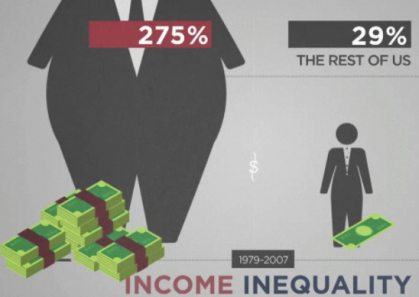
The rise of a powerful kleptocratic economic elite which ‘interpenetrates’ and shares power with a militarist political elite have joined forces to pillage the productive economy and the US Treasury. Their powerful links are the main reason for heightening class inequalities, political and social insecurities. They have driven American society into a permanent state of crises and wars. Over the past quarter century, Americans have lived through two major economic crashes, prolonged periods of stagnation and declining income, three major wars and a multitude of overt and covert military operations – all of which have eroded living standards.
Military propaganda saturates the mass media and permeates all mass spectacles. Stock reports, dominate the economic news. Investment speculators and swindlers are presented as cultural heroes. The gap between elite opinion and interests and those of the majority of citizens widens.
This leads politicians to greater dependence on billionaire campaign funders. The electoral process is unabashedly and totally controlled by the economic oligarchy. The vast majority of Americans recognizes and publically admit their total lack of political influence on all public issues of interest including those privileging the kleptocrats and the warlords.
The deeply felt and pervasive malaise resulting from social impotence in vital spheres of life is the clearest expression of the decline of political living standards. The shrinking of public involvement, the narrow focus of isolated individuals manipulating computerized gadgets , the replacement of face to face public engagement by impersonal electronic communications, are an expression of the decline of social living standards. The rise of ethno-religious chauvinism among klepto-elites is matched by the political warlords’ reliance on systematic deception and espionage of American citizens. Warlords and kleptocrats are enclosed in privileged living enclaves, including the private appropriation of former public spaces, but their intrusion into private communications define the diminished world of everyday life for the most Americans. Life expectancy may have increased but human life has decreased, drastically, over the past quarter of a century.
Conclusion
Blood and gore does not drip off the Saville suited clever inside trader. They never see or hear their victims, nor do they have an interest in them, except to fleece them collectively and anonymously.
America is ruled by a division of labor. The financial speculators, corporate tax evaders, investment bankers – the kleptocratic ruling class– pillage the treasury and productive economy. Their political counterparts manipulate, distract and police their exploited victims – to ensure that they submit or are intimidated if they protest.
When they political elites come up short, there are the new “opiums of the people’ videos, painkillers, terror threats, entertainment and sports spectacles.
But citizens are restless– as living standards continue to decline. Nobody believes in bailing out speculators because they are ‘too big to fail”. Nobody trusts the political leaders who lied their way to twelve year wars, adding others along the way. No one follows media pundit extremists in defense of kleptocrats and warlords. Passive resistance is widespread because it is clear to most Americans that living standards are in a free fall. Time awaits a popular backlash. Will it happen in our lifetime?




 After the Crash