NATO prolongs the Ukraine proxy war, and global havoc

With diplomacy thwarted, the US and its allies plan for “open-ended” military and economic warfare against Russia, no matter the costs at home and abroad.

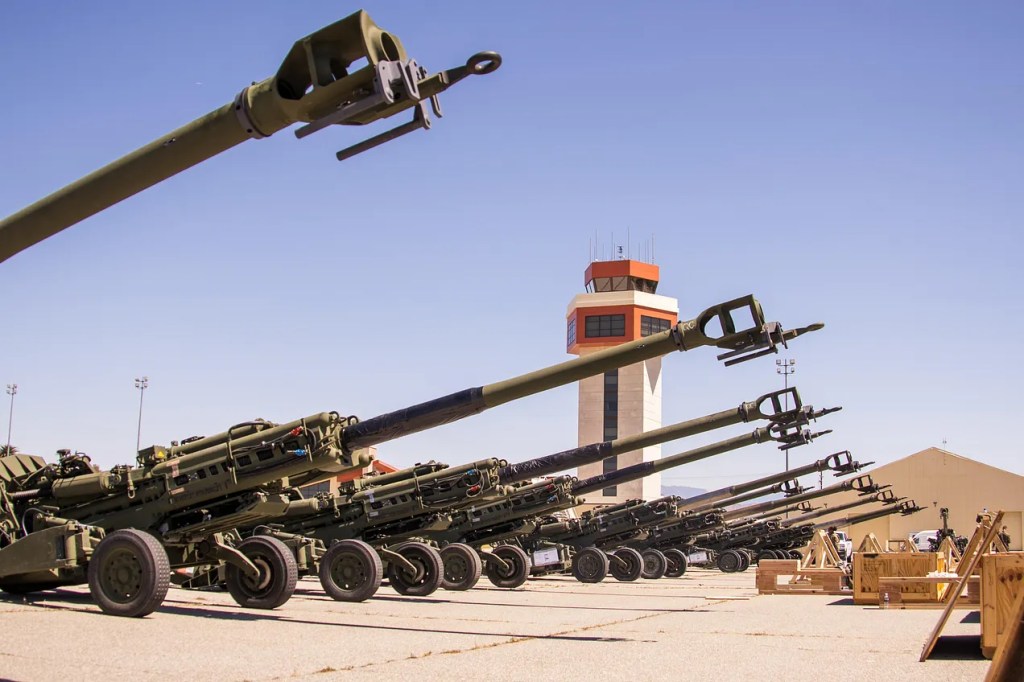
(US Dept. of Defense)

By Aaron Maté

Source: Aaron Mate Substack

Russia has announced plans to mobilize an additional 300,000 troops for the war in Ukraine. In his speech unveiling the expanded war effort, Vladimir Putin vowed to achieve his main goal of the “liberation of Donbas,” and issued a thinly veiled nuclear threat in the process. The move comes days ahead of planned referendums in breakaway Ukrainian areas to formalize Russian annexation.

Russia’s escalation ensures that the fighting is entering an even more dangerous phase. While Russia bears legal and moral responsibility for its invasion, recent developments underscore that NATO leaders have shunned opportunities to prevent further catastrophe and chosen instead to fuel it.

Putin’s announcement comes just after the Ukrainian military’s routing of Russian forces from Kharkiv, which relied extensively on US planning, weaponry and intelligence, sparked triumphant declarations that the tide has turned.

According to The Atlantic’s Anne Applebaum, “Americans and Europeans need to prepare for a Ukrainian victory,” one so overwhelming that it may well bring “about the end of Putin’s regime.”

Beyond the chorus of emboldened neoconservatives, Western officials are less sanguine.

“Certainly it’s a military setback” for Russia, a US official said of the Kharkiv retreat to the Washington Post. “I don’t know if I could call it a major strategic loss at this point.” Germany’s defense chief, General Eberhard Zorn, said that while Ukraine “can win back places or individual areas of the frontlines,” overall, its forces can “not push Russia back over a broad front.”

Whether or not it marked a major strategic loss for Russia, the battle in Kharkiv is already a major victory for NATO leaders seeking to prolong their proxy war in Ukraine and economic warfare next door.

Ukraine’s expulsion of Russian forces in the northeast, the New York Times reports, has “amplified voices in the West demanding that more weapons be sent to Ukraine so that it could win.”

“Despite Ukrainian forces’ startling gains in the war against Russia,” the Washington Post adds, “the Biden administration anticipates months of intense fighting with wins and losses for each side, spurring U.S. plans for an open-ended campaign with no prospect for a negotiated end in sight.”

As has been apparent since the Ukraine crisis erupted, US planning for open-ended proxy warfare against Russia has led it to sabotage any prospect of a negotiated end.

The US rejection of diplomacy around Ukraine has been newly substantiated by former White House Russia expert Fiona Hill. Citing “multiple former senior U.S. officials,” Hill reports that in April of this year “Russian and Ukrainian negotiators appeared to have tentatively agreed on the outlines of a negotiated interim settlement.” Under this framework, Russia would withdraw to its pre-invasion position, while Ukraine would pledge not to join NATO “and instead receive security guarantees from a number of countries.”

In confirming that US officials were aware of this tentative agreement, Hill bolsters previous news that Washington’s junior partner in London was enlisted to thwart it. As Ukrainian media reported, citing sources close to Ukrainian President Volodymyr Zelensky, UK Prime Minister Boris Johnson traveled to Kiev in April and relayed the message that Russia “should be pressured, not negotiated with.” Johnson also informed Zelensky that “even if Ukraine is ready to sign some agreements on [security] guarantees with Putin,” his Western patrons “are not.” The talks promptly collapsed.

In his speech announcing the expanded war effort, Putin invoked this episode. After the invasion began, he said, Ukrainian officials “reacted very positively to our proposals… After certain compromises were reached, Kyiv was actually given a direct order to disrupt all agreements.”

Having undermined the prospect of a negotiated peace in the war’s early weeks, proxy warriors in Washington are openly celebrating their success.

“I like the structural path we’re on here,” Republican Senator Lindsey Graham recently declared. “As long as we help Ukraine with the weapons they need and the economic support, they will fight to the last person.”

Graham’s avowed willingness to expend every “last person” in Ukraine to fight Russia is in line with a broader US strategy that views the entire world as subordinate to its war aims. As the Washington Post reported in June, the White House is willing to “countenance even a global recession and mounting hunger” in order to hand Russia a costly defeat. In Ukraine, this now means also countenancing the threat of nuclear disaster, as the crisis surrounding the Zaporizhzhia nuclear power plant has laid bare.

The prevailing willingness to sacrifice civilian well-being extends to the US public, as National Security Advisor Jake Sullivan has newly made clear. Appearing at the Aspen Security Conference, Sullivan was asked if he is worried about the “American people’s staying power” on the Ukraine proxy war, amid “criticism that we’re spending billions and billions to support Ukraine, and not spending it here.”

 “Fundamentally not,” Sullivan responded. “It’s very important for Putin to understand what exactly he’s up against from the point of view of the United States’ staying power.” That staying power, Sullivan explained, was cemented in the $40 billion war funding measure overwhelmingly approved by Congress (including every self-identified progressive Democrat) in May.

“That can go on, just on the basis of what we have already had allocated to us and resources for a considerable period of time,” Sullivan vowed. “And then, I strongly believe that there will be bipartisan support in the Congress to re-up those resources should it become necessary.”

To policymakers like Sullivan, there is not only an endless pool of money to “re-up” the war, but a “fundamentally” indifferent posture toward the taxpayers footing the bill.

Despite Biden’s reported scolding of Defense Secretary Lloyd Austin for admitting that the US goal in Ukraine is to leave Russia “weakened,” Sullivan – speaking before a friendly Beltway crowd — also forgot to stick to the script.

The US “strategic objective” in Ukraine, Sullivan explained, is to “ensure that Russia’s invasion of Ukraine… is a strategic failure for Putin,” and that “Russia pay a longer-term price in terms of the elements of its national power.” This would teach a “lesson,” he added, “to would-be aggressors elsewhere.”

By “would-be aggressors elsewhere”, Sullivan naturally precludes the US and its allies, whose aggression is not only permitted but promoted under the US-led “rules-based international order.”

President Biden has made that clear by abandoning his pledge to make Saudi Arabia a “pariah” state, notwithstanding its murderous (US-backed) aggression in Yemen. The regular aggression by US ally Israel against Gaza and Syria also continues unabated. The United Nations just reported that an Israeli strike on the Damascus international airport in June – one of hundreds of Israeli bombings on Syria that go largely ignored — “led to considerable damage to infrastructure” and “meant the suspension of U.N. deliveries of humanitarian assistance” to Syrians in need for nearly two weeks. As of this writing, the latest Israeli strike killed five Syrian soldiers, eliciting no Western media and political protest. It is more accurate to describe Israeli aggression on Syria as a joint Israeli-US effort, given that the US reviews and approves the strikes.

Allied NATO leaders are also vocally countenancing the Ukraine proxy war’s costs on their domestic populations. In response to the European sanctions, Russia has now halted gas deliveries to the EU via the key Nord Stream 1 pipeline. Having previously relied on Russia for close to 40 percent of its gas needs, European industries are facing layoffs, factory closures, and higher energy bills that “are pushing consumers to near poverty,” the Financial Times reports.

“People want to end the war because they cannot bear the consequences, the costs,” the EU’s Josep Borell observed this month. While ending the war might appeal to some, it does not interest the EU’s top diplomat. “This mentality must be overcome,” Borell declared. “The offensive on the northeastern front helps with that.”

Europe, NATO chief Jens Stoltenberg recently wrote, may even face “civil unrest,” as economies contract and temperatures drop, but “for Ukraine’s future and for ours, we must prepare for the winter war and stay the course.”

“No matter what my German voters think, I want to deliver to the people of Ukraine,” Germany’s Foreign Minister Annalena Baerbock told a conference in Prague last month. During the upcoming winter, Baerbock acknowledged, “we will be challenged as democratic politicians. People will go in the street and say ‘We cannot pay our energy prices’.” While pledging to help people “with social measures,” Baerbock insisted that the European Union’s sanctions on Russia will remain. “The sanctions will stay also in wintertime, even if it gets really tough for politicians,” she said.

Whereas Western leaders appear confident they can manage civil unrest at home, they face additional resistance abroad. In Africa, a leaked report from the European Union’s envoy to the continent warns that African nations are blaming the EU’s Russia sanctions for food shortages. The report also cautions that “the EU is seen as fueling the conflict,” in Ukraine, “not as a peace facilitator.”

Rather than address these African concerns, the envoy’s office proposes a “more transactional… approach” in which the EU makes “clear” that its “willingness” to “maintain higher levels” of foreign aid “will depend on working based on common values and a joint vision,” – in short, on Africa falling in line.

That is undoubtedly the US policy, as UN Ambassador Linda Thomas-Greenfield made clear last month. After promising a “listening tour,” Thomas-Greenfield instead came to Africa with a dictate and an outright threat. “Countries can buy Russian agricultural products, including fertilizer and wheat,” she decreed. But “if a country decides to engage with Russia” and break US sanctions, “they stand the chance of having actions taken against them.” That Africa faces a food security crisis, with hundreds of millions going hungry, is apparently of lower importance.

While Western sanctions on Russia wreak havoc worldwide, the architects in Washington seem only perturbed by their failure, so far, to inflict the intended levels of suffering on Russian civilians. “We were expecting” that US sanctions “would totally crater the Russian economy” by now, a disappointed senior US official told CNN.

Other US officials are leaving room for hope. “There’s going to be long-term damage done to the Russian economy and to generations of Russians as a result of this,” CIA Director William Burns told a cybersecurity conference this month. Burns’ long-term forecast of harming “generations of Russians” is based on extensive planning. As one US official explained it to CNN, when the sanctions were designed, Biden officials not only “wanted to keep pressure on Russia over the long term as it waged war on Ukraine,” but also “wanted to degrade Russia’s economic and industrial capabilities.” Accordingly, “we’ve always seen this as a long-term game.”

The “long-term game” of trying to destroy Russia’s economy and immiserate “generations” of its citizens is accompanied by increasing plans for a long-term fight. The Biden administration plans to formally name the US military mission in Ukraine – such as in prior campaigns like Operation Desert Storm — while also appointing a general to oversee the effort. The naming, the Wall Street Journal observes, is “significant bureaucratically, as it typically entails long-term, dedicated funding.”

The US plan for a long-term military and economic campaign against Russia is being implemented despite the awareness that Ukraine could face far worse.

“Some American officials express concern that the most dangerous moments are yet to come,” the New York Times reports. To date, “Putin has avoided escalating the war in ways that have, at times, baffled Western officials.” Unlike US military campaigns in Iraq, Russia “has made only limited attempts to destroy critical infrastructure or to target Ukrainian government buildings.”

“The current moment draws attention to a tension that underlies America’s strategy for the war,” the Washington Post observes, “as officials channel massive military support to Ukraine, fueling a war with global consequences, while attempting to remain agnostic about when and how Kyiv might strike a deal to end it.”

These rare admissions not only contradict the typical portrayal of a genocidal Russia that is used to justify the proxy war, but capture the underlying policy driving it. More than six months in, US officials are aware that Russia has “avoided escalating the war” and targeting “critical infrastructure,” – to the point where these same officials are “baffled” by Russian restraint. Despite this, their policy centers on “fueling” this same war, while remaining “agnostic” about ending it.

War being fluid – and US-led military support for Ukraine ever-expanding – it is of course possible that Ukraine will continue to defy expectations and drive out the invading Russian forces.

What the latest developments on and off the battlefield make undoubtedly clear is that NATO states are willing to use Ukraine for as long as it takes to achieve the stated aim of leaving Russia “weakened” or even achieving regime change, no matter the damage knowingly inflicted on Ukrainians, Russians, the Global South, and their own citizens.

The Drumbeats of War and US-NATO Propaganda: “China is Bad” and “They are Coming to Enslave Us”

The Truth about China’s Imperial Ambitions, the Uyghurs and What the West Really Fears

By Timothy Alexander Guzman

Source: Silent Crow News

Western media outlets are playing the drumbeats of war by warning the public that a new Chinese empire is going to develop into an unstoppable force capable of ruling the world with an iron fist.  They claim that under the leadership of the Chinese Communist Party (CCP), they will control every country and human being on earth.  Overall, it’s an absurd claim.  It is fair to say that China under the leadership of the CCP has several issues that concerns the Chinese public with a social credit score system, Zero Covid policy rules and a nation-wide surveillance system that is Orwellian to say the least.  China also had a one child policy that has led to a decline in its population which was and still is problematic for its future when it comes to their labor force and economy, but they ended that policy in 2016.  Whatever faults China has, it is not looking to rule the world despite what Western countries claim especially the United States who say that Beijing’s policies reflect a growing appetite for imperial expansion.  On May 25th, 2017, Reuters published ‘China says new Silk Road not about military ambitions’ reported on what China’s Defense ministry had said about China’s future “China’s ambition to build a new Silk Road is not about seeking to expand its military role abroad nor about seeking to set up foreign bases.” The Chinese Defense Ministry spokesman Ren Guoqiang told a regular monthly news briefing conference that China’s Silk Road was not expanding militarily nor setting up bases in any sovereign country and that the accusations were “groundless.” Guoqiang said that “the new Silk Road is about cooperation and trade” and that “The Belt and Road initiative has no military or geostrategic intent. China is not seeking the right to guide global affairs, or spheres of influence, and will not interfere in the internal affairs of other countries.”

According to a report from September 23rd, 2020, by the National Herald India titled ‘China will never seek expansion, has no intention to fight either ‘Cold War’ or ‘hot war’, says Xi Jinping’ as Xi Jinping declared in a pre-recorded video sent to the United Nations meeting that “We will continue to narrow differences and resolve disputes with others through dialogue and negotiation” he continued “We will never seek hegemony, expansion, or sphere of influence. We have no intention to fight either a Cold War or a hot war with any country.”   The report also mentioned India’s Prime Minister Narendra Modi’s surprise visit to the Ladakh region a few months prior where he said that “the era of expansionism is over and that the history is proof that “expansionists” have either lost or perished” in what the report described as a “clear message” to China.  “Xi, also the General Secretary of the ruling Communist Party of China and the Commander-in-Chief of the Chinese military, said his country will not pursue development behind closed doors.” Xi made it clear that a new plan for development for growth domestically and internationally will create more opportunities for China’s economy.  Xi said the following:

Rather, we aim to foster, over time, a new development paradigm with domestic circulation as the mainstay and domestic and international circulations reinforcing each other. This will create more space for China’s economic development and add impetus to global economic recovery and growth

The report also mentioned that during the Covid-19 pandemic, US President, Donald Trump ramped up tensions with China and “demanded that China, where the coronavirus emerged, be held accountable for failure to control the virus and for allowing it to spread across the world” he continued, “As we pursue this bright future, we must hold accountable the nation which unleashed this plague onto the world: China”.  Trump’s rhetoric including his administration slapping tariffs on China’s goods surely increased tensions between Washington and Beijing.  The National Herald India quoted what Xi had said about China’s own decisions that will benefit its own economy and path of development and that it should be respected, “one should respect a country’s “independent choice of development path and model.”  Xi made a point that the world is diverse, and that it can inspire human advancements:

The world is diverse in nature, and we should turn this diversity into a constant source of inspiration driving human advancement. This will ensure that human civilisations remain colourful and diversified

Conflicts and Disagreements: China, India, and the Soviet Union

The history between China and India involved conflicts over border issues.  In 1962, China had a dispute with India over Aksai Chin and Arunachal Pradesh borders.  The conflict was mostly among ground troops of both sides which did not involve any Air force or Naval forces.  What started the conflict was China’s construction of a road that connected the Chinese regions of Tibet and Xinjiang.  However, Aksai Chin was claimed by India.  So, in the months of October and November the Sino-Indian War began.  Several violent conflicts also occurred between China and India after the 1959 Tibetan uprising due to India’s recognition of the Dalai Lama, or who is known as Gyalwa Rinpoche to the Tibetan people.  In an important note to consider, the Dalai Lama was supported by the CIA for many years.  The CIA financially supported the Dalai Lama from the late 1950s until the mid-1970s with more than $180,000 a year for the CIA’s Tibetan program to support anti-China activities and to create foreign offices within Tibet to lobby for international support which was a concern for China. 

In 1960, India had constructed a defensive policy to disrupt China’s military patrols and its logistics in what was called Forward Policy  that placed Indian outposts along the borders in the north of the McMahon Line, the eastern portion of the Line of Actual Control.   However, China did try to implement diplomatic settlements between 1960 and 1962, but India rejected the proposal allowing China to abandon diplomacy and became aggressive along the disputed borders. China defeated Indian forces in Rezang La in Chushul in the west and Tawang in the east.  China declared a ceasefire on November 20th, 1962.  The war ended as China withdrew to its areas claimed in the ‘Line of Actual Control.’  Matters became complicated when the Soviet Union sold MiG fighter aircrafts to India in a show of support since the US and the UK refused to sell arms to India.  However, tensions between China and the Soviet Union were also high during that time which was known as the ‘Sino-Soviet split’ over ideological differences in Marxist-Leninist theories during the Cold War.  There were various agreements between China and India with no progress for peace until 2006.   Although Indian officials were concerned with China’s growing military power and its relationship with Pakistan (India’s main rival), China’s Silk Road opened the doors for peace between both nations.  In October of 2011, China and India formulated border mechanisms regarding the Line of Actual Control as both resumed bilateral army exercises between China and Indian troops by early 2012.  In 2013, what was known as the Depsang standoff, India had agreed to demolish and remove several ‘live-in bunkers’ in the Chumar sector along with the removal of observation posts built along the border among other things that made the resolution of the dispute a success, so the Chinese military withdrew it forces, ending the dispute in May 2013.  Although there are some disagreements between both countries still exist over their borders policies, today China and India are part of the BRICS coalition.

The Sino-Vietnamese War of 1979

On December 21st, 1978, Vietnam launched an attack on the Khmer Rouge.  After more than 10 years of fighting, Vietnam had successfully defeated the Khmer Rouge ending Pol Pot’s reign of terror.  Then in February 1979, China had declared war with Vietnam over its borders.  Now Vietnam was facing a two-front war. China’s invasion was a surprise to the world because China supported Vietnam with its wars against France and the US.  From 1965 until 1969, China had more than 300,000 troops in the Vietnam war with more than 1,000 members from the People’s Liberation Army (PLA) who were killed with 4,300 wounded. 

However, it all changed due to China’s domination of Vietnam for centuries which created animosity among the Vietnamese government and its people towards Beijing thus creating tensions between both countries.  Conflicts on the border also developed between China and the Soviet Union in 1969 during the Sino-Soviet split, so Vietnam had a dilemma, it had to choose one of them as an ally.  On November 3, 1978, Vietnam signed the Treaty of Friendship and Cooperation with the Soviet Union that offered security assurances.  Since tensions were high at the time, more than 150,000 Chinese who were living in Vietnam had fled. Chinese leader Deng Xiaoping and CCP officials viewed Vietnam as ungrateful and traitorous.  The Chinese saw the treaty as a threat since the Soviets had a similar treaty with Mongolia which in a way allowed the Soviets to surround China.  On December 7, 1978, China’s Central Military Commission decided to launch a “limited war” along their borders and at the same time, Vietnam had invaded Cambodia to destroy the Khmer Rouge.

Since Vietnam had border clashes with the China-backed Khmer Rouge in Cambodia along with Beijing’s decision to cut aid to Hanoi, it decided to partner with Moscow.  On January 29th, 1979, for the first time, Chinese Vice-premier Deng Xiaoping went to the US and reportedly told President Jimmy Carter that “The child is getting naughty, it is time he got spanked.”   A couple of weeks later, on February 15th, China terminated the 1950 Sino-Soviet Treaty of Friendship, Alliance and Mutual Assistance and Xiaoping declared that China was going to attack Vietnam to support its ally, the Khmer Rouge of Cambodia among other reasons including the plan to reclaim the Vietnamese occupied Spratly Islands.  China wanted to prevent the Soviet Union from intervening on Vietnam’s behalf, so Xiaoping warned the Soviets that China’s forces were prepared for war.  Declaring an emergency, China deployed all of the PLA forces along the Sino-Soviet border and set up a military command station in Xinjiang, they also evacuated more than 300,000 civilians from the area.

China eventually suffered a defeat by the Vietcong since its military was not prepared to fight an experienced fighting force who previously defeated two Western powers, France, and the US.  It was reported that experienced Vietnamese ‘tank-killing teams’ destroyed or damaged more than 280 tanks and armored vehicles during the war.  China avoided the use of its Air Force and Navy since it promised the Soviets and Americans a limited war against Vietnam.  China also knew that Vietnam had an experienced military as well as having one of the best anti-air capabilities in the world.  After two short weeks of fighting, China began withdrawing its troops.  By March 16, Chinese troops had a ‘scorched-earth campaign’ in Vietnam destroying bridges, factories, mines, farms, and crops.  It is estimated that China had between 7,900 to 26,000 troops killed and between 23,000 to 37,000 wounded.  Vietnam had between 20,000 to 50,000 troops and civilians killed and wounded.  China clearly had a difficult time with Vietnam. 

China’s history with its neighbors shows that it may be difficult even today if they decided to become an imperialist power subjugating the world to its demands because it would face an uphill battle that will become economically and politically costly and that will collapse its economy and society.  Before the US became a global empire, they made sure they contained and controlled its own backyard and that was the Caribbean and Latin America after the Spanish-American War of 1898.  China would have to control its own backyard against several nations including Russia, India, Vietnam, and others.  China understands that imperial projects to dominate the world is a risk not worth taking. 

Remember, China was on the receiving end of Japanese Imperialism that practically destroyed its society.  In 1931, Imperial Japan had invaded the Chinese province of Manchuria for raw materials to fuel its industries, and by 1937 they controlled many areas of China.  The Imperial Japanese war crimes mounted against the Chinese people.  China understands the consequences of war because it sees what has happened to the US and its military adventures which has led to its decline.  It knows it will not benefit anyone, in fact wars can destabilize regions, destroy economies, and disrupt societal norms and China is not at all interested in any of that.  They want to rebuild their civilization.      

The age of empires is over.  A new multipolar world is needed now more than ever before where no single entity or centralized power could rule over any country who wants to remain sovereign.  That would start an era of lasting peace around the world.  Of course, there are no guarantees that total peace would prevail in a multipolar world because there will be bad actors who will prefer a globalized world order over countries who want sovereignty, but in a multipolar world order, wars can be avoided.  It would be a good start where sovereign countries would respect each other’s boundaries and work out their differences.  That’s the way it should be instead of a group of globalist psychopaths making geopolitical and economic decisions to change the social fabric of every country on the planet.         

Inside China: The Surveillance State

China’s internal problems is a stain on its reputation.  China’s surveillance state is indeed problematic.  In 2018, the CCP installed more than 200 million surveillance cameras with an increase in facial recognition technology nationwide.  Surveillance cameras and facial recognition networks would add to the social credit system already in place that gives Chinese citizens a score based on their “social behaviors.”  Going back to 2003, China began its Smart City pilot programs to track and analyze air quality, traffic, wastewater disposal systems, social behaviors of its residents and other areas of urban life.  We can fairly say that China’s surveillance state is rather extreme and unnecessary.  The Chinese people will increasingly voice their concerns to the CCP’s leadership in the future to scrap its surveillance capabilities because it can get out of control, but the question is, will it happen?  Only time will tell.   

The Uyghurs: China’s Problem with the East Turkestan Islamic Movement (ETIM)

One issue that has been mainly ignored in recent years by the Western mainstream media is the terrorism committed in China by the Uyghurs. Why? The Western view of China’s human rights abuses when it comes to the Uyghurs has two sides of the story.  First it benefits the Military-Industrial Complex and its future of selling arms to its allies throughout Asia including Taiwan, South Korea, and Japan.  Second, it’s the demonization of China to gain support among the American people for a future war with China because they are “bad.”  Former US President Barack Obama supported his Secretary of State Hillary Clinton and her ‘Pivot to Asia’ agenda that she had published in Foreign Policy magazine titled ‘America’s Pacific Century.’ Clinton made it clear that the US goal is to remain a global hegemonic power especially in the Asia-Pacific region:

As secretary of state, I broke with tradition and embarked on my first official overseas trip to Asia. In my seven trips since, I have had the privilege to see firsthand the rapid transformations taking place in the region, underscoring how much the future of the United States is intimately intertwined with the future of the Asia-Pacific. A strategic turn to the region fits logically into our overall global effort to secure and sustain America’s global leadership. The success of this turn requires maintaining and advancing a bipartisan consensus on the importance of the Asia-Pacific to our national interests; we seek to build upon a strong tradition of engagement by presidents and secretaries of state of both parties across many decades. It also requires smart execution of a coherent regional strategy that accounts for the global implications of our choices.

What does that regional strategy look like? For starters, it calls for a sustained commitment to what I have called “forward-deployed” diplomacy. That means continuing to dispatch the full range of our diplomatic assets — including our highest-ranking officials, our development experts, our interagency teams, and our permanent assets — to every country and corner of the Asia-Pacific region. Our strategy will have to keep accounting for and adapting to the rapid and dramatic shifts playing out across Asia. With this in mind, our work will proceed along six key lines of action: strengthening bilateral security alliances; deepening our working relationships with emerging powers, including with China; engaging with regional multilateral institutions; expanding trade and investment; forging a broad-based military presence; and advancing democracy and human rights

FOX News is one of the US mainstream media outlets that jumps into the defense of the Uyghurs when it comes to the CCP and its alleged abuses.  However, FOX News ignores the daily abuses of the Israeli regime against the Palestinians or the abuses by the Saudis against the people of Yemen who have been bombarded with US-made weapons since 2015.  To be fair, not only FOX News demonizes China, but so does the liberal media such as CNN, MSNBC, the New York Times that includes the BBC and others throughout Europe.   

One situation that is rarely discussed in the West is the terrorism incidents caused by certain groups and individuals in the Uyghur community not only against the CCP, but also against the Han Chinese, the largest ethnic majority in China.  In Violent Separatism in Xinjiang: A Critical Assessment by James Millward from the East-West Center based in Honolulu, Hawaii and Washington D.C. documented terrorist activities since the early 1990’s that accelerated after the September 11th attacks in New York City and Washington, D.C. Millward wrote the following concerning terror groups originating out of the Xinjiang region in China:

Since the 1990s, concerns about Uyghur separatism have received increasing official and media attention. These concerns have heightened since the events of 9-11 with the advent of a more robust U.S. presence in Central Asia and Chinese attempts to link Uyghur separatism to international jihadist groups. A steady flow of reports from the international media—as well as official PRC releases (a document on “East Turkistan” terrorism, a white paper on Xinjiang, and a list of terrorist groups)—have given the impression of an imminent separatist and terrorist crisis in the Xinjiang region

Some of the terror attacks that were documented occurred in as early as 1992: 

February 5, 1992: Urumqi Bus Bombs. Three were killed and twenty-three injured in two explosions on buses in Urumqi; the PRC’s 2002 document claims that other bombs were discovered and defused around the same time in a cinema and a residential building. Five men were later convicted in this case and reportedly executed in June 1995.

February 1992-September 1993: Bombings. During this period there were several explosions in Yining, Urumqi, Kashgar, and elsewhere; targets included department stores, markets, hotels, and centers of “cultural activity” in southern Xinjiang. One bomb in a building of the Nongji Company (apparently a firm concerned with agricultural equipment) in Kashgar on June 17, 1993, killed two and injured six. One bomb went off in a wing of the Seman Hotel in Kashgar, though no one was hurt in this explosion. The PRC’s 2002 document claims that in the 1993 explosions two people were killed and thirty-six injured overall

On March 9th, 2008, Reuters published an account on what took place during an attempted terrorist attack on a passenger jet on its way to Beijing China foils attempted terror attack on flight.’  The report said that “China foiled a bid to cause an air disaster on a passenger jet en route to Beijing and the plane made a safe emergency landing, an official said on Sunday, in what state media called an attempted terrorist attack.”  According to Reuters sources, “The China Southern flight originated in Urumqi, capital of the restive far western Chinese region of Xinjiang, where militant Uighurs have agitated for an independent “East Turkestan.”  On September 8th, 2011, the BBC reported that a militant Islamic group was behind a terrorist attack in the Xinjiang region that resulted in dozens of people dead.  The BBC report Islamic militant group ‘behind Xinjiang attacks said the following:

A militant Islamic group has released a video saying it was behind recent attacks in China’s Xinjiang region which left dozens of people dead, a US internet monitoring group says.  The video was made by a group calling itself the Turkistan Islamic Party.  The group, which is fighting against Chinese control of Xinjiang, says the attacks were revenge against the Beijing government.

One of the deadliest attacks experienced in China occurred on March 1st, 2014 in the Kunming Railway Station in Kunming which is located in the Yunnan province.  The BBC reported on the incident and said that ‘China separatists blamed for Kunming knife rampage’ and said that “Chinese officials have blamed separatists from the north-western Xinjiang region for a mass knife attack at a railway station that left 29 people dead and at least 130 wounded” and that “a group of attackers, dressed in black, burst into the station in the south-west city of Kunming and began stabbing people at random.”  The report also said that “Images from the scene posted online showed bodies lying in pools of blood” and that the “State news agency Xinhua said police shot at least four suspects dead.”  There were other terrorist attacks that involved the Uyghurs that only pushed the CCP to move forward with facial recognition and a social credit system associated with a criminal offending database.  By 2021, the CCP’s surveillance system expanded in the southern city of Guangzhou that allowed incoming passengers to walk through a biometric security checkpoint. 

In Xinjiang, security checkpoints and identification stations were in many places where people must show proof of ID with their faces being scanned at the same time by various cameras before they enter any supermarket, train stations or any other public place.  China’s security concerns do go beyond what is needed to protect themselves from terrorism. 

However, I do not justify any form of police state tactics against any population despite China’s extreme measures that resembles George Orwell’s 1984, however, at the same time, there are legitimate concerns involving the Uyghur population and their use of terrorism that has caused numerous deaths and injuries of innocent people.

From China to Syria: ETIM joins Al-Qaeda and the Syrian “Moderate” Rebels

One piece of information the Western media usually ignores is the fact that since 2013, there have been thousands of Uyghurs who have traveled to Syria and joined terrorist groups such as Al-Qaeda, the Syrian “Moderate Rebels” and others to fight against Bashar al-Assad’s Syrian army.  One western media news agency reported on the Uyghurs in Syria and their affiliation with US-backed terrorists who were trying to overthrow or kill Syria’s President Bashar al-Assad and that was the Associated Press (AP) who published an Exclusive story Uighurs fighting in Syria take aim at China admits a fact about the Uyghurs and their ties to terrorist groups from the Middle East and Africa and how they are using their experiences to fight China:

Since 2013, thousands of Uighurs, a Turkic-speaking Muslim minority from western China, have traveled to Syria to train with the Uighur militant group Turkistan Islamic Party and fight alongside al-Qaida, playing key roles in several battles. Syrian President Bashar Assad’s troops are now clashing with Uighur fighters as the six-year conflict nears its endgame

The AP mentioned a Uyghur by the name of Ali who said, “We didn’t care how the fighting went or who Assad was,” said Ali, “we just wanted to learn how to use the weapons and then go back to China.”  That’s what Chinese officials needed on their hands, Uyghurs traveling to Syria to learn how Al-Qaeda and others use terrorist tactics and techniques then bring that knowledge back to China.  The CCP had its hands full with the threat of terrorism on Chinese soil.  The AP outlined the facts that the Uyghurs have committed numerous crimes in China over the years: 

Uighur militants have killed hundreds, if not thousands, in attacks inside China in a decades-long insurgency that initially targeted police and other symbols of Chinese authority but in recent years also included civilians. Extremists with knives killed 33 people at a train station in 2014. Abroad, they bombed the Chinese embassy in Kyrgyzstan in September last year; in 2014, they killed 25 people in an attack on a Thai shrine popular with Chinese tourists

In a report from June 2016 by the U.S.-China Economic and Security Review Commission titled China’s Response to Terrorism’ by Murray Scot Tanner and James Bellacqua clarifies what China has been facing when it comes to terrorism:

While tracking the nature and magnitude of China’s terrorist challenges is difficult, it is clear that China faces some level of domestic terrorist threat, and that its citizens have been victims of terrorist attacks both at home and abroad.

Between 2012 and 2015, China suffered multiple domestic terrorist attacks. Reported incidents became more frequent during this period, and they also became more dispersed geographically, with major incidents occurring in Beijing and other eastern cities, in addition to China’s mostly Muslim western regions. Several of these incidents were also targeted at high-traffic urban areas, resulting in indiscriminate injury or death to civilians

In an unusual fashion, in what they call a backgrounder, the Council on Foreign Relations (CFR), a bi-partisan establishment think tank based in New York City published ‘The East Turkestan Islamic Movement (ETIM)’ explained who and what is ETIM and its longtime affiliations with terrorists: 

Reportedly founded by Hasan Mahsum, a Uighur from Xinjiang’s Kashgar region, ETIM has been listed by the State Department as one of the more extreme separatist groups. It seeks an independent state called East Turkestan that would cover an area including parts of Turkey, Kazakhstan, Kyrgyzstan, Uzbekistan, Pakistan, Afghanistan, and the Xinjiang Uighur Autonomous Region (XUAR). After Mahsum’s assassination by Pakistani troops in 2003 during a raid on a suspected al-Qaeda hideout near the Afghanistan border, the group was led by Abdul Haq, who was reportedly killed in Pakistan in 2010. In August 2014, Chinese state media released a report stating that Memetuhut Memetrozi, a co-founder of ETIM who is serving a life sentence in China for his involvement in terrorist attacks, had been indoctrinated in a madrassa in Pakistan. The report, which said Memetuhut had met Mahsum in 1997 and launched ETIM later that year, marked a rare public admission of Pakistani ties to Uighur militancy. 

Some experts say ETIM is an umbrella organization for many splinter groups, including ones that operate in Pakistan and central Asia. The Turkestan Islamic Party (TIP), for instance, is one of the most prominent groups, formed in 2006 by Uighurs who fled to Afghanistan and Pakistan in the 1990s. That group took credit for a series of attacks in several Chinese cities in 2008, including deadly bus explosions in Shanghai and Kunming. According to U.S.-based intelligence firm Stratfor, the TIP’s “claims of responsibility appear exaggerated, but the threat TIP poses cannot be ignored.” Stratfor also said that the TIP had expanded its presence on the Internet, issuing videos calling for a jihad by Uighurs in Xinjiang. Ben N. Venzke, head of the U.S.-based independent terrorism-monitoring firm IntelCenter, says it is unclear whether the TIP is separate from ETIM, but notes that the groups’ objectives are both Islamist and nationalist

In the last year of the Trump administration, despite the proof from various reports including those produced by the US and its think tanks that ETIM committed multiple terrorist attacks in mainland China, the US government removed ETIM from its terror list.  According to Germany’s Deutsche Welle (DW) US removes separatist group condemned by China from terror list reported that The United States said it would no longer designate a Chinese Uighur separatist group as a “terrorist organization” on Friday, sparking sharp condemnation from Beijing.”  This was a clear indication that Washington is doing everything it can to destabilize China.  It is a move that will allow newly trained Uyghurs to use their newly acquired skills to cause more chaos in China.  It’s basically a slap in the face:    

The East Turkestan Islamic Movement (ETIM) was removed from Washington’s terror list, US Secretary of State Mike Pompeo announced in a notice posted in the Federal Register.

“ETIM was removed from the list because, for more than a decade, there has been no credible evidence that ETIM continues to exist,” a State Department spokesperson said, news agency AFP reported

This is a typical turn of events for Washington and its long-term objective of destabilizing China by whatever means necessary to try stop its rise to power. The New World Order is becoming a multipolar world order with China, Russia and others who will compete with declining Western powers who are basically responsible for many of the wars, economic exploitation, and the colonization of the global south and that’s what Washington and its European allies are afraid of. 

US Government Propaganda on China’s Internment Camps for the Uyghurs

In an important investigation by Ben Norton and Ajit Singh of The Grayzone ‘No, the UN did not report China has ‘massive internment camps’ for Uighur Muslims starts off with an introduction on how mainstream media propaganda has claimed that China has imprisoned more than 1 million Uyghurs in designated “internment camps” but as the facts makes itself clear, it is a fabrication by the CIA and the National Endowment for Democracy (NED) that is funded by Washington’s armchair warriors:

A spokesperson from the UN Office of the High Commissioner for Human Rights (OHCHR) confirmed in a statement to The Grayzone that the allegation of Chinese “camps” was not made by the United Nations, but rather by a member of an independent committee that does not speak for the UN as a whole. That member happened to be the only American on the committee, and one with no background of scholarship or research on China.

Moreover, this accusation is based on the thinly sourced reports of a Chinese opposition group that is funded by the American government’s regime-change arm and is closely tied to exiled pro-US activists. There have been numerous reports of discrimination against Uighur Muslims in China. However, information about camps containing 1 million prisoners has originated almost exclusively from media outlets and organizations funded and weaponized by the US government to turn up the heat on Beijing

On August 10, 2018, the United Nations Committee on the Elimination of Racial Discrimination conducted a review for 179 countries who were signed on to the convention which is a process that takes place annually which also included a review for China’s compliance.  “On the day of the review, Reuters published a report with an explosive headline: “U.N. says it has credible reports that China holds million Uighurs in secret camps.”  From CNN, FOX News to the New York Times, all echoed the same propaganda that the UN had investigated China’s actions against the Uyghurs and accused Beijing of genocide, but it was all a lie.  The UN did conduct any investigation into the Uyghur internment camps “and this committee’s official website makes it clear that it is “a body of independent experts,” not UN officials.”  One individual that The Grayzone report focused on is Gay McDougall, a member of the Office of the United Nations High Commissioner for Human Rights (OHCHR):

What’s more, a look at the OHCHR’s official news release on the committee’s presentation of the report showed that the only mention of alleged re-education “camps” in China was made by its sole American member, Gay McDougall. This claim was then echoed by a Mauritanian member, Yemhelhe Mint Mohamed.

During the committee’s regular review of China, McDougall commented that she was “deeply concerned” about “credible reports” alleging mass detentions of millions of Uighurs Muslim minorities in “internment camps.” The Associated Press reported that McDougall “did not specify a source for that information in her remarks at the hearing.” (Note that the headline of the AP news wire is much weaker than that of Reuters: “UN panel concerned at reported Chinese detention of Uighurs”)

The Grayzone received an email from the OHCHR spokesperson Julia Gronnevet “confirmed that the CERD was not representative of the UN as a whole.”  She said that “You are correct that the Committee on the Elimination of Racial Discrimination is an independent body,” Gronnevet wrote. “Quoted comments were made during public sessions of the Committee when members were reviewing State parties.”  The report confirmed that McDougall’s claims were false:

Thus the OHCHR implicitly acknowledged that the comments by McDougall, the lone American member of an independent committee, were not representative of any finding by the UN as a whole. The report by Reuters is simply false

The mainstream media has tried to cover up McDougall’s lies with an “Activist group” called ‘Chinese Human Rights Defenders (CHRD), but the problem with this network is that it is supported by US regime-change operators based in, you guessed it, Washington D.C:

In addition to this irresponsible misreporting, Reuters and other Western outlets have attempted to fill in the gaps left by McDougall, referring to reports made by so-called “activist group” the Network of Chinese Human Rights Defenders (CHRD).

Conveniently left out of the story is that this organization is headquartered in Washington, DC and funded by the US government’s regime-change arm.  CHRD advocates full-time against the Chinese government, and has spent years campaigning on behalf of extreme right-wing opposition figures

CHRD is supported by one of the most notorious organizations involved in Regime-Change operations around the world, and that is the National Endowment for Democracy (NED):

However, tax documents uncovered by The Grayzone show that a significant portion of this group’s budget comes from the US government’s National Endowment for Democracy (NED), a CIA-linked soft-power group that was founded by the Ronald Reagan administration in the 1980s to push regime change against independent governments and support “free markets” around the world.

In 2012, the NED gave the Network of Chinese Human Rights Defenders $490,000. In 2013, it got a $520,000 grant from the NED

The list of funds given to CHRD from the NED continued in 2015 with $496,000, and another $412, 300 was added to its budget in 2016. 

Behind the CHRD is its international director, Renee Xia who is an anti-China activist who in the past has called upon Washington to impose sanctions on CCP officials.  She is an advocate for the release of a neoconservative Chinese dissident by the name of Liu Xiaobo:  

While Liu Xiaobo became a cause celebre of the Western liberal intelligensia, he was a staunch supporter of colonialism, a fan of the most blood-soaked US military campaigns, and a hardcore libertarian. 

As writers Barry Sautman and Yan Hairong reported in The Guardian in 2010, Liu led numerous US government-funded right-wing organizations that advocated mass privatization and the Westernization of China. He also expressed openly racist views against the Chinese. “To choose Westernisation is to choose to be human,” Liu insisted, lamenting that traditional Chinese culture had made its population “wimpy, spineless, and fucked up.”

While CHRD described Liu as an “advocate of non-violence,” he practically worshiped President George W. Bush and strongly supported the illegal US-led invasion of Iraq, as well as the war in Afghanistan. “Non-violence advocate” Liu was even a fan of America’s wars in Korea and Vietnam, which killed millions of civilians

The Grayzone mentioned an article published by The Guardian in 2010, Do supporters of Nobel winner Liu Xiaobo really know what he stands for?’ written by Barry Sautman and Yan Hairong state the fact that Liu supports Israel’s atrocities against the Palestinians and has claimed that they are the provocateurs:

Liu has also one-sidedly praised Israel’s stance in the Middle East conflict. He places the blame for the Israel/Palestine conflict on Palestinians, who he regards as “often the provocateurs”

Overall, the accusations by the CHRD against China and its imprisonment of the Uyghurs is brought to you by the CIA and its propaganda news networks from around the world:

A look at the sourcing of the Network of Chinese Human Rights Defenders’ research raises many doubts about its legitimacy. For one, the most-cited source in the CHRD report, accounting for more than one-fifth of the 101 references, is Radio Free Asia, a news agency created by the CIA during the Cold War pump out anti-China propaganda, and still today funded by the US government.

Even The New York Times has referred to Radio Free Asia as a “Worldwide Propaganda Network Built by the CIA.” Along with Voice of America, Radio Free Europe / Radio Liberty, Radio y Televisión Martí, and Middle East Broadcasting Networks, Radio Free Asia (RFA) is operated by the Broadcasting Board of Governors (BBG), a federal agency of the US government under the supervision of the State Department. Describing its work as “vital to U.S. national interests,” BBG’s primary broadcasting standard is to be “consistent with the broad foreign policy objectives of the United States.”  The near-total reliance on Washington-linked sources is characteristic of Western reporting on Uighurs Muslims in China, and on the country in general, which regularly features sensational headlines and allegations

China’s Threat to the ‘New World Order’ is the Multipolar World Order

The US and its European allies are afraid of China’s economic growth and of its political influence on the world stage, not of its supposed “imperial agenda” they consistently claim.  China is becoming part of a multipolar world where more than one country has the economic and diplomatic influence instead of the Old-World Order where a unified Western power structure led by the US and its European allies that has brought nothing more than death and destruction to most of the global south.  Their imperial expansion accelerated after World War II to become a global empire, but the world is tired of the same old political establishment from the West telling the rest of the world what to do and who they can become allies with.  China is a target of the West, but China will protect its sovereignty at all costs.  China is ready for a war. 

China will be a force economically for centuries to come with their Belt and Road Initiative (BRI) that was introduced in 2013 as a global investment project to develop an economic infrastructure strategy to invest and trade with more than 150 countries who participate in the project.  The US is worried about that, so, like spoiled children, the US House Speaker, Nancy Pelosi and then later on, fellow Democrat Senator, Ed Markey from Massachusetts and other Democrat Representatives including John Garamendi and Alan Lowenthal from California, and Don Beyer of Virginia with Aumua Amata Coleman Radewagen of American Samoa, who is a Republican with more politicians to follow suit in the future, all defiantly went to Taiwan in an effort to antagonize China to see how far will the CCP go knowing that the One-China Policy is what Beijing takes seriously, in fact, it’s the red line for them.  It was an insult, but China did not take any serious actions against the move that would have led to a world war.     

China has human rights issues and to be fair, so does the US government, for example, the US has more people in prison than any other country on the planet.  There is no doubt that the CCP has serious issues when it comes to its internal security policies, but hopefully the Chinese people and their government will work something out in the future when the threat of terrorism and other security issues are no longer a problem.  Perhaps a new beginning can emerge that will benefit China’s society.  But one thing is certain, China and its people will not be bullied by the West.  They experienced an invasion by Imperial Japan during World War II, so it is guaranteed that China will not allow something like that to happen again especially if the US planned to install a military base in Taiwan.    

China was and still is a great civilization.  China had periods of history where they flourished, for example under the Tang Dynasty (618-907), although not a perfect example because there were internal conflicts and rebellions for political reasons, but it was considered China’s golden age.  Under the Tang Dynasty, China had a rich, highly educated society that was well-governed. The Tang Dynasty has a rich history of poetry and numerous innovations with political and cultural influences throughout Asia.  China has the potential to become a great civilization once again.  

Today, China is not a threat to world peace.  What the West fears is China’s rise as an economic powerhouse along with its Russian counterpart and others who challenge US and European hegemony.  Now the rest of the world (especially the global south) can pick and choose who they trade with and who they choose as an ally.  In other words, most countries around the world will now have a choice.  They don’t have to listen to Washington anymore, they can choose whoever they want that will benefit them the most without giving up their sovereignty in doing so.  The US and Europe as a partner is risky, especially for smaller countries who in some cases, have natural resources but don’t have a formidable military that can protect themselves from western powers.  However, China, Russia and Iran have that power to challenge the West, and now the global south sees what is happening geopolitically and they feel more optimistic about the future.  A future without Uncle Sam waving his big stick and telling governments what to do will be a new start for the world.  The era of empires is over with a multipolar world order is on the horizon and that’s a fact the West is not willing to accept. 

We are closer to World War III than ever before, but the question is, where would it begin?  In the South China Sea, in the Middle East or in Eastern Europe? I believe that World War III will begin in the Middle East between Israel and Iran, but it’s hard to tell at this point, but one thing is guaranteed, China will be involved in the next world war.  They want China to become another puppet state that they can control and dominate economically and politically forever and that’s not an exaggeration.  The US and its European allies have been the dominant power on the global stage for centuries and they are not willing to give that up anytime soon, but there is a new multipolar world emerging and that would end the threat of Western hegemonic powers that has only brought misery and pain around the world.  

Ukraine: Somewhere between Afghanization and Syrianization

Ukraine is finished as a nation – neither side will rest in this war. The only question is whether it will be an Afghan or Syrian style finale.

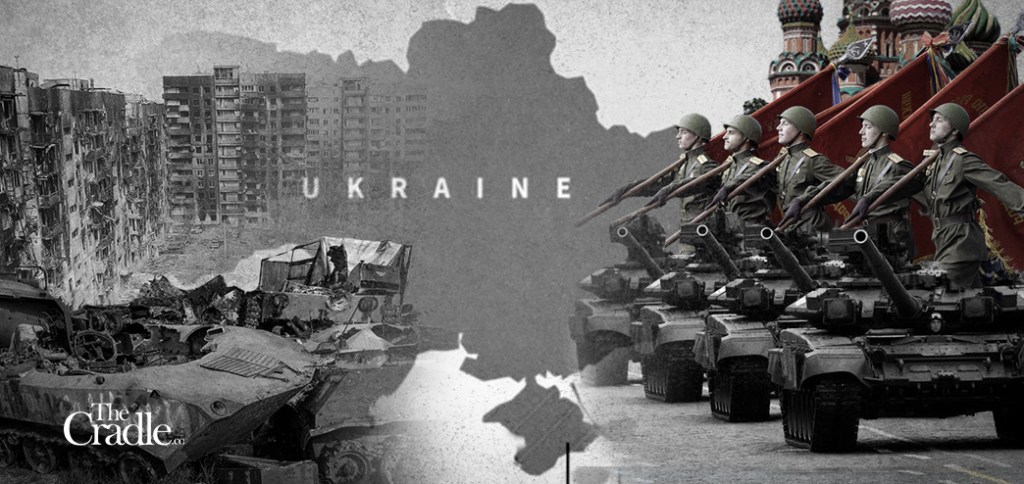
Photo Credit: The Cradle

By Pepe Escobar

Source: The Cradle

One year after the astounding US humiliation in Kabul – and on the verge of another serious comeuppance in Donbass – there is reason to believe Moscow is wary of Washington seeking vengeance: in the form of the ‘Afghanization’ of Ukraine.

With no end in sight to western weapons and finance flowing into Kiev, it must be recognized that the Ukrainian battle is likely to disintegrate into yet another endless war. Like the Afghan jihad in the 1980s which employed US-armed and funded guerrillas to drag Russia into its depths, Ukraine’s backers will employ those war-tested methods to run a protracted battle that can spill into bordering Russian lands.

Yet this US attempt at crypto-Afghanization will at best accelerate the completion of what Russia’s Defense Minister Sergei Shoigu describes as the “tasks” of its Special Military Operation (SMO) in Ukraine. For Moscow right now, that road leads all the way to Odessa.

It didn’t have to be this way. Until the recent assassination of Darya Dugina at Moscow’s gates, the battlefield in Ukraine was in fact under a ‘Syrianization’ process.

Like the foreign proxy war in Syria this past decade, frontlines around significant Ukrainian cities had roughly stabilized. Losing on the larger battlefields, Kiev had increasingly moved to employ terrorist tactics. Neither side could completely master the immense war theater at hand. So the Russian military opted to keep minimal forces in battle – contrary to the strategy it employed in 1980s Afghanistan.

Let’s remind ourselves of a few Syrian facts: Palmyra was liberated in March 2016, then lost and retaken in 2017. Aleppo was liberated only in December 2016. Deir Ezzor in September 2017. A slice of northern Hama in December and January 2018. The outskirts of Damascus in the Spring of 2018. Idlib – and significantly, over 25 percent of Syrian territory – are still not liberated. That tells a lot about rhythm in a war theater.

The Russian military never made a conscious decision to interrupt the multi-channel flow of western weapons to Kiev. Methodically destroying those weapons once they’re in Ukrainian territory – with plenty of success – is another matter. The same applies to smashing mercenary networks.

Moscow is well aware that any negotiation with those pulling the strings in Washington – and dictating all terms to puppets in Brussels and Kiev – is futile. The fight in Donbass and beyond is a do or die affair.

So the battle will go on, destroying what’s left of Ukraine, just as it destroyed much of Syria. The difference is that economically, much more than in Syria, what’s left of Ukraine will plunge into a black void. Only territory under Russian control will be rebuilt, and that includes, significantly, the bulk of Ukraine’s industrial infrastructure.

What’s left – rump Ukraine – has already been plundered anyway, as Monsanto, Cargill and Dupont have already bagged 17 million hectares of prime, fertile arable land – over half of what Ukraine still possesses. That translates de facto as BlackRock, Blackstone and Vanguard, top agro-business shareholders, owning whatever lands that really matter in non-sovereign Ukraine.

Going forward, by next year the Russians will be applying themselves to cutting off Kiev from NATO weapons supplies. As that unfolds, the Anglo-Americans will eventually move whatever puppet regime remains to Lviv. And Kiev terrorism – conducted by Bandera worshippers – will continue to be the new normal in the capital.

The Kazakh double game

By now it’s abundantly clear this is not a mere war of territorial conquest. It’s certainly part of a War of Economic Corridors – as the US spares no effort to sabotage and smash the multiple connectivity channels of Eurasia’s integration projects, be they Chinese-led (Belt and Road Initiative, BRI) or Russian-led (Eurasian Economic Union, EAEU).

Just like the proxy war in Syria remade large swathes of West Asia (witness, for instance, Erdogan about to meet Assad), the fight in Ukraine, in a microcosm, is a war for the reconfiguration of the current world order, where Europe is a mere self-inflicted victim in a minor subplot. The Big Picture is the emergence of multipolarity.

The proxy war in Syria lasted a decade, and it’s not over yet. The same may happen to the proxy war in Ukraine. As it stands, Russia has taken an area that is roughly equivalent to Hungary and Slovakia combined. That’s still far from “task” fulfillment – and it’s bound to go on until Russia has taken all the land right up to the Dnieper as well as Odessa, connecting it to the breakaway Republic of Transnistria.

It’s enlightening to see how important Eurasian actors are reacting to such geopolitical turbulence. And that brings us to the cases of Kazakhstan and Turkey.

The Telegram channel Rybar (with over 640k followers) and hacker group Beregini revealed in an investigation that Kazakhstan was selling weapons to Ukraine, which translates as de facto treason against their own Russian allies in the Collective Security Treaty Organization (CSTO). Consider too that Kazakhstan is also part of the Shanghai Cooperation Organization (SCO) and the EAEU, the two hubs of the Eurasian-led multipolar order.

As a consequence of the scandal, Kazakhstan was forced to officially announce the suspension of all weapons exports until the end of 2023.

It began with hackers unveiling how Technoexport – a Kazakh company – was selling armed personnel carriers, anti-tank systems and munitions to Kiev via Jordanian intermediaries, under the orders of the United Kingdom. The deal itself was supervised by the British military attaché in Nur-Sultan, the Kazakh capital.

Nur-Sultan predictably tried to dismiss the allegations, arguing that Technoexport had not asked for export licenses. That was essentially false: the Rybar team discovered that Technoexport instead used Blue Water Supplies, a Jordanian firm, for those. And the story gets even juicier. All the contract documents ended up being found in the computers of Ukrainian intel.

Moreover, the hackers found out about another deal involving Kazspetsexport, via a Bulgarian buyer, for the sale of Kazakh Su-27s, airplane turbines and Mi-24 helicopters. These would have been delivered to the US, but their final destination was Ukraine.

The icing on this Central Asian cake is that Kazakhstan also sells significant amounts of Russian – not Kazakh – oil to Kiev.

So it seems that Nur-Sultan, perhaps unofficially, somehow contributes to the ‘Afghanization’ in the war in Ukraine. No diplomatic leaks confirm it, of course, but bets can be made Putin had a few things to say about that to President Kassym-Jomart Tokayev in their recent – cordial – meeting.

The Sultan’s balancing act

Turkey is a way more complex case. Ankara is not a member of the SCO, the CSTO or the EAEU. It is still hedging its bets, calculating on which terms it will join the high-speed rail of Eurasian integration. And yet, via several schemes, Ankara allows Moscow to evade the avalanche of western sanctions and embargoes.

Turkish businesses – literally all of them with close connections to President Recep Tayyip Erdogan and his Justice and Development Party (AKP) – are making a killing, and relishing their new role as crossroads warehouse between Russia and the west. It’s an open boast in Istanbul that what Russia cannot buy from Germany or France they buy “from us.” And in fact several EU companies are in on it.

Ankara’s balancing act is as sweet as a good baklava. It gathers    economic support from a very important partner right in the middle of the endless, very serious Turkish economic debacle. They agree on nearly everything: Russian gas, S-400 missile systems, the building of the Russian nuclear power plant, tourism – Istanbul is crammed with Russians – Turkish fruits and vegetables.

Ankara-Moscow employ sound textbook geopolitics. They play it openly, in full transparence. That does not mean they are allies. It’s just pragmatic business between states. For instance, an economic response may alleviate a geopolitical problem, and vice-versa.

Obviously the collective west has completely forgotten how that normal state-to-state behavior works. It’s pathetic. Turkey gets “denounced” by the west as traitorous – as much as China.

Of course Erdogan also needs to play to the galleries, so every once in a while he says that Crimea should be retaken by Kiev. After all, his companies also do business with Ukraine – Bayraktar drones and otherwise.

And then there’s proselytizing: Crimea remains theoretically ripe for Turkish influence, where Ankara may exploit the notions of pan-Islamism and mostly pan-Turkism, capitalizing on the historical relations between the peninsula and the Ottoman Empire.

Is Moscow worried? Not really. As for those Bayraktar TB2s sold to Kiev, they will continue to be relentlessly reduced to ashes. Nothing personal. Just business.

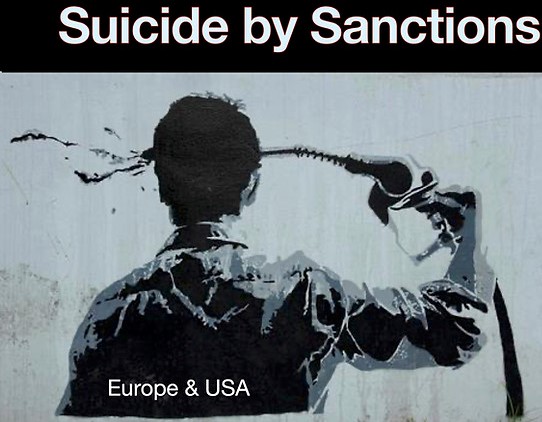
Europe Commits Suicide-By-Sanctions

Relentless Ukraine reporting helps conceal other conflicts

By Ron Paul

Source: Eurasia Review

A Swiss billboard is making the rounds on social media depicting a young woman on the telephone. The caption reads, “Does the neighbor heat the apartment to over 19 degrees (66F)? Please inform us.” While the Swiss government has dismissed the poster as a fake, the penalties Swiss citizens face for daring to warm their homes are very real. According to the Swiss newspaper Blick, those who violate the 66 degree heating limit could face as many as three years in prison!

Prison time for heating your home? In the “free” world? How is it possible in 2022, when Switzerland and the rest of the political west have achieved the greatest economic success in history, that the European continent faces a winter like something out of the dark ages?

Sanctions.

While long promoted – often by those opposed to war – as a less destructive alternative to war, sanctions are in reality acts of war. And as we know with interventionism and war, the result is often unintended consequences and even blowback.

European sanctions against Russia over its invasion of Ukraine earlier this year will likely go down in history as a prime example of how sanctions can result in unintended consequences. While seeking to punish Russia by cutting off gas and oil imports, European Union politicians forgot that Europe is completely dependent on Russian energy supplies and that the only people to suffer if those imports are shut down are the Europeans themselves.

The Russians simply pivoted to the south and east and found plenty of new buyers in China, India, and elsewhere. In fact, Russia’s state-run Gazprom energy company has reported that its profits have increased by 100 percent in the first half of this year.

Russia is getting rich while Europeans are facing a freezing winter and economic collapse. All because of the false belief that sanctions are a cost-free way to force other countries to do what you want them to do.

What happens when the people see dumb government policies making energy bills skyrocket as the economy grounds to a halt? They become desperate and take to the streets in protest.

This weekend thousands of Austrians took to the streets in a “Freedom Rally” to demand an end to sanctions and the opening of Nord Stream II, the gas pipeline on the verge of opening earlier this year. Last week an estimated 100,000 Czechs took to the streets of Prague to protest NATO and EU policy. In France, the “Yellow Vests” are back in the streets protesting the destruction of their economy in the name of “defeating” Russia in Ukraine. In Germany, Serbia, and elsewhere, protests are gearing up.

Even the Washington Post was forced to admit that sanctions on Russia are not having the intended effect. In an article yesterday, the paper worries that sanctions are inflicting “collateral damage in Russia and beyond, potentially even hurting the very countries that impose them. Some even worried that the sanctions intended to deter and weaken Putin could end up emboldening and strengthening him.”

This is all predictable. Sanctions kill. Sometimes they kill innocents in the country targeted for destruction and sometimes they kill innocents in the country imposing them. The solution, as always, is non-intervention. No sanctions, no “color revolutions,” no meddling. It’s really that simple.

THE WEST’S FALSE NARRATIVE ABOUT RUSSIA AND CHINA

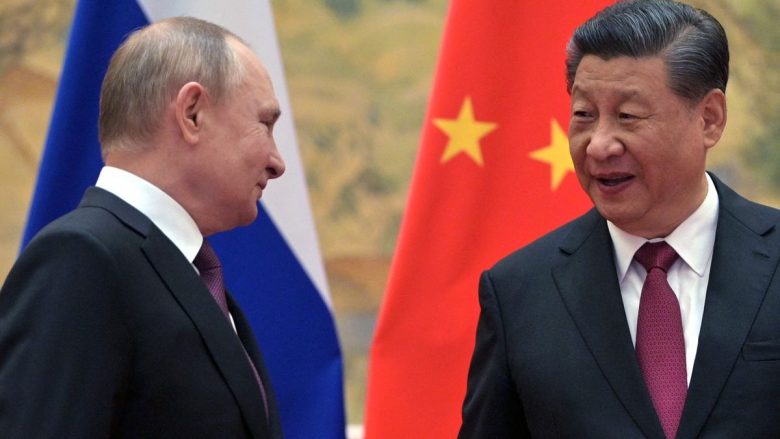
Vladimir Putin meets with Xi Jinping in Beijing just weeks before the invasion of Ukraine. Photograph: SPUTNIK/Reuters

By Jeffrey Sachs

Source: New Cold War

The world is on the edge of nuclear catastrophe in no small part because of the failure of Western political leaders to be forthright about the causes of the escalating global conflicts. The relentless Western narrative that the West is noble while Russia and China are evil is simple-minded and extraordinarily dangerous. It is an attempt to manipulate public opinion, not to deal with very real and pressing diplomacy.
___________________________

The essential narrative of the West is built into US national security strategy. The core US idea is that China and Russia are implacable foes that are “attempting to erode American security and prosperity.” These countries are, according to the US, “determined to make economies less free and less fair, to grow their. militaries, and to control information and data to repress their societies and expand their influence.”

The irony is that since 1980 the US has been in at least 15 overseas wars of choice (Afghanistan, Iraq, Libya, Panama, Serbia, Syria, and Yemen just to name a few), while China has been in none, and Russia only in one (Syria) beyond the former Soviet Union. The US has military bases in 85 countries, China in 3, and Russia in 1 (Syria) beyond the former Soviet Union.

President Joe Biden has promoted this narrative, declaring that the greatest challenge of our time is the competition with the autocracies, which “seek to advance their own power, export and expand their influence around the world, and justify their repressive policies and practices as a more efficient way to address today’s challenges.” US security strategy is not the work of any single US president but of the US security establishment, which is largely autonomous, and operates behind a wall of secrecy.

The overwrought fear of China and Russia is sold to a Western public through manipulation of the facts. A generation earlier George W. Bush, Jr. sold the public on the idea that America’s greatest threat was Islamic fundamentalism, without mentioning that it was the CIA, with Saudi Arabia and other countries, that had created, funded, and deployed the jihadists in Afghanistan, Syria, and elsewhere to fight America’s wars.

Or consider the Soviet Union’s invasion of Afghanistan in 1980, which was painted in the Western media as an act of unprovoked perfidy. Years later, we learned that the Soviet invasion was actually preceded by a CIA operation designed to provoke the Soviet invasion! The same misinformation occurred vis-à-vis Syria. The Western press is filled with recriminations against Putin’s military assistance to Syria’s Bashar al-Assad beginning in 2015, without mentioning that the US supported the overthrow of al-Assad beginning in 2011, with the CIA funding a major operation (Timber Sycamore) to overthrow Assad years before Russia arrived.

Or more recently, when US House Speaker Nancy Pelosi recklessly flew to Taiwan despite China’s warnings, no G7 foreign minister criticised Pelosi’s provocation, yet the G7 ministers together harshly criticised China’s “overreaction” to Pelosi’s trip.

The Western narrative about the Ukraine war is that it is an unprovoked attack by Putin in the quest to recreate the Russian empire. Yet the real history starts with the Western promise to Soviet President Mikhail Gorbachev that NATO would not enlarge to the East, followed by four waves of NATO aggrandisement: in 1999, incorporating three Central European countries; in 2004, incorporating 7 more, including in the Black Sea and Baltic States; in 2008, committing to enlarge to Ukraine and Georgia; and in 2022, inviting four Asia-Pacific leaders to NATO to take aim at China.

Nor do the Western media mention the US role in the 2014 overthrow of Ukraine’s pro-Russian president Viktor Yanukovych; the failure of the Governments of France and Germany, guarantors of the Minsk II agreement, to press Ukraine to carry out its commitments; the vast US armaments sent to Ukraine during the Trump and Biden Administrations in the lead-up to war; nor the refusal of the US to negotiate with Putin over NATO enlargement to Ukraine.

Of course, NATO says that is purely defensive, so that Putin should have nothing to fear. In other words, Putin should take no notice of the CIA operations in Afghanistan and Syria; the NATO bombing of Serbia in 1999; the NATO overthrow of Moammar Qaddafi in 2011; the NATO occupation of Afghanistan for 15 years; nor Biden’s “gaffe” calling for Putin’s ouster (which of course was no gaffe at all); nor US Defence Secretary Lloyd Austin stating that the US war aim in Ukraine is the weakening of Russia.

At the core of all of this is the US attempt to remain the world’s hegemonic power, by augmenting military alliances around the world to contain or defeat China and Russia. It’s a dangerous, delusional, and outmoded idea. The US has a mere 4.2% of the world population, and now a mere 16% of world GDP (measured at international prices). In fact, the combined GDP of the G7 is now less than that of the BRICS (Brazil, Russia, India, China, and South Africa), while the G7 population is just 6 percent of the world compared with 41 percent in the BRICS.
There is only one country whose self-declared fantasy is to be the world’s dominant power: the US. It’s past time that the US recognised the true sources of security: internal social cohesion and responsible cooperation with the rest of the world, rather than the illusion of hegemony. With such a revised foreign policy, the US and its allies would avoid war with China and Russia, and enable the world to face its myriad environment, energy, food and social crises.

Above all, at this time of extreme danger, European leaders should pursue the true source of European security: not US hegemony, but European security arrangements that respect the legitimate security interests of all European nations, certainly including Ukraine, but also including Russia, which continues to resist NATO enlargements into the Black Sea. Europe should reflect on the fact that the non-enlargement of NATO and the implementation of the Minsk II agreements would have averted this awful war in Ukraine. At this stage, diplomacy, not military escalation, is the true path to European and global security.

An Engineered Food and Poverty Crisis to Secure Continued US Dominance 

By Colin Todhunter

Source: Dissident Voice

In March 2022, UN Secretary-General Antonio Guterres warned of a “hurricane of hunger and a meltdown of the global food system” in the wake of the crisis in Ukraine.

Guterres said food, fuel and fertiliser prices were skyrocketing with supply chains being disrupted and added this is hitting the poorest the hardest and planting the seeds for political instability and unrest around the globe.

According to the International Panel of Experts on Sustainable Food Systems, there is currently sufficient food and no risk of global food supply shortages.

We see an abundance of food but skyrocketing prices. The issue is not food shortage but speculation on food commodities and the manipulation of an inherently flawed global food system that serves the interests of corporate agribusiness traders and suppliers of inputs at the expense of people’s needs and genuine food security.

The war in Ukraine is a geopolitical trade and energy conflict. It is largely about the US engaging in a proxy war against Russia and Europe by attempting to separate Europe from Russia and imposing sanctions on Russia to harm Europe and make it further dependent on the US.

Economist Professor Michael Hudson recently stated that ultimately the war is against Europe and Germany. The purpose of the sanctions is to prevent Europe and other allies from increasing their trade and investment with Russia and China.

Neoliberal policies since the 1980s have hollowed out the US economy. With its productive base severely weakened, the only way for the US to maintain hegemony is to undermine China and Russia and weaken Europe.

Hudson says that, beginning a year ago, Biden and the US neocons attempted to block Nord Stream 2 and all (energy) trade with Russia so that the US could monopolise it itself.

Despite the ‘green agenda’ currently being pushed, the US still relies on fossil fuel-based energy to project its power abroad. Even as Russia and China move away from the dollar, the control and pricing of oil and gas (and resulting debt) in dollars remains key to US attempts to retain hegemony.

The US knew beforehand how sanctions on Russia would play out. They would serve to divide the world into two blocks and fuel a new cold war with the US and Europe on one side with China and Russia being the two main countries on the other.

US policy makers knew Europe would be devastated by higher energy and food prices and food importing countries in the Global South would suffer due to rising costs.

It is not the first time the US has engineered a major crisis to maintain global hegemony and a spike in key commodity prices that effectively trap countries into dependency and debt.

In 2009, Andrew Gavin Marshall described how in 1973 – not long after coming off the gold standard – Henry Kissinger was integral to manipulating events in the Middle East (the Arab-Israeli war and the ‘energy crisis’). This served to continue global hegemony for the US, which had virtually bankrupted itself due to its war in Vietnam and had been threatened by the economic rise of Germany and Japan.

Kissinger helped secure huge OPEC oil price rises and thus sufficient profits for Anglo-American oil companies that had over-leveraged themselves in North Sea oil. He also cemented the petrodollar system with the Saudis and subsequently placed African nations, which had embarked on a path of (oil-based) industrialisation, on a treadmill of dependency and debt due to the spike in oil prices.

It is widely believed that the high-priced oil policy was aimed at hurting Europe, Japan and the developing world.

Today, the US is again waging a war on vast swathes of humanity, whose impoverishment is intended to ensure they remain dependent on the US and the financial institutions it uses to create dependency and indebtedness – the World Bank and IMF.

Hundreds of millions will experience (are experiencing) poverty and hunger due to US policy. These people (the ones that the US and Pfizer et al supposedly cared so much about and wanted to get a jab into each of their arms) are regarded with contempt and collateral damage in the great geopolitical game.

Contrary to what many believe, the US has not miscalculated the outcome of the sanctions placed on Russia. Michael Hudson notes energy prices are increasing, benefiting US oil companies and US balance of payments as an energy exporter. Moreover, by sanctioning Russia, the aim is to curtail Russian exports (of wheat and gas used for fertiliser production) and for agricultural commodity prices to therefore increase. This too will also benefit the US as an agricultural exporter.

This is how the US seeks to maintain dominance over other countries.

Current policies are designed to create a food and debt crisis for poorer nations especially. The US can use this debt crisis to force countries to continue privatising and selling off their public assets in order to service the debts to pay for the higher oil and food imports.

This imperialist strategy comes on the back of ‘COVID relief’ loans which have served a similar purpose. In 2021, an Oxfam review of IMF COVID-19 loans showed that 33 African countries were encouraged to pursue austerity policies. The world’s poorest countries are due to pay $43 billion in debt repayments in 2022, which could otherwise cover the costs of their food imports.

Oxfam and Development Finance International have also revealed that 43 out of 55 African Union member states face public expenditure cuts totalling $183 billion over the next five years.

The closure of the world economy in March 2020 (‘lockdown’) served to trigger an unprecedented process of global indebtedness. Conditionalities mean national governments will have to capitulate to the demands of Western financial institutions. These debts are largely dollar-denominated, helping to strengthen the US dollar and US leverage over countries.

The US is creating a new world order and needs to ensure much of the Global South remains in its orbit of influence rather than ending up in the Russian and especially Chinese camp and its belt road initiative for economic prosperity.

Post-COVID, this is what the war in Ukraine, sanctions on Russia and the engineered food and energy crisis are really about.

Back in 2014, Michael Hudson stated that the US has been able to dominate most of the Global South through agriculture and control of the food supply. The World Bank’s geopolitical lending strategy has transformed countries into food deficit areas by convincing them to grow cash crops – plantation export crops – not to feed themselves with their own food crops.

The oil sector and agribusiness have been joined at the hip as part of US geopolitical strategy.

The dominant notion of ‘food security’ promoted by global agribusiness players like Cargill, Archer Daniel Midland, Bunge and Louis Dreyfus and supported by the World Bank is based on the ability of people and nations to purchase food. It has nothing to do with self-sufficiency and everything to do with global markets and supply chains controlled by giant agribusiness players.

Along with oil, the control of global agriculture has been a linchpin of US geopolitical strategy for many decades. The Green Revolution was exported courtesy of oil-rich interests and poorer nations adopted agri-capital’s chemical- and oil-dependent model of agriculture that required loans for inputs and related infrastructure development.

It entailed trapping nations into a globalised food system that relies on export commodity mono-cropping to earn foreign exchange linked to sovereign dollar-denominated debt repayment and World Bank/IMF ‘structural adjustment’ directives. What we have seen has been the transformation of many countries from food self-sufficiency into food deficit areas.

And what we have also seen is countries being placed on commodity crop production treadmills. The need for foreign currency (US dollars) to buy oil and food entrenches the need to increase cash crop production for exports.

The World Trade Organization’s Agreement on Agriculture (AoA) set out the trade regime necessary for this type of corporate dependency that masquerades as ‘global food security’.

This is explained in a July 2022 report by Navdanya International – Sowing Hunger, Reaping Profits – A Food Crisis by Design – which notes international trade laws and trade liberalisation has benefited large agribusiness and continue to piggyback off the implementation of the Green Revolution.

The report states that US lobby and trade negotiations were headed by former Cargill Investors Service CEO and Goldman Sachs executive – Dan Amstutz – who in 1988 was appointed chief negotiator for the Uruguay round of GATT by Ronald Reagan. This helped to enshrine the interests of US agribusiness into the new rules that would govern the global trade of commodities and subsequent waves of industrial agriculture expansion.

The AoA removed protection of farmers from global market prices and fluctuations. At the same time, exceptions were made for the US and the EU to continue subsidising their agriculture to the advantage of large agribusiness.

Navdanya notes:

With the removal of state tariff protections and subsidies, small farmers were left destitute. The result has been a disparity in what farmers earn for what they produce, versus what consumers pay, with farmers earning less and consumers paying more as agribusiness middlemen take the biggest cut.

‘Food security’ has led to the dismantling of food sovereignty and food self-sufficiency for the sake of global market integration and corporate power.

We need look no further than India to see this in action. The now repealed recent farm legislation in India was aimed at giving the country the ‘shock therapy’ of neoliberalism that other countries have experienced.

The ‘liberalising’ legislation was in part aimed at benefiting US agribusiness interests and trapping India into food insecurity by compelling the country to eradicate its food buffer stocks – so vital to the nation’s food security – and then bid for food on a volatile global market from agribusiness traders with its foreign reserves.

The Indian government was only prevented from following this route by the massive, year-long farmer protest that occurred.

The current crisis is also being fuelled by speculation. Navdanya cites an investigation by Lighthouse Reports and The Wire to show how speculation by investment firms, banks and hedge funds on agricultural commodities are profiting off rising food prices. Commodity future prices are no longer linked to actual supply and demand in the market but are based purely on speculation.

Archer Daniels Midland, Bunge, Cargill and Louis Dreyfus and investment funds like Black Rock and Vanguard continue to make huge financial killings, resulting in the price of bread almost doubling in some poorer countries.

The cynical ‘solution’ promoted by global agribusiness to the current food crisis is to urge farmers to produce more and seek better yields as if the crisis is that of underproduction. It means more chemical inputs, more genetic engineering techniques and suchlike, placing more farmers in debt and trapped in dependency.

It is the same old industry lie that the world will starve without its products and requires more of them. The reality is that the world is facing hunger and rising food prices because of the system big agribusiness has instituted.

And it is the same old story – pushing out new technologies in search of a problem and then using crises as justification for their rollout while ignoring the underlying reasons for such crises.

Navdanya sets out possible solutions to the current situation based on principles of agroecology, short supply lines, food sovereignty and economic democracy – policies that have been described at length in many articles and official reports over the years.

As for fighting back against the onslaught on ordinary people’s living standards, support is gathering among the labour movement in places like the UK. Rail union leader Mick Lynch is calling for a working class movement based on solidarity and class consciousness to fight back against a billionaire class that is acutely aware of its own class interests.

For too long, ‘class’ has been absent from mainstream political discourse. It is only through organised, united protest that ordinary people will have any chance of meaningful impact against the new world order of tyrannical authoritarianism and the devastating attacks on ordinary people’s rights, livelihoods and standards of living that we are witnessing.

Powerful New Evidence that U.S. Is A Dictatorship

By Eric Zuesse

Source: The Duran

Because the U.S. Government flaunts itself as being a democracy instead of a dictatorship and it coups and invades and overthrows and replaces (“regime changes”) Governments that it declares to be dictatorships instead of democracies (the “New Cold War” isn’t about “capitalism versus communism,” but about “democracy versus dictatorship”), a crucial question now in all international political discussions is: Is the U.S. Government ACTUALLY a democracy, or does it instead only pretend to be one? In other words: Is the U.S. Government’s position in “the New Cold War” fraudulent?

The June 2022 issue of the peer-reviewed academic journal, Structural Change and Economic Dynamics, contained an article that answers this question with empirical data which has definitively crushed all of the U.S. Government’s references to itself as being a “democracy.” It is therefore significant not only because it proves that the U.S. Government is a dictatorship, but also because it proves that the U.S. position in “the New Cold War is fraudulent. The article is therefore of significance not just to Americans, but globally.

The article, which was specifically about and addressed to America, closed by saying: “We think it is time that social scientists stop pushing the equivalent of the Ptolemaic solar system. They need to recognize what almost everyone else does: that we live in a money-driven political system. No one is going to make progress by adding epicycles to voting models.” In other words: political ‘scientists’ and ‘historians’ who continue to perpetuate the U.S. regime’s claim to being a democracy (one-person-one-vote instead of one-dollar-one-vote) are now archaic: they are equivalent to the physical philosophers who had preceded the first physical scientist or “physicist” Galileo’s empirical demonstrations and the resulting first scientific theory (and subsequently Darwin doing the same thing in the biological sciences), that the Bible is not a book of history but instead a book of mythology mixing lies with truths in order to perpetuate and expand a particular clergy. But, now, the issue isn’t about control of the State by the clergy, but instead it’s about control of the State by the aristocracy — the nation’s super-rich. That’s what’s at issue in today’s America. Science is finally now extending outward, from its existing base, first in physics, and then in biology, to demonstrate such powerful empirical political realities as this in society — encroaching now upon the U.S. regime’s fraudulent dogma that the U.S. Government is a “democracy” instead of a “dictatorship” (a dictatorship such as it invades abroad and tries to overthrow and replace, by a ‘democracy’, some foreign nation’s Government — to add a new vassal-nation to the American empire’s ‘allies’ or actual colonies). This Emperor has no clothes, is what this academic article displays. But this particular “Emperor” represents not the clergy (such as in the time of Galileo and of Darwin), but instead the aristocracy — the super-rich (the imperialists, in the “New Cold War”). 

The article’s title is: “How money drives US congressional elections: Linear models of money and outcomes”. Its “Abstract” or summary says that “the relations between money and votes cast for major parties in elections for the U.S. Senate and House of Representatives from 1980 to 2018 are well approximated by straight lines.” In other words: Billionaires and other super-rich individuals can and do purchase electoral outcomes with their enormous political donations in America. It’s a “straight-line” relationship between money and winning: the candidate who is backed by the most money has the biggest (a huge) likelihood of winning; the candidate who is backed by the least money has the least (a minuscule) likelihood, and most of that money to the winning candidates comes from the few super-rich. The way to be politically successful in today’s America is, now clearly, to be more corrupt than your competitor — to be offering the Government for sale to the highest bidders (and to deliver on the promises that the politician makes to these individuals, so as to be able to remain in public office and continue to serve those masters). (And, then, after public office, come the biggest private benefits, to those former office-holders.) America is an aristocracy, not a democracy; it is one-dollar-one-vote, not one-person-one-vote. That’s what the article demonstrates.

Even more crushing is the same three authors’ (Thomas Ferguson, Paul Jorgenson, and Jie Chen) further analysis from these same data, their article “Big Money — Not Political Tribalism — Drives US Elections”, which exposes the fraudulence of the two American political Parties’ supposed ‘ethnic’ or ‘racial’ appeals, as being instead actually the aristocracy’s distractive political theater pumping those divides, as being, in reality, instead — at the structurally deeper level — between Republican versus Democratic Party billionaires, with Republican billionaires financing White-power appeals, and Democratic billionaires financing Black and other minority (and feminist) power appeals, all so that the nation’s population-at-large won’t be fighting instead against the aristocracy itself, which is the sole real beneficiary of this system of exploitation of the masses (exploitation of workers and consumers). Thus, the aristocracy’s victims — the public, the consumers and workers, the people who are NOT in the aristocracy — look elsewhere than at the aristocracy, to see their enemy. This latter paper isn’t behind a paywall, and it shows the same straight-line graphs relating money to power that the first-mentioned one here (which IS paywalled) did. So, one can readily see visually, here, how profoundly corrupt America’s Government actually is. (Those graphs are stunning, because the data are.)

I have previously posted articles summarizing, and linking to, a vast range of other empirical evidences, of many different types, all likewise pointing very strongly toward America’s being an aristocracy instead of a democracy, and these are some of them:

“How America’s dictatorship works”

“America Is One-Dollar-One-Vote, Not Really One-Person-One Vote.”

“Jimmy Carter Is Correct That the U.S. Is No Longer a Democracy”

“Politicians Don’t Actually Care What Voters Want”

“Is the U.S. actually a ‘police state’?”

“How the U.S. Government is controlled by its armaments firms”

“How the Billionaires Control American Elections”

“The Evilness of America’s Ruling Class”

All of those data should be compared to the opposite view, the U.S.-regime-imposed view, which is expressed by America’s political ‘scientists’ and ‘historians’, who continue to perpetuate the U.S. regime’s claim to being a democracy (one-person-one-vote, instead of one-dollar-one-vote — which is America’s reality). Not only politicians, but also scholars, are beneficiaries of billionaires’ donations — the donations funding professorial chairs, college endowments, and ‘non’-profit foundations and ‘charities’. Such private interests thus control the public interests, to produce a deeply corrupt (privatized) body-politic. 

On which side of this debate, about the aristocracy and the public, do you stand, and why? And what do you think should be done about it? Do you favor the aristocrats, or the public? This is not a political question, but a meta-political one. It transcends existing political Parties, and all existing political prejudices. It requires authentically scientific thinking about public policies. Above all, such questions concern the existing one-dollar-one-vote (aristocracy), versus the possibility of one-person-one-vote (democracy) emerging (or re-emerging). But can dictatorship ever transform into democracy? If so, how? Of course, history provides answers, and it shows that, at least for a while, the American Revolution did transform an aristocracy here into a democracy (albeit, a limited one): it conquered Britain’s aristocracy on its land. Unfortunately (or fortunately, if one prefers aristocracy to democracy), an American aristocracy has recently risen here. America now has its own aristocracy. In science, only history provides answers. There have also, in some other countries, been revolutions overthrowing the local nation’s own aristocracy. All evidences in science are historical facts — nothing else than that. And the articles which are linked-to here are scientific: they are analyses which are based only on the relevant historical facts, displaying what history (not myth) shows. One thing that all of human history shows is that every aristocracy is based on myths. America’s aristocracy is no different. Social science is now puncturing that myth — exposing that fraud. This is significant globally, not merely locally.

—————

Investigative historian Eric Zuesse’s new book, AMERICA’S EMPIRE OF EVIL: Hitler’s Posthumous Victory, and Why the Social Sciences Need to Change, is about how America took over the world after World War II in order to enslave it to U.S.-and-allied billionaires. Their cartels extract the world’s wealth by control of not only their ‘news’ media but the social ‘sciences’ — duping the public.

Ukraine and the Politics of Permanent War

Permanent war requires permanent censorship.

War Inc. – by Mr. Fish

By Chris Hedges

Source: The Chris Hedges Report

No one, including the most bullish supporters of Ukraine, expect the nation’s war with Russia to end soon. The fighting has been reduced to artillery duels across hundreds of miles of front lines and creeping advances and retreats. Ukraine, like Afghanistan, will bleed for a very long time. This is by design.

On August 24, the Biden administration announced yet another massive military aid package to Ukraine worth nearly $3 billion. It will take months, and in some cases years, for this military equipment to reach Ukraine. In another sign that Washington assumes the conflict will be a long war of attrition it will give a name to the U.S. military assistance mission in Ukraine and make it a separate command overseen by a two- or three-star general. Since August 2021, Biden has approved more than $8 billion in weapons transfers from existing stockpiles, known as drawdowns, to be shipped to Ukraine, which do not require Congressional approval.

Including humanitarian assistance, replenishing depleting U.S. weapons stocks and expanding U.S. troop presence in Europe, Congress has approved over $53.6 billion ($13.6 billion in March and a further $40.1 billion in May) since Russia’s February 24 invasion. War takes precedence over the most serious existential threats we face. The proposed budget for the Centers for Disease Control and Prevention (CDC) in fiscal year 2023 is $10.675 billion while the proposed budget for the Environmental Protection Agency (EPA) is $11.881 billion. Our approved assistance to Ukraine is more than twice these amounts. 

The militarists who have waged permanent war costing trillions of dollars over the past two decades have invested heavily in controlling the public narrative. The enemy, whether Saddam Hussein or Vladimir Putin, is always the epitome of evil, the new Hitler. Those we support are always heroic defenders of liberty and democracy. Anyone who questions the righteousness of the cause is accused of being an agent of a foreign power and a traitor.

The mass media cravenly disseminates these binary absurdities in 24-hour news cycles. Its news celebrities and experts, universally drawn from the intelligence community and military, rarely deviate from the approved script. Day and night, the drums of war never stop beating. Its goal: to keep billions of dollars flowing into the hands of the war industry and prevent the public from asking inconvenient questions. 

In the face of this barrage, no dissent is permitted. CBS News caved to pressure and retracted its documentary which charged that only 30 percent of arms shipped to Ukraine were making it to the front lines, with the rest siphoned off to the black market, a finding that was separately reported upon by U.S. journalist Lindsey Snell. CNN has acknowledged there is no oversight of weapons once they arrive in Ukraine, long considered the most corrupt country in Europe. According to a poll of executives responsible for tackling fraud, completed by Ernst & Young in 2018, Ukraine was ranked the ninth-most corrupt nation from 53 surveyed. 

There is little ostensible reason for censoring critics of the war in Ukraine. The U.S. is not at war with Russia. No U.S. troops are fighting in Ukraine. Criticism of the war in Ukraine does not jeopardize our national security. There are no long-standing cultural and historical ties to Ukraine, as there are to Great Britain. But if permanent war, with potentially tenuous public support, is the primary objective, censorship makes sense.

War is the primary business of the U.S. empire and the bedrock of the U.S. economy. The two ruling political parties slavishly perpetuate permanent war, as they do austerity programs, trade deals, the virtual tax boycott for corporations and the rich, wholesale government surveillance, the militarization of the police and the maintenance of the largest prison system in the world. They bow before the dictates of the militarists, who have created a state within a state. This militarism, as Seymour Melman writes in The Permanent War EconomyAmerican Capitalism in Decline, “is fundamentally contradictory to the formation of a new political economy based upon democracy, instead of hierarchy, in the workplace and the rest of society.” 

“The idea that war economy brings prosperity has become more than an American illusion,” Melman writes. “When converted, as it has been, into ideology that justifies the militarization of society and moral debasement, as in Vietnam, then critical reassessment of that illusion is a matter of urgency. It is a primary responsibility of thoughtful people who are committed to humane values to confront and respond to the prospect that deterioration of American economy and society, owing to the ravages of war economy, can become irreversible.”

If permanent war is to be halted, as Melman writes, the ideological control of the war industry must be shattered. The war industry’s funding of  politicians, research centers and think tanks, as well as its domination of the media monopolies, must end. The public must be made aware, Melman writes, of how the federal government “sustains itself as the directorate of the largest industrial corporate empire in the world; how the war economy is organized and operated in parallel with centralized political power — often contradicting the laws of Congress and the Constitution itself; how the directorate of the war economy converts pro-peace sentiment in the population into pro-militarist majorities in the  Congress; how ideology and fears of job losses are manipulated to marshal support in Congress and the general public for war economy; how the directorate of the war economy uses its power to prevent planning for orderly conversion to an economy of peace.”

Rampant, unchecked militarism, as historian Arnold Toynbee notes, “has been by far the commonest cause of the breakdown of civilizations.” 

This breakdown is accelerated by the rigid standardization and uniformity of public discourse. The manipulation of public opinion, what Walter Lippman calls “the manufacture of consent,” is imperative as the militarists gut social programs; let the nation’s crumbling infrastructure decay; refuse to raise the minimum wage; sustain an inept, mercenary for-profit health care system that resulted in 25 percent of global Covid deaths — although we are less than 5 percent of the world’s population — to gouge the public; carries out deindustrialization; do nothing to curb the predatory behavior of banks and corporations or invest in substantial programs to combat the climate crisis. 

Critics, already shut out from the corporate media, are relentlessly attacked, discredited and silenced for speaking a truth that threatens the public’s quiescence while the U.S. Treasury is pillaged by the war industry and the nation disemboweled. 

You can watch my discussion with Matt Taibbi about the rot that infects journalism here and here.

The war industry, deified by the mass media, including the entertainment industry, is never held accountable for the military fiascos, cost overruns, dud weapons systems and profligate waste. No matter how many disasters — from Vietnam to Afghanistan — it orchestrates, it is showered with larger and larger amounts of federal funds, nearly half of all the government’s discretionary spending. The monopolization of capital by the military has driven the U.S. debt to over $30 trillion, $6 trillion more than the U.S. GDP of $24 trillion. Servicing this debt costs $300 billion a year. We spend more on the military, $813 billion for fiscal year 2023, than the next nine countries, including China and Russia, combined.

An organization like NewsGuard, which has been rating what it says are trustworthy and untrustworthy sites based on their reporting on Ukraine, is one of the many indoctrination tools of the war industry. Sites that raise what are deemed “false” assertions about Ukraine, including that there was a U.S.-backed coup in 2014 and neo-Nazi forces are part of Ukraine’s military and power structure, are tagged as unreliable. Consortium NewsDaily KosMint Press and Grayzone have been given a red warning label. Sites that do not raise these issues, such as CNN, receive the “green” rating” for truth and credibility.  (NewsGuard, after being heavily criticized for giving Fox News a green rating of approval in July revised its rating for Fox News and MSNBC, giving them red labels.) 

The ratings are arbitrary. The Daily Caller, which published fake naked pictures of Alexandria Ocasio-Cortez, was given a green rating, along with a media outlet owned and operated by The Heritage Foundation. NewsGuard gives WikiLeaks a red label for “failing” to publish retractions despite admitting that all of the information WikiLeaks has published thus far is accurate. What WikiLeaks was supposed to retract remains a mystery. The New York Times and The Washington Post, which shared a Pulitzer in 2018 for reporting that Donald Trump colluded with Vladimir Putin to help sway the 2016 election, a conspiracy theory the Mueller investigation imploded, are awarded perfect scores. These ratings are not about vetting journalism. They are about enforcing conformity.

NewsGuard, established in 2018, “partners” with the State Department and the Pentagon, as well as corporations such as Microsoft. Its advisory board includes the former Director of the CIA and NSA, Gen. Michael Hayden; the first U.S. Homeland Security director Tom Ridge and Anders Fogh Rasmussen, a former secretary general of NATO.

Readers who regularly go to targeted sites could probably care less if they are tagged with a red label. But that is not the point. The point is to rate these sites so that anyone who has a NewsGuard extension installed on their devices will be warned away from visiting them. NewsGuard is being installed in libraries and schools and on the computers of active-duty troops. A warning pops up on targeted sites that reads: “Proceed with caution: This website generally fails to maintain basic standards of accuracy and accountability.”

Negative ratings will drive away advertisers, which is the intent. It is also a very short step from blacklisting these sites to censoring them, as happened when YouTube erased six years of my show On Contact that was broadcast on RT America and RT International. Not one show was about Russia. And not one violated the guidelines for content imposed by YouTube. But many did examine the evils of U.S. militarism.

In an exhaustive rebuttal to NewsGuard, which is worth reading, Joe Lauria, the editor-in-chief of Consortium News, ends with this observation:

NewsGuard’s accusations against Consortium News that could potentially limit its readership and financial support must be seen in the context of the West’s war mania over Ukraine, about which dissenting voices are being suppressed. Three CN writers have  been kicked off Twitter. 

PayPal’s cancellation of Consortium News’ account is an evident attempt to defund it for what is almost certainly the company’s view that CN violated its restrictions on “providing false or misleading information.” It cannot be known with 100 percent certainty because PayPal is hiding behind its reasons, but CN trades in information and nothing else.  

CN supports no side in the Ukraine war but seeks to examine the causes of the conflict within its recent historical context, all of which are being whitewashed from mainstream Western media.

Those causes are: NATO’s expansion eastward despite its promise not to do so; the coup and eight-year war on Donbass against coup resisters; the lack of implementation of the Minsk Accords to end that conflict; and the outright rejection of treaty proposals by Moscow to create a new security architecture in Europe taking Russia’s security concerns into account.  

Historians who point out the onerous Versailles conditions imposed on Germany after World War I as a cause of Nazism and World War II are neither excusing Nazi Germany nor are they smeared as its defenders.

The frantic effort to corral viewers and readers into the embrace of the establishment media — only 16 percent of Americans have a great deal/quite a lot of confidence in newspapers and only 11 percent have some degree of confidence in television news — is a sign of desperation. 

As the persecution of Julian Assange illustrates, the throttling of press freedom is bipartisan. This assault on truth leaves a population unmoored. It feeds wild conspiracy theories. It shreds the credibility of the ruling class. It empowers demagogues. It creates an information desert, one where truth and lies are indistinguishable. It frog-marches us towards tyranny. This censorship only serves the interests of the militarists who, as Karl Liebknecht reminded his fellow Germans in World War I, are the enemy within.