Saturday Matinee: Color Out of Space

By Peter Sobczynski

Source: RogerEbert.com

According to IMDb, the seemingly inexhaustible Nicolas Cage has no fewer than six additional movies in various stages of production that are currently scheduled for release in 2020, ranging from high-profile studio outings to the kind of demented head-scratchers that he somehow manages to sniff out in the manner of a pig finding truffles. And yet, none of these films may be able to top his latest effort, “Color Out of Space,” in terms of sheer nuttiness. Considering that the film takes its inspiration from one of the most famous short stories by the legendarily weird H.P. Lovecraft, and was directed and co-written by Richard Stanley (making his first stab at narrative filmmaking since being fired from his remake of “The Island of Dr. Moreau” after only a few days of shooting), there was very little chance that it was every going to be just another run-of-the-mill project. However, the addition of Cage to the already heady cinematic brew definitively puts it over the top, making it the kind of cult movie nirvana that was its apparent destiny from the moment the cameras started rolling.

The film centers on the Gardner family, who have recently left the hustle and bustle of the city for a more bucolic life in a remote house near a lake in the deep woods of Massachusetts. While father Nathan (Cage) is gung-ho about becoming a farmer and raising alpacas (“the animal of the future”) despite no discernible talent for either, wife Theresa (Joely Richardson) is preoccupied with recovering from a recent mastectomy, eldest son Benny (Brendan Meyer) is off getting stoned most of the time, teen daughter Lavinia (Madeline Arthur) vents her annoyance at the move by dabbling in the black arts with her paperback copy of “The Necronomicon” and young son Jack (Julian Hilliard) more often than not simply gets lost in the shuffle. The Gardners are not crazy or hostile in any way, but it also becomes quickly obvious that their isolation has begun to drive them all a bit batty. 

That weirdness escalates one night when the sky turns an almost indescribable shade of fuchsia, and a meteorite crashes into their front yard. Although the meteorite itself soon crumbles away, strange things begin happening in its wake. A batch of new and heretofore unseen flowers begin blooming while Nathan’s tomato crop comes in weeks ahead of schedule; the family’s phones, computers, and televisions are constantly being distorted by waves of static that render them all but useless. The Gardners themselves begin exhibiting signs of strange behavior as well: Nathan begins acting daffier than usual, flying off into rages at the drop of the hat; a seemingly dazed Theresa chops off the tops of a couple of her fingers while cutting carrots; Jack is constantly staring and whistling at a well that he claims contains a “friend.” Before long, everything in the area begins mutating in indescribable ways, and while Benny and Lavinia recognize what is happening around them, even they appear to be powerless to escape the grip of whatever is behind everything.

The stories of H.P. Lovecraft have inspired, directly or otherwise, any number of films over the years but with very few exceptions (chiefly Stuart Gordon’s cult classics “Re-Animator” and “From Beyond”), most of them have not been especially good. In most cases, the problem is that Lovecraft’s stories tended to focus on indescribable horrors and much of the impact for the reader came from taking the vague hints that he did parcel out and then picturing it in their own minds, where their imaginations had no limitations or budgetary restrictions. To successfully adapt one of his works, a filmmaker needs either an unlimited budget to try to bring his horrors fully to life, or the kind of unlimited imagination that allows them to take Lovecraft’s suggestions and go off in their own unusual directions. When these requirements are missing, the results can be fairly dire, as anyone who saw “The Curse,” a dire low-budget 1987 adaptation of Color of Outer Space, can attest.

In this case, the film works because it is clear that Stanley is not only working on the same wavelength as Lovecraft was when he wrote the original story, but has managed to transform the author’s decidedly purple prose into cinematic terms. Take the titular color, for example. In the original story, it is never properly described to us other than being of a shade never before seen on the typical color spectrum. That sort of non-description description can work on the page but isn’t especially helpful as a guide for someone who has to bring it to life. Stanley proves himself to be up to the challenge, and hits upon a wild color scheme that honors Lovecraft’s intentions by bathing everything in a genuinely otherworldly tinge. Not content to rest there, he builds upon that weirdness with an equally vivid soundscape, including a creepily effective score by Colin Stetson. Stetson’s score shifts levels of reality in aural terms and conjure up the kind of terrors that are even harder to shake than the numerous and undeniably eye-popping physical mutations on display.

Stanley also manages to work the film’s additional otherworldly element—Cage’s performance—organically into the material, without losing any of its total strangeness in the process. For fans of oddball cinema, a Cage-Stanley collaboration is the stuff dreams are made of. In that respect, it does not disappoint. Obviously, once things go crazy in the second half, Cage brings out the weirdness full force (even randomly employing the wheeling vocal tic that he used decades earlier in “Vampire’s Kiss”). But what is interesting is that, instead of making Nathan into a completely normal guy who does an immediate 180 as a result of the strange occurrences, he and Stanley instead see him as a guy who is already a bit off right from the start, albeit in endearingly oddball ways. As a result of his work in these early scenes, there is an unexpected degree of poignance that he brings to the proceedings later on even as things go fully gonzo.

The chief problem with “Color Out of Space” is that, at nearly two full hours, it is a little too much of a good thing at times, with some plot elements—chiefly one involving potentially shady dealings by the town’s mayor (Q’orianka Kilcher)—that could have easily been jettisoned. For the most part, however, the film is the kind of audacious and deliriously messed-up work that fans of Stanley, Cage, and cult cinema have been rooting for ever since the existence of the project became known. Both as an effective cinematic translation of Lovecraft’s particular literary skills, and as a freakout of the first order with sights and sounds that will not be easily forgotten, this is one of those films that I suspect is going to grow in significance and popularity in due time. Hopefully it will serve as just the first of many collaborations between Stanley and Cage, two decidedly kindred artistic spirits.

Watch Color Out of Space on Hoopla here: https://www.hoopladigital.com/title/13038495

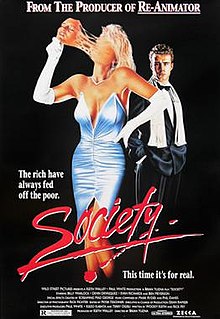
Saturday Matinee: Society

“A Matter of Good Breeding”: The Shape-Shifting Elite in Brian Yuzna’s ‘Society’

By Noah Berlatsky

Source: We Are the Mutants

The elite is an amorphous clotted blob of parasitic greed and hate. Its tendrils extend with slimy stealth into every orifice of society—which makes its precise outlines difficult to see. Are the elite contemptuous coastal liberals and academics? Are they hedge fund managers and tech billionaires? Are they infiltrating globalists or capitalist pigs? Are they your bosses? Or are they your neighbors sneering at your MCU films and your fast food diet? Or are they all of these people and more, gelatinously fusing into a suffocating, boundaryless mass, conspiring in the dank corners of the hierarchy to feed upon and absorb your labor and your soul?

Brian Yuzna’s 1989 schlock horror film Society slides its moist appendages around the concept of the elite, queasily exposing its power and its vile plasticity. Squeezing into the paranoid horror genre at the very end of the Cold War, Society contorts itself away from the communist menace to focus on the evil assimilating rituals of a boneless capitalism. In doing so, though, it inadvertently shows how difficult it is, with the tropes of terror we have, to tell communism and capitalism apart. The two dissolve into a single two-headed, or multi-headed, or faceless mass, impossible to pin down or define, and therefore impossible to escape.

Society‘s protagonist is Bill Whitney (Billy Warlock), a wealthy Beverly Hills teen and star basketball player running for student body president. Everything seems to be going well for him. And yet, “If I scratch the surface, there’ll be something terrible underneath,” he tells his therapist, Dr. Cleveland (Ben Slack), just before biting into an apple and seeing it squirming with (hallucinatory?) maggots. The worm in Bill’s Garden of Eden is his family. His parents Nan (Connie Danese) and Jim (Charles Lucia) are much closer to his sister Jenny (Patrice Jennings) than they are to him. He suspects they don’t love him; he worries he is adopted. Soon, though, he has cause for even more serious alarm. His sister’s ex-boyfriend David Blanchard (Tim Bartell) secretly bugs Bill’s parents and sister; on the tape the three of them reveal that Jenny’s debutante coming out party is a bizarre incestuous group sex ritual. When Bill tries to share the evidence, the tape disappears, and Blanchard is killed in a car crash. The wooden acting and incoherent plot tremble between B-movie incompetence and sweat-drenched fever dream as the conspiracy begins to engulf everyone from Bill’s rival, Ted Ferguson (Ben Meyerson), to his new girlfriend Clarissa Carlyn (Devin DeVasquez), to his doctor, his parents, and the police.

In the film’s infamous conclusion, we learn that Bill was in fact adopted, and his parents and their friends are part of a shape-shifting species that devours humans in a bizarre group feeding sex ritual called the “shunt.” The last twenty minutes of the runtime are an oozy apocalypse courtesy of special effects guru Screaming Mad George: flesh dissolves, mouths turn into clotted rubbery tendrils, and Bill literally reaches up through Ted Ferguson’s anus to pull him inside out in a climactic battle, ending Ted’s life and Bill’s hopes of a Washington internship. Clarissa is so in love with Bill that she betrays her own species, and she, Bill, and Bill’s buddy Milo (Evan Richards) escape the clutches of the elite, whose members have to satisfy themselves with eating Blanchard, saved from his apparent death by car crash for an even more awful fate.

Society is a decadent, absurdly sodden and febrile extension of the body horror genre of the ‘70s and ‘80s, taking The Thing (1982), 1985’s Re-Animator (which Yuzna produced), The Blob (1988), and The Fly (1986), and adding even more K-Y Jelly and quivering sexual innuendo. It can also be seen, though, as a reversal of those late Cold War-era films, reaching through the back end to grab hold of the eye sockets from the inside to pull out the wet, pulsing innards. Just as the Berlin Wall was falling, Society revealed that the fear of the Soviets was fear of the wealthy elite all along.

***

Anti-communist paranoia in Cold War horror often centers on deindividuation and dehumanization. Ronald Reagan was channeling films like 1954’s Them!, with its giant, mindless insect invaders, when he described Communism as an “ant heap of totalitarianism.” The 1958 The Blob features a figurative Red menace: a clump of gelatin fallen from space that absorbs all those in its path, dissolving discrete persons into a single jelly-like mass. 1956’s Invasion of the Body Snatchers imagines alien seed pods falling to earth, from which gestate repulsively fibrous duplicates. They drain human appearance and personality when, in a metaphorical excess of failed vigilance, their targets fall asleep. “Love, desire, ambition, faith—without them life’s so simple,” a pod person explains to the horrified protagonists, sketching a vision of a world enervated by a lack of human warmth and capitalist moxy. Significantly, one of the first signs of the pod invasion is a dual leeching away of business initiative and consumerist impulses. Dr. Miles Binnell (Kevin McCarthy) first notices something awry when he sees an abandoned roadside vegetable stand. Later, when he takes Becky Driscoll (Dana Wynter) out to dinner, the restaurant is almost abandoned. Pod people neither sell nor buy; the hive mind, possessed of invisible tendrils, does not require an invisible hand.

Communism doesn’t just eat through commercial relationships in these films; it eats through domestic ones. Removing consumer desire also removes traditional sexual and romantic impulses, leaving behind monstrous abomination. Science-fiction author Jack L. Chalker neatly summarizes the anti-communist logic in his 1978 novel Exiles at the Well of Souls, in which humans have created Comworlds where “The individual meant nothing; humanity was a collective concept.” To advance that group good, the Comworlds retool sexual biology itself: “Some bred all-females, some retained two sexes, and some, like New Harmony, bred everyone as a bisexual. A couple had dispensed with all sexual characteristics entirely, depending on cloning.” In one of the most quietly ugly moments in Invasion of the Body Snatchers, a working mother prepares a pod for her own baby, noting in a monotone that soon it won’t cry. Plants replace wombs just as outsourced childcare replaces homemaking, and maternal feelings dissolve into a grey, ichorous, proto-feminist puddle.

The 1970s remake of Invasion of the Body Snatchers further teases out the bleakly kinky implications of mind-controlled interference in the reproductive process. Elizabeth Driscoll (Brooke Adams) falls asleep in a field, and, as her personality is sucked from her, her body cracks and crumbles like a rotten pumpkin. Nearby, she rises up in her new form, “born again into an untroubled world, free of anxiety, fear, hate”—and also free of clothes. Pod Elizabeth is completely nude, and the film’s stark gaze willfully conflates desire and terror. In fact, the terror is precisely that she is both fully available and completely unavailable, a desirable body in thrall to some inhuman mass will.

Society takes that body and molds it to different ends. The communist infiltration is replaced with a festering class divide. Good, upstanding businessmen, mothers, and citizens are not infected with an alien ideology. Instead, as the maniacal Dr. Cleveland explains, “No, we’re not from outer space or anything like that. We have been here as long as you have. It’s a matter of good breeding, really.” The parasitic infection is not foreign, but native. No one has been changed; rather, the paranoid revelation is that the evil ones were here all along, squatting wetly in those mansions, and sliding hideously into prestigious internships. No blob or pod or thing needs to take control of the judges, the police, the hospitals, and the student presidency. The blob/pod/thing is already here, salivating. “Didn’t you know, Billy boy, the rich have always sucked off low-class shit like you,” Ted Ferguson sneers, before rolling out an impossibly long tongue to sloppily lick his prey.

Ted’s tongue slides around various kinds of appetite; the rich are hungry not just for deviant power, but for deviant erotics. Just as communism in horror films disorders sexuality, so in Society the rich are marked as evil in large part because of their hypocritical flouting of family values. “We’re just one big happy family except for a little incest and psychosis,” Bill tells Dr. Cleveland nervously, and it’s truer than he knows. His parents and sister share improbably pliable group sex. In a polymorphously perverse primal scene, Bill walks in on them, discovering his mother lying back with her legs turned into arms, and sister Jenny’s head sprouting from her genitals. “If you have any Oedipal fantasies you’d like to indulge in, Billy, now’s the time,” Jenny shrieks gleefully—vapid ‘80s high-class party teen revealed as demonic sexual reprobate.

Billy does have uncomfortable fantasies. Earlier in the film, before he knows what he’s dealing with, he walks in on Jenny in the shower. What he sees is one of the strangest erotic images in film history: through the glazed glass, his sister is facing him from the waist up, her breasts clearly visible. But below the waist her butt is towards him. Bill is frozen in confusion and desire at the sexual grotesque, a literally twisted incestuous spectacle. This erotic narrative stasis is something of a motif in the film. The plot slows down to catch Bill’s wide-eyed reaction during the student president debate, when Clarissa in the audience opens her legs, foreshadowing Sharon Stone’s more explicit move in Basic Instinct (1992) a few years later. Bill similarly comes to a staring halt while watching his parents inspect a phallic, writhing slug in the garden—and then again on the beach, when he is crawling to try to recover some fallen suntan lotion stolen by a couple of mischievous kids. Clarissa, entering stage right, picks up the lotion, and, leaning over him, sprays his face, a move that mimes ejaculation in a phallic role reversal. Finally, when Bill actually has sex with Clarissa, the expression on his face is one of distress and horror as much as pleasure—perhaps because at the height of passion, her left hand slides down sensuously over her back and then down her right arm, as if it’s been cut loose from her body and has wandered off on its own.

The movie itself mirrors Bill’s conflicted gaze, simultaneously fascinated and sickened. The climax is a special effects money shot in multiple respects. The scene is exuberantly concupiscent, with group sex, incest, porn movie tongue kisses, and indeterminate bodily fluids all slickly fusing. The leader of the shunt, Judge Carter (David Wiley), mutters greedily about Blanchard’s beauty mark before devouring him with his mouth, and shoving his hand up his anus. Homosexuality is framed as the ultimate decadence—a terrifying embodiment of penetrative lust that makes you recoil, laugh, and feel things you don’t, or do, want to feel.

The shunt is the Communist blob, with joy added. Judge Carter, Ted, and Jenny all obviously love the shunt. “It’s so fun to see how far you can stretch,” one of Jenny’s fellow shunters tells her. “The hotter and wetter you get the more you can do. It’s great!” The wealthy elite should be opposed to the depersonalization of Communism, but instead they leap in, eager and willing. They’re the enthusiastic audience for all those Cold War films, cheering for the goopy appearance of the Blob.

If all those capitalist viewers loved consuming the Blob, was the Blob ever really a Red Menace in the first place? The problem with seeing Society as an inversion of Cold War anti-communist narratives is that those Cold War anti-communist narratives were often torso-twisted replicas of themselves anyway. The 1988 Blob, for example, replaces the invading goop from space with a biological weapon created by the U.S. government; the shapeless metaphor for communist invasion heaves and bulges and becomes a shapeless metaphor for capitalist invasion.

John Rieder, in 2017’s Science-Fiction and the Mass Culture Genre System, points out that the anti-communism of Invasion of the Body Snatchers can also be read as a terror of capitalism, alluding to the economic signifiers I mentioned earlier.

One of the first signs of the invasion is the closure of a small farmer’s produce stand. Later we see a restaurant losing its business. Finally a group of aliens conspires behind a Main Street-type storefront after one of them grimly turns the sign on the door from Open to Closed. What these emptying-out and closures signify is an economy bent entirely on the production and distribution of seed pods. The colonizing economy is not attuned to the local needs that a produce stand responds to, but rather focuses solely on the single-minded propagation and export of its one and only crop.

The machinations of the body-snatching elites hollow out the town of Santa Mira, just as the society feeds on Blanchard—or just as the vampire feeds in 1922’s Nosferatu. Bram Stoker’s decadent, parasitic aristocrat was robbing helpless victims of their will and individuality via debased, incestuous, homoerotic sexual rituals long before the Cold War seedpods split open. Anti-communism spawned anti-elitism, and anti-elitism spawned anti-communism. Rieder argues that the real danger of the pods is “monopolistic corporate capitalism,” not communism. But which take is the true reading is less important than the way anti-communism is an indistinguishably parasitic replication of anti-capitalism, and vice versa. The tropes of anti-elitism and of anti-communism are grown from one bloated pod. Both dissolve personality, virtue, ambition, love, and sex into a repulsive muck that lives only to eat and perversely reproduce.

Perhaps the best example of how radical and reactionary horror tropes sprout from one another is John Carpenter’s 1988 classic They Live. In the movie, John Nada (Roddy Piper), a virtuous, optimistic, working-class protagonist, discovers that cadaverous aliens are living among us, controlling us with television messages that turn us into obedient, consuming drones. The movie is widely considered a critique of Reagan-era neoliberalism, and it is that. But it’s also a story about the virtues of genocide. A white guy discovers aliens who don’t look like him living in his town, and his first impulse is to murder them. Foreign shape-shifting immigrants, like vampires, are a standard anti-Semitic stand-in for Jews, and They Live can be read as a fascist conspiracy theory, in which brave working Americans finally recognize their racial oppressors, and respond with righteous cleansing violence.

Actual neo-Nazis have in fact read the film in exactly this way. Director John Carpenter insists that this was not his intention, and there’s no reason to disbelieve him. But tropes, like pod people, have minds of their own. When a creator assembles signs that signal “anti-elitism,” those same signs exude a duplicate, indistinguishable signal that is “anti-communism” or its frequent partner on the right, “fascism.” This is certainly the case in Society, a film in which Judaism is as slippery as sexuality. David Blanchard, we’re repeatedly told, is not the right kind of boy to date Jenny. That’s in part, we learn, because he’s Jewish. After his car accident, he has an open casket funeral in a synagogue. The problem is that Jewish people don’t have open casket funerals. Blanchard, whose corpse is faked by the society, is, it turns out (and unbeknownst to the film creators), a fake simulacra of a Jew.

If Blanchard isn’t really a Jew, it follows that the group that rejects him is made up of fake gentiles. And indeed, the vampiric, endogamous, shape-shifting vampires of the society are a not-very-buried anti-Semitic caricature. “You’re a different race from us, a different species, a different class. You’re not one of us. You have to be born into society,” the creatures tell him. This is a statement about the insularity, privilege, and snobbishness of the hereditary rich. But it’s also a racialization of class that is uncomfortably congruent with anti-Semitism. When the rich are horned devils feeding on the blood of your progeny, that could mean they’re not the rich at all, but the usual scapegoat.

Society expresses its disgust for the elite through the visceral, loathsome, oily imagery of homophobia, anti-Semitism, and anti-leftism. Class critique in the popular imagination draws parasitically on the stigmatization of marginalized people, and on tropes of deindividuation and sexual disorder sucked up from anticommunism. This is in part why it’s been so easy for the right over the last half century and more to position itself as the defender of working people. We have built the rhetoric of anti-elitism and the rhetoric of fascism from the same putrid, writhing flesh. If we don’t find a better way to imagine resistance, and soon, society will consume us too.

Watch the full film on Kanopy here.

Saturday Matinee: The Dead Zone

“The Dead Zone” (1983) is a horror/drama directed by David Cronenberg based on a novel by Stephen King. When Johnny Smith (Christopher Walken) awakens from a coma caused by a car accident, he finds that years have passed. Heartbroken that his girlfriend (Brooke Adams) has moved on, Johnny must also contend with new unsettling powers allowing him to see a person’s future with a mere touch. After shaking the hand of aspiring politician Greg Stillson (Martin Sheen), Johnny sees the impending danger presented by the candidate’s victory and resolves to prevent it.

Watch the full film on Crackle here.

Saturday Matinee: The Boxer’s Omen

“The Boxer’s Omen” (1983) is a gonzo Hong Kong horror film directed by Kuei Chih-Hung and produced by the Shaw Brothers. Phillip Ko stars as Fei Kao, a boxer whose brother is nearly killed in a match by a rival from Thailand (played by Bolo Yeung). To get revenge, Fei travels to Thailand where he discovers he happens to be a spiritual twin of a revered Buddhist monk whose temple is under siege from a black magic cult. In a series of spiritual battles, the protagonist and his fellow monks must overcome demonic bats, spiders, snakes and caterpillars, floating human heads, animated crocodile skulls and statues, and a she-devil among other obstacles. While some of the puppetry work may seem amateurish by today’s standards, the often strikingly bizarre visuals evoke psychedelic fare such as Altered States and The Holy Mountain as well as aspects of giallo cinema or the supernatural genre films produced by Tsui Hark.

“An Enthusiastic Corporate Citizen”: David Cronenberg and the Dawn of Neoliberalism

(Editor’s note: In commemoration of director David Cronenberg’s 75th birthday we present this compelling and socially relevant analysis of his filmography.)

By Michael Grasso

Source: We Are the Mutants

The cinematic corpus of David Cronenberg is probably best known for its expertly uncanny use of body horror, but looming almost as large in the writer-director’s various universes is the presence of faceless, all-powerful organizations. Like his rough contemporary Thomas Pynchon and the conspiracies that litter Pynchon’s early works—V. (1963), The Crying of Lot 49 (1966), and Gravity’s Rainbow (1973)—Cronenberg’s shadowy organizations offer fodder for paranoid conspiracy. These conspiracies operate under the cloak of beneficent academic institutes and, in his later work, corporations. The transition from institutes to corporations occurred during Cronenberg’s late ’70s and early ’80s output, specifically the trio of films The Brood (1979), Scanners (1981), and Videodrome (1983).

It is no coincidence that, at this particular time, international finance and prevailing political winds helped put the corporation in society’s driver’s seat. In Adam Curtis’s recent documentary film HyperNormalisation (2016), he notes how the default of the city of New York in 1975 opened the door for private investment and the finance industry to get their hands on municipal governance on a large scale for the first time, and how this creaked open the door for the Thatcher-Reagan privatization wave in the ’80s. These last few “hinge” years of the 1970s offered the last chance for a real alternative to the coming neoliberal revolution. Soon, all alternatives for governance in the name of the public good were destroyed. Corporatism tightened its grip on the Western polity.

Cronenberg’s early eerie organizations—the “Canadian Academy of Erotic Enquiry” from Stereo (1969) and the panoply of gruesome academic and cosmetic conspiracies in his Crimes of the Future (1970)—eventually yielded to corporations like Scanners‘ ConSec and Videodrome‘s Spectacular Optical. In these early works, Cronenberg’s mysterious organizations are headed by visionary (mad) geniuses. In 1975’s Shivers, experiments by a lone mad scientist infect an entire apartment building with parasites, which awaken dark impulses in the building’s residents and spread themselves through sexual violence. But as the decade went on, Cronenberg slowly backed away from utilizing the character of a singular scientific genius harboring a twisted vision of the future. Now, organizations sought to pull the strings from the shadows. The key transitional work in this chronology is the sometimes-underlooked The Brood from 1979.

In the film, Oliver Reed plays esteemed psychologist Dr. Hal Raglan, who has developed a method of exorcising deep-seated psychological issues using a technique called “psychoplasmics.” In intense one-on-one sessions reminiscent of psychodrama, Raglan is able to physically remove trauma from the human body in the form of ulcers, rashes, and, we eventually discover, cancer. In the ultimate reveal, it’s shown that Raglan has helped traumatized patient Nola Carveth (Samantha Eggar) to birth violent, deformed homunculi who go out into the world, psychically connected to her, in order to resolve her childhood abandonment issues and abuse with bloody murder. Raglan’s foundation, the Somafree Institute of Psychoplasmics (its name simultaneously evocative of Aldous Huxley’s perfect drug soma, and reminiscent of fringe psychological research like Wilhelm Reich’s orgone theory) inhabits a modernist chalet far outside the city of Toronto. Non-resident patients have to be bussed in. Raglan’s public reputation is that of an eccentric, but effective, therapist. At several points in the film we see the covers of Raglan’s presumably best-selling The Shape of Rage. (Curiously, a decade later, in 1990, a documentary titled Child of Rage would be released covering the controversial use of “attachment therapy.”)

As depicted in the film, Somafree is not a corporation. But the thematic threads surrounding Raglan and his Institute are based on real-life trends in the 1970s. In its practices and in the person of Raglan, Somafree resembles psycho-intensive institutes like Esalen, self-improvement organizations like Lifespring, and personalities like Werner Erhard. Erhard’s est movement used primal abuse to ostensibly create psychological breakthroughs, helping the “patient” become more assertive, more powerful, less prone to obeying impulses caused by their early traumas. There is also the real-life analogue to the psychological method that Raglan employs: psychodrama. In the 1970s, new methods of conflict resolution pioneered in places like Esalen were beginning to seep into the mainstream of North American society. These methods soon spread into the corporate world as a purported means of defusing tensions at work and making an office more productive. The “encounter group” soon became a punchline, but the principles behind the Age of Aquarius’s more touchy-feely psychodynamic methods soon became part of the warp and weft of corporate culture in the ’80s and well beyond.

Nola’s estranged husband Frank interviews a former Raglan patient, Jan Hartog, in an attempt to discredit Somafree so Frank can regain custody of his daughter. This patient bears the scars of Raglan’s work on him: a lymphatic cancer sprouting from his neck (an eerie foreshadowing of the coming of another mysterious lymphatic disorder that would soon break out all over North America). Hartog plans to sue; not to achieve victory in a courtroom, but to destroy Raglan’s reputation. It doesn’t matter if they win, Hartog says, because “They’ll just remember the slogan. Psychoplasmics can cause cancer.” The 1970s was full of an increased awareness of the carcinogens that surrounded us in the late-industrial West—cigarettes, sweeteners, food dyes, and pesticides—thanks in large part to the nascent environmental and consumer rights movements, which faced off against corporations using  weapons of negative publicity.

By the time we get to Scanners in 1981, we are fully invested in a world of shadowy corporate overlords. A huge multinational security firm, ConSec, tries to shepherd psychics called “scanners,” ostensibly to help them control their powers, but also to utilize and exploit their paranormal abilities. Protagonist Cameron Vale (Steven Lack) is apprehended off the streets, where, due to his psychic pain, he’s living as a derelict. We learn that scanners don’t “fit in” with society. When Vale is given the inhibitive drug ephemerol by ConSec’s head of scanner research, Dr. Paul Ruth (Patrick McGoohan), he is able to get himself together and is even given a new proto-yuppie wardrobe and mission by ConSec: eliminate rogue scanner Darryl Revok (Michael Ironside). But as Vale accepts his mission and new identity, he finds himself enlisted in ConSec’s private war against renegade scanners. When he runs into an emerging cell of scanners who are forming a powerful “group mind” in a New Age-like encounter session, assassins controlled by Revok murder most of the cell. “Everywhere you go, somebody dies,” one of the hive mind tells Vale, who is complicit with ConSec’s need to exert corporate control over scanners, including the use of violence as part of the corporate mission. Meanwhile, ConSec itself is riddled with moles working with Revok. Indeed, a chemical and pharmaceutical company called “Biocarbon Amalgamate,” founded by Dr. Ruth but now infiltrated by Revok, manufactures ephemerol in massive quantities. Scanners recontexualizes the Cold War espionage “wilderness of mirrors” in terms of corporate espionage for a new age of corporate domination. (It’s no coincidence that Cronenberg cast McGoohan, one of the Cold War’s most famous fictional spies, in the role of Dr. Ruth.)

ConSec’s corporate mission is revealed in a board meeting when the new head of security says, “We’re in the business of international security. We deal in weaponry and private armories.” This head of security also tells Dr. Ruth, “Let us leave the development of dolphins and freaks as weapons of espionage to others.” To the new breed of ConSec executive, fringe ’70s research is a thing of the past, despite its obvious power and relevance. The future is in fighting proxy wars, ensuring private security for the wealthy, and providing mercenary security forces. ConSec in this way is like many other private security firms that first emerged in the 1970s and ’80s. Begun as an outgrowth of post-colonial British military adventurism, the private military company soon became a way for ex-military officers to assure themselves a handsome post-service sinecure in a new era where hot wars were a thing of the past. “Brushfire wars” would continue to ensue, ensuring these companies an expanding portfolio, both in the waning years of the Cold War and in the 1990s and beyond. In fact, it’s interesting to note that many of the real-world military’s supposed psychic assets themselves got into private security after the U.S. Army shut down fringe science projects like Project STARGATE. Art imitates life imitates art.

Videodrome expands Cronenberg’s conspiratorial corporate, military, and espionage worldview into the rapidly exploding world of the media in the early ’80s. Leaps forward in technology, all of which are explicitly called out in Videodrome, litter the film’s visual landscape. Cable television, satellite transmissions (and the attendant hacking thereof), video cassette recorders, the rise of video pornography, virtual reality, postmodern media theory, and violence in entertainment all play essential roles in the film. Max Renn’s (James Woods) tiny Civic TV/Channel 83 (itself based on groundbreaking independent Toronto television station CityTV) is trying to survive as best it can in a world of massive international media players. Ever seeking the latest hit that will tap into the public’s unending hunger for sex and violence, his on-staff “satellite pirate” Harlan delivers the mysterious Videodrome transmission. Harlan is later revealed to be working with the Videodrome conspiracy, having intentionally exposed Max to the signal. In a memorable speech, Harlan nails Max’s amoral desire to sell sex and violence to his viewers: “This cesspool you call a television station, and your people who wallow around in it, and your viewers who watch you do it; you’re rotting us away from the inside.” When Renn is deep into his Videodrome-triggered hallucinations, he is offered corporate “help” much as Cameron Vale was. This time, his “savior” is Barry Convex, a representative of Spectacular Optical. In his video message to Max, he, like the ConSec executive before him, lays out Spectacular Optical’s corporate mission:

I’d like to invite you into the world of Spectacular Optical, an enthusiastic global corporate citizen. We make inexpensive glasses for the Third World… and missile guidance systems for NATO. We also make Videodrome, Max.

The final form of the military-industrial-entertainment complex is laid bare. Videodrome’s intent is to harden and make psychotic a North American television audience who’ve “become soft,” as Harlan puts it. Renn’s hallucinations are recorded, he is literally “reprogrammed” to kill Civic TV’s board (thanks to the memorable hallucinatory image of Convex sticking a VHS tape into Renn’s gut). Renn is then reprogrammed to retaliate and assassinate Convex by the much more ’70s-cult Cathode Ray Mission of “media prophet” Brian O’Blivion, whose postmodern, expressly McLuhanesque view of television’s place in the world allowed Videodrome to come into existence in the first place: “I had a brain tumor and I had visions. I believe the visions caused the tumor and not the reverse… when they removed the tumor, it was called Videodrome.” It’s also worth noting that O’Blivion tells us that Videodrome made him its first victim; postmodern criticism of the medium of television is no match for its violent, cancerous growth.

The deregulation of media in the U.S. in the Reagan years is common knowledge; rules around children’s television were especially eviscerated, which allowed for an explosion in violent, warlike cartoons based on popular toy lines, training a new generation for a lifetime of endless war. Combined with the aforementioned explosion of video technology, the laissez-faire environment shepherded by Reagan’s FCC allowed a new breed of cable television magnates to get rich and created a television and media landscape with a relatively friction-free relationship to government. By the time the first Gulf War broke out in 1991, war provided the cable news networks with surefire ratings and cable news provided the propaganda platform for the war effort, a mutually beneficial (and Cronenberg-esque) symbiosis that’s continued to metastasize through multiple subsequent wars in the Middle East. The world of Videodrome, the one Harlan evokes where America will no longer be soft in a world full of tough hombres, has finally come to fruition thanks in part to all of our enmeshment in the video arena—the video drome.

After Videodrome—in The Fly (1986), Dead Ringers (1988), and Crash (1996)—Cronenberg focuses less on sinister organizations and more on monomaniacal researchers, doctors, and fetishists who pursue their individual idiosyncratic agendas through the director’s trademark twisting mindscapes (and bodyscapes). With the exception of eXistenZ (1999), Cronenberg’s meditation on computer technology and gaming released amidst the first dot-com bubble, and his Occupy-influenced adaptation of Don DeLillo’s 2003 novel Cosmopolis (2012), he has retreated from a more overt suspicion of corporations and shadowy conspiracies. His warning about these invisible masters pulling the strings of society came during the time period when something could have been done about corporate hegemony. But now, the conspiracy operates in the open. We are now all of us the dumb, trusting Cronenberg protagonist, lulled into a false sense of security by a series of “enthusiastic corporate citizens.” Long live the new flesh.

Saturday Matinee: The People Under the Stairs

“The People Under the Stairs” (1991) is one of most overt and subversive social critiques in horror film format from the late great Wes Craven. The film’s plot, which also serves as a parable for America’s racial/class divide, focuses on Poindexter “Fool” Williams (Brandon Adams), whose family faces eviction by their landlords the Robesons (Everett McGill and Wendy Robie (who also played a quirky but far less menacing couple in Twin Peaks). Due to his desperate circumstances, Fool gets involved in a plot by his uncle Leroy and an associate to break into the Robesons’ house. The plan quickly spirals out of control and Fool escapes by hiding in the house with the help of children who were horrifically punished for breaking the Robesons’ “see/hear/speak no evil” rules.  Against the odds, Fool must escape to save his family and free the prisoners of the household.

Watch the full film here. (Streaming speed may be slowed by pop-up ads.)

Saturday Matinee: Carnival of Souls

carnival-of-souls-candace-hilligoss-1962

Synopsis from Wikipedia:

Carnival of Souls is a 1962 American independent horror film starring Candace Hilligoss. The film was produced and directed by Herk Harvey for an estimated $33,000. Carnival of Souls did not gain widespread attention when originally released as a double feature with The Devil’s Messenger. Today, however, it is regarded as a cult classic. Its plot follows a young woman whose life is disturbed after a car accident, finding herself drawn to the pavilion of an abandoned carnival.

Set to an organ score by Gene Moore, Carnival of Souls relies more on atmosphere than on special effects to create a mood of unease and foreboding. The film has a large cult following and is occasionally screened at film and Halloween festivals. It has been cited as an important influence on the films of both David Lynch and George A. Romero.

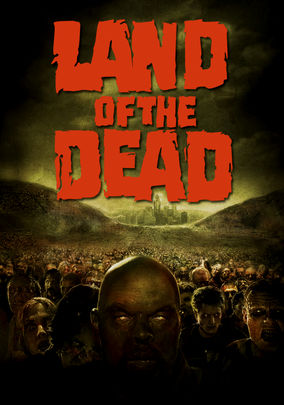
Saturday Matinee: Land of the Dead

3768363“Land of the Dead” (2005) is writer/director George Romero’s fourth film in his “Night of the Living Dead” series and  is possibly the most underrated installment so far. The film offers a variety of new twists to the series such as the development of basic problem solving skills among zombies and the not-too-subtle symbolism of a walled city ruled by a dictator from the top of a luxury high rise. It continues and heightens the social commentary most apparent in the second film of the series, “Dawn of the Dead” while steering it in surprising directions. While the film is not without it’s share of plot holes, it’s screenplay is satisfying nevertheless, and features good performances from Dennis Hopper, Simon Baker, John Leguizamo, Asia Argento and Eugene Clark (with surprise cameos by Shaun of the Dead’s Simon Pegg and Edgar Wright).

http://www.dailymotion.com/video/x2ja94s