The Bayer-Monsanto Merger Is Bad News for the Planet

By Ellen Brown

Source: Truthdig

Two new studies from Europe show that the number of birds in agricultural areas of France has crashed by a third in just 15 years, with some species being almost eradicated. The collapse in the bird population mirrors the discovery last October that more than three quarters of all flying insects in Germany have vanished in just three decades. Insects are the staple food source of birds, the pollinators of fruits and the aerators of the soil.

The chief suspect in this mass extinction is the aggressive use of neonicotinoid pesticides, particularly imidacloprid and clothianidin, both made by the Germany-based chemical giant Bayer. These pesticides, along with toxic glyphosate herbicides such as Roundup, have delivered a one-two punch to monarch butterflies, honeybees and birds. But rather than banning these toxic chemicals, on March 21 the EU approved the $66 billion merger of Bayer and Monsanto, the U.S. agribusiness giant that produces Roundup and the genetically modified (GMO) seeds that have reduced seed diversity globally. The merger will make the Bayer-Monsanto conglomerate the largest seed and pesticide company in the world, giving it enormous power to control farm practices, putting private profits over the public interest.

As Massachusetts Sen. Elizabeth Warren noted in a speech in December at the Open Markets Institute, massive companies are merging into market-dominating entities that invest a share of their profits in lobbying and financing political campaigns, shaping the political system to their own ends. She called on the Trump administration to veto the Bayer-Monsanto merger, which is still under antitrust scrutiny and has yet to be approved in the U.S.

A 2016 survey of Trump’s voter base found that more than half disapproved of the Monsanto-Bayer merger, fearing it would result in higher food prices and higher costs for farmers. Before 1990, there were 600 or more small, independent seed businesses globally, many of them family-owned. By 2009, only about 100 survived, and seed prices had more than doubled. But reining in these powerful conglomerates is more than just a question of economics. It may be a question of the survival of life on this planet.

While Bayer’s neonicotinoid pesticides wipe out insects and birds, Monsanto’s glyphosate has been linked to more than 40 human diseases, including cancer. Its seeds have been genetically modified to survive this toxic herbicide, but the plants absorb it into their tissues. In the humans who eat the plants, glyphosate disrupts the endocrine system and the balance of gut bacteria, damages DNA and is a driver of cancerous mutations. Researchers summarizing a 2014 study of glyphosates in the Journal of Organic Systems linked them to the huge increase in chronic diseases in the United States, with the percentage of GMO corn and soy planted in the U.S. showing highly significant correlations with hypertension, stroke, diabetes, obesity, lipoprotein metabolism disorder, Alzheimer’s, Parkinson’s, multiple sclerosis, hepatitis C, end stage renal disease, acute kidney failure, cancers of the thyroid, liver, bladder, pancreas, kidney and myeloid leukaemia. But regulators have turned a blind eye, captured by corporate lobbyists and a political agenda that has more to do with power and control them protecting the health of the people.

The Trump administration has already approved a merger between former rivals Dow and DuPont, and has signed off on the takeover of Swiss pesticide giant Syngenta by ChemChina. If Monsanto-Bayer gets approved as well, just three corporations will dominate the majority of the world’s seed and pesticide markets, giving them enormous power to continue poisoning the planet at the expense of its inhabitants.

The Shady History of Bayer and the Petrochemical Cartel

To understand the magnitude of this threat, it is necessary to delve into some history. This is not the first time Monsanto and Bayer have joined forces. In both world wars, they made explosives and poisonous gases using shared technologies that they sold to both sides. After World War II, they united as MOBAY (MonsantoBayer) and supplied the ingredients for Agent Orange in the Vietnam War.

In fact, corporate mergers and cartels have played a central role in Bayer’s history. In 1904, it joined with German giants BASF and AGFA to form the first chemical cartel. After World War I, Germany’s entire chemical industry merged to become I.G. Farben. By the beginning of World War II, I.G. Farben was the largest industrial corporation in Europe, the largest chemical company in the world, and part of the most gigantic and powerful cartel in all history.

A cartel is a grouping of companies bound by agreements designed to restrict competition and keep prices high. The dark history of the I.G. Farben cartel was detailed in a 1974 book titled “World Without Cancer,” by G. Edward Griffin, who also wrote the best-selling “Creature from Jekyll Island,” on the shady history of the Federal Reserve. Griffin quoted from a book titled “Treason’s Peace,” by Howard Ambruster, an American chemical engineer who had studied the close relations between the German chemical trust and certain American corporations. Ambruster warned:

Farben is no mere industrial enterprise conducted by Germans for the extraction of profits at home and abroad. Rather, it is and must be recognized as a cabalistic organization which, through foreign subsidiaries and secret tie-ups, operates a far-flung and highly efficient espionage machine—the ultimate purpose being world conquest … and a world superstate directed by Farben.

The I.G. Farben cartel arose out of the international oil industry. Coal tar or crude oil is the source material for most commercial chemical products, including those used in drugs and explosives. I.G. Farben established cartel agreements with hundreds of American companies. They had little choice but to capitulate after the Rockefeller empire, represented by Standard Oil of New Jersey, did so, because they could not hope to compete with the Rockefeller-I.G. combination.

The Rockefeller group’s greatest influence was exerted through international finance and investment banking, putting them in control of a wide spectrum of industry. Their influence was particularly heavy in pharmaceuticals. The directors of the American I.G. Chemical Company included Paul Warburg, brother of a director of the parent company in Germany and a chief architect of the Federal Reserve system.

The I.G. Farben cartel was technically disbanded at the Nuremberg trials following World War II, but in fact it merely split into three new companies—Bayer, Hoescht and BASF—which remain pharmaceutical giants today. To conceal its checkered history, Bayer orchestrated a merger with Monsanto in 1954, giving rise to the MOBAY Corp. In 1964, the U.S. Justice Department filed an antitrust lawsuit against MOBAY and insisted that it be broken up, but the companies continued to work together unofficially.

In “Seeds of Destruction: The Hidden Agenda of Genetic Manipulation” (2007), William Engdahl states that global food control and depopulation became U.S. strategic policy under Rockefeller protégé Henry Kissinger, who was secretary of state in the 1970s. Along with oil geopolitics, these policies were to be the new “solution” to the threats to U.S. global power and continued U.S. access to cheap raw materials from the developing world. “Control oil and you control nations,” Kissinger notoriously declared. “Control food and you control the people.”

Global food control has nearly been achieved, by reducing seed diversity and establishing proprietary control with GMO seeds distributed by only a few transnational corporations, led by Monsanto; and by a massive, taxpayer-subsidized propaganda campaign in support of GMO seeds and neurotoxic pesticides. A de facto cartel of giant chemical, drug, oil, banking and insurance companies connected by interlocking directorates reaps the profits at both ends, by waging a very lucrative pharmaceutical assault on the diseases created by their toxic agricultural chemicals.

Going Organic: The Russian Approach

In the end, the Green Revolution engineered by Kissinger to control markets and ensure U.S. economic dominance may be our nemesis. While the U.S. struggles to maintain its hegemony by economic coercion and military force, Russia is winning the battle for the health of the people and the environment. Russian President Vladimir Putin has banned GMOs and has set out to make Russia the world’s leading supplier of organic food.

Russian families are showing what can be done with permaculture methods on simple garden plots. In 2011, 40 percent of Russia’s food was grown on dachas (cottage gardens or allotments), predominantly organically. Dacha gardens produced more than 80 percent of the country’s fruit and berries, more than 66 percent of the vegetables, almost 80 percent of the potatoes and nearly 50 percent of the nation’s milk, much of it consumed raw. Russian author Vladimir Megre comments:

Essentially, what Russian gardeners do is demonstrate that gardeners can feed the world—and you do not need any GMOs, industrial farms, or any other technological gimmicks to guarantee everybody’s got enough food to eat. Bear in mind that Russia only has 110 days of growing season per year—so in the US, for example, gardeners’ output could be substantially greater. Today, however, the area taken up by lawns in the US is two times greater than that of Russia’s gardens—and it produces nothing but a multi-billion-dollar lawn care industry.

In the U.S., only about 0.6 percent of the total agricultural area is devoted to organic farming. Most farmland is soaked in pesticides and herbicides. But the need for these toxic chemicals is a myth. In an October 2017 article in The Guardian, columnist George Monbiot cited studies showing that reducing the use of neonicotinoid pesticides actually increases production, because the pesticides harm or kill the pollinators on which crops depend. Rather than an international trade agreement that would enable giant transnational corporations to dictate to governments, he argues that we need a global treaty to regulate pesticides and require environmental impact assessments for farming. He writes:

Farmers and governments have been comprehensively conned by the global pesticide industry. It has ensured its products should not be properly regulated or even, in real-world conditions, properly assessed. … The profits of these companies depend on ecocide. Do we allow them to hold the world to ransom, or do we acknowledge that the survival of the living world is more important than returns to their shareholders?

President Trump has boasted of winning awards for environmental protection. If he is sincere about championing the environment, he needs to block the merger of Bayer and Monsanto, two agribusiness giants bent on destroying the ecosystem for private profit.


Ellen Brown is an attorney, chairman of the Public Banking Institute, and author of twelve books including “Web of Debt” and “The Public Bank Solution.”
The Other Side of the Post’s Katharine Graham

By Norman Solomon

Source: Consortium News

Movie critics are already hailing “The Post,” directed by Steven Spielberg and starring Meryl Streep as Washington Post publisher Katharine Graham. Millions of people will see the film in early winter. But the real-life political story of Graham and her newspaper is not a narrative that’s headed to the multiplexes.

“The Post” comes 20 years after Graham’s autobiography Personal History appeared and won enormous praise. Read as a memoir, the book is a poignant account of Graham’s long quest to overcome sexism, learn the newspaper business and gain self-esteem. Read as media history, however, it is deceptive.

“I don’t believe that whom I was or wasn’t friends with interfered with our reporting at any of our publications,” Graham wrote. However, Robert Parry — who was a Washington correspondent for Newsweek during the last three years of the 1980s — has shed some light on the shadows of Graham’s reassuring prose. Contrary to the claims in her book, Parry said he witnessed “self-censorship because of the coziness between Post-Newsweek executives and senior national security figures.”

Among Parry’s examples: “On one occasion in 1987, I was told that my story about the CIA funneling anti-Sandinista money through Nicaragua’s Catholic Church had been watered down because the story needed to be run past Mrs. Graham, and Henry Kissinger was her house guest that weekend. Apparently, there was fear among the top editors that the story as written might cause some consternation.” (The 1996 memoir of former CIA Director Robert Gates confirmed that Parry had the story right all along.)

Graham’s book exudes affection for Kissinger as well as Robert McNamara and other luminaries of various administrations who remained her close friends until she died in 2001. To Graham, men like McNamara and Kissinger — the main war architects for Presidents Lyndon Johnson and Richard Nixon — were wonderful human beings.

In sharp contrast, Graham devoted dozens of righteous pages to vilifying Post press operators who went on strike in 1975. She stressed the damage done to printing equipment as the walkout began and “the unforgivable acts of violence throughout the strike.” It is a profound commentary on her outlook that thuggish deeds by a few of the strikers were “unforgivable” — but men like McNamara and Kissinger were lovable after they oversaw horrendous slaughter in Southeast Asia.

Graham’s autobiography portrays union stalwarts as mostly ruffians or dupes. “Only a handful of [Newspaper Guild] members had gone out for reasons I respected,” she told readers. “One was John Hanrahan, a good reporter and a nice man who came from a longtime labor family and simply couldn’t cross a picket line. He never did come back. Living your beliefs is a rare virtue and greatly to be admired.”

But for Hanrahan (whose Republican parents actually never belonged to a union) the admiration was far from mutual. As he put it, “The Washington Post under Katharine Graham pioneered the union-busting ‘replacement worker’ strategy that Ronald Reagan subsequently used against the air-traffic controllers and that corporate America — in the Caterpillar, Bridgestone/Firestone and other strikes — used to throw thousands of workers out of their jobs in the 1980s and the ’90s.”

The Washington Post deserves credit for publishing sections of the Pentagon Papers immediately after a federal court injunction in mid-June 1971 stopped the New York Times from continuing to print excerpts from the secret document. That’s the high point of the Washington Post’s record in relation to the Vietnam War. The newspaper strongly supported the war for many years.

Yet Graham’s book avoids any semblance of introspection about the Vietnam War and the human costs of the Post’s support for it. Her book recounts that she huddled with a writer in line to take charge of the editorial page in August 1966: “We agreed that the Post ought to work its way out of the very supportive editorial position it had taken, but we couldn’t be precipitous; we had to move away gradually from where we had been.” Vast carnage resulted from such unwillingness to be “precipitous.”

Although widely touted as a feminist parable, Graham’s Pulitzer Prize-winning autobiography is notably bereft of solidarity for women without affluence or white skin. They barely seemed to exist in her range of vision; painful realities of class and racial biases were dim, faraway specks. Overall the 625-page book gives short shrift to the unrich and unfamous, whose lives are peripheral to the drama played out by the wealthy publisher’s dazzling peers. The name of Martin Luther King Jr. does not appear in her star-studded, history-drenched book.

Katharine Graham’s decision to publish the Pentagon Papers was indeed laudable, helping to expose lies that had greased the wheels of the war machinery with such horrific consequences in Vietnam. But the Washington Post was instrumental in avidly promoting the lies that made the Vietnam War possible in the first place. No amount of rave reviews or Oscar nominations for “The Post” will change that awful truth.


Norman Solomon is the coordinator of the online activist group RootsAction.org and the executive director of the Institute for Public Accuracy. He is the author of a dozen books including “War Made Easy: How Presidents and Pundits Keep Spinning Us to Death.”

Are Globalists Losing Ground?

Source: News Junkie Post

Death might be the ultimate equalizer, but in the case of David Rockefeller, considerable wealth brought unacceptable privilege and made  survival to illness obscene by any moral or even medical ethics standards. On August 24, 2016, David Rockefeller received his 7th heart transplant which made him, besides being the grandson of the United States’ richest man and first billionaire, the worldwide record holder for number of heart transplants. Coincidentally, musician Chuck Berry passed away a couple of days before David Rockefeller. While Chuck Berry’s lust for life will be a legacy of pure joy for generations to come, not only on earth but even far in the cosmos, David Rockefeller’s refusal to let life take its natural course came from greed and a lust for power. Rockefeller was the ultimate symptom of the sickness of our world, where quantity matters, and quality does not.

Even though Rockefeller was a key figure and, in many regards, one of the founding fathers of the globalist world order project, the speculations that his death is a major blow to the financial elite is a pie in the sky. The self-proclaimed Masters of the Universe of Wall Street are as arrogant as ever, all of them young crocodiles ready to feast on the carcasses of the old ones. Despite Rockefeller’s passing, the giant Hydra of the globalist swamp still thrives: one of the many heads was lost, a few will grow to take its place. This notion that a board matters more than an organ or an individual is, after all, part of the precept of the globalist doctrine, which David Rockefeller helped to structure in the early 1950s. Setting up networks, groups, or councils of his elite peers was always the Rockefellers’ philosophy, and it became the redoubtable strength of the one-world-order project.

Like all prominent members of  the  globalist syndicate, David Rockefeller had nothing but contempt for the common mortal. Machiavellian plans to manipulate the public opinion, like one would mold a slab of clay, came easily to him. “We are on the verge of a global transformation. All we need is the right major crisis and the nations will accept the New World Order,” said David Rockefeller on September 14, 1994 at a United Nations meeting. Seven years later, almost to the day, the right major crisis would occur in New York City at the World Trade Center.

Under David Rockefeller as CEO, Chase Bank grew through a network of correspondent banks, including some in the former Soviet Union and in China in the early 1970s. Chase reached a network of about 50,000 banks, and it is the largest financial consortium in the world. As a key player in the globalist order, Rockefeller was instrumental in setting up the Chase International Advisory Committee (IAC) in the early 1960s. He was the IAC Chairman until 1999. The IAC was renamed International Council, after Chase’s merger with JP Morgan, and by 2005 included 25 members of the global elite from 20 different countries. This exclusive financial club has included Henry Kissinger, Riley Bechtel, George Shultz, Gianni Agnelli, John Loudon (CEO of Shell), David Packard, Henry Ford II, and current chairman Tony Blair. Ultimate oligarch globalist David Rockefeller was also the driving force behind the creation of the Bilderberg group, where he served for decades as gatekeeper, being the only member of the advisory board. It is through those various channels and groups of people that David Rockefeller quietly but efficiently influenced not only United States domestic and foreign policies but also world affairs.

Rockefeller has been a behind-the-scene adviser of every US president since Dwight Eisenhower. Needless to say, his half-a-century friendship with Henry Kissinger was highly beneficial for both in world affairs. The two men met in 1954, and at first the patronage of Rockefeller was critical to Kissinger’s rise as a top policy adviser. To David Rockefeller’s credit, he was always upfront about his globalist agenda. “Some even believe we are part of a secret cabal working against the best interest of the United States, characterizing my family and me as ‘Internationalists’, and of conspiring with others around the world to build a more integrated global political and economic structure: one world, if you will. If that’s the charge, I stand guilty and I am proud of it,” wrote David Rockefeller in his memoirs.

Just like relatively newcomer George Soros, Rockefeller was extremely media savvy, and few news outlets dared to cross the billionaire, who, despite his relatively modest fortune of 3 billion, which is suspected to be highly under-reported, had a lot more sway and political power than his high-tech billionaire colleagues reported to be vastly richer. Rockefeller was a major force personally in the corridors of international power since the early 50s and, through his family network, for more than a century. In the globalist Orwellian construct, David Rockefeller had seniority, not only in age but also in influence, over Henry Kissinger and George Soros. Some fringe anti-globalist conspiracy theorists have recently claimed that George Soros doesn’t really exist and is another persona invented by David Rockefeller. This is nonsense, of course, and just as counterproductive as the characterization of globalists such as Soros, Rockefeller, and Kissinger as anti-Christ blood sucking vultures by Christian fundamentalists who support Trump. As a matter of fact, this type of lunacy is detrimental to valid rational critiques in the fight against a world order that, if successful in its final takeover still in progress, would enslave most humans for the benefit of a few thousand worldwide. This is what we are dealing with here: a prosaic fight for freedom and decent survival for all, not some chimeras extracted from fairy tales.

David Rockefeller was not Satan, but he was, just like his colleague and globalist partner-in-crime George Soros, a consummate kingmaker and puppet master. As such, Rockefeller played a big role in Bill Clinton’s rise to power. In 1991, when Clinton was Governor of Arkansas, Rockefeller invited him to the secretive Bilderberg group meeting, which took place that year in Baden-Baden, Germany. It was there that Rockefeller made the statement: “We are grateful to The Washington Post, The New York Times, Time Magazine and other great publications whose directors have attended our meetings and respected their promises of discretion for almost forty years. It would have been impossible for us to develop our plan for the world if we had been subjected to the lights of publicity during those years. But the world is now more sophisticated and prepared towards a world government. The supranational sovereignty of an intellectual elite and world bankers is preferable to the national auto-determination practiced in past centuries.” During the 26 years since David Rockefeller gave this speech, the lead globalists, their giant corporations, especially those of the military-industrial complex, as well as their obedient political helpers worldwide have worked hard to implement their plan to dismantle national sovereignty.

The BREXIT vote in the United Kingdom and election of Trump in the US were a reaction against the looming monstrosity of a world government dominated by a rarefied oligarchy, but at this juncture the globalists are alive and kicking, as the anti-establishment drain-the-swamp rhetoric seems to be not much more than a flash in a pan. Personality issues, spying rumors, accusations of collusion with a foreign government, and the threat of a so-called deep state are amplified by news outlets, fake and real. It is hard to tell the difference. These supposed issues have fostered a climate of fear and paranoia and been a distraction from real policy issues. Despite a Republican majority in the Congress, the Trump administration has so far essentially ruled by executive orders, some of which have been almost immediately challenged by courts. Level of wealth, rather than competence at a specific job, seems to be the criterion for being hired in the Trump administration. Judging by the facts alone, America Empire Inc. might have a new CEO, but the same people appear to be in control of the board, and if he were still alive, David Rockefeller’s voice would be heard on this. President Donald Trump’s budget proposal tells the story accurately: while most areas of the meager American social safety net could experience a cut, the Pentagon budget would increase by 10 percent. Mr. Trump has always been about money and business. As such, he understands that the military-industrial complex should remain the core division of America Empire Inc. So much for draining the swamp.


Gilbert Mercier is the author of The Orwellian Empire. Composite one by David Blackwell; cartoons four and six Frits Ahlefeldt; composite five by Tom Blackwell; photograph eight by Paolo Di Tommaso; and photograph nine Zach Korb. Part of this article was published as an interview with Sputnik.

Hillary Clinton Breaks the Irony Meter

By Kevin Carson

Source: Center for a Stateless Society

At the March 9 Democratic debate, Hillary Clinton had this to say about competitor Bernie Sanders’s favorable comments on Castro’s Cuba and the Sandinista regime in the ’80s:  “if the values are that you oppress people, you disappear people, imprison people or even kill people for expressing their opinions…, that is not the kind of revolution of values that I ever want to see anywhere.” This, coming from a former Secretary of State who backed a right-wing coup in Honduras and proudly name-drops Henry Kissinger — Henry Kissinger! — as a close friend and mentor, is the kind of thing the Onion can’t compete with.

If Kissinger was known for anything in his years as National Security Adviser and Secretary of State, it was installing dictators who oppressed, disappeared and imprisoned people. He oversaw a wave of coups that swept South America in the late ’60s and ’70s, installing right-wing military regimes that tortured, murdered or disappeared dissidents by the thousands, and where a common fate for labor and peasant activists was to be found in a ditch with their faces hacked off. Under Kissinger the U.S. actively supported Operation Condor — the program by which these South American dictators used torture and murder to suppress opposition — with military aid and technical assistance. He gave the green light to Indonesia’s genocidal invasion of East Timor.

Clinton has a long history of close personal friendship with this monster, and indeed touts herself as something of a protege. According to both Hillary and Bill, Kissinger praised her for running the State Department better than anybody in decades. And well might he praise her, because she’s followed in his footsteps in many ways. As Secretary of State, she oversaw the sale of millions of dollars worth of arms to despotic regimes that oppressed, disappeared and imprisoned people for expressing their opinions — many of which regimes were also large donors to the Clinton Foundation. And while we’re on the subject of people being murdered and disappeared, how about Berta Caceres — an activist murdered by the right-wing Honduran regime whose seizure of power Clinton backed in 2009?

As senator, Clinton voted to authorize George Bush’s criminal war of aggression on Iraq, which has resulted in hundreds of thousands of Iraqi deaths since 2003. She says now it was “a mistake.” It was a mistake all right. She mistakenly believed the vote would make her more viable as a future presidential candidate. She mistakenly predicted the way the political winds would be blowing when she decided to run for president.

And don’t forget Clinton’s support for the Obama administration’s indiscriminate use of drones for extrajudicial killing. Many of the victims were civilians, and hundreds of them were actually children.

If you add it all up, Hillary Clinton still isn’t quite the war criminal her old friend and mentor Henry Kissinger is. Those are some big, bloody shoes to fill. But if she’s elected she’ll grow into them.

Bush-Clinton Mafia Dynasties Merry-Go-Round

The_Godfather_LogoBy Gilbert Mercier

Source: News Junkie Post

If a space or a time traveler would set his time ship’s dial to 2015, with the United States as its destination, one could think that a mandatory preparation for the journey to understand the US’ political system would be an attentive study of the Constitution. After all, the document, drafted in 1787 by the so called “founding fathers” and finally ratified three later in 1790 in its original form, is supposed to be the foundation of the US’ political edifice. Two hundred and twenty-five years later, the document has been so much thoroughly gutted of its substantial original merits, at least in its spirit if not its letter, that the foundation of the building has become a superfluous architectural ornament. While the US Constitution was far from being revolutionary and granted equal rights only to white male landowners, it marked, in conjunction with the French revolution of 1789, a resolute break from the European kingdoms. No kings or queens could ever claim this land again, under any circumstance. A republic, ruled by a meritocracy of well-educated Anglo-Saxon patrician men, was born. Since 190 years after the US Constitution’s ratification, however, which is exactly since 1980, the country has been ruled by two dynasties or their surrogates: the Bushes and the Clintons.

American royal mafia and co: organized crime as political model

To understand the undemocratic and extremely seedy side of US modern-day politics, it would be imperative for our time traveler, de Tocqueville in training, to watch two classics of American cinema: “The Godfather” and “The Godfather Part II”. Director Francis Ford Coppola, in his fictional, yet extremely well-researched and documented films, invited us inside the US’ underbelly. During the 19th century and up to the early 20th century, a massive numbers of poor immigrants, mainly Italians, Irish and Jews from eastern Europe, were lured to the Americas largely to escape economic hardship. Those who landed in the US quickly understood that they were excluded from or at best marginalized in this promised land run by white Anglo-Saxon Protestants. The more ambitious ones, unencumbered by moral boundaries, developed their own form of government and social code of conduct in the form of a tightly knit family-like structure that usually strictly followed ethnic lines. The birth of organized crime in the US, either Italian, Jewish or Irish, was a direct consequence of the fight for survival of communities that were deliberately excluded from power or even any political discourse.

Mafia families had a strictly enforced code of conduct and precise hierarchy, with a Don (boss) at the top; a Consiglierie (adviser to the head of the family) directly picked by the Don; an Under-Boss who was usually groomed to be the Don’s successor; Capos (the lieutenants), and “soldiers”. In the 1930s, under the supervision of Lucky Luciano, the Don of all Dons, not only the five Italian mafia families worked together, but they also collaborated on many occasions with the Jewish and Irish mafia. In this parallel brand of power and economy, mafia families extracted contributions (a primitive form of taxation of usually 10 percent of income) from businesses, ironically to protect them from random criminal activity. By the mid-1930s mafia families controlled large sections of the US economy. The prohibition of alcoholic beverages, which spanned from 1920 to 1933, marked the apogee of the mafia families, either Italian, Jewish or Irish. The mob controlled the flow of liquor, and Americans were thirsty.

During the prohibition era, Joe Kennedy (father of John F. Kennedy and Robert F. Kennedy), the patriarch of a family that passed for being true US aristocracy although he had been the grandson of a dirt-poor potato-famine Irish immigrant, substantially increased his vast fortune by importing, from the UK and Canada, and selling illicit liquor in association with Italian-American don Frank Costello and Jewish gangster Meyer Lansky. Joe Kennedy had an edge on the competition: he went into the prohibition era in 1920 with large stocks of booze from his father’s own stores. In what cannot be a coincidence, on the day prohibition ended 13 years later, Joe Kennedy had three exclusive deals to import British whiskey and gin, as well as a extensive network of retailers already in place. Kennedy understood that his political ambitions for his sons would require vast amounts of money. Like any mafia bosses, don Joe Kennedy wanted to start a dynasty at any cost and regardless of moral or even legal considerations. In the US, money meant power, and this is a notion that was the motto for both supposed blue-blood patriarch Kennedy and don Lucky Luciano.

Bush mafia vs Clinton mafia: Defining US politics from 1980 to 2016

Arguably, the first term of George H. Bush, founder of the Bush dynasty, started in 1980 when he officially became Vice President or, to use the mafia term, super under-boss to Ronald Reagan, an aging actor, perhaps already senile, hired to perform the role of global don: “Leader of the free world” and most powerful man on earth, according to US mainstream media propaganda. Bush Sr. had previously run the Central Intelligence Agency. During the two terms of the Reagan administration (1980 to 1988), it was common knowledge that he was the boss who led US policy. He officially became the don in 1988, and ran his own operation with pretty much the same crew until 1992. James Baker was the key consigliere to don Bush Sr, but he also listened closely to the Talleyrand of US politics, consigliere extraordinaire Henri Kissinger. Bush Sr’s under-boss was Donald Rumsfeld who picked his capo in the person of Dick Cheney. George W. Bush or Bush Jr, when his turn came, kept most of the old don’s crew with some minor changes and additions. Cheney became the under-boss, while Rumsfeld took the vital Pentagon portfolio.

Before George W. Bush’s turn, the Clinton dynasty came along in 1992, courtesy of WallMart, and with the firm intention, as an obligation to their sponsors, to facilitate a global corporate imperialist agenda. With the North American Free Trade Agreement (NAFTA), don Bill Clinton went the extra mile for the benefit of his friends in transnational corporations. Bill Clinton became a favorite of Wall Street’s investment banks, such as Goldman Sachs, by being instrumental in the repeal of the Glass-Steagall Act which was voted in 1933 during the Great Depression in the aftermath of the 1929 Wall Street crash. The Glass-Steagall Act limited commercial banks securities activities, and it clearly separated commercial banking from investment banking, to curtail speculation. The repeal of this Act allowed Wall Street investment banks to gamble money that was held in commercial banks, and this was arguably one of the lead systemic factors in the 2008 global financial-market crash.

Don Clinton’s consigliere was mainly first-lady Hillary, but he also took the advice of the other super-consigliere, beside Kissinger: Polish born Zbigniew Brzezinski. Consigliere Brzezinski started his career in 1966 when he advised Lyndon B. Johnson. He returned in the late 1970s to advise Jimmy Carter. When he was Carter’s consigliere, Brzezinski came up with the idea to finance and arm the Mujahideen in Afghanistan to fight the Soviet Union. Don Clinton’s under-boss was Leon Panetta, and the lead capo was Rahm Emanuel. When dona Hillary Clinton lost what she viewed as being her turn in the driver’s seat, both the Clinton and Bush mafias made sure that young capo Barack Obama, who had not patiently waited for his turn in the limelight, was surrounded by trusted hands. One can imagine the deal imposed on Obama by Bill and Dick. The Bush mafia would keep the Pentagon for the time being; Hillary would run US foreign policy from the State Department; don Bill’s under-boss Leon Panetta would become Obama’s CIA director (2009 to 2011) and boss of the Pentagon (2011 to 2013). Clinton’s trusted lead capo Rahm Emanuel became Obama’s under-boss. Don Bill did not stay idle after the 2008 election, he became Obama’s lead consigliere, with the occasional help on geopolitical dossiers such as Ukraine of… Brzezinski of course. The 88-year-old anti-Russian Democrat uber-consigliere’s latest contribution has been to bring back the Cold War into international affairs. Bill Clinton’s main task was to replenish the family coffers through the Clinton Global Initiative, a fund raising operation disguised as being humanitarian. After the 2010 earthquake, Haiti became don Bill’s pet project and personal fiefdom.

Is there anyway off this sinister merry go round?

By now, our time-traveler hero realizes that the premise of the upcoming 2016 US presidential  election “fight” is already set. It will be a rematch of an old time classic: Bush against Clinton, dona Hillary versus don Jeb. For good measure, and to give American consumers of elections a sense that their democracy is not an illusion, there will be unelectable challengers in the fake primaries. This will be strictly for entertainment purposes and to indulge the so-called American left. On a short list of likely seat warmers for Hillary are Elizabeth Warren, Bernie Sanders, perhaps even Joe Biden. On the Bush side of the ring, the supposed primary challengers will be harder to find: perhaps Mitt Romney again or phony Libertarian Rand Paul. But let us listen to what Consigliere extraordinaire Henry Kissinger recently said on the issue, after all he has advised more US presidents than anyone else alive. In a September 6, 2014 interview with NPR‘s Scott Simon, when asked if Hillary Clinton would make a good president, Kissinger said:“I know Hillary as a person, and as a personal friend. I would say, yes she would be a good president. But that would put me under a great conflict of interest if she were a candidate, because I intend to support the Republicans….Yes I would be comfortable with her as a president.” Our time traveler, de Tocqueville in training, is dazed, confused and disgusted by what the US has grown into: in this display of vile and raw power for power’s sake, the sort of charade that notions like democracy, the common good and morality have become.


Who’s the “Low Life Scum:” Kissinger or CODEPINK?

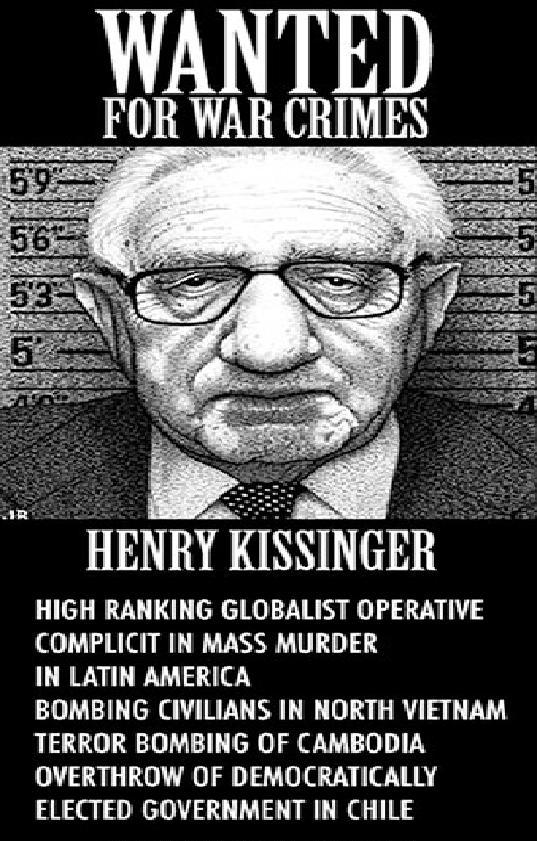
kissinger-wanted

By Medea Benjamin

Source: Information Clearing House

A very angry Senator John McCain denounced CodePink activists as “low-life scum” for holding up signs reading “Arrest Kissinger for War Crimes” and dangling handcuffs next to Henry Kissinger’s head during a Senate hearing on January 29. McCain called the demonstration “disgraceful, outrageous and despicable,” accused the protesters of “physically intimidating” Kissinger and apologized profusely to his friend for this “deeply troubling incident.”

But if Senator McCain was really concerned about physical intimidation, perhaps he should have conjured up the memory of the gentle Chilean singer/songwriter Victor Jara. After Kissinger facilitated the September 11, 1973 coup against Salvador Allende that brought the ruthless Augusto Pinochet to power, Victor Jara and 5,000 others were rounded up in Chile’s National Stadium. Jara’s hands were smashed and his nails torn off; the sadistic guards then ordered him to play his guitar. Jara was later found dumped on the street, his dead body riddled with gunshot wounds and signs of torture.

Despite warnings by senior US officials that thousands of Chileans were being tortured and slaughtered, then Secretary of State Kissinger told Pinochet, “You did a great service to the West in overthrowing Allende.”

Rather than calling peaceful protesters “despicable,” perhaps Senator McCain should have used that term to describe Kissinger’s role in the brutal 1975 Indonesian invasion of East Timor, which took place just hours after Kissinger and President Ford visited Indonesia. They had given the Indonesian strongman the US green light—and the weapons—for an invasion that led to a 25-year occupation in which over 100,000 soldiers and civilians were killed or starved to death. The UN’s Commission for Reception, Truth and Reconciliation in East Timor (CAVR) stated that U.S. “political and military support were fundamental to the Indonesian invasion and occupation” of East Timor.

If McCain could stomach it, he could have read the report by the UN Commission on Human Rights describing the horrific consequences of that invasion. It includes gang rape of female detainees following periods of prolonged sexual torture; placing women in tanks of water for prolonged periods, including submerging their heads, before being raped; the use of snakes to instill terror during sexual torture; and the mutilation of women’s sexual organs, including insertion of batteries into vaginas and burning nipples and genitals with cigarettes. Talk about physical intimidation, Senator McCain!

You might think that McCain, who suffered tremendously in Vietnam, might be more sensitive to Kissinger’s role in prolonging that war. From 1969 through 1973, it was Kissinger, along with President Nixon, who oversaw the slaughter in Vietnam, Cambodia and Laos—killing perhaps one million during this period. He gave the order for the secret bombing of Cambodia. Kissinger is heard on tape saying, “[Nixon] wants a massive bombing campaign in Cambodia. He doesn’t want to hear anything about it. It’s an order, to be done. Anything that flies or anything that moves.”

Senator McCain could have taken the easy route by simply reading the meticulously researched book by the late Christopher Hitchens, The Trial of Henry Kissinger. Writing as a prosecutor before an international court of law, Hitchens skewers Kissinger for ordering or sanctioning the destruction of civilian populations, the assassination of “unfriendly” politicians and the kidnapping and disappearance of soldiers, journalists and clerics who got in his way. He holds Kissinger responsible for war crimes that range from the deliberate mass killings of civilian populations in Indochina, to collusion in mass murder and assassination in Bangladesh, the overthrow of the democratically elected government in Chile, and the incitement and enabling of genocide in East Timor.

McCain could have also perused the warrant issued by French Judge Roger Le Loire to have Kissinger appear before his court. When the French served Kissinger with summons in 2001 at the Ritz Hotel in Paris, Kissinger fled the country. More indictments followed from Spain, Argentina, Uruguay—even a civil suit in Washington DC.

Hitchens was disgusted by the way Henry Kissinger was treated as a respected statesman. He would have been appalled by Senator McCain’s obsequious attitude. “Kissinger should have the door shut in his face by every decent person and should be shamed, ostracized, and excluded,” Hitchens said. “No more dinners in his honor; no more respectful audiences for his absurdly overpriced public appearances; no more smirking photographs with hostesses and celebrities; no more soliciting of his worthless opinions by sycophantic editors and producers.”

Rather than fawning on him, Hitchens suggested, “why don’t you arrest him?”

Hitchens’ words were lost on Senator McCain, who preferred fawning to accountability. That’s where CodePink comes in. If we can’t get Kissinger before a court of law, at least we can show—with words and banners—that there are Americans who remember, Americans who empathize with the man’s many victims, Americans who have a conscience.

While McCain called us disgraceful, what is really disgraceful is the Senate calling in a tired old war criminal to testify about “Global Challenges and the U.S. National Security Strategy.” After horribly tragic failed wars, not just in Vietnam but over the last decade in Iraq and Afghanistan, it’s time for the US leaders like John McCain to bring in fresh faces and fresh ideas. We owe it to the next generation that will be cleaning up the bloody legacy left behind by Kissinger for years to come.