The New Economy: Unemployment and the Return of the American Hobo

By Sheldon Greaves

Source: Cogito!

A few years ago I read somewhere about a trend in the “gig economy” in which people who had been reduced to living in their cars or RVs roamed the country by the thousands; homeless, nomadic workers driving from one temporary job to another. It painted a tragic picture; underpaid, overworked, often lacking health insurance, men and women, many of whom ought to be enjoying retirement but were working in warehouses filling orders for Amazon (“Camperforce”) or stocking shelves in a big-box store.

It sharply reminded me of the Great Depression, another time when mobile workers moved from place to place across the country in search of work. Thinking about this I realized that what we were seeing was the return of the migrant worker apart from the seasonal farm worker, i.e., the Hobo. Also called Tramps, Bums and other less charitable names, these men were the displaced detritus of the Great Depression who wandered the country looking for any jobs that would help them survive and, if there was any left over, to send home to their families. It was a dangerous life; travelling by hopping freight trains or hitchhiking on the highways wasn’t the safest way to get around. Many hobos were maimed or killed in accidents travelling this way, or were victims of violence. Loren Eisley’s wonderful memoir All the Strange Hours recalls his days as a young hobo with all of the dangers and troubles that went with being a hobo. They also faced hostility from towns naturally suspicious of outsiders, especially if there wasn’t any work even for the locals.

But the hobos also became a part of American folklore. The music of Woody Guthrie, who spent quite a bit of time on freight trains himself, helped to make the plight of these unemployed workers known to the rest of the country. Government programs found ways to harness this pool of labor and skill, pouring it into vast projects, many of which continue to contribute to national economy today.

There was, however, another side to hobo life. It became a sort of counter-culture, a rebellion of sorts against a social order that had unfairly cast aside decent, hard-working people for the sake of profit. Hobo life in some cases became a form of dropout culture, mainly, I suspect, as a way of embracing what apparently could not be avoided. An old professor of mine, who spent some of his youth as a tramp, recalled how some of his tramping companions actually knew more about science and literature than his college professors, but preferred tramping as a better way to enjoy God’s creations. Dropouts indeed.

I have been fascinated by American dropout culture as a response to moments when society becomes economically, intellectually, morally, and spiritually intolerable and so, like a few Biblical figures, one leaves, going out of bondage, but into the wilderness for whatever it may bring one. Historically, I’ve noticed that from Roanoke to the 1960’s and 70’s, the dropouts generally seemed to have a point, even if it wasn’t clear at the time. Sometimes the dropouts used their unique viewpoint to inform changes for the better, or became part of grander projects as happened with the government work projects of the New Deal.

So it is with some bemusement that I have noticed an interesting trend when it comes to the mobile temp workers, hobos with RVs or living out of their cars. Over the last seven or so years a small body of literature has emerged celebrating the homeless, wandering worker. Getting out of debt is a common reason for ditching less settled living, and as a rejection of consumerism (Ironic, given how many of these mobile temp jobs are serving precisely that consumer economy). The whole thing has a Small is Beautiful/Voluntary Simplicity vibe to it. Three of the six or so book titles of the last few years even reference “living in a van down by the river” in homage to a classic SNL skit.

So which is it? Is the new hobo a national tragedy in slow-motion, or rebellion against consumer culture, a new manifestation of the All-American dropout? I think it’s too early to tell. This may be nothing more or less than trying to make the best of a bad situation. I hope it’s more than that.

Famed American author and philosopher Eric Hoffer, himself a long-time migrant worker, had some remarkable insights into the responsibility of a nation to do right by such men and women. In his essay, “The Role of the Undesirables”, based on his own experience in government work camps in the early 1930’s. He draws some interesting and telling comparisons between the “human junk pile” that made up the bulk of his fellow workers and the early American pioneers–themselves undesirables from Europe–who built the nation. He points out that these pioneers craved change, much like the RV hobos of today. Hoffer writes: “…the quality and destiny of a nation are determined to a considerable extent by the nature and potentialities of its inferior elements.” He further argues that the quality of a nation is likewise manifest by how those at the bottom rise to the top. And that, I submit, is the problem. Is there an endgame to the RV hobo life that involves a chance to settle back down, to enjoy some of the fruits of one’s labor in security and dignity? Certainly a life on the road can be exciting. I find the idea compelling myself. But the other kind of mobility–upward mobility–has all but ceased to exist in this country. I cannot yet say whether these economic rebels of the road are truly making a new way of living, or accepting the unacceptable.

The 1% Versus the 99%: Realignment, Repression or Revolution

640px-Standard_oil_octopus_loc_color

Wealth Inequality Is Putting the US on Course for a Showdown

By Klaus Marre

Source: WhoWhatWhy.org

The richest 20 Americans now own as much wealth as the country’s poorest 152 million people combined.

That is just one of the findings of noted inequality scholar and author Chuck Collins’s most recent report, “Billionaire Bonanza, The Forbes 400 and the Rest of Us.”

In a wide-ranging interview, which will be available in its entirety as a podcast tomorrow, Collins likened the current situation to the “Gilded Age,” the time just before the turn of the 20th century, when there was a similar accumulation of wealth at the top and political power was concentrated in the hands of a few rich men.

And Americans are slowly realizing that the extreme accumulation of wealth at the very top is hurting their own prospects.  But grassroots efforts to redress economic inequality must contend with the political power that comes with great wealth.

This is an unstable situation. With pressure building for change but potent forces stacked against it, there are only three options, Collins told WhoWhatWhy: “Realignment, revolution or repression.”

Rules Rigged, and the Rich Get Richer

Back in the Gilded Age, the country managed to convert the pressure that was building from the bottom up into meaningful changes that resulted in a realignment of political power and the rise of the middle class. Those gains, however, are now being reversed. In fact, a new report found that, for the first time in decades, the middle class no longer constitutes the economic majority in the United States.

The shift toward increasing inequality began in the 1970s. At that time, Collins says (and research shows), “we stopped being an economy in which most people grew together” and instead became a “society that is dramatically pulled apart.”

Wages have now been stagnant for three decades and the median wealth of Americans has actually declined since 1990. At the same time, the rich have gotten richer. A lot richer.

Like the Great Depression in the early 1930s, the economic crisis of 2008 has been a wake-up call for the country. Polls historically have shown that people are indifferent to great wealth as long as they feel the rules are fair and that they at least have the option of moving up the ladder. But for many, the latest crash is changing that perception.

“In the economic meltdown of 2008, people realized the rules are rigged, that the big financial industry people … are tipping the scale in their favor,” Collins said. This has led to a perception that upward mobility in America is stalled — a perception supported by statistical data.

Collins believes that this sentiment has helped boost the candidacies of presidential hopefuls as diverse as Donald Trump and Bernie Sanders.

The collapsing middle class, including groups like recent college students whose prospects are blighted by crushing debt burdens, represents an “angry and mobilized constituency.” These are the people whose dissatisfactions are articulated by populists like Trump.

At the other end of the spectrum, the success of self-avowed “democratic socialist” Sanders shows how fluid the situation is. Collins pointed out that the Vermont senator has been saying the same things for 30 years — but only now are they resonating with a larger proportion of the electorate.

Collins pointed out that Sanders is the only major candidate who does not need a billionaire bankrolling his primary campaign to do well in the polls.

One bloc of voters who can cause a tectonic shift in the near future are millennials, many of whom are resentful of the obstacles they face in pursuing the American dream while paying off their college loans. With 40 million households shouldering a burden of $1.2 trillion in college debt, Collins believes that if this segment of the population were to organize, they could force significant change.

“Otherwise, the machinery of inequality will just keep chugging along as it currently is and it will get more concentrated,” Collins said. In any case, all of the ingredients are there for a major political realignment.

“We’re headed for a showdown.”

[audio http://www.whowhatwhy.org/files/Chuck%20Collins%20WWW%20Final.mp3 ]

http://www.whowhatwhy.org/files/Chuck%20Collins%20WWW%20Final.mp3

The US economy has not recovered and will not recover

6a00d83451d87169e2014e8c142d89970d

By Paul Craig Roberts

Source: Intrepid Report

The US economy died when middle class jobs were offshored and when the financial system was deregulated.

Jobs offshoring benefitted Wall Street, corporate executives, and shareholders, because lower labor and compliance costs resulted in higher profits. These profits flowed through to shareholders in the form of capital gains and to executives in the form of “performance bonuses.” Wall Street benefitted from the bull market generated by higher profits.

However, jobs offshoring also offshored US GDP and consumer purchasing power. Despite promises of a “New Economy” and better jobs, the replacement jobs have been increasingly part-time, lowly-paid jobs in domestic services, such as retail clerks, waitresses and bartenders.

The offshoring of US manufacturing and professional service jobs to Asia stopped the growth of consumer demand in the US, decimated the middle class, and left insufficient employment for college graduates to be able to service their student loans. The ladders of upward mobility that had made the United States an “opportunity society” were taken down in the interest of higher short-term profits.

Without growth in consumer incomes to drive the economy, the Federal Reserve under Alan Greenspan substituted the growth in consumer debt to take the place of the missing growth in consumer income. Under the Greenspan regime, Americans’ stagnant and declining incomes were augmented with the ability to spend on credit. One source of this credit was the rise in housing prices that the Federal Reserve’s low interest rate policy made possible. Consumers could refinance their now higher-valued home at lower interest rates and take out the “equity” and spend it.

The debt expansion, tied heavily to housing mortgages, came to a halt when the fraud perpetrated by a deregulated financial system crashed the real estate and stock markets. The bailout of the guilty imposed further costs on the very people that the guilty had victimized.

Under Fed Chairman Bernanke, the economy was kept going with Quantitative Easing, a massive increase in the money supply in order to bail out the “banks too big to fail.” Liquidity supplied by the Federal Reserve found its way into stock and bond prices and made those invested in these financial instruments richer. Corporate executives helped to boost the stock market by using the companies’ profits and by taking out loans in order to buy back the companies’ stocks, thus further expanding debt.

Those few benefitting from inflated financial asset prices produced by Quantitative Easing and buy-backs are a much smaller percentage of the population than was affected by the Greenspan consumer credit expansion. A relatively few rich people are an insufficient number to drive the economy.

The Federal Reserve’s zero interest rate policy was designed to support the balance sheets of the mega-banks and denied Americans interest income on their savings. This policy decreased the incomes of retirees and forced the elderly to reduce their consumption and/or draw down their savings more rapidly, leaving no safety net for heirs.

Using the smoke and mirrors of under-reported inflation and unemployment, the US government kept alive the appearance of economic recovery. Foreigners fooled by the deception continue to support the US dollar by holding US financial instruments.

The official inflation measures were “reformed” during the Clinton era in order to dramatically understate inflation. The measures do this in two ways. One way is to discard from the weighted basket of goods that comprises the inflation index those goods whose price rises. In their place, inferior lower-priced goods are substituted.

For example, if the price of New York strip steak rises, round steak is substituted in its place. The former official inflation index measured the cost of a constant standard of living. The “reformed” index measures the cost of a falling standard of living.

The other way the “reformed” measure of inflation understates the cost of living is to discard price rises as “quality improvements.” It is true that quality improvements can result in higher prices. However, it is still a price rise for the consumer as the former product is no longer available. Moreover, not all price rises are quality improvements; yet many prices rises that are not can be misinterpreted as “quality improvements.”

These two “reforms” resulted in no reported inflation and a halt to cost-of-living adjustments for Social Security recipients. The fall in Social Security real incomes also negatively impacted aggregate consumer demand.

The rigged understatement of inflation deceived people into believing that the US economy was in recovery. The lower the measure of inflation, the higher is real GDP when nominal GDP is deflated by the inflation measure. By understating inflation, the US government has overstated GDP growth.

What I have written is easily ascertained and proven; yet the financial press does not question the propaganda that sustains the psychology that the US economy is sound. This carefully cultivated psychology keeps the rest of the world invested in dollars, thus sustaining the House of Cards.

John Maynard Keynes understood that the Great Depression was the product of an insufficiency of consumer demand to take off the shelves the goods produced by industry. The post-WW II macroeconomic policy focused on maintaining the adequacy of aggregate demand in order to avoid high unemployment. The supply-side policy of President Reagan successfully corrected a defect in Keynesian macroeconomic policy and kept the US economy functioning without the “stagflation” from worsening “Philips Curve” trade-offs between inflation and employment. In the 21st century, jobs offshoring has depleted consumer demand’s ability to maintain US full employment.

The unemployment measure that the presstitute press reports is meaningless as it counts no discouraged workers, and discouraged workers are a huge part of American unemployment. The reported unemployment rate is about 5%, which is the U-3 measure that does not count as unemployed workers who are too discouraged to continue searching for jobs.

The US government has a second official unemployment measure, U-6, that counts workers discouraged for less than one-year. This official rate of unemployment is 10%.

When long term (more than one year) discouraged workers are included in the measure of unemployment, as once was done, the US unemployment rate is 23%. (See John Williams, shadowstats.com)

Fiscal and monetary stimulus can pull the unemployed back to work if jobs for them still exist domestically. But if the jobs have been sent offshore, monetary and fiscal policy cannot work.

What jobs offshoring does is to give away US GDP to the countries to which US corporations move the jobs. In other words, with the jobs go American careers, consumer purchasing power and the tax base of state, local, and federal governments. There are only a few American winners, and they are the shareholders of the companies that offshored the jobs and the executives of the companies who receive multi-million dollar “performance bonuses” for raising profits by lowering labor costs. And, of course, the economists, who get grants, speaking engagements, and corporate board memberships for shilling for the offshoring policy that worsens the distribution of income and wealth. An economy run for a few only benefits the few, and the few, no matter how large their incomes, cannot consume enough to keep the economy growing.

In the 21st century US economic policy has destroyed the ability of real aggregate demand in the US to increase. Economists will deny this, because they are shills for globalism and jobs offshoring. They misrepresent jobs offshoring as free trade and, as in their ideology, free trade benefits everyone, claim that America is benefitting from jobs offshoring. Yet, they cannot show any evidence whatsoever of these alleged benefits. (See my book, The Failure of Laissez Faire Capitalism and Economic Dissolution of the West.)

As an economist, it is a mystery to me how any economist can think that a population that does not produce the larger part of the goods that it consumes can afford to purchase the goods that it consumes. Where does the income come from to pay for imports when imports are swollen by the products of offshored production?

We were told that the income would come from better-paid replacement jobs provided by the “New Economy,” but neither the payroll jobs reports nor the US Labor Department’s projections of future jobs show any sign of this mythical “New Economy.”

There is no “New Economy.” The “New Economy” is like the neoconservatives promise that the Iraq war would be a six-week “cake walk” paid for by Iraqi oil revenues, not a $3 trillion dollar expense to American taxpayers (according to Joseph Stiglitz and Linda Bilmes) and a war that has lasted the entirety of the 21st century to date, and is getting more dangerous.

The American “New Economy” is the American Third World economy in which the only jobs created are low productivity, low paid nontradable domestic service jobs incapable of producing export earnings with which to pay for the goods and services produced offshore for US consumption.

The massive debt arising from Washington’s endless wars for neoconservative hegemony now threaten Social Security and the entirety of the social safety net. The presstitute media are blaming not the policy that has devastated Americans, but, instead, the Americans who have been devastated by the policy.

Earlier this month I posted readers’ reports on the dismal job situation in Ohio, Southern Illinois, and Texas. In the March issue of Chronicles, Wayne Allensworth describes America’s declining rural towns and once great industrial cities as consequences of “globalizing capitalism.” A thin layer of very rich people rule over those “who have been left behind”—a shrinking middle class and a growing underclass. According to a poll last autumn, 53 percent of Americans say that they feel like strangers in their own country.

Most certainly these Americans have no political representation. As Republicans and Democrats work to raise the retirement age in order to reduce Social Security outlays, Princeton University experts report that the mortality rates for the white working class are rising. The US government will not be happy until no one lives long enough to collect Social Security.

The United States government has abandoned everyone except the rich.

In the opening sentence of this article, I said that the two murderers of the American economy were jobs offshoring and financial deregulation. Deregulation greatly enhanced the ability of the large banks to financialize the economy. Financialization is the diversion of income streams into debt service. When debt service absorbs a large amount of the available income, the economy experiences debt deflation. The service of debt leaves too little income for purchases of goods and services and prices fall.

Michael Hudson, whom I recently wrote about, is the expert on financialization. His book, Killing the Host, which I recommended to you, tells the complete story. Briefly, financialization is the process by which creditors capitalize an economy’s economic surplus into interest payments to themselves. Perhaps an example would be a corporation that goes into debt in order to buy back its shares. The corporation achieves a temporary boost in its share prices at the cost of years of interest payments that drain the corporation of profits and deflate its share price.

Michael Hudson stresses the conversion of the rental value of real estate into mortgage payments. He emphasizes that classical economists wanted to base taxation not on production, but on economic rent. Economic rent is value due to location or to a monopoly position. For example, beachfront property has a higher price because of location. The difference in value between beachfront and non-beachfront property is economic rent, not a produced value. An unregulated monopoly can charge a price for a service that is higher than the price that would bring that service unto the market.

The proposal to tax economic rent does not mean taxing you on the rent that you pay your landlord or taxing your landlord on the rent that you pay him such that he ceases to provide the housing. By economic rent Hudson means, for example, the rise in land values due to public infrastructure projects such as roads and subway systems. The rise in the value of land opened by a new road and housing and in commercial space along a new subway line is not due to any action of the property owners. This rise in value could be taxed in order to pay for the project instead of taxing the income of the population in general. Instead, the rise in land values raises appraisals and the amount that creditors are willing to lend on the property. New purchasers and existing owners can borrow more on the property, and the larger mortgages divert the increased land valuation into interest payments to creditors. Lenders end up as the major beneficiaries of public projects that raise real estate prices.

Similarly, unless the economy is financialized to such an extent that mortgage debt can no longer be serviced, when central banks lower interest rates property values rise, and this rise can be capitalized into a larger mortgage.

Another example would be property tax reductions and legislation such as California’s Proposition 13 that freeze in whole or part the property tax base. The rise in real estate values that escape taxation are capitalized into larger mortgages. New buyers do not benefit. The beneficiaries are the lenders who capture the rise in real estate prices in interest payments.

Taxing economic rent would prevent the financial system from capitalizing the rent into debt instruments that pay interest to the financial sector. Considering the amount of rents available to be taxed, taxing rents would free production from income and sales taxation, thus lowering consumer prices and freeing labor and productive capital from taxation.

With so much of land rent already capitalized into debt instruments shifting the tax burden to economic rent would be challenging. Nevertheless, Hudson’s analysis shows that financialization, not wage suppression, is the main instrument of exploitation and takes place via the financial system’s conversion of income streams into interest payments on debt.

I remember when mortgage service was restricted to one-quarter of household income. Today mortgage service can eat up half of household income. This extraordinary growth crowds out the production of goods and services as less of household income is available for other purchases.

Michael Hudson and I bring a total indictment of the neoliberal economics profession, “junk economists” as Hudson calls them.

The U.S. Is At The Center Of The Global Economic Meltdown

maxresdefault

By Brandon Smith

Source: Alt-Market.com

While the economic implosion progresses this year, there will be considerable misdirection and disinformation as to the true nature of what is taking place. As I have outlined in the past, the masses were so ill informed by the mainstream media during the Great Depression that most people had no idea they were actually in the midst of an “official” depression until years after it began. The chorus of economic journalists of the day made sure to argue consistently that recovery was “right around the corner.” Our current depression has been no different, but something is about to change.

Unlike the Great Depression, social crisis will eventually eclipse economic crisis in the U.S. That is to say, our society today is so unequipped to deal with a financial collapse that the event will inevitably trigger cultural upheaval and violent internal conflict. In the 1930s, nearly 50% of the American population was rural. Farmers made up 21% of the labor force. Today, only 20% of the population is rural. Less than 2% work in farming and agriculture. That’s a rather dramatic shift from a more independent and knowledgeable land-utilizing society to a far more helpless and hapless consumer-based system.

What’s the bottom line? About 80% of the current population in the U.S. is more than likely inexperienced in any meaningful form of food production and self-reliance.

The rationale for lying to the public is certainly there. Economic and political officials could argue that to reveal the truth of our fiscal situation would result in utter panic and immediate social breakdown. When 80% of the citizenry is completely unprepared for a decline in the mainstream grid, a loss of savings through falling equities and a loss of buying power through currency destruction, their first response to such dangers would be predictably uncivilized.

Of course, the powers-that-be are not really interested in protecting the American people from themselves. They are interested only in positioning their own finances and resources in the most advantageous investments while using our loss and fear to extract more centralization, more control and more consent. Thus, the hiding of economic decline is enacted because the decline itself is useful to the elites.

And just to be clear for those who buy into the propaganda, the U.S. is indeed in a speedy decline.

In ‘Lies You Will Hear As The Economic Collapse Progresses’, published in summer of last year, I predicted that “Chinese contagion” would be used as the scapegoat for the downturn in order to hide the true source: American wealth destruction. Today, as the Dow and other markets plummet and oil markets tank due to falling demand and glut inventories, all we seem to hear from the mainstream talking heads and the people who parrot them in various forums is that the U.S. is the “only stable economy by comparison” and the rest of the world (mainly China) is a poison to our otherwise exemplary financial health. This is delusional fiction.

The U.S. is the No. 1 consumer market in the world with a 29% overall share and a 21% share in energy usage, despite having only 5 percent of the world’s total population. If there is a global slowdown in consumption, manufacturing, exports and imports, then the first place to look should be America.

Trucking freight in the U.S. is in steep decline, with freight companies pointing to a “glut in inventories” and a fall in demand as the culprit.

Morgan Stanley’s freight transportation update indicates a collapse in freight demand worse than that seen during 2009.

The Baltic Dry Index, a measure of global freight rates and thus a measure of global demand for shipping of raw materials, has collapsed to even more dismal historic lows. Hucksters in the mainstream continue to push the lie that the fall in the BDI is due to an “overabundance of new ships.” However, the CEO of A.P. Moeller-Maersk, the world’s largest shipping line, put that nonsense to rest when he admitted in November that “global growth is slowing down” and “[t]rade is currently significantly weaker than it normally would be under the growth forecasts we see.”

Maersk ties the decline in global shipping to a FALL IN DEMAND, not an increase in shipping fleets.

This point is driven home when one examines the real-time MarineTraffic map, which tracks all cargo ships around the world. For the past few weeks, the map has remained almost completely inactive with the vast majority of the world’s cargo ships sitting idle in port, not traveling across oceans to deliver goods. The reality is, global demand has fallen down a black hole, and the U.S. is at the top of the list in terms of crashing consumer markets.

To drive the point home even further, the U.S. is by far the world’s largest petroleum consumer. Therefore, any sizable collapse in global oil demand would have to be predicated in large part on a fall in American consumption. Oil inventories are now overflowing, indicating an unheard-of crash in energy use and purchasing.

U.S. petroleum consumption was actually lower in 2014 than it was in 1997 and 25% lower than earlier projections predicted. A large part of this reduction in gas use has been attributed to fewer vehicle miles traveled. Though oil markets have seen massive price cuts, the lack of demand continued through 2015.

This collapse in consumption is reflected partially in newly adjusted 4th quarter GDP forecasts by the Federal Reserve, which are now slashed down to 0.7%.  And remember, Fed and government calculate GDP stats by counting government spending of taxpayer money as “production” or “commerce”.  They also count parasitic programs like Obamacare towards GDP as well.  If one were to remove government spending of taxpayer funds from the equation, real GDP would be far in the negative.  That is to say, if the fake numbers are this bad, then the real numbers must be horrendous.

And finally, let’s talk about Wal-Mart. There is a good reason why mainstream pundits are attempting to marginalize Wal-Mart’s sudden announcement of 269 store closures, 154 of them within the U.S. with at least 10,000 employees being laid off. Admitting weakness in Wal-Mart means admitting weakness in the U.S. economy, and they don’t want to do that.

Wal-Mart is America’s largest retailer and largest employer. In 2014, Wal-Mart announced a sweeping plan to essentially crush neighborhood grocery markets with its Wal-Mart Express stores, building hundreds within months. Today, those Wal-Mart Express stores are being shut down in droves, along with some supercenters. Their top business model lasted around a year before it was abandoned.

Some in the mainstream argue that this is not necessarily a sign of economic decline because Wal-Mart claims it will be building 200 to 240 new stores worldwide by 2017. This is interesting to me because Wal-Mart just suffered its steepest stock drop in 27 years on reports that projected sales will fall by 6% to 12% for the next two years.

It would seem to me highly unlikely that Wal-Mart would close 154 stores in the U.S. (269 stores worldwide) and then open 240 other stores during a projected steep crash in sales that caused the worst stock trend in the company’s history. I think it far more likely that Wal-Mart executives are attempting to appease shareholders with expansion promises they do not plan to keep.

I am going to call it here and now and predict that most of these store sites will never see construction and that Wal-Mart will continue to make cuts, either with store closings, employee layoffs or both.

As the above data indicates, global demand is disintegrating; and the U.S. is a core driver.

The best way to sweep all these negative indicators under the rug is to fabricate some grand idea of outside threats and fiscal dominoes. It is much easier for Americans to believe our country is being battered from without rather than destroyed from within.

Does China have considerable fiscal issues including debt bubble issues? Absolutely. Is this a catalyst for global collapse? No. China’s problems are many but if there is a first “domino” in the chain, then the U.S. economy claims that distinction.

China is the largest exporter in the world, not the largest consumer. If anything, a crash in China’s economy is only a REFLECTION of an underlying collapse in U.S. demand for Chinese goods (among others). That is to say, the mainstream dullards have it backward; a crash in China is a herald of a larger collapse in U.S. markets. A crash in China is a symptom of the greater fiscal disease in America. The U.S. is the primary cause; it is not the victim of Chinese contagion. And the crisis in the U.S. will ultimately be far worse by comparison.

I wrote in ‘What Fresh Horror Awaits The Economy After Fed Rate Hike?’, published before Christmas:

“Market turmoil is a guarantee given the fact that banks and corporations have been utterly reliant on near-zero interest rates and free overnight lending from the Fed. They have been using these no-cost and low-cost loans primarily for stock buybacks, purchasing back their own stocks and reducing the number of shares on the market, thereby artificially elevating the value of the remaining shares and driving up the market as a whole. Now that near-zero lending is over, these banks and corporations will not be able to afford constant overnight borrowing, and the buybacks will cease. Thus, stock markets will crash in the near term.

This process has already begun with increased volatility leading up to and after the Fed rate hike. Watch for far more erratic stock movements (300 to 500 points or more) up and down taking place more frequently, with the overall trend leading down into the 15,000-point range for the Dow in the first two quarters of 2016. Extraordinary but short lived positive increases in the markets will occur at times (Christmas and New Year’s tend to result in positive rallies), but shock rallies are just as much a sign of volatility and instability as shock crashes.”

Markets moved immediately into crash territory after the new year began. This was an easy prediction to make and one that I have been reiterating for months — just as the timing of the Fed rate hike was an easy prediction to make, based on the Fed’s history of deliberately increasing instability through bad policy as the economy moves into deflationary spirals. The Fed did it during the Great Depression and is doing it again today.

It is no coincidence that global markets began to tank after the first Fed rate hike; no-cost overnight lending to banks and corporations was the key to maintaining equities in a relatively static position.  As the U.S. loses momentum, the world loses momentum.  As the Fed ends outright stimulation and manipulation, the house of cards falls.

I have said it many times and I’ll say it yet again: If you think the Fed’s motivation is to prolong or protect the U.S. economy and currency, then you will never understand why it takes the policy actions it does. If you understand and accept the fact that the Fed is a saboteur working carefully and incrementally toward the destruction of the U.S. to make way for a new globally centralized system, everything falls into place.

To summarize, the U.S. economy as we know it is not slated to survive the next few years. Read my article ‘The Economic Endgame Explained’ for more in-depth information on why a collapse is being engineered and what the openly admitted goal is, including the referenced 1988 article from The Economist titled “Get Ready A World Currency In 2018,” which outlines the plan for a reduction of the dollar and the U.S. system in order to make way for a global basket reserve currency (Special Drawing Rights).

It is astonishingly foolish to assume that even though the U.S. has held the title of king of global consumption share for decades, that our economy is somehow not a primary faulty part in the sputtering global economic engine.  Economies are falling because demand is falling.   Demand is falling because Americans are not buying.  Americans are not buying because Americans are broke. Americans are broke because central bank policy has created an environment of wealth destruction. This wealth destruction in the U.S. has been ongoing, but only now is it becoming truly visible.  The volatility we see in developing nations is paltry compared to the financial chaos we now face.  Anyone who attempts to dismiss the dangers of a U.S. breakdown or the threat to the unprepared public is either an idiot, or they are trying to divert and distract you from reality. The coming months will undoubtedly verify this.

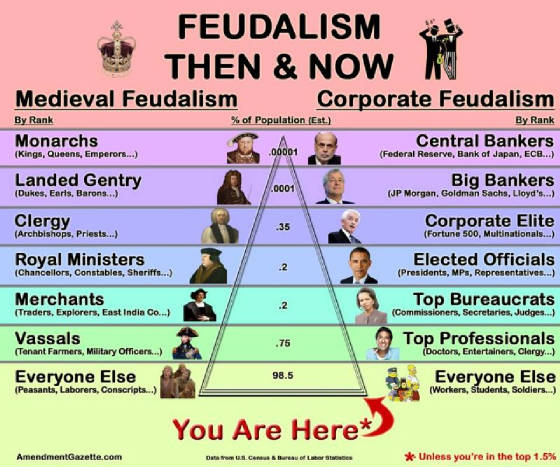
An Introduction to Technofeudalism Ascending

feudalism-then-and-now-hierarchy.jpg.w560h467

By SARTRE

Source: BATR.org

The future of the planetary Reign of Terror has never been clearer. The pattern for global governance has been set into motion and operates under a model that has been used throughout much of history. The modern day version of command and control can be effectively described as Technofeudalism. The purpose of this introduction is to provide an outline of the arguments used by Steven Yates, Ph.D. The link to this significant treatise is provided below. In addition News With Views maintains an extensive archives of Dr. Yates’ work. Invest the time to read the entire essay for a full understanding of the linkage behind Technofeudalis and the course for top down dominance.

Technofeudalism Ascending comprises nine sections. Dr. Yates provides the following preface.

My book Four Cardinal Errors (2011) introduced the idea of technofeudalism. Though a bit of a mouthful, this is the best term for the political economy towards which an intergenerational superelite has been directing as much of the world as possible for at least a century. This existence of this group, I argue, is the foremost political-economic reality of our times.

Their goal, I argued in Four Cardinal Errors, is to institute corporate controlled global governance: de facto world government, managed for private profit and for control over national governments and populations. Technofeudalism is the resulting political economy. While preserving some of the vocabulary and outward features of market capitalism, technofeudalism has almost nothing to do with free markets, or free enterprise, as generally understood. It is about instituting whatever policies, instigating whatever wars, bringing about whatever revolutions, and causing whatever levels of misery are deemed necessary for enforced mass compliance. Its tools include both neoliberal and neoconservative ideology, artificial scarcity, education reduced to job training, and fear induction through constant pontificating about “terrorism” amidst random and often-depraved acts of violence, reducing as many as possible to a status of permanently cash-strapped, mentally paralyzed subjects — living amidst the most advanced technology in human history, but equivalent to serfs (“owned” as de facto property by “their” governments, employers, etc., as in medieval feudal systems of old). Hence, the term technofeudalism.

Introduction:  Why Technofeudalism? (Technofeudalism is the best term for a kind of political economy that has been coming together very gradually for much of the past century, but accelerating in recent decades: it is technologically advanced but populations are controlled by various means and, in effect, made into serfs who are tied to whatever work they can find and to government programs. Technofeudalism is driven by those I call the superelite—a group of globalist-minded extended families whose primary motivation is wealth and power. It illustrates the primary problem of practical political philosophy and strategy: how to contain that minority in our midst that is drawn to power.)

  1. The End of History? (The collapse of the Soviet Union seemed to leave the world at a major turning point; Communism was dead, the combination of market capitalism and liberal democracy seemed to be catching on everywhere, and the U.S. was the sole superpower. It seemed conceivable that it really was, as Francis Fukuyama described, the end of history.)
  1. The Neoliberal Illusion.  (Things began to unravel almost at once, as trade deals such as NAFTA began to put an end to the largest financially independent middle class in history. Neoliberal ideology proved to have a dark side, as wealth began to be redistributed upward and millions of people ended up out of work.)
  1. Precariatization and the Destruction of the American Mind.  (Higher education faced multiple crises: rising radical left “scholarship” in the humanities, a rising corporate or business mindset in expanding administrations, the collapse of the academic job market creating conditions where control was possible, and the impoverishing of faculty via adjunctification, one species of the creation of a precariat — workers in an environment of part-time, temporary, and short term work. Liberal arts learning itself came under assault, as the thinking skills it provides threaten a political economy of power, domination, precarity, and corruption.)
  1. The Empire of Corruption.  (Ensuing decades have seen rising corruption and financial manipulation which eventually caused the 2008 meltdown and have brought about a steadily lowering of the standard of living in the U.S. Supreme Court decisions such as Citizens United ensure a bought-and-paid-for political class, and articles now appear in refereed journals indicating that the U.S. is now a plutocratic oligarchy.)
  1. The Global Corporatist Leviathan.  (If the present political system is plutocratic oligarchy, the correct term for the present economy is corporatism, with technofeudalism its broader political-economic-technocratic instrument. Poor education ensures a systematic confusion between capitalism and corporatism. Under corporatism, corporations are in the driver’s seat behind governments, as we can see from their latest effort to dominate a section of the world’s economy: the Trans-Pacific Partnership.)
  1. The New Serfdom.  (You are living in a feudal system when there is one set of rules for those with power and another set of rules for those without power, with only token representation. Technofeudalism emerges in that its subjects are technologically advanced serfs — surrounded by technology but tied to low-wage work or to a government-based support system.)
  1. “What Can We Do?”  (You can educate yourself on issues ranging from the possibilities of expatriation to that of peoples separating politically from empires, which may become possible as a very severe downturn, worse than the Great Recession — a Greater Depression — is almost certainly inevitable.)
  1. Preparing for the Greater Depression.  (The world is on the verge of having to face the realities of financialization that will bring on the Greater Depression. You can prepare by building proper skills now. It is conceivable that the global superelite is planning on a Greater Depression. You should prepare anyway.)
  1. Grounds for Hope: Real Sustainability and the Cycles of History.  (Technofeudalism will prove unsustainable. It may be put in place, but its structure and the mindset that gave rise to it will cause it to decay and eventually disintegrate. We have come this way before, as empires have risen and fallen before. This provides hope, in that with the collapse of the technofeudalist state, separation and the building of a world of small states will become possible — again if we begin to prepare now.)

This summary outline attempts to persuade the compelling case to review the entire critique. Filling in the connections and relationships to achieve the eternal objective of worldwide ascendancy in an age of technological supremacy, means that the return to a feudal society becomes the undeniable 21th century danger.

Technofeudalism is based upon herding marginal and unneeded humans into ghettos of subsistent serfdom existence. The technocrats who administer the process of dehumanization become the executioners of civilization. Utopia for the select, built on the misery of the masses is a future not worth living. This fact is exactly the objective of the globalist. Destroying resistance through marginalizing survival rules a feudal society. However, building the achievement of a renaissance culture is based upon the liberation of the human spirit and decentralization of authority.

The global elites depend on acquiesce of the masses to accept and adopt the tyrannical systems and indoctrination methods propagated by the technocratic matrix. Liberty is despised by authoritarians. Technofeudalism is the enemy of all human beings. Once armed with the knowledge of this threat, what will be the response of the populace targeted for slavery or extinction?


It’s the Law

privacyNOT

Interesting commentary by James E. Miller, editor-in-chief of the Ludwig von Mises Institute of Canada. It connects recent current events in a logical narrative and offers a plausable explanation for the apparant wind-down of the war on (some) drugs.

excerpt:

With today’s nation-state, the monopoly on law enforcement has eroded the traditional notion of justice. Certainly various levels of government still prosecute those who commit malum in se wrongs. But the granting of sole discretion over societal function to the state has brought about a litany of prohibitions on otherwise harmless actions. The most widespread and destructive example of this gross perversion of law has been the American drug war. In major metropolitan areas, large numbers of users of substances designated harmful to public tranquility are fined, detained, and imprisoned. The very act of ingesting mentally-altering narcotics constitutes no harm absent the self-imposed kind. The outlawing of drug use superimposes control of the individual, and makes him beholden to the political class. As Will Grigg posits, the malum prohibitum on narcotics is a subset of human slavery as the premise denies complete self-ownership.

In an act of supposed moral revelation, U.S. Attorney General Eric Holder recently announced the federal government would begin relaxing indictments of low-level, nonviolent possessors of drugs. In a speech before the sleazebag of litigating opportunists known as the American Bar Association, the nation’s top mob enforcer declared “too many Americans go to too many prisons for far too long and for no good law enforcement reason.” The mandatory minimum sentencing laws passed by Congress will simply go ignored.

The gullible reader might assume the odious basis for the war on drugs may finally be visible to the heavily armed buffoons who raid private homes and the sloth-resembling chief law enforcer, but that would be a naive supposition. The wind down has little to do with morality and everything to do with cost. Imprisoning thousands of junkies takes a great deal of resources. With a corpulent debt financing military adventurism and welfare pocket-padding, Holder and the rest of the federal government racket are feeling the squeeze.

The very same penalty relaxation occurred at the height of the Great Depression. While Franklin Roosevelt busied himself with turning American business into a quasi-fascist state, he was intelligent enough to recognize the civil demolition wrought by alcohol prohibition. As the black market for booze paved the way for organized crime during the roaring 1920s, the stock market crash left state and local governments hamstrung by a lack of tax revenue. If action was not taken, thousands of wealth-sucking bureaucrats would be thrown to the streets. So the Democratic Party endorsed making America wet again, while nominating the craze-minded Roosevelt in 1932. After the Twenty-first Amendment to the Constitution was ratified, excise taxes were levied on wine and spirits. As economists Mark Thornton and Chetley Weise document, the resulting tax receipts staved off what would have been shriveling bankruptcy.

Rarely does the state cede authority when it comes to corralling the citizenry. The only barrier that stands between government domineering is always the cost of its behemoth, sluggish operation. The relaxation of penalties for drug ingestion is demonstrative of this rule. At the same time, it is a mockery of the concept of reasoned law. If using narcotics were truly an affront to the natural order, there would be no leniency. The immoral act would be opposed root and branch, similar to rape or murder. Current legal prohibitions on various forms of opiates are not grounded in justice but are merely a form of societal control. In the classic bootleggers and baptists sense, these restrictions enrich those who profit from sale, distribution, and incarceration while satisfying the warped psyche of taskmaster puritans.
To read the complete essay, visit the Ludwig von Mises link or the repost at Zerohedge.com.