Edward Snowden On Big Tech Companies, Like Facebook, Censoring & Controlling Information

By Arjun Walia

Source: Collective Evolution

Glenn Greenwald is no stranger to censorship, he’s the journalist who worked with Edward Snowden (NSA mass surveillance whistleblower)  to put together his story and release it to the world while working for the Guardian. He eventually left the Guardian and co-founded his own media company, The Intercept, an organization that would be free from censorship and free to report on government corruption and wrong-doings of powerful people and corporations. He recently resigned from The Intercept as well due to the fact that they’ve now censored him, and is now completely independent. You can find his work here.Glenn Greenwald is no stranger to censorship, he’s the journalist who worked with Edward Snowden (NSA mass surveillance whistleblower)  to put together his story and release it to the world while working for the Guardian. He eventually left the Guardian and co-founded his own media company, The Intercept, an organization that would be free from censorship and free to report on government corruption and wrong-doings of powerful people and corporations. He recently resigned from The Intercept as well due to the fact that they’ve now censored him, and is now completely independent. You can find his work here.Glenn Greenwald is no stranger to censorship, he’s the journalist who worked with Edward Snowden (NSA mass surveillance whistleblower)  to put together his story and release it to the world while working for the Guardian. He eventually left the Guardian and co-founded his own media company, The Intercept, an organization that would be free from censorship and free to report on government corruption and wrong-doings of powerful people and corporations. He recently resigned from The Intercept as well due to the fact that they’ve now censored him, and is now completely independent. You can find his work here.

Anybody who reports on or sheds a bright light onto immoral and unethical actions taken by governments and the powerful corporations they work with has been subjected to extreme censorship. In the case of Edward Snowden, he’s been exiled, and Julian Assange of Wikileaks is currently clinging to his life for exposing war crimes and other unethical actions by multiple governments and corporations. There are many other examples. What does it say about our civilization when we prosecute those who expose harm, corruption, immoral/unethical actions by governments and war crimes?

Greenwald recently interviewed Snowden about internet censorship and the role big tech companies and governments are playing. Greenwald explains that in one of his earliest meetings with Snowden, he (Snowden) explained that he was driven in large part by the vital role the early internet played in his life, “one that was free of corporate and state control, that permitted anonymity and exploration free of monitoring, and, most of all, fostered unrestrained communication and dissemination of information by and among citizens of the world without corporate and state overlords regulating and controlling what they were saying.

This is what he and Snowden go into in the interview posted below. Prior to that I provide a brief summary of Snowden’s key thoughts.

Snowden starts off by mentioning government surveillance programs and the companies they contracted to do this work and compares them to modern day Big Tech giants censoring information on a wide range of topics. We see this today with elections/politics, to medical information dealing with coronavirus and vaccines, for example.

“In secret, these companies had all agreed to work with the U.S. Government far beyond what the law required of them, and that’s what we’re seeing with this new censorship push is really a new direction in the same dynamic. These companies are not obligated by the law to do almost any of what they’re actually doing but they’re going above and beyond, to, in many cases, to increase the depth of their relationship (with the government) and the government’s willingness to avoid trying to regulate them in the context of their desired activities, which is ultimately to dominate the conversation and information space of global society in different ways…They’re trying to make you change your behaviour… – Snowden

So basically, these Big Tech companies have become slaves, if you will, to the governments will, or at least powerful people situated in high places within the government. Snowden brings up the fact that many of these companies are hiring people from the CIA, who come from the Pentagon, who come from the NSA, who have top secret clearances…The government is a customer of all the major cloud service providers. They are also a major regulator of these companies, which gives these companies the incentive to do whatever they want.

This is quite clear if you look at Facebook, Google and Amazon employees. There are many who have come from very high positions within the Department of Defense.

In no case is this more clear than Amazon – Snowden

Amazon appointed Keith Alexander, director of the NSA under Barack Obama.

He was one of the senior architects of the mass surveillance program that courts have repeatedly now declared to be unlawful and unconstitutional….When you have this kind of incentive from a private industry to maintain the warmest possible relationship with the people in government, who not just buy from you but also have the possibility to end your business or change the way you do business…You now see this kind of soft corruption that happens in a constant way. – Snowden

Snowden goes on to explain how people get upset when government, especially the Trump government, tries to set the boundaries of what appropriate speech is by attempting to stop big tech censorship, he then says,

If you’re not comfortable letting the government determine the boundaries of appropriate political speech, why are you begging Mark Zuckerberg to do it?

I think the reality here is…it’s not really about freedom of speech, and it’s not really about protecting people from harm…I think what you see is the internet has become the de facto means of mass communication. That represents influence which represents power, and what we see is we see a whole number of different tribes basically squabbling to try to gain control over this instrument of power.

What we see is an increasing tendency to silence journalists who say things that are in the minority.

You can watch the full conversation between Greenwald and Snowden below, the conversation is about 40 minutes long.

Closing Comments: This kind of information almost begs the question, are we ready as a society to truly create and disseminate journalism that is honest, integral and bi-partisan? Why is it that these types of organizations fail or struggle? How do some media companies fail? Well, they no longer stay true to their mission. They fall to the pressure of politics and fall into ideology. How many other times did ideology change what media outlets reported? Yes, it’s almost impossible to have zero bias, but how close can we get to zero? How can we achieve this when media outlets who do not fit within the accepted framework and disseminate information that challenges the popular opinion are constantly being punished for simply putting out information?

As Snowden mentioned above, these Big Tech companies in collusion with governments are literally attempting to not only censor information, but change the behaviour of people as well, especially journalists. When you take away one’s business or livelihood as a result of non-compliance, you are in a way forcing them to comply and do/say things you they way you want them done/said. We’ve experienced massive amounts of censorship and demonetization here at Collective Evolution, but we haven’t changed as a results of it. We simply created CETV, a platform that helps support our work as a result of censorship.

Battlefield Social Media: The West’s Growing Censorship

Censorship in the West flourishes as tech giants turn social media back into traditional programmed media. 

By Gunnar Ulson

Source: Land Destroyer

The United States, United Kingdom and the European Union are fond of passing judgement on nations around the globe regarding “free speech.”

While it is increasingly clear to a growing number of people that this “concern” is disingenuous and aimed at merely defending agitators funded and directed by Western special interests in these targeted nations, the West still likes to fashion itself as a sort of champion of free speech.

Yet back home the Internet has been taken over by social media and tech giants like Google, Facebook and Twitter.

Their platforms clearly serve as online public squares where everything is discussed and even election campaigns play out. Yet these companies have, over the years, begun to eliminate voices of dissent against a notion known as “consensus.”

If you are speaking out against “consensus” you are in real danger of disappearing from these platforms. Some of these platforms, like Google-owned YouTube, serve as the livelihood to people who have for years built up their audiences, produced hundreds of videos and when their accounts are deleted for speaking out against the “consensus,” they have their livelihoods destroyed.

In the wake of these incremental “purges” is a chilling effect with content creators self-censoring or even withdrawing entirely from Western social media.

It is the sort of very real censorship the West has crusaded against in fiction around the globe for decades. 

Concensus or Else 

A more recent example is Google’s decision to ban ad revenue for those going against the Coronavirus Disease 2019 (COVID-19) “consensus.”

CNBC in their story “Google will ban ads from running on stories spreading debunked coronavirus conspiracy theories,” would claim:

Google next month will ban publishers from using its ad platform to show advertisements next to content that promotes conspiracy theories about Covid-19. It will also ban ads that promote those theories. In cases where a particular site publishes a certain threshold of material that violates these policies, it will ban the entire site from using its ad platforms.

Those “conspiracy theories” might include questioning the official death rates of COVID-19. Yet even the British government itself has been recently forced to investigate its statistics regarding death rates, vindicating the very sort of people who would have been either forced into silence or forced to give up ad revenue.

The London Guardian in its article, “Matt Hancock orders urgent review of PHE Covid-19 death figures,” would admit:

The UK health secretary, Matt Hancock, is ordering an urgent review of the daily Covid-19 death statistics produced by Public Health England, after it emerged that they may include recovered former sufferers who could have died of other causes.

False reporting over deaths to hype COVID-19, induce greater public panic and pave the way for billions in government handouts to pharmaceutical giants is at the very core of many of these so-called “conspiracy theories” Google seeks to silence through its campaign of financial coercion.

Imagine if this chilling effect was achieved sooner. Would the British government have even bothered investigating its faulty statistics if there weren’t people suspicious of them?

The chilling effect this has over openly discussing something as serious as COVID-19 considering its socioeconomic impact is truly alarming and much more so because it is happening in the so-called “free world” overseen by its self-appointed arbitrators in the US, UK and EU.

A similar campaign was carried out to purge Google, Twitter and Facebook of anyone allegedly connected with “Russia” who also so happened to be anti-war and anti-NATO for waging those wars.

Entire lists are compiled by Western government-funded organizations which are then submitted to these tech giants for purging. The Western media writes accompanying articles announcing, justifying and spinning the purges… but also sending a warning to those left about what is and isn’t going to be tolerated on these platforms.

Social Media Transforming Back into Programmed Media 

Content creators are faced with two decisions; to either self-censor themselves to protect their work, their audiences and their livelihood, or to accept the possibility they will eventually be “purged” (censored) and need to rebuild their audiences from scratch on platforms with far fewer potential readers, viewers and patrons.

Social media, of course, is no longer social media in this sort of environment, but more akin to the sort of programmed media giant Western special interests built their power on over the course of the 20th and early 21st century.

Private Public Squares? 

Of course the defense is that Google, Facebook and Twitter are “private companies”and can do as they please with their platforms. In reality, these companies work in tandem with Western governments whether it is fomenting political destabilization abroad or creating “concensus” at home.

The notion that censorship is “ok” because the US, UK and EU governments launder it through private companies ignores the close relationship these companies have with the government and how their platforms have been transformed into defacto public squares and critical channels of public communication and participation.

The West’s growing overt censorship leaves it with a choice; to either accept that it is in reality as guilty of censorship and manipulating the public as it has claimed its opponents are, or continue pretending it isn’t but at the continued cost of its legitimacy upon the global stage.

There is a very good reason the West is in decline around the globe and why its attempts to leverage notions like “human rights” and “free speech” against nations like China or Russia are increasingly impotent. That reason can be found, at least in part, among the growing number of purge lists, censorship campaigns and calls for “consensus” across Western social media.

Finally, the increasingly overt nature of censorship and controlled narratives promoted by tech giants like Google, Facebook and Twitter should have them facing restrictions and bans around the globe. Why should any nation host a “public square” where discourse is entirely controlled by interests oceans away? Why shouldn’t a local alternative be created instead where the revenue is kept locally and if narratives are to be controlled, controlled in a way that best suits people locally?

It is ironic that, China for example, is condemned for not allowing Google, Facebook and Twitter to operate freely within their information space because it is a violation of “free speech,” even as Google, Facebook and Twitter cudgel free speech on their own respective platforms.

How much longer will the world tolerate these double standards? How long until individuals, organizations and even entire nations begin creating alternatives to Google, Facebook and Twitter to at the very least balance out the lopsided power and influence they have collectively accrued and abused? 

New Pentagon-Google Partnership Suggests AI Will Soon Be Used to Diagnose Covid-19

Google recently teamed up with the Pentagon as part of the new, AI-driven “Predictive Health” program. Though only focused on “predictive cancer diagnoses” for now, Google and the military have apparent plans to expand the AI model for automating and predicting Covid-19 diagnoses.

By Whitney Webb

Source: Unlimited Hangout

At the beginning of September, Google Cloud announced that it had won a project from the Pentagon’s relatively new Defense Innovation Unit (DIU) to “prototype an AI-enabled digital pathology solution at select DoD [Department of Defense] facilities.” This prototype, per a Google Cloud press release, combines “augmented reality telescopes” with “AI-enabled” cancer detection tools that will allegedly improve the accuracy of “predictive cancer diagnoses.” It is the second DIU contract Google has won this year, with the first being related to combatting “cyber threats.”

The initial implementation of this Pentagon-funded, Google-created “digital pathology solution” will take place “at select Defense Health Agency (DHA) treatment facilities and Veterans Affairs hospitals in the United States,” and the program includes “future plans to expand across the broader U.S. Military Health System,” according to Google.

The initiative is part of a larger DIU-led program called “Predictive Health” that is also partnered with the joint AI effort of the US military and US intelligence community, the Joint Artificial Intelligence Center, and JAIC’s “Warfighter Health” initiative. The JAIC, which is currently led by a former Silicon Valley executive, is providing much of the funding for Predictive Health, while its related “Warfighter Health” initiative more broadly seeks “to field AI solutions that are aimed at transforming military health care.”

In addition to its stated goal of improving the accuracy of cancer diagnoses, the implementation of this Google-DIU AI-driven medical diagnosis tool aims to show “frontline health practitioners” that such tools “can improve the lives” of US troops, according to Google executives. As Mike Daniels, vice president of Global Public Sector at Google Cloud, noted in a statement, Google is “partnering with DIU to provide our machine learning and artificial intelligence technology to help frontline healthcare practitioners learn about capabilities that can improve the lives of our military men and women and their families.” Google also stated that the use of their tool at military health facilities would also “lower overall healthcare costs.”

The Google-DIU effort to outsource human doctor decision-making to a tailor-made artificial intelligence algorithm is, for now, only focused on the diagnosis of cancers. However, last Thursday, less than two weeks after winning the DIU contract, Google announced that it was donating $8.5 million to several organizations to advance the development and use of AI  “for monitoring and forecasting” Covid-19. That money is part of a larger $100 million donation from Google for financing “solutions” to Covid-19 that was announced in May.

Further evidence that Google soon plans to offer AI-driven “predictive diagnoses” for Covid-19 came in August, when Google Cloud partnered with Harvard’s Global Health Institute to provide “Covid-19 Public Forecasts,” which “provide a projection of Covid-19 cases, deaths, and other metrics over the next 14 days for US counties and states.” The announcement of the Google-Harvard collaboration coincided with an announcement from the National Institutes of Health (NIH) would begin “harness[ing] AI for COVID-19 diagnosis, treatment, and monitoring.”

Notably, other tech companies that have produced “predictive diagnosis” AI models for Covid-19 also began first by offering AI-created “forecasts” of “likely” Covid-19 outbreaks. For instance, the Israeli intelligence–linked Diagnostic Robotics initially offered AI-driven predictive “forecasts” of cities and districts to guide lockdown policy in Israel and the US state of Rhode Island before then teaming up with the US-based company Salesforce to develop a platform that uses AI to “predict” which individuals are likely to be diagnosed with Covid-19 and then uses AI to monitor and even “treat” those individuals.

Furthermore, in partnership with researchers at Mount Sinai healthcare centers in New York, tech giant Microsoft has already aided the development of an AI algorithm that “rapidly diagnoses” Covid-19. Mount Sinai’s AI model, supported by a recent grant from Microsoft’s “AI for Health” initiative, “was as accurate as an experienced radiologist in diagnosing the disease,” according to one of the lead researchers behind the model’s development. While its development was aided by Microsoft, the core of the Mount Sinai AI model is TensorFlow, which was developed by Google and is Google AI’s second-generation system for machine learning.

In addition, both Google and Microsoft are part of a Europe-based effort aimed at “automating diagnoses” for Covid-19 via an AI algorithm that analyzes CT scans, which is similar in several ways to the Mount Sinai AI model. Thus, it seems highly likely that Google’s efforts to offer AI-powered “predictive diagnoses” will soon expand to include tools that use algorithms to diagnose Covid-19, not just cancer.

The Merging of the Pentagon, the CIA, and Silicon Valley

Established in 2015, the Defense Innovation Unit of the Department of Defense officially exists to transfer “leading-edge commercial capabilities to the military faster and more cost-effectively than traditional defense acquisition methods” and to accelerate “the adoption of commercial technology throughout the military and [grow] the national security innovation base.” As the DIU makes clear on its website, the “national security innovation base” it seeks to “grow” consists of private tech companies, namely those based in Silicon Valley, that provide “advanced commercial solutions” to “national security challenges.” This, of course, includes the tech companies that already double as contractors for the national security state, such as Google, Microsoft, and Amazon, among numerous others.

The DIU boasts offices in Silicon Valley, Boston, Austin, and at the Pentagon itself and is largely led, not by career military men, but by former Silicon Valley executives. For instance, its current director—Michael Brown—is the former CEO of cybersecurity giant Symantec and, prior to that, led the Quantum corporation. In another example, the leader of the DIU’s artificial intelligence portfolio is Jeff Klugman, a former top executive at TiVo, the Quantum corporation, and Hewlett-Packard.

A year after the DIU was created, it was followed by the Defense Innovation Board (DIB), which is composed of “leaders from across the national security innovation base” and provides recommendations that “have been used to inform DoD leadership strategy and action, as well as congressional legislation.” Like the DIU, Silicon Valley is well represented on the DIB, as its members include former Google CEO Eric Schmidt and LinkedIn founder Reid Hoffman as well as top executives from Google, Microsoft, and Facebook.

Notably, just months before the DIU-led Predictive Health program was launched, the DIB noted in March 2020 that the Pentagon “owns the largest repository of disease- and cancer-related medical data in the world,” asserting further that “if the entire repository were leveraged to its fullest potential, it would advance diagnosis and treatment for thousands of illnesses, saving lives across DoD and the global population.” The DIB then specifically suggested that “artificial intelligence and machine learning models may help pathologists sort through this massive dataset more quickly and effectively to provide better care for patients in and out of the military,” adding that these troves of medical data should be used “to support DoD reform and modernization efforts in the field of AI/ML [Artificial Intelligence / Machine Learning].”

In other words, the Silicon Valley–dominated DIB called for what is now the Predictive Health program just months before the Silicon Valley–dominated DIU formally announced it. Also noteworthy is that Google—whose former CEO, current vice president, and several other Google-tied researchers and businessmen serve on the DIB—is the very company that won the DIU contract to have its AI models serve as the foundation for the Predictive Health program. This, of course, means that Google’s AI models will benefit immensely from the Pentagon’s “unique” and massive medical datasets, which the DIB previously stated was something that the Pentagon “must treat . . . as a strategic asset.”

It is also important to point out the considerable overlap between the Pentagon’s Defense Innovation Board and the National Security Commission on Artificial Intelligence. The NSCAI is chaired by Eric Schmidt (also on the DIB) and includes representatives from Google, Microsoft, Facebook, and Amazon as well as the current and former leaders of the CIA’s In-Q-Tel.

The official purpose of the NSCAI is “to consider the methods and means necessary to advance the development of artificial intelligence, machine learning, and associated technologies to comprehensively address the national security and defense needs of the United States.” As I previously reported for The Last American Vagabond, the vice-chair of NSCAI, Robert Work—former Deputy Secretary of Defense and senior fellow at the hawkish Center for a New American Security (CNAS)described the commission’s purpose as determining “how the U.S. national security apparatus should approach artificial intelligence, including a focus on how the government can work with industry to compete with China’s ‘civil-military fusion’ concept [my emphasis].”

For this reason, the NSCAI unites the US intelligence community and the military, which is already collaborating on AI initiatives via the Joint Artificial Intelligence Center and Silicon Valley companies. Notably, many of those Silicon Valley companies—like Google, for instance—are not only contractors to US intelligence, the military, or both but were initially created with funding from the CIA’s In-Q-Tel, which also has a considerable presence on the NSCAI. Thus, while the line between Silicon Valley and the US national-security state has always been murky, now that line is essentially nonexistent as entities like the NSCAI, DIB, and DIU, among several others, clearly show. Whereas China, as Robert Work noted, has the “civil-military fusion” model at its disposal, the NSCAI and the US government respond to that model by further fusing the US technology industry with the national-security state.

It is also certainly interesting that, just like the DIB, the NSCAI called for what would become the DIU’s Predictive Health program a few months before it was formally announced. In a NSCAI paper from June 2020 titled “The Role of AI Technology in Pandemic Response and Preparedness: Recommended Investments and Initiatives,” the commission recommends investments and initiatives aimed at using AI for diagnosing illnesses, including Covid-19. This seems to suggest that the Silicon Valley–led but Pentagon-housed DIU is the body that actually creates the government-industry partnerships and initiatives that are first planned out by the DIB and the NSCAI.

It’s All About the Data

While Google has stated that one of their main goals in participating in the Predictive Health program is showing health-care practitioners how AI can “improve lives,” the DIU was decidedly more direct regarding their intent in implementing this “predictive diagnosis” program. For instance, an article on the Google-DIU pilot program at DefenseOne, citing military officials, notes that the “enormous amount of healthcare data, unique to the Department of Defense, also presents a rare opportunity for the Department to train new machine learning tools.” It then adds that “there are 9.6 million beneficiaries in the Defense Health System, which means a lot of data to improve the accuracy of [AI] models.”

DIU’s chief medical officer, Niels Olsen, who created the Predictive Health program, recently stated that massive quantities of data planned to be obtained by the program and used for developing improved AI algorithms was a critical component of the project. In a Pentagon press release, Olsen stated that “the more data a tool has available to it, the more effective it is. That’s kind of what makes DOD unique. We have a larger pool of information [i. e., medical data] to draw from, so that you can select more diverse cases.”

Thus, the implementation of the Predictive Health program is expected to amass troves upon troves of medical data that offer both the DIU and its partners in Silicon Valley the “rare opportunity” for training new, improved AI models that can then be marketed commercially. This may explain part of the interest in partnering this initiative with the Defense Health Agency (DHA), which “owns the largest repository of disease- and cancer-related medical data in the world” through its management of the Joint Pathology Center, which was noted by the DIB in its March 2020 publication. In addition, as previously mentioned, Google will now be able to access that trove of sensitive data to refine its AI “health-focused” algorithms, thanks to it having won the DIU contract earlier this month.

Notably, the relatively new Predictive Health program builds on past DIU initiatives, such as an AI algorithm that predicts illnesses “48 hours before symptoms show.” That algorithm was developed by the Defense Threat Reduction Agency, the DIU, and the health IT company Royal Phillips. The Phillips team that developed that algorithm is now “refin[ing] the model at military hospitals and clinics managed by the Veterans Affairs Department.” According to the DTRA’s Edward Argenta, the focus of the program is to eventually use the AI algorithm to analyze data from devices that remotely monitor individual health, specifically “a wearable device that might sit on your body—like a watch-based one or a chest strap one.”

While various “innovation-focused” agencies at the Pentagon have been busy developing their own algorithms after harvesting mass amounts of medical data from military members and their families, a web of intelligence-linked tech companies, including those represented on the DIB and NSCAI, have gained access to the jackpot of medical data through partnering with the “Covid-19 Healthcare Coalition.”

According to its website, the Covid-19 Healthcare Coalition was established as “a coordinated public-interest, private-sector response to the Covid-19 pandemic, convening healthcare organizations, technology firms, nonprofits, academia, and startups.” The coalition, which was launched by the intelligence and defense contractor MITREalso includes tech giants like Google, Microsoft, Palantir, Salesforce, and Amazon and allows its member organizations to “collaborate, collect, analyze, visualize, and share data and insights.” With access to the data from partnered health-care institutions, such as the Mayo Clinic and the Cedars-Sinai Health System, these tech companies are “helping” the coalition “unlock large-scale analytics for Covid-19.” Institutions tied to the US government, and the NSCAI in particular, such as the CIA’s In-Q-Tel, are also members of the Covid-19 Healthcare Coalition.

Notably, the recent advances in US-based efforts to “predict” or “automate” Covid-19 diagnoses are all tied to this very coalition. Indeed, all of the companies and institutions mentioned thus far in this report have engaged in developing these tools, as Diagnostic Robotics, Salesforce, Google, Microsoft, Amazon, and Mount Sinai Medical Center are all coalition members.

Google, in the press release regarding its recent partnership with the DIU, noted that the prototype of the AI model set to make “predictive cancer diagnoses” had been “developed from [unspecified] public and private datasets,” making it possible—if not likely—that the private datasets were obtained through Google’s membership in this massive, yet relatively unknown, coalition of health-care institutions, tech companies, and US intelligence–linked entities like MITRE and In-Q-Tel.

This apparent obsession with medical data may explain the dramatic uptick in hacks of hospitals in the United States, which have been considerable in recent months and have largely targeted patient data. It is worth pointing out that the increase in these attacks seeking patient data coincides with the DIB-NSCAI policy recommendations regarding training AI algorithms on troves of medical data for automated and predictive diagnoses, among other applications.

Notably, the “solutions” offered to many of the health-care institutions that have been hacked have come from government-promoted yet opaque groups that are deeply tied to US and allied intelligence agencies as well as Silicon Valley. These “volunteer groups,” such as “the CTI League” and “the Cyber Alliance to Defend Our Healthcare,” offer their services for free but, notably, gain access to the patient data they are tasked with guarding. Are such groups, given their deep ties to Silicon Valley and intelligence agencies, helping acquire even more data to satisfy the Silicon Valley and national-security state’s endless hunger for more and more data?

Reporters Claim Facebook is Censoring Information on Julian Assange Case


“90% of my traffic has just been cut off by what seems to be a general algorithm command of some kind to downplay Assange.” “I think it is as simple as that.”

By Alan Macleod

Source: Mint Press News

Craig Murray, the former British ambassador to Uzbekistan and longtime confidant of Julian Assange, has been fastidiously reporting on the Australian publisher’s extradition hearing to the United States. Yet few people have been reading it. This, according to Murray, is because of a deliberate decision by online media giants to downplay or suppress discussion of the case. On his blog, Murray wrote that he usually receives around 50 percent of his readers from Twitter and 40 percent from Facebook links, but that has dropped to 3 percent and 9 percent, respectively during the hearing. While the February hearings sent around 200,000 readers to his site daily, now that figure is only 3,000.

To be plain that is very much less than my normal daily traffic from them just in ordinary times. It is the insidious nature of this censorship that is especially sinister – people believe they have successfully shared my articles on Twitter and Facebook, while those corporations hide from them that in fact it went into nobody’s timeline,” he added.

Asked about the situation by former New York Times reporter Chris Hedges, Murray explained that

Anybody who is at all radical or takes any view of anything that is outwith the official establishment view gets used to occasional shadow banning, but I have never seen anything on this scale before.”

“90% of my traffic has just been cut off by what seems to be a general algorithm command of some kind to downplay Assange,” he added. “I think it is as simple as that.”

There has been considerable public interest in the court proceedings, but very little mainstream attention given to them. To be fair, British authorities have made it inordinately difficult to cover the case, allowing only a small handful of journalists into the Old Bailey court system, where they can watch a live television link up but cannot bring in recording devices. An online stream can only be watched if one registers and signs in between exactly 9:30 and 9:40 a.m., and if they suffer even a momentary lapse in wifi connection, they are shut out of the session. The court system has also blocked human rights groups, including Amnesty International, from monitoring proceedings.

Still, considering the implications for the future of journalism, the lack of coverage might surprise some. The New York Times, the flagship outlet of American print media (and a Wikileaks partner) printed only two articles on the subject and has not mentioned Assange in over two weeks. Its broadcast journalism equivalent CNN, meanwhile, has not touched the issue at all.

Online media creators have, for many years, lived with the threat of algorithmic suppression or demonetization of content on sensitive or controversial issues. YouTube regularly cuts all advertising on videos on the Syrian Civil War, fracking, or other topics on which advertisers might not wish to promote scrutiny. Even airsoft and paintball enthusiasts have learned not to use words like “shoot” and “gun” in their titles, lest the platform demonetizes their content.

Perhaps more alarmingly, however, Silicon Valley tech giants are becoming increasingly closely intertwined with the state department, to the point where it is often difficult to tell where one ends, and another begins. “What Lockheed Martin was to the twentieth century…technology and cyber-security companies [like Google] will be to the twenty-first,” wrote Google executives Eric Schmidt and Jared Cohen in their book, “The New Digital Age: Reshaping the Future of People, Nations and Business.” For example, Facebook is now in a close partnership with the Atlantic Council, who essentially decides for them what content to promote in people’s news feeds and what content is discarded as fake news, misinformation, or low quality. The problem is that the Atlantic Council is a NATO cutout, and a government-funded organization whose board of directors is a who’s who of deep state officials, including virtually every living ex-C.I.A. director, Bush-era cabinet members like Condoleezza Rice and Colin Powell, and military generals like Wesley Clark and David Petraeus. Thus, an organization like this deciding what the world sees on their screens is barely one step removed from total government control of the flow of information.

The U.S. government also frequently directly interferes with content appearing on prominent social media. Earlier this year, Facebook announced that it would remove all comments or posts in praise of recently-slain Iranian General Qassem Soleimani from all its platforms. This was done to comply with the Trump administration’s designation of the Iranian Revolutionary Guard Corps (which Soleimani led) as a terrorist organization. The problem is that Soleimani was Iran’s most popular political figure, with an over 80 percent approval rating, and that Instagram is used by around one-third of the entire Iranian population. Thus, Iranians speaking in their local language were barred from sharing a majority opinion with their country folk because of a decision by Donald Trump.

The Middle East is a particularly contentious area of the world. Yet when news broke that the British Army’s online psychological operations brigade had managed to become a senior Twitter executive, responsible for Middle Eastern content, media largely ignored it, raising even more questions. Algorithm changes have also hammered independent alternative media outlets — often precisely the ones most likely to cover the Assange case — drastically reducing their search engine traffic flow.

Former C.I.A. chief Leon Panetta (an honorary director of the Atlantic Council) recently admitted that Assange is being prosecuted as a warning to journalists. “All you can do is hope that you can ultimately take action against those that were involved in revealing that information so you can send a message to others not to do the same thing,” he told a German documentary crew. While the message is being heard loud and clear by journalists, the public is far less aware that anything is going on, thanks, in part, to online suppression of news about the case. Judge Vanessa Baraitser is scheduled to pronounce judgment on the media “trial of the century” on January 4, after the U.S. presidential election. Murray will doubtless be there. But will anyone read what he has to say?

Social media fact-checking, brought to you by the Deep State

By Daniel Espinoza

Source: Off-Guardian

Almost four years of mainstream media hype about “fake news” and “Russian meddling” propaganda has brought to the world exactly what they were intended to bring: an effective mechanism for internet and social media censorship.

In the center of this move toward global discourse control is an organization called the Poynter Institute, home to the International Fact-Checking Network (IFCN), a body created to coordinate, promote and train dozens of fact-checkers from around the world.

The IFCN and many non-profits working in the same field are funded by the big capitalist “philanthropists” of our era, like George Soros, Pierre Omidyar, Bill Gates, and even the Koch brothers…but also by the US Department of State and a shady “aid” – in reality, political meddling – organization, the National Endowment for Democracy (NED), historically linked to the CIA and regime change operations.

Google and Facebook – itself tied to the warmongering Atlantic Council and its “Digital Forensic Research Lab” – are also associated with Poynter, by funding and partnerships to fight “fake news” (including the development of an “automated” fact-checking program for the upcoming 2020).

The marriage between Poynter’s IFCN, politically inclined billionaires, the State Department – and the whitewashed public face of the Deep State – suggest that the institute is probably working in what Nelson Poynter, its founder, worked on for a key part of his life: propaganda and censorship for the US government.

Although this information is not available in Nelson Poynter’s Wikipedia profile or in poynter.org’s history page, his work for a government propaganda agency is not exactly a secret. A resemblance of his wife, Henrietta, also at the institute’s website, quickly passes over the fact that Poynter did work for the Office of War Information (OWI) during WWII, but his specific role as a government censor and propagandist is never mentioned.

Nevertheless, Hollywood Goes to War, a book written in 1987 by Clayton R. Koppes and Gregory D. Black, is one of the many historical sources that tell the details of Poynter’s job.

FILM CENSORSHIP AND THE BIRTH OF THE VOICE OF AMERICA

Nelson Poynter was recruited by the OWI with his wife Henrietta, who worked as assistant program chief under Elmer Davis, head of the agency. She came up with the name for the “Voice of America”, the famous psychological war operation of the US government.

The radio project was established in February 1942 and soon grew to be the most important US overt propaganda arm of the Cold War.

Unlike his wife’s job, Poynter’s regarded not radio – or his previous line of work, journalism – but movies. In 1942, the OWI’s Bureau of Motion Pictures (BMP) set up office in Hollywood, naming Poynter as its head. His mission was to act as liaison between the agency and the owners of Warner Brothers, Twentieth Century Fox, MGM and the other big studio names.

Elmer Davis, head of the OWI, regarded films as:

The easiest way to inject a propaganda idea into most people’s minds”, in part, because they “do not realize that they are being propagandized”.

Davis was a career journalist who worked for ten years for the New York Times before being recruited by the government. Franklin D. Roosevelt’s White House needed the film industry to incorporate specific themes in their movies, ideas that promoted the notion of WWII as being a “popular” war, fought to defend his Four Freedoms.

But at first, Poynter’s office in Hollywood had little veto power over what the industry could produce – for the entire Western world – limiting itself to suggest cosmetic changes here and there, or the toning down of reactionary and racist imagery and language, an inherent feature in the Hollywood of that era.

The heads of the studios were in fairly good terms with the US Army, historically close to the industry. Its owners were happy to portrait US wars abroad as heroic, in exchange for the lending of military equipment, installations and expert advice.

But in most cases, a disappointed Poynter complained, war ended up only as “a backdrop” for shallow romance, cheap comedies and other proven formulas. Poynter and his boss at the BMP, Lowell Mellett, also hired a former assistant of Harold Lasswell, a famous social researcher who said – back in the 30s – that democracy needed propaganda because people were not the best judges of their own interest.

Eventually, the team devised a way to exert more power over the unruly, reactionary and overly commercial Hollywood studios. They decided to ask the US Office of Censorship to weight in and threat them with banning “offending” films from export, seriously reducing their potential earnings.

According to Koppes and Black’s Hollywood Goes to War, it was a success, prompting MGM, Warner and the other big names to start turning their scripts for review to the Poynter. The BMP knew it was important to intervene right at that stage, before big amounts of money were spent in production.

Poynter was a diligent censor and propagandist, going as far as to suggest dialogues for the movie scripts he was reviewing, breaching “one of the industries taboos” and provoking the powerful tycoons, according to the authors mentioned above.

When the war ended, Poynter went back to journalism. He eventually took over the St. Petersburg Times (renamed Tampa Bay Times in 2012), owned by his father. He also founded the Congressional Quarterly with his wife Henrietta, who died in 1968. As we can read in the Poynter institute’s website:

When Henrietta died suddenly at the age of 66, Nelson mourned deeply. ‘Her passing marked the end of an era for Mr. Poynter,’ said David Shedden, former research librarian at The Poynter Institute. ‘He started looking to the future and thinking about his legacy. He focused on creating a school for journalists, which of course became the Modern Media Institute, and then the Poynter Institute’.”

Nevertheless, historian W.C. Bourne explains that many of the OWI’s top brass – as Elmer Davis and Nelson Poynter, former journalists – returned to the corporate media after the war, but “retained an abiding belief in the things for which OWI stood and the possibilities of accomplishment in the international information picture”.

Many of them also retained the Deep State contacts and a nationalistic “spirit of collaboration”.

A LEGACY OF CENSORSHIP

Nelson Poynter’s work for the government ended many decades ago, and it would be reasonable to suggest that his ties to the US government and its propaganda apparatus probably never involved the journalism institution he founded years after leaving the OWI.

But we have evidence pointing precisely in the opposite direction.

Firstly, the obvious – and open – ties between the institute and today’s version of the foreign meddling machine installed by the US during the Cold War (i.e. the NED). As informed on many occasions by independent journalists, one of the founders of the National Endowment for Democracy once admitted that:

A lot of what we do today was done covertly twenty-five years ago by the CIA.”

Secondly, the intimate ties between the Poynter Institute and the US State Department, which selected it to conduct the “Edward Murrow Program for Journalists”. It brings together “more than 100 emerging international journalists from around the world to examine journalistic practices in the United States”.

In other words, to be indoctrinated in Western corporate journalism and culture and start a relationship with a potential foreign opinion leader.

The State Department’s Murrow program is part of Bureau of Educational and Cultural Affairs (ECA), an agency dedicated to “cultural diplomacy”, intimately tied to intelligence and foreign policy since way before the Cold War. The participants to be trained by Poynter are chosen by US embassies abroad.

2017 report of the historical success of the educational exchange agency stated that:

…565 alumni of the ECA programs are current heads or former heads of state and government, and 31 alumni are heads of international organizations.”

Thirdly, the Poynter Institute, too, redacted an infamous blacklist of “fake news” sites, with the intention of marginalize and, in this case, deny many of them of any kind of advertisement money.

A BLACKLIST TO DEFUND THEM ALL

For this operation, launched on April 30, 2019, Poynter ganged-up with the rest of the fact-checking “cartel”, so to speak.

The institute gathered the blacklists and analysis done in recent years by Snopes, Fact-check.org, Politifact (owned by the Tampa Bay Times and Poynter), OpenSources and the Fake News Codex, and used them to create the mother of all blacklists, naming 515 “unreliable” news websites.

It was retracted shortly after its publication, on May 2, after coming under criticism for “unreliability and poor methodology”. The irony! And this should be understood as an indictment on the whole bunch. As one critic from the George Washington University noted:

Beneath the veneer of its precision, the fact-checking enterprise relies heavily on opinion and interpretation…If a list summarizing fact-checking results and verified by fact checkers is ultimately retracted by those same fact checkers for not being rigorous, it underscores the question of why we should trust anything from the fact-checking community.”

To add insult to injury, Poynter’s dubious list of “unreliable websites” was intended to cause financial harm to those named in it, by guiding advertisers and ad-technology applications to deny them of ads.

After the retraction, Stephen Gutowski, a writer from one of the affected websites, Free Beacon, wrote:

What a disgusting exercise in bad faith from an organization that’s supposed to be about improving and promoting journalism. Instead, they’re creating tabloid-level listicles to smear reporters without offering even a single piece of evidence. Shame on you, @Poynter.”

Philip Klein, from The Washington Examiner – also listed – thought it was:

…worrisome to call for advertisers blacklisting news organizations, especially given the opacity of the process and arbitrariness of many of the judgements [sic].”

THE “CARTEL”

Most of the non-profits behind Poynter’s blacklist share patrons, except for the controversial Snopes, that runs on less grant money than advertisement revenues.

The International Fact-checking Network and its more than a hundred “associated” – subordinated – smaller fact checkers around the globe, are also funded by the same “philanthropists”, like Bill Gates, whose foundation already finances tens of mainstream corporate news outlets with tens of millions of dollars, just like the Columbia Journalism Review recently uncovered.

Regarding Poynter and Gates, specifically:

…Poynter senior vice president Kelly McBride said Gates’s money was passed on to media fact-checking sites, including Africa Check, and noted that she is “absolutely confident” that no bias or blind spots emerged from the work, though she acknowledged that she has not reviewed it herself.”

In a blatant conflict of interests, those same fact-checkers often (try to) debunk information related to the Gates Foundation, just like a private PR agency.

Many lesser players in the global constellation of fact checkers are also funded directly by George Soros and his Open Society Foundation, the Ford Foundation, the US embassy and/or the NED.

When “fact-checking”, the members of this private-public consortium often limit themselves to copy/paste from their “parent” sources, like Poynter’s Politifact and Snopes.

As Emil Marmol and Lee Mager recently wrote for Project Censored, the “fake news” psychological operation was little more than a “Trojan horse for silencing alternative news and reestablishing corporate news dominance”:

The fake news hysteria created by those in government and echoed by the corporate news media is being harnessed and used as a pretext for the suppression of dissent and counterhegemonic viewpoints while re-establishing the corporate press’s preeminence as the sole purveyor and manufacturer of public opinion”.

The Covid-19 pandemic has accelerated the degenerative process under the guise of “protecting us”, prompting democratic governments to take dangerous paths, like arresting citizens for promoting street marches on Facebook.

The internet opened up a world of information to the regular citizen, we must keep it open so more of us can take a look.


Daniel Espinosa lives in Arequipa, second largest city of Peru. He graduated in Communication Sciences in Lima and started researching propaganda and mainstream media. He writes for a Peruvian in-print weekly, Hildebrandt en sus trece, since 2018, and collaborates with many online media. His writings are a critique of the role of mass media in society. You can read his previous work through his MuckRack profile.

The Real Reason Why Blackstone Is Courting The Pentagon

Photo credit: Financial Times / Flickr (CC BY 2.0) .

The sudden push by Wall Street’s largest private equity firm to heavily lobby the Pentagon and State Department for largely unspecified reasons is part of an increasingly visible conflict within the U.S. establishment regarding how to handle the Artificial Intelligence “arms race.”

By Whitney Webb

Source: Unlimited Hangout

One of Wall Street’s largest private equity firms, the Blackstone Group, has been making a series of moves that have left mainstream analysts puzzled, with the most recent being Blackstone’s hire of David Urban, a Washington lobbyist with close ties to the Trump administration.

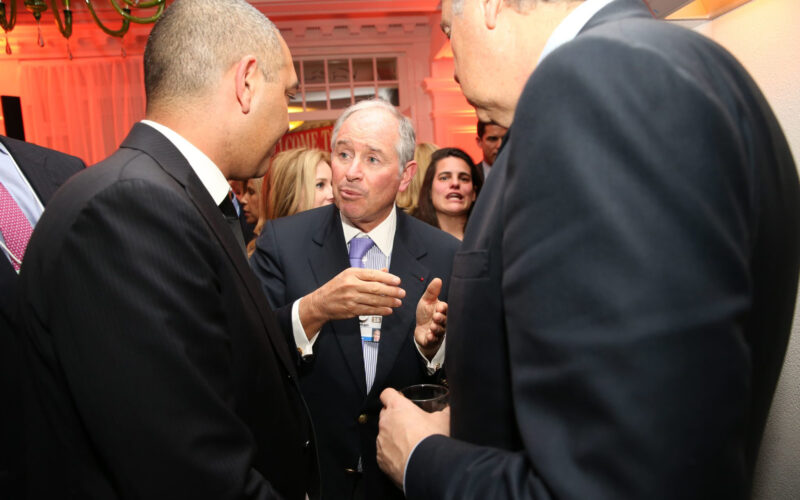
Blackstone’s courting of a Trump ally was not surprising given that the firm’s CEO, Steven Schwarzman, recently donated $3 million to Trump’s re-election efforts and had previously chaired the President’s now-defunct Strategic and Policy Forum of “business leaders” and advisors. The close ties that have developed between Schwarzman and Trump following the latter’s election in late 2016 have led mainstream media to describe Schwarzman as a confidant of the President.

However, what was odd about Blackstone’s hiring of David Urban was its murky reason for doing so, as the firm plans to task Urban with lobbying the Pentagon and State Department on “issues related to military preparedness and training.” This is odd, as CNBC noted, because Blackstone “doesn’t have any publicly listed government contracts, and its known investments don’t appear to have direct links to the defense industry.” However, Urban has extensive experience in dealing with both Departments in addition to his close ties to the current administration and the fundraising apparatus of the Republican Party.

While media reports on Blackstone’s recent hire of Urban were unable to elucidate the motive behind Blackstone’s sudden desire to court the Pentagon and State Department, they did note that Blackstone’s previous hire of a Trump-connected fundraiser lobbyist, Jeff Miller, had been remarkably successful earlier this year, with Miller lobbying Congress specifically on coronavirus relief legislation like the CARES Act. The CARES Act ultimately allowed private equity giants like Blackstone to access funds designated for coronavirus relief, likely thanks to the efforts of Miller and other lobbyists hired by Blackstone as well as other private equity giants like the Carlyle Group.

Though CNBC was left looking for answers as to Blackstone’s sudden interest in aiding the Pentagon with “military preparedness” and wooing the State Department, the likely motive may be related to other recent moves made by the company, such as the hire of former Amazon and Microsoft executive Christine Feng. Feng, who was hired by Blackstone on August 3, previously led data and analytics mergers and acquisitions at Amazon Web Services (AWS), which is a contractor to the U.S. intelligence community and other U.S. federal agencies. Previously, Feng was a senior member of Microsoft’s Corporate Development team. Microsoft recently won lucrative contracts for information technology (IT) services and cloud computing for the State Department and Pentagon, respectively.

According to Blackstone executives, the decision to hire Feng was made due to her “deep relationships in Silicon Valley” and “her experience working at Amazon and Microsoft.” They also added that her hire was motivated by Blackstone’s push to “identify new opportunities to invest and partner with innovative companies reshaping the world” and Blackstone’s recent effort to “double down” on tech sector investments. Notably, Feng’s hire came just a few months after Blackstone had hired Vincent Letteri, another tech-focused investor experienced with growth-stage tech companies, and amid a series of recent investments by Blackstone in tech firms, including HealthEdge software and Chinese data center provider 21Vianet, among others.

Schwarzman’s Push for “Common Governance”

It strongly appears that Blackstone’s recent moves, including Urban’s hire, are part of the firm’s bid to become one of the top “innovative companies reshaping the world” as the Artificial Intelligence (AI) arms race becomes a key driver in the “reshaping” of the global economy. Blackstone’s Steven Schwarzman is a key part of the relatively tight-knit group of billionaires and influential political figures, like Henry Kissinger and Eric Schmidt, that are working to create a “global compact on the research, introduction, and deployment of AI,” and Schwarzman has heralded the coming age of AI as representing a “fourth revolution” for humanity.

Schwarzman argued for greater global collaboration on AI-driven technologies, particularly between the U.S. and China, in a July 2020 Op-Ed for Yahoo! Finance where he wrote that the establishment of “common governance structures” for the research, introduction and deployment of AI is necessary if “we are to avoid the negative consequences of AI,” ultimately comparing the current pace of development of AI to that of past arms races, such as those involving nuclear and biological weapons. Per Schwarzman, these “common governance structures” would produce “explicit global commitments, agreements, and eventually international laws with consequences for violation” that relate directly to AI and its use.

Blackstone’s head is convinced that these “common governance structures” should be built between the U.S. and China, hence his heavy investment in universities and artificial intelligence education in both countries. For instance, Schwarzman created the Schwarzman Scholars program in 2016 where around 100-200 students from around the world pursue a Master’s Degree in Global Affairs at Tsinghua University in Beijing annually. The official goal of the program, which was modeled after the Rhodes Scholars program, is to “create a growing network of global leaders that will build strong ties between China and the rest of the world.” The program’s advisors include former Secretary of States Henry Kissinger, Condoleezza Rice and Colin Powell and former UK Prime Minister Tony Blair as well as former World Bank President James Wolfensohn and former U.S. Secretary of the Treasury and Goldman Sachs executive Henry Paulson. Schwarzman has also donated hundreds of millions of dollars to create an AI-focused institute at Oxford University.

Then, in the U.S., Schwarzman gave $350 million to MIT, prompting the school to create the Schwarzman College of Computing, which aims to specifically “address the global opportunities and challenges presented by the ubiquity of computing — across industries and academic disciplines — and by the rise of artificial intelligence.” MIT News later noted that “the impulse behind the founding of the college came from trips he [Schwarzman] had taken to China, where he observed intensified Chinese investment in artificial intelligence, and wanted to make sure the U.S. was also on the leading edge of A.I.” The college’s inauguration also featured Henry Kissinger as a speaker, where Kissinger mulled the potential impacts of AI and stated that “AI makes it technically possible, easier, to control your population.”

Eric Schmidt, the former CEO of Google, credits Schwarzman’s lead to invest in AI education in the U.S. and abroad as determining “the future of American philanthropy.” “Steve’s donation triggered an arms race among all the universities to match him. This is the next trend in philanthropy, in my view,” Schmidt told Axios regarding Schwarzman’s MIT donation last May. Schmidt also stated that his own investment in Princeton University’s Computer Science department had been prompted by Schwarzman’s previous acts of “AI philanthropy.”

Last May, a federal commission that Schmidt chairs, called the National Security Commission on AI (NSCAI), produced a document that was obtained by a FOIA request earlier this year. One particularly important page made a point that was essentially repeated in Schwarzman’s July Op-Ed regarding a “global AI compact.” Titled “The Importance of a US/China AI Cooperation,” it begins with a quote from Kissinger, a key advisor to and “great friend” of Schmidt, about the need for “arms control negotiation” for AI and then states that “the future of [AI] will be decided at the intersection of private enterprise and policy leaders between China and the US.” In other words, the Schmidt-chaired NSCAI argues that the future of AI will be determined by the political leaders and business leaders of China and the U.S. The page also adds that “we [The United States] risk being left out of the discussions where norms around AI are set for the rest of our lifetimes. Apple, Amazon, Alibaba, and Microsoft will not be.”

This is particularly significant given the NSCAI is tasked with making recommendations to the federal government regarding how to move forward with AI regulations within the context of “national security” and its members include key members of the Pentagon, U.S. intelligence community and Silicon Valley behemoths that double as contractors to the U.S. military, U.S. intelligence or both. One of the NSCAI’s interests, per the FOIA-obtained document, is the use of “AI in diplomacy,” suggesting that it also seeks to explore potential State Department uses for AI. Notably, earlier this year, and a year after the aforementioned NSCAI document was written, the State Department saw key aspects of its IT infrastructure privatized and given over to NSCAI-linked companies like Microsoft.

The Establishment Divide over AI

Given Schwarzman’s views on AI, his AI-focused “philanthropy,” and Blackstone’s recent pivot towards technology, it becomes easier to understand why Blackstone has recently hired David Urban to lobby the Department of Defense and the State Department. Over the last few years, Schwarzman ally Eric Schmidt has “reinvented himself as the prime liaison between Silicon Valley and the national security community” through his chairing of the NSCAI and other positions and has been lobbying “to revamp America’s defense forces with more engineers, more software and more A.I.” Blackstone’s plans to use David Urban to woo the Pentagon are likely directly related to these efforts to speed up and determine not just when but how the U.S. military adopts A.I-driven technologies, particularly regarding the degree of collaboration with China.

Schwarzman, Schmidt, Kissinger and their allies, as pointed out above, appear to favor direct collaboration with China regarding A.I., seeing it as better for business and the best way to avert “catastrophe.” This is particularly true for Schwarzman who has close business ties to China and has been described as “Trump’s China whisperer” by mainstream media. Indeed, Schwarzman and Blackstone have completed numerous, multi-billion dollar deals in China, with a Hong Kong-based publication even claiming that “Schwarzman has become the go-to man for Chinese buyers.” In addition, Schwarzman has a strong personal relationship with Chinese leader Xi Jinping and is credited with softening Trump’s rhetoric and stance on certain issues related to China since 2017. Part of the reason for this, per Henry Kissinger, owes to Schwarzman’s “unique standing” in China where Schwarzman has “done so many useful things.”

Despite his close ties to Schwarzman, Trump has sent mixed signals regarding how much of Schwarzman’s advice regarding China he will take. Trump’s tendency, in public anyway, has been to bolster the nationalist rhetoric of the cadre of neoconservatives and other figures who compose the Committee on the Present Danger, China (CPDC), chief among them former Trump strategist Steve Bannon.

Bannon and other CPDC figures have described Schwarzman as a “rival,” with Bannon specifically singling Schwarzman out, asserting that the Blackstone founder threatened to “undo his efforts” at guiding the President towards more nationalist policies popular with his base, such as fighting an “economic war” with China. Bannon’s concerns are also echoed by some hardliners in the Trump administration and the Pentagon who, like Bannon, view China as an existential threat to U.S. hegemony and, therefore, “national security.”

Ultimately, with David Urban’s hire, Schwarzman and Blackstone appear to be taking their efforts to shape AI’s future by lobbying the Pentagon and State Department directly in the event that Trump’s nationalistic tendencies threaten their vision of U.S.-China collaboration in AI in the post-Coronavirus world.

Twitter QAnon Purge Gives Bigger Monopoly to Corporate Media

By Tony Cartalucci

Source: Land Destroyer

News outlets like CNN reported on Twitter’s move to purge the QAnon movement from its platform.

Articles like, “Twitter cracks down on QAnon accounts,” would claim Twitter fears QAnon’s rhetoric online could eventually lead to “offline harm.”

There is no doubt that QAnon has been behind absurd conspiracy theories and verified lies circulating online – suspiciously absurd. Banning it from Twitter because of alleged fears its activity will lead to “offline harm” is even more absurd .
Despite making absurd claims that demonstrably never materialize or providing evidence that is later revealed to be clearly fabricated, nothing QAnon has done differs from what the corporate media does on a daily basis. In many ways they are one in the same – dividing and distracting the public while US special interests advance their agenda unnoticed and unopposed.
QAnon allegedly made false claims that Hillary Clinton’s arrest was imminent – she was never arrested. Conversely, the corporate media regularly claims that various world leaders in nations targeted by Western regime change have “fled,” are “dead,” or otherwise “ousted from power” – with lies spread by the Western media over the alleged “fates” of still incumbent leaders like Syrian President Bashar Al-Assad, Venezuela’s President Nicolás Maduro, and North Korean leader Kim Jong-un coming to immediate mind.
The Western corporate media also helps sell various wars of aggression.

This includes the US invasion of Afghanistan in 2001, the US invasion of Iraq in 2003, US interventions in Libya and Syria from 2011 onward and US-backed regime change in Ukraine in 2013-2014.

Collectively these conflicts have killed over a million people and driven millions more from their homes. This “offline harm” – the direct result of lies told by the Western corporate media – has not only gone completely unaddressed by Twitter – it is enabled by Twitter.
Twitter – along with other US tech giants like Facebook and Google – aided the US government in sowing chaos across North Africa and the Middle East in 2011, precipitating wars that are still raging today, claiming lives, and effecting “offline harm” impacting millions of people.
The banning of the more absurd QAnon movement will pave the way for other purges – eventually eliminating any alternative to the corporate media and its demonstrably dangerous and dishonest narratives. QAnon’s absurdity will make it easy for Twitter to justify its ban, but the momentum toward greater censorship across Western social media will eventually impact accounts and movements previously difficult to justify banning.
US-based “social media” platforms – Twitter, Facebook, YouTube, etc. – are no longer truly social media. They are clearly transforming into centralized programed media where corporate monopolies create content that is consumed, removing the public, independent organizations, and competitors’ role in creating content, contributing to discussions, offering alternative views, and interacting with one another.
It is important that this fact be fully recognized and exposed as well as the creation of alternative platforms – especially overseas where US-based “social media” has been fully weaponized and used to undermine sociopolitical and economic stability.

Having Sucked America Dry, Tech Giants Seek New Markets Beyond Reach of US Antitrust Laws

Sept. 27, 2015 Facebook CEO Mark Zuckerberg hugs Prime Minister of India Narendra Modi at Facebook in Menlo Park, Calif. (AP Photo/Jeff Chiu, File)

An aggressive push to consolidate companies in the tech sector, coupled with the world’s ever-increasing dependence on digital platforms and tools, is quickly leading to a crisis of sovereignty.

By Raul Diego

Source: MintPress News

The American consumer market for big tech gadgets appears to have reached the point of saturation as the novelty of mobile devices and laptops plateau and the persistent lockdown sees savings dwindle and discretionary spending disappear. Apple, which has enjoyed reigning over the smartphone market for more than a decade, has been forced to drop its prices over the last year as a result of a market at full capacity.

Nevertheless, one of the world’s most liquid companies, along with other tech giants like Facebook and Google – whose parent company, Alphabet, Inc. recently overtook Apple as the most cash-rich company in the world – are taking full advantage of their position to gobble up startups in emerging sectors in the Artificial Intelligence (AI) space like Natural Language Processing (NLP), Machine Learning (ML) and Deep Learning (DL), in order to solidify their place in other, mostly untapped markets in developing nations.

Big tech’s insatiable appetite, as manifested in this current sprint to further consolidate their assets, is bound to give them even more control over their already substantial access to our data and other digital activities of the population at large.  Earlier this year, then Presidential candidate Elizabeth Warren led the call to “Break Them Up,” in reference to the big tech companies, declaring that they had “bulldozed competition, used our private information for profit, and tilted the playing field against everyone else. And in the process, they have hurt small businesses and stifled innovation.” Her plan to “level the playing field,” however, seems to have gone away with her fleeting candidacy.

Nonetheless, they are all gearing up to face an election-year challenge to their growing power as a year-long House Judiciary subcommittee investigation is set to conclude and will more than likely provide plenty of fodder for the antitrust battles looming on the horizon. Some analysts have speculated that the U.S. government could impose fines on companies like Google in the tens of billions for past violations. But, whether or not this Congress implements measures with any real teeth remains to be seen.

Captive market shares

American tech giants are turning their focus to south-east Asia as their original markets in the U.S. can no longer support most of their quarterly profit projections. Apple’s recent acquisition of Seattle-based Xnor.ai, which specializes in “low-power, edge-based artificial intelligence tools” that will help them develop low-cost hardware for things like security cameras using artificial visual intelligence.

The Xnor.ai acquisition is just one of several made by Apple this year. Others include an Irish AI platform called Voysis that enables voice interactions with digital retailers; NextVR, a virtual reality headset company that holds over 40 patents in that space and will help Apple carve out a niche in the burgeoning world of streaming music and sporting events.

Google, which already has a virtual monopoly over Internet search capabilities and related tools, is aggressively pursuing startups in the cloud computing space, healthcare, and advertising market. A salient example is the ongoing $2.1 Billion-dollar acquisition of Fitbit, which has reportedly entered its final stages but has raised calls in some quarters for U.S. antitrust regulators to take a closer look.

The bank of Zuckerberg

Meanwhile, Facebook is continuing its incursion into the virtual entertainment arena with the purchase of Sanzaru Games in February as the social media giant solidifies its VR stake by taking over both hardware and software sides of that emerging market. Zuckerberg has also added to his social media empire with plans to acquire animated gif search engine Giphy for $400 Million, extending his consolidation over two of the most popular social media and communication platforms in its portfolio: Instagram and WhatsApp.

Facebook’s recent $5.7 Billion-dollar investment in India’s Jio Platforms also reveals how the tech giant is betting on Asia for its future growth. Facebook claims that Jio has “brought more than 388 million people online” and is poised to leverage its ubiquitous presence in the country through WhatsApp, boasting that the chat/call app has become a “commonly used verb across many Indian languages and dialects.”

The Indian telecom, led by that nation’s richest man, also includes a recently launched e-commerce site called JioMart, that further opens the door for Facebook’s digital payments platform and has the very real potential to put the social media company in a new class as a payment processing giant, shaking up the status quo in a space largely controlled by the banking sector.

Breaking out of the virtual gold cage

Having sucked the American market dry, these colossal corporations continue their unfettered growth and are increasingly beyond the reach of national anti-monopoly laws. Their aggressive push to consolidate across sectors in the technology space, coupled with the world’s ever-increasing dependence on digital platforms and tools is quickly leading us into a crisis of sovereignty.

If three companies own or have a stake in virtually all of the apps, gadgets and software that are ultimately responsible for collecting out data, performing our transactions and providing the content we consume, we will effectively become prisoners of these same corporations.

Even if Google were to re-instate the infamous “don’t be evil” motto in its code of conduct, such a state of affairs would render that promise moot. The slew of acquisitions by the world’s top tech companies in the midst of an economic depression for the rest of us does not bode well for a future of greater self-determination as the wealth and knowledge gaps grow larger.

Efforts to bridge these gaps are being undertaken by people like Dion Devow in Australia, an entrepreneur who is on a mission to close the gap between Indigenous Australians and IT. But, how effective can such efforts really be in the long run if the technological infrastructure continues to accumulate in the hands of so very few?