Iraqi PM reveals Soleimani was on peace mission when assassinated, exploding Trump’s lie of ‘imminent attacks’

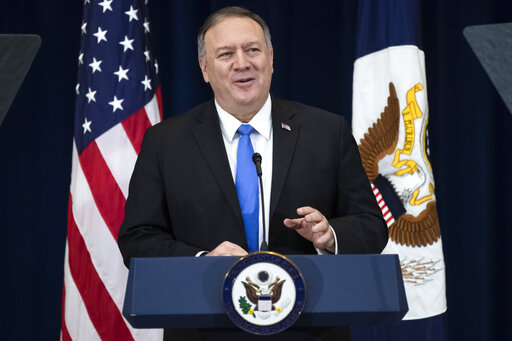
Secretary of State Mike Pompeo (AP Photo/Matt Rourke)

The Trump administration claimed Iranian general Qasem Soleimani was planning “imminent attacks” on US interests when it assassinated him. That lie was just destroyed, but not before countless corporate media outlets transmitted it to the public.

By Max Blumenthal

Source: The Grayzone

Desperate to justify the US drone assassination of Iranian Major General Qasem Soleimani, Secretary of State Mike Pompeo insisted that Washington had made an “intelligence-based assessment” that Soleimani was “actively planning in the region” to attack American interests before he was killed.

President Donald Trump justified his fateful decision to kill the Iranian general in even more explicit language, declaring that Soleimani was planning “imminent attacks” on US diplomatic facilities and personnel across the Middle East.

“We took action last night to stop a war,” Trump claimed. “We did not take action to start a war.”

Trump’s dubious rationale for an indisputably criminal assassination has been repeated widely across corporate media networks, and often without any skepticism or debate.

At a January 3 State Department briefing, where reporters finally got the chance to demand evidence for the claim of an “imminent” threat, one US official erupted in anger.

“Jesus, do we have to explain why we do these things?” he barked at the press.

Two days later, when Iraqi Prime Minister Adil Abdul-Mahdi addressed his country’s parliament, Trump’s justification for killing Soleimani was exposed as a cynical lie.

According to Abdul-Mahdi, he had planned to meet Soleimani on the morning the general was killed to discuss a diplomatic rapproachment that Iraq was brokering between Iran and Saudi Arabia.

Abdul-Mahdi said that Trump personally thanked him for the efforts, even as he was planning the hit on Soleimani – thus creating the impression that the Iranian general was safe to travel to Baghdad.

Soleimani had arrived in Baghdad not to plan attacks on American targets, but to coordinate de-escalation with Saudi Arabia. Indeed, he was killed while on an actual peace mission that could have created political distance between the Gulf monarchy and members of the US-led anti-Iran axis like Israel.

The catastrophic results of Soleimani’s killing recall the Obama administration’s 2016 assassination of Mullah Akhtar Muhammad Mansur, a Taliban leader who was eager to negotiate a peaceful end to the US occupation of Afghanistan. Mansur’s death wound up empowering hardline figures in the Taliban who favored a total military victory over the US and triggered an uptick in violence across the country, dooming hopes for a negotiated exit.

Since Soleimani’s assassination, Iraq’s parliament has voted to expel all US troops from the country and Iran’s Grand Ayatollah Ali Khamenei has sworn to exact a “severe revenge” on the “the criminals who have stained their hands with [Soleimani’s] and the other martyrs’ blood…”

Trump, for his part, tweeted a litany of gangster-like threats, promising to destroy Iranian cultural sites if it retaliated and pledging to sanction Iraq “like they’ve never been before” if it ousted US troops.

Trump’s treacherous assassination has brought the US closer to war than ever before against a country more militarily potent than any adversary it has faced since the Korean War. And as with the failed US invasion of Iraq, Washington’s casus belli for triggering this conflict was based on falsified intelligence sold to Americans by administration officials, and on a pliant Beltway media acting as their megaphone.

With its claim of “imminent attacks,” the Trump administration has essentially re-mixed Condoleeza Rice’s 2003 warning that “we don’t want the smoking gun to be a mushroom cloud.” Back then, the US attacked a sovereign state to rid it of WMD that did not exist. This time, it killed the second-most important Iranian official to prevent a killing spree that was not on the way. And Trump administration officials knew they were lying.

In fact, Pompeo pitched assassinating Soleimani to Trump several months ago, well before any attacks were “imminent.” And in the wake of the general’s killing, a US official revealed to the New York Times that the NSA had intercepted “communications the United States had between Iran’s supreme leader, Ayatollah Ali Khamenei, and General Suleimani showing that the ayatollah had not yet approved any plans by the general for an attack.”

But the preponderance of evidence exposing Trump’s basis for killing Soleimani as a titanic lie has not generated the same level of media interest as the lie itself.

On January 3, CNN assigned three reporters to disseminate the Trump administration’s disinformation about Soleimani, claiming without a hint of critical detachment that he was “planning specific attacks on US interests, including US personnel.”

After the story went live, CNN’s lead reporter, Jim Sciutto, reached out to another official US source to “confirm” his now-discredited piece of war propaganda. In Sciutto’s mind, if more than one US official says a thing, it must be true.

Sciutto is not just any run-of-the-mill national security reporter. During the Obama era, he accepted a job as chief of staff at the US Embassy in Beijing, placing himself at the center of Washington’s gathering Cold War with China. Now back behind CNN’s anchor desk, Sciutto poses as a ferocious critic of Trump while providing the Pentagon and State Department with reliable stenographic services.

No president in recent history has been despised more viscerally by the Beltway press corps than Trump. Nearly everything he says is met with disdain and suspicion, even when he is telling the truth.

But when Trump and his administration attempt to lie the public into war against a designated evildoer, a swath of the corporate media responds with reflexive trust, then shrugs when the lie is exposed in broad daylight.

On The Idiotic Partisan Debate Over Regime Change In Iran Or Syria

By Caitlin Johnstone

Source: CaitlinJohnstone.com

I love my job. Really, I do. But writing about US military agendas for a living often brings one into contact with such staggering stupidity that all you can do is pause and wonder how our species survived past the invention of the pointy stick.

By far the dumbest thing in all of US politics is the fact that Democrats tend to support regime change in Syria, while Republicans tend to support it more in Iran. I am not talking about the elected officials in those parties; I’m talking about the ordinary rank-and-file Joes and Janets who stand absolutely nothing to gain from toppling either Damascus or Tehran, but who have been brainwashed by lifelong media consumption into supporting one or the other anyway.

Whenever I write against the US government’s longstanding agenda to replace the leadership of Tehran with a compliant puppet regime, I know with absolute certainty that I’m going to spend the rest of my time online arguing with Trump supporters and lifelong Republicans. Whenever I write against the US government’s longstanding agenda to do the same in Syria, I know with absolute certainty that I’m going to be arguing predominantly with so-called centrist liberals.

At no time has this ever failed to occur.

I’ve spent the last few days arguing with Trump supporters who are telling me I’m crazy for not celebrating the death of an Iranian general they had no idea existed one week ago, and many of these pro bono State Department propagandists began following my work because they liked what I’ve been saying about Syria.

Conversely, all the fauxgressives and liberal interventionists who spent all last month telling me I’m a monster for writing about leaked OPCW documents showing we were lied to about an alleged 2018 chemical weapons incident have been staying out of my social media notifications completely these past four days.

It is truly bizarre. And it is truly, deeply, profoundly stupid.

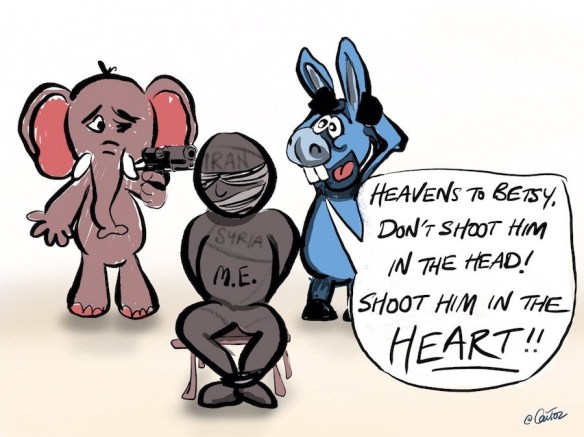
It is truly, deeply and profoundly stupid because the agenda to topple Iran’s government and the agenda to topple Syria’s government are not two separate agendas. They are the same. Supporting one while opposing the other is like wanting to shoot someone in the head but being morally opposed to shooting them in the heart.

Syria and Iran are allies. Eliminating one government necessarily hurts the other. Iran has been helping Syria to win the war against foreign-backed extremist proxy fighters who nearly succeeded in toppling Damascus before its allies stepped in, and should Syria succeed in rebuilding itself (something the Trump administration is actively preventing it from doing) we can be sure it would return the favor when called upon.

The US government’s agenda to “take out” all noncompliant governments in the Middle East is completely removed from any consideration for American party politics. It’s one unified agenda, and the more the imperial blob succeeds in weakening any of the remaining unabsorbed nations, the easier it gets to absorb the others.

Supporting regime change in Iran but not Syria, or vice-versa, is for this reason an inherently absurd position to take. If you opposed Obama’s attempt to topple Damascus via Timber Sycamore-armed proxies, it’s absurd for you to support any maneuvers which could lead to the elimination of Syria’s key ally in that fight. If you oppose Trump’s current warmongering toward Iran, it’s absurd for you to support the elimination of one of Iran’s remaining friends in the region.

If Iran falls you may be sure that Syria will fall next, and vice versa. It’s the same box being ticked; you’re just arguing over whether it should be a left-handed or right-handed check mark.

But such is the strength of propaganda. The perception managers of the US war machine have successfully manipulated the voting public into a debate not about whether regime change interventionism should happen, but which regime change intervention should happen first.

In a sense it’s quite brilliant; we may be quite sure that government agency departments responsible for domestic perception management on US foreign policy have discussed this precise dynamic at length. But in another sense it’s quite mundane: the recent Republican presidents have pursued regime change in Iran, while Obama pursued it in Syria, so Republicans support Republican interventions while Democrats support Democratic ones.

This has nothing to do with any substantial difference in these agendas (again, it’s actually one agenda) and everything to do with what each faction can be more easily propagandized toward. Liberal hearts are easier to grab with horror stories about a monster who gasses babies for no reason and less concerned about refugee crises and the persecution of Syrian Christians, while Republicans are much easier to manipulate into despising a theocracy run by Muslims.

And of course there’s overlap; people who prioritize mass murder above all else like John Bolton and Lindsey Graham will cheer enthusiastically for as much military interventionism as they can get in either country (or any country, really). But by and large, especially among the rank-and-file, people tend to support the interventions their respective presidents propagandized them into supporting. Propaganda is pretty much the only thing the presidential “bully pulpit” is used for.

Because Iraq has poisoned the idea, each mainstream faction may deny actually wanting the US to oust the government of Iran or Syria. Trump supporters who still stand by the anti-interventionist platform he falsely campaigned on may say “I don’t want war with Iran, I just want Iranians to get their freedom and I think it’s awesome they killed Solamumi or however you spell it.” Liberals might say “I don’t want interventionism! I just support the Freedom Fighters™️ in Idlib and want Assad to stop murdering civilians for fun and sexual gratification.” But circulating propaganda narratives about governments targeted for regime change is supporting regime change. You’re participating in it as surely as if you’d deployed the Tomahawk missiles yourself.

Yesterday someone told me that everyone at Qassem Soleimani’s incredibly massive funeral procession was attending because they were forced to. When I asked him if he was claiming that every single one of those millions of people were publicly mourning because they’d been literally forced at gunpoint, he told me no: many were forced in the sense that state propaganda was all they’d ever known, so they were psychologically coerced into grieving Soleimani.

“I don’t accept that your ‘state propaganda their whole lives’ model is any more coercive or fascistic than the kind that causes Americans to turn up to pro- and anti-Trump rallies,” I said. “Americans are no less propagandized than Iranians. If anything it’s worse, since Americans don’t know they’re being propagandized.”

“You’ve got it backwards,” he said. “Iranians don’t know they’re being propagandized because they only have one source of information. The U.S. knows it because we have sides screaming it to other sides all the time and the freedom of information and thought to come to our own conclusions.”

“Nonsense,” I replied. “Nearly all Americans are propagandized to the gills. They’re probably the most aggressively propagandized population on earth, just because so much depends on their swallowing propaganda. It’s just a more scientific sort.”

“And yet here we are, talking about it freely without worrying about swallowing a bullet,” he said.

“Here I am arguing with a man who just so happens to be striving very, very hard to convince me to swallow the exact same narrative that Mike Pompeo is trying to convince me to swallow,” I replied.

The greatest asset of the propagandists is the belief that we haven’t been propagandized.

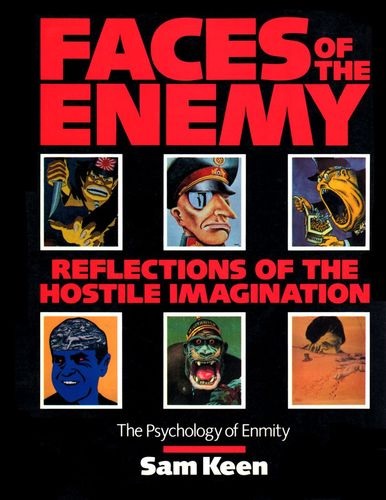
Saturday Matinee: Faces of the Enemy

Description from California Newsreel:

As relevant today as when it was first released, Faces of the Enemy follows social psychologist Sam Keen as he unmasks how individuals and nations dehumanize their enemies to justify the inhumanity of war.

Using archival news footage, public service announcements, and editorial cartoons, Keen unveils the same frightening pattern in conflict after conflict – World War II, the Vietnam War, the Cold War, Islamic and Christian Fundamentalism – and prefigures the current War on Terrorism. First we identify ourselves as victims. Then we blame, demonize and finally dehumanize our adversaries, rationalizing our murder of other human beings.

Faces of the Enemy contends that before a drop of blood is spilled we must ‘think each other to death.’ It is a story replayed on the nightly news, in Islamic Fundamentalists’ characterization of the West as the ‘Great Satan’ and our own stereotyping of Muslims as terrorists. In a revealing examination of the images and iconography of war Keen interviews the nation’s leading editorial cartoonists. They discuss how they use an almost universal language of stereotypes and prejudices to tap into readers’ most visceral emotions.

In a chilling example of the psychological roots of enmity, we meet David Rice, an unemployed welder now an inmate on Death Row. Influenced by far-right propaganda, Rice decided communism was responsible for his personal problems. He bludgeoned to death a family of four whom he (mistakenly) thought were communists. He remains without remorse regarding them as ‘collateral damage’ in a war against the Evil Empire. The Christian Fundamentalist leaders who inspired Rice are only too happy to explain that they are in a holy war against communists and any non-believers.

By contrast, William Broyles, a Viet Nam veteran and author, returned after the war to personalize the individuals who had been his enemies’ to humanize the abstractions. He explains how racist terms and images can be used to turn human beings into monsters. These epithets and images extend the circumstances of war into terrible brutality. But he also explains how we can move beyond these dehumanizing thoughts and seek out the humanity of others.

Psychologists Robert Lifton and Steven Kull explain how war and artificial enemies provide people with the moral and mental certainties they crave, giving them a sense of purpose in a sometimes-ambiguous world. Mythologist Joseph Campbell, providing a note of hope, suggests that underneath the mask of the enemy we ultimately recognize ourselves. This, Campbell further contends, may be the origin of compassion, brotherhood and altruism, in other words the inverse of war.


Watch the full film on Kanopy.

In Redux of Iraq War Run Up, Media Cheers on Assassination of Soleimani

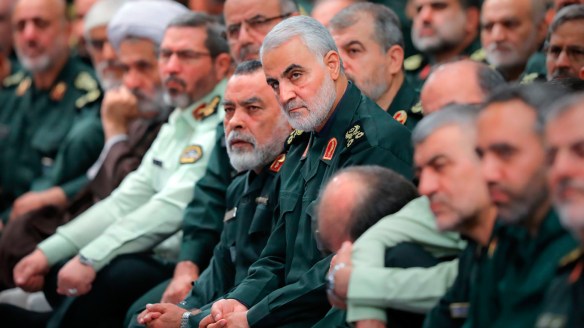
Gen. Qassim Soleimani, center, attends a meeting of a group of the Guard members with Iranian Leader Ayatollah Ali Khamenei, in Tehran, Iran on Oct. 2, 2019. Photo | AP

With echoes of Iraq, media are once again cheering an attack against a Middle Eastern country on the grounds of a supposedly imminent strike against the United States.

By Alan Macleod

Source: Mint Press News

Early Friday morning, a U.S. airstrike assassinated Iranian Lt. General Qassem Soleimani as he traveled from Baghdad’s international airport. A charismatic and capable military figure, Soleimani was widely considered to be one of the most powerful and influential individuals in Iran. Two years to the day since MintPress News reported that the U.S. government had given the green light to assassinate him, Soleimani’s convoy was struck from the air. Secretary of State Mike Pompeo presented the decision as a defensive one, claiming that Soleimani was preparing an “imminent attack” against the U.S. When pressed, he refused to give any more evidence or details. Despite claiming the strike made Americans much safer, the government immediately instructed all U.S. citizens to leave Iraq and avoid the American Embassy.

Assassinating foreign leaders is a major international war crime under international law, yet across the corporate spectrum, media applauded the bombing, or “precision targeting,” as CNN described it. Unsurprisingly, many conservative media outlets supported the Trump administration’s decision to potentially spark a huge international conflict. The Washington Examiner quoted one “expert” celebrating the killing as more important than Bin Laden’s death and a “massive blow to the regime.” Fox News quickly published an opinion piece from Christian Whiton of the strongly hawkish Center for the National Interest, praising Trump for acting “correctly and decisively,” preventing further American bloodshed by taking out a major “terrorist.” It also immediately invited major Neoconservative hawks and public faces of the Iraq War, Karl Rove and Ari Fleischer, on air to discuss the situation and inform its audience what to think.

Media with more liberal audiences ­– who claim to be leading the resistance against a dangerous fascist commander-in-chief – were no less supportive of Trump’s latest aggressive actions. Just as it had done with U.S.-supported coup attempts in Venezuela and Bolivia, resistance media lined up shoulder-to-shoulder with the president and condemned Soleimani as guilty of a myriad of crimes against humanity. CNBC’s headline read, “America just took out the world’s no. 1 bad guy,” accusing him of being the leader of the world’s “most active and pervasive terrorist army.” It claimed that Trump’s decision had “saved current lives” and represented “justice” to his many victims. It also claimed that it saved further American lives as it would “deter future Iranian attack plans.” “There’s no question Soleimani had American blood on his hands” claimed one source in USA Today; “he was an enemy.” It is worth noting, however, that the American deaths being referenced are not civilians, but members of an invading and occupying army in Iraq who were killed by locals resisting a foreign occupier.

The New York Times claimed he had “spent the last decade replicating the Hezbollah model in Iraq, Syria and Yemen, propping up local militias with precision weapons and tactical know-how” and held him responsible for “driving over 10 million [Syrian] people from their homes” not mentioning the American role in any of those warzones. Meanwhile, CNN’s Alex Marquardt claimed that, “US lawmakers are united in their support of the killing of Soleimani” and that Republicans and Democrats alike agreed that, “this is a man who deserved to be killed because of everything he has done against American forces” and were busy “congratulating” Trump for his heroism. The message from corporate media was clear: “Soleimani is a ruthless killer. He’s a horrible human being,” (CNN). The evidence presented for this claim was that “he commanded a division in the Iran/Iraq War” – a war in which the United States armed, funded and supported its then ally Saddam Hussein to invade Iran, causing around one million deaths.

In reality, corporate media are not celebrating Soleimani’s assassination because of his many (real) faults, but rather because of his qualities as an effective leader and organizer, someone who has constantly stymied American efforts to further dominate the region. In Syria, where the U.S. has all but allied with Al-Qaeda/Al-Nusra in order to overthrow the Assad dynasty, Iran has provided a significant counterweight to American-backed forces. Likewise, it continues to support groups such as Hezbollah that resist the U.S. and its allies across the region. It has also, rhetorically at least, supported the Houthi rebels fighting against a U.S./Saudi onslaught, although the extent of Iranian involvement is questionable.

The U.S. government has announced that it is preparing to increase its presence in the wake of the Soleimani assassination, sending at least 3,000 more troops to the region. With echoes of Iraq, media are once again cheering an attack and a military build-up against a Middle Eastern country on the grounds of a supposedly imminent strike against the United States. History, they say, never repeats itself. But it often rhymes.


Related Video

The Scourge of US Hostility to World Peace and Stability

By Stephen Lendman

Source: StephenLendman.org

The US is a warrior state, a global menace hostile to peace, stability, equity, justice, and the rule of law.

Its agenda is all about advancing its imperium by achieving control over nations and resources, especially their oil and gas.

Dollar hegemony is key. Maintaining it as the world’s reserve currency facilitates corporate takeovers, finances militarism, endless wars, and America’s global empire of bases.

Large dollar inflows into US Treasuries finance the nation’s budget deficit.

As long as world central banks buy US dollars and they dominate international trade, its hegemony is preserved.

De-dollarization, nations increasingly trading more in their own currencies, could undermine US imperial aims if the trend continues.

“Without the dollar’s function as the vehicle for world saving – in effect, without the Pentagon’s role in creating the Treasury debt that is the vehicle for world central bank reserves – the US would find itself constrained militarily and hence diplomatically constrained,” economist Michael Hudson explained.

Russia, China, Iran and other nations the US doesn’t control threaten dollar hegemony, the source of its strength on the world stage.

Soleimani was assassinated because of his success in combatting US-supported ISIS and other terrorists, undermining its regional imperial aims.

In Iraq on a peace mission, according to its PM Mahdi, not plotting imminent attacks on US regional interests as Trump falsely claimed, Hudson explained the following:

“(E)very indication is that he was in Iraq to work with that government seeking to regain control of the oil fields that President Trump has bragged so loudly about grabbing.”

Along with maintaining dollar hegemony, controlling Middle East and global energy resources are key US imperial objectives.

Without them, its hegemonic aims are undermined — furthered by endless wars and other hostile actions, its key strategies.

Independent nations controlling their own hydrocarbon resources are targeted by the US for regime change, including Russia, China and Iran.

For the Islamic Republic, wanting its government replaced by pro-Western puppet rule is also about eliminating Israel’s main regional rival.

Netanyahu, other regime hardliners, and their Jewish state counterparts need the US to wage its wars. Achieving Israeli regional hegemony depends on it.

Trump overstepped by assassinating Soleimani and Iraqi deputy PMU head Muhandis, connected to the country’s military.

His action backfired, uniting tens of millions of Iranians, Iraqis, others in the region and elsewhere against the menace that the US poses.

US troops occupy Iraq to control the country and its oil. Expelling them, if things turn out this way, would eliminate this lever of control.

It’s why policymakers in Washington are resisting Baghdad’s demand to leave, things uncertain so far whether they’ll stay or go.

By letter on Monday, US Task Force Iraq commander General William Seely discussed “measures to ensure that the movement (of US forces) out of Iraq is conducted in a safe and efficient manner,” adding:

They’ll “be reposition(ed) over the course of the coming days and weeks to prepare for onward movement.”

Not so, according to US war secretary Mark Esper, indicating no preparations for “movement out of Iraq…no decision whatsoever to leave” the country, adding:

Seely’s letter is “inconsistent with where we are right now.” Joint Chiefs Chairman Mark Milley said “(i)t shouldn’t have been sent.”

Trump warned Baghdad of sanctions “like they’ve never seen before” if US forces are expelled from the country — what Iraqi parliamentarians voted for, PM Mahdi supporting their demand.

According to the CIA-connected Washington Post, the Trump regime began drafting possible sanctions on Iraq, citing anonymous sources.

Separately on Monday, Russia and China blocked a US sponsored Security Council statement to condemn last week’s storming of Baghdad’s heavily fortified Green Zone by angry Iraqis in response to the Trump regime’s assassination of Soleimani and Muhandis.

This action more greatly destabilized the region already embroiled in multiple US wars of aggression.

Do its hardliners have another one in mind against Iran? Will the Trump regime strike a nation able to retaliate strongly against US regional interests and its allies?

Year 2020 began with a bang. It’s an ominous sign for what may lie ahead in the new year and beyond.

The Final Act

By Dmitry Orlov

Source: Club Orlov

In processing the flow of information about the goings on in the US, it is impossible to get rid of a most unsettling sense of unreality—of a population trapped in a dark cave filled with little glowing screens, all displaying different images yet all broadcasting essentially the same message. That message is that everything is fine, same as ever, and can go on and on. But whatever it is that’s going on can’t go on forever, and therefore it won’t. More specifically, a certain coal mine canary has recently died, and I want to tell you about it.

It’s easy to see why that particular message is stuck on replay even as the situation changes irrevocably. As of 2019, 90% of the media in the United States is controlled by four media conglomerates: Comcast (via NBCUniversal), Disney, ViacomCBS (controlled by National Amusements), and AT&T (via WarnerMedia). Together they have formed a corporate media monoculture designed to most effectively maximize shareholder value.

As I wrote in Reinventing Collapse in 2008, “…In a consumer society, anything that puts people off their shopping is dangerously disruptive, and all consumers sense this. Any expression of the truth about our lack of prospects for continued existence as a highly developed, prosperous industrial society is disruptive to the consumerist collective unconscious. There is a herd instinct to reject it, and therefore it fails, not through any overt action, but by failing to turn a profit because it is unpopular.”

Two years earlier, in a slideshow optimistically titled “Closing the Collapse Gap” (between the USSR and the USA), I wrote: “…It seems that there is a fair chance that the US economy will collapse sometime within the foreseeable future. It also would seem that we won’t be particularly well-prepared for it. As things stand, the US economy is poised to perform something like a disappearing act.” And now, 12 years later, I believe I am finally watching what amounts to preparations for that act’s final rehearsal; the ballet troupe is doing stretching exercises and the fat lady is singing arpeggios to warm up…

Clearly, this final act is yet to be performed. The media replay loop continues to play, keeping the populace convinced that the future will resemble the past (except, perhaps, it will have more wind generators, solar panels and electric cars). The populace continues to be persuaded to go out and shop for (or, more frequently now, order online) things it doesn’t need, to be paid for by money it doesn’t have.

Of course, there have been changes. The populace in the US has been doing progressively worse. Drug addiction and suicide rates have skyrocketed while rates of childbirth have plummeted. The purchase of a home is now out of reach for the vast majority of young couples. Artificially rosy unemployment statistics hide the 100 million or so people who are considered “not in labor force” (because they lost their jobs some time ago and haven’t been able to find another one). Uniquely among developed nations, life expectancy among white males—historically the most economically active and prosperous part of the population—has been dropping. These are all negatives, but neither any one of them nor any combination of them adds up to anything that could cause the US economy to undergo a spontaneous existence failure.

Nevertheless, it is possible to build a convincing case that Rome is, to put it figuratively, burning. To continue with the metaphor, evidence that there is some fiddling going on is particularly compelling. Overall, there is a steady backing away from addressing the substance of any problem and a concerted effort to maintain appearances at all cost.

Take the trade war with China, which has been going on since early 2018. Trump has recently declared a major victory in it, but upon examination signs of victory are impossible to discern. In 2017 the US ran a $750 billion trade deficit with China on $3.3 trillion of trade (22.7%). In 2018 it has jumped to $930 billion on $3.8 trillion of trade (24.4%). China has found ways to parry each of Trump’s thrusts by imposing countertariffs. After two years of this sort of World War I-style trench warfare, in which the US has been slowly losing ground, it became clear that the US doesn’t have any means to put pressure on China.

And so Trump suddenly declares victory; not a full victory (that will have to wait until after Trump is reelected for his second term) but a victory nonetheless, because the Chinese have supposedly agreed to buy an extra $200 billion worth of US exports, $50 billion of them of agricultural exports from states that voted for Trump in 2016. But Trump is lying to his supporters. Over the past two years the Chinese have imported roughly $24 billion of agricultural commodities from the US, and sources close to the trade talks have said that the Chinese have agreed to increase these imports by just $16 billion, putting the total $10 billion short of the $50 billion mark. Even then, the US agricultural sector would have to rapidly scale up production by a factor of 1.6—and this is not at all likely.

The farmers will discover this only after they vote to reelect Trump, but that’s not Trump’s problem. Nor was it Trump’s problem when in 2017 the Chinese promised to buy $120 billion of US liquefied natural gas exports and then the US wasn’t able to provide anywhere near that volume. And now that Russia’s Power of Siberia pipeline is operational and ramping up volumes, while US fracking companies are going bankrupt left and right, the question has become largely moot. The AG promise is just a replay of the LNG promise at a smaller scale. Appearances are all that matter, and appearances are what Trump delivers every time. And if his voters want to believe—who’s to stop them? Even though it is clearly heading toward a defeat for the US as a whole, the trade war with China is definitely a huge positive for Trump: all he has to do to win personally is periodically deliver promises that others won’t keep—but that’s not his problem.

Another net benefit for Trump is the never-ending impeachment saga. It has kept him in the media limelight and has allowed him to pretend that he is prevailing heroically against great odds while making his opposition look ridiculous in the eyes of his supporters. After the “Russian meddling” fable unraveled, an even more preposterous rationale for impeachment has taken its place. An attempt to impeach Trump for refusing to cooperate with a congressional investigation is in the process of failing, since anyone with more intelligence than a bucket of California penis fish should know that it is up to the courts, not up to the legislature, to resolve disputes between the legislature and the executive. All that remains now is an alleged abuse of power by Trump. Apparently, it is a no-no for a US president to ask a foreign leader to investigate a US presidential candidate for a variety of crimes such as corruption, bribery and money-laundering. This may all seem quite ridiculous, but it serves a purpose: it allows Trump to clean up on free publicity and to continue fiddling (tweeting, in his case) as Rome burns.

But what has set fire under Rome is not the decrepitating state of US society, or the permanent and permanently worsening trade imbalance with China, or the never-ending impeachment farce. It is the incipient failure of the US dollar. For those who have been paying careful attention, the surreal nature of the proceedings, and the fact that results no longer matter—only appearances do—have become perfectly obvious, but they are a tiny minority. What has allowed the politicians and the media to exploit the general public’s innate normalcy bias and to keep the media replay loop going without too many people catching on to what’s really happening was (note the past tense!) the ability of the US government (with the assistance of the Federal Reserve, which is a government-linked but essentially private entity) to paper over the gaping chasm in the nation’s finances by issuing debt, in the form of US Treasury paper.

The US Treasury has been able to exploit its “exorbitant privilege” to issue internationally recognized and traded debt instruments denominated in its own currency—the US dollar—which has been the world’s main reserve currency for many decades. The reserve currency status has conveyed a certain aura of security and reliability (paper money is, after all, pretty much just a confidence game) and has supported the world’s largest and most liquid financial market. Anybody anywhere could put up US Treasury paper as collateral for a loan and get a low interest rate because that paper was considered as good as “real money” (whatever that means). And then that scheme suddenly broke.

It is difficult to say what caused the confidence game to fail. It could be just the inexorable and ever-accelerating increase in US government debt. It could be the blatant decoupling between the growth rate of the US economy and the rate of increase of its indebtedness. It could also be the fact that much of the world is making a concerted effort to walk away from the US dollar as a reserve currency and as a means of exchange in international trade (Russia has sold off almost all of its US debt; China’s hoard is much larger but it is also gradually selling it off). It is unclear what was the ultimate cause, but what is clear is that in August of 2019 something finally snapped, and USTs went from “good as real money” to “stuff nobody wants to hold.”

I first wrote about this in September when it became clear that real trouble was brewing in the market for US debt. Now, three months later, the situation has gone from bad to worse, and it would appear that the market for USTs definitively broke. I will try to sketch out what that means for the US economy and society later on (spoiler alert: nothing good) but for now I just want to lay out some of what has happened. In the meantime please take your normalcy bias and put it some place safe (in case you need it later, although I have no idea what for).

Previously, when it was clear that an overburden of bad debt could trigger financial collapse at any moment, the Federal Reserve (which is in charge of printing money) engaged in something it euphemistically called “quantitative easing” (“QE”). It printed lots of US dollars in exchange for various bits of USTs, along with other financial garbage, with the goal of later selling the USTs while hiding the garbage, thereby preserving the appearance that USTs are sovereign debt supported by the full faith and credit of the US government rather than just some waste paper clogging up its vaults. But when it declared “quantitative easing” to be over and tried selling the USTs, all hell immediately broke loose and it was forced to go right back to buying them up, in a scheme that has been sarcastically referred to as “not QE.” Euphemisms aside, what is happening is properly called “debt monetization”: it’s when a government “borrows” money not by selling its debt in exchange for money that already exists but simply printing the money using paper and ink, or magic digits inside a very secure computer.

Let’s go over some of the relevant details. “Not QE” actually started well before it was announced and proceeded in stealth mode. Over six weeks starting in September 2019, the Fed monetized an average of $20.5 billion per week. This rate is compatible with the extent of its previous efforts at “quantitative easing” at their height. It was forced to do so because the REPO rate on USTs spiked to 10 times the rate set by the Fed. (REPO stands for “repurchase agreement”; it is where one party borrows short-term from another party, using USTs (and other supposedly very safe debt instruments) as collateral, much as a pawn shop will give you money for a watch and then allow you to buy it back.) The huge spike in interest rates signaled that USTs were no longer seen as particularly safe collateral and the Fed had to step in and start throwing freshly minted dollars at the problem. And it never stopped. In fact, the problem grew larger; so large, that now, at the year’s end, the Fed has committed $500 billion of printing press output to making sure that nobody runs out of cash.

It is commonly thought that the Fed’s action has to do with short-term debt, and is therefore a short-term problem, but that’s simply not the case. Since early August (the start of stealth-mode “not QE”) the Fed has vacuumed up $179 billion with of USTs, of which USTs with terms longer than a year made up $108 billion, or 60%. Compare these numbers to the total borrowing by the US government over the same period, which amounted to $659 billion, of which $368 billion was short-term debt and $291 billion long-term. Thus, over this period the Fed has monetized 29.4% of new long-term debt and 24.4% of short-term debt. This should help put your mind at ease if you suspected that this isn’t a short-term problem but weren’t sure. It’s a long-term, structural problem.

Next, let’s consider whether the problem is being solved or is getting worse. Rest assured, it is getting worse. Looking at the numbers for October and November, the Fed monetized over half (50.7%) of new US government debt. A straight-line projection is that if it took the Fed to go from 0% to 50% in four months, then it will go from 50% to 100% in another four—by April Fool’s 2020. But who’s to say that the increase will be linear rather than exponential? Whichever it is, the trend is unmistakable: the market in US government debt—once the deepest and most liquid market in the world—is dead. The only thing propping up the value of USTs is the Fed’s printing press. And the only thing propping up the value of the output of the Fed’s printing press is… what is it, exactly? Exactly!

Let’s add one more salient detail. Over the course of 2020, $4.665 trillion of USTs will mature and will need to be rolled over into new USTs. This is an all-time record, and this is on top of new debt that will have to be issued in order for the US government to be able to stay open. Over the past year the US budget deficit has amounted to $1.022 trillion, which is a 15.8% increase over the previous year. If this trend continues, the new deficit will be around $1.183 trillion. In order to keep the wheels of finance from grinding to a halt, over 2020 the Fed will have to monetize, or print, close to $6 trillion.

It appears likely that at some point over the coming months Fed chairman Jerome Powell will have to announce “not not QE,” and then “not not not QE,” and then “Milk-milk-lemonade, ’round the corner fudge is made!” and run for the unigender restroom sobbing inconsolably. And then Donald Trump will be forced to channel Boris Yeltsin, who, on August 14, 1998, summoned all the presidential gravitas he could muster and spoke the following sage words:

«Девальвации рубля не будет. Это твердо и четко. Мое утверждение — не просто моя фантазия, и не потому, что я не хотел бы девальвации. Мое утверждение базируется на том, что все просчитано. Работа по отслеживанию положения проводится каждые сутки. Положение полностью контролируется».

“There will be no ruble devaluation. This is my firm and clear position. My assertion is not just a product of my fantasy, and not because I don’t want devaluation to happen. My assertion is based on the fact that everything is taken into account. The work on reassessing the situation is being conducted daily. The situation is entirely under control.” (My translation.)

And then three days later the Russian government declared sovereign default. The ruble dropped by 2/3 against the US dollar and the Russian economy, which was at that time extremely import-dependent, crashed hard. In a similar scenario, the US economy will crash much harder. Like Russia in 1998, the US is extremely import-dependent. But here the US government is not the only large borrower: most of US corporations are zombified corpses bloated with debt. For many years they have been borrowing at artificially low interest rates in order to buy up their own shares and prop up their value in a ridiculous effort to maximize shareholder value in the face of stalling economic growth. If they become unable to roll over their debt at artificially low interest rates (which will go away once the Fed definitively loses control of the situation) then they will automatically be forced to declare bankruptcy and liquidate.

If you want to maintain an optimistic outlook in spite of all of this, here is a book you might want to read.

US assassinates top Iranian general as 4,000 troops readied for Iraq intervention

Revolutionary Guard Gen. Qassem Soleimani, center, attends a meeting in Tehran, Iran. (Office of the Iranian Supreme Leader via AP, File).jpg

By Bill Van Auken

Source: WSWS.org

The targeted assassination of the commander of the Islamic Revolutionary Guard Corps’ (IRGC) Quds Force commander Major General Qasem Soleimani at Baghdad’s international airport early Friday morning has sharply intensified the spiraling conflict between the US and Iran, placing the outbreak of a catastrophic new war in the Middle East on a hair trigger.

The Iraqi and Lebanese media, as well as officials in Iraq’s Shia militia movement, reported that a US missile strike killed Soleimani after he had disembarked from a plane that had brought him to Iraq from either Syria or Lebanon. Also slain in the attack was Abu Mahdi al-Muhandis, the second in command of the Popular Mobilization Forces (PMF), the powerful coalition of Iraqi Shia militias.

The Pentagon issued a statement taking responsibility for the killing: “The U.S. military has taken decisive defensive action to protect U.S. personnel abroad by killing Qasem Soleimani, the head of the Iranian Revolutionary Guard Corps-Quds Force, a U.S.-designated Foreign Terrorist Organization.”

For its part, Iran’s Revolutionary Guards confirmed the killing, telling the Iranian media that “Honored supreme commander of Islam Soleimani was martyred in attack by U.S. helicopters.”

Soleimani has been a major figure within the Iranian military since the Iran-Iraq war of 1980-88. As head of the Quds Force, he played a central role in defeating the US-backed Al Qaeda-linked militias unleashed by Washington and its allies against the government of President Bashar al-Assad in Syria, and subsequently helped lead Iraqi militia forces in routing the Islamic State of Iraq and Syria (ISIS). While mentioned as a possible candidate for the Iranian presidency, he rejected any run for office, insisting that he would serve his country as a soldier.

He was well known to US officials and military commanders who had engaged in back-channel communications with the Iranian general since Tehran’s collaboration with Washington in the 2001 US invasion of Afghanistan.

The assassination came as the Pentagon dispatched another 750 US paratroopers to the Middle East, while 4,000 more have been placed on high alert for deployment to the region.

The deployment follows this week’s storming of the US Embassy in Baghdad by Iraqi demonstrators, an act of popular anger over US militarism that Washington blamed upon Iran.

Defense Secretary Mark Esper claimed on Thursday that there were “indications out there” that Iran is planning “additional attacks” on US forces or interests in the region and that Washington was prepared to “take preemptive action” if it received any “word of attacks or some kind of indication.”

“The game has changed,” Esper said. “Do I think they might do something? Yes, and they will likely regret it.”

Thus, US imperialism has arrogated to itself the “right” to launch not only assassinations, but devastating military attacks on Iran based on the claim that it is acting to “preempt” rumored or invented threats from any entity in the Middle East that Washington deems an Iranian “proxy.” This category stretches from Iraqi Shia militias to the Hezbollah mass political and militia movement in Lebanon to Hamas, the Islamist party that governs the Israeli-occupied territory of Gaza.

On Tuesday, the US Embassy in Baghdad came under siege by thousands of protesters outraged over the December 29 US air strikes against bases in both Iraq and Syria of Kata’ib Hizbullah, an Iraqi Shia militia. The bombings, carried out by US F-15E fighters, killed 25 of the militia’s members and wounded at least 55 others.

The Trump administration claimed that the airstrikes were in retaliation for a missile attack on Iraq’s K-1 military base outside of Kirkuk in which an American civilian contractor was killed. While Washington blamed Kata’ib Hizbullah for the attack, it has presented no evidence of its responsibility.

The protesters, including many militia members and supporters, had marched on the embassy, located in Baghdad’s heavily fortified Green Zone, following funeral services for the slain militia fighters that had brought thousands into the streets of the Iraqi capital.

They scaled the wall surrounding the US Embassy and laid siege to it, hurling Molotov cocktails and rocks. The embassy complex, the largest US diplomatic facility in the world, sprawls over 104 acres on the Tigris River and, at its high point in 2012, housed 16,000 US personnel, an effective continuation of the American occupation that formally ended in 2011.

The protesters managed to storm the main entrance to the complex, setting alight a guard booth and two reception rooms. Photographs released by the Associated Press on Wednesday showed the charred interiors of these areas of the embassy, with smashed furniture and windows and smoke still rising from the ruins.

Walls to the embassy compound were left covered with graffiti, including slogans such as “US embassy closed by order of the people” and “Death to America and Israel.”

US Marines manning the embassy’s interior fired continuous rounds of tear gas, stun grenades and warning shots in an attempt to disperse the protesters. Apache attack helicopters circled overhead firing flares toward the crowds in what was described as a “show of force.”

While the December 29 airstrikes were meant as a demonstration of US power and a blow to the Kata’ib Hizbullah militia, the popular response expressed in the siege of the embassy has exposed the immense crisis of Washington’s policy in Iraq and across the region.

The crowds of protesters were able to reach and enter the embassy only because the elite US-trained Iraqi antiterror troops deployed to protect the Green Zone, which also houses government buildings, other embassies and villas of the Iraqi oligarchy, offered no resistance whatsoever.

The event further exposes the predominant role played in the Iraqi government and its security forces by Shia militias—many of which originated in the fight against American troops following the criminal US invasion of Iraq in 2003—organized under the umbrella of the Popular Mobilization Forces (PMF). This had already become clear in 2014, when the Islamic State of Iraq and Syria (ISIS) was able to overrun roughly a third of Iraq after US-trained security forces collapsed, and the main opposition was mounted by the forces that would be organized into the PMF.

Infuriating the Trump administration, among those present at the embassy protest were Faleh al-Fayyadh, the nominal head of the PMF, who also serves as the country’s national security advisor, Hadi al-Amiri, the former minister of transport and leader of the Badr Brigades, one of the largest militias within the PMF, and other leading members of parliamentary factions tied to the Shia militias.

While the US ambassador had been meeting with these figures in recent months, US Secretary of State Mike Pompeo fired off an angry tweet, including a photograph of four of them, branding them as “terrorists.”

All of Iraq’s key government leaders, including the president, prime minister and head of the parliament, have denounced the US airstrikes as a violation of Iraqi sovereignty. Iraqi Prime Minister Abdul Mahdi, who heads a caretaker government after resigning in the face of mass protests against unemployment, social inequality and government corruption that have swept the country since last October, described the strikes as an “unacceptable vicious assault” against a militia that is considered part of Iraq’s armed forces and warned of its “dangerous consequences.” He described being notified by US Defense Secretary Esper of the impending bombings shortly before they were launched and pleading with him, unsuccessfully, to call them off.

The country’s President Barham Salih, who also condemned the US attack, described a similar conversation with a US diplomatic official.

While Trump fired off a tweet Wednesday thanking Abdul Mahdi and Salih for their “rapid response” to Washington’s demand that they provide security for the embassy, the US-trained Iraqi antiterrorism force charged with protecting the Green Zone, issued a pointed statement to the media denying that it had received an order to protect “any entity.”

The protesters left the Green Zone chanting “Yeah, we burned them!” after being told by militia leaders that they had achieved their purpose, and that legislation would be introduced in the Iraqi parliament demanding the expulsion of all US troops from the country.

While similar proposals have been introduced in the past without success, the present crisis may well have produced the conditions for the approval of such a measure. Leaders of a number of the blocs in the Iraqi legislature have signaled their support for ending the US military presence.

According to the Pentagon’s figures, some 5,000 uniformed US personnel are deployed in Iraq along with an unknown number—undoubtedly greater than that amount—of civilian military contractors. Their presence in the country was justified in the name of the “war on ISIS,” in which the US played a massively destructive role, reducing Mosul, previously Iraq’s second city, along with a number of other urban centers in Anbar province, into rubble and killing tens of thousands.

With ISIS smashed, Trump early last year allowed that having “spent a fortune on building this incredible base” in Iraq, Washington should keep it to “watch” Iran. The remark drew a swift rebuke from the Iraqi president, who stated that Iraq’s constitution “does not allow our territory … to be used against our neighbors” and that Baghdad did not want to be “part of any axis.”

If the Iraqi parliament were to vote for legislation mandating an end to the US military presence in Iraq, it is by no means clear that Washington would withdraw its troops. A continuation of the American occupation, initiated by an unprovoked and criminal invasion, would initiate a new stage in the protracted war that has devastated Iraqi society.

While Washington postures as the victim of missile attacks and an embassy invasion, the conflicts and tensions that continue to roil the Middle East are the product of decades of US military aggression and crippling economic sanctions against Iraq, Iran and Syria that have claimed well over a million lives.

This has culminated in the Trump administration’s abrogation last year of the 2015 nuclear accord between Tehran and the major world powers, followed by the initiation of a “maximum pressure” campaign aimed at reducing Iranian oil exports to zero and starving the Iranian population into accepting regime change and the installation of a US puppet government.

The recklessness and criminality that characterize Washington’s acts against Iran are not a sign of strength, but rather an expression of the deep-going social tensions, economic instability and political crisis gripping American capitalism, which the ruling financial oligarchy seeks to divert outward in an explosion of military violence.

A war against Iran would eclipse the horrific bloodshed of the Iraq war launched in 2003, drawing in the entire region and all of the major powers, including US imperialism’s so-called “great power” rivals Russia and China, bringing humanity face-to-face with the threat of a nuclear Third World War.

The Art of Doublespeak: Bellingcat and Mind Control

By Edward Curtin

Source: Behind the Curtain

In the 1920s, the influential American intellectual Walter Lippman argued that the average person was incapable of seeing or understanding the world clearly and needed to be guided by experts behind the social curtain.  In a number of books he laid out the theoretical foundations for the practical work of Edward Bernays, who developed “public relations” (aka propaganda) to carry out this task for the ruling elites.  Bernays had honed his skills while working as a propagandist for the United States during World War I, and after the war he set himself up as a public relations counselor in New York City.

There is a fascinating exchange at the beginning of Adam Curtis’s documentary, The Century of Self, where Bernays, then nearly 100 years old but still very sharp, reveals his manipulative mindset and that of so many of those who have followed in his wake.  He says the reason he couldn’t call his new business “propaganda” was because the Germans had given propaganda a “bad name,” and so he came up with the euphemism “public relations.”  He then adds that “if you could use it [i.e. propaganda] for war, you certainly could use it for peace.”  Of course, he never used PR for peace but just to manipulate public opinion (he helped engineer the CIA coup against the democratically elected Arbenz government in Guatemala in 1954 with fake news broadcasts).  He says “the Germans gave propaganda a bad name,” not Bernays and the United States with their vast campaign of lies, mainly aimed at the American people to get their support for going to a war they opposed (think weapons of mass destruction).  He sounds proud of his war propaganda work that resounded to his credit since it led to support for the “war to end all wars” and subsequently to a hit movie about WWI, Yankee Doodle Dandy, made in 1942 to promote another war, since the first one somehow didn’t achieve its lofty goal.

As Bernays has said in his book Propaganda,

The American motion picture is the greatest unconscious carrier of propaganda in the world today.

He was a propagandist to the end.  I suspect most viewers of the film are taken in by these softly spoken words of an old man sipping a glass of wine at a dinner table with a woman who is asking him questions. I have shown this film to hundreds of students and none has noticed his legerdemain.  It is an example of the sort of hocus-pocus I will be getting to shortly, the sly insertion into seemingly liberal or matter-of-fact commentary of statements that imply a different story.  The placement of convincing or confusing disingenuous ingredients into a truth sandwich – for Bernays knew that the bread of truth is essential to conceal untruth.

In the following years, Bernays, Lippman, and their ilk were joined by social “scientists,” psychologists, and sundry others intent on making a sham out of the idea of democracy by developing strategies and techniques for the engineering of social consensus consonant with the wishes of the ruling classes.  Their techniques of propaganda developed exponentially with the development of technology, the creation of the CIA, its infiltration of all the major media, and that agency’s courting of what the CIA official Cord Meyer called in the 1950s “the compatible left,” having already had the right in its pocket. Today most people are, as is said, “wired,” and they get their information from the electronic media that is mostly controlled by giant corporations in cahoots with government propagandists.  Ask yourself: Has the power of the oligarchic, permanent warfare state with its propaganda and spy networks increased or decreased over your lifetime. The answer is obvious: the average people that Lippman and Bernays trashed are losing and the ruling elites are winning.

This is not just because powerful propagandists are good at controlling so-called “average” people’s thinking, but, perhaps more importantly, because they are also adept – probably more so – at confusing or directing the thinking of those who consider themselves above average, those who still might read a book or two or have the concentration to read multiple articles that offer different perspectives on a topic.  This is what some call the professional and intellectual classes, perhaps 15-20 % of the population, most of whom are not the ruling elites but their employees and sometimes their mouthpieces.  It is this segment of the population that considers itself “informed,” but the information they imbibe is often sprinkled with bits of misdirection, both intentional and not, that beclouds their understanding of important public matters but leaves them with the false impression that they are in the know.

Recently I have noticed a group of interconnected examples of how this group of the population that exerts influence incommensurate with their numbers has contributed to the blurring of lines between fact and fiction. Within this group there are opinion makers who are often journalists, writers, and cultural producers of some sort or other, and then the larger number of the intellectual or schooled class who follow their opinions.  This second group then passes on their received opinions to those who look up to them.

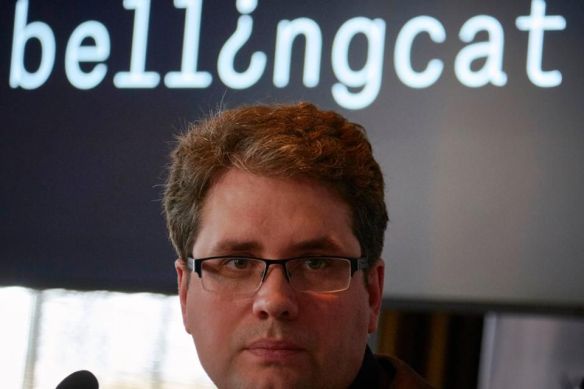
There is a notorious propaganda outfit called Bellingcat, started by an unemployed Englishman named Eliot Higgins, that has been funded by The Atlantic Council, a think-tank with deep ties to the U.S. government, NATO, war manufacturers, and their allies, and the National Endowment for Democracy (NED), another infamous U.S. front organization heavily involved in so-called color revolution regime change operations all around the world, that has just won the International Emmy Award for best documentary. The film with the Orwellian title, Bellingcat: Truth in a Post-Truth World, received its Emmy at a recent ceremony in New York City.  Bellingcat is an alleged group of amateur on-line researchers who have spent years shilling for the U.S. instigated war against the Syrian government, blaming the Douma chemical attack and others on the Assad government, and for the anti-Russian propaganda connected to, among other things, the Skripal poisoning case in England, and the downing of flight MH17 plane in Ukraine. It has been lauded by the corporate mainstream media in the west.  Its support for the equally fraudulent White Helmets (also funded by the US and the UK) in Syria has also been praised by the western corporate media while being dissected as propaganda by many excellent independent journalists such as Eva Bartlett, Vanessa Beeley, Catte Black, among others.  It’s had its work skewered by the likes of Seymour Hersh and MIT professor Theodore Postol, and its US government connections pointed out by many others, including Ben Norton and Max Blumenthal at The Gray Zone. And now we have the mainstream media’s wall of silence on the leaks from the Organization for the Prohibition on Chemical Weapons (OPCW) concerning the Douma chemical attack and the doctoring of their report that led to the illegal U.S. bombing of Syria in the spring of 2018.  Bellingcat was at the forefront of providing justification for such bombing, and now the journalists Peter Hitchens, Tareq Harrad (who recently resigned from Newsweek after accusing the publication of suppressing his revelations about the OPCW scandal) and others are fighting an uphill battle to get the truth out.

Yet Bellingcat: Truth in a Post-Truth World won the Emmy, fulfilling Bernays’ point about films being the greatest unconscious carriers of propaganda in the world today.

Who presented the Emmy Award to the film makers, but none other than the rebel journalist Chris Hedges.  Why he did so, I don’t know.  But that he did so clearly sends a message to those who follow his work and trust him that it’s okay to give a major cultural award to a propaganda outfit.  But then, perhaps he doesn’t consider Bellingcat to be that.

Nor, one presumes, does The Intercept, the billionaire Pierre Omidyar owned publication associated with Glen Greenwald and Jeremy Scahill, and also read by many progressive-minded people. The Intercept that earlier this year disbanded the small team that was tasked with reviewing and releasing more of the massive trove of documents they received from Edward Snowden six years ago, a minute number of which have ever been released or probably ever will be. As Whitney Webb pointed out, last year The Intercept  hosted a workshop for Bellingcat.  She wrote:

The Intercept, along with its parent company First Look Media, recently hosted a workshop for pro-war, Google-funded organization Bellingcat in New York. The workshop, which cost $2,500 per person to attend and lasted five days, aimed to instruct participants in how to perform investigations using “open source” tools — with Bellingcat’s past, controversial investigations for use as case studies…Thus, while The Intercept has long publicly promoted itself as an anti-interventionist and progressive media outlet, it is becoming clearer that – largely thanks to its ties to Omidyar – it is increasingly an organization that has more in common with Bellingcat, a group that launders NATO and U.S. propaganda and disguises it as “independent” and “investigative journalism.”

Then we have Jefferson Morley, the editor of The Deep State, former Washington Post journalist, and JFK assassination researcher, who has written a praiseworthy review of the Bellingcat film and who supports Bellingcat.  “In my experience, Bellingcat is credible,” he writes in an Alternet article, “Bellingcat documentary has the pace and plot of a thriller.”

Morley has also just written an article for Counterpunch“Why the Douma Chemical Attack Wasn’t a ‘Managed Massacre’” – in which he disputes the claim that the April 7, 2018 attack in the Damascus suburb was a false flag operation carried out by Assad’s opponents. “I do not see any evidence proving that Douma was a false flag incident,” he writes in this article that is written in a style that leaves one guessing as to what exactly he is saying.  It sounds convincing unless one concentrates, and then his double messages emerge.  Yet it is the kind of article that certain “sophisticated” left-wing readers might read and feel is insightful.  But then Morley, who has written considerably about the CIA, edits a website that advertises itself as “the thinking person’s portal to the world of secret government,” and recently had an exchange with former CIA Director John Brennan where “Brennan put a friendly finger on my chest,” said in February 2017, less than a month after Trump was sworn in as president, that:

With a docile Republican majority in Congress and a demoralized Democratic Party in opposition, the leaders of the Deep State are the most—perhaps the only—credible check in Washington on what Senator Bob Corker (R-Tenn.) calls Trump’s “wrecking ball presidency.”  

Is it any wonder that some people might be a bit confused?

“I know what you’re thinking about,” said Tweedledum; “but it isn’t so, nohow.”

“Contrariwise,” continued Tweedledee, “if it was so, it might be; and if it were so, it would be; but as it isn’t, it ain’t.  That’s logic.”

As a final case in point, there is a recent book by Stephen Kinzer, Poisoner in Chief: Sidney Gottlieb And The CIA Search For Mind Control, the story of the chemist known as Dr. Death who ran the CIA’s MK-ULTRA mind control project, using LSD, torture, electric shock therapy, hypnosis, etc.; developed sadistic methods of torture still used in black sites around the world; and invented various ingenious techniques for assassination, many of which were aimed at Fidel Castro.  Gottlieb was responsible for brutal prison and hospital experiments and untold death and suffering inflicted on all sorts of innocent people.  His work was depraved in the deepest sense; he worked with Nazis who experimented on Jews despite being Jewish himself.

Kinzer writes in depth about this man who considered himself a patriot and a spiritual person – a humane torturer and killer.  It is an eye-opening book for anyone who does not know about Gottlieb, who gave the CIA the essential tools they use in their “organized crime” activities around the world – in the words of Douglass Valentine, the author of The CIA as Organized Crime and The Phoenix Program. Kinzer’s book is good history on Gottlieb; however, he doesn’t venture into the present activities of the CIA and Gottlieb’s patriotic followers, who no doubt exist and go about their business in secret.

After recounting in detail the sordid history of Gottlieb’s secret work that is nauseating to read about, Kinzer leaves the reader with these strange words:

Gottlieb was not a sadist, but he might well have been…. Above all he was an instrument of history.  Understanding him is a deeply disturbing way of understanding ourselves.

What possibly could this mean?  Not a sadist?  An instrument of history?  Understanding ourselves?  These few sentences, dropped out of nowhere, pull the rug out from under what is generally an illuminating history and what seems like a moral indictment. This language is pure mystification.

Kinzer also concludes that because Gottlieb said so, the CIA failed in their efforts to develop methods of mind control and ended MK-ULTRA’s experiments long ago. Why would he believe the word of a man who personified the agency he worked for: a secret liar? He writes,

When Sydney Gottlieb brough MK-ULTRA to its end in the early 1960s, he told his CIA superiors that he had found no reliable way to wipe away memory, make people abandon their consciences, or commit crimes and then forget them.

As for those who might think otherwise, Kinzer suggests they have vivid imaginations and are caught up in conspiracy thinking: “This [convincing others that the CIA had developed methods of mind control when they hadn’t] is Sydney Gottlieb’s most unexpected legacy,” he asserts. He says this although Richard Helms, the CIA Director, destroyed all MK-Ultra records. He says that Allen Dulles, Gottlieb, and Helms themselves were caught up in a complete fantasy about mind control because they had seen too many movies and read too many books; mind control was impossible, a failure, a myth, he maintains. It is the stuff of popular culture, entertainment. In an interview with Chris Hedges, interestingly posted by Jefferson Morley at his website, The Deep State, Hedges agrees with Kinzer.  Gottlieb, Dulles, et al. were all deluded.  Mind control was impossible.  You couldn’t create a Manchurian Candidate; by implication, someone like Sirhan Sirhan could not have been programmed to be a fake Manchurian Candidate and to have no memory of what he did, as he claims.  He could not have been mind-controlled by the CIA to perform his part as the seeming assassin of Senator Robert Kennedy while the real killer shot RFK from behind. People who think like this should get real.

Furthermore, as is so common in books such as Kinzer’s, he repeats the canard that JFK and RFK knew about and pressured the CIA to assassinate Fidel Castro. This is demonstrably false, as shown by the Church Committee and the Assassinations Record Review Board, among many others. That Kinzer takes the word of notorious liars like Richard Helms and the top-level CIA operative Samuel Halpern is simple incredible, something that is hard to consider a mistake.  Slipped into a truth sandwich, it is devoured and passed on. But it is false. Bullshit meant to deceive.

But this is how these games are played. If you look carefully, you will see them widely.  Inform, enlighten, while throwing in doubletalk and untruths.  The small number of people who read such books and articles will come away knowing some history that has no current relevance and being misinformed on other history that does. They will then be in the know, ready to pass their “wisdom” on to those who care to listen. They will not think they are average.

But they will be mind controlled, and the killer cat will roam freely without a bell, ready to devour the unsuspecting mice.