Whistleblowers in the United States military exposed a strike in Syria that resulted in the massacre of around 70 women and children, according to an investigation by the New York Times.
The command responsible for the strike conceded a war crime may have taken place, but a report by the Office of the Inspector General for the Defense Department removed this opinion.
Officials in the Pentagon impeded an investigation and ensured no one would ever be held accountable for the civilian deaths. They also turned on one of the whistleblowers, forcing them out of their position in the I.G.’s office.
What happened proves once again that going through proper channels can be a fruitless and risky career-ending effort.
Lisa Ling, a former tech sergeant who worked on drone surveillance systems and is a known whistleblower, reacted, “Again, the public is notified of a ‘possible’ war crime by a brave whistleblower who was eventually forced out of their job.”
“This is a pattern that exemplifies the need for robust whistleblower protections especially for the intelligence community so often carved out of them. We need more light shined in these secret spaces so that this doesn’t happen again, and again, and again, without the public knowing what is done in our name.”
As the Times reported, on March 18, 2019, “In the last days of the battle against the Islamic State in Syria, when members of the once-fierce caliphate were cornered in a dirt field next to a town called Baghuz, a U.S. military drone circled high overhead, hunting for military targets. But it saw only a large crowd of women and children huddled against a river bank.”
U.S. military forces launched a double tap strike. An American F-15E “attack jet” dropped a 500-pound bomb. As survivors scrambled for cover, another jet dropped a 2,000-pound bomb that killed “most of the survivors.” A “high-definition drone” recorded the scene prior to the bombing. Two or three men were near a compound. Though they had rifles, neither engaged coalition forces. Women and children were observed in the area.“
At nearly every step, the military made moves that concealed the catastrophic strike. The death toll was downplayed. Reports were delayed, sanitized, and classified,” and the Times added, “Coalition forces bulldozed the blast site.”
The strike was the work of a classified U.S. special operations unit known as Task Force 9. They were responsible for the third-worst “casualty event” in Syria. According to the Times, an unnamed Air Force intelligence officer in the Combined Air Operations Center at Al Udeid Air Base in Qatar contacted Lieutenant Colonel Dean Korsak, who was an Air Force lawyer. They were ordered to preserve video and other evidence from the “F-15E squadron and drone crew.”
Korsak concluded a “possible war crime” was committed that required an independent investigation. He noted that Task Force 9 was “clearly seeking to cover up” incidents like this strike by logging false entries after the fact—for example, the man had a gun.
The Air Force’s Office of Special Investigations was notified. However, as the Times recalled, a major refused to investigate because civilian casualties were only investigated if there was a “potential for media attention, concern with outcry from local community/government, [and/or] concern sensitive images may get out.”
In other words, if the Pentagon needed to get ahead of a potential scandal, they would investigate and craft a narrative that could tamp down outrage. But they did not believe the Baghuz strike would ever make headlines.
Korsak tried once more to convince his superiors to investigate in May 2019. They still refused. So Korsak filed a “hotline complaint” with the I.G.’s office in August 2019.
Gene Tate, a “former Navy officer who had worked for years as a civilian analyst with the Defense Intelligence Agency and the National Counterterrorism Center before moving to the inspector general’s office,” told the Times, “When [Korsak] came to us, he wanted to make it very clear he had tried everything else first. He felt the I.G. hotline was the only option remaining.”
Roadblocks prevented Tate from having any success. He could not find the footage from the task force drone that called in the strike. U.S. Central Command (CENTCOM) removed the war crime finding from a report on the massacre.
In January 2020, according to the Times investigation, the deputy inspector general refused to sign off on a memo that would have alerted authorities to the war crime.
Tate did not hesitate to criticize leadership in the I.G.’s office, and by October 2020, he was forced out of the office.
In May 2021, Tate contacted the Senate Armed Services Committee and sent a 10-page letter that detailed the Baghuz strike. However, as of November 13, he was still waiting for any member of the committee to call him back.
*
To further illustrate how stunning it is that senators on the committee ignored what Tate shared, CIA officers in Syria were so alarmed by the conduct of Task Force 9 that they complained to the I.G.’s office for the Defense Department.
“CIA officers alleged that in 10 incidents the secretive task force hit targets knowing civilians would be killed,” according to one former task force officer quoted by the Times.
The New York Times shared their reporting with CENTCOM prior to publication and asked for official comment. CENTCOM acknowledged “80 people were killed” but insisted the strike was justified.
“The bombs killed 16 fighters and four civilians.”“As for the other 60 people killed, the statement said it was not clear that they were civilians, in part because women and children in the Islamic State sometimes took up arms,” according to CENTCOM.
This is part of the legacy of President Barack Obama’s administration. He developed a method of counting civilian casualties that would not “box him in.”
In 2012, the Times reported all “military-age males in a strike zone” found dead were presumed to be “combatants” unless there was “explicit intelligence posthumously proving them innocent.”
If commanding officers refuse to support an investigation into a massacre, then they never have to worry about an investigation moving deaths in the “combatant” column to the “civilian” column, which would make them look bad.
On November 3, the Air Force released the findings of the investigation into the U.S. drone strike in Kabul on August 29 that killed Zemerai Ahmadi, an aid worker and father, his three sons, two of his nephews, and three girls who were toddlers. They exonerated themselves.
“The investigation found no violation of law including the law of war,” Air Force Inspector General Sami Said declared. “We did find execution errors.” Combined with “confirmation bias” and “communication breakdowns,” that “regrettably led to civilian casualties.”
But Said is undoubtedly implicated in the coverup of countless war crimes committed by Task Force 9 and various other special operations units, which engage in similar bombing attacks.
Meanwhile, drone whistleblower Daniel Hale is in a communications management unit (CMU) at a medium-security federal prison in Marion, Illinois. He is closely monitored by the FBI and Bureau of Prisons officials so they can prevent him from further commenting on the bloodshed caused by U.S. drone strikes.
Reflecting on how the cycle of violence with militant groups continues, Ling stated, “They don’t hate our way of life. They rightfully hate our way of killing. Seventy innocent women and children were needlessly killed in Syria, 10 killed in Afghanistan, and plenty more we will never know about.”
“These are human beings, and we took their lives while using sanitized words with fancy legal footwork to get away with breaking international law. It is wrong. It is terror, and I believe Americans are complicit as long as we remain silent about what is being done in our name.”
“We cannot fight a war on terror with more terror,” Ling concluded.
Nicaragua has been a target of U.S. aggressions since the 1850s. The Biden administration’s attack on the newly elected government is the latest chapter in a long and sordid history. Eyewitness accounts of the electoral process reveal the manipulations and lies concocted by the U.S. and its corporate media partners in this latest regime change effort.
The United States has continuously carried out acts of aggression against Nicaragua and its people for more than 150 years. Joseph Biden’s effort to undermine that country’s sovereignty is part of a long history of invasions, coups, and support for U.S. puppets.
The Biden administration declared the recent election fraudulent before it had even taken place. The corporate media repeated lies about an “authoritarian dictatorship” that came straight from the State Department’s script. The United States congress voted overwhelmingly to pass the RENACER Act, a regime change plot featuring the imposition of sanctions meant to create misery for Nicaraguans. Sanctions are war by other means, the modern-day version of sending the marines.
The U.S. has done just that, occupying the country from 1912 to 1933. But that was not the first time that U.S. forces were sent to undermine Nicaraguan governments. In 1856 an American named William Walker invaded the country with a mercenary army and declared himself president. Walker was supported by the American slavocracy and sought to create new slave holding nations in the region. During his year long reign, he revoked Nicaragua’s abolition law and he was recognized as president by the Franklin Pierce administration.
The next bout of American aggressions began with an occupation by the U.S. marines in 1912 which lasted until 1933. Augusto Cèsar Sandino fought a guerrilla war against the occupation before being executed under orders of Anastasio Somoza. The Somoza family ruled until 1979 and always with the backing of the United States.
The Sandinista movement (which took its name after Sandino) emerged triumphant in 1980 against Somoza’s regime and quickly came under attack from the Ronald Reagan administration. The opposition groups known as “contras” were given millions of dollars and were assisted in fund raising through the sale of cocaine in the United States. The crack cocaine epidemic began as part of a U.S. imperialist plan. The war waged in Nicaragua was also carried out against communities of color in this country too.
President Daniel Ortega was re-elected on November 7, 2021 and Washington once again declared war on his nation. The RENACER Act passed by a vote of 387 to 35 in the House of Representatives, a huge majority indicative of bipartisan support for war by other means.
The Biden administration acted quickly in denouncing the election before it took place, and repeated their claims of a “pantomime election ” on the day that Nicaraguans went to the polls. They followed up by orchestrating an Organization of American States (OAS) rejection of the Nicaraguan people’s electoral decision.
As a member of the Black Alliance for Peace (BAP) delegation in Nicaragua, this columnist witnessed the determination of Nicaraguans to choose their own government without interference. More than 200 representatives from 27 nations, were designated as acompañantes, companions, to the electoral process.
The BAP delegation travelled to the Caribbean coast city of Blue Fields where African descended Garifunas and Creoles reside with Mestizos and the Miskito, Rama, and Olwas indigenous communities. Voters from all these groups came out to well managed polling places, where all presidential candidates were listed on the ballot. The process was transparent and orderly, unlike the voting process in the United States, where eligible voters can be stricken from the ballot or be forced to wait for hours to cast their votes.
Despite what the white house and the corporate media claimed, opposition parties were able to campaign freely. Their signage and literature were quite visible, and no one can truthfully say that the public were unaware of the variety of electoral choices.
The Frente Sandinista para Liberacion Nacional (FSLN) emerged triumphant because they endeavor to meet popular needs. The Afro-descended citizens of the Caribbean coast were recognized as a group with distinct needs that were enshrined in the FSLN constitution. That region was excluded and quite literally isolated from the rest of the country without access to transportation and lacking basic infrastructure such as electricity and clean water. BAP delegates heard the consistent message that support for the FSLN is a result of concrete improvements in people’s lives. Despite the determination of the U.S. to undermine them, the FSLN now provide free health care and increased educational opportunities throughout the nation.
The 19th century Monroe Doctrine is alive and well in the 21st century. Whoever is in power in Washington considers other nations in this hemisphere to be its “backyard.” Nicaragua’s population of 6.5 million is smaller than that of New York City. Yet those few people are not allowed to exercise their rights to self-determination without raising Uncle Sam’s ire. Nicaraguans are not the first to feel imperialist vengeance. Tiny Grenada was undermined and invaded when it sought to determine democracy for itself. Venezuela is also under the sanctions hammer and Haiti is allowed to do nothing that Washington doesn’t approve.
The corporate media may be under the dictates of the state, but the people have no reason to follow suit. The presence of companion delegations in Nicaragua was an important step in revealing how the hybrid warfare playbook is put into practice.
Nicaraguans are well aware of their history. The lies are intended for a different audience. The United States seeks to fool its own people and thereby gain support for whatever form of aggression that it may choose. The plan is a consistent one which starts with media amplifying narratives that will gain support for interference. Creating falsehoods of human rights abuses is a reliable ruse to keep Americans complacent about their government’s activities.
The collusion between government and media explains why “trolls” are active on social media, attacking anyone who questions what Washington says. Facebook continued its work on behalf of the state by removing accounts expressing any support for Nicaragua’s sovereignty. The marriage of big tech companies and the Democratic party showed itself once again, proving that claims of freedom and democracy in U.S. politics are indeed an elaborate “pantomime.”
It may seem odd that a small nation can be the focus of so much determination to destroy its independence. But it isn’t hard to understand that Nicaragua threatens the U.S. should it be allowed to determine its own fate. The people who think they live in a democracy do not. They do not have access to free health care and are told they cannot expect to ever have it. Nicaragua is an example of what people in the U.S. could have if they were as free as they like to believe.
The drive to subjugate is as old as the republic, with the United States acting as a hegemon around the world, creating conflict and great suffering. The evil commitment to destroy Nicaraguan democracy is not unexpected but it must be vociferously opposed. Doing so is a litmus test which determines who is really on the left and who is not. There can be no compromise on the anti-imperialist stance. The human rights of people around the world must be respected and any United States government effort to violate them must be met with equivalent resolve.
A tacit agreement between the government and Facebook appears to have been made: you can keep the profits, but we control the message. As such, a cynic might wonder what functional difference there is between Facebook and the national security state.
MANAGUA, NICARAGUA — Less than a week before Nicaragua’s presidential election, social media giant Facebook deleted the accounts of hundreds of the country’s top news outlets, journalists and activists, all of whom supported the ruling left-wing Sandinista government, a top Washington target for regime change.
Facebook claims that these accounts were bots engaged in “inauthentic behavior.” Considering that around half of the country uses the platform for news and entertainment, the decision could barely have been more heavy-handed and intrusive. However, early reports show that if their goal was to swing the result, it has failed badly and the Sandinistas have achieved an overwhelming victory.
“This is appalling interference by Facebook in particular (which is the most popular social media outlet in Nicaragua). They allege that they’ve stopped a government-deployed troll farm but what they have actually done is to close accounts of ordinary Sandinista activists, particularly young people, often with many followers,” John Perry, a journalist living in the city of Masaya, told MintPress.
Worse still, after dozens of Sandinistas took to Twitter to record video messages proving they were real people being censored, their accounts were systematically deleted as well, in what Managua-based journalist Ben Nortondescribed as a Silicon Valley “double-tap strike.”
“These are accounts that average Nicaraguans have come to count on for news and communicating with each other about current events and, in this case, about the election. So it is very troubling that it was obviously targeted against one political group: the Sandinistas,” said Daniel Kovalik, a human-rights lawyer and an observer of this weekend’s elections.
Both Perry and Kovalik were of the opinion that it was no coincidence that Facebook had taken action against precisely the group the U.S. government is trying to overthrow.
Facebook as security-state beard
Perhaps even more worrying from a freedom-of-speech viewpoint is who made the decision at Facebook. The 11-page report detailing the company’s supposed evidence of inauthentic behavior has just two contributors: Luis Fernando Alonso and Ben Nimmo, individuals with deep and long-lasting ties to Western military intelligence. According to his biography on LinkedIn, Alonso was, until last year, working for Booz Allen Hamilton, a shadowy corporation situated in the area around Washington, D.C. colloquially known as “Raytheon Acres.” The national security state farms out much of its most controversial work to the firm, which is technically a private company (and therefore not subject to the same oversight and scrutiny as public agencies). Edward Snowden, for instance, actually worked for Booz Allen Hamilton, not the NSA. Before that, Alonso directly worked for the government at the William J. Perry Center for Hemispheric Defense Studies, a Department of Defense-controlled institution that trains top military and intelligence leaders.
Nimmo’s background is equally spooky. Between 2011 and 2014, he served as NATO’s press officer, moving the next year to the Institute for Statecraft, a U.K. government-funded propaganda operation aimed at spreading misleading information about enemies of the British state. The Institute for Statecraft established a secret network of journalists across Europe who were used to push anti-Russia and pro-establishment talking points, all in coordination.
In 2019, Nimmo played a key role in downplaying the bombshell news that the Conservative government was quietly negotiating to sell off key parts of Great Britain’s National Health Service (NHS) to foreign plutocrats. When the Labour Party publicized this information just days before the election, Nimmo jumped into action, immediately announcing, without evidence, that the documents in question “closely resemble … a known Russian operation.” His supposedly expert conjecture — together with help from allied journalists in the Integrity Initiative — allowed the story to become “Labour’s links to Russia” rather than “Tories privatizing the NHS in secret,” helping the Conservatives make huge electoral gains.
Nimmo also became a senior fellow at the Atlantic Council, NATO’s semi-official think tank.
Facebook — now officially called “Meta” — is extremely secretive about who actually works at their intelligence department. Nowhere can one find a list of names of key figures. However, going back through months of reports and blog posts for names reveals a veritable revolving door between big tech and big government. In short, Facebook is strewn with spies.
For example, a document published in May, entitled “The State of Influence Operations, 2017-2020,” lists five author names in addition to Nimmo’s, at least four of whom have long histories as senior agents in the national security state.
In order, they are:
Nathaniel Gleicher, Head of Security Policy: Gleicher spent two and a half years at the White House as the National Security Council’s Director of Cyber Security Policy. Before that he also spent five years at the Department of Justice.
David Agranovich, Head of Security Communications: Agranovich worked for more than six years in a senior role at the Department of Defense, before, in 2017, moving on to become the Director for Intelligence for the National Security Council at the White House.
Olga Belogolova, Influence Operations Product Policy Manager: The most academic of the authors, Belogolova teaches cybersecurity and influence operations to students at Georgetown University, an institution notorious as America’s spy school. Before that, she worked at the State Department’s Bureau of European and Eurasian Affairs and on Russian, Ukrainian and Eurasian policy at the Office of the Secretary of Defense. She has also served on several working groups at government- and military-funded think tanks like The Center for New American Security, The Center for Strategic and International Studies, and The Atlantic Council.
Mike Torrey, Threat Intelligence Analyst: From 2010 until 2018, Torrey was a high-level CIA agent, specializing in cyberwarfare against China. Before that, he worked as a global network intelligence analyst for the NSA.
Of the six authors listed, only one, Margarita Franklin, comes from a non-governmental background.
Looking further into Facebook’s official blog, Mike Dvilyanski is described as the company’s Head of Cyber Espionage Investigations. From 2005 until 2018, Dvilyanski was an FBI agent in Washington and New York City, rising to the rank of Supervisory Special Agent, leading teams investigating cyberwafare.
Another official Facebook report from April was authored by the company’s Technical Threat Investigator, Michael Flossman, who spent nearly six years in the Australian Department of Defense.
In 2018, Facebook announced a partnership with The Atlantic Council, whereby it gave an undisclosed amount of control over users’ news feeds to the group, allowing it to help them decide what posts users saw and which ones were suppressed. Given that the council’s board features a plethora of military generals, former cabinet members, and no fewer than seven former CIA directors, this is tantamount to state censorship on a global level. A tacit agreement between the government and Facebook appears to have been made: you can keep the profits, but we control the message. As such, a cynic might wonder what functional difference there is between Facebook and the national security state.
Silicon Valley: tip of US imperial spear
It might be unfair, however, to single Facebook out. Other large platforms are similarly stocked with government plants. Reddit’s Director of Policy, for instance, was formerly a Deputy Director of The Atlantic Council’s Middle East Task Force. Meanwhile, a senior Twitter executive is also an active duty officer in the British Army’s psychological warfare and online propaganda brigade.
Silicon Valley has not only made their peace with this relationship; they actively court it. “What Lockheed Martin was to the twentieth century, technology and cyber-security companies will be to the twenty-first,” wrote Google executives Eric Schmidt and Larry Cohen in their book, “The New Digital Age,” laying out how they saw Silicon Valley becoming the tip of the American empire’s spear.
Washington has already used social media as a weapon aimed at its enemies. In July, Americans in Miami used Facebook to organize an attempted color revolution in Cuba, while Twitter ignored blatantly obvious bots boosting the anti-government message, even choosing to put it at the top of its “what’s happening” sidebar for 36 hours, meaning every user in the world was alerted to the news. Individuals inside Cuba complained to MintPress that the endless supply of fake news citizens receive from the U.S. via Facebook and WhatsApp is spreading disinformation and rotting Cubans’ brains.
Meanwhile, in 2009, the U.S. government persuaded Twitter to delay scheduled maintenance of its app because of widespread protests it was fomenting in Iran, knowing the platform was being used to coordinate anti-government forces. Last year, Facebook banned all positive references to Iranian general Qassem Soleimani in the wake of his assassination by the Trump administration. “We operate under U.S. sanctions laws, including those related to the U.S. government’s designation of the Iranian Revolutionary Guard Corps and its leadership,” the company said in a statement. Despite the fact that over 80% of the country held positive views towards the general (even before his killing), this meant that even Iranians speaking Farsi with other Iranians online in Iran could not share an overwhelmingly held view. This is but one example of the extraordinary power the U.S. national security state now holds over the means of communication worldwide.
Ineffective interference
The United States has a long history of interfering in Nicaragua, from invasions to propping up the 40-year Somoza family dictatorship. When Sandinista rebels ran them out of town in 1979, Washington began a long campaign of terror against the Sandinistas, including funding, training and arming the infamous Contra death squads. After more than a decade of interference, U.S.-backed candidate Violeta Chamorro won the 1990 election. However, after Daniel Ortega and the Sandinistas returned to power in 2006, the U.S. once again began trying to undermine their rule through sanctions and by supporting a 2018 coup attempt. Washington has also unleashed an army of NGOs into the country, each attempting to foment discontent with the ruling government.
In September, Secretary of State Anthony Blinken met in New York with the foreign ministers of Mexico and every other Central American country in an attempt to organize a united front against Nicaragua. Last week, the U.S. also announced new sanctions on the country. Kovalik told MintPress:
This is clearly punishment for the fact that they’re going to vote [the wrong way]. And meanwhile, of course the U.S. is putting millions into the country in terms of supporting opposition groups and different propaganda sources. So that continues. Again, what passes for alleged foreign interference in the U.S. …. is nothing compared to what the U.S. is doing here.
Western journalists and election observers whose opinions the U.S. government would rather not be shared have also been targeted. British journalist Steve Sweeney was detained in Mexico en route to Nicaragua. “It is no coincidence that it came just weeks after my ban from the U.S. I fully believe my detention is political and an attack on press freedom,” he wrote, after being released. Meanwhile, Canadian observer Dr. Timothy Bood was barred from sharing his experiences on Facebook, the platform blocking him immediately after he made a comment about U.S. interference in the election.
Perry suggested, however, that if Washington thinks that sanctions sanctions or other new measures will dislodge the government and break the people’s will, they are mistaken, and that the plan could backfire:
We had the approval in the U.S. Congress of the RENACER Act a few days ago, which is another threat of U.S. interference during and after the election process. I think opinion polls show that most people reject U.S. interference very strongly. I think in most cases it will strengthen people’s desire to vote and probably to vote for the Sandinista government. So it could have the opposite effect to the one that the U.S. wants to achieve.
Judging by the jubilant Sandinista parades in Managua and other cities today, coupled with the announcement that Ortega won an estimated three-quarters of the vote on a 65% turnout rate, Perry might have been proved right.
The Global Public-Private Partnership (GPPP) is a world-wide network of stakeholder capitalists and their partners.
This collective of stakeholders (the capitalists and their partners) comprises global corporations (including central banks), philanthropic foundations (multi-billionaire philanthropists), policy think-tanks, governments (and their agencies), non-governmental organisations, selected academic & scientific institutions, global charities, the labour unions and other chosen “thought leaders.”
The GPPP controls global finance and the world’s economy. It sets world, national and local policy (via global governance) and then promotes those policies using the mainstream media (MSM) corporations who are also “partners” within the GPPP.
Often those policies are devised by the think-tanks before being adopted by governments, who are also GPPP partners. Government is the process of transforming GPPP global governance into hard policy, legislation and law.
Under our current model of Westphalian national sovereignty, the government of one nation cannot make legislation or law in another. However, through global governance, the GPPP create policy initiatives at the global level which then cascade down to people in every nation. This typically occurs via an intermediary policy distributor, such as the IMF or IPCC, and national government then enact the recommended policies.
The policy trajectory is set internationally by the authorised definition of problems and their prescribed solutions. Once the GPPP enforce the consensus internationally, the policy framework is set. The GPPP stakeholder partners then collaborate to ensure the desired policies are developed, implemented and enforced. This is the oft quoted “international rules based system.”
In this way the GPPP control many nations at once without having to resort to legislation. This has the added advantage of making any legal challenge to the decisions made by the most senior partners in the GPPP (it is an authoritarian hierarchy) extremely difficult.
The GPPP has traditionally been referenced in the context of public health and specifically in a number of United Nation’s (UN) documents, including those from their agencies such as the World Health Organisation (WHO).
In their 2005 document Connecting For Health, the WHO, in noting what the Millennium Development Goals meant for global health, revealed the emerging GPPP:
These changes occurred in a world of revised expectations about the role of government: that the public sector has neither the financial nor the institutional resources to meet their challenges, and that a mix of public and private resources is required……Building a global culture of security and cooperation is vital….The beginnings of a global health infrastructure are already in place. Information and communication technologies have opened opportunities for change in health, with or without policy-makers leading the way…….Governments can create an enabling environment, and invest in equity, access and innovation.”
The revised role of governments meant that they were no longer leading the way. The traditional policymakers weren’t making policy anymore, other GPPP partners were. National government had been relegated to creating the GPPP’s enabling environment by taxing the public and increasing government borrowing debt.
This is a debt owed to the senior partners in the GPPP. They are also the beneficiaries of the loans and use this comically misnamed “public investment” to create markets for themselves and the wider the GPPP.
The researchers Buse & Walt 2000 offers a good official history of the development of the GPPP concept. They suggest it was a response to the growing disillusionment in the UN project as a whole and the emerging realisation that global corporations were increasingly key to policy implementation. This correlates to the development of the stakeholder capitalism concept, first popularised in the 1970s.
Buse & Walt outlined how GPPP’s were designed to facilitate the participation of new breed of corporations. These entities had recognised the folly of their previously destructive business practices. They were ready to own their mistakes and make amends. They decided they would achieve this by partnering with government to solve global problems. These existential threats were defined by the GPPP and the selected scientists, academics and economists they funded.
The two researchers identified a key Davos address, delivered by then UN Secretary General Kofi Annan to the WEF in 1998, as marking the transition to a GPPP based global governance model:
The United Nations has been transformed since we last met here in Davos. The Organization has undergone a complete overhaul that I have described as a ‘quiet revolution’…A fundamental shift has occurred. The United Nations once dealt only with governments. By now we know that peace and prosperity cannot be achieved without partnerships involving governments, international organizations, the business community and civil society…The business of the United Nations involves the businesses of the world.”
Buse & Walt claimed that this signified the arrival of a new type of responsible global capitalism. As we shall see, that is not how the corporations viewed this arrangement. Indeed, Buse and Walt acknowledged why the GPPP was such an enticing prospect for the global giants of banking, industry, finance and commerce:
Shifting ideologies and trends in globalization have highlighted the need for closer global governance, an issue for both private and public sectors. We suggest that at least some of the support for GPPPs stems from this recognition, and a desire on the part of the private sector to be part of global regulatory decision-making processes.”
The conflict of interest is obvious. We are simply expected to accept, without question, that global corporations are committed to putting humanitarian and environmental causes before profit. Supposedly, a GPPP led system of global governance is somehow beneficial for us.
Believing this requires a considerable degree of naivety. Many of the stakeholder corporations have been convicted, or publicly held accountable, for the crimes they have commited. These include war crimes. The apparent passive agreement of the political class that these “partners” should effectively set global policy, regulations and spending priorities seems like infantile credulity.
This naivety is, in itself, a charade. As many academics, economists, historians and researchers have pointed out, corporate influence, even dominance of the political system had been increasing for generations. Elected politicians have long-been the junior partners in this arrangement.
With the arrival of GPPP’s we were witnessing the birth of the process to formalise this relationship, the creation of a cohesive world order. The politicians have simply stuck to the script ever since. They didn’t write it.
It is important to understand the difference between government and governance in the global context. Government claims the right, perhaps through a quasi-democratic mandate, to set policy and decree legislation (law.)
The alleged western representative democracies, which aren’t democracies at all, are a model of national government where elected representatives form the executive who enact legislation. For example, in the UK this is achieved through the parliamentary process.
Perhaps the closest thing to this form of national government on an international scale is the United Nations General Assembly. It has a tenuous claim to democratic accountability and can pass resolutions which, while they don’t bind member states, can create “new principles” which may become international law when later applied by the International Court of Justice.
However, this isn’t really world “government.” The UN lacks the authority to decree legislation and form law. The only way its “principles” can become law is via judicial ruling. The non-judicial power to create law is reserved for governments and their legislative reach only extends to their own national borders.
Due to the often fraught relationships between national governments, world government starts to become impractical. With both the non-binding nature of UN resolutions and the international jockeying for geopolitical and economic advantage, there isn’t currently anything we could call a world government.
There is the additional problem of national and cultural identity. Most populations aren’t ready for a distant, unelected world government. People generally want the political class to have more democratic accountability, not less.
The GPPP would certainly like to run a world government, but imposition by overt force is beyond their capability. Therefore, they have employed other means, such as deception and propaganda, to promote the notion of global governance.
Former Carter administration advisor and Trilateral Commission founder Zbigniew Brzezinski recognised how this approach would be easier to implement. In his 1970 book Between Two Ages: Americas Role In The Technetronic Era, he wrote:
Though the objective of shaping a community of the developed nations is less ambitious than the goal of world government, it is more attainable.”
The last 30 years have seen numerous GPPP’s form as the concept of global governance has evolved. A major turning point was the WEF’s conspectus of multistakeholder governance. With their 2010 publication of Everybody’s Business: Strengthening International Cooperation in a More Interdependent World, the WEF outlined the elements of GPPP stakeholder’s form of global governance.
They established their Global Agenda Councils to deliberate and suggest policy covering practically every aspect of our existence. The WEF created a corresponding global governance body for every aspect of our society. From our values and economy, through to our security and public health, our welfare systems, consumption, access to water, food security, crime, our rights, sustainable development and the global financial and monetary system, nothing was left untouched.
The executive chairman of the WEF, Klaus Schwab, spelled out what the objective of global governance was:
Our purpose has been to stimulate a strategic thought process among all stakeholders about ways in which international institutions and arrangements should be adapted to contemporary challenges…the world’s leading authorities have been working in interdisciplinary, multistakeholder Global Agenda Councils to identify gaps and deficiencies in international cooperation and to formulate specific proposals for improvement…
These discussions have run through the Forum’s Regional Summits during 2009 as well as the Forum’s recent Annual Meeting 2010 in Davos-Klosters, where many of the emerging proposals were tested with ministers, CEOs, heads of NGOs and trade unions, leading academics and other members of the Davos community…
The Global Redesign process has provided an informal working laboratory or marketplace for a number of good policy ideas and partnership opportunities…We have sought to expand international governance discussions…to take more pre-emptive and coordinated action on the full range of risks that have been accumulating in the international system.
By 2010 the WEF had taken it upon themselves to begin the Global Redesign process. They defined the international challenges and they proposed the solutions. Fortunately for the GPPP, their proposals meant more control and partnership opportunities for them. The WEF sought to spearhead the expansion of this international governance.
In just one example, in 2019 the UK Government announced its partnership with the WEF to develop future business, economic and industrial regulations. The UK government were committed to supporting a regulatory environment created by the global corporations who would then be regulated by the same regulations they had designed.
The WEF do not have an electoral mandate of any kind. None of us have any opportunity to influence or even question their judgments and yet they are working in partnership with our supposedly democratically elected governments, and other GPPP stakeholders, to redesign the planet we all live on.
Stakeholder capitalism lies at the heart of the GPPP. Essentially it usurps democratic government (or indeed government of any kind) by placing global corporations at the centre of decision making. Despite deriving authority from no one but themselves, the leaders of the GPPP assume their own modern interpretation of the “divine right of kings” and rule absolutely.
The most important characteristic of the stakeholder model today is that the stakes of our system are now more clearly global.. What was once seen as externalities in national economic policy making and individual corporate decision making will now need to be incorporated or internalized in the operations of every government, company, community, and individual. The planet is.. the center of the global economic system, and its health should be optimized in the decisions made by all other stakeholders.”
The GPPP will oversee everything. Every government, all business, our so-called communities (where we live) and each of us individually. We are not the priority. The priority is the planet. Or so the WEF claim.
Centralised control of the entire planet, all its resources and everyone that lives on it is the core ethos of the GPPP. There is no need to interpret GPPP intentions, we don’t have to read between the lines. It is stated plainly in the introduction to the WEF’s Great Reset initiative:
To improve the state of the world, the World Economic Forum is starting The Great Reset initiative.. The Covid-19 crisis.. is fundamentally changing the traditional context for decision-making. The inconsistencies, inadequacies and contradictions of multiple systems –from health and financial to energy and education – are more exposed than ever.. Leaders find themselves at a historic crossroads.. As we enter a unique window of opportunity to shape the recovery, this initiative will offer insights to help inform all those determining the future state of global relations, the direction of national economies, the priorities of societies, the nature of business models and the management of a global commons.”
It should be noted that the WEF are just one partner organisation among many in the GPPP. However, they have been perhaps the most influential in terms of public relations throughout the pseudopandemic. Contrary to the hopes of Buse & Walt, we see an emergent global, corporate dictatorship, not caring stewardship of the planet.
The GPPP will determine the future state of global relations, the direction of national economies, the priorities of societies, the nature of business models and the management of a global commons. There is no opportunity for any of us to participate in either their project or the subsequent formation of policy.
While, in theory, governments do not have to implement GPPP policy, the reality is that they do. Global policies have been an increasing facet of our lives in the post WW2 era. The mechanism of translating GPPP policy initiatives, first into national and then regional and eventually local policy, can be clearly identified by looking at sustainable development.
In 1972 the privately funded, independent policy think-tank the Club of Rome (CoR) published the Limits of Growth. As we saw with the roll-out out of the pseudopandemic, the CoR used computer models to predict what they decreed were the complex problems faced by the entire planet: the “world problematique.”
Their offered opinions derived from the commissioned work of the Massachusetts Institute of Technology’s (MIT’s) system dynamic “World3 model.” This assumed global population would deplete natural resources and pollute the environment to the point where “overshoot and collapse” would inevitably occur.
This is not a scientific “fact” but rather a suggested scenario. So far, none of the predictions made have come to pass.
The scientific and statistical to-and-fro on the claims made in the Limits to Growth has been prolific. However, ignoring all doubts, the World3 model was firmly planted at the centre of the sustainable development policy environment.
In 1983 the Brundtland Commission was convened by former Norwegian Prime Minister Gro Harland Brundlandt and then Secretary General of the UN Javier Pérez de Cuéllar. Both were Club of Rome members. Based upon the highly questionable assumptions in the World3 model, they set about uniting governments from around the world to pursue sustainable development policies.
In 1987 the Commission published the Brundtland Report, also known as Our Common Future. Central to the idea of sustainable development, outlined in the report, was population control (reduction.) This policy decision, to get rid of people, won international acclaim and awards for the authors.
The underlying assumptions for these policy proposals weren’t publicly challenged at all. The academic and scientific debate raged but remained almost completely unreported. As far as the public knew, scientific assumption and speculation was a proven fact. It is now impossible to question these unproven assumptions and obviously inaccurate models without being accused of “climate denial.”
This resulted in the Millenium Development Goals and eventually, in 2015, they gave way to the United Nation’s full adoption of Sustainable Development Goals (SDGs), In turn, these have been translated into government policy. For example, the UK government proudly announced their Net Zero policy commitment to sustainable development goals in 2019.
SDGs were already making an impact at the regional and local level in counties, cities, towns and boroughs across the UK. Nearly every council across the country has a “sustainable development plan.”
Regardless of what you think about the global threats we may or may not face, the origin and the distribution pathway of the resultant policy is clear. A privately funded, globalist think-tank was the driver of a policy agenda which led to the creation of a global policy framework, adopted by governments the world over, which has impacted communities in nearly every corner of the Earth.
SDGs are just one among numerous examples of GPPP global governance in action. The elected politician’s role in this process is negligible. They merely serve to implement and sell the policy to the public.
It doesn’t matter who you elect, the policy trajectory is set at the global governance level. This is the dictatorial nature of the GPPP and nothing could be less democratic.
During the last eighteen months, I think I’ve stood nearly alone on the Internet in arguing that the late 2019 Covid outbreak that began in Wuhan, China was probably the result of an American biowarfare attack conducted by rogue elements of our own national security establishment.
The individual articles in my long series have been viewed some 350,000 times, but with rather few exceptions almost no one has publicly endorsed such an extremely controversial hypothesis, and almost as few of the multitude of readers have even been willing to acknowledged its existence.
However, that unfortunate situation may now be starting to change. Just a couple of days ago, an influential MAGA/Trumpist website called The Conservative Treehousepublished a 1,400 word piece strongly suggesting that America’s “Fourth Branch of Government,” namely our intelligence services, were quite possibly responsible for the Covid epidemic, and even concurring with me that former Secretary of State and CIA Director Mike Pompeo seems the individual most likely to know who was really responsible.
The motives suggested are somewhat different from my own, with the alleged goal being to help ensure Trump’s defeat for reelection, and other details are also at variance with my analysis. But these are secondary matters of little importance compared to general agreement on the overriding question of “Who Did It?” and I have anyway never claimed much certainty in my speculations about “Why?”
To the extent that America’s enormous number of still-fervent Trump supporters begin moving in the direction suggested by this piece, the likelihood of our being able to firmly answer both “Who?” and “Why?” will be greatly enhanced. Given the deaths of so many hundreds of thousands of American citizens and the severe disruption to the daily lives of our entire population, these seem very important questions to be asking.
With fortuitous timing, I had recently created a separate section on our website Sidebar providing convenient access to all my major Covid/Biowarfare articles as well as freely downloadable eBook containing them, and I append the contents below:
Based upon excess death totals, the Covid epidemic has probably killed more than 15 million people worldwide, and also greatly disrupted the lives of many billions more. For these reasons, it probably already ranks as the most important global event since World War II, with an impact easily exceeding the collapse of the Soviet Union or the 9/11 Attacks and the Middle Eastern wars they unleashed.
Since April 2020 I have published a long series of articles arguing the the Covid outbreak was due to an American biowarfare attack against China (and Iran), and have been almost unique in publicly taking this extremely controversial position. I have also placed it within the context of the hidden history of America’s longstanding biological warfare programs.
Taken together, these articles run more than 50,000 words and have been viewed some 350,000 times, while provoking almost 9,000 comments totaling more than 1.2 million words. Aside from being available on this website, they have also been collected into a freely downloadable ebook, available both in EPub and Mobi/Kindle formats.
Although the articles make a lengthy and detailed case for my remarkable claims, some of the strongest evidence may easily be summarized in just the following few paragraphs, extracted from these much longer works:
But with the horrific consequences of our own later governmental inaction being obvious, elements within our intelligence agencies have sought to demonstrate that they were not the ones asleep at the switch. Earlier this month, an ABC News story cited four separate government sources to reveal that as far back as late November, a special medical intelligence unit within our Defense Intelligence Agency had produced a report warning that an out-of-control disease epidemic was occurring in the Wuhan area of China, and widely distributed that document throughout the top ranks of our government, warning that steps should be taken to protect US forces based in Asia. After the story aired, a Pentagon spokesman officially denied the existence of that November report, while various other top level government and intelligence officials refused to comment. But a few days later, Israeli television mentioned that in November American intelligence had indeed shared such a report on the Wuhan disease outbreak with its NATO and Israeli allies, thus seeming to independently confirm the complete accuracy of the original ABC News story and its several government sources.
It therefore appears that elements of the Defense Intelligence Agency were aware of the deadly viral outbreak in Wuhan more than a month before any officials in the Chinese government itself. Unless our intelligence agencies have pioneered the technology of precognition, I think this may have happened for the same reason that arsonists have the earliest knowledge of future fires.
According to these multiply-sourced mainstream media accounts, by “the second week of November” our Defense Intelligence Agency was already preparing a secret report warning of a “cataclysmic” disease outbreak taking place in Wuhan. Yet at that point, probably no more than a couple of dozen individuals had been infected in that city of 11 million, with few of those yet having any serious symptoms. The implications are rather obvious. Furthermore:
As the coronavirus gradually began to spread beyond China’s own borders, another development occurred that greatly multiplied my suspicions. Most of these early cases had occurred exactly where one might expect, among the East Asian countries bordering China. But by late February Iran had become the second epicenter of the global outbreak. Even more surprisingly, its political elites had been especially hard-hit, with a full 10% of the entire Iranian parliament soon infected and at least a dozen of its officials and politicians dying of the disease, including some who were quite senior. Indeed, Neocon activists on Twitter began gleefully noting that their hatred Iranian enemies were now dropping like flies.
Let us consider the implications of these facts. Across the entire world the only political elites that have yet suffered any significant human losses have been those of Iran, and they died at a very early stage, before significant outbreaks had even occurred almost anywhere else in the world outside China. Thus, we have America assassinating Iran’s top military commander on Jan. 2nd and then just a few weeks later large portions of the Iranian ruling elites became infected by a mysterious and deadly new virus, with many of them soon dying as a consequence. Could any rational individual possibly regard this as a mere coincidence?
Congresswoman Alexandria Ocasio-Cortez and other so-called progressives exemplify the dangers of depending on the Democratic Party to enact any meaningful change.
Since the election of Barack Obama in 2008, Black Agenda Report has been the most consistent voice on the Left sounding the alarm about Democratic Party bankruptcy. The late founder and executive editor of the publication, Glen Ford, rightly called the Democratic Party the more effective evil serving the Lords of Capital in their reign of terror against the working class and oppressed masses. Late managing editor of BAR, Bruce Dixon, routinely pointed out that the Democratic Party made tepid promises to get elected but refused to enact a progressive policy agenda once in possession of majorities in Congress.
It was impossible to predict, however, that the reign of Barack Obama would precipitate a crisis of legitimacy in the two-party duopoly after his diligent service to the Lords of Capital had reduced much of the Left in the United States to a state of political stagnation. The economic discontent expressed in the Occupy Wall Street movement gave rise to Bernie Sanders’s presidential campaign in 2016. Thus began the ongoing split within the Democratic Party between an ever-consolidating establishment and a growing cohort of left-ish “democratic socialists.” The Democratic National Committee’s deliberate takedown of Bernie Sanders’ initial bid for the Democratic Party nomination gave rise to “the Squad,” a group of four women of color who adopted the Sanders agenda and successfully won Congressional seats in 2018.
One member of the Squad who has ripped whatever mask was left hanging on the Democratic Party is Alexandria Ocasio-Cortez (AOC). AOC has done a masterful job bursting asunder whatever illusions existed that the Democratic Party can operate as anything other than an engine for war and austerity. AOC attended the $30,000 per ticket Met Gala event in mid-September wearing a dress draped with the message, “tax the rich.” This eye-grabbing moment prompted a good number of liberals to applaud AOC for bringing a progressive message on taxation into an elite space. However, others on the Left questioned why the self-described “democratic socialist” would tout a message already popular with majorities of the country instead of expressing solidarity with Black Lives Matter activists protesting outside of the Gala or, better yet, taking more meaningful action to pressure Medicare for All and the rest of the Squad’s so-called progressive agenda.
AOC followed up this act by changing her vote on $1 billion in additional U.S. funding for Israel’s Iron Dome from “nay” to “present.” The sudden decision appeared to be encouraged by House speaker Nancy Pelosi. Photos went viral of AOC visibly in tears following an encounter with Pelosi on the floor of the House. AOC has routinely coined herself a champion of human rights for the Palestinian people yet abdicated her responsibility to oppose additional funding to the settler colonial regime currently colonizing Palestine. To make matters worse, AOC painted herself as the victim in her response to the backlash by insinuating that a climate of “volatility” forced her to make a decision in haste. She did not, however, apologize to the Palestinian people and their allies for the vote.
While AOC has received her fair share of bad-faith criticism from the political right, she has yet to answer any of her good-faith critics from the left. It is thus quite easy to dismiss her most recent errors as worthy of criticism but not total condemnation. However, history is a stubborn thing. History says that AOC is not an innocent bystander in the establishment’s ongoing effort to sheep-dog the Left into the Democratic Party on the one hand and satisfy the interests of the rich on the other. In 2018, AOC called the deceased warmongering Republican John McCain an “unparalleled example of human decency” and expressed admiration for Nancy Pelosi’s activist credentials . She then collaborated with Republican Senator Ted Cruz in 2019 on a letter demanding that the National Basketball Association (NBA) pledge support for the U.S. color revolution in Hong Kong.
AOC has tacitly supported imperialism by regurgitating the State Department’s narrative of humanitarian imperialism on nearly every major instance of U.S. aggression. She has labeled Venezuela a “failed state” but has yet to demand an end to U.S. sanctions under Joe Biden. On Palestine, AOC has offered a variety of word salads when questioned on her opposition to Israeli colonialism . She has also professed her loyalty to the CIA-backed Dalai Lama . These instances of capitulation to imperialism have only aggravated frustrations held by progressives and leftists who rebuke her tendency to privilege spectacle over meaningful political action in the fight for a so-called “progressive” agenda.
AOC has recently been thrown praise by supporters for standing up to establishment Democrats seeking to tank Biden’s “Build Back Better” spending plan. Yet neither AOC, the Squad, nor the rest of the Progressive Caucus has been willing to take the political action necessary to meet the moment of crisis. AOC refused to force a vote on Medicare for All in exchange for Nancy Pelosi’s House Speaker vote and even suggested that Jimmy Dore and others who demanded that she do so were engaging in violence . AOC and the Squad’s so-called protest against the removal of the eviction moratorium did not include demands for universal housing, healthcare, or income during a deadly pandemic. Furthermore, AOC and the rest of the Democratic Party has been unwilling to take the streets to oppose the Biden administration’s mass deportation of undocumented immigrants , privatization of the Postal Service , and abandonment of police reform but has been more than willing to call Joe Biden a “good faith” partner in the Democratic Party.
AOC offers a particularly difficult but useful lesson on the need to dump the duopoly. In the final analysis, no member of the Democratic Party is equipped to lead the United States out of the abyss of its systemic decline. For successive administrations, progressives and leftists across the political spectrum have allowed the Democratic Party’s massive escalation of war and austerity to go unchallenged. While support for progressive policies has risen among the impoverished majority in tandem with a new wave of “left” sounding politicians, none of this has changed the overall character of the Democratic Party. The Democratic Party remains the more effective evil of U.S. imperialism—a system which only independent, grassroots political organization can defeat.
“This could either be the world’s biggest murder mystery, or the world’s most idiotic conspiracy theory.”
Two years before the JFK assassination, on the 18th of September 1961, the world was shocked by the suspicious death of the second serving Secretary-General of the United Nations. In a plane crash in Ndola, Rhodesia, Dag Hammarskjöld was the only person on board not horribly scorched in the ‘accident.’ Instead he was bloodied, and a playing card was tucked in his shirt collar.
Nearly six decades later, the UN is still (nominally) investigating the details of what was thought first thought to be an accident, then a targeted assassination, of a man who had designs on the political and financial independence of the African continent. In fact, U.S. President John F. Kennedy himself described the Secretary General as “the greatest statesman of our century.” The assassination theory holds several motive possibilities – various industrial interests active in the region (both then and now) or various clandestine military or mercenary operations taking orders from the US, the UK and Europe who had designs at odd with the ‘activist’ Secretary General.
There are crimes, and then there are crimes. Outside of the small circles of Denmark Television or offbeat cinephiliia, Mads Brügger is criminally unknown. The journalist, comedian, satirist, filmmaker, but above all, provocateur, has been twisting the documentary form into pretzels of truth and performance art for more than a decade.
In 2006, he toured an autistic theatre troupe though North Korea, cascading through a collection of political handlers and bureaucrats, to make a point about propaganda and totalitarian fear imposed on the so-called Democratic Peoples Republic of Korea. As if that stunt, The Red Chapel, was not fraught with enough risk, he then purchased illegal diplomatic credentials from the Central African Republic (CAR) to set up his own personal blood diamond operation (under the front of a match factory whose product would be manufactured by the local Pygmy population). By the time The Ambassador wowed Sundance attendees (and yours truly) in 2011, several of the ‘characters’ in the film, political figures in the CAR, had disappeared or been killed.
The Danish filmmaker takes large risks, some might say indefensible ones. Along with his countryman Lars Von Trier (whose outfit Zentropa produced The Ambassador), Brügger keeps plenty of his own skin in the game of his cinematic endeavours — for the sake of your education, and entertainment. He is a hell of a talented filmmaker.
With Cold Case Hammarskjöld, things go the full Errol Morris (Wormwood, A Wilderness of Error) investigation route. With the help of Göran Björkdahl, a Swedish activist/investigator who is in possession of the only part of Hammarskjöld’s plane that was not buried under the soil of the Ndola airport, Brügger uses every trick in the documentary playbook: re-creations, animations, historical footage, official and redacted document scavenging, and a lot of interviews with people who where sidelined, ignored, or simply unknown at the time.
Above all, Brügger recreates, in glossy cinematic terms, himself making the documentary itself. Form as function, as with any good conspiracy theory, things start to fold back on themselves in increasingly avant garde ways.
But there is purpose in this narrative trickery. By filming himself, twice, it offers Brügger the storyteller the opportunity to rope a Zodiac-level ‘filing cabinet ‘of names, facts, dates, and political organizations, together into a ‘lean in’ yarn of far reaching proportions. Two hundred old Secret Marine Societies, megalomaniac villains dressed in white, biological guerrilla warfare, the fallout of Apartheid, World War II fighter aces, assassins leaving Playing Cards in their victims’ collar, and of course, the fate of both a continent, and a fledgling World Government Body are all tethered together.
To say that the film’s 128 minutes is dense, is an understatement. Via this experimental technique (which of course the filmmaker acknowledges, in somewhat of a mea culpa, at one point) along with some pretty detailed, rational, detective work, makes the whole thing as seductive and addicting as Serial or The Staircase.
At one point, Michael Moore-style, Brügger and Björkdahl arm themselves with a high powered metal detectors, shovels, and a cigar (in the off chance they are successful), and go scouring the back-fields of the Ndola airport looking for the 50+ year old burial site of the plane. The authorities arrive. They are polite, but firm, regarding this activity. You are simply not welcome to do this kind of digging.
Cold Case Hammarskjöld has caused a stir in ‘papers of record’ such as The New York Times and The Guardian, reacting to the film compelling presentation and investigation of SAIMR, the South African Institute for Maritime Research, and its quack doctor, Lord Nelson cosplaying Commodore, Keith Maxwell, the “man in white”, who is said here of not only co-ordinating the murder of Dag Hammarskjöld, but also weaponizing AIDS virus for genocidal purposes, and ostensibly participating in bad amateur theatre.
The former may have been at the behest of the CIA and MI6, the latter was on his own personal time. Maxwell was a surreal combination of L. Ron Hubbard, and Colonel Kurtz, and Brügger condemns, mythologizes, exposes, at several points even mimics, him in the way only larger than life cinema can.
If there is a signature image across several of the films of Mads Brügger, it is that of an impeccably dressed man, wildly out of place, sitting on a skinny boat drifting on the current of a wide, and fast moving body of water. Here it is Göran Björkdahl, no closer to the truth of the matter, but still floating on the river of possibilites. We have learned things, both true and untrue, along the way.
Cold Case Hammarskjöld is the most engaging (and entertaining) documentary of the year.
In October 2019, in a speech at an International Monetary Fund conference, former Bank of England governor Mervyn King warned that the world was sleepwalking towards a fresh economic and financial crisis that would have devastating consequences for what he called the “democratic market system”.
According to King, the global economy was stuck in a low growth trap and recovery from the crisis of 2008 was weaker than that after the Great Depression. He concluded that it was time for the Federal Reserve and other central banks to begin talks behind closed doors with politicians.
In the repurchase agreement (repo) market, interest rates soared on 16 September. The Federal Reserve stepped in by intervening to the tune of $75 billion per day over four days, a sum not seen since the 2008 crisis.
At that time, according to Fabio Vighi, professor of critical theory at Cardiff University, the Fed began an emergency monetary programme that saw hundreds of billions of dollars per week pumped into Wall Street.
Over the last 18 months or so, under the guise of a ‘pandemic’, we have seen economies closed down, small businesses being crushed, workers being made unemployed and people’s rights being destroyed. Lockdowns and restrictions have facilitated this process. The purpose of these so-called ‘public health measures’ has little to do with public health and much to do with managing a crisis of capitalism and ultimately the restructuring of the economy.
Neoliberalism has squeezed workers income and benefits, offshored key sectors of economies and has used every tool at its disposal to maintain demand and create financial Ponzi schemes in which the rich can still invest in and profit from. The bailouts to the banking sector following the 2008 crash provided only temporary respite. The crash returned with a much bigger bang pre-Covid along with multi-billion-dollar bailouts.
The dystopian ‘great reset’ that we are currently witnessing is a response to this crisis. This reset envisages a transformation of capitalism.
Fabio Vighi sheds light on the role of the ‘pandemic’ in all of this:
“… some may have started wondering why the usually unscrupulous ruling elites decided to freeze the global profit-making machine in the face of a pathogen that targets almost exclusively the unproductive (over 80s).”
Vighi describes how, in pre-Covid times, the world economy was on the verge of another colossal meltdown and chronicles how the Swiss Bank of International Settlements, BlackRock (the world’s most powerful investment fund), G7 central bankers and others worked to avert a massive impending financial meltdown.
The world economy was suffocating under an unsustainable mountain of debt. Many companies could not generate enough profit to cover interest payments on their own debts and were staying afloat only by taking on new loans. Falling turnover, squeezed margins, limited cashflows and highly leveraged balance sheets were rising everywhere.
Lockdowns and the global suspension of economic transactions were intended to allow the Fed to flood the ailing financial markets (under the guise of COVID) with freshly printed money while shutting down the real economy to avoid hyperinflation.
Vighi says:
“… the stock market did not collapse (in March 2020) because lockdowns had to be imposed; rather, lockdowns had to be imposed because financial markets were collapsing. With lockdowns came the suspension of business transactions, which drained the demand for credit and stopped the contagion. In other words, restructuring the financial architecture through extraordinary monetary policy was contingent on the economy’s engine being turned off.”
It all amounted to a multi-trillion bailout for Wall Street under the guise of COVID ‘relief’ followed by an ongoing plan to fundamentally restructure capitalism that involves smaller enterprises being driven to bankruptcy or bought up by monopolies and global chains, thereby ensuring continued viable profits for these predatory corporations, and the eradication of millions of jobs resulting from lockdowns and accelerated automation.
“It retains all the cruelties of the free market for those who live and work in the real world, but turns the paper economy into a state protectorate, surrounded by a kind of Trumpian Money Wall that is designed to keep the investor class safe from fear of loss. This financial economy is a fantasy casino, where the winnings are real but free chips cover the losses. For a rarefied segment of society, failure is being written out of the capitalist bargain.”
The World Economic Forum says that by 2030 the public will ‘rent’ everything they require. This means undermining the right of ownership (or possibly seizing personal assets) and restricting consumer choice underpinned by the rhetoric of reducing public debt or ‘sustainable consumption’, which will be used to legitimise impending austerity as a result of the economic meltdown. Ordinary people will foot the bill for the ‘COVID relief’ packages.
If the financial bailouts do not go according to plan, we could see further lockdowns imposed, perhaps justified under the pretext of ‘the virus’ but also ‘climate emergency’.
It is not only Big Finance that has been saved. A previously ailing pharmaceuticals industry has also received a massive bailout (public funds to develop and purchase the vaccines) and lifeline thanks to the money-making COVID jabs.
The lockdowns and restrictions we have seen since March 2020 have helped boost the bottom line of global chains and the e-commerce giants as well and have cemented their dominance. At the same time, fundamental rights have been eradicated under COVID government measures.
Capitalism and labour
Essential to this ‘new normal’ is the compulsion to remove individual liberties and personal freedoms. A significant part of the working class has long been deemed ‘surplus to requirements’ – such people were sacrificed on the altar of neo-liberalism. They lost their jobs due to automation and offshoring. Since then, this section of the population has had to rely on meagre state welfare and run-down public services or, if ‘lucky’, insecure low-paid service sector jobs.
What we saw following the 2008 crash was ordinary people being pushed further to the edge. After a decade of ‘austerity’ in the UK – a neoliberal assault on the living conditions of ordinary people carried out under the guise of reining in public debt following the bank bail outs – a leading UN poverty expert compared Conservative welfare policies to the creation of 19th-century workhouses and warned that, unless austerity is ended, the UK’s poorest people face lives that are “solitary, poor, nasty, brutish, and short”.
Philip Alston, the UN rapporteur on extreme poverty, accused ministers of being in a state of denial about the impact of policies. He accused them of the “systematic immiseration of a significant part of the British population”.
In another 2019 report, the Institute for Public Policy Research think tank laid the blame for more than 130,000 deaths in the UK since 2012 at the door of government policies. It claimed that these deaths could have been prevented if improvements in public health policy had not stalled as a direct result of austerity cuts.
Over the past 10 years in the UK, according to the Trussell Group, there has been rising food poverty and increasing reliance on food banks.
And in a damning report on poverty in the UK by Professor David Gordon of the University of Bristol, it was found that almost 18 million cannot afford adequate housing conditions, 12 million are too poor to engage in common social activities, one in three cannot afford to heat their homes adequately in winter and four million children and adults are not properly fed (Britain’s population is estimated at around 66 million).
Moreover, a 2015 report by the New Policy Institute noted that the total number of people in poverty in the UK had increased by 800,000, from 13.2 to 14.0 million in just two to three years.
Meanwhile, The Equality Trust in 2018 reported that the ‘austerity’ years were anything but austere for the richest 1,000 people in the UK. They had increased their wealth by £66 billion in one year alone (2017-2018), by £274 billion in five years (2013-2018) and had increased their total wealth to £724 billion – significantly more than the poorest 40% of households combined (£567 billion).
Just some of the cruelties of the ‘free market’ for those who live and work in the real world. And all of this hardship prior to lockdowns that have subsequently devastated lives, livelihoods and health, with cancer diagnoses and treatments and other conditions having been neglected due to the shutdown of health services.
During the current economic crisis, what we are seeing is many millions around the world being robbed of their livelihoods. With AI and advanced automation of production, distribution and service provision on the immediate horizon, a mass labour force will no longer be required.
It raises fundamental questions about the need for and the future of mass education, welfare and healthcare provision and systems that have traditionally served to reproduce and maintain labour that capitalist economic activity has required.
As the economic is restructured, labour’s relationship to capital is being transformed. If work is a condition of the existence of the labouring classes, then, in the eyes of capitalists, why maintain a pool of (surplus) labour that is no longer needed?
A concentration of wealth power and ownership is taking place as a result of COVID-related policies: according to research by Oxfam, the world’s billionaires gained $3.9 trillion while working people lost $3.7 trillion in 2020. At the same time, as large sections of the population head into a state of permanent unemployment, the rulers are weary of mass dissent and resistance. We are witnessing an emerging biosecurity surveillance state designed to curtail liberties ranging from freedom of movement and assembly to political protest and free speech.
In 2020, World Bank Group President David Malpass stated that poorer countries will be ‘helped’ to get back on their feet after the various lockdowns but such ‘help’ would be on condition that neoliberal reforms become further embedded. In other words, the de facto privatisation of states (affecting all nations, rich and poor alike), the (complete) erosion of national sovereignty and dollar-denominated debt leading to a further strengthening of US leverage and power.
In a system of top-down surveillance capitalism with an increasing section of the population deemed ‘unproductive’ and ‘useless eaters’, notions of individualism, liberal democracy and the ideology of free choice and consumerism are regarded by the elite as ‘unnecessary luxuries’ along with political and civil rights and freedoms.
We need only look at the ongoing tyranny in Australia to see where other countries could be heading. How quickly Australia was transformed from a ‘liberal democracy’ to a brutal totalitarian police state of endless lockdowns where gathering and protests are not to be tolerated.
Being beaten and thrown to the ground and fired at with rubber bullets in the name of protecting health makes as much sense as devastating entire societies through socially and economically destructive lockdowns to ‘save lives’.
It makes as much sense as mask-wearing and social-distancing mandates unsupported by science, misused and flawed PCR tests, perfectly healthy people being labelled as ‘cases’, deliberately inflated COVID death figures, pushing dangerous experimental vaccines in the name of health, ramping up fear, relying on Neil Ferguson’s bogus modelling, censoring debate about any of this and the WHO declaring a worldwide ‘pandemic’ based on a very low number of global ‘cases’ back in early 2020 (44,279 ‘cases’ and 1,440 supposed COVID deaths outside China out of a population of 6.4 billion).
There is little if any logic to this. But of course, If we view what is happening in terms of a crisis of capitalism, it might begin to make a lot more sense.
The austerity measures that followed the 2008 crash were bad enough for ordinary people who were still reeling from the impacts when the first lockdown was imposed.
The authorities are aware that deeper, harsher impacts as well as much more wide-ranging changes will be experienced this time around and seem adamant that the masses must become more tightly controlled and conditioned to their coming servitude.



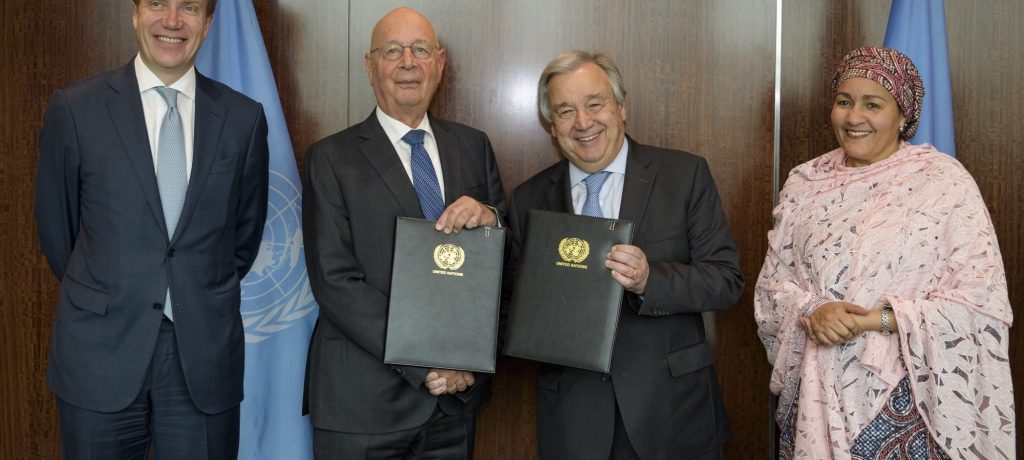
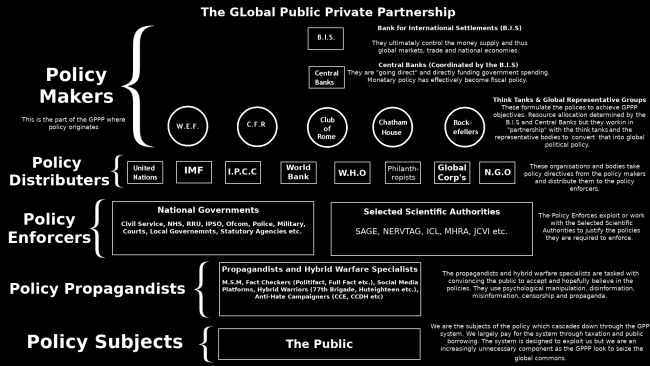
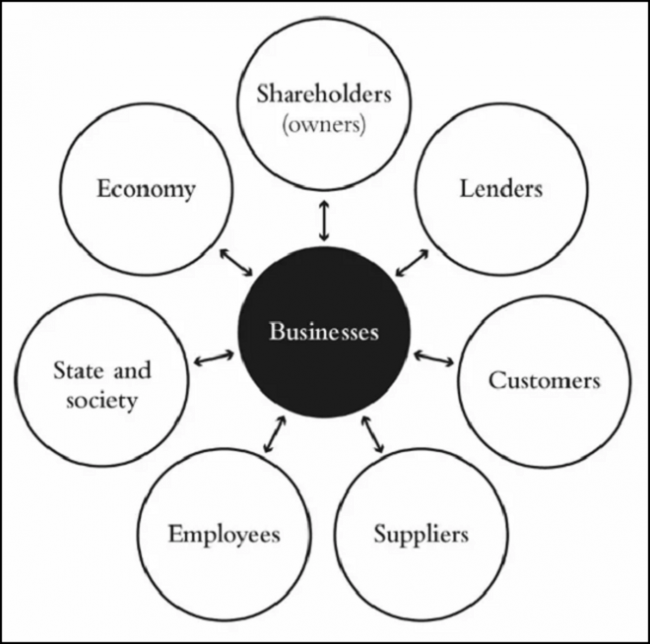
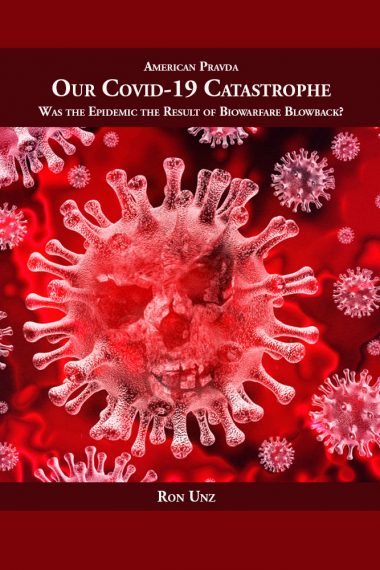
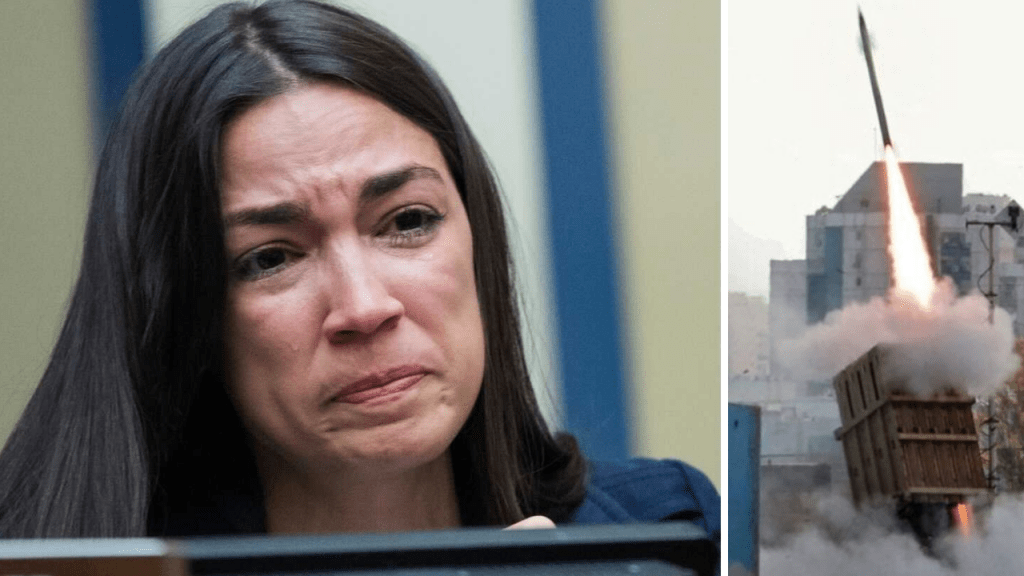

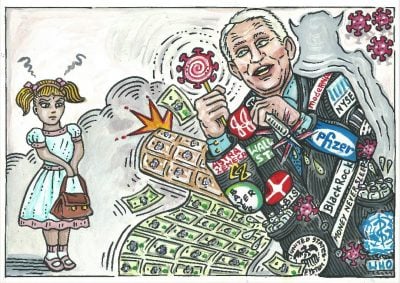
 After the Crash