Economic effect of coronavirus could be revolutionary

By Paul Craig Roberts

Source: Intrepid Report

Coronavirus and globalism will teach us vital lessons. The question is whether we can learn vital lessons that do not serve the ruling interest groups and ideologies.

Coronavirus will teach us that a country without free national health care is severely handicapped. Millions of Americans live paycheck to paycheck. They cannot afford health care premiums, deductions, and copays. Millions have no insurance. This means millions of people infected with coronavirus who cannot get medical help. The morbidity from this is intolerable in any society.

Shutdowns associated with efforts to contain the spread of coronavirus will deny income to millions of Americans who live paycheck to paycheck. What do they do for food, shelter, transportation?  You don’t have to think very long along these lines to see a very frightening scenario.

Globalism has taken down the ladders of upward mobility by exporting American middle class jobs to Asia. A population once able to save now lives on debt, the service of which is interrupted by recession/depression and by debt service absorbing all net disposable income.

Globalism has also reduced the survivability of our society by making it dependent  on externally produced goods, the supply of which can be cut off by disruptions in other societies, by policy disagreements leading to sanctions, and by an inability to export enough to pay for imports, which is what the offshored production of US firms is.

The United States has an unprotected population and an economy in trouble. For years, corporate executives have run the companies for the benefit of their bonuses, which are largely dependent on rises in their company’s share price. Consequently, profits and borrowings have been invested in buying back the companies’ shares and not in new investment in the businesses. Corporate indebtedness is extreme and will threaten many corporations and many jobs in a downturn. Boeing is a case in point.

Economist Michael Hudson has for many decades studied the use of debt-forgiveness to restart economies killed by debt burdens. Debt forgiveness for corporations has a different implication than debt forgiveness for individuals. For corporations, forgiving debts lets those who financialized and indebted the economy and the population off the hook. To avoid rewarding them for the catastrophe they produced and to prevent widespread public outcry and distrust, nationalization is implied for insolvent companies and banks.

Nationalization would be limited to insolvent companies and financial institutions and doesn’t mean that there would be no private companies or businesses. Additional nationalization could be used to prevent strategic companies from substituting their interests for national interests, which they do when they move American jobs and factories offshore. Pharmaceuticals could be nationalized along with health care. Energy which often sacrifices the environment to its profits could be considered for nationalization. A successful society has to have more driving it than private profit.

For most Americans nationalization is a dirty word, but it has many benefits. For example, a national health care system reduces costs tremendously by taking profits out of the system. Additionally, nationalized pharmaceutical companies could be made more focused on research and cures than on profit avenues. Everyone knows how Big Pharma influences medical schools and medical practice in line with Big Pharma’s approach. A more open-minded approach to medicine would be beneficial.

Socialist is another American dirty word, one that is being used against Bernie Sanders.  I have not turned into a socialist overnight. I am simply thinking outloud. How can the economy recover when the population and corporations are smothered by debt?  Debt forgiveness is the only way out of this debt suffocation. Can debts be forgiven without nationalization? Not without a huge giveaway to financial mangers and Wall Street. It is the members of the “one percent” who have received 95% of the increase in us income and wealth since 2008. Do we want to reward them for smothering the economy with debt by bailing them out without nationalizing them?

The combination of an economy covered in debt and an unprotected population is clearly revolutionary. Do we have leadership capable of breaking out of interest group politics and ruling ideologies in order to save our society and put it on a more sustainable basis?

Or will the economic hardships be blamed on the virus, the catalyst that ignited the debt timebomb?

Data governance and the new frontiers of resistance

The 21st century corporation is using algorithmic-based intelligence to accumulate data on a massive scale. Social movements need to grasp this change quickly.

By Anita Gurumurthy and Nandini Chami

Source: ROAR

Four centuries after the East India Company set the trend for corporate resource extraction, most of the world is now in the grip of unbridled corporate power. But corporate power is on the cusp of achieving “quantum supremacy” and social movements in the digital age need to understand this in order to shift gears in their struggles. The quantum shift here comes from “network-data” power; the ingredients that make up capitalism’s digital age recipe.

Contemporary capitalism is characterized by the accumulation of data-as-capital. Big Tech, as digital companies are collectively known, use the “platform” business model. This model provides a framework for interactions in the marketplace by connecting its many “nodes” — consumers, advertisers, service providers, producers, suppliers and even objects — that comprise the platform ecosystem, constantly harvesting their data and using algorithms to optimize interactions among them as a means to maximize profit.

The platform model emerged as a business proposition in the early 2000s when internet companies offering digital communication services began extracting user data from networked social interactions to generate valuable information for targeted advertising. It is estimated that by 2025, over 30 percent of global economic activity will be mediated by platform companies, an indication of the growing “platformization” of the real economy. In every economic sector, from agriculture to predictive manufacturing, retail commerce and even paid care work, the platform model is now an essential infrastructural layer.

Control over data-based intelligence gives platform owners a unique vantage point — the power to shape the nature of interactions among member nodes. Practices such as Amazon’s segmenting and hyper-targeting of consumers through price manipulation, Uber’s panoptic disciplining of its partner drivers, and TripAdvisor’s popularity ranking algorithm of listed properties, restaurants and hotels are all examples of how such platforms mediate economic transactions. The accumulation of data that feeds algorithmic optimization enables more intensified data extraction, in a self-propelling cycle that culminates in the platform’s totalizing control of entire economic ecosystems.

Amazon for instance, is no longer an online book store, and was perhaps never intended to be. With intimate knowledge about how the market works, Amazon is a market leader in anticipatory logistics and business analytics, providing both fulfillment and on-demand cloud-based computing services to third parties. Not only has it displaced traditional container-freight stations in port cities, it has begun to look increasingly like a shipping company. The dynamics of an intelligence economy have led to large swathes of economic activity being controlled by a handful of platform monopolies.

Studies suggest that in a matter of a couple of decades, platform monopolies have overtaken oil, automobile and financial corporations in market capitalization. Today, platform-based business models account for seven of the world’s top eight companies ranked by market capitalization. The pan-global platform corporation, with its DNA of data-based intelligence, has replaced the trans-national industrial corporation as the Leviathan of our times.

Enter the intelligent corporation

As the dominant form of economic organization in the capitalist world order, the corporation has always wielded power, not just in the market but also in political and socio-cultural realms. The rise of the “intelligent corporation” defined by the political economy of data capital has produced qualitative shifts in the exercise of corporate power, including the following.

From dominating the market to becoming the market

Like its predecessor, the intelligent corporation also aims at complete market domination. In platform-based capitalism, local business models based on intimate contextual knowledge are completely displaced by the data-based intermediation of marketplace and social transactions. It is by eliminating these disparate pockets of capital accumulation that platform owners maximize their profits.

The intelligent corporation also goes a step further, moving beyond “dominating the market” to “becoming the market.” Integrating across business lines, these companies both operate a platform and promote their own goods and services on it. This places them in direct competition with the businesses that use their infrastructure, and creates a conflict of interest. For example, Amazon uses its product marketplace data to consolidate its private labels, launching high-demand products at prices that undercut third-party sellers.

In this new strategy for acquiring market power, long-term market monopolization is privileged over the ability to break-even in the short run. The ecosystem that a platform seeks to capture has room only for one winner with the wherewithal to forgo immediate profits and invest in business integration — through aggressive acquisition — and systematic data-layer development. Other competitors are destined to fall by the wayside.

From cheap labor to freedom from labor

In the capitalist economy, the key contradiction is between capital and labor. Capital is in a perennial quest for freedom from labor through labor-substituting technological advances and territories to shift production to reduce labor costs. In the intelligence economy, capital seems to have come very close to realizing its primordial pursuit.

Using 360° surveillance, the intelligent corporation creates a self-optimizing ecosystem, manipulating each node, expanding its captive network, accumulating data capital and entrenching its dominance. It is able to achieve a global operational footprint with few assets and a minuscule employee base. Think Uber. Uber drivers are not considered to be employees in most places where the company runs its business. With a god’s eye view of the city and its roads, the customers and the driver, Uber takes over city transport, often without owning a single taxi. Passing off the liability to the driver, who must take a high-interest loan to acquire a vehicle to become Uber’s coveted “partner,” the corporation extracts from the driver more than just labor time.

In traditional labor-intensive manufacturing and services sectors, data capital is slowly but surely affecting far-reaching transformation. Projections show that automation based on artificial intelligence (AI) will eventually displace labor. It is estimated that over 40 percent of the global workforce will lose their jobs in AI-led disruption of manufacturing over the next 15–25 years. A limited number of high-paying jobs may open up for individuals with advanced skills in the development of data and AI technologies. But most of the labor force will end up in low-paid, personalized service work.

For countries in the Global South, the challenge will be especially pernicious. As rising wages erode the comparative advantage of labor in these economies, the shift to AI technology is likely to trigger a re-shoring trend whereby factories are relocated to richer countries that offer more sophisticated infrastructural support for deployment of AI systems. According to the World Bank, over two-thirds of the workforce in developing countries are likely to lose jobs. It is not clear how these changes will shift gender-based segmentation and gender hierarchies in labor markets. However, going by current trends, women seem to be the first to lose their jobs in this transition, with a reversal of both pay and status gains.

Planetary-scale time-space enclosure

Capturing previously non-commodified time and place has always been a central strategy of capitalist expansion. In the intelligence economy, we are witnessing a new phase of such “primitive accumulation” – through “data dispossession.” The expropriation of data from everyday social exchanges through the platform business model is comparable to the expropriation of natural resources for capitalist production in a previous age. The pervasive data extraction by platform companies has transformed data-mined social interaction into a factor of production, just as invaluable a resource as land for the creation of goods and services. The centralization of wealth and power today, derives from an unprecedented quality and scale of dispossession.

The dynamic of data dispossession is self-propelling. It is now well understood that platforms aggressively pursue a strategy of locking-in users, offering instant gratification in exchange for data and making it costly for them to leave a platform. The Chinese “super-platforms” WeChat and Meituan-Dianping combine news, entertainment, restaurant reviews, food delivery and ride-hailing, along with cross-cutting applications such as payment systems and digital wallets, demonstrating a “stickiness” that is almost addictive.

When participation in the platform on the platform owner’s terms becomes de facto the only choice for economic actors, data extractivism is normalized. Similar to the predatory practices of historical colonialism, the platform tactics of the intelligent corporation function as a neo-colonial project. The difference is that this time around, rather than European companies, the US and Chinese platform companies are in the driving seat.

A profoundly unsustainable exploitation of the natural world accompanies the rapid inroads of the intelligent corporation. Take the case of the vast ecological footprint of the online food-delivery sector. According to a 2018 study published in the science journal Resources, Conservation and Recycling, door-to-door fast-food delivery in China accounted for a nearly eightfold jump in packaging waste between 2015 and 2017, from 0.2 to 1.5 million tonnes. This has coincided with the exponential growth of the sector in the country, where the number of customers using food-delivery platforms has gone up from zero in 2009 to 406 million by the end of 2018! The intelligence economy is a veritable resource guzzler whose network data devices are expected to be consuming about one-fifth of global electricity by 2030 just to keep going.

The loss of self-determination for individuals and communities in these new intelligence-based modes of production reflects an asymmetry in power that was previously impossible. This is the route through which the brand-new corporation colonizes bodies and nature, takes control of production and social reproduction, and intensifies accumulation on a global scale.

The “deep corporate” and the death of the social contract

It is no secret that in the digital era, the deep state has had a makeover. Edward Snowden’s revelations and witness testimonies from China’s Uighur-dominated Xinjiang have exposed the dark workings of the contemporary military–industrial complex, the unholy nexus between Big Tech and the state. Trade justice activists have constantly pointed to the “hidden hand” of Silicon Valley and Chinese corporations using their governments to bat for their interests, reducing policy decisions to executive fiats for entrenching their power.

But what is only recently coming to light is the rise of the “deep corporate” — the extension of the Kraken-like tentacles of intelligent corporations into the heart of public life. The subsuming of social life by platform capitalism has distorted the political space thanks to the echo chambers of the automated public sphere. The contagion of mispropaganda and informational warfare in political campaigning has become impossible to contain in a public sphere determined by algorithmic filters. In this scenario, deliberative democracy itself is under the threat of extinction.

The social credit system being developed by China in partnership with eight tech companies takes the “corporatization” of governance to a whole new level. Access to benefits and citizens’ guaranteed rights are now predicated on behavioral scoring on the basis of online purchase history, financial transactions and social media connections on the partnering platforms. With the archetypal “good consumer” becoming the deserving citizen, citizenship is thus dislocated from political claims. The “deep corporate” acquires the formal authority to mediate the social contract.

Living with the intelligent corporation

We are living through a phase in capitalism that is marked by extreme market concentration, unprecedented inequality in wealth and the declining share of labor in global income; a state of affairs that has led even the IMF to express caution. It is no coincidence that this period of intensified economic injustice has coincided with the rise of platform capitalism and its real-world vehicle, the intelligent corporation.

What does living with the intelligent corporation mean?

What is new about this phase of capitalism that has spawned the intelligence economy is a deeply qualitative shift. Datafication and data capital transform the way capitalist “accumulation by dispossession” happens. “Intelligencification” makes plausible a planetary-scale colonization and commodification of everyday life by the new corporation in ways previously impossible. Both nature and caring bodies are trapped in a planetary enclosure insofar as everything and everybody can be turned into data.

It also feeds off and emboldens the financialization apparatus that runs the neoliberal economy. Through the perverse confluence of data and finance, the intelligent corporation universalizes and naturalizes its authority, destroying the marketplace of things and ideas.

Through data extractivism, the intelligent corporation ravages sociality, taking the ideological project of neoliberalism all the way to the expropriation of the political. This is a deep take-over, an “ontological encroachment” of human subjectivity.

Where does all this leave us?

As UNCTAD has highlighted, the pace of concentration of market power is extremely worrying. Consider this: Amazon’s profits-to-sales ratio increased from 10 percent in 2005 to 23 percent in 2015, while that of Alibaba increased in just four years from 10 percent in 2011 to 32 percent in 2015.

Policymakers across the world are struggling to reform their legacy laws to rein in the intelligent corporation. Even the domestic governments of powerful US and Chinese platform corporations are struggling to contain their excesses. The US Federal Trade Commission (FTC) is currently investigating Amazon and Facebook for abuse of market dominance while the US Justice Department is probing Google. The state of California is facing massive resistance from Uber and Lyft to its new regulation for labor rights of “gig” workers, with the two companies currently leading a $60 billion ballot initiative to extricate themselves from employer’s liability. In November 2019, the state administration for market regulation in China had to hold a meeting with Alibaba and other online retail platforms about their strong-arming of third-party vendors, in violation of existing regulations to curb anti-competitive conduct.

The loopholes of pre-digital taxation laws based on a physical presence in a given country have been effectively exploited by platform companies to escape tax liability, through profit shifting to low-tax jurisdictions. Similarly, when faced with liability for unfair market practices in overseas markets, it is very easy for platform companies to shift liability to their parent company outside the jurisdiction. For instance, Uber in South Africa resorted to the defense that its partner drivers were employees of the parent company headquartered in the Netherlands and not the South African subsidiary, in order to evade its liabilities under existing labor laws. The lack of binding international regulations governing cross-border data flows has also aided rampant data extractivism,

More recently, in the wake of malpractice lawsuits brought against Big Tech by their own employees; exposes about founding CEOs who have enjoyed a godly status; and public disenchantment with multiple revelations of clandestine data mining and algorithmic gaming, the early sheen seems to be wearing off. Google’s parent company Alphabet can no longer use its “Do the right thing” motto without irony. Facebook has been forced to switch to the “too big to fail” defense from the “protector and defender of the freedoms of the global community” line. Alibaba may not be able to proclaim its commitment to the development of small and medium enterprises in Africa for much longer. The façade has crumbled. And this rupture in the discursive hegemony of the intelligent corporation in which we are currently situated is the right moment to mount a collective challenge.

So, resist we must, so that the wealth of data and of networks can be appropriated and used to create a just and humane society. This means taking the intelligent corporation by the horns, and forging a movement that is able to grapple with the ethical–political boundaries of digital intelligence.

Taming the Leviathan and reclaiming the planet

Given the enormous economic and political clout of the modern corporation in the age of data, unshackling people and the planet from corporate power is an urgent task. Struggles against the extreme unfairness of the global trade and intellectual property regime by transnational social movements have shown the necessary connection between the agenda for development justice and the dismantling of corporate power.

Building alliances among movements has become a vital strategy in halting TNCs’ inexorable plunder. The trade justice movement against corporate globalization, the environment movement’s quest for sustainable development, feminist struggles to reclaim the body and the sphere of social reproduction from capital and workers’ struggle against the intensified squeeze on labor and the dismantling of social protection in neoliberal globalization are inspiring examples in this regard. Transnational civil society has painstakingly built alliances and solidarities across these movements to expose corporate excess, bringing pressure on the UN for a global binding treaty on TNCs’ human rights obligations in the face of near-insurmountable odds.

In the digital age, as corporate power assumes indomitable proportions — with tech CEOs carving out data dominions that they rule over — current frameworks of power analysis and action may not go very far. A concerted and coherent strategy is urgently needed in order to enable a more equitable distribution of the gains of data-based intelligence. The Digital Justice Manifesto released in November 2019 by the Just Net Coalition — through a process of strategic and sustained dialogue between digital rights, trade justice, feminist, environmental, labor and human rights groups and activists — outlines such a roadmap. As the Manifesto underlines, we need immediate action along three broad fronts to reclaim digital power from the intelligent corporation:

(a) Wrestling back ownership of our personal and collective data and intelligence by instituting an economic rights framework for data resources.

(b) Governing critical platform infrastructures as public utilities.

(c) Enforcing a local-to-global governance model for digital and data infrastructure that supports local economies and democratic self-determination of collectivities, preventing the enclosure of entire market and social ecosystems by a centralized intelligence. In other words, the governance of tech infrastructure must enable the flourishing of disparate local economies and make room for multiple platform models to function — co-operatives, social enterprises, public etc. — challenging the totalizing impetus of global intelligence capitalism.

Neoliberal globalization and financialization have led to profoundly unequal societies. The impunity of the TNC has been central to this dynamic. Social movements have placed several creative proposals to counter this: mandating charter renewal every five years overturning the principle of corporations’ perpetual legal existence; taxing stock trade on the basis of the holding period to contain excessive financial speculation; placing a cap on the individual assets of founders/CEOs and so on.

“Intelligencification” demands a new frontier for resistance. The power of the intelligent corporation must be contained through tactics small and big in political and cultural realms. A new wisdom about the governance of data must be explored for a truly emancipatory future for all.

Neoliberal Economics Destroyed the Economy and the Middle Class

By Paul Craig Roberts

Source: PaulCraigRoberts.com

According to official US government economic data, the US economy has been growing for 10.5 years since June of 2009. The reason that the US government can produce this false conclusion is that costs that are subtrahends from GDP are not included in the measure. Instead, many costs are counted not as subtractions from growth but as additions to growth. For example, the penalty interest on a person’s credit card balance that results when a person falls behind his payments is counted as an increase in “financial services” and as an increase in Gross Domestic Product. The economic world is stood on its head.

It is aggregate demand that drives the economy. Payments made on a rise in interest rates on credit card balances from 19% to a 29% penalty rate reduce consumers’ ability to contribute to aggregate demand by purchasing goods and the services of doctors, lawyers, plumbers, electricians, and carpenters. Contrary to logic, the fee is magically counted in the “financial services” category as a contributor to GDP growth. The extortion of a fee that reduces aggregate demand lowers GDP, but builds paper wealth in the financial services sector.

GDP growth is also artificially inflated by counting as GDP abstract concepts that do not produce income streams. For example, for homeowners the US Department of Commerce estimates the rental values of owner-occupied housing, that is, the amount owners would be paying if they rented instead of owned their homes, and counts this imputed rent as GDP.

These and other absurdities have caused economist Michael Hudson to conclude correctly that the “financial reality of how the U.S. economy works is no longer captured in GDP statistics.”
https://michael-hudson.com/2019/10/asset-price-inflation-and-rent-seeking/

Today we have two economies. One is the real economy of production and consumption. The other is the financialized economy of paper wealth. The former is doing poorly, and the latter is doing well. The financialized economy is growing much faster than the real economy. Indeed, the real economy might not be growing at all.

Michael Hudson describes the difference. The stock market is at all time highs that have created massive wealth in financial assets for stock and bond owners. In the real economy the situation is totally different: “The Federal Reserve’s Report on the Economic Well-Being of U.S. Households in 2018 reports that 39% of Americans do not have $400 cash available for a medical or other emergency, and that a quarter of adults skipped medical care in 2018 because they could not afford it ( https://www.federalreserve.gov/publications/files/2018-report-economic-well-being-us-households-201905.pdf ). The latest estimates by the U.S. Government Accountability Office (GAO) report that nearly half (48 percent) of households headed by someone 55 and older lack any retirement savings or pension benefits ( https://www.aarp.org/retirement/retirement-savings/info-2019/no-retirement-money-saved.html ). Even in what the press calls an economic boom, most Americans feel stressed and many are chronically angry and worried. According to a 2015 survey by the American Psychological Association, financial worry is the “number one cause of stress in America today” ( https://www.apa.org/news/press/releases/2015/02/money-stress ).

The data is completely clear. The rich are becoming much richer, and the rest are becoming poorer. Michael Hudson explains:

“The creation and trading of property and financial assets at rising prices has been fueled by rising debt levels owed to the financial sector. This sector’s returns therefore are best seen not as real wealth on the asset side of the balance sheet, but as overhead on the liabilities side. And the process is multi-layered: income accruing to the financial wealth owned by the top 10 Percent is paid mainly by the bottom 90 percent in the form of rising debt service and other returns to financial and other property.

“In the textbook models of industrial capitalism’s mass production and consumption, an asset’s price is determined by its cost of production. If the price rises above this level, competitors will offer it cheaper. But in the financialized economy an asset’s price is determined by how much credit buyers can borrow to buy it, not by its cost of production. A home is worth as much as a bank will lend to a bidder.

“The engine of industrial capitalism and its consumer society is a positive feedback loop in which widely shared income growth, expanding consumption and markets generated yet more investment and growth. By contrast, the feedback loop of financial capitalism is an exponential growth of credit-driven debt, driving up asset prices and hence requiring yet more borrowing to buy homes, retirement income and other assets. Corporate management and investment today is mainly about obtaining capital gains for real estate, stocks and bonds than about earning income.

“We illustrate this by charting the flow of income and capital gains in the real estate sector to show the dominance of asset-price gains over net rental income – and how rental income is used up paying interest in our financialized economy. Likewise, corporate income is spent (and new debt taken on) largely for stock buybacks to raise share prices. The resulting dynamic is exponential and destabilizing.”

This dynamic is destabilizing, because as more of consumers’ discretionary income is drawn off to service mortgage, credit card, automobile and student debt and for compulsory health insurance, less is left to purchase the goods and services in the real economy. Consequently, credit-driven debt grows faster than the income that services it, and this impoverishes the 90%. However, for the 10%, money creation by the Federal Reserve in order to protect the balance sheets of the “banks too big to fail or jail” drives up the values of financial assets. As a result the distribution of income and wealth becomes hightly polarized.

Think about the many Americans who meet their living expenses by making only the minimum payment on their credit card balance. At 19% interest their debt grows monthly. Eventually they hit a credit card debt cap and can no longer use the card to cover their living expenses. But they have the burden of a large debt balance to service without an income stream capable of servicing it.

Think about the corporation that decapitalizes itself in order to produce short to intermediate term capital gains for shareholders and executives by indebting the firm in order to buy back the firm’s shares. The end result is that all income goes for debt service.

In a financialized economy, the only possible outcomes are debt forgiveness or collapse.

As Michael Hudson makes clear, the combination of nonsensical categories in the National Income and Product Accounts and a financialized economy means we have no accurate picture of the economy’s condition. Michael Hudson has a proposal for correcting these problems and making GDP accounting more accurate, but as ecological economists such as Herman Daly have made clear, GDP measurement also omits the external costs of production. This means that we do not know whether GDP is growing or declining. It is entirely possible that the ecological and social costs of an increase in GDP (as currently measured) are greater than the value of the increased output. (See Paul Craig Roberts, The Failure of Laissez-Faire Capitalism, https://www.amazon.com/Failure-Laissez-Faire-Capitalism/dp/0986036250/ref=sr_1_2?crid=16NHZEQ9G3JRW&keywords=paul+craig+roberts+books&qid=1576440032&s=books&sprefix=Paul+Craig%2Caps%2C173&sr=1-2 )

Perhaps the major way in which GDP is overstated is the exclusion of external or social costs. External or social costs are costs of producing a product that the producer does not incur but imposes on third parties or on the environment. For example, untreated sewage dumped into a stream imposes costs on people downstream. Runoff of chemical fertilizers from commercial farming produces dead zones in the Gulf of Mexico and toxic algal blooms such as Red Tide that result in massive fish kills, make seafood unsafe, cause human ailments and adversely impact the tourist trade of beach areas. The result is lost incomes, ruined vacations, health expenses, and none of these costs are born by the commercial farmers.

Real estate development produces massive external costs. Scenic views from existing properties are blocked, thus reducing their values. Construction noise and congestion impose costs on existing residents and reduces the quality of their lives. Water runoff problems are often created. Infrastructure has to be provided, such as larger highways to provide evacuation from hurricane-impacted areas, usually financed by taxpayers. If the global warming case is correct, the external cost of human economic activity can be the life of the planet.

Lakshmi Sarah in the May/June, 2019, issue of the Sierra Club magazine provides an excellent detailed account of the external costs of coal-fired power plants being built in India by the Indian conglomerate Tata with a loan from the International Finance Corporation, a branch of the World Bank. The ground water in the area has been ruined and is no longer drinkable. Farmers are no longer able to grow crops on half of the area farmland. Heated wastewater that is dumped into the Gulf of Kutch is destroying fishing. The ecology and the livelihoods of the population are essentially destroyed. None of these costs are born by the private power companies.

Tired of being doormats for capitalists and the World Bank, the residents of the affected provinces rebelled. They have succeeded in getting their case before the US Supreme Court. It seems that the International Finance Corporation is so accustomed to financing projects that produce large external costs that it overlooked its obligation to examine the environmental impact of the projects it finances. This oversight resulted in Indian farmers and fishermen getting their case before the US Supreme Court. The International Finance Corporation’s lawyers argued that the World Bank lending agency had “absolute immunity.” The Supreme Court said no and remanded the case to the circuit court to rule on the damages.

Perhaps the most surprising thing about this apparent victory for ordinary faraway little people in an American court against the World Bank, a principle instrument of American imperialism, is that the Trump administration appeared in court as a friend of the Indian farmers and fishermen. The US Solicitor General, represented by Jonathan Ellis, rejected the notion that international orgnizations have absolute immunity. The Establishment exists on its immunity. Here we see the ultimate reason that the ruling Establishment wants rid of Trump.

Already the senior staff of the International Finance Corporation have come to the realization that they have other responsibilities than just to shuffle money out the lending shute. If the Indian farmers and fishermen succeed in protecting themselves from ruination by external costs, perhaps Americans who suffer external costs will follow their lead.

Perhaps economists will also come to the realization that they owe us accurate GDP accounting and not fanciful accounts that serve elite wealth in the financialized economy.

Now That We’ve Incentivized Sociopaths–Guess What Happens Next

By Charles Hugh Smith

Source: Of Two Minds

As long as central banks create and distribute trillions in conscience-free credit to conscience-free financiers and corporations, the incentives for sociopathy only increase.

“Sociopath” is a word we now encounter regularly in the mainstream media, but what does it mean? Here is a list of 16 traits, many of which are visible in lionized corporate and political leaders and entrepreneurs.

One key trait is a lack of moral responsibility or conscience; the sociopath feels no remorse if he/she takes advantage of people or exploits them.

Sociopaths are masters of superficial charm, intelligence and confidence, and adept at massaging or misrepresenting reality up to and including outright lying to persuade others or get their way.

Like all psychological syndromes (manic depression, autism, bipolar disorder, etc.), there is a wide spectrum of sociopathological traits, some of which may offer some adaptive benefits (and hence their continued presence in the human genome). In other words, an individual can have a few of the traits in greater or lesser proportions.

Thus the modern BBC Sherlock Holmes (played by Benedict Cumberbatch) describes himself as a “high-functioning sociopath” (though many contest this diagnosis of the original Holmes in Arthur Conan Doyle’s stories).

Anyone who has read Walter Isaacson’s biography of Steve Jobs can readily see manifestations of sociopathy in Jobs: his famous “reality distortion field,” his refusal to accept that he’d fathered a daughter, his lack of empathy, his wild emotional swings (from verbal abuse to weeping), his dietary extremes, his charm, so quickly turned on or off, his uneven parenting, and so on. His obsessive-compulsive behavior was also on full display. Yet Jobs is lauded and even worshiped as a genius and unparalleled entrepreneur. Was this the result of his sociopathological traits, or something that arose despite them?

The ledger of costs and benefits of Jobs’ output is weighted by the global benefits of the products he shepherded to market and the hundreds of billions of dollars in sales and net worth he generated for investors while the head of Apple. Though narcissistic in many ways (with the resulting negative effects on many of his intimates), Jobs was clearly focused on creating “insanely great” products that would benefit customers and users. Despite his sociopathological traits, there is no evidence he set out to deceive anyone with the objective of exploiting their good will or belief in his vision to skim billions of dollars from unwary investors.

But the ledgers of others manifesting sociopathy are far less beneficial, as the billions of dollars they generated were in essence a form of fraud.

The rise and fall of WeWork is a recent textbook example of sociopathy reaping enormous financial gains for the sociopaths without creating any actual value. There are plenty of media accounts of the founders’ excesses (including the goal of becoming the world’s first trillionaire), some of which we might have expected to raise flags in venture capitalists, board members, etc., but these traits were overlooked in the rush for all involved to garner billions of dollars in fees and net worth when WeWork went public.

This example (among many) illustrates that sociopathy is incentivized in our socio-political-economic system, and sociopathic “winners” are lionized as epitomes of ambitious success. (The entire charade of the stock market rising due to Federal Reserve-enabled stock buybacks is an institutionalized example of sociopathy.)

Correspondent Tom D. recently summarized the core dynamic and consequence of this systemic incentivization of sociopathy:

I’ve been a successful business owner, but I’m not a sociopath–I deliver value to my customers, my investors, and I don’t move forward if I see anyone being substantially hurt by my actions.

My peers and I look at organizations such as WeWorks, see the rewards reaped by the sociopathic leaders, and realize we are at a constitutional disadvantage working within such a system.

I could never conceive of taking a $700-900m payday at the expense of investors for whom I’ve generated no value whatsoever.

I simply could not do it.

If ‘out-sociopathing’ the sociopaths is what it takes to ‘succeed’ in todays business climate– I’ll fail.

So I don’t try.

From the sociopath’s standpoint, that’s probably a feature not a bug–one that helps keep effective competition out of the marketplace.

I wonder how much of civilizational decline is simply due to good people accepting their lot and opting out.

If the system incentivizes conscience-free sociopaths more than it incentivizes those creating real value, the system will eventually fall into the equivalent of Gresham’s law (“bad money drives out good money”): the con-men and fraudsters will drive out entrepreneurs with a conscience who create real value for customers, investors and society at large.

If we look at recent IPOs and compare them to the Apple IPO, it seems we’ve already reached that point. Apple went public as a highly profitable company. Uber, Lyft, Beyond Meat and WeWork (if their IPO fraud hadn’t been revealed) are all unprofitable, in some cases losing billions of dollars with little prospect for eventual profits.

Venture capital folks explain this by noting that the flood of central bank credit-money-creation has generated trillions of dollars of liquid capital seeking “the next big thing” that will “disrupt” existing models and therefore generate billions in profits.

This pinpoints one key source of the incentivization of sociopaths: central banks’ creation of trillions of dollars of conscience-free capital seeking a quick profit anywhere on the planet, by any means available.

Conscience-free capital is an easy mark for a conscience-free sociopath. It’s a marriage made in heaven, a perfect match.

Those with a conscience are essentially squeezed out of the system. The choice is binary: either play and lose or opt out.

I’ve written about “opting out” since 2009, since it was one of the few options available to commoners in the final decline of the Western Roman Empire. If we feel we’re at a systemic disadvantage, i.e. the system is rigged against us, opting out makes much more sense than sacrificing oneself in a fruitless battle to stay alive in a system that incentivizes amoral sociopaths.

If we consider what generates outsized success in our rapidly changing economy, we find a variety of factors supporting “winner take most” asymmetric gains. As economist Michael Spence has observed, those who develop new business models earn outsized gains because new forms of capital and labor that are scarce create the most value.

Many of these new business models disintermediate existing models, obsoleting entire layers of middlemen and management.

Netflix is a good example: the move from mailing CDs to streaming content obsoleted cable companies. Now Disney is disrupting Netflix by launching its own streaming service at $6.99 a month, offering content that cable subscribers had to pay $60+ a month to access via a “premium” cable add-on, most of which they didn’t even use.

In contrast, WeWork sold itself as a “tech innovator” when in fact it was simply a commercial real estate packager, leasing large spaces and chopping them up into small spaces with common areas and a few services.

How does our system incentivize sociopathy? By focusing exclusively on short-term gains reaped from IPOs (initial public offerings) and by blindly seeking “the next disruptor that will generate billions,” the system is easy prey for charming sociopaths who can tell a good (if not quite truthful) story.

The amoral sociopath with the story attracts amoral sociopaths in venture capital, banking and politics, as these fields are all focused on short-term, outsized, quickly skimmed gains, regardless of the consequences to investors or society at large.

What would change this incentivization of sociopathy? Ending the Federal Reserve’s delivery of trillions of dollars in conscience-free capital to sociopaths and limiting the VC-IPO flim-flam machine would be a start, but given Wall Street’s dependence on these profits and the millions the Street gives to political campaigns, this is politically unfeasible. Any such regulation that reaches Congress will be watered down or larded with loopholes.

There may be no way to excise the incentives for sociopathy, because the incentives all favor the sociopaths’ most fertile ground: the Federal Reserve’s money spigot of nearly free money for the most sociopathological financiers and corporations; amoral, conscience-free greed; the worship of short-term gains, regardless of consequences, and the extreme profitability of rigged games and The Big Con PR (“we’re only evil when it’s profitable, which is, well, all the time”.)

As long as central banks create and distribute trillions in conscience-free credit to conscience-free financiers and corporations, the incentives for sociopathy only increase, and the incentives for everyone else to opt out increase proportionately.

What happens next? The dead wood of sociopathy is ignited by a random lightning strike, and the entire financial system (and the economy it feeds) burns to the ground in an uncontrollable conflagration of blowback, consequence and karma.

The Unraveling Quickens

By Charles Hugh Smith

Source: Of Two Minds

Even if we don’t measure the erosion of intangible capital, the social and political consequences of this impoverishment are manifesting in all sorts of ways.

The central thesis of my new book Will You Be Richer or Poorer? is the financial “wealth” we’ve supposedly gained (or at least a few of us have gained) in the past 20 years has masked the unraveling of our intangible capital: the resilience of our economy, our social capital, i.e. our ability to find common ground and solve real-world problems, our sense that the playing field, while not entirely level, is not two-tiered, and our sense of economic security–have all been shredded.

The unraveling of everything that actually matters is quickening. While every “news” outlet cheerleads the stock market (“The Dow soared today as investor optimism rose… blah blah blah”), our “leadership” and our media don’t even attempt to measure what’s unraveling, much less address the underlying causes.

The hope is that if we ignore what’s unraveling, it will magically go away. But that’s not how reality works.

The unraveling is gathering momentum because prices have been pushing higher while wages lag, feeding the rising precariousness and inequality of our economy. The connection between people losing ground and social disorder/disunity has been well established by historians such as Peter Turchin Ages of Discord and David Hackett Fischer The Great Wave: Price Revolutions and the Rhythm of History.

In our era, trust in the legitimacy of our institutions is unraveling because the statistics presented as “facts” are so clearly designed to support the status quo narrative that everything’s getting better every day in every way rather than the politically unwelcome reality that the bottom 95% are losing ground and whatever they do earn and own is increasingly at risk from forces outside their control.

Economic decay leads to social and political disorder / disunity. The sudden rise of vast homeless encampments is one manifestation of the social fabric unraveling. In the political realm, the insanity of accusing Democratic candidates of being “Russian agents” matches the hysterical destructiveness of the McCarthy era in the 1950s.

It all starts with economic decay, so let’s look at some charts. Here’s a chart of income inequality which helps drive wealth inequality.

Note that the only group that benefited from the past 20 years of speculative bubbles is the top 1%. The whole idea that inflating bubbles creates a “wealth effect” that “trickles down” is preposterous, as evidenced by the decline of the middle 60% of households while the speculators and owners of bubble-assets skimmed the vast majority of income gains.

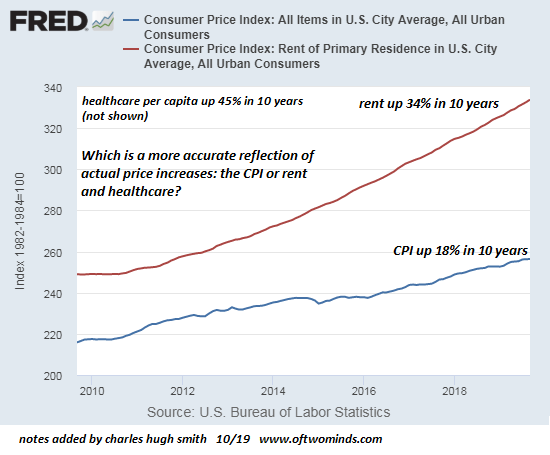
Meanwhile, we’re told inflation is less than 2% annually while rising costs have outpaced meager wage increases. What’s a more realistic measure of real-world inflation–the official Consumer Price Index (CPI) at 18% over ten years or rent and healthcare at 34% and 45%?

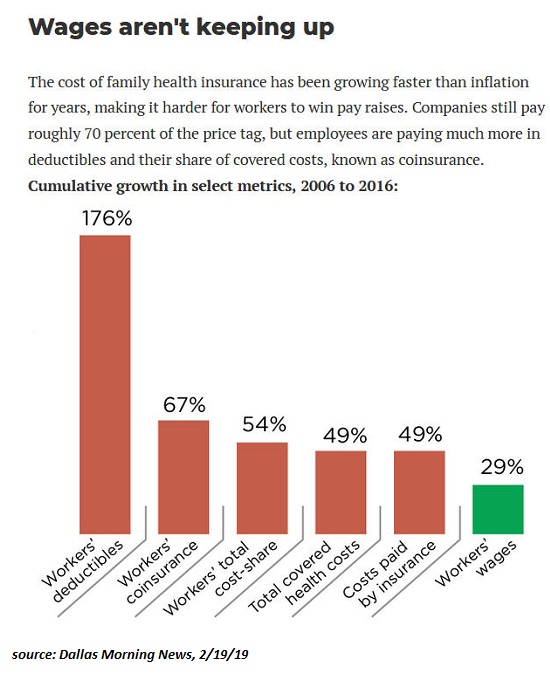
According to the Chapwood Index, real-world inflation in urban America is running 9% to 13% annually. This is more in line with reality than the bogus CPI, as evidenced by this chart of wages and healthcare costs:

Even if we don’t measure the erosion of intangible capital, the social and political consequences of this impoverishment are manifesting in all sorts of ways: large-scale social disorder is breaking out around the globe, and the political middle ground has completely vanished: no matter which way an issue is decided, one camp will refuse to accept the outcome.

The only way forward with any chance of success is to start by acknowledging the decay of our economy due to rampant financialization, legalized looting, the pathologies of “winner take most” speculation and the realities of a two-tiered system in which entrenched elites are “more equal” than the rest of us, economically, socially and politically. We have to accept the limits of technology to reverse the unraveling and assess the damage that’s already been done to our shared capital.

Acting as if the system is working just fine and the problem is perception/optics is accelerating the unraveling.

Amazon and Apple: Wall Street’s Trillion Dollar Babies

By Dean Baker

Source: CounterPunch

Last month Amazon joined Apple, becoming the second company in the world to have a $1 trillion market capitalization. Amazon’s accomplishment didn’t cause quite as much celebration as Apple’s – it pays to be number one – nonetheless this was treated as a milestone that all of us should view as good news.

Actually, the celebratory coverage of both events demonstrated the incredibly ill-informed nature of much economic reporting in the United States. A big run-up in share prices is good news for the people who own lots of stock in the company; it is not especially good news for anyone else.

In principle, the value of a stock is supposed to represent the expected future earnings of the company. I said “supposed” because stock prices fluctuate wildly in response to all sorts of things that are not obviously connected to future earnings, but in the textbook definition, it is the discounted value of future earnings that determine stock prices. To be clear, this is not the socialist textbook, this is the capitalist textbook that is taught in business schools.

What does it mean that Amazon and Apple have market valuations of more $1 trillion? Presumably, it means that investors are now more optimistic about the companies’ future profit potential. It’s difficult to see why the rest of us should celebrate this outcome.

Apple obviously makes products that consumers value, and in that sense, it is contributing to the economy and generating wealth. But, suppose instead of one huge company we had 10 little (or littler) Apples that sold iPhones, computers, and the other items that comprise Apple’s product line? Would we be any poorer as a society in that case, even if the market cap of our leading tech company was just $100 billion?

Or, even with Apple as our dominant tech company, suppose the surge over the $1 trillion barrier was due to a victory in an antitrust case, which would allow Apple to charge higher prices going forward. That’s great for Apple’s stockholders, but what exactly would the rest of us be celebrating? Paying more money for our iPhones?

In the same vein, in the past, Apple has been caught conspiring with other Silicon Valley companies, agreeing not to compete for workers. Apple, along with its co-conspirators, ended up paying a substantial settlement as a result.

Suppose Apple found a legal way to fix wages or bought a judge to make it legal. The prospect of a lower wage bill would also be good for Apple’s stock price, but not especially good news for those of us who are more likely to make our living from working than owning Apple stock. Again, there is not much in this story for most of us to celebrate.

The celebration for Amazon is even more peculiar. Amazon is clearly an innovative company that has sped the development of Internet retailing. It also has specialized in tax avoidance, eliciting investment incentives from state and local governments, and abusive labor practices.

Perhaps the crossing of the $1 trillion threshold was associated with investors’ confidence that Amazon’s CEO had developed a new and more effective tax avoidance scheme. Again, great news for Amazon stockholders, but pretty bad news for the folks who will have to make up the revenue shortfall.

What is notably different about Amazon is that, unlike Apple, the company does not have huge profits. While Apple earned $48.4 billion in after-tax profits in 2017, Amazon’s profit was just over $3 billion. That gives the company an incredible price-to-earnings ratio of more than 300-to-1.

There are two stories we can tell here. One is that investors expect Amazon’s profits to increase enormously. This would be a case where it takes advantage of its market power to increase its profit margins hugely. Ordinarily, this would be the basis for antitrust action, but given the corruption of the political system, it is certainly possible the company could get away with it. Again, is a future of higher prices something the rest of us should really be celebrating?

The other possibility is that Amazon’s stock price is driven by fantasy, like the Internet stocks of the late 1990s or Bitcoin today. Presumably, at some point reality will reassert itself, but should the rest of us celebrate ill-informed investors being taken for ride?

It is striking that so many would see economic or social progress as being in some way captured by stock valuations. In 1953 Jonas Salk developed the polio vaccine. This eventually led to the near eradication of a disease that had killed or crippled tens of millions of people.

Salk didn’t try to patent his invention. A private charity funded the research. But, what if there had been a Salk Inc. that had the patent on a vaccine that could save tens of millions of lives? Surely the market cap would be an order of magnitude larger than either Apple’s or Amazon’s. Was it a loss to society that the vaccine was made available for pennies rather than tens of thousands of dollars a shot?

If we want to talk about value to society, the anti-smoking crusaders of the last four decades have saved tens of thousands of lives and improved the health of millions more by reducing smoking in the United States and around the world. The people who led this fight, most of whom were women, won’t be featured on the covers of business magazines, but they did much more to enhance society’s wealth than Jeff Bezos.

Anyhow, congratulations to Apple and Amazon’s stockholders on their stock gains. They have been fortunate. The rest of us, not so much.

For Economic Truth Turn To Michael Hudson

By Paul Craig Roberts

Source: PaulCraigRoberts.org

Readers ask me how they can learn economics, what books to read, what university economics departments to trust. I receive so many requests that it is impossible to reply individually. Here is my answer.

There is only one way to learn economics, and that is to read Michael Hudson’s books. It is not an easy task. You will need a glossary of terms. In some of Hudson’s books, if memory serves, he provides a glossary, and his recent book “J Is for Junk Economics” defines the classical economic terms that he uses. You will also need patience, because Hudson sometimes forgets in his explanations that the rest of us don’t know what he knows.

The economics taught today is known as neoliberal. This economics differs fundamentally from classical economics that Hudson represents. For example, classical economics stresses taxing economic rent instead of labor and real investment, while neo-liberal economics does the opposite.

An economic rent is unearned income that accrues to an owner from an increase in value that he did nothing to produce. For example, a new road is built at public expense that opens land to development and raises its value, or a transportation system is constructed in a city that raises the value of nearby properties. These increases in values are economic rents. Classical economists would tax away the increase in values in order to pay for the road or transportation system.

Neoliberal economists redefined all income as earned. This enables the financial system to capitalize economic rents into mortgages that pay interest. The higher property values created by the road or transportation system boost the mortgage value of the properties. The financialization of the economy is the process of drawing income away from the purchases of goods and services into interest and fees to financial entities such as banks. Indebtedness and debt accumulate, drawing more income into their service until there is no purchasing power left to drive the economy.

For example, formerly in the US lenders would provide a home mortgage whose service required up to 25% of the family’s monthly income. That left 75% of the family’s income for other purchases. Today lenders will provide mortgages that eat up half of the monthly income in mortgage service, leaving only 50% of family income for other purchases. In other words, a financialized economy is one that diverts purchasing power away from productive enterprise into debt service.

Hudson shows that international trade and foreign debt also comprise a financialization process, only this time a country’s entire resources are capitalized into a mortgage. The West sells a country a development plan and a loan to pay for it. When the debt cannot be serviced, the country is forced to impose austerity on the population by cutbacks in education, health care, public support systems, and government employment and also to privatize public assets such as mineral rights, land, water systems and ports in order to raise the capital with which to pay off the loan. Effectively, the country passes into foreign ownership. This now happens even to European Community members such as Greece and Portugal.

Another defect of neoliberal economics is the doctrine’s denial that resources are finite and their exhaustion a heavy cost not born by those who exploit the resources. Many local and regional civilizations have collapsed from exhaustion of the surrounding resources. Entire books have been written about this, but it is not part of neoliberal economics. Supplement study of Hudson with study of ecological economists such as Herman Daly.

The neglect of external costs is a crippling failure of neoliberal economics. An external cost is a cost imposed on a party that does not share in the income from the activity that creates the cost. I recently wrote about the external costs of real estate speculators. https://www.paulcraigroberts.org/2018/04/26/capitalism-works-capitalists/ Fracking, mining, oil and gas exploration, pipelines, industries, manufacturing, waste disposal, and so on have heavy external costs associated with the activities.

Neoliberal economists treat external costs as a non-problem, because they theorize that the costs can be compensated, but they seldom are. Oil spills result in companies having to pay cleanup costs and compensation to those who suffered economically from the oil spill, but most external costs go unaddressed. If external costs had to be compensated, in many cases the costs would exceed the value of the projects. How, for example, do you compensate for a polluted river? If you think that is hard, how would the short-sighted destroyers of the Amazon rain forest go about compensating the rest of the world for the destruction of species and for the destructive climate changes that they are setting in motion? Herman Daly has pointed out that as Gross Domestic Product accounting does not take account of external costs and resource exhaustion, we have no idea if the value of output is greater than all of the costs associated with its production. The Soviet economy collapsed, because the value of outputs was less than the value of inputs.

Supply-side economics, with which I am associated, is not an alternative theory to neoliberal economics. Supply-side economics is a successful correction to neoliberal macroeconomic management. Keynesian demand management resulted in stagflation and worsening Phillips Curve trade-offs between employment and inflation. Supply-side economics cured stagflation by reversing the economic policy mix. I have told this story many times. You can find a concise explanation in my short book, “The Failure of Laissez Faire Capitalsim.” This book also offers insights into other failures of neoliberal economics and for that reason would serve as a background introduction to Hudson’s books.

I can make some suggestions, but the order in which you read Michael Hudson is up to you. “J is for Junk Economics” is a way to get information in short passages that will make you familiar with the terms of classical economic analysis. “Killing the Host” and “The Bubble and Beyond” will explain how an economy run to maximize debt is an economy that is self-destructing. “Super Imperialism” and “Trade, Development and Foreign Debt” will show you how dominant countries concentrate world economic power in their hands. “Debt and Economic Renewal in the Ancient Near East” is the story of how ancient economies dying from excessive debt renewed their lease on life via debt forgiveness.

Once you learn Hudson, you will know real economics, not the junk economics marketed by Nobel prize winners in economics, university economic departments, and Wall Street economists. Neoliberal economics is a shield for financialization, resource exhaustion, external costs, and capitalist exploitation.

Neoliberal economics is the world’s reigning economics. Russia is suffering much more from neoliberal economics than from Washington’s economic sanctions. China herself is overrun with US trained neoliberal economists whose policy advice is almost certain to put China on the same path to failure as all other neoliberal economies.

It is probably impossible to change anything for two main reasons. One is that so many greed-driven private economic activities are protected by neoliberal economics. So many exploitative institutions and laws are in place that to overturn them would require a more thorough revolution than Lenin’s. The other is that economists have their entire human capital invested in neoliberal economics. There is scant chance that they are going to start over with study of the classical economists.

Neoliberal economics is an essential part of The Matrix, the false reality in which Americans and Europeans live. Neoliberal economics permits an endless number of economic lies. For example, the US is said to be in a long economic recovery that began in June 2009, but the labor force participation rate has fallen continuously throughout the period of alleged recovery. In previous recoveries the participation rate has risen as people enter the work force to take advantage of the new jobs.

In April the unemployment rate is claimed to have fallen to 3.9 percent, but the participation rate fell also. Neoliberal economists explain away the contradiction by claiming that the falling participation rate is due to the retirement of the baby boom generation, but BLS jobs statistics indicate that those 55 and older account for a large percentage of the new jobs during the alleged recovery. This is the age class of people forced into the part time jobs available by the absence of interest income on their retirement savings. What is really happening is that the unemployment rate does not include discouraged workers, who have given up searching for jobs as there are none to be found. The true measure of the unemployment rate is the decline in the labor force participation rate, not a 3.9 percent rate concocted by not counting those millions of Americans who cannot find jobs. If the unemployment rate really was 3.9 percent, there would be labor shortages and rising wages, but wages are stagnant. These anomalies pass without comment from neoliberal economists.

The long expansion since June 2009 might simply be a statistical artifact due to the under-measurement of inflation, which inflates the GDP figure. Inflation is under-estimated, because goods and services that rise in price are taken out of the index and less costly substitutes are put in their place and because price increases are explained away as quality improvements. In other words, statistical manipulation produces the favorable picture required by The Matrix.

Since the financial collapse caused by the repeal of Glass-Steagall and by financial deregulation, the Federal Reserve has robbed tens of millions of American savers by driving real interest rates down to zero for the sole purpose of saving the “banks too big to fail” that financial deregulation created. A handful of banks has been provided with free money—in addition to the money that the Federal Reserve created in order to take the banks’ bad derivative investments off their hands—to put on deposit with the Fed from which to collect interest payments and with which to speculate and to drive up stock prices.

In other words, for a decade the economic policy of the United States has been run for the benefit of a few highly concentrated financial interests at the expense of the American people. The economic policy of the United States has been used to create economic rents for the mega-rich.

Neoliberal economists point out that during the 1950s the labor force participation rate was much lower than today and, thereby, they imply that the higher rates prior to the current “recovery” are an anomaly. Neoliberal economists have no historical knowledge as the past is of no interest to them. They do not even know the history of economic thought. Whether from ignorance or intentional deception, neoliberal economists ignore that the lower labor force participation rates of the 1950s reflect a time when married women were at home, not in the work force. In those halcyon days, one earner was all it took to sustain a family. I remember the days when the function of a married woman was to provide household services for the family.

But capitalists were not content to exploit only one member of a family. They wanted more, and by using economic policy to suppress pay while fomenting inflation, they drove married women into the work force, imposing huge external costs on the family, child-raising, relations between spouses, and on the children themselves. The divorce rate has exploded to 50 percent and single-parent households are common in America.

In effect, unleashed Capitalism has destroyed America. Privatization is now eating away Europe. Russia is on the same track as a result of its neoliberal brainwashing by American economists. China’s love of success and money could doom this rising Asian giant as well if the government opens China to foreign finance capital and privatizes public assets that end up in foreign hands.

What’s Wrong with the Economy: 9 Toxic Dynamics

By Charles Hugh Smith

Source: Of Two Minds

These nine dynamics are mutually reinforcing.

Beneath the surface signals of an eternally rising stock market and expanding GDP, we all sense something is deeply, systemically wrong with the U.S. economy. These nine structural dynamics generate secondary dynamics, all of which are toxic to social mobility, sustainable prosperity, accountability and democracy:

1. The financialization of the economy, which transformed services, credit, risk and labor into commodities that could be traded globally. Financialization generates enormously asymmetric returns: those with access to low-cost credit, global markets and expertise in finance collect the lion’s share of gains in income and wealth.

2. The technological transformation of the economy, which has placed a substantial scarcity premium on specific tech/managerial/communication skills and devalued ordinary labor and capital. As a result, the majority of gains in wealth and income flow to those with the scarce skills and forms of capital, leaving little for ordinary labor and capital.

3. The end of cheap fossil fuels. The fracking boom/bubble has obscured the long-term secular trend: the depletion of cheap-to-access and process oil. As many analysts have observed (Nate Hagens, Gail Tverberg, Richard Heinberg, Chris Martenson et al.), the global economy only grows if energy and credit are both cheap.

4. Globalization, which transformed the developing world into the environmental dumping ground of the wealthy nations and enabled the owners of capital to offshore waste and labor.

5. The destructive consequences of “growth at any cost” are piling up. “Growth” is the one constant of all existing political-economic systems, and none of the current Modes of Production (i.e. the structures that organize production, consumption, the economy and society) recognize that “growth” is not sustainable.

The first two dynamics drive three other dynamics that have hollowed out the productive economy:

6. The dominance of debt-funded speculation as the means of “getting ahead” as opposed to producing products and services of intrinsic value that serve the core needs of communities.

7. The economy’s gains in income and wealth are concentrated in the very top of the wealth-power pyramid: the top 5%–entrepreneurs, professionals and technocrats, etc., and within this class, most of the gains go to the top 1/10th of 1% –the existing owners of wealth, and financiers/speculators with access to cheap credit.

The net result is the bottom 95% have few opportunities to “get ahead” outside of gambling in the asset bubbles du jour: the stock and housing market. While the average middle class household may be able to borrow enough to speculate in the housing bubble, two factors limit the odds of success for ordinary investors/gamblers:

A. The gains in housing are concentrated in specific markets; outside these hot markets, gains are modest.

B. Asset bubbles eventually pop, leaving those still owning the assets with losses. The risks are thus intrinsic and high. The average investor/gambler lacks the experience needed to recognize the bubble has stopped expanding and exit the market before ll the other speculators rush for the narrowing exit.

8. The devaluation of ordinary labor and capital means the bottom 60% of the economy that lacks the requisite skills with a scarcity premium in the Emerging Economy have lost easy access to the ladder of social mobility.

9. The concentration of wealth and power in the hands of the self-serving few corrupts the economy and democracy. The U.S. economy is dominated by insider and elite rackets, skims, scams and cartels/quasi-monopolies, all of which corrupt the economy by creating perverse incentives for exploitation and gaming the system to benefit the few at the expense of the many.

This corruption in service of maximizing private/personal gains at the expense of the system itself also corrupts the mechanisms of governance, which are now little more than cloaking devices that protect insiders and elites from scrutiny and consequences.

The 20% above the bottom 60% may appear to have some access to social/economic mobility, but this is largely an artifact of the bubble economy since 2009. Once the bubble deflates, the illusion of social mobility for the “middle class” between the bottom 60% and the upper 20% vanishes.

The “upper middle class” between the bottom 80% and the top 5% is being squeezed by the over-production of elites, i.e. the over-abundance of those with college degrees and the relative scarcity of secure jobs within the top 5%. As a result, credential inflation is rampant, with Masters Degrees replacing Bachelors Degrees as the default for a white-collar job, and PhDs replacing Masters diplomas as the new default for positions that lack security and upward mobility.

In other words, the number of people who qualify for and desire a slot in the elite class (top 5%) far exceeds the number of slots available. As Peter Turchin has explained, this competition generates social disorder at the top of economic heap as the top 20% fight over the few positions open in the top 5%. The disgruntled, frustrated losers far outnumber the relatively few winners.

These nine dynamics are mutually reinforcing, meaning that each dynamic strengthens one or more of the others, reinforcing each other so the sum of the nine is far more powerful than a mere addition might suggest.

The New Aristocracy (the top 9.9%) (The Atlantic)