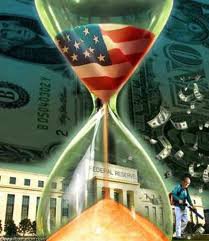
The Engineered Stagflationary Collapse Has Arrived – Here’s What Happens Next

By Brandon Smith

Source: Alt-Market.us

In my 16 years as an alternative economist and political writer I have spent around half that time warning that the ultimate outcome of the Federal Reserve’s stimulus model would be a stagflationary collapse. Not a deflationary collapse, or an inflationary collapse, but a stagflationary collapse. The reasons for this were very specific – Mass debt creation was being countered with MORE debt creation while many central banks have been simultaneously devaluing their currencies through QE measures. On top of that, the US is in the unique position of relying on the world reserve status of the dollar and that status is diminishing.

It was only a matter of time before the to forces of deflation and inflation met in the middle to create stagflation. In my article ‘Infrastructure Bills Do Not Lead To Recovery, Only Increased Federal Control’, published in April of 2021, I stated that:

Production of fiat money is not the same as real production within the economy… Trillions of dollars in public works programs might create more jobs, but it will also inflate prices as the dollar goes into decline. So, unless wages are adjusted constantly according to price increases, people will have jobs, but still won’t be able to afford a comfortable standard of living. This leads to stagflation, in which prices continue to rise while wages and consumption stagnate.

Another Catch-22 to consider is that if inflation becomes rampant, the Federal Reserve may be compelled (or claim they are compelled) to raise interest rates significantly in a short span of time. This means an immediate slowdown in the flow of overnight loans to major banks, an immediate slowdown in loans to large and small businesses, an immediate crash in credit options for consumers, and an overall crash in consumer spending. You might recognize this as the recipe that created the 1981-1982 recession, the third-worst in the 20th century.

In other words, the choice is stagflation, or deflationary depression.”

It’s clear today what the Fed has chosen. It’s important to remember that throughout 2020 and 2021 the mainstream media, the central bank and most government officials were telling the public that inflation was “transitory.” Suddenly in the past few months this has changed and now even Janet Yellen has admitted that she was “wrong” on inflation. This is a misdirection, however, because the Fed knows exactly what it is doing and always has. Yellen denied reality, but she knew she was denying reality. In other words, she was not mistaken about the economic crisis, she lied about it.

As I outlined last December in my article ‘The Fed’s Catch-22 Taper Is A Weapon, Not A Policy Error’:

‘First and foremost, no, the Fed is not motivated by profits, at least not primarily. The Fed is able to print wealth at will, they don’t care about profits – They care about power and centralization. Would they sacrifice “the golden goose” of US markets in order to gain more power and full bore globalism? Absolutely. Would central bankers sacrifice the dollar and blow up the Fed as an institution in order to force a global currency system on the masses? There is no doubt; they’ve put the US economy at risk in the past in order to get more centralization.’

The Fed has known for years that the current path would lead to inflation and then market destruction, and here’s the proof – Fed Chairman Jerome Powell actually warned about this exact outcome in October of 2012:

“I have concerns about more purchases. As others have pointed out, the dealer community is now assuming close to a $4 trillion balance sheet and purchases through the first quarter of 2014. I admit that is a much stronger reaction than I anticipated, and I am uncomfortable with it for a couple of reasons.First, the question, why stop at $4 trillion? The market in most cases will cheer us for doing more. It will never be enough for the market. Our models will always tell us that we are helping the economy, and I will probably always feel that those benefits are overestimated. And we will be able to tell ourselves that market function is not impaired and that inflation expectations are under control. What is to stop us, other than much faster economic growth, which it is probably not in our power to produce?

When it is time for us to sell, or even to stop buying, the response could be quite strong; there is every reason to expect a strong response. So there are a couple of ways to look at it. It is about $1.2 trillion in sales; you take 60 months, you get about $20 billion a month. That is a very doable thing, it sounds like, in a market where the norm by the middle of next year is $80 billion a month. Another way to look at it, though, is that it’s not so much the sale, the duration; it’s also unloading our short volatility position.”

As we all now know, the Fed waited until their balance sheet was far larger and until the economy was MUCH weaker than it was in 2012 to unleash tightening measures. They KNEW the whole time exactly what was going to happen.

It is no coincidence that the culmination of the Fed’s stimulus bonanza has arrived right after the incredible damage done to the economy and the global supply chain by the covid lockdowns. It is no coincidence that these two events work together to create the perfect stagflationary scenario. And, it’s no coincidence that the only people who benefit from these conditions are proponents of the “Great Reset” ideology at the World Economic Forum and other globalist institutions. This is an engineered collapse that has been in the works for many years.

The goal is to “reset” the world, to erase what’s left of free market systems, and to establish what they call the “Shared Economy” system. This system is one in which the people who survive the crash will be made utterly dependent on government through Universal Basic Income and one that will restrict all resource usage in the name of “carbon reduction.” According to the WEF, you will own nothing and you will like it.

The collapse is engineered to create crisis conditions so frightening that they expect the majority of the public to submit to a collectivist hive mind lifestyle with greatly reduced standards. This would be accomplished through UBI, digital currency models, carbon taxation, population reduction, rationing of all commodities and a social credit system. The goal, in other words, is complete control through technocratic authoritarianism.

All of this is dependent on the exploitation of crisis events to create fear in the population. Now that economic destabilization has arrived, what happens next? Here are my predictions…

The Fed Will Hike Interest Rates More Than Expected, But Not Enough To Stop Inflation

Today, we are witnessing the poisonous fruits of a decade-plus of massive fiat money creation and we are now at the stage where the Fed will reveal its true plan. Hiking interest rates fast, or hiking them slow. Fast hikes will mean an almost immediate crash in markets (beyond what we have already seen), slow hikes will mean a drawn out process of price inflation and general uncertainty.

I believe the Fed will hike more than expected, but not enough to actually slow inflation in necessities. There will be an overall decline in luxury items, recreation commerce and non-essentials, but most other goods will continue to climb in cost. It is to the advantage of globalists to keep the inflation train running for another year or longer.

In the end, though, the central bank WILL declare that the pace of interest rates is not enough to stop inflation and they will revert to a Volcker-like strategy, pushing rates up so high that the economy simply stops functioning altogether.

Markets Will Crash And Unemployment Will Abruptly Spike

Stock markets are utterly dependent on Fed stimulus and easy money through low interest rate loans – This is a fact. Without low rates and QE, corporations cannot engage in stock buybacks. Meaning, the tools for artificially inflating equities are disappearing. We are already seeing the effects of this now with markets dropping 20% or more.

The Fed will not capitulate. They will continue to hike regardless of the market reaction.

As far as jobs are concerned, Biden and many mainstream economists constantly applaud the low unemployment rate as proof that the American economy is “strong,” but this is an illusion. Covid stimulus measures temporarily created a dynamic in which businesses needed increased staff to deal with excess retail spending. Now, the covid checks have stopped and Americans have maxed out their credit cards. There is nothing left to keep the system afloat.

Businesses will start making large job cuts throughout the last half of 2022.

Price Controls

I have no doubt that Joe Biden and Democrats will seek to enforce price controls on many goods as inflation continues, and there will be a handful of Republicans that will support the tactic. Price controls actually lead to a reduction in supply because they remove all profits and thus all incentive for manufacturers to keep producing goods. What usually happens at that point is government steps in to nationalize manufacturing, but this will be substandard production and at a much lower yield.

In the end, supplies are reduced even further and prices go even higher on the black market because no one can get their hands on most goods anyway.

Rationing

Yes, rationing at the manufacturing and distribution level is going to happen, so be sure to buy what you need now before it does. Rationing occurs in the wake of price controls or supply chain disruptions, and usually this coincides with a government propaganda campaign against “hoarders.”

They will hold up a few exaggerated examples of people who buy truckloads of merchandise to scalp prices on the black market. Then, not long after, they will accuse preppers and anyone who bought goods BEFORE the crisis of “hoarding” simply because they planned ahead.

Rationing is not only about controlling the supply of necessities and thus controlling the population by proxy; it is also about creating an atmosphere of blame and suspicion within the public and getting them to snitch on or attack anyone that is prepared. Prepared people represent a threat to the establishment, so expect to be demonized in the media and organize with other prepared people to protect yourself.

Be Ready, It Only Gets Worse From Here On

It might sound like I am predicting success of the Great Reset program, but I actually believe the globalists will fail in the end. That’s not going to stop them from making the attempt. Also, the above scenarios are only predictions for the near term (within the next couple of years). There will be many other problems that stem from these situations.

Naturally, food riots and other mob actions will become more commonplace, perhaps not this year, but by the end of 2023 they will definitely be a problem. This will coincide with the return of political unrest in the US as leftist factions, encouraged by globalist foundations, demand more government intervention in poverty. At the same time, conservatives will demand less government interference and less tyranny.

At bottom, the people who are prepared might be called a lot of mean names, but as long as we organize and work together, we will survive. Many unprepared people will NOT survive. Understand that the economic conditions ahead of us are historically destructive; there is no way that serious consequences can be avoided for a large part of the population, if only because they refuse to listen and to take proper steps to protect themselves.

The denial is over. The crash is here. Time to take action if you have not done so already.
Is Housing a Bubble That’s About to Crash?

By Charles Hugh Smith

Source: Of Two Minds

Are we heading into another real estate bubble / crash? Those who say “no” see the housing shortage as real, while those who say “yes” see the demand as a reflection of the Federal Reserve’s artificial goosing of the housing market via its unprecedented purchases of mortgage-backed securities and “easy money” financial conditions.

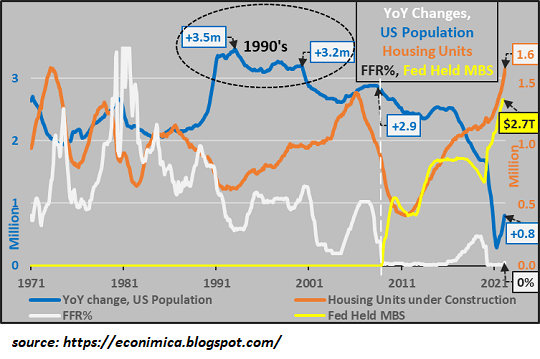
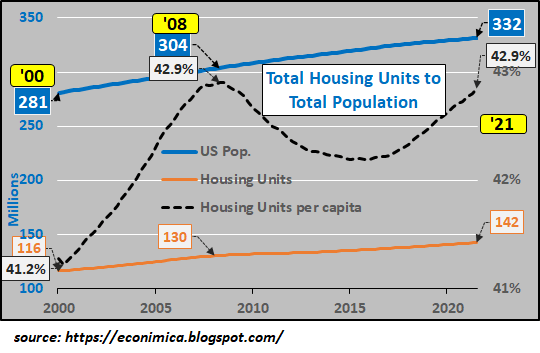
My colleague CH at econimica.blogspot.com recently posted charts calling this assumption into question. The first chart (below) shows the U.S. population growth rate plummeting as housing starts soar, and the second chart shows housing unit per capita, which has just reached the same extreme as the 2008 housing bubble.

Demographics and housing do not reflect a housing shortage nationally, though there could be scarcities locally, of course, and other factors such as thousands of units being held off the market as short-term rentals or investments by overseas buyers who have no interest in renting their investment dwellings.

On a per capita basis, housing has reached previous bubble levels. That suggests housing shortages are artificial or local, not structural.

Next, let’s consider how the current housing bubble differs from previous bubbles in the late 1970s and 2000s. In my view, the previous bubbles were driven by demographics, inflation and monetary policy: in the late 70s, the 65 million-strong Baby Boom generation began buying their first homes, pushing demand higher while inflation soared, making real-world assets such as housing more desirable.

Once the Federal Reserve pushed interest rates to 18%, mortgage rates rose in lockstep and housing crashed as few could afford sky-high housing prices at sky-high mortgage rates.

The housing bubble of 2007-08 was largely driven by declines in mortgage rates (as the Fed pursued an “easy money” policy to escape the negative effects of the Dot-Com stock market bubble crash) and a loosening of credit/mortgage standards. These fueled a bubble that morphed into a speculative free-for-all of no-down payment and no-document loans.

This decline in the cost of borrowing money (mortgage rates) enabled a sharp rise in the price of housing, a speculative boom that was greatly accelerated by “innovations” in the mortgage market such as zero down payments loans, interest-only loans, home equity loans, and no-document “liar loans”–mortgages underwritten without the usual documentation of income and net worth.

These forces generated a speculative frenzy of house-flipping, leveraging the equity in the family home to buy two or three homes under construction and selling them before they were even completed for fat profits, and so on.

Needless to say, the pool of potential buyers expanded tremendously when people earning $25,000 a year could buy $500,000 houses on speculation.

Once the bubble popped, the pool of buyers shrank along with the home equity.

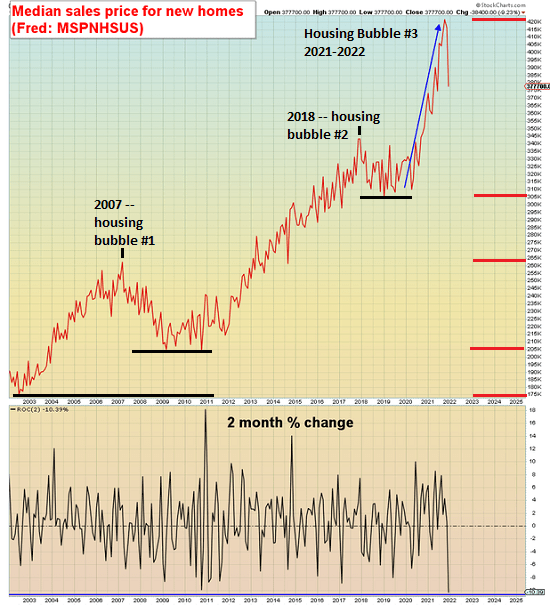
If we study this chart below of new home prices (courtesy of Mac10), we can see that the 21st century’s Bubble #2 rose as the Federal Reserve pushed mortgage rates far below historic norms. Once rates reached a bottom, the 7-year inflation of home prices (from 2011 to 2018) began rolling over.

This deflation of home prices was reversed by the pandemic recession, as the Fed’s vast expansion of credit and mortgage-buying, which pushed mortgage rates to new lows. Trillions of dollars in new credit and cash stimulus ignited a speculative frenzy in stocks, bonds and real estate, a frenzy which drove bubble #3 to extraordinary heights.

All this unprecedented fiscal and monetary stimulus also ignited inflation, and so rates are rising in response. Bubble #3 is already deflating, at least by the measure of new home prices.

But the current bubble has a number of dynamics that weren’t big factors in previous bubbles.

One is the rise of remote work. Many people have been working remotely since the late 1990s enabled Internet-based work, but the pandemic greatly increased the pool of employers willing to accept remote work as a permanent feature of employment.

This trend has been well documented, but the consequences are still unfolding: remote workers are no longer trapped in unaffordable, congested cities and suburbs.

Several other trends have attracted much less attention, but I see them as equally consequential.

1. Housing in many urban zones are out of reach of all but the top 10% without extraordinary sacrifice, and now that employment isn’t necessarily tied to urban zones, the bottom 90% of young people without family wealth or high incomes are coming to realize the benefits of urban living are not worth the extreme sacrifices needed to buy an overvalued house.

A middle-class life–home ownership, financial security, leisure and surplus income to invest in one’s family and well-being–is no longer affordable for the majority of young Americans.

Few are willing to concede this because it reveals the neofeudal nature of American life. Those who bought homes in coastal urban zones 20+ years ago are wealthy due to soaring housing valuations while young people can’t even afford the rent, much less buying a house.

If you’re not making $250,000 or more a year as a couple, the only hope for a middle-class life that includes leisure and some surplus income to invest is top move to some place with much lower housing and other costs. That place is rural America.

2. The benefits of urban living are deteriorating while the sacrifices and downsides are increasing. Urban living is fun if you’re wealthy, not so fun if you don’t have plenty of surplus income to spend.

Urban problems such as homelessness, traffic congestion and crime are endemic and unresolvable, though few are willing to state the obvious. Americans are expected to be optimistic and to count on some new whiz-bang technology to solve all problems.

Unfortunately, problems generated by dysfunctional, overly complex institutions, corruption and unaffordable costs can’t be solved by some new technology, and so the decay of cities will only gather momentum.

The hope that billions of federal stimulus funding would solve these problems is about to encounter reality as the funds dry up and all the problems remain or have actually expanded despite massive “investments” in solutions.

Few analysts have looked at the finances of high-cost cities. The decline in bricks-and-mortar retail, rising crime, soaring junk fees, rents and property taxes have all made urban small business insanely costly and therefore risky.

Small businesses are the core sources of employment and taxes. As high costs, crime, etc. choke small businesses, employment and tax revenues drop and commercial real estate sits empty, generating decay and defaults.

Once office and retail space is no longer affordable or necessary, commercial real estate crashes in value as owners who bought at the top default and go bankrupt.

People need shelter but they don’t need office space or to start a bricks-and-mortar retail business.

As urban finances unravel, cities won’t have the funding to run their bloated, inefficient, overly complex and unaccountable bureaucracies.

3. In geopolitics, we speak of the core and the periphery. Empires have a core (Rome and central Italy in the Roman Empire) and a periphery (Britain, North Africa, Egypt, the Levant).

As finances and trade decay and costs soar, the periphery is surrendered to maintain the core.

In urban zones, the same dynamic will become increasingly visible: the peripheral neighborhoods will be underfunded to continue protecting the wealthy enclaves.

Crime will skyrocket in the periphery even as residents of the wealthy enclaves see little decay in their neighborhoods.

This asymmetry–already extreme–will drive social unrest and disorder. This is a self-reinforcing feedback: as the periphery neighborhoods deteriorate, the remaining businesses flee and the smart money sells and moves away.

Tax revenues plummet and city services decay even further, persuading hangers-on to move before it gets even worse. Cities compensate for the lower revenues by increasing taxes on the remaining residents and cutting services.

Each turn of the screw triggers more closures and selling and fewer tax revenues.

4. Dependency chains will become increasingly consequential: the greater a city’s dependency on essentials trucked/shipped from hundreds or thousands of of kilometers/miles away, the more prone that city will be to disruptions of essentials: food, energy, materials and infrastructure.

Though few are willing to dwell on such vulnerabilities, most cities are totally dependent on diesel fueled fleets of trucks, rail and jet fuel for luxuries flown in from afar for virtually all goods. Cities produce very little in the way of essentials such as food and energy.

The past reliability of long supply chains has instilled a confidence that these supply chains stretching thousands of kilometers and miles are unbreakable and forever. They aren’t, and the initial disruptions will be a great shock to Americans who believe full gas tanks and fully stocked store shelves are their birthright.

5. As I’ve explained in my new book Global Crisis, National Renewalthe era of cheap, reliable abundance has drawn to a close and now we are entering an era of scarcity in essentials.

Another reality few discuss is the relative stability of global weather over the past 40 years. As weather becomes less reliable, so too do crop yields and food supplies.

Globalization has poured capital into expanding acreage under cultivation to the point that the planet’s forests are being decimated to grow more soy to feed animals to be slaughtered for human consumption.

On the margins, land that was once productive has been lost to desertification. Fresh water aquifers have been drained and glaciers feeding rivers are melting away. Soil fertility has declined even as fertilizer use has expanded.

The low-hanging fruit of GMO seeds, fertilizers, insecticides, herbicides and Green Revolution hybrids have all been plucked. The gains have been reaped but now the downsides of these dependencies are becoming increasingly consequential: fertilizer costs are rising fast, insects and diseases are evading chemicals and vaccines, and the vulnerabilities of mono-crop, industrialized agriculture and animal husbandry threaten to cascade into crop failures, soaring prices and shortages.

6. This will have two consequences: rural incomes which have been falling for decades due to globalization (i.e. bringing in cheap food from places with no environmental standards, cheap labor and few taxes / social costs) will start rising sharply, fueling a reversal in the long decline of rural communities based on agricultural income.

The soaring costs of essentials will reduce the disposable income of the bottom 90%, reducing the money they’ll have to spend on eating out, retail shopping, etc.–all the surplus spending that drives cities’ economies and tax revenues.

Few (if any) commentators forecast a cyclical reversal of the demographic trend of people moving from rural locales to cities. I think this trend has already reversed and will gather momentum as cities become increasingly unlivable, disposable incomes decline as scarcities push prices higher and people flee for lower cost, more secure environs.

7. As I often note, following what the super-wealthy are doing is a pretty sound investment strategy because the super-wealthy spend freely to buy the best advice and are highly motivated to protect their wealth.

People who live in well-known, highly desirable rural towns (Telluride, Jackson Hole, Lake Tahoe, etc.) are describing a feeding frenzy of wealthy urbanites buying multi-million dollar homes. Small cities such as Bozeman, MT and Ashville, NC are experiencing a flood of new residents that is straining infrastructure and pushing housing prices out of reach for local residents with average wages.

8. Rural towns in the U.S., Italy, Japan and even Switzerland are trying to attract new residents with offers of free land, subsidized rent, low cost homes, etc. This shows that the trends are global and not limited to any one nation. Would you take free land in rural America?

The decay of urban life isn’t yet consequential enough to push people into making a major move, but once someone has been robbed, repeatedly found human feces on their doorstep or experienced scarcities that trigger the madness of crowds, the decision to leave becomes much, much easier.

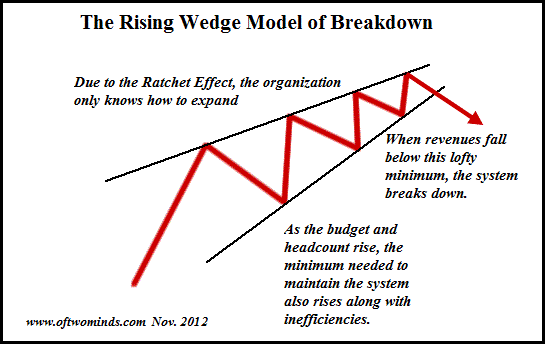
Some cities will manage the decline of employment and tax revenues more gracefully than others. Most will suffer from the dynamic I’ve often described on the blog: the Ratchet Effect. Costs move effortlessly higher as tax revenues have increased in one speculative bubble after another, but once revenues drop, cities have no mechanisms or political constituency to manage a sharp, long-term decline in revenues.

They then become prone to the other dynamic I’ve described, the Rising Wedge Breakdown (see chart below): as agencies and institutions become sclerotic, unaccountable and self-serving, even a relatively modest cut in revenues triggers institutional collapse, as the system requires 100% funding to function. A 10% reduction doesn’t cause a 10% decline in service, it causes an 50% decline in service, on the way to complete dysfunction.

Few believe cities can unravel, but remote work, geographic arbitrage (discussed below), tightening credit, rising crime, the decline of commercial real estate, end of massive stimulus, scarcities, the madness of crowds, the decline of civic services and amenities and an insanely high cost of living all have consequences and second-order effects.

What were beneficial synergies become fatal synergies as dynamics reverse and begin reinforcing each other.

So let’s put all this together.

A. The cycle of declining interest rates and inflation has ended and a cycle of much higher interest and mortgage rates and inflation is beginning. Higher mortgages rates will depress housing prices as only the highest income households will be able to afford today’s prices once mortgage rates rise.

B. The decay of urban finances and quality of life will accelerate as stimulus ends, credit dries up and inflation decimates disposable income.

C. The stress of trying to make enough money to afford the high costs of city/suburban living as the real estate bubble pops and the benefits of city living decline will burn out increasing numbers of people who will have no choice but to find more affordable, more secure and more livable places.

D. While the wealthy have already secured second or third homes in the toniest desirable towns, there are still opportunities for lower cost, more secure residences in rural areas.

E. This migration, even at the margins, will further depress urban housing prices and push prices in desirable rural locales higher.

F. This migration will have regional, ethnic and cultural variations. For example, some African-Americans leaving the upper Midwest are finding favor with communities in the South where family, church and cultural ties beckon.

G. Correspondent John F. used the phrase geographic arbitrage which means earning money remotely in high-wage sectors while living some place that’s low cost and secure.

I wrote about this many years ago in my post about young Japanese maintaining a part-time remote-work gig while pursuing farming in rural communities: Degrowth Solutions: Half-Farmer, Half-X (July 19, 2014).

H. Though monetary / inflationary forces will pop housing prices based solely on low mortgage rates, this doesn’t mean housing everywhere will decline: as burned out urbanites seek lower cost, more secure and livable places in rural locales, homes in desirable towns and small cities could rise sharply because they’re starting from such low levels.

I. If urban areas decay rapidly, housing prices could plummet much faster than most people think possible.

When cities lose employment, tax revenues and desirability, they can go down fast. Property values can fall in half and then by 90%.

How is this possible? Supply and demand: if demand falls off a cliff, there won’t be buyers for thousands of homes that come on the market all at once. This is just like a stock market in which buyers disappear, as no one wants to buy an asset that’s rapidly losing value.

As I’ve noted many times, prices for assets are set on the margins: the last sale of a house resets the price for the entire neighborhood.

The stock market is easily manipulated by the big players, who can stop a slide in prices by buying huge chunks of stocks and call options. There are no equivalent forces which can stop a decline in housing prices.

And since rates will rise regardless of what the Federal Reserve does because global capital is demanding a real return above inflation, then the hope for lower mortgage rates to support bubble-level housing prices will be in vain.

How low could housing go? As explained above, there will likely be very asymmetric declines and increases in housing valuations going forward. But on a technical-analysis level, we can anticipate a general decline to previous lows, first to the 2019 lows and then to the 2011 lows.

Some analysts believe inflation will funnel capital into housing as investors seek assets that will go up with inflation, but this is a murky forecast: the bottom 90% of American households are already priced out of coastal housing, so inflation only robs their wages of purchasing power. They don’t have any hope of buying a house anywhere near current prices.

Corporations are buying thousands of houses for the rental income, but once all the stimulus runs out and the excesses of speculation reverse, they’ll find few renters can afford their sky-high rents. At that point corporate buyers become corporate sellers, but they won’t find buyers willing or able to pay their asking prices, which are based on bubble pricing, not reality.

All these swirling currents will affect housing valuations in different places differently. Some areas could see 50% declines while others see 50% increases, regardless of mortgage rates or Fed policy.

What will become most desirable is a low cost of living, security and livability, which includes community, reduced dependency on long supply chains and local production of essentials.

We are all prone to believing the recent past is a reliable guide to the future. But in times of dynamic reversals, the past is an anchor thwarting our progress, not a forecast.

The American Empire self-destructs.

By Michael Hudson

Source: Michael-Hudson.com

But nobody thought that it would happen this fast.

Empires often follow the course of a Greek tragedy, bringing about precisely the fate that they sought to avoid. That certainly is the case with the American Empire as it dismantles itself in not-so-slow motion.

The basic assumption of economic and diplomatic forecasting is that every country will act in its own self-interest. Such reasoning is of no help in today’s world. Observers across the political spectrum are using phrases like “shooting themselves in their own foot” to describe U.S. diplomatic confrontation with Russia and allies alike.

For more than a generation the most prominent U.S. diplomats have warned about what they thought would represent the ultimate external threat: an alliance of Russia and China dominating Eurasia. America’s economic sanctions and military confrontation has driven them together, and is driving other countries into their emerging Eurasian orbit.

American economic and financial power was expected to avert this fate. During the half-century since the United States went off gold in 1971, the world’s central banks have operated on the Dollar Standard, holding their international monetary reserves in the form of U.S. Treasury securities, U.S. bank deposits and U.S. stocks and bonds. The resulting Treasury-bill Standard has enabled America to finance its foreign military spending and investment takeover of other countries simply by creating dollar IOUs. U.S. balance-of-payments deficits end up in the central banks of payments-surplus countries as their reserves, while Global South debtors need dollars to pay their bondholders and conduct their foreign trade.

This monetary privilege – dollar seignorage – has enabled U.S. diplomacy to impose neoliberal policies on the rest of the world, without having to use much military force of its own except to grab Near Eastern oil.

The recent escalation U.S. sanctions blocking Europe, Asia and other countries from trade and investment with Russia, Iran and China has imposed enormous opportunity costs – the cost of lost opportunities – on U.S. allies. And the recent confiscation of the gold and foreign reserves of Venezuela, Afghanistan and now Russia, along the targeted grabbing of bank accounts of wealthy foreigners (hoping to win their hearts and minds, along with recovery of their sequestered accounts), has ended the idea that dollar holdings or those in its sterling and euro NATO satellites are a safe investment haven when world economic conditions become shaky.

So I am somewhat chagrined as I watch the speed at which this U.S.-centered financialized system has de-dollarized over the span of just a year or two. The basic theme of my Super Imperialism has been how, for the past fifty years, the U.S. Treasury-bill standard has channeled foreign savings to U.S. financial markets and banks, giving Dollar Diplomacy a free ride. I thought that de-dollarization would be led by China and Russia moving to take control of their economies to avoid the kind of financial polarization that is imposing austerity on the United States. But U.S. officials are forcing them to overcome whatever hesitancy they had to de-dollarize.

I had expected that the end of the dollarized imperial economy would come about by other countries breaking away. But that is not what has happened. U.S. diplomats have chosen to end international dollarization themselves, while helping Russia build up its own means of self-reliant agricultural and industrial production. This global fracture process actually has been going on for some years now, starting with the sanctions blocking America’s NATO allies and other economic satellites from trading with Russia.For Russia, these sanctions had the same effect that protective tariffs would have had.

Russia had remained too enthralled by free-market ideology to take steps to protect its own agriculture or industry. The United States provided the help that was needed by imposing domestic self-reliance on Russia (via sanctions). When the Baltic states lost the Russian market for cheese and other farm products, Russia quickly created its own cheese and dairy sector – while becoming the world’s leading grain exporter.

Russia is discovering (or is on the verge of discovering) that it does not need U.S. dollars as backing for the ruble’s exchange rate. Its central bank can create the rubles needed to pay domestic wages and finance capital formation. The U.S. confiscations thus may finally lead Russia to end neoliberal monetary philosophy, as Sergei Glaziev has long been advocating in favor of MMT.

The same dynamic undercutting ostensible U.S aims has occurred with U.S. sanctions against the leading Russian billionaires. The neoliberal shock therapy and privatizations of the 1990s left Russian kleptocrats with only one way to cash out on the assets they had grabbed from the public domain. That was to incorporate their takings and sell their shares in London and New York. Domestic savings had been wiped out, and U.S. advisors persuaded Russia’s central bank not to create its own ruble money.

The result was that Russia’s national oil, gas and mineral patrimony was not used to finance a rationalization of Russian industry and housing. Instead of the revenue from privatization being invested to create new Russian means of protection, it was burned up on nouveau-riche acquisitions of luxury British real estate, yachts and other global flight-capital assets. But the effect of making the Russian dollar, sterling and euro holdings hostage has been to make the City of London too risky a venue in which to hold their assets. By imposing sanctions on the richest Russians closest to Putin, U.S. officials hoped to induce them to oppose his breakaway from the West, and thus to serve effectively as NATO agents-of-influence. But for Russian billionaires, their own country is starting to look safest.

For many decades now, the Federal Reserve and Treasury have fought against gold recovering its role in international reserves. But how will India and Saudi Arabia view their dollar holdings as Biden and Blinken try to strong-arm them into following the U.S. “rules-based order” instead of their own national self-interest? The recent U.S. dictates have left little alternative but to start protecting their own political autonomy by converting dollar and euro holdings into gold as an asset free of political liability of being held hostage to the increasingly costly and disruptive U.S. demands.

U.S. diplomacy has rubbed Europe’s nose in its abject subservience by telling its governments to have their companies dump the Russian assets for pennies on the dollar after Russia’s foreign reserves were blocked and the ruble’s exchange rate plunged. Blackstone, Goldman Sachs and other U.S. investors moved quickly to buy up what Shell Oil and other foreign companies were unloading.

Nobody thought that the postwar 1945-2020 world order would give way this fast. A truly new international economic order is emerging, although it is not yet clear just what form it will take. But “prodding the Bear” with the U.S./NATO confrontation with Russia has passed critical-mass level. It no longer is just about Ukraine. That is merely the trigger, a catalyst for driving much of the world away from the US/NATO orbit.

The next showdown may come within Europe itself. Nationalist politicians could seek to lead a break-away from the over-reaching U.S. power-grab over its European and other Allies, trying in vain to keep them dependent on U.S.-based trade and investment. The price of their continuing obedience is to impose cost-inflation on their industry while relinquishing their democratic electoral politics in subordination to America’s NATO proconsuls.

These consequences cannot really be deemed “unintended.” Too many observers have pointed out exactly what would happen – headed by President Putin and Foreign Secretary Lavrov explaining just what their response would be if NATO insisted in backing them into a corner while attacking Eastern Ukrainian Russian-speakers and moving heavy weaponry to Russia’s Western border. The consequences were anticipated. The neocons in control of U.S. foreign policy simply didn’t care. Recognizing its concerns was deemed to make one a Putinversteher.

European officials did not feel uncomfortable in telling the world about their worries that Donald Trump was crazy and upsetting the apple cart of international diplomacy. But they seem to have been blindsided at the Biden Administration’s resurgence of visceral Russia-hatred by Secretary of State Blinken and Victoria Nuland-Kagan. Trump’s mode of expression and mannerisms may have been uncouth, but America’s neocon gang has much more globally threatening confrontation obsessions. For them, it was a question of whose reality would emerge victorious: the “reality” that they believed they could make, or economic reality outside of U.S. control.

What foreign countries have not done for themselves – replacing the IMF, World Bank and other arms of U.S. diplomacy – American politicians are forcing them to do. Instead of European, Near Eastern and Global South countries breaking away out of their own calculation of their long-term economic interests, America is driving them away, as it has done with Russia and China. More politicians are seeking voter support by asking whether they would be better served by new monetary arrangements to replace dollarized trade, investment and even foreign debt service.

The energy and food price squeeze is hitting Global South countries especially hard, coinciding with their own Covid-19 problems and the looming dollarized debt service coming due. Something must give. How long will these countries impose austerity to pay foreign bondholders?

How will the U.S. and European economies cope in the face of their sanctions against imports of Russian gas and oil, cobalt, aluminum, palladium and other basic materials? American diplomats have made a list of raw materials that their economy desperately needs and which therefore are exempt from the trade sanctions being imposed. This provides Mr. Putin a handy list of pressure points to use in reshaping world diplomacy, in the process helping European and other countries break away from the Iron Curtain that America has imposed to lock its satellites into dependence on high-priced U.S. supplies.

But the final breakaway from NATO’s adventurism must come from within the United States itself. As this year’s midterm elections approach, politicians will find a fertile ground in showing U.S. voters that the price inflation led by gasoline and energy is a policy byproduct of the Biden administration blocking Russian oil and gas exports. Gas is needed not only for heating and energy production, but to make fertilizer, of which there already is a world shortage. This is exacerbated by blocking Russian and Ukrainian grain exports, sending U.S. and European food prices soaring.

Trying to force Russia to respond militarily and thereby looking bad to the rest of the world is turning out to be a stunt aimed simply at demonstrating Europe’s need to contribute more to NATO, buy more U.S. military hardware and lock itself deeper into trade and monetary dependence on the United States. The instability that this has caused is turning out to have the effect of making the United States look as threatening as Russia.

The Fed Has Triggered A Stagflationary Disaster That Will Hit Hard This Year

By Brandon Smith

Source: Alt-Market.US

I don’t think I can overstate the danger that the U.S. economy is in right now as we enter 2022. While most people are caught up in the ongoing drama of Covid-19, a REAL threat looms over the nation in the form of a stagflationary tidal wave. The mainstream media is attempting to place the blame on “supply chain disruptions,” but this is a misrepresentation of the issue.

The two factors are indeed intertwined, but the reality is that inflation is the cause of supply chain disruptions, not the result of supply chain disruptions. If we look at the underlying stats for price rises in essential products we can get a clearer picture.

Before I get into my argument, I really want to stress that this is a precarious time and I suggest that people prepare accordingly. In just the past few months I have seen personal expenses rise at least 20% overall, and I’m sure it’s the same or worse for most of you. Stocking necessities and safe-haven investments with intrinsic value like physical precious metals are a good choice for protecting whatever buying power your dollars have left…

Higher prices everywhere

The Consumer Price Index (CPI) is officially at the highest levels in 40 years. CPI measurements often diminish the scale of the problem because they do not include things like food, energy and housing which are core expenses for the public. CPI calculations have also been “adjusted” over the past few decades by the government to express a more positive view on inflation. If we look at the inflation numbers at Shadowstats, calculated according to the same methods they used in the 1980’s, we see a dramatic increase in CPI which paints a more dire (but more accurate) picture.

U.S. food prices have spiked to levels not seen since 2008 at the onset of the credit and derivatives collapse that brought about tens of trillions of dollars in Federal Reserve bailouts.

If we look beyond the 2008 crisis, food costs do not see a similar jump until the 1980s. Rising food prices in the US are often obscured by creative accounting and “shrinkflation” (shrinking packages and rising prices), but if we look at global food prices the average is a 30% jump in the past year.

Rental and home prices have also gone into the stratosphere. Rental costs went up around 18% in 2021, and this is an extension of a trend that has been prevalent for the past decade. Prices have been rising for a while, it’s just that now the avalanche has accelerated.

Home prices are currently out of the range of most new potential home buyers. Values jumped 16% in the past year alone, with the average property costing $408,000. Home sales continue to remain elevated compared to two years ago despite inflating prices for one reason and one reason only – the mass migration of Americans away from the draconian mandates and bureaucracy of blue states into more conservative states.

I live in Montana, a primary destination for people relocating, and from my experience the majority of these people are conservatives seeking to escape the vaccine and lockdown mandates in places like California, New York and Illinois. They see the writing on the wall and they are trying to get ahead of the economic and social calamity that will surely befall such states.

I would also note that home sales have finally begun to flatten in the past six months but prices are not dropping, which is a trend that I think needs to be explored further because it illustrates the larger issue of stagflation.

When inflation becomes stagflation

Understand that prices are not just rising because of increased demand (demand is starting to fall in many sectors), prices are rising because of increased money supply and dollar devaluation which is not yet being reflected in the Dollar Index.

Take a look at U.S. GDP and you will see that for the past several years it has tracked in tandem with price inflation. Obviously, if prices inflate then this means people are spending more, which then leads to higher U.S. GDP; it’s like magic, right? In other words, inflation makes it seem as though U.S. GDP is always improving.

However, this has not been the case in the past couple of years.

Official GDP has flattened despite the fact that U.S. money supply and inflation have rocketed higher. What does this mean? I believe it is a sign of stagflation and a reckoning in 2022. If we examine inflation adjusted GDP numbers from Shadowstats we see that GDP has declined rather aggressively in the past couple of years.

We can also see odd tendencies in oil and gasoline prices. While it’s true that gas prices have been higher in the past, this does not address the full context of the situation. U.S. travel spending has declined 12% since 2019 and airline travel has dropped at least 21% in the past year. Average gasoline usage dropped after 2019 and still has not recovered. Yet, gas prices continue to rise? In other words, travel demand is stagnant but prices are INCREASING – this is another signal of inflationary pressures and dollar devaluation. Oil is priced in dollars globally, and therefore any inflation in the dollar will be readily visible in oil. This would help explain why pandemic paranoia and reduced travel have not caused gas prices to drop.

If the current momentum continues the majority of necessities in the U.S. will not be affordable for most people by next year. We are looking at a fast-moving decline in production along with a swift explosion in prices. In other words, a stagflationary disaster.

This is the Federal Reserve’s fault

I and many other alternative economists have been warning about the inevitable inflation/stagflation crisis for years, but the most important factor to understand is WHO is responsible this event?

The mainstream financial media is going to protect the government and the Federal Reserve at all costs during this breakdown. They are going to blame Covid, the lockdowns here and overseas as well as the supply chain bottleneck.

The Fed is the true culprit, though.

While there have been many American Presidents and other politicians that have supported the Fed in its inflationary activities, the central bank itself needs to be held accountable for the downturn that is about to occur. This is a process that started back at the founding of the Fed, but spread like cancer after the crash of 2008 and the introduction of 12+ years of stimulus and bailout measures along with near-zero interest rates.

The inflationary end-game

The pandemic is the perfect cover for the inflationary end game. In 2008 the response to the crisis was to print and pump dollars into banks and corporations in the U.S. and around the globe. This money supply was held in corporate coffers and in central banks overseas, which slowed the effects of inflation. This set the precedent for subversive stimulus policies by giving the Fed a blank check to do whatever it wanted.

In 2020, the Fed created trillions more but this time the money was injected directly into the U.S. economy through Covid stimulus checks, PPP loans and other measures. In the alternative economic field we call this “helicopter money.” These dollars triggered a massive retail buying spree in 2020, but with more dollars in the economy chasing less goods prices are now spiking much higher.

The big discussion today is whether or not the Fed will taper their asset purchases, reduce their balance sheet and raise interest rates to counter inflation?

The fact is it won’t matter; inflation/stagflation will continue or even accelerate as the Fed tapers. With a taper comes the threat of a flattening yield curve in Treasury bonds as well as the danger of bonds and dollars being dumped by foreign investors and central banks. If the trillions upon trillions of dollars being held overseas come flooding back into the U.S., inflation will continue at its current pace or erupt even higher. In fact, the world’s ownership of dollars reached a 26-year low recently. The global transition away from the dollar, toward inflation-resistant investments, has already begun.

This is not a policy error

I explained this Catch-22 threat in my recent article The Fed’s Catch-22 Taper Is a Weapon, Not a Policy Error. In that essay I outline the Fed’s documented history of creating economic disasters that conveniently end up benefiting their friends in the international banks.

I also explained (with evidence) how the Federal Reserve actually takes its marching orders from the Bank for International Settlements, a globalist institution which along with the International Monetary Fund and World Economic Forum is openly seeking a one-world economic system and one-world currency system.

I do not believe that the Fed’s actions are a product of ignorance or stupidity or basic greed. I do not believe the Fed is scrambling to keep the U.S. economy afloat. I believe according to the evidence that the Fed knows exactly what it is doing. The pandemic offers a perfect scapegoat for an engineered crash of the U.S. economy which the Fed is trying to facilitate.

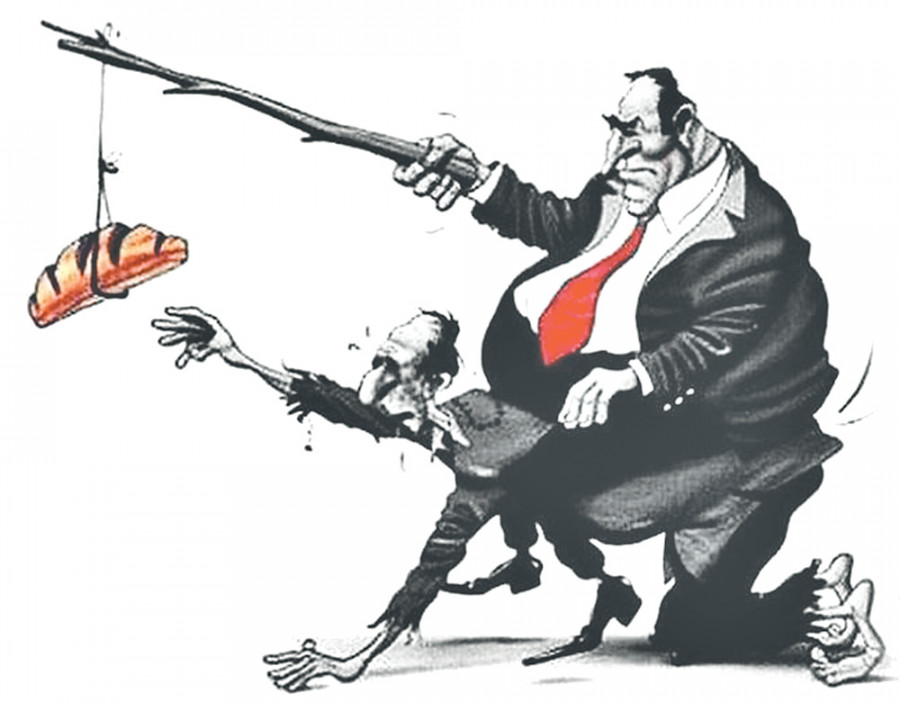
Why? Because the more desperate people are financially, the easier they are to buy off with false promises and a loaf of bread. They are easier to control. On top of that, with the U.S. economy reduced to second- or third-world status, it is easier to sell the public on the predetermined solution – total global centralization and far less freedom.

As the stagflationary crash plays out, never forget who was really the cause of the public’s suffering. In the fog of national crisis it is easy for the establishment to shift blame and responsibility and to cloud the truth. The inflation calamity is about to get much worse, and as it does we need to rally newly awakened people to take action against the central bankers and globalists behind it.

Politics Is Dead, Here’s What Killed It

By Charles Hugh Smith

Source: Of Two Minds

Representational democracy–a.k.a. politics as a solution to social and economic problems–has passed away. It did not die a natural death. Politics developed a cancer very early in life (circa the early 1800s), caused by wealth outweighing public opinion. This cancer spread slowly but metastasized in the past few decades, spreading to every nook and cranny of our society and economy as “democracy” devolved into an invitation-only auction of elections and political favors.

Politics might have had a fighting chance but three forces betrayed the nation and its citizenry.

1. The Federal Reserve transferred trillions of dollars of unearned wealth into the feeding troughs of the super-wealthy and corporations, vastly increasing the wealth the top 0.01% had to buy elections and favors. The Federal Reserve cloaked its treachery with jargon– quantitative easing, stimulus, etc.–and then stabbed the nation’s representational democracy in the back.

2. The Supreme Court betrayed the nation’s representative democracy by labeling corporations buying elections and political favors a form of “free speech.” (Please don’t hurt yourself laughing too hard.) The Supreme Court’s equating wealth buying elections and favors with individual citizens’ sacrosanct right of free speech was a knife in the back of the nation and its citizenry.

3. The two political parties betrayed their traditional voter bases to kneel at the altar of corporate / elite wealth, wealth which bought elections and political favors. The Democrats, traditional champions of the workforce in the 20th century, abandoned workers in favor of serving their corporate masters, masking their betrayal with fine-sounding phrases.

The Republican Party, traditionally promoters of Big Business (Wall Street, banks, mega-corporations), had maintained a narrow but crucial interest in trust-busting (limiting monopolies) to defend free enterprise and small business from the predations of monopolies and cartels. Those days are long past; just as the Democratic Party tossed the working class overboard to the sharks, the Republican Party walked small business off the gangplank right into the voracious jaws of cartels and globalized, financialized corporate sharks.

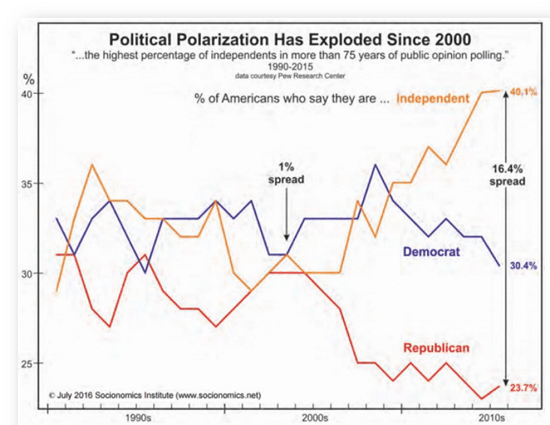
To cloak their betrayal and treachery, the parties have pursued a divide-and-conquer distraction game, pushing half the nation into one-size-fits-all “enemies lists” with labels that have lost all meaning other than as means to promote divisiveness and rancor: Liberal and Conservative, socialist and capitalist, etc.

It’s not the citizenry who are “deplorable,” it’s the parties’ corporate-derriere-kissing toadies, lackeys, apparatchiks, purveyors of propaganda, enforcers, apologists, sycophants, grifters and “leaders” who manage to greatly increase their private wealth while “serving the public” (heh).

These three betrayals of public trust and representational democracy caused the demise of politics as a solution to social and economic problems. “Politics” has been stripped to its essence: an invitation-only auction of elections and political favors. The price to watch from the rear of the auction is $1 million; to actually place a bid, the minimum is $10 million, but the winning bids are generally much higher.

(Lobbying, campaign contributions, bogus think-tanks, and philanthro-capitalist foundations are all part of the auction funding.)

Here’s “politics” in America now: come with mega-millions or don’t even bother to show up. Choose which “enemies list” you want to be on; there’s not much choice. And don’t forget to put a flower on the grave of representational democracy.

The Real Threat to Democracy is Corrupting Wealth Inequality

By Charles Hugh Smith

Source: Of Two Minds

Imagine a town of 1,000 adults and their dependents in which one person holds the vast majority of wealth and political influence. Would that qualify as a democracy? Now imagine that 100 of the 1,000 adults own 90% of all the wealth, collect 97% of all the income from capital and have virtually all the political power. How can a society in which 90% of the populace is decapitalized, disenfranchised and demoralized by political powerlessness be a democracy?

This is America: a kleptocratic autocracy that serves the few at the expense of the many, stripmining the bottom 90% under the guise of a fraudulent “democracy” in which only the few wield real power. Recall Smith’s Neofeudalism Principle #1: If the citizenry cannot replace a kleptocratic government and/or limit the power of the financial Aristocracy at the ballot box, the nation is a democracy in name only.

That our elected government responds only to the super-wealthy and corporations has been well-established:Testing Theories of American Politics: Elites, Interest Groups, and Average Citizens.

It’s also a fact that the top 10% get virtually all the gains from the nation’s capital, and this wealth is concentrated in the top 0.1%:Monopoly Versus Democracy: How to End a Gilded Age
Ten percent of Americans now control 97 percent of all capital income in the country. Nearly half of the new income generated since the global financial crisis of 2008 has gone to the wealthiest one percent of U.S. citizens. The richest three Americans collectively have more wealth than the poorest 160 million Americans.

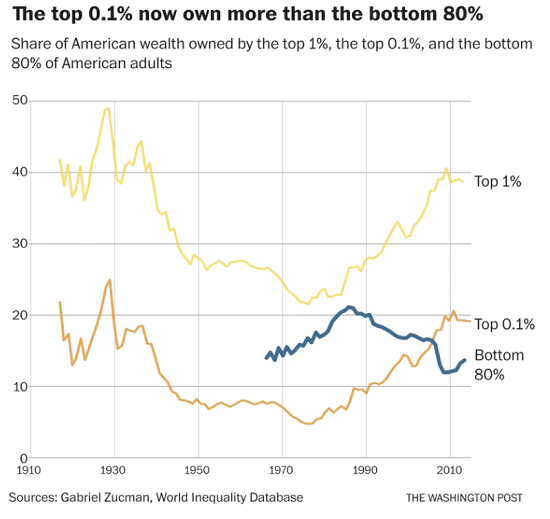
Exactly how can a system of governance that is nothing but an invitation-only auction of political favors in which the top 0.1% own more than the bottom 80% be a functional democracy? The answer is it cannot. Politics and government have been reduced to protecting and enriching a neofeudal autocracy while claiming to serve the stripmined public.

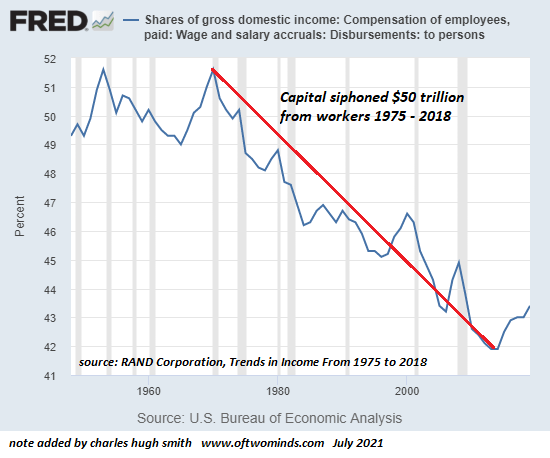
This extreme concentration of wealth and power is not accidental; the government’s policies have generated this concentration of wealth which has hollowed out democracy. The super-wealthy didn’t siphon $50 trillion from those earning their living from labor on their own; government policies aided and abetted this vast transfer of wealth.

Trends in Income From 1975 to 2018$50 trillion in earnings has been transferred to the Financial Aristocracy from the bottom 90% of American households over the past 45 years.

The catastrophic consequences of this systemic concentration of wealth and power are also well documented. For example, Human and nature dynamics (HANDY)Modeling inequality and use of resources in the collapse or sustainability of societies. Extreme inequality brings down societies, and America is now a society dominated by extreme inequality.

America is nothing but a vast moral cesspool that the public is told is a pristine pond of “democracy”. Self-enrichment is cloaked as “doing God’s work,” profiteering is sold as “value,” fraud is packaged as “finance” and rapacious monopolies are marketed as “enterprise.”

Institutions have become little more than rackets enriching insiders and the wealthiest few; they have lost moral legitimacy which is the fundamental foundation of democracy and a market-based economy.

As I explain in my new book Global Crisis, National Renewal: A (Revolutionary) Grand Strategy for the United Statesmoral legitimacy is the foundation of social cohesion. Once moral legitimacy has been lost, social cohesion unravels and the nation falls.

It wasn’t just bad luck that financialization and globalization hollowed out America’s economy and democracy and turned the bottom 90% into debt-serfs and tax donkeys; it was government policies implemented by elected officials and the appointed handmaidens of the super-wealthy. Virtually every major policy implemented by either party served the interests of the super-wealthy and corporations: tax cuts had trivial impacts on the bottom 90% while vastly increasing the wealth of the super-wealthy; the Supreme Court’s rulings in favor of corporate “personhood” and “free speech” (a.k.a. the best government we can buy), and the evisceration of the rule of law for corporate fraud, collusion and embezzlement (“too big to fail, too big to jail”).

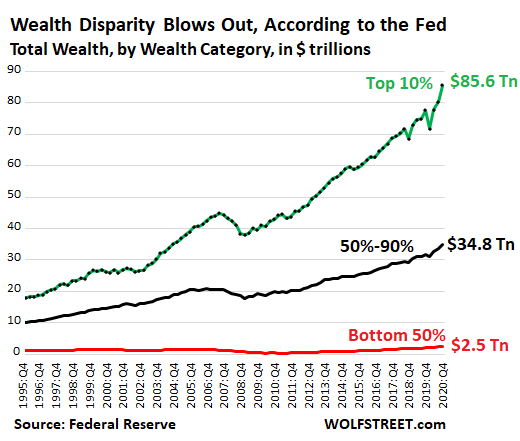
The Federal Reserve’s free money for financiers distributes gains on the order of 20-to-1 in favor of the super-wealthy: $2 trillion in gains for the bottom 90%, $40 trillion for the top tier.

The list is long and painful proof that the elected government of the United States serves the interests of the top few–a reality masked by expert PR and partisanship.

Partisanship reflects a core structural dynamic: America is now a two-tier society and economy. If you’re an executive at a big Wall Street investment bank, you can rig markets and embezzle billions and you’ll never face any personal legal consequences such as being indicted, convicted and imprisoned. (Bernie Madoff’s conviction was a classic Soviet-style show trial to mask the fact that thousands of other white-collar criminals kept their ill-gotten gains and faced no consequences.)

But try being an employee at a local credit union and embezzle $5,000–a prison sentence is very predictable.

If a spoiled-rotten rich kid gets caught with drugs, Mommy and Daddy’s lawyer kicks into gear and gets a suspended sentence plea bargain. The kid from the bottom 90% gets a tenner in the Drug War Gulag. And so on.

America is also a regional two-tier economy/society. When a society kneels down and worships financialization and globalization, it gives all the political and financial power to the already-super-wealthy and corporations who get 97% of the gains from financialization and globalization.

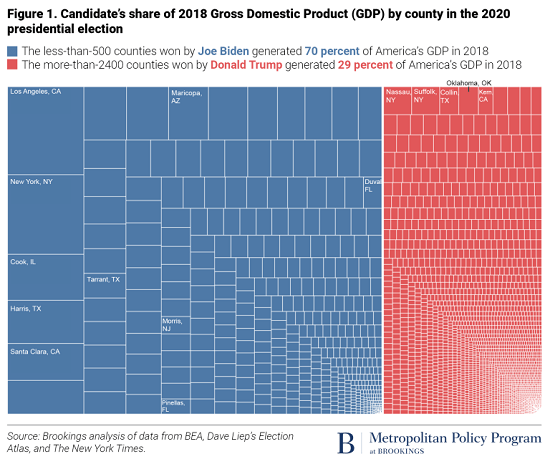
Since the majority of already-super-wealthy and corporate managers reside in coastal metropolitan areas, the tide of new wealth flooding into the hands of the few boosts the economies of these select regions. The Brookings chart below may look like a chart of political polarization, and superficially that’s obvious: the 500 counties Biden won hold 70% of the nation’s GDP while the 2,500 counties Trump won hold 30% of the nation’s GDP.

The real polarization is economic-financial: there are two economies in America and there’s very little commonality in the two economies. One benefited greatly from financialization and globalization, and the other was hollowed out and brought to its knees by financialization and globalization.

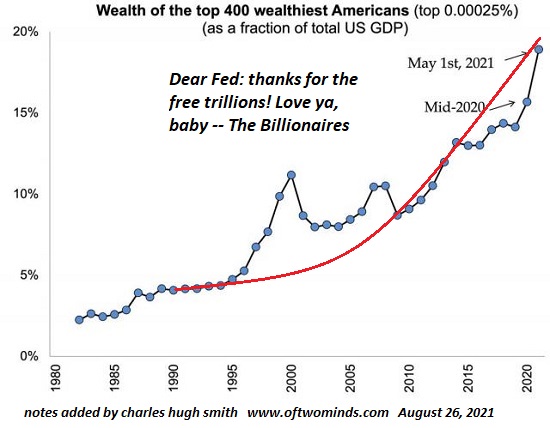
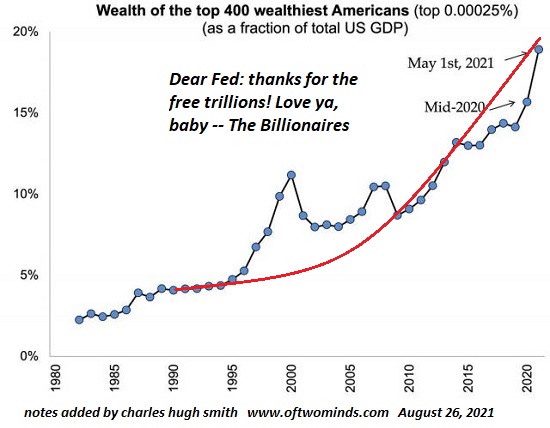
Since income and political power flow to capital, the disparity / inequality far exceed the 70/30 split depicted in this chart. The chart showing the soaring wealth of billionaires is a more accurate reflection of inequality in America.

What’s missing from the 70/30 map is the staggering percentage of residents in the wealthiest 500 counties who are precariats living paycheck to paycheck, the ALICE Americans: Asset Limited, Income Constrained, Employed.

Is there any wonder that stripmined Americans who sense their powerlessness are attracted to virulent partisanship? The more extreme the pendulum swing of wealth-power inequality, the more extreme the political blowback.

America’s political class has no plan to reverse this destructive tide. Our leadership’s “plan” is something they know well first-hand: bribery and complicity: just send a monthly stipend of bread and circuses to all the disempowered, decapitalized households, urban and rural, so they can stay out of trouble and not bother the elites’ profitable pillaging of America and the planet.

The insurrection and coup happened long ago, when financialization and globalization hollowed out the real economy and disempowered the bottom 90%. When the whole rotten palace of corruption collapses in a putrid heap, look no further for the cause than the extremes of wealth-power inequality that rendered “democracy” a convenient facade for the stripmining of the bottom 90%.

Try to find a developing-world kleptocracy in which the top few collect more than 97% of the income from capital. There aren’t any that top the USA, the world’s most extreme kleptocracy. We’re Number 1.

Corporate Power: Who Owns the World?

By Dr. Joseph Mercola

Source: The Herland Report

Who Owns the World? A handful of mega corporations — private investment companies — dominate every aspect of our lives; everything we eat, drink, wear or use in one way or another.

These investment firms are so enormous, they control the money flow worldwide.

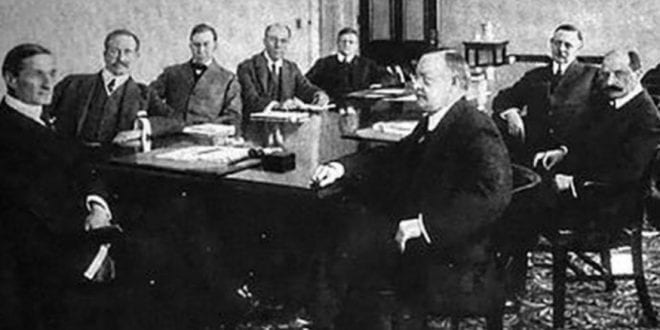
While there appear to be hundreds of competing brands on the market, like Russian nesting dolls, larger parent companies own multiple smaller brands. In reality, all packaged food brands, for example, are owned by a dozen or so larger parent companies. (Feature photo: A rare photo of The Federal Reserve Board of Governors)

These parent companies, in turn, are owned by shareholders, and the largest shareholders are the same in all of them: Vanguard and Blackrock, writes Dr. Joseph Mercola, osteopathic physician, best-selling author and recipient of multiple awards in the field of natural health.

No matter what industry you look at, the top shareholders, and therefore decision makers, are the same: Vanguard, Blackrock, State Street and/or Berkshire Hathaway. In virtually every major company, you find these names among the top 10 institutional investors.

These major investment firms are in turn owned by their own set of shareholders. One of the most amazing things about this scheme is that the institutional investors also own each other.

They’re all shareholders in each other’s companies. At the very top are Vanguard and Blackrock. Blackrock’s largest shareholder is Vanguard, which does not disclose the identity of its shareholders due to its unique structure.

To understand what’s really going on, watch Tim Gielen’s hour-long documentary, “MONOPOLY: Who Owns the World?”

Who Owns the World? Until recently, it appeared economic competition had been driving the rise and fall of small and large companies across the U.S. Supposedly, PepsiCo is Coca Cola’s competitor, Apple and Android vie for your loyalty and drug companies battle for your health care dollars. However, all of that turns out to be an illusion.

Since the mid-1970s, two corporations — Vanguard and Blackrock — have gobbled up most companies in the world, effectively destroying the competitive market on which America’s strength has rested, leaving only false appearances behind.

Indeed, the global economy may be the greatest illusionary trick ever pulled over the eyes of people around the world. To understand what’s really going on, watch Tim Gielen’s hour-long documentary, “MONOPOLY: Who Owns the World?” above.

Corporate Domination

Who Owns the World? As noted by Gielen, who narrates the film, a handful of mega corporations — private investment companies — dominate every aspect of our lives; everything we eat, drink, wear or use in one way or another. These investment firms are so enormous, they control the money flow worldwide. So, how does this scheme work?

While there appear to be hundreds of competing brands on the market, like Russian nesting dolls, larger parent companies own multiple smaller brands. In reality, all packaged food brands, for example, are owned by a dozen or so larger parent companies.

Pepsi Co. owns a long list of food, beverage and snack brands, as does Coca-Cola, Nestle, General Mills, Kellogg’s, Unilever, Mars, Kraft Heinz, Mondelez, Danone and Associated British Foods. Together, these parent companies monopolize the packaged food industry, as virtually every food brand available belongs to one of them.

These companies are publicly traded and are run by boards, where the largest shareholders have power over the decision making. This is where it gets interesting, because when you look up who the largest shareholders are, you find yet another monopoly.

While the topmost shareholders can change from time to time, based on shares bought and sold, two companies are consistently listed among the top institutional holders of these parent companies: The Vanguard Group Inc. and Blackrock Inc.

Pepsi and Coca-Cola — An Example

Who Owns the World? For example, while there are more than 3,000 shareholders in Pepsi Co., Vanguard and Blackrock’s holdings account for nearly one-third of all shares. Of the top 10 shareholders in Pepsi Co., the top three, Vanguard, Blackrock and State Street Corporation, own more shares than the remaining seven.

Now, let’s look at Coca-Cola Co., Pepsi’s top competitor. Who owns Coke? As with Pepsi, the majority of the company shares are held by institutional investors, which number 3,155 (as of the making of the documentary).

As shown in the film, three of the top four institutional shareholders of Coca-Cola are identical with that of Pepsi: Vanguard, Blackrock and State Street Corporation. The No. 1 shareholder of Coca-Cola is Berkshire Hathaway Inc.

These four — Vanguard, Blackrock, State Street and Berkshire Hathaway — are the four largest investment firms on the planet. “So, Pepsi and Coca-Cola are anything but competitors,” Gielen says. And the same goes for the other packaged food companies. All are owned by the same small group of institutional shareholders.

Big Tech Monopoly

Who Owns the World? The monopoly of these investment firms isn’t relegated to the packaged food industry. You find them dominating virtually all other industries as well. Take Big Tech, for example. Among the top 10 largest tech companies we find Apple, Samsung, Alphabet (parent company of Google), Microsoft, Huawei, Dell, IBM and Sony.

Here, we find the same Russian nesting doll setup. For example, Facebook owns Whatsapp and Instagram. Alphabet owns Google and all Google-related businesses, including YouTube and Gmail.

It’s also the biggest developer of Android, the main competitor to Apple. Microsoft owns Windows and Xbox. In all, four parent companies produce the software used by virtually all computers, tablets and smartphones in the world. Who, then, owns them? Here’s a sampling:

  • Facebook — More than 80% of Facebook shares are held by institutional investors, and the top institutional holders are the same as those found in the food industry: Vanguard and Blackrock being the top two, as of the end of March 2021. State Street Corporation is the fifth biggest shareholder
  • Apple — The top four institutional investors are Vanguard, Blackrock, Berkshire Hathaway and State Street Corporation
  • Microsoft — The top three institutional shareholders are Vanguard, Blackrock and State Street Corporation

You can continue going through the list of tech brands — companies that build computers, smart phones, electronics and household appliances — and you’ll repeatedly find Vanguard, Blackrock, Berkshire Hathaway and State Street Corporation among the top shareholders.

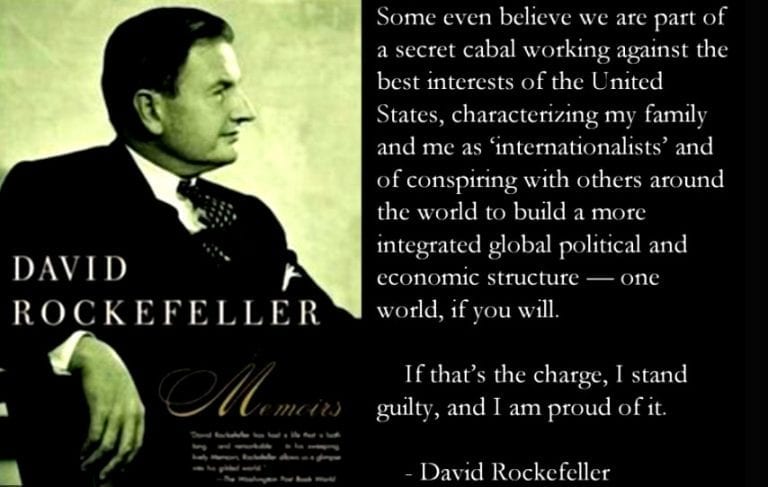
Who Owns the World? A famous David Rockefeller quote, the dream of a global political and economic structure – one world.

Same Small Group Owns Everything Else Too

Who Owns the World? The same ownership trend exists in all other industries. Gielen offers yet another example to prove this statement is not an exaggeration:

“Let’s say we want to plan a vacation. On our computer or smart phone, we look for a cheap flight to the sun through websites like Skyscanner and Expedia, both of which are owned by the same group of institutional investors [Vanguard, Blackrock and State Street Corporation].

We fly with one of the many airlines [American Airlines, Air France, KLM, United Airlines, Delta and Transavia] of which the majority of the shares are often owned by the same investors …

The airline we fly [on] is in most cases a Boeing or an Airbus. Again, we see the same [institutional shareholders]. We look for a hotel or an apartment through Bookings.com or AirBnB.com. Once we arrive at our destination, we go out to dinner and we write a review on Trip Advisor. The same investors are at the basis of every aspect of our journey.

And their power goes even much further, because even the kerosene that fuels the plane comes from one of their many oil companies and refineries. Just like the steel that the plane is made of comes from one of their many mining companies.

This small club of investment companies, banks and mutual funds, are also the largest shareholders in the primary industries, where our raw materials come from.”

The same goes for the agricultural industry that the global food industry depends on, and any other major industry. These institutional investors own Bayer, the world’s largest seed producer; they own the largest textile manufacturers and many of the largest clothing companies.

They own the oil refineries, the largest solar panel producers and the automobile, aircraft and arms industries. They own all the major tobacco companies, and all the major drug companies and scientific institutes too. They also own the big department stores and the online marketplaces like eBay, Amazon and AliExpress.

They even own the payment methods we use, from credit card companies to digital payment platforms, as well as insurance companies, banks, construction companies, telephone companies, restaurant chains, personal care brands and cosmetic brands.

No matter what industry you look at, the top shareholders, and therefore decision makers, are the same: Vanguard, Blackrock, State Street and/or Berkshire Hathaway. In virtually every major company, you find these names among the top 10 institutional investors.

Who Owns the Investment Firms of the World?

Who Owns the World? Diving deeper, we find that these major investment firms are in turn owned by their own set of shareholders. One of the most amazing things about this scheme is that the institutional investors — and there are many more than the primary four we’ve focused on here — also own each other. They’re all shareholders in each other’s companies.At the top of the pyramid — the largest Russian doll of all — we find Vanguard and Blackrock.

“Together, they form an immense network that we can compare to a pyramid,” Gielen says. Smaller institutional investors, such as Citibank, ING and T. Rowe Price, are owned by larger investment firms such as Northern Trust, Capital Group, 3G Capital and KKR.

Those investors in turn are owned by even larger investment firms, like Goldman Sachs and Wellington Market, which are owned by larger firms yet, such as Berkshire Hathaway and State Street. At the top of the pyramid — the largest Russian doll of all — we find Vanguard and Blackrock.

“The power of these two companies is something we can barely imagine,” Gielen says. “Not only are they the largest institutional investors of every major company on earth, they also own the other institutional investors of those companies, giving them a complete monopoly.”

Gielen cites data from Bloomberg, showing that by 2028, Vanguard and BlackRock are expected to collectively manage $20 trillion-worth of investments. In the process, they will own almost everything on planet Earth.

BlackRock — The Fourth Branch of Government

Who Owns the World? Bloomberg has also referred to BlackRock as the “fourth branch of government,” due to its close relationship with the central banks. BlackRock actually lends money to the central bank, the federal reserve, and is their principal adviser.

Dozens of BlackRock employees have held senior positions in the White House under the Bush, Obama and Biden administrations. BlackRock also developed the computer system that the central banks use.

While Larry Fink is the figurehead of BlackRock, being its founder, chairman and chief executive officer, he’s not the sole decision maker, as BlackRock too is owned by shareholders. Here we find yet another curiosity, as the largest shareholder of BlackRock is Vanguard.

Who Owns the World? “This is where it gets dark,” Gielen says. Vanguard has a unique structure that blocks us from seeing who the actual shareholders are. “The elite who own Vanguard don’t want anyone to know they are the owners of the most powerful company on earth.” Still, if you dig deep enough, you can find clues as to who these owners are.

The owners of the wealthiest, most powerful company on Earth can be expected to be among the wealthiest individuals on earth. In 2016, Oxfam reported that the combined wealth of the richest 1% in the world was equal to the wealth of the remaining 99%. In 2018, it was reported that the world’s richest people get 82% of all the money earned around the world in 2017.

In reality, we can assume that the owners of Vanguard are among the 0.001% richest people on the planet. According to Forbes, there were 2,075 billionaires in the world as of March 2020. Gielen cites Oxfam data showing that two-thirds of billionaires obtained their fortunes via inheritance, monopoly and/or cronyism.

“This means that Vanguard is in the hands of the richest families on earth,” Gielen says. Among them we find the Rothschilds, the DuPont family, the Rockefellers, the Bush family and the Morgan family, just to name a few.

Many belong to royal bloodlines and are the founders of our central banking system, the United Nations and just about every industry on the planet.

Gielen goes even further in his documentary, so I highly recommend watching it in its entirety. I’ve only summarized a small piece of the whole film here.

A Financial Coup D’etat

Speaking of the central bankers, I recently interviewed finance guru Catherine Austin Fitts, and she believes it’s the central bankers that are at the heart of the global takeover we’re currently seeing. She also believes they are the ones pressuring private companies to implement the clearly illegal COVID jab mandates. Their control is so great, few companies have the ability to take a stand against them.

“I think [the central bankers] are really depending on the smart grid and creepy technology to help them go to the last steps of financial control, which is what I think they’re pushing for,” she said.

“What we’ve seen is a tremendous effort to bankrupt the population and the governments so that it’s much easier for the central bankers to take control. That’s what I’ve been writing about since 1998, that this is a financial coup d’etat.

Now the financial coup d’etat is being consolidated, where the central bankers just serve jurisdiction over the treasury and the tax money. And if they can get the [vaccine] passports in with the CBDC [central bank digital currency], then it will be able to take taxes out of our accounts and take our assets. So, this is a real coup d’etat.”

America’s Bottom 50% Have Nowhere To Go But Down

By Charles Hugh Smith

Source: Of Two Minds

One might anticipate that the bottom 50%’s meager share of the nation’s exploding wealth would have increased as smartly as the wealth of the billionaires, but alas, no.

America’s economy has changed in ways few of the winners seem to notice, as they’re too busy cheerleading their own brilliance and success. In the view of the winners, who just so happen to occupy all the seats at the media-punditry-Federal Reserve, etc. table–the rising tide of stock, bond and real estate bubbles are raising all boats. What’s left unsaid is except for the 50% of boats with gaping holes below the waterline, i.e. stagnant wages and a fast-rising cost of living.

The truth the self-satisfied winners don’t include in their self-congratulatory rah-rah is there’s no place for the bottom 50% of American households to go but down. All the winnings flow to those who already owned assets back when they were affordable– the already-wealthy–whose wealth has soared as assets have shot to the moon while the the burdens of inflation and debt service hit the bottom 50% the hardest.

Meanwhile, the Federal Reserve is whining that inflation isn’t high enough yet for their refined tastes. Boo-hoo, how sad for the Fed–inflation isn’t yet high enough. Oh wait–didn’t they each mint millions by front-running their own policies? No wonder they’re not worried about inflation.

The reality few acknowledge is that globalization and financialization have stripped the American economy of low-skilled jobs that don’t demand much of the employee. The reality is that a great many people don’t have what it takes to learn high-level skills and work at a demanding pace under constant pressure–the description of the average job in America.

There were once millions of low-skill, low-pay jobs for people who for whatever mix of reasons were unable to muster the wherewithal to fulfill the fantasy of working extra hard, going to night school, soaking up high-level skills, moving quickly up the ladder to higher pay, buying the starter home and then moving up the food chain to middle class security from there.

The cost of living was low enough that those working these low-skill, low-pay jobs could still have an independent life. There were still low-cost rentals, often derided by the wealthy, in nooks and crannies of even the costliest cities. (I once lived in a room stuffed with old tax records in a poolside shack in an upscale neighborhood. The room had been cleared for a single bed and a path to the decrepit bathroom. Its most important attribute was that I could afford it on my low earnings.)

Affordable housing has vanished, eliminated by the financialization of America’s economy. Once landlords pay double the price for the property, rents have to double to pay their higher expenses. The apartment didn’t double in size or amenities–the rent doubled without any increase in utility to the renter. You get nothing more for double the price–nice.

Yes, people could make better choices, and some do. The point here is the game is rigged against those in the lower tier of the economy who can no longer afford a house or other stake in the only winning game in town–speculative asset bubbles. Go ahead and work a second job and go to night school–you’ll still be left behind the already-rich.

Globalization opened every job in America to global competition via offshoring or the influx of undocumented workers so desperate to support their families back home that no pay was too low and no working condition too wretched to refuse.

Many overindulged pundits who never worked an honest day in their lives sneer about burger flippers without realizing how hard those burger flippers have to work. I doubt the well-dressed pundits, snobbish about their university degrees and general brilliance, could manage to work a single day in a demanding fast-food job.

As the price of housing and other assets have soared, enriching the already rich, they’re out of reach for the bottom 50% who struggle to pay their bills as wages have stagnated and the costs of essentials have skyrocketed.

The rising cost of parking tickets, junk fees, user fees, utilities and food don’t impact the well-paid top 5% technocrat class, whose stake in the Everything Bubble keeps expanding by tens or hundreds of thousands of dollars. But for the bottom 50%, those incremental increases are, when added to higher rents, absolutely crushing.

As for getting high-quality healthcare that includes mental health support–those are reserved for the rich. But no worries, self-medication is always a “choice.”

Getting a boost in pay from $12 an hour to $15 an hour is welcome, but that doesn’t put the worker any closer to affording a house or equivalent stake in the Everything Bubble.

The new feudalism is masked by the glossy SillyCon Valley PR of a gig economy where (per the PR fantasy) bright, shiny and totally independent workers freely choose to serve the winners in the rigged sweepstakes for low pay and zero benefits.

In the SillyCon Valley PR, serfs freely choose to serve their noble masters for nothing but survival because they love the “freedom” and “choice” of kissing the nobility’s plump derrieres. (After all, there were “choices” even back in the good old days of feudalism–one could join the brigands in the forest, or enlist in a poorly paid mercenary army where the odds of dying were high–you know, “choices” of “gigs.”)

One might anticipate that the bottom 50%’s meager share of the nation’s exploding wealth would have increased as smartly as the wealth of the billionaires, but alas, no–the bottom 50%’s share of stocks (equities) actually plummeted in the the glorious decades of Federal Reserve free money for financiers, stock buy-backs and asset bubbles.

All this suits the billionaires and those collecting the crumbs of the Everything Bubble just fine. So what if the bottom 50% have nowhere to go but down? There’s plenty of room in the homeless encampment for another broken down station wagon or an old camper. There’s lots of “choices.”

And no consequences for the winners, of course, because The Fed has our backs.