Gee, Thanks America! U.S. Sanctions Make Russian Economy Stronger and Precipitate Multipolar World

By SCF Editorial

Source: Strategic Culture Foundation

The paradoxical thing is that U.S. and European sanctions against Russia while intended to cripple the Russian economy have made the stronger.

Russia’s economy is performing strongly, according to recent forecasts from the World Bank and International Monetary Fund. The outcome defies earlier predictions by the United States and its European allies which held that Western sanctions would bring the Russian economy to its knees and force it to submissively “Cry Uncle”.

When the conflict in Ukraine escalated 16 months ago (after eight years of NATO-sponsored aggression using the Kiev Neo-Nazi regime), various Western politicians and pundits were relishing the prospect of the Russian economy collapsing from “Total War” launched against its international banking and trade.

Well, it didn’t turn out like that. Far from it. As the World Bank noted above, the Western sanctions have simply helped Russia boost alternative markets in China, India, and elsewhere around the globe. A principal earner for Russia is energy exports of oil and gas. Increased sales to Asia have maintained revenues despite the loss of European markets due to Western sanctions.

The paradoxical thing is that U.S. and European sanctions against Russia while intended to cripple the Russian economy have actually made the latter stronger.

Michael Hudson, an American global economics analyst, points out: “The sanctions have obliged Russia to become self-sufficient in food production, manufacturing production and consumer goods.”

Hudson also notes that the U.S. geopolitical strategy is to use sanctions in order to make its supposed European allies more dependent and subservient to Washington.

Another respected commentator, Glenn Diesen, a Norwegian geoeconomics professor, likened the use of Western sanctions to the self-destructive behavior of “self-harm”. The United States and European Union, he says, have “handed over a huge market to the rest of the world”.

Diesen also observes that 85 percent of the world’s population lives in countries that do not comply with Western sanctions against Russia. This global majority is more than ever creating new forms of trade and finance that obviate Western control. A major impetus for this positive development is the necessity bequeathed by Washington’s systematic abuse of power and privilege.

The repercussions are more far-reaching and profound than the inadvertent benefits accruing to Russia’s national economy. What the Western sanctions are also doing is accelerating the development of a multipolar world and the demise of the U.S. dollar as a global reserve currency. The upshot of those two trends is the historic dwindling of American imperial power – albeit with outbursts of militarism and warmongering along the way down.

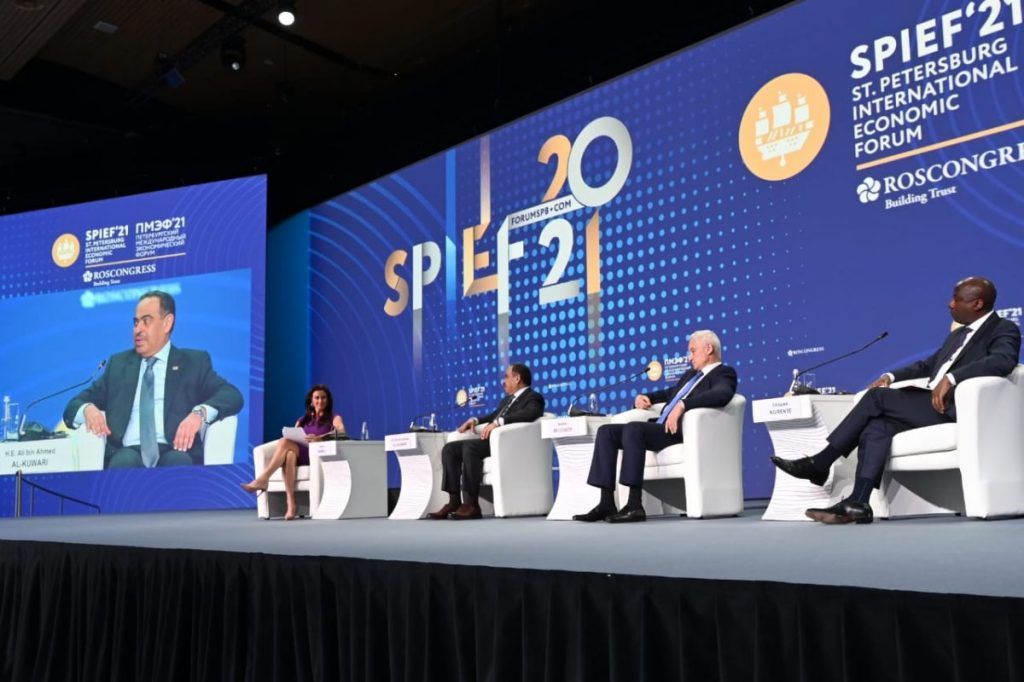
A significant illustration of the times a-changing was seen this week at the 25th summit of the St Petersburg International Economic Forum (SPIEF). Attending the four-day event were 17,000 delegates from some 130 nations. This year’s convocation witnessed large representations from Asia, Latin America and Africa.

The bustling event not only reflected Russia’s own economic strength but the fact that – far from being “isolated” and downtrodden – Russia is viewed by the rest of the world as an engine for growth and more prosperous multipolar relations.

Indeed, from the perspective of most nations, it looks like the United States and its Western allies are the ones who are isolated and anachronistic.

One of the attendees at SPIEF was American industrial analyst Douglas Andrew Littleton who commented: “Western sanctions against Russia have backfired.” And he added: “I’m happy that Russia has been able to bypass and skirt the sanctions in so many ways with their friends and allies.”

What’s going on here is not just merely the emergence of an alternative system, but an epochal political and perhaps moral paradigm shift. The globe wants more peaceful and mutual relations of cooperation and development. Most people on this Earth want endless warmongering, militarism and unilateral bullying by self-ordained powers to be put to an end. The planet is crying out for a world based on justice and peace.

What the world is realizing more than ever is that the unilateral use of economic sanctions by Washington is nothing but warfare and state terrorism by another, more palatable name. For decades, the U.S. has tried to use economic weapons to strangle and kill other nations. North Korea, Cuba, Iran, Iraq and many other countries come to mind where U.S. imperialism has imposed conditions of economic genocide.

The world is well aware of this fiendish legacy and has had enough of American barbarism wielded with the help of its Western lackeys in NATO and the European Union.

We should here make special mention of Syria, the Arab nation struggling to recover from 12 years of war that was inflicted upon it by Washington and its NATO partners for “regime change”. Today, Syria’s recovery is cruelly hampered by economic sanctions imposed by the U.S. and EU. How despicable is that?

There is an unerring historical sense, however, that Washington, has finally met its nemesis. By racking up sanctions against Russia and dragooning its EU lackeys to follow suit, the United States has now unleashed a historic dynamic process of its own imperial collapse.

For decades, U.S. sanctions worked to a nefarious degree on isolated, smaller nations to indeed enforce vengeful hardship.

Not anymore. Russia’s vast natural wealth and economy are too big to contain. Militarily, too, Russia will not be pushed around. Indeed, it has pushed back in Ukraine against the West’s deceptive and pernicious proxy war.

Organically and consciously, the world economy and international relations have been transformed in recent years, especially with the rise of China and Eurasia generally.

Another key development is that the Western imperialist media monopoly has also been broken. Washington and its minions in the European political class are held in contempt as liars and charlatans, even by their own populations.

By unwisely attempting to trap the Russian bear, the West has only created a scenario of revolt by the rest of the world from the West’s exploitative control. Five centuries of European and American Western parasitism have run their course.

Russia’s economic strength is galvanizing the rest of the world to shake off the chains of Western domination and subjugation. The process of dumping the dollar is gathering momentum which self-harming sanctions are precipitating. Pillars and facades are crumbling in real time.

The theme for the SPIEF event this year was “Sovereign Development – the Basis for a Just World”.

As with many other empires in the annals of history that have collapsed, arrogance and hubris often precede the fall. The American and Western elite thought they had an eternal license to wreak havoc for their own selfish gain. Their economic plunder and weaponry are now turning on their own heads. And it’s long overdue.
Schrödinger’s War – And Orwell’s

By Raúl Ilargi Meijer

Source: The Automatic Earth

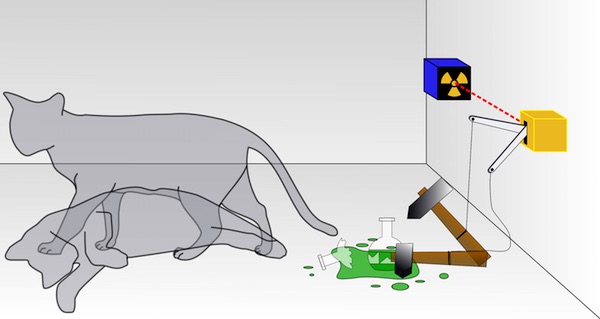
Physicist Erwin Schrödinger in 1935 tried to explain the (consequences of the) uncertainty principle, defined by Werner Heisenberg as a core theme of Albert Einstein’s view of quantum mechanics, to … Albert Einstein. The latter must have been thrilled. Even though he did not like the uncertainty principle (God does not play dice). The thought experiment became known as “Schrödinger’s cat”. Since you cannot know both a particle’s position and its speed -and that’s just one example-, you have to assume all possible outcomes are valid (superposition). Only when you “look” does one particular outcome become the “reality”. It’s all part of the subatomic “world”

Wikipedia: “In Schrödinger’s original formulation, a cat, a flask of poison, and a radioactive source are placed in a sealed box. If an internal monitor (e.g. a Geiger counter) detects radioactivity (i.e. a single atom decaying), the flask is shattered, releasing the poison, which kills the cat. The Copenhagen interpretation implies that, after a while, the cat is simultaneously alive and dead. Yet, when one looks in the box, one sees the cat either alive or dead, not both alive and dead. This poses the question of when exactly quantum superposition ends and reality resolves into one possibility or the other.”

As I’m trying to explain this, I very much have to wonder if I get it right. And I always thought that follows the uncertainty principle too: I can understand it and not understand it both at the same time. A physicist might fare a bit better, but it won’t come easy.

This is what I was thinking of with regards to the war in Ukraine. Before the fighting started, all possible outcomes seemed equally possible. If you did not look too closely at numbers of soldiers and weaponry, that is. But once it did start (when Schrödinger’s box was opened), it became clear very rapidly that Ukraine had no chance of winning. So why are we still acting as if the box remains closed? Because that way we get to spend billions more on armory, and we get western people to support Zelensky and his neo-nazis as those same people suffer from high prices for everything. Any outcome is still possible!

Take the Kakhovka dam narrative, or Nord Stream or any of the numerous other examples. When both sides accuse each other of perpetrating a certain event, Schrödinger’s box remains closed. Which is exactly what our politicians and arms makers desire. They don’t want us to know that they’ve been beaten by Russia, because you would no longer support their policies and their arms purchases. They want “superposition”. They can’t very well declare victory -though they try-, but they don’t need to either. They need uncertainty. Politicians, arms makers and media. They all profit from keeping you in the dark.

The best comment on Kakhovka I’ve seen perhaps comes from @CheburekiMan on Twitter: “Restoring water flow to the North Crimean Canal was top priority for Russia, the very first act of the SMO. Before Kiev shut off the flow in 2014, the canal was supplying 85% of Crimea’s water. So much depended on it, from crops to industry to drinking water, that’s how important it is. Now the pro-Ukraine bleating sheep want people to believe that Russia would wreck the dam, empty the reservoir and cause serious harm to its own people by running the canal dry. It’s so bonkers that one has to seriously consider such ideas are the result of brain damage, or perhaps fetal alcohol syndrome.”

Where Orwell comes in is in the terminology. Where “War equals Peace”. The EU pays its member states for the second hand weapons they “donate” to Kiev, through something called the European Peace Fund (aka Facility). Mass weapons deliveries that get huge numbers of people killed, are labeled “Peace”. Zelensky touts a plan labeled a Peace Plan, which demands Russia give back all territories, pay war reparations, deliver Putin et al to some international criminal court etc. The chance of that happening is of course zero, but as long as Schrödinger’s box remains closed, anything is possible. Still, it is a War Plan, not a Peace Plan.

Similarly, Zelensky and his international backers are organizing a Peace Summit, where everybody is invited except Russia. That makes it a War Summit. The suggestion made to westerners is that this is a globally supported initiative, but it is only a small part of the world population (10%?) that supports it. NATO+Japan+Australia. Did I leave anyone out? New Zealand? Ha ha ha, I read that Jacinda Ardern was made a dame. If you know a better illustration of how deep we’ve sunk, I’m game.

All the rest of the world is much more interested in the economic developments that involve BRICS+. 31 and counting nations have expressed interest in joining. And they’re not going to risk their potential role in that over a local fight far away that they know is long decided. US/NATO, in provoking this war, have lost not only the fight, but much more importantly, their economic power. Recently, the G7 were talking about what they were going to do in Central Asia. Which is basically all the “-Stans” left over after the Soviet Union dissolved. But the G7 is not going to do anything, it has no power there anymore. All these countries want to join the BRICS+. Why would you join a waning power if you have a shot at joining a power in its ascendancy, that all your neighbors are also joining?

The same attitude is prevalent in Africa, South America, East Asia, etc. Full of countries that remember how they were treated through the years by first Europe and then the US. The world has changed beyond recognition since the start of Russia’s SMO, and the “globalist west” is the only “region” that doesn’t recognize this. The USD won’t be replaced tomorrow as the reserve currency, but it doesn’t have to be. The process goes step by step, and is unstoppable. Hemingway’s famous words about how you go bankrupt (first gradually, then suddenly) have us on the wrong foot here. We only look at the “suddenly” part when it comes to the reserve currency, and ignore all the “gradually” steps. And then one day we will wake up and everything’s changed.

The rest of the world sees Schrödinger’s box as open. Only the west thinks that it’s still closed, and all possible outcomes are still viable.

‘Give War a Chance’ – A ‘War That Even Pacifists Can Get Behind’

By Alastair Crooke

Source: Strategic Culture Foundation

The West is now waking up to the reality of the emerging, polycentric and fluid global order, Alastair Crooke writes.

More than a year into Russia’s Special Operation, the initial burst of European excitement at western push-back on Russia has dissipated. The mood instead has turned to “existential dread, a nagging suspicion that [western] civilisation may destroy itself”, Professor Helen Thompson writes.

For an instant, a euphoria had coalesced around the putative projection of the EU as a world power; as a key actor, about to compete on a world scale. Initially, events seemed to play to Europe’s conviction of its market powers: Europe was going to bring down a major power – Russia – by financial coup d’état alone. The EU felt ‘six feet tall’.

It seemed at the time a galvanising moment: “The war re-forged a long-dormant Manichaean framing of existential conflict between Russia and the West, assuming ontological, apocalyptic dimensions. In the spiritual fires of the war, the myth of the ‘West’ was rebaptised”, Arta Moeini suggests.

After the initial disappointment at the lack of a ‘quick kill’, the hope persisted – that if only the sanctions were given more time, and made more all-embracing, then Russia surely would ultimately collapse. That hope has turned to dust. And the reality of what Europe has done to itself has begun to dawn – hence Professor Thomson’s dire warning:

“Those who assume that the political world can be reconstructed by the efforts of human Will, have never before had to bet so heavily on technology over [fossil] energy – as the driver of our material advancement”.

For the Euro-Atlanticists however, what Ukraine seemed to offer – finally – was validation for their yearning to centralise power in the EU, sufficiently, to merit a place at the ‘top table’ with the U.S., as partners in playing the Great Game.

Ukraine, for better or worse, underlined Europe’s profound military dependence on Washington – and on NATO.

More particularly, the Ukraine conflict seemed to open the prospect for consolidating the strange metamorphosis of NATO from military alliance to an enlightened, Progressive, peace alliance! As Timothy Garton Ash effused in the Guardian in 2002, “NATO has become a European peace movement” where one could watch “John Lennon meet George Bush”.

The Ukraine war is portrayed, in this vein, as the “war­ that even former pacifists can get behind. All its proponents seemed to be singing is “Give War a Chance””.

Lily Lynch, a Belgrade-based writer, argues that,

“…especially in the past 12 months, telegenic female leaders such as the Finnish Prime Minister, Sanna Marin, German Foreign Minister, Annalena Baerbock, and Estonian Prime Minister, Kaja Kallas, have increasingly served as the spokespersons of enlightened militarism in Europe … ”

“No political party in Europe better exemplifies the shift from militant pacifism to ardent pro-war Atlanticism than the German Greens. Most of the original Greens had been radicals during the student protests of 1968 … But as the founding members entered middle age, fissures began to appear in the party – that would one day tear it apart”.

“Kosovo then changed everything: The 78-day NATO bombing of what remained of Yugoslavia in 1999, ostensibly to halt war crimes committed by Serbian security forces in Kosovo, would forever transform the German Greens. NATO for the Greens became an active military compact concerned with spreading and defending values such as human rights, democracy, peace, and freedom – well beyond the borders of its member states”.

A few years later, in 2002, an EU functionary (Robert Cooper) could envisage Europe as a new ‘liberal imperialism’. The ‘new’ was that Europe eschewed hard military power, in favour of weaponising both a controlled ‘narrative’ and controlled participation in its market. He advocated for ‘a new age of empire’, in which Western powers no longer would have to follow international law in their dealings with ‘old fashioned’ states; they could use military force independently of the United Nations; and could impose protectorates to replace regimes which ‘misgovern’.

The German Greens’ Foreign Minister, Annalena Baerbock, has continued with this metamorphosis, scolding countries with traditions of military neutrality, and imploring them to join NATO. She has invoked Archbishop Desmond Tutu’s line: “If you are neutral in situations of injustice, you have chosen the side of the oppressor”. And the European Left has been utterly captivated. Major parties have abandoned military neutrality and opposition to war – and now champion NATO. It is a stunning reversal.

All this may have been music to the ears of the Euro-élites anxious for the EU to rise to Great Power status, but this soft-power European Leviathan was wholly underpinned by the unstated (but essential) assumption that NATO ‘had Europe’s back’. This naturally implied that the EU had to tie itself ever closer to NATO – and therefore to the U.S. which controls NATO.

But the flip-side to this Atlanticist aspiration – as President Emmanuel Macron noted – is its inexorable logic that Europeans simply end by becoming American vassals. Macron was trying rather, to rally Europe towards the coming ‘age of empires’,hoping to position Europe as a ‘third pole’ in a concert of empires.

The Atlanticists were duly enraged by Macron’s remarks (which nonetheless drew support of other EU states). It could even seem (to furious Atlanticists) that Macron actually was channelling General de Gaulle who had called NATO a “false pretence” designed to “disguise America’s chokehold over Europe”.

There are however, two related schisms that flowed out from this ‘re-imagined’ NATO: Firstly, it exposed the reality of internal European rivalries and divergent interests, precisely because the NATO lead in the Ukraine conflict sets the interests of the Central East European hawks wanting ‘more America, and more war on Russia’ up and against that of the original EU western axis which wants wanting strategic autonomy (i.e. less ‘America’, and a quick end to the conflict).

Secondly, it would be predominantly the western economies that would have to bankroll the costs and divert their manufacturing capacity towards military logistic chains. The economic price, non-military de-industrialisation and high inflation, potentially, could be enough to break Europe – economically.

The prospect of a pan-European cohesive identity might be both ontologically appealing – and be seen to be an ‘appropriate accessory’ to an aspiring ‘world actor’ – yet such identity becomes caricature when mosaic Europe is transformed into an abstract de-territorialised identity that reduces people to their most abstract.

Paradoxically, the Ukraine war – far from consolidating the EU ‘identity’, as first imagined – has fractured it under the stresses of the concerted effort to weaken and collapse Russia.

Secondly, as Arta Moeini, the director of the Institute for Peace and Diplomacy, has observed:

“The American push for NATO expansion since 1991 has enlarged the alliance by adding a host of faultline states from Central and Eastern Europe. The strategy, which began with the Clinton administration but was fully championed by the George W. Bush administration, was to create a decidedly pro-American pillar on the continent, centred on Warsaw – which would force an eastward shift in the alliance’s centre of gravity away from the traditional Franco-German axis”.

“By using NATO enlargement to weaken the old power centres in Europe that might have occasionally stood up to [Washington] such as in the run-up to the invasion of Iraq, Washington ensured a more compliant Europe in the short-term. The upshot, however, was the formation of a 31-member behemoth with deep asymmetries of power and low compatibility of interests” – that is much weaker and more vulnerable – than it believes itself to be”.

Here is the key: “the EU is much weaker than it believes it to be”. The outset of the conflict was defined by a cast of mind entranced by the notion of Europe as a ‘mover and shaker’ in world affairs, and mesmerised by Europe’s post-war prosperity.

EU leaders convinced themselves that this prosperity had bequeathed it the clout and the economic depth to contemplate war – and to weather its reversals – with panglossian sanguinity. It has produced rather, the converse: It has put its project in jeopardy.

In John Raply and Peter Heather’s The Imperial Life Cycle, the authors explain the cycle:

“Empires grow rich and powerful and attain supremacy through the economic exploitation of their colonial periphery. But in the process, they inadvertently spur the economic development of that same periphery, until it can roll back and ultimately displace its overlord”.

Europe’s prosperity in this post-war era, thus was not so much one of its own making, but drew benefit from the tail-end of accumulations hewn from an earlier cycle – now reversed.

“The fastest-growing economies in the world are now all in the old periphery; the worst-performing economies are disproportionately in the West. These are the economic trends that have created our present landscape of superpower conflict — most saliently between America and China”.

America may think of itself as exempt from the European colonial mould, yet fundamentally, its model is

“an updated cultural-political glue that we might call “neoliberalism, NATO and denim”, which follows in the timeless imperial mould: The great wave of decolonisation that followed WW2 was meant to end that. But the Bretton Woods system, which created a trading regime that favoured industrial over primary producers and enshrined the dollar as the global reserve currency – ensured that the net flow of financial resources continued to move from developing countries to developed ones. Even when the economies of the newly-independent states grew, those of the G7 economies and their partners grew more”.

A once-mighty empire is now challenged and feels embattled. Taken aback by the refusal of so many developing countries to join with isolating Russia, the West is now waking up to the reality of the emerging, polycentric and fluid global order. These trends are set to continue. The danger is that economically weakened and in crisis, western countries attempt to re-appropriate western triumphalism, yet lack the economic strength and depth, so to do:

“In the Roman Empire, peripheral states developed the political and military capacity to end Roman domination by force… The Roman Empire might have survived – had it not weakened itself with wars of choice – on its ascendant Persian rival”.

The final ‘transgressive’ thought goes to Tom Luongo: “Allowing the West to keep thinking they can win – is the ultimate form of grinding out a superior opponent”.

Interesting!

Those ‘Dam’ Russians… Now They’re Flooding Themselves for Propaganda!

By Finian Cunningham

Source: Strategic Culture Foundation

It’s not the Russians who are perverse and barbaric. It’s the Western regimes and their Nazi terrorist front in Ukraine.

Western media would have its consumers believe that Russians are the most devious, perverse, and self-destructive people on Earth. Following a flood of jaw-dropping, biblical proportions in the Russian-controlled Kherson region this week, the Western media amplified the Kiev regime’s talking points, which is to say, the Kiev regime’s Western sponsors’ talking points.

The Russians are destroying themselves for propaganda gain, according to those talking points.

The giant Kakhovka Hydroelectric Power Plant was spectacularly blown up by an explosion or explosions and its vast reservoir began flooding hundreds of cities and villages in the surrounding Kherson countryside. The nearby city of Nova Kakhovka with a population of 45,000 is being evacuated. Aerial images of the deluge show an unprecedented disaster with huge environmental, economic and social repercussions.

The damage from the dam’s collapse is catastrophic. The impact of displacement and destroyed livelihoods, businesses and industries will affect millions of Russian citizens. Kherson is one of the four former Ukrainian territories that voted to join the Russian Federation in referenda last year following Moscow’s military intervention in Ukraine to neutralize what was then ongoing aggression from the Kiev regime towards ethnic Russians.

Of the countless consequences from the dam’s destruction, there are two main specific impacts of priority concern. The Kakhovka power plant serves to supply water for the upstream Zaporozhye Nuclear Power Plant – Europe’s largest civilian nuclear power station. Disruption of the water supply could adversely impact the cooling systems at the nuclear plant, causing its reactors to blow up thereby creating a radiation disaster. The Zaporozhye nuclear station is in Russian-controlled territory and has been under Russian military protection since the beginning of Russia’s military intervention on February 24, 2022.

A second consequence from the dam’s collapse is the threat to cut off supply of drinking water to Russia’s Crimea Peninsula where some 3 million people live.

It is obvious who gains and who loses from the blowing up of the Kakhovka hydro facility. The NATO-backed Kiev regime has inflicted massive damage to Russian infrastructure in the Kherson region and beyond.

Yet, in spite of the patently obvious conclusion, Western media and governments are trying to tell the world that the dam was sabotaged by Russian “terrorists”. British foreign minister James (Not-So) Cleverly and the European Union’s Charles Michel were among the Western politicians who were immediately trying to cast the Kremlin as the villain.

It takes an inestimable capacity for double-think and debilitating Russophobia for such logic to be articulated with a straight face.

This a repeat of the same stultifying nonsense that followed the destruction of the Nord Stream gas pipelines last September. When the Russian-owned pipelines under the Baltic Sea were blown up, the Western governments and their dutiful media immediately blamed Russia for sabotaging its own infrastructure. It transpired later that the gas pipes were mined by the U.S. military, an act of terrorism that was ordered by President Joe Biden, according to respected veteran investigative journalist Seymour Hersh. Months later, the Western media ignored or censored out this most plausible cause as a means to delete European-Russian energy trade for America’s strategic interests.

The same double-think by Western governments and media has been deployed over the constant artillery attacks on the Zaporozhye nuclear plant. For months, the plant has been bombarded by the Kiev regime with U.S.-supplied HIMARS rockets. The unspeakable nefarious objective is to cause a nuclear catastrophe in Europe. The Russians are guarding the nuclear facility and have presented documentary evidence to the United Nations Security Council and the International Atomic Energy Agency of who is doing the shelling. Yet, the UN and IAEA as well as the Western media feign a cynical agnosticism about who the nuclear terrorists are, trying to leave question marks that Russia may be somehow inflicting self-sabotage.

The same shelling tactics have been used to hit the Kakhovka dam over many months by Kiev regime forces. It was Russia that has repeatedly warned of the imminent danger of flooding if the hydro plant was crippled. That warning has come to reality, though the Western media are defying cause, motive and past record to invert the accusations.

The Kiev regime has claimed that Russia bombed the Kakhovka dam in order to hamper its planned counteroffensive. This week saw intensified efforts along the 1000-kilometer front line between Ukrainian forces and Russian-held territory. Moscow said it repelled the attacks with heavy losses incurred by the Ukrainian side. Those battles occurred much further to the north from the Kherson region on the Black Sea where the dam was blown.

Adding two and two and getting five is the usual Western media formula because, more than ever, this media system is shown to be a propaganda service, both private and state-owned.

The shamelessness of such media’s double-think is breathtaking to any rational observer. What’s more, the Western public can more and more see through the lies and preposterous pretensions of “independent journalism”. The Western media is a war ministry aiming to demonize Russia as barbarians whose level of sub-humanity, it is implied, is deserving of war and destruction.

In case you didn’t notice, such a mindset is consistent with Nazi ideology.

It’s not the Russians who are perverse and barbaric. It’s the Western regimes and their Nazi terrorist front in Ukraine.

China, Russia and India Versus USA, EU and Japan: Axis Powers of a New Global Cold War?

By Gilbert Mercier

Source: New Junkie Post

The birth of a bipolar world order?

Since 2014, which marked the first Russian intervention in Ukraine, a new global geopolitical dynamic has amplified under conflicting impulses. The areas of direct, or more often proxy conflicts, have been in many senses contained with some sort of cynical pressure-cooker mechanism. If empires always seek hegemony, sane geopolitics imply balance to avoid slipping into World War scenarios. We have presently reached a Cold War-like balance between two blocks: the West and their satellites on one side, against BRICS nations and their affiliates on the other side. In the best case scenario, this new cold war could give birth to a lasting bipolar world order: curiously enough, following pretty closely Orwell’s cartography of Oceania & Eurasia.

The West is defined by the US empire and its vassals

The two axes of powers must be explained more precisely. On one side “the West” includes US, UK, EU, Canada, Japan, South Korea and Australia. The command headquarters of this imperial structure are of course located in the United States of America. The empire’s military muscle is NATO. As for the junior members such as the UK, European Union and Japan, they are, despite some claims of the contrary the vassals of big Uncle Sam.

One factor could be viewed as a miscalculation by Vladimir Putin. In many ways his decision last year to start a military operation in Ukraine had a paradoxical effect. The intervention was an attempt by Russia to prevent Ukraine from joining NATO & the EU, but this has failed as Western military gears as well as direct assistance have poured in. Just like in Afghanistan in the 1980’s Russia was effectively sucked into a West proxy war. Meanwhile, NATO has found a new raison d’etre with Finland now officially a member and Sweden soon also to become one. The general paranoia used in Western media to depict Putin as the ultimate bogeyman has worked wonders on Europe’s public opinion.

BRICS & affiliates

On the other side it is more complex as China’s dominance is more subdued than that of the US. Besides the BRICS nations of Brazil, Russia, India, China & South-Africa, other nations are gravitating into the same geopolitical orbit: notably Iran, Venezuela and African countries such as Mali and Burkina Faso. While China is clearly the biggest power within BRICS, the other two major players, which are Russia and India, also are heavyweights on an overall geopolitical and economic scale.

Russia holds vast reserves of energy products, such as gas and oil, and since the European sanctions has quickly worked on redirecting its energy production both towards China and India. India, which has become the most populous country on Earth, has just like China a considerable manufacturing power as well as a huge internal market for products and services. In other words, neither China nor India have to rely mainly on exports to sustain their respective economic growth.

Non-alignment is dead

The concept of non-alignment in a multipolar world, dear to the likes of Tito and de Gaulle, has unfortunately become a geopolitical faux pas at best, or a risky behavior for a small state wanting to stay independent at worst. Because of a lack of political will and leadership, the European Union has basically capitulated from asserting itself as a third block to become a provincial entity of the US empire. The notion of true non-alignment might have run its course in this new bipolar order.

As matter of fact, one of the Ukraine war’s major side effects has been to speed up the process of obedient realignment of the EU to the US. European leaders with their respective media propaganda divisions (either state or corporate controlled) have managed to convince the bulk of their public opinion that the ogre Vladimir Putin and Russia had to be defeated in Ukraine as if the hordes from a memory of the Red Army were about to invade Europe. The Ukraine war has been sold in Europe as a war of necessity to counter an existential threat that was never really there. Public opinion largely bought it, and the financial rewards are pouring into the coffers of the military-industrial complex, as well as US and Qatari energy businesses of natural gas liquefaction, to replace the well-organized Russian gas supply Europe used to get before the sanctions against Russia.

Ukraine war cannot be won on the battle fields

Despite what most people are lead to believe in the West, a military victory by Ukrainian forces, even with full logistic support from NATO in equipment and training is quasi impossible. After all, a lesson should be learned from Afghanistan where the Taliban managed to defeat the mighty alliance. If the EU and the United States cared for the welfare of Ukrainians, they would come to the realization that only a diplomatic solution can resolve the crisis. A sine qua non condition of diplomacy is that it requires concessions on all sides.

For example, let’s take the case of Crimea. It has a complex history. During the 15th century Crimea was under control of the Ottoman Empire. In 1783, the Russian Empire of Tsarina Catherine the Great annexed Crimea after a conflict with Turkey. Lastly, under the authority of Nikita Khrushchev, the USSR gave Crimea to Ukraine in 1954. Therefore, Crimea was Russian for 171 years while it was Ukrainian for only 60 years. The weight of history, in this case, should tilt the balance in favor of Russia.

Military-industrial complex Uber Alles

Wars have always been capitalism‘s best friend. Ultimately they are seldom about the lofty notions of patriotism but systematically about profits. Ukraine’s Western proxy adventure is no exception. As matter of fact, it has been a gargantuan bonanza for the global military-industrial complex and its stockholder war profiteers. Case in point: since Russia started its military operation in Ukraine in February 2022, the United States has spent $30 billion in military equipment which was shipped to Ukraine. This is according to the US Department of Defense.

For its part the European Union is planning a 74 billion Euros increase in military spending within three years. This trend of huge increase in military spending affects all the EU 27 members, as they are allocating bigger shares of their respective GDPs to this weapons race. In December 2022, the European Defense Agency proudly announced that EU defense spending had surpassed 200 billion Euros for the first time in the union’s history. What an accomplishment!

Needless to say, military-industrial consortium and their unscrupulous stockholders have collected huge dividends from the death and destruction business. Stocks in the so-called aerospace & defense area of the market have been incredibly profitable for investors and are therefore in high demand. On average, most defense-company stocks have seen their values increase by 25 to 30 percent since February 2022.

Naturally, in terms of military spending, the United States represents the lions’ share with a whopping 38 percent of the global military spending. It is an astronomical $800 billion a year or 3.1 percent of the US GDP. Unfortunately other major powers are catching up. In second place comes China with $293 billion or 1.7 percent of its GDP; then India with $76.6 billion; the UK with 68.4 billion; Russia with $65.9 billion or 3.1 percent of GDP; France and Germany with $56 billion each; and Japan with $54 billion. In France, despite a very concerning debt, the Macron administration has announced that 413 billion Euros will be spent on the military between 2024 and 2030.

Taiwan: the Ukraine of the far-east?

With Russia sucked into what can be called a military quagmire in Ukraine, one has to wonder if the Oceania empire, with its Washington nevralgic center, would not indeed want to take advantage or even provoke a Chinese move to take over Taiwan, in accordance to the One-China precept. This could create a Ukrainian-like situation for China in Taiwan. Instead of having the obedient EU to absorb part of the cost in the West, in the Pacific it could be US vassals such as Japan, South-Korea and Australia that could get involved into a proxy war with China, and therefore increase their military spending in US equipment. Trillion of dollars would be wasted in resources to allow the chess masters of geopolitics to keep playing their mindless criminal games. Everywhere, the brutal Russian roulette folly of capitalism, either state or corporate, would thrive while all populations suffer.

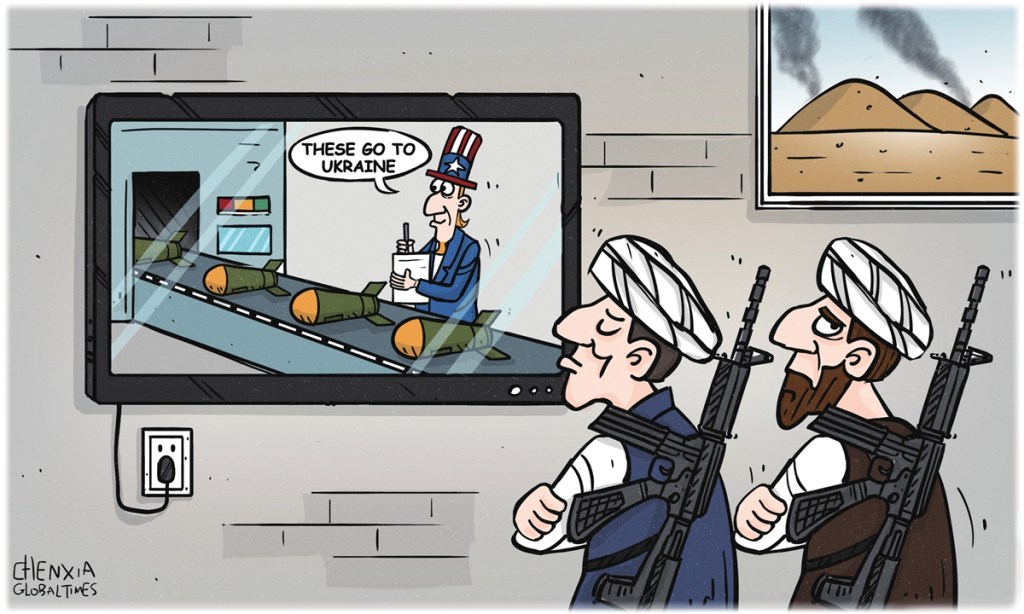
Ukraine is America’s Afghanistan More Than Russia’s

By Peter Van Buren

Source: We Meant Well

The thinking in Washington goes like this: for the “low cost” of Ukrainian lives and some American dollars, the West can end Putin’s strategic threat to the United States. No Americans are dying. It’s not like Iraq or Afghanistan ’01-’21. This is post-modern, something new, a clean great power war, Jackson Pollack for war. Getting a lot of foreign policy mojo at little cost. It’s almost as if we should have though of this sooner.

Um, we did. It didn’t work out past the short run and there’s the message. Welcome to Afghanistan 1980’s edition with the U.S. playing both the American and the Soviet roles.

At first glance it seems all that familiar. Russia invades a neighboring country who was more or less just minding its own business. Russia’s goals are the same, to push out its borders in the face of what it perceives as Western encroachment on the one hand, and world domination on the other. The early Russian battlefield successes break down, and the U.S. sees an opportunity to bleed the Russians at someone else’s bodily expense. “We’ll fight to the last Afghani” is the slogan of the day.

The CIA, via our snake-like “ally” in Pakistan, floods Afghanistan with money and weapons. The tools are different but the effect is the same: supply just enough firepower to keep the bear tied down and bleeding but not enough to kill him and God forbid, end the war which is so profitable — lots of dead Russkies and zero Americans killed (OK, maybe a few, but they are the use-and-forget types of foreign policy, CIA paramilitary and Special Forces, so no fair counting them.) And ironic historical bonus: in both Afghanistan 1980s and Ukraine, some of the money spent is Saudi. See the bothersome thread yet?

Leaving aside some big differences that enabled initial successes in Afghanistan, chief among which is the long supply lines versus Ukraine’s border situation, let’s look at what followed early days.

Though NATO countries and others sent small numbers of troops and material to Afghanistan, the U.S. has gone out of its way to make Ukraine look like a NATO show when it is not. Washington supposedly declared support for Ukraine to preserve and empower NATO (despite the fact that Ukraine was not a member.) Yet, to keep Germany on sides in the Russian-Ukraine war, Washington (allegedly) conducted a covert attack on Germany’s critical civilian infrastructure that will have lasting, negative consequences for the German economy. Seymour Hersh reported the Nord Stream pipeline connecting cheap Russian natural gas to Europe via Germany was sabotaged by the United States. An act of war. The destruction of an ally’s critical infrastructure, and no doubt a brush back pitch carefully communicated to the Germans alongside a stern warning to stay put on sanctions against energy trade with Russia. It’s a helluva thing, blowing up the pipeline to force Germany to color inside the lines NATO (actually the U.S.) laid out. This, in addition to the U.S. treating NATO countries as convenient supply dumps and little more, shows that NATO will emerge from Ukraine broken. One does also wonder if the future of Europe is at stake why the greatest concern is expressed in Washington and not Bonn or Paris.

As with Afghanistan, there are questions if we Americans will ever be able to leave, about whether Colin Powell’s “Pottery Barn” rules applies — you break it, you bought it. President Zelensky, portrayed in the West as a cross between Churchill and Bono, in actuality was a comedian and TV producer who won the 2019 Ukrainian presidential election. Zelensky’s popularity was due in part to his anti-establishment image and promises to fight corruption and improve the economy. He was also aided by his portrayal of a fictional president in a popular TV show, which helped to increase his name recognition and appeal to young voters.

Zelensky was preceded by the Ukrainian Revolution, also known as the Euromaidan Revolution, which began in late 2013 as a series of protests in response to then-President Viktor Yanukovych’s decision to reject an association agreement with the European Union and instead pursue closer ties with Russia. The protests grew in size and intensity, with demonstrators occupying the central Maidan Nezalezhnosti square in Kiev, demanding Yanukovych’s resignation and new elections. In February 2014, the situation escalated when Yanukovych’s security forces cracked down on protesters, resulting in violent clashes that left dozens dead. This led to Yanukovych fleeing the country and a new government being formed in Ukraine. The revolution also sparked tensions with Russia, which subsequently annexed Crimea and supported separatists in eastern Ukraine. None of those problems goes away even if the Russia army retreats to its pre-invasion borders. The notion that there is nothing going on here except a rough land grab by a power-made Putin is shallow and incomplete.

What’s left are concerns about the level of corruption in Ukraine, and the U.S.’s role in addressing it. Despite the U.S. providing significant financial aid to Ukraine, there have been reports of corruption and mismanagement of funds. Some have argued that the U.S. has not done enough to address these issues, and has instead turned a blind eye in order to maintain its strategic interests in the region. America’s history with pouring nearly unlimited arms and money into a developing nation and corruption is not a good one (see either Afghanistan, 1980s or ’01 onward.) Corruption can only get worse.

A great fear in Afghanistan was arms proliferation, weapons moving off the battlefield into the wrong hands. Whether that be a container of rifles or the latest anti-aircraft systems, an awful lot of weapons are loose in Ukraine. In the case of Afghanistan, the real fear was for Stinger missiles, capable of shooting down modern aircraft, ending up in terrorist hands. The U.S. has been chasing these missiles through the world’s arms bazaars ever since, right into the Consulate in Benghazi. It is worse in Ukraine. America’s top-of-the-line air defense tools are being employed against Russian and Iranian air assets. What would those countries pay for the telemetry data of a shoot down, never mind actual hardware to reverse engineer and program against? There are no doubt Russian, Chinese, Iranian and other intelligence agencies on the ground in Ukraine with suitcases full of money trying to buy up what they can. Another cost of war.

It is also hard to see the end game as the demise of Putin. This would mean the strategy is not fight until the last Afghani/Ukrainian but to fight until the last Russian. The plan is for that final straw to break, that last Russian death, to trigger some sort of overthrow of Putin. But by whom? Trading Putin for a Russian-military lead government seems a small gain. Look what happened the last time Russia went through a radical change of government — we got Putin. In Afghanistan, it was the Taliban x 2.

History suggests the U.S. will lose in a variety of ways in Ukraine, with the added question of who will follow Putin and what might make that guy a more copacetic leader towards the United States. As one pundit put it, it is like watching someone play Risk drunk.

The Hunter Biden / Ihor Kolomoïsky affair

By Thierry Meyssan

Source: VoltaireNet.org

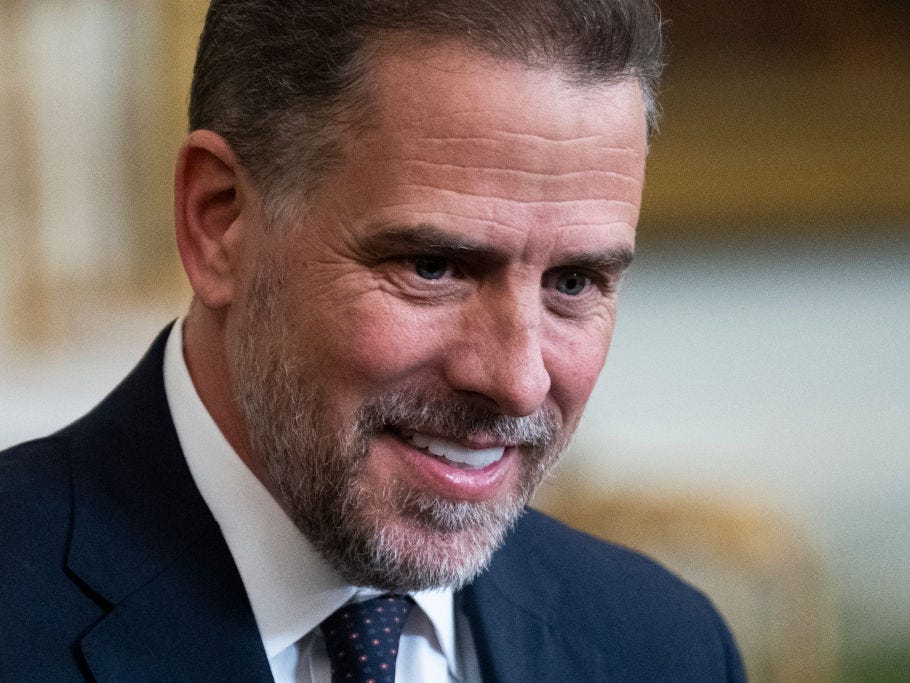
The Biden Administration is finally reacting to the scandals that have arisen from the computer of the president’s son, Hunter Biden. This loser, whose only known activities are those of a junkie and a pimp, managed to become the director of a large gas company; a job he knows nothing about. A man of straw, he signed all sorts of big contracts, in different countries, where he travelled -without right- in official US planes. His father is now launching an operation to cover up his affairs, which has led him to clean up the Ukrainian government.

As time goes on, American voters are turning away from President Joe Biden. Many of those who say they voted for him tell pollsters they regret it. Some say that if they had known about the Hunter Biden affair beforehand, they would never have trusted his father as president.

During the presidential election campaign, the Republican Party filed a lawsuit with the Federal Election Commission because the social networks Twitter and Facebook censored thousands of accounts that relayed the New York Post’s revelations about Hunter Biden’s computer [1]. The seizure was dismissed, but the Twitter Files, revealed by Elon Musk, attest in detail that the FBI and an intelligence agency (probably the CIA) had intervened with Twitter and Facebook to censor this information.

I was astonished that in the United States, the son of a vice-president, then president, could travel in official planes to the four corners of the world, giving the impression of being an official personality when he was only a junkie [2]. This abuse was, in my opinion, a sign of the decadence of the US Empire.

However, the new Republican majority in the House of Representatives intends to carry out various investigations, notably on Joe Biden’s involvement in his son’s dirty dealings. If these investigations were to succeed, they could call into question the independence of the President of the United States and therefore lead to his impeachment.

It should be remembered that when Joe Biden was Barack Obama’s vice-president, 7 million dollars in bribes were paid to the Attorney General of Ukraine to keep his nose out of Burisma’s affairs. Later, this same prosecutor, who had become too greedy, was ousted by the Verkhovna Rada (Parliament) under pressure from the United States, the European Union, the IMF and the World Bank, which wanted to save the owner of Burisma and former Prime Minister Yulia Tymoshenko at a lower price.

In a puritanical country like the United States, public opinion first focused on Hunter Biden’s frequent use of prostitutes and his drug use before it became clear that his financial affairs were much more important.

Now the Hunter Biden affair, which had been covered up by very senior members of the intelligence community, for whom the whole saga was “Russian disinformation” [3], is likely to turn the tables. It is no longer appropriate to deny the facts, so much so that Harvard University has just announced that it is closing its Technology and Social Change Project, a structure that had been constantly assimilating the existence of Hunter Biden’s laptop to Fake news [4].

Until now, the citizens who cared about this affair were only “conspiracy theorists”, “extreme right-wing” followers of President Trump and readers of the gutter press. On the contrary, almost the entire ruling class had “discerned” that it was just a popular rumor, Fake News. On the one hand, there were the readers of the New York Post, which had revealed the affair [5], on the other hand, those of the New York Times, which kept on denying it.

Among the many financial affairs of the president’s son, two stand out. The first concerns a Chinese spy. It could reveal influence peddling in the service of a foreign power. While the second concerns his activities in Ukraine and particularly his appointment and that of his friend Devon Archer (former roommate of Christopher Heinz, John Kerry’s son-in-law, during their university period) to the board of directors of the oil company Burisma. This is the group that President Vladimir Putin denounced as “a bunch of drug addicts and neo-Nazis” [6] when he called on his armies to end the civil war in Ukraine under UN Security Council Resolution 2202.

This week two seemingly unrelated events have shaken things up. They were probably imagined by or with David Brock, the undisputed agitprop specialist on whom President Biden relied in 2016 against President Trump. Ill, he had disappeared, he is now back [7]

Hunter Biden has hired one of the most famous American lawyers, Abbe Lowell. He has requested a criminal investigation and sent letters to all the people who played a role in the disclosure of the contents of his client’s laptop, including former New York City Mayor Rudy Giuliani and former Donald Trump advisor Steve Bannon. He accused them of violating the privacy of his client, urged them to retract the conclusions they drew from the contents of the computer, and thus bury the case. At the same time, a delegation from the Departments of Defense and State, as well as USAID, went to Ukraine to advise the Zelensky government to clean up some of the mess [8]. Officially, it was only to ensure that the money offered at the expense of the US taxpayers was not misappropriated by corrupt officials. Unofficially, it was only a matter of eliminating the annoying pawns without touching the others. In two days, fourteen personalities resigned in a chain. Five regional governors (Valentin Reznichenko (Dnipropetrovsk), Oleksander Starukh (Zaporizhia), Dmytro Zhivytsky Surya), Yaroslav Yanshayevich (Kherson) and Oleksiy Kulba (Kiev)), four deputy ministers (including Viacheslav Shapovalov (Defense) and Vasyl Lozynsky (Infrastructure)) and two heads of a government agency left their posts, in addition to the deputy head of the presidential administration (Kyrylo Tymoshenko) and the deputy prosecutor general (Oleksiy Symonenko).

The Western media reported faithfully on this major sweep. But the most important thing happened on the 3rd day and very few people talked about it. SBU troops searched the home of oligarch Ihor Kolomoysky, sponsor of both President Volodymyr Zelensky and the “integral nationalists”, but above all owner of… Burisma Holding, which he had bought from Mykola Zlochevskyi, in 2011, i.e. before Hunter Biden entered it. Of course the Anticorruption Action Center’s article on this change of ownership has long since been removed from its site [9].

Technically, Ihor Kolomoysky is not being prosecuted for the assassinations he ordered, but for rigging a gas lot auction involving two deputy energy ministers for nearly a million dollars.

Arresting mafia boss Ihor Kolomoysky removes the traces of many problems. He is the key witness to link President Volodymyr Zelensky with the “integral nationalists”, i.e. between a defender of democracy and anti-democrats, and between a Jewish personality and mass murderers of Jews. For the “President’s Men”, Kolomoysky is the main Ukrainian personality who can be held accountable for the corruption of Hunter Biden and, eventually, Joe Biden.

It will be remembered that in 2019 the US Secretary of Energy Rick Perry reportedly informed Rudy Giuliani about President Zelensky’s confidences during his inauguration ceremony about Hunter Biden [10]. President Donald Trump then asked the Ukrainians for information about their investigations. But the affair was leaked, President Trump was accused of acting out of revenge, and a new impeachment procedure was launched against him.

The Hunter Biden affair has many facets. One thing is to erase his role in Burisma, another is to erase his role in the activities of US military laboratories in Ukraine. These activities were carried out through Rosemont Seneca Technology Partners (RSTP), one of his companies that he created with Christopher Heinz, son-in-law of the special presidential envoy for the climate John Kerry, who joined him on the board of Burisma [11].

[1] «Republican National Committe Letter to the Federal Election Commission», Octobrer 16, 2020.

[2] « La décadence de l’Empire états-unien », par Thierry Meyssan, Réseau Voltaire, 6 septembre 2022.

[3] “Public Statement on the Hunter Biden Emails”, Voltaire Network, 19 October 2020.

[4] «Harvard pulls the plug on disinformation research project led by Hunter Biden laptop skeptic», Yael Halon, Fox News, February 3, 2023. «Harvard shuts down ’misinformation’ research program and cuts ties with director who was skeptical of Hunter Biden laptop story (but claims it was for ’bureaucratic reasons’)», Will Potter, Daily Mail, February 3, 2023.

[5] “Smoking-gun email reveals how Hunter Biden introduced Ukrainian businessman to VP dad”, Emma-Jo Morris & Gabrielle Fonrouge ; “WH press secretary locked out of Twitter for sharing Post’s Hunter Biden story” , Steven Nelson, New York Post, October 14, 2020.

[6] “A gang of drug addicts and neo-nazis”, by Thierry Meyssan, Voltaire Network, 5 March 2022.

[7] “David Brock, Clintons agitprop man, zeroes in to rescue the Bidens”, Voltaire Network, 2 December 2022.

[8] «Defense, State, and USAID Inspectors General Visit Kyiv», Department of Defense Office of Inspector Genral, January 31, 2023.

[9] « Kings of Ukrainian Gas », Anticorruption Action Center, 26 août 2012.

[10] “WSJ News Exclusive“, Timothy Puko & Rebecca Ballhaus, October 16, 2019, Wall Street Journal.

[11] «Hunter Biden Bio Firm Partnered With Ukrainian Researchers ‘Isolating Deadly Pathogens’ Using Funds From Obama’s Defense Department», Natalie Winters & Raheem J. Kassam, The National Pulse, March 24, 2022.

War Certainly Is A Racket

By Iain Davis

Source: Off-Guardian

In 1935, Major General Smedley Butler’s seminal book “War Is A Racket” warned of the dangers of the US military-industrial complex, more than 25 years before the outgoing US President Eisenhower implored the world to “guard against” the same thing.

One of the most decorated soldiers in US military history, Butler knew what he was talking about, famously writing that war is “…conducted for the benefit of the very few, at the expense of the very many.”

While he lamented the loss of his fallen comrades and despite the gongs he received for defending his country, Butler came to understand that he was actually a “high class muscle man for big business, for Wall Street and the bankers.” Later, the historian Antony C. Sutton proved that Butler was right.

When the US administration of George Bush passed its Foreign Operations Appropriation Law in 1991, it ended all US credit to the former, thriving socialist republic of Yugoslavia. At the time the perception on the Hill was that Yugoslavia was no longer required as a buffer zone between the NATO states and their former Warsaw Pact adversaries, so its independent socialism was no longer tolerated.

The US military industrial complex, that Butler and Eisenhower told everyone to tackle, effectively destabilised the entire Balkan region, destroyed hitherto relatively peaceful countries and then fuelled the resultant wars with its pet Islamist terrorists. Ably assisted by the World Bank and the IMF.

So-called “assistance,” via the Train and Equip Program, gave US taxpayers the opportunity to funnel $500M to private security contractors like DynCorp. DynCorp put taxpayer’s money to use, seemingly by training terrorists and child trafficking to paedophiles.

The US and its Western allies’ military industrial complex pulled off more or less the same trick in Iraq, Libya and nearly in Syria. In hindsight this doesn’t appear to have been a very good idea. That is, if you think wars are fought for the reasons we are told.

Having bombed Iraq into the stone age, to stop its regime producing the WMDs it didn’t have, the US then “rescued” the country, from the horrific violence and starvation sanctions the US government itself visited upon the Iraqi people, by establishing the US led coalition’s puppet Coalition Provisional Authority (CPA) government. Once installed, the CPA did things like award US engineering firm Kellogg Brown & Root (KBR) a ‘sole source contract’ to fix and operate all of Iraq’s oil wells.

That US Vice President Dick Cheney, who lied passionately about Iraqi WMD, was also in receipt of an annual $2M stipend from KBR was just a coincidence. As was the massive boost to the value of his Halliburton shareholdings as a direct result of the war he was instrumental in starting.

When the former UK Prime Minister Teresa May OK’d missile trikes upon Syrian civilians, the fact that her husband made millions out of it, as his investments in missile manufactures went through the roof, was also just a coincidence. In no way did she personally profit from killing children and the fact that her family continues to make a fortune by killing more children in Yemen does not undermine Theresa’s very public profile as a champion of good causes. Although, it appears, not killing children isn’t one of them.

So we shouldn’t be surprised when, once again, we discover that war, far from an impediment to business, actually improves operational margins, increases production, boosts markets and offers white collar criminal enterprises industrial scale profits.

Sure, people, including children, die in huge numbers but so what? Where there’s muck there’s brass. War certainly is a racket.

It turns out that Ukraine has been buying Russian fuel from the EU member state Bulgaria throughout the Ukraine War. An odd oversight for alleged combatants in a war. It is similar to the Ukrainian government’s decision to allow the continuing transit of Russian gas from Gazprom to EU markets through its resident pipelines.

The Russian energy giant Lukoil, whose former CEO Ravil Maganov accidentally fell out of a window a few months ago—a common problem for the wrong Russian executives—has been shipping Russian oil to its refinery in the Bulgarian port city of Burgas. The Burgas refinery is the only one in Bulgaria and the largest in the Balkans. From there the refined gas-oil (red diesel) is exported to Russia’s supposed enemy, Ukraine.

This was all being done in secret, says the Russian MSM, although this is just perception management, pro-war propaganda. There has also been a lot of nonsense written by the Western MSM, alleging that Bulgaria has been illicitly circumnavigating EU “sanctions.” Regardless of the fact that this too is monumental tripe.

There isn’t anything “secret” about it. In truth, the door was left open for Russia and Bulgaria to continue this trade, at least until the end of 2024, because the EU inserted a loophole to ensure that they could. Presumably, the Russian government knew nothing about the massive oil shipments, which is why it remained a “secret,” according to Russian MSM.

Given that the “secrecy” narrative is total claptrap, why would both the Western and the Russian MSM want to peddle essentially the same disinformation? Let’s spend a moment to reflect upon the EU’s non-sanction sanctions shall we?

It means that third party non-EU trading nations, like Kazakhstan for instance, can ship Russian oil to the EU unhindered by the inconvenience of alleged sanctions. The sanctions are for reordering global energy flows, not ending them.

While the switch-over has plunged European citizens into an energy crisis, that’s OK. It is essential for the future of the planet that Europeans are convinced to accept ever increasing energy prices. Otherwise they might not welcome the transition to the “sustainable energy” that will make their lives much worse.

Red diesel in Ukraine is used for industrial and heavy machinery, in agriculture and manufacturing for example. It is also used for, oh I don’t know, fuelling tanks and armoured personnel carriers, mobile artillery units and stuff like that.

Stories from European news outlets that Bulgaria provides nearly 40% of Ukrainian military fuel are all nonsense because reasons. Officials have denied the evidence, such as confirmation from the former Bulgarian President, so it isn’t “officially approved” evidence. Consequently, it can safely be discounted by anyone gullible enough to do so.

Don’t forget, according to Western and Russian MSM outlets, it’s all a secret. Which may come as a relief to some, because otherwise the Russian government would have been colluding with the EU to ensure that the Ukrainian military could stay in the fight wouldn’t it?

Recently, despite apparently running out of weaponry, if you believe Western propaganda that is, Russia has launched a massive missile strike on Ukraine, targeting Ukraine’s energy infrastructure. According to Russian MSM this is part of the Russian governments efforts to undermine Ukraine’s “military capabilities.”

The fact that it ensures that Ukraine will need to be rebuilt by borrowing enormous sums from international financiers, with the diligent assistance of Gazprom investors BlackRock, is not relevant. So ignore this too please.

Gazprom sells gas to Moldova which is now going to provide gas to Ukraine via the Ukrainian transit gas pipelines that Russian bombing has accidentally missed entirely. The Moldovan government is keen to stress that this is not the gas it buys from Gazprom but is rather the gas it buys from somewhere else it hasn’t specified despite admitting that it is completely reliant upon Russian energy.

If the energy and the fuel from countries like Moldova, Bulgaria and Kazakhstan is used by the Ukrainian government’s military, which it won’t under any official circumstances whatsoever, and Gazprom gas helps keep Ukrainian’s lights on, despite the missile strikes, it looks like the Russian government’s objective is to keep Ukraine at war while hobbling it just enough to ensure it can’t win.

This can’t be true because NATO appears to be doing exactly the same thing and Russia and NATO are enemies. Although NATO’s not quite enough assistance differs from the Russian governments not quite enough aggression, it essentially amounts to the same thing.

The piddly number of tanks offered to Ukraine by its NATO “partners,” the reluctance from NATO to give Ukraine military aircraft and the tepid reception for Ukraine’s more recent pleas to join NATO, appears to signal that NATO isn’t prepared to provide, or perhaps isn’t capable of providing, the military support Ukraine would need for victory. But it is seemingly willing to give it just enough old used scrap to keep it loosing.

This means Ukrainians, the new Russian populations in the Donbas, and troops on both sides, though primarily the Ukrainians, will continue to die while the geopolitical landscape continues to shift around them. Meanwhile the military industrial complex and the billionaires it enriches, such as Elon Musk, are making a fortune. When the conflict is concluded, multinational corporations on both sides will be awarded the contracts to rebuild the stuff their government partners have just destroyed.

Butler wrote:

Let the officers and the directors and the high-powered executives of our armament factories and our munitions makers and our shipbuilders and our airplane builders and the manufacturers of all the other things that provide profit in war time as well as the bankers and the speculators, be conscripted.

While some might think it wise to add politician’s to that list, for some unfathomable reason, far more people seem to think this is a good point but that it isn’t a serious proposal. Why not? Do they not get it, do they not understand what Butler, Eisenhower, Sutton and many more like them have been trying to tell them for nearly a century?

What is it about the military industrial complex that they assume to be inevitable? Why on Earth do they think it is a “necessary evil?”

It is only necessary because millions, perhaps billions, of us accept that war is the “failure” of foreign policy and diplomacy, instead of understanding the obvious fact that it is the extension of foreign policy. As we are seeing right now with the warmongering posturing of the West and China, war is the intended product of foreign policy and sledgehammer diplomacy.

Wars don’t just “happen” by accident. They are planned, engineered and delivered as required. Our’s and our children’s deaths mean nothing to the people who we allow to lead us into war. They don’t have skin in the game but they should and we have the power to make sure that they do. All we have to do is refuse to fight. It really isn’t rocket science. Obedience is not a virtue.

But we won’t because we continue to fall for the same old lies, time and time again. We continue to imagine, like amnesiac slaves, that we can only be led to a better future by following another bunch of parasitic criminals.

Around and around we go: blowing up and starving children to death, condemning pensioners to freezing fuel poverty and accepting that we might just have to sacrifice ourselves and our loved ones along the way.

When the warmongers next press gang our sons and daughters into dying for their ambitions, we will again say it is in a good cause: for the defence of our country, our culture or our way of life.

It isn’t, it never was and it never will be as long as we continue to go along with it.