Here’s what denormalization means: there was no “New Normal” for the dinosaurs.
Everyone talks about the “New Normal,” as if there’s a guarantee that life will return to normal. But the “New Normal” is De-Normalization, which I define as everything that was normal is gone and will not be replaced with some new normal. In other words, normal is gone, done, over: old normal, new normal, doesn’t matter: normal is history.
Denormalization is currently used to describe a database optimization process, but it’s too valuable a concept to be limited to a narrow geekspeak term.
What I mean by Denormalization is the complete dismantling of what was taken for granted as normal and the loss of any future version of normal. Consider sports as an example. We all know the Old Normal that millions hope will magically return: $100 million player contracts, millions in TV ad revenues, pro franchises worth billions of dollars, NCAA playoffs, etc.: a dominant kingdom in the nation’s media and mindshare.
The dirty little secret that troubled the kingdom long before Covid-19 was a steady erosion in attendance at live games and in the viewing audience. Younger generations have relatively little interest in all the trappings and habits of Boomer sports manias. They’d rather watch the 3-minute highlight video on their phones than blow half a day watching games that are generally lacking in drama and are largely replaceable with some other game.
What few seem to notice is that the Old Normal had become insanely expensive, irksome and boring, activities that were habits coasting on momentum. Those embedded in the Old Normal acclimatized to the absurdly overpriced seats, snacks, beer, parking, etc. of live events and the insanely long commutes required to get to the venue and then back home, as their happy memories of $5 seats decades ago is the anchor of their lifelong devotion and habits.
The old fans coasting on ritual habituated to the cookie-cutter nature of the games, while those who never acquired the habit look with amazement at the seemingly endless dull progression of hundreds of interchangeable sporting events.
Advertisers will eventually notice that younger generations never acquired the habit of worshipping sports and so there is nothing to stem the collapse of the Old Normal but older fans, some percentage of whom will find they don’t miss it once they fall out of the habit.
Some other percentage will find they can no longer afford to attend live games, or they’ll realize they no longer feel it’s worth it to grind through traffic or public transit just to sit for additional hours and then repeat the entire slog back home.
Another percentage will suddenly awaken to the artifice of the whole thing; they will simply lose interest. Others will finally realize the corporate machine (which includes college sports) has long since lost any connection to the era that they remember so fondly.
This same Denormalization will dismantle fast food, dining out, air travel, healthcare, higher education and innumerable other iterations of normal that have become unaffordable even as the returns on the lavish investments of time and money required diminish sharply.
How many of you deeply miss air travel? You’re joking, right? Only certifiably insane people would miss the irksome hassle and discomfort, from the endless delays due to mechanical problems (don’t you people keep any spare parts, or is it all just in time like every other broken system in America?), the seats that keep getting smaller as the passengers keep getting larger, the fetid terminals, and so on.
Like all the other iterations of normal, the entire experience has been going downhill for decades, but we all habituated to the decline because we were stuck with it.
What few seem to understand is all the Old Normal systems can’t restabilize at some modestly lower level of diminishing returns; their only possible future is collapse. Just as fine-dining restaurants cannot survive at 50% capacity because their cost structure is so astronomical, the same is true of sports, airports, airlines, cruise lines, fast food, movie theaters, healthcare, higher education, local government services and all the rest of the incredibly fragile and unaffordable Old Normal.
None of these systems can operate at anything less than about 80% of full capacity and customers paying 80% of full pop, i.e. full retail. Since their fixed cost structures are so high, and their buffers so thin, there’s nothing below the 80% level but air, i.e. a quick plummet to extinction.
Here’s what denormalization means: there was no New Normal for the dinosaurs. A few winged species survived and evolved into the birds of today, but that is by no stretch of the imagination a New Normal that included all the other dinosaur species. For them, denormalization meant extinction.
De-Normalization: everything that was normal is gone and will not be replaced with some new normal. Normal is gone, done, over: goodbye to all that.
The economic pain that we are witnessing right now is far greater than anything that we witnessed during the last recession. U.S. GDP declined by 32.9 percent on an annualized basis last quarter, more than 100,000 businesses have permanently shut down since the COVID-19 pandemic first hit the United States, and more than 54 million Americans have filed new claims for unemployment benefits over the last 19 weeks. Up until just recently, a $600 weekly unemployment “supplement” and a federal moratorium that prevented many evictions had helped to ease the suffering for millions of American families, but both of those measures have now expired. As a result, a tremendous amount of economic pain which had previously been deferred will now come rushing back with a vengeance. Millions of American families are no longer going to be able to pay their bills, and experts are warning that we could soon see an “eviction crisis” that is absolutely unprecedented in American history.
48-year-old Thomas Darnell of West Point, Mississippi never thought that he would be in this position. He had been a factory worker for over 20 years until he lost his job in May, and since then he hasn’t been able to find another. And then on top of everything else, everyone in his house caught COVID-19…
First, he was furloughed for three weeks in April and then laid off in May. Then things got worse: His entire household of seven, including himself, his wife, three kids and daughter-in-law, along with his baby grandson, contracted coronavirus after they saw their immediate family over the Independence Day weekend.
“I’m tired and shaky. Even after a few weeks, I’m still trying to recover,” Darnell says, who has since been cleared of the virus but still has lingering symptoms.
He is concerned that employers will be scared away by his recent illness, and he is becoming desperate because he is running out of money.
With no health insurance and no paychecks coming in, Darnell and his wife have gotten to the point where they have to make a choice between buying insulin or buying groceries…
He can’t afford health insurance, which has added to his anxiety because he and his wife are both diabetic, he says. Like Bolei, Darnell and his wife have been forced to make a grueling decision between either paying for their medications or keeping food on the table.
“Do we buy insulin or groceries? It’s a hard juggle,” Darnell says. “I’m willing to make less money and start working again to get health insurance, but no one is hiring.”
The weekly $600 unemployment supplements from the federal government had helped to keep them going for a while, but now those payments have ended, and the immediate future is looking quite bleak.
In Richmond, Virginia, a mother of eight named Shamika Rollins wasn’t sure how she was going to make it when her hours as a home health aid were reduced. Unpaid bills started piling up, and then she got an eviction notice a few weeks ago. The following comes from CBS News…
Shamika Rollins’ eight children share two bedrooms in Richmond, Virginia. But she’s worried about losing their home after she says she received an eviction notice in June.
“First thing, I panic, and then next thing, I look, and I’m like, I got my kids. And it’s like, okay, now you gotta figure this out,” she told CBS News correspondent Adriana Diaz.
If a miracle does not happen, Rollins and her eight children will soon be out in the street, and this is causing her to have “a lot of sleepless nights”…
“I have a lot of sleepless nights,” Rollins said. “My mind is constantly racing, you know, what’s your next move?”
Sadly, there are millions of other Americans in the exact same position.
In fact, experts are projecting that up to 40 million Americans could be evicted from their homes during this pandemic.
Many small business owners are also facing heartbreaking choices during this downturn. A restaurant owner in Delaware named Alex Heidenberger “hasn’t paid the mortgage on his home the past four months” as he desperately tries to keep his once profitable restaurants alive…
Heidenberger, who typically draws about $20,000 a month in profit from the restaurant, now receives nothing. He says he hasn’t paid the mortgage on his home the past four months. He served lifeguard duty for a couple of weeks, mostly to help a beach crew depleted by COVID-19 quarantines but also to make some cash.
“I’m working harder than I have ever worked in my life,” he says, adding that he puts in about 80 hours a week at the two restaurants. Yet, “I have no money… This is all I think about. I don’t sleep.”
The COVID-19 pandemic has hit the restaurant industry particularly hard. Americans are not eating out as regularly as they once did because of the virus, and it is probably going to remain that way for the foreseeable future.
In Massachusetts, a restaurant owner named John Pepper once had eight thriving locations, but at this point only two of them remain open…
John Pepper used a PPP loan to pay employees and reopen four of his eight Boloco restaurants when Massachusetts lifted its shutdown order in early May. But with the money spent and business at the restaurants down as much as 70%, Pepper had to again close two locations. The staff of 125 he had before the virus outbreak is down to 50.
“A lot of this is out of our hands at this point,” Pepper says. “At this moment, I don’t see getting my full payroll back.”
Overall, we are facing a “restaurant apocalypse” in the U.S. that is unprecedented in size and scope.
As many as 231,000 of the nation’s roughly 660,000 eateries will likely shut down this year, according to an estimate from restaurant consultancy Aaron Allen & Associates provided to Bloomberg News. This will bring the industry’s steady growth to a halt and mark the first time in two decades that U.S. restaurant counts don’t climb. Restaurants have already shed millions of jobs this year, economic data show.
What we are watching is truly horrifying. So many hopes and dreams went into each one of those restaurants that are shutting down, and countless restaurant owners are going to be completely financially ruined by all of this.
For other Americans, this economic downturn has put their very lives at risk. In Colorado, 70-year-old Catherine Azar was already dealing with heart problems and diabetes, and now she is in danger of being thrown out into the street…
“It’s hard for me to conceive of someone being willing to put another person out in the street in the middle of a deadly pandemic, and I’m high risk. I’m 70. I have heart issues and I’m diabetic,” Azar said.
Rollins and Azar are just two of the 43 million Americans at risk of eviction in the coming months. For context, about 1 million Americans were evicted in 2010, the year after the Great Recession.
How long do you think that a 70-year-old woman with heart problems and diabetes would last on the street or in a shelter?
And as millions upon millions of Americans get evicted during the months ahead, the shelters are all going to fill up really fast.
Clearly, 2020 has been unlike any previous year in the last century or so. The world is currently battling against an infodemic of propaganda spewing from the corporate media and official health authorities. Yes, people are sick and dying. However, the statistics make it clear that COVID-19 simply does not warrant a total lockdown of the planet and further destruction of the economy.
Regardless, nations around the world are using COVID-19 as an opportunity to grab more surveillance and police state powers, institute mask and vaccine mandates, accelerate the push towards a completely digital world, enact more corporate bailouts, and generally, extreme control and involvement in citizens lives. The sheer magnitude of the COVID-19 operation is unparalleled, with the most recent similar event being the attacks of September 11, 2001. As with the 9/11 attacks, the predator class is using COVID-19 as the excuse to push plans and agendas which predate the spread of the novel coronavirus.
Even so, the COVID-19 operation is unlike any other event to take place in modern history because the results of this event are affecting people in every single nation on the planet and will continue to for years to come. Also, unlike 9/11 – which took place over the course of one morning – the COVID-19 operation is taking place daily for months on end. The effects of this constant bombardment with fear and panic are taking a toll on the hearts and minds of free people all around the world. Quite simply, the people are ready for this to end and they will do almost anything to achieve this goal. It is within this space of fear and uncertainty which the predator class has now begun to insert themselves, ready to present the “solution” to our ills.
The Great Reset
As every student of power and deception knows, the easiest way to achieve victory over your opponent is to guide them to a predetermined destination which benefits your agenda. If you can do this while convincing your opponent that they are consciously making their own choices and the path is for their own good – well, you are all but guaranteed success. I believe the evidence indicates this is the strategy we are seeing unfold during the COVID-19 operation.
The predetermined path we are being led down is known as “The Great Reset” and was announced in early June by the World Economic Forum. Regular readers will remember that on October 18, 2019, the Bill and Melinda Gates Foundation partnered with the Johns Hopkins Center for Health Security and the WEF on a high-level pandemic exercise known as Event 201. Event 201 simulated how the world would respond to a coronavirus pandemic which swept around the planet. The simulation imagined 65 million people dying, mass lock downs, quarantines, censorship of alternative viewpoints under the guise of fighting “disinformation,” and even floated the idea of arresting people who question the pandemic narrative.
The launch of The Great Reset was supported by Klaus Schwab, the founder and executive chairman of the World Economic Forum; England’s Prince Charles; Antonio Guterres, Secretary-General of the UN; and Kristalina Georgieva of the International Monetary Fund. The kick-off was truly an international event with the participation of Ma Jun, the chairman of the Green Finance Committee at the China Society for Finance and Banking and a member of the Monetary Policy Committee of the People’s Bank of China. The event was also supported by Bernard Looney, CEO of BP; Ajay Banga, CEO of Mastercard; and Bradford Smith, president of Microsoft.
During the launch of The Great Reset, Prince Charles stated that humanity cannot waste time because “we need to put nature at the heart of how we operate.” UN Secretary-General Guterres called for “more equal, inclusive and sustainable economies and societies” that can face pandemics, climate change, and other global challenges.
In an opinion piece published in The Globe and Mail, Klaus Schwab provided more details on the goals of The Great Reset (emphasis added):
COVID-19 lockdowns may be gradually easing, but anxiety about the world’s social and economic prospects is only intensifying. There is good reason to worry: a sharp economic downturn has already begun, and we could be facing the worst depression since the 1930s. But, while this outcome is likely, it is not unavoidable.
To achieve a better outcome, the world must act jointly and swiftly to revamp all aspects of our societies and economies, from education to social contracts and working conditions. Every country, from the United States to China, must participate, and every industry, from oil and gas to tech, must be transformed. In short, we need a “Great Reset” of capitalism.
Schwab goes on to describe several crises facing humanity, including rising government debt, unemployment, and increasing social unrest. Combined with COVID-19, these crises will leave the world less sustainable, less equal and more fragile. “We must build entirely new foundations for our economic and social systems,” Schwab writes. He details the 3 main components of TGR agenda, specifically fairer market outcomes, investments in “equality and sustainability,” and harnessing the innovations of the Fourth Industrial Revolution.
When it comes to producing “fairer market outcomes,” Schwab calls for governments to improve coordination in tax, regulatory, and fiscal policy. He also calls for upgrading trade agreements and moving towards a “stakeholder economy.” When he speaks of equality and sustainability, Schwab means that current and future government stimulus and relief packages should be used to create a new system that is “more resilient, equitable and sustainable.”He also calls for more “green” urban infrastructure and incentivizing industries to improve their environmental record.
Finally, Schwab calls for utilizing the innovations of “the Fourth Industrial Revolution” to support public good. The 4IR is another pet project of Schwab which was first announced in December 2015. To put it simply, the 4IR is the digital panopticon of the future, where digital surveillance is omnipresent and humanity uses digital technology to alter and, hopefully, improve our lives. Sometimes known as “The Internet of Things,” this world will be powered by 5G and 6G technology.
“Ubiquitous, mobile supercomputing. Intelligent robots. Self-driving cars. Neuro-technological brain enhancements. Genetic editing. The evidence of dramatic change is all around us and it’s happening at exponential speed,” Schwab wrote for the announcement of the 4IR.
Of course, for Schwab and other globalists, the 4IR also lends itself towards more central planning and top-down control. The goal is a track and trace society where all transactions are logged, every person has a digital ID that can be tracked, and social malcontents are locked out of society via social credit scores.
In fact, much of this call for a Great Reset is already playing out. For example, Mastercard and the Bill and Melinda Gates Foundation-funded GAVI recently announced a partnership with AI-powered “identity authentication” company, Trust Stamp. As MintPress Newsreported, “The program, which was first launched in late 2018, will see Trust Stamp’s digital identity platform integrated into the GAVI-Mastercard “Wellness Pass,” a digital vaccination record and identity system that is also linked to Mastercard’s click-to-play system that powered by its AI and machine learning technology called NuData.“
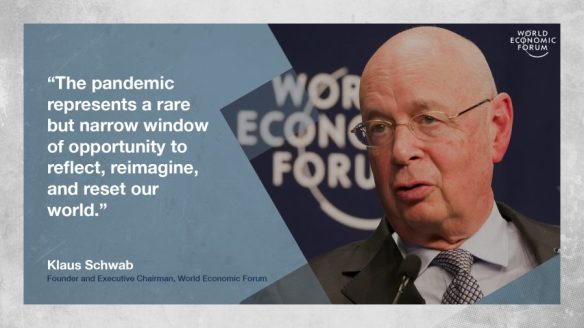
This is why astute readers are skeptical when they hear Schwab say, “the pandemic represents a rare but narrow window of opportunity to reflect, reimagine, and reset our world to create a healthier, more equitable and more prosperous future.”
Who exactly is Schwab speaking to when he speaks of a more prosperous future? How long has this Great Reset been in the works? The answers to these questions can help us understand the true goals of this agenda.
As researcher Brandon Smith reported, Christine Lagarde, former head of the IMF,discussed a global reset as far back as 2014. “The reset is often mentioned in the same breath as ideas like “the New Multilateralism” or “the Multipolar World Order” or “the New World Order.” All of these phrases mean essentially the same thing,” Smith writes.
Smith correctly notes that the Great Reset is not a response to the pandemic, but rather, “the global reset as implemented by central banks and the BIS/IMF is the cause of the collapse. The collapse is a tool, a flamethrower burning a great hole in the forest to make way for the foundations of the globalist Ziggurat to be built.”
New Normal, Same World Order
In early July, Schwab and French author Thierry Malleret released a book outlining the vision of The Great Reset. The book, Covid-19: The Great Reset, explores what the post-pandemic world might look like. “Will there be enough collective will to take advantage of this unprecedented opportunity to reimagine our world, in a bid to make it a better and more resilient one as it emerges on the other side of this crisis?,” Schwab and Malleretpondered at the release of the book. The two men believe COVID-19 triggered “momentous changes and magnified the fault lines that already beset our economies and societies.” They also predict that falling oil prices and a freeze in tourism could lead to a wave of massive anti-government demonstrations.
“One path will take us to a better world: more inclusive, more equitable and more respectful of Mother Nature. The other will take us to a world that resembles the one we just left behind – but worse and constantly dogged by nasty surprises,” the authors argue.
In the book, Schwab expands upon the initial announcement of The Great Reset. Once again he calls for the 4th Industrial Revolution and the digitalization of everything, powered by 5G technology. However, Schwab goes even further in his book, calling for rethinking the “social contract” society has with governments.
Schwab also calls for a nature based or green economy. In January 2020, the WEF released their report, Nature Risk Rising: Why the Crisis Engulfing Nature Matters for Business and the Economy, as part of their New Nature Economy series of reports. The report is “the first of a series of New Nature Economy reports, prepared through the Nature Action Agenda, a platform that aims to encourage a movement of businesses, governments, civil society, academics, innovators and youth to disrupt business-as-usual approaches.”
A second report, The Future of Nature and Business, was released in July. Once again, the WEF states that COVID-19 presents an “opportunity, to change the way we eat, live, grow, build and power our lives to achieve a carbon-neutral, ‘nature-positive’ economy and halt biodiversity loss by 2030. Business as usual is no longer an option.“
In a companion report, the WEF provides some detail on what it means to change the way we eat. “Another set of policy measures that would stimulate more resource-efficient food systems entail directing stimulus packages towards R&D to support the diversification away from diets based on resource intensive animal proteins, and towards four main categories of alternatives – aquatic, plant-based, insect-based and laboratory-cultured,” the report states. This push for alternatives to animal proteins has coincided with a rise in laboratory created fake meat, including products funded by the Bill and Melinda Gates Foundation.
Interestingly, the companion report also calls for “corporate bailout packages for the meat sector” which “could accelerate these developments.” Coincidentally, because of COVID-19, the Trump administration awarded $15.5 billion in relief aid for the meat and dairy industry. Once again, the predictions and declarations of these global institutions appear to play out in reality as perfect as any scripted TV show.
The calls for a Great Reset greatly mimic previous programs and initiatives put forward by other globalist organizations, including the United Nations. Researcher F. William Engdahl provided much-needed clarity in a recent piece on the announcement of The Great Reset. Engdahl notes that, “the declaration by the World Economic Forum to make a Great Reset is to all indications a thinly-veiled attempt to advance the Agenda 2030 “sustainable” dystopian model, a global “Green New Deal” in the wake of the covid19 pandemic measures. Their close ties with Gates Foundation projects, with the WHO, and with the UN suggest we may soon face a far more sinister world after the covid19 pandemic fades.”
Strategic Intelligence, Strategic Partners, and Event 201
In March, the WEF launched the COVID Action Platform which is essentially a call for global government in response to COVID-19. The answer, WEF believes, is to have greater global cooperation, move away from the nation-state, and tackle the world’s problems as one international community.
Along with the launch of the Action Platform, the WEF released an impressive graphic as part of their “Strategic Intelligence” platform, which outlines the wide ranging ways their plans will effect and shape the world of the 21st century and beyond. From the media’s role in the pandemic to finding a vaccine, the graphic attempts to provide details on this centrally planned future being promoted by the WEF. I encourage all readers to spend an evening going down the rabbit hole that is the COVID Action Platform for a better understanding of where we are headed.
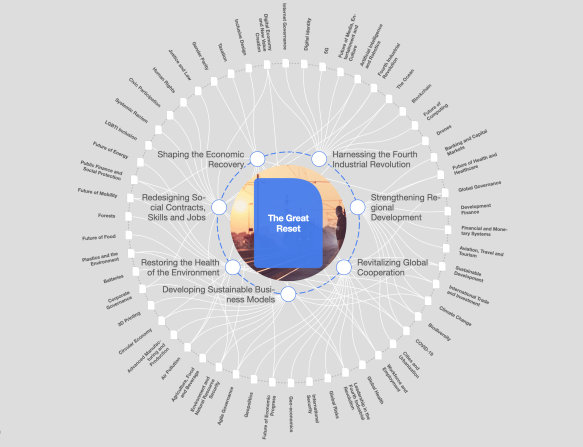
With the launch of The Great Reset, the WEF also launched a Strategic Intelligence graphic detailing how their plans will unfold. The Great Reset graphic details how everything from drones, blockchain, the future of energy, LGBTI inclusion, and 3D printing will play a role in the New Normal. Once again, I encourage readers to take a dive into this graphic to gain clarity on what the WEF and their partners have planned for the coming decade.
The WEF promotes itself as the “International Organization for Public-Private Cooperation.” They partner with a variety of private companies, philanthropic outlets, and governments to achieve their goals. Researcher Steven Guinness recently outlined how the WEF partners with various institutions to accomplish their stated aims and how the Strategic Intelligence platform is “co-curated with leading topic experts from academia, think tanks, and international organizations.”
“‘Co-curators‘ are perhaps the most important aspect to consider here, given that they have the ability to ‘share their expertise with the Forum’s extensive network of members, partners and constituents, as well as a growing public audience,’” Guinness writes. “It is safe to assume then that when co-curators speak, members and partners of the World Economic Forum listen. This in part is how the WEF’s agenda takes shape.”
As Guinness notes, the co-curators of the Strategic Intelligence road map of the globalist vision include Harvard university, the Massachusetts Institute of Technology, Imperial College London, Oxford University, Yale and the European Council on Foreign Relations. Several of these institutions continue to play an influential role in shaping the narrative around COVID-19.
The WEF’s highest level of partnership is known as Strategic Partners. There are only 100 international companies listed as Strategic Partners. Each partner receives an invitation if they have “alignment with forum values.” These partners “shape the future through extensive contribution to developing and implementing Forum projects and championing public-private dialogue.”
The WEF’s Strategic Partners include Johnson & Johnson, and the Bill and Melinda Gates Foundation. BillGates is also a long time “Agenda Contributor” for the WEF.As mentioned above, the Bill and Melinda Gates Foundation partnered with the Johns Hopkins Center for Health Security and the WEF on the Event 201 pandemic exercise in October 2019. Johnson & Johnson were also partners in the exercise.
As TLAV has previously documented, the Bill and Melinda Gates Foundation operates in a similar fashion to the WEF: their publicly stated goals mask a global control agenda. Thus, it should come as no surprise that Klaus Schwab, founder of the WEF, is a former attendee and member of the Steering Committee for the secretive Bilderberg Group.
The WEF itself is akin to a more public Bilderberg Group which brings together around 3,000 business leaders, international political leaders, economists, celebrities, and journalists for a five day conference to discuss global issues. The WEF meets every January in Davos, Switzerland, to discuss their agenda. The elitism of the WEF has resulted in Schwab and his cohorts being nicknamed The Davos Class.
In January 2021 the theme of the WEF meeting will be “The Great Reset.” It’s important that we keep an eye on the WEF and their push for the Great Reset as we draw closer to election 2020 and a potential Dark Winter. Klaus Schwab, Bill Gates, and their ilk are determined to present themselves as the saviors of humanity. They are using the COVID-19 panic as an opportunity to push their agenda while selling it as the cure to our problems.
This predator class attempts to mask their true intentions with flowery language designed to lull the waking masses back to sleep. To be clear, our world is absolutely, without a doubt existing in an unsustainable paradigm. We do have growing income inequality, police violence, failing healthcare systems, and insufficient food production systems. These problems were apparent before COVID-19 and the fragility of these systems has indeed become more obvious in recent months. However, these psychopaths would prefer if we allowed them to stay in the driver’s seat as they careen us into a future of technocratic control and the end of individual liberty.
While Schwab and Gates would prefer that the people of the world submit to their vision, we must stand against this push for centralization of power and technology. The Great Reset is coming, and perhaps, it should come. We have many issues facing our species that need to be addressed. However, central planning, surveillance, and loss of individual liberty is not the answer. The answer is decentralization, opting out en masse, non-compliance, and non-participation in the systems which have brought us to this predicament.
We, as free people, must decide what path we intend to take. Will we stand by and allow the predators to seize control of all resources and power for the coming generations?Or, will we finally break free from their violent systems and initiate a Great Reset which benefits the people, from bottom to top?
The answer depends on you.
Question Everything, Come To Your Own Conclusions.
The laughably hopeless hope is that by propping up the corpses, the populace will discern some faint flicker of life in the decaying carcasses and return to their free-spending ways.
Call it cultural synchronicity, but it increasingly feels like we’re living in the 1979 Talking Heads song Life During Wartime, which was anchored by the lyric “This Ain’t No Party, This Ain’t No Disco, This Ain’t No Foolin’ Around.” Indeed.
It also feels like Life During Wartime because the propaganda is so blatant and intense:we’re winning the war on Covid-19, and our wars on everything else, too, of course, as war is the favored metaphor and favored policy at the end of the Empire.
The ceaseless propaganda is that “a vaccine is right around the corner.” The inconvenient reality is that Corporate Insiders Pocket $1 Billion in Rush for Coronavirus Vaccine: Well-timed stock bets have generated big profits for senior executives and board members at companies developing vaccines and treatments.
In other words, wartime profiteering isn’t just allowed, it’s encouraged–yet another sign that we’re in the final decay/collapse phase of Imperial Pretensions.
It’s easy to mix up the propaganda and the counter-propaganda, because they’re both so extreme. There is no middle ground, only pre-packaged positions which dictate which “data” is cherry-picked to support the political partisanship that’s being defended.
In a world of thousands of unread papers published in hundreds of scientific journals no one even reads and a corrupt culture of “science for sale,” there’s a veritable orchard to cherry-pick.
“Robert Horton, editor in chief of The Lancet, one of the most respected professional peer reviewed publications in the world dealing with biomedical research had this to say in an editorial published by The Lancet in April of 2015:”
“The case against science is straightforward: much of the scientific literature, perhaps half, may simply be untrue. Afflicted by studies with small sample sizes, tiny effects, invalid exploratory analyses, and flagrant conflicts of interest, together with an obsession for pursuing fashionable trends of dubious importance, science has taken a turn towards darkness.”
“And this, published in 2009, by Dr. Marcia Angell, former editor of The New England Journal of Medicine, another world leading publication in medical research:”
“It is simply no longer possible to believe much of the clinical research that is published, or to rely on the judgment of trusted physicians or authoritative medical guidelines. I take no pleasure in this conclusion, which I reached slowly and reluctantly over my two decades as an editor of The New England Journal of Medicine.”
Metaphorically speaking, the civilian populace believes “we’re winning” until the bombs start dropping on their homes. For some reason, this doesn’t feel like “winning.”
The V-shaped recovery is the propaganda war the status quo must win, for this is the narrative battle for the hearts and minds of the populace. The fear here is that should the populace lose confidence in The V-shaped recovery, they might reduce their borrowing and spending and increase their saving, dooming an economy that depends entirely on marginal spending funded by debt to keep from imploding.
As the chart of the rising wedge model of breakdown below illustrates, when big-ticket costs ratchet higher like clockwork–rent, property taxes, childcare, higher education, debt, healthcare, etc.– while income stagnates for the bottom 90%, any drop in spending, no matter how modest, breaks the system because any reduction in spending reduces tax revenues, corporate profits and debt payments below the critical threshold.
This is why the Federal Reserve is so keen on bailing out bankrupt-in-all-but-name corporations and banks: The laughably hopeless hope is that by propping up the corpses, the populace will discern some faint flicker of life in the decaying carcasses and return to their free-spending ways.
This is also why “stimulus” is being scattered from helicopters: the hope is that by substituting borrowed trillions for earned trillions, people will substitute magical thinking for clear-eyed recognition that the era of “growth” has transitioned into the era of DeGrowth, a state of affairs that signals the demise of all the bloated, sclerotic institutions operated to benefit insiders and Corporate America’s cartels and monopolies: the most protected bastions of the era, colleges and hospitals, are going broke and closing.
As Marx noted, “everything solid melts into air” when it’s no longer financially viable. Helicopter “stimulus” just creates a temporary illusion of solidity.
The foundations are collapsing, but by all means, please keep your eye on the decaying corpses: didn’t an eyelid flicker in that one? I could swear that one moved its foot…
This is “life in wartime,” where the battles are waged in narratives, confidence and magical thinking.
The Covid-19 virus itself didn’t run the United States into a ditch but it exposed the weakness and rot in the nation’s drive-train, and now all of us passengers on that disabled bus must decide whether to stay helplessly inside the smoldering wreckage arguing over who’s to blame, or begin a long, uncertain march down the road on our own two feet to a place of new arrangements.
In 1918, the country was lashed by a far deadlier pandemic disease at the same time it was fighting a world war, and daily life barely missed a step. The economy then was emphatically one of production, not the mere consumption of things made elsewhere in the world (exchanged for US IOUs), nor of tanning parlors, nail salons, streaming services, and Pilates studios. The economy was a mix of large, medium, and small enterprises, not just floundering giants, especially in the retail commerce of goods. We lived distributed in towns, cities not-yet-overgrown, and a distinctly rural landscape devoted to rural activities — not the vast demolition derby of entropic suburbia that has no future as a human habitat. Banking was only five percent of the economy, not the bloated matrix of rackets now swollen to more than forty percent of so-called GDP. Government at the federal and state levels was miniscule compared to the suffocating, parasitic leviathan it is now.
What happened? Like Hemingway’s old quip about a man going broke slowly and then all-at-once, we allowed everything in American life to creep into hapless giantism too cumbersome to adapt to new conditions, and suddenly conditions have changed. And now it’s all coming apart: the dying chain stores, the giant zombie companies that can only exist by borrowing money to buy back their own stocks, the auto-makers who have run out of lending schemes for non-creditworthy customers, the shale oil fracking companies that could never make a red cent, the agri-biz farmers grown morbidly obese on a diet of credit and government subsidies (just like their end-customers grew obese on engineered snack-foods), the Wall Street lords of financialization hypothecating fortunes by leveraging the stripped assets of everything not nailed down from sea to shining sea, the swelling underclass conditioned to helplessness, addiction, and vice, the inescapable ambient tyranny of media hype, propaganda, and disinformation, and, of course, the catastrophe that government has become.
Get this: none of these things now wobbling and staggering will be resurrected. They’re all going extinct, like the Baluchitherium of the Oligocene. To keep propping them up — as the Federal Reserve sedulously props up financial markets — will only promote the illusion that we don’t have to move on and conduct daily human life differently. A worldwide contraction was already underway before Covid-19 stepped onstage. The contraction was sending a very loud and clear message: gigantism went as far as it could go and now it’s up to the smaller and nimbler to carry on. Beware the promises of the sclerotic authorities asking you to remain in thrall to them — and dependent on them.
Expect these authorities to screw up even the next big exercise in their own franchise: the 2020 election. It will be the climax to a season of political hysteria and will complete the chapter of our history that left us on that smoldering big bus in the ditch. The scramble away from that disaster scene will be frightful and desperate. No matter who ends up in control of the government — or pretends to be — the same forces of contraction and decomplexifying will actually rule and you will have to act accordingly.
Many people will seek to escape the places they live now to find new homes and livelihoods elsewhere. These demographic movements are already underway. New York City is hemorrhaging much of its tax base as the wealthy flee, Chicago too, and the whole state of California. These places will be overwhelmed by functional bankruptcy, even if legal legerdemain allows them to avoid declaring it. Other states, counties and municipalities — including many suburban blobs — will also founder, meaning all the usual support systems and safety nets vanish. Many supply chains will break. Money may either be scarce or worthless, which are two ways of going broke.
Right now, start planning where you might go and what you can do. The turmoil will be filled with opportunity to find ways to be useful to other people, to devise work-arounds for ruptured systems and relationships, in getting food to people, making things they need, distributing them, fixing things that are broken where possible, and moving people and stuff from point A to point B. There will be plenty of work for people who are willing to do it. Keep in mind that it’s entirely up to you to make good choices.
Don’t despair, and if you find yourself veering toward it, get over yourself. It’s just part of becoming stronger than you thought you could be, and the times will require it of you anyway. The offices that gave out brownie points for avouched victimhood will also be shutting down. Won’t that be a relief? Welcome to the joyful illumination that life is difficult for everybody. Who is ready for this epic journey?
The lower reaches of the financial food chain are already dying, and every entity that depended on that layer is doomed.
Though under pressure from climate change, the dinosaurs were still dominant 65 million year ago–until the meteor struck, creating a global “nuclear winter” that darkened the atmosphere for months, killing off most of the food chain that the dinosaurs depended on. (See chart below.)
The ancestors of modern birds were one of the few dinosaur species to survive the extinction event, which took months to play out.
It wasn’t the impact and shock wave that killed off dinosaurs globally–it was the “nuclear winter” that doomed them to extinction. As plants withered, the plant-eating dinosaurs expired, depriving the predator dinosaurs of their food supply.
This is a precise analogy for the global economy, which is entering a financial “nuclear winter” extinction event. As I’ve been discussing for the past few months, costs are sticky but revenues and profits are on a slippery slope.
Businesses still have all the high fixed costs of 2019 but their revenues are sliding as the “nuclear winter” weakens consumer spending, investment in new capacity, etc.
Despite all the hoopla about a potential vaccine, no vaccine can change four realities: one, consumer sentiment has shifted from confidence to caution and from spending freely to saving. This is the financial equivalent of “nuclear winter”: there is no way to return to the pre-impact environment.
Two, uncertainty cannot be dissipated, either. There are no guarantees a vaccine will be 99% effective, that it will last more than a few months, that it won’t have side-effects, etc. There are also no guarantees that consumers will resume their care-free spending ways as credit tightens, incomes decline, risks emerge and the need for savings becomes more compelling.
Three, consumer behavior and uncertainty have already changed, and so businesses that cannot survive on much lower revenues won’t last long enough to emerge from the “nuclear winter” of uncertainty and a shift in sentiment.
Four, assets based on 2019 revenues, profits and demand are now horrendously overvalued, and the repricing of all assets will bring down the predators, i.e. the banks.
As I’ve noted here before, the top 10% of households account for almost 50% of consumer spending. These households are older, and own the majority of assets –between 80% and 90% of stocks, bonds, business equity, rental real estate, etc. This is the demographic with the most to lose in returning to care-free air travel, jamming into crowded venues and cafes, etc.
This demographic has “been there, done that” and foregoing fine dining, sports events, concerts, cruises, etc. is not much a burden and may actually be a relief.
Meanwhile, the entire food chain of landlords, banks, local government, employees, etc. depends on enterprises returning to 100% of 2019 revenues. As tenants stop paying rent, landlords default on mortgages, sending banks into insolvency, leaving local government with less tax revenues and employees with fewer job prospects.
To a degree few appreciate, the “recovery” since 2009 has been dependent on over-spending, over-borrowing and over-speculating: as spending, borrowing and speculation all pull back to what would have been “normal” levels two generations ago, the economy collapses because it’s become completely dependent on over-spending, over-borrowing and over-speculating.
As consumers and businesses retrench, borrowing declines while defaults and bankruptcies eviscerate bank profits and balance sheets. As spending declines, businesses with high fixed costs and pre-pandemic business models (crowding people together in close quarters, etc.) cannot generate enough revenues to survive. As the collateral of commercial real estate and profit streams collapse, assets are repriced all down the food chain, reversing the wealth effect: as people feel poorer, they borrow and spend less, creating a feedback loop of lower valuations, lower spending, lower profits, lower borrowing all of which feed back into each other, pushing everything lower.
The lower reaches of the financial food chain are already dying, and every entity that depended on that layer is doomed: the small business die-off will bring down distributors, banks, landlords, and employment, and as the this layer collapses then the top predators will starve to death as well: Big Tech, healthcare, higher education, tourism, local tax revenues, etc.
The clouds are spreading and thickening, and the dawn sky is tinted an ominous red. This is a financial extinction event, and the Fed’s pathetic shamans can’t reverse history.
Personality is persona, a mask…The mask is magic…Larva means mask; or ghost…it also means mad, a case of demoniacal possession.”
Norman O. Brown, Love’s Body
Walk the streets in the United States and many countries these days and you will see streaming crowds of people possessed by demons, masked and anonymous, whose eyes look like vacuums, staring into space or out of empty sockets like the dead, afraid of their own ghosts. Fear and obedience oozes from them. Death walks the streets with people on leashes in lockstep.
That they have been the victims of a long-planned propaganda campaign to use an invisible virus to frighten them into submission and shut down the world’s economy for the global elites is beyond their ken. This is so even when the facts are there to prove otherwise.
It is a clear case, as Peter Koenig tells Michel Chossudovsky in this must-see interview, that is not a conspiracy theory but a blatant factual plan spelled out in the 2010 Rockefeller Report, the October 18, 2019 Event 201, and Agenda 21, among other places.
Who can wake the sleepwalkers up in this cowardly new world where culture and politics collude to create and exploit ignorance?
Fifty-five years ago on, July 20, 1965, Bob Dylan released his song “Like a Rolling Stone.” It arrived like a rocking jolt into the placid pop musical culture of the day. It was not about wanting to hold someone’s hand or cry in the chapel. It wasn’t mumbo-jumbo like “Wooly Bully,” the number one hit. It wasn’t like the pop pap that dominates today’s music scene. It wasn’t Woody Guthrie in slow time.
It beat you up. It attacked. It confronted you. Maybe, if you were alive then, you thought Dylan was kidding you. You thought wrong. Bitching about his going electric was a dodge. He was addressing all of us, including himself.
Still is. But who wants to hear his recent “Murder Most Foul” and read Dylan’s scathing lyrics about the assassination of JFK, the killing that started the slow decay that has resulted in such masked madness. “And please, Don’t Let Me Be Misunderstood,” he tells us in capital letters for emphasis. Exactly what all the mainstream media have done, of course, and not by accident.
There are no alibis.
“How does it feel/To be on your own/with no direction home/A complete unknown/Like a rolling stone?”
It was in the mid-1960s when confidence in knowing where home was and how to get there disappeared into thin air. If you left mommy and daddy, could you ever get back from where you were going? Who had the directions?
Absolutes were melting and relativity was widespread. Life was wild and the CIA was planning to make it wilder and more confusing with the introduction of LSD on a vast scale. MKUltra was expanding its scope. Operation Mockingbird was singing so many tunes that heads were spinning, as planned.
The national security state killers were in the saddle, having already murdered President Kennedy and Malcolm X as they sharpened their knives for many more to come. The peace candidate, Lyndon Baines Johnson, had been elected nine months earlier with 61.1% of the popular vote and went immediately to work secretly expanding the war against Vietnam. War as an invisible virus. Who knew?
Who, but a small anti-war contingent, wanted to know?
War takes different forms, and the will to ignorance and historical amnesia endure. War is a disease. Disease is weaponized for war. In 1968 Richard Nixon was elected on a “secret plan” to end the Vietnam War and then ramped it up to monstrous proportions, only to be reelected in 1972 by carrying 49 out of 50 states.
Who wants to know now? The historian Howard Zinn once said correctly that this country’s greatest problem wasn’t disobedience but obedience.
What’s behind the masks? The lockstep?
On the same day that Dylan released “Like a Rolling Stone,” Secretary of Defense Robert McNamara, just back from a “fact-finding” trip to Vietnam, recommended to LBJ that U.S. troop levels in Vietnam be increased to 175,000 and that the U.S. should increase its bombing of North Vietnam dramatically.
This was the same McNamara who, in October 1963, had agreed with JFK when he signed NSAM 263 calling for the withdrawal of 1,000 military personnel from Vietnam by the end of 1963 and the remainder by the end of 1965. One of the moves that got Kennedy’s head blown open.
Poor McNamara, the fog of war must have clouded his conscience, confused the poor boy, just like Secretary of State Colin Powell holding up that vile vial of “anthrax” at the United Nations on February 5, 2003 and lying to the world about weapons of mass destruction in Iraq.
Powell recently said, “I knew I didn’t have any choice. He’s the President.” How “painful,” to use his word, it must have been for the poor guy, lying so that so many Iraqis could be slaughtered. Of course, he had no choice. These war criminals all wear masks. And have no choice.
Masks, or demonic possession, or both. You?
Also in that fateful year 1965, far out of sight and out of mind for most Americans, the CIA planned and assisted in the slaughter of more than a million Indonesians, led by their man, General Suharto. This led to the coup against President Sukarno, who two years earlier had been on good terms with JFK as they worked to solve the interrelated issues of Indonesia and Vietnam. Their meeting planned for early 1964 was cancelled in Dallas on November 22, 1963.
And the politicians and media luminaries came out in their masks and told the public that communists everywhere were out to get them.
It’s tough being on your own. It hurts to think too much. Or think for yourself, at least. To obey an authority higher than your bosses. “I was tricked” is some sort of mantra, is it not?
You never turned around to see the frowns on the jugglers and the clowns
When they all did tricks for you
Dylan was lost and disgusted when he wrote the song. His own music sickened him, which, for an artist, means he sickened himself. He had just returned from a tour of England and was sick of people telling him how much they loved his music when he didn’t. He needed to change.
What else is the point of art but change? If you’re dead, or afraid of getting dead, you aren’t going to change. You’re stuck. Stuck is dead. Why wear a mask if you know who you are?
Knowledge, or more accurately, pseudo-knowledge or mainstream media lies, is a tomb “the mystery tramp” sold to us, a place to hide to avoid pain and guilt.
I have read more books than anyone I know. It sickens me.
I know too much. That sickens me.
I sicken myself. All the news sickens me.
I know so much no one believes me.
As Francesco Serpico once told me: “It’s all lies.”
Of course. Dylan and Serpico are blood brothers.
Only art tells the truth. Real art.
Not bullshit pop art. Some say “Like a Rolling Stone” is about Edie Sedgwick, “the girl of the year” in 1965 and one of Andy Warhol’s superstars. Perhaps to a degree it is, but it’s far more than that. It’s about us.
Poor Edie was poisoned by her wealthy family at a young age and barely had a chance. She was an extreme example of a rather common American story. People poisoned in the cradle. Thinking of her got me thinking of Andy Warhol, the death obsessed hoarder, the guy who called his studio “The Factory” in a conscious or unconscious revelation of his art and persona, his wigs and masks and the hold he has had on American culture all these years. Isn’t he the ultimate celebrity?
Warhol once took my photo on a deserted street. His and my secret but this is the truth. West 47th Street on an early Sunday morning, 1980. I guess he thought he was doing art or collecting images for his museum of dead heads. When I asked him why, he said I had an interesting face.
I told him he did too, rather transparent and creepy, but I didn’t want to capture him. He was a ghost with a camera, a face like a death mask, trying to capture a bit of life. I told him I didn’t give him permission to shoot me, but he turned and walked away into the morning mist. The shooters always just walk away in pseudo-innocence.
I then went down the street to the Gotham Book Mart that was my destination and asked James Joyce why he had written “The Dead,” and Joyce, secretive as ever, quoted himself, “Ed,” he said, “Think you’re escaping and run into yourself. Longest way round is the shortest way home.” Now that was direction.
Only those who know how to play and be guided by intuition are able to escape the living tomb of so-called knowledge; what Dylan called, lifelessness. But that was from “Desolation Row,” released as the closing track of Highway 61 Revisited on August 30, 1965. The only acoustic song on the album. Slow it down to make the point another way. “Like a Rolling Stone” was the opening track.
Do you feel all alone or part of a masked gang roaming the streets incognito? Miss and Mr. Lonely, does that mask help? How do you feel?
Desolation means very lonely. From Latin, de, completely, solare, lonely.
Does that mask help? Do you feel alone together now, one of the crowd?
Do you really want to know about desolation row? It’s here. It was here in 1965, too. Only the true lonely know how it feels to really be all alone.
The Umbrella People, those who some call the deep state or secret government under whose protection all the politicians work, say they want to protect us all from death and disease. They are lying bastards who’ve gotten so many to imitate their masked ways. They can only sing a mockingbird’s song.
Listen to real singers. Dylan has arched the years, as true artists do. Who has paid close attention to what he said this year about the assassination of President Kennedy in his song, “Murder Most Foul”? Or were many caught up in the propaganda surrounding corona virus, and rather than contemplating his indictment of the U.S. government and its media accomplices, were they contemplating their navels to see if a virus had secreted itself in there. Viruses lurk everywhere, they say, and the corporate media made certain to circulate a vaccine about the truth in Dylan’s song. This is normal operating procedure.
We are still on Desolation Row.
“Take Off the Masks.” That was the title of a book by Rev. Malcolm Boyd that I reviewed long ago. He was a gay priest who decided that his mask was a lie. He came out into the light of truth. He had guts.
It is time for everyone to take off the masks. Escape from Desolation Row by seeing what’s going on behind our backs.
Listen to Dylan, long ago – today:
At midnight all the agents
And the superhuman crew
Come out and round up everyone
That knows more than they do
And they bring them to the factory
Where their heart attack machine
Is strapped across their shoulders
And then the kerosene
Is brought down from the castles
By insurance men who go
Check to see that nobody is escaping
To Desolation Row
Praise be to Nero’s Neptune
The Titanic sails at dawn
Everybody’s shouting
“Which side are you on?”
Sorry for the deliberately click-bait-y headline, but I think this message is important to get out there.
In my discussions few months back on What is Neoliberalism, I noted that a core element of neoliberal philosophy is that markets are the only efficient, effective and rational way to distribute goods and services.
Neoliberals profess the idea that only competitive markets can allocate “scarce” resources efficiently, and that it is only such “free” markets that can lift people out of poverty and deliver broad prosperity. They pound it into our heads constantly.
Yet the Covid-19 crisis has illustrated spectacular and pervasive failures of such “free” markets all over the globe, and especially in the U.S. Instead of fairness or efficiency, we see systemic failure in every market we look: the food industry, the medical industry, the retail industry, the employment market. Resources are being destroyed and misallocated on a massive scale
Let’s start with the food industry, because food is the most important thing (nine means from anarchy, and all that). Thousands and thousands of pigs are being slaughtered, their meat left to rot, eaten by no-one, regardless of the forces of supply and demand:
The United States faces a major meat shortage due to virus infections at processing plants. It means millions of pigs could be put down without ever making it to table…
Boerboom, a third-generation hog farmer, is just one of the tens of thousands of US pork producers who are facing a stark reality: although demand for their products is high in the nation’s grocery stores, they may have to euthanise and dispose of millions of pigs due to a breakdown in the American food supply chain.
In fact, the whole food situation is rather ugly, as this piece from The Guardian summarizes:
This March and April, even as an astounding 30 million Americans plunged into unemployment and food bank needs soared, farmers across the US destroyed heartbreaking amounts of food to stem mounting financial losses.
In scenes reminiscent of the Great Depression, dairy farmers dumped lakes of fresh cow’s milk (3.7m gallons a day in early April, now about 1.5 million per day), hog and chicken farmers aborted piglets and euthanized hens by the thousands, and crop growers plowed acres of vegetables into the ground as the nation’s brittle and anarchic food supply chain began to snap and crumble.
After delays and reports of concealing worker complaints, meatpacking plants that slaughter and process hundreds of thousands of animals a day ground to a halt as coronavirus cases spread like wildfire among workers packed tightly together on dizzyingly fast assembly lines.
Meanwhile, immigrant farmworkers toiled in the eye of the coronavirus storm, working and living in crowded dangerous conditions at poverty wages; at one Washington state orchard, half the workers tested positive for Covid-19. Yet many of these hardest working of Americans were deprived of economic relief, as they are undocumented. Advocates report more farmworkers showing up at food banks – and some unable to access food aid because they can’t afford the gas to get there.
None of this is acceptable or necessary and it’s not just about Covid-19, it’s also illustrative of a deeply deregulated corporate capitalism. America’s food system meltdown amid the pandemic has been long-developing, and a primary cause is decades of corporate centralization and a chaotic array of policies designed to prop up agribusiness profits at any cost.
That doesn’t sound very “efficient” to me, does it? How about you? Free market fundamentalists, care to weigh in?
Meanwhile, hospitals in the United States, which one would think are the most important thing to keep open during a pandemic, are actually closing across the country. These are the very things you want most to be open! Why is this happening? Because health care in the U.S. is a profit-driven enterprise that “competes” in the free market. Because elective procedures—their cash cow—have either been suspended or postponed. U.S. hospitals are closing because they are dependent upon these elective procedures to shore up their profits, and markets rely on profits.
As the deadly virus has spread beyond urban hotspots, many more small hospitals across the country are on the verge of financial ruin as they’ve been forced to cancel elective procedures, one of the few dependable sources of revenue. Williamson Memorial and similar facilities have been struggling since long before the pandemic — at least 170 rural hospitals have shut down since 2005, according to University of North Carolina research on rural hospital closures.
But even as hospitals in cities like New York City and Detroit have been deluged with coronavirus patients, many rural facilities now have the opposite problem: their beds are near-empty, their operating rooms are silent, and they’re bleeding cash.
More than 100 hospitals and hospital systems around the country have already furloughed tens of thousands of employees, according to a tally by industry news outlet Becker’s Hospital Review. They’ve sent home nurses and support staffers who would be deemed essential under state stay-home orders.
And how about allocating labor via impersonal markets? How’s that going? Well, not so well. The workers with the skills most desperately needed on the front lines during the crisis are taking pay cuts and getting laid off left and right. Instead of contributing, they are sitting at home, unable to work even if they wanted to:
At a time when medical professionals are putting their lives at risk, tens of thousands of doctors in the United States are taking large pay cuts. And even as some parts of the US are talking of desperate shortages in nursing staff, elsewhere in the country many nurses are being told to stay at home without pay.
That is because American healthcare companies are looking to cut costs as they struggle to generate revenue during the coronavirus crisis.
“Nurses are being called heroes,” Mariya Buxton says, clearly upset. “But I just really don’t feel like a hero right now because I’m not doing my part.”
Ms Buxton is a paediatric nurse in St Paul, Minnesota, but has been asked to stay at home.
At the unit at which Ms Buxton worked, and at hospitals across most of the country, medical procedures that are not deemed to be urgent have been stopped. That has meant a massive loss of income.
It’s an ironic twist as the coronavirus pandemic sweeps the nation: The very workers tasked with treating those afflicted with the virus are losing work in droves.
Emergency room visits are down. Non-urgent surgical procedures have largely been put on hold. Health care spending fell 18% in the first three months of the year. And 1.4 million health care workers lost their jobs in April, a sharp increase from the 42,000 reported in March, according to the Labor Department. Nearly 135,000 of the April losses were in hospitals.
So it doesn’t seem like “free and open” markets are doing so well with either health care or labor.
Meanwhile, U.S. states are competing against each other for desperately needed PPE equipment, bidding up the price and preventing scarce resources from going to where they are most badly needed, which would naturally be where Covid-19 has struck the hardest:
As coronavirus testing expands and more cases of infection are being identified, doctors, nurses and other healthcare workers are scrambling to find enough medical supplies to replenish their dwindling supply.
But state and local governments across the United States are vying to purchase the same equipment, creating a competitive market for those materials that drives up prices for everyone.
“A system that’s based on state and local governments looking out for themselves and competing with other state and local governments across the nation isn’t sustainable,” said John Cohen, an ABC News contributor and former acting Undersecretary of the Department of Homeland Security, “and if left to continue, we’ll certainly exacerbate the public health crisis we’re facing.”
“There’s a very real possibility,” he added, “that those state and local governments that have the most critical need won’t get the equipment they need.”
Yet neoliberals always tell us how important “competition” is in every arena of life.
Failure, failure, failure! Everywhere we look, we see failure. Pervasive, systematic failure. Resources going unused. Surpluses of food being dumped even while people go hungry and line up at food banks. Workers with necessary skills sitting at home, twiddling their thumbs. Other workers unable to even earn a living to support themselves and their families, no matter how badly they want to work. Masks and protective equipment NOT going to where they are most needed, their costs inflating, befitting no one except profiteers even as people die.
Tell me again about how the market is “efficient” at distributing resources. Tell me again about how central planning inevitably results in wasted resources, surfeits and shortages.
And here is the big, bold, underscored point:
The free-marketeers want to trumpet the market’s successes, but they don’t want to own its failures.
Free-market boosters always want to talk about the wonderful benefits of markets. How they allow multiple people to coordinate their activities across wide variations of space and time. How they allow knowledge to be distributed among many different actors. How they favor tacit knowledge that a single entity could not possess. Libraries of encomiums have been written celebrating the virtues of the “free” market. You know their names: The Provisioning of Paris, Economics in One Lesson, Free to Choose, I Pencil, and all of that. Much of what passes for economic “science” is simply cheerleading for markets– the bigger, freer and less-regulated the better.
Okay, fair enough.
But how about market failures? Why don’t they ever talk about that? Because if you read the economics books I cited above, you would come away with the idea that there are no market failures! That, in fact, there is no such thing. That markets, in effect, cannot fail!
If you want to own the successes, you need to own the failures.
Oh, they love, love, love to talk about central planning’s “failures”. They can’t get enough of that. They love to talk about empty shelves in the Soviet Union, long lines at supermarkets, the lack of toilet paper in Venezuela (amusingly, now a problem throughout the capitalist world), and the allegedly long waiting times in “socialized medicine” countries. We are constantly subjected to that drumbeat day after day after day. It’s part of every economics 101 course. Central planning doesn’t work. Central planning is inefficient. Central planning is “tyranny.”
But what about all that stuff I cited above?
Where are all the free-market fundamentalists now?
What is their excuse?
They’ll use special pleading. They’ll argue that it’s exceptional circumstances. That no one could have foreseen a “black swan” event like the global Covid-19 pandemic (despite numerous experts warning about it for years). They’ll tell us that markets work just fine under “normal” circumstances. They’ll say we cannot pass any kind of judgement on the failings of markets during such an unusual event.
Here’s why that argument is bullshit:
Pandemics are a real, and recurring phenomenon in human history. We’ve been incredibly fortunate that we’ve been in rare and atypical hundred-year period from 1918-1919 to today without a global pandemic or novel disease we couldn’t quickly contain and/or eradicate.
But pandemics are always—and always have always been—a societal threat, even if we’ve forgotten that fact. And the experts tell us that there will be a lot more of them in our future, with population overshoot, environmental destruction, encroachment on formerly unoccupied lands and climate change proceeding apace. What that means is this:
If your economic system can’t function properly during a pandemic, then your economic system is shit.
If your economic system only works when conditions are ideal, in fact depends upon conditions being ideal, then, your economic system doesn’t really work at all. If something like a pandemic causes it to seize up and fail, then your economic system is poorly designed and doesn’t work very well. Not only do the free markets graphed on economists’ chalkboards not exist in anywhere the real world, they apparently rely on a blissful Eden-like Arcadia to function as intended—a situation any causal glance at human history tells us is highly unusual. Any disruption and they fall like dominoes. They are about as resilient as tissue paper.
And the stresses are only going to get worse in the years ahead, with climate change making some areas uninhabitably hot, while other places are submerged under rising sea levels. And that’s before we get to the typical natural disasters like volcanic eruptions, tsunamis and earthquakes. And there will be new novel plant diseases as well, unfolding against the increasing resistance of germs to antibiotics.
Will the free market fundamentalists and libertarian market cheerleaders acknowledge this???
Don’t hold your breath.
No, they will continue to lionize “private initiative” at every opportunity, while completely ignoring the stuff I opened this post with. They’ll sweep it under the rug or, more likely, simply handwave it away. They’ll continue to say that we need to scale back government regulation and interference and let the invisible hand sort it all out.
Because discipline of modern economics as practiced today is not a science. It may not even rise to the level of a pseudoscience. It’s PR for laissez-faire capitalism.
Of course, we’ve had market failures before. They occurred all throughout the nineteenth century and during Great Depression, for example. These are well-documented. But many of the things that came out of those bygone market failures to prevent or mitigate them have been systematically and deliberately dismantled over the past generation due to rise of neoliberalism.
And now we’re paying the price.
Karl Polanyi made an important distinction between markets and Market Society. Markets are where people come together to buy, sell, and exchange surplus goods. These have existed throughout history. They are tangential to society; embedded in something larger than it. Such markets can be shut down without causing an existential threat to civilization.
But Market Society is dependent upon impersonal forces of supply and demand and functioning markets for absolutely everything in the society, from jobs to food to health care. Everything is oriented around maximizing private profits, and not human needs. Markets failing to function adequately lead to unemployment, sickness, starvation and death. Shutting them down is an existential threat to civilization.
As Dmitry Orlov wrote in his best-known work, the Russians survived the collapse of the Soviet Union precisely because they didn’t rely on the Market.
Naturalizing markets in this way is an abdication of both causal and moral responsibility for famines, a way to avoid reality and the ethical consequences for people in a position to change things. Markets are not given; they are predicated on a host of laws and social conventions that can, if the need arises, be changed. It makes no sense for American farmers to destroy produce they can’t sell while food banks are struggling to keep up with demand. This kind of thinking is a way for powerful people to outsource ethical choices to the market, but the market has no conscience.
Now, to be clear I’m not necessarily making an argument for or against central planning as opposed to markets. That’s a different discussion.
But my core point is simply this: you cannot discuss market successes without discussing market failures. To do so is intellectually dishonest, disingenuous, and not to mention incredibly dangerous and irresponsible. If economics were a real science, instead of just PR for capitalism, it would take a look at the things I described above, and figure out ways they could have been avoided, regardless of any preconceived ideology or assumptions about the “right” way to arrange a society, or assumptions about how things “should” work. It would seek out ways for society to become, in Nassim Taleb’s terminology, “antifragile.”