
A Most Peculiar Recession

By Charles Hugh Smith

Source: Of Two Minds

So what are conventional pundits missing today? I would start with three dynamics.

Only old people experienced real recessions–those in 1973-74 and 1980-82. Recessions since then have been shorter and less systemic.

In the good old days, a recession laid waste to entire industries which never recovered their previous employment. People who were laid off couldn’t find another job. Major sectors of the economy dried up and blew away. Jobs were scarce and there was an oversupply of people looking for work.

We’re told consumer confidence is in the dumps and everyone expects the worst: recession! Oh Lordy. Interestingly, there isn’t much evidence of this near-panic behaviorally. Everyone’s tightening their belts and battening down the hatches, but it’s not the cliff-dive we see in a real recession.

There’s certainly a lot of froth to be scraped off the latte, but what I’m curious about are the armatures of the economy and what I’m seeing is the crowd ignoring key dynamics because they’re so busy pushing the Recessionary Play-Doh into the old playboard.

The entire notion that there is a hard and fast line indicating “recession” is not realistic or useful. The economy dropped 1% for two quarters in a row, quick hit the alarm, go to DefCon 1. Uh, OK, right.

The more useful approach is to look at data points as mostly signal noise that fail to reflect or illuminate the core dynamics of the economy. Here’s an example: the stagflation of the 1970s is a hot topic as the financial punditry compares then to now, seeking evidence of similarities strong enough to predict a Lost Decade ahead.

One key factor that’s rarely (if ever) mentioned was the staggering cost of cleaning up America’s industrial sector and polluted skies and waterways at the same time that the Cold War required the U.S. to strengthen its allies by allowing them unfettered access to the U.S. marketplace–exports to the U.S. that had a price advantage due to the dominance of the dollar and the relative weakness of allies’ currencies.

1972 exchange rates indicate that the Japanese yen was 302 to $1–an enormous advantage when compared to recent exchange rates of around 110 yen to the USD.

What few current pundits seem to grasp is the dominant dynamic of the entire era of 1945-1992 was the Cold War with the Soviet Union and its client states and allies. Strengthening allies’ economies was a core goal and so the costs to the domestic economy had to be absorbed: there was no choice.

The costs of cleaning up the nation and its vast industrial base was an enormous drag on the economy. The value of the trillions of dollars (in current dollars) invested was not in boosting profits, it was in restoring what had been heedlessly destroyed and damaged by rampant dumping of waste and pollutants and improving the health and well-being of the citizenry.

Check out the smog in early 1970s TV series filmed in Los Angeles for a taste of what was cleaned up.

But in a mind-boggling failure of conventional economics, our financial punditry is blind to the impact of the most consequential economic realities of the 1970s–the Cold War and the lengthy, painful, costly clean-up of the nation and its industrial base–on stagflation.

One reason for this abject failure is these dynamics were difficult to measure, so they weren’t measured.We only manage what we measure and so if we don’t measure it, it doesn’t exist. If we measure things in a no-longer-relevant manner, for example GDP, we continue to act as if this misguided measure is of supreme importance when the reality is it’s dangerously misleading.

So what are conventional pundits missing today? I would start with three dynamics:

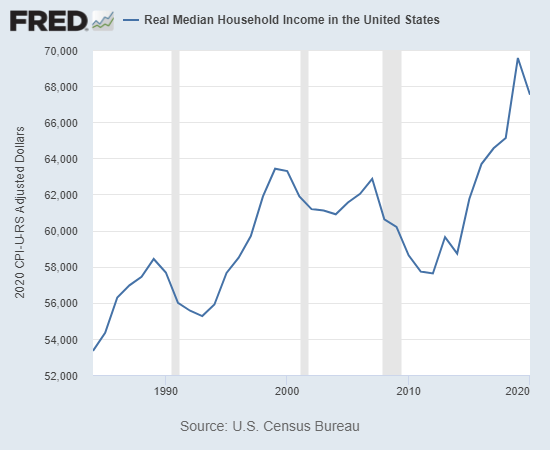
1. For the first time in multiple generations, there is a structural scarcity of labor. For a variety of reasons, there are fewer people willing to do the work at the offered wage than there are jobs. This is not temporary, it is demographic and social, not simply economic. All the supposedly easy fixes– automate everything, etc.–are not that easy.

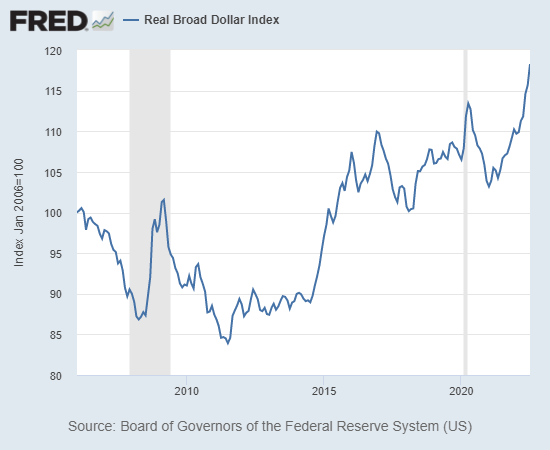
2. The strength of the U.S. dollar is exporting inflation, to the benefit of the domestic economy. After offshoring critical supply chains–a disaster that will take years to reverse–now the U.S. is offshoring inflation and the resulting demand destruction.

3. Global capital flows are reversing. capital flowed from the Core to the Periphery to reap the gains of globalization. Now the flow is reversing and capital is flowing from the Periphery to the Core to preserve capital and lock in lower-risk returns. What looks expensive to those earning U.S. dollars may look cheap and secure to those fleeing depreciating currencies and assets.

In my analysis, these are consequential dynamics that merit little attention in conventional financial analysis.

There is much more to say but glance at these two charts: real (i.e. adjusted for official inflation) median household income and real Broad U.S. Dollar Index.

If we’re not measuring or pondering the core structural dynamics of the economy, we’re not going to make sense of no-longer-relevant data. This is a most peculiar recession, and few seem to be asking if the reason is we’re missing what’s changed structurally.

Charts courtesy of St. Louis Federal Reserve Database (FRED))
Get Ready For An Economic Wake-Up Call This Holiday Season

By Brandon Smith

Source: Alt-Market.com

If we are to measure the concept of “economic recovery” in real terms, then we would have to look at the fundamentals (not stock markets) and whether or not they’re improving. Unfortunately, not all economic data is presented to the public honestly. Very often it is mired and obscured in a fog of disinformation and false standards.

I would point out, though, that there is relatively accurate information out there in certain areas of the global economy, and it tells us our economic structure is destabilizing. Beyond that, even the rigged numbers are moving into negative territory. But what does all this mean for the holiday retail season, one of the mainstream’s favorite gauges of US financial health? And, if 2019’s holiday profits sink, what does this tell us is going to happen in 2020?

First, let’s start with what we know…

Since we live in a “globalized” economy where everything is supposedly “interdependent”, it helps to examine international export numbers. The US doesn’t manufacture and export much of anything anymore beyond agricultural products, but global markets do expect us to consume the goods of other nations. A decline in exports indicates a failing global economy, but in particular a failing US consumer economy.

The obvious example would be China, which has seen plunging export data at least the past three months, though many will argue that this is merely due to tariffs and the trade war. However, it’s not just China that is showing signs of collapse.

South Korea, another major manufacturing and export hub in Asia (5th largest in the world) has seen declining exports for 11 consecutive months. South Korean shipping is crumbling in November and the media is blaming the trade war, as some SK companies would be “hit indirectly” because they sell intermediate goods to China are are linked to US companies in China. But this makes little sense. Tariffs are highly targeted to specific companies and specific goods, and so far the US has not directed major tariff attention at South Korea beyond the auto market.  Also, the new KORUS deal between Trump and SK is different only cosmetically to original trade agreements, yet, South Korean exports continue to fall.

The same situation can be seen in Japan, with Japanese exports witnessing a 9.2% year-over-year drop in October, the largest decline in 3 years. Japan has seen three consecutive months of declines in exports.

And what about Europe? While Germany, the manufacturing powerhouse of the EU, finally saw a jump in exports to the US this past month, overall the European Union has seen consistently poor export performance for the past year, and Germany itself is hovering on the edge of recession with 0.1% official GDP growth. Many economist already consider Germany to be in recession, as official GDP numbers are constantly manipulated by governments to the upside.

But let’s not forget about the US. Remember how Trump promised that the trade war would result in a renaissance for US manufacturing and that millions of industrial jobs would be returning to our shores? Well, as I’ve warned consistently for the past couple years, there is NO WAY corporations will be bringing manufacturing jobs and factories back to the US without ample incentives. Trump already gave companies tax cuts without demanding anything in return, and the cost/benefit ratio of building new factories and paying American workers top dollar versus keeping existing factories in Asia and dealing with 10%-25% tariffs just doesn’t add up to a new US rust belt renaissance.

While manufacturing jobs have increased, US manufacturing activity has declined.  Meaning, there simply isn’t enough demand for the goods being produced.  US manufacturing ISM index just sank this month and has been sinking for the past four month into negative territory. While US PMI manufacturing data jumped this month, it is still well below the 10 year average and is also very low compared to past holiday seasons, which almost always see a spike in manufacturing.  US manufacturing remains at a historic low of 11% of US GDP and production output has decline steadily since January of this year.

The question is, will the vast decline in global manufacturing translate to a crash in consumer demand?  We know that US credit dependency has skyrocketed in the past few years, but will more debt result in more profits for retailers?  This is highly unlikely, as US retail sales growth, for example, has been in decline at the same time that consumer debt has been rising.  Why?  Credit delinquencies have been relatively stable (so far) this year, so my theory is that people in the US are paying off previous debts by taking on new debt. They are kicking the can on their insolvency.

We have seen this kind of destructive credit death cycle before – Right before the crash of 2008.

So what does all this mean? And why is the media portraying the trade war with China as the cause of the global export and shipping crisis when clearly most of the world is not directly or even indirectly tied to the tariffs?

As noted above, the narrative that is being pushed is that we live in an “interdependent” and globalized world, and that nations cannot function economically without cooperation. The trade war, I believe, is a smokescreen designed by the globalist establishment to do two things specifically:

1) It is being created to hide a crash in the greater economy. Notice that almost no one in the mainstream is talking about a collapse in global production and multiple fundamentals due to DEMAND; instead they constantly talk about the trade war and exports. The trade war is becoming the scapegoat for the implosion of the market bubble engineered by globalists and central banks through a decade of stimulus measures.

The collapse of the economic bubble is being caused in part by massive debt and a lack of consumer demand due to lack of consumer savings and cash flow. The trade war has little to do with it, and I suspect we would be seeing sharp declines in the US economy in particular even without the trade war.

2) The trade war creates a false dichotomy in which many Americans will be lured into blaming China and other nations for their economic ills, and China and the rest of the world will be lured into blaming America. It also reasserts the globalist propaganda argument that when nations and economies “go rogue”, they hurt everyone; therefore, more global controls and centralization will have to be established in order to prevent nationalism from harming the rest of the world.

And what does this all have to do with the Christmas shopping season? Like the end of last year, I think we are in for another ugly holiday retail event – Perhaps far worse than before. All the manufacturing and export data indicates that this will be the case. If so, then the mainstream narrative of recovery, long perpetuated as fact by the media and the Federal Reserve for the past several years, will finally die.

The only thing that might elevate holiday numbers would be increased price inflation in goods, but I predict that even inflation misrepresented as “profits” will not save Christmas stats this year.  Some skeptics of the ongoing crash will argue that Black Friday numbers this year were the best since 2013, therefore the holiday season will be a good one.  These people don’t know their economic history.  In most cases, holiday seasons that start off with a high traffic Black Friday end with poor overall sales data, including 2013.  This is because consumers that are cash strapped are more likely to buy early during Black Friday sales and spend far less over the rest of the season.

In the mind of the average American consumer, holiday retail sales are a primary indicator of the health of the economy. A dramatic crash in Christmas retail will end the delusion of a stable US system and cause the public to start asking questions. Economics is 50% math and 50% psychology. The math in the US economy says we are in the middle of a crash. The psychological orientation of the public has been on the opposite end of spectrum, but is now slowly moving to meet with reality. When the psychological delusion ends, the game is over. And, for the globalists a new game begins.

Order out of chaos is their motto for a reason…

The global “reset” as they sometimes refer to it, has already been triggered. Going into 2020, the question is will the fantasy fall completely away to reveal the grotesque economic swamp our foundation has been built on top of? Or, will the delusion drag on for at least one more year? Given the current data, I suspect the party is over. But it is difficult to predict how the public will react to a financial crash. Sometimes people have no choice but to acknowledge the danger in front of them, but sometimes they simply bury their heads in the sand deeper and hope that by dragging out the inevitable the inevitable will become forgettable.

The Economic Crash So Far: A Look At The Real Numbers

By Brandon Smith

Source: Alt-Market.com

There are many problems when attempting to track a faltering economy. For one, the people in government generally do not want the public to know when the system is in decline because this looks bad for them. They prefer to rig statistical indicators as much as possible and hope that no one notices. When the crash occurs, they then claim that “no one saw it coming” and the disaster “came out of nowhere”, so how could they be to blame?

I have even heard it argued that political leaders, including the president, have a “duty” to lie about the state of the economy because once they admit to the decline they will cause a panic and perpetuate the crisis. This is stupidity. If an economic system is in disrepair and is built on a faulty foundation, then the problems should be identified and fixed immediately. The weak businesses should be culled, not bailed out. The wasteful government spending should be cut, not increased. The downturn should not be hidden and prolonged for years or decades. In most cases, this only makes the inevitable crash far worse and more damaging.

Another factor, which some people might call “conspiracy theory” – but it has been proven time and time again in history – is that the money elites have a tendency to engineer economic disasters while deliberately hiding the real statistics from the public. Why? Well, if the real data was widely disseminated, then a crash would not be much of a surprise and the populace could be prepared for it. I suspect the elites hide the data because they WANT the crash to be a surprise. The bigger the shock, the bigger the psychological effect on the masses. This fear and confusion allows them to make changes in the power structure of a nation or of the entire world that they would not be able to accomplish otherwise.

The most rigged statistics tend to be the least important overall in analysis, but this does not stop the mainstream media and investors from hyper focusing on them. How many times have you told friends and family about the collapse in manufacturing or the explosion in consumer and corporate debt, only to hear them say, “But the stock market is at all-time highs!” Yes, even though stock markets are a meaningless trailing indicator, even though GDP stats are a complete fallacy, and even though jobless numbers do not include tens of millions of people out of work, these are the stats that the average person takes mental note of when consuming their standard 15 minutes of news per day.

While the issue of rigged statistics makes analysis of a crash difficult, a willfully ignorant citizenry makes reporting on the real data almost impossible. It’s sad to say, but a large number of people do not want to hear about negative information. They want to believe that all is well, and will delude themselves with fantasies of blind optimism and endless summers. Like the tale of “The Ant And The Grasshopper”, they are grasshoppers and they see anyone who focuses on the negative as “chicken littles” and “doom mongers”. In their minds they have all the time in the world, until they freeze and starve when winter comes.

When I encounter people who actually believe the manipulated numbers or buy into the stock market farce or simply don’t want to accept that a crash could happen in their lifetime, I always ask them to consider these questions: If the global economy is not on the verge of collapse, then why did central banks keep propping it up for the past ten years? And if central banks have been propping up the system, how much longer do you think they can do this? How much longer do you think they want to do it? What if one day they decide to let the entire house of cards tumble? What if such an event actually benefits them?

We’ve seen that a broken economy can be technically held together for a decade, but under the surface, the structure continues to rot. The bottom line is that even if the elites wanted to keep the system going for another ten years, and even if politicians continued to help them by pumping out false statistics, there is no way to hide the effects of crumbling fundamentals. We saw this during the crash of 2008, and now we’re seeing it again.

After nearly ten years of stimulus inflated the largest financial bubble in history (the Everything Bubble), the Federal Reserve and other central banks halted stimulus measures and tightened global liquidity. By the end of 2018, a new crash began, the implosion of the Everything Bubble had been triggered. All of this is still just an extension of the crash of 2008, which never really subsided; it was only slowed down through tens of trillions of dollars in central bank intervention. Now, the central banks have started an avalanche that cannot be stopped. But the fact of the matter is, they don’t really want to stop it.

Here are the indicators so far that prove a crash is happening in the U.S. while a majority of the public is oblivious:

GDP numbers are completely manipulated. Government spending of taxpayer dollars on a number of inflated programs, including continued spending on Obamacare, is added to GDP calculations. Without this fancy accounting, U.S. GDP growth would actually be negative, according to ShadowStats. But even with the juiced data, official GDP growth is still in decline, falling to 1.9% and well below the 3% growth we were supposed to see this year.

Official unemployment stats remain at all-time lows, which is commonly cited by the mainstream media, Donald Trump (he used to argue the opposite three years ago), and even the Federal Reserve in reference to the health and stability of the economy. What they do not mention much is the 95 million people not in the labor force and not counted because they have been unemployed for so long. When the media does mention this fact, they claim the number is “misleading”, that most of these people are students or retired, that the retirement age is decreasing and Baby Boomers are leaving the workforce sooner, and that the people who don’t have jobs are simply “not interested” in working. None of this is true.

The retirement age is increasing in the U.S., not decreasing, according the SS Administration. Current average retirement age is now 67, up from 65, almost the same as it was during the Great Depression.

Baby Boomers are not retiring at rates similar to ten years ago, and are in fact attempting to stay in the workforce due to the poor economy. Many of them are trying to come OUT of retirement just to make ends meet.

The labor participation rate remains near record lows.

Interestingly, the Bureau of Labor Statistics (BLS) house survey that is used to determine if people “want a job” assumes that if you are near retirement age and do not have a job, you are simply not interested in a job, and they count you as “non-participating”. However, if you DO have a job and you are near retirement age, they count you as participating. It’s a rather convenient assumption on the government’s part to claim that just because an unemployed person is near retirement age, that means they “don’t want a job”.

While there is surely a small percentage of the 95 million people not counted in the labor force that do not want a job, if unemployment stats counted U-6 measurements as they used to, the unemployment rate would be closer to 20%.

Another problem is the quality of jobs being created. U.S. manufacturing jobs, as well as higher wage jobs, are in steep decline. They have been replaced with low paying jobs in the service sector.

Real wages in the U.S. have not kept up with inflation. The average worker is now losing money overall as prices rise beyond the pace of their incomes.

As more and more Millennials say they cannot afford to buy a home, rental prices have skyrocketed in the past several years. The home ownership rate plunged starting in 2006 and has not recovered since.

U.S. manufacturing has fallen to levels not seen since the crash of 2008. U.S. factory orders have slumped in 2019.

U.S. Services PMI continues to falter since spring of this year. Job growth is now slowing and over 8,500 retail stores have been closed down already in 2019. Web-based retail is not picking up the slack, as online sellers like Amazon are suffering from falling profits.

Corporate profits overall have tumbled this year and projected future profits have been drastically adjusted to the downside.

Corporate debt, consumer debt and national debt are all at historic highs. Corporate cash flow is so tight that Federal Reserve repo purchases continue to run into high demand. This debt signal is one we saw in 2007, just before the credit crisis.

U.S. trucking and railroad freight continue to log steep declines in traffic and goods. This tells us what we already know: Even though consumer spending has increased recently, this does not mean people are buying more stuff or have more disposable income. What is really happening is inflation, or stagflation. Cost of living is going up. Debt payments are going up. Consumers are spending more on the same amount of stuff, or less stuff, and have less expendable income. U.S. consumers are being bled dry.

All of these factors and more show an economy in recession or depression (depending on what historic standards you use). In the darker corners of the investment world, the great hope is that the central banks will return to pumping trillions into the banking sector ($16 trillion during the TARP bailout dwarfs the $250 billion the Fed has recently pumped out in their repo markets). They hope that this will free up even more credit. Meaning, they believe only more debt will save the system from suffering.

I say, time is up on the debt party. More stimulus will not stall the crash that is already happening, and the Fed does not appear poised to print anywhere near what it did during the credit crisis, at least not in time to change the trend. The can has been kicked for the last time. The grasshopper mentality will not save people from the clear reality. Only preparation and planning will.

Now That We’ve Incentivized Sociopaths–Guess What Happens Next

By Charles Hugh Smith

Source: Of Two Minds

As long as central banks create and distribute trillions in conscience-free credit to conscience-free financiers and corporations, the incentives for sociopathy only increase.

“Sociopath” is a word we now encounter regularly in the mainstream media, but what does it mean? Here is a list of 16 traits, many of which are visible in lionized corporate and political leaders and entrepreneurs.

One key trait is a lack of moral responsibility or conscience; the sociopath feels no remorse if he/she takes advantage of people or exploits them.

Sociopaths are masters of superficial charm, intelligence and confidence, and adept at massaging or misrepresenting reality up to and including outright lying to persuade others or get their way.

Like all psychological syndromes (manic depression, autism, bipolar disorder, etc.), there is a wide spectrum of sociopathological traits, some of which may offer some adaptive benefits (and hence their continued presence in the human genome). In other words, an individual can have a few of the traits in greater or lesser proportions.

Thus the modern BBC Sherlock Holmes (played by Benedict Cumberbatch) describes himself as a “high-functioning sociopath” (though many contest this diagnosis of the original Holmes in Arthur Conan Doyle’s stories).

Anyone who has read Walter Isaacson’s biography of Steve Jobs can readily see manifestations of sociopathy in Jobs: his famous “reality distortion field,” his refusal to accept that he’d fathered a daughter, his lack of empathy, his wild emotional swings (from verbal abuse to weeping), his dietary extremes, his charm, so quickly turned on or off, his uneven parenting, and so on. His obsessive-compulsive behavior was also on full display. Yet Jobs is lauded and even worshiped as a genius and unparalleled entrepreneur. Was this the result of his sociopathological traits, or something that arose despite them?

The ledger of costs and benefits of Jobs’ output is weighted by the global benefits of the products he shepherded to market and the hundreds of billions of dollars in sales and net worth he generated for investors while the head of Apple. Though narcissistic in many ways (with the resulting negative effects on many of his intimates), Jobs was clearly focused on creating “insanely great” products that would benefit customers and users. Despite his sociopathological traits, there is no evidence he set out to deceive anyone with the objective of exploiting their good will or belief in his vision to skim billions of dollars from unwary investors.

But the ledgers of others manifesting sociopathy are far less beneficial, as the billions of dollars they generated were in essence a form of fraud.

The rise and fall of WeWork is a recent textbook example of sociopathy reaping enormous financial gains for the sociopaths without creating any actual value. There are plenty of media accounts of the founders’ excesses (including the goal of becoming the world’s first trillionaire), some of which we might have expected to raise flags in venture capitalists, board members, etc., but these traits were overlooked in the rush for all involved to garner billions of dollars in fees and net worth when WeWork went public.

This example (among many) illustrates that sociopathy is incentivized in our socio-political-economic system, and sociopathic “winners” are lionized as epitomes of ambitious success. (The entire charade of the stock market rising due to Federal Reserve-enabled stock buybacks is an institutionalized example of sociopathy.)

Correspondent Tom D. recently summarized the core dynamic and consequence of this systemic incentivization of sociopathy:

I’ve been a successful business owner, but I’m not a sociopath–I deliver value to my customers, my investors, and I don’t move forward if I see anyone being substantially hurt by my actions.

My peers and I look at organizations such as WeWorks, see the rewards reaped by the sociopathic leaders, and realize we are at a constitutional disadvantage working within such a system.

I could never conceive of taking a $700-900m payday at the expense of investors for whom I’ve generated no value whatsoever.

I simply could not do it.

If ‘out-sociopathing’ the sociopaths is what it takes to ‘succeed’ in todays business climate– I’ll fail.

So I don’t try.

From the sociopath’s standpoint, that’s probably a feature not a bug–one that helps keep effective competition out of the marketplace.

I wonder how much of civilizational decline is simply due to good people accepting their lot and opting out.

If the system incentivizes conscience-free sociopaths more than it incentivizes those creating real value, the system will eventually fall into the equivalent of Gresham’s law (“bad money drives out good money”): the con-men and fraudsters will drive out entrepreneurs with a conscience who create real value for customers, investors and society at large.

If we look at recent IPOs and compare them to the Apple IPO, it seems we’ve already reached that point. Apple went public as a highly profitable company. Uber, Lyft, Beyond Meat and WeWork (if their IPO fraud hadn’t been revealed) are all unprofitable, in some cases losing billions of dollars with little prospect for eventual profits.

Venture capital folks explain this by noting that the flood of central bank credit-money-creation has generated trillions of dollars of liquid capital seeking “the next big thing” that will “disrupt” existing models and therefore generate billions in profits.

This pinpoints one key source of the incentivization of sociopaths: central banks’ creation of trillions of dollars of conscience-free capital seeking a quick profit anywhere on the planet, by any means available.

Conscience-free capital is an easy mark for a conscience-free sociopath. It’s a marriage made in heaven, a perfect match.

Those with a conscience are essentially squeezed out of the system. The choice is binary: either play and lose or opt out.

I’ve written about “opting out” since 2009, since it was one of the few options available to commoners in the final decline of the Western Roman Empire. If we feel we’re at a systemic disadvantage, i.e. the system is rigged against us, opting out makes much more sense than sacrificing oneself in a fruitless battle to stay alive in a system that incentivizes amoral sociopaths.

If we consider what generates outsized success in our rapidly changing economy, we find a variety of factors supporting “winner take most” asymmetric gains. As economist Michael Spence has observed, those who develop new business models earn outsized gains because new forms of capital and labor that are scarce create the most value.

Many of these new business models disintermediate existing models, obsoleting entire layers of middlemen and management.

Netflix is a good example: the move from mailing CDs to streaming content obsoleted cable companies. Now Disney is disrupting Netflix by launching its own streaming service at $6.99 a month, offering content that cable subscribers had to pay $60+ a month to access via a “premium” cable add-on, most of which they didn’t even use.

In contrast, WeWork sold itself as a “tech innovator” when in fact it was simply a commercial real estate packager, leasing large spaces and chopping them up into small spaces with common areas and a few services.

How does our system incentivize sociopathy? By focusing exclusively on short-term gains reaped from IPOs (initial public offerings) and by blindly seeking “the next disruptor that will generate billions,” the system is easy prey for charming sociopaths who can tell a good (if not quite truthful) story.

The amoral sociopath with the story attracts amoral sociopaths in venture capital, banking and politics, as these fields are all focused on short-term, outsized, quickly skimmed gains, regardless of the consequences to investors or society at large.

What would change this incentivization of sociopathy? Ending the Federal Reserve’s delivery of trillions of dollars in conscience-free capital to sociopaths and limiting the VC-IPO flim-flam machine would be a start, but given Wall Street’s dependence on these profits and the millions the Street gives to political campaigns, this is politically unfeasible. Any such regulation that reaches Congress will be watered down or larded with loopholes.

There may be no way to excise the incentives for sociopathy, because the incentives all favor the sociopaths’ most fertile ground: the Federal Reserve’s money spigot of nearly free money for the most sociopathological financiers and corporations; amoral, conscience-free greed; the worship of short-term gains, regardless of consequences, and the extreme profitability of rigged games and The Big Con PR (“we’re only evil when it’s profitable, which is, well, all the time”.)

As long as central banks create and distribute trillions in conscience-free credit to conscience-free financiers and corporations, the incentives for sociopathy only increase, and the incentives for everyone else to opt out increase proportionately.

What happens next? The dead wood of sociopathy is ignited by a random lightning strike, and the entire financial system (and the economy it feeds) burns to the ground in an uncontrollable conflagration of blowback, consequence and karma.

This Is The Reality Of It: “We Are Factually In A Recession. Period.”

images

By Max Slavo

Originally posted at SHTFplan.com

We can cite scores of statistics and financials that prove without a shadow of a doubt that the U.S. economy is in a tail spin and won’t be recovering any time soon. Abysmal home sales, continued degradation in the national employment numbers, sky rocketing national debt, and ever rising consumer prices all point to serious problems.

But one number in particular pretty much sums it all up. It depicts not just the worsening state of our economy, but puts the lies and machinations of the U.S. government on full display for the world to see.

You’ll often hear the media cite the U.S. Growth Domestic Product (GDP) as a measure of economic growth. It measures the rate at which our economy grows.

In 2013, for example, our GDP was $17.08 trillion, up from the previous year’s $16.42 trillion. So, all of the goods and services sold throughout the United States (essentially, all of the money spent by Americans) rose about $661 billion dollars year-over-year.

Most people might look at the number, see 4% growth, and say it’s a no-brainer. How can the economy not be growing if the GDP rose?

The answer is simple. And when you look at it from the perspective Karl Denninger of the Market Ticker outlines below, you can’t help but realize that you’ve been purposely duped into believing that things are getting better. Just the opposite is true.

When looking at GDP you absolutely must account for the manufactured credit infused into the system during this same time period. When you do you’ll see just why the economy is not growing in any way, shape or form.

It is, in fact, contracting.

However, The Federal Reserve added $1.112 trillion in credit (unbacked by anything) during the same period of time; that’s a debasement of the units in which GDP is reported of 6.51%.

So the real change in the economy is in fact negative 2.51%.

We are factually in a recession.

Period.

There can be no progress economically or politically until the lies are stopped.  These are not mistakes; both the hosts and guest are fully-aware of The Fed’s balance sheet.

That extra trillion dollars slammed into the system by The Fed pretty much wipes out any growth noted by the Federal government’s statistics, because we never actually earned that money. It’s debt. Not growth!

Incidentally, the other oft cited measure of economic health is the Dow Jones Industrial Average, which currently sits around record all-time highs of 16,000 points, is likewise benefiting from this illusion. Guess where that stock market “growth” came from? Yes, the very same credit being used to prop up the economy (that $85 billion or so in Fed Treasury purchases every month) is also keeping stocks at record highs.

Back on Main Street, where most Americans live, we’re feeling the effects. Do we need to mention that the Patient Affordable Care Act has just forced working Americans to spend up to quadruple on their monthly premiums? Or that millions of Americans who are unemployed and no longer counted in the official statistics have absolutely no income whatsoever because their unemployment insurance has run out? Or that the price of everything from food and energy to rent and clothing is rising?

That kind of thing tends to happen when you debase your currency.

Last week famed contrarian economist John Williams noted that the economy gave a powerful recessionary signal in January that had not been seen since right before the market crash in 2007. Furthermore, one of the leading economic indicators of a recessionary environment is the price of copper because it is so closely associated with global growth. It has dropped significantly in recent months and it could well be signaling a coming crash in stocks just as it did in 2008.

When, not if, this thing buckles again we’re going to be in for an unprecedented period in U.S. history.

The system was on the brink of total collapse in 2008, as evidenced by Representative Brad Sherman on the House floor:

Many of us were told in private conversations that if we voted against this bill on Monday, that the sky would fall, the market would drop two or three thousands points the first day, another couple thousand the second day, and a few members were even told that there would be martial law in America if we voted no.

House Representative Brad Sherman (D-California)
Debate on the House Floor, October 2, 2008


They’ve used up all of the tricks in their magic hat. One misstep here and we’re going down. Any number of domestic or geo-political events could trigger a meltdown in U.S. stock markets and send the broader economy crashing.