Re-Opening the Economy Won’t Fix What’s Broken


By Charles Hugh Smith

Source: Of Two Minds

Re-opening a fragile, brittle, bankrupt, hopelessly perverse and corrupt “normal” won’t fix what’s broken.

The stock market is in a frenzy of euphoria at the re-opening of the economy. Too bad the re-opening won’t fix what’s broken. As I’ve been noting recently, the real problem is the systemic fragility of the U.S. economy, which has lurched from one new extreme to the next to maintain a thin, brittle veneer of normalcy.

Fragile economies cannot survive any impact with reality that disrupts the distortions that are keeping the illusion of “growth” from shattering. For the past two decades, every collision with reality cracked the illusion, and the “fix” was to duct-tape the pieces together with new extremes of money-creation, debt, risk and speculative excess.

While the stock market has soared, the real world falls apart. If your region needs a new bridge built, count on about 20 years to get all the “stakeholders” to agree and get the thing actually built. Count on the cost quintupling from $500 million to $2.5 billion. Count on corners being cut as costs skyrocket, so those cheap steel bolts from China that are already rusting before the bridge is even finished? Oops. Replacing them will add millions to the already bloated budget.

Want to add a passenger stop on an existing railroad line? Count on 20 years to get it done. The complexity thicket of every regulatory agency with the power to say “no” basically guarantees the project will never get approved, because every one of these bureaucracies justifies its existence by saying “no.” Sorry, you need another study, another environmental review, and so on.

Need a new landfill? I hope you started the process 15 years ago, so you’ll get approval in only five more years. Every agency with the power to say “no” will stretch out the approval, so they have guaranteed “work” for another decade or two.

Did your subway fares double? Was the excuse repairing a crumbling system? Did the work get done on budget and on time? You must be joking, right? All the fare increase did was cover the costs of skyrocketing salaries, pensions and administrative costs. Repairs to the tracks and cars– that’s extra. Let’s float a $1 billion bond so nobody have to tighten their belts, and have riders pay for it indirectly, through higher taxes to pay the exorbitant costs of 20 years of interest on the bond.

Have you been thrown off your bicycle by the giant potholes in the city’s “bike lanes”? The city reluctantly admits that these streets that haven’t been maintained for decades–yes, decades. The city once paid for street maintenance out of its general budget, but alas, that’s been eaten up by skyrocketing salaries, pensions and administrative costs, so now we need to float $100 million bond to fund filling potholes. If all goes according to plan (ha-ha), we should be able to re-pave the streets that have been crumbling for 20 years in… the next 20 years.

These real-world examples are just four of thousands of manifestations of a broken system. Rather than make tough choices that drain power and wealth from vested interests, we simply borrow more money, in ever increasing amounts, to keep the entrenched interests and elites happy.

There are two “solutions” in the status quo: dump the debt on taxpayers or on powerless debt-serfs–for example, college students. (See chart below of the $1.6 trillion that’s stripmining student debt-serfs.) Who benefits from selling all the municipal bonds, bundled student loans, etc. to investors starving for a yield above 0.1%? Wall Street, of course.

The problem is that while debt has soared, productivity and earned income have stagnated. The statistical narrative has been ruthlessly gamed to hide the erosion of living standards, but even with the bogus “low inflation” of official statistics, wages for the bottom 95% have stagnated for decades.

Measures of productivity have also been gamed to mask the ugly reality that the vast majority of the U.S. economy is stagnating under the weight of interest payments on debt, mal-investments in speculative gambles, higher junk fees and taxes, crushing regulatory compliance, high costs imposed by monopolies and cartels and a well-cloaked decline in the quality of just about everything the bottom 95% uses or owns.

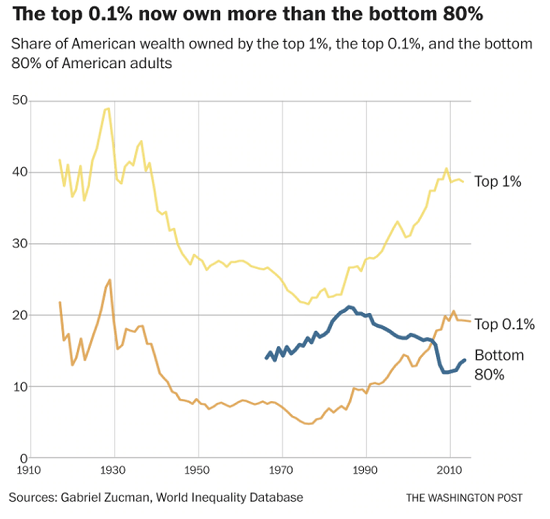
What little productivity gains have been made have been skimmed by the top 5%. Coupled with the Federal Reserve’s single-minded goosing of the one signaling device it controls, the stock market, the top 0.1% in America own more wealth than the bottom 80%.

If productivity stagnates and winners take all, the wages of the bottom 95% cannot rise. Real wealth is only created by increases in the productivity of labor and capital; everything else is phantom wealth.

The only way stagnant incomes can support more debt is if interest rates decline. Presto, the Fed dropped interest rates to near-zero a decade ago. Of course you and I can’t actually borrow millions for 0.1%; that privilege is reserved for financiers and other financial parasites and predators.

Debt-serfs were able to refinance their crushing mortgages to save a few bucks, and so they can afford to 1) take on more debt and 2) pay higher taxes to fund the ballooning public debt.

Every one of these extremes has increased the systemic fragility of the American economy. This fragility is reflected in the impoverishment of the bottom 95%, the thin line between solvency and bankruptcy, the decay of public trust in institutions run for the benefit of entrenched interests, and the quickening erosion of America’s social contract.

Re-opening a fragile, brittle, bankrupt, hopelessly perverse and corrupt “normal” won’t fix what’s broken.


The Covid-19 Chronicles: USA

By Gunnar Ulson

Source: Land Destroyer

The US is claimed to be hardest hit by Covid-19 with, at the time of writing, over 80,000 deaths attributed to the virus. The nation is also suffering from socioeconomic disaster as lockdowns have driven millions of Americans into not only unemployment, but predictable poverty and hunger as a result.

The crisis has been pounced upon by special interests to help propel various sociopolitical and economic agendas rather than confront and overcome the crisis, leading many to suspect the crisis itself has been deliberately overblown.

Health Impact

At face value the US would seem to be hit by an unprecedented health crisis. Hysteria spread by the mass media focusing on the numbers of infected and dead are provided to a panicked public without context.

Indeed, over 80,000 people have so far died with infections at nearly 1.5 million (confirmed).

Yet a quick look at basic statistics provided by the US government’s own Center for Disease Control (CDC) shows that Covid-19’s impact on human health including total deaths has not even surpassed recent flu season burdens. For example, according to the CDC’s website, the 2017-2018 flu season (running from December 2017 to March 2018) left anywhere between 46,000 to 95,000 dead.

Deaths attributed to Covid-19 have been recorded for 2 full months longer with questionable methods used to attribute Covid-19 as the cause for death.

The death rate has been reported at anywhere between 1% to as high as 5% to 6%. Missing from these seemingly concerning numbers is the fact that widespread testing has not been undertaken. The few instances where it has been done has shown that the number of infected is many times higher than official reports. This means that the death rate is much lower and more comparable to the annual flu than any sort of novel and particularly dangerous pathogen.

Testing in California and New York have revealed that in these states alone millions are likely to have been infected by Covid-19 and simply showed little to no symptoms.

A CBS article titled, “Study shows 13.9% of people tested in New York state have coronavirus antibodies, Cuomo says,” admits:

New York’s first survey of coronavirus antibodies shows that 13.9% of those tested in the state had coronavirus antibodies in their system, meaning they have contracted and recovered from the virus, New York Governor Andrew Cuomo said Thursday. That suggests that 2.7 million people have been infected statewide.

In other words, there are likely more people infected in New York state alone than infected nationwide according to “official” reports.

If information regarding how widespread Covid-19 actually is and how dangerous it is or isn’t, is not accurate, how can the United States formulate appropriate measures to respond to the outbreak?

Measures

Despite what appears to be nothing more than a bad cold or flu, the US has ground its society to a halt with lockdowns and social distancing measures.

“Non-essential” occupations have been encouraged to work from home or to not work at all. The food and beverage industry for example, the second largest employer in the United States, has been ground to a halt with employees furloughed for what has now been weeks or even months. Many of these employees do not expect to return to work until at least June.

In Los Angeles, county officials have extended “stay at home” measures for another 3 months meaning that people will have been shut in for nearly half a year if and when in late August people are allowed to return to their normal lives!

Social distancing is being enthusiastically enforced by police around the nation. In New York City, in order to “protect” people, those not practicing social distancing have been beaten, tased and even arrested. The physical and legal damage done “saving” the public from Covid-19 appears to be more extreme than the actual threat of Covid-19 itself.

Since most New Yorkers (and most people around the entirety of the United States) likely have been infected by the virus anyway, social distancing and lockdowns are more of a psychological exercise than one of isolating the pathogen and stopping its spread, an exercise aimed at addressing public panic, but public panic deliberately fuelled by the media and the government.

Socioeconomic Impact

For the United States, a nation’s whose economy was already in steep decline and losing ground to emerging economies around the globe, most notably China, these lockdowns amount to a self-inflicted mortal wound no conceivable plan of action can reverse.

Had Covid-19 been the deadly pathogen many may believe it is owed to mass media misinformation, the United States stood ill-prepared for it. This was not merely the doing of the current US administration, but a problem known for well over a decade with US presidents from George Bush Jr. to Barack Obama to current US President Donald Trump taking turns ignoring it.

The New York Times reported that things like ventilator shortages were known for at least 13 years and instead of rectifying the problem, large biomedical corporations were allowed by the US government to buy out small contractors tasked with fixing the shortage and ending programs to develop cheap ventilators in order to maintain artificial scarcity and the high prices (and profits) associated with it.

While Covid-19 appears to be far less dangerous than claimed by the mass media, the impact of measures taken by the US government and local state governments has created what is a disaster now being compared to the Great Depression.

Rather than rectifying it by simply rolling back lockdowns and social distancing measures, or even finding ways to aid the millions left unemployed, special interests are taking turns exploiting the crisis by blaming political opponents or even international competitors (like China). They are also looking for ways to cash in, with America’s deeply corrupt pharmaceutical industry being the most prominent example already teeing up massive profiteering by offering “vaccines” to solve Covid-19 fears.

The US, rather than uniting and overcoming whatever Covid-19 actually is, be it a pathogen or an unprecedented wave of widespread panic, has instead allowed itself to become divided and distracted, as well as exposed to the very worst sort of socioeconomic predators lurking amid America’s economic and political landscape.

It is difficult to predict what will happen in the weeks, months and even years to come regarding the state of America socioeconomically considering just how widespread and deep the damage being done now is. A nation as large as the United States plunging so quickly has never historically boded well for that nation nor the world it finds itself free falling in. The US already faced many challenges regarding its decline both at home economically and abroad geopolitically.

Covid-19 has simply exposed and accelerated the process, compounding an already uncertain future with a new degree of damage, danger and desperation.

Get Ready for an Unacceptable New Normal

By Stephen Lendman

Source: StephenLendman.org

At times like now, ideas lying around dormant on the shelf become reality.

Economic and other crisis conditions are times when most people can be convinced to accept unacceptable policies they’d likely reject otherwise.

During and after 2008-09 economic crisis conditions, Americans were brainwashed to accept force-fed austerity, frozen wages, and loss of benefits when economic stimulus and other government help were needed.

Economic recovery was for the nation’s privileged class exclusively. 

Ordinary Americans experienced protracted hard times that may become much worse today looking ahead, the same true in other Western societies.

In his 1995 book titled, “The Rotten Heart of Europe,” noted euro expert Bernard Connolly said the following: 

“The true story of the ERM (Europe’s Exchange Rate Mechanism) has been one of duplicity, skullduggery, conflict; of economic harm done to every country and in the caste interests of the elite; of the distortions of economic logic and the dilution of political accountability,” adding:

“The implication is that increasing globalization of economic activity and mobility of production has been purposely implemented in such a way as to render already destroyed ‘nation-state(s)’ meaningless entit(ies) in economic terms.”  

Protracted “austerity will lead to social unrest” in Europe, the US or elsewhere. Hard times are fertile ground for revolutions and fascist dictatorships.

Censorship is the new normal in the US and West — speech, press, and academic freedoms at risk. Without them all other rights are threatened.

Social and conventional media, Google, and other tech giants are complicit in a campaign to suppress content conflicting with the official narrative.

Controlling the message is the hallmark of totalitarian rule. Anything conflicting with the official narrative on vital issues is considered “inauthentic behavior.”

The US already is a police state. Is martial law the next shoe to drop? Will Trump declare it if current conditions worsen?

While not included in the Constitution, Article 1, Section 9 mentions suspension of habeas, saying the following:

“The privilege of the writ of habeas corpus shall not be suspended, unless when in cases of rebellion or invasion the public safety may require it.”

Will Trump invoke “public safety” or another pretext to take this action?

Article 1, Section 8 empowers Congress to call “forth the Militia to execute the Laws of the Union, suppress Insurrections and repel Invasions.”

The US military and National Guard are today’s “militia.”

Martial law suspends civil rule, replacing it with military authority under the president as commander-in-chief of the nation’s armed forces — including the National Guard when activated.

During the Civil War, Lincoln assumed dictatorial powers.

He suspended the Constitution and habeas corpus, forcefully closed courts, arbitrarily ordered arrests, conscripted US citizens without congressional consent, and closed newspapers opposing his policies.

His Emancipation Proclamation didn’t free a single slave. He wanted them deported at war’s end to maintain America as a white supremacist society.

History taught in the US at all levels of education conceals the nation’s dark side.

What happened before can happen again by presidential diktat.

According to Constitutional Law Professor Bruce Ackerman, US presidents can institute policies by executive orders, military orders, national security and homeland security presidential directives, along with other ways of circumventing Congress and the courts.

They wage illegal wars without Security Council and congressional authorization.

White House lawyers justify the unjustifiable. “They serve as authoritative judges for the executive branch, providing a legal framework for millions of civilian and military personnel as they implement executive decrees,” Ackerman explained.

Checks and balances don’t work, new ones needed, he stressed — enforced to restrain executive power-grabbing.

Following Japan’s December 1941 Pearl Harbor attack, Hawaii, not a US state at the time, was placed under martial law.

After Hurricane Katrina in August 2005, martial law was declared in New Orleans.

Throughout US history, it’s been imposed by federal or state authorities numerous times on the pretext of public safety, restoring order, or another reason.

Will Trump impose it if the US economy is reopened too soon, as apparently planned, and COVID-19 outbreaks increase greatly?

Will larger-scale outbreaks than already if occur be used as a pretext for hardening police state rule, including suspension of the Constitution and imposition of martial law?

Most of the population is locked down. Will Trump by presidential diktat order the extrajudicial arrest and indefinite detention of targeted individuals on the phony pretext of public safety and security?

This type harshness is what fascist tyranny is all about.

Is it coming ahead to the US full-blown in the form of presidential national emergency powers? 

The USA Patriot Act was written before 9/11. Is other draconian legislation on the shelf — ready to be rolled out by congressional action or presidential decree?

Is America the way it was pre-COVID-19, warts and all, to be replaced by hardened rule?

If COVID-19 abates and more greatly flares up this summer or fall will November elections be suspended or cancelled?

Whatever may unfold ahead most likely was planned by the nation’s ruling class.

It happened pre-and-post-9/11. It may be happening again now for ill, not good — including draconian mass surveillance more intensive than before, along with other police state policies.

Is a dystopian future coming for ordinary Americans, resisters subject to harsh repercussions — constitutional rights declared null and void?

What’s unthinkable may be planned and inevitable. 

Private gain must no longer be allowed to elbow out the public good

By Dirk Philipsen

Source: aeon

Adam Smith had an elegant idea when addressing the notorious difficulty that humans face in trying to be smart, efficient and moral. In The Wealth of Nations (1776), he maintained that the baker bakes bread not out of benevolence, but out of self-interest. No doubt, public benefits can result when people pursue what comes easiest: self-interest.

And yet: the logic of private interest – the notion that we should just ‘let the market handle it’ – has serious limitations. Particularly in the United States, the lack of an effective health and social policy in response to the coronavirus disease (COVID-19) outbreak has brought the contradictions into high relief.

Around the world, the free market rewards competing, positioning and elbowing, so these have become the most desirable qualifications people can have. Empathy, solidarity or concern for the public good are relegated to the family, houses of worship or activism. Meanwhile, the market and private gain don’t account for social stability, health or happiness. As a result, from Cape Town to Washington, the market system has depleted and ravaged the public sphere – public health, public education, public access to a healthy environment – in favour of private gain.

COVID-19 reveals a further irrational component: the people who do essential work – taking care of the sick; picking up our garbage; bringing us food; guaranteeing that we have access to water, electricity and WiFi – are often the very people who earn the least, without benefits or secure contracts. On the other hand, those who often have few identifiably useful skills – the pontificators and chief elbowing officers – continue to be the winners. Think about it: what’s the harm if the executive suites of private equity, corporate law and marketing firms closed down during quarantine? Unless your stock portfolio directly profits from their activities, the answer is likely: none. But it is those people who make millions – sometimes as much in an hour as healthcare workers or delivery personnel make in an entire year.

Simply put, a market system driven by private interests never has protected and never will protect public health, essential kinds of freedom and communal wellbeing.

Many have pointed out the immorality of our system of greed and self-centred gain, its inefficiency, its cruelty, its shortsightedness and its danger to planet and people. But, above all, the logic of self-interest is superficial in that it fails to recognise the obvious: every private accomplishment is possible only on the basis of a thriving commons – a stable society and a healthy environment. How did I become a professor at an elite university? Some wit and hard work, one hopes. But mostly I credit my choice of good parents; being born at the right time and the right place; excellent public schools; fresh air, good food, fabulous friends; lots of people who continuously and reliably provide all the things that I can’t: healthcare, sanitation, electricity, free access to quality information. And, of course, as the scholar Robert H Frank at Cornell University so clearly demonstrated in his 2016 book on the myth of the meritocracy: pure and simple luck.

Commenting on how we track performance in modern economies – counting output not outcome, quantity not quality, prices not possibilities – the US senator Robert F Kennedy said in 1968 that we measure ‘everything, in short, except that which makes life worthwhile’. His larger point: freedom, happiness, resilience – all are premised on a healthy public. They rely on our collective ability to benefit from things such as clean air, free speech, good public education. In short: we all rely on a healthy commons. And yet, the world’s most powerful metric, gross domestic product (GDP), counts none of it.

The term ‘commons’ came into widespread use, and is still studied by most college students today, thanks to an essay by a previously little-known American academic, Garrett Hardin, called ‘The Tragedy of the Commons’ (1968). His basic claim: common property such as public land or waterways will be spoiled if left to the use of individuals motivated by self-interest. One problem with his theory, as he later admitted himself: it was mostly wrong.

Our real problem, instead, might be called ‘the tragedy of the private’. From dust bowls in the 1930s to the escalating climate crisis today, from online misinformation to a failing public health infrastructure, it is the insatiable private that often despoils the common goods necessary for our collective survival and prosperity. Who, in this system based on the private, holds accountable the fossil fuel industry for pushing us to the brink of extinction? What happens to the land and mountaintops and oceans forever ravaged by violent extraction for private gain? What will we do when private wealth has finally destroyed our democracy?

The privately controlled corporate market has, in the precise words of the late economics writer Jonathan Rowe, ‘a fatal character flaw – namely, an incapacity to stop growing. No matter how much it grew yesterday it must continue to do so tomorrow, and then some; or else the machinery will collapse.’

To top off the items we rarely discuss: without massive public assistance, late-stage extractive capitalism, turbocharged by private interest and greed, would long be dead. The narrow kind of macroeconomic thinking currently dominating the halls of government and academia invokes a simpleminded teenager who variously berates and denounces his parents, only to come home, time and again, when he is out of ideas, money or support. Boeing, Goldman Sachs, Bank of America, Exxon – all would be bust without public bailouts and tax breaks and subsidies. Every time the private system works itself into a crisis, public funds bail it out – in the current crisis, to the tune of trillions of dollars. As others have noted, for more than a century, it’s a clever machine that privatises gains and socialises costs.

When private companies are back up and running, they don’t hold themselves accountable to the public who rescued them. As witnessed by activities since the 2008 bailouts at Wells Fargo, American Airlines and AIG, companies that have been rescued often go right back to milking the public.

By focusing on private market exchanges at the expense of the social good, policymakers and economists have taken an idea that is good under clearly defined and very limited circumstances and expanded it into a poisonous and blind ideology. Now is the time to assert the obvious: without a strong public, there can be no private. My health depends on public health. My freedom depends on social freedom. The economy is embedded in a healthy society with functional public services, not the other way around.

This moment of pain and collapse can serve as a wakeup call; a realisation that the public is our greatest good, not the private. Look outside the window to see: without a vibrant and stable public, life can quickly get poor, nasty, brutish and short.

Why Assets Will Crash

By Charles Hugh Smith

Source: Of Two Minds

This is how it happens that boats that were once worth tens of thousands of dollars are set adrift by owners who can no longer afford to pay slip fees.

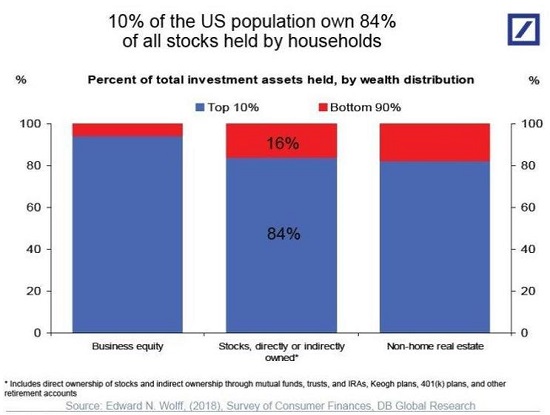
The increasing concentration of the ownership of wealth/assets in the top 10% has an under-appreciated consequence: when only the top 10% can afford to buy assets, that unleashes an almost karmic payback for the narrowing of ownership, a.k.a. soaring wealth and income inequality: assets crash.

Most of you are aware that the bottom 90% own very little other than their labor (tradeable only in full employment) and modest amounts of home equity that are highly vulnerable to a collapse of the housing bubble. (The same can be said of China’s middle class, only more so, as 75% of China’s household wealth is in real estate, more than double the percentage of wealth held in housing in U.S. households.)

As the chart illustrates, the top 10% own 84% of all stocks, over 90% of all business equity and over 80% of all non-home real estate. The concentration of ownership of assets such as vintage autos, collectibles, art, pleasure craft and second homes in the top 10% is likely even greater.

The more expensive the asset, the greater the concentration of ownership, as the top 5% own roughly 2/3 of all wealth, the top 1% own 40% and the top 0.1% own 20%. In other words, the more costly the asset, the narrower the ownership. (Total number of US households is about 128 million, so the top 5% is around 6 million households and the top 1% is 1.2 million households.)

This means the pool of potential buyers is relatively small, even if we include global wealth owners.

Since price is set on the margins, and assets like houses are illiquid, then we can anticipate all the markets for assets owned solely by the wealthy to go bidless–yachts, collectibles, vacation real estate–because the pool of buyers is small, and if that pool gets cautious due to a drop in net worth/unearned income, there won’t be any buyers except at the margins, at incredible discounts.

As we know, in a neighborhood of 100 homes currently valued ar $1 million each, when a desperate seller accepts $500,000, the value of the other 99 homes immediately drops to $500,000.

Since few of the current bubble-era asset valuations are supported by actual income fundamentals, then the sales price boils down to a very small number of potential buyers and what they’re willing to pay.

Houses have a value based on rent, of course, but rents will drop very quickly for the same reason: prices are set on the margins. The most desperate landlords will drop rents and re-set the rental market from the margins. If demand plummets (which it will as people can no longer afford rents in hot urban markets once they lose their jobs), then vacancies will soar and rents will crash as a few desperate landlords will take $1200/month instead of $2500/month.

Due to the multi-year building boom of multi-family buildings in hot job markets (which inevitably leads to an over-supply once the boom ends), there are now hundreds of vacancies where there were once only a few dozen, and thousands where there were previously only hundreds.

As millions of wait staff, bartenders, etc. who made good money in tips find their jobs have vanished, all the urban hotspots will see mass out-migration: Seattle, Portland, the S.F. Bay Area, L.A., NYC, Denver, etc. as demand for rentals will evaporate and rents will be set on the margins by the most desperate landlords. Everyone holding out for the previous bubble-era rent will have $0 income as their units are vacant.

Tech start-ups and Unicorns are melting like ice cubes in Death Valley, and tech-sector layoffs are already in the tens of thousands. This wave of highly paid techies losing their jobs will become a tsunami, further reducing the pool of people who can afford rents of $2,500 to $3,000 for a studio or one-bedroom apartment.)

The concentration of ownership generates a self-reinforcing feedback that further depresses prices: since the top 10% own most of the assets of the nation, they are most prone to a reversal of “the wealth effect.” As their assets soared in value, the top 10% felt wealthier and more confident in future gains, enabling them to borrow and spend freely on second homes, pleasure craft, new vehicles, collectibles, luxury travel, etc.

Once even one class of assets plummets in value–for example, the recent decline in the stock market– the wealth effect reverses and the top 10% feel poorer and less confident about future gains, and thus less enthused about borrowing and spending. The demand for other costly assets quickly evaporates, further reducing the wealth of the “ownership class,” which further reduces their desire and ability to buy bubble-era assets.

The high-priced assets owned by the top 10% will be the assets least in demand due to their high cost and potential for enormous losses: nothing loses value faster in a recession that narrowly owned assets such as vintage cars, art, vacation homes, yachts, etc.

Once assets start sliding in value, the reverse wealth effect quickly dries up demand for all asset classes with narrow ownership. Since these assets are illiquid–that is, the market for them is thin, with buyers few and far between–the prices are set by a very shallow pool of buyers and desperate sellers.

Consider a pleasure craft that retails new for $120,000. In the boom era of rising stocks and housing, a used boat might fetch $65,000. But as the wealth of the small pool of households able to buy and maintain a costly craft evaporates, the number of qualified buyers evaporates, too.

The seller might be aghast by an offer of $35,000 and reject it angrily. Six months later, he’s praying someone will take it off his hands for $15,000, and in another six months, he’ll accept $500 just to get out from underneath the insurance, slip-rental and licencing fees.

This is how it happens that boats that were once worth tens of thousands of dollars are set adrift by owners who can no longer afford to pay slip fees, and vacation homes are abandoned and auctioned off for overdue property taxes: the market for these luxuries dries up and blows away, i.e. goes bidless–there are no buyers at any price.

Once housing and real estate valuations fall, that will trigger a decline in the value of all other costly, narrowly owned assets, which will reinforce the reverse wealth effect.

This is the systemic payback for concentrating ownership of assets in the hands of the few: when their bubble-era priced assets plummet in value, the bottom falls out of all assets with narrow ownership. The price of superfluous assets such as boats, vintage cars, collectibles, art and vacation homes can quickly fall to a fraction of bubble-era valuations, destroying much of what was always fictional capital.

(For more on the intrinsic fragility of a system that concentrates ownership in the hands of the few, please read Our Inevitable Collapse: We Can’t Save a Fragile Economy With Bailouts That Increase Fragility May 1, 2020.)

The Federal Reserve reckons it can “save” the bubble-era valuations of junk bonds by being the “buyer of last resort,” but it will end up being the “only buyer,” effectively making the system even more fragile and prone to collapse.

The public will eventually have to decide if the nation’s central bank should be bailing out assets owned by the financial elite while the upper-middle class watches its assets collapse in value.

America’s Super-Rich See Their Wealth Rise by $282 Billion in Three Weeks of Pandemic

America’s billionaires have accrued more wealth in the past three weeks alone than they made in total prior to 1980.

Source: Mint Press News

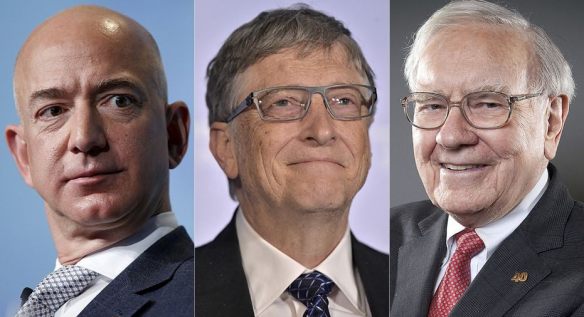
A new report from the Institute for Policy Studies found that, while tens of millions of Americans have lost their jobs during the coronavirus pandemic, America’s ultra-wealthy elite have seen their net worth surge by $282 billion in just 23 days. This is despite the fact that the economy is expected to contract by 40 percent this quarter. The report also noted that between 1980 and 2020 the tax obligations of America’s billionaires, measured as a percentage of their wealth, decreased by 79 percent. In the last 30 years, U.S. billionaire wealth soared by over 1100 percent while median household wealth increased by barely five percent. In 1990, the total wealth held by America’s billionaire class was $240 billion; today that number stands at $2.95 trillion. Thus, America’s billionaires accrued more wealth in just the past three weeks than they made in total prior to 1980. As a result, just three people ­– Amazon CEO Jeff Bezos, Microsoft co-founder Bill Gates and Berkshire Hathaway’s Warren Buffet – own as much wealth as the bottom half of all U.S. households combined.

The Institute for Policy Studies’ report paints a picture of a modern day oligarchy, where the super-rich have captured legislative and executive power, controlling what laws are passed. The report discusses what it labels a new “wealth defense industry” – where “billionaires are paying millions to dodge billions in taxes,” with teams of accountants, lawyers, lobbyists and asset managers helping them conceal their vast fortunes in tax havens and so-called charitable trusts. The result has been crippled social programs and a decrease in living standards and even a sustained drop in life expectancy – something rarely seen in history outside of major wars or famines. Few Americans believe their children will be better off than they were. Statistics suggest they are right.

Billionaires very theatrically donate a fraction of what they used to give back in taxes, making sure to generate maximum publicity for their actions. And they secure positive coverage of themselves by stepping in to keep influential news organizations afloat. A December investigation by MintPress found that Gates had donated over $9 million to The Guardian, over $3 million to NBC Universal, over $4.5 million to NPR, $1 million to Al-Jazeera, and a staggering $49 million to the BBC’s Media Action program. Some, like Bezos, prefer to simply outright purchase news organizations themselves, changing the editorial stance to unquestioning loyalty to their new owners.

The spike in billionaire wealth comes amid an unprecedented economic crash; 26.5 million Americans have filed for unemployment over the last five weeks, and that number is expected to continue to rise dramatically. While the super-rich are holed up in their mansions and yachts, the 49-62 million Americans designated as “essential workers” must continue to risk their lives to keep society functioning, even as many of them do not even earn as much as the $600 weekly increase in unemployment benefits the CARES act stipulates. Many low paid workers, such as grocery store employees, have already fallen sick and died. The mother of one 27-year-old Maryland worker who contracted COVID-19 and died received her daughter’s last paycheck. It amounted to $20.64.

Amazon staff, directly employed by Bezos, also risk their lives for measly pay. One third of all Amazon workers in Arizona, for example, are enrolled in the food stamps program, their wages so low that they cannot afford to pay for food. The vast contrast in the effect that COVID-19 has had on the super wealthy versus the rest of us has many concluding that billionaires’ wealth and the poverty of the rest of the world are two sides of the same coin: that the reason people working full-time still cannot afford a house or even to eat is the same reason people like Bezos control more wealth than many countries. Bezos’ solution to his employees’ hunger has been to set up a charity and ask for public donations to help his desperate workers.

The majority of millennials, most of them shut out from attaining the American dream, already prefer socialism to capitalism, taking a dim view of the latter. The latest news that the billionaire class is laughing all the way to the bank during a period of intense economic suffering is unlikely to improve their disposition.


Alan MacLeod is a Staff Writer for MintPress News. After completing his PhD in 2017 he published two books: Bad News From Venezuela: Twenty Years of Fake News and Misreporting and Propaganda in the Information Age: Still Manufacturing Consent. He has also contributed to Fairness and Accuracy in Reporting, The Guardian, Salon, The Grayzone, Jacobin Magazine, Common Dreams the American Herald Tribune and The Canary.

No, This Is Not Another 1929, 1973, 1987, 2000, or 2008

By Charles Hugh Smith

Source: Of Two Minds

Basing one’s decisions on analogs from the past is entering a fool’s paradise of folly.

Like addicts who cannot control their cravings, financial analysts cannot stop themselves from seeking some analog situation in the past which will clarify the swirling chaos in their crystal balls. So we’ve been swamped with charts overlaying recent stock market action over 1929, 1987,2000 and 2008–though the closest analogy is actually the Oil Shock of 1973, an exogenous shock to a weakening, fragile economy.

But the reality is there is no analogous situation in the past to the present, and so all the predictions based on past performance will be misleading. The chartists and analysts claim that all markets act on the same patterns, which are reflections of human nature, and so seeking correlations of volatility and valuation that “worked” in the past will work in 2020.

Does anyone really believe the correlations of the past decade or two are high-probability predictors of the future as the entire brittle construct of fictional capital and extremes of globalization and financialization all unravel at once?

Here are a few of the many consequential differences between all previous recessions and the current situation:

1. Households have never been so dependent on debt as a substitute for stagnating wages.

2. Real earnings (adjusted for inflation) have never been so stagnant for the bottom 90% for so long.

3. Corporations have never been so dependent on debt (selling bonds or taking on loans) to fund money-losing operations (see Netflix) or stock buybacks designed to saddle the company with debt service expenses to enrich insiders.

4. The stock market has never been so dependent on what amounts to fraud–stock buybacks–to push valuations higher.

5. The economy has never been so dependent on absurdly overvalued stock valuations to prop up pension funds and the spending of the top 10% who own 85% of all stocks, i.e. “the wealth effect.”

6. The economy and the stock market have never been so dependent on central bank free money for financiers and corporations, money creation for the few at the expense of the many, what amounts to an embezzlement scheme.

7. Federal statistics have never been so gamed, rigged or distorted to support a neofeudal agenda of claiming a level of wide-spread prosperity that is entirely fictitious.

8. Major sectors of the economy have never been such rackets, i.e. cartels and quasi-monopolies that use obscure pricing and manipulation of government mandates to maximize profits while the quality and quantity of the goods and services they produce declines.

9. The economy has never been in such thrall to sociopaths who have mastered the exploitation of the letter of the law while completely overturning the spirit of the law.

10. Households and companies have never been so dependent on “free money” gained from asset appreciation based on speculation, not an actual increase in productivity or value.

11. The ascendancy of self-interest as the one organizing directive in politics and finance has never been so complete, and the resulting moral rot never more pervasive.

12. The dependence on fictitious capital masquerading as “wealth” has never been greater.

13. The dependence on simulacra, simulations and false fronts to hide the decay of trust, credibility, transparency and accountability has never been so pervasive and complete.

14. The corrupt linkage of political power, media ownership, “national security” agencies and corporate power has never been so widely accepted as “normal” and “unavoidable.”

15. Primary institutions such as higher education, healthcare and national defense have never been so dysfunctional, ineffective, sclerotic, resistant to reform or costly.

16. The economy has never been so dependent on constant central bank manipulation of the stock and housing markets.

17. The economy has never been so fragile or brittle, and so dependent on convenient fictions to stave off a crash in asset valuations.

18. Never before in U.S. history have the most valuable corporations all been engaged in selling goods and services that actively reduce productivity and human happiness.

This is only a selection of a much longer list, but you get the idea. Basing one’s decisions on analogs from the past is entering a fool’s paradise of folly.

Why Post-Coronavirus America Will Have Massive Poverty

By Eric Zuesse

Source: Strategic Culture Foundation

The way that Congress and the President structured America’s coronavirus bailout legislation, the protections that go to the super-wealthy start immediately, but the protections that go to the neediest — the soaring numbers of unemployed, the increasingly endangered medical workers, etc. — require documentation which is creating delays that might soon cause many of these individuals to lose their homes, their cars, even their lives.

On April 17th, Matt Taibbi headlined “The Trickle-Up Bailout” and he noted that:

As we head into the second month of pandemic lockdown, two parallel narratives are developing about the financial rescue.

In one, ordinary people receive aid through programs that are piecemeal, complex, and riddled with conditions.

A law freezing evictions applies to holders of government-backed mortgages only. “Disaster grants” are coming more slowly and in smaller amounts than expected; small businesses were disappointed to learn from the SBA early last week that aid would be limited to $1000 per employee.

That’s typical.

As I had already explained on April 14th:

America’s bailout package to overcome the coronavirus ‘recession’ is twofold:

One part is printing money for employees and consumers, so that they won’t be thrown out onto the streets for non-payment of debts such as mortgages, car-loans, credit cards, and student loans.

Another part is printing money for bondholders and stockholders, so that their investments will still have value and there won’t be panicked selling of them as corporations accumulate soaring losses because consumers are staying home and are cutting way back on expenses.

The top-down part of the bailout (the part for investors) will merely add to the wealth of the already-wealthy, while everybody else sinks financially into oblivion. (On April 9th, the Zero Hedge financial site explained in detail why even bailing out the airlines would hurt the economy more than help the economy.) The top-down part supplies the money to the corporations instead of to their employees and consumers, and is therefore supply-boosting instead of demand-boosting. Supplying money to the corporations that the Government selects to protect will enable those corporations to buy up assets and corporations which during the crisis are being auctioned off by the ones that go out of business, and this will leave the nation’s wealth in even fewer hands than before the epidemic struck.

The bottom-up part (the part for workers and consumers) will be exactly the opposite of that: it will help prevent another Great Depression. By boosting purchases, instead of bailing-out billionaires and such, it will enable the economy to keep functioning, and it will not increase the concentration of wealth.

However, employees and consumers don’t have many lobbyists, but billionaires do, and billionaires also own (through political donations and lobbyists) almost all members of Congress (and also the mainstream press), and they not only own, but are represented by, one inside the White House, who is surrounded there by others, and by representatives of others, so that the concerns of the wealthiest will be very well represented by America’s Government, and will end up dominating the bailouts, so that only the insiders, who are well-connected in Washington, will be protected. (And Joe Biden would be no improvement over Donald Trump, though his rhetoric is different.)

Already, we see, in the ‘news’-reports, that there is ‘chaos’ etc. in the U.S. Government’s response to the crisis, but what’s not being reported in the mainstream ‘news’-media is that there very much is method to this seeming madness, and it is the method of the well-practiced and well-funded takers, definitely not of their victims, from whom they (and their Government) have been, and now increasingly are, taking. The takers own the Deep State, and are protected by it. The vast bulk of the bailouts will go to them. The vast bulk of the bailouts will go to suppliers (investors), not to their workers and consumers.

So, as a general rule: the more that a person’s income depends upon investments, and the less that it depends upon their labor (wages), the more fully that the bailouts will compensate for the losses they’ll be suffering as a result of the coronavirus disruptions.

Here is a breakdown of the incomes that the super-rich receive (mainly from investments), versus the incomes that everybody else receive:

As can easily be seen there, only the super-rich (the top 1%, and most especially the top 0.1%) receive the majority of their incomes from investments (“Business income” and “Capital income”). Everybody else receives it mainly from “compensation” (wages), “retirement income,” and “Transfer income” (welfare).

Most of the benefits to the top 0.1% will be coming by means of monetary policy, via the Federal Reserve, not by means of fiscal policy — such as the payments to the unemployed (which are subject to many delays) and such as the $1,200-per-adult grants (which were the fastest to be paid because it’s the “helicopter money” that buys votes for the political incumbents, all of whom had voted for the bailouts).

The bailouts’ widely publicized part is the $2.2 trillion, since that includes whatever the public gets. However, that part is the smaller portion of the entire program. As CBS News reported on March 24th, “Top White House economic adviser Larry Kudlow said the price tag of economic stimulus amounts to roughly $6 trillion, which includes $2 trillion for direct assistance, and roughly $4 trillion in Federal Reserve lending power. Kudlow said this will be the single-largest such Main Street financial package in the history of the country.” Kudlow said it at a White House press conference. He mentioned there just in passing (at 1:36), that it’s a “six trillion-dollar program, four trillion dollars in lending power from the Fed, that’s a six trillion-dollar package …,” and the reporters in the White House press corps didn’t ask him anything about the Fed’s part, the $4 trillion portion (the program’s part that protects the billionaires); they evidently didn’t care about that, but only about the $2.2 trillion, which is actually the PR decoration on this $6T cake — the $2.2T that the public is interested in, the bait-part of the entire bailout-program. (Its hook won’t sink in until the readers’ children and grandchildren will be paying for it via their taxes in a stripped America.) However, on March 26th, Wall Street on Parade (WSP) — the best investigative-reporting source about Wall Street — headlined “Stimulus Bill Allows Federal Reserve to Conduct Meetings in Secret; Gives Fed $454 Billion Slush Fund for Wall Street Bailouts” and disclosed that even what Kudlow had called “Main Street” (the $2.2T part) included much for Wall Street; and WSP then rhetorically asked, “Why does the Federal Reserve need $454 billion from the U.S. taxpayer to bail out Wall Street when it has the power to create money out of thin air and has already dumped more than $9 trillion cumulatively in revolving loans to prop up Wall Street’s trading houses since September 17, 2019 – long before there was any diagnosis of coronavirus anywhere in the world?” They promptly answered this: “The Fed needs that money to create more Special Purpose Vehicles (SPVs) — the same device used by Enron to hide its toxic debt off its balance sheet before it went belly up.” Furthermore, the $454 billion, which WSP called “the money the Treasury is handing over to the Fed” is what CBS had reported “would result in ‘$4 trillion in Federal Reserve lending power’.” And U.S. taxpayers are guaranteeing 100% of these loans to investors — so, it’s “heads you win, tails we lose,” for taxpayers addressing billionaires, and “heads we win, tails you lose,” for billionaires addressing taxpayers. The billionaires win, the public loses. But the billionaires’ media don’t mention this fact, that investors get the guarantees, while the public takes all of the risks. However, what is an “investment” for, if non-investors are receiving its risks? It’s just legalized crime. And these are huge risks, and all or most of the $454 billion that the U.S. is lending to the Fed to guarantee private investors’ investments could be destroyed in the coronavirus-crisis. This is far more socialism for the super-rich than for the bottom 99%. The billionaires love socialism when they’re the ones who are getting the bailouts — the public taking on the risks that investors are supposed to assume. The issue for billionaires isn’t “socialism versus capitalism,” like they always say; it’s actually “socialism for us, and capitalism for everybody else.” That’s not “survival of the fittest,” for the wealthiest class; it’s instead their ordering their politicians to: protect our wealth, no matter what the cost to the public could turn out to be. And that’s precisely what the President and Congress did. Kudlow, however, said, instead, that the “package” would produce “a good rebound in the second half of the year.” Maybe for the billionaires it would.

Kudlow was simply being consistent with his own prior record. On 10 December 2007, he had headlined in National Review, “Bush Boom Continues: You can call it Goldilocks 2.0. But you can’t call it a recession.” And he closed by saying, “This sort of fiscal and monetary coordination will continue the Bush boom for years to come.” He’s good for the billionaires; and, so, today, he’s President Trump’s top economic advisor. He’s up there, because he’s wrong — not because he’s right. (If he had been right, he wouldn’t be there.)

After the immediate crisis is over, America will have a top 0.1% who are unscathed and whose mega-corporations will be selling not only what they had been selling before, but selling virtually everything that sells in the post-coronavirus world. For examples: what mom-and-pop businesses (including restaurants, B&Bs, etc.) had previously been selling, will, in the future, be supplied (to the extent that it remains being supplied at all) by McDonalds, Starbucks, Marriott, Amazon, Target, Walmart, and other megacorporations (controlled by billionaires), which will have been receiving, from the Fed, and from the Treasury, whatever they needed in order to carry their investors through the crisis-period. (And who are those investors? Look at that chart above, the recipients mainly of “Business income” and “Capital income” — the chief recipients of dividends, interest, and capital gains incomes.)

Furthermore: after the crisis, commercial real estate will be super-cheap, because of all the bankrupted mom-and-pop businesses. Wages also will decline, as the public become increasingly desperate, and the billionaires win increasing market-power. Therefore, not only will the megacorporations be selling a larger percentage of the national output, but their expenses will go down.

Consequently: America will have lots more poor people, and lots wealthier billionaires.

This, however, will be only a temporary situation, because the enormous spread of poverty will result in greatly decreased taxes coming into all levels of the U.S. Government. Bridges will collapse, potholes will proliferate, unendowed colleges will close, nervous breakdowns and heart-attacks will increase, and thus the public won’t be able to spend as much as they were spending before the crisis hit. And, so, although the megacorporations will be selling a larger percentage of national output, that national output will decline, because of the spreading poverty. Therefore, even the billionaires won’t necessarily become richer than they were before the crisis hit.

All of this outcome is unnecessary and results from corruption. The only reason why there is any bailout, at all, for investors (in anything other than pass-through entities), is the pervasive governmental corruption at the very top. If there were no corruption, then the only bailouts would be to individuals and pass-through businesses (which are individuals) — the “bottom-up” bailouts. America is a very corrupt country at the top, and that is the reason why it will collapse in the aftermath of the coronavirus crisis.

Ultimately, when the wealth-inequality is so extreme, the billionaires are selling mainly to each other, and the necessities for the public are less and less profitable to sell at all. The outcome will therefore be economic collapse, and perhaps even revolution.

The basic way to evaluate how well or poorly a nation’s Government is performing in this crisis is the country’s ratio of coronavirus cases to its total population, but if a given country has not yet reached its peak in its daily number of new cases, then that country’s ratio is probably still rising, in which instance, that country’s performance will probably turn out to have been less good than this ratio currently is showing it to be. And, conversely, the lower this ratio is, the better the performance of that country’s Government is shown to be in responding to Covid-19.

Here are the ten nations that have the largest numbers of cases at the present time, and the ratio of that number to their total population; and also shown here is the date when the daily number of new cases peaked (because if it hasn’t yet peaked, then this crucial ratio will probably be rising in that country):

Ratio of total cases divided by total population (the lower this number, the better):

USA = 740,928/330,000,000 = 0.00224523636 not yet peaked

SPAIN = 195,944/46,940,000 = 0.00417435023 peaked March 26th

ITALY = 178,972/60,360,000 = 0.0029650762 peaked March 19th

FRANCE = 152,578/66,990,000 = 0.00227762352 peaked April 3rd

GERMANY = 144,387/83,020,000 = 0.00173918332 peaked March 27th

UK = 120,067/66,650,000 = 0.00180145536 peaked April 10th

TURKEY = 86,306/82,000,000 = 0.00105251219 peaked April 11th

CHINA = 82,735/1,393,000,000 = 0.00005939339 peaked February 12th

IRAN = 82,211/81,800,000 = 0.00100502444 peaked March 30th

RUSSIA = 42,853/144,500,000 = 0.00029656055 not yet peaked

In addition, the following major countries might especially be noted, since the main reason they aren’t on that list is their being outstandingly good performers:

JAPAN = 10,797/126,500,000 = 0.00008535177 peaked April 11th

S. KOREA = 10,661/51,640,000 =0.00020644848 peaked March 3rd

The worst of all these performers appear currently to be, though not yet in any clear order: USA, Spain, and Italy.

The best appear to be, in order: China, Japan, and S. Korea.

The U.S. press has recently been particularly praising Denmark’s performance, and noting that Denmark’s coronavirus emergency legislation is more socialistic than Sweden’s is. However, both of those Scandinavian countries actually have very similar actual performance, thus far, in this crisis. In Denmark, the focus of the emergency legislation was on “saving jobs,” instead of on protecting investors. It’s a democratic socialist country, perhaps the most equalitarian in the world. Of course, that’s the exact opposite of dictatorial capitalism (fascism), which became America’s system after FDR died in 1945, and increasingly thereafter (hyper-imperialistic, military-industrial-complex or “MIC” dominated, like fascist regimes usually are), perpetrating coups and invasions, destroying Iran, Iraq, and many other countries, in order to expand its power and the wealth of its billionaires (like the fascist countries had done going into WW II). No cases of coronavirus-19 were reported in Denmark until February 27th. Denmark unanimously passed its emergency law on March 13th — drastically different bailout legislation from the one that America subsequently passed — in order to deal with the crisis. The daily number of Denmark’s new Covid-19 cases peaked on April 7th, and has been declining since that time. Its neighbor Sweden peaked on April 8th. Sweden’s emergency legislation is less strict about lockdowns, but relies more on individual discretion. However, since Sweden, like Denmark, is a democratic socialist country, individuals needn’t worry about paying medical bills, nor about being paid while on sick-leave. So, employees aren’t desperate to return to their places of work, such as in America; and, therefore, these countries don’t spread the infection as readily as in the U.S. and are thus far less likely to have recurring peaks and delayed terminations of the coronavirus crisis. (By contrast: in America, where losing one’s job can mean losing one’s health care, even sick employees may be inclined to stay on the job and perhaps infect customers.) And there are no corporate bailouts in either Denmark’s or Sweden’s legislation. Denmark’s Finance Minister, the Social Democrat (or democratic socialist) Nicolai Wammen was interviewed for 15 minutes on March 27th, by Christiane Amanpour, and he explained Denmark’s emergency law, which was overwhelmingly bottom-up, not top-down (such as America’s is).

Here, therefore, is the actual performance, thus far, of both of those two countries:

DENMARK = 7,384/5,806,000 = 0.00127178780 peaked April 7th

SWEDEN = 14,385/10,230,000 = 0.00140615835 peaked April 8th

Both of them are reasonably comparable to Germany, UK, Turkey, and Iran, but not as good as S. Korea, and not nearly as good as the two best, China and Japan.

In the final analysis, China and Japan could turn out to have the least-corrupt and best-run Governments; and the most corrupt Governments could turn out to be USA, Spain, and Italy. However, the performances of Brazil and some other nations in the southern hemisphere might yet turn out to be even worse than those of USA, Spain, and Italy, because the winter season has’t yet reached there.

On April 16th, Wall Street on Parade headlined “Here Are the Contracts Showing How $4.5 Trillion in Stimulus Was Outsourced to Wall Street” and described — and documented — what the Wall Street Journal and the rest of the financial press would not, which is the U.S. Government’s legalized money-laundering operation, via the Fed, transferring onto the American public almost all of the losses that America’s billionaires will be suffering from the coronavirus crash. Back on 21 January 2020, WSP described this money-laundering, in its earlier 2008 embodiment, this way: “The epic financial collapse on Wall Street in 2008 was, reduced to its basic terms, simply the end game of Wall Street banks’ efforts to monetize their frauds.” They noted: “On April 9, 2019, the nonprofit Wall Street watchdog, Better Markets, released a study titled: “Wall Street’s Six Biggest Bailed-Out Banks: Their RAP Sheets & Their Ongoing Crime Spree.” It should have made headlines on the front pages of every major newspaper in the U.S. Instead, it was effectively ignored by mainstream media.” (Incidentally: Obama repeatedly promised to prosecute banksters, but secretly protected them and prosecuted none of them, though their crimes had been monstrous. The billionaires’ thefts from the public are entirely bipartisan, supported by over 95% of Congress — the billionaires own the Presidents and members of Congress, and not only own virtually all of the news-media.) On April 20th, America’s National Public Radio (NPR) broadcast “Amid Pandemic, Italian Prosecutors Warn That Mafia Groups Are Cementing Their Power” and reported that Mafia bosses were buying up cheap some of Italy’s suddenly desperate small businesses. If the same thing is being done by America’s billionaires, that’s not yet being reported by their press — perhaps it will instead be reported by Italy’s press.

The Federal Reserve are controlled by and represent the banksters — Wall Street — who not only skim on their own accounts but work with and for the billionaires, some of whom are themselves banksters, but many of whom are operating hedge funds, private equity funds, and all types of FORTUNE 500 companies. Basically, Wall Street works for the billionaires. The billionaires run practically everything in America, except Main Street.

In the upcoming June 2020 issue of the neoconservative (pro-U.S.-imperialist) Democratic Party U.S. magazine, The Atlantic, their George Packer banners “We Are Living in a Failed State: The coronavirus didn’t break America. It revealed what was already broken.” That magazine blames this “failed state” on the (neoconservative) Republican Party, and so Packer’s phrase there “a dysfunctional government” links to an anti-Republican article, by one of the top officials in the liberal neoconserative U.S. Administration of the Democrat Barack Obama, titled “How Trump Designed His White House to Fail.” However, the actual cause of the gradual collapse, since 1945, of what had been U.S. President FDR’s largely democratic U.S.A., is the billionaires who own both Parties — it is bipartisan. This rot comes from both Parties’ billionaires. (The particular propaganda-operation, The Atlantic, happens to be controlled by the same Democratic Party billionaire who controls Apple corporation.) No billionaire will publish the reality. For example, Packer’s article said: “The second crisis, in 2008, intensified it [‘a bitterness toward the political class’]. At the top, the financial crash could almost be considered a success. Congress passed a bipartisan bailout bill that saved the financial system.” The presumption there is that the only way to restore the economy after a crash is to bail out the country’s billionaires. It’s a timely message, at this moment when the billionaires require their Government to bail them out, yet again. (I recently proposed one way to reduce the billionaires’ dictatorship over America.)

On April 17th, WSP headlined “Americans Are Paying a Tragic Price for Allowing Five Banks to Control the U.S. Economy” and closed by urging: “Americans need to use this time at home to call their Senators and Reps in Congress and demand the separation of federally-insured, deposit-taking banks from the casinos on Wall Street. We’re talking about nothing less than the survival of this country.” Needless to say, the ultimate beneficiaries of this public largesse — to America’s billionaires — don’t desire to publicize such writings, any more than they desire to publicize to the public their offshore bank accounts.

Unlike so much that’s in the billionaires’ ‘news’, the facts that are reported here are solidly documented (and linked-to), but the billionaires don’t report these facts. Thus, the masses don’t know these facts, and so the mass-violence, when it comes, won’t be focused against the billionaires. What you’re reading, here, is being kept secret by (not being published by) the billionaires’ media. So — if only to spread word that the cause of this is not “the Chinese” or “foreigners” or “the Jews” or some other amorphous ethnicity, who aren’t actually to blame — please email the URL (the web-address) atop this article, to all of your friends, as “FYI:”. It might stir some interesting conversations, especially if all the ‘news’ that they know comes from America’s billionaires — the same people who fund the country’s successful politicians, each and every election-year. The American Revolution did not come about by misinformed people. It came about by informed people. Misinformed people create only more problems.

So, that’s “FYI.” And thanks for reading here.